
She Had a Poor Single Father Removed From Her Family’s Table—Then Her Grandmother Revealed Who the Empty Chair Was Really For
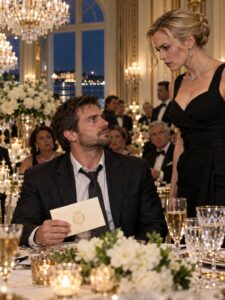
“You’re sitting at my family’s table.”
Ardan Whitmore did not raise her voice.
She didn’t need to.
In the Whitmore ballroom, people had spent generations learning to hear power even when it whispered.
Three conversations died at once.
A waiter carrying a silver tray slowed near the champagne tower.
A woman in diamonds turned her head.
And beside Wade Hollis, his nine-year-old daughter quietly lowered her fork.
Wade looked up at the woman standing over them.
Ardan Whitmore was forty, elegant without appearing to try, dressed in black silk beneath the crystal chandeliers of her family’s Newport hotel. Her face had been printed on business magazines, charity programs, annual reports, and the enormous centennial display near the ballroom entrance.
CHIEF EXECUTIVE OFFICER.
WHITMORE HOUSE GROUP.
Fourth generation.
To most people in the room, her last name explained everything.
Wade’s did not explain anything.
His suit was dark, old, carefully pressed, and slightly too plain for a ballroom filled with custom tuxedos and women whose earrings probably cost more than his truck.
His hands were worse.
No amount of soap had completely removed the dark stain of walnut oil around his fingernails.
They were the hands of a man who repaired furniture for a living.
Ardan’s eyes briefly moved toward them.
Then back to his face.
“This table is reserved for my family.”
Wade nodded.
“I know.”
The answer clearly wasn’t the one she expected.
Her expression tightened.
“Then I’m sure you understand the problem.”
Across the table, Trip Whitmore leaned back.
Trip was Ardan’s cousin, a senior executive in the family company, and the sort of man who could make contempt sound like concern.
He looked Wade over.
Then he looked at Mara.
A faint smile touched his mouth.
Wade saw it.
So did Mara.
Her fingers twisted the corner of her linen napkin.
Wade felt something inside him harden.
Not because he was embarrassed.
He had survived embarrassment.
He had survived collection notices taped inside kitchen drawers so his daughter wouldn’t see them.
He had survived selling the house where his wife had once sung while making breakfast.
He had survived counting quarters at a gas station.
What he could not tolerate was the expression slowly appearing on Mara’s face.
She was beginning to wonder whether these people were right.
Whether they did not belong.
“I was invited,” Wade said.
That changed the air.
Ardan studied him more carefully.
“By whom?”
Before Wade could answer, Trip gave a small laugh.
“Come on, Ardan. He probably misunderstood the seating arrangement.”
“I didn’t.”
“Then show us the invitation.”
“Dad,” Mara whispered.
Wade looked at her.
She was staring at the white tablecloth.
Beyond her, the Whitmore Centennial Gala glittered beneath chandeliers imported from France almost a century earlier. A string quartet played near the grand staircase. White roses climbed silver centerpieces. Through enormous windows, the Atlantic was black against the Newport shoreline.
Everything in the room had been designed to make people feel they had entered somewhere important.
And his daughter suddenly looked as if she wanted to disappear.
Wade reached beneath his jacket.
Trip raised two fingers.
A security officer near the private dining section immediately started walking toward them.
Mara saw him.
Her face changed.
“Dad…”
“It’s okay.”
“But they think we don’t belong here.”
Her voice was barely audible.
Wade stopped reaching for the invitation.
He turned toward her instead.
“Look at me.”
She did.
“Belonging isn’t decided by whoever talks the loudest.”
For the first time, something flickered across Ardan Whitmore’s face.
Uncertainty.
Then the security officer arrived.
“Sir, I’m going to have to ask you to step away from the table.”
Wade remained seated.
“I’d rather not embarrass my daughter.”
Trip smiled without humor.
“Then you probably shouldn’t have sat down in the first place.”
Wade looked at him.
Long enough for Trip’s smile to weaken.
There was no threat in Wade’s expression.
No anger.
Just stillness.
And sometimes stillness made arrogance sound much uglier than it intended to.
The officer carefully placed a hand on Wade’s shoulder.
Mara immediately grabbed her father’s wrist.
Ardan noticed.
She also noticed Wade did not pull away.
“Sweetheart,” he told Mara quietly, “it’s okay.”
Then a woman’s voice cut through the ballroom.
“Take your hand off my guest.”
The quartet seemed to stop before the musicians actually did.
Every face turned.
At the entrance to the private dining section stood Lenora Whitmore.
Seventy-four years old.
Silver hair.
Straight back.
Camel-colored evening coat draped over one arm.
And the kind of authority that came from having spent decades watching powerful men eventually discover that she had been listening more carefully than they had.
The security officer removed his hand.
Immediately.
Trip stood.
Ardan did not move.
Lenora crossed the ballroom without hurrying.
Her eyes never left Wade.
“I invited him.”
No one laughed now.
Mara looked at her father.
Wade gave her the smallest nod.
Lenora stopped beside Ardan.
“And before tonight is over,” she said softly, “you may want to ask yourself why the man you were ready to remove from this table understands this family better than most of the people sitting at it.”
Ardan stared at her grandmother.
Then at Wade.
And for the first time that evening, the embarrassment changed direction.
Three weeks earlier, Wade Hollis had no idea who Lenora Whitmore was.
To him, she was simply an old woman stranded in the rain.
That was all.
And that was precisely why she remembered him.
Wade’s workshop sat behind a narrow rental house outside Providence, close enough to the highway that he could hear trucks after dark.
He restored furniture.
Not glamorous furniture.
Not usually.
People brought him cracked dining chairs, dressers with missing handles, tables scarred by generations of plates and elbows and arguments.
They brought him things they had nearly thrown away.
Wade liked that part.
He liked proving that damage and worth were not the same thing.
One rainy Thursday night, he was sanding the edge of a century-old oak table when Mara appeared in the doorway wearing mismatched socks.
She held a math worksheet against her chest.
“Dad?”
Wade kept sanding.
“That tone worries me.”
“I think number seven is impossible.”
“What is it?”
“Fractions.”
He shut off the sander.
“You’re right. We should call the governor.”
Mara rolled her eyes.
“You’re not funny.”
“You laughed yesterday.”
“That was yesterday.”
Their kitchen was small.
One cabinet door refused to stay closed unless Wade wedged a folded grocery receipt beneath the hinge. The refrigerator hummed too loudly. Three chairs around the kitchen table had come from three different sets.
Nothing matched.
Nothing was expensive.
But the room was warm.
Wade reheated tomato soup and grilled cheese while Mara attacked her fractions.
Halfway through dinner, she glanced toward the workshop.
“Why do people pay you to fix old furniture?”
“Because buying new furniture is expensive.”
She frowned.
“That’s not the real answer.”
Wade smiled.
Nine years old, and already dangerous.
He considered the question.
“Because some things are worth keeping even when they’re broken.”
Mara dipped her sandwich into the soup.
“Like what?”
“Tables. Chairs. People.”
She looked up.
Wade pointed his spoon at her.
“Broken isn’t the same as worthless.”
Mara thought about that.
Then nodded.
Wade forgot the conversation before bedtime.
Mara did not.
Children rarely remember the speeches adults prepare for them.
They remember what adults say when they aren’t trying.
After helping Mara finish her homework, Wade returned to the workshop.
Rain started after eight.
By nine-thirty it was coming down hard enough to turn the road silver.
Wade loaded a repaired bench into his twelve-year-old pickup.
He had promised to deliver it to a community shelter.
The truck’s heater worked according to a philosophy known only to itself, and the passenger door had to be lifted slightly before it would close.
Wade loved it anyway.
The truck had never pretended to be anything except useful.
Five miles from the shelter, his headlights caught a dark sedan on the shoulder.
Hazard lights blinked through the rain.
An older woman stood beside it beneath a black umbrella that had already lost its argument with the wind.
Wade drove past.
Twenty yards.
Then he sighed.
“Mara’s going to turn me into an idiot,” he muttered.
He backed up.
The woman watched suspiciously as he climbed out.
“Ma’am?”
“I’ve already called roadside assistance.”
“Good.”
“They said forty-five minutes.”
Wade looked around.
Dark road.
Cold rain.
Almost no traffic.
He pointed toward her car.
“What happened?”
“The engine stopped.”
“Try starting it.”
She studied him.
“Are you a mechanic?”
“No.”
Her eyebrow rose.
“That is remarkably reassuring.”
Wade almost smiled.
“I fix things.”
“That is not the same profession.”
“No, but occasionally the universe gets confused.”
She stared at him for another second.
Then got inside.
The engine clicked.
Nothing.
Wade opened the hood and used the flashlight from his toolbox.
Rain ran down his neck.
Within minutes, he found corrosion around a loose battery connection.
Nothing dramatic.
Nothing expensive.
Just a small failure capable of leaving someone stranded because nobody had stopped long enough to look closely.
He cleaned the terminal.
Tightened the connection.
Closed the hood.
“Try now.”
The engine started.
The woman lowered her window.
“What do I owe you?”
“Nothing.”
“You stopped in the rain.”
“Unfortunately.”
“You used your tools.”
“They’ll recover.”
“You fixed my car.”
“Took ten minutes.”
“That wasn’t my question.”
Wade glanced at the clock glowing on her dashboard.
“My answer is still nothing.”
Something changed in her face.
Not gratitude exactly.
Curiosity.
“What’s your name?”
“Wade Hollis.”
She nodded slowly.
“Lenora.”
No last name.
Wade didn’t ask.
“Drive safe, Lenora.”
He turned away.
“Mr. Hollis.”
He looked back.
“If you won’t take money, let me buy you dinner.”
“You don’t owe me dinner.”
“Perhaps I dislike owing people.”
Wade pulled his hood tighter against the rain.
“Then help the next person you see stranded.”
He climbed into his old pickup.
Lenora watched its taillights disappear.
Wade forgot about her before he reached the shelter.
Lenora Whitmore did not forget him at all.
Four days later, a black sedan pulled into Wade’s driveway.
He recognized the car before he recognized Lenora.
This time she wore a navy coat.
Two delivery workers followed her carrying something wrapped in moving blankets.
Wade set down his screwdriver.
“Car trouble again?”
“Not unless you did a very poor job.”
“Then we’re both having a better day.”
“I brought you something.”
The movers removed the blankets.
Wade’s expression changed.
It was a walnut dining chair.
Old.
Very old.
Narrow vines had been carved into the back. One leg carried an ugly metal brace from a repair decades earlier. The seat rail was fractured. Layers of varnish had darkened the grain.
Wade crouched.
“How old?”
“Just over a hundred years.”
“Family piece?”
Lenora hesitated.
“Very much so.”
Wade studied the joints.
“Several people have repaired this.”
“Can you tell?”
“They used the wrong glue.”
“That sounds judgmental.”
“Wood can handle honesty.”
Lenora laughed.
It was the first time Wade heard her laugh.
He tilted the chair toward the window.
“You want it restored or made to look new?”
“Is there a difference?”
“A big one.”
He pointed toward a worn section of wood.
“See that?”
“Yes.”
“That wasn’t damaged. Someone’s hand rested there for years. Maybe decades. Human skin polished the wood.”
Lenora looked closer.
“If I make this chair look new, I erase that.”
“And if you restore it?”
“I make it strong enough to keep carrying the story.”
The workshop went quiet.
Lenora looked at Wade.
“Restore it.”
“All right.”
“How long?”
“Two weeks. Three if the old repairs fight me.”
“Money isn’t an issue.”
Wade stood.
“Time is.”
Her eyes narrowed.
“Do you speak to all your customers like this?”
“Only the ones who tell me money isn’t an issue.”
The back door opened.
Mara walked in carrying her backpack.
“Dad, Mrs. Keller says I need cardboard for my history—”
She stopped.
Her eyes found the chair.
“Whoa.”
“Mara.”
“What? It’s really old.”
Lenora smiled.
“It is.”
Mara walked around it.
“Are you going to make it pretty again?”
“Useful first,” Wade said.
“But you always make them pretty.”
“Only after they can stand.”
Mara nodded.
Then looked at Lenora.
“He says broken doesn’t mean worthless.”
Wade closed his eyes.
“Apparently I say too much around you.”
“I remember the good ones.”
Lenora stared at the child.
Something moved behind her eyes.
A memory, perhaps.
Or recognition.
“That,” she said softly, “is a very good thing to remember.”
Over the next week, Lenora returned twice.
The first visit had a reason.
The second did not.
She drank terrible coffee from a chipped mug and listened to Mara explain why George Washington appeared far too often in school projects.
Wade never asked Lenora what she did.
Lenora never volunteered.
For perhaps the first time in years, she existed somewhere without her last name entering the room before she did.
On the ninth day, Wade discovered the carving.
It was hidden beneath the chair.
Four words.
Almost invisible beneath a century of varnish and dust.
NO GUEST STANDS ALONE.
When Lenora arrived that afternoon, Wade showed her.
Her fingers hovered over the words.
“You could sand that out.”
Wade frowned.
“Why would I?”
“It’s old. Barely visible.”
“So are most things worth saving.”
Lenora looked at him.
Long enough that Wade finally became uncomfortable.
Then she reached into her handbag.
She placed a cream-colored envelope on his workbench.
“Friday night.”
Wade eyed it suspiciously.
“Dinner?”
“This isn’t repayment.”
“Lenora—”
“Bring Mara.”
She left before he could argue.
Wade opened the envelope.
Heavy paper.
Embossed lettering.
Newport.
Whitmore Centennial Gala.
His eyes moved toward the seating designation.
Then stopped.
TABLE ONE.
WHITMORE FAMILY.
Wade stared at it.
Across the workshop, the restored chair stood beneath the afternoon light.
And beneath its seat, where almost no one would ever see them, four old words remained untouched.
No guest stands alone.
Wade almost didn’t attend.
But Mara wanted to go.
That was how, three weeks after a rainy roadside encounter, a furniture restorer from outside Providence found himself sitting at the Whitmore family table while one of the richest women in Rhode Island prepared to have security remove him.
After Lenora’s intervention, the officer stepped away.
Trip sat down.
Ardan remained standing.
“You invited him?” she asked.
“I did.”
Trip glanced at Wade.
“We assumed he was staff.”
Wade looked down at his suit.
Then at Trip.
“Interesting uniform.”
Mara covered her smile with her napkin.
Lenora did not bother covering hers.
Ardan slowly pulled out the chair beside Wade.
“Mr. Hollis, I was given incomplete information.”
Wade looked at her.
“That’s different from being wrong?”
The question was quiet.
That made it worse.
Ardan met his eyes.
For several seconds, neither moved.
Then she sat.
Dinner continued.
But Ardan watched him.
She watched when a young waiter dropped a spoon.
Wade picked it up before the boy could apologize twice.
“You’re fine.”
She watched when another server refilled his water.
“Thank you, Allison.”
He had read her name tag.
He spoke to Lenora exactly the way he spoke to the staff.
No extra warmth for wealth.
No reduced respect for service.
Halfway through dinner, Mara knocked over her water.
Her face went white.
“I’m sorry.”
Wade grabbed his napkin.
“No emergency.”
“I ruined the table.”
“Tables are built for people, sweetheart. People aren’t built for tables.”
Across from him, Trip looked away.
Ardan did not.
Her eyes went to Wade’s hands.
Rough.
Scarred.
Patient.
The same hands security had nearly pulled away from her family’s table.
The same hands now reassuring a frightened child that a spilled glass of water did not make her an embarrassment.
Something about it bothered Ardan.
Not because the moment was extraordinary.
Because it wasn’t.
It was ordinary kindness.
The kind practiced when nobody was supposed to be impressed.
By dessert, embarrassment had become curiosity.
And curiosity was far more dangerous.
Two days later, Ardan drove to Wade’s workshop.
Alone.
No assistant.
No driver.
No announcement.
Wade saw her through the window.
“Lose your way to Manhattan?”
“I was told my grandmother’s chair is here.”
“It is.”
“So technically, this is business.”
“You drove an hour for a chair?”
“Forty-eight minutes.”
“That sounds like something a CEO would measure.”
She ignored him.
The workshop smelled of cedar and coffee.
Hand tools hung in neat rows.
Mara’s watercolor drawing was taped beside an invoice.
Ardan touched the chair.
“It looks different.”
“It’s stronger.”
“You left the scratches.”
“She didn’t ask me to erase its life.”
Ardan looked at him.
“You really believe that?”
“What?”
“That damage should stay visible.”
Wade folded a cloth.
“Depends what the damage teaches you.”
Something crossed Ardan’s face.
“That sounds personal.”
“Most useful things are.”
Silence.
Then Ardan noticed the drawings above his drafting table.
Furniture designs.
Precise.
Beautiful.
Not repair sketches.
Original work.
“You designed these?”
“Some.”
She pointed.
“Arts and Crafts influence. Federal proportions.”
Wade looked at her differently.
“That’s specific.”
“I studied architectural history at Brown.”
“Your company biography leaves that out.”
“My company biography leaves out anything the board can’t put in a quarterly report.”
Wade smiled.
“You studied design?”
“For a while.”
“Why stop?”
He looked toward Mara’s watercolor.
“My wife got sick.”
Ardan’s posture changed.
Wade continued.
“Last year of school. I left. Took whatever work paid fastest.”
“I’m sorry.”
“She was sick for two years.”
“And Mara?”
“Remembers pieces.”
He swallowed.
“Her laugh. A song. The smell of her shampoo.”
Ardan looked at the floor.
“My father died when I was twenty-six.”
Wade waited.
“Everyone remembers his deals. His hotels. His decisions.”
She touched the old chair.
“I remember that he burned pancakes every Sunday.”
Wade laughed softly.
“That sounds expensive.”
Ardan smiled.
Not the controlled smile from the gala.
A real one.
Then Mara burst through the door.
“Dad, Mrs. Keller made two apple muffins—”
She saw Ardan.
“Oh. Fancy dinner lady.”
Wade shut his eyes.
“Mara.”
“What?”
Ardan laughed.
Actually laughed.
“That’s fair.”
Ten minutes later, the CEO of Whitmore House Group sat on a wooden stool eating an apple muffin from a paper towel.
There was no chandelier above her.
No board.
No family name carved into anything.
Just sawdust, weak coffee, and a nine-year-old explaining the difference between furniture that was old and furniture that was “old but cool.”
Wade watched her.
People from Ardan’s world visited workshops like his when they needed something fixed.
They did not stay after the work was finished.
Ardan stayed until sunset.
When she finally stood, Mara asked, “Are you coming back?”
Ardan looked at Wade.
“If I’m invited.”
Wade held her gaze.
“We charge for the second muffin.”
“Send me an invoice.”
She came back three days later.
Then again.
Mara started saving the better muffins.
Wade stopped pretending he didn’t notice when Ardan stayed after dark.
And somewhere between cups of bad coffee and conversations neither had intended to have, the distance between their worlds began shrinking.
That was when Trip noticed.
He noticed Ardan leaving Newport early.
He noticed Lenora asking Wade to restore the family’s century-old dining table.
He noticed Ardan correcting him when he called Wade “the carpenter.”
“He has a name.”
Trip smiled.
His eyes didn’t.
Two days later, he hired a private investigator.
The investigator found no crimes.
No secret marriage.
No lawsuits worth exploiting.
No scandal.
What he found was worse, in Trip’s mind.
Poverty.
Medical debt.
A house sold after Wade’s wife died.
Collection notices.
Late payments.
An unfinished degree.
A period when Wade’s checking account had fallen below two hundred dollars.
Trip placed the folder on Ardan’s desk.
“Read it.”
She didn’t touch it.
“What is it?”
“Your new friend.”
Her expression hardened.
“You investigated Wade?”
“I protected the family.”
“From what?”
“Someone with every reason to want what we have.”
“He’s never asked me for anything.”
“Not yet.”
“That isn’t evidence.”
“It’s timing.”
Trip opened the folder.
Numbers stared up at her.
Debt.
Property records.
Collections.
Dates.
Facts without context.
The worst years of a man’s life converted into bullet points.
“His wife was sick,” Ardan said.
“That explains the debt.”
“It should.”
“It doesn’t erase it.”
“Why should it need erasing?”
Trip leaned forward.
“Because Grandmother is giving him access to private family property. And you’re giving him access to you.”
Ardan stared at the file.
She knew what the correct answer was.
She knew it immediately.
Throw it away.
Tell Trip he had crossed a line.
Call Wade.
Instead, she hesitated.
“I need time to think.”
Trip sat back.
That was all he needed.
Ardan did not know Wade was inside the Newport property that afternoon.
He had come to measure the family dining table.
He was walking past the library when he heard Trip’s voice.
“You’re being careless.”
Ardan answered.
“I said I don’t believe he’s using us.”
“Then why are you hesitating?”
Silence.
One second.
Two.
Then Ardan said:
“I need to think about what’s appropriate.”
Wade stopped.
He looked down at the tool roll in his hand.
He could have entered the room.
Could have demanded an explanation.
Could have made Ardan defend herself.
Instead, he turned around.
The next morning, he called Lenora.
“I’ll finish the table.”
“And afterward?”
“I won’t accept any more Whitmore work.”
Lenora was silent.
“Did something happen?”
“I gave my word about the table.”
“Wade.”
“I gave my word.”
Lenora understood enough not to ask again.
For four nights, Wade worked late.
Mara found him in the workshop after ten.
“Are you mad at Ardan?”
“No.”
“You look mad.”
“Disappointed is quieter.”
Mara climbed onto the stool.
“Is she coming back?”
Wade rubbed oil into the walnut.
“I don’t know.”
The finished table was delivered Friday.
Ardan found an envelope resting on it.
Inside was Wade’s invoice.
At the bottom:
BALANCE PAID IN FULL.
She found him outside.
“Why does this say paid?”
“Your grandmother covered the materials.”
“That wasn’t our agreement.”
“The agreement changed.”
Her stomach dropped.
“You heard us.”
“Enough.”
“Trip hired someone. I didn’t know.”
“But you read it.”
Ardan hesitated.
Wade nodded.
“That’s what I thought.”
“I was trying to protect my family.”
“From me?”
“I didn’t say that.”
“You didn’t have to.”
The harbor wind moved between them.
Ardan stepped closer.
“I don’t think you’re after our money.”
Wade looked at her.
“Then you should’ve said it when it mattered.”
Her face changed.
He opened his truck door.
“Wade.”
He stopped.
“I can survive being poor, Ardan.”
She said nothing.
“I’ve survived worse.”
His voice remained calm.
“But I will not teach my daughter to survive being looked down on.”
Ardan’s throat tightened.
“I never looked down on Mara.”
“No. You let the people around you look down on us while you decided whether we deserved your trust.”
“That isn’t fair.”
“Neither was the investigation.”
She flinched.
Wade looked toward the hotel.
“I don’t need your family to think I’m good enough.”
Then he looked directly at her.
“I need my daughter never to see me beg them to believe it.”
He climbed into the truck.
“Wade—”
The door closed.
He drove away.
Ardan stood on the curb with an apology she had waited too long to say.
That was the moment she understood something nobody in her world had ever taught her.
Dignity did not always slam a door.
Sometimes it closed the door gently.
And the silence afterward was worse.
Lenora found her that evening in the private dining room.
Ardan stood beside the restored table.
“He left,” Lenora said.
“Yes.”
“What did you say?”
“Not enough.”
Lenora approached.
“That has always been one of this family’s more expensive habits.”
“Grandmother, please.”
“No.”
Ardan looked at her.
“You wanted to know why I invited Wade Hollis.”
Lenora rested one hand on the restored table.
“Now you’re finally ready to hear the answer.”
She reached beneath its edge.
Pressed a small brass catch Wade had repaired.
A hidden drawer opened.
Inside were yellowed letters.
Old photographs.
A folded document tied with faded blue ribbon.
Ardan frowned.
“What is this?”
“The part of our family history we stopped telling at charity dinners.”
Lenora removed a photograph.
A thin teenage boy stood beside a crowded kitchen table.
“That’s Silas Whitmore.”
Ardan stared.
Her great-grandfather.
Founder of the family empire.
The man whose portrait hung in every Whitmore hotel.
“I’ve seen photographs of him.”
“You’ve seen photographs taken after he became rich.”
Lenora placed the picture on the table.
“Before that, he was seventeen. Orphaned. Homeless.”
Ardan slowly sat.
“One winter, an immigrant family named Bellini took him in. Six people living in two rooms. They barely had enough food.”
“Why have I never heard this?”
“Because wealthy families are very good at remembering the parts of history that flatter them.”
Lenora removed a letter.
“The Bellinis gave Silas food. A mattress when they could manage it. But according to him, the thing he remembered most was simpler.”
“What?”
“A chair.”
Ardan looked up.
“At dinner.”
Lenora’s voice softened.
“They made room.”
She touched the table.
“Years later, when Silas opened his first hotel, he commissioned this table. He wanted one rule followed in every Whitmore house.”
Ardan’s eyes moved toward the empty chair.
Lenora nodded.
“There was always supposed to be one place for a guest.”
“A guest?”
“Anyone who needed it. A traveler. An employee far from home. A widow. Someone alone.”
Ardan stopped breathing for a second.
Lenora turned the restored chair.
Underneath were the four words Wade had preserved.
NO GUEST STANDS ALONE.
Ardan touched them.
“He found this?”
“Yes.”
“You told him?”
“No.”
“Why?”
“Because I wanted to see what he would do with something whose value he didn’t understand.”
Ardan stared at her.
“He could have sanded it away,” Lenora said. “Cleaner. Easier. More valuable to a collector.”
“But he kept it.”
“He said old things shouldn’t lose their truth just because the truth is inconvenient.”
Ardan closed her eyes.
Trip’s folder flashed through her mind.
Medical debt.
Foreclosure.
Collections.
She had done exactly the opposite.
She had taken Wade’s history and stripped away every human truth until only numbers remained.
Lenora laid another photograph on the table.
Silas Whitmore, decades later.
Rich.
Silver-haired.
Seated at this same table.
Beside him were hotel employees.
Children.
A mail carrier.
A man in work clothes.
People Ardan had never seen in the official family portraits.
“We turned a promise into a symbol,” Lenora said.
Her voice was quiet now.
“Then we polished the symbol until we forgot the promise.”
Ardan looked around the room.
For years, she had seen the table as proof of belonging.
Now it looked like evidence.
Evidence of how badly they had misunderstood themselves.
“Why Wade?”
Lenora looked at her.
“Because his truck stopped beside me in the rain when he thought I was nobody.”
“That’s all?”
“That’s everything.”
Ardan swallowed.
“He didn’t know my name. Didn’t know my money. Wouldn’t take payment. Then he restored this chair and protected words he didn’t understand because he believed someone before him had thought they mattered.”
Lenora leaned closer.
“He behaved like this family claims to behave when nobody was watching.”
Ardan looked down.
“And I had him investigated.”
“Trip did.”
“I let it matter.”
“Yes.”
Lenora did not comfort her.
That hurt.
“I thought I was protecting us.”
“From what?”
Ardan had no answer.
Lenora’s expression softened.
“You’re not cruel, Ardan.”
“That doesn’t make this better.”
“No.”
Lenora touched her granddaughter’s hand.
“But cruelty isn’t the only way people hurt each other. Good people can become careless when privilege prevents them from feeling the weight of their choices.”
Ardan looked at Wade’s empty chair.
“What do I do?”
“Don’t buy forgiveness.”
Lenora walked toward the door.
“Don’t send flowers. Don’t have your assistant arrange something. Don’t ask public relations to find prettier words for what happened.”
She opened the door.
Ardan whispered, “Then what?”
Lenora looked back.
“Make room.”
For three days, Ardan did not contact Wade.
Instead, she changed the room he had walked away from.
At the next Whitmore family dinner, Trip arrived to find two additional place settings.
“Who are those for?”
“Guests,” Ardan said.
“You invited Hollis again?”
“I invited Wade and Mara.”
Trip glanced toward the empty doorway.
“He didn’t come?”
“No.”
A thin smile appeared.
“Maybe he understands boundaries after all.”
Lenora’s fork stopped.
Ardan felt the old instinct rise inside her.
Keep the peace.
Do not create conflict at the family table.
Let ugly words disappear beneath polished manners.
For thirty-nine years, that instinct had been rewarded.
This time, she ignored it.
“You hired someone to investigate him.”
Trip’s smile vanished.
“We discussed this.”
“No. You spoke. I hesitated.”
“I was protecting this family.”
“From what?”
“Access.”
“To what?”
“Grandmother. You. Private information. Assets.”
“Wade asked for none of those things.”
“People don’t always ask directly.”
Ardan set down her fork.
“He stopped for Grandmother on a dark road without knowing who she was. He refused her money. He restored our furniture without destroying its history.”
Trip rolled his eyes.
“And?”
“And when he learned we searched through the worst years of his life hoping poverty would reveal a character defect, he left.”
“You’re risking family unity over a carpenter.”
Ardan looked toward the empty chair.
Then back at Trip.
“No.”
The room became still.
“I’m trying to remember what family means.”
Trip stared at her.
Ardan continued.
“Effective tomorrow, no Whitmore family member, executive, or employee will authorize private investigations into individuals without documented legal or security grounds.”
Trip laughed once.
“You cannot create corporate policy because your feelings were hurt.”
“This isn’t about my feelings.”
“Then what is it about?”
Ardan looked at the old chair.
“Respect.”
One word.
Celia Markham stood near the sideboard holding a coffee pot.
Ardan turned.
“Celia?”
“Yes, Miss Whitmore?”
“How long have you worked for this family?”
“Thirty-two years.”
“Have you ever sat at this table?”
Celia froze.
“I’m working.”
“That wasn’t my question.”
Celia looked toward Lenora.
Lenora smiled.
“Sit down, Celia.”
The woman who had organized three decades of Whitmore weddings, funerals, birthdays, anniversaries, board dinners and Christmas mornings stood motionless.
Then she set down the coffee pot.
She pulled out the empty chair.
And sat.
There was no applause.
No speech.
Only the sound of wood moving across the floor.
Ardan finally understood.
Making room was not a philosophy.
It was an action.
The following afternoon, she drove to Wade’s workshop.
She parked outside.
Through the window she could see him helping Mara with a small piece of wood.
Mara wore safety glasses much too large for her face.
Wade guided her hands.
Ardan watched.
Then started her car.
She wasn’t ready.
Not because she feared Wade’s anger.
Anger would have given her something to defend herself against.
She feared his grace.
Grace would leave her nowhere to hide.
That weekend, Ardan searched the Whitmore archives.
She found the seating ledger from the first hotel.
Beside names were occupations.
BAKER.
PORTER.
NURSE.
RAILROAD WORKER.
WIDOW.
TEACHER.
Near the bottom of one page was a sentence written in Silas Whitmore’s hand.
Underlined twice.
A FAMILY THAT ONLY MAKES ROOM FOR ITSELF EVENTUALLY BECOMES NOTHING MORE THAN A NAME.
Ardan stared at the sentence for a long time.
Monday evening, she drove to Providence.
No assistant.
No invitation.
No proposal.
No gift.
Just the restored walnut chair in the back of her SUV.
She knocked on Wade’s door shortly after seven.
Mara opened it.
Flannel pajamas.
Pencil behind one ear.
Her face brightened.
“Fancy dinner lady.”
Ardan smiled despite the knot in her stomach.
“I was hoping that name wasn’t permanent.”
“Probably permanent.”
Wade appeared behind her.
He stopped.
No anger.
No warmth.
“What do you need?”
Mara looked between them.
Wade nodded toward the kitchen.
“Homework.”
“I have two questions left.”
“Then you’re almost free.”
Mara disappeared.
Wade stepped onto the porch.
Ardan had rehearsed six versions of this conversation.
Every one sounded ridiculous now.
“What do you need?” he repeated.
“Nothing.”
Wade waited.
“That’s why I came.”
She walked to the SUV.
Opened the back.
Removed the chair.
Wade frowned.
“Your grandmother’s chair.”
“She gave it to me.”
“Why bring it here?”
Ardan placed it between them.
“Because I spent my whole life thinking my family’s table was something people should feel honored to approach.”
Wade said nothing.
“You taught me it was supposed to be somewhere people felt safe approaching.”
The porch light hummed.
“I was wrong.”
Wade’s expression did not change.
Ardan forced herself not to explain.
Not to soften it.
Not to protect herself.
“Trip was wrong for investigating you.”
She swallowed.
“But I was wrong before I knew he’d done it.”
Wade looked at her.
“When it mattered, I hesitated.”
Her voice shook slightly.
“I let your debt become evidence against your character. I let losing your home become something suspicious. I let the years you spent caring for your wife and raising Mara alone become numbers in a folder.”
Wade’s face softened.
Barely.
Ardan continued.
“I’m sorry.”
Three words.
Nothing after them.
No “but.”
No explanation.
No request.
Wade looked toward the chair.
“You changed the policy?”
Ardan blinked.
“How did you know?”
“Lenora called.”
“Of course she did.”
“She was proud.”
“She hides that badly.”
The corner of Wade’s mouth moved.
Ardan exhaled.
“I also asked Celia to sit at the family table.”
“How did Trip enjoy that?”
“He discovered silence.”
Wade almost laughed.
Almost.
Then his expression became serious again.
“Why are you really here?”
Ardan knew this was the question money could not answer.
“Because I don’t want to ask you to come back to my world.”
His brow shifted.
“I think that was my mistake from the beginning.”
She looked through the window.
Mara sat beneath the yellow kitchen light.
“So I came to ask whether there’s room in yours.”
Wade did not answer.
Ten seconds passed.
Maybe more.
Ardan let them.
She had spent a lifetime believing silence was a problem powerful people were supposed to solve.
Wade had taught her something else.
Sometimes silence was where another person got to decide.
The front door opened.
Mara appeared with her worksheet.
“I finished.”
She saw the chair.
“Are we having furniture delivered now?”
Wade sighed.
“Apparently.”
Mara stepped outside.
“Is she staying for dinner?”
Ardan looked at Wade.
Wade looked at Mara.
Mara looked at both adults with the merciless patience of a child who had no respect for emotional complexity.
Finally, Wade opened the door wider.
“We have meatloaf.”
Ardan smiled.
“I like meatloaf.”
“You’ve never had Dad’s.”
“Mara.”
“I’m warning her.”
Ten minutes later, Ardan Whitmore sat at Wade Hollis’s kitchen table.
No chandeliers.
No silver.
No place cards.
One cabinet door still wouldn’t close.
The refrigerator hummed.
Mara explained why ketchup improved nearly every food.
And Ardan had never felt less interested in leaving a room.
After dinner, Mara pointed toward the walnut chair.
“Where are we putting that?”
Wade looked at Ardan.
“Good question.”
Ardan ran her hand across the worn back.
“Maybe somewhere people actually use it.”
Wade pulled it toward the kitchen table.
There were three chairs already.
He placed the walnut chair at the empty side.
Then looked at Ardan.
“You sure?”
She met his eyes.
“I was invited.”
From the sink, Mara immediately corrected her.
“Actually, you asked.”
Ardan laughed first.
Then Wade.
Quiet laughter.
The kind that didn’t need an audience.
Weeks passed.
The chair stayed.
So did Ardan.
Not every night.
Not dramatically.
Real second chances rarely arrive with music.
They arrive through repetition.
Ardan came for dinner.
Mara eventually stopped calling her Fancy Dinner Lady, though only after negotiating the right to restore the nickname on special occasions.
Wade finished several tables for the community shelter.
Whitmore House Group began donating surplus furniture to housing programs, but Ardan never used Wade’s name in the announcement.
He had not asked to become her redemption story.
Trip kept his distance.
Lenora occasionally arrived carrying pie and absolutely no intention of leaving quickly.
Nothing became perfect.
Ardan still had meetings that ran late.
Wade still worried about bills.
Mara still forgot her lunchbox.
Sometimes Wade and Ardan argued.
Sometimes the difference between their worlds returned in ways neither expected.
But now they noticed it.
And noticing mattered.
One winter evening, snow fell outside Wade’s kitchen.
He stood at the sink rinsing plates.
Mara and Ardan were bent over a history project.
The old walnut chair creaked beneath Ardan.
Wade looked at them.
Years earlier, that kitchen had contained two voices and one absence nobody knew how to name.
Now there were three voices.
Four chairs.
And no empty place felt forgotten.
Wade did not call it a miracle.
Ardan would have hated the word.
Mara probably would have liked it.
But some things did not need grand names.
Sometimes redemption looked like an apology offered without excuses.
Sometimes dignity looked like leaving a beautiful room rather than begging the people inside it to recognize your worth.
Sometimes family had nothing to do with the name printed on a place card.
And sometimes love began only after someone finally stopped asking who deserved a seat at the table.
Wade turned off the faucet.
Behind him, Mara groaned.
“Ardan, Dad says my conclusion needs another paragraph.”
“He’s right.”
“You’re supposed to be on my side.”
“I am.”
“That doesn’t sound like my side.”
Wade smiled.
Outside, snow gathered against the window.
Inside, Ardan shifted in the century-old chair.
Her fingers rested unknowingly over the wood beneath which four words had survived a hundred years of dinners, wealth, pride, grief, mistakes, and people who had forgotten why the chair existed at all.
No guest stands alone.
The words were hidden.
They no longer needed to be seen.
The people around the table were finally living them.









