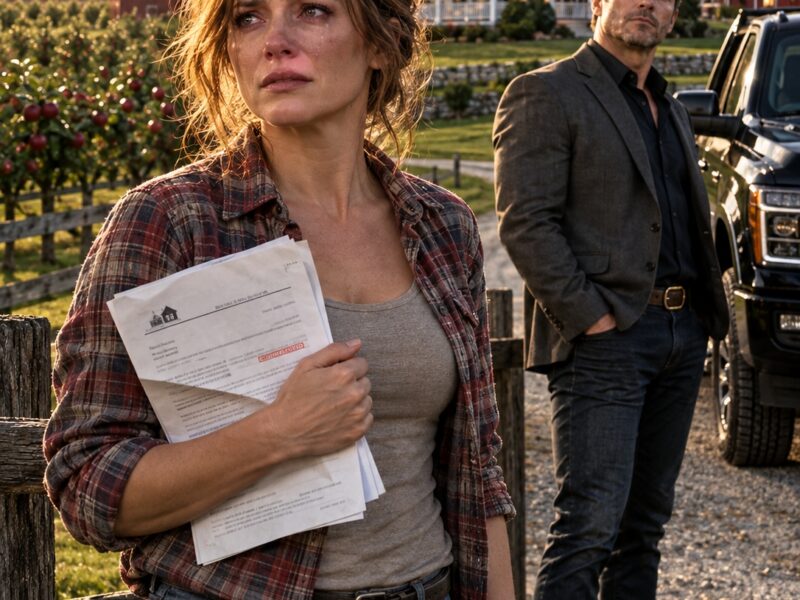
SHE HAD SEVEN DAYS TO SAVE HER FARM—THEN A STRANGER FIXED HER BROKEN STEP FOR ONE MEAL

“Don’t leave.”
Jack Mercer stopped with one hand on the handle of his truck.
Behind him, Emma Ward stood barefoot on the porch of a farmhouse that had survived three generations, two recessions, one tornado, and the death of the man she had once believed would grow old beside her.
Her seven-year-old son stood several feet behind her.
Noah had not spoken for fourteen months.
Until Jack came.
The truck bed held everything Jack owned: a canvas duffel, two changes of clothes, a rolled sleeping bag, and an old carpenter’s toolbox that had belonged to his father.
He had arrived seven days earlier.
He had repaired the broken porch step.
Then the fence.
Then the barn roof where Emma’s husband had fallen to his death.
He had done exactly what he had promised.
Now the work was finished.
Which meant Jack was leaving.
That was what Jack Mercer did.
He fixed broken things.
Then he disappeared before anyone could mistake him for something permanent.
Emma came down one porch step.
“Don’t leave,” she repeated.
Jack stared at the gravel beneath his boots.
“Emma.”
“Look at me.”
He didn’t.
Maybe because he already knew what he would see.
Maybe because staying had always frightened him more than leaving.
Emma crossed the yard until only a few feet separated them.
“You want another job?” she asked.
Jack finally raised his eyes.
Her voice trembled.
Her expression didn’t.
“Be my husband.”
Jack stopped breathing.
Emma swallowed.
“And I’ll be your home.”
Seven days earlier, neither of them would have believed those words could ever be spoken.
Especially Jack.
Because when he first came to Ward Farm, he wasn’t looking for a home.
He was looking for enough money to buy gas to the next town.
And Emma Ward was seven days away from losing everything.
The diner opened at six, but Jack walked through the door at 6:17 on a gray Monday morning.
Rain had followed him most of the night.
His jacket was damp across the shoulders, his beard needed trimming, and dried mud covered the edges of his boots.
He chose the stool nearest the window.
A waitress poured coffee without asking.
“Passing through or staying?”
Jack looked at the coffee.
“Depends whether there’s work.”
The waitress studied him.
She was somewhere in her sixties, with silver hair twisted behind her head and the sharp expression of someone who had spent forty years learning which strangers were trouble.
“What kind?”
“Carpentry. Repairs. Roofing. Framing. Whatever needs doing.”
“You any good?”
Jack wrapped both hands around the mug.
“I’ve never had a callback.”
She snorted.
“That could mean you’re good.”
“It usually does.”
For the first time, she smiled.
Then her eyes dropped to the old toolbox beside his stool.
“You know roofs?”
Jack’s fingers tightened slightly around the mug.
“Yes.”
The answer came quieter than the others.
The waitress noticed.
She didn’t ask why.
Instead, she leaned against the counter.
“There’s a woman three miles east of here. Ward Farm.”
Jack said nothing.
“Apple place. Fifty acres. Been in the husband’s family forever. Her barn roof’s been half-covered with a blue tarp for more than a year.”
“Why?”
The waitress’s face changed.
“Her husband fell off it.”
Jack looked up.
“Died?”
“Before the ambulance got there.”
Something moved behind Jack’s eyes.
The waitress continued.
“Her name’s Emma. She’s got a little boy. Noah. She’s been running that farm alone since Tom died.”
Jack took another drink.
“If she needs a carpenter, why hasn’t she hired one?”
“Because hiring people requires money.”
“Right.”
“And because she won’t let anybody near that roof.”
That interested him.
“Why?”
The waitress gave him a look that suggested the answer should have been obvious.
“Because that’s where her husband died.”
Outside, rain ticked against the glass.
Jack stared through the window.
“How long ago?”
“Fourteen months.”
Fourteen months.
The number sat between them.
The waitress lowered her voice.
“She has a bank review in seven days.”
Jack looked back at her.
“If the property doesn’t pass?”
“She could lose it.”
“And you think I’m supposed to fix a fifty-acre farm in seven days?”
“I think you asked if there was work.”
“That’s more than work.”
“Yes.”
“What is it?”
The waitress topped off his coffee.
“A miracle.”
Jack almost smiled.
“I don’t do miracles.”
“No. But you’re the first carpenter who’s walked through that door in six months.”
She straightened.
“And don’t tell Emma I sent you.”
“Why?”
“She’ll never forgive me.”
Ward Farm looked worse than Jack expected.
The farmhouse itself was beautiful in the exhausted way old things sometimes were.
White clapboard.
Deep porch.
Dark green shutters.
A red barn stood beyond the house, its roof scarred by missing shingles and a large blue tarp pulled across one side.
The orchard stretched behind it in disciplined rows, disappearing into the morning mist.
But everywhere Jack looked, he saw delayed repairs.
A leaning fence post.
Rot along the lower edge of the barn siding.
A gate sagging from one hinge.
A gutter pulling loose from the farmhouse.
And the porch step.
Jack noticed that first.
One board had split almost completely through.
He parked near the barn.
Before he reached the porch, the front door opened.
The woman who stepped outside was younger than he expected.
Mid-thirties, maybe.
Brown hair pulled into a careless knot.
Jeans.
Work boots.
Faded flannel shirt.
She was pretty, but Jack noticed that only after he noticed how tired she looked.
Not sleepy.
Tired in the deeper sense.
The kind of exhaustion that became part of someone’s posture.
A boy appeared behind her.
Thin.
Dark-haired.
Watching.
Emma stopped at the edge of the porch.
“Can I help you?”
“Ma’am, I’m a carpenter. Looking for day work.”
Her expression immediately closed.
“We’re fine.”
Jack glanced toward the barn.
“I was driving past. Saw your roof.”
“It’s fine.”
“Respectfully, it isn’t.”
Her jaw tightened.
“That tarp comes loose in the next hard wind, you’ll have water inside. Maybe worse.”
“I said it’s fine.”
Jack looked at her.
“I’m not hiring.”
He nodded once.
“All right.”
Emma seemed surprised by how easily he accepted it.
Jack turned toward his truck.
Then he stopped.
His eyes had dropped to the porch.
“That step isn’t fine either.”
Emma folded her arms.
“Excuse me?”
Jack pointed.
“That center board is split underneath.”
“I know.”
“The joist’s soft.”
“I know.”
“You’ve got a kid standing behind you.”
Her expression sharpened.
Jack crouched near the step without touching it.
“If he comes running down here and lands wrong, his foot could go straight through.”
Emma looked back.
Noah had moved closer to the doorway.
Her face changed.
Just slightly.
“How much?”
Jack looked up.
“For the step?”
“Yes.”
He glanced toward the boy, then at the house.
“A meal.”
Emma stared.
“A meal?”
“I fix the step. You feed me lunch.”
“What’s the catch?”
“If you like the work, we talk about the rest.”
“And if I don’t?”
“I finish eating and leave.”
She studied him for several seconds.
“What’s your name?”
“Jack.”
“Jack what?”
“Mercer.”
“Where are you from?”
“Depends which year you’re asking about.”
That answer did not reassure her.
Jack could see it.
So he added, “I’m not asking you to trust me. I’m asking for two hours and a sandwich.”
Emma glanced at the broken step again.
Then at Noah.
“One meal.”
Jack nodded.
“One meal.”
She stepped aside.
And without either of them knowing it, Emma Ward let the man who would change both their lives onto her property.
Jack removed the damaged board.
The rot underneath was worse than he expected.
He didn’t say anything.
He went to his truck, opened the old toolbox, and carried back a pry bar, hammer, square, hand saw, and measuring tape.
Noah watched from the porch.
Jack never spoke to him.
That was the first thing Emma noticed.
Most adults tried.
They asked Noah his name.
Asked how old he was.
Asked whether he liked school.
And when he didn’t answer, they became uncomfortable.
Some spoke louder, as if silence were deafness.
Some looked at Emma with pity.
Jack did none of it.
He simply worked.
After twenty minutes, Noah sat on the porch.
After forty, he moved closer.
When Jack needed a pencil and discovered his had snapped, Noah silently pushed one across the porch boards.
Jack picked it up.
“Thanks.”
Nothing more.
Noah stayed.
Jack replaced more than the visible board.
He reinforced the frame underneath, cut new lumber, treated the exposed wood, and reset the step until it no longer moved beneath his weight.
Emma came outside when he finished.
She pressed one boot against the new board.
Then harder.
Her eyebrows lifted.
“That’s better than when Tom built it.”
Jack began collecting his tools.
“Sometimes the second build is stronger.”
Emma looked at him.
“Why?”
“Because you know what went wrong the first time.”
Something in his voice made the sentence sound like it wasn’t about lumber.
Emma heard it.
So did Jack.
Neither acknowledged it.
Lunch was chicken soup, bread, and yesterday’s apple pie.
Jack ate at the kitchen table.
Noah sat opposite him.
And stared.
Finally Jack lowered his spoon.
“You planning to eat,” he asked, “or just watch me?”
Noah looked down.
Emma froze at the stove.
Jack immediately sensed he had crossed some invisible line.
“He doesn’t talk,” she said.
Jack looked toward her.
“Okay.”
“No. I mean he doesn’t talk at all.”
Jack glanced at Noah.
The boy was tearing a piece of bread into tiny pieces.
“How long?”
“Since his father died.”
Emma’s hand tightened around the dish towel.
“Fourteen months.”
Jack looked at Noah again.
Then returned to his soup.
“That’s all right.”
Emma frowned.
“What?”
“I’m not much of a talker either.”
Noah looked up.
For half a second, something almost like amusement crossed his face.
Emma saw it.
She looked away before either of them noticed the tears gathering in her eyes.
After lunch she led Jack outside.
“The barn roof,” she said. “Fence along the orchard. Back gate.”
Jack surveyed the property.
“How long?”
“If the weather holds?”
“Yes.”
“A week.”
Emma exhaled.
Then came the part she hated.
“I can’t pay real wages.”
Jack waited.
“I can give you meals. Spare room. Forty dollars.”
“For the week?”
Her embarrassment answered before she did.
“That’s what I have.”
Jack should have left.
Forty dollars wouldn’t fill his gas tank twice.
The work was worth thousands.
But his eyes drifted toward the barn.
Toward the blue tarp snapping in the wind.
Then toward Noah.
“I’ve worked for less.”
Emma stared at him.
“One week,” she said. “You fix what needs fixing. Then you move on.”
Jack lifted his toolbox.
“That’s always the deal.”
She didn’t know then how much he meant it.
The next morning, Emma stood twenty feet from the barn and pointed upward.
“That section.”
Jack followed her finger.
The western slope.
Three rows below the ridge.
The tarp covered most of it.
“That’s where Tom fell.”
Jack said nothing.
“He was trying to patch it himself.”
Emma’s voice thinned.
“We couldn’t afford anyone.”
Jack began checking his harness.
“He kept saying he’d done it a hundred times.”
She stared at the roof.
“I was in the kitchen when I heard him hit the ground.”
Jack stopped.
Emma folded her arms tightly across herself.
“I still hear it sometimes.”
He understood that.
There were sounds grief never allowed the brain to forget.
For Jack, it was glass breaking in the heat.
For Emma, it was her husband hitting the earth.
“I’ll start from the other side,” Jack said quietly. “Work across.”
“You don’t have to.”
He looked at her.
“I can find someone else for the roof.”
“You haven’t.”
Her eyes flashed.
Jack softened his voice.
“You haven’t found someone else in fourteen months.”
Emma looked away.
“I’m here. I do roofs. Let me do this one.”
She swallowed.
“If you fall—”
“I won’t.”
“You don’t know that.”
Jack clipped his safety line to the anchor.
“I’ve been on a thousand roofs.”
He tightened the harness.
“Not one fall.”
“That’s what Tom would’ve said.”
“Maybe.”
Jack looked directly at her.
“But I tie off every time.”
Emma’s expression shifted.
“Your husband sounds like he was a brave man,” Jack said.
Then he looked toward the roof.
“I’m just a careful one.”
He climbed.
Emma stayed below for almost an hour.
Every time Jack moved near the damaged section, her shoulders tightened.
Every time his hammer stopped, she looked up.
Finally she forced herself back toward the orchard.
Noah remained.
The boy stood beneath the ladder watching Jack work.
Jack removed damaged shingles.
Cut replacement boards.
Repaired water-damaged sheathing.
At noon he looked down.
Noah was still there.
Jack reached into his belt pouch.
“You want to hand me nails?”
Noah stared.
Jack lowered a small bucket on a rope.
“You don’t have to talk.”
The boy hesitated.
Then picked up a box of roofing nails.
One handful at a time, Noah filled the bucket.
Jack hauled it up.
“Perfect.”
The next bucket came down.
Noah filled it again.
That became their system.
No questions.
No pressure.
No pity.
Just nails.
And somewhere between the third bucket and the fifth, Noah stopped being afraid of the roof.
That night, Jack slept in the spare room.
At dawn he opened the door and nearly stepped on Noah.
The boy was curled against the wall outside with a blanket.
Jack crouched.
“Noah?”
The boy opened his eyes.
Emma appeared from the hallway.
Her face went pale.
“He slept here?”
Jack nodded.
“He was here when I opened the door.”
Emma stared at her son.
“He hasn’t done that since Tom died.”
Noah stood and gathered the blanket.
Jack didn’t ask why.
Neither did Emma.
Later that morning, Jack returned to the roof.
Noah resumed nail duty.
By noon, almost half the damaged section was repaired.
Jack was measuring flashing when he heard it.
“Jack.”
His entire body went still.
He looked down.
Noah stared up at him.
Jack slowly lowered the measuring tape.
“Yeah, buddy?”
Noah’s mouth moved once before the words came.
“Are you fixing the barn like my dad was?”
Jack’s throat tightened.
Across the orchard, Emma was too far away to hear.
Jack sat carefully against the roof.
“Yeah.”
Noah looked toward the repaired section.
“I’m finishing what your dad started.”
The boy lowered his head.
“He fell.”
“I know.”
Noah looked back up.
“I’m sorry about that.”
Silence.
Then the question that had apparently been trapped inside a seven-year-old boy for fourteen months.
“Are you going to fall?”
Jack closed his eyes for half a second.
Now he understood.
Noah had not been watching the repair.
He had been waiting for the fall.
Jack opened his eyes.
“These hands have been on a thousand roofs.”
He held them where Noah could see.
“Not one fall.”
Noah studied him.
“You promise?”
Jack almost said yes.
Instead he told the truth.
“I promise I’m going to be careful.”
Noah nodded.
And somehow, that was enough.
Jack found Emma behind the barn forty minutes later.
She was repairing irrigation tubing.
“Emma.”
Something in his voice made her stand immediately.
“What happened?”
“Nothing bad.”
Her face had already drained of color.
“Noah?”
“He’s fine.”
“Then what?”
Jack removed his gloves.
“Noah talked to me.”
Emma didn’t move.
The wind moved through the apple trees behind her.
“What?”
“He said my name.”
Her lips parted.
“He asked whether I was fixing the barn like his dad.”
Jack watched her hands begin to shake.
“He asked if I was going to fall.”
Emma turned away.
For several seconds she made no sound.
Then both hands covered her mouth.
“Fourteen months.”
Jack stepped closer but didn’t touch her.
“Fourteen months.”
Her knees seemed to weaken.
Jack caught her elbow.
Emma gripped his forearm.
“He talked?”
“Yes.”
“My baby talked?”
Jack nodded.
A broken sound escaped her.
Half laugh.
Half sob.
“He just needed someone who wasn’t going to rush him.”
Emma wiped at her face.
Then looked at Jack.
“Why you?”
He shook his head.
“I don’t know.”
“Why did he talk to you?”
Jack looked toward the barn.
“Maybe because I didn’t ask him to.”
That answer stayed with Emma.
So did the way Jack had caught her without thinking.
And the way he released her the second he knew she could stand alone.
By the fifth day, Ward Farm looked different.
Not transformed.
Not yet.
But alive.
The roof was solid.
The orchard fence stood straight again.
The porch no longer groaned beneath Emma’s boots.
The back gate closed properly for the first time in two years.
And Noah talked.
Not constantly.
Not easily.
But he talked.
At breakfast he asked Jack whether nails rusted.
At lunch he told Emma there was a bird nest near the barn.
That afternoon, he laughed when Jack dropped a wrench into a bucket of water.
Emma had forgotten the sound.
She turned away and cried where Noah couldn’t see.
That evening, she and Jack sat on the porch after Noah went to bed.
Emma handed him coffee.
“You’re the best carpenter I’ve ever seen.”
Jack looked suspicious.
“That sounds like the beginning of unpaid work.”
She smiled.
“Better than Tom.”
Jack’s smile disappeared.
“Tom was good.”
“I’m sure he was.”
“He built half this porch.”
“Then I take it back.”
Emma laughed.
It surprised both of them.
For a moment, the farmhouse felt like it had before death moved in.
Then Emma looked at Jack.
“Can I ask you something?”
“Depends.”
“You could make real money doing this.”
Jack stared into his coffee.
“You could have a shop. A crew. Build houses.”
He said nothing.
“So why are you sleeping in spare rooms and taking forty-dollar jobs?”
The silence stretched.
Emma realized she had gone too far.
“You don’t have to answer.”
“I had a shop.”
She stopped.
Jack stared across the dark orchard.
“Six years ago.”
His voice sounded different now.
“I had a crew too.”
Emma waited.
“And a wife.”
Jack’s thumb moved slowly along the rim of the mug.
“Her name was Grace.”
Emma said nothing.
“I built our house.”
He looked at his hands.
“These hands.”
Something cold moved through Emma.
“From the foundation up. Framing. Floors. Cabinets. Roof. Everything I was licensed to do, I did myself.”
His mouth twisted faintly.
“I thought it was the best thing I’d ever built.”
Emma already knew this story did not end there.
“What happened?”
“Electrical fire.”
The words were almost emotionless.
Which somehow made them worse.
“Middle of the night.”
Jack stared into the darkness.
“There was old wiring in one wall. I knew it was old. Electrician told me it should probably be replaced eventually.”
His jaw tightened.
“But the readings were fine. Everything looked fine.”
He swallowed.
“So I closed the wall.”
Emma felt her chest tighten.
“Three years later, I woke up and the hallway was on fire.”
Jack’s voice became rough.
“I went through the bedroom window.”
He paused.
“Grace didn’t.”
Emma closed her eyes.
“I went back.”
Jack was no longer seeing Ward Farm.
He was somewhere else.
Six years earlier.
Inside smoke.
Inside heat.
Inside the worst night of his life.
“I went back through the window. Couldn’t see anything. Couldn’t breathe. I kept calling her name.”
His fingers tightened around the mug.
“I couldn’t find her.”
“Jack…”
“Fire department got there seven minutes later.”
He gave a hollow laugh.
“Seven minutes can be a lifetime.”
Emma knew that too.
“The inspector said the fire came from the old wiring.”
Jack looked at her.
“Not my framing.”
“Then it wasn’t your fault.”
“I knew the wiring was there.”
“That doesn’t make it your fault.”
“I closed the wall.”
“You didn’t start the fire.”
“I built the house.”
Emma stared at him.
Jack finally said the sentence he had apparently been carrying for six years.
“I built a house that killed my wife.”
Emma set down her coffee.
“No.”
Jack stood.
“I did.”
“No.”
“You weren’t there.”
“Neither are you anymore.”
He looked at her sharply.
Emma stood too.
“The man standing in front of me isn’t inside that burning house anymore.”
“You don’t understand.”
“I understand enough.”
“No, you don’t.”
Jack’s voice rose for the first time.
“I woke up every morning for a year knowing that if I’d opened one wall—one wall—she might still be alive.”
Emma stepped closer.
“And I spent fourteen months thinking if I’d told Tom not to climb that roof, Noah might still have a father.”
Jack went silent.
“You think I don’t understand bargaining with the dead?”
Emma’s eyes filled.
“I understand it perfectly.”
The anger left his face.
Jack looked away.
“That’s why I don’t build anymore.”
“What?”
“I repair things.”
He nodded toward the barn.
“Roof. Porch. Fence. Somebody else’s mistakes.”
“And then?”
“I leave.”
“Why?”
“Because repairs don’t become homes.”
Emma stared at him.
“And homes can burn.”
Jack said nothing.
She looked down at the old toolbox beside his chair.
“Six years.”
“What?”
“You’ve been running for six years.”
“I’ve been working.”
“You’ve been running.”
Jack’s jaw tightened.
“Those tools belonged to my father.”
Emma waited.
“He died when I was twenty.”
Jack rested one hand on the wooden handle of the toolbox.
“They’re the only home I’ve got left.”
Emma looked at the man before her.
A carpenter afraid to build.
A widower afraid to love.
A homeless man carrying his father’s tools from town to town because a toolbox was the only home he trusted not to burn.
Her voice softened.
“So you fix every broken thing in the world except yourself.”
Jack looked at her.
“And then you leave before anyone can ask you to stay.”
He didn’t answer.
He didn’t need to.
The next morning, Emma found Jack already working.
Day six.
The gate was nearly finished.
Noah sat nearby drawing something on a scrap of lumber.
Emma leaned against the fence.
“You know what your problem is?”
Jack continued tightening a hinge.
“I have several. You’ll need to narrow it down.”
“You think fear is evidence.”
His wrench stopped.
Emma continued.
“You’re afraid your hands destroy things, so you decided that means they do.”
Jack resumed working.
“Emma.”
“No.”
She walked toward him.
“Look at the barn.”
He didn’t.
“Look at it.”
Jack finally turned.
New shingles covered the western slope.
The blue tarp was gone.
“Look at the fence.”
Straight.
Strong.
“Look at the porch.”
Solid.
Then Emma pointed toward the house.
“My son is in there talking to himself while he draws because apparently he has fourteen months of words stored up.”
Jack looked toward the kitchen window.
Emma’s voice broke slightly.
“Your hands did that.”
“No.”
“Yes.”
“I fixed some wood.”
“You gave him a reason to believe a man could climb onto that roof and come back down.”
Jack stared at her.
“You didn’t build something that destroyed him.”
Emma stepped closer.
“You built something that brought him back.”
For once, Jack had no answer.
“Tomorrow is day seven,” she said.
“I know.”
“You’ll finish the gate.”
“Yes.”
“And then?”
Jack looked toward his truck.
Emma followed his eyes.
Her heart sank.
“You’ll leave.”
“That was the deal.”
She wanted to argue.
Instead she nodded.
Because it had been.
And because she suddenly understood that the hardest thing about Jack Mercer was not convincing him that he was wanted.
It was convincing him that being wanted did not make him dangerous.
Dale Harrington arrived before the bank inspector.
Emma saw his black pickup coming up the driveway and muttered something Jack pretended not to hear.
Dale stepped out wearing polished boots and a jacket too expensive for farm work.
He smiled at Emma.
“Morning.”
“What do you want, Dale?”
His eyes moved across the barn.
“Place looks good.”
He noticed Jack.
“New roof.”
Emma folded her arms.
“You finally hired someone.”
“What do you want?”
“I heard the bank review was today.”
Jack glanced toward Emma.
Dale smiled as though he were concerned.
“Just checking in.”
“I’m fine.”
“My offer still stands.”
Emma’s expression hardened.
Jack remained beside the gate.
“What offer?” he asked.
Dale looked at him.
“Two hundred thousand.”
“For?”
“The acreage.”
Emma cut in.
“And the water rights.”
Jack looked across the orchard.
Fifty acres.
The farmhouse.
Barn.
Trees.
Everything Tom’s family had built.
Two hundred thousand wasn’t an offer.
It was a man waiting beside a hospital bed for someone to die.
Dale spread his hands.
“It’s fair.”
“No,” Emma said.
“More than fair considering the debt.”
“No.”
“You could move into town.”
“No.”
“Get Noah into a better school.”
Emma stepped toward him.
“My son’s school is fine.”
“Start fresh.”
“This is Noah’s home.”
Her voice sharpened.
“This was Tom’s home.”
She pointed toward the road.
“It isn’t for sale.”
Dale’s smile disappeared.
“Tom’s gone, Emma.”
Jack saw her flinch.
Only once.
But he saw it.
Dale continued.
“And with all due respect, you’re trying to run fifty acres alone. You’ve got a mortgage, equipment repairs, irrigation problems—”
“She said it isn’t for sale.”
Silence.
Dale looked at Jack.
“And you are?”
“The part of the conversation where you leave.”
Dale laughed once.
“Farm help?”
Jack didn’t move.
“Didn’t know Emma had the budget.”
Jack took one step forward.
Emma touched his arm.
That stopped him.
Dale noticed.
His eyes moved between them.
Something ugly entered his smile.
“I’ll leave my card.”
He set it on the porch railing.
“The math doesn’t lie, Emma.”
Jack looked at the card.
Then at Dale.
“No.”
Dale paused.
“People do.”
For the first time, Dale’s expression hardened completely.
Then he walked to his truck.
Jack waited until it disappeared down the road.
“How long?”
Emma picked up the card.
“Since Tom’s funeral.”
Jack looked at her.
“He brought flowers.”
She tore the card in half.
“And an offer.”
The bank inspector arrived at 10:15.
Emma spent the next hour trying not to look nervous.
The inspector checked the barn.
Fence.
Equipment shed.
Orchard.
House exterior.
Drainage.
Jack stayed out of the way.
Noah stayed near him.
Finally, the woman closed her clipboard.
“Mrs. Ward.”
Emma braced herself.
“I’ll be honest.”
Her stomach dropped.
“This is a significant improvement over last year’s report.”
Emma blinked.
“The structures are in good condition. Orchard maintenance is current. Fencing is adequate.”
Emma’s fingers curled against her jeans.
“What does that mean?”
“It means I’m recommending continuation under your existing terms.”
Emma stared.
“No foreclosure action.”
For several seconds, she didn’t react.
Then she covered her mouth.
Jack looked down.
Noah smiled.
The inspector softened.
“But Emma.”
Reality returned.
“The balance is still there.”
“I know.”
“You’re going to need a strong harvest next fall.”
“I understand.”
“And there isn’t much room for another bad year.”
“I know.”
The inspector closed the folder.
“Good luck, Mrs. Ward.”
She glanced toward the repaired barn.
“I truly hope it works out.”
Emma watched her drive away.
Then she turned toward Jack.
He was smiling.
Not much.
But enough.
“We did it,” Emma whispered.
Jack shook his head.
“You did.”
She wanted to tell him he was wrong.
But Noah ran between them.
“We’re keeping the farm?”
Emma crouched and pulled him into her arms.
“Yes.”
Noah laughed.
“We’re keeping it.”
Jack watched mother and son hold each other in the driveway.
Something inside him hurt.
Because he knew what came next.
The farm had passed.
The work was finished.
Day seven was over.
And Jack Mercer had run out of reasons to stay.
Emma found his bag in the truck before she found him.
Everything packed.
Toolbox secured.
Sleeping bag rolled.
Her chest tightened.
Noah saw it too.
“Jack?”
Jack came around the barn carrying the last of his tools.
Noah looked at the truck.
“Where are you going?”
Jack stopped.
“I finished the work, buddy.”
Noah’s face changed.
“Time for me to head on.”
“Are you coming back?”
Jack looked at Emma.
Then away.
“I don’t usually come back to places.”
Noah stared at him.
The words were simple.
The damage wasn’t.
Emma saw her son retreat inside himself.
Not completely.
But enough.
“Where are you going?” she asked.
“Next town.”
“And then?”
Jack shrugged.
“There’s always another town.”
“And after that?”
“The one after that.”
Emma laughed once.
There was no humor in it.
“So that’s it?”
“Emma.”
“You’ll fix somebody else’s porch.”
Jack’s expression tightened.
“Eat somebody else’s dinner.”
“Stop.”
“Some other little boy will hand you nails.”
“Emma.”
“And when they start caring about you, you’ll leave them too.”
Jack’s jaw flexed.
“I told you what I do.”
“Yes.”
“I fix things.”
His voice hardened.
“And I move on.”
“Why?”
“You know why.”
“No. I know the story you tell yourself.”
“It’s safer.”
“For who?”
Jack stopped.
Emma walked toward him.
“For who, Jack?”
“For everyone.”
“No.”
She shook her head.
“For you.”
He looked away.
“It isn’t safer for Noah.”
Jack’s eyes flicked toward the boy.
“It isn’t safer for me.”
“Emma…”
“In seven days you made my barn whole.”
She pointed toward the orchard.
“You straightened my fence.”
Toward the porch.
“You fixed the step my son could have fallen through.”
Her voice began to shake.
“You made my kitchen table feel like a kitchen table again instead of a place where I sit after Noah goes to bed and stare at the wall because I don’t know what else to do with myself.”
Jack’s face changed.
“You made my son talk.”
“That wasn’t me.”
“It was partly you.”
“No.”
“Yes.”
Emma stepped closer.
“You fixed everything.”
She looked into his eyes.
“Everything except the part where you stay.”
Jack’s breathing changed.
“If I stay…”
“What?”
He looked at the farmhouse.
The barn.
The orchard.
Noah.
Then Emma.
“If I stay, I build.”
She understood.
“And the last thing I built—”
“Burned.”
Jack closed his eyes.
“And Grace died.”
“Yes.”
His eyes opened.
Emma’s voice became quieter.
“But Jack, leaving didn’t bring her back.”
He flinched.
“Punishing yourself didn’t bring her back.”
“Stop.”
“Sleeping in trucks didn’t bring her back.”
“Emma.”
“Refusing to love anybody didn’t bring her back.”
His eyes filled with something she had never seen there before.
Fear.
Not grief.
Fear.
Because Emma was standing at the door he had kept locked for six years.
And she was asking him to open it.
“I don’t know how to do this,” he whispered.
Emma reached for his hand.
Jack stared down at their fingers.
“Don’t leave.”
He looked at her.
Emma had not planned the next words.
Maybe that was why they were true.
“Be my husband.”
Jack’s eyes widened.
Noah stared at his mother.
Emma’s heart hammered.
“And I’ll be your home.”
Nothing moved.
Not Jack.
Not Noah.
Not Emma.
Even the orchard seemed to hold its breath.
Jack finally whispered, “You don’t know what you’re asking.”
“I do.”
“We’ve known each other seven days.”
“I know.”
“You can’t marry a man because he fixed your roof.”
“I’m not asking because you fixed my roof.”
“Then why?”
Emma looked toward Noah.
“Because yesterday I heard my son laugh.”
Her eyes returned to Jack.
“Because last night I slept six hours without waking up listening for a sound that happened fourteen months ago.”
Jack swallowed.
“Because when Dale told me I couldn’t save this place, for the first time since Tom died, I didn’t feel like I was standing alone.”
She squeezed his hand.
“And because I think you’re as tired of leaving as I am of losing people.”
Jack’s eyes closed.
“I don’t know how to stay.”
Emma waited.
“I haven’t stayed anywhere in six years.”
His voice cracked.
“I don’t know if I remember how.”
Emma stepped closer.
“Then I’ll teach you.”
He opened his eyes.
“One day at a time.”
Noah moved toward them.
Emma smiled through her tears.
“The same way you taught my son to talk.”
Jack looked down at Noah.
The boy stared up at him.
“Are you staying?”
Jack looked toward his packed truck.
Then toward the barn.
The new roof caught the afternoon light.
He remembered smoke.
Grace.
The house collapsing.
He remembered six years of highways.
Cheap motels.
Spare rooms.
Diners.
Porches belonging to strangers.
Never unpacking enough to make leaving difficult.
Then he looked at Emma.
At Noah.
At the farmhouse.
“What are you doing?” Emma whispered.
Jack walked to his truck.
He opened the passenger door.
Emma’s face fell.
Then Jack pulled out his duffel.
He carried it back toward the porch.
“Staying.”
Noah smiled.
Jack looked down at the step.
“Might need reinforcing before winter anyway.”
Emma laughed while she cried.
And for the first time in six years, Jack Mercer carried his bag into a house without knowing when he would carry it back out.
Staying turned out to be harder than Jack expected.
Leaving required only a full tank.
Staying required mornings.
Arguments.
Decisions.
Promises.
It required allowing people to depend on you.
The first month, Jack still kept his duffel packed.
Emma noticed.
She never mentioned it.
The second month, his clothes appeared in the dresser.
By the third, the duffel was empty beneath the bed.
Noah noticed that too.
He didn’t mention it either.
Instead, he asked questions.
Hundreds of them.
“Jack, do apples grow faster if you talk to them?”
Jack looked up from repairing the porch rail.
“I don’t know, buddy.”
Noah waited.
“But porches do.”
Noah frowned.
“That doesn’t make sense.”
“Most good things don’t.”
Emma heard them from the kitchen.
She smiled.
Some mornings Jack burned pancakes.
Emma banned him from the stove.
“You can rebuild a barn roof but can’t flip a pancake?”
“The roof doesn’t fight back.”
“Move.”
“I can learn.”
“No.”
She pointed toward the coffee maker.
“You’re on coffee duty permanently.”
Jack saluted.
“Yes, ma’am.”
There were harder days too.
Days Emma resented having another opinion on the farm.
Days Jack woke from dreams smelling smoke that wasn’t there.
Days Noah became quiet again.
But silence no longer terrified them.
They had learned something about silence.
Sometimes it was not an ending.
Sometimes it was only someone gathering the courage for the next word.
By summer, Jack had built produce stands from scrap lumber.
Emma sold apples, preserves, cider, and pies beside the highway.
One Saturday she came running toward the barn holding a cash box.
“Four hundred dollars.”
Jack looked up.
“What?”
“We made four hundred dollars today.”
Noah raised both hands.
“We’re rich!”
Emma laughed.
“No, sweetheart.”
Jack wiped sawdust from his arms.
“That’s nearly a mortgage payment from scrap lumber.”
Emma looked at the stands.
“Good lumber.”
Jack looked at her.
“Good apples.”
Then he smiled.
“Good woman selling them.”
Emma rolled her eyes.
Later, as sunset turned the orchard gold, she sat beside him on the porch.
“Noah asked me something this morning.”
Jack tensed automatically.
“What?”
“He asked if you were going to be here for his birthday.”
Jack looked toward the yard.
“When?”
“October.”
“I’ll be here.”
Emma watched him.
Jack frowned.
“What?”
She smiled.
“I know.”
Those two words hit him harder than he expected.
Not I hope.
Not you promised.
I know.
Trust.
The thing he had believed he no longer deserved.
Their first real argument happened over irrigation.
“We don’t need a new line,” Emma said.
Jack stared at her.
“The old one leaks forty gallons a day.”
“It works.”
“That is not the definition of works.”
“I’ve managed this farm’s money for years.”
“And I’ve patched the same line three times.”
“It can make another season.”
“It shouldn’t.”
Emma put down her ledger.
“This is my farm.”
The sentence landed harder than she intended.
Jack became quiet.
Immediately Emma regretted it.
He nodded.
“Right.”
He turned toward the door.
“Jack.”
“It’s your farm.”
“Wait.”
He stopped.
Emma looked at the ledger.
Then toward the orchard.
Then back at him.
“I’m not used to this.”
“What?”
“Someone having an opinion.”
Jack’s expression softened.
“Someone staying long enough to have one.”
She nodded.
He returned to the table.
“This isn’t about controlling the money.”
“I know.”
“It’s about the orchard.”
“I know.”
Emma exhaled.
“Our orchard?”
Jack raised an eyebrow.
She pointed at him.
“Don’t make me regret that.”
His smile appeared slowly.
“Our orchard.”
“Fine. Replace the irrigation.”
Jack nodded.
“But I’m choosing the contractor.”
Jack stared at her.
“You’re looking at him.”
“Then I want a discount.”
He laughed.
And Emma realized they had just had their first argument about something that assumed there would be a future.
She had never been happier to lose one.
October arrived with cold mornings and red leaves along the orchard fence.
Jack was there for Noah’s birthday.
He built him a treehouse.
Not because Noah asked.
Because Jack wanted to build something again.
The first time he cut lumber for it, his hands shook.
Emma noticed.
She didn’t stop him.
He framed the platform.
Set the supports.
Measured every joint twice.
Then three times.
Noah helped.
When the treehouse was finished, Jack stood beneath it staring upward.
Emma came beside him.
“It’s solid.”
Jack nodded.
“You say that like you’re surprised.”
“I’m not.”
She slipped her hand into his.
“I’m proud.”
Jack looked at her.
He had spent six years believing building was the worst thing he could do.
Now a little boy was laughing inside something he had built.
Nothing was burning.
Nobody was dying.
The structure held.
And slowly, so did Jack.
The following spring, the orchard bloomed so heavily the branches looked covered in snow.
Emma found Jack near the barn one evening.
He was standing at the exact place where Noah had first said his name.
There was sawdust on his shirt.
Something was hidden behind his back.
“What did you break?” she asked.
Jack looked offended.
“Why assume I broke something?”
“Experience.”
“That’s hurtful.”
Emma smiled.
Then she noticed his expression.
“Jack?”
He exhaled.
“I’m not good at this.”
“At what?”
“I don’t have a speech.”
Her smile disappeared.
Jack brought his hand forward.
A ring rested between his fingers.
Emma stopped breathing.
Jack looked down at it.
“I know you already asked me once.”
A laugh escaped her.
“That was technically a crisis-management proposal.”
“Still counts.”
“Continue.”
Jack looked toward the barn.
“I stopped running the day you grabbed my hand beside that truck.”
Emma’s eyes filled.
“And I know this is the spot where Noah said my name for the first time.”
His voice became rough.
“That was the day I started thinking maybe I didn’t have to leave.”
He lowered himself onto one knee.
Emma covered her mouth.
Jack looked up.
“Marry me.”
She laughed through her tears.
“Again?”
“For real this time.”
He smiled.
“Not because I fixed your farm.”
His expression softened.
“Because you fixed me.”
Emma shook her head.
“No.”
Jack’s face fell.
Then she crouched in front of him.
“I didn’t fix you.”
She took his face between her hands.
“You were never something broken that needed fixing.”
Jack stared at her.
“You just needed somewhere safe enough to stop running.”
She kissed him.
When she pulled away, Jack whispered, “Is that a yes?”
Emma laughed.
“Yes.”
From behind the barn came Noah’s voice.
“FINALLY!”
Jack stood.
“You were listening?”
Noah appeared around the corner.
“I’ve been waiting forever.”
“You’re eight.”
“Exactly.”
Emma laughed so hard she had to hold onto Jack.
And for a moment, the three of them stood beneath the apple blossoms while the evening sun stretched their shadows across the same ground where grief had once convinced each of them that life had already given them its final answer.
It hadn’t.
Later that night, Emma and Jack sat on the porch.
Noah was asleep.
The ring caught the light from the kitchen window.
Emma leaned her head against Jack’s shoulder.
“You know what I was doing the night before you showed up?”
Jack looked down at her.
“What?”
“Sitting in this chair.”
She stared across the orchard.
“Alone.”
Jack waited.
“I had Dale’s offer on the table.”
His body stiffened.
“I was thinking about signing it.”
Jack turned toward her.
“You never told me that.”
“I know.”
“Why?”
“Because I was ashamed.”
“Of what?”
“Giving up.”
Jack shook his head.
“You weren’t giving up.”
“I was.”
“No.”
“I was tired, Jack.”
Her voice softened.
“So tired.”
She looked toward the barn.
“I couldn’t climb that roof. Couldn’t afford someone who would. Noah wouldn’t speak. The bank was coming.”
Her eyes glistened.
“And every broken thing on this farm felt like proof that Tom was gone.”
Jack said nothing.
“The next morning I woke up and decided I’d sell after the bank review.”
She smiled faintly.
“And then this dirty stranger drove up with an old toolbox and told me my porch step was dangerous.”
Jack laughed.
“You were very welcoming.”
“I almost told you to go to hell.”
“You basically did.”
“But then you offered to fix it for a meal.”
Jack looked at the step.
The first thing he had repaired.
The smallest thing.
Emma slipped her fingers through his.
“You know what I think about sometimes?”
“What?”
“If that step hadn’t been broken…”
Jack looked at her.
“You’d have sent me away.”
“Probably.”
“And I’d have left.”
“Probably.”
They sat quietly.
One broken board.
One meal.
Seven days.
Sometimes a life did not change because of a grand decision.
Sometimes it changed because something small finally broke at exactly the right moment.
Years later, the old porch step was still there.
Jack could have replaced it.
He replaced almost everything else eventually.
The irrigation.
Sections of fencing.
Barn doors.
Kitchen cabinets.
He added a workshop near the equipment shed.
He even began taking local construction jobs again.
First repairs.
Then additions.
Then, one summer, an entire house.
On the morning he poured the foundation, Jack sat in his truck for twenty minutes.
Emma found him there.
“You okay?”
“No.”
She climbed into the passenger seat.
He stared at the building plans.
“What if I miss something?”
“You might.”
He looked at her.
“That isn’t what you’re supposed to say.”
“I’m your wife. Not your motivational speaker.”
He almost smiled.
Emma took his hand.
“You’ll inspect it.”
“Yes.”
“You’ll have electricians inspect their work.”
“Yes.”
“You’ll follow code.”
“Yes.”
“You’ll worry about every detail until everyone working with you wants to murder you.”
“Probably.”
“Then build the house.”
Jack looked through the windshield.
Six years earlier, the thought would have been impossible.
Now he opened the door.
And built.
When the house was finished, Jack stood in the driveway as a young family carried boxes inside.
A little girl ran through the front door.
Nothing collapsed.
Nothing burned.
It was simply a house.
Safe.
Warm.
Waiting to become a home.
Jack cried in his truck afterward.
Not because Grace was forgotten.
She never would be.
He cried because for the first time he understood that surviving her did not require him to remain inside the fire forever.
Ward Farm survived too.
Some years barely.
Some years beautifully.
There were late frosts.
Broken equipment.
Bad prices.
A storm that destroyed nearly a quarter of one harvest.
There were arguments about money and tractors and whether Noah was old enough to drive one.
There were birthdays.
Christmas mornings.
Burned pancakes.
Hospital visits.
School concerts.
Bills.
Laughter.
Ordinary things.
The things Jack once believed he had lost the right to have.
Dale eventually stopped making offers.
The mortgage balance shrank.
Noah grew taller.
By fifteen, he could repair almost anything Jack could.
By seventeen, he had begun talking about agricultural engineering.
Emma blamed Jack.
Jack blamed “apple math.”
Noah blamed both of them.
But every October, no matter how old he became, Noah asked Jack the same question.
“You gonna be here for my birthday?”
At first it was a joke.
Later it became tradition.
Jack always gave the same answer.
“I’ll be here.”
And every year, Emma heard the deeper promise inside those words.
One autumn evening, many years after the stranger first arrived, Jack sat alone on the porch.
His father’s toolbox rested beside him.
The wood was scratched.
The hinges had been replaced twice.
Noah came outside.
He was nearly grown now.
He sat beside Jack.
For a while neither spoke.
Jack smiled.
“You used to be better at this.”
“At what?”
“Silence.”
Noah laughed.
Then his eyes settled on the toolbox.
“You ever think about leaving?”
Jack looked across the orchard.
The barn roof glowed red beneath the sunset.
The same roof.
Different shingles now.
Same place.
“No.”
“Never?”
Jack considered it.
“I used to think leaving was what kept people safe.”
Noah waited.
“Then your mom taught me something.”
“What?”
Jack looked toward the kitchen window.
Emma stood inside, reading something at the table.
“Sometimes leaving is the thing that hurts them.”
Noah nodded.
Jack rested one hand on the toolbox.
“My dad gave me these tools.”
“I know.”
“For years I told myself they were the only home I had.”
Noah looked at him.
Jack smiled.
“I was wrong.”
From inside the house, Emma called their names.
Dinner.
Noah stood.
Jack remained seated another moment.
His hand rested on the porch railing he had repaired years before.
Then his eyes dropped to that first step.
It had been reinforced many times.
Emma had refused to let him replace it completely.
Jack finally understood why.
It was crooked in one corner.
Scarred by weather.
Patched underneath.
Imperfect.
But solid.
Sometimes the second build really was stronger because you knew what had gone wrong the first time.
Jack picked up his father’s toolbox and carried it inside.
He no longer carried it because it was the only home he had left.
He carried it because it belonged there.
Emma was setting plates on the table.
Noah was stealing potatoes before dinner.
Jack stopped in the doorway.
For one brief instant he remembered another doorway.
Another house.
Smoke.
Grace.
Loss never disappeared completely.
Love did not erase the dead.
It simply taught the living that remembering them and continuing to live were not betrayals of each other.
Emma caught him staring.
“What?”
Jack shook his head.
“Nothing.”
She smiled.
“Then sit down before Noah eats everything.”
Jack placed the toolbox beside the wall.
Not by the door.
He hadn’t kept anything by the door in years.
Then he sat at the kitchen table.
Outside, autumn wind moved through fifty acres of apple trees.
The barn stood firm.
The fence held.
The porch step did not move.
And the carpenter who had once believed his hands could only destroy things finally understood what they had actually been doing all along.
They had rebuilt a roof.
They had rebuilt a farm.
They had helped a silent little boy find his voice.
They had held a grieving woman when she finally allowed herself to stop carrying everything alone.
And, piece by piece, nail by nail, year by year, they had rebuilt the man attached to them.
Jack reached across the table.
Emma took his hand.
Noah complained that they were being weird again.
Emma laughed.
Jack did too.
And in the house beyond the repaired porch, the sound traveled through rooms Jack was no longer afraid to call home.









