She Humiliated the Old Man Who Bought the Cheapest Roll Every Morning—Then She Learned Who Owned the Building
At exactly 7:15 every morning, the bell above Emma Carter’s bakery door made the same thin, irritating sound.
And every morning, the same old man walked in.
On the morning Emma finally lost her temper, she had been awake for twenty-one hours, owed money to three different people, had a dying oven behind her, and was holding an electricity shutoff notice beneath the register so her customers wouldn’t see it.
Then the bell rang.
Mr. Gray stepped inside wearing his old brown coat, rain shining on its shoulders.
Emma looked at him and felt something ugly rise inside her.
Not because he had done anything wrong.
Because he was about to order one plain bread roll and one black coffee, spend less than five dollars, and occupy one of her best tables for nearly an hour while her entire life was collapsing around her.
He closed his umbrella carefully near the mat.
“Morning, Emma.”
She didn’t answer.
She was already reaching for the cheapest roll in the display case.
Mr. Gray noticed the burnt pastries stacked beside the kitchen door. “Rough morning?”
That was all he said.
Three harmless words.
Emma slammed the paper cup onto the counter hard enough to splash coffee across the lid.
“If you have nothing better to do every morning than sit here watching me work,” she said, “maybe you could at least stop commenting on how badly I’m doing it.”
The bakery went silent.
A woman near the window stopped stirring sugar into her latte.
A delivery driver lowered his phone.
Even the hiss of the espresso machine seemed too loud.
Mr. Gray stood motionless.
Emma heard herself continuing, but exhaustion had already outrun judgment.
“This is a business,” she said. “Not a waiting room. Some of us actually have things to do.”
For the first time in the months he had been coming to Emma’s Oven, something changed in the old man’s face.
Not anger.
That would have been easier.
It was hurt.
Small, controlled, almost immediately hidden.
He looked down at the bread roll in his hand.
“I see,” he said quietly.
The shame hit Emma almost as soon as the words left her mouth, but pride was quicker.
Mr. Gray nodded once.
“I’m sorry I’ve been in the way.”
Then he carried his coffee to the little table beside the window—the same table where he had sat every weekday morning since winter—and finished his breakfast alone.
Twenty minutes later, he left without another word.
Emma watched him disappear into the rain.
She told herself she had been justified.
She told herself anyone under the pressure she was under might have snapped.
She told herself he probably wouldn’t come back.
That last thought should have brought relief.
Instead, for reasons she could not yet understand, it frightened her.
Because Emma Carter had no idea that the quiet man she had just humiliated owned the building beneath her feet.
And by the end of the week, he would have the power to decide whether her bakery lived or died.
Emma had grown up believing bread could save things.
Not in a dramatic way.
Bread could not save a marriage or reverse a diagnosis or erase debt. Her mother, Helen Carter, had been far too practical to make claims like that.
But bread could soften a terrible morning.
It could make a stranger stay at a kitchen table five minutes longer.
It could give a tired child something warm to hold.
It could make a cheap apartment above a noisy laundromat smell, briefly, like the safest place in the world.
When Emma was nine, she and her mother lived in a two-bedroom apartment above Parkside Laundry on the south side of Milwaukee. The washing machines downstairs began rattling before sunrise, and the floors vibrated slightly whenever three dryers entered their spin cycle at the same time.
Helen worked the front desk at a dental office during the week.
On Sundays, she baked.
She never owned expensive equipment. Their oven door had to be lifted slightly before it would close, and one burner on the stove worked only if you twisted the knob past HIGH and then slowly turned it backward.
Still, every Sunday before seven, the apartment filled with the smell of yeast, butter, cinnamon, and flour.
Neighbors began knocking.
Mrs. Russo from 2B came first.
Then the Johnson twins from across the hallway.
Then Mr. Lee downstairs, who always insisted he had only come to return a newspaper but somehow left holding half a loaf.
Helen never charged anyone.
“You know we’re not rich, right?” Emma once asked when she was twelve.
Her mother laughed. “I had noticed.”
“Then why do you give food away?”
Helen dusted flour from her fingers.
“Because hungry people remember kindness longer than they remember prices.”
At twelve, Emma rolled her eyes.
At twenty-nine, with Helen seven years gone from cancer, Emma thought about those words almost every day.
Especially when she unlocked the front door of Emma’s Oven at 4:38 in the morning.
The bakery had been her dream since high school.
Not a chain.
Not an Instagram fantasy full of decorative food nobody could afford.
A neighborhood bakery.
Good coffee.
Fresh bread.
Soup in winter.
Tables people could sit at without being pressured to leave.
A place her mother would have loved.
Emma spent eight years saving for it.
She worked hotel kitchens, restaurant prep lines, catering events, weddings, corporate breakfasts and Christmas banquets where wealthy people abandoned entire trays of untouched pastries because someone had ordered too much.
She learned every station.
She learned inventory.
She learned payroll.
She learned that restaurant margins could be brutal and customers became remarkably emotional about croissants.
By twenty-eight, she had forty-six thousand dollars saved.
It wasn’t enough.
She opened anyway.
The storefront on Willow Street had been empty for almost two years. It sat at the ground floor of a four-story red-brick building built in the 1920s, between a florist and a small bookstore.
The windows were tall.
The kitchen was narrow.
The floors sloped slightly toward the alley.
Emma loved it instantly.
She painted the walls warm cream herself.
She bought six secondhand oak tables from a restaurant that had closed in Madison.
Her brother, Jake, built shelves from reclaimed pine.
Behind the counter, Emma hung her mother’s handwritten cinnamon-roll recipe inside a walnut frame.
On opening day, she arrived at 3:30 a.m.
At 6:59, one minute before she unlocked the door, Emma stood alone in the center of the bakery with flour on her cheek and cried.
Not because she was afraid.
Because she had done it.
For almost a year, it seemed as though she had been right to believe in impossible things.
People came.
Teachers stopped in before school.
Construction workers bought coffee at six.
Mothers pushed strollers through the door after nine.
College students found the place.
A local food blogger posted a photograph of Emma’s maple pecan rolls and called them “dangerously worth waking up for.”
On Saturdays there was sometimes a line outside.
Emma hired two employees.
She bought another mixer.
She started imagining a second location.
Then everything became more expensive at once.
Butter.
Eggs.
Flour.
Insurance.
Electricity.
Packaging.
Repair work.
The commercial oven failed twice in six months.
The refrigerator compressor died during a July heat wave.
A supermarket four blocks away renovated its bakery section and began selling mass-produced bread for less than Emma paid for ingredients.
Customers still told her they loved Emma’s Oven.
They simply came less often.
Love, Emma discovered, did not necessarily pay invoices.
Then Jake lost his warehouse job.
He had a seven-year-old daughter named Sophie and an ex-wife who was already covering more than her share.
Jake never asked Emma for money.
She gave it anyway.
School shoes.
Lunch account.
A winter coat.
Field-trip fees.
“Stop,” Jake told her once.
“She’s my niece.”
“You have a business to save.”
“She’s seven.”
“And you’re drowning.”
Emma remembered how angry that sentence had made her.
Not because it was cruel.
Because it was accurate.
By the following spring, she was working sixteen to eighteen hours most days.
One employee left for a job with benefits.
The other cut back to weekends.
Emma stopped renting her apartment and began sleeping in the tiny storage room behind the bakery kitchen on an old folding cot.
She told people it was temporary.
Three months later, her toothbrush was still beside the staff sink.
Her clothes hung from hooks behind sacks of flour.
At night she listened to the refrigerator compressor cycle on and off and tried to calculate how many cinnamon rolls she needed to sell the next morning to cover invoices due Friday.
Sometimes she dreamed in numbers.
And then, one February morning, Edward Gray appeared.
Exactly at 7:15.
The bell rang.
He was probably in his late sixties, though Emma initially guessed older because grief had carved deep lines beside his mouth.
He had silver hair combed neatly back.
A weathered face.
Good shoes, but old ones.
And the brown wool coat.
The coat was clean but outdated, polished smooth around the cuffs from years of wear.
He looked over the display case.
“What’s the least expensive bread you sell?”
Emma pointed.
“Plain breakfast roll. Two twenty-five.”
“I’ll have one.”
“Coffee?”
“How much?”
“Two dollars.”
“Black, please.”
He paid exact change.
Then he sat at the table beside the window.
Emma forgot about him.
At 8:08, she noticed he was still there.
At 8:12, he left.
The next morning, he returned at 7:15.
Same order.
Same table.
On the third morning, Emma smiled.
“Let me guess.”
He smiled back faintly.
“I’m becoming predictable.”
“Roll and black coffee?”
“Please.”
That should have been the beginning of a friendship.
Instead, it became the beginning of Emma’s resentment.
Not immediately.
At first, she liked that he was consistent.
There was comfort in a familiar customer.
But as money became tighter, she began measuring everything in dollars.
Table turnover.
Average transaction.
Food cost.
Labor hours.
She noticed that Mr. Gray spent less than almost anyone else and stayed longer than almost everyone else.
During busy mornings, people sometimes opened the bakery door, saw the tables full and left.
Emma began looking at Mr. Gray.
One coffee.
One bread roll.
Forty-seven minutes.
The equation began to irritate her.
Then she noticed he occasionally read the newspaper without buying a second coffee.
I’m heating the whole building for this, she thought one freezing morning.
The thought embarrassed her.
A week later, she thought it again.
Soon she stopped asking how he was.
She placed his roll on the counter before he ordered.
Some mornings she barely looked up.
He always said, “Thank you, Emma.”
She rarely answered with more than a distracted “Sure.”
What Emma never noticed was that Edward Gray watched far more than the street.
He saw her arrive before dawn.
He noticed the stiffness in her shoulders when she lifted fifty-pound flour sacks.
He saw her eat the corner of a broken pastry for breakfast because she did not want to remove a full one from inventory.
He watched her quietly put yesterday’s bread into a paper bag every evening for a homeless woman named Marlene who slept near the bus station.
He noticed Emma never rang those items through the register.
He noticed she was kinder when she believed nobody was watching.
He saw Jake come in one afternoon looking ashamed.
“You really don’t have to do this,” Jake said.
Emma pushed an envelope across the counter.
“What is it?” Edward heard Jake ask.
“Sophie’s school trip.”
“Emma—”
“Take it.”
“I’m serious.”
“So am I.”
“You’re behind on your oven repair.”
Emma glanced toward the tables.
Edward looked out the window immediately, pretending he had heard nothing.
“My problems aren’t Sophie’s problems,” Emma whispered.
Jake’s jaw tightened.
“You’re Mom all over again.”
Emma went still.
Jake regretted it instantly.
“Sorry.”
“No,” Emma said. “You’re right.”
Edward saw her turn away, pretending to clean the espresso machine while blinking rapidly.
That was the day he stopped thinking of Emma merely as the young tenant who sold good bread.
But Emma knew nothing about that.
She only knew the old man kept occupying Table Six.
And the sound of the bell at 7:15 began feeling like one more demand on a life already full of them.
Then came the rain.
The night before Emma snapped at him, the oven thermostat failed.
At 11:36 p.m., Emma sat on the kitchen floor with a screwdriver, an online repair tutorial open on her phone and grease on her fingers.
At 2:10 a.m., she thought she had fixed it.
At 4:20, half her first tray burned.
At 5:48, her flour supplier called.
“Emma, I hate doing this.”
Her stomach tightened.
“Doing what?”
“We can’t deliver Friday.”
“I made a payment Monday.”
“It wasn’t enough.”
“Cal, please. Give me another week.”
“I’ve given you six.”
“I know.”
“I’ve got a business too.”
She closed her eyes.
“How much do I have to send today?”
“Eight hundred and forty.”
Emma looked at the register.
She had two hundred and twelve dollars in the business account.
“Okay,” she whispered.
“Okay what?”
“I’ll figure it out.”
After he hung up, Emma stood perfectly still.
At 6:06, an automated email arrived from the utility company.
FINAL NOTICE.
At 6:41, her voicemail notification appeared.
It was the management office.
“Ms. Carter, this is Laura with Graystone Property Management regarding your upcoming lease review. Please return our call as soon as possible.”
Emma replayed the message twice.
Lease review.
Those two words frightened her more than the shutoff notice.
Her lease expired in ninety days.
She had spent almost every dollar she owned renovating that bakery.
If the rent increased significantly, she was finished.
By 7:00, customers were arriving.
Emma smiled.
That was the strange cruelty of service work.
Your life could be collapsing and somebody would still ask cheerfully whether almond milk cost extra.
At 7:15, the bell rang.
Mr. Gray entered.
Twenty minutes later, Emma had said the words she would replay in her head for months.
This is a business, not a waiting room.
Some of us actually have things to do.
When Edward left that morning, Emma wanted to call him back.
She almost did.
But there were customers.
Then an order came in.
Then the espresso machine clogged.
Then the morning became afternoon.
At 6:30 that evening, Emma wiped down Table Six.
She lifted Edward’s coffee cup.
Underneath it were four twenty-dollar bills.
Eighty dollars.
Emma stopped.
His breakfast had cost $4.25.
She checked beneath the saucer for a note.
Nothing.
She looked toward the window as though he might somehow still be outside.
Eighty dollars.
For several minutes, she did not touch it.
Then she folded the bills and placed them beneath the register.
She intended to return them.
At least that was what she told herself.
But that night, when the bakery was dark and Emma sat alone on the folding cot behind the kitchen, the money felt less like generosity and more like an accusation.
He had responded to humiliation with kindness.
Emma almost wished he had yelled back.
Anger she could defend herself against.
Grace left her nowhere to hide.
At 7:14 the next morning, Emma stood behind the counter staring at the clock.
7:15.
The bell rang.
Edward walked in.
Emma’s heart lurched.
He removed his gloves.
“Morning.”
“You came back.”
He looked mildly surprised.
“I usually do.”
Emma swallowed.
She reached beneath the register and pulled out the folded bills.
“You left this.”
Edward glanced at the money.
“I know.”
“You overpaid.”
“No.”
“Your breakfast is four twenty-five.”
“I’m aware.”
“Then why—”
“Keep it.”
“I can’t.”
He studied her for a moment.
“You can.”
“That isn’t the point.”
“Then what is the point?”
Emma opened her mouth.
No answer came.
Edward’s expression softened slightly.
“Some mornings cost more than others.”
Then he took his roll and coffee and walked to Table Six.
Emma stared after him.
She wanted to apologize.
She did not.
Not yet.
That was another mistake.
Over the next three weeks, strange things began happening inside the building.
The front door, which had dragged against the floor for months, was repaired.
Emma arrived one morning to find a maintenance technician replacing the warped hinge.
“Management finally approve that?” she asked.
The man shrugged. “Work order came through yesterday.”
A week later, the leak above the rear kitchen shelves disappeared.
Then the ancient radiator that had clanked uselessly all winter was replaced.
The florist next door, Rosa Martinez, leaned into Emma’s bakery one afternoon.
“Did you threaten somebody?”
Emma laughed. “Why?”
“They fixed my back window too.”
“Maybe management discovered our side of the building exists.”
Rosa shook her head. “Miracles are suspicious.”
Emma thought nothing more about it.
Edward continued arriving at 7:15.
Their relationship remained polite.
Too polite.
He never mentioned her outburst.
That made it worse.
One morning Emma placed his coffee down and said, “You know, you can order something else.”
Edward looked at the roll.
“What’s wrong with this?”
“Nothing. You’ve eaten it every morning for months.”
“I like consistency.”
“Life must love you.”
For the first time in weeks, he laughed.
It was quiet but real.
Emma found herself smiling despite everything.
Then Edward said, “You sound like my wife.”
The smile vanished from his face almost immediately.
Emma noticed.
“You’re married?”
He looked out the window.
“I was.”
Emma waited.
He offered nothing more.
She did not ask.
That afternoon, the letter arrived.
It came in a thick white envelope bearing the Graystone Property Management logo.
Emma knew before opening it.
Some fears announce themselves.
She carried the envelope into the kitchen.
Her fingers trembled as she tore it open.
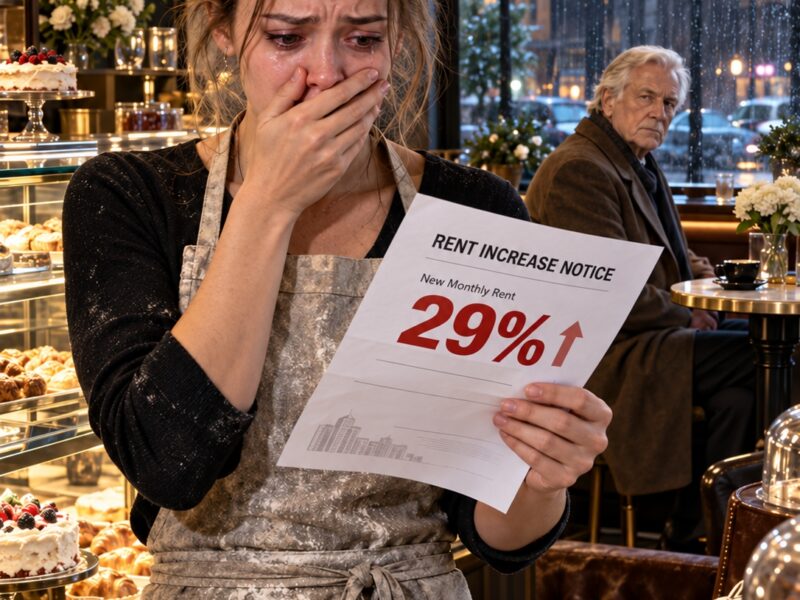
LEASE RATE ADJUSTMENT NOTICE.
She read the first paragraph.
Then the second.
Then she found the number.
Twenty-nine percent.
Emma sat down on an overturned flour bucket.
For several seconds, she heard nothing.
Not the mixer.
Not traffic outside.
Not customers speaking.
Twenty-nine percent.
Her base rent would increase by more than thirteen hundred dollars a month.
She calculated automatically.
Food sales.
Payroll.
Utilities.
Loan payments.
Insurance.
Supplier debt.
There was no version of the math in which Emma’s Oven survived.
She read the effective date again.
Ninety days.
Her mother’s recipe hung fifteen feet away on the wall.
Emma stared at the frame through the kitchen doorway.
For nearly two years she had fought for this place.
She had slept behind sacks of flour.
She had missed birthdays.
She had stopped dating.
She had stopped taking Sundays off.
She had poured every dollar into staying alive.
And now a number printed on office paper was going to erase all of it.
Rosa found her ten minutes later.
“What happened?”
Emma handed her the letter.
Rosa read it.
Her face hardened.
“Mine came too.”
Emma looked up.
“How much?”
“Twenty-six percent.”
“Oh my God.”
“The bookstore got twenty-eight.”
Emma stood.
“This can’t be right.”
“It’s right.”
“No. We call them.”
“We already have.”
“And?”
Rosa gave a bitter laugh.
“Financial review.”
Emma grabbed her phone.
The receptionist at Graystone was polite.
That somehow made Emma angrier.
“Yes, Ms. Carter, the adjustments were determined following a property portfolio review.”
“I’m not a portfolio,” Emma said.
“I understand.”
“No, I don’t think you do.”
“I can submit your concerns.”
“I’ve submitted concerns. For two years. I want to speak to whoever approved this.”
There was a pause.
“That decision came from ownership.”
“Then give me the owner.”
“Ms. Carter—”
“I have put everything I own into that bakery. I’m asking for fifteen minutes.”
Another pause.
Longer this time.
Finally the receptionist exhaled.
“The building is held privately.”
“By who?”
“I’m not sure I’m authorized—”
“Please.”
Something in Emma’s voice must have reached her.
Keys clicked.
“The principal owner is Edward Gray.”
Emma stopped breathing.
“I’m sorry?”
“Edward M. Gray. Graystone Holdings.”
The bakery around her seemed to tilt.
Edward Gray.
Emma gripped the counter.
“Can you describe him?”
The receptionist hesitated.
“Ms. Carter?”
“Please.”
“Well… late sixties. Silver hair.”
Emma closed her eyes.
The brown coat.
Exact change.
Table Six.
7:15.
“Does he come here?” the receptionist asked.
Emma barely heard her.
The phone slipped from her fingers and struck the rubber floor mat.
She stared toward the window.
Edward’s chair was empty.
And suddenly every moment she had misread rearranged itself in her mind.
The repairs.
His knowledge of the building.
The money beneath the coffee cup.
His silence.
His questions.
Her humiliation burned so hot she felt nauseated.
“He owns it,” Emma whispered.
Rosa stepped closer.
“Who?”
Emma looked at her.
“Mr. Gray.”
“The coffee guy?”
Emma nodded.
Rosa stared.
“No.”
“Yes.”
“The brown-coat guy?”
“Yes.”
“The guy you yelled at?”
Emma shut her eyes.
“Thank you, Rosa.”
“I’m just clarifying.”
“I know.”
Rosa’s face softened.
“Oh, Emma.”
Emma lowered herself into a chair.
The old man she had spent months resenting for occupying a four-dollar table owned the floor, ceiling, walls, windows, kitchen and sidewalk lease surrounding her dream.
And now his company was raising her rent almost thirty percent.
A terrible thought entered her mind.
What if this wasn’t coincidence?
What if he had never forgotten what she said?
What if the increase was punishment?
Emma hated herself for suspecting it.
Then hated herself more because she could not rule it out.
At 7:15 the next morning, she was waiting.
She had barely slept.
The bell rang.
Edward entered.
Same coat.
Same careful movements.
Same calm expression.
He approached the counter.
“Morning.”
Emma stared at him.
Edward stopped.
Something in her face told him the morning was different.
“You know,” he said.
Emma nodded.
“You own the building.”
“Yes.”
“Why didn’t you tell me?”
Edward removed one glove, then the other.
“You never asked.”
The answer stung.
Emma looked away.
“No. I didn’t.”
She placed his bread roll on the counter.
Her hands shook so badly the plate rattled.
Edward noticed.
“Emma—”
“I’m sorry.”
He went quiet.
“I’m sorry for what I said that morning. Actually, I’m sorry for more than that.”
She forced herself to meet his eyes.
“I judged you. Every day. I saw what you ordered, how long you sat there, your coat, the exact change—and I decided I understood you.”
Edward said nothing.
“I thought you were using the bakery because it was warm.”
His eyes dropped briefly.
“I thought you were lonely and cheap and had nowhere else to go.”
A sad smile touched his face.
“One of those was correct.”
Emma swallowed.
“I was exhausted. I was scared. I still am. But none of that gives me the right to make another person feel small.”
“No,” Edward said quietly. “It doesn’t.”
Emma flinched.
He was not going to make this easy.
She respected him for that.
“I found out about the rent increase.”
“I assumed that was how you learned my name.”
“Did you approve it?”
“Yes.”
The single word landed hard.
Emma’s fingers tightened against the counter.
“Because of what happened?”
Edward’s eyebrows drew together.
“What?”
“The morning I yelled at you.”
Understanding entered his face.
“You think I raised the rent because you embarrassed me?”
Emma hated the sentence once it was spoken.
“I don’t know what to think.”
Edward looked at her for a long moment.
Then he pulled out a chair.
“Do you have ten minutes?”
Emma almost laughed at the absurdity.
“I have ninety days before I lose my business. So yes. I have ten minutes.”
They sat at Table Six.
For the first time, Emma sat where Edward sat.
From his chair, she could see the bakery differently.
The framed recipe behind the counter.
The entrance.
The ovens through the half-open kitchen door.
People walking past outside.
Edward folded his hands.
“The review began six months ago,” he said. “Long before our argument.”
Emma exhaled.
A pressure she had not admitted she was carrying eased slightly.
“My management team recommended rent adjustments across several properties. I approved the review.”
“Without knowing what it would do to us.”
Edward nodded.
“Without knowing enough.”
Emma stared at him.
“That’s supposed to make me feel better?”
“No.”
“Then what are you saying?”
“I’m saying something I’m not proud of.”
He looked through the window.
“For years, I’ve owned buildings by reading reports about them.”
“Reports.”
“Occupancy. Repairs. Tax increases. Comparable rents. Revenue per square foot.”
Emma gave a humorless laugh.
“I’m sure we look very tidy in Excel.”
“You do.”
That caught her off guard.
Edward’s mouth tightened.
“That’s the problem.”
He reached for his coffee but did not drink.
“My wife’s name was Margaret.”
Emma remembered his earlier comment.
You sound like my wife.
“She died fourteen months ago.”
“I’m sorry.”
Edward nodded.
“We were married forty-one years.”
The bakery noise seemed to recede.
“Margaret baked,” he continued. “Not professionally. She never wanted that. But every morning, almost without exception.”
He smiled toward some private memory.
“She had no respect for measurements.”
Emma laughed softly.
“My mother was the same.”
“Margaret used coffee mugs instead of measuring cups.”
“That’s criminal.”
“I told her that.”
“What did she say?”
“That I still ate everything.”
Emma smiled.
Edward did too.
Then his expression changed.
“When she died, people brought food.”
Emma understood immediately.
“They always do.”
“For two weeks my refrigerator was full.”
“Then everybody went home.”
Edward looked at her.
“Yes.”
The simple answer hurt more than something dramatic would have.
“For forty-one years,” he said, “I woke up to noise. Cabinet doors. Radio. The kettle. Margaret talking to herself when she thought I was asleep.”
He looked down.
“Then there was nothing.”
Emma stayed quiet.
“I stopped eating breakfast. Stopped cooking. Some mornings I left my house at six and drove without knowing where I was going.”
His fingers tightened slightly around the coffee cup.
“One morning I was walking down Willow Street and smelled cinnamon.”
Emma’s throat tightened.
“I looked through that window.”
He pointed toward the front.
“You were standing behind the counter arguing with a tray of muffins.”
Emma covered her face briefly.
“I do that.”
“I know.”
“You heard me?”
“You threatened them.”
“They deserved it.”
Edward laughed.
Then his eyes became distant again.
“The bakery smelled like my house used to smell.”
Emma looked at him.
“That’s why you came in.”
He nodded.
“I asked for the cheapest bread because Margaret used to tease me about spending seven dollars on breakfast.”
A faint smile appeared.
“She said anyone willing to pay seven dollars for toast deserved financial hardship.”
Emma laughed despite the tears forming behind her eyes.
“And the black coffee?”
“That was hers.”
Emma looked at Table Six.
For months she had believed Edward came because he had nowhere better to go.
In a way, she had been right.
But she had mistaken grief for freeloading.
“What about the table?” she whispered.
Edward glanced toward the window.
“Margaret loved sitting by windows.”
Emma had to look away.
He continued.
“The morning you yelled at me…”
“You don’t have to—”
“Yes, I do.”
She became still.
“I almost never came back.”
Emma’s chest tightened.
“I’m sorry.”
“I know.”
“Then why did you?”
Edward studied her.
“Because I had watched you long enough to know that what you said wasn’t the whole truth about who you were.”
Emma’s eyes filled.
“That doesn’t make it okay.”
“No.”
“But you came back anyway.”
“Yes.”
“Why?”
Edward looked toward the framed recipe behind her counter.
“Second chances.”
Emma’s mother’s voice flashed through her memory.
Hungry people remember kindness longer than they remember prices.
Edward continued.
“I’d seen you feeding the woman from the alley.”
Emma blinked.
“You saw that?”
“I’d seen you give money to your brother.”
Her face changed.
“I wasn’t listening intentionally.”
“You heard.”
“Yes.”
Emma looked down.
“I saw you let a teenage boy come back and pay the next day when his card declined.”
She remembered him.
“I saw you carry coffee outside to the crossing guard when it was twelve degrees.”
Emma said nothing.
“So when you were cruel to me, I had two choices.”
Edward leaned back.
“I could decide those thirty seconds revealed your entire character. Or I could remember the months I had spent watching everything else.”
Emma wiped under one eye.
“And you picked the better version.”
“I picked the larger one.”
Those words stayed between them.
The larger one.
Not the flattering version.
Not the innocent version.
The whole version.
Emma took a breath.
“What happens now?”
Edward knew what she meant.
“The rent.”
“Yes.”
He looked serious again.
“The increase was not personal.”
“That doesn’t make it survivable.”
“I know.”
“Do you?”
His eyes lifted.
Emma’s fear sharpened her voice.
“You can walk away from this table and go home. If that increase happens, I lose everything.”
“I understand.”
“No. You understand the sentence. I need you to understand what it means.”
Edward did not interrupt.
Emma pointed toward the kitchen.
“That mixer came from a restaurant that went bankrupt in Green Bay. I drove two hours in a snowstorm because they sold it for six hundred dollars.”
She pointed to the tables.
“My brother and I refinished those ourselves.”
Then the recipe.
“My mother wrote that eleven days before she went into the hospital for the last time.”
Her voice broke slightly.
“I sleep in the storage room.”
Edward’s face changed.
“You what?”
Emma wished she could take it back.
But now that she had started, she could not stop.
“I gave up my apartment four months ago.”
“Emma.”
“I’m not asking you to feel sorry for me.”
“I don’t.”
“Good.”
“I’m worried about you.”
“That’s not useful either.”
“What would be useful?”
Emma stared at him.
“Don’t decide what this place is worth without understanding what would disappear if you price us out.”
Edward went still.
For a long time, neither spoke.
Then he nodded.
“All right.”
Emma waited.
“All right what?”
“I’ll listen.”
“To me?”
“To everyone.”
Three days later, a letter appeared beneath every tenant’s door.
MANDATORY OWNER-TENANT MEETING.
Monday.
6:30 p.m.
Ground-floor bookstore.
Rosa walked into Emma’s bakery waving hers.
“What did you do?”
Emma shook her head.
“I don’t know.”
“Did you threaten him?”
“No.”
“Cry?”
“Not strategically.”
The bookstore owner, Mr. Patel, arrived behind her.
“He suspended the increase pending review.”
Emma stared at him.
“What?”
Mr. Patel held up the letter.
“It says implementation is paused.”
Rosa looked at Emma.
“You definitely did something.”
Emma glanced toward Table Six.
It was empty.
Edward had not come that morning.
For the first time in months, 7:15 arrived without the bell.
Emma told herself it meant nothing.
At 7:20, she checked the street.
At 7:35, she checked again.
By 8:00, an uncomfortable thought had formed.
She missed him.
Not the building owner.
Not the man who might save her business.
The old man in the brown coat.
That realization unsettled her more than she expected.
At Monday’s meeting, twenty-three tenants squeezed into Willow Books after closing.
Edward stood near the front.
Beside him were two people from Graystone Property Management and a younger man in a navy suit who looked as though he had never worried about rent in his life.
Emma sat beside Rosa.
The tailor from the second storefront sat behind them.
The elderly Korean couple from Lee Shoe Repair shared one chair near the aisle.
Edward did not begin with a speech.
He began with an admission.
“I approved rent recommendations without understanding enough about the businesses affected.”
The young man in the navy suit shifted uncomfortably.
Edward continued.
“That was a mistake.”
The room quieted.
“I can tell you about maintenance costs and property taxes. Those things are real. But before I make another decision, I want to understand what the numbers cannot tell me.”
He looked around.
“So tonight, I’m listening.”
At first, nobody spoke.
Then Rosa stood.
“My mother opened the flower shop thirty-one years ago.”
Her voice shook despite her effort to sound firm.
“She arrived from Mexico with six hundred dollars and cleaned hotel rooms at night. I grew up sleeping on newspapers under the counter because she couldn’t afford childcare.”
Edward listened.
“If you raise the rent twenty-six percent, I close.”
She sat.
Then Mr. Patel spoke.
“My bookstore hasn’t made me wealthy.”
A few people laughed.
He smiled.
“But fifteen years ago, when there was no library program nearby, we started free reading afternoons for children. Fifty-two children came last summer.”
The tailor spoke next.
Then Mr. Lee.
Then the owner of the small repair shop.
A hairdresser.
A music teacher.
A woman who rented a second-floor studio for ceramic classes.
Each story changed the room.
Emma watched the management representatives gradually stop taking notes about money and begin looking at faces.
Eventually Edward turned toward her.
“Emma?”
She had not planned to speak.
She stood anyway.
“My mother taught me to bake.”
She looked down at her hands.
“They were poor recipes.”
Laughter moved gently through the room.
“I mean financially poor. Cheap ingredients. Nothing fancy.”
She smiled.
“But when I was a kid, everybody came to our apartment on Sundays because she always made enough to share.”
Emma glanced around.
“I opened Emma’s Oven because I wanted to recreate that feeling.”
Her voice tightened.
“I’ve made a lot of mistakes trying to keep it alive.”
Edward met her eyes.
“One of them was forgetting why I opened it.”
Nobody understood exactly what she meant.
Edward did.
Emma continued.
“I don’t think landlords should lose money because tenants have emotional stories.”
The navy-suit man looked almost relieved.
“But I also don’t think neighborhoods survive when every decision is made as though the only thing that matters is the highest number somebody could theoretically pay for a room.”
The relief disappeared.
A few tenants nodded.
Emma sat down.
Edward stayed quiet for several seconds.
Then he closed the folder in his hands.
“The proposed increases are canceled.”
Nobody moved.
Rosa whispered, “What?”
Edward repeated it.
“The proposed increases are canceled.”
The room erupted.
People began speaking at once.
Edward raised a hand.
“Not frozen forever. Costs exist. Repairs exist. Taxes rise.”
The room settled.
“But future adjustments will be phased, individually reviewed and capped at manageable levels. Major structural repairs will not be passed directly to tenants through surprise increases.”
The property manager turned toward him.
“Edward—”
“We’ll discuss it.”
“But the projected return—”
“I said we’ll discuss it.”
The man fell silent.
Edward looked around the bookstore.
“This isn’t charity.”
His eyes moved briefly to Emma.
“It’s correction.”
After the meeting, tenants surrounded him.
Emma waited until the bookstore emptied.
Edward was putting on his coat when she approached.
“Thank you.”
He shook his head.
“You were right.”
“About what?”
“I didn’t understand what I owned.”
Emma frowned.
“You own a building.”
“That’s what I thought.”
He looked through the bookstore window toward the row of glowing storefronts.
“Turns out I own responsibilities too.”
Emma smiled.
Then she remembered something.
“Where were you Thursday?”
Edward looked confused.
“You didn’t come in.”
“Doctor.”
Her stomach dropped.
“Are you okay?”
He blinked, then realized.
“Yes. Routine.”
Emma exhaled so visibly that he smiled.
“You noticed?”
“Don’t get arrogant.”
“I wouldn’t dare.”
“Seven fifteen tomorrow?”
Edward buttoned his coat.
“If I’m welcome.”
Emma stared at him.
“Don’t make me answer that.”
He smiled.
At exactly 7:15 the next morning, the bell rang.
Emma already had his roll ready.
But beside it sat something else.
A warm cinnamon roll.
Edward looked at it.
“I didn’t order that.”
“No.”
“I ordered plain bread.”
“I heard you.”
“Then why is that there?”
Emma poured his coffee.
“Because you’ve had the cheapest thing on the menu for five months and I’m starting to take it personally.”
“I don’t need charity.”
She looked at him.
“It isn’t charity.”
Edward recognized his own words.
Emma pushed the cinnamon roll closer.
“It’s correction.”
For the first time since Margaret’s death, Edward Gray laughed loudly enough that people at the other tables turned to look.
Something changed after that.
Not all at once.
Emma was still in debt.
Her oven did not become magically young.
Customers still complained.
Suppliers still wanted payment.
Business remained business.
But surviving no longer felt exactly like waiting for disaster.
And Emma noticed something else.
Once her fear eased enough for her to look beyond herself, people became visible again.
There was Walter, who came in every Tuesday at eleven and ordered tomato soup.
Emma had assumed he liked Tuesdays.
Eventually she learned Tuesday was the day he used to take his wife to chemotherapy. She had died two years earlier, and he still could not sit alone at home between ten and noon.
There was Camille, the woman who sat by the rear wall with one coffee for two hours.
Emma had privately resented her too.
Then she learned Camille had lost her marketing job and spent those afternoons filling out applications because she could not bear to let her children see how frightened she was.
There was Daniel, a delivery driver who always bought two pastries.
One morning Emma teased, “You know you can eat both here.”
He looked embarrassed.
“The second one’s for my mom.”
“Does she like almond?”
“She likes anything I bring home.”
Then, after a pause, “She has early dementia. Sometimes she forgets my name. But she always remembers this place.”
Emma stood behind the counter after he left and thought about all the stories she had nearly missed.
Everyone carried something.
The realization did not make her endlessly patient.
She still got irritated.
She still had bad days.
But irritation was no longer the end of her curiosity.
Sometimes she asked a second question before making a judgment.
That small habit changed more than she expected.
Edward changed too.
He began visiting the building without his management team.
He met tenants.
He learned names.
He discovered the second-floor plumbing had been unreliable for years even though quarterly maintenance reports listed it as “functional.”
He learned the rear entrance was dangerous after dark.
He learned Mr. Lee had requested a handrail eleven months earlier.
Edward became furious.
At himself.
“You pay people to tell you what’s happening,” Emma said one morning.
“They told me.”
“No. They gave you data.”
Edward looked toward the window.
“What’s the difference?”
Emma smiled.
“One fits in spreadsheets.”
“And the other?”
“Walks into your bakery every morning.”
By late spring, Willow Street looked different.
The building repairs were completed properly.
New lighting went up along the rear sidewalk.
The exterior brick was restored.
Storefront signs were cleaned rather than replaced with generic corporate designs.
Then Edward approached Emma with another idea.
It happened at 7:42 on a Wednesday.
He had finished half his coffee.
“What happens to the bread you don’t sell?”
Emma glanced toward the kitchen.
“Some goes home with staff. Some to Marlene. I donate what I can.”
“How much is wasted?”
“More than I like.”
Edward nodded.
“What if none was?”
She looked suspicious.
“You have your building-owner face.”
“I have a face?”
“You absolutely have a face.”
“What does it look like?”
“Like you’re about to spend somebody else’s time.”
Edward almost smiled.
“I want to start something.”
Emma leaned against the chair opposite him.
“What?”
“A breakfast program.”
She waited.
Edward explained.
Customers could pay for an extra breakfast item when ordering.
Nothing large.
Three dollars.
Five dollars.
The donated amount would fund simple breakfast bags: bread, fruit, milk vouchers, sometimes eggs or oatmeal.
Local families could collect them discreetly.
No applications at the counter.
No public list.
No requirement to prove desperation to strangers.
Emma liked the idea immediately.
That frightened her.
“Who manages it?”
“You.”
“There it is.”
“I’ll fund startup costs.”
“Edward.”
“And cover administrative expenses for a year.”
“Edward.”
“And—”
“No.”
He stopped.
“You haven’t heard the rest.”
“That’s why I’m stopping you.”
“Why?”
“Because I’m already working sixteen hours a day.”
“Twelve.”
“Sixteen.”
“You promised twelve.”
“I lie.”
“I know.”
Emma sat.
“If we do this, it can’t depend on me destroying myself.”
Edward considered that.
“What would make it sustainable?”
Emma thought for a moment.
“A coordinator.”
“Done.”
“I didn’t say hire someone.”
“I did.”
“Part-time.”
“Full-time.”
“Edward.”
“Part-time.”
Emma narrowed her eyes.
“And volunteers.”
“Yes.”
“And donations have to cover food costs eventually.”
“Agreed.”
Emma crossed her arms.
“What do you want out of this?”
Edward looked surprised.
“Nothing.”
“I don’t believe rich people who say that.”
“I’m not asking you to.”
She waited.
Finally he said, “Margaret hated wasted food.”
Emma’s expression softened.
“She used to freeze everything.”
“My mother too.”
“She once froze half a wedding cake.”
“Why?”
“She said sugar was expensive.”
“Was it your wedding cake?”
“No.”
Emma stared at him.
Edward smiled.
“I never asked where it came from.”
Emma laughed so hard she had to sit down.
The Willow Breakfast Shelf began six weeks later.
It started small.
A wooden sign near the register read:
BUY ONE FOR SOMEONE ELSE.
No dramatic slogans.
No photographs of recipients.
No speeches.
People simply added three dollars to their checks.
The first week, forty-one breakfasts were covered.
The next week, ninety-six.
A local elementary teacher named Claire Monroe heard about it and offered to connect the bakery with families through the school counselor.
A retired nurse volunteered on Thursdays.
Rosa donated small bunches of leftover flowers for the tables.
Mr. Patel created a children’s shelf in the bakery with used books people could take without charge.
The idea spread through neighborhood social media.
People began driving from outside Willow Street to buy breakfast because they liked what the building was doing.
Business increased.
Emma hated admitting Edward had accidentally developed an excellent marketing strategy.
“I told you community matters,” he said.
“You didn’t predict this.”
“I absolutely did.”
“You asked me last week what Instagram was.”
“I know what Instagram is.”
“You called it ‘the Instagram.’”
“That was once.”
Emma laughed.
For the first time in years, the bakery’s bank account stopped making her nauseated.
She paid Cal, the flour supplier, in full.
The day she sent the final overdue payment, he called.
“Are you dying?”
Emma frowned. “Why?”
“You paid the whole invoice.”
“Very funny.”
“I’m proud of you.”
She went quiet.
Cal softened.
“You okay?”
Emma looked around the bakery.
At customers.
At the breakfast shelf.
At Edward reading by the window.
“Yeah,” she said.
For once, she meant it.
She rented a small apartment again.
The first night she slept there, she woke at 2:13 a.m. in panic because she couldn’t hear the bakery refrigerator.
Then she remembered she was home.
Home.
She lay staring at the ceiling until she began crying.
Not from sadness.
From the delayed realization of how exhausted she had been.
The next morning she arrived at work at 5:15 instead of 4:30.
Edward entered at 7:15.
“You’re late,” he said.
Emma stared at him.
“Do you want to die?”
He smiled into his coffee.
Summer arrived.
Then fall.
The bakery found its rhythm.
Jake got another job.
Sophie began spending Saturdays at Emma’s Oven, where she decorated cookies badly and gave customers unsolicited business advice.
“You need more pink,” she told Edward one morning.
“Pink what?”
“Everything.”
Edward considered this.
“I’ll inform management.”
“Good.”
Sophie approved.
Edward became part of their lives so gradually that nobody could identify the exact moment it happened.
He attended Sophie’s school play.
He helped Jake negotiate a lease when Jake found a better apartment.
At Thanksgiving, Emma invited Edward to dinner.
He declined.
Emma did not argue.
Then Thanksgiving morning at 9:03, he appeared at the bakery carrying a bottle of wine.
Emma opened the door.
“You said no.”
“I reconsidered.”
“You’re twelve hours early.”
“I panicked.”
She stepped aside.
“Come in.”
That Thanksgiving was Edward’s first holiday at a crowded table since Margaret died.
He spoke very little during dinner.
But when Sophie fell asleep against his arm while watching a movie, Edward did not move for almost an hour because he did not want to wake her.
Emma watched from the kitchen.
Something inside her hurt beautifully.
Later that night, after Jake and Sophie left, Edward stood near the bakery door with his coat on.
“Thank you,” he said.
“For dinner?”
“For not making a ceremony out of me being here.”
Emma understood.
“You’re welcome.”
He looked toward Table Six.
“Margaret would have liked you.”
Emma smiled.
“Margaret had questionable taste. She married you.”
Edward laughed.
Then his face grew quiet.
“No,” he said. “She would have really liked you.”
Emma did not know what to say.
So she hugged him.
Edward froze.
For one second Emma thought she had made a mistake.
Then he put his arms around her.
His shoulders shook once.
Only once.
Emma pretended not to notice.
That was another kind of kindness she had learned.
Sometimes seeing somebody meant knowing when not to say you had seen them.
Winter returned.
One snowy morning in January, Edward came in carrying a small wooden box.
Emma noticed immediately.
“What’s that?”
He placed it on the counter.
“For you.”
“If it’s a rent notice, I’m throwing coffee at you.”
“It isn’t.”
She wiped her hands and opened the box.
Inside was a worn recipe notebook.
The cover was blue cloth, faded almost gray at the corners.
Emma looked up.
Edward’s face had changed.
“This was Margaret’s.”
Emma immediately pushed the box toward him.
“No.”
“Emma.”
“I can’t take this.”
“I want you to.”
“No.”
“Yes.”
“It belonged to your wife.”
“That’s why I’m giving it to someone who will use it.”
Emma stared at the notebook.
“Edward…”
“She wrote recipes in it for thirty years.”
“Then it belongs with you.”
He was quiet.
“No,” he said finally. “It belongs somewhere bread is still being made.”
Emma looked at him.
His eyes glistened.
“She wouldn’t want it sitting in a drawer because I was afraid to let anything go.”
Emma touched the cover.
Carefully.
As though Margaret herself might feel it.
She opened the notebook.
The pages were crowded with handwriting.
Measurements crossed out.
Notes in margins.
Coffee stains.
Butter marks.
One page contained three different versions of apple cake and an angry handwritten comment:
TOO DRY. EDWARD CLAIMS OTHERWISE. EDWARD IS WRONG.
Emma laughed through sudden tears.
“She seems reasonable.”
“She was relentless.”
Emma turned another page.
Inside the front cover, written in blue ink, was a sentence.
Good bread needs patience. Dough cannot be bullied into rising before it’s ready.
Beneath it, in different ink, Margaret had added years later:
People are probably the same.
Emma stared at the words.
Edward looked toward the window.
“She wrote that after we had a terrible fight.”
“About what?”
“I don’t remember.”
Emma looked up.
“Really?”
“I remember thinking our marriage was over.”
“What happened?”
“We ate breakfast.”
Emma laughed softly.
“Then?”
“We stayed married another twenty-seven years.”
Emma traced the words with one finger.
People are probably the same.
Some need time.
Some need another chance.
Some need the warmth of a place before they remember how to become themselves again.
Emma closed the book against her chest.
She thought of the morning she had humiliated Edward.
She thought of the woman she had been then.
Exhausted.
Afraid.
Sharp with anybody who seemed to require more from her.
She had believed survival meant protecting every chair, every dollar, every minute, every ounce of herself.
Maybe survival had required something else too.
Room.
For other people.
For mistakes.
For repair.
For the possibility that a person could behave badly without being permanently bad.
Emma stepped around the counter and hugged Edward again.
This time he hugged her immediately.
“Thank you,” she whispered.
He smiled into her hair.
“You haven’t tasted the recipes yet.”
“What if they’re terrible?”
“Then don’t tell me.”
“They’re probably terrible.”
“Give the book back.”
She pulled away laughing.
“No chance.”
Years later, people told stories about Emma’s Oven as though it had always been successful.
That amused Emma.
Success had a way of editing its own history.
Visitors saw the expanded kitchen and assumed it had always been spacious.
They saw six employees and assumed Emma had always had help.
They saw the line outside on Saturday mornings and imagined the bakery had always been popular.
They did not see the folding cot that had once been behind the flour sacks.
They did not see the shutoff notice beneath the register.
They did not hear Emma begging a supplier for one more week.
They did not see eighty dollars beneath a coffee cup after she had humiliated a grieving man.
But Emma remembered.
She kept reminders.
Not as punishment.
As perspective.
The burnt metal tray from the morning she snapped at Edward remained hanging near the rear kitchen door.
When an employee once asked why she had never thrown it away, Emma said, “It’s useful.”
“For what?”
“Remembering not to assume the worst version of myself is the only version available.”
The employee looked confused.
Emma smiled.
“You’ll understand when you’re older.”
At thirty-six, she had become exactly the kind of person she used to hate.
The bakery expanded into the empty storefront next door.
Emma added weekend baking classes for children.
The Willow Breakfast Shelf grew into a neighborhood nonprofit run independently from the bakery.
Rosa became its board president.
Mr. Patel handled literacy programs.
Jake managed logistics.
Edward tried to stay out of meetings and failed.
He still came every morning.
7:15.
Always the old brown coat in winter.
Always black coffee.
And despite Emma’s efforts, often the cheapest bread roll.
“You can afford a croissant,” she told him one morning.
“That’s how wealth disappears.”
“You own six buildings.”
“Seven.”
“Then buy the croissant.”
“No.”
“Margaret would have wanted you to.”
“Don’t weaponize my dead wife.”
Emma laughed.
“Croissant?”
Edward sighed.
“Fine.”
“Chocolate?”
“Plain.”
“You’re impossible.”
“Yet you continue serving me.”
Above the counter hung two photographs.
One showed Helen Carter in the tiny apartment kitchen above the laundromat, flour on her face, laughing at whoever held the camera.
The other showed Margaret Gray sitting on a backyard step with a mixing bowl in her lap.
Between them hung Margaret’s handwritten sentence, copied onto a small wooden plaque:
PEOPLE NEED TIME TO RISE TOO.
Emma never hung the phrase “Everyone deserves a second chance.”
She had considered it.
But over the years she had come to believe the truth was more complicated.
Second chances were not automatic.
They did not erase consequences.
They did not require tolerating cruelty forever.
Some relationships could not be repaired.
Some apologies arrived too late.
Some harm changed things permanently.
But Emma believed people should at least be allowed to become more than their worst morning.
She was living proof.
Edward was too.
One evening, long after closing, Emma found him sitting at Table Six.
It was unusual.
Edward had stopped staying late years earlier.
The bakery was dim except for the pendant lights above the counter.
Snow drifted past the windows.
Emma approached.
“You okay?”
Edward looked up.
“Yeah.”
“You’re a bad liar.”
“I’m an excellent liar.”
“You once told Sophie the tooth fairy had a pension plan.”
“She asked complicated questions.”
Emma sat across from him.
Edward looked toward the window.
“Today would’ve been Margaret’s birthday.”
Emma said nothing for a moment.
“How old?”
“Seventy-three.”
Emma nodded.
Then she stood, went behind the counter and returned with a cinnamon roll still warm from the last batch.
She placed it beside him.
Edward looked at it.
“What’s this?”
“Dinner.”
“That’s nutritionally irresponsible.”
“So is grief.”
He smiled faintly.
Emma poured herself coffee.
They sat together.
No customers.
No music.
No need to fill the silence.
After several minutes Edward broke off a piece of cinnamon roll.
“Your mother’s recipe?”
“Mostly.”
“What does mostly mean?”
“I changed the icing.”
Edward looked offended.
“You changed Helen’s recipe?”
“She’s dead. She can’t stop me.”
“Margaret would haunt you.”
“Margaret put raisins in bread. Her judgment is questionable.”
Edward laughed.
Then the laughter faded.
His eyes moved slowly around the bakery.
“You know what I thought after Margaret died?”
Emma waited.
“That the important part of my life had already happened.”
Something in his voice tightened her chest.
“I thought everything after her would just be… remaining.”
Emma looked at him.
Edward continued.
“I didn’t want to die. I just couldn’t imagine wanting anything from the future.”
The snow thickened beyond the glass.
“And then one morning,” he said, “I smelled cinnamon.”
Emma smiled.
“You found a bakery with excellent pricing.”
“I found a very rude woman.”
“She improved.”
“Marginally.”
Emma kicked him lightly beneath the table.
Edward smiled.
Then his eyes filled.
“You gave me somewhere to go in the mornings.”
Emma shook her head.
“You saved my bakery.”
“No.”
“You did.”
“I changed a rent decision.”
“You changed more than that.”
Edward looked at her.
Emma leaned forward.
“You taught me something I needed to learn when I was becoming somebody I didn’t recognize.”
“What?”
“That pain makes terrible evidence.”
Edward frowned slightly.
Emma explained.
“I was hurting, so I thought everyone irritating me must be selfish. I was scared, so I thought everything taking up space was stealing something from me. I looked at you and saw a four-dollar customer occupying a table.”
Edward smiled faintly.
“I was four twenty-five.”
“Inflation.”
“Fair.”
Emma looked toward the framed recipes.
“But you were grieving. And I didn’t know.”
“You couldn’t have.”
“I could have been kinder without knowing.”
Edward considered that.
“Yes.”
Emma nodded.
“That’s the part I don’t want to forget.”
He looked at her for a long moment.
Then he said, “You weren’t wrong about one thing.”
“What?”
“I was using the bakery.”
Emma blinked.
Edward smiled.
“I was using it for warmth.”
Her eyes filled.
“Edward.”
“It just wasn’t the kind you thought.”
Emma looked down because if she kept looking at him she would cry.
The little bakery hummed around them.
The refrigerator clicked.
Pipes shifted inside the wall.
A bus passed outside.
Ordinary sounds.
The sounds of a place alive.
Emma remembered being nine years old, sitting on a kitchen stool while her mother kneaded dough.
“How do you know when it’s ready?” young Emma had asked.
Helen pressed her thumb gently into the dough.
“You don’t rush it.”
“But how do you know?”
Her mother smiled.
“You learn to pay attention.”
At the time, Emma thought she was talking about bread.
Years later, she understood.
The next morning, Emma arrived before sunrise.
She mixed dough.
She prepared coffee.
She opened the blinds.
At 7:13, snow still covered Willow Street.
At 7:14, she placed a plain bread roll on a plate.
Then she reconsidered.
She added a small cinnamon roll beside it.
At exactly 7:15, the bell above the door rang.
Edward Gray stepped inside wearing the old brown coat.
The same coat Emma had once used as evidence in a story she invented about him.
Poor.
Lonely.
Cheap.
Inconvenient.
She knew better now.
A person could be wealthy and lonely.
Powerful and grieving.
Generous and flawed.
Kind and still capable of making decisions that hurt people.
A woman could be hardworking and cruel in the same morning.
A good person could fail somebody.
A hurt person could hurt someone else.
And an apology, when followed by change, could become the first sentence of a different ending.
Edward approached the counter.
Emma pushed the plate toward him.
He looked down.
“There are two rolls.”
“I can count.”
“I ordered one.”
“You haven’t ordered yet.”
“I was going to order one.”
“Then it’s fortunate I ignored you.”
Edward shook his head.
“You’re becoming impossible.”
“I learned from my landlord.”
He picked up his coffee.
Then he paused.
“Emma?”
“Yeah?”
He looked around the bakery.
Morning light was beginning to reach through the windows.
Behind Emma, Helen’s photograph caught a thin strip of gold.
Margaret’s recipe book rested on a shelf beneath it.
Outside, Willow Street was waking.
Edward smiled.
“Margaret would’ve loved this place.”
Emma’s throat tightened.
She looked at him.
“Maybe she does.”
Edward said nothing.
For a moment, grief crossed his face.
Then something softer followed it.
Not healing exactly.
Emma had learned not to use that word too easily.
Some losses were not wounds that closed.
They became rooms inside you.
You learned where the furniture was.
You learned how to walk through them in the dark.
Edward carried Margaret with him.
Emma carried Helen.
Neither had stopped missing them.
But missing someone, Emma eventually understood, was not proof that life had ended.
Sometimes grief and gratitude occupied the same chair.
Sometimes an old recipe found a new kitchen.
Sometimes a woman who nearly lost her dream ended up feeding a neighborhood.
Sometimes a businessman who thought his life had already happened discovered that the future could still know his name.
And sometimes the person who irritated you most was not your enemy.
Sometimes they were simply standing in front of you carrying a story you had not yet bothered to learn.
Edward walked toward Table Six.
Emma watched him sit by the window.
Once, she had counted every minute he stayed there.
Now she hoped he stayed as long as he wanted.
She turned back toward the counter as the door opened again.
A young mother came in holding the hand of a tired little boy.
A delivery driver followed.
Then Walter.
Then Camille, who had recently found another job but still preferred filling out paperwork at Emma’s tables.
The bakery filled with voices.
Coffee cups.
Chair legs.
Laughter.
Life.
Emma moved through it all.
Not perfectly.
Never perfectly.
But differently.
And when the bell above the door rang again, she did not hear the sound of another demand.
She heard her mother in a tiny kitchen above a laundromat.
She heard Margaret laughing somewhere inside an old recipe book.
She heard Edward ordering the cheapest roll despite owning half the block.
She heard the sound of a second chance arriving without announcing itself.
Emma glanced toward Table Six.
Edward lifted his coffee in a silent toast.
She smiled.
Years earlier, on the worst morning of her life, Emma Carter had looked at an old man in a worn brown coat and believed she knew exactly who he was.
She had been wrong.
But the deeper truth—the truth she would spend the rest of her life remembering—was that Edward had looked at Emma on that same terrible morning and understood something she had not yet learned to offer anyone else.
He had seen her at her worst.
And he had refused to believe it was the whole story.









