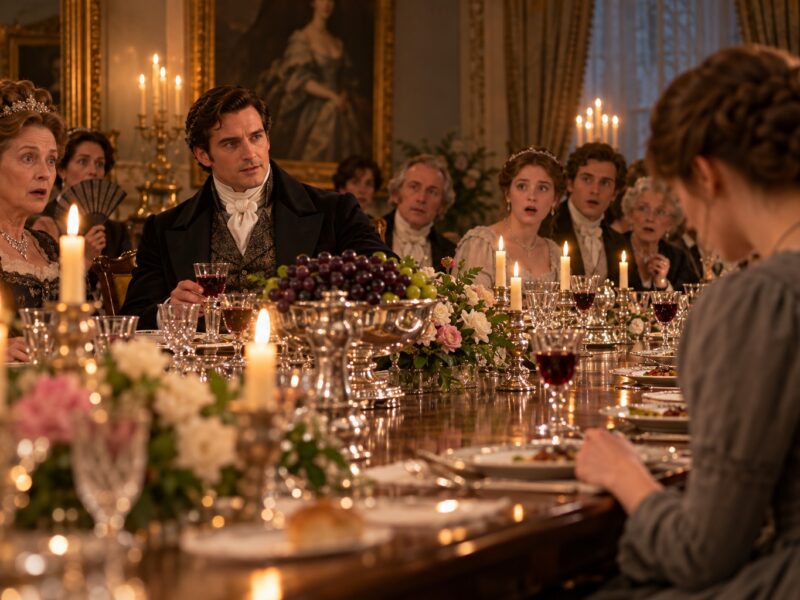
SHE IS 30 AND STILL UNMARRIED,” HER AUNT MOCKED AT DINNER—THEN THE DUKE STOOD UP AND SAID, “I HAVE BEEN WAITING FOR HER FOR TWELVE YEARS.”
The laughter had barely begun when the Duke of Asheford set down his wineglass.
At the far end of the dining table, a woman in a faded gray gown stared at her plate, pretending not to hear the cruel remarks being made about her.
Then the most powerful gentleman in the county spoke a single sentence that turned twelve years of carefully buried secrets into a scandal no one at Crane Park would ever forget.
“So am I, Lady Harriet. Thirty-four and still unmarried. And I have been waiting for her.”
The silence that followed was extraordinary.
Lady Harriet Crane’s silver spoon slipped from her fingers and struck the edge of her plate with a sharp, delicate ring. Across the table, young Clarissa stopped laughing. Her fiancé, Mr. Edmund Fairley, sat motionless with a forkful of pheasant suspended halfway to his mouth.
At the very end of the table, Eleanor Whitmore felt the blood drain from her face.
She knew that voice.
She had not heard it in twelve years, but there had been a time when she could have recognized it through a locked door, across a crowded street, or beneath the noise of a summer thunderstorm.
Now the man who had once promised to return for her was sitting at her aunt’s dinner table, wearing a duke’s title and looking directly at her.
And Eleanor could not bring herself to raise her eyes.
Only moments earlier, Lady Harriet had been enjoying one of her favorite forms of entertainment: reminding her guests that her niece was an unmarried woman of thirty.
“And of course there is our dear Eleanor,” she had announced, lifting her glass of claret so the candlelight shone through it. “Thirty years old and still without a husband. We have quite given up hope, I am afraid.”
She had smiled as though delivering a charming observation rather than a deliberate humiliation.
“But she is wonderfully useful with the household accounts, and the children of the parish adore her. One must count one’s blessings.”
The guests had laughed because Lady Harriet was their hostess, and a hostess’s jokes, however unkind, were generally expected to be appreciated.
Mrs. Pumphrey concealed her amusement behind her fan. Sir Gerald Hollis produced a hearty bark of laughter. Clarissa Crane, nineteen and newly engaged, laughed loudest, leaning toward Mr. Fairley to whisper something that made him grin.
Eleanor sat beneath the salt, far from the honored guests, wearing the same gray gown she had altered twice to disguise its age.
She lowered her eyes and smiled.
It was a particular smile, one she had spent twelve years perfecting. It required neither happiness nor forgiveness. Only enough control to persuade the people around her that their words had failed to hurt.
She had heard variations of the same judgment at church, in drawing rooms, at village shops, and even over the breakfast table.
Poor Eleanor. Such a sensible creature, but no fortune. Rather too old now to attract a serious gentleman. Perhaps some elderly widower would eventually appreciate a companion so practical and undemanding.
She had learned not to answer.
There were few advantages to being a dependent relative, but one could at least avoid worsening one’s circumstances by remaining quiet.
Yet the Duke had not laughed.
His Grace Alexander Thorne, Duke of Asheford, had returned to the county only a fortnight earlier to take possession of his ancestral home. At thirty-four, he was a distinguished former soldier, broad-shouldered and dark-haired, with a quiet manner that suggested he preferred listening to speaking.
Every mother with an unmarried daughter had been maneuvering to secure his attention.
Lady Harriet had been especially delighted when he accepted her invitation. Her daughter Clarissa was already engaged, but having a duke at her table was still a triumph worth celebrating.
Now that same duke was looking past the silver, crystal, flowers, and candles toward the woman Lady Harriet had just made the subject of a joke.
“I have been waiting for her,” he repeated, quietly enough that no one could mistake his seriousness.
Eleanor’s fingers tightened around her fork.
The china beneath it made a faint tapping sound. She tried to stop the trembling, but her hands no longer obeyed her.
For twelve years, she had imagined what she might say if she ever met Alexander again.
She had imagined greeting him politely. Perhaps asking after his health. Perhaps congratulating him upon his marriage, if he had married the wealthy young woman her aunt had once mentioned.
She had never imagined him looking at her with the same expression he had worn beneath an apple tree when they were young.
And she had certainly never imagined him declaring, before half the county, that he had been waiting for her.
Twelve years earlier, Eleanor Whitmore had been eighteen and living with her father at the little stone vicarage in Little Hartwell.
The Reverend Thomas Whitmore was a gentle, scholarly man whose affection for books was exceeded only by his affection for his daughter. Their modest home possessed more volumes than shelves, and the books overflowed onto staircases, windowsills, bedside tables, and even, on one memorable occasion, into an unused oven.
Eleanor’s mother had died when she was eight.
In the ten years that followed, father and daughter had become each other’s closest companions. He taught her Greek and Latin, encouraged her curiosity, and treated her opinions with a seriousness that many gentlemen reserved exclusively for other men.
She managed the household, mended his increasingly threadbare coats, and occasionally persuaded him to shorten a sermon when his enthusiasm for a theological subject threatened to exhaust the congregation.
To supplement his income, the Reverend Whitmore accepted pupils from respectable families. These were usually young gentlemen preparing for university or a profession, sent to Little Hartwell for a season of concentrated study.
In the summer of 1804, one such pupil arrived in a traveling carriage.
His name was Alexander Thorne.
At twenty-two, Alexander was the younger son of the Duke of Asheford. His elder brother Charles stood to inherit the family title and estates, while Alexander could expect only a modest allowance, a respectable name, and whatever life he made for himself.
His commission in the army had already been purchased. He was to join his regiment in the autumn, and his father had decided that a final summer of disciplined study would be good for him.
According to the old duke, Alexander read far too much poetry and not nearly enough history.
Eleanor expected to dislike him.
She imagined a proud young gentleman accustomed to servants anticipating his every need, a man who would complain about the food and leave his boots scattered through the hallway.
Instead, she found him on the floor of her father’s study.
Every chair was occupied by books, so Alexander had settled himself beside the window with a worn volume of Cowper’s poetry. The late afternoon light was fading, but he seemed entirely absorbed in what he was reading.
“You will ruin your eyes,” Eleanor said from the doorway. “There is scarcely enough light.”
He looked up.
For a moment, he seemed surprised to discover someone standing there. Then he smiled, not the polished smile of a fashionable gentleman, but an open, unguarded one.
“I suspect my eyes have survived worse,” he replied.
“Then they have been fortunate.”
“Are you always so severe with strangers?”
“Only those who attempt to read in the dark.”
He laughed, and Eleanor found herself smiling before she had meant to.
That was how it began.
Not with a grand declaration or a dramatic encounter, but with a young man sitting among books and a young woman who refused to be impressed by his title.
The weeks passed gently.
Alexander accompanied Reverend Whitmore on walks through the village and sometimes helped Eleanor carry provisions to elderly parishioners. Once, when they visited Mrs. Tully’s cottage beside the river, Alexander noticed that her garden gate had broken.
Without making a ceremony of the matter, he removed his coat, rolled up his sleeves, and spent an hour repairing it.
Eleanor watched him from the cottage window.
His hands were scratched by the time he finished. Mrs. Tully tried to reward him with a jar of preserves, and he accepted it with such solemn gratitude that the old woman laughed until tears appeared in her eyes.
Later, as they walked home, Eleanor asked why a duke’s son had concerned himself with a broken gate.
“Because it was broken,” he answered.
She looked at him.
He looked back, puzzled by the question.
And Eleanor realized that she had begun to love him.
There were arguments about poetry over supper and long walks beside the river. There were evenings when the Reverend Whitmore fell asleep in his chair while Alexander and Eleanor continued discussing some book until the candles burned low.
There was also a particular afternoon in July.
A thunderstorm swept across Little Hartwell while they were walking through the orchard. Rain came down so suddenly that neither had time to reach the house.
They took shelter beneath an old apple tree, although its branches offered little protection.
Eleanor had lost one shoe in the wet grass. Alexander had searched for it in the downpour, returned triumphantly with the muddy object, and then nearly slipped trying to present it to her.
She laughed so hard that she had to hold the tree trunk to remain standing.
Alexander stood in front of her, soaked through, his dark hair plastered against his forehead.
And gradually, his laughter faded.
He looked at her with an expression she had never seen before.
“Eleanor,” he said softly.
She became still.
Rain struck the leaves above them. Somewhere beyond the orchard, thunder rolled across the hills.
“I have nothing to offer you,” he said. “Not in the way a gentleman ought to offer something to a lady he means to marry. I have a commission, my name, and a younger son’s allowance.”
She could hear the effort it cost him to speak so plainly.
“I don’t know where the army will send me. I don’t know how long I’ll be away, or whether I’ll come home. I have no right to ask you to promise me anything.”
“Then don’t ask,” she whispered.
He frowned slightly.
“Just tell me.”
He took her hand.
“I love you.”
It was extraordinary how quietly he said it.
There was no grand flourish, no speech borrowed from the poetry he loved. Only three words, spoken with such complete sincerity that Eleanor felt something inside her settle into place.
“I have loved you since the evening you scolded me for reading in the dark,” he continued. “And I believe I shall love you for the rest of my life.”
She looked down at their joined hands.
“I love you, too.”
He closed his eyes briefly.
Then he made her a promise.
He would write every week, wherever the army sent him. He would save whatever he could from his allowance and military pay. And when he returned with a captain’s rank and sufficient means to support a wife, he would come straight back to Little Hartwell and ask her father for permission to marry her.
“Will you wait for me?” he asked.
Eleanor squeezed his hand.
“However long it takes.”
Before he departed that September, Alexander gave her something.
It was a slender silver ring with a single tiny pearl at its center, plain and delicate from years of careful wear.
“It belonged to my mother,” he told her.
Eleanor stared at it.
“Alexander, I cannot take this.”
“Of course you can.”
“It is too precious.”
“That is why I want you to have it.”
He smiled, although his eyes were serious.
“It is not an engagement ring. Not yet. Your father would have my head if I presumed so much without asking him. Think of it as a promise.”
He placed it in her palm.
“When I come home, I shall put it on your finger properly.”
Eleanor threaded the ring onto a narrow blue ribbon and wore it beneath her dress, close to her heart.
She stood beside the garden gate on a cold September morning and watched his carriage disappear along the road.
The first letter arrived in October.
It came from Portsmouth and was four pages long, full of observations about his fellow officers, the miserable food, the relentless sea wind, and a lieutenant who had somehow managed to misplace three pairs of boots in a single week.
At the bottom of the final page, Alexander had written:
I think of you every hour. I think of the orchard, the apple tree, and the rain. Wait for me, my dearest. Wait for me.
Eleanor read it until the paper softened along its folds.
A second letter arrived in December, written aboard ship. His handwriting tilted unevenly across the page, but the message was unchanged.
He loved her.
He would return.
He wanted her to wait.
Then, in February 1805, everything in Eleanor’s world changed.
Her father went out during a snowstorm to visit a dying parishioner. He returned exhausted and shivering, with a cough that grew steadily worse.
Within days, the illness settled in his lungs.
Eleanor nursed him through eleven terrible days.
She kept the fire burning, prepared broth he could barely swallow, and sat beside his bed as the candles shortened and the hours passed.
On the final evening, he opened his eyes with unexpected clarity.
“My girl,” he said.
She leaned closer.
“You are the best thing I ever did.”
“Papa, don’t speak. You need your strength.”
His hand tightened weakly around hers.
“Do not let anyone tell you that you are less than you are.”
Those were his last words.
The next morning, Eleanor Whitmore was an orphan.
The vicarage belonged to the parish and would pass to the next clergyman. Her father’s books were sold to discharge his debts. The income Eleanor was told remained to her amounted to scarcely forty pounds a year.
She had no brother, no independent home, and no practical means of supporting herself in the manner to which she had been raised.
Then her mother’s sister wrote.
Lady Harriet Crane lived comfortably with her husband, Bertram Crane, at Crane Park in the neighboring county. Her letter expressed sympathy for Eleanor’s bereavement and assured her that family had a duty to protect its own.
She offered Eleanor a home.
Eleanor wept with gratitude.
She did not yet understand the price of that generosity.
Before leaving Little Hartwell, she wrote Alexander a long letter describing her father’s death, her grief, and her impending move.
She addressed it to his regiment and told him where to find her.
I am frightened, Alexander. Everything has changed, and I do not know what will become of me. But I am safe with my aunt, and I am still waiting. I shall always wait.
She sealed the letter carefully.
Then she departed for Crane Park with a single trunk containing almost everything she owned.
No answer came.
At first, Eleanor told herself that the war had disrupted the post. Ships were delayed, roads were dangerous, and correspondence could disappear somewhere between an army camp and an English village.
She wrote again in April.
Then in June.
Then in August.
Each letter was placed in Lady Harriet’s hands, because her aunt managed the household correspondence.
“I shall see that it goes in the postbag, my dear,” Lady Harriet always said, offering a small, sympathetic smile.
Eleanor thanked her.
She waited.
Months passed without a word from Alexander.
In the spring of 1806, Lady Harriet summoned her niece into the morning room.
There was a fire burning despite the mild weather, and a tray of untouched tea stood beside her chair.
“Sit down, Eleanor,” she said.
Something in her manner made Eleanor’s stomach tighten.
“My dear, I have some unpleasant news. It concerns Mr. Thorne.”
Eleanor sat very straight.
“I understand he has formed another attachment.”
For a moment, the room seemed to become strangely distant.
“A merchant’s daughter in Lisbon,” Lady Harriet continued. “A young lady with a considerable fortune. The connection is being discussed openly, or so I am told.”
Eleanor could not speak.
Her aunt sighed.
“A younger son must consider his financial position. It is unfortunate, but one cannot expect a gentleman to sacrifice his prospects for a youthful fancy.”
Eleanor folded her hands in her lap.
“I thought you ought to know,” Lady Harriet said. “It would be cruel to let you continue waiting.”
“Thank you, Aunt.”
The words sounded as though someone else had spoken them.
She went upstairs to her narrow bedroom beneath the eaves, shut the door, and sat on the edge of her bed with Alexander’s silver ring in her hand.
She remained there until evening.
She did not cry.
She had expected tears, but they never came.
Instead, something seemed to become still within her, as though a clock had stopped and no one knew how to wind it again.
In the years that followed, Eleanor occasionally read Alexander’s name in the newspapers.
His elder brother Charles died in a riding accident, making Alexander heir to the dukedom. Two years later, his father died, and Alexander became Duke of Asheford.
But he remained in the army.
Reports mentioned his courage during campaigns on the Peninsula. There were accounts of wounds, commendations, and battles, including Talavera, Badajoz, and eventually Waterloo.
Eleanor read those reports in silence.
She avoided the society pages.
She had no desire to discover the name of his wife.
Eventually, she placed the pearl ring inside a little wooden box at the bottom of her trunk.
The blue ribbon had faded.
She closed the lid and did not open it again for eleven years.
Life at Crane Park was not marked by obvious cruelty.
Eleanor was not starved or beaten. She had a bedroom, meals, and a place in the family pew at church.
But she gradually understood that none of these things was given freely.
Her aunt’s generosity had conditions that were never written down because everyone in the household was expected to understand them.
Eleanor managed the accounts because Lady Harriet found figures tiresome. She educated Clarissa in reading, French, music, and household accomplishments because employing a governess would have been expensive.
She wrote letters, repaired delicate lace, supervised household arrangements, and prepared baskets for sick parishioners so Lady Harriet could receive credit for charitable visits she rarely made herself.
When guests arrived, Eleanor was useful.
When entertainment was arranged, she was unnecessary.
“Sit at the far end tonight, Eleanor. We need the better places for the Pumphreys.”
“You needn’t attend the assembly. You do not dance, and someone must remain with the dogs.”
“Gray suits you, my dear. At your age, it is best not to draw attention.”
Eleanor bore these remarks with the quiet dignity her father had taught her.
Twice, a respectable gentleman appeared to take an interest in her.
When Eleanor was twenty-two, a shy young curate named Mr. Hobbes began accompanying her home from church. He shared her fondness for books and spoke gently to the village children.
After a private conversation with Lady Harriet, he stopped calling.
At twenty-six, a widowed gentleman farmer approached Mr. Crane to ask whether he might pay Eleanor his addresses.
That possibility ended just as suddenly.
Eleanor never learned what her aunt had said to either man.
She was disappointed, but not heartbroken.
Somewhere deep within herself, she believed she had already given away the one love her heart was capable of holding.
She had given it to a young soldier beneath an apple tree in the rain.
And nothing had ever quite replaced it.
By the time she turned thirty, Eleanor had become precisely what Lady Harriet wanted her to be.
Quiet.
Useful.
Grateful.
Almost invisible.
Then Alexander Thorne returned to England.
News reached Crane Park that the Duke of Asheford had finally left military service and taken residence at his ancestral abbey, only nine miles away.
Eleanor heard the announcement at breakfast.
Her hand tightened around her teacup.
For one impossible moment, she felt eighteen again.
Then she reminded herself that twelve years had passed. Alexander had chosen another life, and she had learned to live with that choice.
If he ever visited Crane Park, she would simply remain upstairs.
A headache would serve well enough as an excuse.
Unfortunately, Lady Harriet had other plans.
The duke had accepted an invitation to dinner, and fourteen guests were expected. Clarissa’s engagement was to be celebrated, the arrangements were elaborate, and Lady Harriet insisted that Eleanor help manage the servants.
“You must be downstairs,” she declared. “I shall need you to see to Lady Margaret’s glass and ensure everything proceeds properly.”
Eleanor tried to object.
Her aunt dismissed the suggestion with a wave of her hand.
“You will sit at the bottom of the table, naturally. His Grace will scarcely notice you.”
So Eleanor dressed in her finest gray gown, arranged her hair without particular care, and went downstairs.
She decided not to look toward the head of the table.
If she could endure the evening without meeting Alexander’s eyes, perhaps the past would remain where she had buried it.
But Lady Harriet raised her glass.
The guests laughed.
And Alexander said he had been waiting for her.
Now, as the silence stretched across the dining room, Lady Harriet struggled to recover her composure.
“Your Grace,” she said with a brittle laugh, “you are pleased to joke.”
Alexander turned toward her.
“I never joke about Miss Whitmore.”
Then he rose.
Every eye followed him as he walked down the long carpeted room, past the silver candlesticks and bowls of fruit, until he reached Eleanor’s chair.
She still had not looked up.
She could see his hand resting beside her plate.
There was a long pale scar across its back, running from his knuckles toward his wrist.
It had not been there twelve years earlier.
“Miss Whitmore,” he said.
His voice was softer now.
“Eleanor, will you look at me?”
She lifted her head.
He had changed, of course.
There were fine lines beside his eyes and silver beginning to show at his temples. His face was leaner, marked by years of hard service, and the young man she remembered had acquired the stillness of someone who had witnessed too much.
But his eyes were the same.
Dark gray.
The color of rain gathering over an orchard.
“I have looked for you,” he said quietly. “For a very long time.”
Eleanor tried to speak.
Nothing came.
Then, to her horror, tears rose in her eyes before a table full of people who had spent years watching her disguise every hurt.
She stood so abruptly that her chair scraped against the floor.
“Forgive me,” she whispered. “I am feeling unwell.”
She fled the dining room.
Eleanor did not stop until she reached the conservatory at the back of the house, where Lady Harriet’s orange trees stood in enormous tubs beneath the glass roof.
Moonlight lay across the tiled floor.
The room was cold.
Eleanor pressed both hands over her mouth and struggled to steady her breathing.
She did not know how long she remained there before the door opened softly behind her.
“Please go away,” she said.
“I have been away for twelve years,” Alexander answered. “I find I have no more talent for it.”
She turned.
He stood near the door, giving her space, his dark coat almost blending into the shadows.
“You should not be here,” she said. “My aunt will be furious. People will talk.”
“They are already talking. I made certain of that.”
He paused.
“I am sorry, Eleanor. I had intended to approach you privately. I had a great many sensible things prepared to say. Then your aunt spoke as she did, and everyone laughed, and you smiled as though you were accustomed to it.”
His expression tightened.
“I could not bear it.”
Eleanor looked at him.
“You should have waited,” he said. “I should have chosen a better moment.”
Something long suppressed rose inside her.
Anger.
Not the helpless embarrassment she felt beneath her aunt’s remarks, but a deep, startling anger she had spent years denying herself.
“You should have waited?”
Alexander went still.
“I waited for you,” she said.
Her voice shook.
“I waited, Alexander. After Papa died, when I had no one left in the world, I wrote to you every month. For an entire year. And you never answered.”
He stared at her.
“Not one line,” she continued. “Not even to tell me that you had changed your mind.”
“Eleanor—”
“And then my aunt told me about the young lady in Lisbon. The merchant’s daughter with the fortune. I understood why you might choose her. I understood that I had nothing to offer a man in your position.”
Her throat tightened.
“But you might have written to say goodbye. Just once. I deserved that much.”
Alexander’s face had become very pale.
“What lady in Lisbon?”
Eleanor turned away sharply.
“Please don’t.”
“I don’t understand.”
“Don’t pretend you don’t remember.”
He took a breath.
“Eleanor, I swear to you on my brother’s grave, there was never any lady in Lisbon. There was never another woman.”
The words struck her with such force that she gripped the edge of an orange tub.
“I wrote to you,” he said. “Every week, exactly as I promised. I wrote from wherever I was stationed. I kept writing until I received your letter.”
She turned.
“My letter?”
He reached inside his coat.
From an inner pocket, he withdrew a small leather case, worn soft from years of handling. He opened it and removed a single folded sheet of yellowed paper.
“I have carried this for eleven years,” he said. “Through the Peninsula. Through Waterloo. I think perhaps I kept it to remind myself what I had lost.”
He held it out.
“Read it.”
Eleanor took the page.
The handwriting was familiar enough to be unsettling.
She moved toward the moonlit glass and unfolded it.
Mr. Thorne,
I write to ask that you cease your correspondence. My circumstances have changed since my father’s death. I have received an offer of marriage from a gentleman of property in this county, and I have accepted him.
I hope you will understand that our acquaintance was a youthful folly, and that you will not attempt to contact me again.
I wish you well in your profession.
E. Whitmore
Eleanor read the letter twice.
Then once more.
The room seemed to tilt around her.
“I did not write this.”
Alexander said nothing.
She looked up.
“I did not write this, Alexander.”
She held the paper closer to the moonlight.
“Look at the capital E. I always make a loop at the top. Papa taught me to form it that way. And these letters—the way the strokes lean, the way the t is crossed.”
Her voice grew sharper.
“I would never sign a letter to you as E. Whitmore. Never.”
Alexander moved closer.
“Then who wrote it?”
Eleanor already knew.
For twelve years, she had seen that same impatient handwriting on lists, instructions, invitations, household memoranda, and notes left on the hall table.
Eleanor, Mrs. Pumphrey is coming Thursday.
Eleanor, wear the gray.
Eleanor, see that the accounts are ready.
She lowered the paper.
“My aunt.”
The words were scarcely audible.
“My aunt wrote this.”
Alexander’s expression changed.
Eleanor stared at the letter in her hands as memory after memory rearranged itself.
Every letter she had written to him had passed through Lady Harriet’s hands.
Every letter arriving at Crane Park had first been carried to Lady Harriet on a silver tray.
Her aunt had managed the correspondence.
Her aunt had told her about the lady in Lisbon.
And her aunt had repeatedly insisted that Eleanor was too poor, too old, or too insignificant to be considered as a wife.
“She never sent my letters,” Eleanor whispered. “And she never gave me yours.”
Alexander looked at the forged page.
“She made you believe I no longer wanted you,” he said.
“And she made you believe I had married someone else.”
Eleanor pressed the letter against her chest.
“Twelve years.”
Her knees weakened.
Alexander crossed the room before she could fall, catching her gently and drawing her into his arms.
For a moment she remained stiff against him, struggling to preserve the composure that had become the foundation of her life.
Then it broke.
She wept against his shoulder, clutching his coat as though she were afraid he might disappear.
She wept for her father, for the letters that had never reached her, for the young woman who had waited by a window and eventually stopped waiting because she believed herself unwanted.
Alexander held her without speaking.
One hand rested against the back of her head.
She could feel his breath catching unevenly.
When at last her tears began to ease, she drew back slightly.
“Why would she do it?” she whispered. “I was only a penniless niece. Why would she care whom I married?”
Alexander’s face hardened.
“You were never nothing to her. You kept her house, educated her daughter, managed her affairs, and asked for no wages.”
He hesitated.
“And there may have been another reason.”
Eleanor waited.
“Your aunt has always been ambitious for Clarissa. When my brother died and I became heir to the dukedom, Clarissa was still a child. But Lady Harriet is a woman who plans years ahead. I suspect she imagined her daughter might eventually become Duchess of Asheford.”
“Clarissa is marrying Mr. Fairley.”
“She became engaged three days after I declined your aunt’s invitation to escort her to the Michaelmas assembly.”
Despite everything, Eleanor gave a startled little laugh.
Alexander smiled.
“I have missed that sound.”
Then his expression grew serious.
“There is something else I must tell you.”
He looked toward the dark glass.
“When I received that letter, I believed it. I was young, proud, and very far away. I thought you were frightened after your father’s death and had chosen safety with another man.”
Eleanor opened her mouth, but he continued.
“I did not blame you. Yet I could not bear it. I volunteered for dangerous assignments, took risks that made little sense, and let my fellow officers believe I was pursuing glory.”
His voice roughened.
“I simply cared less than I should have about coming home.”
“Alexander.”
“Then Charles died. Then my father. Suddenly I was the duke, but I remained with the regiment. I could not face returning to England and discovering you happily married to another man.”
He paused.
“After Waterloo, I had no more excuse.”
He told her how, a month earlier, he had encountered a gentleman from the county at his London club.
Alexander had asked casually whether the man knew what had become of Reverend Whitmore’s daughter.
The answer had kept him awake through the night.
Miss Whitmore had never married.
She was still living with her aunt at Crane Park.
People said she had suffered a disappointment when she was young.
For the first time in eleven years, Alexander had examined the handwriting in the letter he carried.
He compared it with the two genuine letters Eleanor had sent him before her father’s death.
The difference was unmistakable.
“I should have noticed it immediately,” he admitted. “I was simply too hurt to look closely.”
“So you came to Asheford?”
“I came to Asheford.”
“And accepted my aunt’s invitation?”
“It was the best way to see you without creating a scandal. I intended to discover the truth quietly and then approach you properly, perhaps with flowers and something resembling a sensible proposal.”
A crooked smile touched his mouth.
“Instead, I announced to fourteen people that I had been waiting for you. My strategy was excellent until it encountered your aunt.”
Eleanor laughed again.
This time she did not try to hide the tears still shining on her cheeks.
For several moments, they stood close together among the orange trees, looking at each other with the bewilderment of people who had discovered that the past was not what they believed it to be.
Then footsteps sounded outside.
“Eleanor!”
Lady Harriet’s voice cut through the corridor.
“Eleanor, where are you? The guests are waiting for coffee!”
Eleanor stepped back instinctively.
Alexander saw the change in her face.
Twelve years of obedience could not be undone in a single conversation.
“Go back inside,” he said.
She stared at him.
“Pour the coffee. Say nothing to her about what we’ve discovered.”
“But—”
“Let her believe she remains in control for one more evening. I need a little time.”
“Time for what?”
Alexander took her hand.
“To put things right.”
He folded the forged letter and pressed it into her palm.
“I have spent twelve years losing you, Eleanor. I do not intend to lose you again.”
Then he slipped out through the conservatory’s garden door and disappeared into the darkness.
Eleanor returned to the drawing room.
Lady Harriet gave her clipped instructions about the coffee service and scarcely addressed her otherwise.
But Eleanor could feel her aunt watching.
The glances were narrow and searching, filled with the cold suspicion of a woman whose carefully arranged household had suddenly ceased to behave as expected.
The guests departed earlier than usual.
A servant announced that His Grace had been called away on urgent business.
Eleanor helped collect the cups, clear the silver, and extinguish the candles.
By the time the last carriage had departed, she was exhausted.
Then Lady Harriet summoned her to the morning room.
Her aunt stood beside the fireplace in purple silk and diamonds, her posture rigid.
“Well,” she said. “That was quite a performance.”
Eleanor folded her hands.
“I am sorry I had to leave the table.”
“You ran out of my dining room in tears in front of a duke. Then he disappeared after you. Do not insult me by pretending otherwise.”
Eleanor remained silent.
Lady Harriet’s lips thinned.
“Do you imagine a gentleman of his position has honorable intentions? He is bored with the countryside and amusing himself at our expense. And you, foolish creature, are allowing him to make you ridiculous.”
Eleanor’s fingers brushed the folded letter hidden in her pocket.
She remembered Alexander’s instruction.
Say nothing.
“Yes, Aunt.”
Lady Harriet seemed dissatisfied by the lack of argument.
She walked to the window, then turned abruptly.
“I have decided that a change of surroundings will be good for you.”
Eleanor looked up.
“My husband’s cousin in Bath requires a companion. She is elderly, quite deaf, and somewhat difficult, but she will pay twenty pounds a year. I have written to her this evening.”
A cold sensation spread through Eleanor’s chest.
“You will leave on Thursday, after Clarissa’s wedding.”
Thursday.
Five days away.
Lady Harriet was sending her away.
The realization brought a curious clarity.
Her aunt had seen the way Alexander looked at her. She feared what he might discover, and she intended to remove Eleanor before he could act.
“Yes, Aunt,” Eleanor said again.
“Good. You may go to bed.”
Eleanor climbed the stairs to her little bedroom, but she did not undress.
She sat beside the window, holding the forged letter.
For the first time in twelve years, she could see the shape of her life from a distance.
The small humiliations had been deliberate.
The isolation had been cultivated.
Her dependence was not an unfortunate consequence of poverty. It had been made useful to someone.
Shortly after one in the morning, a faint scratching sounded at her door.
Eleanor rose.
Outside stood Mrs. Haspel, the elderly housekeeper, wearing a nightcap and wrapper and holding a single candle.
Mrs. Haspel was sixty-two and had served at Crane Park for thirty years. In all the time Eleanor had lived there, they had rarely exchanged words beyond discussions of linen, meals, candles, and household expenses.
Now the older woman’s hands were shaking.
“Miss Whitmore,” she whispered. “May I come in?”
Eleanor stepped aside.
Mrs. Haspel entered and closed the door.
“Everyone in the servants’ hall heard what His Grace said tonight.”
She set the candle on the washstand.
“I have something to tell you, miss. Something I ought to have told you years ago.”
Eleanor waited.
The housekeeper drew a small brass key from her pocket. It hung on an old, faded ribbon.
“Her Ladyship has a writing box,” she whispered. “Rosewood, with brass corners. She keeps it locked at the bottom of the wardrobe in her dressing room.”
Eleanor’s heart began to pound.
“Eleven years ago, I was clearing out that wardrobe. The box fell from the shelf, and the lock broke.”
Mrs. Haspel swallowed.
“Letters spilled out, miss. Dozens of them. Every one addressed to you in a gentleman’s hand. Some had military markings.”
Eleanor reached for the edge of her bed.
“I put them back,” the housekeeper said. “I repaired the lock and never spoke of it.”
Tears filled her eyes.
“I had a sister to support, and I was afraid of losing my position. Her Ladyship has a terrible temper. I told myself it was none of my business.”
She held out the key.
“But I kept a spare.”
Eleanor stared at it.
“For years, I told myself I would give it to you when I had the courage. Tonight, when I heard what His Grace said, I realized you had been robbed of your life while I stood by and did nothing.”
Her voice broke.
“I am so sorry.”
Eleanor looked at the small brass key.
There were things she might have said.
She might have asked why the older woman had waited so long. She might have reminded her that each year of silence had cost something neither could recover.
Instead, she closed Mrs. Haspel’s trembling fingers around the key.
“You are telling me now,” she said.
Mrs. Haspel wept.
“Thank you,” Eleanor whispered. “Thank you for finding the courage.”
The following afternoon, Lady Harriet and Clarissa drove into town for the final fitting of Clarissa’s wedding gown.
Mr. Crane was asleep in his library, a newspaper open across his lap.
Eleanor went to her aunt’s dressing room.
She knelt before the great mahogany wardrobe, moved aside a pile of folded shawls, and discovered a rosewood box with brass corners.
For a moment she could only stare.
Then she inserted the key.
The lock turned with a stiff little click.
Inside were letters.
Dozens of them.
Letters addressed to Miss Eleanor Whitmore at Crane Park, written in a hand she recognized instantly.
She carried the box upstairs.
Then she locked her bedroom door and spread the contents across the floor.
Forty-one letters from Alexander.
They had been written between March 1805 and April 1806, from Portsmouth, Lisbon, and military encampments in places whose names she had never heard.
Some were several pages long.
Others consisted of hurried lines written in pencil on paper stained by rain or mud.
Beneath them lay another bundle tied with string.
Eleanor’s breath caught.
They were her own letters.
Twelve of them.
The seals were unbroken.
Every letter she had entrusted to Lady Harriet had been kept instead of posted.
Her aunt had not merely encouraged her to forget Alexander.
She had ensured that he would never hear her voice again.
Eleanor opened the first of his letters.
My dearest Eleanor,
I have received your letter telling me of your father’s death. I had to sit alone to read it, because I could not bear to let the other officers see my face.
My darling girl, I would give my commission, my name, and my right arm to hold your hand for one hour.
Your father was the finest man I have ever known. You were the whole of his heart, just as you are the whole of mine.
Eleanor pressed the paper against her lips.
She had believed herself forgotten during the loneliest days of her life.
Yet Alexander had written to her.
He had wanted to comfort her.
The letter was here, only a few rooms away from where she had sat grieving, concealed inside a locked box.
She opened another.
Then another.
She read about the long marches beneath the Portuguese sun, the young soldier in Alexander’s company who cried for his mother at night, and the blanket Alexander had given him when the cold grew severe.
She read about battles, fear, exhaustion, and the memories that sustained him.
In one letter, he described seeing a wild apple tree on a Spanish hillside and being reminded so strongly of their summer together that he had sat beneath it for an hour.
The later letters grew increasingly troubled.
Why had she not written?
Was she ill?
Had something happened?
Had his own letters gone astray?
He promised to continue writing even without an answer, because he had given his word and because the act of writing to her helped him endure the war.
Eleanor read until evening darkened the windows.
Then she lit a candle and continued.
At last, she reached the final letter.
April 1806.
Eleanor,
I have received your letter. I shall not trouble you again.
Whatever you have decided, I do not blame you. If he is good to you, then I am glad.
But there is something I must say once, rather than leave it unsaid forever.
I would have waited for you all my life. I would have come home to you if it had taken twenty years.
That will not change.
God keep you.
Eleanor laid the page in her lap.
She sat there for a long time.
Then she crossed the room, opened her trunk, and searched beneath the folded clothes and small possessions she had carried through twelve years of dependence.
At the bottom was a wooden box.
Inside lay a thin silver ring on a faded blue ribbon.
The pearl had lost some of its shine.
Eleanor rubbed it gently with her sleeve.
Then she slipped the ribbon around her neck and tucked the ring beneath her dress.
For the first time in eleven years, it rested against her heart.
Clarissa Crane’s wedding took place the following Wednesday at St. Mary’s parish church.
The wedding breakfast at Crane Park was intended to be the grandest social occasion of the season.
Lady Harriet had spared no expense.
There were elaborate sugar decorations, towers of fruit, flowers arranged in every room, and a five-tiered cake occupying a place of honor. The dining room and drawing room had been opened together to accommodate sixty guests.
Everyone of consequence had been invited.
A special invitation had also been sent to the Duke of Asheford.
He had not replied.
Eleanor had not seen Alexander since their conversation in the conservatory.
Mrs. Haspel reported that the duke had been riding out very early each morning. On one occasion, he had traveled all the way to Little Hartwell.
Eleanor did not know what he was doing.
Yet she was no longer quite so afraid.
She had read his letters.
Whatever the future held, she now knew the truth.
She had not been abandoned.
She had not been replaced.
She had been loved faithfully across battlefields and oceans, while the people she trusted had persuaded her otherwise.
On the morning of Clarissa’s wedding, Eleanor stood before the small mirror in her attic room.
Her gray gown lay across the bed.
She looked at it for a long moment.
Then she opened the wardrobe and took out another dress.
It was made of deep blue silk, the color of a summer evening just before the stars appeared.
The gown had belonged to her mother.
Years earlier, Eleanor had carefully altered it for an assembly she had hoped to attend. Lady Harriet had forbidden her to go, and the dress had been folded away.
Now Eleanor shook it out, smoothed the fabric, and put it on.
She arranged her hair softly around her face.
The pearl ring remained beneath the silk.
When she descended the stairs, Lady Harriet stopped in the hall.
Her eyes widened.
“Eleanor. Whatever are you wearing?”
“My mother’s dress,” Eleanor replied.
“I can see that. But why?”
Eleanor smiled.
“It is a wedding, Aunt.”
Her aunt’s eyes narrowed.
Before she could answer, the arrival of the first guests demanded her attention.
Eleanor went to see to the punch.
The wedding breakfast was already underway when the butler appeared in the doorway and cleared his throat.
“His Grace, the Duke of Asheford.”
Conversation faltered.
Alexander stood in the entrance wearing a plain dark coat.
Behind him were two gentlemen.
One was elderly and slightly stooped, dressed in the black coat of a clergyman. The other was thin, precise, and carried a leather portfolio.
Lady Harriet hurried forward with a radiant smile.
“Your Grace! What an honor. We had quite given up hope of seeing you.”
Alexander bowed.
“My congratulations to your daughter and her husband.”
“Do come in. You must meet the bride.”
“Thank you, Lady Harriet. But I have come on a matter of business that cannot wait.”
Her smile flickered.
“Business? Today?”
“Today.”
He stepped aside.
“May I present the Reverend Mr. Josiah Hale, formerly curate at Little Hartwell under the late Reverend Thomas Whitmore, and Mr. Simon Garrick, solicitor of Lincoln’s Inn.”
Beside the punch bowl, Eleanor felt her breath catch.
She knew Mr. Hale.
He had served with her father for eleven years, taught her to fish at the mill pond, and read the service at her father’s funeral.
Across the crowded room, he caught her eye and gave her a gentle smile.
She almost wept.
Alexander continued.
“Mr. Garrick has been examining the affairs of the late Reverend Whitmore, particularly his will, proved in March 1805.”
Lady Harriet’s hand went to her throat.
“I cannot imagine what possible relevance—”
“It appears,” Mr. Garrick said, opening his portfolio, “that Reverend Whitmore was not nearly as poor as was generally believed.”
A murmur passed through the guests.
Eleanor stood very still.
The solicitor removed several papers.
“As a young man, Reverend Whitmore purchased shares in a northern canal company using a legacy left to him by his godmother. In 1803, improvements to the canal network caused the value of those shares to increase substantially.”
He looked around the room.
“At the time of his death, the holding was worth a little over six thousand pounds.”
Eleanor gripped the edge of the punch table.
Six thousand pounds.
It was a fortune beyond anything she had imagined possessing.
Mr. Garrick continued.
“Reverend Whitmore left the holding to his daughter, Eleanor Whitmore, in trust until either her twenty-fifth birthday or her marriage.”
He consulted another document.
“The trustee appointed under the will was his wife’s sister, Lady Harriet Crane.”
No one moved.
“Miss Whitmore reached the age of twenty-five five years ago. The trust should then have been dissolved and the property transferred to her. That did not happen.”
Lady Harriet’s face had lost its color.
“Instead,” the solicitor continued, “the income from the shares, amounting to approximately three hundred pounds annually in recent years, has been directed into an account held in Lady Harriet Crane’s name.”
Somewhere near the dining-room doorway, a glass fell and shattered.
Eleanor scarcely heard it.
She was thinking of the forty pounds a year she had been told was all her father could leave.
She was thinking of the mended gowns, the missed assemblies, the years of unpaid work.
Her father had provided for her.
He had not left her helpless.
And the woman entrusted to safeguard that provision had kept it for herself.
“This is a misunderstanding,” Lady Harriet said sharply.
She attempted a laugh.
“The money was being kept safe. Eleanor knows nothing of investments. She would have squandered it, or some unscrupulous gentleman would have married her for it.”
“With respect, my lady,” Reverend Hale said, “Eleanor kept her father’s accounts from the age of twelve. I was there. She possesses a better understanding of money than many gentlemen who pride themselves upon such matters.”
Lady Harriet drew herself up.
Alexander looked at her.
“And the letters, Lady Harriet?”
The room grew quiet again.
“What letters?” she whispered.
“Forty-one letters that I sent to Miss Whitmore at this house, none of which she received. Twelve letters that she wrote to me and entrusted to you for posting, none of which reached me.”
He paused.
“And a letter written in your own hand, signed with Miss Whitmore’s initials, informing me that she had accepted another gentleman.”
He removed the worn leather case from his coat.
“Mr. Garrick has compared that letter with samples of your handwriting preserved in county records. The resemblance is conclusive enough to raise serious legal questions.”
Lady Harriet stood before the wedding cake, surrounded by silk, flowers, and sixty witnesses.
Her mouth opened.
No words emerged.
Clarissa had gone pale.
Beside her, Edmund Fairley stared at his new mother-in-law in dawning horror.
Then a chair scraped softly across the floor.
Mr. Bertram Crane was rising.
Eleanor’s uncle was a mild, round-faced gentleman who preferred his newspaper, his library, and a peaceful household to public argument.
In twelve years, Eleanor had rarely heard him speak sharply to anyone.
Now he looked at his wife with an expression she had never seen before.
“Harriet,” he said. “Is this true?”
Lady Harriet turned toward him.
For a moment, she appeared almost frightened.
Then she lifted her chin.
“I did it for the family.”
The confession came in a rush.
“For Clarissa. A proper season in town, the carriage, repairs to the east wing. Eleanor had a perfectly comfortable home. What would she have done with six thousand pounds?”
No one answered.
“She would have married that soldier,” Lady Harriet continued. “He might have been killed in Spain, and she would have been left destitute. I protected her.”
Mr. Crane stared at her.
“You told me the canal shares came from your family.”
Lady Harriet said nothing.
“For eleven years, I believed that money belonged to you.”
He removed his spectacles.
“And when young Hobbes came calling, you told me Eleanor suffered from a weak chest and that marriage would endanger her health.”
Eleanor closed her eyes.
So that was what had happened.
“I believed you,” Mr. Crane said.
His voice was shaking.
“God help me, Harriet. I believed you.”
He replaced his spectacles and turned to Mr. Garrick.
“My niece’s money will be restored to her in full. Every penny, with interest. If I must sell the east wing to accomplish it, then so be it.”
The solicitor inclined his head.
“I shall call upon you tomorrow, sir.”
Mr. Crane crossed the room toward Eleanor.
His face crumpled as he reached her.
“My dear girl,” he whispered. “I am so very sorry.”
He took her hands.
Then, before all the assembled guests, he bent and kissed her forehead in the same gentle manner her father once had.
Eleanor could not find words.
She only held his hands and nodded.
Lady Harriet made a small, strangled sound.
Then she turned and left the room.
Clarissa hurried after her.
A door slammed upstairs.
For several moments, no one spoke.
The wedding breakfast, which Lady Harriet had planned as a celebration of her family’s standing, had become the occasion of her public disgrace.
Alexander walked toward Eleanor.
The guests parted to allow him through.
Old Lady Margaret Vane, seated near the front, leaned forward with unmistakable interest.
“Now we shall see something,” she announced.
Three people attempted to hush her.
Alexander stopped in front of Eleanor.
“Miss Whitmore.”
“Your Grace.”
Her voice was scarcely audible.
He glanced at Mr. Crane, who was still holding her hands.
Her uncle coughed, released them, and stepped aside.
Alexander turned back to Eleanor.
“There is something I wish to say to you,” he began. “And I wish to say it here, where everyone can hear.”
Eleanor looked at him.
“For twelve years, you have endured ridicule in rooms like this. People have treated your unmarried state as a failure, your kindness as weakness, and your dependence as a reason to deny you respect.”
His voice remained steady.
“I should like every person who ever laughed at you to understand what they were laughing at.”
Eleanor’s eyes filled again.
“You are the bravest, cleverest, and kindest woman I have ever known. When I was a soldier in Spain, and grief had nearly driven everything decent out of me, the memory of you helped me remain human.”
He took her hand.
“You were robbed of your inheritance, your letters, and twelve years of the life you ought to have lived.”
A tremor entered his voice.
“Yet you did not become cruel. You remained generous to people who had shown you very little generosity in return.”
Eleanor shook her head.
“Alexander—”
“You smiled when they mocked you. Not because their words did not hurt, and not because you lacked the courage to answer. You did what you had to do in order to survive.”
He paused.
“And you deserved so much better.”
Then Alexander Thorne, Duke of Asheford, lowered himself onto one knee.
A collective gasp passed through the room.
Eleanor stood motionless.
“You are thirty years old,” he said. “Your aunt spoke of it as though it were something shameful.”
He looked up at her.
“To me, it means twelve years that I should have spent beside you.”
His grip tightened gently around her hand.
“I cannot give those years back. But if you will allow me, I should like to spend the rest of my life making certain that no one ever causes you to doubt your worth again.”
Eleanor could barely breathe.
“I do not wish for the girl you were at eighteen,” he continued. “I love the woman standing before me now. The woman who has lived and suffered and survived.”
His voice softened.
“I told you once that I would wait for you even if it took twenty years. It has taken twelve.”
He looked at her with an expression so vulnerable that she could see the young man from her father’s study beneath the scars and years.
“I am still waiting, Eleanor.”
The room seemed to fall away.
“Will you marry me?”
For a moment, Eleanor could not move.
Then she reached beneath the neckline of her mother’s blue silk gown and drew out the faded ribbon.
A small silver ring hung at its end.
The pearl caught the morning light.
Alexander drew a sharp breath.
“You kept it.”
“I kept it,” Eleanor whispered.
She looked down at the ring.
“I put it away for a long time because I could not bear to look at it. But I could never make myself part with it.”
She untied the ribbon.
Then she held the ring toward him.
“You told me that when you came home, you would put this on my hand properly.”
Alexander’s eyes shone.
“I did.”
“You are very late.”
“I know.”
“Then you had better do it now,” she said, a faint smile trembling across her face, “before anything else goes wrong.”
Alexander took the ring.
He lifted her left hand with extraordinary tenderness and slipped the silver band onto her finger.
It fit perfectly.
As though it had never belonged anywhere else.
“Yes,” Eleanor said.
Her voice carried clearly to the back of the room.
“Yes, Alexander. I will marry you.”
He stood and kissed her.
And the room erupted.
Lady Margaret Vane declared that it was about time. Sir Gerald Hollis, who had laughed so heartily at Eleanor only a week before, wiped his eyes with a handkerchief.
From the servants’ corridor came a cheer, led by Mrs. Haspel, who was openly weeping into her apron.
Eleanor heard almost none of it.
She was occupied with kissing the man she had once believed she would never see again.
And for the first time in twelve years, the future no longer frightened her.
Six weeks later, Eleanor Whitmore and Alexander Thorne were married by special license in the little stone church at Little Hartwell.
It was the same church in which Eleanor had been christened, where her father had preached for twenty years, and where she had once sat beside him as a child, listening to his familiar voice.
Reverend Hale performed the ceremony.
He became so overcome with emotion that he had to stop twice to blow his nose.
There were only about thirty guests.
Mr. Bertram Crane gave Eleanor away, having kept his promise to restore her inheritance in full.
Mrs. Haspel attended as the newly appointed housekeeper of Asheford Abbey, a position that paid three times her former wages.
Lady Margaret Vane brought a silver teapot of questionable beauty but considerable value.
Mrs. Tully, now nearly ninety, declared to anyone willing to listen that she had known from the beginning that Eleanor and Alexander were intended for one another.
Lady Harriet did not attend.
She had departed for the Continent with Clarissa, living on a greatly reduced income after the exposure of her misconduct.
Eleanor wore her mother’s blue silk gown.
Alexander offered to purchase a hundred new dresses for her, but she insisted on wearing the one she had worn when he finally asked her to marry him.
When she appeared at the church entrance, Alexander’s expression changed so completely that Lady Margaret, who claimed not to have cried since 1779, reached for her handkerchief.
They left the church on a cold December morning.
The bells rang above the village.
Children scattered dried rose petals along their path, fresh flowers being impossible to obtain at that season.
As they walked toward the waiting carriage, Alexander stopped beside the old vicarage garden.
Beyond its stone wall stood an apple tree.
It was bare now, its dark branches reaching into the pale winter sky.
But it was still there.
“Do you remember?” he asked.
Eleanor smiled.
“Of course.”
“It was raining.”
“You were soaked through,” she said. “And you lost my shoe in the grass.”
“I found it.”
“Eventually.”
He laughed.
Then his expression grew tender.
“I remember thinking that I had never seen anyone so beautiful.”
Eleanor looked at him.
“I was eighteen.”
“You were.”
“I am thirty now.”
Alexander raised her hand and kissed the finger on which his mother’s pearl ring rested.
“And now I know what it cost you to keep smiling through those years,” he said.
He looked toward the apple tree.
“Your aunt thought thirty was something to be ashamed of. I see a woman who has been tested and has not broken.”
Eleanor’s eyes filled.
“I would not exchange a single year of the woman you have become,” he told her. “Even the years I missed helped make you who you are.”
He kissed her hand again.
Then they continued toward their carriage.
That evening, a fire burned brightly in the library at Asheford Abbey.
Alexander had filled the room with books for his new wife, so many books that Eleanor laughingly suggested they might soon be forced to stack them on the stairs.
“There is always the oven,” Alexander said.
She laughed harder than she had in years.
Later, when the house had grown quiet, Eleanor sat beside him on the hearthrug with a bundle of letters in her lap.
They were not Alexander’s letters.
They were her own.
Twelve letters written during the loneliest year of her life, sealed and entrusted to Lady Harriet, then hidden away unread for more than a decade.
Eleanor held them out.
“I want you to have these.”
Alexander looked down at the bundle.
“They were always yours,” she said. “You should have received them years ago.”
He took the first envelope.
He studied her handwriting, especially the careful loop of the capital E that her father had taught her.
Then he broke the seal.
Eleanor watched him read.
She saw his expression change when he reached the account of Reverend Whitmore’s final illness.
She watched his hand tighten around the paper as he read her father’s last words.
And then he came to the part she remembered writing with tears falling onto the desk.
I am frightened, Alexander. I am alone, and I do not know what will become of me.
But I am still waiting.
I will always be waiting.
Alexander lowered the letter.
For a moment, he said nothing.
Then he covered his face with one hand.
Eleanor moved closer.
She put her arms around him and held him as he wept, just as he had held her among the orange trees.
Neither attempted to explain what the years had cost.
Some losses were too large for explanations.
Outside, snow began falling over the abbey grounds, settling on the lake, the park, and the long avenue of oak trees.
They read through the night.
His letters and hers, placed beside one another in the order they had been written.
For the first time, they could follow the story of those missing years as it should have unfolded.
There was his fear for her after her father’s death.
There was her gratitude for the shelter she believed her aunt had offered.
There were the small things they had wanted to tell each other, the worries they had hidden, the promises they had never withdrawn.
When dawn began whitening the windows, Alexander placed the final letter on top of the others.
“Twelve years,” he said quietly.
Eleanor rested her head against his shoulder.
“Forty-one letters from me. Twelve from you. Fifty-three letters that never reached the people they were written for.”
She looked at the bundle.
“They have reached us now.”
Alexander drew her closer.
“Yes,” he whispered. “They have reached us now.”
And they sat together as the snow fell.
A year later, had anyone in the county been asked to name its happiest woman, many would have answered without hesitation.
The Duchess of Asheford.
Not because she possessed a grand title, a wealthy husband, or beautiful gowns.
Those things had come to her, but they were not the qualities by which she chose to live.
Eleanor continued carrying baskets of food to sick villagers herself rather than sending servants in her place.
She established a school for girls on the estate and taught there twice a week.
Her library became a gathering place for children who had never owned a book, and Alexander was often found there reading aloud to a group who insisted he perform all the different voices.
At her own dining table, Eleanor made one rule that nobody dared challenge.
No guest would ever be humiliated for being poor, unmarried, elderly, unfashionable, or dependent upon the kindness of others.
She remembered too clearly what it felt like to sit at the far end of a table while everyone laughed.
Sometimes a young woman came to her for advice, ashamed because she was twenty-six or twenty-eight or thirty and still unmarried.
Eleanor would listen.
Then she would turn the little pearl ring on her finger and smile.
“My aunt once said something about me at dinner,” she would begin.
“She announced that I was thirty and still unmarried, and everyone laughed.”
The young woman would usually look distressed.
Eleanor’s smile would deepen.
“But a gentleman at the table told her that he was unmarried too, and that he had been waiting for me.”
She would take the young woman’s hand.
“You must not allow other people to decide what your life is worth. There is no shame in being unmarried, nor in growing older, nor in refusing to become smaller merely to make someone else comfortable.”
And when the visit ended, Eleanor often sent her guest home with a basket of apples.
They came from a tree in the abbey orchard.
Alexander had grown it from a cutting taken from the old apple tree in the garden of the Little Hartwell vicarage.
Every autumn, it bore fruit.
And every autumn, on the first evening when the rain began to fall, the Duke and Duchess of Asheford walked into the orchard together.
They stood beneath the branches and listened to the rain.
Sometimes Alexander took Eleanor’s hand.
Sometimes she leaned her head against his shoulder.
And sometimes, without speaking at all, they remembered the two young people who had once promised to wait for each other beneath another apple tree, long before either knew how dearly that promise would be tested.
Their letters had taken twelve years to arrive.
But at last, they had found their way home.









