SHE LAUGHED WHEN I INHERITED ONE DOLLAR—THEN THE LAWYER WHISPERED, “DON’T LET YOUR EX-HUSBAND KNOW WHAT’S UNDER THE HOUSE.”
The first thing Sarah Mitchell did after learning she was worth millions was turn off the cellar light.
Not because she was afraid of the dark.
Because she was afraid someone might see it.
She stood motionless beneath a sprawling Victorian mansion in upstate New York, one hand pressed against a cold stone wall, the other clutching a cream-colored envelope so tightly that the edge had cut a thin red line into her palm.
Around her, fifty-seven paintings rested behind protective cloth.
Some were stacked in custom wooden racks. Others stood inside climate-controlled crates stamped with dates going back four decades.
Sarah had spent the previous night wondering whether she had enough gas to get her daughter to a medical appointment.
Now an attorney had just told her that the room surrounding her might contain twelve million dollars.
And upstairs, on the dusty floor of a mansion she had never known belonged to her, lay the one-dollar bill her former mother-in-law had laughed about less than twenty-four hours earlier.
One dollar.
Judith Richardson had actually laughed when the lawyer handed it over.
“Even a woman who barely knew you could see you’re worthless.”
Sarah could still hear the words.
She could still see Michael sitting beside his mother, wearing the same detached expression he had worn when he signed divorce papers while their six-year-old daughter was undergoing chemotherapy.
She could still see Vanessa, his new fiancée, hiding a smile behind one manicured hand.
They had believed that dollar was the final humiliation.
The universe agreeing with them.
Sarah Mitchell was finished.
What none of them knew was that Aunt Evelyn had designed the humiliation herself.
And the deeper Sarah went into the old woman’s house, the more she began to understand something that frightened her almost as much as it thrilled her.
Evelyn had not merely left her an inheritance.
She had prepared for a war.
And somewhere inside that preparation was the reason the Richardsons could never be allowed to discover what Sarah had found.
Not yet.
Twenty-four hours earlier, Sarah had been standing beneath the flickering fluorescent sign of a pawn shop in Bridgeport, Connecticut, counting four crumpled twenty-dollar bills while November rain soaked through her denim jacket.
Eighty dollars.
That was what the broker had given her for her grandmother’s gold locket.
Sarah stared through the shop window at the little velvet tray where the locket now lay beneath harsh white lights.
Her grandmother had worn it every Sunday for thirty-two years.
Sarah had promised herself she would never sell it.
Then Emma needed medication.
Promises became surprisingly negotiable when your child was sick.
She tucked the money into her wallet and hurried across the parking lot toward her fifteen-year-old Toyota Corolla.
The fuel light had been glowing since yesterday.
Sarah climbed inside, shut the door, and sat without starting the engine.
Rain drummed against the roof.
For several seconds, she simply listened.
It was strange how quiet desperation could become.
People imagined desperation as screaming, crying, begging.
Sarah had discovered it usually sounded like subtraction.
Eighty dollars.
Twenty-six for gas.
Forty-two for Emma’s prescription.
Twelve remaining.
Maybe eggs.
Bread.
Peanut butter.
No laundry detergent.
Definitely no rent.
She leaned her forehead against the steering wheel.
Two years earlier, she had been a registered nurse at Mercy General Hospital.
She had a husband.
A suburban house with hydrangeas beside the driveway.
A retirement account.
A refrigerator covered in Emma’s drawings.
A life ordinary enough that Sarah had once complained about boring things—traffic, laundry, Michael leaving coffee cups beside the sink.
Then Emma developed bruises that didn’t make sense.
A fever that wouldn’t disappear.
Exhaustion that made a six-year-old ask to be carried from the couch to the bathroom.
Sarah had known before the oncologist said it.
She had been a nurse long enough to recognize the careful voice doctors used when they were about to divide a family’s life into before and after.
Leukemia.
One word.
Everything else collapsed behind it.
Insurance covered a great deal.
It did not cover everything.
Sarah took leave from work during the worst cycles of chemotherapy.
Michael initially told her they would survive together.
For three months, he meant it.
By month four, he started coming home late.
By month five, he stopped coming to the hospital unless someone reminded him.
Six months after Emma’s diagnosis, Sarah was sitting beside her daughter’s hospital bed watching medication drip through an IV when a process server walked into the room.
“Sarah Mitchell?”
She looked up.
“Yes?”
He handed her an envelope.
“I’m sorry.”
She remembered thinking he looked genuinely sorry.
Her husband had filed for divorce.
Michael called twenty minutes later.
“I can’t do this anymore.”
Sarah had stepped into the hallway because Emma was sleeping.
“Do what?”
“This. All of it.”
Sarah looked through the glass at their daughter.
“All of what, Michael?”
There was a pause.
“The hospitals. The debt. You never being home.”
“Our daughter has cancer.”
“I know that.”
“Then what exactly are you divorcing me for?”
Another pause.
Longer this time.
“I need a life too.”
Sarah remembered sliding down the hospital wall until she was sitting on the floor.
She didn’t cry.
Not then.
She simply said, “Emma needs you.”
Michael answered quietly.
“I’ll still be her father.”
But fatherhood, Sarah learned, could become a very flexible word when expensive lawyers were involved.
The Richardson family had money.
Old Connecticut money.
Summer houses, charity boards, private clubs, attorneys whose hourly rates were larger than Sarah’s weekly grocery budget.
Michael’s mother, Judith, approached the divorce like an acquisition.
Sarah had no income while caring for Emma.
That became leverage.
The marital home was heavily mortgaged.
That became leverage.
The medical debt had accumulated largely in Sarah’s name.
That became leverage too.
By the time it ended, Sarah left with Emma, a Corolla, boxes of clothing, and debt.
Michael left with his future intact.
He also left with Vanessa Cole, a blonde attorney from one of the firms that occasionally worked with his family’s businesses.
Sarah tried not to think about when their relationship had actually begun.
Some questions could destroy you even after you already knew the answer.
Emma eventually went into remission.
It should have felt like the beginning of their recovery.
Instead, Sarah discovered that surviving illness did not erase what illness had cost.
Her nursing license lapsed because she could not afford the required continuing education.
Their savings were gone.
Insurance disappeared with the divorce.
They moved into a cramped one-bedroom apartment where Sarah slept on a secondhand futon so Emma could have the bedroom.
She worked occasional overnight shifts at a diner when Mrs. Chen from downstairs could watch Emma.
Church members left grocery bags outside the door without mentioning them.
Sarah pretended not to know who did it.
Pride was easier to swallow when no one watched you swallow it.
Then the certified letter arrived.
CALLAWAY & FINCH, ATTORNEYS AT LAW.
Sarah nearly threw it away because official envelopes usually contained bills.
Instead she opened it standing beside the kitchen sink.
Dear Ms. Mitchell,
We regret to inform you of the passing of Evelyn Margaret Witmore…
Sarah read the name twice.
Great-Aunt Evelyn.
Technically, Evelyn had been connected through marriage somewhere on Michael’s side of the family, though Sarah remembered her from childhood gatherings long before Sarah had ever met Michael.
An eccentric white-haired woman who sent birthday cards containing crisp five-dollar bills and never wrote more than two sentences.
Sarah hadn’t seen her in over twenty years.
The letter said Evelyn had named Sarah in her will.
For the first time in months, hope entered Sarah’s apartment.
She hated herself for it.
Evelyn was dead, and Sarah was calculating whether a dead woman might save her.
But desperation made morality complicated.
Maybe five thousand dollars.
Even two thousand.
Enough to catch up on rent.
Renew her nursing license.
Repair the Corolla.
Something.
The will reading took place three days later in a conference room polished to the point of intimidation.
Sarah wore her only black slacks and a cream blouse she had ironed three times.
When she entered, she stopped.
Judith Richardson was already seated.
Michael sat beside her.
And beside Michael was Vanessa.
Judith looked Sarah up and down.
“Well.”
That single word contained an entire insult.
Sarah sat across from them.
“What are you doing here?”
Judith smiled.
“Evelyn was family.”
“So was I once.”
Judith’s smile sharpened.
“Briefly.”
Michael stared at his phone.
Sarah wondered how she had ever loved someone who could make ignoring her look so effortless.
Attorney Gerald Callaway entered carrying a leather folder.
He was in his late sixties, silver-haired, formal without being cold.
“Thank you for coming.”
Nobody answered.
He sat.
Opened the folder.
And began.
Evelyn left Judith a collection of vintage costume jewelry and first-edition poetry books.
Judith’s lips tightened.
“Costume jewelry?”
Callaway continued without reacting.
Michael received a 1987 automobile currently held in storage.
Michael gave a small laugh.
“What kind?”
“That information is included in the transfer documents.”
Then Callaway reached the final page.
Sarah’s heart began beating faster.
He looked directly at her.
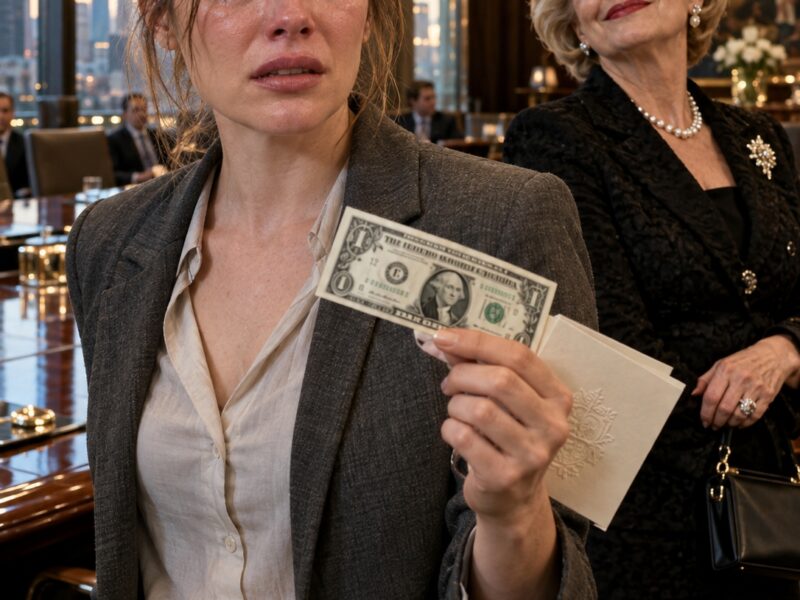
“And finally, to Sarah Mitchell, I leave the sum of one dollar, payable in cash immediately following the reading of this testament.”
Silence.
Sarah thought she had misunderstood.
“I’m sorry?”
Callaway closed the folder.
“One dollar.”
Three seconds passed.
Then Judith laughed.
Not politely.
Not awkwardly.
She threw her head back and laughed.
“One dollar?”
Michael looked down, but Sarah saw the grin.
Vanessa covered her mouth.
Judith turned toward Sarah.
“Well, that’s fitting, isn’t it?”
Sarah’s cheeks burned.
“Judith.”
“Even a woman who barely knew you could see you’re worthless.”
Michael finally spoke.
“That should cover bus fare home.”
Vanessa made a choking sound that might have been a laugh disguised as a cough.
Sarah’s fingernails dug into her palms.
Do not cry.
Not here.
Not in front of them.
She had walked into that office stupid enough to hope.
Now even a dead woman had apparently found a way to tell her what the Richardsons had been telling her for two years.
You are nothing.
Callaway reached into his briefcase.
He removed a crisp dollar bill.
He slid it across the mahogany table.
Sarah stared at it.
For some reason, that tiny piece of green paper hurt more than the divorce settlement.
She reached for it.
Callaway placed something on top.
A cream business card.
Heavy stock.
Gold lettering.
Their eyes met.
Something about his expression stopped her.
“Ms. Mitchell,” he said, “I need to speak with you privately tomorrow morning.”
Judith’s laughter died.
Sarah looked at the card.
The address wasn’t his office.
Raven’s Hollow, New York.
“Why?”
“Nine a.m. sharp.”
Judith leaned forward.
“About what?”
Callaway did not look at her.
“It is a matter regarding Ms. Mitchell’s inheritance.”
Judith’s face changed.
“What inheritance? You just gave her a dollar.”
Callaway closed his briefcase.
“Tomorrow, Ms. Mitchell.”
He stood.
“Do not be late.”
That night Sarah placed the dollar and the card on her kitchen table.
Emma was asleep.
The apartment radiator clicked uselessly.
Sarah studied the address.
Two hours away.
Driving there would cost money she didn’t have.
Maybe Callaway wanted paperwork signed.
Maybe there was another fifty dollars.
Maybe Evelyn had left her a piece of furniture she could sell.
Sarah almost threw the card away.
Then she remembered Callaway’s eyes.
Not pity.
Not embarrassment.
Something else.
Intent.
At 7:02 the next morning, she knocked on Mrs. Chen’s door.
“I need a favor.”
Mrs. Chen looked past her toward Emma.
“How long?”
“Hopefully before noon.”
“Go.”
Sarah hesitated.
“I can’t keep—”
Mrs. Chen waved her away.
“You can repay me when you’re ninety.”
Sarah smiled despite herself.
“I might take you seriously.”
“You should.”
Emma hugged Sarah before she left.
“Where are you going?”
“To meet a lawyer.”
Emma frowned.
“Are lawyers good?”
Sarah looked toward the hallway.
“Sometimes.”
The Corolla coughed twice before starting.
Sarah spent nearly the last of the pawnshop money filling the tank.
The interstate eventually narrowed into two-lane roads cutting through bare November forest.
Her phone lost signal.
Raven’s Hollow didn’t appear correctly on GPS, so she stopped at an old gas station where a clerk drew directions on the back of a receipt.
“Witmore place?” he asked.
Sarah froze.
“You know it?”
“Everybody around here knows it.”
“What do they know?”
He handed her the receipt.
“That nobody goes there.”
Not comforting.
Twenty minutes later, Sarah turned onto a cracked private road nearly swallowed by weeds.
Trees pressed close on both sides.
Fog moved between them.
She considered turning around twice.
Then the forest opened.
Sarah slammed on the brakes.
At the top of a low hill stood a three-story Victorian mansion overlooking a gray lake.
A wide porch wrapped around the front.
Tall windows reflected the pale morning sky.
The white paint had faded toward gray, and vines had consumed sections of the stone foundation, but none of that could hide the scale of the place.
Beside it stood a carriage house and a restored barn.
Attorney Callaway waited beneath a black umbrella.
Sarah got out slowly.
“This can’t be right.”
Callaway descended the steps.
“Good morning.”
“What is this?”
He smiled.
“Witmore House.”
Sarah looked from him to the mansion.
“Why am I here?”
His answer changed her life.
“Because it’s yours.”
Sarah laughed once.
It wasn’t amusement.
It was disbelief escaping her body.
“No.”
“Yes.”
“You gave me a dollar.”
“I did.”
“In front of everyone.”
“Exactly.”
She stared at him.
“Why?”
“Because Evelyn instructed me to.”
Rain tapped softly against Callaway’s umbrella.
“She wanted Judith Richardson to watch you receive one dollar. She wanted Michael to laugh. She wanted them convinced there was nothing here worth fighting over.”
Sarah felt something cold move through her.
“You humiliated me on purpose?”
“Evelyn did.”
“Why would she do that?”
Callaway’s expression became serious.
“Because she knew Judith.”
He looked toward the mansion.
“And because if the Richardsons had known yesterday what I’m about to show you today, you would already have three lawsuits waiting for you.”
He removed an iron key.
The front door groaned open.
Cold air spilled from the house carrying the smell of old wood, lavender, and dust.
Sarah stepped inside.
A grand staircase curved toward the second floor.
A chandelier hung above them beneath cobwebs.
Furniture disappeared under white sheets.
A library filled one side of the ground floor.
Even abandoned, the house possessed a strange dignity.
“Evelyn lived here for forty-three years,” Callaway said.
“Alone?”
“After her husband died.”
“Why leave it to me?”
“She watched you.”
Sarah stopped.
“What?”
“Not literally. She kept informed.”
“That sounds only slightly less disturbing.”
Callaway almost smiled.
“She knew Emma became ill. She knew you left nursing to care for her. She knew Michael divorced you.”
Sarah looked away.
“She knew what his family did in the settlement.”
“How?”
“Evelyn had lawyers.”
“Apparently everyone in that family has lawyers except me.”
“Which was part of the problem.”
Sarah walked into the library.
Dust covered an enormous desk.
“Why didn’t she contact me?”
“She believed help offered too early can become another form of control.”
“That sounds convenient.”
“It also sounds like Evelyn.”
Sarah faced him.
“So the house is mine?”
Callaway hesitated.
Sarah immediately recognized the pause.
There was always a pause before bad news.
“What?”
“There are conditions.”
Of course there were.
She almost laughed.
“You must make Witmore House your primary residence for one full year.”
Sarah blinked.
“You’re serious?”
“You cannot sell, lease, or transfer it during that period. If you abandon the property, ownership reverts to the state historical society.”
“Fine.”
“There are financial obligations.”
Her confidence vanished.
“How much?”
“Eighteen thousand dollars in property taxes due within ninety days.”
Sarah stared.
“The roof requires approximately thirty thousand dollars in immediate repairs.”
She stopped breathing.
“The utilities have been disconnected for four years. The septic system requires work. Plumbing restoration is necessary. There is currently no reliable heat.”
Sarah walked toward a covered chair and sat.
Dust rose around her.
“So that’s the joke.”
“Sarah—”
“She left a broke woman a mansion.”
Callaway said nothing.
“I pawned my grandmother’s locket yesterday for eighty dollars.”
Her voice cracked.
“I have twelve dollars left after gas and Emma’s prescription.”
Callaway crouched beside his briefcase.
“I know.”
“How am I supposed to pay eighteen thousand dollars in taxes?”
He removed a manila envelope.
“Evelyn anticipated the problem.”
Inside was a cashier’s check.
Sarah read the number twice.
$50,000.
Her hand trembled.
“This is real?”
“Yes.”
She looked up.
“It covers the taxes.”
“And essential repairs.”
“What happens afterward?”
Callaway watched her carefully.
“What do you mean?”
“I mean houses eat money. Especially houses that look like they belong in ghost stories. Fifty thousand gets me through the door. What happens six months from now?”
Something shifted in his expression.
Approval, perhaps.
“You’re thinking exactly as Evelyn hoped you would.”
He stood.
“Follow me.”
They crossed the kitchen and entered an old butler’s pantry.
Callaway opened a narrow door.
Stone steps descended underground.
He flipped a switch.
Yellow bulbs illuminated the staircase.
“What’s down there?”
“The rest of your inheritance.”
At the bottom stood a reinforced wooden door.
Callaway unlocked it.
Cold, dry air touched Sarah’s face.
The room beyond had once been a wine cellar.
There was no wine.
There were paintings.
Dozens.
Covered.
Catalogued.
Protected.
Callaway removed the cloth from the nearest canvas.
Sarah stared at a coastal landscape exploding in blues and violent gray.
She knew almost nothing about art.
But she recognized the signature.
“Rothwell?”
Callaway nodded.
Sarah moved closer.
“I saw one of his paintings at a Mercy General fundraiser.”
“Yes.”
“It sold for more than a hundred thousand dollars.”
“Yes.”
Sarah turned slowly.
“How many?”
“Fifty-seven works.”
Her mouth went dry.
“Value?”
“The preliminary conservative estimate is eight to twelve million dollars.”
Sarah’s knees weakened.
She grabbed a crate.
“No.”
“Sarah—”
“No. People like me don’t suddenly own twelve million dollars.”
“People like you?”
She laughed shakily.
“People who count quarters before buying milk.”
Callaway’s face softened.
“Yesterday you counted quarters. Today you own the same character you had yesterday and significantly more property.”
Sarah looked around.
“Why didn’t Evelyn sell these?”
“She didn’t need to.”
“She lived upstairs without heat.”
“She lived the way she wanted.”
Sarah shook her head.
“This makes no sense.”
Callaway handed her a leather portfolio.
“Perhaps she can explain it better than I can.”
Inside were certificates of authenticity, receipts, catalogues, insurance documents.
And one envelope.
SARAH.
The handwriting was delicate but firm.
She opened it.
Dear Sarah,
If you are reading this, you have survived what would have broken many people.
Sarah stopped.
Her vision blurred.
She continued.
I watched you fight for your daughter with a ferocity I recognized. I watched others mistake your exhaustion for weakness. I watched people with every advantage treat your hardship as proof of inferiority.
Never confuse suffering with failure.
The Richardsons are vultures. I know because I spent enough years feeding at the same table.
They have taken enough from you.
This house, this collection, and whatever future you build from them belong to you.
I ask only that you do nothing quickly.
Live here one year.
Do not sell the art during that year.
Restore the house.
Let Emma know what safety feels like.
Learn who you are when survival is no longer consuming every hour of your day.
After that, choose freely.
Build something beautiful.
Evelyn.
Sarah lowered the letter.
For two years, almost everyone had spoken to her in the language of deficiency.
No money.
No job.
No husband.
No insurance.
No house.
No options.
Evelyn had written to her as though none of those things defined her.
Sarah covered her mouth.
The sob escaped anyway.
Callaway turned slightly, granting her the dignity of pretending not to watch.
After several minutes Sarah whispered, “I don’t understand why someone who barely knew me believed in me this much.”
“Sometimes distance makes character easier to see.”
Sarah looked at the paintings.
“Can I really do this?”
Callaway answered without hesitation.
“Yes.”
She laughed through tears.
“You don’t know me.”
“I knew Evelyn.”
“That isn’t what I asked.”
“No.”
He met her eyes.
“But Evelyn knew people.”
Sarah folded the letter carefully.
Then she noticed his expression.
The warmth had disappeared.
“What?”
Callaway said nothing.
Her stomach tightened.
“What else?”
He exhaled.
“Judith called my office this morning.”
Sarah went still.
“She is contesting the will.”
The cellar suddenly felt colder.
“On what grounds?”
“Mental incompetence. Undue influence. Potential fraud.”
“Fraud?”
“She claims Evelyn could not have knowingly left a multimillion-dollar estate to you.”
Sarah almost laughed.
“She didn’t even know about the mansion yesterday.”
“She knows now.”
“How?”
“Probate records.”
Sarah stared at him.
“Can she freeze everything?”
“She is trying.”
“And the fifty thousand?”
“Accessible under the trust’s emergency maintenance provision.”
“And the house?”
“Yours unless the court rules otherwise.”
Sarah looked around at the covered paintings.
For ten minutes, she had allowed herself to imagine Emma running through those enormous rooms.
A bedroom.
A yard.
No landlord.
No eviction notice taped to the door.
She should have known hope would come with attorneys attached.
“They’re going to take it.”
“No.”
“You didn’t see what they did during my divorce.”
“I did.”
Sarah turned sharply.
Callaway’s eyes remained steady.
“Evelyn did too.”
He led Sarah back upstairs.
In the library, he unlocked the bottom drawer of the oak desk.
Inside was a fireproof document box.
He removed stacks of medical evaluations.
Neurological assessments.
Psychological reports.
Notarized statements.
“Evelyn underwent cognitive examinations every six months during the final three years of her life.”
Sarah stared.
“Why?”
“She expected this challenge.”
Callaway placed four reports side by side.
“Independent physicians. Full cognitive function. Intact memory. Clear testamentary intent.”
He removed a digital drive.
“She also recorded the execution of her will.”
Sarah looked at the drive.
“How long?”
“Ninety minutes.”
“She recorded herself for ninety minutes?”
“She explained every major decision.”
“Including me?”
“Especially you.”
Sarah sank into the desk chair.
“This woman planned a battle after her own funeral.”
Callaway smiled faintly.
“That is one way to describe Evelyn.”
“Why did she hate Judith so much?”
“Hate may not be the right word.”
“What is?”
“Experience.”
He sat opposite her.
“When Evelyn’s husband died in 1989, Judith claimed he had promised her part of his business interests.”
“Had he?”
“No.”
“Judith sued anyway?”
“For eighteen months.”
Sarah looked toward the window.
“Of course she did.”
“Evelyn won, but the litigation cost a fortune. More importantly, it taught her exactly how Judith responds when she believes money is available.”
Sarah’s fingers touched Evelyn’s letter.
“So the dollar was camouflage.”
“Precisely.”
“She wanted Judith to think there was nothing to steal.”
“Yes.”
Sarah gave a quiet, exhausted laugh.
“And for about three minutes yesterday, Judith thought Evelyn was a genius.”
Callaway raised an eyebrow.
“How so?”
“She agreed with her.”
Six days later, Sarah entered county probate court wearing a black suit borrowed from the church clothing closet.
The sleeves were half an inch too long.
She had hemmed them herself.
Judith arrived in a tailored suit that probably cost more than Sarah’s Corolla.
Three attorneys surrounded her.
Michael sat behind them.
Vanessa was absent.
Sarah didn’t know whether that made things better or worse.
Callaway placed a folder before her.
“Don’t react.”
“To what?”
“Anything.”
“That’s easy advice from a man who isn’t being accused of manipulating a dying woman.”
“Evelyn was not dying when the will was executed.”
“You know what I mean.”
“Yes.”
He lowered his voice.
“And they want you emotional. Don’t help them.”
Judge Margaret Winters entered.
Everyone stood.
Proceedings began.
Judith’s lead attorney, Preston Cole, was polished, controlled, and almost pleasant.
That made him more dangerous.
“Your Honor, Evelyn Witmore was eighty-one years old. She lived largely isolated from family in a deteriorating rural property.”
Sarah listened.
“She then transferred an estate valued in excess of twelve million dollars to Sarah Mitchell, a woman she had not seen personally in more than twenty years.”
Cole turned.
Looked directly at Sarah.
“Ms. Mitchell was experiencing extreme financial distress.”
Sarah felt every eye in the courtroom move toward her.
“She carried substantial medical debt. She was unemployed. She faced housing instability.”
Each fact was true.
That was what made it hurt.
“We believe those circumstances created powerful motive for undue influence.”
Sarah’s hands curled beneath the table.
Cole continued.
“We ask the court to freeze the estate while a full investigation is conducted.”
Judge Winters looked toward Callaway.
“Response?”
Callaway stood.
“Evidence, Your Honor.”
Nothing more.
He approached the bench with the medical records.
Four doctors.
Three years.
Repeated assessments.
Judge Winters read in silence.
Cole whispered to another attorney.
Judith glanced backward toward Michael.
For the first time, Sarah saw uncertainty.
Then Callaway said, “There is also a recording.”
A screen was brought forward.
The courtroom lights dimmed.
Sarah’s heartbeat filled her ears.
Evelyn appeared.
Small.
White-haired.
Sitting in the library at Witmore House.
She wore a dark green cardigan.
Her posture was straight.
Her eyes were extraordinary.
Sharp.
Amused.
Alive.
“My name is Evelyn Margaret Witmore. I am eighty-one years old, and I am recording this statement voluntarily to eliminate any confusion regarding my final wishes.”
Sarah stopped breathing.
Evelyn continued.
“I am leaving the majority of my estate to Sarah Mitchell.”
Judith’s jaw tightened.
“I expect this decision will anger certain members of my extended family. Their anger does not concern me.”
A few people shifted in their seats.
“I have not been manipulated by Sarah Mitchell. Sarah does not know she is named in this will.”
Evelyn looked straight into the camera.
“She has never asked me for money.”
Sarah’s throat tightened.
“She has never asked me for property.”
Then Evelyn paused.
“What Sarah has done is demonstrate character when nobody was rewarding her for it.”
Sarah looked down.
“She stopped working to care for her sick daughter. Her husband responded by leaving. His family used her financial vulnerability against her. I watched this happen.”
Michael’s face changed.
Barely.
But Sarah saw it.
“I watched a woman lose almost everything without abandoning the child who needed her.”
Evelyn leaned forward.
“That is worth something.”
Silence.
“I am leaving Judith Richardson nothing of significant financial value because she attempted to take property from me after my husband’s death.”
Judith whispered something furious to Cole.
Evelyn continued.
“I expect Judith to challenge this will.”
Judge Winters glanced toward Judith.
“And because I know how predictable greed becomes after enough years, I have undergone repeated independent examinations establishing my competency.”
Callaway did not smile.
He didn’t need to.
Then Evelyn said the words Sarah would remember for the rest of her life.
“If you are watching this because Judith has dragged Sarah into court, then Judith has proved my point more efficiently than I ever could.”
Someone in the gallery coughed to hide a laugh.
Judith turned crimson.
Evelyn’s expression remained composed.
“Sarah Mitchell did not manipulate me.”
A pause.
“I chose her.”
Another pause.
“Those are not the same thing.”
The recording ended after Evelyn signed each page of the will in front of witnesses.
Lights came back on.
Judge Winters removed her glasses.
“Mr. Cole.”
He stood.
“Your Honor.”
“Do you have evidence contradicting these competency assessments?”
He hesitated.
“No direct medical evidence.”
“Evidence Ms. Mitchell communicated with the decedent regarding the estate?”
“No, Your Honor.”
“Evidence of financial transfers between them?”
“No.”
“Evidence of meetings?”
“No.”
The judge looked over the file.
“Then what evidence of undue influence do you have beyond the fact that your client dislikes the decedent’s decision?”
Cole’s face tightened.
“Your Honor—”
“That was a question.”
Silence.
Finally:
“None at this time.”
Judge Winters picked up her gavel.
“The petition to freeze the estate is denied.”
Sarah closed her eyes.
“The will is admitted as executed. Ownership shall pass according to its provisions.”
The gavel struck.
“Case dismissed.”
Sarah did not immediately understand that she had won.
Callaway touched her shoulder.
“Breathe.”
She inhaled.
Her lungs shook.
Across the aisle, Judith stood.
She shoved papers into her purse.
Michael walked toward the exit without looking at Sarah.
Of all the things he had done, that somehow hurt most.
Not the divorce.
Not the money.
Not Vanessa.
The refusal to look.
As though Sarah and Emma were an unpleasant chapter he had successfully closed.
Judith stopped beside Sarah.
Her perfume arrived before her words.
“You think you’ve won?”
Sarah looked up.
Judith leaned closer.
“You can’t maintain that house.”
Sarah said nothing.
“You don’t understand money. You don’t understand property. You don’t understand people like us.”
Sarah’s heartbeat slowed.
“You’ll burn through whatever Evelyn left for repairs, and within a year you’ll be exactly where you belong.”
Sarah stood.
For years, Judith had seemed taller than she really was.
Money did that to people.
It enlarged them in rooms where everyone else had been taught to shrink.
But Sarah wasn’t shrinking now.
“I survived you once.”
Judith’s eyes narrowed.
Sarah picked up Evelyn’s letter.
“I can survive you again.”
“You are nobody.”
Sarah almost smiled.
“And this time, nobody has a house.”
She walked away before Judith could answer.
The first night Sarah and Emma slept at Witmore House, there was heat in only four rooms.
The plumbing groaned.
Plastic tarps covered part of the roof.
Wind rattled an upstairs window.
Emma stood in the foyer wearing purple pajamas and stared at the staircase.
“We live here?”
“For a year.”
“Why only a year?”
“Because that’s the rule.”
Emma considered this.
“Can we stay after?”
Sarah looked around.
“I think so.”
Emma’s eyes widened.
“Can I have any bedroom?”
“Within reason.”
Emma immediately ran upstairs.
Sarah heard doors opening.
Then Emma shouted.
“MOM!”
Sarah ran.
She found Emma standing inside a room overlooking the lake.
“What happened?”
Emma pointed.
“This one has a window seat.”
Sarah waited.
“That’s the emergency?”
Emma nodded solemnly.
“I need this room.”
Sarah laughed.
It came from somewhere she had forgotten existed.
“All right.”
Emma hugged her.
Sarah held her daughter in the empty bedroom while rain moved across the lake outside.
For once, she wasn’t calculating what would disappear next.
That did not mean life became easy.
Witmore House consumed money exactly as Sarah predicted.
Roof repairs revealed damaged flashing.
Plumbing exposed corroded pipes.
The septic estimate increased.
Sarah learned about historical preservation permits, contractors, insurance riders, drainage, boilers, and a hundred other things she had never wanted to know.
She returned to continuing education.
Renewed her nursing license.
Took part-time shifts once Emma’s medical schedule stabilized.
At night, after Emma slept, Sarah sat in Evelyn’s library surrounded by invoices.
Some evenings she panicked.
One evening, six months after moving in, she called Callaway.
“I can’t do this.”
“Yes, you can.”
“You don’t know what I’m calling about.”
“The boiler.”
Sarah stared at the phone.
“How did you know?”
“You sent me the estimate.”
“Twenty-two thousand dollars.”
“I saw.”
“Twenty-two thousand dollars for something whose purpose is apparently to make water angry.”
Callaway laughed.
Sarah didn’t.
“I mean it.”
Her voice weakened.
“What if Judith was right?”
Silence.
“About which part?”
“That I’m not equipped for this.”
“Are you behind on taxes?”
“No.”
“Is the roof repaired?”
“Yes.”
“Are you employed?”
“Yes.”
“Is Emma healthy?”
Sarah looked toward the stairs.
“Her last bloodwork was clear.”
“Then which specific evidence supports Judith’s theory?”
Sarah had no answer.
Callaway’s voice softened.
“Sarah, fear is not evidence.”
She wrote those words on the corner of the boiler estimate.
Fear is not evidence.
She kept it.
The first anniversary of Evelyn’s death arrived quietly.
The one-year restriction ended.
Sarah could finally sell paintings.
Auction houses had been waiting.
The collection’s revised valuation was even higher than expected.
Sarah sold one piece.
Then another.
She could have sold everything.
Bought a modern house.
Never worked again.
Instead she found herself staring at Evelyn’s letter.
Build something beautiful.
Money could remove fear.
Sarah knew that.
But money could also become another version of Judith’s dining table—something accumulated mainly to prove that other people had less.
Sarah didn’t want that.
She wanted Emma to grow up understanding why the money existed.
So Sarah made a decision Evelyn had never required.
She established the Evelyn Witmore Foundation.
Its first grants helped families dealing with childhood cancer pay expenses insurance ignored.
Transportation.
Temporary housing.
Childcare.
Medication.
Lost wages.
The boring emergencies that rarely appeared in fundraising brochures but could quietly destroy a household.
Sarah knew every one of them.
She had lived them.
The restored carriage house became a small contemporary art museum.
Local schools visited.
The barn became event space for fundraising programs.
Witmore House itself remained a home.
Not a monument.
Emma’s backpack stayed beside the staircase.
Shoes collected near the kitchen door.
Sometimes cereal bowls remained in the sink until afternoon.
Sarah refused to turn survival into something polished beyond recognition.
Six years after the day Judith Richardson laughed over that one-dollar bill, Sarah stood in the same library where Evelyn had recorded her final statement.
Outside, Witmore House gleamed beneath spring sunlight.
The roof was slate again.
The gardens had been restored.
The lake reflected a clean blue sky.
Twelve paintings from Evelyn’s collection had been sold over several years, generating approximately $4.7 million.
Most of the remaining collection belonged to the museum.
The foundation had funded research programs and assisted dozens of families.
Sarah worked part-time at a rural health clinic because she still loved nursing.
Emma was twelve.
Healthy.
Loud.
Funny.
And currently furious because Sarah would not let her paint the attic floor turquoise.
“It would look amazing.”
“It would look like a swimming pool.”
“Exactly.”
“No.”
“You have no artistic vision.”
Sarah looked toward Evelyn’s paintings.
“That accusation feels dangerous in this house.”
Emma grinned.
Then ran upstairs.
Her footsteps thundered through the hallway.
Sarah listened until they faded.
There had been a time when she listened to Emma breathing at night because she was afraid the sound might stop.
Now she complained about the noise her daughter made.
That might have been the greatest luxury of all.
Michael remarried.
Then divorced again.
Sarah heard about it through people who believed she would care.
She didn’t.
Judith never contacted her after the probate case.
The failed challenge had cost the Richardson family enough in legal fees to disrupt Judith’s plan to purchase a vacation property in the Bahamas.
Years earlier, Sarah might have considered that justice.
She no longer did.
Justice wasn’t Judith losing something.
Justice was Sarah no longer measuring her life against Judith’s.
On the mantel above the library fireplace sat a simple black frame.
Inside was a one-dollar bill.
The same one Callaway had slid across the conference table.
Visitors often asked why it was there.
Sarah usually smiled.
“Long story.”
Beside it was Evelyn’s letter.
The paper had softened along the folds from being opened too many times.
Sarah still read it occasionally.
Not when things were bad.
Strangely, she read it when things were good.
Because good things could be frightening after years of survival.
You kept waiting for someone to arrive and take them away.
One rainy November evening, almost exactly six years after the will reading, Sarah sat alone in the library.
Emma was upstairs painting.
The house smelled of wood smoke.
Rain tapped against the windows.
Sarah opened Evelyn’s letter.
She read the familiar lines.
Never confuse suffering with failure.
Her eyes moved toward the framed dollar.
She remembered Judith laughing.
Michael smiling.
Vanessa hiding her amusement.
Sarah remembered walking from that conference room believing a dead woman had valued her at exactly one dollar.
For years, she had thought the cruelty of that moment was what made the reversal so powerful.
She understood differently now.
Evelyn hadn’t given her millions to prove Judith wrong.
That would still have made Judith the center of the story.
Evelyn had given Sarah time.
A year in which she could not run.
A house she had to learn to care for.
A collection she could not immediately convert into money.
A future she had to inhabit before she could spend it.
She had forced Sarah to discover something wealth alone could never provide.
That survival and living were not the same thing.
Footsteps sounded behind her.
Emma appeared wearing paint-stained sweatpants.
“What are you doing?”
“Reading.”
“That letter again?”
Sarah smiled.
“That letter again.”
Emma walked over and picked up the framed dollar.
“You know this is objectively the ugliest thing in the entire house.”
“It cost me a lot.”
Emma laughed.
“It’s one dollar.”
“No.”
Sarah looked around the library.
At the restored wood.
The books.
The rain beyond the windows.
At her daughter standing healthy beneath the same ceiling where Evelyn had once sat alone preparing a defense for a woman who didn’t even know she needed one.
“It cost me almost everything.”
Emma’s smile faded.
She understood enough now to know there were parts of her childhood Sarah rarely described.
“Do you hate them?”
Sarah knew who she meant.
Michael.
Judith.
The people who left.
She considered the question.
“No.”
Emma looked surprised.
“Why not?”
Sarah took the frame from her and placed it back on the mantel.
“Because hate is expensive.”
Emma waited.
“And I already paid enough.”
Thunder rolled softly across the lake.
Emma leaned against her mother.
Sarah wrapped an arm around her.
For a while, neither spoke.
Then Emma looked at Evelyn’s letter.
“Do you think she knew?”
“Knew what?”
“That you’d do all this.”
Sarah looked through the library doors toward the hall.
Beyond them were photographs from foundation events.
Children who had completed treatment.
Parents who had received grants.
Nurses Sarah now worked beside.
Families who had slept in warm hotel rooms near hospitals instead of cars.
She shook her head.
“No.”
Emma frowned.
“You don’t?”
“I think she hoped.”
Sarah touched the worn edge of the letter.
“There’s a difference.”
Outside, the rain grew heavier.
Inside, Witmore House was warm.
And somewhere in that ordinary warmth was the part Sarah valued most.
Not the paintings.
Not the estate.
Not even the money.
Six years earlier, she had been standing outside a pawn shop with eighty dollars and a sick child, convinced her worth could be calculated by everything she had lost.
Then a dead woman had given her one dollar in front of the people who wanted to see her humiliated.
For a few terrible hours, Sarah had believed the dollar represented her value.
She knew better now.
The dollar had never been the inheritance.
It had been the disguise.
The mansion wasn’t the inheritance either.
Neither were the paintings.
The real inheritance was the moment Sarah stopped allowing the people who abandoned her to decide what abandonment said about her.
She had spent years asking why Michael could leave.
Why Judith could humiliate her.
Why suffering seemed to select people who had already endured enough.
Evelyn’s gift never answered those questions.
It gave Sarah something better.
A reason to stop asking them.
Upstairs, a door slammed.
“Mom?”
Sarah looked toward the ceiling.
“Yes?”
A pause.
Then Emma shouted:
“I accidentally got turquoise paint on the floor!”
Sarah closed her eyes.
“How accidentally?”
A much longer pause.
“Emotionally accidentally.”
Sarah began laughing.
She laughed until tears came.
Then she folded Evelyn’s letter, placed it beside the framed dollar, and headed upstairs to see exactly how much artistic vision twelve-year-old Emma Mitchell had inflicted on a nineteenth-century hardwood floor.
At the staircase, Sarah stopped.
For just a second, she looked back.
The dollar rested beneath the warm library light.
Small.
Ordinary.
Almost meaningless.
Exactly as Evelyn had intended it to appear.
Sarah smiled.
Then she went upstairs to her daughter, leaving the dollar behind.
For once, she didn’t need to look at it to remember what she was worth.









