She Left Him at the Altar When His Millions Vanished—Then the Woman Holding a Mop Changed Everything
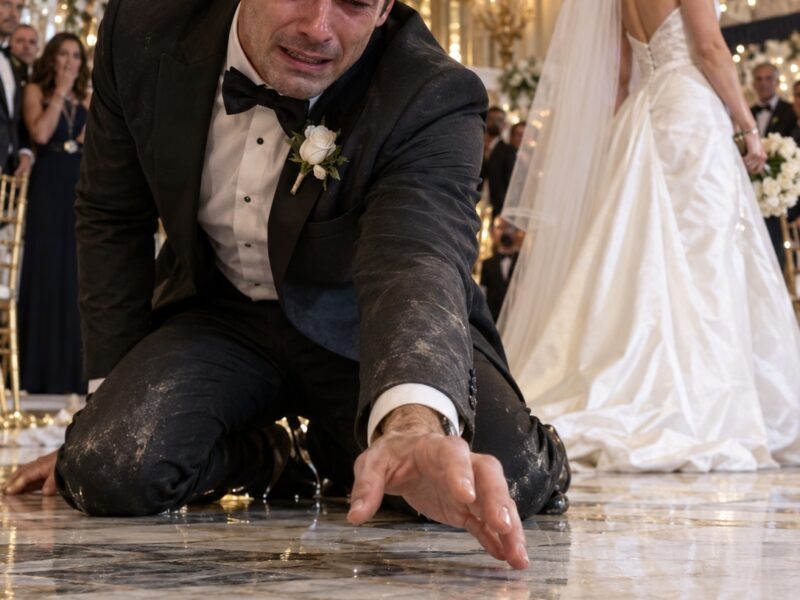
The engagement ring hit the marble floor before Ethan Callahan fully understood that his wedding was over.
It bounced once beneath the crystal chandeliers, spun in a bright little circle, and stopped beside the polished toe of his black dress shoe.
For several seconds, nobody moved.
Two hundred guests stood inside one of the most expensive private estates outside Chicago, surrounded by white roses, champagne towers, gold-rimmed place settings, and a string quartet that had gone silent halfway through a song.
At the center of it all stood Ethan in a charcoal tuxedo that had cost more than his father used to make in a month.
Across from him, Camille Harrington was still wearing her wedding gown.
She looked breathtaking.
She also looked at him as though he had become a stranger in the fifteen minutes since she walked down the aisle.
“I can’t do this,” she said.
Ethan stared at her.
The room seemed to tilt.
“Camille.”
Her lips trembled, but her voice did not.
“I’m sorry.”
Then she turned.
Not toward him.
Away.
And as Ethan watched the woman he had planned to spend his life with walk past the altar, past the roses, past the guests who had toasted their future less than an hour earlier, his phone vibrated again inside his jacket.
Another emergency alert.
Another account frozen.
Another executive demanding answers.
Another piece of the life he had spent fifteen years building disappearing while everyone watched.
But the worst thing had not happened yet.
The worst thing would happen when Ethan finally understood why his company had collapsed on the exact morning of his wedding—and who had needed him ruined badly enough to make sure it happened in public.
Until that moment, however, all he knew was that the woman he loved had left him standing at an altar with a dead company, a useless ring, and hundreds of people suddenly pretending they had never known him.
Three hours earlier, Ethan had believed he was the luckiest man in Chicago.
He had arrived at Bellamy Estate before eight that morning because he had never learned how to be late for anything important.
The habit came from his father.
Patrick Callahan had repaired diesel engines for thirty-one years and treated punctuality like a moral principle.
“If somebody trusts you with their truck,” he used to tell Ethan, “you don’t make them wonder whether you’re coming.”
Patrick had died six years before the wedding.
Ethan still heard his voice whenever something mattered.
That morning, standing alone in the groom’s suite, adjusting a cuff link with fingers that refused to stay steady, Ethan caught his reflection in the tall antique mirror and quietly said, “I made it, Dad.”
He almost laughed at how emotional he sounded.
At thirty-eight, Ethan had done more than make it.
Callahan Logistics had started with two used delivery trucks, a rented warehouse with a leaking roof, and forty-three thousand dollars Ethan had borrowed against everything his family owned.
Fifteen years later, the company operated in eleven states.
Its trucks moved medical equipment, restaurant supplies, automotive parts, and commercial freight across the Midwest.
Industry magazines had called Ethan a self-made success story.
Banks returned his calls.
Politicians invited him to fundraisers.
Business schools asked him to speak about disciplined growth.
He owned a forty-third-floor apartment overlooking Lake Michigan, belonged to clubs he once would not have been allowed to enter through the front door, and could afford a wedding at Bellamy Estate without asking the price of every flower.
Yet the part of his life he was proudest of had nothing to do with money.
His mother, Teresa, no longer counted grocery money at the kitchen table.
His younger brother, Michael, had finished college without debt.
His company employed more than eight hundred people.
And that morning he was marrying Camille Harrington.
At least, that was the story Ethan believed.
Camille belonged to a world Ethan had spent years learning to navigate.
Her father, Richard Harrington, owned luxury hotels in five states.
Her mother, Evelyn, sat on museum boards, chaired charity galas, and remembered the family histories of people Ethan had only read about in newspapers.
The Harringtons did not discuss prices.
They discussed access.
They did not ask what a person did.
They asked who knew them.
When Ethan first met Camille at a children’s hospital fundraiser four years earlier, he had expected her to be exactly like them.
Instead, she spent almost twenty minutes talking with a nurse who had accidentally spilled champagne on her dress.
She laughed about it.
She asked Ethan questions about his mother.
She told him she hated being introduced as Richard Harrington’s daughter before anyone learned her name.
That night, sitting together on a terrace overlooking the Chicago River, Camille had asked, “Do you ever get tired of people deciding who you are before you speak?”
Ethan smiled.
“Every room I walk into.”
“Me too.”
That was the moment he fell for her.
Years later, he would return to that conversation again and again, wondering whether Camille had been telling the truth or simply telling him what he needed to hear.
But on their wedding morning, he still believed every word.
At 10:42 a.m., Ethan’s best man, Michael, walked into the suite holding two glasses of bourbon.
“You look sick.”
“I’m getting married.”
“Exactly.”
Ethan accepted the glass but did not drink.
Michael was thirty-four, broader than Ethan, less polished, and one of the only people in Ethan’s life who still told him when he was being an idiot.
He looked around the enormous suite.
“Dad would hate this place.”
Ethan laughed.
“He’d ask how much the chairs cost.”
“And then he’d steal three dinner rolls.”
“For later.”
They both went quiet.
Michael raised his glass.
“To Dad.”
Ethan touched his glass against it.
“To Mom.”
“And to you somehow convincing a Harrington to marry a Callahan.”
Ethan shook his head.
“You know, you could try being supportive.”
“I am supporting you. I wore the tie.”
Michael’s smile faded slightly.
“Seriously, though. You good?”
Ethan looked toward the window.
On the lawn below, staff were arranging chairs beneath a white canopy. Florists moved among thousands of roses. Black SUVs were pulling through the gates.
“I think so.”
“You think so?”
“I’ve spent fifteen years knowing exactly what the next problem is. Payroll. Fuel. Insurance. Contracts. Expansion. There’s always something to solve.”
“And today?”
Ethan looked down at the ring box in his hand.
“Today there’s nothing to solve.”
Michael studied him for a moment.
“Maybe that’s why you’re terrified.”
Ethan smiled.
Maybe it was.
His phone buzzed on the table.
He glanced at it.
A message from Daniel Mercer, Callahan Logistics’ chief financial officer.
Need to speak before noon. Urgent.
Ethan frowned.
Michael noticed.
“Company?”
“Daniel.”
“On your wedding day?”
“He wouldn’t call unless it mattered.”
Michael took the phone from Ethan’s hand and set it facedown.
“For the next ninety minutes, let somebody else be a millionaire.”
Ethan almost corrected him.
The company’s valuation made him wealthy on paper, but he had never liked the word millionaire.
It sounded like somebody who had arrived.
Ethan still felt like the boy washing grease from his father’s tools in a South Side garage.
He let the phone sit.
That decision would haunt him by lunchtime.
At 11:31, the ceremony began.
Ethan stood beneath an arch of white roses while sunlight poured through the ballroom windows.
His mother sat in the front row wearing a pale blue dress and crying before the music even changed.
Michael leaned toward Ethan.
“You’re shaking.”
“I know.”
“Don’t lock your knees.”
“Why?”
“You’ll pass out.”
“Very helpful.”
Then the doors opened.
Camille appeared beside her father.
Every conversation in the room died.
Ethan forgot Daniel Mercer.
He forgot the company.
He forgot the strange message.
He forgot everything except the woman walking toward him.
Camille wore a simple silk gown that fell cleanly from her shoulders, nothing like the jeweled dress Evelyn Harrington had wanted her to choose.
Her dark hair was pinned loosely at the back of her neck.
She looked at Ethan.
For one perfect second, she smiled.
Ethan’s chest tightened.
He thought, This is the moment.
Richard Harrington placed Camille’s hand into Ethan’s.
“Take care of her,” Richard murmured.
Ethan answered without hesitation.
“Always.”
The officiant began speaking.
Marriage.
Commitment.
Partnership.
Choosing another person not only when life was easy but when circumstances tested the promises being made.
Ethan remembered that sentence later because of what happened next.
A ballroom door opened.
A man in a navy suit stepped inside.
Ethan recognized Samuel Price, Callahan Logistics’ vice president of operations.
Samuel’s face was gray.
Not nervous.
Gray.
He walked toward Michael and whispered something.
Michael’s expression changed instantly.
Ethan saw it.
So did Camille.
“What is it?” Ethan whispered.
Michael shook his head.
“Nothing. Keep going.”
Samuel whispered again.
This time Michael swore under his breath.
Ethan’s stomach tightened.
“Michael.”
The officiant stopped.
A hundred and eighty-seven guests watched them.
Michael leaned toward Ethan.
“You need to see this.”
He held out his phone.
There were twelve missed calls.
Four from Daniel Mercer.
Three from the company’s attorney.
Two from First Continental Bank.
One from the head of security.
Two from numbers Ethan didn’t recognize.
Below them was a financial news alert.
MIDWEST FREIGHT GIANT CALLAHAN LOGISTICS FACES LIQUIDITY CRISIS AFTER MAJOR CONTRACT TERMINATION.
Ethan read the headline twice.
“That’s wrong.”
Samuel shook his head.
“It isn’t.”
Camille’s fingers tightened around Ethan’s.
“What happened?”
“I don’t know.”
Samuel lowered his voice.
“Westbridge terminated the national contract this morning.”
“That contract runs another twenty-two months.”
“They’re claiming breach.”
“What breach?”
“I don’t know.”
“Call Daniel.”
“We have.”
“And?”
Samuel hesitated.
“He’s not answering anymore.”
Something cold moved through Ethan’s stomach.
The Westbridge contract represented almost twenty percent of Callahan Logistics’ annual revenue.
Losing it would hurt.
It would not destroy the company.
Ethan turned toward the officiant.
“Give me five minutes.”
Then Samuel said quietly, “There’s more.”
Every instinct Ethan had developed during fifteen years in business screamed at him not to ask.
He did anyway.
“How much more?”
Samuel showed him another message.
Two revolving credit facilities had been suspended.
A commercial lender had frozen access to a forty-million-dollar line pending an internal review.
Three company accounts were under temporary restriction.
Ethan stared at the screen.
“That doesn’t happen because one customer cancels a contract.”
“No.”
“Then why?”
Samuel swallowed.
“Accounting found transfers.”
“What transfers?”
“They don’t know yet.”
“Samuel.”
“Several million dollars.”
Ethan stopped breathing.
Camille slowly removed her hand from his.
That was the first thing he noticed.
Not the whispers spreading through the room.
Not the phones appearing beneath tables.
Not Richard Harrington stepping toward one of his attorneys.
Camille’s hand.
Leaving his.
“Ethan,” she said, “what does that mean?”
He turned toward her.
“I don’t know yet.”
“Millions are missing?”
“I said I don’t know.”
“From your company?”
“Camille, give me five minutes.”
Her eyes moved across the guests.
The first online article was already circulating.
Somebody near the back whispered bankruptcy.
Ethan heard the word.
So did Camille.
He reached for her hand.
She pulled it away.
That tiny movement frightened him more than the financial alerts.
“Camille.”
“I need to talk to my father.”
“Why?”
“I just need a minute.”
“We’re standing at our wedding.”
“I know.”
“Then stand here with me.”
Her eyes hardened.
“Don’t tell me what to do right now.”
A murmur moved through the ballroom.
Ethan lowered his voice.
“I’m not telling you what to do. I’m asking my future wife to give me ten minutes to understand what’s happening.”
Camille looked at him as if the words future wife had suddenly become an accusation.
Then she walked away.
Ethan stood beneath the roses while Samuel continued feeding him numbers that no longer made sense.
At 11:44, the company’s general counsel finally reached him.
“Ethan, listen carefully,” Jeremiah Brooks said through the phone. “Do not approve anything. Do not move money. Do not destroy documents. We may be dealing with internal fraud.”
Ethan turned away from the guests.
“Whose?”
“We don’t know.”
“Where’s Daniel?”
Silence.
“Jeremiah.”
“We can’t locate him.”
Ethan closed his eyes.
Daniel Mercer had been with Callahan Logistics for nine years.
He had attended Ethan’s mother’s birthday dinners.
He had spent Christmas Eve at Ethan’s apartment.
He was supposed to be sitting at table six.
Ethan looked across the ballroom.
Daniel’s chair was empty.
That was when Camille returned.
She was no longer carrying her bouquet.
Richard and Evelyn Harrington walked behind her.
Richard’s face looked carefully neutral.
Evelyn looked furious.
“Can we speak privately?” Camille asked.
Ethan stared at her.
“Apparently my CFO is missing.”
“Ethan.”
“My company may have been robbed from the inside.”
Her father glanced toward the guests.
“This is not the appropriate place.”
Ethan almost laughed.
“It became the appropriate place when somebody chose my wedding morning to destroy my company.”
Richard’s jaw tightened.
Camille said, “Please.”
They moved into a small reception room beside the ballroom.
The second the door closed, Evelyn spoke.
“How long have you known?”
Ethan looked at her.
“Known what?”
“That your company was unstable.”
“It isn’t unstable.”
“Your stock is collapsing.”
“We’re privately held.”
Evelyn blinked.
Ethan realized the rumors were already growing faster than the facts.
Richard raised a hand.
“Let’s keep this rational.”
Ethan turned toward Camille.
“I need to go to the office.”
She said nothing.
“I can have this under control—”
“Can you?”
The question hurt because of how quickly it came.
“What?”
“You just said millions are missing.”
“I said they may be.”
“And your credit has been frozen.”
“Temporarily.”
“And your largest customer walked away.”
“Camille.”
“Is the company bankrupt?”
“No.”
“Could it be?”
He hesitated.
That hesitation changed everything.
Camille looked down.
Ethan stepped closer.
“I built that company from nothing. Whatever happened this morning, I’ll find it.”
“That isn’t what I asked.”
“You asked me to predict something before I have facts.”
She looked toward her father.
Ethan saw it.
The silent conversation.
The calculation.
He had seen that expression in boardrooms a thousand times.
He had never expected to see it on the woman wearing his wedding dress.
Richard cleared his throat.
“Perhaps the ceremony should be postponed.”
Ethan looked at him.
“Postponed?”
“Until the situation is clearer.”
“No.”
Camille stared at Ethan.
He softened his voice.
“No. We either mean what we were about to promise each other, or we don’t.”
“Don’t do that,” she whispered.
“Do what?”
“Turn this into a test of love.”
“I’m not.”
“You are.”
“You were about to promise for richer or poorer.”
Evelyn inhaled sharply.
Camille’s eyes flashed.
“That is unfair.”
“Why?”
“Because this is not some hypothetical setback. People are saying your entire company could collapse.”
“People?”
“I’m talking about reality.”
“So am I.”
He stepped closer.
“I don’t know what I’ll own tomorrow, Camille. I don’t know whether I’ll spend the next year rebuilding the company or fighting in court. I don’t know whether I’ll lose my apartment.”
Her face changed at that.
Ethan noticed.
And once he noticed, he could not unsee it.
He continued more quietly.
“But I know who I am.”
Camille shook her head.
“You don’t understand.”
“Then tell me.”
She looked at him for a long time.
“When I agreed to this life, I thought there was stability.”
Ethan felt something inside him go still.
“This life?”
She closed her eyes.
“I didn’t mean it like that.”
“How did you mean it?”
“I don’t want to live through lawsuits and bankruptcy and reporters outside our house.”
“Our house?”
“You know what I mean.”
“No. I don’t.”
He waited.
Camille could have reached for him then.
He would remember that for years.
She could have touched his face, told him she was afraid, admitted that the speed of the collapse terrified her.
Ethan would have understood fear.
He understood fear better than anybody in that room.
Instead she said, “I can’t become the wife of a man who may have nothing by tonight.”
The room became silent.
Even Evelyn looked uncomfortable.
Ethan stared at Camille.
He thought he must have misunderstood her.
“What did you say?”
Tears appeared in Camille’s eyes.
“I’m sorry.”
“That’s not an answer.”
“I can’t do this.”
“You loved me ten minutes ago.”
“I still love you.”
Ethan gave a hollow laugh.
“Apparently not enough to risk losing a penthouse.”
“That’s cruel.”
“No, Camille. Cruel is discovering during your wedding ceremony that the woman beside you was actually marrying your balance sheet.”
She slapped him.
The sound cracked through the room.
Richard stepped forward.
Ethan did not move.
Camille stared at her own hand.
Then she began crying.
“I never wanted this.”
“Neither did I.”
“I need security.”
“You had me.”
“That’s not what I mean.”
And there it was.
The truth was quieter than Ethan expected.
He looked at Camille’s wedding dress.
The woman he had loved for four years stood less than three feet away, and suddenly every expensive dinner, every vacation, every discussion about houses and schools and neighborhoods rearranged itself inside his memory.
Small details he had dismissed began forming a pattern.
Camille asking how much equity he personally held.
Camille insisting on a penthouse instead of the Lincoln Park house he preferred.
Camille becoming tense when Ethan talked about reinvesting profits into employee pensions.
Camille laughing when he said he would happily drive his old Ford pickup forever if it still ran.
None of those things had seemed important by themselves.
Now they screamed.
Camille slowly removed her engagement ring.
For a moment, Ethan thought she was adjusting it.
Then she placed it in his palm.
“I’m sorry.”
He closed his hand around it.
“No, you’re not.”
She walked past him.
At the door, she stopped.
Ethan’s heart betrayed him.
Some part of him still believed she would turn around.
She did.
But she wasn’t looking at him.
She was looking at her mother.
“Can we go?”
That was how Ethan Callahan’s wedding ended.
Not with shouting.
Not with broken furniture.
Not with security removing anyone.
With three words.
Can we go?
By the time Ethan returned to the ballroom, nearly everybody knew.
The officiant had disappeared.
The string quartet stood awkwardly beside their instruments.
Servers carried untouched plates back toward the kitchen.
Guests clustered in small groups, lowering their voices whenever Ethan passed.
His mother came toward him.
Teresa Callahan was sixty-seven, barely five feet four inches tall, and had spent most of Ethan’s life worrying quietly so her sons would not have to.
She saw his face.
“Oh, honey.”
That was all it took.
Ethan turned away.
“I’m fine.”
She touched his arm.
“You don’t have to be.”
He almost broke then.
Instead, his phone rang.
Jeremiah.
“Ethan, we need you downtown.”
“I’ll be there.”
“Don’t speak to press.”
“I won’t.”
“Don’t answer questions from lenders without me.”
“Fine.”
“And Ethan?”
“What?”
“We found something else.”
Ethan looked toward the empty chair where Daniel Mercer should have been sitting.
“What?”
“Some of the transfers were authorized using your credentials.”
Ethan felt the blood leave his face.
“That’s impossible.”
“I know.”
“How much?”
Jeremiah hesitated.
“Potentially fourteen million.”
Ethan sat down.
Teresa whispered, “What happened?”
Ethan could not answer.
Because bankruptcy was no longer the worst possibility.
Somebody had built evidence that made it look as if Ethan himself had stolen from Callahan Logistics.
And suddenly the wedding disaster looked less like bad timing.
It looked planned.
News vans appeared outside Bellamy Estate before noon.
The Harrington family left through a private gate.
Several of Ethan’s investors left through another.
People Ethan had known for years walked past him while pretending to be busy on their phones.
One man who had begged Ethan three months earlier to invest in his startup avoided eye contact completely.
Another shook Ethan’s hand and murmured, “Terrible situation,” before leaving so quickly it felt like an evacuation.
Within twenty minutes, the ballroom lost its warmth.
Flowers that had looked elegant now looked ridiculous.
Champagne bubbles died in untouched glasses.
White candles burned beside empty seats.
Ethan stood beneath the chandelier and watched an entire social world detach itself from him.
Not because anyone knew what had happened.
Because they feared being near him if he had become poor.
Michael stayed.
Teresa stayed.
Samuel stayed.
A handful of employees stayed.
Almost everyone else left.
Then Michael’s phone rang.
His expression tightened.
“What?”
He walked toward a window.
“No. Absolutely not.”
Ethan looked over.
Michael ended the call.
“The bank has people at your apartment.”
Ethan laughed once, without humor.
“Of course they do.”
“They’re inventorying secured assets.”
“My home isn’t collateral.”
“Some holding-company structure apparently connected it.”
“That’s impossible.”
“Today seems to be full of impossible things.”
Ethan sat on the edge of a chair.
For the first time, exhaustion reached him.
He had been running on adrenaline since Samuel entered the ballroom.
Now his hands began shaking.
Michael crouched beside him.
“Come home with me.”
Ethan shook his head.
“You have Sarah and the kids.”
“They love you.”
“I’m not bringing reporters to your street.”
“Then Mom’s.”
“Same problem.”
“We’ll find somewhere.”
Ethan nodded without hearing him.
Across the ballroom, staff had begun cleaning.
A woman in a green uniform was collecting broken champagne flutes from beneath a table.
Another employee rolled a cleaning cart toward the hallway.
Ethan looked down at the ring still in his hand.
A ring worth eighty thousand dollars.
That number suddenly felt obscene.
He stood, walked three steps, and nearly fell.
Michael reached for him.
“I’m okay.”
“You’re not.”
“I said I’m okay.”
His voice came out louder than he intended.
Several staff members looked over.
Ethan walked toward the entrance because he needed air.
Halfway there, his legs simply stopped cooperating.
He sat down on the marble floor.
Then he lowered his head into his hands.
He did not cry elegantly.
There was no single movie-star tear.
His entire body shook.
He cried for Camille.
For his father.
For fifteen years of sixteen-hour days.
For eight hundred employees who might wake up without jobs.
For the possibility that someone he trusted had framed him.
For the boy he had once been, who believed money could protect his mother from fear forever.
Most of all, he cried because for the first time since he was nineteen years old, Ethan Callahan could not identify the next thing he was supposed to fix.
People walked around him.
Some stared.
A photographer outside captured him through the glass doors.
The image would be online within an hour.
Fallen Chicago Tycoon Breaks Down After Bride Flees Wedding.
But before the photograph went viral, somebody stopped beside him.
Ethan noticed the shoes first.
Cheap black work shoes.
He looked up.
A woman wearing a green cleaning uniform stood in front of him.
She was in her early forties, perhaps.
Dark skin.
Tired eyes.
Hair twisted into a practical bun beneath a thin headband.
Her name tag said MIRIAM.
She held out her hand.
Ethan stared at it.
“Sir?”
He looked at her face.
There was no curiosity in it.
No excitement.
No pity.
Just concern.
“I’m okay.”
Miriam glanced at him sitting on the floor in a ten-thousand-dollar tuxedo with tears on his face.
“No, you aren’t.”
Under any other circumstances, Ethan might have laughed.
Instead, he stared at her hand.
It was rough, the knuckles dry from cleaning chemicals and years of work.
A small scar crossed her thumb.
“You don’t have to sit here,” she said.
“Apparently I do.”
“No.”
Her voice remained gentle.
“You just don’t know where else to go yet.”
Something about those words reached him.
Ethan slowly took her hand.
Miriam leaned backward and helped him stand.
He outweighed her by at least seventy pounds.
She didn’t complain.
“Come on,” she said.
“Where?”
“Somewhere people can stop looking at you.”
She led him into a service corridor.
For the first time that day, nobody followed.
The room she found was hardly a room at all.
It was a staff break area behind the estate kitchen, with two plastic chairs, a vending machine, a humming refrigerator, and a fluorescent light that flickered every few seconds.
Miriam handed Ethan a paper cup of water.
He drank it in one swallow.
“Another?”
He nodded.
She filled it.
Ethan sat with his elbows on his knees.
Miriam stood near the door.
“You can go,” he said.
“I know.”
“You probably have work.”
“I do.”
“Then why are you still here?”
She looked at him.
“Because you look like somebody shouldn’t leave you alone for five minutes.”
Ethan rubbed both hands over his face.
“I’m not going to do anything stupid.”
“I didn’t say you were.”
He looked up.
Miriam pointed toward the cup.
“You want more water?”
“No.”
“Then breathe.”
He almost told her he knew how to breathe.
Instead, he tried.
In.
Out.
Again.
His heartbeat slowed.
“What’s your name?” he asked, despite the badge.
“Miriam Cole.”
“I’m Ethan.”
“I know.”
“Everybody does now.”
She said nothing.
That silence was kinder than any reassurance she could have given him.
After a minute, Ethan asked, “Did you see what happened?”
“Some of it.”
“My fiancée left me.”
“I saw.”
“My company might be bankrupt.”
“I heard people talking.”
“I may be accused of stealing from my own business.”
That surprised her.
She pulled out the other chair.
“Did you?”
“No.”
“Then there’s at least one thing you know.”
Ethan stared at her.
Miriam shrugged.
“Sometimes one true thing is enough to start with.”
He remembered those words months later during depositions, negotiations, and nights when bankruptcy documents covered his kitchen table.
At that moment, however, they only made him tired.
“My father used to say things like that.”
“Was he smart?”
“He repaired trucks.”
“That wasn’t my question.”
Ethan looked at her.
Then, unexpectedly, he smiled.
A small, broken smile.
“Yes,” he said. “He was.”
Miriam nodded.
“Then maybe listen to him.”
For ten quiet minutes, a millionaire whose life had collapsed sat in a staff break room with a cleaner he had never met.
Miriam did not ask for a photograph.
She did not tell him everything happened for a reason.
She did not insist things would get better.
She simply remained.
That was what Ethan remembered.
She remained.
Eventually Michael found him.
“There you are.”
Ethan stood.
Michael looked from his brother to Miriam.
“You okay?”
“No.”
It was the first honest answer Ethan had given all day.
Michael nodded.
“We need to leave through the service exit. Press is everywhere.”
Miriam said, “There’s a laundry delivery entrance behind the south kitchen.”
Michael looked impressed.
“You may have just saved our lives.”
“No. Just your privacy.”
They followed her through corridors guests never saw.
At the loading entrance, Ethan reached into his jacket and realized his wallet was gone.
He searched his pockets.
“Damn it.”
“What?” Michael asked.
“My wallet.”
“You had it this morning.”
“It’s probably in the groom’s suite.”
“I’ll get it.”
“No, reporters are watching the main building.”
Michael checked his own pockets and swore.
“My wallet’s in my jacket upstairs.”
Miriam looked between them.
“Where are you going?”
“Downtown,” Ethan said.
“You have a car?”
“My driver can’t get through the front gate.”
Miriam reached into the pocket of her uniform.
She removed a small cloth wallet.
Ethan realized what she was doing.
“No.”
“What?”
“Absolutely not.”
She pulled out two twenties and a ten.
“It’s fifty dollars.”
“I know what fifty dollars is.”
“Good. Then you can pay me back.”
“Miriam.”
“You need a taxi.”
“You don’t know me.”
She looked toward the hallway where wealthy guests had disappeared.
“Seems like knowing somebody hasn’t helped you much today.”
Michael covered his mouth, hiding a smile.
Ethan stared at her.
“Please,” Miriam said. “Take it.”
He accepted the money.
Not because he needed fifty dollars.
Because refusing would have turned her kindness into something about his pride.
He folded the bills carefully.
“I’ll return this.”
“I assume millionaires are good for fifty bucks.”
“I may not be one by tonight.”
“Then pay me when you can.”
She opened the service door.
Cold Chicago air rushed inside.
Ethan stepped out.
Then he turned back.
“Miriam?”
“Yes?”
“Why did you help me?”
She looked genuinely confused by the question.
“Because you needed help.”
That answer followed him for the rest of his life.
Twenty-four hours later, Ethan stopped being a groom and became the subject of a federal inquiry.
Jeremiah Brooks met him inside Callahan Logistics headquarters before sunrise.
The building felt different.
Usually the lobby buzzed by six-thirty.
That morning, security guards whispered near the elevators.
Employees stared at screens.
Nobody laughed.
Ethan had changed out of his tuxedo but had not slept.
He wore jeans, an old blue shirt, and the same brown leather jacket he had owned before Callahan Logistics could afford corporate offices.
Jeremiah walked him into a conference room.
A stack of printed bank records waited on the table.
“So?” Ethan asked.
Jeremiah closed the door.
“You’re going to want coffee.”
“I want answers.”
Jeremiah sat.
“Fourteen-point-six million dollars moved out of company-controlled accounts over fourteen months.”
“To where?”
“Three shell corporations.”
“Owned by?”
“We’re tracing them.”
“Daniel?”
“Maybe.”
“Maybe?”
“Some transfers were approved under his credentials.”
“And mine.”
“Yes.”
Ethan stared at the records.
“What else?”
Jeremiah pushed another document forward.
“Your digital signature appears on two authorization forms.”
“Forged.”
“I believe you.”
“Will the bank?”
“That depends on what we can prove.”
Ethan picked up the page.
His signature looked perfect.
Not similar.
Perfect.
Someone had copied the way his E tilted slightly forward.
Even the pressure points looked natural.
“This wasn’t done last week.”
“No.”
“Somebody planned it.”
“Yes.”
Ethan looked toward the glass wall.
Employees moved outside.
People who had trusted him with mortgages, children, tuition payments, and retirement plans.
“How bad is liquidity?”
Jeremiah’s expression answered before he spoke.
“If the banks don’t release credit within seventy-two hours, payroll becomes difficult.”
“How difficult?”
“We can make one cycle.”
“And after that?”
Jeremiah said nothing.
Ethan stood.
“No.”
“Ethan—”
“No. I’m not telling eight hundred people they don’t get paid because somebody stole from us.”
“We may not have a choice.”
“Sell something.”
“What?”
“Everything that isn’t necessary.”
Jeremiah studied him.
“Personal assets?”
“Yes.”
“Your apartment?”
“If necessary.”
“Ethan.”
“My employees didn’t steal fourteen million dollars.”
Neither man spoke.
Then Jeremiah said quietly, “There’s another problem.”
Ethan turned.
“Westbridge claims you disclosed confidential pricing data to a competitor.”
“That’s insane.”
“They have emails.”
“From me?”
“Yes.”
Ethan felt the same coldness he had felt at the wedding.
“Show me.”
The emails appeared to come from his account.
They included information only senior leadership should have known.
One message ended with a sentence Ethan had used hundreds of times.
Let’s get this done before Friday.
Whoever was framing him knew how he wrote.
Knew his signature.
Knew his credentials.
Knew his company.
Knew when he would be distracted.
And had chosen the morning of his wedding to pull the final trigger.
Ethan slowly sat down.
“This wasn’t just theft.”
Jeremiah nodded.
“No.”
“Somebody wanted Callahan Logistics destroyed.”
“I think so.”
“And me with it.”
Jeremiah did not answer.
He didn’t have to.
The first week was brutal.
Ethan sold the lakefront apartment.
He liquidated two investment accounts.
He sold a vintage Porsche Camille had convinced him to buy even though he rarely drove it.
He resigned from two private clubs.
He canceled the lease on an executive suite used mostly for entertaining clients.
He injected every available dollar into company operations.
The press interpreted each sale as proof of collapse.
Former friends stopped calling.
Invitations vanished.
People who once asked Ethan to speak at conferences suddenly needed to “revisit scheduling.”
Camille never called.
On the fifth night after the wedding, Ethan finally texted her.
We need to talk.
No response.
He waited an hour.
Then two.
At midnight, three dots appeared.
Then disappeared.
Twenty minutes later, her message arrived.
I don’t think there’s anything left to say.
Ethan read it until the words blurred.
Then he typed:
Was any of it real?
He stared at the message.
Deleted it.
Typed again.
Did you ever love me?
Deleted that too.
Finally he locked his phone and set it facedown.
There are questions a person asks because they want answers.
And questions they avoid because they already know them.
The next morning, a package arrived at the temporary apartment Ethan had rented over a pharmacy in Oak Park.
Inside were several personal belongings Camille had kept at his old penthouse.
A watch.
A framed photograph.
Two books.
At the bottom lay an envelope.
For one ridiculous second, Ethan thought it might contain a letter.
Instead, it contained a receipt.
The wedding ring.
Camille had mailed it back.
Ethan sat at the kitchen table for a long time.
Then he opened the drawer beside him and found three crumpled bills.
Two twenties.
One ten.
Miriam’s fifty dollars.
He had carried them through the chaos without spending them because Michael eventually found his wallet.
Ethan spread the bills flat.
One woman had returned an eighty-thousand-dollar ring because he might be poor.
Another had given him fifty dollars when she had no reason to believe he could repay it.
Ethan looked at the two kinds of wealth sitting on his table.
For the first time, he understood how badly he had confused them.
He returned to Bellamy Estate the following afternoon.
Not for memories.
Not for closure.
He wanted to repay Miriam.
The estate manager looked surprised.
“Miriam Cole?”
“Yes.”
“She works Tuesday, Thursday, Saturday.”
“It’s Thursday.”
The manager checked a schedule.
“She should be in the west ballroom.”
Ethan found her polishing the base of a brass railing.
She looked up.
For a second, she didn’t recognize him without the tuxedo.
Then she smiled.
“Look who survived.”
“Barely.”
“Still counts.”
He held out an envelope.
“What’s that?”
“Your money.”
“You came all the way out here for fifty dollars?”
“Yes.”
“That’s ridiculous.”
“It bothered me.”
“You have bigger things bothering you.”
“I’m discovering that.”
She accepted the envelope.
It felt too thick.
Miriam opened it.
Inside were five hundred-dollar bills.
Her smile disappeared.
“No.”
“It’s not charity.”
“Then why is it five hundred dollars?”
“Interest.”
She handed it back.
“You’re terrible at interest.”
“Miriam—”
“I gave you fifty.”
“You helped me.”
“So pay me fifty.”
“I can afford—”
She looked at him sharply.
“That sentence is why I’m giving it back.”
Ethan stopped.
Miriam softened.
“You don’t have to turn everything into money.”
He looked at the envelope.
He had spent fifteen years solving problems with capital.
Payroll shortage? Capital.
Expansion? Capital.
Broken truck fleet? Capital.
Legal dispute? Settlement capital.
But Miriam had done something his entire professional life had trained him not to understand.
She had helped without seeking leverage.
He removed four of the hundred-dollar bills.
Then hesitated.
“Technically this is still twice what you gave me.”
“I’ll allow emotional damages.”
He laughed.
It surprised both of them.
Miriam pocketed the hundred.
“There. We’re even.”
“No.”
She raised an eyebrow.
“No?”
“I don’t think we ever will be.”
Her expression changed slightly.
Before either could say more, a teenage boy appeared in the doorway.
“Mom?”
Miriam turned.
“Nathan? What are you doing here?”
“You didn’t answer.”
The boy was maybe sixteen, tall and thin, wearing a faded Chicago Bulls hoodie.
He held a backpack against one shoulder.
“Bus got canceled. Grandma said I should meet you.”
Miriam sighed.
“Nathan, this is Ethan.”
Nathan stared.
“The wedding guy?”
Ethan winced.
“That’s apparently my official name now.”
Nathan looked horrified.
“Sorry.”
“It’s okay.”
Miriam shook her head.
“Wonderful introduction.”
Nathan glanced at Ethan again.
“My economics teacher talked about your company.”
Ethan smiled faintly.
“Hopefully before last week.”
“He said you built it from two trucks.”
“I did.”
Nathan hesitated.
“Are you really bankrupt?”
“Nathan.”
“What? Everybody at school says—”
Ethan raised a hand.
“It’s fine.”
He thought about the question.
“I don’t know.”
Nathan’s face showed surprise.
“You don’t?”
“No.”
“Aren’t adults supposed to know stuff like that?”
“Mostly adults become very good at pretending.”
Miriam smiled despite herself.
Nathan nodded as if Ethan had just confirmed a suspicion.
Then he said, “My mom says people show who they are when something goes wrong.”
Ethan looked toward Miriam.
“She says a lot of dangerous things.”
Nathan shrugged.
“She’s usually right.”
That evening, Ethan learned more about Miriam Cole than he expected.
Her husband, David, had died seven years earlier after a sudden brain aneurysm.
The hospital bills that followed nearly destroyed the family.
Miriam had been working in hotel housekeeping at the time.
After David died, she took two jobs—morning cleaning at Bellamy Estate and evening shifts at an office complex three nights a week.
Her mother, Lorraine, lived with her.
Nathan wanted to study engineering.
Miriam had begun saving for his college tuition when he was nine.
Then Lorraine needed surgery.
The savings disappeared.
Miriam told the story without asking for sympathy.
Ethan listened.
At one point he said, “I’m sorry.”
She shrugged gently.
“Life doesn’t ask permission.”
He understood that better now.
Over the next month, Ethan’s world continued shrinking.
His legal team discovered another fraudulent transfer.
A lender filed suit.
Two board members resigned.
Three senior managers left for competitors.
Anonymous sources fed damaging stories to the press.
One article described Ethan as a “reckless founder who confused personal ambition with corporate discipline.”
Another questioned whether the wedding had been an extravagant final celebration financed by a company already in trouble.
Ethan wanted to sue everybody.
Jeremiah told him to stay quiet.
“Truth first,” the attorney said. “Reputation later.”
“Easy for you to say.”
“No. Expensive for me to say. You pay by the hour.”
Ethan nearly smiled.
Then Samuel Price walked into the conference room holding a laptop.
“We found Daniel.”
Ethan stood.
“Where?”
“Not him physically. His activity.”
Samuel turned the laptop around.
Daniel Mercer had booked a flight from O’Hare to Toronto on the morning of the wedding.
He never boarded it.
Instead, security footage placed him at a downtown parking garage forty minutes before the ceremony.
A black Mercedes picked him up.
The vehicle belonged to a leasing company.
The leasing company belonged to another corporation.
And that corporation had a director Ethan recognized.
He leaned closer to the screen.
“No.”
Samuel said nothing.
Jeremiah watched Ethan carefully.
The name on the filing was Lucas Vane.
Former chief strategy officer of Callahan Logistics.
Ethan had fired Lucas two years earlier after discovering he had concealed safety reports to protect quarterly earnings.
Lucas had threatened Ethan on the way out.
“You think integrity makes you untouchable,” he had said.
Ethan remembered answering, “No. I think it helps me sleep.”
Lucas had smiled.
“Enjoy it while you can.”
Ethan had forgotten that conversation.
Lucas apparently had not.
They dug deeper.
Shell companies connected to the missing money led through Nevada, Delaware, and eventually the Cayman Islands.
One trail linked back to a consulting entity used by Lucas Vane.
But Daniel Mercer’s involvement remained unclear.
Was he a partner?
A victim?
A man who discovered the fraud and fled?
Then Jeremiah found something that made the room go silent.
Three months before the wedding, Daniel had purchased a condominium in Miami for $1.8 million.
Cash.
Ethan stared at the record.
“He told me he was renting.”
Samuel said quietly, “Looks like he lied.”
Ethan sat down.
Nine years.
Birthdays.
Christmas dinners.
Hospital visits when Teresa had pneumonia.
Daniel had stood beside Ethan at Patrick Callahan’s funeral.
Ethan remembered Daniel helping carry the casket.
“How much?” Ethan asked.
Jeremiah knew what he meant.
“How much did he take personally?”
“We don’t know.”
“Find out.”
“Ethan—”
“Find out.”
His voice broke on the second word.
Nobody mentioned it.
That night Ethan drove aimlessly through Chicago.
He passed restaurants where Camille had once held his hand.
The rooftop where he had proposed.
The old repair garage his father had rented when Ethan was a child.
Eventually, without planning to, he stopped near Miriam’s neighborhood.
He knew roughly where she lived from something Nathan had mentioned.
He almost drove away.
Instead, he called.
Miriam answered on the fourth ring.
“Hello?”
“It’s Ethan.”
A pause.
“Is everything okay?”
“No.”
“Where are you?”
He told her.
“Stay there.”
Ten minutes later, Miriam appeared wearing sweatpants, an old coat, and house slippers.
She walked to his car and opened the passenger door.
“You look terrible.”
“You have an unusual way of comforting people.”
“I told you the truth the first day.”
She got in.
For a while, neither spoke.
Then Ethan said, “My CFO stole from me.”
“You know for sure?”
“Almost.”
“Almost isn’t sure.”
“He bought a million-eight condo in cash.”
Miriam winced.
“That’s pretty sure.”
Ethan gripped the steering wheel.
“He was family.”
Miriam looked through the windshield.
“No. He was close.”
“What’s the difference?”
“Family doesn’t mean somebody can’t betray you. But being close to someone and knowing them aren’t always the same thing.”
Ethan turned toward her.
“You always talk like this?”
“Only when dragged into luxury vehicles at night by depressed businessmen.”
He laughed despite himself.
Then he covered his eyes.
“I missed it.”
“What?”
“Everything.”
“Maybe.”
“I trusted Camille. I trusted Daniel. I trusted people who disappeared in forty-eight hours.”
Miriam waited.
Ethan lowered his hands.
“What does that say about me?”
“That you trusted people.”
“That sounds stupid now.”
“It only sounds stupid after betrayal.”
He stared at her.
Miriam continued.
“If you punish yourself for believing somebody, then the dishonest person gets two victories. They get whatever they stole, and they get to change who you are.”
Ethan looked out the window.
For the first time in weeks, he felt something other than humiliation.
Anger.
Not destructive anger.
Useful anger.
The kind that straightened his spine.
“Jeremiah thinks we can prove the transfers were forged.”
“Then prove it.”
“We may still lose the company.”
“Then lose it telling the truth.”
He looked at her.
“You say that like it’s simple.”
“No.”
Miriam opened the car door.
“I say it like it’s the only part you control.”
Before she got out, Ethan asked, “What would you do if you lost everything?”
Miriam paused.
Then she looked back at him.
“I already did once.”
She closed the door.
Ethan sat there for a long time.
The investigation turned six weeks later.
A forensic accountant discovered that the fraudulent approvals supposedly sent from Ethan’s laptop occurred on dates when Ethan was traveling.
One authorization had been made while he was speaking onstage at a logistics conference in Dallas.
Hundreds of people had watched him live.
Another had been executed while Ethan was visiting Teresa in the hospital.
Security footage proved he had never entered the office.
The digital signatures were real copies.
The timestamps were manipulated.
For the first time, Ethan had evidence.
Then federal agents located Daniel Mercer.
He was not in Canada.
He had been hiding in a furnished apartment in Milwaukee.
When investigators searched the unit, they found two phones, encrypted drives, seventy-eight thousand dollars in cash, and a passport under another name.
Daniel agreed to cooperate.
Jeremiah called Ethan at 2:13 in the morning.
“He’s talking.”
Ethan sat upright in bed.
“About Lucas?”
“Yes.”
“How much did Lucas pay him?”
“Three million initially. More promised later.”
Ethan closed his eyes.
“And Westbridge?”
“Daniel leaked the pricing information using your credentials.”
“Why the wedding?”
Jeremiah went silent.
“Why that morning?”
“Lucas wanted maximum pressure.”
Ethan’s stomach turned.
Jeremiah continued.
“According to Daniel, Lucas believed that if the contract collapsed publicly while lenders froze credit, investors would panic. He expected you to make desperate moves that could be used against you.”
“And Daniel?”
“He chose the wedding date because he knew you wouldn’t be monitoring the company.”
Ethan said nothing.
Jeremiah’s voice softened.
“I’m sorry.”
Ethan remembered asking Daniel to attend the wedding.
He remembered personally arranging a room at the estate because Daniel had complained about driving home afterward.
He remembered Daniel joking that Ethan would finally have somebody else to boss him around.
All the while, Daniel had been planning the exact hour of Ethan’s destruction.
“Is that everything?” Ethan asked.
“No.”
There was something in Jeremiah’s voice.
“What?”
“Daniel says Lucas knew the Harrington family would react badly.”
Ethan sat completely still.
“How?”
“He had information about Richard Harrington’s financial exposure.”
“What exposure?”
“Harrington Hospitality apparently has significant debt tied to two major developments. Lucas believed Richard would pressure Camille to separate herself from you immediately.”
Ethan’s throat tightened.
“Are you saying Camille knew?”
“We don’t know.”
“Did she?”
“Ethan, we don’t know.”
That answer kept him awake until sunrise.
The next afternoon, Camille called.
Her name appeared on his phone for the first time since the wedding.
Ethan watched it ring.
Once.
Twice.
Three times.
He almost let it go.
Then he answered.
“Hello.”
Camille inhaled.
“Hi.”
He waited.
“I heard they arrested Daniel.”
“Who told you?”
“My father.”
“Of course.”
Silence.
Then Camille said, “Can we meet?”
“Why?”
“I think we should talk.”
“We had that opportunity.”
“I know.”
“You left.”
“I know.”
Ethan looked through the window of his small apartment.
Below him, an elderly man carried groceries across the street.
“What changed?”
“Please.”
He almost said no.
Instead he agreed.
They met at a quiet café in Lincoln Park.
Camille arrived first.
She wore jeans, a beige coat, and almost no makeup.
For four years, Ethan had known every expression on her face.
Now she looked unfamiliar.
He sat across from her.
“You look different,” she said.
“So do you.”
“I meant thinner.”
“I sold my chef.”
She flinched.
“Ethan.”
“What did you want to talk about?”
Camille wrapped both hands around her coffee.
“I was wrong.”
He waited.
“I panicked.”
“Okay.”
“I felt like everything was falling apart.”
“It was.”
“I had my parents in my ear. Reporters. People texting me. My father saying the company could expose us to lawsuits.”
“Us?”
“You know what I mean.”
“No, Camille. I’ve learned that phrase usually means I’m supposed to understand something nobody wants to say clearly.”
She looked down.
“My father told me if I married you that day, your legal problems could become mine.”
“We had a prenup.”
“He said that might not protect me from everything.”
“And you believed him.”
“I was terrified.”
Ethan studied her.
“Did Lucas Vane contact your father?”
Camille froze.
There.
The answer before the answer.
Ethan leaned forward.
“Camille.”
She looked toward the window.
“My father received an email a few days before the wedding.”
Ethan felt his pulse quicken.
“From Lucas?”
“I don’t know.”
“What did it say?”
“That Callahan Logistics was about to face serious financial trouble.”
Ethan stared.
“You knew before the ceremony?”
“No. My father did.”
“When did he tell you?”
“That morning.”
“What time?”
She hesitated.
“Before I walked down the aisle.”
Ethan sat back.
The café noise faded.
“You knew.”
“I knew there might be a problem.”
“And you still walked down the aisle.”
“Because I loved you.”
“Until Samuel walked in.”
“Ethan—”
“Until the rumor became visible.”
Her eyes filled with tears.
“That isn’t fair.”
“Was your father waiting to see whether the threat was real?”
She said nothing.
“Was he?”
“Yes.”
The truth hurt differently now.
At the wedding, Ethan had believed Camille abandoned him in sudden fear.
Now he understood there had been a rehearsal.
A warning.
A calculation.
A private conversation before she took his hand.
“Why didn’t you tell me?”
“My father told me not to.”
“You were thirty-five years old.”
“I know.”
“You were about to become my wife.”
“I know.”
“Then why didn’t you walk into that room and say, Ethan, somebody is warning my family that your company is about to collapse?”
Camille began crying.
“I don’t know.”
“Yes, you do.”
She pressed a napkin beneath her eyes.
“Because part of me was scared it was true.”
Ethan nodded.
There it was.
No villain speech.
No dramatic confession.
Just fear mixed with privilege.
“I did love you,” she whispered.
“I believe you.”
Camille looked up, surprised.
Ethan continued.
“I think you loved me when loving me was comfortable.”
“That’s not fair.”
“Maybe not.”
“I’m here now.”
“Yes.”
“Doesn’t that matter?”
“Why are you here?”
She opened her mouth.
Stopped.
Ethan already knew.
“The federal investigation is clearing me,” he said.
Camille looked away.
“And the banks may restore our credit.”
She said nothing.
“And suddenly I’m less frightening.”
“That’s not why.”
“Then tell me why.”
She reached across the table.
Ethan looked at her hand.
Once, he would have crossed a crowded room for that hand.
Now he remembered another one.
Rough skin.
A scar across the thumb.
Fifty dollars folded in a worn wallet.
He left Camille’s hand untouched.
“I miss us,” she said.
Ethan felt the grief of that sentence.
Because he missed them too.
Or rather, he missed the people he thought they had been.
“There is no us to go back to,” he said.
“We could try.”
“No.”
“Why?”
“Because I would spend the rest of my life waiting for the next bad day to find out whether you’re still standing beside me.”
Camille cried quietly.
Ethan wanted to comfort her.
That was the hardest part.
He still cared.
Love does not vanish simply because trust does.
Sometimes love remains after trust has died, like furniture left inside a burned house.
Recognizable.
Useless.
Painful to touch.
Ethan stood.
Camille whispered, “I’m sorry.”
He looked at her for a long moment.
“So am I.”
Then he walked away.
Three months after the wedding, Callahan Logistics survived.
Barely.
The federal investigation cleared Ethan of wrongdoing.
Daniel Mercer pleaded guilty to conspiracy, fraud, and embezzlement.
Lucas Vane was arrested after attempting to leave the country through Vancouver.
Several million dollars were recovered.
More remained missing.
Westbridge withdrew its breach allegations after forensic investigators proved the damaging emails had been fabricated.
Two lenders restored credit.
One did not.
Ethan’s investors forced a restructuring that cost him controlling ownership of the company he had founded.
That hurt.
But it saved seven hundred and sixteen jobs.
Ethan signed the restructuring documents at 7:10 on a rainy Thursday morning.
Jeremiah closed the folder.
“You understand you’re giving up forty-one percent of your remaining personal stake.”
“Yes.”
“You’re also surrendering unilateral executive control.”
“Yes.”
Jeremiah leaned back.
“Five months ago, you would have fought this.”
“Five months ago, I thought owning something proved I had built it.”
“And now?”
Ethan looked through the glass wall at employees arriving for work.
“Now I think keeping people employed matters more than seeing my name above the door.”
Jeremiah smiled faintly.
“Your father would probably approve.”
Ethan looked at him.
“How do you know about my father?”
“You mention him every time you’re about to do something expensive.”
Ethan laughed.
It was the first time the sound felt completely natural.
His life became smaller after that.
And, strangely, larger.
He cooked for himself.
Badly at first.
He learned which grocery store discounted meat on Wednesdays.
He drove an eight-year-old Chevrolet Tahoe.
He rented a two-bedroom apartment where the upstairs neighbor practiced trumpet at midnight.
He stopped wearing three-thousand-dollar suits unless a meeting required one.
He began visiting Teresa twice a week.
He attended Nathan Cole’s high-school robotics competition.
He helped Miriam repair a leaking kitchen faucet and flooded half the cabinet because he refused to read the instructions.
“You ran an eight-hundred-person company?” Miriam asked, laughing.
“Logistics. Not plumbing.”
“Water is literally logistics.”
“That feels unnecessarily philosophical.”
Their friendship grew without either of them naming it.
Miriam still cleaned Bellamy Estate.
Ethan still spent most days fighting through Callahan Logistics’ restructuring.
But once or twice a week, they had coffee.
Sometimes Nathan joined them.
Sometimes Teresa did.
The worlds Ethan had once believed could never overlap began sitting at the same kitchen table.
One evening, Ethan noticed an eviction notice on the counter in Miriam’s apartment.
Miriam immediately turned it facedown.
“What’s that?”
“Nothing.”
“That looked like something.”
“Ethan.”
He picked it up.
She grabbed for it.
“Give me that.”
He read.
Two months behind on rent.
Medical expenses.
Late fees.
“Miriam.”
“We’re handling it.”
“How?”
“I picked up another shift.”
“You’re already working sixty hours a week.”
“I’ve worked more.”
“No.”
She stared at him.
“No?”
“You helped me when I was sitting on a floor with nothing.”
“I helped you stand up. That doesn’t mean you get to manage my life.”
“I can pay this today.”
“And that is exactly why you won’t.”
He stared at her.
“Why are you so stubborn?”
She laughed once.
“You really want to have that conversation?”
Ethan put the notice down.
“Fine. Then let me lend it.”
“No.”
“Zero interest.”
“No.”
“Half interest?”
“That isn’t how negotiations work.”
He exhaled.
“What do you want?”
“To solve my own problem.”
“Why?”
“Because dignity matters.”
That silenced him.
Miriam softened.
“You think helping means removing every problem.”
“I’m learning.”
“Then learn this. Sometimes helping means giving somebody enough room to solve it themselves.”
Ethan nodded slowly.
“What if there were a job that paid more?”
Miriam narrowed her eyes.
“What job?”
“I don’t know yet.”
“That sounds suspicious.”
“It probably is.”
The idea stayed with him.
So did the hundreds of employees he had almost been unable to pay.
The drivers who lived one missed paycheck from losing apartments.
Warehouse workers who could not afford emergency dental bills.
Administrative assistants who used credit cards when children got sick.
Men like his father.
Women like his mother.
People like Miriam.
Ethan had spent years celebrating business growth while rarely asking what happened to workers during the weeks when life broke faster than a paycheck could repair it.
He began researching.
Emergency assistance programs.
Vocational training.
Short-term grants.
Transportation funds.
Rent stabilization.
Scholarships.
He called Jeremiah.
“I want to start a foundation.”
Jeremiah sighed.
“You just survived financial ruin.”
“I know.”
“And your immediate reaction is to give money away.”
“Yes.”
“I miss the old Ethan.”
“No, you don’t.”
“No, I really don’t.”
The Callahan Bridge Foundation began in two borrowed rooms above a community clinic.
It had almost no publicity.
Ethan preferred it that way.
Its first emergency grant went to a warehouse employee whose apartment had burned.
Its second paid for temporary childcare for a single father completing commercial-driver training.
Its third kept an elderly woman from losing heat during January.
Ethan discovered quickly that money alone was not enough.
People often needed somebody who understood the humiliation of asking.
Some applicants abandoned forms halfway through.
Others lied about how desperate things were because admitting the truth felt unbearable.
One afternoon Ethan watched a woman leave the office after refusing assistance she clearly needed.
He called Miriam.
“I have a job for you.”
“No.”
“I haven’t described it.”
“You’re using the voice.”
“What voice?”
“The rich-person-I-have-decided-something voice.”
“I don’t have one of those.”
“You absolutely do.”
He smiled.
“Come to the office tomorrow.”
“Why?”
“Because I need somebody who knows how to help without making people feel small.”
Miriam went quiet.
Ethan continued.
“I can hire accountants. Lawyers. Social workers. Administrators. But the first time I was completely broken, you managed to help me without taking anything from my dignity.”
“You were sitting on the floor.”
“Exactly.”
“That’s not professional experience.”
“It should be.”
She arrived the next afternoon wearing the nicest blouse she owned.
Ethan showed her the office.
Tiny desks.
Secondhand chairs.
A coffee machine Nathan had repaired.
A whiteboard listing families needing help.
Miriam read the names.
“What would I do?”
“Talk to people. Help us design the program. Tell me when we’re being idiots.”
“That last one sounds full-time.”
“Excellent benefits.”
She smiled.
Then shook her head.
“I don’t have a degree.”
“I don’t care.”
“You should.”
“I have people with degrees.”
“Ethan.”
“Miriam, I spent years believing qualifications were the same thing as wisdom.”
He pointed toward the whiteboard.
“These families don’t need to be impressed by us. They need to trust us.”
She looked at the names again.
“What’s the salary?”
Ethan told her.
Miriam stared at him.
“No.”
“That is the market rate.”
“For what market? Presidents?”
“For program directors.”
“I clean ballrooms.”
“You did.”
She looked at him.
Something changed behind her eyes.
Not excitement.
Fear.
The strange fear of someone who has survived one identity for so long that a different life feels like stepping off a ledge.
“What if I’m terrible at it?”
Ethan smiled.
“Then I’ll fire you.”
“You’re awful.”
“I’ve been told.”
Miriam looked around the little office again.
Then she said, “I want Wednesdays off early when Nathan has school events.”
“Done.”
“And my mother has medical appointments twice a month.”
“Done.”
“And if you start treating people like charity cases, I quit.”
Ethan held out his hand.
“Done.”
Miriam looked at it.
The symbolism was not lost on either of them.
Months earlier, she had been the one reaching down.
This time, Ethan reached across.
Miriam took his hand.
That was how the foundation truly began.
Not with a gala.
Not with a press release.
With a handshake in a second-floor office above a community clinic.
Within two years, Callahan Bridge had expanded across Chicago.
It partnered with unions, community colleges, shelters, churches, and neighborhood organizations.
The foundation paid for commercial-driving certifications, nursing assistant courses, HVAC training, emergency rent, childcare, transportation, and scholarships.
Miriam became its director of community programs.
She was frighteningly good at the job.
She rejected complicated forms.
“No mother with three jobs has time to prove poverty in seventeen different ways.”
She insisted on evening hours.
“People who need help are usually working when offices are open.”
She created a small emergency fund that employees could approve without executive meetings.
“If somebody needs eighty dollars to keep electricity on, we should not spend four hundred dollars of staff time discussing it.”
Ethan learned to stop arguing.
Nathan graduated high school.
Callahan Bridge gave scholarships to twelve students that year.
Nathan refused to accept one.
“My mom runs the program. People will talk.”
Ethan looked at him.
“You earned it.”
“Still.”
Nathan attended the University of Illinois with a mixture of grants, loans, and savings Miriam had rebuilt.
Ethan quietly connected him with a paid engineering internship.
Nathan discovered two months later.
“You did that.”
“I made a phone call.”
“My mom says favors create obligations.”
“Your mom thinks breathing creates obligations.”
Nathan laughed.
“Does this?”
“No.”
“Why?”
“Because somebody once gave me fifty dollars without asking for anything.”
Nathan knew the story.
Everybody close to them eventually did.
But Ethan never told it publicly.
Not yet.
Four years after the failed wedding, Callahan Logistics regained financial stability.
Ethan never recovered his original ownership stake.
He discovered he did not care.
He still served as chief executive, but the company became less centered around him.
He established employee profit-sharing.
Expanded safety programs.
Reduced executive perks.
When a board member complained that certain policies were unnecessarily generous, Ethan replied, “So was building a company on the labor of people who never appeared in the magazine profiles.”
The comment caused an uncomfortable silence.
Ethan had grown comfortable with those.
Lucas Vane was sentenced to federal prison.
Daniel Mercer received a reduced sentence in exchange for cooperation.
Ethan attended neither sentencing.
Jeremiah asked why.
“I thought you wanted to see justice.”
“I did.”
“And?”
“I realized justice doesn’t require me in the room.”
Camille married two years later.
Ethan saw the announcement online by accident.
The groom was an investment banker from New York.
For several minutes, Ethan stared at the photograph.
Camille looked happy.
He felt something complicated.
Not jealousy.
Not anger.
Grief, perhaps.
For a road not taken.
For a version of himself who once believed that photograph should have been theirs.
Then Miriam walked into his office carrying two sandwiches.
“You’re eating.”
“I’m in a meeting.”
“You are staring at a computer.”
“That is how most meetings happen now.”
She put a sandwich beside him.
Then she noticed the screen.
“Oh.”
Ethan closed the article.
“You okay?”
“Yes.”
“You sure?”
He thought about it.
“Yes.”
Miriam nodded.
“Good. Turkey or roast beef?”
“That’s your response?”
“What do you want me to do? Burn down New York?”
Ethan laughed.
“Turkey.”
She handed him the sandwich.
That evening, walking through downtown Chicago after a foundation event, Ethan realized he had not thought about Camille again.
Healing, he discovered, rarely announced itself.
Sometimes it was simply noticing that an old wound had stopped deciding where you stepped.
On the fifth anniversary of the wedding, Bellamy Estate contacted the foundation.
The estate’s owner had followed Callahan Bridge’s work and wanted to host its annual fundraising dinner without charging a venue fee.
When Miriam told Ethan, he stared at her.
“No.”
“Why?”
“You know why.”
“It’s a building.”
“It’s a cursed building.”
“You don’t believe in curses.”
“I developed the belief there.”
She smiled.
“Five years, Ethan.”
“I know.”
“Maybe it’s time.”
“For what?”
“To stop letting that place own the worst day of your life.”
He looked at her.
She always knew where to place the knife.
Gently.
But accurately.
The event was scheduled for October.
When Ethan arrived that evening, the estate looked almost exactly as he remembered.
Same white stone entrance.
Same marble floors.
Same ballroom chandeliers.
For several seconds, he could hear phantom music.
Feel the ring in his hand.
Hear Camille saying, I can’t do this.
His chest tightened.
Then a voice beside him said, “You planning to sit on the floor again?”
Ethan turned.
Miriam stood beside him wearing a dark green dress.
Not a uniform.
A dress.
Elegant and simple.
Her hair fell softly around her shoulders.
Ethan stared a second too long.
She raised an eyebrow.
“What?”
“Nothing.”
“That was definitely something.”
“You look…”
“Careful.”
He smiled.
“You look beautiful.”
Miriam’s expression softened.
“Thank you.”
Then she pointed toward his shoes.
“And you’re standing.”
“I am.”
“Progress.”
The ballroom filled with people.
Not celebrities.
Not socialites.
Nurses.
Mechanics.
Drivers.
Teachers.
Small-business owners.
Foundation donors.
Former grant recipients.
Families whose lives had changed because help arrived before disaster became permanent.
A woman named Elena hugged Miriam and cried because the foundation had paid for childcare while she completed nursing school.
A former warehouse worker named Marcus introduced Ethan to his daughter, now studying engineering.
An elderly man whose electricity had once been saved by an emergency grant insisted on shaking Ethan’s hand with both of his.
Ethan kept looking around the room.
Five years earlier, this same ballroom had emptied when people believed he had nothing.
Now it was full because people had discovered what they could give each other.
The symmetry was almost too much.
During dinner, Miriam gave a speech.
She hated speeches.
Ethan enjoyed that fact immensely.
She stood at the microphone and looked out over the room.
“When this foundation started, I thought Ethan Callahan was crazy.”
Laughter.
Ethan called from his table, “Past tense?”
“Be quiet.”
More laughter.
Miriam smiled.
“Five years ago, I worked in this building. I cleaned these floors. I carried trash out after events I could never afford to attend.”
The room became quiet.
“I was here one day when a man’s life fell apart.”
Ethan looked down.
Miriam continued.
“I didn’t know his bank balance. I didn’t know whether the things people were saying about him were true. I knew he was sitting on the floor and looked like he couldn’t stand up.”
She paused.
“So I gave him my hand.”
Ethan closed his eyes briefly.
“He likes to tell people I saved him.”
Miriam looked toward him.
“I didn’t.”
Ethan raised his eyes.
“He stood up himself.”
Her voice softened.
“All I did was make sure he didn’t have to do it alone.”
Silence filled the ballroom.
“That is what Callahan Bridge tries to do. We do not save people. People are not broken objects waiting for somebody richer, smarter, or more powerful to repair them.”
Several former recipients nodded.
“We stand close enough for someone to remember they can stand.”
Ethan felt Teresa take his hand beneath the table.
Miriam finished.
“Five years ago, I thought kindness was a small thing. A glass of water. Fifty dollars. A hand in a hallway. I know now that small things do not always stay small.”
She looked directly at Ethan.
“Sometimes they become bridges.”
The entire room stood.
Ethan did too.
He applauded until his hands hurt.
Later, after the guests left, Ethan remained in the ballroom.
Staff cleared tables.
Candles burned low.
Miriam found him near the old altar area, though there was no altar now.
“You okay?”
“Yes.”
He looked at the marble floor.
“This is where it happened.”
“I know.”
“She dropped the ring right there.”
Miriam stood beside him.
“You still have it?”
“No.”
“What did you do with it?”
“Sold it.”
She looked surprised.
“When?”
“Years ago.”
“What did you do with the money?”
Ethan smiled.
“Funded the first round of emergency grants.”
Miriam stared at him.
“You never told me that.”
“You never asked.”
She shook her head.
“That is disgustingly symbolic.”
“I thought you’d appreciate it.”
“I do. I’m still making fun of you.”
They stood in silence.
Ethan looked around.
“I thought losing everything here was the worst thing that ever happened to me.”
Miriam said nothing.
“I thought Camille ruined my life.”
“She hurt you.”
“Yes.”
“That’s different.”
He nodded.
“Daniel betrayed me. Lucas tried to destroy me. People walked away.”
“And?”
Ethan looked at her.
“And I spent a long time thinking that day showed me how cruel people could be.”
He glanced toward the service hallway.
“But that isn’t what I remember most anymore.”
Miriam followed his gaze.
The hallway where she had taken him away from the crowd.
The break room.
The paper cup.
The fifty dollars.
Ethan smiled.
“I remember you.”
Miriam lowered her eyes.
“Ethan.”
“What?”
“You’re getting sentimental.”
“I’m at the scene of my emotional destruction. I’m allowed.”
She laughed.
Then something shifted.
It had been shifting for years.
Neither of them had named it because naming it might disturb the thing itself.
Ethan had dated occasionally.
Nothing lasted.
Miriam had gone to dinner with a man from one of the foundation’s partner organizations twice, then decided she preferred being home.
Friends noticed the closeness between them.
Teresa definitely noticed.
Nathan had once asked Ethan, “Are you ever going to figure this out?”
Ethan pretended not to understand.
Now, beneath the same chandeliers where he had lost one future, Ethan finally stopped pretending.
“Miriam.”
She looked at him.
“I have spent five years trying not to confuse gratitude with something else.”
Her smile disappeared.
He continued carefully.
“I told myself you helped me when I was vulnerable. I told myself that made everything complicated. I told myself our work mattered too much to risk.”
Miriam’s eyes remained on his.
“And?”
“I’m running out of excuses.”
She exhaled.
“Ethan…”
“If you don’t feel the same, nothing changes. I mean that.”
“Stop talking.”
He stopped.
Miriam looked down for a moment.
Then back at him.
“You think you’re the only one who has been making excuses for five years?”
Ethan stared.
She almost smiled.
“I told myself you were grateful. Then I told myself you were lonely. Then I told myself you were still healing. Then I told myself you were my boss.”
“I’m technically not your boss. The foundation board—”
“Do you want to ruin this moment?”
“No.”
“Then stop being a lawyer.”
“I’m not a lawyer.”
“Ethan.”
“Right. Sorry.”
She laughed softly.
Then her expression became serious.
“I don’t want to be somebody you love because I was there on the worst day of your life.”
“You’re not.”
“How do you know?”
“Because I’ve known you on thousands of ordinary days since then.”
He stepped closer.
“I know you leave coffee cups everywhere.”
“That is slander.”
“I know you sing terribly in the car.”
“I have range.”
“You have volume.”
She tried not to smile.
“I know you pretend not to worry about Nathan when you’re terrified for him. I know you still talk to David sometimes when you visit his grave. I know you hate asking for help. I know you cry at animal rescue commercials and deny it immediately.”
“I had allergies.”
“In February?”
“Severe allergies.”
Ethan smiled.
Then his voice softened.
“And I know that if that wedding had never happened, if I had met you somewhere else five years later, I would still want to know you.”
Miriam’s eyes filled.
That frightened Ethan more than any board meeting.
She stepped forward.
Not all the way.
Just enough to close most of the distance.
“You really are sentimental tonight.”
“I can stop.”
“Don’t.”
So he didn’t.
Their first kiss happened beneath a crystal chandelier that had once watched Ethan’s life fall apart.
It was not dramatic.
No orchestra played.
No guests applauded.
Miriam’s hand rested lightly against his chest.
Ethan touched her face.
Both of them laughed afterward because neither knew what to say.
Finally Miriam whispered, “Five years.”
“I’m slow.”
“You run a logistics company.”
“Apparently emotional freight takes longer.”
“That may be the worst thing you’ve ever said.”
“I panicked.”
She kissed him again.
Somewhere in the ballroom, a staff member dropped a tray and muttered an apology.
Miriam laughed against Ethan’s shoulder.
And for the first time, the room no longer belonged to Camille.
Years later, Ethan would still visit Bellamy Estate every October.
But the anniversary changed.
It was no longer the anniversary of the wedding that failed.
It became the night the foundation held its annual gathering.
Families returned.
Scholarship students brought graduation photographs.
People once helped by emergency grants became donors themselves.
Nathan Cole eventually became a civil engineer.
Teresa Callahan lived long enough to see Ethan marry again.
The second wedding was nothing like the first.
There were no two hundred guests.
No champagne tower.
No society photographers.
No designer floral installations.
Ethan and Miriam married in a small garden behind a restored community center funded partly by Callahan Bridge.
Nathan stood beside Miriam.
Michael stood beside Ethan.
Teresa cried before the ceremony began.
Again.
When the officiant reached the vows, Ethan looked at Miriam.
“For richer or poorer,” he said.
She narrowed her eyes.
“Don’t you dare.”
The guests laughed.
Ethan laughed too.
Then he took both her hands.
Rougher than Camille’s had been.
Warmer.
Real.
“I spent a long time believing losing money was the day my life fell apart,” he said. “It wasn’t.”
Miriam’s eyes filled.
“It was the day everything false fell away.”
The garden became quiet.
“And when there was nothing left for anyone to want from me, you were there.”
Miriam squeezed his hands.
“You had fifty dollars left.”
“Technically those were yours.”
More laughter.
Ethan smiled.
Then his voice broke slightly.
“You never asked what I could give you. You asked whether I could stand.”
Miriam whispered, “You could.”
“Eventually.”
He looked at her as though the rest of the world had disappeared.
“I promise I will never measure what we have by what we own.”
Miriam nodded.
“Good.”
“And if I ever buy another eighty-thousand-dollar ring, you have permission to have me evaluated.”
“Already arranged.”
They married beneath ordinary lights on an ordinary Saturday surrounded by people who had known them in ordinary clothes.
It was the happiest Ethan had ever been.
Callahan Logistics never again became the empire Ethan once imagined.
It became something he valued more.
A stable company.
A responsible employer.
A place that survived him instead of revolving around him.
Callahan Bridge eventually helped tens of thousands of families across Illinois and neighboring states.
Its most famous internal tradition remained something few outsiders understood.
Every new employee received a small framed card on their first day.
It contained no corporate mission statement.
No photograph of Ethan.
No inspirational quote from a famous billionaire.
Only five words.
Help without making people smaller.
Miriam had written them.
Ethan insisted they remain.
And in Ethan’s office, behind books, awards, company reports, and photographs of people he loved, there was one object he never explained unless somebody asked.
A cheap paper cup.
The kind used in staff break rooms.
Years after the wedding, Miriam discovered he had kept it.
“You kept garbage?”
“It’s not garbage.”
“It is literally a disposable cup.”
“It’s historical.”
“You need help.”
“You started this.”
She rolled her eyes.
But she never made him throw it away.
Sometimes Ethan looked at that cup during difficult days.
It reminded him of something no financial statement ever could.
There had been a moment when he sat in a room believing he was worthless because the things that had made other people admire him were disappearing.
Company.
Apartment.
Reputation.
Bride.
Influence.
Money.
Then a woman who cleaned floors for a living handed him water as if none of those things had ever determined whether he deserved kindness.
That was the real turning point.
Not recovering stolen money.
Not clearing his name.
Not saving the company.
Not starting the foundation.
Those things came later.
The turning point was smaller.
A hallway.
A paper cup.
A tired woman with rough hands deciding not to walk past a broken stranger.
Ethan had once spent fifteen years trying to become rich enough that nobody he loved would ever feel powerless again.
Life taught him the flaw in that dream.
Money could pay hospital bills.
It could preserve jobs.
It could open doors, build houses, fund education, and rescue people from emergencies.
Money mattered.
But it could not force someone to stay.
It could not manufacture loyalty.
It could not turn fear into courage.
It could not make a selfish person generous or a dishonest person trustworthy.
And it could not purchase the thing Ethan needed most on the day his fortune disappeared.
A hand.
That cost Miriam nothing.
And everything Ethan built afterward began there.
Years after the scandal faded from newspapers, a young reporter interviewed Ethan for a business magazine.
She asked about his comeback.
Ethan disliked the word.
“Comeback from what?”
“Losing your fortune.”
“I didn’t lose all of it.”
“Almost all.”
“For a while.”
“And your wedding ended.”
“Yes.”
“And your CFO betrayed you.”
“Yes.”
“And yet you rebuilt.”
Ethan leaned back.
The reporter waited for something about resilience, leadership, entrepreneurship, or strategic restructuring.
Instead Ethan said, “You’re telling the story backward.”
She frowned.
“What do you mean?”
“You think the interesting part is that I lost everything and became successful again.”
“Isn’t it?”
“No.”
He looked through the glass wall of the foundation office.
Miriam was arguing with a printer.
After twenty years of technological progress, she still believed printers responded to threats.
“The interesting part,” Ethan said, “is that when I thought I had nothing, somebody treated me like I was still worth helping.”
The reporter followed his gaze.
“Miriam?”
Ethan smiled.
“Yes.”
“She became your wife.”
“Eventually.”
“So it’s a love story?”
Ethan considered the question.
“Not exactly.”
“What is it?”
He looked toward the old framed paper cup on his shelf.
“It’s a story about value.”
The reporter waited.
Ethan continued.
“I spent half my life becoming the kind of man people wanted to know.”
Outside his office, Miriam finally got the printer working and raised both arms in victory.
Ethan laughed.
“Then one terrible day showed me how many of them only wanted what being near me provided.”
“And Miriam?”
“She knew me for about three minutes.”
“And helped anyway.”
“Yes.”
The reporter smiled.
“Why do you think she did that?”
Ethan thought of asking Miriam the same question years earlier.
Because you needed help.
He had searched for deeper explanations ever since.
There weren’t any.
That was what made it profound.
“Because some people don’t need a reason to be decent.”
The reporter closed her notebook.
“That sounds almost too simple.”
Ethan nodded.
“Most important things do.”
That evening, he and Miriam left the office together.
It was raining.
Chicago traffic crawled beneath wet streetlights.
Miriam opened an umbrella.
Ethan stepped beneath it.
“You told that reporter the cup story, didn’t you?” she asked.
“Possibly.”
“I knew it.”
“You’re famous.”
“I hate being famous.”
“You are moderately recognized by approximately twelve nonprofit professionals.”
“Too many.”
They reached the corner.
The pedestrian signal turned red.
Ethan slipped his hand into hers.
Even after all those years, he sometimes noticed the scar across her thumb.
The same hand.
Older now.
So was his.
Miriam looked over.
“What?”
“Nothing.”
“You’re doing the staring thing.”
“I’m allowed to look at my wife.”
“Not like you’re about to deliver a speech.”
“I wasn’t.”
“Good.”
The signal changed.
They crossed.
Behind them stood towers Ethan once believed represented success.
Ahead waited a small apartment they had chosen together because Miriam refused to live anywhere that required a staff elevator.
Nathan was coming for dinner.
Teresa had sent too much food.
Michael would probably arrive late.
Ordinary life waited.
Ethan had once been terrified of ordinary.
He had chased bigger contracts, bigger buildings, bigger valuations, bigger rooms filled with more important people.
Now the most valuable things in his life fit around a kitchen table.
He squeezed Miriam’s hand.
She squeezed back.
Neither said anything.
They did not need to.
And somewhere far behind them, in a ballroom filled with chandeliers and polished marble, another event was beginning.
Guests were arriving.
Flowers were being arranged.
Champagne was being poured.
A cleaner pushed a cart through a service hallway most people would never notice.
Ethan no longer believed the richest person in a room was necessarily the one whose name appeared on the building.
Sometimes wealth looked like the ability to give when there was nothing to gain.
Sometimes courage looked like standing beside someone whose future had become inconvenient.
Sometimes love revealed itself not at an altar when everything was perfect, but on a cold floor after perfection had disappeared.
Ethan had needed fifteen years to build his fortune.
He needed less than fifteen minutes to lose almost everything he thought defined him.
And one exhausted woman carrying a mop needed only a few seconds to teach him the difference.
Because when the chandeliers went dark, when the money stopped protecting him, when the bride walked away and the friends vanished and the world decided he was no longer useful, Miriam Cole did the simplest thing anyone could have done.
She stayed.
And in the end, that was the one thing all his millions had never been able to buy.









