SHE LEFT THE PARALYZED BILLIONAIRE AT THE ALTAR—BUT THE MAID HE CALLED FROM THE BACK ROW KNEW WHY
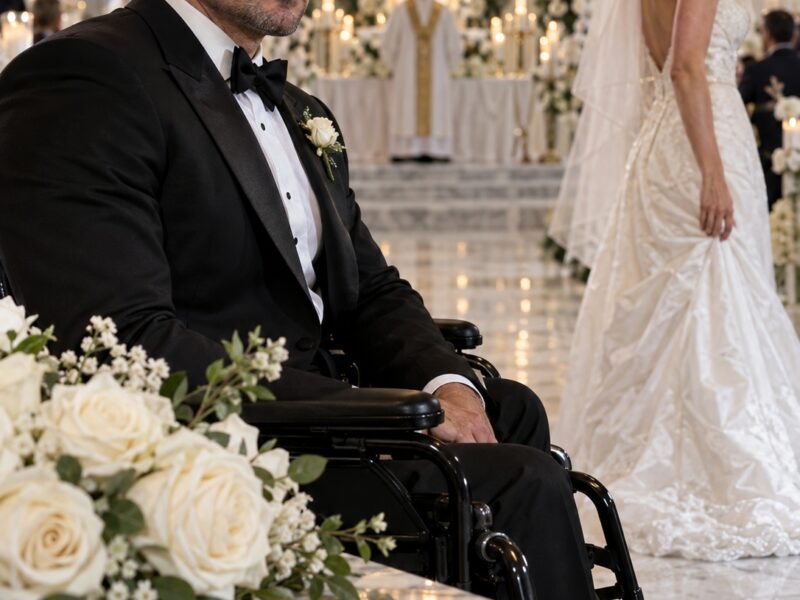
Serena Whitlock took off her engagement ring before the officiant had even finished closing his book.
For one strange second, the sound of metal touching marble seemed louder than the string quartet, louder than the restless shifting of one hundred and eighty guests, louder even than the rain ticking softly against the stained-glass windows of St. Matthew’s Chapel outside Boston.
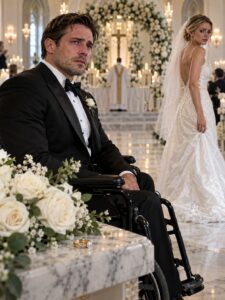
Lucas Vale sat beneath an arch of white roses in a custom black wheelchair, dressed in a tuxedo tailored so perfectly that from a distance nothing about him appeared broken.
That was the word people had used around him for eight months without ever saying it aloud.
Broken.
Lucas had learned to recognize it in lowered voices, in doors held open too aggressively, in strangers who bent at the waist when they spoke to him as though paralysis had somehow damaged his hearing. He recognized it in friends who called him “inspiring” for attending his own board meetings and in employees who tried to take coffee cups from his hands before he had even asked for help.
But he had never expected to see it in Serena’s face on their wedding day.
“I can’t do this,” she whispered.
The quartet stopped in the middle of a note.
Somewhere near the front row, Serena’s mother inhaled sharply.
“Serena,” she murmured.
Serena shook her head.
“No.”
Her voice cracked on the word.
Lucas did not move.
He had spent eight months learning how not to hate the body that no longer obeyed him below the waist. He had learned how to transfer from bed to chair without tearing the skin on his palms, how to navigate hotel bathrooms designed by architects who had technically followed accessibility codes while apparently never meeting a wheelchair user, how to smile when people told him miracles happened.
He had learned how to survive humiliation.
He had not prepared to survive this one in front of everyone he knew.
Serena stared at him through the veil.
“I tried,” she said. “Lucas, I really tried.”
His sister Elena made a small movement from the front pew.
Lucas lifted one hand.
She stopped.
He looked at the woman he had planned to marry and said quietly, “Then say what you came here to say.”
Serena’s lips trembled.
“I thought things would get better.”
“They did.”
“You know what I mean.”
Yes.
He did.
That was the cruelty of it.
Eight months earlier, Lucas’s car had spun across a rain-slick highway after a delivery truck crossed the median outside Boston. Steel folded around him. Glass burst across the road. Two vertebrae fractured, and damage to his spinal cord changed his body before he even regained consciousness.
The surgeons saved his life.
Rehabilitation gave him back strength.
He returned to work.
He learned to dress himself again.
He learned to cook from a wheelchair because one night he became so angry at everyone insisting he rest that he rolled into the kitchen at two in the morning and made terrible scrambled eggs just to prove he could.
But Serena had been waiting for another recovery.
She had been waiting for his legs.
And they had not come back.
“I can’t spend the rest of my life pretending this is what I wanted,” she said.
A painful murmur passed through the chapel.
Lucas watched several guests immediately lower their eyes.
Others did something worse.
They looked at him.
Not Serena.
Him.
As though her confession had revealed something shameful about his body instead of her heart.
Lucas swallowed.
Then he nodded once.
“Okay.”
Serena blinked.
“What?”
“Then don’t.”
“Lucas—”
“If you don’t want this marriage, don’t turn leaving me into another sacrifice you’re making for me.”
Her face crumpled.
“That isn’t fair.”
“Neither is marrying someone you secretly wish were somebody else.”
“I never said that.”
“You didn’t need to.”
A phone appeared briefly between two guests in the fifth row.
Lucas saw it.
He saw everything.
The flowers that had cost more than some people’s annual salaries. The antique chandeliers. The champagne waiting at Vale House. The custom ramp he had insisted remain visible rather than hidden behind ivory fabric because he was tired of pretending accessibility was something ugly.
And beside Serena’s bouquet, he saw the empty place where she had put the ring.
Three years reduced to a circle of platinum lying beside white roses.
Serena wiped at her face.
“I’m sorry.”
Lucas’s hands tightened around his wheels.
“Go.”
She stared at him.
“Please don’t make me hate myself for this.”
Something inside him went cold.
“That’s not a job I’m accepting.”
Serena flinched.
Then she turned.
Her father, Richard Whitlock, stood as she approached the first pew. He looked toward Lucas with an expression impossible to read, then placed one hand against his daughter’s back.
Together they walked down the aisle.
No one stopped them.
No one spoke.
The chapel doors opened.
Serena disappeared into gray afternoon rain.
Lucas remained beneath the roses.
For perhaps ten seconds, nobody in the room seemed to know what came next.
There was no protocol for a billionaire abandoned at the altar.
There was certainly no protocol for a billionaire in a wheelchair abandoned at the altar.
The pity became almost physical.
Lucas could feel it pressing against him from every direction.
His sister stood.
“Lucas—”
“Not yet.”
Elena froze.
He needed one minute in which nobody touched him.
One minute in which nobody told him Serena was a fool or that he deserved better or that everything happened for a reason.
One minute in which he could still own his own humiliation.
Then, from the rear of the chapel, Lucas noticed one face that looked different from all the others.
Amora Reed stood beside the service door.
Thirty years old. Black. Hair pulled into a neat low knot. Plain black staff uniform beneath a wool coat she had thrown on over it before leaving the estate that morning.
She had worked at Vale House for almost five years.
And she was furious.
Not embarrassed.
Not devastated.
Not pitying.
Furious.
For him.
Their eyes met across the chapel.
Something in Lucas’s chest loosened.
“Amora.”
The room seemed to inhale as one.
Amora’s eyes widened.
“Yes, Mr. Vale?”
He looked at the guests surrounding him like witnesses at a funeral.
Then he looked back at her.
“Take me home, please.”
No one moved.
Amora walked down the aisle.
Her shoes sounded softly against the stone floor.
When she reached him, she did not grab the chair.
She bent slightly so only he could hear her.
“Are you sure?”
Lucas glanced toward the ring Serena had left behind.
Then toward the hundred and eighty people watching him as if tragedy had suddenly become human.
“You’re the only person in this room who hasn’t looked at me like I died.”
Amora’s anger softened.
“You didn’t.”
Lucas held her gaze.
“I know.”
Only then did she put her hands on the handles of his chair.
And she took him home.
What almost no one in that chapel understood was that Serena Whitlock had not decided to leave Lucas at the altar that morning.
The wedding had merely been the place where she finally stopped lying about a decision she had been making in pieces for months.
And Amora Reed knew exactly when it had begun.
Before the accident, Lucas Vale’s life had been built around motion.
Airports before sunrise.
Hotel openings at midnight.
Construction meetings in Chicago followed by investor dinners in Manhattan and site inspections in Miami two days later.
At thirty-nine, Lucas controlled Vale House International, a luxury hospitality company valued in the billions, though he hated the articles that described him as self-made.
“My father made the first part,” he once told a reporter. “I just made it bigger.”
His father, Antonio Vale, had arrived in America with little English and less money. After years working double shifts in hotel kitchens, he and Lucas’s mother bought a failing forty-room property outside Providence.
Lucas grew up changing sheets, carrying luggage, unclogging toilets and doing homework behind the front desk.
He learned hospitality from the bottom upward.
He also learned that wealth had a strange way of making people forget where things started.
By thirty-five, business magazines called him ruthless.
By thirty-seven, competitors called him impossible.
By thirty-nine, Serena called him late for dinner.
She had loved his speed once.
At least Lucas believed she had.
They met at a charity auction in Manhattan where Serena, the daughter of private-equity titan Richard Whitlock, outbid Lucas on a first-edition Hemingway she later admitted she did not particularly want.
“You kept raising your paddle,” she told him afterward.
“So did you.”
“I was testing you.”
“For what?”
“Whether billionaires get irritated over losing.”
“They do.”
She smiled.
“Good.”
Serena was elegant without being fragile, intelligent without pretending she did not know it, and one of the few women Lucas had dated who seemed unimpressed by either his money or his schedule.
She had her own foundation.
Her own opinions.
Her own social circle.
For nearly three years, she followed Lucas through hotels, airports, galas and quiet Sundays at Vale House.
Then one rainy night, a truck crossed a median.
And every promise they had made to each other changed shape in less than five seconds.
Lucas remembered none of the collision.
He remembered waking.
There was a machine breathing softly beside him.
His mouth tasted like metal.
His sister Elena was asleep in a chair.
Serena sat with her head lowered beside the hospital bed, still wearing yesterday’s clothes.
Lucas tried to move.
Pain exploded through his ribs.
Then he tried to move his legs.
Nothing happened.
He looked at Serena.
Her face told him before the doctors did.
“No.”
“Lucas—”
“No.”
She reached for his hand.
He pulled away.
“Move the blanket.”
“What?”
“My legs. Move the blanket.”
“Please.”
“Serena.”
She stood slowly and pulled the sheet lower.
His legs were there.
They looked exactly as he remembered them.
That was somehow worse.
Lucas stared.
“Tell me.”
“We need the doctor.”
“Tell me.”
Serena began crying.
Lucas closed his eyes.
Two hours later, Dr. Nathan Warren explained the spinal injury carefully.
There had been decompression surgery.
There was swelling.
There would be rehabilitation.
Some patients regained function.
Some did not.
Lucas listened without interrupting.
Then he asked the only question that mattered to him at that moment.
“Will I walk again?”
Dr. Warren hesitated.
Lucas noticed.
Doctors who knew good news did not hesitate.
“We don’t know.”
Three months later, Lucas stopped asking.
Not because he had given up.
Because he realized the question had started swallowing every other question.
Could he work?
Could he live alone?
Could he drive again with modifications?
Could he travel?
Could he have sex?
Could he build hotels?
Could he be furious and happy and ambitious and difficult and ordinary?
Walking had become the only outcome everyone seemed capable of imagining.
Lucas eventually chose another.
Living.
At first, Serena seemed to choose it too.
She stayed through surgeries.
She slept badly in hospital chairs.
She learned medication schedules.
She argued with insurance administrators even though Lucas could have purchased the hospital itself if necessary.
During his first week in rehabilitation, Lucas threw a plastic water cup against a wall after failing to transfer independently from his bed.
Serena picked it up.
“Again.”
“I said I’m done.”
“No.”
“Get out.”
“No.”
He glared at her.
She dragged the wheelchair closer.
“You can hate me after you get into that chair.”
And somehow, trembling with exhaustion and rage, Lucas did.
That night he told her he loved her.
Serena cried against his chest.
“I’m not going anywhere.”
He believed her.
Maybe she believed herself.
That was what made everything afterward harder.
Vale House had been modified before Lucas returned.
Door thresholds were lowered.
A residential elevator was serviced.
Bathroom fixtures were changed.
The kitchen island was altered.
And everywhere Lucas looked, someone had tried to make the estate easier for him.
The gesture was generous.
The effect was suffocating.
His first morning home, Lucas rolled from his study carrying coffee on his lap.
The mug slipped.
It shattered.
Three employees rushed toward him.
Lucas froze.
Before the accident, a broken coffee cup would have earned perhaps one curse from the nearest housekeeper.
Now three adults were crouching around him.
“I’ve got it,” Lucas said.
“Sir, please.”
“I said I’ve got it.”
“You could cut yourself.”
“I am thirty-nine years old, not three.”
Nobody moved.
Then Amora entered.
She took one look at the scene.
“Everybody move.”
The employees obeyed before Lucas could speak.
Amora looked at the broken cup.
Then at Lucas.
“You break it?”
He frowned.
“Yes.”
“You cut?”
“No.”
“Good.”
She tossed a towel onto his lap.
“Congratulations.”
Lucas stared at her.
“For what?”
“You dropped a cup.”
“So?”
“You remain qualified to clean it.”
For a heartbeat, Lucas simply looked at her.
Then he laughed.
Not politely.
Not because he wanted someone else to feel comfortable.
He laughed hard enough that his ribs hurt.
Amora crouched nearby but did not touch the glass.
“You missed a piece.”
“Helpful.”
“It’s under the wheel.”
“I see it.”
“Apparently not, because you almost rolled over it.”
“You are extraordinarily rude for someone employed in my house.”
“You knew that when you hired me.”
Lucas laughed again.
From the doorway, Serena watched them.
She did not.
Later that afternoon, Serena found Amora arranging pantry shelves.
“He shouldn’t be reaching down like that.”
Amora did not turn.
“He was cleaning a cup.”
“He could fall out of the chair.”
“He could.”
“That doesn’t concern you?”
“Of course it concerns me.”
Amora slid a jar into place.
“But falling is different from being forbidden to move.”
Serena’s jaw tightened.
“You’re not his therapist.”
“No.”
Amora turned.
“That’s why I treat him like Lucas.”
Serena stared at her.
“He needs support.”
“Yes.”
“Then why do you insist on making everything harder?”
“Because support and helplessness aren’t the same thing.”
Something shifted in Serena’s face.
It was small.
But Amora saw it.
From that day forward, Serena stopped seeing her as just another employee.
At first, the disagreements between Lucas and Serena seemed trivial.
Dining arrangements.
Furniture.
Transportation.
She wanted him transferred into a standard dining chair when important guests visited.
Lucas refused.
“It photographs better,” Serena explained.
“For whom?”
“Lucas.”
“No. Finish the sentence.”
She looked away.
Lucas rolled backward from the table.
“I’m not getting lifted into another chair so nobody has to remember I use this one.”
“That isn’t what I meant.”
“You keep telling me what you don’t mean.”
He turned toward the door.
“I’m starting to care more about what you do.”
Another week, Serena suggested decorative screens around the exterior ramp before a fundraiser at the estate.
“It ruins the symmetry of the entrance.”
Lucas stared at her.
“So does needing it?”
“That’s not what I said.”
Again.
Always that sentence.
That’s not what I said.
Until Lucas began hearing the sentence beneath it.
I wish I didn’t have to see this.
Serena booked specialists without consulting him.
Experimental programs.
Private therapists.
A doctor in Switzerland.
A clinic in California.
Every brochure contained photographs of smiling patients standing beside walkers.
Lucas placed them in a drawer.
Serena found them.
“You didn’t even call.”
“No.”
“What if one of these helps?”
“With what?”
She looked at his chair.
Lucas waited.
Neither of them spoke.
Finally he said, “Say it.”
“I want you to have every chance.”
“At walking.”
“Yes.”
“I have a life now.”
“And you could have more.”
Lucas stared at her.
“That sentence is exactly the problem.”
Serena started crying.
He hated himself for resenting her tears.
She hated herself for needing to cry.
Neither knew what to do with the other’s grief.
And then came the wedding platform.
Serena entered Lucas’s study six weeks before the ceremony carrying architectural renderings.
“The planner solved the altar issue.”
Lucas looked up from his laptop.
“What altar issue?”
She spread the drawings over his desk.
The chapel was represented beautifully.
White flowers.
Candles.
A raised platform beneath the altar.
Lucas studied it.
Then his eyes stopped.
“How do I get onto that?”
Serena pointed at an ornate wooden chair near the altar.
“We’d transfer you before guests arrive.”
He looked at her.
“To that?”
“Just for the ceremony.”
Lucas’s voice became quiet.
“You want to hide the wheelchair.”
“No.”
He looked again at the rendering.
There was no ramp.
No visible access.
Nothing suggesting the groom used a wheelchair at all.
“Serena.”
“It’s our wedding.”
“Yes.”
“I’m trying to make it beautiful.”
Silence.
Serena realized the mistake the instant the words left her mouth.
Lucas looked at her.
“My chair makes it ugly.”
“That’s not what I said.”
He leaned back.
“There it is.”
“Lucas, please.”
“You designed an altar I can’t reach unless two men carry me onto it before everyone arrives.”
“It isn’t about shame.”
“Then what is it about?”
She opened her mouth.
Nothing came.
Lucas nodded slowly.
“That’s what I thought.”
Serena gathered the papers.
“I cannot do anything right with you anymore.”
“That makes two of us.”
She walked out.
An hour later, Amora found Lucas still staring at the rendering.
“Problem?”
“No.”
She glanced at the paper.
“Liar.”
He slid it toward her.
Amora studied the design.
Then she frowned.
“That chair looks uncomfortable.”
Lucas looked at her.
“That is your professional assessment?”
“I have several.”
She pointed.
“You can’t reach your own altar.”
“I noticed.”
“Who designed this?”
“Serena.”
Amora paused.
Then folded her arms.
“I stand by my professional assessment.”
Lucas laughed.
He did not want to.
That almost made it worse.
After Amora left, the smile disappeared from his face.
Because Serena had not made him laugh in weeks.
And Amora had done it without trying.
That frightened him more than the wedding drawing.
So Lucas became careful around her.
He stopped asking Amora to stay when she brought coffee.
He avoided conversations that became personal.
He reminded himself that she was an employee in his house.
Amora seemed to notice.
She respected the distance.
That somehow made him notice her more.
She never hovered.
Never pushed his chair without asking.
Never applauded ordinary tasks.
If he dropped something, she told him where it landed.
If he needed help, she waited until he requested it.
If he was unbearable, she informed him.
One evening Lucas snapped at two employees, his sister, a physical therapist and finally Amora over the course of forty minutes.
Amora stood in the study doorway.
“Finished?”
Lucas glared at her.
“With what?”
“Punishing everyone for something none of us did.”
His face hardened.
“Careful.”
“No.”
“Amora.”
“The truck driver isn’t here.”
She folded her arms.
“Your spinal cord isn’t going to apologize. Serena isn’t here. So you’re attacking the people who are.”
Lucas stared at her.
“You think you understand what this feels like?”
“No.”
“Then don’t lecture me.”
“I didn’t say I understood.”
She stepped away from the door.
“I said you’re being an ass.”
Then she left.
Lucas sat alone for almost twenty minutes.
Afterward, he called every person he had snapped at and apologized.
Amora was last.
“I was an ass.”
“Yes.”
“I’m apologizing.”
“I noticed.”
“You’re supposed to accept it.”
“I do.”
“Then say something gracious.”
“No.”
He laughed despite himself.
From the hallway, Serena heard him.
She stopped walking.
And something old and frightened moved behind her eyes.
The fear became sharper when Richard Whitlock returned to Vale House.
Richard had been interested in Lucas’s company for years.
Whitlock Capital owned stakes in resorts, restaurants and commercial real estate, but Vale House International had something Richard’s portfolio lacked: a luxury brand customers genuinely loved.
Before the accident, he had suggested partnerships three times.
Lucas rejected all three.
After the accident, Richard arrived with another.
He sat across from Lucas in the study while Serena poured coffee.
“This isn’t the same proposal.”
“It has your name on it.”
Richard smiled.
“Very funny.”
“I wasn’t joking.”
Richard opened a leather folder.
“A management venture. Select Whitlock assets would operate under Vale House standards. Your systems. Our capital.”
“No.”
“You haven’t read it.”
“I remember the previous versions.”
“Your circumstances have changed.”
Lucas’s eyes lifted.
Serena went still.
Richard continued.
“You’ve been absent for eight months.”
“I’ve been injured.”
“The market doesn’t distinguish emotionally.”
“I’m not asking the market to love me.”
“Investors need stability.”
“They have it.”
Richard leaned back.
“Do they?”
Lucas slowly closed the folder.
“What exactly are you suggesting?”
“That while you continue recovering, someone with experience could reduce your operational burden.”
“My executive team already does.”
“A temporary strategic adviser.”
Lucas looked at Serena.
She avoided his eyes.
Then he looked at Richard.
“You.”
Richard smiled faintly.
“If the board believed it was useful.”
Lucas pushed the folder across the desk.
“No.”
“Lucas—”
“No.”
“You are letting pride interfere with business.”
“And you’re using my spinal injury to negotiate a deal I rejected when my legs worked.”
The smile vanished from Richard’s face.
Serena touched Lucas’s shoulder.
“Dad is trying to help.”
Lucas looked up at her hand.
Then at her.
“No.”
His voice was low.
“Your father is trying to turn my recovery into leverage.”
Richard stood.
“You’re making a mistake.”
Lucas said nothing.
Richard buttoned his jacket.
“Eventually your board will ask what happens if your recovery takes longer than expected.”
Lucas’s expression changed.
“My recovery is not the same thing as my leadership.”
“Investors may disagree.”
“Then let them.”
Richard left.
Serena remained.
“You embarrassed him.”
“He insulted me.”
“He’s worried.”
“About me?”
“About the company.”
Lucas laughed once.
“That’s what I thought.”
Serena’s face tightened.
“Why does everything have to be a battle now?”
Lucas looked at her.
“Because apparently if I stop fighting for five minutes, someone else starts deciding what my life should look like.”
Two weeks later, Amora overheard the conversation that changed everything.
She was replacing flowers in the west drawing room.
Richard and Serena entered the adjacent library without realizing the connecting door had remained slightly open.
Amora heard Richard first.
“The wedding changes the optics.”
Serena sounded exhausted.
“He won’t sign.”
“He doesn’t need to immediately.”
“Then what’s the point?”
“The board is already nervous.”
“My wedding is not a corporate vote.”
“No. But marriage gives you influence.”
Silence.
Amora stopped trimming the stems.
Richard continued.
“Once you’re married, push him to step back for a year.”
“He won’t.”
“He loves you.”
“That doesn’t mean—”
“I come in as temporary strategic adviser. Nothing dramatic. The executive team remains. Lucas focuses on rehabilitation.”
“He’ll see exactly what you’re doing.”
“Only if you present it badly.”
Serena lowered her voice.
“What if he never agrees?”
Richard laughed softly.
“He will eventually understand it works.”
“And if he doesn’t?”
“He loves you.”
Amora’s hand tightened around the scissors.
Richard continued.
“That gives you more influence than you understand.”
Amora left before they finished.
She said nothing for three days.
Not because she wanted to protect Serena.
Because she distrusted partial information.
She had spent too much of her life watching powerful people destroy weaker ones using fragments of truth.
She wanted context.
Then Serena gave it to her.
Late Friday afternoon, Serena entered the pantry and closed the door behind her.
“You heard my father.”
Amora looked up.
“Yes.”
No point lying.
Serena folded her arms.
“How much?”
“Enough.”
“You will not repeat that conversation.”
Amora’s face remained neutral.
“That depends.”
“On what?”
“Whether Mr. Vale asks me.”
Serena stared.
“You really think you matter that much?”
“No.”
Amora set down the inventory sheet.
“I think the truth does.”
Serena stepped closer.
“You have become far too comfortable in this family.”
“I’m an employee.”
“Exactly.”
Amora nodded.
“Then why are you threatened by me?”
The words landed harder than she intended.
Serena’s face changed.
“After the wedding there will be some staffing changes.”
“What kind?”
“You won’t be working here.”
Amora studied her.
“Does Lucas know?”
“He will understand.”
“No.”
Amora’s voice softened.
“You mean you hope he won’t fight you.”
Serena slapped one palm against the counter.
“You have no idea what I’ve given up.”
Amora remained silent.
Something inside Serena finally broke.
“My entire life changed because of one phone call.”
“I know.”
“No, you don’t.”
Her voice shook.
“The travel. The wedding. The future we planned. Children. Everything.”
Amora’s expression softened slightly.
“Serena—”
“And every time I say I’m tired, somebody looks at me like a monster because Lucas has it worse.”
“That isn’t what I’m doing.”
“Everyone does it.”
Serena wiped angrily beneath one eye.
“I stayed in that hospital. I slept in chairs. I cleaned blood off his hand after he ripped out an IV. I helped him shower when he couldn’t do it himself. I watched the man I loved wake up and hate the world.”
Amora said nothing.
“I have been there.”
“I know.”
“And now he looks at me like every mistake proves I never loved him.”
“Do you?”
Serena stared at her.
Amora regretted the question immediately.
But Serena answered.
“Yes.”
Her voice cracked.
“That’s the worst part.”
For the first time, Amora saw something beneath Serena’s anger she recognized.
Grief.
Not grief because Lucas had died.
Grief because Serena could not stop mourning the version of him who had.
Amora spoke carefully.
“Being exhausted doesn’t make you a monster.”
Serena’s shoulders lowered.
Then Amora continued.
“But resenting him for surviving differently than you wanted might.”
Serena’s face hardened again.
“You don’t know anything about love.”
Amora did not answer.
The silence lasted one second too long.
Serena noticed.
Her eyes narrowed.
“Oh my God.”
Amora’s stomach tightened.
“No.”
“You love him.”
“No.”
Too fast.
Serena gave a bitter laugh.
“Of course.”
“Nothing has happened between us.”
“You think that matters?”
“Yes.”
“It won’t.”
Amora moved toward the door.
Serena’s voice stopped her.
“After the wedding, you’re leaving.”
Amora turned.
“What?”
“You heard me.”
That night, Amora typed a resignation letter.
She printed it at eleven twenty-three.
At eleven thirty, she stood outside Lucas’s study holding the envelope.
“Come in.”
She entered.
Lucas was reviewing hotel occupancy reports on a large monitor.
“What is it?”
She handed him the envelope.
He read the first line.
Then looked up.
“No.”
Amora almost smiled.
“That is not generally how resignations work.”
“Why?”
“Personal reasons.”
“Bad answer.”
“Still my answer.”
He studied her face.
“Serena.”
Amora looked away.
Lucas’s voice hardened.
“What did she say?”
“It doesn’t matter.”
“It matters to me.”
“She doesn’t want me working here after the wedding.”
Lucas’s eyes narrowed.
“Why?”
Amora inhaled.
Then she told him everything she could justify telling him.
Richard’s conversation.
The temporary advisory plan.
The belief that marriage would give Serena influence over him.
The threat to Amora’s job.
Lucas listened without interrupting.
When she finished, he asked, “Anything else?”
“No.”
“Amora.”
She looked at him.
His eyes did not leave hers.
“Anything else?”
Her throat tightened.
She thought of Serena saying, You love him.
“No.”
Lucas knew she was lying.
She saw it.
But he did not force her.
Instead, he picked up his phone.
“Lucas.”
He looked at her.
“Go home.”
“What are you doing?”
“Having a conversation with the woman I’m supposed to marry in nine days.”
The argument lasted fifty-seven minutes.
Amora did not hear it.
The household did.
Voices carried down the corridor.
Serena admitted speaking with her father.
She denied agreeing to manipulate Lucas.
She admitted telling Amora she would be dismissed.
“Why?” Lucas asked.
Serena stared at him.
“You really need me to explain?”
“Yes.”
“She has become emotionally inappropriate.”
Lucas became very still.
“What does that mean?”
“You know exactly what it means.”
“No.”
Serena laughed without humor.
“You look for her.”
Lucas said nothing.
“Every time you enter a room.”
His jaw tightened.
“Serena.”
“You do.”
“She works here.”
“So do fourteen other people.”
“That isn’t fair.”
“There.”
Tears filled Serena’s eyes.
“That silence. That’s exactly what I mean.”
Lucas rubbed one hand across his forehead.
“Our wedding is in nine days.”
“I know.”
“Do you want to marry me?”
“Yes.”
Serena answered immediately.
Lucas stared at her.
Then something unsettled him.
She had not hesitated.
He had.
And because he was terrified of what that hesitation meant, Lucas convinced himself that her certainty mattered more.
The wedding continued.
Amora agreed to stay until the ceremony because the estate was overwhelmed.
She planned to leave the following morning.
Nobody discussed the argument again.
For nine days, everyone performed normalcy.
Florists arrived.
Caterers finalized menus.
Security reviewed guest lists.
Serena smiled at fittings.
Lucas attended physical therapy.
Amora packed her apartment above the east garage.
And beneath all of it, three people quietly understood that something had already ended.
None of them knew which relationship it was.
Then Serena stood beneath the roses and removed the ring.
Six hours after Amora wheeled Lucas out of the chapel, Vale House was nearly silent.
The reception had been canceled.
Food intended for one hundred and eighty guests was donated before sunset.
Flowers remained everywhere.
White roses in the entrance hall.
White roses on the dining tables.
White roses around a wedding cake nobody touched.
Lucas refused to enter the suite prepared for the newlyweds.
Instead, he went to his study.
Amora brought him water.
Nothing else.
He looked at the glass.
“No inspirational speech?”
“No.”
“Good.”
“I’m off the clock in fifteen minutes.”
Lucas looked at her.
“You’re still leaving tomorrow.”
“Yes.”
“Even now?”
“Especially now.”
He frowned.
“Why?”
Amora sat in the chair opposite him.
“Because six hours ago, the woman you thought you’d spend your life with abandoned you in front of nearly two hundred people.”
“That seems like an argument for not leaving.”
“It’s the opposite.”
Lucas stared.
“You need time to figure out who you are without Serena.”
His face tightened.
“And you?”
“I need to figure out who I am when I’m not working in your house.”
“You already know.”
“No.”
She smiled faintly.
“You know the version of me who remembers where you leave your reading glasses.”
“I don’t leave them anywhere.”
“They’re under the blue folder.”
Lucas looked.
They were.
Amora’s smile disappeared.
“I had plans before this job.”
“I know.”
“No, you know the résumé version.”
She looked toward the dark windows.
“I studied hotel operations. I wanted to run properties. Maybe build something. Then my mother got sick.”
Lucas knew that part.
Kidney disease.
Dialysis.
Amora left school and helped raise her younger brother while her mother underwent years of treatment.
Private housekeeping paid quickly.
Internships did not.
One year at Vale House became five.
“Your mother is stable now.”
“Yes.”
“And your brother graduates this spring.”
“Yes.”
“So go back.”
Amora looked at him.
“You say that like it’s easy.”
“No.”
Lucas’s voice softened.
“I say it like maybe easy stopped being the requirement.”
She looked away.
Silence filled the room.
Then Lucas asked the question neither of them was prepared for.
“Do you love me?”
Amora closed her eyes.
“Don’t do this tonight.”
“That isn’t a no.”
“It’s the only answer you’re getting.”
“Amora.”
She stood.
“You were abandoned at your wedding today.”
“I noticed.”
“You don’t get to replace one certainty with another because the second one hurts less.”
Lucas went still.
“That isn’t what I’m doing.”
“You don’t know what you’re doing.”
The words were gentle.
That made them worse.
Amora walked toward the door.
Behind her, Lucas said, “You could stay.”
She stopped.
He added quietly, “Not as an employee.”
Amora turned.
“And become what?”
Lucas had no answer.
She nodded.
“That’s why I have to go.”
The next morning, Amora left Vale House with two suitcases.
There was no dramatic farewell.
No embrace in the rain.
No confession.
She hugged the kitchen staff.
She cried when the head housekeeper gave her a small framed photograph of everyone at Christmas.
Then she went to Lucas’s study.
He was already dressed.
“Car is here,” she said.
“I know.”
Neither moved.
Finally Lucas held out his hand.
Amora looked at it.
Then took it.
“Thank you,” he said.
“For what?”
Lucas thought about the chapel.
The coffee cup.
The fights.
The moments she had refused to treat him like a tragedy.
“For knowing the difference between helping me and carrying me.”
Amora’s eyes filled.
“Don’t make me cry before nine in the morning.”
“Very unprofessional.”
“I resigned.”
“Right.”
She released his hand.
Lucas wanted to ask her to stay.
Every selfish part of him wanted to.
He did not.
That mattered more than either understood at the time.
Three weeks later, Richard Whitlock entered a Vale House board meeting expecting an opportunity.
Instead, he found Lucas sitting at the head of the table.
Wheelchair visible.
Suit immaculate.
No attempt to disguise what had changed.
Richard stopped.
“Lucas.”
“Richard.”
Several directors exchanged glances.
Richard took his seat.
He began carefully.
“Given recent personal events, I believe leadership stability deserves discussion.”
Lucas closed the folder in front of him.
“My leadership is stable.”
“No one is attacking your leadership.”
“Good.”
Richard’s jaw tightened.
“Your circumstances have created uncertainty.”
“My personal circumstances are none of this board’s concern unless they impair my ability to perform my job.”
Richard leaned back.
“That’s precisely the question.”
Lucas smiled.
“No. That’s the question you’ve been trying to create.”
Silence.
Lucas slid a document across the table.
“The Whitlock partnership proposal is permanently rejected.”
Richard stared at it.
“You’re emotional.”
“About business?”
“About Serena.”
Lucas’s expression did not change.
“Your daughter ended our relationship. You attempted to use that relationship to gain influence over my company. Those are separate issues.”
Richard looked around the table.
Several directors avoided his eyes.
Lucas continued.
“And effective today, every Vale House property will undergo a full accessibility review.”
One director frowned.
“We already comply with federal requirements.”
Lucas looked at him.
“That wasn’t what I said.”
The director fell silent.
“For eight months, I’ve stayed in hotels with accessible rooms where the bed was too high for an independent transfer. I’ve used bathrooms where the door met the legal width requirement but weighed so much I couldn’t close it. I’ve sat at restaurant tables I technically had access to but could not comfortably approach.”
He turned his chair slightly.
“I’ve also watched staff speak to the person beside me instead of speaking to me.”
No one moved.
“We built luxury around understanding what guests need before they have to ask.”
Lucas looked around the table.
“Apparently, we only meant certain guests.”
That meeting changed Vale House more than the accident had.
Within six months, the company created a dedicated accessibility division.
Not a charitable project.
Not a marketing campaign.
An operating unit with authority over design, training, guest experience and renovations.
Lucas refused proposals featuring inspirational slogans.
“We’re not saving disabled people,” he told marketing. “We’re fixing hotels.”
The line spread through headquarters.
So did the work.
For the first time since his accident, Lucas felt as though paralysis had become information instead of merely loss.
He still had bad mornings.
Days when his body hurt in ways he could not explain.
Days when inaccessible buildings made him furious.
Days when he dreamed he was walking and woke before remembering he couldn’t.
But he stopped organizing his life around the possibility of becoming his old self again.
He bought a hand-controlled car.
Returned to traveling.
Moved furniture without asking Serena’s imagined permission.
He also started therapy.
That surprised nearly everyone.
“You hate therapy,” Elena told him.
“I hate being told what I think.”
“That is not what therapy is.”
“I know that now.”
His sister smiled.
“Growth.”
“Don’t ruin it.”
He dated nobody.
For months, he heard occasional reports about Serena through mutual acquaintances.
She had moved to Manhattan.
Then London for a period.
She stepped away from several foundation events.
Someone told Lucas she had started therapy too.
He did not ask for details.
They spoke once.
Seven months after the wedding, Serena called him.
Lucas nearly ignored the number.
Then answered.
“Hello.”
For a moment, neither spoke.
Finally Serena said, “I’m sorry.”
Lucas looked out his office window.
“For leaving?”
“For staying after I already knew.”
That surprised him.
Serena continued.
“I kept waiting for you to become who you were.”
“I know.”
“And every time you adapted, I treated it like surrender.”
Lucas said nothing.
“I loved you,” she whispered.
“I know.”
“I think I loved you and still failed you.”
Those words hurt more than hatred would have.
Lucas closed his eyes.
“I failed you too.”
“No.”
“Yes.”
He exhaled.
“I knew you were drowning and kept demanding you prove you weren’t.”
Serena cried quietly.
Neither forgave everything.
Neither needed to.
Some relationships ended without creating villains.
Sometimes two people could love each other and still become dangerous to the person the other was trying to become.
Before hanging up, Serena said, “I hope you’re happy.”
Lucas thought for a second.
“I’m getting there.”
He meant it.
By then, Amora Reed was getting there too.
She had rented a small apartment in Cambridge.
Returned to school.
Finished the hospitality management certification she had abandoned years earlier.
She worked nights at a boutique hotel while studying.
Her first month nearly broke her.
She was thirty years old sitting beside twenty-two-year-olds who complained about group projects and weekend plans.
She almost quit twice.
The second time, her mother looked at her across the kitchen table.
“You left school for me.”
“Mama—”
“You did.”
“You were sick.”
“And now I’m telling you something.”
Her mother reached across the table.
“Do not spend the rest of your life turning love into an excuse for never choosing yourself.”
Amora stayed.
Six months after leaving Vale House, she saw a job posting.
Vale House International.
Accessibility Division.
Hospitality Operations Coordinator.
She stared at it for almost a minute.
Then closed the browser.
Two hours later, she reopened it.
She submitted an application under her own name.
She told nobody.
Not Lucas.
Not Elena.
Not anyone at the estate.
Her résumé reached the final round.
The interview panel recognized her immediately.
Lucas learned she had applied when legal flagged the prior employment relationship.
He stared at the email.
Then called Human Resources.
“Remove me from the process.”
The director paused.
“You don’t want input?”
“None.”
“She worked in your home.”
“I know.”
“And you have a personal relationship?”
Lucas looked toward the window.
“Not currently.”
The director understood enough not to ask more.
“Then we’ll handle it independently.”
Amora got the job.
On merit.
Lucas learned only after she accepted.
On her first day, she walked through Vale House headquarters carrying a laptop bag and wearing a navy suit Lucas had never seen before.
He rolled around a corner.
Stopped.
Amora stopped too.
They looked at each other.
“You work here,” he said.
“Apparently.”
“You didn’t tell me.”
“You weren’t interviewing me.”
Lucas tried not to smile.
“Good.”
Amora pointed at his wheelchair.
“Still terrifying junior managers with that thing?”
“Mostly executives.”
“Better.”
Then she walked away.
Lucas sat there smiling like an idiot.
His assistant noticed.
He ignored him.
Their relationship changed carefully.
Amora had her own salary.
Her own manager.
Her own apartment.
Her own career.
Lucas made sure she never reported through his office.
They sometimes crossed paths during meetings.
Then at lunch.
Then during late-night project reviews.
Months passed before he asked her to dinner outside work.
Even then, Amora narrowed her eyes.
“Is this business?”
“No.”
“Are you sure?”
“I prepared a rule.”
“That sounds romantic.”
“No board reports.”
“Good.”
“No accessibility audits.”
“Excellent.”
“No hotel openings.”
She smiled.
“You may have nothing left to talk about.”
“I’m willing to risk it.”
“One dinner.”
It became another.
Then another.
Nothing happened quickly.
That was deliberate.
Lucas had learned to distrust certainty built from desperation.
Amora had learned not to confuse being needed with being loved.
And both understood something outsiders later ignored when they turned their story into gossip.
A billionaire employer falling in love with the woman who cleaned his house was not automatically romantic.
Power mattered.
Money mattered.
Dependence mattered.
So Amora had walked away until choosing Lucas could genuinely be a choice.
And Lucas had let her.
One year after the failed wedding, he finally kissed her.
It happened outside a tiny Italian restaurant where the tables were too close together and Lucas had spent twenty minutes pretending not to be annoyed by it.
Amora stood beside his car.
“You hated that restaurant.”
“The food was good.”
“You nearly declared war on table twelve.”
“They kept moving their chair into my path.”
“You glared at a seventy-year-old woman.”
“She knew what she was doing.”
Amora laughed.
Lucas watched her.
Then became serious.
“What?”
He looked at her.
“I want to kiss you.”
Amora’s smile faded.
“You’re asking?”
“Yes.”
“That’s unexpectedly civilized.”
“I contain multitudes.”
She stepped closer.
“Then kiss me.”
He did.
Nothing exploded.
No music played.
No one applauded.
And that was exactly why Lucas remembered it.
It did not feel like rescue.
It felt like the beginning of something ordinary enough to survive.
Two years later, Vale House reopened the first hotel Antonio Vale had ever owned.
The building had been completely redesigned.
Not as what journalists kept calling a “special-needs hotel.”
Lucas hated that phrase.
It was simply a better hotel.
Accessible rooms did not resemble hospital rooms.
Beds adjusted quietly.
Bathroom layouts worked for different bodies.
Lower service counters existed beside standard ones instead of at separate stations.
Furniture could move.
Pool lifts were incorporated into the architecture instead of hidden behind storage walls.
Staff were trained to ask one question before offering assistance.
“What would be useful?”
Not, “What’s wrong?”
Not, “Can your companion help?”
Not, “Should I push you?”
Just:
What would be useful?
At the opening gala, Lucas stood—figuratively, as he joked—in the center of the ballroom speaking with investors.
A small orchestra began playing.
Amora appeared beside him.
“Come on.”
He looked up.
“Where?”
“The dance floor.”
Lucas stared at her.
“You remember the paralysis part?”
Amora raised one eyebrow.
“You remember I know that?”
“I don’t dance.”
“You did before.”
“I also walked before. Should we keep listing historical facts?”
She held out her hand.
Lucas looked toward the dance floor.
Couples were already moving.
“I’m serious.”
“So am I.”
“Amora.”
“You told me once you hated everybody acting like your life ended.”
“I do.”
“Then stop acting like dancing belongs exclusively to legs.”
Lucas stared at her.
Then laughed.
“You rehearsed that.”
“All afternoon.”
He took her hand.
They moved onto the floor.
Lucas turned the chair beneath his palms.
Amora followed the rhythm beside him.
At first, he felt every pair of eyes.
Then he nearly clipped a table.
Amora burst out laughing.
“You’re terrible.”
“I wasn’t trained for this.”
“That’s your excuse for everything.”
Lucas spun the chair the other direction.
She moved with him.
Something loosened inside his chest.
People were watching.
He knew they were.
But for the first time, he did not feel like they were watching disability.
They were watching two people dancing badly.
The distinction was everything.
Later, they escaped onto the terrace.
The Atlantic stretched dark beyond the hotel grounds.
Lucas rested his hands on his wheels.
“Do you remember the wedding?”
Amora groaned.
“Unfortunately.”
“What I said?”
She looked at him.
“Take me home, please.”
Lucas smiled faintly.
“I thought home meant the estate.”
“And now?”
He reached for her hand.
“I think I was asking the wrong person to take me back to the wrong life.”
Amora became quiet.
Lucas looked toward the ocean.
“Serena wanted the man I was before the accident.”
He paused.
“Richard wanted the CEO he thought he could temporarily replace.”
Amora squeezed his hand.
“Everyone kept waiting for me to become familiar again.”
He turned toward her.
“You were the first person who acted like I was still here.”
Amora held his eyes.
“You were.”
Lucas smiled.
“You know what people say about us?”
“That I seduced you with excellent laundry management?”
“Among other things.”
She laughed.
Lucas looked serious again.
“They say you saved me.”
Amora shook her head.
“No.”
“I know.”
“You were unbearable. Saving you would have required specialized equipment.”
He laughed.
Then she leaned against the terrace railing.
“I didn’t save you, Lucas.”
“No.”
“You did that.”
He watched her.
“And you left.”
“I had to.”
“I know.”
That was the part people eventually misunderstood when the story spread beyond Boston society pages.
The headlines made everything simple.
PARALYZED BILLIONAIRE ABANDONED AT ALTAR FINDS LOVE WITH HOUSEKEEPER.
It sounded like a fairy tale.
It was not.
Serena Whitlock was not evil because she struggled after Lucas became disabled.
Fear did not make her cruel.
Grief over a future that disappeared overnight did not make her heartless.
What destroyed them was something quieter.
She could not stop loving Lucas as a memory.
She kept waiting for rehabilitation to return him to the man she had planned her future around.
And every time he adapted to his changed body, she saw adaptation as surrender.
Lucas was guilty of his own form of denial.
For months, he demanded that Serena accept a reality he himself had not fully accepted.
He punished her for grieving because he was terrified her grief confirmed his worst fear—that his changed body made him less lovable.
By the time they understood what they were doing to each other, their relationship had become a room neither knew how to leave without becoming the villain.
The wedding merely opened the door.
Richard’s mistake had been different.
He saw vulnerability and mistook it for weakness.
Lucas spent the rest of his career proving how expensive that mistake could be.
Under the new accessibility initiative, Vale House became an industry leader not because Lucas wanted praise but because he had discovered a fundamental business truth.
People noticed when dignity was designed into a room.
The company grew.
So did Amora.
Within four years, she became regional director of guest experience.
Within six, she led hospitality strategy across the East Coast.
She never worked directly for Lucas.
She insisted on it.
At one company retreat, a new executive mistakenly introduced her as “Lucas Vale’s partner.”
Amora smiled.
“Professionally?”
The executive blushed.
“I meant—”
“My title is Executive Vice President.”
Lucas nearly choked on his coffee.
Later he told her, “You enjoyed that.”
“Immensely.”
“You terrified him.”
“Mostly executives.”
Lucas smiled.
“Better.”
Years after the wedding that never happened, Lucas kept one photograph from that day.
It was not a portrait beneath the flowers.
Serena was not in it.
The abandoned ring was nowhere to be seen.
The photograph had been taken accidentally by a guest standing near the chapel entrance.
Lucas was rolling toward the open doors.
Amora walked beside him.
Behind them, one hundred and eighty guests blurred into a wash of dark suits, pale dresses and white roses.
Lucas had hated the picture the first time he saw it.
His shoulders looked rigid.
His face looked exhausted.
The wheelchair was impossible to ignore.
Years later, that became why he loved it.
One evening Amora found him holding the photograph.
“You kept that?”
“Yes.”
“Why?”
Lucas turned it over.
On the back, in his own handwriting, was one sentence.
Amora read it quietly.
“The day I thought someone left me behind was the day I finally stopped trying to become the man everyone else wanted back.”
She looked at him.
“That’s dramatic.”
“I was abandoned at the altar. I earned dramatic.”
“Fair.”
Lucas placed the photograph back on the shelf.
Amora rested one hand on his shoulder.
He looked up at her.
“You know something strange?”
“That narrows nothing.”
“For years I thought the worst day of my life was the accident.”
Amora waited.
“Then I thought it was the wedding.”
“And now?”
Lucas looked toward the photograph.
“The accident changed my body.”
He touched one wheel.
“The wedding changed the lie I was living.”
Amora’s expression softened.
“What lie?”
“That getting my life back meant getting the old one back.”
For a moment, neither spoke.
Outside, evening light spread across the windows of Vale House.
Lucas thought of Serena beneath the roses.
Richard in the boardroom.
The hospital ceiling.
The first shattered coffee cup.
The moment Amora placed a towel on his lap instead of kneeling to clean the floor for him.
He thought about all the people who had loved him and still misunderstood what love required.
Then he thought about the woman beside him, who had loved him enough to leave before staying could become another form of dependence.
Lucas reached for her hand.
Paralysis had changed the architecture of his life.
It changed how he entered buildings.
How he traveled.
How strangers looked at him.
How he slept.
How he worked.
How he danced.
It changed what future children might ask him.
It changed which streets he could cross easily and which restaurants he quietly stopped visiting.
What it never changed was the thing everyone around him had been in danger of forgetting.
He was still Lucas Vale.
Difficult.
Ambitious.
Funny when he forgot to protect himself.
Arrogant more often than he admitted.
Capable of love.
Capable of being wrong.
Capable of building a life that looked nothing like the one he had planned.
Serena had walked away because she could not accept that changed life without constantly comparing it to the original.
Amora stayed beside him long enough to remind him he was still alive.
Then she did something even harder.
She walked away too.
Not because she loved him less.
Because love without freedom was only another beautiful cage.
She built a career.
He rebuilt an identity.
They met again as two people who no longer needed the other to rescue them.
And only then did they choose each other.
Years later, when Lucas remembered the chapel, he no longer heard Serena saying, “I can’t do this.”
He remembered four other words.
Take me home, please.
At the time, he had meant Vale House.
He had meant get me away from these people.
Get me away from the flowers.
Get me away from the staring.
Get me somewhere I do not have to watch strangers decide whether I am pathetic.
He thought home was a building.
He thought dignity meant never needing help.
He thought recovery meant becoming recognizable again.
He had been wrong about all three.
Home was not the estate waiting beyond the chapel doors.
It was not Serena’s memory of the man he had been.
It was not even Amora.
Home was the life Lucas finally stopped apologizing for living.
And on the day one woman left him in front of everyone he knew, the woman walking quietly beside his wheelchair became the first person to show him the way there.
Not by carrying him.
Not by saving him.
Not by promising he would someday walk again.
But by looking at him exactly as he was and saying the one truth almost everyone else had forgotten.
You didn’t die.
Lucas had looked up at her that afternoon and answered with two words.
“I know.”
It took him years to understand that those were the words that saved him.
Not because they meant he was healed.
Because they meant he no longer needed to be.









