She Lost a $50,000 Wallet—But the Stranger Who Returned It Took Something Far More Valuable
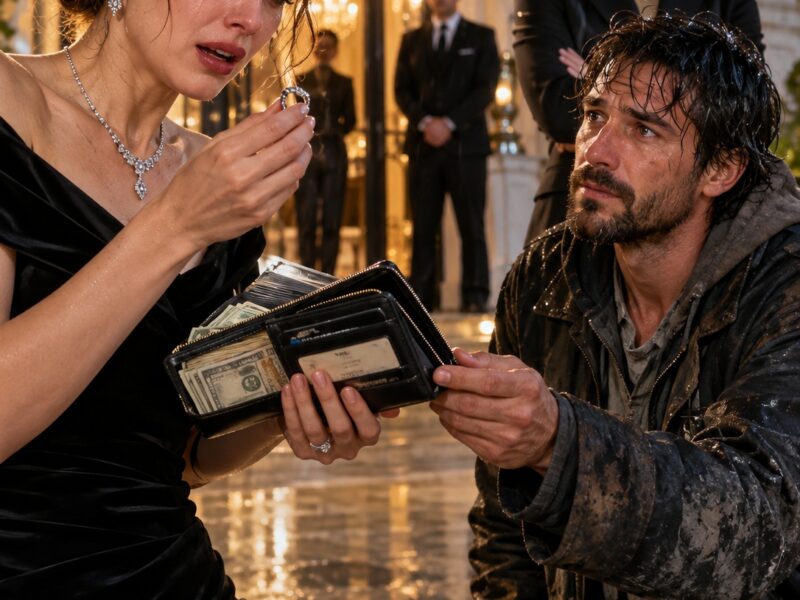
The stranger standing outside Victoria Sterling’s mansion was soaked to the skin.
Rain ran from his dark hair onto the collar of a faded canvas jacket. Sawdust still clung to one sleeve. His boots had left muddy prints across the pale stone beyond the front door, and behind him, at the end of the long circular driveway, a security guard watched with one hand hovering near his radio.
The man looked completely out of place.
Victoria noticed all of that.
Then she noticed what he was holding.
Her wallet.
For several seconds, she forgot how to breathe.
Six hours earlier, that wallet had contained more than fifty thousand dollars in cash, her passport, her driver’s license, a black credit card with no spending limit, and enough private identification to create the kind of nightmare her attorneys were paid obscene amounts of money to prevent.
But none of those things mattered now.
Victoria reached for the wallet, opened it, pushed past the cash and cards, and found the small inner pocket.
Her fingers stopped.
The ring was there.
Small.
Worn.
Almost worthless to anyone else.
Her mother’s ring.
Victoria stared at it until the enormous foyer behind her seemed to disappear.
“Where did you get this?”
“Sidewalk downtown.”
The stranger’s voice was quiet.
No performance.
No smile.
No attempt to impress her.
Victoria looked at him again.
“You opened it?”
“I needed to know who it belonged to.”
“You saw the cash?”
“Yes.”
“All of it?”
“I assume so.”
She counted it anyway.
Fifty thousand dollars.
Not one bill missing.
Behind Victoria, Linda Whitfield gave a skeptical little breath.
Linda was deputy director of Sterling Living and had spent fifteen years learning that generosity usually arrived carrying an invoice.
“This doesn’t make sense,” Linda said.
The stranger glanced at her.
“It doesn’t have to.”
Linda folded her arms.
“You expect us to believe you found more money than most people make in a year and walked across the city in the rain just to return it?”
“No.”
His answer caught everyone off guard.
Linda narrowed her eyes.
“No?”
“You can believe whatever you want.”
Then he looked at Victoria.
“I just thought you’d want your things back.”
Victoria had negotiated acquisitions against men who had built fortunes intimidating everyone in the room.
She had fired senior executives without raising her voice.
She had stared across conference tables at investors threatening to pull hundreds of millions of dollars and never allowed her pulse to show in her face.
But now her hand trembled.
Because the stranger had returned the one thing money could not replace.
Her mother had worn that ring for thirty-one years.
Victoria remembered it tapping against coffee mugs when she was a child.
She remembered it catching sunlight while her mother braided her hair.
She remembered holding that same hand beside a hospital bed eight years earlier, when the monitors finally went quiet.
Victoria closed the wallet.
“What’s your name?”
“Daniel Brooks.”
She turned immediately.
“Ethan.”
Her assistant stepped forward.
“Write Mr. Brooks a check.”
Daniel’s expression changed for the first time.
“Don’t.”
Victoria barely heard him.
“One hundred thousand dollars.”
The foyer went silent.
Even Linda looked surprised.
Ethan hesitated only a second before reaching for the leather folio he carried.
Daniel shook his head.
“No.”
Victoria looked at him.
“You returned fifty thousand dollars.”
“It wasn’t mine.”
“You returned my passport, my cards, and something that belonged to my mother.”
“I know.”
“So take the money.”
“No.”
Victoria actually laughed once, softly, because she assumed she had misunderstood.
“You’re refusing a hundred thousand dollars?”
“Yes.”
“Why?”
Daniel looked at the wallet in her hands.
Then at the ring she was still touching with her thumb.
“If I take a hundred thousand dollars for returning something that already belonged to you, then I didn’t really return it for the reason I thought I did.”
Victoria stared at him.
Daniel stepped backward toward the rain.
“A person either does the right thing because it’s right,” he said, “or he does it because he wants to be paid. I’d rather know which kind of man I am.”
And then he walked away.
No business card.
No request.
No favor.
No backward glance.
Victoria Sterling stood beneath a chandelier worth more than Daniel Brooks’s house, holding a check no one wanted and a wallet containing fifty thousand dollars.
Yet for the first time in years, she felt poor.
Three days earlier, if someone had asked Victoria what she believed about people, she would have given the polished answer.
People were complicated.
Motivated by different things.
Capable of kindness.
Capable of sacrifice.
That was what respectable people said.
What Victoria actually believed was much simpler.
Everyone wanted something.
Money.
Access.
Recognition.
Influence.
Security.
A better office.
A better title.
A photograph beside someone important.
Even generosity, in Victoria’s experience, usually wanted an audience.
She knew because she had built an empire understanding what people wanted.
At thirty-six, Victoria was chief executive of Sterling Living, a furniture and home-design company operating across three continents. That morning she had walked out of a glass tower downtown after signing an investment agreement worth several hundred million dollars.
Cameras had flashed.
Reporters had shouted questions.
“Victoria, is this your biggest expansion yet?”
“Are you entering the European market?”
“Do you think Sterling Living can double revenue within five years?”
She had smiled exactly long enough.
“This isn’t about becoming bigger,” she had said. “It’s about becoming better.”
The quote would appear in financial publications by afternoon.
It sounded good.
Victoria knew that because six people had approved it.
Then she climbed into the back of her town car and immediately asked Ethan about the next meeting.
She did not notice the torn seam inside her handbag.
She did not notice the wallet sliding through it.
She did not notice it hitting the pavement.
By the time she discovered it missing, she was inside another meeting twelve miles away.
The money irritated her.
The passport created complications.
The cards could be replaced.
But the ring—
That had made her leave the room.
She had stood alone in a restroom stall with her eyes closed, hearing her mother’s voice from years ago.
Ambition can be a wonderful engine, sweetheart.
Just don’t make it your home.
Victoria had dismissed the advice then.
Her mother had grown up with very little. Victoria had believed people without ambition romanticized simplicity because they had never experienced power.
Now the ring was gone.
And suddenly the woman who could replace almost anything realized exactly how helpless money could make you.
She had told herself she would never see it again.
Then Daniel Brooks appeared in the rain.
Across the city, Daniel lived in a neighborhood that would never appear in Sterling Living’s promotional materials.
The houses were old.
Porches leaned.
Fences needed paint.
People borrowed tools instead of ordering new ones.
Daniel’s workshop occupied a narrow addition attached to a modest wooden house beneath two enormous maple trees.
He restored furniture.
Not the fashionable kind.
Not the kind wealthy people displayed because an interior designer had told them it was important.
He repaired chairs inherited from grandmothers.
Tables damaged by floods.
Cabinets people could not afford to replace.
Desks carrying initials carved by children who had since become grandparents.
Daniel was thirty-eight.
He drove a truck older than some of his tools.
He owned three flannel shirts that appeared in such regular rotation his neighbor Alice Puit joked she could tell the day of the week by what he wore.
He had also once had another life.
But Daniel rarely spoke about that.
His wife, Clare, had died six years earlier.
Afterward, Daniel had learned there were two kinds of silence.
The first was empty.
The second was peaceful.
It had taken him years to understand the difference.
When he found Victoria’s wallet, he had been walking home from the hardware store.
He almost passed it.
Then he saw the corner of black leather near the curb.
Inside was enough cash to change his year.
Maybe several years.
The workshop roof needed replacing.
His truck needed a transmission.
Two invoices from customers remained unpaid.
There were months when Daniel moved money between accounts and hoped nothing expensive broke before Friday.
Fifty thousand dollars could have erased every immediate problem in his life.
He never considered keeping it.
What stopped him on the bench beneath the streetlamp was the ring.
Behind it, tucked into the wallet, was an old photograph.
A younger Victoria stood between a smiling couple.
The woman in the photograph wore the same ring.
Daniel had stared at it longer than he stared at the money.
Clare had left objects behind too.
A blue coffee cup with a crack near the handle.
A scarf Daniel had never been able to throw away.
A wooden measuring ruler with her handwriting on the back.
Worthless things.
Priceless things.
That was why he had walked the wallet directly to Victoria’s house.
Not because she was rich.
Because grief recognized grief even when one person wore a tailored charcoal suit and the other wore sawdust.
Victoria knew none of that.
Not yet.
All she knew was that Daniel Brooks had disturbed something inside her, and she hated unresolved variables.
Two days after the wallet was returned, she called Ethan into her office.
“Find out who he is.”
Ethan paused.
“Daniel Brooks?”
Victoria continued reading the document in front of her.
“Is there another man who recently refused a hundred thousand dollars from me?”
“No.”
“Then yes.”
Ethan knew better than to smile.
“What exactly am I looking for?”
“Everything.”
The file arrived forty-eight hours later.
It was disappointingly thin.
No criminal record.
No lawsuits.
No extravagant debts.
No social-media persona.
No suspicious financial history.
No political ambitions.
No obvious connection to Sterling Living.
Daniel owned his house, though a small mortgage remained.
He ran Brooks Restoration.
His income was modest.
His wife had died six years earlier.
Nothing explained him.
Victoria read the file twice.
Then a third time.
“What am I missing?”
Ethan stood across from her desk.
“Maybe nothing.”
She looked up.
“That isn’t an answer.”
“It might be.”
Victoria closed the folder.
“People don’t refuse a hundred thousand dollars for nothing.”
“Technically, he refused it for something.”
“What?”
“His principles.”
Victoria gave him a look.
Ethan immediately became interested in the carpet.
That evening Victoria brought the file home.
At 9:17 p.m., she was still reading it.
At 10:06, she poured wine she barely touched.
At 10:43, she walked from one end of her living room to the other.
At 11:02, she caught herself staring at Daniel’s address.
“This is ridiculous,” she whispered.
At 11:11, she picked up her car keys.
Daniel was sanding an antique rocking chair when a black luxury sedan stopped across from his house.
He recognized Victoria before she crossed the street.
It was difficult not to.
She looked as though she had accidentally stepped out of another universe.
Tailored blazer.
Dark trousers.
Shoes completely unsuitable for the uneven pavement.
She stopped at the open workshop door.
Daniel looked up.
“Lose something else?”
Victoria almost smiled.
“No.”
“That’s good. I was starting to worry about you.”
She glanced at the chair.
“Am I interrupting?”
“Yes.”
She stiffened.
Daniel waited.
Then his mouth moved slightly.
“But Alice has been interrupting me for twenty minutes, so one more probably won’t kill the chair.”
An elderly woman seated near the window slapped his arm.
“I brought you pie.”
“You brought yourself pie and used my workshop so you wouldn’t have to eat it alone.”
Alice looked at Victoria.
“See what I deal with?”
Victoria laughed.
It surprised her.
Not because the joke was extraordinary.
Because the laugh came before she could evaluate whether it was appropriate.
Daniel noticed.
He said nothing.
Alice’s rocking chair had belonged to her late husband.
One arm was cracked.
Daniel was repairing it for free.
When Victoria asked why, Alice answered before he could.
“Because he’s terrible at business.”
Daniel nodded.
“Confirmed.”
“He fixed my porch last winter too.”
“Alice.”
“And my kitchen cabinet.”
“Alice.”
“And brought firewood when the power went out.”
“Alice.”
The old woman smiled at Victoria.
“He likes pretending nobody notices.”
Victoria looked at Daniel.
He returned to sanding.
For the first time, she wondered whether the wallet had not been an extraordinary act at all.
Perhaps extraordinary was simply Daniel’s ordinary.
When Alice left, Daniel made tea.
Not expensive tea.
Not tea carried in on silver.
Two chipped ceramic mugs.
Victoria sat at a scarred wooden table while rain began tapping against the workshop roof.
Daniel slid a mug toward her.
“So.”
“So?”
“You investigated me.”
Victoria froze.
Daniel lifted his tea.
“How did you know?”
“You parked across the street for four minutes before getting out of your car.”
“That proves nothing.”
“You knew my address.”
Victoria had no response.
Daniel smiled.
“You’re not very good at being spontaneous.”
“I’m excellent at being spontaneous.”
“Did you schedule this argument?”
That time she laughed hard enough to look away.
Something changed after that.
Not suddenly.
Not dramatically.
Victoria returned the following week.
Then again nine days later.
Then twice in one week.
At first she invented reasons.
She wanted to ask about the ring.
She wanted to understand furniture restoration.
She wanted Daniel’s opinion on craftsmanship.
Eventually, even she stopped pretending.
Daniel never asked why she came.
Perhaps because he understood loneliness too well to embarrass someone by naming it.
One rainy evening, Victoria found an old photograph on his shelf.
Daniel beside a woman with auburn hair.
Both laughing.
“Clare?”
He nodded.
“My wife.”
“She was beautiful.”
“She knew.”
Victoria looked at him, uncertain whether she was allowed to smile.
Daniel did.
“She would’ve said that herself.”
He told Victoria how Clare had loved old furniture.
How she dragged him through estate sales.
How she believed broken things deserved patience before replacement.
After she died, Daniel nearly sold the house.
Nearly abandoned his work.
Nearly abandoned himself.
“For almost a year,” he said, “I thought grief meant everything meaningful was behind me.”
Victoria said nothing.
“One day Alice knocked on the door with a broken cabinet hinge.”
“That saved you?”
“No.”
Daniel looked at the chair beneath his hands.
“But fixing it gave me something to do for twenty minutes.”
“And then?”
“Then someone else needed something fixed.”
He shrugged.
“Eventually I figured out you don’t always survive grief by solving it. Sometimes you survive by finding enough reasons to get through Tuesday.”
Victoria looked down at her hands.
“My mother died eight years ago.”
Daniel waited.
“She was the only person who could tell me I was becoming unbearable.”
“That sounds useful.”
“It was incredibly irritating.”
Daniel smiled.
Victoria touched the ring now hanging on a fine chain beneath her blouse.
“She told me ambition was an engine, not a home.”
“And?”
“I built a mansion inside the engine.”
Daniel’s smile disappeared.
The rain grew louder.
Victoria stared toward the workshop window.
“I have everything I wanted.”
“That doesn’t sound like good news when you say it that way.”
She looked at him.
And for perhaps the first time in her adult life, Victoria Sterling admitted something without calculating what it would cost her.
“I don’t know if I wanted the right things.”
Daniel did not reassure her.
He did not tell her she was successful or remarkable or deserving.
He simply said, “Then you’re allowed to want different things now.”
The sentence followed her home.
It followed her into the elevator the next morning.
Into a board meeting.
Into lunch.
Into bed.
Then another problem arrived.
Her name was Linda Whitfield.
Linda had watched Victoria change.
She had also watched Daniel become increasingly present in her life.
And Linda did not believe in miracles.
She believed in motives.
“He’s working her,” she told Ethan.
Ethan barely looked up.
“Who?”
“You know who.”
“If you mean Daniel, I disagree.”
“Men like that don’t turn down money because they don’t want it.”
“Men like what?”
Linda ignored the question.
“He refused a hundred thousand dollars because he knew refusing it would make him unforgettable.”
Ethan finally looked at her.
“That’s an elaborate theory.”
“It worked.”
Linda decided to prove it.
She hired a courier named Bobby Chastain.
She gave him a leather wallet containing one hundred thousand dollars in cash and fabricated identification.
His instructions were simple.
Leave it on Daniel’s porch.
Knock twice.
Disappear.
Watch.
Bobby did exactly that.
Daniel opened his door.
Saw the wallet.
Picked it up.
Bobby waited from behind a parked car.
Daniel opened it.
Saw the cash.
Closed it.
Then he went back inside.
Bobby smiled.
There.
Everybody had a price.
Except five minutes later Daniel came out carrying his truck keys.
He drove directly to the police station.
He handed the wallet to Deputy Harmon.
He filed a report.
He documented where he had found it.
Then he left.
He did not take a dollar.
Linda’s experiment should have disappeared there.
It didn’t.
An unrelated invoice review led Ethan to a payment associated with Bobby.
Then to an account.
Then to Linda.
Victoria summoned her.
Linda entered the CEO’s office at 8:10 on a Tuesday morning.
At 8:17, her career at Sterling Living was over.
“You planted a hundred thousand dollars at his house?”
Linda’s face was pale.
“I was protecting you.”
“From what?”
“From someone you barely know.”
“So you committed fraud to test his morality?”
“I needed you to see—”
“What?”
Victoria stood.
“What exactly did you need me to see, Linda?”
“That nobody is that good.”
Victoria stared at her.
Something about the sentence hurt more than it angered her.
Because once, she would have agreed.
“You’re terminated.”
Linda’s face collapsed.
“Victoria—”
“Effective immediately.”
“I’ve given fifteen years to this company.”
“And you used company resources to humiliate an innocent man.”
“I was trying to protect you.”
“No.”
Victoria’s voice softened.
“You were trying to prove the world was as ugly as you needed it to be.”
Linda left crying.
Victoria expected Daniel to approve.
Instead, when she told him, he frowned.
“You fired her?”
“She deserved it.”
“Maybe.”
Victoria blinked.
“Maybe?”
“What she did was wrong.”
“Then why are we debating this?”
“We’re not.”
Daniel placed a repaired drawer back into a cabinet.
“I’m asking whether punishment has to become destruction.”
“She tried to make you look like a thief.”
“And failed.”
“That isn’t the point.”
“No.”
He turned toward her.
“The point is what kind of person you want to be after someone hurts you.”
Victoria stared at him.
Daniel wiped sawdust from his hands.
“People don’t usually become suspicious for no reason.”
“You’re defending her.”
“I’m not defending what she did.”
“Sounds remarkably similar.”
“I’m saying fear has a history.”
Victoria crossed her arms.
“So what would you do?”
“I’d make sure she couldn’t do it again.”
“And?”
“And I wouldn’t enjoy ruining her.”
The words landed exactly where he intended.
Victoria had enjoyed it.
For seven minutes in her office, she had felt powerful.
Right.
Vindicated.
Daniel saw that without her telling him.
Two days later, Victoria changed the terms of Linda’s departure.
Linda would not return to Sterling Living.
There would still be consequences.
But Victoria approved severance.
She also gave a private recommendation acknowledging fifteen years of legitimate work rather than ensuring Linda would never work in the industry again.
Accountability and mercy.
Victoria had spent most of her career believing one cancelled the other.
Daniel showed her they could occupy the same room.
Then Victoria discovered something about him that changed the balance between them again.
She was reviewing Sterling Living’s archived design catalog when she saw a set of sketches.
Oak cabinets.
Clean lines.
Distinctive recessed handles.
One of the company’s longest-selling collections.
Victoria had seen the designs thousands of times.
But that afternoon she noticed handwriting in the margin.
She knew that handwriting.
Daniel’s.
Her pulse quickened.
She ordered the original acquisition records.
Hours became days.
A small design firm.
An old merger.
Transferred intellectual property.
Anonymous corporate credits.
And there, buried in a file no one had opened in more than a decade:
Daniel Brooks.
Architect and junior designer.
Victoria drove to his house with copies of the documents.
She placed them on his workshop table.
“You designed these.”
Daniel looked down.
His face did not change.
“You knew?”
“Of course I knew.”
“Sterling Living has made millions from variations of this collection.”
“I know.”
“Why didn’t you tell me?”
“Why would I?”
Victoria stared at him.
“Because it matters.”
“To you.”
“It should matter to you.”
Daniel looked at the drawings.
For several seconds, the workshop seemed to retreat around him.
Then he sat.
“I was twenty-six.”
Victoria remained standing.
“I thought if I designed something important enough, people would finally have to admit I mattered.”
His finger traced one pencil line.
“Clare hated that version of me.”
“Why?”
“He was never home.”
Daniel smiled sadly.
“He thought everything good was waiting one promotion away.”
Victoria felt the accusation even though none had been spoken.
“What happened?”
“The firm was bought. Designs transferred. People left. I moved on.”
“And you never fought for credit?”
“At first I did.”
“Then?”
“Clare got sick.”
The room changed.
“Suddenly having my name under a cabinet in a catalog didn’t seem urgent.”
Victoria sat across from him.
“I can fix this.”
Daniel looked up.
“Victoria.”
“I can restore the credit. I can compensate you. I can create a consulting position.”
“Victoria.”
“Creative director if you want it.”
“No.”
She stopped.
Again.
That word.
The word almost no one said to her.
“I haven’t told you the salary.”
“I don’t care.”
“It would be substantial.”
“I know.”
“You deserve recognition.”
Daniel’s eyes returned to the drawings.
“Recognition arriving fifteen years late isn’t always justice.”
“What is it, then?”
“Sometimes it’s an invitation to mourn who you used to be.”
Victoria said nothing.
Daniel pushed the drawings gently back toward her.
“That man wanted the title.”
“And you don’t?”
“No.”
“The money?”
“No.”
“The credit?”
He considered that longer.
“Maybe once.”
“And now?”
“Now I want to finish Alice’s rocking chair before she decides I’m incompetent.”
Victoria almost laughed.
But tears had gathered unexpectedly in her eyes.
“You could have had so much more.”
Daniel looked around the workshop.
The old tools.
The afternoon light.
Clare’s photograph.
A half-restored table.
A kettle beginning to whistle.
“More what?”
The question stayed with Victoria for months.
More what?
More money?
More rooms?
More people answering your calls?
More strangers knowing your name?
More dinners you ate while reading emails?
More birthdays you attended through video calls?
More proof?
More applause?
She had spent her life chasing more without ever defining the noun.
Daniel had less of almost everything Victoria had been trained to measure.
Yet he seemed to possess something she could not purchase.
Enough.
And Victoria envied him for it.
Their friendship slowly became something neither tried to name.
She helped him sand chairs.
Badly.
The first time, Daniel examined her work and said, “I’ve seen vandalism with more respect for wood grain.”
She stared at him.
“Do you know how many people work for me?”
“Should I ask one of them to sand this?”
She laughed.
He taught her again.
They walked to the neighborhood market.
Victoria learned that tomatoes did not arrive naturally polished in identical rows.
She helped Alice rake leaves.
She tore an expensive sweater on a branch and laughed until she had tears in her eyes.
Daniel took her to an abandoned barn outside the city where he salvaged old timber.
Victoria spent six hours pulling nails from boards.
Her palms blistered.
She had never been happier.
At Sterling Living, people noticed.
Victoria stopped scheduling meetings at 6:30 a.m. simply because she could.
She began asking Ethan whether he had eaten lunch.
She learned the name of the woman who cleaned her office at night.
She asked a junior designer about his drawings instead of asking only about deadlines.
She started leaving the office before dark.
One Friday, Ethan stood in her doorway.
“You’re leaving?”
Victoria looked at the clock.
“It’s six.”
“I know.”
“So?”
“I’ve worked here six years.”
“And?”
“I’ve never seen you voluntarily leave at six.”
Victoria picked up her bag.
“Document the occasion.”
“I already have.”
She smiled.
Employees whispered.
Some assumed she was sick.
Others assumed Sterling Living was about to be sold.
One executive asked Ethan whether Victoria had joined a religion.
Ethan answered, “Furniture restoration.”
Then came the annual company celebration.
Sterling Living rented a grand ballroom downtown.
Crystal lights.
Towering flowers.
Champagne.
Politicians.
Investors.
Executives.
Designers.
Journalists.
Victoria had attended versions of that event for years and remembered almost none of them.
This year, she invited Daniel.
He refused a tuxedo.
Of course he did.
He arrived in dark trousers, a clean shirt, and the same canvas jacket.
Victoria saw three board members glance at him.
She enjoyed not explaining.
When she took the stage, a prepared speech waited on the podium.
Quarterly achievements.
International growth.
Market expansion.
A paragraph about innovation.
Victoria looked at it.
Then looked toward Daniel.
She folded the speech.
Ethan nearly dropped his glass.
“Most of you know the story Sterling Living likes to tell about success,” Victoria began.
The room quieted.
“We tell it in numbers.”
She glanced at the screens displaying revenue growth.
“Revenue. Markets. Acquisitions. Expansion.”
Then she reached into her handbag.
And removed the wallet.
Several people exchanged confused looks.
“A few months ago, I lost this.”
Victoria told them about the fifty thousand dollars.
The passport.
The black card.
Then the ring.
Her voice changed when she mentioned her mother.
The ballroom became completely silent.
“A man found it.”
She looked at Daniel.
“He returned every dollar.”
Heads turned.
Daniel looked uncomfortable for perhaps the first time since she had known him.
“I offered him twice what was inside.”
A few people laughed softly.
“He refused.”
Now no one laughed.
“I thought he was foolish.”
Daniel raised an eyebrow.
Victoria smiled.
“Then I thought he was hiding something. Because I had reached a point in my life where uncomplicated goodness made me suspicious.”
She paused.
“That should tell you more about me than it tells you about him.”
Ethan lowered his glass.
Victoria had never spoken publicly like this.
Not once.
“Daniel Brooks did not return fifty thousand dollars to me.”
She touched the ring at her neck.
“He returned something I had lost years before.”
The silence deepened.
“My belief that a person could do something good without calculating what it would earn them.”
She looked around the ballroom.
“And I realized I had built a company that spoke constantly about value while I had slowly forgotten how to recognize the things that cannot be priced.”
Nobody moved.
“Some of the people in this room have worked beside me for ten years. Fifteen. Some longer. And I know your performance metrics better than I know your children’s names.”
Victoria swallowed.
“That is not leadership.”
No communications director had approved those words.
No attorney had reviewed them.
No strategist had measured their impact.
They were simply true.
“I don’t intend to become less ambitious.”
A few smiles appeared.
“But I intend to become more human.”
Then she looked at Daniel.
“Thank you for reminding me that those things do not have to be opposites.”
The applause began slowly.
Then spread.
Not the polite applause Victoria knew.
Something warmer.
Something almost uncomfortable in its sincerity.
Daniel did not stand.
He did not wave.
He simply looked at her.
And nodded.
Later, employees approached him.
A young designer told Daniel about her grandfather restoring furniture.
Another employee shook his hand and said Victoria had needed someone like him for years.
Daniel replied, “I think she mostly needed herself.”
When the ballroom emptied, Victoria found him near the entrance.
“You hated that.”
“Every second.”
“You survived.”
“Barely.”
“My communications team may not.”
“They’ll recover.”
“Come home with me.”
Daniel looked at her.
Victoria immediately realized how it sounded.
“I mean—”
“I know what you mean.”
She stopped.
“Do you?”
“Yes.”
The drive to Daniel’s neighborhood was quiet.
The city lights thinned.
The streets narrowed.
When they reached his house, they did not go inside.
They sat on the porch.
For a long time neither spoke.
Victoria could still hear echoes from the ballroom.
Applause.
Glasses.
Voices.
But here there were crickets.
A distant car.
Wind in the maple leaves.
Daniel leaned back against the step.
“You gave a good speech.”
“I abandoned a very expensive speech.”
“Even better.”
Victoria smiled.
Then became serious.
“I spent weeks trying to figure out how to thank you.”
“You tried money.”
“Yes.”
“Jobs.”
“Yes.”
“Public humiliation.”
“That was gratitude.”
“Questionable.”
She looked at him.
“I don’t want to thank you anymore.”
Daniel’s expression shifted.
Victoria took a breath.
She had negotiated deals worth hundreds of millions.
Nothing had ever frightened her this much.
“Because gratitude isn’t what this is.”
Daniel waited.
Victoria stared into the dark yard.
“When I leave the office now, I think about coming here.”
No answer.
“When something good happens, I want to tell you.”
Still nothing.
“When something terrible happens, I want to tell you first.”
She turned toward him.
“I spent years building a home that looks like everything I thought success was supposed to look like.”
Her voice weakened.
“And I have never felt as at home there as I do sitting on this ridiculous porch.”
Daniel looked offended.
“The porch is structurally excellent.”
Victoria laughed through the tears she had been trying to control.
“I’m serious.”
“So am I. I rebuilt those steps.”
She wiped one cheek.
“Daniel.”
His expression softened.
“I know.”
“I don’t want this because you returned my wallet.”
“I know.”
“I don’t want you because you saved me.”
His eyes held hers.
“Good.”
“Good?”
“I’m not interested in saving you.”
Victoria stared at him.
Daniel leaned forward.
“You saved yourself.”
The words broke something open.
Victoria looked away.
For years people had wanted her to be invincible.
Daniel was the first person who seemed uninterested in whether she was.
He reached over.
Took her hand.
No dramatic declaration.
No promise about forever.
Just warmth.
Steady and certain.
The same hand that had once held out a wallet containing everything she thought she had lost.
Victoria squeezed his fingers.
“I think I love you.”
Daniel looked toward the yard.
“That’s inconvenient.”
She laughed.
Then hit his shoulder.
He smiled.
“I love you too.”
And that was all.
No orchestra.
No photographers.
No enormous gesture.
Two people sitting beneath an old porch light while somewhere downtown Victoria’s name was probably still glowing on the side of a building.
For once, she did not care.
The months afterward did not turn Victoria into someone else.
She remained CEO of Sterling Living.
She still negotiated hard.
Still demanded excellence.
Still appeared on magazine covers.
Still made decisions affecting thousands of employees.
But she stopped confusing being needed with being loved.
Her weekends belonged increasingly to Daniel’s world.
They restored furniture.
They volunteered at community centers.
Victoria funded projects sometimes, but Daniel insisted she also show up.
“Writing checks is useful,” he told her.
“So is carrying boxes.”
She learned to do both.
She kept her mansion.
Daniel kept his house.
Neither rushed to erase the distance between their lives.
They crossed it.
Again and again.
Sometimes Victoria slept at Daniel’s small wooden house and woke to the sound of tools in the workshop.
Sometimes Daniel stayed at her estate and complained that finding the kitchen required navigational equipment.
Alice adopted Victoria with the efficiency of a woman who had been waiting years for someone else to boss around.
Ethan became bolder.
One afternoon he told Victoria she was being unreasonable.
She stared at him.
He visibly reconsidered his career.
Then Victoria said, “Explain.”
He did.
He was right.
She changed the decision.
Word spread through Sterling Living faster than any corporate memo.
Victoria Sterling could now be disagreed with and survive.
The company changed because she did.
Not perfectly.
Not instantly.
But noticeably.
Employees took creative risks.
Managers listened more.
Victoria created a program restoring discarded furniture for families moving out of shelters.
Daniel refused to have his name attached to it.
Naturally.
She stopped arguing.
Mostly.
One winter afternoon, Daniel carried a small wooden box into the workshop.
Victoria was sanding a table.
She looked up.
“What’s that?”
“Finished something.”
He set it down.
The box was simple.
Beautifully made.
A thin curved line had been carved across the lid.
Victoria ran a finger along it.
“What does it mean?”
“A road.”
“That’s a terrible road.”
“It’s symbolic.”
“It has no intersections.”
“Would you like your gift or would you like to criticize municipal planning?”
She opened the box.
Inside was her old leather wallet.
Victoria stared at it.
She had stopped carrying it months earlier after the lining finally tore beyond repair.
“You kept this?”
“You left it here.”
“I assumed you threw it away.”
Daniel looked horrified.
“You know what I do for a living?”
Victoria smiled.
She lifted the wallet.
The leather was worn now.
Ordinary.
Nothing inside.
No fifty thousand dollars.
No passport.
No black card.
No ring.
Nothing.
And somehow it had never seemed more valuable.
“Why the road?” she asked.
Daniel touched the carved line.
“Because none of this was straight.”
Victoria looked at him.
“You finding it.”
He traced one section.
“Me walking to your house.”
Another.
“You showing up here.”
Another.
“Linda.”
Another.
“The company.”
Another.
“Us.”
Victoria closed the lid.
“Where should we put it?”
“Your house?”
She shook her head.
“Here.”
“Why?”
She looked around the workshop.
At Clare’s photograph.
At Alice’s repaired rocking chair.
At the old cabinets.
At the table where she and Daniel had shared tea the first night she arrived without admitting why.
“Because this is where my life changed.”
Daniel studied her.
“No.”
Victoria frowned.
“No?”
“Your life changed before you got here.”
“When?”
“When you opened the door.”
She thought about that rainy evening.
Daniel soaked beneath the porch light.
Linda suspicious behind her.
Ethan preparing a check.
Victoria holding the ring.
Maybe he was right.
Maybe lives did not change at the moment people understood what was happening.
Maybe they changed quietly.
At doors.
On sidewalks.
During ordinary choices nobody thought would matter.
The box remained on a shelf in Daniel’s workshop.
Visitors sometimes asked about it.
“What’s inside?”
Daniel would glance toward Victoria if she happened to be there.
Then answer the same way every time.
“A story worth more than what the wallet used to hold.”
People assumed he meant the fifty thousand dollars.
He never corrected them.
Years earlier, Victoria would have.
She would have explained the valuation.
Clarified the facts.
Controlled the narrative.
Now she understood that some things became smaller when explained too precisely.
So she let the box remain what it was.
A reminder.
Not of money.
Not even of honesty.
Of consequence.
One ordinary man had bent down on a crowded sidewalk when he could have kept walking.
He had picked up a wallet.
He had seen fifty thousand dollars.
He had seen a ring.
And when no one was watching, he had decided what kind of person he wanted to be.
That choice traveled farther than he could have imagined.
It crossed neighborhoods.
Entered a mansion.
Changed a woman.
Changed a company.
Softened an enemy’s punishment.
Resurrected forgotten work.
Created a friendship.
Then a love.
Not because Daniel had tried to change anyone.
Because he had refused to betray himself.
One evening, long after sunset, Victoria sat alone in the workshop while Daniel finished repairing a chair.
Sawdust drifted through the warm light.
Her phone vibrated on the table.
An executive message.
Then another.
Then a news alert mentioning Sterling Living.
She turned the phone face down.
Daniel glanced at her.
“Emergency?”
“No.”
“You sure?”
Victoria looked toward the wooden box.
“Yes.”
Outside, Alice’s porch light came on.
A dog barked somewhere down the street.
Daniel returned to the chair.
Victoria watched his hands work.
Slow.
Patient.
Never forcing damaged wood back into shape before it was ready.
She thought about her mother.
Ambition can be a wonderful engine.
Just don’t make it your home.
Victoria finally understood.
Her mother had never asked her to become less ambitious.
She had asked her to remember where to return when ambition was finished with her for the day.
Victoria stood.
Walked behind Daniel.
Wrapped her arms around him.
He stopped working.
“What did I do?”
“Nothing.”
“That sounds dangerous.”
She rested her cheek against his shoulder.
“Keep doing it.”
He smiled.
Then continued working.
The mansion still existed.
The empire still existed.
The headlines still came.
Money still mattered.
Work still mattered.
Ambition still mattered.
But none of them could sit beside her in silence.
None could know when she was pretending.
None could hold her hand without wanting access to what that hand controlled.
And none could return what Daniel Brooks had returned.
Because the most valuable thing Victoria Sterling lost that day had never been inside the wallet.
She had lost the belief that goodness could exist without an audience.
That love could arrive without negotiation.
That a person could look at everything she owned and still care more about who she was when the doors were closed.
She had lost the ability to believe there were things in life that became more valuable precisely because nobody could buy them.
Daniel gave that back.
Not with fifty thousand dollars.
Not with the ring.
Not with the wallet.
With one quiet choice made on a city sidewalk when there were no cameras, no applause, and no reason to believe anyone would ever know his name.
Years later, the old wallet still rested inside the wooden box in Daniel’s workshop.
Empty.
Worthless to anyone else.
Priceless to them.
And sometimes, when the evening light fell across the curved line carved into the lid, Victoria would remember the woman she had been before a stranger knocked on her door.
A woman who owned almost everything.
Except enough.
Then Daniel would call her from the other side of the workshop.
She would turn.
And every time, without fail, she would understand the same beautiful, unsettling truth.
The day she lost fifty thousand dollars was the day she finally found something money had never been able to give her.
A reason to come home.









