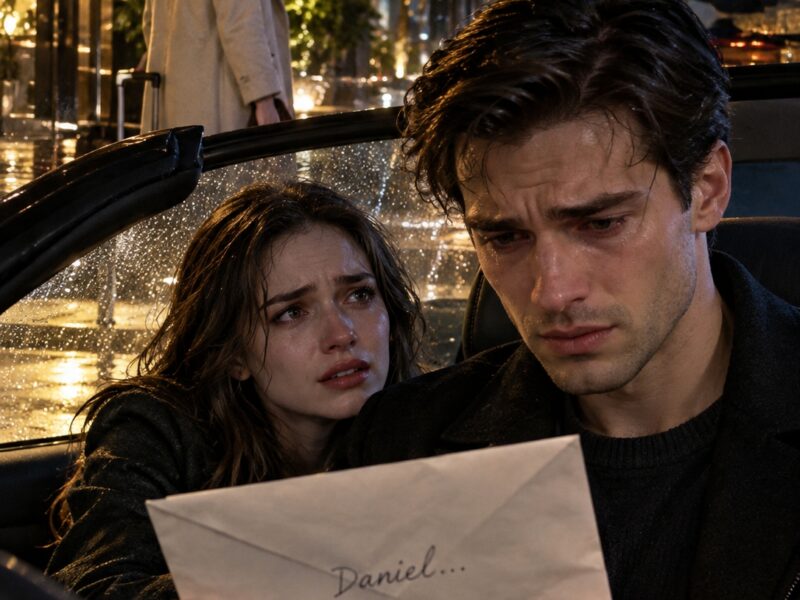
She Made Me Believe She Stopped Loving Me—Eight Months Later, Her Best Friend Got Into My Car and Told Me Why

The last person I expected to see standing alone in the rain was the woman who had helped my girlfriend disappear from my life.
For eight months, Sarah Mitchell had been nothing more than a name I refused to say out loud.
Then, on a cold Thursday night in Chicago, I saw her beneath the broken neon sign of a closed convenience store, soaked to the skin, clutching her phone against her chest as if whatever was glowing on that screen had just destroyed something inside her.
I almost kept driving.
Maybe I should have.
My foot had already moved toward the gas pedal when lightning flashed across the windshield and illuminated her face.
Sarah looked terrified.
Not inconvenienced.
Not annoyed.
Terrified.
I hit the brakes.
My car stopped twenty feet past her.
For several seconds, neither of us moved.
Rain hammered the roof of my old Honda. The wipers dragged back and forth, smearing the streetlights into long yellow streaks. In the rearview mirror, Sarah slowly lifted her head.
She recognized my car.
Then she recognized me.
Even through the rain, I saw her freeze.
That should have been enough.
I should have driven away.
Sarah had been Emily’s best friend. She had sat at our kitchen table, eaten my food, laughed at my jokes, gone on weekend trips with us, and helped me choose the necklace I’d given Emily on our fourth anniversary.
And when Emily left me without a real explanation, Sarah vanished too.
No phone call.
No text.
Not even the meaningless little sentence people send when they don’t know what else to say.
I’m sorry.
Nothing.
For eight months, I had assumed Sarah knew exactly why Emily had left.
And for eight months, she had allowed me to believe I wasn’t worth an explanation.
I tightened my grip on the steering wheel.
Then Sarah started walking toward the car.
She stopped beside the passenger window.
I lowered it two inches.
Cold rain blew inside.
“Daniel.”
Hearing my name in her voice made something harden in my chest.
“What?”
Her lips trembled.
“My car died.”
I said nothing.
“I’ve been trying to get a rideshare for almost forty minutes. Everything keeps canceling.”
Still nothing.
Sarah looked toward the empty road.
Then back at me.
“Could you just take me home?”
I almost laughed.
Not because anything was funny.
Because life has a vicious sense of timing.
Eight months earlier, Sarah had watched the woman I planned to marry walk out of our apartment carrying two suitcases.
Now she was asking me to open my door.
“You don’t have anyone else?”
“I wouldn’t be asking you if I did.”
I stared at her.
She looked exhausted.
There were dark circles beneath her eyes. Her mascara had run slightly, and one hand was shaking badly enough that she had to hold her phone with both hands.
Something had happened.
Whatever anger I had toward her, leaving a frightened woman alone beside a closed store at nearly midnight wasn’t who I wanted to become.
So I unlocked the door.
Sarah climbed inside.
And five minutes later, she told me something that changed the meaning of every painful memory I had carried for eight months.
But first, there was silence.
The kind of silence that has history inside it.
Sarah gave me her address.
I knew it already.
Emily and I had been there dozens of times.
“Still on Addison?” I asked.
“Yeah.”
I pulled away from the curb.
Neither of us spoke.
The heater blew warm air toward Sarah’s soaked coat. Water dripped from her hair onto the floor mat. She rubbed her hands together while staring through the windshield.
I kept my eyes on the road.
I could feel her looking at me every few seconds.
Finally she said, “How have you been?”
I gave a short laugh.
“Don’t.”
She swallowed.
“Okay.”
Another mile passed.
“You don’t get to ask me that, Sarah.”
“I know.”
“Do you?”
She turned toward the window.
“Yes.”
“Because for eight months, nobody seemed particularly interested.”
“I know.”
“You keep saying that.”
“Because I do know.”
“Then maybe say something else.”
She went quiet again.
That should have been the end of it.
But anger is strange after enough time passes.
At first, it burns.
Later, it becomes sediment. It settles into the bottom of you until something stirs it again.
Seeing Sarah had stirred everything.
Emily.
The apartment.
The key on the counter.
Those two suitcases.
Her face when she told me she didn’t feel the same anymore.
Eight months earlier, I had stood in our kitchen while the woman I’d loved for almost five years quietly dismantled the future we’d built.
There had been no screaming.
No cheating confession.
No shattered glass.
Sometimes I wished there had been.
A betrayal would have given me something solid to hate.
Instead, Emily had simply stood across from me wearing the gray sweater I’d bought her in Boston and said, “Daniel, I can’t do this anymore.”
I remember staring at her.
“Do what?”
“This.”
She gestured vaguely between us.
Our home.
Our life.
Us.
“What does that mean?”
Her eyes were red, but she wouldn’t let herself cry.
“It means I need to leave.”
“Why?”
“I just do.”
“That’s not an answer.”
“I know.”
“Then give me one.”
She looked toward the floor.
“I’m tired.”
“Of me?”
“No.”
“Then of what?”
“Everything.”
I had stepped closer.
She stepped back.
That hurt more than I admitted.
“Emily, look at me.”
She did.
And there was something in her expression I spent months misunderstanding.
At the time, I thought it was guilt.
Later, I convinced myself it was pity.
Only much later would I understand that it had been fear.
“I’m not happy anymore,” she whispered.
Those five words can destroy a man in surprisingly quiet ways.
I remember feeling my body become strangely light.
As if the floor had disappeared but gravity hadn’t noticed yet.
“Since when?”
“I don’t know.”
“Is there someone else?”
“No.”
The answer came too quickly.
I hated myself for noticing.
“Are you sure?”
“Daniel.”
“Just tell me.”
“There isn’t anyone else.”
“Then what happened?”
She closed her eyes.
“I changed.”
“When?”
“I don’t know.”
“People don’t wake up one morning after five years and suddenly become different people.”
“I didn’t say it happened overnight.”
“Then when did it happen?”
She couldn’t answer.
I began searching her face for something recognizable.
Anything.
“Was it work?”
“No.”
“Was it me working too much?”
“No.”
“The money?”
“No.”
“My brother?”
“No.”
“Then what?”
Her lower lip trembled.
For one second, I thought she was going to collapse into me.
Instead, she picked up the handle of her suitcase.
“I need a different life.”
That sentence haunted me longer than anything else.
A different life.
One without me.
She placed her apartment key on the counter.
I looked at it instead of at her.
“You’ve already decided.”
“Yes.”
“How long?”
She hesitated.
“Daniel—”
“How long have you been planning this?”
“A while.”
“Days?”
Silence.
“Weeks?”
She looked away.
That was answer enough.
I felt humiliated.
While I had been discussing summer trips, rent increases, and whether we should finally replace the couch, Emily had apparently been planning an escape.
I laughed once under my breath.
“You’ve been lying to me.”
“I’m sorry.”
“Don’t say that.”
“I am.”
“No. You’re leaving. That’s what you’re doing. Don’t make it prettier.”
Her eyes filled with tears.
I wanted those tears to mean something.
I wanted them to prove she still loved me.
But I had already started protecting myself.
“Go.”
“Daniel—”
“You’ve made your decision. Go.”
She stood there for several seconds.
Then she whispered, “I hope someday you understand.”
That made me angry.
“Understand what?”
She didn’t answer.
“Emily.”
She picked up the second suitcase.
“Understand what?”
Her hand closed around the doorknob.
She looked at me one final time.
There are moments you remember incorrectly because pain edits them.
For months, I remembered Emily looking cold.
Detached.
Almost relieved.
But sitting beside Sarah eight months later, I suddenly remembered something else.
Emily’s fingers had been shaking.
Then she left.
The door closed.
And that was it.
At least, that’s what I thought.
The first week after the breakup, I barely slept.
I kept expecting Emily to call.
I told myself she needed time.
Maybe she’d gone to Sarah’s apartment.
Maybe she’d wake up three days later and realize we’d made a mistake.
Then a week became two.
Two became a month.
Emily never called.
Eventually, I did.
Straight to voicemail.
I texted.
Can we please talk?
No answer.
Two days later:
I don’t understand what happened.
Nothing.
A week after that:
If there’s someone else, just tell me. I can handle the truth better than this.
She never replied.
That silence became its own answer.
So I started blaming myself.
That part was easy.
There was plenty of evidence.
I remembered every dinner I’d missed because my supervisor needed someone to stay late.
Every time Emily tried to talk while I stared at my laptop.
Every birthday gift I’d bought at the last minute.
Every evening she said, “I’m fine,” and I accepted it because I was too tired to ask twice.
I remembered the year my younger brother, Michael, almost dropped out of college because our father couldn’t help him anymore.
I’d taken extra shifts.
Paid part of Michael’s tuition.
Covered his rent twice.
Emily never complained.
Not once.
But after she left, I wondered whether she had.
Maybe she’d simply learned to complain silently.
Maybe while I was busy being a good brother and dependable employee, I had stopped being a good partner.
That possibility ate me alive.
Friends told me to move on.
My mother told me, gently, that some relationships end without satisfying explanations.
Michael blamed himself.
“If you hadn’t been helping me—”
“Don’t.”
“But maybe—”
“Emily didn’t leave because of you.”
I said it confidently.
I didn’t believe it.
By month three, I had deleted most of our pictures from my phone.
By month four, I packed her remaining things into a cardboard box.
A chipped blue coffee mug.
Two paperbacks.
A scarf.
An old charger.
A photograph from Wisconsin that I couldn’t bring myself to throw away.
I put the box in the back of my closet.
Then I tried to become a person who had never expected Emily to be part of his future.
It almost worked.
Until the rain.
Until Sarah.
Until she suddenly said, “Pull over.”
I glanced at her.
“What?”
“Daniel, please pull over.”
“Are you sick?”
“No.”
“Then what?”
“Just pull over.”
Something in her voice made me obey.
I turned into an empty pharmacy parking lot and stopped beneath a streetlamp.
Rain poured across the windshield.
Sarah sat perfectly still.
Her hands were clasped in her lap.
“What is this?” I asked.
She didn’t answer.
“Sarah.”
“I’ve rehearsed this conversation about a hundred times.”
My stomach tightened.
“What conversation?”
She looked at me.
Her eyes were full of tears.
I immediately thought of Emily.
“Is she okay?”
“Yes.”
“Is Emily okay?”
“She’s okay now.”
Now.
One word.
But it changed the temperature inside the car.
“What does now mean?”
Sarah wiped beneath one eye.
“There’s something you deserve to know.”
I stared at her.
“Don’t do that.”
“What?”
“Don’t sit there eight months later and tell me I deserve something. If I deserved it, somebody would’ve told me eight months ago.”
“You’re right.”
“Where is Emily?”
“She’s back in Chicago.”
That landed like a punch.
I turned toward her.
“What?”
“She came back three days ago.”
I hadn’t known she had left Chicago.
That fact alone made me feel stupid.
“Where was she?”
“Minneapolis.”
“Why?”
Sarah closed her eyes.
“Because of her mother.”
I frowned.
“What about her mother?”
Sarah’s face crumpled slightly.
And suddenly I knew this wasn’t about another man.
It wasn’t about Emily getting bored.
It wasn’t even about me.
“Three months before Emily left you,” Sarah said carefully, “her mom got sick.”
The rain seemed to become louder.
“What do you mean, sick?”
“Seriously sick.”
I stared at her.
“How seriously?”
Sarah told me.
Not every medical detail mattered.
What mattered was that Emily’s mother had faced an illness requiring prolonged treatment and, eventually, a major procedure her family could barely afford.
There were bills insurance didn’t fully cover.
Deposits.
Travel.
Medication.
Lost income.
Appointments.
The ordinary brutal economics of illness.
And Emily had hidden all of it from me.
“No.”
Sarah nodded.
“No. I would’ve known.”
“She made sure you didn’t.”
“I talked to her mother.”
“Not as often as you thought.”
“I saw her.”
“On good days.”
I shook my head.
“Emily would’ve told me.”
“She wanted to.”
“Then why didn’t she?”
Sarah looked at me for a long time.
“Because of Michael.”
I stopped breathing for a second.
“What does my brother have to do with this?”
“You were already paying part of his tuition. You’d taken extra shifts. You were talking about getting a second job.”
“So?”
“Emily knew what you’d do if you found out.”
“You don’t know what I would’ve done.”
Sarah’s expression broke.
“She did.”
I looked away.
Because she was right.
I would have helped.
Immediately.
I would have emptied my savings.
Sold my car.
Taken another job.
Delayed everything.
I would have done it without asking whether it was sensible because Emily’s mother wasn’t a stranger to me.
She was family.
Or I thought she was going to be.
Sarah continued.
“Emily started taking extra shifts. She sold jewelry. Clothes. A camera her dad gave her. She borrowed money.”
My jaw tightened.
“What jewelry?”
Sarah hesitated.
“Daniel.”
“What jewelry?”
“The bracelet you gave her.”
That hurt in a way I hadn’t expected.
Not because she’d sold it.
Because I remembered noticing it was gone.
I’d asked about it.
Emily had laughed and said she’d left it at Sarah’s apartment.
Another lie I had believed because I trusted her.
“How much debt?”
“Enough.”
“That’s not a number.”
“I don’t know the exact amount.”
“Did she borrow from you?”
“Yes.”
“Who else?”
“Daniel—”
“Who else knew?”
Sarah’s silence told me the answer.
Several people.
Just not me.
I opened my door.
“Daniel.”
I stepped into the rain.
Cold water hit my face.
I walked several feet away from the car because suddenly the inside felt too small.
Sarah followed.
“Please get back inside.”
“You all knew?”
“Not everyone.”
“You knew.”
“Yes.”
“And you sat at my table.”
“I know.”
“You looked me in the face.”
“I know.”
“Stop saying that!”
My voice echoed across the empty parking lot.
Sarah flinched.
I immediately hated that.
I lowered my voice.
“Why?”
“Because she begged me.”
“That’s your answer?”
“No.”
“Then give me a better one.”
Sarah wrapped her coat tighter around herself.
“I thought she was wrong.”
That surprised me.
“What?”
“I told her she was wrong. Over and over. I told her to tell you.”
“Then why didn’t you?”
“Because she was my best friend, and she was terrified, and every decision felt like choosing which person to betray.”
I laughed bitterly.
“You chose.”
“Yes.”
At least she didn’t deny it.
Rain ran down her face.
“I chose her. And I’ve regretted it for eight months.”
I looked toward the road.
“Keep talking.”
Sarah hesitated.
Then she told me the rest.
Emily’s mother needed a procedure.
The hospital required a substantial deposit.
Emily was running out of options.
Then an old family connection helped her secure a position in Minneapolis.
The salary was far higher than what she earned in Chicago.
Housing was included for the first several months.
The job required an almost immediate start.
It was the kind of offer someone drowning in medical bills couldn’t refuse.
“So she moved for money,” I said.
“Yes.”
“Why not just tell me that?”
“Because she knew you’d go with her.”
I turned around.
“What?”
“She knew you’d either go with her or start sending money you couldn’t afford to send.”
“That would’ve been my decision.”
“I know.”
“Apparently nobody did.”
Sarah lowered her eyes.
“That’s the part Emily finally understands.”
Something cold moved through me.
“So instead of trusting me, she decided to destroy the relationship.”
“She thought she was protecting you.”
“By telling me she didn’t love me?”
Sarah said nothing.
“Do you hear how insane that sounds?”
“Yes.”
“Did she?”
“At the time? I don’t think she let herself.”
I went back to the car.
Sarah climbed in after me.
Neither of us closed the doors immediately.
Rain blew inside.
Finally I slammed mine shut.
“Tell me exactly what happened.”
Sarah closed her door.
Then she said the sentence I would remember for the rest of my life.
“Emily decided the only way to make sure you didn’t sacrifice your future for her family was to make you stop wanting a future with her.”
I stared at her.
Sarah’s voice shook.
“She wanted you to hate her.”
For months, I had imagined a hundred reasons Emily left.
Another man.
Boredom.
Regret.
My failures.
Someone richer.
Someone more exciting.
I had never imagined that she had deliberately tried to become the villain in my memory.
“That’s ridiculous.”
“I know.”
“That’s not love.”
Sarah looked at me.
“No. It was fear pretending to be love.”
That silenced me.
Sarah continued.
“She thought anger would heal faster than guilt.”
My throat tightened.
“What?”
“Those were her words.”
I looked down.
“She said if you knew the truth, you’d wait. You’d help. You’d put Michael’s education at risk. You’d give up opportunities. She thought if you believed she simply stopped loving you, eventually you’d get angry enough to move on.”
“Did she think I was a machine?”
“No.”
“Because I didn’t get angry enough to move on.”
“I know.”
“I thought I wasn’t enough.”
Sarah began crying.
I didn’t.
Not yet.
“I spent eight months thinking I had failed her.”
“I’m sorry.”
“I replayed every conversation.”
“I know.”
“I blamed my job. I blamed Michael. I blamed myself for being tired. I blamed myself for not noticing she was unhappy.”
“Daniel—”
“She let me do that.”
“Yes.”
That answer hurt more than an excuse would have.
“She let me believe I was the reason.”
“Yes.”
I leaned back against the seat.
Something inside me was rearranging itself.
Not healing.
Rearranging.
Memories I’d spent months using as evidence against myself suddenly looked different.
Emily coming home late.
I had assumed she was avoiding me.
She’d been working.
The missing bracelet.
Sold.
The calls she took in the hallway.
Hospital conversations.
The nights she barely ate.
Stress.
The red eyes.
Not boredom.
Not another man.
Fear.
I remembered one Tuesday about six weeks before she left.
I’d found Emily sitting alone on the kitchen floor at two in the morning.
She said she’d dropped a glass.
I saw no broken glass.
“What’s wrong?” I’d asked.
“Nothing.”
I sat beside her.
She rested her head against my shoulder.
“Daniel?”
“Yeah?”
“If someone loved you, but they had to hurt you to keep you from ruining your life, would you forgive them?”
I laughed softly.
At the time, I thought she was talking about some show she’d been watching.
“That’s suspiciously specific.”
“I’m serious.”
“I don’t know.”
“Would you?”
“I’d probably tell them not to make my decisions for me.”
Emily had become very still.
Then she’d whispered, “Yeah.”
I had kissed the top of her head.
“Come to bed.”
That was all.
I had forgotten the conversation.
Until now.
My chest tightened so violently I had to lean forward.
“Oh my God.”
Sarah watched me.
“What?”
“She asked me.”
“When?”
“Before she left. She practically asked me what I would think, and I didn’t understand.”
“You couldn’t have.”
“I should have.”
“No.”
“Don’t.”
“Daniel, you couldn’t have known what she wouldn’t tell you.”
That sentence broke something open.
For eight months, I’d lived inside a courtroom where I was defendant, prosecutor and judge.
Every memory was evidence of my inadequacy.
Now someone had finally told me the trial itself had been built on missing evidence.
I covered my face with both hands.
For the first time since Emily left, I cried.
Not loudly.
Not dramatically.
Just the exhausted crying of someone discovering that the wound he’d been touching every night wasn’t where he thought it was.
Sarah waited.
Eventually I asked, “Why now?”
She didn’t answer immediately.
“Her mother is doing better.”
I looked at her.
“How much better?”
“She’s recovering. She can live independently again. There will still be follow-ups, but the immediate crisis is over.”
“And Emily?”
“She left the Minneapolis job.”
“Why?”
“Because she realized she couldn’t keep building a life around the damage she’d caused.”
I stared through the windshield.
“That’s convenient.”
“I know it sounds that way.”
“Does she want me back?”
Sarah took a breath.
“She wants to apologize.”
“That’s not what I asked.”
“I don’t think she believes she has the right to ask for you back.”
I turned toward her.
“Then why are you here?”
Sarah looked at her phone.
For the first time, I noticed the screen was cracked.
“Because Emily is terrified to face you.”
I laughed without humor.
“Good.”
Sarah nodded.
“She should be.”
That surprised me too.
“She asked you to come?”
“No.”
“What?”
“She doesn’t know I’m telling you tonight.”
I stared at her.
“Then why?”
“Because I’m done helping people lie in the name of protecting each other.”
The car went silent.
“Emily told me yesterday she wanted to see you. Then she said she couldn’t. She said maybe the kindest thing was to leave you alone.”
Sarah wiped her cheek.
“And I realized she was doing it again.”
“Doing what?”
“Making your choice for you.”
That landed.
Sarah looked directly at me.
“So I came to tell you the truth.”
I stared at the rain.
For eight months, I had fantasized about Emily returning.
In some versions, I slammed the door.
In others, I demanded answers until she cried.
Sometimes I imagined being indifferent.
That was my favorite fantasy.
Emily would appear.
I would look at her and feel nothing.
She would realize too late what she’d lost.
Then I’d walk away.
But revenge fantasies are designed for simple wounds.
This wasn’t simple anymore.
I wasn’t ready to forgive Emily.
I wasn’t even sure I wanted to see her.
But for the first time since she left, I knew one thing with absolute certainty.
I wanted the truth from her.
Not Sarah.
Not memories.
Not theories.
Her.
“Tell her to come tomorrow.”
Sarah blinked.
“Are you sure?”
“No.”
“What time?”
“Ten.”
She nodded.
I started the car.
Then Sarah touched my arm.
“Daniel.”
I looked at her.
“There’s one more thing.”
My stomach dropped.
“What?”
She reached into her bag.
For one terrible second, I expected another secret.
Instead, Sarah pulled out a white envelope.
My name was written across the front.
I knew the handwriting immediately.
Emily.
“She wrote this the night she left,” Sarah said.
I didn’t take it.
“What is it?”
“A letter.”
“Obviously.”
“She gave it to me before she moved.”
“Why didn’t you give it to me?”
“Because she called me from the airport and made me promise I’d destroy it.”
My anger returned instantly.
“Did you?”
Sarah shook her head.
“No.”
“Why?”
“Because I thought someday one of us would stop being a coward.”
She placed the envelope on the console between us.
I stared at it all the way to her apartment.
I didn’t open it.
Not that night.
When I got home, I put the envelope on my kitchen table.
Then I sat across from it until almost four in the morning.
The apartment looked different.
Or maybe I did.
There was the counter where Emily had left her key.
The doorway where I’d watched her disappear.
The chair where she used to sit barefoot drinking coffee.
Nothing had changed.
Everything had changed.
At 4:12 a.m., I finally opened the letter.
There were three pages.
The first line nearly stopped me.
Daniel, if Sarah gives you this, then either I wasn’t strong enough to keep my promise or she finally became braver than I was.
I read on.
Emily didn’t ask for forgiveness.
She explained.
Her mother’s diagnosis.
The bills.
The fear.
The Minneapolis offer.
Michael’s tuition.
My savings.
My habit of trying to solve problems by carrying them myself.
She wrote that she knew if she told me, I would say, We’ll figure it out.
And she knew exactly what “we” would mean.
Me taking extra shifts.
Me draining my savings.
Me delaying my own plans.
Me pretending I wasn’t afraid.
Then came the paragraph that made me put the letter down.
I know what I’m doing is cruel. Maybe someday I’ll understand that it was also selfish. But I don’t know how to stand in front of you and ask you not to save me, because I know you won’t listen. So I’m going to make you believe there is nothing left to save.
I walked away from the table.
Ten minutes later, I came back.
The final paragraph was shorter.
If you hate me, maybe you’ll heal. If you know I still love you, I’m afraid you’ll wait. Please don’t wait for me.
Below that:
I’m sorry for making the decision for both of us.
The letter was dated the day she left.
I didn’t sleep.
At 9:58 the next morning, someone knocked.
I stood in the kitchen staring at the door.
Another knock.
Soft.
Then silence.
I walked over.
My hand rested on the lock.
Eight months.
Two suitcases.
One key.
Three unanswered texts I still remembered word for word.
A letter that had rewritten the entire night.
I opened the door.
Emily stood in the hallway.
For a moment, neither of us spoke.
She looked different.
Not dramatically.
Just enough.
Her hair was shorter.
Her face was thinner.
There were shadows beneath her eyes that hadn’t been there before.
She wore jeans, a dark coat and no makeup.
She looked smaller than I remembered.
Then her eyes met mine.
They filled immediately.
“Hi.”
I had imagined this moment hundreds of times.
In none of those fantasies had I been unable to speak.
Emily looked down.
“Sarah told me she saw you.”
I nodded.
“She also told me she gave you the letter.”
“She did.”
Emily closed her eyes.
“I told her to destroy it.”
“I know.”
“I’m glad she didn’t.”
I didn’t answer.
“Can I come in?”
That question almost undid me.
This had once been her home.
Now she was asking permission to enter.
I stepped aside.
Emily walked in.
She stopped when she saw the apartment.
Her eyes moved toward the kitchen counter.
I knew what she was remembering.
The key.
She took off her coat but kept it folded over her arm.
As though she wasn’t sure she’d be staying longer than five minutes.
“Coffee?” I asked automatically.
Then I hated how normal it sounded.
Emily almost smiled.
“No. Thank you.”
We sat across from each other at the kitchen table.
The letter was between us.
She stared at it.
“I don’t know where to start.”
“Start with the truth.”
She nodded.
So she did.
For nearly an hour, Emily told me everything.
Not the romantic version.
Not the version where sacrifice made her noble.
The ugly version.
She had panicked.
Her mother’s illness terrified her.
The medical bills terrified her.
Watching me already stretch myself thin helping Michael terrified her.
She became convinced that telling me would ruin two lives instead of one.
“So you lied.”
“Yes.”
“Repeatedly.”
“Yes.”
“You sold things and told me you’d misplaced them.”
“Yes.”
“You took calls from doctors in the hallway.”
“Yes.”
“You accepted a job in another state before telling me we were over.”
Emily’s face tightened.
“Yes.”
“Did you ever plan to tell me?”
“I planned to tell you a hundred times.”
“But?”
“I was afraid you’d make it impossible for me to leave.”
“By loving you?”
Her eyes closed.
“Yes.”
I sat back.
“Do you understand how messed up that is?”
“I do now.”
“Do you?”
“Daniel, I thought I was being strong.”
“No. You were controlling.”
She flinched.
I almost apologized.
I didn’t.
Because it was true.
“You decided what I could handle. You decided what I should sacrifice. You decided what my future should look like. Then you decided what I was allowed to believe about the woman I loved.”
Tears rolled down her cheeks.
“I know.”
“No, Emily. I need you to hear this.”
“I’m listening.”
“You didn’t protect me from pain.”
Her shoulders shook.
“You chose the pain for me.”
She covered her mouth.
I continued, quieter now.
“You decided heartbreak would be better for me than sacrifice. But you never asked me.”
“I’m sorry.”
“I would have helped.”
“I know.”
“I probably would’ve emptied my savings.”
“I know.”
“I might have been stupid about it.”
“I know.”
“But it was my right to be stupid.”
A broken laugh escaped her through the tears.
“Yes.”
“It was my right to choose you.”
Emily lowered her head.
“Yes.”
That was when my anger changed.
Not disappeared.
Changed.
Because she wasn’t defending herself.
She wasn’t saying, I did it because I loved you, so you have to understand.
She was sitting there accepting that love had not automatically made her decision right.
After a long silence, she whispered, “I loved you every day.”
I looked away.
“Don’t.”
“It’s the truth.”
“That’s not comforting.”
“I know.”
“Do you know what would have been easier?”
She waited.
“If you’d cheated.”
Emily stared at me.
“I mean it. If there had been another guy, at least the story would’ve made sense. I could’ve hated you cleanly.”
Her face crumpled.
“But this?”
I tapped the letter.
“This means you loved me while you were hurting me.”
“Yes.”
“And somehow that’s worse.”
Emily nodded.
“I know.”
For several minutes, the only sound was the refrigerator humming.
Then she said, “I didn’t come here to ask you to take me back.”
I looked at her.
“I came because I owed you the truth from my mouth. And because I’m sorry.”
She wiped her face.
“I was so afraid of becoming a burden that I turned you into someone who wasn’t allowed to help me.”
I said nothing.
“I thought love meant preventing you from ruining your life for me.”
She looked at the letter.
“But what I did wasn’t trust. It was fear.”
Sarah’s words from the night before came back to me.
Fear pretending to be love.
Emily continued.
“I kept telling myself that if you hated me, you’d recover faster.”
“Did it work?”
“No.”
“How do you know?”
“Because I didn’t.”
That silenced me.
Emily stared at her hands.
“I went to Minneapolis. I worked. I paid bills. I sent money home. Mom had the procedure. Things slowly improved.”
Her voice became quieter.
“And every day, I wanted to call you.”
“Why didn’t you?”
“Because every day that passed made what I’d done harder to confess.”
“That’s usually how lying works.”
“I know.”
She accepted that too.
“I checked your social media.”
I looked at her.
“Sarah’s too.”
“She told you?”
“No. I guessed.”
“I’d look at pictures of you with Michael or your coworkers. If you smiled, I told myself I’d done the right thing.”
“And if I didn’t?”
Emily’s eyes filled again.
“I’d tell myself the next picture would be different.”
I didn’t know what to say.
“So what changed?”
“Mom.”
“What about her?”
“She found out.”
“Found out what?”
“What I’d done to you.”
I waited.
Emily gave a sad smile.
“She was furious.”
Despite everything, I almost laughed.
“Your mother?”
“She said she’d rather have lost the house than know I had thrown away someone I loved because of her medical bills.”
I looked down.
“She said something I couldn’t stop thinking about.”
“What?”
“She said, ‘You don’t get to call it sacrifice when somebody else pays the price without agreeing to it.'”
That sentence sat between us.
Emily took a breath.
“She was right.”
I looked at the woman I’d loved for five years.
Maybe still loved.
That was the frightening part.
Love had survived.
Trust hadn’t.
And they weren’t the same thing.
“What do you want from me?” I asked.
“Nothing.”
“That’s not true.”
She thought about it.
“Okay.”
Her voice trembled.
“I want the chance to become someone you can know honestly.”
Not love.
Not forgive.
Know.
That mattered.
“And if I say no?”
“I’ll leave.”
“And you won’t send Sarah?”
A faint, embarrassed smile.
“No.”
“You won’t write another secret letter?”
“No.”
“You won’t decide that staying away is what’s best for me?”
She shook her head.
“No.”
“Why?”
“Because you were right.”
She looked directly at me.
“You should get to choose.”
I didn’t take Emily back that morning.
When she stood to leave, I didn’t stop her.
At the door, she turned around.
“Daniel?”
“Yeah?”
“Thank you for listening.”
I nodded.
She left.
And for the second time in eight months, I watched that door close behind her.
But this time something was different.
She hadn’t taken my future with her.
She had left the choice on my side of the door.
Three days passed.
Then I texted her.
Coffee.
Emily responded thirty seconds later.
Okay.
We met at a small café near Lincoln Square.
No flowers.
No dramatic embrace.
No declarations.
We talked for forty minutes.
Mostly about ordinary things.
Michael had graduated.
Emily’s mother was recovering.
Sarah had finally replaced the car that stranded her in the rain.
When we left, Emily asked, “Can I see you again?”
I looked at her.
“Maybe.”
She smiled.
“Maybe is fair.”
We met again the following week.
Then again.
Sometimes it went well.
Sometimes it didn’t.
Once, Emily didn’t answer a text for six hours because she was in a meeting.
I hated how quickly panic returned.
When she called, I was cold.
She noticed.
“What’s wrong?”
“Nothing.”
Then we both stopped.
That word.
Nothing.
The word that had hidden too much before.
Emily took a breath.
“No. We’re not doing that anymore.”
So I told her.
“I thought you were disappearing again.”
Her face softened.
“I’m sorry.”
“I know it’s irrational.”
“No. It’s a consequence.”
That distinction mattered.
Another time, Emily saw me talking to a woman outside my office and became quiet during dinner.
I asked why.
She tried to say nothing.
Then she caught herself.
“I’m jealous.”
I stared at her.
She laughed nervously.
“I know I don’t have much right to be.”
“Feelings don’t need permission.”
“What do we do with it?”
“Talk.”
So we did.
That became our new rule.
No noble lies.
No protective silence.
No “I’m fine” when we weren’t.
No making decisions for the other person because we were afraid of the answer.
Months passed.
Trust returned in pieces so small I almost didn’t notice.
Emily called when she said she would.
I told her when I was angry instead of punishing her with distance.
She told me when her mother’s follow-up appointments frightened her.
I didn’t immediately try to fix everything.
That was difficult for me.
One evening she called after a medical checkup.
“Mom’s scan is tomorrow.”
“Are you scared?”
“Yes.”
My old instinct appeared.
I wanted to research doctors.
Make calls.
Offer money.
Solve.
Instead I asked, “What do you need?”
Emily was quiet.
“Can you just stay on the phone?”
So I did.
We barely spoke.
For almost an hour, I listened to her breathe.
That night taught me something I hadn’t understood during our first relationship.
Sometimes love isn’t rescuing someone.
Sometimes it’s refusing to leave while they rescue themselves.
And sometimes being allowed to stand beside someone is more intimate than being allowed to save them.
Almost a year after Sarah climbed into my car, Emily’s mother invited us to dinner.
The restaurant was small.
Nothing fancy.
Sarah came too.
Michael arrived late from work.
Emily’s mother looked healthier than I’d seen her in years.
Not untouched.
Recovery leaves evidence.
But alive.
Present.
Laughing.
Halfway through dinner, Sarah raised her glass.
“To terrible cars.”
Everyone laughed.
I shook my head.
“That car probably saved three relationships.”
Sarah pointed at me.
“You’re welcome.”
Emily smiled.
Then her hand moved across the table.
She didn’t automatically take mine.
That was another small thing I’d come to love about who we’d become.
She rested her hand nearby.
An invitation.
Not an assumption.
I turned my palm upward.
She placed her hand in mine.
Her mother saw it.
She said nothing.
She just smiled.
Outside, rain had started falling.
Not a storm.
Just a soft October rain turning the street glossy beneath the restaurant lights.
For a moment, I remembered Sarah standing outside that convenience store.
I remembered almost driving past her.
Sometimes I wonder what would have happened if I had.
Maybe Sarah would have found another ride.
Maybe she would have told me the next day.
Maybe Emily would eventually have knocked on my door anyway.
Or maybe none of that would have happened.
Maybe I would have spent years carrying the wrong explanation.
That’s the frightening thing about unanswered goodbyes.
Eventually, the mind creates an answer.
And usually, it chooses the answer that hurts us most.
I wasn’t enough.
I wasn’t worth staying for.
Someone better came along.
I should have noticed.
I should have tried harder.
For eight months, I punished myself with a story built from missing information.
Learning the truth didn’t erase what Emily did.
It didn’t make lying romantic.
It didn’t transform pain into some beautiful proof of love.
She hurt me.
She took away my choice.
She confused sacrifice with control and silence with protection.
But understanding why someone hurt you and pretending they never hurt you are two different things.
Forgiveness didn’t require me to erase the wound.
It required both of us to stop lying about how it got there.
After dinner, Emily and I stood beneath the restaurant awning.
Sarah had already left.
Michael was helping Emily’s mother into a cab.
Rain tapped against the sidewalk.
Emily looked at me.
“What?”
I hadn’t realized I was staring.
“Nothing.”
She raised an eyebrow.
I smiled.
“Okay. Not nothing.”
“Better.”
I looked toward the rain.
“I was thinking about the night Sarah got into my car.”
Emily’s expression changed.
“I still hate thinking about that.”
“I don’t.”
“Why?”
“Because that’s the night I stopped believing the worst thing that ever happened to me was proof that I wasn’t enough.”
Emily’s eyes lowered.
“I’m sorry.”
“I know.”
There had been a time when those words infuriated me.
Now they meant something different.
Not absolution.
Acknowledgment.
Emily leaned against the brick wall beside me.
“Do you ever wish she hadn’t told you?”
I thought about it.
“No.”
“Even if we hadn’t gotten back together?”
I looked at her.
“Especially then.”
She seemed surprised.
“Why?”
“Because the truth wasn’t valuable because it brought you back.”
Rain slid from the awning in silver threads.
“It was valuable because it gave me myself back.”
Emily’s eyes filled.
She nodded.
A cab pulled away from the curb with her mother and Michael inside.
Emily and I remained under the awning.
After a moment she asked, “Ready?”
I looked at the rain.
Then at her.
“Yeah.”
She started to step forward.
I caught her hand.
Emily turned.
For one second, I saw the woman from eight months earlier standing in our apartment with two suitcases.
Scared.
Convinced she had to carry everything alone.
Then that image disappeared.
The woman in front of me wasn’t the same person.
Neither was I.
“Emily.”
“Yeah?”
“If something terrible happens again…”
She waited.
“Don’t protect me from my own choices.”
Her eyes glistened.
“I won’t.”
“And if you’re afraid?”
“I’ll tell you.”
“If you think I’ll sacrifice too much?”
“I’ll tell you.”
“If you think leaving me would somehow save me?”
A small, sad smile appeared.
“I’ll tell you you’re dating an idiot.”
I laughed.
“Good.”
Then her expression softened.
“And Daniel?”
“Yeah?”
“You have to promise me something too.”
“What?”
“Don’t assume loving someone means you have to destroy yourself for them.”
I looked at her.
Fair.
“Okay.”
“Okay?”
“I promise.”
She squeezed my hand.
Then we walked into the rain together.
There was no dramatic music.
No perfect ending.
No moment where the past disappeared.
The past doesn’t disappear.
It changes shape.
Years later, I would still remember the sound of Emily’s key touching the kitchen counter.
I would still remember those two suitcases.
I would still remember the empty apartment after she left.
But those memories no longer whispered that I had been unlovable.
That was the gift the truth gave me.
Not the relationship.
Not reconciliation.
The truth.
Sometimes the person who leaves you does love you.
Sometimes they are simply afraid.
Sometimes they make terrible decisions while convincing themselves those decisions are sacrifices.
And sometimes understanding their reason doesn’t mean you owe them another chance.
I chose to give Emily one.
But that wasn’t the lesson.
The lesson was that love without trust can become cruel even when its intentions are gentle.
Love does not give us the right to decide another person’s life for them.
It doesn’t give us permission to lie because we believe the truth will hurt.
And protecting someone by removing their choice isn’t always protection.
Sometimes it’s just another kind of loneliness.
That rainy Thursday, I almost drove past Sarah.
Had I done it, I might have spent the rest of my life believing Emily left because I wasn’t enough.
Instead, I stopped.
I unlocked a door.
And a woman I thought had helped destroy my relationship climbed into my car carrying the truth that would eventually repair something far more important.
Not my relationship with Emily.
My relationship with myself.
A year after that night, as Emily and I crossed the wet Chicago sidewalk hand in hand, I looked back once at the restaurant window.
Sarah was still inside.
She had returned for the umbrella she’d forgotten.
She saw me looking and lifted it with an embarrassed grin.
I laughed.
Emily followed my gaze.
“What?”
“Nothing.”
She nudged me.
“We don’t say nothing anymore.”
I smiled.
“Right.”
I looked at the rain.
Then at the woman beside me.
“I was just thinking how strange it is.”
“What is?”
“How close you can come to living the rest of your life believing the wrong story.”
Emily became quiet.
Then she slipped her fingers through mine.
We crossed the street.
Behind us were eight months neither of us could recover.
Ahead of us was nothing guaranteed.
No promises that illness would never return.
No promise that fear wouldn’t.
No promise that love alone would be enough.
Just two people who had finally learned that when fear arrived, the answer wasn’t to disappear.
It was to tell the truth and let the other person decide whether to stay.
And maybe that was why, after everything, the sound I remember most clearly isn’t Emily’s key hitting the counter on the night she left.
It’s the quiet click of my passenger door unlocking eight months later.
Because sometimes a life doesn’t change when someone walks away.
Sometimes it changes when, despite every reason not to, you open the door.









