SHE MARRIED A STRANGER TO ESCAPE HER BROTHER—THEN HE RODE 600 MILES THROUGH A SNOWSTORM TO TAKE HER BACK
Evelyn Mercer had forty-eight hours before her brother realized she was gone.
Maybe less.
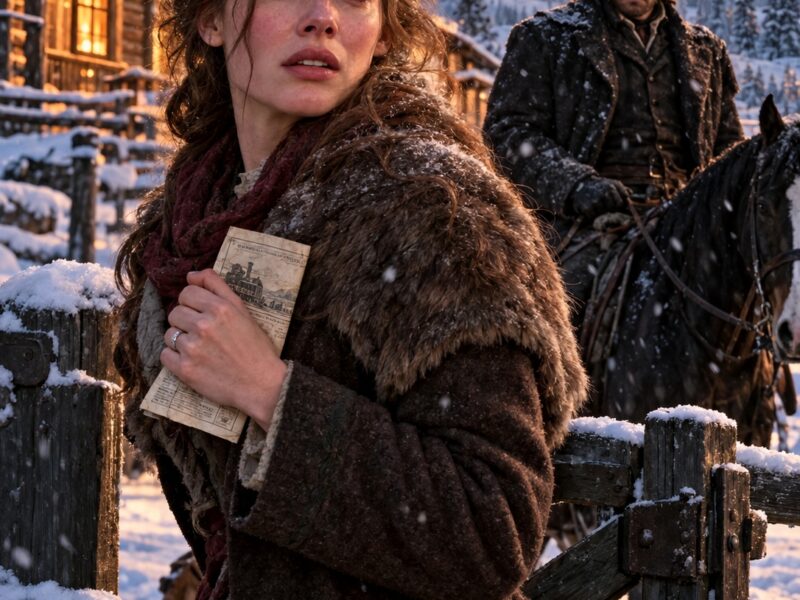
At four seventeen on a February morning, she stood barefoot inside the front door of the Nebraska farmhouse with one hand wrapped around a worn leather bag and the other gripping a folded newspaper clipping so tightly the edge had cut a pale line across her palm.
Twelve feet away, behind a closed bedroom door, Gerald was sleeping.
The man who had controlled where she went for four years.
The man who counted the money in her purse.
The man who once made her explain why she had spent eleven minutes at the mercantile when he believed the errand should have taken eight.
The man who had broken a supper plate against the kitchen wall because her biscuits were too thick, then made her clean the pieces while he finished eating.
Her brother.
Her last living family.
And the person she feared most in the world.
Evelyn slipped her boots on without sitting down.
The floorboards complained beneath almost any weight, and she knew every one of them by sound. She knew which board outside Gerald’s room gave a dry click. She knew which one near the kitchen groaned. She knew where to place her feet because four years of living carefully had turned the house into a map of danger.
She lifted the latch.
Cold air entered through the crack.
For one terrible second, she looked toward Gerald’s door.
Nothing.
No footsteps.
No voice.
No command to stop.
She stepped outside.
The frozen ground glittered faintly beneath a moonless sky.
She closed the door without making a sound.
Then Evelyn Mercer walked away from the only home she had known for years to cross three mountain ranges and marry a man she had never seen.
She did not look back.
Because she knew that if she did, fear might convince her that captivity was safer than uncertainty.
And somewhere in Wyoming Territory, a stranger named Rowan Ashcroft was waiting for her.
Four months earlier, she hadn’t even known he existed.
His advertisement had been three inches long, buried on the back page of the Frontier Courier between a notice about missing livestock and an announcement from a land surveyor.
Evelyn found it because Gerald had thrown her dinner plate.
The biscuits were half an inch thicker than he liked.
That was the reason.
Not that reasons mattered much with Gerald anymore.
The plate struck the wall beside the stove and exploded into white ceramic pieces.
Gerald stared at her.
“You know how I like them.”
Evelyn said nothing.
She had learned that apologies sometimes prolonged things.
“Clean it up.”
He walked out.
She crouched with a broom and dustpan, gathering pieces from beneath the table.
The newspaper slid from the chair and opened beside her knee.
Her eyes landed on six lines.
Seeking an honest woman of practical temperament.
She stopped sweeping.
Mountain homestead. 160 acres. Good well water.
Then came the sentence that made her forget the broken plate.
I am not a man of smooth words. I can offer fair work, fair share, and fair treatment. Nothing more promised, nothing less delivered.
Evelyn read it twice.
Then a third time.
At the bottom:
Reply to R. Ashcroft, General Post, Harland’s Crossing, Wyoming Territory.
Fair treatment.
Two ordinary words.
Yet they felt almost obscene in Gerald’s kitchen.
She tore the advertisement from the paper, folded it until it was smaller than a matchbook, and slipped it into her apron pocket.
Then she finished sweeping.
For the next four months, that tiny clipping became the most dangerous thing she owned.
Evelyn wrote seven letters to Rowan Ashcroft.
She burned the first six.
One sounded desperate.
One sounded too cold.
One read like a business proposal.
Another sounded like a woman begging to be rescued, and Evelyn hated it so much she shoved it into the stove before the ink had fully dried.
She did not want rescuing.
Or at least she didn’t want to admit she did.
The seventh letter was written quickly at the post office while Gerald waited outside in the wagon.
Mr. Ashcroft,
I saw your advertisement. I am a woman who knows how to work hard and keep my word. I am not looking for affection or promises. I am looking for the fair situation you described.
I can cook, preserve food, sew, keep a garden, and I am not afraid of snow.
I have some experience with difficult circumstances.
I will be honest with you if you will be honest with me.
Evelyn Mercer. Caldwell, Nebraska.
She did not mention the bruises hidden beneath her sleeves.
She did not mention that she had not left the county without Gerald’s permission in four years.
She did not mention waking at night when the floor creaked because her body had learned to prepare for danger before her mind knew whether danger existed.
Some truths were too large for a first letter.
Rowan answered three weeks later.
His handwriting was careful and slightly uneven.
Miss Mercer,
Thank you for writing plainly. I will do the same.
I am thirty-four. I have been on this land eight years. The work is real and the winters are hard.
I had a wife before. She left during the second winter. I do not blame her.
Evelyn paused there.
That surprised her.
Gerald blamed everyone for everything.
Rowan continued.
I am looking for someone who understands that a partnership built on honesty is worth more than one built on pleasant words.
Then came the sentence she would eventually memorize.
I have no interest in control or possession. I have enough trouble managing 160 acres without trying to manage a person.
Evelyn read that line four times while sitting in the outhouse because it was the only place Gerald usually left her alone.
No interest in control or possession.
She wanted to believe such a man existed.
That frightened her almost as much as the possibility that he didn’t.
They exchanged five more letters.
Rowan told her practical things.
The well was forty feet deep and had never gone dry.
Harland’s Crossing was eleven miles away.
The road could disappear under snow for weeks.
He owned two horses, a milk cow named Ruth, and a border collie named Nell whose left ear refused to stand upright and who apparently considered the entire homestead her personal jurisdiction.
He never called Evelyn beautiful.
Never promised happiness.
Never told her Wyoming would save her.
That mattered.
Gerald had always used promises before demands.
Rowan made almost none.
In Evelyn’s fifth letter, she finally gave him one fragment of the truth.
My current situation is not one I can remain in. I am not in a position to explain fully. But I want to be honest that I am not considering Wyoming because I admire the scenery.
She almost didn’t mail it.
Rowan’s answer arrived eight days later.
It was his shortest.
Miss Mercer,
I am not asking you to explain.
I am asking you to come if you decide to.
The offer stands.
I will meet you at the station in Harland’s Crossing on whatever day you choose.
Just send the date.
Rowan.
It was the first time he had signed his first name.
Evelyn carried that letter inside her left boot for three days.
On the third evening, Gerald struck her across the face during supper.
She had answered a question incorrectly.
It wasn’t the hardest he had ever hit her.
That was what changed everything.
Not the pain.
Not the shock.
The ordinariness.
Gerald struck her, picked up his fork, cut another piece of meat, and continued eating.
As if nothing significant had happened.
As if she were an object in the room that had required adjustment.
Evelyn looked at him.
Something inside her became very still.
That night, after Gerald fell asleep, she removed Rowan’s letter from her boot.
On the back she wrote:
March 14. Evening train.
Two weeks later, before dawn, she walked away.
The train journey took twenty-two hours.
Nebraska flattened behind her.
Colorado rose in front of her.
Then the mountains appeared.
Evelyn had seen drawings of mountains.
Drawings had lied.
These were enormous.
Dark ridges rose into an iron-colored winter sky, making human lives look temporary and foolish.
She sat with her bag in her lap and watched them grow.
With every mile, another fear replaced the one behind her.
What if Rowan had lied?
What if he was worse than Gerald?
What if the advertisement had been bait?
What if she had crossed half the country only to discover that a cage in Wyoming was still a cage?
But beneath those fears was another feeling.
Small.
Unfamiliar.
Relief.
Harland’s Crossing consisted of a muddy main street, a hardware store, a feed merchant, a post office, two saloons, a church, and a station platform weathered gray by mountain winters.
Evelyn stepped off the train and immediately realized she had made a remarkable mistake.
She had no idea what Rowan looked like.
A dozen people stood on the platform.
She studied every man.
Then a voice came from her left.
“Miss Mercer.”
Not a question.
She turned.
He was taller than she expected.
Broad shoulders beneath a heavy coat. Weathered face. Brown hair. A jaw that should have been shaved yesterday.
His hat was held awkwardly in both hands.
His eyes were dark and steady.
He looked at her.
She looked at him.
Neither smiled.
They had spent months speaking on paper.
Standing three feet apart was somehow more intimate.
“Mr. Ashcroft?”
“Yes.”
A pause.
“The train was on time,” he said.
“It was.”
He nodded as though they had successfully completed the first stage of negotiations.
“I have the wagon.”
“All right.”
Another silence.
Then Rowan said, “Judge Harland performs marriages Tuesdays and Fridays.”
Evelyn swallowed.
“Today’s Friday.”
“I know.”
“You hungry?”
The question surprised her.
“What?”
“There’s a place down the street. Mabel’s. Food’s decent. We can eat before we do anything.”
Evelyn had eaten almost nothing since the previous evening.
“Yes,” she said. “I’d like that.”
So before Evelyn Mercer married a stranger, they ate roast beef and potatoes.
Mabel’s dining room smelled of coffee, woodsmoke, and frying fat.
Rowan ate like a man who considered food fuel.
He didn’t fill silence because silence existed.
Evelyn found that strangely comforting.
Halfway through the meal, she asked, “Are you nervous?”
He thought about it.
“Some.”
“Only some?”
“Maybe more than some.”
For the first time, something almost like humor touched his face.
“You?”
“More than some.”
“Fair enough.”
Judge Harland married them an hour later.
There were no flowers.
No family.
No promises about eternity.
Only an aging judge with magnificent white eyebrows, two witnesses, a worn American flag, and a man and woman who barely knew each other saying I do because each believed the arrangement might offer something the life before it had not.
When it was finished, Rowan reached into his coat.
“I have this.”
A thin silver ring lay in his palm.
It was worn.
Old.
Evelyn looked at it.
“My mother’s,” he said. “If you’d rather have something new later—”
“No.”
The answer came too quickly.
She softened it.
“This is fine.”
He slid it onto her finger.
His hands were steady.
For reasons she couldn’t explain, hers became steadier too.
Judge Harland signed the certificate.
“Done,” he announced.
Outside, nothing had changed.
Same mountains.
Same street.
Same February wind.
But Evelyn stared at the silver circle on her finger and understood that legally, at least, Gerald no longer had any claim he could pretend was authority.
She should have felt safe.
Instead she thought:
He’ll come.
The wagon ride to Rowan’s homestead took hours.
The road climbed beyond the town, around ridges and through stands of pine until Harland’s Crossing disappeared.
Rowan kept his attention on the horses.
Evelyn kept hers on the road behind them.
Finally he noticed.
“Expecting someone?”
Her body tightened.
“No.”
Rowan nodded.
He did not ask again.
That was the first time Evelyn understood that silence could be offered as privacy instead of punishment.
The cabin appeared near dusk.
It was smaller than she imagined.
Dark logs.
Stone chimney.
A long porch.
A barn forty feet away.
Enough stacked firewood to survive a siege.
Nothing elegant.
Everything solid.
Nell came racing through the snow and stopped three feet from Evelyn.
The dog’s good ear stood straight.
The bent one folded sideways.
Nell stared at her.
Evelyn stared back.
“She’s deciding about you,” Rowan said.
“How long does that take?”
“Depends.”
“On what?”
“Nell.”
Evelyn almost smiled.
Inside, the cabin was warm.
A plate covered with cloth sat on the table.
“You cooked?”
“Beans.”
He sounded defensive.
“And salt pork.”
“You cooked supper.”
“I didn’t know when the train would arrive.”
Something about that nearly undid her.
Not because beans mattered.
Because he had expected her.
Prepared for her.
Without demanding gratitude for it.
After supper, Rowan showed her the blankets, lamp oil, water, door latch, pantry, washstand and everything else she might need.
Then he took a blanket from a shelf.
“I’ll sleep in the barn.”
Evelyn stared.
“This is your house.”
“Ours now, technically.”
“Your bed.”
“I’ve slept in the barn before.”
“You don’t have to.”
“I know.”
He looked at her.
“We don’t know each other yet.”
No embarrassment.
No wounded pride.
Just fact.
“We’ll figure the rest out when it makes sense.”
Then he left.
Evelyn locked the door.
She stood listening.
For years, locked doors had meant Gerald was angry.
Tonight, the lock was hers.
She climbed into Rowan’s bed fully expecting not to sleep.
Four minutes later, she was unconscious.
She woke before sunrise to an axe striking wood.
Crack.
Pause.
Crack.
Pause.
The sound was steady.
Predictable.
Evelyn lay beneath the blankets and remembered where she was.
Then she realized something.
No one had shouted her name.
No one was demanding breakfast.
No one was angry because she had slept too long.
She got up and made coffee.
When Rowan entered with snow on his shoulders, he stopped.
“Hope that’s all right,” she said.
He looked at the pot.
“More than all right.”
That became the beginning of their mornings.
Life together was not suddenly beautiful.
It was awkward.
Rowan misplaced tools because Evelyn moved them while cleaning.
Evelyn bent a cabinet hinge trying to repair it herself.
He fixed it in ninety seconds.
She glared.
He said, “Tricky hinge.”
“You fixed it immediately.”
“I’ve fought it before.”
That was as close to tact as Rowan Ashcroft came.
They divided work without formally discussing it.
Evelyn cooked because she was better at it.
Rowan washed dishes because, as he put it, “I make half the mess.”
The first time she saw him scrubbing a pot without being asked, she stared.
“You don’t have to do that.”
He looked genuinely confused.
“Why wouldn’t I?”
She had no answer that didn’t reveal too much.
Weeks passed.
Rowan continued sleeping separately until Evelyn told him he could stop.
Even then, he moved carefully around boundaries she had never named.
He never grabbed her from behind.
Never blocked a doorway while speaking.
Never demanded explanations for silence.
Never asked where every bruise had come from.
One evening, while she mended his coat, he said, “You’re waiting for something to go wrong.”
Her needle stopped.
“What makes you say that?”
“You look at the door every time I come into a room.”
She lowered her eyes.
“Old habit.”
Rowan rinsed the dish in his hands.
“Room to be cautious.”
That was all.
No demand.
No wounded declaration that he was different.
He simply gave her room.
And because he never demanded trust, she slowly began giving it.
March buried the mountain in snow.
Rowan taught her how to read storms, fasten snowshoes, care for livestock in subzero temperatures and pack supplies in case they ever needed to leave quickly.
“Leave quickly?” she repeated.
“Wildfire. Flood. Roof damage.”
He paused.
“Other reasons.”
Their eyes met.
He knew.
Maybe he had always known.
One afternoon, after a storm trapped them inside for three days, Evelyn finally told him.
Not everything.
Enough.
Her father dying.
Gerald taking control of the household.
The rules multiplying.
Money disappearing from her reach.
Neighbors being told she was fragile.
The bruises.
The broken plate.
The seven letters.
The four years in which she had never traveled without permission.
Rowan listened.
He didn’t interrupt.
When she finished, the storm continued battering the windows.
Finally he asked, “Gerald?”
“Yes.”
“That’s his name?”
“Yes.”
“Will he look for you?”
Evelyn stared into the fire.
“Yes.”
“Will he find you?”
“Eventually.”
Rowan was quiet.
“All right.”
She looked at him sharply.
“All right?”
“Yes.”
“That’s all?”
“What do you want me to say?”
“I don’t know.”
He leaned his forearms on the table.
“I’m not going to pretend it’s nothing.”
Her stomach tightened.
“And I’m not going to pretend I can solve it for you.”
She waited.
“But I’m also not going to tell you to leave because of it.”
She hadn’t realized until that moment how certain she had been that he would.
“He’ll come in spring,” she whispered.
Rowan nodded.
“Then we have until spring.”
“For what?”
“To be ready.”
She stared at him.
“You’re not angry?”
“At you?”
“Most men would say I brought trouble to their door.”
Rowan considered that.
Then he said something Evelyn would remember for the rest of her life.
“You didn’t bring him.”
He looked toward the dark window.
“If he comes, he’ll bring himself.”
Something changed after that.
Not dramatically.
Healing rarely announces itself.
Evelyn simply stopped sleeping in clothes she could run in.
She stopped counting steps to the door.
Sometimes she woke without panic.
By April, Rowan brought a rifle to the table.
“You know how to use one?”
“Some.”
“Want to know better?”
“Yes.”
Her first shots were terrible.
The recoil bruised her shoulder.
She cursed once.
Rowan raised an eyebrow.
“You object?”
“No.”
“You looked like you objected.”
“I was impressed.”
She narrowed her eyes.
“That sounded like sarcasm.”
“I’m developing range.”
Weeks later she hit the center of a fence post.
Rowan lowered his rifle.
“Decent shot.”
Evelyn stared at him.
“Decent?”
“Very decent.”
“Careful. You’re becoming emotional.”
The corner of his mouth moved.
And Evelyn realized, with genuine alarm, that she liked him.
Not because he had given her shelter.
Not because he was better than Gerald.
That was too low a standard for love.
She liked Rowan himself.
His dry humor.
His quiet.
The embarrassing adventure novels he hid behind flour sacks and denied owning.
“They came with the cabin,” he claimed.
“All twelve?”
“Apparently.”
Nell chose Evelyn around the same time.
One evening the dog jumped onto the porch bench, dropped her head into Evelyn’s lap and sighed.
“Does this mean I’ve passed inspection?” Evelyn asked.
Rowan glanced over.
“Temporary approval.”
Spring came slowly.
With it came fear.
Evelyn began climbing the ridge every Monday to inspect the road.
She told herself she was checking conditions.
Rowan never contradicted her.
Then one evening he returned from the lower meadow and washed his hands longer than necessary.
Evelyn noticed.
“What happened?”
“Saw Hector Vargas.”
Her stomach tightened.
“And?”
“Man was in Harland’s Crossing last week asking about this place.”
The spoon slipped from her fingers and struck the table.
“What man?”
“Nebraska accent. Well dressed.”
Evelyn already knew.
Rowan continued.
“Mabel didn’t like him.”
“Did she tell him where we live?”
“Said the high road wasn’t passable until June.”
Evelyn looked toward the window.
“It’s May.”
“Road’s been open two weeks.”
Mabel had lied.
For a woman she barely knew.
Evelyn stood.
“He’ll ask somebody else.”
“Yes.”
“Then he’s coming.”
“Probably.”
The room suddenly felt smaller.
Rowan dried his hands.
“We can see Sheriff Wills tomorrow.”
“Gerald has money.”
“This isn’t Nebraska.”
“You don’t know what he’s like when he wants someone to believe him.”
“No.”
Rowan met her eyes.
“But you do.”
That stopped her.
“I’m not deciding for you, Evelyn. If you want the sheriff, we go. If you don’t, we don’t.”
She thought for a long time.
“I want to go.”
Sheriff Tom Wills listened to her the next morning.
He didn’t interrupt.
When she finished, he said, “You’re legally married?”
“Yes.”
“Then your brother has no authority over you. None.”
The simplicity of the sentence almost made her laugh.
No authority.
Four years of terror reduced to two words by a man behind a desk.
Wills wrote a formal notice.
“If Mercer comes onto your property and refuses to leave, he’s trespassing. If he touches either of you, it’s assault.”
“He’ll reach us before you can.”
Wills stopped writing.
“Probably.”
Evelyn appreciated the honesty.
“Paper doesn’t stop a man on a mountain,” he said. “But it matters afterward. And sometimes knowing there’s an afterward stops a man beforehand.”
Evelyn folded the sheriff’s letter into her coat.
For two weeks, nothing happened.
Then the mountain gave them a late-May snowstorm.
At four in the morning, Evelyn woke before she understood why.
Wind screamed around the cabin.
Snow struck the windows.
Nell lifted her head.
Then Evelyn heard it.
Hooves.
Coming up the road.
Her blood turned cold.
She was dressed before Rowan reached the window.
She took the rifle from the wall.
“It’s him.”
“Could be somebody caught in the storm.”
“No.”
Rowan looked at her face.
Then nodded.
“Stay inside until—”
“I’m coming.”
“Evelyn—”
“I’m coming.”
Something in her voice ended the argument.
They stepped into the storm together.
A horse stood at the gate.
The rider was working the latch.
Lantern light reached his face.
Evelyn stopped breathing.
Gerald.
Three months without him had made him smaller in memory.
Reality restored his full size.
Broad shoulders.
Dark coat.
Controlled posture.
The face she had spent years studying for tiny changes that predicted violence.
He looked at her.
“Evelyn.”
Her body remembered him before her mind did.
Her fingers went cold.
Her stomach tightened.
But the rifle did not shake.
“You’re coming home,” Gerald said.
Not Will you?
Not Please.
A command.
Just like before.
Evelyn felt Rowan beside her.
Not ahead of her.
Beside her.
“No.”
Gerald blinked.
Perhaps he hadn’t prepared for the word.
“I didn’t ride through this storm to argue.”
“Then you wasted the trip.”
His eyes narrowed.
“You’ve embarrassed yourself enough.”
Evelyn heard her old life inside that sentence.
Every correction.
Every rule.
Every apology extracted from her until she could no longer remember what she was apologizing for.
“This is private property.”
“I’m your brother.”
“I’m his wife.”
Gerald finally looked at Rowan.
“And you must be the man who took advantage of a frightened woman.”
Rowan let the silence stretch.
Then:
“She wrote me.”
Gerald’s mouth tightened.
“She was desperate.”
“She bought her own ticket.”
“She wasn’t thinking clearly.”
“She traveled twenty-two hours.”
Rowan’s voice remained calm.
“She stood before a judge and answered for herself.”
Gerald’s control cracked slightly.
“You don’t know her.”
Rowan looked at Evelyn.
Then back at Gerald.
“I know enough to let her speak.”
Gerald turned toward her.
“Evelyn, you’re frightened.”
“I was.”
“This isn’t a life.”
She looked behind her.
The cabin.
The barn.
The smoke from the chimney disappearing into snow.
Nell barking from inside.
The garden buried beneath weather but waiting for spring.
Rowan standing beside her without speaking for her.
“Yes,” she said.
Gerald frowned.
“Yes what?”
“Yes. This is better.”
His face changed.
“This?”
He gestured toward the mountain.
“This frozen piece of nowhere? A cabin? A man you didn’t know three months ago?”
“Yes.”
“You’re being ridiculous.”
“No.”
She heard her own voice.
Quiet.
Steady.
“I’m not coming with you.”
“Evelyn—”
“Not tonight. Not tomorrow. Not after the snow melts. Not ever.”
Gerald moved his horse forward.
Only half a step.
But Evelyn knew that movement.
Rowan stepped beside her.
Shoulder to shoulder.
“You should turn your horse around,” he said.
Gerald stared at him.
“Stay out of family matters.”
Rowan’s answer came immediately.
“She’s my family.”
Then, after a beat:
“And this is our land.”
Gerald looked at Evelyn’s rifle.
She had not raised it.
She didn’t need to.
Her hands were perfectly steady.
Something in his expression changed.
For the first time, Evelyn saw him understand that the woman he had come to retrieve was not the woman who had left Nebraska.
“You’re making a mistake,” he said.
Evelyn met his eyes.
“That’s mine to make.”
Silence.
Then Gerald turned his horse.
He rode away.
The storm swallowed him.
Evelyn remained at the gate long after the hoofbeats disappeared.
Snow covered the tracks almost immediately.
“You didn’t say much,” she whispered.
Rowan looked down the empty road.
“You didn’t need me to.”
Only then did she begin shaking.
Not visibly.
Somewhere deeper.
A tension leaving her body after years of believing it belonged there.
Rowan did not touch her.
He simply said, “Come inside. You’re freezing.”
And for the first time in her life, Evelyn understood that protection did not always look like someone standing in front of you.
Sometimes it looked like someone refusing to take your place.
Gerald returned a week later.
In daylight.
This time he brought a lawyer.
Evelyn saw two riders from the ridge and ran down so fast she sliced her palm on shale.
Rowan was repairing Ruth’s stall.
“He’s coming.”
Rowan set down the hammer.
“Alone?”
“No.”
They met the riders in the yard.
Gerald dismounted wearing the reasonable expression Evelyn hated most.
Beside him was a heavyset man in an expensive coat.
“My name is Aldis Crane,” he said. “I represent Gerald Mercer.”
He produced a document.
Gerald almost smiled.
Crane continued.
“This affidavit raises concerns that Mrs. Ashcroft entered her marriage under duress and in a state of psychological vulnerability.”
Rowan’s jaw tightened.
“She’s standing right there.”
Crane looked at Evelyn.
“Then perhaps Mrs. Ashcroft can answer. Was this marriage your choice?”
“Yes.”
“Did Mr. Ashcroft pressure you?”
“No.”
“Did anyone?”
“No.”
Gerald stepped forward.
“Eevee.”
The childhood nickname hit her like a slap.
He hadn’t called her that since she was ten.
“You were scared,” he said gently. “I understand.”
There it was.
The performance.
Concern.
Compassion.
The mask he wore for outsiders.
Evelyn looked at the lawyer.
Then at Gerald.
“I know what you’re doing.”
Gerald stopped.
“I’ve watched you do it my entire life. You explain my feelings for me. You tell people I’m confused. Then you wait for me to soften enough that you can turn one inch into a doorway.”
His expression hardened.
“I’m your brother.”
“That doesn’t give you ownership.”
“I have a right to be concerned.”
“Concern doesn’t ride six hundred miles to collect a grown woman.”
Crane shifted slightly.
Evelyn continued.
“Concern doesn’t come to someone’s home in a snowstorm at four in the morning. Concern doesn’t require lawyers because someone said no.”
She stepped closer.
“You’re not worried about me, Gerald.”
Her voice dropped.
“You’re angry that I left.”
Silence filled the yard.
Crane cleared his throat.
“Mr. Ashcroft, legally—”
“Take it to Tom Wills,” Rowan said.
Crane paused.
“The sheriff?”
“Eleven miles down the road. We already have documentation with him.”
Rowan nodded toward the affidavit.
“If that paper has legal standing, bring it through the law. We’ll answer it through the law.”
Then his eyes settled on Gerald.
“If it doesn’t, get off our property.”
Gerald looked at Evelyn.
She had spent four years afraid of what happened when he lost control.
Now she saw something else.
A man realizing control had already been lost.
“I have the sheriff’s letter,” she said. “Your first visit is documented.”
Gerald’s face went still.
“If you’d like your second visit documented as trespassing, stay.”
The mountain seemed unnaturally quiet.
Finally Gerald put on his hat.
“You’ll need money.”
“We manage,” Rowan said.
“Winter supplies.”
“We manage.”
Gerald looked at Evelyn one last time.
“All right.”
Two syllables.
But she knew what they cost him.
He mounted.
Crane followed.
Evelyn watched them ride away until the road swallowed them.
Then she walked to the gate.
It was still open.
She closed it.
Slid the latch into place.
A small sound.
Metal against metal.
Click.
Evelyn rested her hand on the wood.
For most people it would have been nothing.
For her, it was a declaration.
A boundary.
Here.
Not there.
Mine.
She turned.
Rowan was watching.
“What?”
“Your hand.”
She looked down.
Blood had soaked through the cloth around her palm.
“It’s fine.”
“Needs cleaning.”
“Rowan—”
“I know it’s fine.”
He opened the cabin door.
“Still needs cleaning.”
She smiled.
Not because he was funny.
Because he cared without turning care into control.
Inside, he washed the cut and wrapped her hand.
Evelyn watched him work.
Then she said, “Rowan?”
“Hm?”
“I think I’m going to stay.”
His hands stopped.
“You live here.”
“I know.”
He looked confused.
“That’s not what I mean.”
She searched for the words.
“I came because I needed somewhere to run.”
Rowan said nothing.
“I’m staying because I don’t want to leave.”
His face changed almost imperceptibly.
“That’s different,” she whispered.
“I know.”
“I needed you to know.”
He nodded.
“Good.”
That was all.
From Rowan, it was almost a love letter.
Three weeks later, Aldis Crane’s envelope arrived.
Evelyn opened it at the kitchen table.
Read it once.
Then again.
Rowan waited.
“Well?”
“Gerald withdrew the affidavit.”
Rowan leaned back.
“Completely?”
“Crane used the word withdrawn twice. I assume lawyers charge extra for certainty.”
A tiny smile crossed Rowan’s face.
Evelyn read the final line.
“Mr. Mercer wishes his sister well in her current situation.”
She laughed once without humor.
“That may be the most Gerald sentence ever written.”
“He won’t admit he was wrong.”
“No.”
“Does that matter?”
Evelyn considered it.
Once, it would have.
She had spent years wanting Gerald to understand what he had done.
Wanting acknowledgment.
An apology.
Something that would transform suffering into a debt he recognized.
Now she understood.
Some people never give you that ending.
You have to leave without it.
“No,” she said.
She folded the letter and placed it in a tin box beside the marriage certificate and sheriff’s documents.
Then she went outside.
June had turned the mountain green.
Her beans were climbing.
Her mother’s parsley had survived.
She knelt in the soil and pressed her hands into the earth.
Nell lay nearby.
Rowan was repairing fence somewhere below.
Evelyn thought about Gerald.
And discovered, almost with surprise, that she did not hate him.
Hatred required room.
She no longer had any to spare.
Her life had filled the space instead.
Summer brought neighbors.
Clara Hennessy arrived with preserves and two children.
Mabel began treating Evelyn as though she had always belonged in Harland’s Crossing.
Sheriff Wills filed Crane’s withdrawal letter and told her to keep her copy.
Hector Vargas stopped by whenever he had news from the lower road.
Slowly, Evelyn stopped being the mysterious woman Rowan had married from Nebraska.
She became Evelyn Ashcroft.
The woman who grew unusually stubborn parsley.
The woman who could preserve enough vegetables for winter without wasting a jar.
The woman who could shoot if necessary.
The woman people asked when a wound needed cleaning or a garden wasn’t behaving.
By September, sixty-two jars lined the cellar shelves.
Rowan stood looking at them.
“I’ve lived here eight years.”
“I know.”
“I’ve never had this much food put up before first snow.”
“You were alone.”
He looked at the shelves.
“I was.”
The words lingered.
Evelyn looked at him.
For the first time, she understood something she had been too consumed by her own escape to notice.
Rowan had needed saving from something too.
Not violence.
Not fear.
Loneliness.
He had built a life strong enough to survive in.
But not necessarily one warm enough to live in.
Neither mentioned it.
They didn’t need to.
One October night, Evelyn put down her sewing.
“Rowan.”
He lowered his book.
“I’m not afraid anymore.”
He waited.
“Not of you. Not of this marriage.”
She looked toward the stove.
“I think I was afraid to want it.”
“Want what?”
“This.”
Her voice became quieter.
“Because wanting something means it can be taken away.”
Rowan closed his book.
“I’m glad you’re here.”
Evelyn looked at him.
He continued.
“In February, I was glad because I needed a partner and you seemed capable.”
“Romantic.”
“I’m working up to it.”
She laughed.
He almost did.
“I’m glad now for reasons that have nothing to do with how capable you are.”
Her laughter disappeared.
The cabin became very quiet.
“That’s the most personal thing you’ve said to me in nine months.”
“I know.”
“You should rest after all that effort.”
This time he did laugh.
And she loved the sound before she was ready to call the feeling love.
Their second winter was brutal.
They argued.
Rowan sprained his wrist.
Evelyn became short-tempered.
A fence collapsed.
Nell broke a toe.
Some days Rowan retreated into the silent moods of a man who had lived alone too long.
Some days Evelyn mistook quiet for danger before reminding herself that not every silence contained a threat.
They were imperfect.
That mattered.
Gerald had taught her that peace meant preventing another person’s anger.
Rowan taught her something better without ever intending to teach it.
Peace could contain disagreement.
A slammed tool did not have to become a slammed fist.
A bad mood could simply be a bad mood.
An argument could end without anyone surrendering their dignity.
Love, she discovered, was not the absence of friction.
It was the absence of fear inside the friction.
By the second spring, neighbors began coming to Evelyn for help.
A trapper arrived with an infected leg.
She cleaned it and ordered him to stay three days.
He complained.
She stared at him.
He stayed.
Clara’s daughter May came to learn preserving.
Evelyn taught her how to test seals on jars.
At a community meeting about road maintenance, Evelyn disagreed openly with three men twice her age.
Nobody struck her.
Nobody told her to lower her voice.
Nobody later punished her for having an opinion.
She rode home that evening almost laughing at the absurdity of how extraordinary ordinary freedom still felt.
A year and three months after she stepped off the train, Evelyn climbed the ridge above the cabin.
Nell followed.
The evening light turned the peaks gold.
Below, Rowan worked on the east fence.
The garden had been planted.
The cellar was stocked.
Smoke rose from the chimney.
Evelyn stood where she used to stand every Monday morning.
For months, this ridge had been her watchtower.
From here she had searched the switchbacks.
Calculated distance.
Measured danger.
Waited for Gerald.
Now she realized she hadn’t looked at the road once.
She turned toward it.
Empty.
For a moment, she remembered Nebraska.
The ceramic pieces on the kitchen floor.
The advertisement hidden in her apron.
Seven letters.
Six burned.
One sent.
Twenty-two hours on a train.
A stranger waiting on a platform with his hat in both hands.
A silver ring.
Beans and salt pork.
An axe before sunrise.
A rifle against her shoulder.
Hooves beneath a snowstorm.
Gerald saying, You’re coming home.
Her own voice answering:
No.
For years, Evelyn had believed courage was something fearless people possessed.
She knew better now.
Courage had looked like writing seven letters because six were too frightening to send.
It had looked like walking toward a train while her knees shook.
It had looked like marrying a stranger because the known life had become worse than the unknown.
It had looked like learning to shoot.
Talking to a sheriff.
Standing at a gate.
Closing it.
Staying.
Most importantly, it had looked like choosing the same life again after she no longer needed it as an escape.
That was the part she had not understood in February.
Running away had saved her.
Choosing where to remain had made her free.
Nell sat beside her and watched a hawk circling above the valley.
Evelyn rested a hand on the dog’s head.
Far below, Rowan straightened from the fence and rubbed his shoulder.
She narrowed her eyes.
He had told her that shoulder was fine.
It clearly wasn’t.
Tomorrow she would make him rest it.
He would insist there was work to do.
She would tell him the work would still exist after lunch.
He would probably argue.
She might win.
He might.
The thought made her smile.
Ordinary problems.
Ordinary irritation.
Tomorrow’s fence.
Rowan’s shoulder.
May’s preserving lesson.
Whether there would be enough rain for the beans.
For most of Evelyn’s life, ordinary had seemed small.
Now it felt enormous.
Because ordinary thoughts required a mind that was no longer occupied by survival.
She looked once more across the valley.
She did not think about Gerald.
She did not wonder whether he regretted anything.
She did not imagine an apology arriving in the mail.
She did not need him to understand what he had lost.
The mountain wind moved through the pines.
Nell leaned against her leg.
Evelyn looked toward the cabin.
Toward Rowan.
Toward the life below her—difficult, imperfect, unfinished.
Entirely chosen.
“All right,” she whispered.
Nothing dramatic happened.
No music.
No revelation.
No final victory.
The mountains did not care what she had survived.
The hawk continued circling.
Rowan continued repairing the fence.
And somewhere hundreds of miles east, Gerald Mercer was presumably living whatever life men like Gerald lived after discovering that one person had finally stopped being afraid of them.
Evelyn didn’t need to know.
That was freedom too.
She turned away from the road.
Nell followed.
Together they started down the ridge.
Halfway to the cabin, Rowan looked up and saw her.
He lifted one hand.
Evelyn lifted hers.
Then he went back to work.
She kept walking.
The evening light stretched across the grass all the way to the porch.
And for the first time since she had left Nebraska with one bag and a newspaper clipping hidden in her coat, Evelyn did not feel as though she were arriving somewhere.
She was already home.









