She Missed Her Flight to Save a Lost Boy — Then His Father Heard Her Voice and Realized She Was the Soldier Who Saved His Life
Sarah Bennett had spent two years making sure nobody remembered her.
Then, in the middle of a crowded airport, a five-year-old boy started to collapse.
And Sarah missed the flight that was supposed to carry her three thousand miles away from everything she had been running from.
She didn’t know it yet, but the boy’s father was already somewhere inside the terminal.
He was coming home from deployment.
He had spent three years searching for a person whose face he had never seen.
All he remembered was a voice.
A calm voice coming through a radio in Afghanistan while eleven men waited to find out whether they were going to live or die.
And before the afternoon was over, Jack Coleman would hear that voice again.
“Ma’am, step away from the child.”
Sarah didn’t.
She lowered herself instead.
The little boy was sitting against a pillar near Gate C14, his navy backpack crooked behind him, tears drying in uneven streaks across his cheeks.
People moved around him with rolling suitcases, coffee cups, headphones, boarding passes.
Hundreds of people.
Almost none of them stopped.
Sarah had noticed him because he wasn’t crying like a child throwing a tantrum.
He was crying silently now.
That was worse.
His skin was damp.
His hands were shaking.
His pupils were too wide.
And underneath the left leg of his khaki shorts, a matte-black prosthetic disappeared into a sneaker.
Sarah’s own boarding announcement echoed above them.
“Group Four, Flight 2214 to Seattle…”
She ignored it.
“Hey,” she said softly.
The boy looked at her.
“My name is Sarah. What’s yours?”
His mouth moved twice before sound came out.
“Noah.”
“Okay, Noah. Where’s your family?”
“My grandma.”
“Where is she?”
“I don’t know.”
His lower lip trembled.
“I lost her.”
Sarah nodded as though this were a problem with an answer instead of a terrified child’s entire world collapsing around him.
“That’s okay. We’re going to find her.”
Noah shook his head.
“I don’t feel good.”
That changed everything.
Sarah moved closer.
“Tell me what doesn’t feel good.”
“The room.”
“What about it?”
“It’s moving.”
His fingers were trembling harder now.
Sarah touched the inside of his wrist.
Fast pulse.
Too fast.
“Do you have diabetes, Noah?”
His eyes widened.
Then he nodded.
Sarah’s voice remained gentle.
“Do you wear a glucose monitor?”
Another nod.
He lifted his sleeve.
A small sensor patch sat above his elbow.
Sarah exhaled through her nose.
There it was.
“Okay. You’re doing really well. I need you to keep looking at me.”
Behind her, the security guard stepped closer.
“Ma’am, I said step away.”
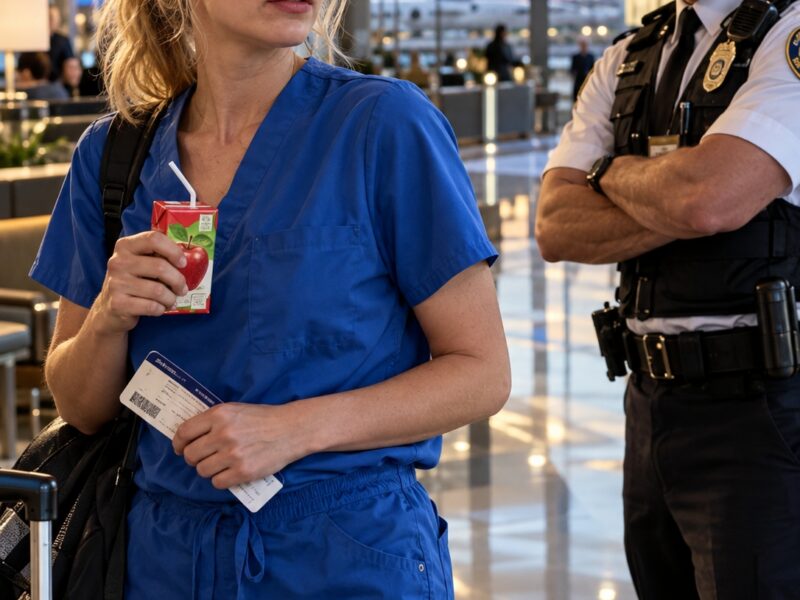
Sarah opened her carry-on.
Paperback.
Phone charger.
A folded sweater.
Then her fingers found the small apple juice box she’d thrown into the bag that morning.
She ripped the straw free.
The security guard reached toward her.
“Don’t give him anything.”
Sarah looked up.
His name tag read M. Doyle.
“I’m a registered nurse.”
“We don’t know that.”
“You don’t need to know it yet.”
His expression hardened.
“Excuse me?”
“You need to know that this child’s blood sugar is dropping.”
She pushed the straw into the juice box.
“Noah, small sips.”
He obeyed.
Doyle took another step.
“You could be anybody.”
Sarah looked at him.
There was something about the way she looked at people when the situation stopped being negotiable.
She didn’t glare.
She didn’t raise her voice.
She simply became still.
“I gave him apple juice,” she said. “You can stand there and watch every sip. Then use the radio on your belt and request medical support for a hypoglycemic child at C14.”
Doyle’s mouth tightened.
“You don’t give me orders.”
“No.”
Sarah checked Noah’s pulse again.
“I’m giving you information. What you do with it is your choice.”
Another boarding announcement sounded.
“Final boarding call for Flight 2214 to Seattle…”
Sarah heard it.
Of course she heard it.
For months, Seattle had existed in her mind as a clean white line drawn across the country.
A trauma unit.
A new apartment.
A new hospital badge.
A new grocery store where nobody knew which cereal she bought.
A new neighborhood where nobody knew she slept with blackout curtains because sudden light sometimes woke her with her heart trying to escape her chest.
A new city where nobody would ask why a civilian nurse automatically chose the chair facing the entrance.
A fresh start.
That was what Sarah called them.
Fresh starts.
She had stopped counting how many she’d had.
Chicago.
Denver.
Phoenix.
Boise.
Temporary contracts.
Short leases.
Friendly coworkers she never allowed to become close friends.
She told herself she liked movement.
She told herself she hadn’t found the right place yet.
She told herself a lot of things.
Seattle was supposed to be different.
The hiring manager had sounded impressed.
The hospital needed trauma nurses.
Sarah needed distance.
It seemed like a fair trade.
The gate doors would close in minutes.
She didn’t move.
Because there was a five-year-old boy sitting on the floor in front of her whose hands were still shaking.
Seattle could wait.
Noah couldn’t.
“Talk to me,” she said.
He swallowed another mouthful of juice.
“About what?”
“Your leg.”
He glanced down.
“What about it?”
“Is it fast?”
A tiny crease appeared between his eyebrows.
Sarah nodded toward the prosthetic.
“Can you run fast with it?”
The faintest smile appeared.
“Really fast.”
“How fast?”
“Faster than Ben.”
“Who’s Ben?”
“My cousin.”
“Is Ben fast?”
“No.”
Sarah almost laughed.
“Then that’s not very impressive.”
For the first time, Noah actually smiled.
“He’s kind of fast.”
“Okay. I’ll give you that.”
His shoulders loosened.
Sarah kept two fingers against his wrist.
Still fast.
But improving.
“What happened to your leg?”
Noah looked down.
“I got sick when I was two.”
“I’m sorry.”
“My dad says not to be sorry.”
Sarah paused.
“Your dad sounds smart.”
“He says I’m the toughest guy he knows.”
“Is he here?”
Noah’s face changed.
“He comes home today.”
“From where?”
Noah shrugged.
“Far away.”
Military.
Sarah didn’t ask anything else.
She didn’t need to.
“My grandma was taking me to meet him,” Noah continued. “Then she went to the bathroom and there were too many people and I couldn’t see her and my arm started buzzing.”
His voice broke.
“I want my dad.”
Sarah placed a hand on his shoulder.
“Look at me.”
He did.
“Your grandmother is looking for you right now.”
“But what if—”
“She is.”
Sarah said it with such certainty that he believed her.
Maybe she believed herself.
“You’re staying right here. That’s exactly what you’re supposed to do when you’re lost. You don’t run around looking for everybody. You let the people looking for you find you.”
“Really?”
“Really.”
She hesitated.
Then added quietly, “Some people take a long time to learn that.”
Noah didn’t understand.
That was fine.
Sarah did.
Behind them, the monitor above Gate C14 changed.
BOARDING became DEPARTED.
Her flight was gone.
Sarah never looked at it.
Then someone screamed Noah’s name.
An older woman came running around the corner, silver hair falling loose from a clip.
“Noah!”
The juice box slipped from his hand.
“Grandma!”
He tried to stand too quickly.
Sarah caught him.
“Slow. Easy.”
The woman dropped to her knees.
“Oh my God. Noah. Baby, I’m sorry.”
She pulled him against her chest.
“I turned around for one minute. One minute.”
“I’m okay.”
“I couldn’t find you.”
“The nurse lady found me.”
Sarah watched Noah’s color.
His breathing.
His fingers.
Better.
Much better.
“He’s stable,” she told the woman. “But I’d still have medical staff check his glucose properly. And get some protein into him soon.”
The grandmother looked up.
Her eyes were wet.
“Who are you?”
Sarah’s answer came automatically.
“Nobody. I was just here.”
The woman stared at her.
Sarah gave a tired smile.
“Right place, right time.”
It was the answer she’d perfected over two years.
Nobody.
Just here.
Passing through.
Never staying.
Never explaining.
Then Sarah heard running footsteps.
Fast.
Heavy.
Purposeful.
A man appeared beyond the crowd, moving through travelers like he barely saw them.
He wore jeans and a dark T-shirt, but the pack slung over his shoulder was military.
Deployment stubble shadowed his jaw.
Exhaustion sat beneath his eyes.
And when he saw Noah, something inside his face broke open.
“Noah!”
The boy twisted around.
“Dad!”
Jack Coleman dropped his bag.
Noah ran.
Jack met him halfway and went to his knees.
For several seconds, the airport disappeared.
There was only a father holding his son after six months of seeing him through unstable video calls and frozen screens.
Jack buried his face against Noah’s shoulder.
“You’re home,” Noah whispered.
“I’m home.”
“Really home?”
Jack pulled back and cupped the boy’s face.
“Really home.”
Then the soldier in him returned.
His eyes moved over Noah automatically.
Face.
Hands.
Breathing.
Prosthetic.
“Mom said something happened.”
“I got lost.”
Jack’s head snapped toward his mother.
“I’m sorry,” she whispered. “I went into the restroom and—”
“I’m okay, Dad.”
Noah grabbed Jack’s sleeve.
“My arm buzzed and I got shaky, but she helped me.”
He pointed.
Jack looked at Sarah.
She was standing several feet away now.
Cobalt-blue scrubs.
Blonde hair tied into a ponytail that had loosened during the last half hour.
Stethoscope around her neck.
Carry-on beside her.
Nothing extraordinary.
Except Jack had spent most of his adult life noticing things other people missed.
Sarah wasn’t watching the reunion.
Not exactly.
Her eyes were moving.
Exits.
Crowd.
Hands.
Distances.
A man nearby lifted his phone to record the reunion.
Sarah shifted half a step.
Nothing dramatic.
Just enough to place herself between the phone and Noah.
Jack noticed.
He had seen people move that way before.
Not nurses.
Soldiers.
“Thank you,” he said.
Sarah looked at him.
“For what?”
Jack almost laughed.
“My son says you kept him from passing out on an airport floor.”
“He helped himself. He told me what was wrong.”
“My mother says you missed your flight.”
Sarah finally glanced toward the gate.
“Apparently.”
“To where?”
“Seattle.”
“You missed a flight to Seattle for a kid you didn’t know?”
Sarah picked up her bag.
“He needed someone more than the plane needed me.”
Jack stared at her.
Something about the sentence bothered him.
Not the words.
The rhythm.
Flat.
Practical.
Priority established.
Decision made.
No emotion wasted explaining what had already been decided.
He knew people who spoke like that.
“Can I buy you coffee?” he asked.
“You don’t owe me anything.”
“I think I owe you considerably more than coffee.”
“Then buy Noah lunch.”
She crouched beside the boy.
“Protein, remember?”
Noah nodded seriously.
“Cheeseburger?”
Sarah pretended to consider it.
“I’ll allow it.”
Jack smiled.
“At least tell me your name.”
“Sarah Bennett.”
“Jack Coleman.”
She extended a hand.
His grip paused for half a second.
There were scars on her hand.
Old ones.
Small.
Meaningless individually.
Not meaningless together.
“Welcome home,” Sarah said.
Jack looked at her again.
“Thanks.”
She glanced at the pack on his shoulder.
“Long one?”
“Long one.”
Two words.
Sarah’s expression changed so slightly he almost missed it.
Recognition without recognition.
The look of one person who knew exactly what those words could contain.
Then she turned toward the rebooking counters.
And the building groaned.
It wasn’t loud at first.
A metallic complaint somewhere down the concourse.
Most people didn’t react.
Sarah did.
Her head came up instantly.
Jack saw the change move through her body.
The tired civilian nurse vanished.
Her weight shifted forward.
Eyes locked toward Gate C19.
Renovation scaffolding surrounded part of the terminal there.
Another groan.
Then a crack.
Someone screamed.
Sarah dropped her bag.
“Stay with your grandmother,” she told Noah.
She was already running before anyone answered.
Jack froze.
Not because he was afraid.
Because he knew that run.
People fleeing danger looked over their shoulders.
Sarah didn’t.
People running toward an accident hesitated as their brains tried to understand what they were seeing.
Sarah didn’t.
She accelerated.
And suddenly Jack wasn’t standing in an airport anymore.
He was three years younger.
Eight thousand miles away.
Kunar Province.
Night.
Dust.
Gunfire.
Eleven men pinned beneath a ridge.
And a voice in his headset saying calmly:
Hold position.
Jack whispered, “No way.”
Then he ran after her.
The scaffolding had folded onto itself.
Metal poles lay twisted across the tile.
Plywood had shattered.
Dust rolled through the terminal.
Beneath a steel support beam lay a maintenance worker.
Pinned from the waist down.
Screaming.
Sarah slid through broken glass and dropped beside him.
“Sir. Look at me.”
“My legs!”
“Look at me.”
He did.
“What’s your name?”
“Rey.”
“Okay, Rey. I’m Sarah.”
“Oh God.”
“I know.”
“My legs—”
“I know. Don’t look at them.”
Sarah’s hands moved.
Head.
Neck.
Chest.
Abdomen.
Pelvis.
Legs.
Beam.
Time.
Always time.
“How long have you been trapped?”
Rey stared at her.
“What?”
“How long?”
“I don’t know.”
“Thirty seconds? Two minutes?”
“Maybe a minute.”
Good.
Bad.
Useful.
Sarah looked over her shoulder.
People were standing everywhere.
Frozen.
Watching.
Phones out.
Nobody moving.
She pointed at a man in a suit.
“You. Take off your belt.”
He blinked.
“What?”
“Your belt. Now.”
He obeyed.
“You.”
A woman holding a cardigan startled.
“Me?”
“Fold that sweater. Put it under his head. Keep him looking at you.”
The woman moved.
Sarah pointed again.
“Call 911 and say structural collapse, entrapment, crush injury, adult male, conscious. Repeat that exactly.”
Someone repeated it into a phone.
The panic changed.
That was what Sarah knew how to do.
Give fear a job.
Fear with nothing to do became chaos.
Fear with instructions became useful.
Jack stopped at the edge of the wreckage.
And watched.
Sarah looped the belt high around Rey’s thigh.
Her hands didn’t shake.
“Rey, listen carefully.”
“I can’t feel my feet.”
“I know.”
“Am I going to lose my legs?”
“I don’t know.”
He stared at her.
She could have lied.
She didn’t.
“But you’re conscious. You’re talking. Help is coming. Those are good things.”
“Don’t leave.”
The words landed somewhere inside her.
Sarah tightened the improvised tourniquet.
“I’m not leaving.”
Jack felt something cold move through him.
He had heard her say those words before.
Different words.
Same voice.
Same promise.
Three years earlier, with gunfire breaking across a ridge.
Hold.
I’m here.
Don’t move.
Birds inbound.
Sarah looked at the hanging scaffolding above them.
“Nobody lifts that beam.”
A firefighter arrived.
“We need to free him.”
“Not yet.”
The firefighter looked at her scrubs.
“Who are you?”
“Registered nurse. Field trauma experience.”
“We need access.”
“If you remove that pressure before establishing fluids, you could kill him.”
The firefighter paused.
Sarah pointed toward Rey’s legs.
“He’s been crushed long enough for reperfusion to become a concern. Get IV access. Aggressive fluids first. Then release.”
“Ma’am—”
“Look at his skin.”
The firefighter looked.
Something in his expression shifted.
Sarah’s voice dropped.
“You release first, toxins flood his circulation. His heart may stop before he reaches the ambulance.”
A second firefighter arrived.
Then EMS.
Sarah didn’t compete with them.
She became useful.
“Forty-one-year-old male,” she said. “Bilateral lower-extremity crush injury. Entrapment approximately four minutes. Conscious throughout. Tourniquet applied. No obvious major thoracic trauma. Request fluids before release.”
Jack stopped breathing.
There.
That cadence.
Patient.
Mechanism.
Time.
Intervention.
Request.
No wasted language.
No panic.
He had heard it through static.
October.
Kunar Province.
Eleven men.
An enemy position less than a hundred meters from them.
Command refusing the strike.
Too close.
Too dangerous.
Jack remembered pressing his body into rock while bullets snapped overhead.
He remembered one of his men bleeding beside him.
He remembered thinking of Noah, only two years old then.
And through the radio came the voice.
Calm.
Almost unnaturally calm.
“Ghost Six. Danger close acknowledged.”
The voice had walked aircraft onto the target.
Meters mattered.
Seconds mattered.
One mistake mattered.
The strike came.
The ridge shook.
Then silence.
Eleven Americans went home.
Jack had spent three years wondering who Ghost Six was.
He had asked.
People wouldn’t tell him.
Classified.
Compartmentalized.
Wrong unit.
Wrong channels.
He eventually learned that Ghost Six had received a Bronze Star with Valor.
Then the trail disappeared.
Jack had imagined a man.
Older.
Hard-faced.
Career military.
He had never imagined a blonde nurse in blue scrubs kneeling on an airport floor.
The firefighters prepared to lift.
Sarah leaned closer to Rey.
“This is going to hurt.”
“I’m scared.”
“I know.”
“How bad?”
“Bad.”
Rey laughed once through his tears.
“You’re terrible at comforting people.”
“I’m excellent at keeping them alive.”
Despite everything, Rey smiled.
Sarah gripped his shoulder.
“Stay with me.”
The beam rose.
Rey screamed.
Then stopped.
Sarah moved instantly.
“Rey.”
Nothing.
“Rey!”
His eyes fluttered.
She found his pulse.
“Stay with me.”
The paramedics flooded around her.
Equipment.
Commands.
Straps.
IV tubing.
For thirty seconds, Jack couldn’t see Sarah.
Then the stretcher rolled free.
Rey was alive.
Sarah remained kneeling in the wreckage.
Blood streaked her scrubs.
Dust covered her hair.
Her hands rested against her thighs.
For the first time since the collapse, they trembled.
Only slightly.
Sarah stared at them.
Then closed her fists.
When she stood, her shoulders squared automatically.
Chin up.
Feet planted.
It lasted perhaps two seconds.
Two seconds were enough.
Jack walked toward her.
“Ghost Six.”
Sarah stopped.
Everything inside her stopped.
The airport noise seemed to recede.
She didn’t turn around immediately.
Jack’s throat tightened.
He knew.
Sarah slowly faced him.
“What did you call me?”
Jack looked directly into her eyes.
“Ghost Six.”
The paper towel in Sarah’s hand crushed into her fist.
“How do you know that name?”
Jack couldn’t answer immediately.
Three years of searching had prepared him for this moment.
He had imagined speeches.
Handshakes.
Buying the person a drink.
Maybe introducing Ghost Six to Noah someday and saying, This is one of the reasons I’m standing here.
None of those imagined moments included an airport floor.
Or blood.
Or a missed flight.
Or his son already knowing the woman.
“Kunar Province,” Jack said.
Sarah’s face emptied.
“October. Three years ago.”
“Stop.”
“Eleven-man element pinned on a ridgeline.”
“I said stop.”
“Enemy position closing from the north.”
Sarah looked around.
People.
Phones.
Security.
Jack lowered his voice.
“I’m not asking you to confirm anything classified.”
Her jaw tightened.
“I’m asking you to let me finish.”
Sarah said nothing.
Jack swallowed.
“I was the squad leader.”
That broke through.
Her eyes snapped back to him.
Jack’s voice became rough.
“Eleven men were on that ridge.”
Sarah knew the number.
Of course she knew it.
She had known it for three years.
She knew how many men had been inside the danger radius.
She knew the aircraft.
The coordinates.
The wind.
The delay between authorization and impact.
She knew how long she’d stared at the map afterward.
She knew the arithmetic.
Eleven.
“I heard you,” Jack continued. “Command told you it was too close.”
Sarah looked away.
“You held the strike until you had the geometry you wanted. Then you walked those aircraft in.”
“Jack.”
“You saved all eleven of us.”
Sarah closed her eyes.
“I’ve spent three years trying to find you.”
“Why?”
The question came out almost angry.
Jack stared at her.
“Why?”
“Yes.”
Sarah opened her eyes.
“Why would you look for me?”
“To thank you.”
“For doing my job?”
“For giving me my life.”
“I didn’t give you anything.”
“My son was two.”
Sarah’s expression flickered.
Jack continued.
“He barely remembered me when I got home.”
“Don’t.”
“I got to fix that.”
“Jack.”
“I got to watch him learn to run with that prosthetic.”
Sarah’s breathing changed.
“I got to hear him call me Dad again. I got to come through this airport today after six months away and have him throw his arms around my neck.”
His eyes filled.
He didn’t wipe them.
“And every one of those moments happened because somebody I had never met stayed calm on a radio.”
Sarah looked toward Noah.
He was standing with his grandmother beyond the security line.
Small.
Alive.
Watching her.
Jack’s voice broke.
“And then I came home today and watched the same woman save my son before I even knew who she was.”
Sarah said nothing.
“And twenty minutes later, I watched her run toward falling steel to save another stranger.”
He shook his head.
“I finally understood why your voice sounded familiar.”
Sarah looked down at the blood on her scrubs.
“I left because of that mission.”
Jack became still.
Sarah seemed surprised she’d said it.
Maybe she was.
“For two years,” she whispered, “I’ve told people I wanted a change.”
She laughed once.
There was no humor in it.
“That’s the phrase civilians like. A change.”
Jack waited.
“I finished my contract. Requested separation. Did everything correctly.”
“Why?”
Sarah looked at him.
“Because after that strike, I sat alone in a tent.”
Her voice grew quieter.
“And I did the math.”
Jack knew what she meant.
“Eleven people lived because I made a decision in seconds.”
She rubbed her thumb against an old scar on her palm.
“Everyone told me that was the part I was supposed to remember.”
Her eyes hardened.
“But all I could think about was the other number.”
“What other number?”
“The number if I had been wrong.”
Jack didn’t answer.
“If I’d moved the coordinates slightly.”
She held two fingers barely apart.
“If the aircraft had been off. If the wind had changed. If I had waited too long. If I hadn’t waited long enough.”
“Sarah—”
“Eleven.”
She looked at him.
“That’s how many families would have received people in uniforms at their doors because I made one bad call.”
“But you didn’t.”
“That doesn’t make the math disappear.”
Jack understood then.
People had probably called Sarah brave.
Decorated her.
Congratulated her.
Told her she had saved lives.
Nobody had understood that survival itself could become a weight.
“So you became a nurse.”
Sarah nodded.
“I thought it would be smaller.”
Jack almost smiled.
“Smaller?”
“Blood pressure. Medication. Wound care. One patient at a time. Decisions where I had minutes instead of seconds.”
Jack looked toward the destroyed scaffolding.
“You ran toward a collapsing structure.”
Sarah followed his gaze.
“That wasn’t planned.”
“You ordered twelve strangers around like they’d trained with you for years.”
“I was helping.”
“You told firefighters how to handle a crush injury.”
“They knew what they were doing.”
“Eventually.”
That earned him a look.
Jack smiled faintly.
Sarah’s mouth almost moved.
Almost.
Then Jack said, “You don’t get smaller stakes.”
Her smile vanished.
“What?”
“You don’t.”
He nodded toward Rey’s blood on her clothes.
“You just got better at pretending they were smaller.”
For a moment, Sarah looked angry.
Then tired.
Then something else.
Seen.
That frightened her more than anger would have.
A throat cleared behind them.
Doyle.
The security guard stood with an airport operations supervisor.
His radio was finally in his hand.
“Ms. Bennett.”
Sarah turned.
“Yes?”
“I’m going to need you to come with us.”
Jack frowned.
“For what?”
Doyle ignored him.
“You treated an unaccompanied minor without verified credentials. Then you interfered with an active emergency response and gave directions to fire and EMS personnel.”
Sarah stared at him.
Doyle continued.
“We need to verify who you are.”
“Do it.”
His eyebrows rose.
Sarah unclipped her hospital badge.
“Check my nursing license.”
She handed it to the supervisor.
“Pull the security footage while you’re at it.”
Doyle’s mouth tightened.
“That’s not the point.”
“What is the point?”
“The point is procedure.”
Sarah nodded slowly.
“Procedure.”
“Yes.”
“Where was procedure when Noah’s blood sugar was crashing?”
Doyle flushed.
“Ma’am—”
“Where was procedure when Rey was under that beam?”
“We had emergency personnel responding.”
“After I got there.”
“You don’t get to take over an emergency scene because you think you know better.”
“I didn’t take it over.”
“You were giving orders.”
“I gave medical information.”
“You told firefighters what to do.”
“Because releasing that beam too early could have stopped Rey’s heart.”
Doyle stepped closer.
“You’ve got a real attitude for somebody who missed a domestic flight and then spent the afternoon creating liability problems.”
Jack moved.
Only one step.
But something in him changed.
“Careful.”
Doyle looked at him.
“Sir, stay out of this.”
“No.”
“Sir—”
“No.”
Jack’s voice was quiet now.
Sarah recognized that tone.
It wasn’t anger.
Anger was louder.
This was control.
“She saved my son’s life.”
“That doesn’t—”
“Then she helped save that maintenance worker.”
“We don’t know—”
“I know exactly who she is.”
Sarah turned sharply.
“Jack.”
Too late.
“Three years ago, she talked aircraft onto an enemy position less than a hundred meters from eleven American soldiers.”
Doyle stared.
The supervisor stopped writing.
Jack continued.
“I was one of them.”
“Jack.”
“Her call sign was Ghost Six.”
Sarah’s face tightened.
Jack saw it.
He stopped before saying anything operational.
But the truth was already standing between them.
The operations supervisor looked at Sarah.
“You were military?”
Sarah exhaled.
“Air Force.”
“What specialty?”
She hesitated.
“Combat control.”
The supervisor’s expression changed.
“CCT?”
Sarah nodded.
“My brother-in-law was Army.”
The man looked at her differently now.
Not worshipfully.
Sarah hated that almost as much as suspicion.
“He talked about combat controllers.”
“We’re people,” Sarah said.
“I know.”
“No.”
Her voice softened.
“You know stories. That’s different.”
Doyle looked from Sarah to Jack.
Some of the certainty drained from his posture.
“I still need to file a report.”
Sarah handed him back the radio he’d almost forgotten he was holding.
“File it.”
Doyle blinked.
“Include everything.”
She nodded toward the ambulance doors.
“Especially the part where Rey left alive.”
A small voice came from behind Jack.
“Is the nurse lady in trouble?”
Noah.
He had escaped his grandmother’s hand and hurried over.
Jack crouched.
“No.”
Noah looked suspiciously at Doyle.
“Are you sure?”
“I’m sure.”
“What happened?”
Jack glanced at Sarah.
Then said, “Some adults are figuring out paperwork.”
Noah accepted this as proof that adulthood was deeply inefficient.
He turned to Sarah.
“Are you a superhero?”
Sarah stared at him.
Jack expected her to laugh.
She didn’t.
She lowered herself until they were eye level again.
“No.”
“But Dad said you’re a hero.”
Sarah glanced at Jack.
“Your dad exaggerates.”
“I do not.”
Noah frowned.
“You saved me.”
“You helped save yourself.”
“You saved the other man.”
“There were lots of people helping him.”
“But you knew what to do.”
Sarah paused.
“That part is true.”
“How?”
“Training.”
Noah considered that.
“So training makes you not scared?”
Sarah smiled sadly.
“No.”
“What does?”
“Nothing.”
Noah’s eyebrows drew together.
Sarah touched the strap of his backpack.
“Being brave doesn’t mean you stop being scared. It means fear doesn’t get to make every decision.”
Noah looked down at his prosthetic.
“Was I brave?”
“Very.”
“I cried.”
“You can cry and be brave.”
“I got scared.”
“You can be terrified and be brave.”
“I wanted my dad.”
Sarah’s expression softened.
“Wanting someone you love doesn’t make you weak.”
Noah seemed satisfied.
Then he looked at her.
“Did you get scared?”
Sarah opened her mouth.
For once, no easy answer came.
“Yes,” she said finally.
Jack watched her.
“When?”
Noah asked.
Sarah looked at the wreckage.
“More times than I can count.”
The airport medical liaison eventually verified her license.
The security footage supported her account.
A paramedic called from the trauma center with news that Rey was in surgery and stable.
The early tourniquet placement and fluid protocol had probably saved his legs.
Possibly his life.
By then, afternoon sunlight had turned gold against the terminal windows.
Sarah sat near the rebooking desk.
Her new flight was scheduled for the next morning.
Seattle.
One more night.
That was all.
Jack sat beside her.
Noah was asleep against his grandmother several seats away.
For a while neither adult spoke.
Jack turned Noah’s empty juice box slowly between his hands.
“You didn’t have to stay.”
Sarah looked at him.
“At the collapse?”
“With Noah.”
She shrugged.
“Yes, I did.”
“No, you didn’t.”
Sarah studied him.
Jack continued.
“You chose to.”
“What’s the difference?”
“Everything.”
Sarah looked toward the departures board.
Cities changed every few seconds.
Atlanta.
Boston.
Denver.
Seattle.
Places people were going because somebody waited for them there.
Sarah had spent two years choosing cities precisely because nobody did.
“Why nursing?” Jack asked.
“You already asked.”
“You didn’t answer.”
“I answered enough.”
“Fair.”
He leaned back.
Sarah glanced at him.
“You give up easily.”
“I’ve learned there’s a difference between giving up and waiting.”
That almost made her smile.
Almost.
Jack let silence sit between them.
Eventually Sarah said, “I thought quiet meant safe.”
He didn’t move.
“Not safe for me.”
She folded her hands.
“Safe for everyone else.”
“Explain.”
Sarah watched a family hug near another gate.
“If I wasn’t the person making those decisions anymore, nobody’s survival depended on whether I was fast enough.”
Jack listened.
“I could be one nurse among thirty on a floor. Follow protocols. Call physicians. Hand off at shift change.”
She smiled without humor.
“Go home.”
“Did it work?”
“No.”
The answer came immediately.
Sarah seemed surprised by its speed.
“No,” she repeated.
“Why not?”
“Because apparently I still run toward collapsing scaffolding.”
Jack smiled.
“Apparently.”
Sarah looked at Noah.
“And diabetic five-year-olds.”
“Those too.”
She leaned back.
“I’ve been moving every few months.”
“Why?”
“I called it ambition.”
“And now?”
Sarah stared at Seattle glowing on the board.
“Now I think I leave before anyone notices.”
“Notices what?”
“That I don’t fit.”
Jack frowned.
“You fit fine.”
“You met me six hours ago.”
“Long six hours.”
She laughed.
This time it was real.
Small.
But real.
Sarah looked at him.
“I scan exits.”
“So do I.”
“I hate fireworks.”
“Same.”
“I wake up reaching for equipment that isn’t beside my bed anymore.”
Jack’s smile disappeared.
Sarah looked down.
“I don’t like people asking about the scars.”
“Then don’t answer.”
“I don’t like being thanked.”
Jack went quiet.
“That one might be a problem for me.”
Sarah looked over.
“I noticed.”
“I’m working on it.”
“No, you’re not.”
“No.”
They smiled.
Then Jack said, “The weight isn’t the only thing on the scale.”
Sarah’s smile faded.
“What?”
Jack nodded toward Noah.
“My deployment ended.”
He watched his sleeping son.
“I came home.”
His voice softened.
“I got that.”
Sarah understood.
“The weight doesn’t disappear,” Jack continued. “Maybe it shouldn’t. But it’s not the only thing you get to carry.”
Sarah looked at Noah.
Five years old.
Broken zipper on his backpack.
One prosthetic leg.
A juice stain on his shirt.
Alive.
She thought of eleven men whose faces she’d never seen.
For years they had existed in her mind as numbers.
Eleven survived.
Eleven almost died.
Eleven families.
Eleven chances to be wrong.
Jack had given one of those numbers a face.
Then Noah had given it a future.
Sarah felt something inside her shift.
Not heal.
Healing was too clean a word.
Maybe simply move.
Noah stirred.
His eyes opened.
He looked around until he found Sarah.
Then relaxed.
“You’re still here.”
The words hit harder than they should have.
Sarah smiled.
“Still here.”
“Are you leaving tomorrow?”
“That’s the plan.”
Noah sat up.
“Can you see my leg trick before you go?”
“Leg trick?”
He nodded enthusiastically.
“It lights up.”
Sarah looked at Jack.
Jack raised both hands.
“I had nothing to do with this feature.”
“When I jump really hard, it turns blue.”
Noah stood.
His grandmother immediately woke.
“No jumping.”
“One jump.”
“Noah—”
He jumped.
The prosthetic flashed faintly blue.
Sarah laughed.
Noah grinned.
“See?”
“That might actually be the coolest leg in the world.”
“I told you.”
Then Jack leaned forward.
“Sarah.”
Something in his voice changed.
She looked at him.
“I run a foundation.”
She blinked.
“A what?”
“Small nonprofit.”
“Okay.”
“We work with veterans.”
Sarah’s posture became cautious.
Jack noticed.
“Not therapy.”
She relaxed by half an inch.
“Good start.”
“We help people figure out what to do with skills that don’t disappear just because the uniform does.”
Sarah said nothing.
“We also train civilians in emergency response. Schools. Security teams. Community groups.”
Jack turned toward her.
“First aid. Bleeding control. Crisis response. How not to freeze while waiting for EMS.”
Sarah already knew where this was going.
“No.”
“You haven’t heard the offer.”
“I know the offer.”
“You don’t.”
“Jack.”
“We need instructors.”
Sarah laughed softly.
“You’re offering me a job?”
“Maybe.”
“We met this morning.”
“Technically yesterday now, depending how long this conversation lasts.”
“Jack.”
“Fine. Six hours.”
“You know almost nothing about me.”
“I know you missed a flight for a stranger’s kid.”
“That’s not a résumé.”
“I know you stabilized a diabetic child.”
“I’m a nurse.”
“I know you recognized crush syndrome before trained responders got their equipment unpacked.”
Sarah looked away.
“I know twenty terrified civilians listened to you because you knew how to make panic useful.”
“Jack.”
“And I know you’ve spent two years moving because you think being unknown is safer than being understood.”
That silenced her.
Jack leaned back.
“I’m not offering you a job because you saved me.”
“Good.”
“I’m offering because you’re exactly the person we’re missing.”
Sarah stared at him.
“Combat experience. Civilian medicine. Someone who knows the difference between textbook emergencies and real ones.”
He paused.
“And someone who understands what happens to people when the emergency is over.”
Sarah looked toward Seattle.
“You rehearsed that fast.”
“I’m good under pressure.”
She gave him a look.
“Apparently.”
Jack smiled.
“No pressure.”
“You just gave me a speech.”
“A low-pressure speech.”
“That’s not a thing.”
“Fine.”
He held up his hands.
“The offer exists. That’s all.”
Sarah looked at him.
“And if I say no?”
“You fly to Seattle.”
“And?”
“And I tell Noah you went somewhere to help other people.”
No guilt.
No persuasion.
No rescue fantasy.
Just a choice.
That was almost worse.
“What exactly are you offering?” she asked.
Jack’s expression remained neutral.
“Come see the place.”
“That’s not an answer.”
“Teach one class.”
“And then?”
“Decide.”
Sarah looked down at her hands.
There was a white scar above one knuckle.
A burn around her wrist.
Marks from lives she rarely discussed.
Hands that had spent two years holding clipboards as if clipboards were the only things they’d ever known.
“I’m tired,” she whispered.
Jack’s answer came gently.
“I know.”
“No. I mean…”
Sarah swallowed.
“I’m tired of leaving.”
Jack said nothing.
That was why she kept talking.
“Every city starts the same.”
She looked toward the windows.
“I unpack half my boxes. I learn the quickest route to the hospital. Find a grocery store. Pick a coffee shop.”
Her voice grew distant.
“Then someone gets close.”
“A coworker?”
“Sometimes.”
“A friend?”
“Almost.”
She smiled sadly.
“They ask where I learned something. Why I react a certain way. Why I know things a normal nurse shouldn’t know.”
“And you leave.”
Sarah nodded.
“I leave.”
“Before they can reject you?”
“No.”
She thought about it.
“Before they can know me.”
Jack absorbed that.
“That’s worse.”
“I know.”
The departures board changed again.
Seattle.
8:15 A.M.
ON TIME.
Sarah stared at it.
“I still have a flight tomorrow.”
“I know.”
“I might take it.”
“I know.”
Jack stood.
Sarah looked up.
“That’s it?”
“That’s it.”
“You aren’t going to convince me?”
“No.”
“Why?”
Jack glanced at Noah.
“Because I think you’ve spent enough years being told where you have to go.”
Then he walked back toward his son.
Sarah sat alone.
And for the first time in two years, she had nowhere to run that didn’t feel exactly like running.
The next morning, Sarah stood at the gate with her boarding pass in her hand.
Seattle.
Group Four.
Again.
There was something almost cruel about the repetition.
The same airport.
The same carry-on.
The same blue scrubs folded inside now instead of worn.
The same promise of anonymity waiting three thousand miles away.
She had barely slept.
At 3:12 a.m., she’d opened the airline app.
At 3:18, she’d looked up Jack’s foundation.
At 3:41, she’d closed the page.
At 4:06, she’d opened it again.
There were photographs.
Veterans teaching teachers how to apply tourniquets.
School staff practicing emergency drills.
Security officers learning triage.
One photograph showed Jack kneeling beside a teenager while demonstrating pressure on a training wound.
He looked different.
Civilian.
Still himself.
Sarah understood why that bothered her.
She had assumed those two things were mutually exclusive.
At 5:30, she showered.
At 6:15, she checked out of the airport hotel.
At 7:40, she arrived at the gate.
At 8:02, boarding began.
“Group Three.”
People stood.
Sarah didn’t.
“Group Four.”
Her group.
Sarah picked up her carry-on.
She walked toward the line.
Ten feet.
Eight.
Five.
The boarding pass felt strangely heavy.
A woman ahead of her laughed into a phone.
A businessman complained about overhead-bin space.
A little girl dragged a stuffed rabbit by one ear.
Ordinary life.
Sarah stopped.
Someone behind her sighed impatiently.
She stepped aside.
The line moved around her.
Seattle was waiting.
A hospital was waiting.
An apartment listing was waiting.
Nobody there knew Ghost Six.
Nobody there knew what Sarah Bennett sounded like over a radio.
Nobody there would look at her and see both versions of her at once.
For two years, that had been exactly what she wanted.
Now it felt unbearably lonely.
Sarah looked down at the boarding pass.
Then she remembered Noah opening his eyes after falling asleep.
You’re still here.
Sarah turned away from the gate.
She called Seattle.
The hiring manager answered on the fourth ring.
“Sarah?”
“Hi.”
“You okay?”
Sarah looked back at the boarding line.
“Yes.”
And for once, it was almost true.
“Something happened.”
The woman waited.
Sarah smiled faintly.
“I don’t think I’m coming.”
There was a pause.
Then, gently, “I had a feeling.”
Sarah laughed.
“Was I that obvious?”
“You sounded like someone trying to convince herself during the interview.”
“That’s embarrassing.”
“It’s human.”
Sarah watched the final passengers disappear down the jet bridge.
“I’m sorry.”
“Don’t be. The door stays open.”
“Thank you.”
“Take care of yourself, Sarah.”
Sarah swallowed.
“I’m going to try.”
She ended the call.
Flight 2214 left without her for the second time.
This time, she hadn’t missed it.
She had chosen not to board.
Three months later, Sarah Bennett stood inside a converted hangar with a marker in one hand.
Twenty-two school security officers sat in folding chairs.
Two off-duty firefighters occupied the back row.
A whiteboard behind Sarah showed diagrams of tourniquet placement, triage priorities, and emergency assessment.
Jack stood near the projector.
Noah sat cross-legged beside the wall with homework spread across his lap.
He wasn’t doing any of it.
Sarah knew because she’d caught him watching her four times.
She turned toward the class.
“The first thing I’m going to teach you isn’t medical.”
Several people looked surprised.
Sarah capped the marker.
“It’s permission.”
A man in the front row frowned.
“Permission?”
“To act.”
She walked between the chairs.
“Most people freeze during emergencies because they’re waiting for someone more qualified to arrive.”
Sarah looked around the room.
“A paramedic. A firefighter. A police officer. A nurse.”
She stopped.
“But sometimes they’re five minutes away.”
The room was silent.
“Sometimes ten.”
She thought of Noah.
“Sometimes the person in front of you doesn’t have ten.”
Sarah pointed toward the training kit.
“So if you’re the first person there, for those minutes, you’re what they have.”
A woman raised her hand.
“What if we do something wrong?”
Sarah smiled.
“You will.”
The room shifted.
Jack watched from the back.
Sarah continued.
“So will I.”
The woman looked surprised.
Sarah nodded.
“Training doesn’t make you perfect. It makes you useful.”
She walked toward the whiteboard.
“Perfect decisions made too late don’t save anyone.”
The marker squeaked against the board.
“Good decisions made in time often do.”
She stopped.
“And sometimes imperfect decisions made by someone paying attention are better than no decision because everyone was waiting for permission.”
Noah raised his hand.
Sarah stared at him.
“You’re not technically enrolled.”
“I have a question.”
Jack covered a smile.
Sarah sighed theatrically.
“Fine.”
“What if you’re scared?”
The room became quiet.
Sarah looked at him.
Three months earlier, she might have given the professional answer.
Today she gave the true one.
“You do it scared.”
Noah nodded.
Sarah continued.
“Being calm isn’t the absence of fear.”
She looked across the room.
“It’s knowing fear is information, not instruction.”
Jack lowered his eyes.
He recognized the line.
Not because he’d heard Sarah say it before.
Because he’d lived it.
After class, people stayed behind to ask questions.
A security officer wanted advice on emergency kits.
One firefighter asked about crush injuries.
A teacher wanted Sarah to run a session at her school.
Sarah answered each one.
She didn’t flinch when people asked where she’d learned certain techniques.
She didn’t tell them everything.
She didn’t have to.
There was a difference between privacy and disappearance.
She was finally learning it.
When the last attendee left, Noah approached.
“You did the speech again.”
Sarah stacked training supplies.
“What speech?”
“The one about trusting your training.”
“I have several speeches.”
“That’s your favorite.”
Sarah smiled.
“It might be.”
“Why?”
She looked at him.
“Because it’s true.”
Noah nodded thoughtfully.
Then he whispered, “Grandma says I can keep coming.”
“Your grandmother says a lot of things.”
“She said you said yes.”
Sarah laughed.
“I did.”
“So I can?”
“You can.”
He grinned.
“Even though I’m five?”
“Especially because you’re five.”
Jack folded the last chair.
“Don’t encourage him. Yesterday he tried to triage his stuffed animals.”
Sarah looked at Noah.
“Results?”
“The bear was critical.”
“What happened?”
“Leg injury.”
Sarah glanced at the prosthetic.
Noah shrugged.
“I know a lot about legs.”
“You do.”
He ran toward the vending machine.
His stride was different now.
Not because the prosthetic had changed.
Because Noah had.
Three months earlier, he had moved cautiously, as though the artificial limb were something the world might notice.
Now he simply ran.
Jack came beside Sarah.
“You ever regret it?”
She kept watching Noah.
“What?”
“Staying.”
Sarah knew exactly what he meant.
“No.”
“Never?”
“Ask me after tax season.”
Jack laughed.
Sarah leaned against the table.
“I think about Seattle sometimes.”
Jack waited.
“Not because I wish I’d gone.”
“Then why?”
“Because I know what would’ve happened.”
“What?”
“I would’ve stayed six months.”
She smiled sadly.
“Maybe eight.”
“Then?”
“Someone would’ve invited me to Thanksgiving.”
“Terrifying.”
“Extremely.”
“Then what?”
“Someone would’ve asked about my family. Or the military. Or why I know how to do something.”
“And you’d leave.”
Sarah nodded.
“I would’ve found another Seattle.”
Jack looked toward the hangar door.
“So what changed?”
Sarah considered the question.
“Nothing.”
Jack raised an eyebrow.
She smiled.
“That’s the strange part.”
She looked down at her hands.
“I’m still me.”
The scars remained.
The memories remained.
Some nights she still woke reaching for a radio.
She still sat facing doors.
Fireworks still made her shoulders tighten before her mind caught up.
The math still existed.
Eleven.
Always eleven.
But now there was another number beside it.
One.
One father who came home.
One five-year-old boy who learned to run on a prosthetic leg.
One maintenance worker who still had both legs.
Twenty-two security officers.
Two firefighters.
Teachers.
Parents.
People who might someday stand beside someone bleeding and know what to do.
The weight had not disappeared.
Jack had been right.
It simply wasn’t the only thing on the scale anymore.
“I spent two years believing the safest thing I could do was become nobody,” Sarah said.
Jack listened.
“I thought if nobody knew what I’d been, then nobody could ask me to be that person again.”
“And?”
Sarah watched Noah feed quarters into the vending machine.
“I was wrong.”
“What was the safest thing?”
She shook her head.
“I don’t think safe was ever the point.”
Jack smiled faintly.
“No.”
Sarah looked at him.
“The hardest thing I ever did wasn’t calling that strike.”
Jack didn’t speak.
“It wasn’t leaving the service either.”
She watched Noah choose a snack.
“It was staying still long enough to let somebody recognize me.”
Jack’s expression softened.
Sarah laughed quietly.
“Turns out all it took was one diabetic five-year-old.”
Across the parking lot, Noah came running toward them.
“Sarah!”
“What?”
“Watch!”
He jumped.
The prosthetic flashed.
Soft blue.
Exactly as promised.
Noah laughed and jumped again.
The late-afternoon sunlight caught the metal edge of the prosthetic, and for one brief second the blue light seemed brighter than it really was.
Sarah watched him run.
Once, she would have seen only the medical history.
The amputation.
The diabetes.
The risks.
Then she would have seen Jack and remembered Kunar.
Coordinates.
Aircraft.
Eleven men.
The math.
Now she saw something else.
A boy racing across a parking lot because his father had come home.
A father standing beside her because years earlier she had refused to let fear make a decision.
A hangar full of empty folding chairs where ordinary people had spent an afternoon learning how not to look away.
Sarah had spent years believing courage was measured by the moments when everything depended on you.
She knew better now.
Sometimes courage was smaller.
It was kneeling beside a frightened child while your flight departed without you.
It was telling a terrified stranger the truth instead of giving him a comforting lie.
It was admitting that surviving something did not mean you had finished carrying it.
It was letting someone thank you.
It was staying when every instinct you’d trained for years told you to leave first.
Noah reached them, breathing hard.
“Did you see?”
Sarah smiled.
“I saw.”
“Coolest leg in the world.”
“Definitely.”
Jack rested a hand on his son’s shoulder.
The three of them walked back toward the hangar.
Sarah paused at the doorway.
For years, whenever she entered a room, she located the exits first.
She still did.
One door behind her.
Another near the equipment room.
Large hangar opening to the parking lot.
Three ways out.
Her mind cataloged them automatically.
Maybe it always would.
But this time, after noticing the exits, Sarah noticed something else.
Jack was turning off the projector.
Noah had left his backpack under a chair again.
Tomorrow’s class materials were stacked on the table.
Her coffee mug sat beside them.
Her name was written across it in black marker because Noah had decided everybody who worked there needed an “official cup.”
SARAH.
Not Ghost Six.
Not Lieutenant.
Not Nurse Bennett.
Not nobody.
Sarah.
She walked inside.
Behind her, the afternoon light slowly disappeared from the parking lot.
Noah’s prosthetic flashed blue once more before the hangar door began to close.
And for the first time in years, Sarah Bennett knew exactly where every exit was—
and had no desire to use any of them.









