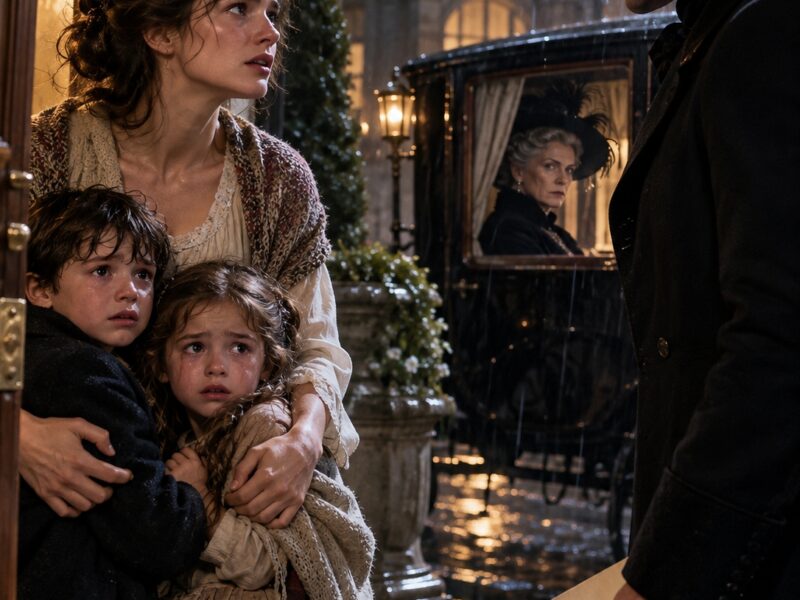
SHE OPENED HER DOOR TO TWO MISSING CHILDREN—THEN A DUKE ARRIVED AND SAID, “THEY BELONG TO ME”
The first child was shaking so badly his teeth clicked.
The second had stopped speaking entirely.
And fifteen days after Eleanor Ray opened her cottage door and found them half-frozen in the rain, a duke appeared on the same threshold and told her, in a voice cold enough to stop her heart:
“I believe you have something of mine.”
Eleanor stared at him.
Rain streamed from the brim of his black hat. Behind him, the Derbyshire moor disappeared beneath a gray October sky, empty for miles except for heather, stone, and a narrow road already turning to mud.
The man standing before her looked as though none of those things had ever inconvenienced him.
Tall. Broad-shouldered. Perhaps thirty-four. His dark greatcoat was cut too well for a country gentleman, his boots too expensive for a traveler, and his expression carried the dangerous stillness of someone accustomed to doors opening before he reached them.
Eleanor did not open hers another inch.
“On what basis?”
His gray eyes sharpened.
“I beg your pardon?”
“You said I have something of yours.”
She rested one hand against the doorframe.
“Children are not somethings, Your Grace.”
For the first time, the man looked surprised.
That pleased her more than it should have.
“If you have come to retrieve property,” Eleanor continued, “you may reconsider your choice of words before I reconsider allowing you into my house.”
The rain filled the silence between them.
Then something changed in his face.
Not embarrassment.
Not quite anger.
Recalculation.
He removed his hat.
“Gideon Wolverton,” he said. “Duke of Stanmere.”
“I know who you are.”
That surprised him too.
Hatherage might have been small, but people still knew the names of the men who owned half the horizon.
Gideon glanced beyond her shoulder.
Eleanor immediately shifted, blocking his view.
Because upstairs were two children who had spent fifteen days learning how not to be afraid.
Edmund was five, serious beyond his years, with dark hair that refused discipline and an obsession with Eleanor’s books.
Clara was four.
She had not spoken once since Eleanor found her.
But she hummed.
Sometimes while eating.
Sometimes beside the fire.
Sometimes in her sleep.
And the previous night, while clutching Eleanor’s hand beneath the blankets, Clara had finally laughed when Edmund made a ridiculous face with two walnuts pressed beneath his upper lip.
It had lasted perhaps three seconds.
Eleanor had nearly cried afterward.
Now a duke stood outside asking for them.
And three nights earlier Edmund had whispered something Eleanor had been unable to forget.
Please don’t make us go back.
She had asked why.
The little boy had looked toward his sleeping sister before answering.
Because she said Papa was bad.
A pause.
And she said I was nothing.
Now Eleanor studied Gideon Wolverton.
“Are they yours?”
His jaw tightened.
“They are my brother’s children.”
“Is your brother alive?”
“No.”
The answer came too quickly for deception and too quietly for indifference.
Eleanor felt the first crack appear in the picture she had formed of him.
She disliked it.
Anger was easier when the person across from you remained simple.
“May I come inside?” he asked.
This time there was no command in it.
Only exhaustion.
And beneath that—
fear.
Eleanor stepped aside.
But only just.
“Wipe your boots.”
His eyes dropped to the mat.
Then back to her.
And to her astonishment, the Duke of Stanmere wiped his boots.
That was how Gideon Wolverton entered Eleanor Ray’s life.
Not with trumpets.
Not with servants announcing his title.
Not with the grandeur people later imagined when they told the story.
He entered dripping rainwater onto her floor while Eleanor put a kettle over the fire because her hands needed something to do.
He did not sit.
Instead he stood in the middle of her small parlor surrounded by everything that made Eleanor’s life hers—books stacked two rows deep, her father’s old writing desk, a cracked blue vase, the faded rug her mother had once chosen, and two tiny pairs of boots drying near the hearth.
Gideon saw the boots.
He stopped.
For several seconds he said nothing.
Then his voice changed.
“Are they well?”
Eleanor looked at him properly.
Not at the coat.
Not at the title.
Not at the arrogance with which he had first looked through her doorway.
At him.
The fear was still there.
He had simply buried it beneath training, breeding and whatever habits a man learned when an entire household waited for him to decide what everyone else should do.
“They are well,” Eleanor said.
Gideon closed his eyes.
Only for a moment.
But she saw it.
“Edmund reorganizes my books,” she continued. “Apparently my system is offensive to him.”
The corner of Gideon’s mouth almost moved.
“And Clara?”
“She eats. She sleeps.”
Eleanor hesitated.
“She still doesn’t speak.”
His eyes opened.
“But yesterday she laughed.”
He looked toward the ceiling.
“One laugh?”
“One.”
Another silence.
Then Gideon lowered himself into the chair beside the fire as though his knees had suddenly remembered he had been searching for two children for more than two weeks.
“How long have they been here?”
“Fifteen days.”
He stared at her.
“I have been looking for them for sixteen.”
Eleanor absorbed the arithmetic.
One day.
The children had crossed the moor for perhaps a day before reaching her cottage.
A five-year-old boy.
A four-year-old girl.
Alone.
In September rain.
Something cold moved through her.
“Why did they run?”
Gideon looked into the fire.
“That answer is longer than you may wish to hear standing.”
Eleanor sat opposite him.
“Try me.”
And over the next twenty minutes, the man she had wanted to despise became considerably more difficult to hate.
His younger brother, Julian Wolverton, had purchased an army commission at nineteen.
According to Gideon, Julian had then spent most of his adult life avoiding his family with remarkable dedication.
He traveled.
He fought.
He wrote rarely.
Then, fourteen months earlier, fever killed him in Lisbon at thirty-one.
The final letter Gideon received contained only a handful of lines.
I have two children.
Their mother is dead.
Take them.
No marriage certificate.
No explanation.
Soon afterward, a boy and a girl arrived at Stanmere with a trunk of clothing and a dead father’s name.
Gideon accepted them.
Immediately.
The rest of the family did not.
“My aunt came to help,” he said.
Something about the way he said help made Eleanor understand that the word meant its opposite.
“Lady Hugh Wolverton?”
“You know her?”
“By reputation.”
“That is unfortunate enough.”
Lady Hugh was sixty-six, widowed, wealthy and entirely convinced that God had created hierarchy primarily so she might supervise it.
Her son, Cuthbert, stood to benefit from one very important uncertainty.
If Julian’s children were illegitimate, Edmund possessed no claim upon the Wolverton succession.
If Edmund was legitimate—
he stood directly behind Gideon.
And Gideon had no children.
Eleanor slowly lowered her teacup.
“What did your aunt say to Edmund?”
His expression hardened.
“I was in London.”
“That was not my question.”
“No.”
His gaze remained on the fire.
“It was not.”
Then he told her.
At dinner, before servants and guests, Lady Hugh had spoken of Julian.
She had called his life disgraceful.
She had questioned whether he had ever married the children’s mother.
Then she had looked directly at a five-year-old boy and explained that there was a word for children born outside marriage.
A word Edmund was old enough to understand as an insult even if he did not yet understand its legal consequences.
“She told him the sooner he learned his place, the kinder the world would be.”
Eleanor placed her cup down.
Very carefully.
“And where were you?”
“London.”
“When did you return?”
“Three days later.”
“And the children?”
“Gone.”
The side gate had been found open before dawn.
Edmund had taken two coats.
A heel of bread.
A small knife from the kitchen.
And a brass compass that had belonged first to Gideon’s father, then to Julian.
Nothing else.
Eleanor looked toward the ceiling.
“You expect me to send them back?”
“No.”
The answer was immediate.
She turned toward him.
“No?”
“My aunt has left Stanmere.”
“By your request?”
“By something considerably less polite.”
Despite herself, Eleanor almost smiled.
“She has gone to Surrey,” Gideon said. “She will not return while the children remain under my protection.”
He looked directly at her.
“They are safe to come home.”
“You have my word.”
That should have settled it.
It did not.
Eleanor had known him less than an hour.
He was powerful enough that his promises rarely needed witnesses.
Men like that, her father had taught her, were precisely the men whose promises deserved examination.
“I would like Edmund to decide whether he wishes to speak with you.”
Gideon nodded.
“So would I.”
Eleanor brought the children downstairs.
Edmund came first.
He held Clara’s hand tightly.
His chin was lifted in an imitation of courage so heartbreaking that Eleanor had to look away for half a second.
Clara stayed one step behind him.
Edmund saw Gideon.
Stopped.
Gideon rose.
But he did not approach.
He did not call the boy’s name.
He did not stretch out his arms.
He simply waited.
For a man with the legal authority to take the children immediately, the restraint mattered.
Eleanor noticed.
So did Edmund.
Finally Gideon spoke.
“I owe you an apology.”
The boy’s chin trembled.
Only once.
“She said Papa was nothing.”
“I know.”
“She said everyone knew.”
Gideon inhaled slowly.
“I should have known what she was doing. I did not. That is my failure, Edmund. Not yours.”
Edmund stared at him.
“Was Papa bad?”
“No.”
The answer shook slightly.
Gideon steadied it.
“Your father was the finest brother a man could have.”
A pause.
“He was also the worst correspondent in England.”
Edmund blinked.
Eleanor nearly smiled.
Gideon crouched until he was level with the child.
“Your father was reckless. Stubborn. Impossible. He once broke my nose because I told him his horse was ugly.”
Edmund’s mouth twitched.
“But he was not nothing. And neither are you.”
Something in the room shifted.
Clara stepped closer to Eleanor.
Then she began to hum.
Gideon froze.
It was the melody Eleanor had heard every day for two weeks.
Soft.
Simple.
Strangely haunting.
Gideon stared at Clara.
“Where did you learn that?”
The little girl stopped humming.
Her fingers tightened around Eleanor’s skirt.
Gideon’s face had gone pale.
“That song…”
He swallowed.
“Our nurse sang it at Stanmere when Julian and I were boys.”
He crouched lower.
“I used to sing it to your father when he was frightened of the dark.”
Edmund looked astonished.
“Papa was afraid?”
“Terrified.”
The boy smiled for the first time.
Gideon smiled back.
Barely.
Then Clara did something Eleanor had not expected.
She reached for Edmund.
Led him across the room.
And placed him directly in front of Gideon.
Edmund hesitated.
Then reached into his coat pocket.
He pulled out the compass.
Brass.
Scratched.
Worn smooth from years of hands passing it from father to son.
Gideon took it.
For one moment the duke disappeared entirely.
There was only a man holding the last object his dead brother had carried through childhood.
His thumb moved over the faded crest.
Eleanor saw his jaw tighten.
Then Gideon placed the compass back into Edmund’s palm.
“It is yours.”
Edmund looked up.
“But it belonged to Papa.”
“Exactly.”
He closed the boy’s fingers around it.
“It always was.”
Outside, the rain became heavier.
By dusk the road was nearly impassable.
Gideon glanced through the window.
“The roads are inadvisable.”
“You mean terrible.”
“I was attempting dignity.”
“You lost that privilege when I made you wipe your boots.”
There it was again.
That almost-smile.
“With your permission,” he said, “I might impose upon your hospitality until morning.”
Eleanor surveyed her cottage.
Two children.
One duke.
Four walls.
And more complications than she had possessed at breakfast.
“You may sleep on the parlor floor.”
“I have slept in worse places.”
“I find that difficult to believe.”
“It is nevertheless true.”
She gave him a blanket.
That night Eleanor learned things about Gideon Wolverton no newspaper, village rumor or society whisper would ever have bothered recording.
He listened when Edmund spoke.
Really listened.
When Edmund launched into a complicated theory about why the compass needle behaved strangely near the window, Gideon did not dismiss him as a child.
He asked questions.
When Clara arranged the buttons of Gideon’s coat from smallest to largest, he sat motionless for fifteen minutes so she could finish.
He drank Eleanor’s terrible tea without complaint.
And after the children were asleep, he sat opposite Eleanor beside the dying fire.
“Edmund has reorganized your books,” he observed.
“Yes.”
“Do you understand his system?”
“No.”
“Neither do I.”
“Then why are you smiling?”
“Julian did the same thing.”
The smile disappeared.
“I would give a great deal to tell him how irritating it was.”
Eleanor knew that kind of grief.
Her father had been dead five years.
She still occasionally turned toward his study with a question forming on her lips.
“He chose well,” she said.
Gideon looked at her.
“In you.”
“You cannot know that.”
“I know you apologized sincerely to a five-year-old. Most men struggle to apologize to their equals.”
He said nothing.
“And Clara trusts almost no one,” Eleanor added. “Yet she led her brother to you.”
The fire cracked.
“It is enough to be going on with.”
Gideon studied her for a long moment.
Then he said, “I am considering asking you to come to Stanmere.”
Eleanor stared at him.
“As what?”
“A governess, perhaps.”
“No.”
“A companion to the children.”
“No.”
“A—”
“No.”
His eyebrow lifted.
“You have not heard the salary.”
“And you have not heard how deeply uninterested I am in becoming an employee in a house where I would be expected to become grateful whenever someone remembered I was educated.”
“That is remarkably specific.”
“I have met aristocrats.”
“I had noticed.”
For the first time, Gideon laughed.
It was brief and rusty, as though the mechanism had gone unused.
Eleanor felt something inside her answer it.
She immediately distrusted the feeling.
“We will discuss it tomorrow,” she said.
“Will tomorrow improve my chances?”
“No.”
“Then I question the strategic value of waiting.”
“Good night, Your Grace.”
“Good night, Miss Ray.”
Morning brought no clarity.
It brought something worse.
A carriage.
Eleanor heard it shortly after one.
Horses came hard up the lane, exhausted from distance.
She reached the window.
Gideon joined her.
The instant he saw the crest on the carriage door, every trace of warmth left his face.
“That is my aunt’s carriage.”
Eleanor looked at him.
“You said she went to Surrey.”
“She was supposed to.”
A thin man descended carrying a leather case.
“Mr. Crane,” Gideon said. “Her solicitor.”
Then Lady Hugh Wolverton emerged.
She was dressed in black silk.
Straight-backed.
Elegant.
Cold.
The sort of woman who did not enter rooms so much as assume jurisdiction over them.
Eleanor’s stomach tightened.
Lady Hugh did not wait to be invited inside.
“Gideon.”
She arranged her face into maternal concern.
“I am so relieved.”
Her gaze moved to the children.
Then Eleanor.
“And this must be the woman who found them.”
“Eleanor Ray,” Gideon said.
“A solicitor’s daughter, I understand.”
Lady Hugh smiled.
“How appropriate. Your father spent his life writing other people’s affairs in a clerk’s hand, and now you have taken in other people’s children. Evidently service runs in the family.”
Eleanor felt the insult land.
She gave it nowhere to live.
Instead she asked, “How did you know where the children were?”
Lady Hugh’s smile stopped.
“I beg your pardon?”
“You said you came when you learned where they had been taken.”
Eleanor stepped closer.
“Who told you?”
Lady Hugh did not answer.
Mr. Crane opened his leather case.
That was when the trap closed.
A petition had already been filed before the Lord Chancellor.
It questioned Gideon’s fitness as guardian.
First, because two children had been able to escape his estate.
Neglect.
Second, because Julian’s marriage had never been proven.
Irregular birth.
And third—
Mr. Crane looked toward Eleanor.
The Duke of Stanmere had spent the previous night beneath the roof of an unmarried woman.
Impropriety.
Lady Hugh was asking the court to remove Edmund and Clara from Gideon’s guardianship and place them in hers.
The hearing would take place in London.
And suddenly Eleanor understood.
This had never been about rescuing the children.
It was about Edmund.
If Julian had legally married their mother, Edmund was legitimate.
If legitimate, he stood in the succession.
If not—
Lady Hugh’s son moved closer to the dukedom.
Gideon looked at his aunt.
“You opened the gate.”
The words were quiet.
Terrifyingly quiet.
Lady Hugh stiffened.
“I did nothing of the kind.”
“You humiliated Edmund publicly. Three days later the gate was open. You claimed you were leaving for Surrey, yet instead you went to a solicitor.”
“Children are easily influenced.”
“They are five and four.”
Eleanor’s voice cut through the room.
Lady Hugh turned.
Eleanor stepped between her and the children.
“You frightened two children into crossing open moorland in autumn.”
Lady Hugh’s eyes narrowed.
“Be careful, Miss Ray.”
“With what?”
“Your position.”
Eleanor almost laughed.
“My position is standing between you and two children.”
She held Lady Hugh’s gaze.
“I find it remarkably secure.”
Later, in the kitchen, Gideon closed the door.
His composure was cracking.
“I need to ask you something.”
“That sentence has never improved a woman’s afternoon.”
“This will not.”
“Then proceed.”
He rubbed a hand across his face.
“The impropriety allegation can be neutralized.”
“How?”
“If my staying here was not an impropriety.”
Eleanor stared at him.
“But instead…”
Gideon looked genuinely uncomfortable for the first time since she had met him.
“A prelude.”
“To what?”
His jaw worked.
Then Eleanor understood.
“Oh, absolutely not.”
“I have not asked yet.”
“You were about to.”
“I am making a catastrophic mess of this.”
“That is the first accurate thing you have said.”
He almost smiled.
Then his expression became serious.
“I am asking whether you would consent to a public betrothal.”
Eleanor said nothing.
“It would protect your reputation,” Gideon continued. “It would answer that portion of the petition. It would strengthen the appearance of a stable household for Edmund and Clara.”
“Appearance.”
“Yes.”
“A performance.”
“At first.”
Eleanor caught the last two words.
“So you intend to pay for your legal trouble with my name.”
Gideon flinched.
“Yes.”
The honesty stopped her.
He did not dress it up.
Did not tell her it would benefit her.
Did not pretend she should feel honored that a duke had proposed even a false engagement.
“Yes,” he repeated. “That is what I am asking.”
Eleanor folded her arms.
“Then you will hear my terms.”
“All of them.”
“One: this ends when the court matter ends, and it ends by my choice.”
“Agreed.”
“Two: I keep this cottage.”
“Agreed.”
“My work.”
“Yes.”
“I attend the hearing.”
He hesitated.
Eleanor lifted an eyebrow.
“Agreed.”
“And when I have something to say, I will say it.”
“God help the opposition.”
“Four: you will never describe me as an arrangement.”
Something softened in Gideon’s eyes.
“Done.”
Eleanor paused.
“Five.”
“Yes?”
“The children are never told this is false.”
Gideon’s face changed.
“If it ends,” she said, “we tell them together. Gently. They have lost enough people without being made to feel foolish for trusting two more.”
For several seconds Gideon could not answer.
Then:
“Done.”
Eleanor extended her hand.
He looked at it.
Then took it.
“Then go tell your aunt,” she said, “that the circumstances of your overnight stay require revision.”
Gideon released her hand slowly.
“One further complication.”
“What?”
“If we are engaged, calling you Miss Ray in front of my solicitor may be unconvincing.”
“Then call me Eleanor.”
The silence that followed was absurdly intimate.
“Gideon,” he replied.
His name landed differently without the title.
Neither of them mentioned it.
The cost of the engagement arrived quickly.
In the village, women who had known Eleanor since childhood suddenly discovered urgent reasons to study the pavement when she passed.
The parson’s wife, who had wept at Eleanor’s father’s funeral, turned her back at church.
Two Derby attorneys who paid Eleanor to copy legal documents returned her work unpaid.
Her income nearly disappeared in a week.
One afternoon she sat at the kitchen table staring at the returned pages.
Edmund came quietly beside her.
“Have we cost you something?”
Eleanor looked at him.
She considered lying.
Then remembered how adults had lied to her about her own mother when she was young.
“Yes,” she said.
Edmund’s face fell.
“A little.”
“I’m sorry.”
“I’m not.”
He looked confused.
Eleanor pulled out the chair beside her.
“Kindness has a price, Edmund.”
He listened.
“I have never known it not to. Sometimes it costs money. Sometimes reputation. Sometimes sleep. Sometimes it costs you people who were only kind to you while kindness was easy.”
His eyes lowered.
“The question is not whether there is a price.”
She touched his hand.
“The question is whether you are willing to be the person who pays it.”
“Are you?”
“Yes.”
“Why?”
Eleanor looked toward Clara sleeping beside the fire.
“Because I decided you were worth more.”
Edmund disappeared upstairs.
A minute later he returned with the compass.
He placed it on the table.
“For you.”
Eleanor’s throat tightened.
She knew what he was offering.
The most valuable thing he owned.
She closed his fingers around it.
“No.”
“But—”
“Your father gave that to you.”
“He gave it to Uncle Gideon.”
“And Gideon gave it to you.”
She pushed his hand gently toward his chest.
“Keep it.”
Edmund looked at her for a long moment.
Then nodded.
Meanwhile, something else was changing.
Gideon came every Tuesday and Thursday.
At first, Eleanor assumed it was part of the performance.
Then Tuesday became Wednesday once because Clara had a fever.
Thursday became Friday because Edmund had discovered a book on navigation and refused to allow Gideon to leave before settling an argument concerning longitude.
Gideon learned Clara’s moods from her humming.
Eleanor learned Gideon rubbed the scar beneath his left thumb when worried.
He learned Eleanor became very quiet when angry.
She learned his silences did not always mean disapproval.
Sometimes they meant he was listening.
Sometimes they meant grief.
And sometimes—
increasingly—
they meant he was looking at her.
Neither acknowledged that last one.
Because while Gideon made the engagement look increasingly real, Eleanor was trying to prove Lady Hugh’s case increasingly false.
One sentence bothered her.
When I learned where they had been taken.
How had Lady Hugh learned?
Eleanor went to the Rising Sun Inn.
Mrs. Pike, the landlady, initially refused to gossip.
“I don’t carry tales.”
“I know.”
Eleanor placed a copy of the court petition on the counter.
“I’m not asking for a tale.”
She looked at the woman.
“I’m asking for your ledger.”
Mrs. Pike studied her.
Then disappeared into the back room.
The entry was there.
Silas Boyd.
A stranger.
He had rented the room above the taproom beginning September twenty-fourth.
The room’s window faced the track leading toward Eleanor’s cottage.
On his first night he had asked about a woman living alone on the moor with two children.
He remained twelve days.
Then left suddenly.
His bill had been paid by draft.
Signed by Lady Hugh Wolverton.
Eleanor’s pulse accelerated.
The petition had been sworn on September twenty-eighth.
In it, Lady Hugh claimed she did not know where the children were.
But her man had been watching Eleanor’s cottage for four days by then.
Lady Hugh had known.
She knew the children were alive.
Warm.
Fed.
Safe.
Yet she had not come for them.
Why?
Eleanor walked home with the answer forming slowly.
Because Lady Hugh had not wanted the children returned immediately.
She had wanted Gideon to find them.
Wanted evidence that they had escaped his guardianship.
Wanted scandal.
Wanted leverage.
But Eleanor still lacked the most important thing.
Proof that Edmund was legitimate.
Then, on a cold Saturday afternoon, Edmund ran into the garden carrying the compass.
“Miss Eleanor?”
“Yes?”
“It’s broken.”
She took it.
“What happened?”
“It won’t close properly.”
Eleanor examined the hinge.
The back plate seemed slightly too thick.
She turned it beneath the light.
There.
A seam.
So fine it was nearly invisible.
Eleanor stopped breathing.
Her father had once owned a snuffbox with a false bottom.
She remembered discovering it after his death.
Using her thumbnail, she pressed against the compass plate.
Nothing.
She pressed harder.
A click.
The back slid sideways.
Inside was a tiny packet wrapped in oilcloth.
Eleanor stared at it.
Edmund leaned closer.
“What is it?”
“I don’t know.”
Her hands began to shake.
She unfolded the paper.
Then read the first line.
And sat down.
Certified extract.
Register of marriages.
St. Thomas’s Parish, Portsmouth.
Julian Henry Wolverton.
Anne Hale.
Married April 14, 1806.
Witnesses.
Signatures.
Beneath it—
the baptism of Edmund Julian Wolverton.
Lawful son.
Eleanor covered her mouth.
There was another scrap.
One sentence.
Written in a hurried hand.
Gideon, she was my wife. He is my son. Do not let anyone tell you otherwise.
J.
Eleanor looked at Edmund.
The boy Lady Hugh had called nothing.
The child who had crossed the moor believing perhaps that his father had disgraced him.
The five-year-old who had carried a brass compass in his pocket through rain, darkness and terror—
had carried proof of who he was the entire time.
“Miss Eleanor?”
She could barely speak.
“Edmund…”
“What?”
She pulled him against her.
At first he stiffened in surprise.
Then hugged her back.
“Nothing,” she whispered.
“Absolutely nothing is wrong with you.”
That evening she sent a rider to Stanmere.
The message contained one word.
Come.
Gideon arrived before dark.
Still wearing his church coat.
He read the papers once.
Then again.
Then sat at Eleanor’s kitchen table and pressed one hand over his mouth.
For a long time, he said nothing.
Finally:
“That is Julian’s handwriting.”
Eleanor watched his eyes.
“He knew.”
“Yes.”
“He knew someone might question the marriage.”
“Yes.”
“And he hid the evidence in Father’s compass.”
Gideon laughed once.
But there was no humor in it.
“Of course he did.”
His eyes filled.
“Impossible bastard.”
Eleanor reached across the table.
Then stopped before touching him.
Gideon noticed.
He turned his hand palm upward.
That was all.
Eleanor placed hers in it.
Neither spoke.
Mrs. Galloway eventually broke the silence.
“Lady Hugh searched the children’s trunk.”
Gideon looked up.
“When?”
“Twice.”
His face went still.
“She knew there might be papers.”
Eleanor understood.
A missing boy might seem like an accident.
A missing boy carrying the only surviving proof of his legitimacy?
That could be something else entirely.
“We cannot rely on this paper alone,” Eleanor said.
Gideon looked at her.
“It proves everything.”
“It proves nothing if your aunt convinces the court I forged it.”
“She cannot.”
“She will try.”
Eleanor withdrew her hand and folded the paper carefully.
“My father used to say a document is only an assertion until someone independent swears to it.”
Gideon understood immediately.
“The parish register.”
“Exactly.”
Portsmouth was more than two hundred miles away.
The hearing was fifteen days away.
Barnaby rode at dawn.
Three days south.
Three days north.
Bad roads.
Cold weather.
No guarantee the register still existed.
No guarantee the curate would cooperate.
Every morning Eleanor listened for horses.
Every evening none came.
Meanwhile Lady Hugh’s solicitor sent additional affidavits.
The village rumors worsened.
One claimed Eleanor had seduced Gideon.
Another claimed she had kidnapped the children herself.
A third, particularly inventive version, had Eleanor secretly pregnant with the duke’s child.
When Gideon heard that one, he stared at her across the breakfast table.
“That is biologically ambitious.”
Eleanor nearly choked on her tea.
“Do not make me laugh. I am furious with you.”
“With me?”
“You are half the rumor.”
“I appear to have contributed remarkably little to the alleged events.”
“You contributed a title. It seems sufficient.”
For several seconds they both tried not to laugh.
Then Clara started giggling.
Edmund joined.
And somehow, in the middle of scandal, litigation and fear, Eleanor realized they had created something that looked dangerously like a family.
Which made the possibility of losing it worse.
Barnaby returned on October thirty-first.
His horse was white with sweat.
He nearly fell from the saddle.
But inside his coat was a sealed letter from the curate of St. Thomas’s.
And a certified copy of the marriage register.
Two days later they left for London.
The hearing chamber in Chancery Lane smelled of damp wool, paper and beeswax.
Lady Hugh sat in black silk near the front.
Her son sat behind her.
Mr. Pomfret, her counsel, presented the case elegantly.
Neglect.
Moral impropriety.
Questionable legitimacy.
He called a footman named Price.
Price testified that the side gate at Stanmere had often been left unsecured.
Eleanor watched him.
Something about the man bothered her.
Not his words.
His eyes.
They kept finding Lady Hugh.
Gideon’s counsel, Mr. Lyall, stood.
“Sir,” he said to Master Aldis, “the questions I wish to put to this witness were largely prepared by Miss Eleanor Ray.”
Master Aldis looked over his spectacles.
“Miss Ray is not counsel.”
“No, sir.”
“Nor a solicitor.”
“No.”
“Then this is irregular.”
“Extremely.”
Master Aldis studied Eleanor.
Then something almost resembling amusement entered his face.
“I confess myself curious.”
He leaned back.
“Proceed.”
Eleanor stood.
Her knees felt weak.
Her voice did not.
“Mr. Price, who was responsible for securing the side gate each night?”
“I was, miss.”
“So on September nineteenth, you secured it?”
“Yes.”
“And before dawn on September twentieth, it was found open.”
“So I heard.”
“You heard?”
Price hesitated.
“I mean—I knew.”
“Who told you to leave it open?”
Mr. Pomfret rose.
“Objection.”
Eleanor did not look at him.
“I did not ask whether the gate was habitually unsecured. I asked who instructed Mr. Price on that specific night.”
Master Aldis nodded.
“Answer.”
Price swallowed.
“No one.”
Eleanor took one step closer.
“Your wages increased this year.”
His eyes flicked toward Lady Hugh.
There.
Master Aldis saw it.
Eleanor saw him see it.
“Who authorized the increase?”
Price’s face changed.
“Her Ladyship.”
Silence.
“Lady Hugh?”
“Yes.”
“And who told you to leave the gate open?”
Price’s breathing became audible.
Lady Hugh stared forward.
“Mr. Price,” Master Aldis said mildly, “you are under oath.”
Price broke.
“Her Ladyship did.”
A murmur swept through the chamber.
Gideon did not move.
Eleanor felt the fury radiating from him.
“She said the children were going to be taken to a school,” Price continued. “A good school. I thought a carriage would come. I didn’t know they would walk out themselves. I swear it.”
Eleanor looked toward Edmund.
His small face had gone white.
She wanted to cross the room.
She could not.
Not yet.
“Thank you,” she said.
Then Mrs. Pike testified.
She brought the Rising Sun ledger.
Silas Boyd.
September twenty-fourth.
Twelve days.
Room facing the moor road.
Questions about Eleanor’s cottage.
Payment by Lady Hugh Wolverton.
Eleanor turned toward the older woman.
“In my parlor, you said you came immediately after learning where the children had been taken.”
Lady Hugh’s face was rigid.
“Your agent began watching my cottage on September twenty-fourth.”
No answer.
“On September twenty-eighth, you swore that you could not discover the children’s whereabouts.”
Mr. Pomfret shifted uncomfortably.
Eleanor continued.
“Your man had been watching them for four days.”
Lady Hugh finally spoke.
“I was concerned for their welfare.”
Eleanor looked at her.
“Then you were extraordinarily patient about it.”
A few people lowered their heads to hide reactions.
“You knew they were alive,” Eleanor said.
“You knew they were warm.”
Her voice tightened.
“You knew they were safe.”
She stepped closer.
“And you left them there because you needed Gideon to find them after they had escaped his household.”
Lady Hugh’s eyes flashed.
“You know nothing of family duty.”
“No.”
Eleanor’s voice became quiet.
“I know something of children.”
Then came the compass.
Eleanor placed the marriage extract on the clerk’s table.
Lady Hugh went pale.
It was the first true fear Eleanor had ever seen on her face.
“This document,” Eleanor said, “was found hidden inside a compartment in a compass belonging to the late Lord Julian Wolverton.”
She produced the second document.
“The petitioner may claim I forged it.”
Lady Hugh opened her mouth.
Eleanor looked directly at her.
“I expected you might.”
Then she handed Master Aldis the sealed parish confirmation.
“So we sent to Portsmouth.”
Master Aldis broke the seal.
Read.
The chamber became so quiet Eleanor could hear the clock.
The parish register confirmed the marriage.
The witnesses.
The date.
Edmund’s baptism.
Everything.
Master Aldis read the letter twice.
Then looked at Lady Hugh.
“Have you anything to say?”
For once, she appeared to have nothing prepared.
Finally:
“I did what was necessary for the family.”
Master Aldis stared at her.
“I am sure you believe that.”
He pointed toward her chair.
“Sit down.”
Lady Hugh sat.
Eleanor’s hands began shaking.
She hid them behind her back.
There was one thing left.
Not evidence.
Not law.
Something else.
She turned toward Lady Hugh.
“When you entered my cottage, I told the Duke that children are not things.”
Lady Hugh stared at her.
“I did not know what that sentence would cost me.”
Eleanor thought of the lost work.
The whispers.
The turned backs.
The nights without sleep.
“I know now.”
Her eyes moved to Edmund.
He was holding the compass against his chest.
“I would pay it again.”
Then she looked at Lady Hugh.
“You told that child he was nothing.”
Lady Hugh’s mouth tightened.
“But I don’t think you ever believed it.”
For the first time, uncertainty entered the older woman’s eyes.
Eleanor understood she had found the wound.
“You were afraid he was something.”
Lady Hugh went still.
“A boy who believes he is nothing will never search for proof of what he is.”
Eleanor sat down.
Master Aldis delivered his finding minutes later.
Guardianship would remain with Gideon.
The allegation of neglect had been created through Lady Hugh’s own actions.
The impropriety accusation had no meaningful foundation.
And regarding Edmund—
the evidence was conclusive.
Edmund Julian Wolverton was the lawful son of Julian Wolverton.
Legitimate.
Recognized.
And unless Gideon someday had a son of his own—
heir presumptive to Stanmere.
The words were spoken without drama.
Yet they passed through the chamber like thunder.
Edmund looked at Eleanor.
Not Gideon.
Not the judge.
Eleanor.
She smiled.
The boy began to cry.
Gideon crossed the room before anyone could stop him.
He knelt.
Edmund threw himself into his uncle’s arms.
Clara followed.
For several seconds the Duke of Stanmere remained there on the floor of a Chancery chamber with two children wrapped around his neck.
Nobody laughed.
Nobody dared.
Outside, the afternoon was cold and gold.
Mrs. Galloway took the children toward the carriage.
Eleanor remained on the courthouse steps.
Gideon stood beside her.
For once neither seemed to know what to say.
Finally Eleanor broke the silence.
“The hearing is over.”
“Yes.”
“Our arrangement is therefore concluded.”
Gideon turned.
Eleanor kept her eyes forward.
“The terms were that it ended by my choice.”
“They were.”
“I am exercising it.”
His face revealed nothing.
“You have the children. Their position is secure. You no longer require a shield.”
“No.”
“I will explain it to Edmund and Clara.”
“Eleanor.”
She looked at him.
“May I say something?”
“You may.”
“And you may tell me to stop.”
“That depends entirely on what you say.”
A faint breath escaped him.
“I did not ask you to become engaged to me because I needed a shield.”
Eleanor stared.
“That is precisely what you said.”
“I know.”
“Repeatedly.”
“I know.”
“Then one of us has misunderstood English.”
“I lied.”
She blinked.
“To me?”
“To myself.”
That silenced her.
Gideon looked down at the hat in his hands.
“I know how to ask for things I need.”
His voice was quieter than she had ever heard it.
“Need is respectable.”
He looked at her.
“A man may need a legal defense. He may need a guardian for children. He may need a public engagement.”
His fingers tightened around the hat.
“But wanting is different.”
Eleanor’s heartbeat changed.
“I did not know how to tell you that I wanted you to stay.”
Neither moved.
“I did not know how to say that your cottage felt more like home after one night than Stanmere had in years.”
“Gideon—”
“I did not know how to say that watching you argue with Edmund makes me want to hear you arguing in every room I enter for the rest of my life.”
Her eyes burned.
“And I certainly did not know how to say that I have spent half my life being obeyed and did not understand how lonely that was until a woman stood in a doorway and refused to let me pass.”
Eleanor looked away.
London blurred around her.
Carriages.
Footsteps.
Cold sunlight.
Everything became distant.
“Ask me again.”
Gideon froze.
“Now?”
“No.”
The hope disappeared so quickly that she nearly laughed.
“Not on courthouse steps.”
“Understandable.”
“Not while you are grateful.”
He nodded.
“Not while I am exhausted.”
“Also understandable.”
“And not while either of us can pretend there is some practical reason.”
Gideon looked at her.
“When?”
“The first Sunday in December.”
“A month.”
“Yes.”
“That is excessive.”
“It is thirty days.”
“I am aware of how months work.”
“Good.”
For the first time since the hearing, Eleanor smiled.
“If after a month of not needing me, you still want me—ask properly.”
“And then?”
“Then I will tell you what I think.”
Gideon stared at her.
Then smiled.
Not the restrained almost-smile she had seen before.
A real one.
It transformed his entire face.
Eleanor felt suddenly irritated that he had apparently possessed that face all along and had neglected to use it.
She turned toward the carriage.
“Thirty days, Your Grace.”
“Gideon.”
She looked back.
“Thirty days, Gideon.”
He waited.
Exactly thirty days.
On the first Sunday of December, frost covered Eleanor’s garden.
She found him standing beside the bare apple tree shortly after church.
No carriage waited dramatically in the lane.
No solicitor accompanied him.
No legal papers.
No witnesses.
Only Gideon.
His breath showed white in the cold.
“You counted,” Eleanor said.
“Every day.”
“That seems unhealthy.”
“It was unbearable.”
She smiled.
He did not kneel.
Eleanor was grateful.
Instead he stood before her as he had stood at her door months earlier.
Except this time he did not look like a duke expecting entry.
He looked like a man asking.
“I have been afraid for a very long time,” he said.
Eleanor’s smile faded.
“I thought fear was something that happened before battle or death or losing someone.”
His gray eyes held hers.
“I did not know it could become a way of living.”
He glanced toward the cottage.
“Then I came here.”
“The first thing you did was insult two children.”
“I have improved since.”
“Marginally.”
“I hoped you might say considerably.”
“Continue.”
A laugh moved through him.
Then he became serious.
“I spent thirty days trying to discover whether gratitude was the reason I wanted you.”
Eleanor waited.
“It was not.”
“Obligation?”
“No.”
“The children?”
“I love what you are to them.”
He stepped closer.
“But no.”
“Then why?”
Gideon looked at her as though the answer had become so obvious he was almost embarrassed by how long it had taken him to see it.
“Because you are the first person who has ever made me feel that being known might be better than being obeyed.”
Eleanor’s throat tightened.
“I want your books at Stanmere.”
“My books stay where I decide.”
“I expected that.”
“My work.”
“Yes.”
“My opinions.”
“I suspect stopping those would require military intervention.”
“And the cottage?”
“Yours.”
She looked at him.
“All of it?”
“All of it.”
“No conditions?”
“One.”
Eleanor raised an eyebrow.
“What?”
“Allow me inside occasionally.”
She laughed.
Then Gideon reached for her hand.
“Eleanor Ray, will you marry me?”
She had imagined, once, that love would feel like a decision.
Something announced.
Measured.
Chosen deliberately.
Instead, she discovered it had arrived much as the children had.
Quietly.
Unexpectedly.
Already inside before she understood what opening the door would mean.
“Yes.”
Gideon closed his eyes.
Just as he had the first day when she told him Clara had laughed.
One breath.
Two.
Then he pulled Eleanor toward him.
And for the first time since she had known him, Gideon Wolverton held something he loved without looking afraid someone might take it away.
They married during the first week of January.
Not at Stanmere.
At the little church in Hatherage.
Mrs. Galloway cried openly.
Mr. Fenwick pretended not to.
Mrs. Dunmore, who had once turned her back on Eleanor in the church porch, sat in the third pew and wept so violently that her husband finally handed her his handkerchief.
Eleanor never asked whether the tears were guilt or happiness.
Some debts did not require collection.
Edmund demanded to sign the marriage register.
The curate explained that he was not legally permitted to serve as witness.
Edmund considered this evidence of a badly designed legal system.
He therefore signed the flyleaf of Gideon’s prayer book instead.
His letters occupied nearly a quarter of the page.
Clara walked ahead of Eleanor down the aisle scattering dried lavender.
And she hummed.
That old lullaby.
The song Gideon had sung to Julian when they were boys.
The song Julian had later sung to his daughter.
The melody had traveled through two generations, across war, death, scandal and miles of cold moorland.
Now it filled a tiny Derbyshire church.
Warm.
Unbroken.
Alive.
Afterward, on the church steps, Edmund approached Eleanor carrying the brass compass.
“I fixed it.”
She looked down.
“You did?”
“It closes now.”
He snapped the lid shut proudly.
Then opened it again.
“I know why it was stuck.”
“Why?”
Edmund touched the hidden compartment.
“It was keeping something safe.”
Clara leaned over.
“What does a compass point to?”
Everyone stopped.
Eleanor stared at her.
Clara stared back.
It was one of the first full questions she had spoken since the night she and Edmund crossed the moor.
Gideon’s face crumpled before he managed to control it.
Eleanor crouched beside them.
Edmund held out the compass.
The needle trembled.
Turned.
Then steadied.
“North,” Edmund said importantly.
Clara frowned.
“That’s boring.”
Gideon laughed.
Eleanor looked at the little brass instrument.
Once it had belonged to Gideon’s father.
Then Julian.
Then Edmund.
Inside it, a dying father had hidden the truth that might someday protect his son.
Yet somehow the compass had done more than preserve a marriage certificate.
It had traveled through every place the Wolvertons had failed one another.
And eventually it had arrived at a cottage where a woman with very little money and absolutely no intention of becoming involved had opened her door.
“What do you think it points to?” Clara asked Eleanor.
Eleanor looked at Gideon.
At Edmund.
At Clara.
At the church behind them.
Then toward the moor beyond the village, silver beneath the winter sky.
She thought about the first rainy evening.
Two children on her threshold.
A boy trying not to cry.
A girl too frightened to speak.
She thought of the second knock.
A duke demanding what belonged to him.
She thought of Lady Hugh saying Edmund was nothing.
The open gate.
The watcher at the inn.
The courtroom.
The hidden paper.
The cost.
And everything that cost had purchased.
Eleanor closed Edmund’s fingers around the compass.
“Home,” she said.
Clara smiled.
“Can a compass do that?”
“Perhaps not.”
Eleanor stood.
“But people can.”
Years later, Eleanor would sometimes remember the woman she had been before that September evening.
Twenty-six.
Living alone.
Earning enough to survive.
Certain she understood the boundaries of her life.
She had believed kindness was simple.
Someone was cold.
You gave them warmth.
Someone was hungry.
You fed them.
Someone was frightened.
You opened the door.
She had been wrong.
Kindness was rarely simple.
Sometimes it followed you into courtrooms.
Sometimes it emptied your purse.
Sometimes it cost you the approval of people you had known your entire life.
Sometimes it required standing in front of someone more powerful than you and refusing to move.
And sometimes—
if you were very lucky—
the thing you paid for returned to you in a form you could never have calculated.
A little boy reorganizing your library.
A little girl humming beside the fire.
A man learning that love was not ownership.
A house becoming a home because the people inside it had chosen one another.
Eleanor had once believed the greatest mistake of her life was opening her door that rainy Sunday.
Then she believed it was loving the children.
Then answering Gideon’s knock.
Then agreeing to an engagement that threatened her reputation and livelihood.
She had been wrong every time.
Because some mistakes only look like mistakes from the side of the door where you have not yet discovered what they will become.
That winter, the brass compass sat on Edmund’s bedside table at Stanmere.
He kept Julian’s note inside it.
Not because he still needed proof that he belonged.
He did not.
That question had been answered.
He kept it because one day, when he was old enough to understand what his father had feared, Gideon intended to tell him the entire story.
About a marriage hidden from a proud family.
About a father who knew paper might someday have to speak after he could not.
About two frightened children crossing a moor.
About a woman who opened her door.
And about the peculiar truth that the most important direction a compass can give you is not always north.
Sometimes it simply tells you where to stop running.
Where someone will believe you.
Where someone will fight for you.
Where someone will pay the cost of keeping you safe without ever making you feel like a debt.
Where, after all the miles you traveled believing you were unwanted, you finally understand that you were never nothing.
You were only trying to find your way home.









