
She Prayed for Someone to Fix Her Roof Before the Snow—Then Learned the Stranger Who Answered Had Been Sent to Take Her Farm
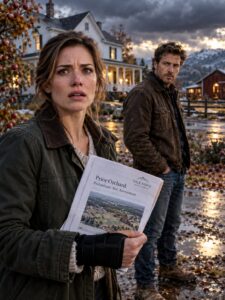
The first time Willa Prior prayed out loud after her father died, she was standing beneath the same roof that had killed him.
Her right wrist was wrapped in a brace.
Six dollars and thirty-eight cents remained in her checking account.
Water was dripping through the kitchen ceiling into seven mismatched buckets.
And the weather service was predicting the first serious snow of the season within ten days.
Willa pressed her forehead against the cold aluminum ladder and closed her eyes.
“Lord, send someone to fix this roof before snow.”
Sleet clicked against her coat.
She swallowed.
Then, quieter:
“And please don’t let helping me cost more than I can pay.”
She did not say amen.
Maybe because she was no longer certain what amen was supposed to mean.
Maybe because the last time she had stood beneath this ladder, her father had been alive.
Or maybe because Willa had spent the five months since Amos Prior died discovering that grief did not arrive alone.
It brought probate.
Insurance notices.
Bank letters.
Unharvested apples.
Broken equipment.
And relatives who used the word practical when they meant sell.
She opened her eyes.
That was when she saw the man standing thirty feet behind her.
Tall.
Early forties.
Brown work jacket darkened by sleet.
Jeans muddy to the knee.
A faded baseball cap in one hand.
Behind him sat an old Ford F-250 hitched to a utility trailer loaded with lumber beneath a blue tarp.
For several seconds, neither of them moved.
Embarrassment hit Willa first.
Then fear.
Then anger, because anger was easier to carry than either.
“This is private property.”
The stranger raised both hands slightly.
“Yes, ma’am.”
“How long have you been standing there?”
His gaze shifted toward the gate.
“Long enough to realize I should’ve announced myself sooner.”
That was not an answer.
Willa stepped away from the ladder.
Pain immediately pulsed through her injured wrist.
“What do you want?”
“Road’s getting bad.”
He nodded toward Cottonwood Creek Road, where sleet was already turning the dirt into brown slurry.
“I’m hauling cedar toward Loveland. Rear tire picked up something sharp. Spare’s low. I saw your barn.”
“You want shelter.”
“For the truck until morning. I’ll stay in the cab.”
Willa studied him.
Then the truck.
Then the lumber.
“You have money?”
One eyebrow lifted.
“For what?”
“Parking.”
Something almost amused appeared in his expression.
“How much?”
“Ten dollars.”
“For one night?”
“It’s my barn.”
The man nodded with remarkable seriousness.
“Ten dollars sounds fair.”
Willa narrowed her eyes.
“You think I’m joking.”
“No.”
He took out his wallet.
“I think you’re making sure this is a transaction.”
The accuracy irritated her.
She held out her left hand.
“Cash.”
He gave her a twenty.
“I don’t have change.”
“Then you’re overpaying.”
“You can give me ten tomorrow.”
“No.”
Willa reached into her coat pocket and found two five-dollar bills folded around a grocery receipt.
Her last cash.
She handed them to him.
His eyes stayed on the bills half a second too long.
He understood.
She could tell.
And she immediately disliked him for understanding.
“Barn’s unlocked,” she said. “Don’t go into the house.”
“I won’t.”
“Don’t smoke near the hay.”
“I don’t smoke.”
“And if you touch the cider press, I charge extra.”
He glanced toward the low shed beyond the orchard.
“Noted.”
Willa turned toward the porch.
“Ma’am?”
She stopped.
“My name’s Ezra.”
She looked over her shoulder.
“Willa Prior.”
Something changed in his face.
Tiny.
Almost nothing.
But Willa had spent years around farmers, bankers, insurance adjusters, contractors and one older brother who thought pauses did not count as lies.
She recognized recognition.
“You know that name?”
Ezra looked toward the farmhouse.
Then the orchard.
Then back at her.
“I’ve heard it.”
“Where?”
A pause.
Too small for most people.
Not for Willa.
“Around.”
She stared at him.
“Mr. Colton, people who answer questions with ‘around’ usually know more than they want to say.”
His mouth shifted at one corner.
“That sounds like experience talking.”
“It is.”
She started toward the house.
Behind her, Ezra looked at the sagging north slope of the farmhouse.
Then the ladder.
Then her wrist.
“You shouldn’t climb that again.”
Willa turned.
“Excuse me?”
“The north footing is soft. Ladder’s twisting.”
His eyes dropped briefly toward her brace.
“And your wrist is hurt.”
Her face went cold.
“I didn’t ask.”
“No.”
“Then don’t answer prayers that weren’t addressed to you.”
The words landed harder than she intended.
Ezra became completely still.
For one second Willa saw something in his expression.
Not offense.
Guilt.
She went inside and locked the door.
Only after the deadbolt clicked did Ezra reach inside his jacket.
He removed a folded document.
Across the top were the words:
VALE RIDGE DEVELOPMENT — PRIOR ORCHARD PRELIMINARY SITE ASSESSMENT.
His name appeared beneath them.
Ezra Colton had not wandered onto Willa Prior’s property because of a damaged tire.
He had been hired to inspect it.
And the company paying him wanted to know how much of her home was worth saving before they bought the land underneath it.
Ezra slept badly.
Not because of the cold.
He had a good sleeping bag, hand warmers, coffee and enough years on remote restoration sites to survive one miserable Wyoming night.
The problem was the file inside his jacket.
Prior Orchard.
One hundred forty-three acres.
Two hundred seventeen mature apple trees.
Farmhouse built in 1912.
Three barns.
Creek frontage.
Road access positioned almost perfectly for the eastern entrance to Vale Ridge’s proposed mountain resort.
Ezra had been hired to evaluate the structural condition of the property before the developer finalized its acquisition strategy.
He had assumed nobody lived there.
That was what bothered him first.
What bothered him more was the signature on the access authorization.
Grant Prior.
Willa’s older brother.
At six-thirty the next morning, the farmhouse door opened.
Willa appeared carrying a metal coffee pot in her left hand.
Her right wrist had been rewrapped.
She placed two enamel mugs on the porch rail.
“You paid ten dollars.”
Ezra approached carefully.
“That includes coffee?”
“No. Coffee is because I’m not a monster.”
She poured.
Black.
Strong enough to remove paint.
He took the mug.
“Thank you.”
“You’re welcome.”
She nodded toward his truck.
“Tire hold?”
“Enough to reach town.”
“Good.”
That should have been the end of it.
Then Ezra noticed the cedar stacked beneath a tarp inside the barn.
Old cedar.
Beautifully seasoned.
Hand split.
Enough for most of a roof.
“Those your father’s?”
Willa stopped.
“How do you know?”
“The ends. Hand cut. Somebody selected straight grain.”
She pulled back the tarp.
Hundreds of cedar bolts rested beneath it.
“My father cut them.”
“For the roof?”
“For everything.”
Her voice changed.
“He was a man with plans.”
Ezra did not ask why those plans had stopped.
Near the wall hung a froe, wooden mallet, drawknife and shaving horse.
Tools waiting for hands that had not returned.
Willa picked up the froe.
“You know how?” Ezra asked.
“I grew up here.”
She placed a cedar bolt vertically on the block and raised the mallet awkwardly in her left hand.
The first strike bit.
The second glanced.
Her right hand moved instinctively to steady the wood.
Pain flashed across her face.
Ezra stepped forward.
Stopped.
“I’m fine.”
“I didn’t say anything.”
“You were about to.”
“The grain’s running opposite.”
She glared.
“I know how to split cedar.”
“Then prove me wrong.”
That almost ended his stay immediately.
Instead, Willa turned the bolt.
Raised the mallet.
The shake separated cleanly.
Ezra kept his expression neutral.
Willa looked at him.
“That’s what I was about to do.”
“Of course.”
She hated him a little more.
“How many?” he asked.
“What?”
“Shakes for the north slope.”
“Three hundred.”
“Whole roof?”
“Closer to six.”
“How many good bolts?”
“Five hundred. Maybe five-fifty.”
“You’re short.”
“I know arithmetic.”
“Roofing too?”
“I watched my father do it for thirty years.”
Ezra glanced at her wrist.
“And?”
Something in Willa broke loose.
Maybe exhaustion.
Maybe humiliation.
Maybe the unbearable fact that this stranger could already see what she had spent months pretending nobody could.
“I have six dollars and thirty-eight cents in my account until Friday.”
Ezra said nothing.
“I have an insurance inspection Friday. If the roof fails, coverage lapses. If coverage lapses, First Western can call the farm note. Apples are dropping faster than I can harvest them. My seasonal crew left for guaranteed work in Riverton.”
She drew a breath.
“And my brother thinks selling the farm is the adult answer.”
Ezra’s attention sharpened.
“Your brother?”
“Yes.”
“Does he own part?”
“Forty percent.”
That information was not in the file the way it should have been.
“My father left me sixty. Grant got forty. He lives in Denver and believes acreage should produce quarterly returns.”
“How much fruit?”
“Enough to make me angry whenever I look outside.”
“Sell fresh?”
“Some. Press the rest.”
“How long with two people?”
“Fast.”
“Alone?”
“Slow enough that frost wins.”
Willa studied him.
“You ask a lot of questions for a man with a flat tire.”
Fair.
Ezra felt the folded Vale Ridge document against his chest.
This was the moment.
Tell her.
Instead, he said, “I have four days before I need this lumber delivered.”
Willa looked toward his trailer.
Then at the lettering on the tarp.
COLTON RESTORATION.
“That isn’t somebody else’s lumber.”
Ezra followed her gaze.
Damn.
“It’s company lumber.”
“Your company?”
“Yes.”
“You own a construction company.”
“Restoration company.”
“Historic timber?”
“Yes.”
“Roofing?”
“Sometimes.”
Her suspicion returned.
“And you want me to believe you randomly drove into my yard?”
The truth stood between them like an open door.
Ezra almost walked through it.
Almost.
“I was on Cottonwood Road for work.”
“What kind?”
“Site assessment.”
“For?”
“A client.”
There.
Not technically a lie.
Worse.
An omission chosen carefully enough to behave like one.
Willa recognized it.
But she did not yet know its shape.
Ezra looked toward the roof.
“I have labor.”
Then toward the barn.
“You have materials.”
Then the orchard.
“You also have apples.”
Willa crossed her arms.
“No charity.”
“I didn’t offer charity.”
“What are you offering?”
“A trade.”
Her eyes narrowed.
“I split and lay the north roof. You feed me while I’m here. I help harvest after daylight if there’s time. I take half the cider we press from apples I pick.”
Willa stared.
“That favors me.”
“Not if the cider’s good.”
“You haven’t tasted it.”
“I’m optimistic.”
“I don’t trust optimists.”
“Then calculate it.”
So she did.
Labor rates.
Meals.
Cider wholesale.
Materials.
Barn parking.
She ran the numbers silently.
“North slope only.”
“Fine.”
“You sleep in the barn loft.”
“Fine.”
“Meals on the porch.”
“Fine.”
“No payment either way.”
“Except cider.”
“Half of what we press together.”
“Fine.”
Willa disappeared inside.
She returned with a feed-store invoice and pencil.
On the blank side she wrote the terms.
Dates.
Scope.
Materials.
Cider split.
Liability.
Ezra read it.
“You put indemnification language in a roof-for-cider agreement.”
“My father raised me correctly.”
“Your father was a lawyer?”
“Farmer.”
“Worse.”
For the first time, something almost like a smile touched her face.
“Sign.”
He did.
Ezra Colton.
Beside:
Willa Prior.
Neither of them understood yet how much those two names on the same piece of paper were going to cost.
They found a rhythm.
Ezra split cedar in the mornings.
Willa harvested apples one-handed.
At ten-thirty they worked the old cider press together.
The grinder chewed through fruit with a hard wooden chatter while amber juice ran through cloth into steel buckets.
On the third day, Willa handed Ezra a tin cup.
“Taste.”
He drank.
Cold.
Sharp.
Sweet at the finish.
He looked at her.
“That’s unfairly good.”
She almost smiled.
“My father planted the north rows. Gravenstein. Liberty. Haralson. Crabapple for tannin.”
“He knew what he was doing.”
“So do you.”
The words escaped before Ezra could stop them.
Willa looked away.
“My father used to say the first cup belonged to whoever turned the press.”
“Then technically—”
“I know.”
She took his cup.
Refilled it.
Then drank from the same rim.
It was nothing.
It was not nothing.
Neither mentioned it.
At night they ate on the porch.
At first Willa left his plate and disappeared inside.
Then she began sitting across from him.
One evening Ezra asked, “Grant contacted you about selling?”
Her spoon stopped.
“Why?”
Ezra immediately knew he had pushed too hard.
“You mentioned him.”
Willa studied him.
Eventually she nodded.
“Vale Ridge Resorts.”
His stomach tightened.
“They want the east forty. Road access first. Then eventually everything.”
“What are they offering?”
“Enough that Grant thinks refusing proves I’m sentimental.”
“Would you sell?”
“No.”
“Why?”
Willa looked toward the orchard.
“This place fed three generations.”
“That’s history.”
“Yes.”
“History doesn’t automatically make a business viable.”
Her eyes snapped back.
“Grant says that too.”
“I’m asking. Not arguing.”
She stared at him before finally saying, “The orchard can make money.”
“Not resort money.”
“Enough.”
She told him about the farm-to-school contract lost after Amos died.
The cider orders she could no longer fulfill.
Probate.
Funeral arrangements.
Maintenance postponed because grief had apparently decided machinery should fail simultaneously.
“I fell behind,” she said.
“That isn’t the same as failing.”
Something shifted between them.
Dangerously.
Willa studied him.
“What exactly do you restore?”
“Old things people have decided are cheaper to replace.”
“Why?”
“Because sometimes they’re wrong.”
Her smile this time was real.
“You and my father would have gotten along.”
Ezra wanted to confess everything.
Instead he smiled back.
That was their second intimacy.
And his second cowardice.
The next morning Ezra climbed onto the roof.
Willa held the ladder.
The moment his boots reached the fourth rung, he felt the rails vibrate.
Not from movement.
From her.
“Willa.”
“I’m fine.”
“You’re not breathing.”
“I’m breathing.”
“Technically.”
“Climb.”
He did.
Slowly.
At the eave, he discovered the damage was worse than expected.
Rot around the flashing.
Water intrusion.
Years of patches layered over patches.
He pulled away a rusted sheet of metal.
Then another.
Something dark lay beneath wet leaves in the gutter.
Wood.
Ezra reached for it.
An old claw hammer.
Hickory handle worn smooth.
Two letters burned into the wood.
A. PRIOR.
He looked down.
Willa saw it.
Her face emptied.
Ezra climbed down.
He extended the hammer.
She did not take it.
Her left hand covered her mouth.
“It was up there?”
“In the gutter.”
“How long?”
“Hard to know.”
Her eyes closed.
“June ninth.”
Ezra waited.
“My father went up after rain. Said he was only checking flashing.”
She stared at the hammer.
“I was in the orchard.”
Her breathing changed.
“I heard the ladder.”
Ezra already knew what came next.
“It slid.”
“He fell?”
She nodded.
“Paramedics came. He was conscious for a little while.”
Her voice cracked.
“He asked whether the ladder was okay.”
Ezra looked away.
Willa finally took the hammer.
“He spent two years saying this roof needed replacing. But Mom got sick. Medical bills. Grant needed help. Equipment broke. There was always something.”
She pressed the hammer against her chest.
“Dad used to say a patch was honorable if you admitted it was a patch.”
A broken laugh escaped her.
“After he died, I kept patching.”
“Why?”
Her eyes lifted toward the roof.
“Because hiring someone felt like admitting he wasn’t coming back to finish it.”
Ezra understood.
“And your wrist?”
“I slipped from the second rung two weeks ago.”
She looked at the ladder.
“When I hit the ground, all I could hear was Dad asking if the ladder was okay.”
Silence.
Then Ezra made the mistake that destroyed everything.
“That’s why you prayed.”
Willa froze.
“What?”
He knew instantly.
Too late.
“I heard you.”
Her grief disappeared behind something colder.
“What?”
“That first evening. I reached the gate before you saw me.”
“You heard me pray?”
“Yes.”
Her face drained.
“You heard everything.”
“Yes.”
“And you stayed.”
“Yes.”
“You looked at my wrist. My roof. You heard me say I couldn’t afford help.”
“Willa—”
“And then you offered exactly what I asked God for.”
“No.”
The word came too quickly.
She stepped backward.
“Don’t tell me no.”
“I offered because the roof was dangerous.”
“But you knew.”
“Yes.”
“You should have told me.”
“Yes.”
“Why didn’t you?”
Ezra had explanations.
None changed the fact.
“I didn’t want you thinking I was turning your prayer into leverage.”
Her stare sharpened.
“So you hid the truth instead.”
“Yes.”
“That isn’t better.”
“No.”
She held her father’s hammer tighter.
“You don’t get to overhear the most private thing I’ve said in months and then stand here pretending coincidence brought you.”
“Willa—”
“Go.”
Ezra stopped.
“The roof—”
“I release you from the agreement.”
“No.”
Her eyes flashed.
“No?”
“I said I’d finish.”
“You said you’d trade labor. I no longer accept the trade.”
He looked at her.
“You want me gone?”
“Yes.”
Ezra packed his tools.
No argument.
No dramatic plea.
At the gate, he opened the truck door.
Then stopped.
Because there was still one truth she did not know.
The worse one.
“I need to tell you something else.”
Willa closed her eyes briefly.
“Of course you do.”
Ezra faced her.
“I didn’t come down Cottonwood Road by accident.”
Silence.
“I was hired to inspect your property.”
Willa did not move.
“For Vale Ridge.”
The orchard seemed to become impossibly quiet.
“Grant authorized access. I was supposed to evaluate the farmhouse, barns and infrastructure for redevelopment.”
“When?”
“The day I arrived.”
Her expression changed.
Not to anger.
Humiliation.
That was worse.
“You were deciding whether my home was worth tearing down.”
Ezra swallowed.
“Yes.”
She walked toward him.
Stopped ten feet away.
“Leave.”
This time, he did.
And behind him, the half-finished roof remained open beneath the October sky.
Willa did not cry until his truck disappeared.
Then she went into the barn and threw their handwritten contract into the trash.
Five minutes later she retrieved it.
Evidence.
Habits were habits.
She called Ruth Kim.
Ruth owned the orchard south of Cottonwood Creek, served as treasurer of the growers cooperative and possessed the emotional warmth of reinforced concrete.
Willa told her everything.
The prayer.
The roof.
Ezra.
Vale Ridge.
Grant.
When she finished, Ruth was silent.
Then:
“You let a development consultant sleep in your barn?”
“He said he was hauling lumber.”
“He was hauling lumber.”
“For himself.”
“And you didn’t Google him?”
“My internet was down.”
“Your phone?”
“Ruth.”
“Sorry.”
Pause.
“No, I’m not. Google him.”
Willa did.
EZRA COLTON RESTORATION GROUP.
Founder.
Historic preservation consultant.
Commercial projects across five western states.
Photographs showed Ezra in suits beside governors, university trustees and preservation boards.
Then she found the result that mattered.
VALE RIDGE DEVELOPMENT HIRES COLTON RESTORATION FOR WYOMING MOUNTAIN RESORT ASSESSMENTS.
Willa felt sick.
“He lied.”
Ruth corrected her.
“He lied by omission.”
“That distinction helps how?”
“It doesn’t. But angry people make better decisions when nouns remain accurate.”
Willa closed her eyes.
That was why she trusted Ruth.
“What do I do?”
“First, insurer. Roof is open.”
Willa looked toward the waterproof membrane Ezra had installed before leaving.
At least he had done that.
“Second?”
“Find out what Grant signed.”
Willa called her brother.
He answered from Denver.
“What happened?”
“You sent an inspector onto my property without telling me.”
Silence.
Then:
“Ezra?”
Willa almost laughed.
“You know him.”
“Damn it.”
“That’s your response?”
“I told Vale Ridge they had inspection rights on my interest.”
“You own forty percent.”
“It’s our land.”
There it was.
The fracture that had existed since their father died.
Willa lowered her voice.
“Dad left me controlling interest.”
“He left me forty percent because he believed I mattered too.”
“I never said you didn’t.”
“You act like the orchard belongs to you.”
“You haven’t pruned a tree in six years.”
“I wired thirty thousand dollars when Dad’s tractor died.”
“And remind me every Thanksgiving.”
Grant exhaled.
“Willa, I’m trying to prevent you from losing everything.”
She stopped.
“What?”
“The note matures in January. Insurance is threatening coverage. You lost two contracts after Dad died.”
His voice softened.
“I’m not trying to steal the place. I’m trying to sell while it’s still worth something.”
Willa felt cold.
“You signed something.”
Silence.
“Grant.”
“A letter of intent.”
Her stomach dropped.
“For your forty percent?”
“For a full sale contingent on your consent or partition.”
“Partition?”
“Don’t make it sound evil.”
“You’re threatening to force a sale.”
“It’s a legal remedy.”
The worst part was that Grant was not evil.
He believed liquidation was rescue.
And then Willa learned why.
“How bad is your business?”
Silence.
“My company lost two commercial projects.”
“How bad?”
“I personally guaranteed equipment debt.”
“How much?”
“Enough.”
There it was.
Not only concern.
Desperation.
“You need my farm sold.”
“Our farm.”
“What did they offer?”
“Two point six million.”
Willa sat down.
Her share would change her life.
Mortgage gone.
Savings.
Security.
No leaking roof.
No ladders.
No waking at three in the morning calculating whether apples could cover insurance.
That was what made the offer dangerous.
Grant spoke softly.
“Dad died fixing that place, Willa. You hurt yourself doing the same thing. How many signs do you need?”
She ended the call.
The first reversal arrived the following morning.
Naomi Brooks, a land-use attorney Ruth knew through the growers cooperative, found something inside Amos Prior’s estate records.
Six months before his death, Amos had begun applying for an agricultural conservation easement.
He had never completed it.
But he had gotten far enough for a preliminary appraisal.
The orchard could potentially receive a conservation payment large enough to reduce its debt significantly.
There was a cost.
Permanent restrictions.
No resort.
No subdivision.
Agriculture preserved.
Forever.
Willa stared at the documents.
“Dad never told me.”
Naomi pointed toward the date.
“He started after your mother died.”
“Can I finish it?”
“Potentially.”
Willa knew the next sentence before Naomi said it.
“Grant must consent.”
“Of course.”
“And you need to demonstrate viable agricultural use.”
“How?”
“Production. Contracts. Business plan.”
Naomi paused.
“Insurance.”
Willa looked upward.
Everything came back to the roof.
That evening she stood beneath it holding Amos’s hammer.
She thought about calling Ezra.
Did not.
Instead, the following morning, she did something harder.
She went to Pastor Malcolm’s church.
On the volunteer board, she wrote:
Roofing assistance. Will trade cider, apples, or pay over time.
Her hand shook harder writing those words than it ever had gripping the ladder.
When she stepped outside, Ezra was across the street.
They saw each other.
Willa hardened immediately.
“What are you doing here?”
“Terminating my Vale Ridge contract.”
She stared.
“Because of me?”
“Because their acquisition team misrepresented occupancy and site access.”
He paused.
“Also because of you.”
“I’m not impressed.”
“I’m not asking you to be.”
He handed her an envelope.
She hesitated.
“What is it?”
“My preliminary assessment.”
“You’re giving me client work?”
“Confidential sections are removed.”
She opened it.
Roof.
Barn.
Foundation.
Cider shed.
Then the conclusion.
Structures suitable for rehabilitation. Demolition not economically necessary. Agricultural operations potentially viable with deferred maintenance corrected.
Willa looked up.
“This hurts Vale Ridge.”
“Yes.”
“You wrote this before I knew who you were?”
“Second morning.”
“Why?”
“Because it was true.”
She studied him.
“Are you trying to come back?”
“No.”
That answer surprised her.
Ezra nodded toward the church.
“You asked someone else for help.”
“So?”
“I’m glad.”
Then he walked away.
No persuasion.
No request for forgiveness.
No attempt to turn his lost contract into a debt she owed him.
For the first time, Willa wondered whether remorse could be real even when forgiveness was not yet possible.
The insurer granted five extra days after reviewing Ezra’s structural report.
Time.
Not a solution.
Then Grant filed notice of intent to seek partition.
Pressure.
Not yet a lawsuit.
Willa fought back with numbers.
She applied for contracts.
The growers cooperative conditionally accepted four hundred gallons of cider.
A school district expressed interest in apples for the next season.
The orchard stopped looking like grief wearing overalls.
It began looking like a business again.
Then Grant dropped another secret.
“Dad talked to Vale Ridge before he died.”
Willa froze.
“What?”
“Two months before the accident.”
She thought she had finally reached the bottom.
She had not.
Naomi obtained the records.
Amos had met Vale Ridge.
But he had not offered them the orchard.
He had proposed selling eight acres on the eastern boundary to finance conservation of everything else.
Vale Ridge refused.
They wanted the access corridor.
Option rights.
Eventually the farm.
Amos walked away.
Willa read his email three times.
Her father had not been preparing to abandon the orchard.
He had been trying to save it.
Grant had known only enough of the truth to misunderstand it.
Or perhaps enough to choose the version that solved his own problems.
Either way, the meaning of everything shifted again.
Willa saw Ezra next at the cooperative packing barn.
He was twenty feet above the floor replacing damaged beams.
Harnessed.
Working.
Actually working.
At lunch they ended up at opposite ends of a picnic table.
Ruth disappeared suspiciously quickly.
Willa looked at Ezra’s hands.
Splinters.
Calluses.
A cut covered with tape.
“You actually work.”
Ezra raised an eyebrow.
“What did you think I did?”
“I saw photos of you shaking hands with the governor.”
“He doesn’t know how to frame a roof.”
“You sure?”
“Fairly.”
She almost smiled.
“I read your company bio.”
“I’m sorry.”
“You have eighty employees.”
“Ninety-three.”
“That’s worse.”
“Why?”
“Because I charged you ten dollars to sleep in my barn.”
“You gave me exact change.”
“That’s the humiliating part.”
Ezra leaned forward.
“Willa.”
She met his eyes.
“I never laughed at you.”
“I know.”
“The ten dollars mattered because you needed the exchange to be fair.”
“Why would you understand that?”
He looked away.
“My father lost our house when I was thirteen.”
Willa went quiet.
“His contracting business failed. People brought groceries. My mother hated it.”
“The groceries?”
“The way people handed them over while explaining what she should have done differently.”
His thumb moved over a scar in the table.
“She made me promise never to confuse generosity with authority.”
Willa remembered her prayer.
“You broke that rule with me.”
“Yes.”
No excuse.
“I thought if you knew why I was there, you’d send me away before I understood what Vale Ridge had hidden.”
“That was your decision.”
“Yes.”
“Not mine.”
“Yes.”
“You keep agreeing with me.”
“I tried the alternative.”
He looked at her.
“It went badly.”
Willa laughed despite herself.
Then she asked the question she had avoided.
“How big was the Vale Ridge contract?”
“Largest in my company’s history.”
Her smile disappeared.
“You gave that up?”
“I terminated it.”
“Because of me.”
“Because they misled my company.”
She waited.
Ezra added:
“And because of you.”
That frightened her more than she expected.
He saw it.
“I’m not making that your burden. Losing the contract was my choice. My company will survive. Some employees are angry. They have a right to be.”
Consequences.
Real ones.
Not romantic sacrifice.
That mattered.
A week later, Willa called him.
“Do you still know how to roof?”
A pause.
“Yes.”
“I need an estimate.”
“Professional?”
“Yes. Invoice. No cider. No prayers.”
Ezra sent another project manager.
The estimate was legitimate.
And far beyond what she could afford.
Willa rejected it.
Ezra did not interfere.
Two days later, he asked:
“What if we finish the original trade?”
“You were released.”
“I know. I’m proposing a new agreement.”
“Why?”
“Because I still want the cider.”
“Liar.”
His mouth moved.
“Also because I want to help.”
There.
No hiding behind economics.
No pretending.
“And if I say no?”
“I leave.”
Willa considered him.
Need.
Pride.
Fear.
Trust.
“I have one condition.”
“What?”
“I work too.”
“With the wrist?”
“Doctor cleared light use.”
“Ground only.”
Her eyes hardened.
“You don’t decide that.”
Ezra stopped.
Then corrected himself.
“What would make the ladder safe enough for you?”
Willa said nothing.
The question was different.
Not:
Don’t climb.
But:
What do you need?
“Not yet,” she whispered.
“Okay.”
They signed another agreement.
Proper paper this time.
The next morning Ezra arrived at the orchard.
Willa opened the farmhouse door.
“Coffee’s inside.”
Not on the porch.
Inside.
Ezra understood exactly how much that meant.
The roof rose course by course.
Old rotten sheathing came down.
New underlayment went on.
Cedar climbed toward the ridge.
Willa measured flashing and loaded buckets from the ground.
At noon they ate at the kitchen table.
One night the power failed.
Wind rattled the windows.
Ezra stayed because driving would have been stupid.
They ate soup by lantern light.
He noticed the Bible above the refrigerator.
“Do you still read it?”
“Sometimes.”
“That sounds complicated.”
“It is.”
Her father had carved Psalm 127 above the front door.
Unless the Lord builds the house, those who build it labor in vain.
“My father believed that,” Willa said.
“You?”
“Ask me another year.”
Ezra nodded.
No sermon.
She appreciated that.
Later she found herself standing at the window.
“You miss him,” Ezra said.
“Every day.”
She looked at her wrist.
“Sometimes angrily.”
“At him?”
“At myself.”
Then she finally told him everything about the morning Amos died.
The sliding ladder.
Her father in the grass.
The sirens.
The hospital.
His absurd final concern.
Is the ladder okay?
“Everyone kept telling me it wasn’t my fault,” Willa said. “None of those words reached the place where guilt lived.”
Ezra listened.
When she finished, he said, “He would have wanted the roof finished properly.”
Tears filled her eyes.
“That’s what I think too.”
“Then why does finishing it hurt?”
Willa looked at him.
“Because finishing it means admitting he isn’t coming back.”
Ezra nodded.
That was exactly it.
“I climbed because I wanted to be him,” she whispered.
“What?”
“He could fix anything. I thought if I did everything he did, maybe I hadn’t lost everything he was.”
Ezra leaned against the window frame.
“Your father built an orchard.”
She looked at him.
“You kept it alive through the worst year of your life.”
His voice softened.
“That sounds like being his daughter without falling off his roof.”
Willa laughed through tears.
“Was that rehearsed?”
“No.”
“It was suspiciously good.”
“I have occasional competence.”
She reached out.
Touched his hand.
Briefly.
Deliberately.
Neither moved afterward.
Then the forecast changed.
Snow was coming three days early.
Six to ten inches.
Wet.
Heavy.
The roof was only half finished.
“We need help,” Ezra said.
Willa reacted automatically.
“We can finish.”
“No.”
Her jaw tightened.
“I’m calling my crew.”
“I can’t pay them.”
“Then we ask volunteers.”
Willa hated that too.
Ezra looked at her.
“You put your name on the church board.”
“How do you know that?”
“Pastor Malcolm.”
“You were checking on me?”
“I was trying to find help after you fired me.”
Despite herself, she almost smiled.
“You already asked for help, Willa.”
He held her gaze.
“Let people answer.”
Sunday morning, they came.
Ruth.
Two growers.
Pastor Malcolm.
Calvin, a retired roofer.
Ezra’s foreman came voluntarily, off company time.
Willa verified that twice.
She cooked.
Organized materials.
Managed ground safety.
And did not climb.
Then a Denver SUV pulled into the drive.
Grant stepped out.
Expensive jacket.
Exhausted face.
Work gloves in one hand.
Willa stared.
“What are you doing here?”
“Ruth called.”
Willa looked at Ruth.
Ruth did not apologize.
Grant held up the gloves.
“I still know how to carry cedar.”
For six hours, he did.
No arguments.
No sale discussion.
At dusk they sat on the porch.
Grant held a cup of cider.
“I withdrew the partition notice.”
Willa turned.
“What?”
“For now.”
“Why?”
“I saw your numbers.”
He looked toward the orchard.
“The conservation payment. Cider contract. School interest.”
Then he said the harder thing.
“I still need money.”
Willa waited.
“My debt is bad.”
“How bad?”
“I may file Chapter 11.”
Her anger changed shape.
“Why didn’t you tell me?”
“Because I’m your older brother.”
“That’s stupid.”
“Yes.”
Grant stared into his cup.
“I thought selling fixed both of us. I get liquidity. You get security. You stop killing yourself trying to keep Dad alive through lumber and apples.”
Willa went still.
“That’s what you thought I was doing?”
“Yes.”
“Were you wrong?”
She looked toward the roof.
“Partly.”
Grant nodded.
“Me too.”
There was no hug.
Not yet.
But he stayed.
Then Vale Ridge made its final move.
Three point one million dollars.
Cash.
Forty-eight hours.
Grant read the offer in Willa’s kitchen.
“That solves everything.”
And the terrible thing was—
he was right.
His debt.
Her mortgage.
Insurance.
Equipment.
Years of uncertainty.
Gone.
“You could buy another orchard,” Grant said.
Willa looked toward Ezra.
“Do you think I should take it?”
Ezra did not answer immediately.
“I think you should decide what you’re buying with the sale.”
“Security.”
“Yes.”
“And what I’m selling.”
“History.”
He shook his head slightly.
“More than history.”
“Work?”
“Yes.”
“Possibility?”
“Yes.”
He looked directly at her.
“Don’t choose because you’re afraid of a roof.”
Grant bristled.
“Easy for you to say.”
Ezra turned toward him.
“You’re right.”
Grant had not expected agreement.
“I have resources Willa doesn’t. My opinion carries that bias.”
Then Ezra looked back at her.
“Ask Ruth. Naomi. Your accountant. Ask the numbers.”
His voice lowered.
“Don’t ask the man who wants the orchard to stay because he has personal reasons.”
Silence.
Grant looked between them.
“Oh.”
“Don’t,” Willa said.
“I didn’t say anything.”
“Your face did.”
That night Willa opened her laptop.
She built three spreadsheets.
Sell.
Keep without easement.
Keep with easement and cooperative contracts.
She used conservative numbers.
Labor.
Insurance.
Yield.
Taxes.
Equipment.
Debt.
No nostalgia.
No miracles.
At 1:30 a.m., the numbers finally answered.
Keeping the orchard under conservation restrictions was viable.
Not easy.
Not wealthy.
Viable.
At 1:47, Willa emailed Grant.
I’m not selling. I’ll buy out part of your interest over five years using conservation proceeds and operating revenue. Naomi will send terms.
Grant answered at 2:11.
Okay.
A second message followed.
Dad would probably say you overpaid for my forty percent.
Willa smiled.
Dad underpaid everyone.
Grant replied:
True.
The farm had survived the decision.
Now the roof had to survive the snow.
Tuesday arrived without sunrise.
Snow began at 1:36 p.m.
By three, Ezra reached the ridge.
Only the final cedar cap remained.
Willa stood below wearing Amos’s old canvas coat.
Her father’s hammer hung from her belt.
Ezra climbed down.
“Twenty minutes.”
“Then finish it.”
He looked at her.
“You said the ridge was yours.”
Her stomach tightened.
Weeks earlier, she had said it without thinking.
Whatever happens, the ridge is mine.
Now snow gathered on the ladder.
Her body remembered June before her mind did.
Grass.
Sirens.
Her father.
Then September.
Her own boot slipping.
Pain exploding through her wrist.
Ezra waited.
No pressure.
Willa stared upward.
“I don’t know if I can.”
“That’s information.”
She looked at him.
“Not a verdict.”
“You stole my line.”
“I improved it.”
She almost laughed.
Grant stood by the porch.
Ruth beside him.
Nobody pushed.
Calvin had installed ladder stabilizers.
The feet were braced.
The top was lashed to a structural rafter.
A safety line waited.
Harness.
Every precaution Amos had not had.
Willa inspected each one herself.
She pulled the rope.
“Again.”
Ezra tightened it.
“Foot deeper.”
He reset it.
Grant finally spoke.
“Will.”
She looked at him.
“You don’t have to prove anything.”
Willa nodded.
“I know.”
And strangely, that was why she could do it.
She clipped the harness.
Put her left foot on the first rung.
Stopped.
Snow.
Metal.
Breath.
Ezra’s hands around the rails.
Willa looked down.
“Is the ladder safe?”
Four words.
But they carried her father inside them.
Ezra did not answer casually.
“Feet are set twelve inches into braced ground. Top is tied to the rafter with two independent straps. Harness has a separate anchor. Calvin inspected every section.”
He held her gaze.
“I’m holding the base.”
Pause.
“Yes.”
Willa breathed.
“It is safe.”
She climbed.
Second rung.
The rung from which she had fallen.
Her breathing broke.
Behind her closed eyes, Amos fell again.
Then another memory came.
Her father teaching her to graft an apple branch.
His patient hands.
Never force a cut that isn’t ready.
Willa opened her eyes.
She climbed.
At the sixth rung, she stopped.
“Lord.”
Everyone below heard.
“I’m up here.”
A nervous laugh escaped her.
“That’s all I’ve got.”
Ruth started crying.
Willa hated her for it.
Loved her too.
She reached the scaffold.
Then the roof.
Ezra stayed at the ladder.
He did not follow.
Her choice.
Willa crawled toward the ridge.
Final cedar cap.
Nails.
Her father’s hammer.
Her wrist ached when she raised it.
She switched hands.
The first nail bent.
“Damn it.”
Pastor Malcolm called from below.
“I’m pretending I didn’t hear that.”
Willa laughed.
The fear loosened.
She removed the nail.
Tried again.
The hammer struck.
Once.
Twice.
Three times.
The sound moved across the orchard.
Clean.
Flat.
Like an answer nobody had promised.
She laid another cap.
Then another.
Snow thickened.
Her hands grew numb.
Her knees soaked through.
Fear returned in waves.
Willa did not conquer it.
She worked while afraid.
There was a difference.
Finally, one board remained.
She aligned it.
Placed the nail.
Raised Amos’s hammer.
Strike.
Strike.
Strike.
The last nail seated.
Willa remained on her knees.
Snow landed on her shoulders.
The cedar beneath her palm felt solid.
“It’s done.”
Nobody cheered.
Not immediately.
Somehow, they understood.
Willa inhaled.
Then laughed.
“It’s done!”
She crawled toward the ladder.
Halfway down, her boot slipped.
Only six inches.
Nothing serious.
But her entire body froze.
Ezra gripped the rails.
The ladder did not move.
Willa pressed her cheek against the cold aluminum.
“It held,” she whispered.
Ezra looked up.
“It held.”
She climbed down.
Grant reached her first.
Her brother wrapped both arms around her.
He was crying.
So was Ruth.
Then Willa found herself standing in front of Ezra.
Snow gathered in his hair.
“You finished your roof,” he said.
Willa shook her head.
“We finished it.”
“Yes.”
She stepped closer.
But there was still something unfinished between them.
“You came here to inspect this place for redevelopment.”
“Yes.”
“You lied to me.”
“Yes.”
“You helped afterward.”
“Yes.”
“You lost the biggest contract your company had ever had.”
“Yes.”
“Do you regret it?”
Ezra looked at the roof.
“No.”
“Do you think that earns you anything from me?”
“No.”
Correct.
Willa grabbed the front of his coat.
Pulled him down.
And kissed him.
Brief.
Cold.
Real.
When she stepped back, Ezra looked stunned.
“That earns you nothing either,” she said.
“I understand.”
“Good.”
Behind them, Grant groaned.
“Can we please go inside before whatever this is gets more uncomfortable?”
Ruth answered immediately.
“No. I’ve waited weeks.”
Willa laughed.
They went inside.
Seven buckets remained lined against the kitchen wall.
The same buckets that had caught every storm since June.
Snow fell all night.
Not one of them caught a single drop.
The insurance inspector arrived Wednesday.
The roof passed.
First Western renewed the farm note after reviewing the conservation process and Willa’s new contracts.
Ezra guaranteed nothing.
Willa would not let him.
The conservation easement closed the following spring.
Grant received the first installment of his buyout and used it to restructure his Denver business through Chapter 11.
Embarrassing.
Legal.
Useful.
He returned to the orchard more often after that.
Not as an owner first.
As a brother.
They still fought.
Sometimes loudly enough that Ruth could hear them from the road.
Family.
Vale Ridge rerouted its resort entrance.
It cost more.
Business moved on.
So did the orchard.
Willa reopened U-pick weekends.
Samuel Brooks Elementary began buying apples.
The cooperative distributed her cider.
Her first profitable quarter was so modest that most business owners would have barely noticed it.
Willa printed the statement and taped it to the refrigerator.
Ezra saw it.
“Frame that.”
“No.”
“You framed the roof inspection.”
“That was trauma.”
“This is revenue.”
He kissed her cheek.
“Much prettier.”
Their relationship moved slowly.
Ezra did not move into the farmhouse for a year.
He came Fridays.
Sometimes Wednesdays.
They attended church together irregularly.
Willa’s faith did not suddenly become simple.
She still had questions.
So did Ezra.
One Sunday, Pastor Malcolm preached from Psalm 127.
Later Willa sat beneath the words Amos had carved above the door.
Unless the Lord builds the house…
“I used to think it meant that if I worked hard enough and believed correctly, nothing terrible would happen.”
Ezra sat beside her.
“And now?”
“I think it means I’m not the whole structure.”
“That sounds healthier.”
“Don’t get comfortable.”
She rested her head against his shoulder.
There was no crisis that day.
No snow.
No broken roof.
Only late sunlight moving through apple trees.
That was when Ezra finally said it.
“I love you.”
Willa remained against him.
“You sure?”
“Yes.”
“Why?”
He laughed.
“That feels like an audit.”
“It is.”
Ezra thought for a moment.
“Because you tell the truth even when it costs you. Because you can be generous without pretending generosity is painless. Because you’re funny when you forget to be guarded.”
He looked toward the orchard.
“And because you taught me that helping someone doesn’t make me the answer to their life.”
Willa considered his response.
“That was acceptable.”
“Thank you.”
“I love you too.”
Ezra exhaled.
“You could sound happier.”
“I’m trying not to encourage arrogance.”
“Of course.”
They married two years after the roof.
Small ceremony.
The orchard was in bloom.
Ruth stood beside Willa.
Ezra’s older sister Claire stood beside him.
Grant walked Willa halfway down the orchard aisle.
Then stopped.
Willa walked the rest herself.
Her choice.
Nobody gave her away.
And Ezra did not buy the farm.
Willa probably would have canceled the wedding if he tried.
He moved into it.
They wrote an agreement together for household expenses.
Their original feed-store roof-for-cider contract ended up framed in the mudroom.
Ezra called it romantic.
Willa called it documentary evidence of poor judgment.
Both were correct.
Amos’s hammer hung beside it.
Not above the fireplace.
Tools belonged near work.
Three years later, Willa expanded cider production.
Not enormously.
Enough.
She hired a manager so the orchard no longer required her exhaustion in order to survive.
That lesson mattered more than she expected.
She also began volunteering with a farm-transition clinic Naomi helped establish.
Widows.
Aging farmers.
Children inheriting land.
People holding documents they did not understand.
People convinced that shame required silence.
One October afternoon, a woman named Marcy sat across from Willa clutching a foreclosure notice.
“My husband handled everything,” she whispered. “He died. I don’t know where anything is. I feel stupid.”
Willa pushed a legal pad across the table.
“You’re not stupid.”
Marcy looked up.
“You’re uninformed.”
Willa picked up a pen.
“Different problem.”
Marcy began crying.
Willa waited.
Then said:
“We make a list.”
Because rebuilding rarely began with a miracle.
Usually, it began with a list.
Years passed.
Hail came.
Drought came.
Two terrible freezes came.
Three excellent seasons followed.
Grant eventually sold the remainder of his interest to Willa.
His business recovered smaller than before.
Healthier too.
One afternoon he admitted:
“I thought selling the orchard would prove Dad’s life had value because it produced money.”
Willa stared at him.
“Dad would hate that sentence.”
“I know.”
They laughed.
Ruth somehow became county commissioner despite insisting for years that she hated politics.
Naomi expanded legal aid.
Ezra rebuilt his company’s pipeline.
He also changed company policy.
No occupied rural property would be structurally evaluated without direct notice to the occupant.
No assumptions about access merely because one partial owner had signed authorization.
An engineer complained the process slowed projects.
Ezra answered:
“Accuracy takes time.”
Willa overheard.
“You stole another line.”
“I improved it.”
“You keep saying that.”
“Because it remains true.”
At forty-three, Willa finally replaced the kitchen floor Amos had installed crooked years earlier.
She kept one board.
Sentiment had limits.
The seven buckets disappeared into the barn.
Except one.
A dented blue bucket remained beneath the workbench.
Ezra discovered it one winter.
“Why this one?”
Willa shrugged.
“Proof.”
“Of what?”
She looked at him.
“That catching water isn’t the same as fixing a roof.”
Ezra knew she was no longer talking about roofs.
He kissed her forehead.
And left the bucket where it was.
Ten years after Willa’s prayer, snow came early again.
The weather service predicted eight inches overnight.
Willa was gathering the last crates when the first flakes began.
Ezra called from the barn.
“Roof still there?”
She looked toward the farmhouse.
The cedar had weathered gray.
Beautifully.
Solid.
“Unfortunately.”
He walked toward her.
More gray in his hair now.
Same shoulders.
Better coat.
Willa smiled.
“Do you remember the first thing you ever heard me say?”
“Yes.”
“What?”
Ezra performed a terrible imitation of her voice.
“Lord, send someone to fix this roof before snow.”
Willa threw an apple.
He caught it.
“Terrible impression.”
“I’ve practiced.”
“You need another decade.”
They carried the final crate inside.
Snow thickened.
Wind pressed against the house.
Willa placed two mugs of coffee on the kitchen table.
No buckets.
Ezra noticed.
He always noticed now.
That was one of the things she loved about him.
Willa took down the old Bible.
Not because storms required performance.
Because memory sometimes asked for ritual.
She opened it.
Ezra sat across from her.
Willa bowed her head.
“Lord.”
She paused.
Ten years earlier, she had asked God to send someone because she believed help meant another person arriving to perform the thing she could not.
Now she understood the answer had been considerably messier.
Ezra had not rescued her.
He had lied.
Helped.
Failed.
Returned.
Learned.
And held the ladder.
Grant had hurt her.
Then changed.
Ruth had pushed when Willa wanted permission to hide.
Naomi had protected the process.
Neighbors had carried cedar.
And Willa herself had climbed.
Grace—if that was the word—had not looked like one man arriving to solve a woman’s life.
It had looked like enough people refusing to let pride make the final decision.
Willa smiled.
“Thank You for everybody who held something.”
Ezra opened his eyes.
“The roof,” she continued.
“The ladder.”
“The paperwork.”
She swallowed.
“Me.”
Her voice softened.
“And thank You for teaching me that asking for help isn’t the same as giving my life away.”
“Amen.”
“Amen,” Ezra whispered.
They ate soup.
At nine, he walked to the window.
“Come look.”
Willa joined him.
The roof was white from ridge to eave.
No dark patches.
No sag.
No drip.
For a moment she saw herself ten years younger.
Swollen wrist.
Six dollars in the bank.
Forehead against an aluminum ladder.
Ashamed that she needed anyone.
Willa pressed her palm against the cold window.
“You know what’s funny?”
“What?”
“I asked God to send somebody to fix the roof.”
Ezra nodded.
“He sent somebody who made the entire situation considerably more complicated.”
Ezra smiled.
“That sounds consistent with my skill set.”
She laughed.
Then looked upward again.
Her father’s final unfinished job.
Her first impossible one.
The place where grief had once convinced her that surviving meant doing everything herself.
Snow kept falling.
The house remained quiet.
Dry.
Whole.
Ezra slipped his hand into hers.
Willa held it.
Not because she needed another person to keep her standing.
Not because love had rescued her.
Not because the fear had disappeared.
She held his hand because somewhere between the broken roof, her father’s hammer, her brother’s betrayal, Ezra’s lie, the volunteers carrying cedar through the snow, and that terrifying second rung of the ladder, Willa had finally learned something she wished she had understood years earlier.
There was no shame in being strong enough to climb.
And there was no weakness in trusting someone worthy enough to hold the ladder while you did.
Outside, the storm deepened.
Inside, not one bucket moved.
This time, the roof held.









