She Pretended Not to Know the Mechanic at Her Promotion Dinner—Then the Founder Walked Onto the Stage Wearing His Clothes
By the time Emma Caldwell realized the dirty mechanic she had ordered out of the ballroom was the man who controlled her future, three hundred people had already watched her deny knowing him.
But that wasn’t the worst part.
The worst part was that William had heard every word.
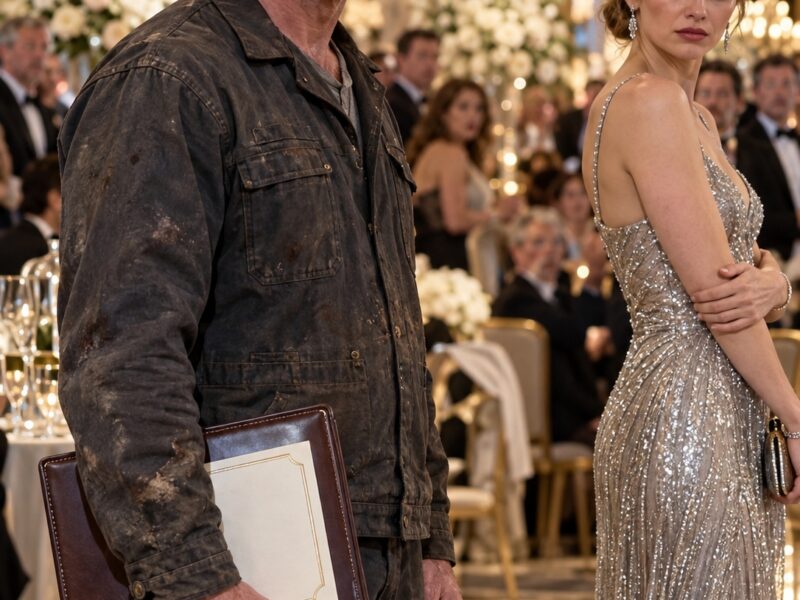
He stood beneath the crystal chandeliers of Caldwell Automotive Group’s fiftieth-anniversary dinner wearing oil-stained work pants, scuffed boots, and a faded charcoal jacket that still smelled faintly of motor grease.
Around him were men in tailored tuxedos, women in evening gowns, executives holding champagne beneath arrangements of white roses.
Emma stood ten feet away in a silver dress he had helped her choose.
She looked directly into his eyes.
And when her boss asked who he was, she said:
“I don’t know him.”
William didn’t argue.
He didn’t expose her.
He didn’t even raise his voice.
He simply looked at the woman he had loved for three years, nodded once, and walked back toward the same door through which security had just ordered him to leave.
In his jacket pocket was a folded document bearing Emma Caldwell’s name.
At the bottom was an empty signature line.
His signature line.
Because Emma had spent three years believing tonight would be the night she earned the biggest promotion of her career.
She had no idea William had already decided to give it to her.
Until she taught him exactly why he shouldn’t.
And ten minutes later, when the ballroom lights dimmed and the master of ceremonies announced that the mysterious founder of the company had finally arrived, Emma was still smiling.
She didn’t know the man they were applauding was walking toward the stage in the same dirty boots she had been ashamed to stand beside.
William Hale had never liked expensive cars.
That fact confused nearly everyone who knew what he owned.
Caldwell Automotive Group operated dealerships, service centers, fleet contracts, and regional distribution facilities across several states. The company sold vehicles worth more than some houses. Its executives arrived at headquarters in German sedans and polished SUVs.
William drove a faded 1989 Ford pickup.
The driver’s seat had a tear along the left edge.
The radio worked only when it felt like it.
The dark-blue paint had surrendered to the weather years ago, and there was a dent above the rear wheel that William refused to repair.
His father had put it there.
Not intentionally.
A grocery-store cart had rolled across a parking lot during a windstorm when William was fourteen. His father had laughed for ten minutes afterward.
“Now it’s ours,” he’d said.
William had never forgotten that.
His father, Thomas Hale, had spent twenty years repairing engines before saving enough money to open a two-bay garage outside Columbus, Ohio.
There had been no investors.
No business school.
No polished logo.
Just Thomas, two hydraulic lifts, a battered coffee machine, and a handwritten sign that read:
HALE MOTOR SERVICE.
William had grown up sweeping those floors.
He had learned to change oil before he learned algebra.
He had learned something else there too.
A customer wearing a thousand-dollar suit could be dishonest.
A customer wearing paint-covered overalls could leave a fifty-dollar tip.
Money told you what someone could buy.
It didn’t tell you who they were.
Thomas repeated that lesson so often William had once grown tired of hearing it.
Then his father died.
Afterward, William would have given almost anything to hear it one more time.
Over twenty-five years, the little garage became a dealership.
The dealership became three.
Three became fourteen.
Acquisitions followed.
Distribution contracts.
Commercial fleets.
Service networks.
Eventually the company was renamed Caldwell Automotive Group after William’s late mother’s family, partly because William disliked seeing his own name on buildings.
By fifty-two, he was wealthy enough to own almost anything and private enough that most new employees had never seen him.
That arrangement suited him.
William hated corporate theater.
He hated people changing their voices when they learned his title.
Most of all, he hated watching kindness become a performance whenever power entered the room.
So he stayed away from cameras.
He delegated public appearances.
He occasionally walked into his own dealerships dressed like a customer and listened.
What he heard told him more than quarterly reports ever could.
That was how he met Emma.
Three years earlier, William had been underneath an old Chevrolet in one of the company’s service bays when a woman’s voice floated beneath the chassis.
“You’re about to get hydraulic fluid on your shirt.”
William rolled out.
Emma Caldwell stood there holding two coffees.
She had been thirty-one then, newly transferred into corporate sales, ambitious without yet being hardened by ambition.
“You warning me because you care about my shirt?” William asked.
“No. I’m warning you because I don’t want to listen to you complain.”
He smiled.
“I’m William.”
“Emma.”
She assumed he was a senior mechanic.
William didn’t correct her.
At first, there hadn’t been a reason.
He wasn’t trying to deceive her. He simply enjoyed being William instead of Mr. Hale.
Then they had lunch.
Then dinner.
Then another dinner.
By the time the relationship became serious, Emma knew he was financially comfortable and connected to the company, but William remained vague about how deeply.
He told himself he would explain everything when the timing felt right.
That became next month.
Then after her next evaluation.
Then after she earned the promotion on her own.
The longer he waited, the more complicated the truth became.
And somewhere during those three years, Emma changed.
Not all at once.
That would have been easier to recognize.
It happened in inches.
She started measuring restaurants by who might see her there.
She began remembering people’s job titles before remembering their children’s names.
She laughed differently around senior executives.
Whenever William arrived wearing work clothes, she started asking whether he’d had time to change.
He noticed.
He also made excuses for her.
She was under pressure.
She had worked hard.
She wanted security.
Ambition wasn’t a crime.
William understood ambition better than most people.
He just hadn’t understood what hers was beginning to cost.
Not until the night of the anniversary dinner.
The company had rented the ballroom of the Whitmore Grand, one of downtown Columbus’s most elegant hotels.
There were white roses on every table.
A jazz trio played beside the stage.
Nearly three hundred employees, spouses, executives, suppliers, and invited guests filled the room.
Everyone knew one rumor.
The regional manager position would be announced that night.
The appointment covered eleven locations and placed its holder directly beneath senior corporate leadership.
Emma had been working toward it for three years.
William knew because she had talked about little else for six months.
What Emma didn’t know was that she had already been selected.
William had reviewed the numbers himself.
Her stores had improved.
Her teams hit targets.
Customer retention was strong.
Her operational instincts were excellent.
There had been complaints about her management style, however.
Nothing catastrophic.
Coldness.
Impatience.
An increasing tendency to judge junior employees harshly.
William had planned to address those issues privately.
He still believed she could grow.
So he had arranged something special.
Instead of allowing General Manager Richard Stevens to announce the promotion, William would appear personally and sign Emma’s appointment letter onstage.
It was supposed to be both professional recognition and a private gift.
Perhaps, afterward, William thought, he would finally tell her everything.
No more half-truths.
No more hiding.
He almost wore the tuxedo his assistant had sent.
Then he looked at his father’s pickup in the garage.
Something made him change his mind.
Maybe it was instinct.
Maybe memory.
Maybe the quiet discomfort he had been ignoring for months.
William put on the clothes he had worn earlier that afternoon while helping diagnose a transmission problem at the original repair facility.
Then he took his father’s keys.
At 6:38 p.m., the old Ford coughed twice before starting.
William smiled.
“Still stubborn,” he murmured.
The truck rattled through downtown Columbus beneath cold November rain.
Luxury cars lined the Whitmore Grand entrance when he arrived.
Valets moved quickly beneath the canopy.
A young employee saw William’s pickup and hesitated.
William noticed.
The young man was probably twenty-four.
His name tag read JACK TURNER.
“This thing actually runs?” another employee joked from beside the entrance.
A couple of younger staff members laughed.
One lifted a phone.
William heard someone say, “This is going in tonight’s blooper reel.”
Jack didn’t laugh.
He stepped toward the truck.
“Evening, sir.”
“Evening.”
“Engine off?”
“Yes.”
“Parking brake set?”
“Yes.”
Jack handed him a ticket.
“I’ll put it at the far end, off to the side. Nobody will bother it.”
William glanced toward the employee filming.
“You sure?”
Jack followed his eyes.
Something uncomfortable crossed the young man’s face.
“Yes, sir. I’ll keep an eye on it.”
William studied him.
“Thank you.”
“It’s my job.”
William started toward the hotel.
Behind him someone whispered loudly enough to be heard.
“Real hillbilly arrival.”
More laughter.
William kept walking.
He had spent enough years in business to know humiliation became more revealing when the victim didn’t interrupt it.
Inside, the marble lobby glowed beneath warm gold light.
William called his assistant.
“Yeah. It’s me.”
“Sir,” she said immediately. “Should I send the suit down? The appointment letter is already onstage waiting for your signature. Mr. Stevens is asking when you’re arriving.”
“Leave the letter where it is.”
A pause.
“You’re not wearing the suit?”
“No.”
“Would you like Stevens to meet you at the entrance?”
William watched executives move toward the ballroom.
“No. Don’t tell anyone I’m here.”
Another pause.
His assistant knew him too well to argue.
“Understood.”
William ended the call.
Then he saw Emma.
For a second, everything softened.
She stood near the ballroom entrance beneath amber light, silver dress falling elegantly to her ankles, dark hair pinned behind one ear.
She looked beautiful.
Not because of the dress.
Because she looked nervous.
Human.
Like the woman who had once brought him coffee beside a broken Chevrolet.
William walked toward her.
“Emma.”
She turned.
Her smile appeared automatically.
Then disappeared.
Her eyes dropped to his jacket.
His boots.
A faint streak of grease beside his cuff.
Her face changed.
“William?”
“Hi.”
“What are you doing here?”
“Tonight matters to you.” He smiled gently. “I wanted to be here.”
Emma looked around.
Not at him.
Around him.
“Why are you dressed like that?”
“I came straight from the shop.”
“You couldn’t change?”
“I didn’t think it mattered.”
Her jaw tightened.
“It matters tonight.”
Before William could answer, Richard Stevens approached.
Stevens was fifty-eight, silver-haired, polished, and proud of his ability to recognize important people.
Unfortunately, his definition of important depended heavily on clothing.
“Emma,” he said warmly. “There you are.”
Then he noticed William.
His smile faded.
“Everything all right?”
Emma froze.
William watched her.
Three years.
Hundreds of dinners.
Christmas mornings.
Hospital visits when Emma’s mother had surgery.
Quiet Sundays.
Plans whispered in bed.
Three years reduced to one tiny decision.
Stevens looked at William.
“And this is?”
Emma opened her mouth.
William waited.
She could have said boyfriend.
Partner.
Friend.
William.
Anything.
Instead she laughed nervously.
“He’s a mechanic I know from the shop.”
Something inside William became very still.
Stevens frowned.
Emma continued too quickly.
“I don’t know how he got in here.”
William stared at her.
Emma wouldn’t meet his eyes.
“Excuse us,” she said.
She caught William’s arm and pulled him toward a quieter corridor.
The moment Stevens disappeared, William gently removed her hand.
“What did you just say?”
Emma exhaled.
“Please don’t do this.”
“Do what?”
“I’m getting that promotion tonight.”
William said nothing.
“I’ve waited three years for this,” she continued. “Stevens is watching everything. Corporate leadership is here. The founder may actually show up.”
“The founder.”
“Yes.”
William almost smiled.
He didn’t.
Emma lowered her voice.
“I can’t have people seeing me walk in with a mechanic dressed like this.”
William looked down at himself.
Then back at her.
“Is it me you have a problem with, Emma?”
“No.”
“Or what I’m wearing?”
“That’s not fair.”
“It was a simple question.”
“William, please. Nothing can go wrong tonight.”
Something already had.
She just didn’t know it.
William glanced through the open ballroom doors.
A waiter passed carrying champagne.
Someone laughed.
The jazz trio shifted songs.
Everything looked exactly as it had five minutes earlier.
Yet William felt as though he were standing in the ruins of something.
Emma touched his sleeve.
“Take the side door. Go home. We’ll talk later.”
“The side door?”
“Please.”
William searched her face.
“Are you embarrassed by me?”
Emma’s silence answered before her mouth did.
Then footsteps approached.
Stevens returned with another executive.
“Emma,” he said. “They’re about to seat everyone.”
His eyes landed on William again.
“Sir, this is a private company event.”
William nodded.
“I understand.”
“Invitation?”
William didn’t produce one.
Stevens straightened.
“No invitation, no entry.”
Emma stared at the carpet.
Stevens pointed toward the lobby.
“Please see yourself out. Security is at the door. Don’t make this ugly.”
William looked at Emma one last time.
She still said nothing.
That silence hurt more than Stevens ever could.
“All right,” William said.
He turned.
And walked out.
No argument.
No threat.
No revelation.
That frightened Emma more than anger would have.
For half a second, she nearly followed him.
Then applause erupted inside the ballroom as someone announced dinner service.
Emma looked toward William.
Then toward the stage.
One direction held the man she loved.
The other held the future she wanted.
She chose the ballroom.
William stepped outside into the cold.
Rain had stopped, but the pavement remained wet.
His father’s truck sat exactly where Jack had promised.
Far end.
Out of the way.
Safe.
Jack approached carrying a paper cup.
“Sir.”
William turned.
“Your truck’s been right here. Nobody touched it.”
“Thank you.”
Jack offered him the cup.
Water.
William accepted it.
“Sold out tonight,” Jack said awkwardly. “You okay?”
William looked toward the glowing hotel windows.
“What makes you think I’m not?”
Jack shrugged.
“You walked in looking like you belonged somewhere. You came out looking like somebody told you that you didn’t.”
William studied him.
Jack immediately looked embarrassed.
“Sorry. None of my business.”
“No. You’re right.”
Jack leaned against the valet podium.
“Don’t let it get to you.”
William almost laughed.
“How long have you worked here?”
“Four months.”
“Valet?”
“Sales.”
William raised an eyebrow.
“I’m covering the entrance tonight. Everybody gets assigned event duty.”
“Name?”
“Jack Turner.”
“Four months in sales?”
“Yes.”
“Like it?”
Jack smiled faintly.
“Ask me after I sell something.”
William laughed for the first time that evening.
Then he lifted the water.
“Why’d you do this?”
Jack looked confused.
“Do what?”
“Bring me water.”
“You were standing outside.”
“So?”
“It’s cold. You looked like you needed something.”
“That’s all?”
Jack shrugged.
“Should there be more?”
William looked at the old pickup.
“No.”
Inside the ballroom, employees were probably discussing customer experience.
Outside, a twenty-four-year-old junior salesman had just demonstrated it without knowing anyone was watching.
That irony wasn’t lost on William.
His phone rang.
His assistant.
William answered.
“Sir, the program starts in twenty minutes. Stevens is asking whether the founder is still attending.”
William looked through the glass doors.
Emma was visible in the distance.
Laughing beside senior management.
“Tell him yes.”
“Should I bring you in?”
“Not yet.”
“What about the appointment letter?”
William looked down at the water in his hand.
“Don’t sign it.”
His assistant went silent.
“Sir?”
“Let the program run exactly as planned. Have a transfer notice prepared for Stevens.”
“Transfer?”
“Sales floor.”
Another silence.
“And find out who was filming at the entrance.”
“Why?”
William watched the employees laughing beside the valet stand.
“Names and departments.”
“Understood.”
“They report to the repair shop tomorrow.”
Jack looked at him strangely.
William turned away.
“And one more thing.”
“Yes?”
“Pull Jack Turner’s personnel file.”
Jack’s expression changed.
William ended the call.
Jack swallowed.
“Did I do something wrong?”
William looked at him.
“No.”
Then he handed back the empty cup.
“But tomorrow might be different.”
Before Jack could ask what that meant, William walked toward the hotel again.
Inside, the ballroom lights dimmed.
General Manager Richard Stevens stepped onto the stage.
“Good evening, everyone.”
Applause.
Emma sat at the front table.
Her hands trembled beneath the tablecloth.
She had checked her phone eleven times.
No message from William.
She told herself he was angry.
She told herself she would fix it later.
She told herself relationships survived embarrassing moments.
Then Stevens began speaking.
“Tonight we celebrate not merely fifty years of business, but fifty years of service.”
Emma forced herself to smile.
“Our company was built on one principle: respect for every customer who walks through our doors.”
Something twisted inside her.
She thought about William being escorted out.
She pushed the thought away.
Stevens continued.
“And tonight, we are honored by something exceptionally rare.”
The room quieted.
“Our founder has chosen to join us personally.”
Excited murmurs moved across the ballroom.
Emma straightened.
This was bigger than expected.
The founder almost never appeared publicly.
Stevens smiled.
“And he has asked to personally sign the appointment of our next regional manager.”
Emma’s pulse hammered.
A spotlight moved toward the stage.
“Emma Caldwell, would you please join us?”
Applause exploded.
Emma stood.
This was it.
Everything.
Every late night.
Every missed birthday.
Every weekend spent answering emails.
Every sacrifice.
She walked toward the stage as cameras lifted.
Stevens shook her hand.
“Congratulations.”
Emma’s eyes filled.
“Thank you.”
On a small table sat a leather folder.
Her appointment letter.
Unsigned.
Stevens turned toward the ballroom entrance.
“Ladies and gentlemen, please welcome the founder of Caldwell Automotive Group.”
The doors opened.
William walked in.
At first, Emma didn’t understand.
She thought he had come back to embarrass her.
Then people began standing.
One by one.
Senior executives first.
Then directors.
Then department heads.
The CFO started applauding.
Emma’s smile vanished.
William walked down the center aisle wearing the same faded jacket.
The same work pants.
The same scuffed boots.
Someone near the back whispered:
“That’s the mechanic.”
Another voice:
“Who let him back in?”
Stevens saw him approaching and stepped forward angrily.
“Sir, we’ve already discussed this.”
William continued walking.
“This isn’t where you belong.”
William stopped.
Three feet from the stage.
Stevens lowered his voice.
“Leave.”
William looked around the ballroom.
Then at Stevens.
“My name is William.”
Stevens frowned.
“A lot of people share that name.”
The CFO had gone pale.
Emma could barely breathe.
William climbed the first step.
Stevens moved to block him.
Then the chairman rose from the front table.
“Richard.”
Stevens turned.
The chairman’s voice was quiet.
“Move.”
Something shifted through the room.
Stevens stepped aside.
William climbed onto the stage.
The chairman approached the microphone.
For several seconds, nobody spoke.
Then:
“Ladies and gentlemen… William Hale.”
Silence.
“Our founder.”
Emma felt the floor disappear beneath her.
A phone slipped from someone’s hand.
Stevens’ face drained of color.
Jack stood near the back entrance, staring.
William approached the microphone.
He didn’t look triumphant.
That somehow made it worse.
“Good evening.”
Nobody moved.
William glanced at Emma.
She whispered:
“William…”
He opened the leather folder.
Emma’s appointment letter lay inside.
Her name printed across the top.
Her dream.
William lifted it.
“I had this prepared several days ago.”
Emma’s eyes filled.
“It was meant to be signed tonight.”
She stepped closer.
“Honey, please. Let’s talk about this at home.”
A murmur moved through the room.
William looked at her.
“You told Stevens at the door you didn’t know me.”
“I panicked.”
“You called me a mechanic you knew from the shop.”
“I wasn’t thinking.”
“No.”
William’s voice remained calm.
“You were thinking very clearly.”
Emma shook her head.
“Please.”
“You thought I had nothing to offer you tonight.”
“That’s not true.”
“You thought being associated with me could cost you this.”
He held up the appointment letter.
“And that’s exactly why you can’t have it.”
Emma covered her mouth.
William placed the document on the podium.
“The appointment is withdrawn.”
Tears spilled down her cheeks.
“I’ll give up the position. I don’t care about it anymore. Just don’t do this.”
William stared at her for a long moment.
“The position is exactly what you cared about.”
“No.”
“Enough to erase me.”
That sentence broke something in Emma.
She reached for him.
William stepped back.
“The promotion is withdrawn,” he said quietly. “And so are we.”
Emma’s hand fell.
Three years ended without shouting.
No shattered glass.
No dramatic accusation.
Just distance.
Sometimes heartbreak sounded exactly like silence.
Stevens cleared his throat.
“Mr. Hale, I believe there has been a misunderstanding.”
William turned.
Stevens straightened his jacket.
“I was following event procedure.”
“Which procedure?”
“Maintaining order.”
“Which rule says a man in work clothes cannot be a guest?”
Stevens hesitated.
“Sir, given the circumstances—”
“What circumstances?”
No answer.
William nodded.
“You’re relieved of your duties as general manager.”
Stevens stared at him.
“You’re firing me?”
“No.”
That surprised everyone.
“Tomorrow morning you report to the sales floor.”
Stevens blinked.
“Excuse me?”
“You’ll work alongside our newest hires. You’ll greet customers. You’ll answer questions. You’ll learn what it’s like to have your value judged before you’ve spoken.”
Stevens flushed.
“I’ve given seventeen years to this company.”
“Then one month learning its first principle shouldn’t frighten you.”
William removed Stevens’ name badge.
He placed it on the podium.
“When you’ve learned how to treat people who can’t advance your career, we’ll discuss what comes next.”
Stevens stood motionless.
William turned toward the room.
“There were employees filming outside tonight.”
Several phones disappeared beneath tables.
“You laughed at a man because of his truck.”
Silence.
“You laughed because of his clothes.”
Someone shifted.
“You believed he was beneath you.”
William’s eyes moved across the room.
“Tomorrow morning, everyone identified in those videos reports to our original repair facility.”
A nervous laugh came from somewhere.
“It was just a joke.”
William looked toward the voice.
“No.”
His answer was quiet.
“You weren’t the joke.”
Nobody laughed again.
“You’ll wash cars. Sweep floors. Carry tires. Work beside the people you’ve been trained not to notice.”
William paused.
“If that feels like punishment, you’ve already proven why you need it.”
The ballroom remained silent.
Then William looked toward the entrance.
“There’s one more employee I want up here.”
Jack’s stomach dropped.
“The young man who parked cars tonight.”
Heads turned.
Jack froze.
“Jack Turner,” someone called.
William nodded.
“Sales department. Four months.”
Jack reluctantly approached the stage.
His face was pale.
When he reached William, he whispered:
“Sir, if this is about the truck, I swear nobody touched it.”
A few people almost smiled.
William did.
“I know.”
Jack stood beside him.
William picked up the paper cup Jack had thrown away earlier—retrieved by his assistant after William mentioned it.
“Why did you bring water to a man in work clothes?”
Jack stared at the cup.
“He was outside.”
“That isn’t what I asked.”
Jack looked uncomfortable beneath hundreds of eyes.
“He looked cold.”
“Did you know who he was?”
“No.”
“Did you think he could help your career?”
Jack shook his head.
“Honestly, sir, I thought you were having a terrible night.”
A few people laughed softly.
This time William joined them.
“So you brought me water.”
“Yes.”
“Why?”
Jack shrugged.
“Because you needed water.”
William turned toward the audience.
“That’s the answer.”
He let the silence hold.
“We spend millions training people to sell.”
His eyes swept across the room.
“Scripts. Systems. Negotiation. Inventory. Finance. Closing techniques.”
Then he pointed toward Jack.
“I can teach him all of those things.”
Jack looked stunned.
“What I can’t teach is what he did tonight when he believed nobody important was watching.”
William glanced toward Emma.
Her eyes dropped.
“Character is what remains when there is nothing to gain.”
The words landed harder than anger.
William closed Emma’s appointment folder.
“The regional manager position remains open.”
Jack’s eyes widened.
William faced him.
“I’m not giving you the title tonight.”
Jack visibly relaxed.
A ripple of surprised laughter crossed the ballroom.
“Good,” Jack whispered.
William smiled.
“But I’m putting you on the development track for it.”
Jack stopped breathing.
“You’ll learn the business from the bottom.”
“Sir—”
“You’ll spend time in repair. Then sales. Finance. Operations. Customer service.”
Jack shook his head.
“I’ve only been here four months.”
“Exactly.”
“I’m not ready.”
“I know.”
That answer surprised him.
William placed a hand on his shoulder.
“That’s why I’m going to train you.”
Jack stared at him.
“Personally.”
The room erupted.
Not immediately.
First came shock.
Then applause.
Jack’s eyes filled.
William leaned closer.
“Don’t make me regret it.”
Jack laughed nervously.
“I’ll try.”
“Don’t try.”
William pointed toward the ballroom doors.
“Report to the repair shop at seven tomorrow.”
Jack blinked.
“Repair shop?”
“You want to sell cars?”
“Yes.”
“Then learn what happens after people buy them.”
Jack nodded.
“Seven.”
“Don’t be late.”
“I won’t.”
William stepped away from the microphone.
Emma was still standing near the stage.
People avoided looking at her now.
Hours earlier, she had feared being seen beside a mechanic.
Now she would have given anything to disappear beside one.
William walked toward her.
For one terrible second, hope returned to her face.
“William.”
He stopped.
“I am sorry.”
“I know.”
“I mean it.”
“I know that too.”
“Then please don’t let tonight be the end.”
William looked at the woman he had loved.
She wasn’t evil.
That would have made leaving easier.
She was frightened.
Ambitious.
Insecure.
Human.
And she had made a choice.
Sometimes love didn’t end because someone stopped loving.
Sometimes it ended because one moment revealed what love had been competing against.
“I hope you get everything you’re looking for, Emma.”
Her lips trembled.
“What if what I’m looking for is you?”
William looked toward the door where she had denied him.
“Then you should have known me when I was standing right there.”
He walked away.
Emma didn’t follow.
The next morning at 6:52, Jack Turner arrived at the original Hale Motor Service facility.
The building had been renovated but deliberately preserved.
Two old service bays remained.
The original sign hung above a workbench.
William was already there.
No suit.
No podium.
No applause.
He tossed Jack a pair of coveralls.
Jack caught them.
“Do I start here?”
“Yes.”
Jack looked around.
“I thought you were training me for management.”
“I am.”
William opened the hood of the old Ford.
“Learn the car first.”
Jack laughed.
“You’re serious.”
“Completely.”
“You can’t sell a car if you don’t understand what it means when somebody depends on one.”
Jack stepped closer.
“How old is this thing?”
“Thirty-seven years.”
“Why keep it?”
William ran his fingers along the faded hood.
“My father drove it for twenty years.”
Jack’s expression softened.
“He started the company?”
“He started a garage.”
William looked toward the old sign.
“The company came later.”
Jack examined the engine.
“Paint’s shot.”
“Yes.”
“Interior’s rough.”
“Very.”
“Probably costs more to maintain than it’s worth.”
William smiled.
“Depends how you define worth.”
Jack nodded slowly.
“The engine still runs.”
William looked at him.
“Exactly.”
For the next six months, Jack learned.
Not ceremonially.
Not as the founder’s favorite.
He worked.
He changed oil.
He washed cars.
He listened to customers complain about repairs they couldn’t afford.
He learned why a $900 transmission problem could destroy a family’s month.
He learned why an elderly woman might cry over a scratched bumper because the car had belonged to her dead husband.
He learned that sales numbers had faces.
Then William moved him onto the showroom floor.
Jack failed spectacularly his first week.
He talked too much.
Forgot financing details.
Lost two sales.
Accidentally quoted the wrong trim package.
William never rescued him.
“Again,” he’d say.
Jack learned.
Stevens worked there too.
That surprised everyone.
At first, the former general manager treated the assignment like humiliation.
He arrived silent.
Avoided customers.
Counted the days.
Then something changed.
One rainy Tuesday, a construction worker entered wearing muddy boots.
Nobody rushed toward him.
Old Stevens would have ignored him.
This time Richard approached.
“Morning. What can I help you find?”
The man bought two fleet vehicles.
But the sale wasn’t what William noticed.
Afterward, Stevens personally cleaned the muddy footprints from the floor rather than calling maintenance.
William said nothing.
He didn’t need to.
Emma stayed with the company for another four months.
She requested no special treatment.
Her performance remained strong.
Her demeanor changed.
She started eating lunch with junior employees again.
She apologized privately to Jack.
She apologized to Stevens.
Eventually she asked William for a meeting.
Not as his former girlfriend.
As an employee.
They met in the old garage.
Emma wore no expensive dress.
Just jeans, a sweater, and tired eyes.
“I resigned this morning,” she said.
William looked up.
“You didn’t have to.”
“I know.”
“Then why?”
Emma glanced toward the Ford.
“Because I spent years believing the next title would make me feel safe.”
She swallowed.
“It never did.”
William remained quiet.
“I don’t expect forgiveness.”
“I forgave you a long time ago.”
Hope flashed across her face.
William gently stopped it.
“Forgiveness isn’t the same as going back.”
Emma nodded.
A tear slipped down her cheek.
“I know.”
They stood in silence.
Then she laughed softly.
“You still have that horrible truck.”
William smiled.
“Watch yourself.”
“It’s objectively horrible.”
“It runs.”
“That’s your defense for everything.”
“It has served me well.”
Emma touched the edge of the hood.
“I wish I’d understood that sooner.”
William looked at her.
“So do I.”
There was no reunion.
No dramatic kiss.
No promise to start again.
Some stories don’t need reconciliation to contain love.
Sometimes the most loving thing two people can do is admit they learned the lesson too late.
Emma left Columbus that winter.
She eventually took a position with a smaller company in Cincinnati.
William heard she was doing well.
He never checked beyond that.
Jack stayed.
Two years later, he became assistant sales manager.
Three years after that, district operations director.
He earned every promotion.
William made sure of it.
The regional manager appointment came much later than anyone expected.
By then, Jack had stopped asking when.
That was partly why William knew he was ready.
On the morning William finally signed the document, there was no ballroom.
No champagne.
No applause.
Just the old garage.
William placed the appointment letter on the hood of his father’s Ford.
Jack read it twice.
Then looked up.
“You’re serious?”
“Unfortunately.”
Jack laughed.
“I thought this was supposed to happen years ago.”
“So did everybody else.”
“You made me wait.”
“I made you learn.”
Jack looked at the signature.
Regional Manager.
Eleven locations.
Hundreds of employees.
The same position that had nearly destroyed another person’s life.
Jack ran a hand over his face.
“I don’t know what to say.”
William reached into the truck and pulled out two paper cups.
Water.
He handed one to Jack.
Jack stared at it.
Then laughed.
“You’ve got to be kidding.”
William raised his cup.
“Business skills can be taught.”
Jack shook his head.
“You’ve been waiting years to do that, haven’t you?”
“Maybe.”
They drank beside the old Ford.
No cameras.
No stage.
Nobody important watching.
Which, William had learned, was precisely when people revealed who they were.
Years later, new employees at Caldwell Automotive would occasionally hear a strange story during orientation.
They’d hear about the night the founder arrived at an anniversary dinner in work clothes.
They’d hear about the executives who laughed.
The manager who tried to throw him out.
The woman who pretended not to know him.
And the twenty-four-year-old salesman covering valet duty who protected an ugly old truck and brought a stranger a glass of water.
Over time, details changed.
Stories always do.
Some versions claimed William had planned the entire thing as a test.
He hadn’t.
Some claimed he had disguised himself deliberately.
Not really.
Some claimed Jack had been promoted to regional manager that very night.
That wasn’t true either.
William corrected that version whenever he heard it.
“No,” he’d say. “He earned it.”
Because that distinction mattered.
Jack’s kindness opened a door.
It didn’t carry him through it.
He still had to walk.
There was one part of the story William rarely discussed.
The truck.
By the time William turned sixty-five, collectors had offered surprising amounts for it.
One man offered $70,000 after learning its history.
William refused.
Another offered more.
Still no.
Eventually Jack asked him why.
They were standing inside the old garage late one evening.
William was preparing to retire from daily operations.
Jack was now running much of the company.
The Ford sat beneath fluorescent lights.
Its paint looked worse than ever.
Jack tapped the hood.
“You know this thing belongs in a museum now.”
William laughed.
“My father would hate that.”
“Why?”
“He believed cars were supposed to move.”
Jack smiled.
“Somebody offered you eighty grand last year, didn’t they?”
“Eighty-five.”
“And you said no?”
“Immediately.”
Jack stared at him.
“Why?”
William looked through the windshield.
For a moment he could see another man behind it.
Work-worn hands.
Grease beneath fingernails.
A cheap thermos in the cup holder.
Thomas Hale pulling into their driveway after fourteen-hour days.
William fourteen years old beside him.
Neither of them knowing what the little garage would become.
“My father drove this truck for twenty years,” William said.
“He repaired it more times than I can count.”
Jack waited.
“He could have replaced it once the business improved.”
“But he didn’t.”
“No.”
“Why?”
William smiled.
“He used to say, ‘If something still carries you where you need to go, don’t throw it away just because someone else stopped admiring it.'”
Jack became quiet.
William touched the faded paint.
“I thought he was talking about cars.”
“And now?”
William looked toward the office windows, where hundreds of employee photographs lined the wall.
“Now I think he was talking about people.”
Jack nodded.
Neither man spoke for a while.
Outside, evening settled across Columbus.
Cars passed along the road.
The world had changed enormously since Thomas Hale opened his two-bay garage.
The company had grown.
Buildings had grown.
Revenue had grown.
Titles had multiplied.
People wore better clothes now.
Drove better cars.
Sat behind larger desks.
Yet William had spent most of his life discovering that success created one dangerous illusion.
It made people believe they could identify value by appearance.
A suit meant authority.
A uniform meant service.
An expensive car meant success.
A cheap one meant failure.
A title meant intelligence.
No title meant invisibility.
William had watched those assumptions destroy careers, relationships, friendships, and sometimes entire companies.
And all because people forgot something his father had understood beneath fluorescent lights in a dirty garage.
You never truly know who is standing in front of you.
More importantly, you shouldn’t need to.
Kindness that depends on someone’s identity isn’t kindness.
Respect offered only upward isn’t respect.
Character begins exactly where advantage ends.
Jack picked up the Ford’s keys.
“Want me to park it for you?”
William looked at him.
It was the same question Jack had asked years earlier after the anniversary dinner.
William smiled.
“No.”
He held out his hand.
Jack dropped the keys into it.
“I’ll drive.”
William climbed behind the wheel.
The engine coughed.
Once.
Twice.
Then came alive.
Jack laughed from the doorway.
“Still runs.”
William rested both hands on the steering wheel his father had held thousands of times.
“Still runs.”
He backed slowly from the garage.
Before pulling away, William stopped.
Jack walked toward the driver’s window.
“One more thing,” William said.
“What?”
“Tomorrow morning, there’s a new hire starting in sales.”
Jack nodded.
“Nineteen years old. Community college. No experience.”
“I saw the file.”
“Don’t put him behind a desk.”
Jack smiled because he already knew.
“Repair shop?”
“First thirty days.”
“You’re never letting that go, are you?”
“No.”
Jack laughed.
William shifted into drive.
Then Jack called after him.
“William.”
He stopped.
Jack leaned toward the window.
“I’ve always wondered something.”
“What?”
“That night at the hotel. If Emma hadn’t denied knowing you…”
William waited.
“Would you really have signed her appointment?”
The question hung between them.
William looked ahead through the windshield.
For years, he had wondered whether that night had been tragedy or rescue.
Maybe both.
Finally, he nodded.
“Yes.”
Jack’s smile disappeared.
“You loved her that much?”
William looked at the old dashboard.
“No.”
Then he looked at Jack.
“I trusted her that much.”
And somehow, that had been the greater loss.
Jack stepped away.
William drove into the evening.
No cameras followed him.
No employees applauded.
No one on the street knew that the man behind the wheel had built a company worth hundreds of millions of dollars.
To everyone passing him, he was simply an older man driving an old truck that should probably have been replaced years ago.
William preferred it that way.
At the next red light, the engine trembled softly beneath him.
His hand rested on the worn steering wheel.
For a moment, he remembered his father laughing about that dent above the rear wheel.
Now it’s ours.
William smiled.
The light turned green.
Behind him stood a company that had nearly forgotten what it had been built to believe.
Ahead of him was an ordinary road.
And beneath him was an old machine everyone had once laughed at because they couldn’t see what it carried.
William pressed the accelerator.
The truck moved forward.
Slowly.
Steadily.
Still running.
And sometimes, he thought, that was worth far more than looking new.









