SHE RAN AWAY WITH HER BABY AND $31—THEN THE BILLIONAIRE WHO STOPPED FOR HER DISCOVERED WHY HER FAMILY WANTED HER BACK
By the time Thea Galant realized Gloria had taken her daughter, she was standing on a sidewalk in Plymouth with forty dollars in her bank account, no car, and twenty-seven minutes of daylight left.
The daycare director was still talking through the phone.
Thea heard words like transferred records and authorized pickup and we didn’t know there was a dispute, but they seemed to come from somewhere far away.
Her fingers had gone numb.
Across the street, a city bus exhaled at the curb.
Someone laughed outside a coffee shop.
A traffic light changed from green to yellow.
The world had the cruelty to keep moving.
“Mrs. Forton picked Lark up at three,” the director repeated carefully. “Her name was on the authorization form from the previous daycare.”
Thea closed her eyes.
Gloria.
Of course.
Gloria hadn’t broken into anything.
She hadn’t threatened anyone.
She hadn’t needed to.
She had simply used a piece of paper Thea had forgotten existed.
That was Gloria’s gift.
She could take your life apart without ever appearing to touch it.
“Where did she take her?”
“We don’t know.”
But Thea did.
She knew exactly where Gloria would go.
Forton Auto.
The dealership where Gloria kept Lark’s birth certificate locked in a safe.
The dealership where Thea’s paychecks had once disappeared into a household account Gloria called more convenient.
The dealership whose cars had followed her down a river road in the rain.
The dealership where, less than two weeks earlier, Thea had discovered a guardianship petition with her daughter’s name typed neatly across the top.
She ended the call.
For several seconds she stood motionless.
Then she opened her contacts.
There was one person she could call.
The realization made something inside her twist.
Because she had spent the last two weeks trying to prove that she didn’t need anyone to rescue her.
Especially him.
She pressed Evan Corass’s name.
He answered on the first ring.
“Thea?”
She couldn’t make herself explain.
Not yet.
“Gloria has Lark.”
Silence.
Not disbelief.
Not panic.
Just a silence that seemed to sharpen around him.
Then Evan asked one word.
“Where?”
“Forton Auto.”
Another beat.
“I’ll be there.”
“Evan.”
“Yes?”
Her throat tightened.
The last time she had needed him, she had asked him to stay away.
This time was different.
“This time,” she whispered, “I need you to come inside.”
Twenty minutes later, a black SUV stopped beside the curb.
Thea stared at it through the rain.
Once, that exact shape had terrified her.
Once, every black SUV in the valley had meant Gloria might have found her.
Now Evan leaned across the passenger seat and pushed the door open.
He didn’t say everything will be okay.
He had learned not to make promises that belonged to somebody else’s future.
He only said, “Get in.”
And as Thea climbed into the vehicle, she remembered another black SUV.
Another rainy evening.
Another version of herself.
A woman with thirty-one dollars in her pocket.
A ten-month-old baby against her chest.
And a blue suitcase whose luggage tag contained a lifetime of addresses—
every one of them crossed out.
Eleven days earlier, Thea Galant had been walking along River Road when the suitcase wheel caught in the gravel for the seventh time.
She stopped.
Rainwater ran from her hair into the collar of her coat.
Lark slept against her chest in the baby carrier, one tiny fist tangled in the fabric beneath Thea’s chin.
“Don’t wake up, Bug,” Thea whispered.
She lifted the suitcase over the rut.
Set it down.
Pulled again.
Three steps.
The wheel caught.
Thea almost laughed.
Instead, a sound came out of her that frightened her because it was halfway between a laugh and a sob.
“Come on.”
She kicked the wheel loose.
“Please.”
The suitcase had belonged to her grandmother.
Blue once, though years of buses, train stations, basements, spare bedrooms and temporary homes had faded it toward gray.
A paper luggage tag hung from the handle.
The paper had become soft as cloth.
There were addresses written across it in different inks.
Berlin.
Manchester.
Concord.
Harlo.
Every address had a line through it.
The last space remained blank.
Inside were three changes of clothes, diapers, two bottles, Lark’s immunization card and a sweater Thea had packed even though it no longer fit.
That was everything.
Thirty-one dollars sat folded in her coat pocket.
In the diaper bag was an address she had copied months ago and hidden beneath a package of wipes.
Pemma Valley Family Shelter.
Plymouth.
The bus left at 6:40.
Eleven miles.
She had done the math before leaving.
If she walked fast enough, she could make it.
The problem was that people who calculated eleven miles on a kitchen map rarely accounted for rain.
Or gravel.
Or a suitcase with one bad wheel.
Or a baby who grew heavier with every mile.
Thea had not planned to leave that morning.
She had planned to apply for a job.
That was all.
The online application required identification documents, so while Gloria was downstairs speaking to a customer from the dealership, Thea had gone into the home office looking for Lark’s birth certificate.
Gloria kept everyone’s important papers.
“Nothing gets lost that way, honey.”
Gloria said things like that gently.
Always gently.
That was what made it difficult to explain her to other people.
There were no bruises.
No screaming matches.
No doors punched through walls.
There were casseroles.
Paid bills.
A bedroom prepared before Thea ever asked for one.
There was a grandmother who bought diapers before anyone noticed they were running low.
There was a woman who would touch Thea’s shoulder and say, You must be exhausted. Let me handle it.
And somehow, after enough months of Gloria handling things, Thea no longer handled anything.
She opened the desk drawer.
No birth certificate.
She checked the folder beside it.
Insurance.
Vehicle registrations.
Dealership paperwork.
Then she saw Lark’s name.
LARK MARIE GALANT.
Thea stopped breathing.
The document beneath it read:
PETITION FOR GUARDIANSHIP OF A MINOR.
Petitioner:
GLORIA FORTON.
A yellow sticky note was attached to the corner.
Gloria’s handwriting.
File Monday.
Thea read the first paragraph standing beside the desk.
Then the second.
Then she sat down because her knees had begun shaking.
The child’s mother has no residence of her own.
True.
No independent income.
True.
No vehicle registered in her name.
True.
She appears emotionally overwhelmed and dependent upon others for basic stability.
Thea stared at that sentence longest.
The horror wasn’t that Gloria had lied.
The horror was that Gloria had spent ten months making every sentence true.
When Brody deployed overseas shortly before Lark was born, Gloria had opened her home.
“You shouldn’t be alone with a newborn.”
Thea had been grateful.
When Thea needed work, Gloria gave her a position in the finance office at Forton Auto.
“Family helps family.”
Thea had been grateful.
When the dealership offered direct deposit, Gloria suggested the household account.
“Why pay separate fees?”
Reasonable.
The car Thea drove?
A dealership demo.
“Why waste money buying one?”
Daycare forms?
Gloria filled them out.
“You have enough on your plate.”
Pediatrician?
Gloria knew the doctor.
Insurance?
Gloria understood the paperwork.
Groceries?
Gloria was already going.
Phone?
Family plan.
At church, Gloria would lift Lark into her arms and beam.
“My granddaughter.”
Then someone would ask about Thea.
Gloria would smile.
“This is Thea. Brody’s friend.”
Not fiancée.
Not partner.
Not Lark’s mother unless somebody asked directly.
Just Thea.
Each favor had been small enough to accept.
Together, they had become walls.
And Thea had thanked Gloria while those walls were being built.
She took a photograph of the petition with her phone.
Then another.
Her hands shook so badly the first two were blurry.
Downstairs, she heard Gloria laughing.
The sound drifted up through the house.
Warm.
Confident.
Ordinary.
Thea looked at the sticky note again.
File Monday.
It was Saturday.
She had forty-eight hours.
She didn’t confront Gloria.
That was the first intelligent thing fear taught her.
Because Thea knew exactly how that conversation would go.
Gloria would sit down.
Gloria would lower her voice.
Gloria would say there had been a misunderstanding.
She would explain the legal reasons.
She would mention Brody.
She would mention Lark.
She would ask why Thea was being emotional.
And somewhere between the first sentence and the twentieth, Thea would begin apologizing for finding the document.
Gloria never had to make you doubt her.
She only had to make you doubt yourself.
So Thea waited until the dealership’s Saturday sales event.
Gloria would be gone until dark.
Thea packed the suitcase.
She didn’t leave a note.
She turned off her phone because it was on Gloria’s family plan.
She put Lark against her chest.
And she walked.
Now, hours later, the river beside River Road ran black beneath the October sky.
Rain thickened.
Lark stirred.
A small unhappy sound escaped her.
Thea touched her cheek.
Cold.
Too cold.
“I know, Bug.”
Lark whimpered.
“I know.”
Thea tucked the blanket around her.
“Almost there.”
It was a lie.
They weren’t even halfway.
An engine approached from behind.
Thea moved closer to the shoulder.
The vehicle slowed.
Her body stiffened.
Black SUV.
Her heart slammed against her ribs.
Forton Auto sold black SUVs by the row.
Gloria drove one.
Dwayne, her service manager, drove one.
Half the senior employees drove dealership demos.
Thea turned her face away.
She covered Lark instinctively with one arm.
The SUV slowed beside her.
For one terrible second she waited for the window to lower.
It didn’t.
The vehicle continued past.
Thea caught only a glimpse of the driver.
A man.
Late thirties, maybe.
Dark coat.
Then the SUV disappeared around the curve.
She breathed again.
Behind the wheel, Evan Corass told himself to keep driving.
He was thirty-eight years old, CEO of Corass Hearth, and had spent three days at his late father’s camp on Newfound Lake packing a dead man’s life into cardboard boxes.
Cliff Corass had been gone six weeks.
Evan had postponed cleaning out the cabin for five of them.
He told people work had been busy.
That was easier than saying he had been afraid of opening drawers.
He wanted a shower.
He wanted a drink.
Mostly he wanted silence.
Then he had seen the woman.
Actually, he had seen the baby first.
A tiny knitted hat beneath the woman’s chin.
Then the suitcase.
Then her shoes, soaked nearly black.
And finally the way she turned away when his SUV approached.
Not from the rain.
From him.
“Not your business,” Evan said aloud.
He had built much of his adult life around that sentence.
Other people’s marriages.
Other people’s grief.
Other people’s fights.
Not your business.
He drove another half mile.
Looked into the rearview mirror.
She was still walking.
Evan swore softly.
At the next driveway, he turned around.
When Thea saw the black SUV returning, adrenaline flooded her so fast she nearly stumbled.
The vehicle passed her.
Then stopped thirty yards ahead.
The driver’s door opened.
The man stepped out.
Tall.
Dark coat.
No hat.
But he didn’t approach.
That mattered.
He stood beside the front bumper in the rain with his hands visible.
Thea stopped.
“I don’t need a ride.”
“Okay.”
She waited.
Nothing else came.
No smile.
No Are you sure?
No explanation of why her answer was foolish.
Just okay.
It unsettled her.
In Gloria’s house, no was never the end of a conversation.
It was simply the beginning of negotiations.
The man glanced toward the sky.
“Rain’s getting worse.”
Thea said nothing.
“Is there someone I can call for you?”
She studied him.
Then reached into the diaper bag.
The shelter address was folded into quarters.
“Can you call this number?”
“Yes.”
He dialed.
Then did something she would remember much later.
He placed the phone on the hood of the SUV, switched it to speaker, and stepped backward.
Three steps.
Then four.
Thea stared at him.
He wasn’t making her stand close enough to owe him trust.
She approached the phone.
A tired female voice answered.
“Pemma Valley Family Shelter.”
Thea swallowed.
“My name is Thea. I have a ten-month-old baby. I need—”
She looked at Evan.
He turned away deliberately.
The shelter’s intake desk had closed.
No emergency family bed was available that night.
An advocate could meet her Monday.
Thea closed her eyes.
“Okay.”
“We can connect you with the crisis line.”
“The bus still runs tonight?”
“The 6:40? Yes.”
“Thank you.”
She ended the call.
Evan retrieved his phone.
Thea stepped back.
“I’ll be fine.”
He looked at her wet shoes.
Then at the baby.
But he said only, “Okay.”
She started walking.
Ten steps later, another engine came over the hill.
Slow.
Searching.
Thea looked back.
Her blood turned cold.
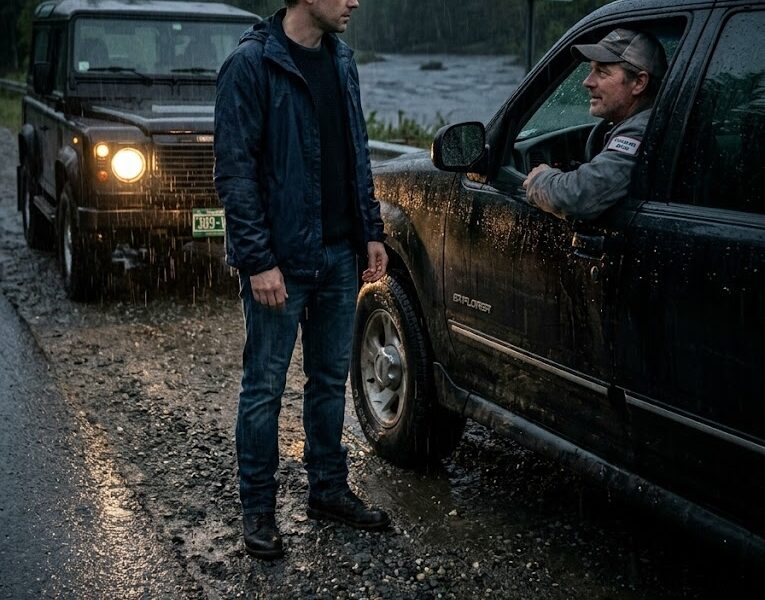
A Ford Explorer.
Black.
Dent on the left side of the front bumper.
She knew that dent.
She had processed the repair order herself.
Dwayne Pelletier.
Gloria’s service manager.
The man Gloria sent whenever something needed to be handled without looking dramatic.
Thea had maybe four seconds.
She turned toward Evan.
“Let me see your driver’s license.”
He blinked.
Then reached for his wallet.
No argument.
No offended question.
He held it out.
EVAN CORASS. LACONIA, NEW HAMPSHIRE.
Thea grabbed a pen.
She wrote his name on the back of the shelter address.
Then his license plate.
“I’m keeping this.”
“You should.”
The Explorer was getting closer.
Thea opened Evan’s rear door.
“Please.”
She shoved the suitcase inside and climbed in with Lark.
“Don’t tell him I’m here.”
She crouched low across the back seat.
The door closed.
Headlights washed across the wet windows.
Lark moved against her chest.
“Shh.”
The Explorer stopped beside them.
A window lowered.
Dwayne’s voice came through the rain.
Friendly.
Concerned.
“Hey there.”
Evan stood beside his SUV.
“Evening.”
“You see a young woman walking out here? Baby with her? Family’s worried sick.”
Inside the SUV, Thea pressed her mouth against Lark’s damp hair.
Please don’t cry.
Please don’t move.
Please.
Evan looked down the road.
“I’ve seen a lot of rain.”
Silence.
Too long.
Thea could imagine Dwayne studying him.
Studying the vehicle.
Memorizing the plate.
“Well,” Dwayne finally said, “if you see her, tell her people are looking.”
“I’ll keep that in mind.”
“Drive safe.”
The window rose.
The Explorer moved away.
Thea didn’t breathe normally until the taillights disappeared.
Evan got behind the wheel.
He started the engine.
Turned the heat high.
He never looked into the back seat.
“Where am I taking you?”
“Plymouth.”
“The bus stop?”
“Yes.”
“Okay.”
Nothing else.
As they drove, Thea sat upright slowly.
She kept the suitcase between herself and the front seat.
She watched Evan’s hands.
Both remained on the wheel.
She watched his eyes in the mirror.
They remained on the road.
“Left here.”
He turned left.
No questions.
“Straight.”
He went straight.
His SUV was expensive.
His coat was expensive.
The watch beneath his sleeve probably cost more than everything Thea owned.
She didn’t care.
She was measuring something else.
Whether he listened.
So far, he did.
Warm air filled the SUV.
Lark sighed and fell asleep.
Thea’s shoulders dropped an inch.
“Can I ask you something?”
Evan’s eyes met hers briefly in the mirror.
“Yes.”
“Can you not ask me anything?”
A pause.
“Yes.”
And he didn’t.
For the rest of the drive, there was only rain, windshield wipers and Lark’s breathing.
Then Plymouth appeared.
Main Street.
Streetlights shining on wet pavement.
The bus shelter ahead.
Thea leaned forward.
“There.”
Then froze.
A black SUV was parked beside the shelter.
Under the awning stood a woman in a camel-colored coat.
Hands folded.
Perfect posture.
Waiting.
Gloria Forton.
She wasn’t pacing.
She wasn’t calling frantically.
She simply stood there as if she already knew the ending.
Thea slid down behind the passenger seat.
“Keep driving.”
Evan didn’t ask why.
The bus shelter passed.
Gloria passed.
Plymouth disappeared behind them.
Only when the last streetlight vanished did Thea sit upright.
Her hands shook so violently she pressed them against her knees.
Evan drove another mile.
Then spoke toward the windshield.
“My father had a camp on Newfound Lake.”
Thea said nothing.
“There’s a bunkhouse separate from the main cabin. Own door. Own bathroom. Own lock.”
“No.”
“Okay.”
Again.
That word.
No punishment attached.
No persuasion.
Evan continued driving.
Thea looked down at Lark.
Her cheeks finally had color.
Monday was two nights away.
Gloria knew the bus station.
Dwayne knew Evan’s SUV.
And Thea had nowhere else to go.
“Can I use your phone again?”
Evan handed it backward.
Thea called the crisis line.
She gave them her full name.
Lark’s name.
Evan’s name.
His license plate.
Then she asked him for the camp address and repeated every word to the advocate.
“If I don’t call by nine tomorrow morning,” Thea said, “send somebody.”
Evan glanced at her in the mirror.
There was something almost like respect in his expression.
The advocate agreed.
Thea ended the call.
“One night,” she said.
“One night.”
The camp stood among dark pines beside black water.
The bunkhouse was fifty feet from the main cabin.
Evan unlocked it.
Then walked back down the steps and held the key toward her at arm’s length.
“One camera,” he said. “Over the garage. Faces the driveway.”
“Inside?”
“None.”
She took the key.
“I’ll leave supplies on the porch.”
Thea stiffened.
He noticed.
“Or I won’t.”
She stared at him.
“Towels would help.”
“Towels.”
“And diapers.”
“What size?”
She told him.
He nodded.
“Lock the door.”
Then he walked away.
Twenty minutes later came a soft knock.
Footsteps retreated.
Thea waited an entire minute before opening the door.
Two grocery bags sat outside.
Towels.
Bottled water.
A thermometer.
Diapers in exactly Lark’s size.
Bread.
Bananas.
Chicken soup.
Nothing extravagant.
Nothing designed to make generosity visible.
Thea picked up one of the bags.
For one dangerous second, she almost cried.
Not because a rich stranger had bought groceries.
Because the bag was ordinary.
Her grandmother had carried bags exactly like these into their narrow Berlin kitchen every Saturday.
Home had once looked like bananas and bread.
Before home became whichever place allowed her to stay.
Inside, the wood stove burned warmly.
On its cast-iron door was a name.
CORASS.
Thea frowned.
“You make stoves,” she murmured.
Lark began fussing.
Thea forgot about it.
She fed her daughter.
Bathed her in the sink.
Changed her into dry clothes.
Then she dragged a chair beneath the doorknob.
It wouldn’t stop anyone determined to enter.
That wasn’t the point.
Across the yard, Evan saw the chair through the window.
He stood in the rain for a moment.
Then continued toward the cabin.
He wasn’t insulted.
One decent evening didn’t buy trust.
He left his porch light on.
Morning came pale over the lake.
Lark woke hungry and warm and grabbed a fistful of Thea’s hair.
“Ow.”
Lark laughed.
Thea stared at her.
Then laughed too.
It was the first time she had heard herself make that sound in days.
At 8:52 she called the crisis line.
“We’re safe.”
Afterward, she turned on her own phone.
Seventeen missed calls.
Gloria’s messages were gentle.
Sweetheart, I’m not angry.
I’m worried sick.
Lark’s documents are safe here.
Come home and we’ll talk like family.
Thea almost preferred threats.
Then she saw an international number.
Brody.
Mom says you ran off in a storm with the baby. Thea, what are you doing?
She put the phone facedown.
A knock came.
Thea removed the chair carefully.
On the porch railing sat a cup of coffee.
Evan was already halfway across the yard.
“Wait.”
He turned.
She lifted the cup.
“What do you do?”
“I make stoves.”
She looked at the Corass stove.
Then back at him.
Despite everything, she almost smiled.
His phone rang.
He answered.
The morning was so quiet that Thea heard the woman’s voice from across the yard.
Warm.
Polite.
Familiar.
“Mr. Corass, this is Gloria Forton from Forton Auto.”
Thea’s smile vanished.
“Your father bought every truck he ever owned from me. Thirty years.”
Evan’s eyes lifted toward Thea.
“My service manager recognized your SUV on River Road last night.”
A pause.
Then:
“I believe you have my granddaughter.”
Thea gripped the coffee cup.
Evan turned away from her while he answered.
His voice was too low to hear.
A minute later he ended the call.
Then he crossed the yard.
Thea was already braced.
“What did you tell her?”
“That you’re safe.”
“What else?”
“She asked me to put you on the phone.”
“And?”
“I said you’re an adult. She can contact you herself.”
Thea waited.
“Then?”
“She said she’d be in touch.”
“That’s everything?”
“Yes.”
Thea stared at him.
For fourteen months, conversations about her had happened in other rooms.
Decisions appeared already finished.
Gloria and Brody discussed Lark.
Gloria and daycare discussed Lark.
Gloria and doctors discussed Lark.
People always told Thea the conclusion.
Nobody told her the conversation.
“Thank you,” she said.
Her voice broke on the second word.
Evan didn’t ask why.
Monday morning, Thea asked for a ride to the Bristol town office.
“Only a ride.”
“Okay.”
At the clerk’s counter she requested a certified copy of Lark’s birth certificate.
“Fifteen dollars.”
Thea opened her wallet.
Thirty-one dollars.
She counted out fifteen.
The printer whirred.
A warm sheet of paper emerged.
LARK MARIE GALANT.
Mother:
THEA GALANT.
Thea held it with both hands.
Gloria’s safe had just lost one key to her life.
She had sixteen dollars left.
She had never felt richer.
That afternoon she opened a checking account in her own name.
Balance:
$16.
She contacted legal aid.
An attorney named Lynn Tibbetts listened without interrupting for twenty minutes.
Then said, “Write everything down.”
“What?”
“Everything you can prove. Dates. Documents. Names. Don’t write what you feel happened. Write what you can prove happened.”
The distinction changed something.
Thea began building a file.
The shelter advocate found a transitional apartment that might become available in two weeks.
Maybe.
Thea filled out job applications from the bunkhouse table.
Her employment history looked like a trap.
Forton Auto.
Gloria.
Her references?
Gloria’s employees.
Her transportation history?
Gloria’s dealership.
Every road seemed to circle back.
Tuesday evening, Evan knocked.
He stayed outside.
“The shelter is still two weeks?”
“Maybe.”
“The weather’s turning.”
“I know.”
“The bunkhouse is empty. You can stay until the apartment opens.”
Thea stared at him.
“Only if we write it down.”
For the first time, Evan looked surprised.
Then he nodded.
“Okay.”
He returned with a Corass Hearth invoice.
They wrote their agreement on the back.
No rent for temporary occupancy.
No entering without permission.
Thea may leave whenever she chooses.
Evan signed.
Thea signed beneath him.
She folded the invoice and placed it beside Lark’s birth certificate.
It was just paper.
But it was the first agreement in fourteen months that contained her handwriting.
The days became almost peaceful.
Almost.
Thea washed bottles while humming French lullabies her grandmother had taught her.
Evan slowed whenever he passed the window.
He ate dinner straight from pans while sitting on the cabin steps.
“Do you own plates?” Thea asked one evening.
“Several.”
“Interesting.”
“My father ate this way.”
“Why?”
“Fewer dishes.”
She waited.
Evan added, “Fewer conversations.”
Thea understood there was another sentence beneath that one.
She didn’t ask for it.
He had given her the same courtesy.
Inside the main cabin, nearly every box from his father’s life had been opened.
Except one.
Black marker across the top:
CUSTODY — 1997.
Evan walked around it as if it were a hole in the floor.
Thea pretended not to notice.
One Wednesday evening, he finally asked about her suitcase.
“The tag.”
She touched the faded paper.
“My grandmother’s.”
“Germany?”
“Berlin.”
Thea traced the first address.
“She raised me until I was nine. When she got sick, this suitcase carried me to my father’s house.”
“What happened there?”
“He had another family.”
Evan waited.
“I slept on a couch in the den for six years.”
She touched another address.
“Then an aunt.”
Another.
“A friend.”
Another.
“Brody’s apartment.”
Another.
“Gloria’s house.”
She looked at the blank final line.
“Every address on this tag is somewhere I was allowed to stay.”
Evan said nothing.
“I’m not writing another one until it’s mine.”
After a moment he said, “That’s a good rule.”
Their fingers touched later when he passed her Lark’s bottle.
Neither moved immediately.
Thea noticed.
So did Evan.
Neither said anything.
The next afternoon, a dusty gray sedan stopped at the camp gate.
A man walked toward the bunkhouse carrying a large envelope.
“Thea Galant?”
Her stomach dropped.
“Yes.”
“You’ve been served.”
The sedan disappeared.
Thea opened the envelope.
Evan came out of the cabin.
She barely noticed him.
PETITION FOR GUARDIANSHIP OF A MINOR.
Gloria had filed.
The same accusations.
No residence.
No independent income.
No vehicle.
Emotionally unstable.
But now there was a new sentence.
Currently residing with an unrelated adult male, Evan Corass, whom she met only days ago.
Thea turned the page.
Something was clipped to the back.
Notarized.
Signed.
She recognized the careless slant immediately.
I consent to the appointment of my mother, Gloria Forton, as guardian of my daughter.
BRODY FORTON.
Thea sat down on the porch step.
For several seconds, she couldn’t hear the lake.
Couldn’t hear Evan.
Couldn’t hear anything.
Brody had signed away their daughter to his mother.
And he hadn’t even called Thea first.
Lynn Tibbetts met her the following morning in the Bristol library.
She read the papers twice.
Then removed her glasses.
“His consent doesn’t erase your rights.”
Thea exhaled.
“But.”
Lynn’s expression stopped her.
“A judge decides what’s in Lark’s best interest. Gloria doesn’t win because she asks.”
“But?”
“A deployed father supporting her. You without permanent housing. You currently staying on property owned by a wealthy man you met last week.”
Lynn tapped the petition.
“On paper, that’s a picture.”
Thea stared at the page.
“Is it a bad picture?”
“It’s an incomplete one.”
“What do I do?”
“Give the judge a better one.”
“How?”
“Proof.”
Lynn didn’t promise victory.
That was why Thea trusted her.
That night, she wrote across a legal pad:
THINGS I CAN PROVE.
Every pediatric appointment listed Thea.
Every vaccination.
Every follow-up.
Every nighttime urgent-care visit.
The old daycare paperwork listed Gloria as guardian.
Thea had never signed it.
The car belonged to Forton Auto.
The household account received Thea’s paychecks.
Then she returned to Gloria’s petition.
Under each accusation, she wrote a question.
No residence of her own.
Who arranged that?
Gloria.
No vehicle.
Who insisted she use dealership cars?
Gloria.
No independent income.
Who directed her wages into the household account?
Gloria.
Thea stared at the page.
For the first time, she didn’t see a helpless woman.
She saw a woman who had been dismantled carefully.
One helpful gesture at a time.
Saturday morning, she found Evan on the dock.
“I have a plan.”
He lowered his coffee.
“Okay.”
“Three things. When the shelter apartment opens, I move immediately.”
He nodded.
“Then nobody can say I’m living off you.”
Something flickered in his face.
He hid it.
“Second, I reach Brody directly.”
“And third?”
“Lynn is offering Gloria a supervised visit.”
Evan’s mug hit the dock harder than necessary.
“No.”
Thea blinked.
It was the first time he had said it like that.
“You don’t give her access.”
“It’s supervised.”
“She sent Dwayne after you.”
“I know.”
“She filed against you.”
“I know.”
“She will use that hour.”
“Maybe.”
“There is no maybe.”
His voice wasn’t loud.
That made the fear beneath it clearer.
Thea studied him.
“Why does this scare you so much?”
Evan looked across the lake.
His jaw worked once.
“I know what it’s like to be the thing two people pull on.”
Thea waited.
He offered nothing else.
So she answered softly.
“Then you know Lark shouldn’t lose a grandmother because the adults couldn’t figure out how to share a room.”
“Thea—”
“No.”
Evan stopped.
The word hung between them.
Thea felt something strange.
Power.
Not power over him.
Power over herself.
“I’m not handing Gloria anything,” she said. “I’m setting the table.”
She held his gaze.
“And this decision is mine.”
For a long moment, Evan said nothing.
Then his shoulders changed.
Not surrender.
Recognition.
“What do you need from me?”
Thea almost smiled.
“Nothing Saturday.”
He nodded.
“Then that’s what you’ll get.”
The visit was arranged for the following weekend at Plymouth Library.
One hour.
Staff supervision.
Evan stayed at the camp.
Exactly as Thea requested.
At ten o’clock, the children’s-room door opened.
Gloria entered wearing the camel coat.
She carried a pink gift.
She smiled at Lark as though nothing had happened.
Then another figure appeared behind her.
Military uniform.
Close-cropped hair.
Exhausted eyes.
Thea’s heart stopped.
Brody.
Home on emergency leave.
Gloria had arranged it without telling her.
Brody looked at Lark.
Not Thea.
His voice was flat.
“I’m here to take my daughter home.”
The librarian stood immediately.
“Nobody is taking anybody anywhere.”
Brody stared at her.
“This is my daughter.”
“And this is a supervised visit.”
Gloria touched his arm.
“Brody.”
That single word carried a warning.
Thea recognized it.
Outside on the stone steps, Brody looked younger than twenty-six.
“I flew twenty hours.”
“I didn’t ask you to.”
“Mom said this was an emergency.”
“It wasn’t.”
“You disappeared.”
“I left.”
“With our baby.”
“My baby too.”
“You walked down a highway in a storm.”
“Because your mother was filing for guardianship.”
Brody rubbed both hands over his face.
“Mom says you met some millionaire on the road and now you’re living at his lake house.”
Thea flinched.
“She says you’re trading Lark’s stability for some guy you barely know.”
The cruelest lies were built from facts.
“I met Evan that day.”
Brody laughed once without humor.
“Jesus Christ.”
“He gave us somewhere safe for one night.”
“One night?”
“The shelter had no bed.”
“And now?”
“Temporary agreement.”
“You have an agreement with him?”
“Yes. Written.”
Brody stared at her as if every answer created a new accusation.
Thea reached into her bag.
She pulled out the notarized consent.
“Did you read this?”
His eyes moved away.
That was enough.
“Brody.”
“Mom said it was paperwork.”
“For what?”
“In case something happened to me overseas.”
“This gives your mother guardianship of our daughter.”
He said nothing.
“You signed it.”
“I trusted my mother.”
“And you didn’t trust me enough to call.”
His face tightened.
“That isn’t fair.”
“No?”
“I’ve been deployed.”
“And I’ve been raising your daughter.”
Brody looked through the library window.
Gloria sat with Lark.
For the first time, something uncertain entered his expression.
“I want to meet Evan.”
That afternoon Brody drove to the lake camp.
Thea stayed inside the bunkhouse.
Through the open window she heard the men talking.
“Did she leave for you?” Brody asked.
“She had never met me.”
“My mother says you’re paying for her lawyer.”
“She won’t let me pay for coffee.”
Silence.
Then Brody asked:
“Would you tell a judge my mother is lying?”
Thea stopped folding Lark’s clothes.
She waited.
Evan’s answer came quietly.
“I don’t know your mother.”
Nothing else.
Thea stared at the tiny sock in her hand.
It was reasonable.
Technically honest.
Careful.
And it hurt more than she expected.
Because careful answers were what she had lived inside for fourteen months.
After Brody left, Thea finished packing.
The shelter apartment had become available four days early.
She called the advocate.
“Can we move today?”
“Yes.”
Thea folded the handwritten bunkhouse agreement.
She left it on the table.
Then she carried the blue suitcase outside herself.
Evan crossed the yard when the advocate’s car arrived.
He saw the luggage.
His expression changed.
“Thea.”
“The apartment opened.”
“Today?”
“Yes.”
He looked toward the bunkhouse.
She knew he wanted to explain.
She didn’t let him.
“And now the petition can’t say I’m living with an unrelated man.”
Evan went still.
The words landed.
But he didn’t defend himself.
He didn’t ask her to stay.
He stepped aside.
Thea put the suitcase in the advocate’s car.
As they drove away, she looked back once.
Evan remained in the driveway.
Alone.
On Monday morning, Gloria walked into Corass Hearth without an appointment.
Evan’s assistant tried to stop her.
Gloria smiled.
Then walked past.
She sat across from Evan’s desk.
“Your father bought trucks from me for thirty years.”
Evan said nothing.
“Every spring, Cliff drank my terrible coffee and complained about transmission prices.”
Still nothing.
Gloria folded her hands.
“He told me about 1997.”
Evan’s entire body changed.
Gloria saw it.
Of course she did.
“Your father waited twenty years for a boy who said one sentence in a courtroom.”
“Get out.”
Her expression remained almost compassionate.
“Don’t help that girl teach my son the same lesson.”
She stood.
Buttoned her coat.
And left.
Evan remained behind his desk until the building emptied.
Twice, he picked up his phone.
Twice, he put it down.
In Plymouth, Thea kept moving.
A temporary job opened at a credit union.
She took it.
A daycare on Highland Street had one vacancy.
She took that too.
She signed every document herself.
Emergency contact.
Medical authorization.
Pickup permissions.
Every signature felt absurdly important.
The daycare requested Lark’s previous records.
Thea authorized the transfer before work.
She didn’t know the old authorized-pickup form was included.
She didn’t know Gloria’s name remained on it.
At three that afternoon, Gloria walked into the daycare.
She showed identification.
She smiled.
And she took Lark.
At 4:30, Thea learned what had happened.
Twenty minutes later, Evan’s SUV arrived.
They drove to Harlo mostly in silence.
Rows of black vehicles gleamed beneath the dealership lights.
Thea stared through the windshield.
Once, she had hidden from those cars.
Tonight she opened the door herself.
Rain struck her face.
Evan came around the vehicle.
She stopped him.
“One step behind me.”
He nodded.
“One.”
Thea walked between the rows.
Evan stayed exactly one step behind.
The showroom door was unlocked.
Gloria’s office light glowed at the back.
Thea entered.
Lark slept inside an old wooden playpen.
Brody stood beside the window wearing jeans and a sweatshirt.
Gloria sat behind her desk.
Nobody appeared surprised.
That frightened Thea most.
Gloria hadn’t kidnapped Lark and fled.
She had brought her to the most obvious place possible.
Because Gloria still believed she was right.
“I called Brody,” Gloria said.
Thea crossed to the playpen.
“Don’t touch her yet.”
Thea turned.
Gloria slid an envelope across the desk.
“Sit down.”
“No.”
A flicker.
Small.
But Thea saw it.
Gloria pushed the envelope farther.
“Lark’s birth certificate. Social Security card. Insurance records. Everything.”
Thea didn’t touch it.
“Move home.”
Brody looked at his mother.
Gloria continued.
“I withdraw the petition. You get your job back. You keep the car. I remain guardian on paper for insurance purposes.”
She smiled.
“Everything becomes easy again.”
Thea looked at the envelope.
For ten months, that offer would have sounded like safety.
Now it sounded like a locked door.
“You gave me a room.”
Gloria’s smile remained.
“Yes.”
“And made sure it was never mine.”
“Thea—”
“You gave me a job and made sure the money wasn’t mine.”
“I helped you.”
“You gave me a car that wasn’t mine. A phone you could monitor. Daycare paperwork you controlled. My daughter’s documents in your safe.”
Gloria’s jaw tightened.
“I kept this family functioning while Brody was overseas.”
“You made every accusation in that petition true.”
Brody looked toward his mother.
Thea stepped closer.
“No home.”
Her voice stayed calm.
“You made sure of it.”
Gloria opened her mouth.
“No independent income.”
Thea continued.
“You arranged that too.”
“Thea, enough.”
“No car.”
“The dealership provided you with—”
“Exactly.”
Silence.
Thea looked down at Lark.
Then back at Gloria.
“You didn’t lie about me.”
Something changed in Gloria’s face.
“You did something smarter.”
Thea’s eyes burned.
“You built the evidence.”
Brody whispered, “Mom?”
Gloria ignored him.
“You have no idea what it means to lose a child.”
Her voice finally cracked.
Thea stopped.
And from behind her, Evan spoke.
“When I was nine, I sat in a courthouse with a box of crayons.”
Everyone turned.
Evan remained near the door.
One step behind Thea.
Exactly where she had asked him to stand.
“A woman asked where I wanted to live.”
Gloria’s face changed.
Evan continued.
“My mother cried every time I came home from my father’s house.”
He swallowed.
“So when they asked me, I said one sentence.”
His eyes moved toward Lark.
“‘I don’t want to go there.’”
Rain ticked against the showroom windows.
“My father heard that sentence and stopped fighting for custody.”
Evan’s voice roughened.
“For twenty years, I thought I had destroyed him.”
Thea watched him.
He hadn’t told her this.
Maybe he had never told anyone.
“Lark will grow up hearing whatever sentence all of you write tonight.”
He looked from Gloria to Brody.
“Don’t make her become the sentence.”
Nobody moved.
Then Brody turned from the window.
“Mom.”
Gloria didn’t look at him.
“Mom, I need to tell you something.”
“Not now.”
“Yes.”
Something in his voice made her turn.
Brody’s eyes were wet.
“At my basic-training graduation, an old woman came up to me.”
Gloria went completely still.
“She said I had my father’s chin.”
The color left Gloria’s face.
“Brody—”
“It was Grandma Bernadette.”
Thea looked between them.
Brody’s voice broke.
“Dad’s mother.”
Gloria gripped the desk.
“She shouldn’t have—”
“You told me she wanted nothing to do with me.”
“She abandoned us after your father died.”
“She didn’t.”
Gloria stared at him.
Brody shook his head.
“She wrote.”
“Brody.”
“She called.”
“Stop.”
“You changed numbers.”
“Stop.”
“She sent birthday cards.”
Gloria’s mouth trembled.
“You returned them.”
“BRODY.”
The shout stunned everyone.
It was the first time Thea had ever heard Gloria truly raise her voice.
Lark stirred in the playpen.
Immediately, everyone fell silent.
Brody lowered his voice.
“I’ve been talking to Grandma Bernadette every month since graduation.”
Gloria stared at him as if he had confessed to a crime.
“Twenty-three years,” Brody whispered. “She waited twenty-three years to meet me.”
His mother sank into the chair.
“You did to Dad’s mother exactly what you’re doing to Thea.”
“No.”
“Yes.”
“I was protecting you.”
“From what?”
Gloria’s lips parted.
Nothing came.
“From loving someone besides you?”
The question landed harder than anger.
Brody wiped his eyes.
“I’ll withdraw my consent tomorrow.”
Gloria looked up.
“Brody.”
“Lark goes home with her mother tonight.”
The room became unbearably quiet.
Gloria looked suddenly older.
Not defeated.
Not evil.
Just tired.
Her eyes moved toward the sleeping baby.
“Lucien’s family wanted you every summer.”
Brody frowned.
“What?”
“The farm in Quebec.”
Gloria’s voice had become small.
“They wanted you for June and July.”
She looked at her son.
“I had just buried your father.”
Brody said nothing.
“They said it would be good for you. Grandparents. Cousins. Fields. French.”
Her fingers trembled against the desk.
“I thought if I shared you…”
She stopped.
Thea knew the rest before Gloria said it.
“…I’d lose you.”
Brody closed his eyes.
Gloria looked at Lark.
“I lost Lucien so fast.”
There it was.
Not justification.
But origin.
Fear had worn the clothes of love for so long that Gloria no longer recognized the difference.
She picked up the envelope.
Her hand shook.
Then she held it toward Thea.
Not Evan.
Not Brody.
Thea.
Thea crossed the room.
She took it.
No one applauded.
No triumphant music existed.
There was only rain.
A sleeping baby.
And four adults standing inside the wreckage of things they had once called love.
Thea lifted Lark from the playpen.
Her daughter stirred.
Then settled against her chest.
At the office door, Thea stopped.
She looked back at Gloria.
“Sundays.”
Gloria stared.
“Two to five.”
“What?”
“My apartment. My table. My rules.”
Gloria’s eyes filled.
“Starting this Sunday.”
“Why?”
Thea adjusted Lark against her shoulder.
“Because she should grow up with more people who love her.”
A pause.
“Not fewer.”
Outside, rain tapped against the rows of black SUVs.
Evan helped Thea buckle Lark into the borrowed car seat.
Then he stood beside the open door.
“I owe you an apology.”
Thea didn’t look at him.
“Gloria came to my office Monday.”
Her hands stopped.
“She knew about my father.”
Thea turned.
Evan’s face was pale.
“I froze.”
He looked toward the dealership.
“I was so afraid of choosing a side again that when Brody asked me whether Gloria was lying, I hid inside the safest answer I could find.”
Thea said nothing.
“I let you stand alone.”
“Yes.”
He nodded.
No defense.
No explanation disguised as one.
“I’m sorry.”
Thea closed the car door.
She didn’t forgive him immediately.
That mattered.
Instead she said, “Next time, call me scared.”
Evan looked at her.
“Don’t call me nothing.”
He understood.
“Okay.”
The following morning, Gloria’s attorney withdrew the guardianship petition.
Months later, Thea and Brody would write a parenting plan together at Thea’s kitchen table.
But that night, there was no courtroom victory.
There was microwaved macaroni.
A secondhand couch.
A donated crib.
And an apartment so small Thea could stand in the kitchen and almost touch the living-room wall.
After Lark fell asleep, Thea locked the front door.
Then unlocked it.
Then locked it again.
Just to hear the sound.
Click.
Her lock.
Her door.
Her choice.
She leaned her forehead against it and cried silently.
Not because the apartment was beautiful.
It wasn’t.
The radiator clanged.
The bathroom faucet dripped.
The upstairs neighbor seemed to own a bowling ball.
But nobody else had a key.
Out on Newfound Lake, Evan sat on the floor of his father’s cabin.
The cardboard box remained in the corner.
CUSTODY — 1997.
For weeks he had walked around it.
Tonight he cut the tape.
Inside were court documents.
Letters.
Receipts.
A child’s drawings.
Then Evan found the transcript.
He recognized the question.
Where do you want to live?
And beneath it, his nine-year-old answer.
I don’t want to go there.
Evan closed his eyes.
Twenty years of guilt lived inside six words.
Then he noticed handwriting in the margin.
His father’s.
Two sentences.
Evan read them.
Then read them again.
He’s protecting her.
Don’t make him say it twice.
Initial:
C.
Evan stopped breathing.
He sat on the floor until his legs went numb.
His father hadn’t believed Evan hated him.
Cliff had understood.
Nine-year-old Evan had seen what happened to his mother every time custody exchanges came.
He had chosen the sentence that stopped the fighting.
And his father—
the man Evan had spent twenty years believing had simply given up—
had understood exactly what his son was doing.
Cliff had walked away so Evan would never have to sit in that courtroom again.
Evan bent forward.
For the first time since his father’s death, he cried.
Not neatly.
Not quietly.
He grieved the father he had lost six weeks earlier.
And the father he had misunderstood for twenty years.
Three weeks later, his phone rang.
Thea.
Evan answered carefully.
“Hey.”
“I have a question.”
“Okay.”
“Would you come to dinner?”
He smiled before he could stop himself.
“At your apartment?”
“My table.”
That mattered.
“I’d like that.”
Winter came hard to the valley.
Thea’s temporary position at the credit union became permanent.
Loan processor.
Her name on the payroll.
Her account.
Her taxes.
Her work.
In December she rented a second-floor apartment above a hardware store on Main Street.
It was drafty.
The radiator knocked at night.
But Lark had a bedroom.
Thea had one too.
Two doors.
Sometimes Thea walked through the apartment after Lark fell asleep and touched the doorframes.
Not because they were special.
Because they belonged to a place where she did not need permission to remain.
Sundays were difficult at first.
At exactly two o’clock, Gloria would arrive carrying food nobody requested.
Casseroles.
Soup.
Bread.
She rang the bell three times.
Thea opened the door.
“My table.”
Gloria nodded.
By the third Sunday, she rang once.
By the fifth, she knocked.
Then waited.
By the seventh, she arrived carrying nothing.
That was the first Sunday Thea believed Gloria might actually be learning.
On December 27, Lark turned one.
Brody was home on leave.
There was cake.
Cheap paper decorations.
Too many people for the apartment.
At 1:47 that afternoon, someone knocked.
Gloria stopped breathing.
Thea opened the door.
An eighty-four-year-old woman stood outside wearing a red wool hat.
Tiny.
Straight-backed.
Sharp-eyed.
Brody came behind Thea.
The old woman looked at him and smiled.
“My Lucien’s chin.”
Brody’s face collapsed.
“Grandma.”
Bernadette had driven down from Quebec.
Gloria stood in the kitchen.
For twenty-three years, these women had existed in each other’s stories as villains.
Now there were six feet of linoleum between them.
Bernadette removed her gloves.
Gloria’s hands began shaking.
“I don’t know what to say.”
Bernadette studied her.
Then opened her arms.
Gloria covered her mouth.
She crossed the kitchen.
And the two grandmothers held each other.
Nobody pretended twenty-three years could be repaired by one embrace.
Some things couldn’t.
That wasn’t why the embrace mattered.
It mattered because somebody finally stopped protecting love by locking it away.
The apartment was too small for chairs.
Everyone ended up sitting on the floor around Lark’s birthday cake.
Lark shoved frosting into her hair.
Brody laughed.
Bernadette cried.
Gloria laughed while crying.
Thea looked around her tiny kitchen and realized something strange.
For most of her life, home had meant being tolerated somewhere.
Tonight people were crowded onto her floor because she had invited them.
There was a difference.
Her relationship with Evan grew slowly.
That was the only way either of them knew how to do it.
There were no expensive rescues.
No penthouse.
No dramatic proposal after three weeks.
There were grocery runs.
Thea paid for her cart.
Evan learned the French lullabies Thea’s grandmother had sung.
He pronounced half the words wrong.
Lark thought it was hilarious.
There were evenings on the fire escape.
There were arguments.
Real ones.
The first time Thea told him, “No, I don’t want you paying for that,” she braced unconsciously.
Evan only said, “Okay.”
Thea stood there afterward.
Waiting.
“For what?” he asked.
She didn’t know how to explain.
Nothing happened.
No guilt.
No withdrawal.
No punishment.
Just no.
Their first kiss happened on the apartment stairs in January.
Snow fell through the yellow streetlight outside.
Evan had come for dinner.
Gloria had just left.
Lark was asleep.
He stood one stair below Thea.
That made them almost the same height.
“I should go.”
“Probably.”
He didn’t move.
Neither did she.
Then Thea smiled.
“You’re waiting for me.”
“Yes.”
“For what?”
“To know whether I’m allowed to kiss you.”
She looked at him for a long time.
Then she touched his coat.
“You are.”
He kissed her.
Slowly.
No urgency.
No possession.
When Thea pulled back, Evan stopped.
Immediately.
She laughed softly.
“What?”
“Nothing.”
“That’s not nothing.”
She looked down the staircase.
“I just realized I can stop something halfway through and the world doesn’t end.”
Evan’s expression changed.
He didn’t turn the moment into tragedy.
He kissed her forehead.
“Useful discovery.”
She laughed again.
Evan changed too.
He began leaving the office before dark.
He opened his father’s lake camp to retired foundry workers for monthly dinners.
He stopped treating emotional distance like neutrality.
Sometimes Thea went silent when Evan offered help too quickly.
Sometimes Evan froze when conflict demanded he choose.
They learned to name those moments.
“You’re disappearing,” Thea would say.
“I know.”
“Come back.”
Or Evan would say, “You’re treating my offer like an order.”
Thea would breathe.
“Give me a minute.”
They were imperfect.
That was why it worked.
In spring, Lark’s daycare sent home a new authorized-pickup form.
Thea sat at her kitchen table.
She read every line.
Twice.
Then she picked up a pen.
Evan Corass.
She stopped.
The next line remained blank.
For several minutes, Thea simply stared at it.
A year earlier, somebody else’s handwriting on a similar form had helped Gloria take her daughter.
Now the pen was in Thea’s hand.
She wrote:
Gloria Forton — Grandmother.
Not because Gloria demanded it.
Not because Brody asked.
Because Thea chose.
One year after the night she walked River Road, Thea asked Evan to drive her there.
Late October again.
Bare maples.
Cold wind.
Dark water moving fast beside the road.
Lark could walk now.
At the turnout, she kicked her little boots excitedly.
“Down!”
Thea laughed.
“Okay, Bug.”
She took Lark’s hand.
Evan looked at her.
“You sure?”
“Yes.”
They walked along the gravel shoulder.
Thea recognized the curve.
Then the rut.
The exact place where the wheel of the blue suitcase had caught again and again.
She stopped.
For a moment, she could see herself.
Soaked shoes.
Thirty-one dollars.
A sleeping baby.
A terrified woman calculating miles because she believed distance was the same thing as freedom.
Thea looked back at Evan.
“Drive behind us.”
“What?”
“Slowly. Just for a minute.”
Understanding moved across his face.
He returned to the SUV.
Thea took Lark’s small hand.
They walked.
One step.
Then another.
Behind them, the black SUV rolled slowly along the shoulder.
Once, that sound had frozen Thea’s blood.
Now she listened to the tires move over gravel.
She wasn’t afraid.
Lark pointed toward the river.
“Water!”
“Yes.”
“Big.”
“Very big.”
Thea laughed.
After a while, she turned around.
Evan was behind the wheel.
Waiting.
Not leading.
Not following too closely.
Just there.
Thea smiled.
Then waved.
The SUV pulled beside them.
That night, after Lark was asleep, Thea stood beneath the closet shelf.
The blue suitcase remained on top.
She pulled it down.
Dust had gathered along one edge.
She didn’t pack it.
She carried it into the bedroom and sat on the floor.
The old paper luggage tag was still attached.
Soft as cloth.
Berlin.
Crossed out.
Her father’s house.
Crossed out.
Her aunt’s.
Crossed out.
Brody’s.
Crossed out.
Gloria’s.
Crossed out.
Every place she had once been allowed to stay.
At the bottom was one empty line.
Thea sat there for a long time.
Then she uncapped a pen.
Slowly, carefully, she wrote:
Thea Galant
Below it:
Main Street
Plymouth, New Hampshire
She stared at the words.
Her eyes filled.
But she didn’t cross them out.
She closed the suitcase.
It was empty now.
That felt important.
Then she put it back on the shelf.
Not because she expected to run again.
Because she wanted to remember the woman who once carried it down River Road with everything she could save inside.
That woman had believed home was something another person permitted you to have.
A room someone could take back.
A car someone could reclaim.
A paycheck someone could manage.
A relationship someone could redefine.
A family someone could control by loving too tightly.
She had been wrong.
Home was the place where no one had to shrink for permission to stay.
It was a door you could close.
A table where you decided who sat.
A bank account with sixteen dollars that belonged entirely to you.
A grandmother invited back under new rules.
A man who understood that love did not mean walking in front of you.
Sometimes it meant staying one step behind.
Thea turned off the bedroom light.
From Lark’s room came the soft rhythm of her daughter’s breathing.
From the kitchen came Evan’s terrible attempt at one of her grandmother’s French songs while he washed the dinner dishes.
Thea smiled.
She walked toward the sound.
And for the first time in her life, she wasn’t staying in somebody else’s house.
She wasn’t being sheltered.
She wasn’t being rescued.
She wasn’t waiting to learn how long she was allowed to remain.
She was simply going home.
And on the shelf behind her, the old blue suitcase stayed empty.
The address on its final line remained uncrossed.
Because Thea Galant would never again be a guest in her own life.









