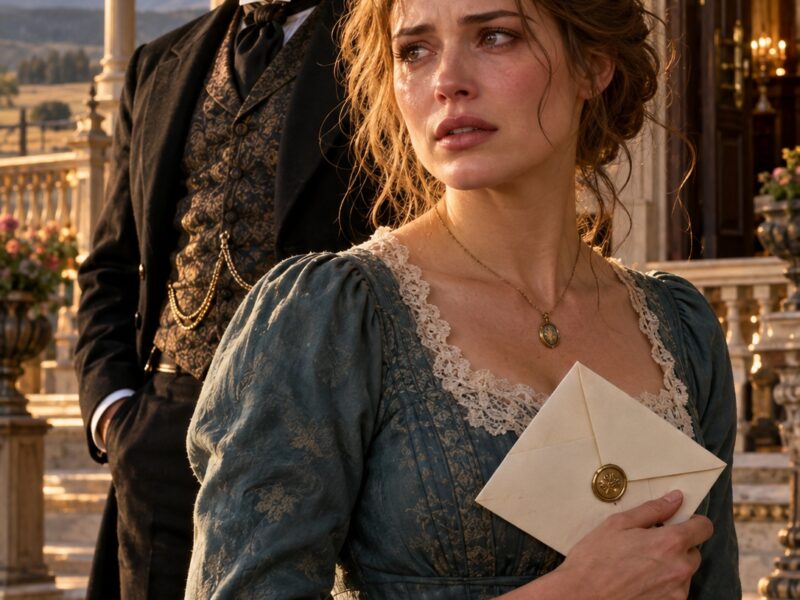
She Rejected Every Man in Town—Until the Richest Rancher Came for Her and the One Man She Loved Finally Realized He Was Too Late

For seven years, Evelyn Harper rejected every man who asked her to marry him.
Then the richest cattle baron in three counties rode into Black Ridge Crossing with a lawyer, a marriage proposal, and enough money to change her life before sundown.
That was when Silas Mercer finally understood the truth.
Evelyn had never been waiting for a better man.
She had been waiting for him.
And he had almost waited long enough to lose her.
The trouble with Evelyn Harper was not that she was difficult.
Difficult women made sense to people.
A difficult woman could be blamed on pride, heartbreak, bad blood, bad luck, or some private wound the town could whisper about after church.
Evelyn gave them nothing so convenient.
She was thirty years old, capable, warm without being foolish, independent without making a performance of it, and by nearly every standard Black Ridge Crossing understood, she should have been married years ago.
She owned the small Harper place west of town, land left to her after her father Douglas died. It was not an empire. There were no thousands of cattle, no army of hired men, no silver-backed bank accounts.
There was a modest house with a porch that leaned slightly toward the south.
A barn that needed new boards every third winter.
A creek cutting along the lower pasture.
Several horses.
A vegetable garden.
And enough land to keep one hardworking woman busy from sunrise until she was too tired to wonder what the rest of her life might have looked like.
Evelyn managed it all.
She repaired what she could.
She hired help when she couldn’t.
She kept accounts better than half the merchants in town.
She brought soup to sick neighbors, remembered children’s birthdays, sat beside grieving widows without filling the silence with useless words.
People liked her.
That was part of the problem.
If Evelyn had been unpleasant, the town could have accepted her being unmarried.
Instead, she was exactly the sort of woman men wanted to marry.
And she kept saying no.
Her first serious proposal had come from Carl Braddock, a rancher with two hundred head of cattle and a square jaw that seemed designed specifically for looking respectable in church.
Carl had gone to the Harper place carrying flowers and confidence.
He returned carrying only the flowers.
Evelyn had been kind.
That somehow made it worse.
“You’ve done nothing wrong,” she’d told him.
Carl stared at her across the porch.
“Then why are you saying no?”
“Because not doing anything wrong isn’t the same as being right.”
Carl never understood that answer.
Most of Black Ridge Crossing didn’t either.
The second proposal came from James Whitfield, eldest son of the general store owner.
James was educated, polite and destined to inherit a prosperous business.
He courted Evelyn for three months.
They attended church socials.
He walked her home.
They had supper together.
Everyone assumed the matter was settled.
Then James proposed.
Evelyn refused him too.
Her closest friend, Ruth Caffey, confronted her two days later in the back room of the dress shop Ruth ran on Main Street.
“James Whitfield,” Ruth said, stabbing a needle through a piece of blue fabric, “has good teeth, good manners, a good business and a mother who actually likes you.”
Evelyn laughed.
“Is that your argument?”
“I’m trying to understand the standards.”
“There aren’t standards.”
“That’s worse.”
Evelyn looked through the window toward the dusty street.
Ruth watched her.
Then Ruth followed her gaze.
Across Main Street stood the livery stable.
And inside the open doors, Silas Mercer was fitting a shoe onto a chestnut mare.
Ruth looked back at Evelyn.
Evelyn had already looked away.
That was the moment Ruth understood.
She said nothing.
Not yet.
A third proposal arrived the following spring.
Then two more attempts over the next few years.
All failed.
Eventually Black Ridge Crossing developed theories.
Some believed Evelyn was waiting for an educated gentleman from back East.
Others thought she had secretly decided never to marry.
A few concluded she simply enjoyed rejecting men.
Ruth knew better.
Evelyn Harper was waiting for a man who had never once asked her to wait.
Silas Mercer was thirty-one years old and had been running Mercer & Son Livery since he was nineteen.
The “Son” on the sign referred to him, though his father had been dead four years.
Silas never changed it.
People assumed sentiment.
The truth was simpler.
The sign still worked.
That was Silas.
He repaired things instead of replacing them.
He used words only when words improved silence.
He owned one good suit.
He read whatever books passed through town but rarely mentioned them.
He wasn’t poor, exactly.
He wasn’t rich either.
The stable provided enough.
Enough food.
Enough coal.
Enough money to keep the roof repaired.
Enough to live.
But not enough to impress anyone.
Especially, Silas believed, Evelyn Harper.
He had known her most of his life.
Their fathers had known each other.
They had grown up near one another without ever becoming close.
Then Douglas Harper died.
And something changed.
That first winter, one of Evelyn’s horses developed a dangerous infection in its hoof.
She rode into town before sunrise.
Silas found her outside the stable, hair coming loose beneath her hat, face pale with exhaustion.
“Can you come?”
That was all she said.
He went.
The snow was nearly knee-deep in places.
They spent four hours working on the horse.
Silas showed Evelyn how to clean the wound.
She listened without interrupting.
When it was finished, she stood beside him in the barn.
“What do I owe you?”
“Nothing.”
“Silas.”
“Your father helped mine plenty of times.”
“My father isn’t here.”
“I know.”
Something in his voice made her stop.
She looked at him.
He looked back.
Neither of them moved.
Then the horse shifted behind them, breaking whatever had almost happened.
Evelyn lowered her eyes.
“Thank you.”
Silas nodded.
“Anytime.”
That word became dangerous.
Anytime.
Whenever a fence post cracked, sometimes Silas appeared.
Whenever one of the stable horses needed something Evelyn grew on her land, she brought it.
They spoke at church.
They saw each other in town.
Sometimes he walked part of the road home with her.
Nothing improper happened.
Nothing obvious happened.
That was the problem.
Three years passed inside a collection of almosts.
Almost touching.
Almost asking.
Almost confessing.
Almost beginning.
Evelyn waited because she believed Silas needed time.
Silas stayed silent because he believed Evelyn deserved better.
Both mistook fear for patience.
And fear, given enough time, begins making decisions for you.
One afternoon Ruth finally lost patience.
Evelyn was sitting near the dress-shop window while Ruth adjusted the sleeve of a green dress.
“How long?”
Evelyn frowned.
“How long what?”
“Are you going to keep doing this?”
“Doing what?”
“Looking at that stable every time you think I’m not watching.”
Evelyn froze.
Ruth continued pinning the sleeve.
“I don’t.”
“You do.”
“Ruth.”
“Seven years.”
“Not seven.”
“Fine. Three years seriously. Seven years stubbornly.”
Evelyn pulled her arm away.
“There’s nothing between Silas and me.”
Ruth met her eyes.
“Exactly.”
That hurt more than Evelyn expected.
She stood.
“What would you have me do?”
“Tell him.”
“No.”
“Why?”
“Because if he wanted me, he would have said something.”
Ruth’s expression softened.
“Maybe.”
Evelyn waited.
Ruth sighed.
“Or maybe he’s a man.”
Despite herself, Evelyn laughed.
“I’m serious,” Ruth said. “Men can shoe a horse that’s trying to kick their skull open, cross a flooded river at night, fight three drunk cowboys behind a saloon—and still be terrified of asking a woman whether she loves them.”
“Silas isn’t terrified of me.”
“No. He’s terrified of being wrong about you.”
Evelyn said nothing.
That sentence followed her home.
But she still didn’t speak.
Neither did Silas.
Then Gideon Barrett came to town.
He arrived on a July morning beneath a sky so clear it made every shadow look sharpened.
Gideon was fifty-three, twice widowed, wealthy enough that his name appeared on land deeds from one county line to another.
The Double B ranch covered more than twenty thousand acres.
He employed dozens of men.
He owned cattle by the thousands.
When Gideon entered a room, people adjusted themselves without consciously knowing they had done it.
He was not handsome in the way younger men were handsome.
He was imposing.
Silver hair.
Broad shoulders.
Expensive boots without unnecessary decoration.
The patient eyes of a man accustomed to studying something before deciding whether to buy it.
He had heard about Evelyn before meeting her.
A woman who ran her own place.
A woman respected in town.
A woman who had rejected several respectable men.
Gideon found the last part intriguing.
The first time he called at the Harper place, Evelyn expected business.
Instead he removed his hat and said, “I’d like to court you.”
Evelyn almost smiled.
“That’s direct.”
“I’m fifty-three. I’ve discovered indirectness wastes daylight.”
“And you’ve discovered enough about me to decide this?”
“I’ve discovered enough to want to discover more.”
It was a good answer.
Evelyn hated that it was a good answer.
She invited him to sit.
Gideon did not flatter her.
That surprised her.
He asked about the property.
About her father.
About how she handled winters.
About whether she wanted children.
That question stopped her.
He noticed.
“Too personal?”
“No.”
She folded her hands.
“I used to think I would have them by now.”
Gideon’s expression changed—not pity, exactly.
Understanding.
“So did I.”
His wives had never given him children.
For the first time Evelyn saw something behind the cattle baron.
Loneliness.
Real loneliness.
Not the loneliness of an empty room.
The loneliness of building an enormous life and having nobody who knew what it had cost.
When Gideon left, Evelyn remained on the porch.
She heard a horse approaching.
Silas.
He was returning from checking a mare at the Jenkins place.
He slowed near her gate.
His eyes followed Gideon disappearing down the road.
“Barrett?”
“Yes.”
“What’d he want?”
There was nothing unusual in Silas’s tone.
That irritated her.
“He came to see me.”
Silas nodded.
“I gathered.”
Evelyn waited.
Silas waited too.
She wanted him to ask.
Who was he to you?
Why was he here?
Is he courting you?
Do you like him?
Instead Silas adjusted his reins.
“Everything all right?”
Something inside her hardened.
“Perfectly.”
He nodded.
“Good.”
Then he rode away.
Evelyn watched him until the dust swallowed him.
“Idiot,” she whispered.
She wasn’t sure which of them she meant.
Gideon returned.
Then returned again.
He took Evelyn to dinner at the hotel.
Walked beside her after church.
Spoke to her as an equal.
He never pushed.
That made refusing him harder.
And Black Ridge Crossing noticed everything.
By Gideon’s fourth visit, everyone knew.
By his fifth, people were already discussing where Evelyn might live after the wedding.
Only one person seemed determined not to participate in the conversation.
Silas.
At least publicly.
Inside him, something had begun to come apart.
He heard men talking at the stable.
“Barrett’s serious.”
Silas kept brushing a gelding.
“So I hear.”
“Wouldn’t blame her.”
“No.”
“Twenty thousand acres.”
Silas’s hand slowed.
“Land doesn’t make a marriage.”
The man laughed.
“Doesn’t hurt.”
Silas resumed brushing.
That evening he walked home alone.
For the first time in years, the rooms felt small.
He imagined Evelyn at the Double B.
A large house.
Servants.
Children, perhaps.
Security.
A husband capable of giving her everything Silas believed he could not.
He told himself he should be glad.
If he loved her, wasn’t that what love required?
Wanting the best for her?
The thought sounded noble.
It also made him feel sick.
Two weeks later, Ruth entered the stable.
Silas looked up.
“You need something?”
“Yes.”
“What?”
“A conversation.”
He immediately disliked the answer.
Ruth folded her arms.
“Gideon Barrett intends to propose.”
Silas’s face barely moved.
“I figured.”
“He has a lawyer coming from Cheyenne.”
That got him.
“A lawyer?”
“Property arrangements.”
Silas set down the harness he was holding.
Ruth watched him.
“Say something.”
“What do you want me to say?”
“The truth would be refreshing.”
“It’s Evelyn’s decision.”
“Of course it is.”
“Then why are you here?”
Ruth stepped closer.
“Because for three years I have watched two intelligent people behave like complete fools.”
Silas looked away.
“Ruth.”
“Do you love her?”
His jaw tightened.
“That’s none of your business.”
“So yes.”
“Don’t.”
“Does she know?”
Silence.
Ruth shook her head.
“You haven’t even given her the dignity of choosing you.”
That landed.
Silas looked at her.
“What exactly would I be offering?”
“Yourself.”
“Barrett can give her—”
“I don’t care what Barrett can give her.”
“I do.”
His voice sharpened for the first time.
“I care that she has a good life.”
Ruth stared at him.
“And you decided for her that a good life doesn’t include you.”
Silas said nothing.
“You call that humility,” Ruth said quietly. “It’s not. It’s fear wearing decent clothes.”
Then she walked out.
Silas stood motionless long after she was gone.
Three days later Gideon’s lawyer arrived.
Randall Priest carried a leather case containing documents that could have changed Evelyn’s life before she finished reading them.
Gideon’s proposal was generous.
More than generous.
If they married, Evelyn would retain ownership of the Harper property.
She would receive independent funds.
She would have authority over significant household decisions.
Gideon had even included provisions protecting her land if he died.
He wasn’t trying to purchase her.
That would have made things easier.
He was trying to respect her.
When Evelyn realized that, she became afraid.
Because Gideon Barrett was not the villain of her story.
He was a good man.
And sometimes the most dangerous alternative to the life you want is not a terrible life.
It’s a perfectly respectable one.
Gideon called on her Tuesday.
They sat on the porch.
“I’ll ask formally tomorrow,” he said.
Evelyn looked at him.
“You’re warning me?”
“I’m giving you time.”
“To decide?”
“To be certain.”
She smiled faintly.
“You sound certain.”
“I generally am.”
“And if I say no?”
Something like sadness passed through his eyes.
“Then I’ll leave Thursday.”
“Just like that?”
“What would you prefer? That I punish you for being honest?”
“No.”
“I’ve buried two wives, Evelyn. Life has cured me of confusing possession with love.”
That sentence nearly broke her.
Because Silas had never said the word love at all.
Gideon stood.
At the steps he paused.
“There is one thing.”
“What?”
“If there is another man, make sure you’re choosing the man himself.”
Evelyn went still.
“Not the possibility of him.”
She stared.
Gideon gave her a small, knowing smile.
“I’m older than you, not blind.”
Then he left.
That evening Evelyn sat alone until sunset.
She thought about seven years of proposals.
Three years of waiting.
She thought about Silas repairing the barn door after her father died.
Silas walking beside her without filling every silence.
Silas remembering which horse frightened easily in storms.
Silas arriving when she needed him.
Silas never asking for anything.
And suddenly the quality she had once loved in him began to feel unbearable.
At eight that night, someone knocked.
Evelyn opened the door.
Silas stood on the porch.
No hat.
Dust on his boots.
Fear in his face.
Real fear.
“Evelyn.”
Her heart slammed once.
“What happened?”
“Nothing.”
He swallowed.
“That’s the problem.”
She stared at him.
He looked toward the dark pasture, then back.
“I’ve spent three years thinking I was being decent.”
Evelyn’s fingers tightened around the doorframe.
“I thought if I didn’t put you in an uncomfortable position, if I didn’t presume, if I didn’t ask for something I had no right to ask for—”
“Silas.”
“I need to finish.”
She let him.
He took a breath.
“I told myself you deserved more.”
Something hot rose behind Evelyn’s eyes.
“More than what?”
“Than me.”
The silence changed.
Evelyn stepped onto the porch.
“Do you know what I hate most about that sentence?”
Silas looked at her.
“You made it sound generous.”
He flinched.
“You decided what I deserved without asking what I wanted.”
“I know.”
“No. I don’t think you do.”
Her voice trembled now.
“I watched you stand ten feet away from me for three years.”
Silas’s face changed.
Evelyn continued before courage abandoned her.
“I waited for you to say something after church. After my father died. After that winter with the mare. After James proposed. After Gideon started coming here.”
Silas looked stunned.
“You were waiting?”
She laughed once, painfully.
“Apparently not very well.”
He stepped toward her.
“Evelyn—”
“No.”
She held up a hand.
“You don’t get to come here because another man forced you to notice that time exists.”
Silas stopped.
The words hurt him.
She could see it.
Part of her wanted to take them back.
She didn’t.
“You’re right.”
That surprised her.
Silas looked down.
“I should’ve come before Barrett.”
“Yes.”
“I should’ve come before James Whitfield.”
“Probably.”
A broken smile touched his mouth.
“Maybe Carl Braddock.”
Despite herself, she almost smiled too.
Then Silas grew serious.
“I can’t undo it.”
“No.”
“But I can stop doing it.”
The night insects buzzed in the grass.
Somewhere in the barn a horse shifted.
Silas looked directly at her.
“I love you.”
There it was.
Three words.
Years late.
Evelyn had imagined hearing them so many times that the real thing felt almost too small to contain what it meant.
She didn’t answer.
Silas’s expression tightened.
“I’m not saying that because Barrett is here.”
“Would you be standing on this porch if he weren’t?”
He could have lied.
He didn’t.
“I don’t know.”
Evelyn closed her eyes.
Silas continued.
“And that’s the part I’m ashamed of.”
She looked at him again.
“I think I might’ve kept waiting. Another month. Another year. Maybe until somebody else married you.”
His voice cracked slightly.
“I thought silence protected me from losing you.”
He swallowed.
“Turns out it was how I was losing you.”
Evelyn’s anger shifted.
Not gone.
Changed.
Silas stepped back.
“I’m not asking you to answer tonight.”
“Why not?”
“Because Barrett asks tomorrow.”
“So?”
“So you should choose without me standing here trying to turn fear into urgency.”
She studied him.
“You came all this way to tell me you love me and then leave?”
“I came because you deserved the truth before you made your decision.”
He picked up his hat from the porch rail.
“Evelyn, if you choose him, I won’t make you guilty for it.”
Her eyes burned.
“And if I choose you?”
Silas froze.
For the first time since she had known him, the quiet man had absolutely no answer.
Evelyn almost laughed.
Instead she said, “Good night, Silas.”
He walked home under a sky filled with stars.
Evelyn did not sleep.
By morning she understood something she had avoided for years.
She had blamed Silas for waiting.
But she had waited too.
She had demanded courage from him while protecting herself with exactly the same silence.
If she wanted a life built on honesty, she could not begin it by pretending she had been braver than he was.
At ten, Gideon Barrett arrived.
He wore his best coat.
Randall Priest remained at the hotel.
Gideon had enough dignity not to bring legal documents to a marriage proposal.
Evelyn met him on the porch.
He studied her face.
“You’ve decided.”
It wasn’t a question.
“Yes.”
Gideon removed his hat.
For several seconds neither spoke.
Then Evelyn said, “You’re one of the finest men I’ve ever known.”
Gideon’s mouth curved faintly.
“That sentence has never ended well for a man.”
Tears filled Evelyn’s eyes.
“I’m sorry.”
“Don’t be.”
“I wish—”
“No.”
His voice was gentle.
“Don’t wish me into being the man you wanted. That’s unfair to both of us.”
She looked down.
Gideon glanced toward the road leading to town.
“Mercer?”
Evelyn said nothing.
That was answer enough.
Gideon nodded.
“Does he know?”
“He knows something.”
“That’s progress, from what I’ve observed.”
She laughed through her tears.
Gideon extended his hand.
Evelyn looked at it.
Then ignored the hand and embraced him.
He stiffened in surprise.
After a moment, he placed one arm around her.
“Be happy,” he said.
“I’ll try.”
“No.”
He stepped back.
“Be honest. Happiness is less obedient.”
Then he left.
By Wednesday morning, Gideon Barrett and Randall Priest were gone from Black Ridge Crossing.
The town understood what had happened before anyone explained it.
A rich man arriving with a lawyer was news.
A rich man leaving before breakfast was bigger news.
But the part the town did not understand was why.
Evelyn let them wonder.
That afternoon she walked into Mercer & Son Livery.
Silas was finishing the evening feed.
He looked up.
Stopped.
Neither spoke.
Evelyn closed the stable door behind her.
“You talked to him,” Silas said.
“I did.”
His face gave away nothing.
“It’s done.”
Silas’s hand tightened around the feed bucket.
“He took it well?”
“He’s a good man.”
Silas nodded.
Then, carefully, he set down the bucket.
Evelyn watched him.
She had spent years reading meaning into his silences.
She was finished doing that.
“Silas.”
He looked at her.
“Ask me.”
His brow furrowed.
“What?”
“Whatever you’ve been too afraid to ask.”
His throat moved.
Evelyn waited.
This time she would not rescue him from the moment.
Silas leaned against the stall door.
He took a breath.
“Evelyn Harper.”
She felt her heart begin pounding.
“I’d like to come calling.”
A smile tugged at her mouth.
“Properly?”
“Properly.”
“With what intentions?”
He nearly smiled.
“Serious ones.”
“That’s vague.”
Silas stepped closer.
“Then I’ll be specific.”
The humor disappeared from his face.
“I don’t want to be the man who appears only when something is broken.”
Evelyn’s breath caught.
“I want the ordinary days too.”
Silas continued.
“The mornings when you’re tired. Winters when there’s nothing dramatic happening. Arguments about fence lines. Bad coffee. Sick horses. Sundays when neither of us has much to say.”
He paused.
“I don’t know how much money I’ll ever have.”
“I know.”
“I don’t own twenty thousand acres.”
“I’ve noticed.”
“I can’t promise you an easy life.”
Evelyn looked at him.
“Silas, I have never asked for one.”
He nodded slowly.
“No.”
Then he said the thing she had actually been waiting to hear.
“But I can promise not to make your choices for you again.”
Evelyn’s eyes filled.
Silas held her gaze.
“So I’m asking.”
He swallowed.
“Would you let me court you?”
For three years she had imagined some perfect version of this moment.
In those imaginings she always knew exactly what to say.
Reality was quieter.
Better.
“I think,” Evelyn said, “I’d like that very much.”
Silas smiled.
Not broadly.
Silas never did anything broadly.
But something opened in his face that Evelyn had never seen before.
Hope without apology.
They began slowly.
That mattered.
Neither wanted to turn years of imagined love into an excuse to skip learning the real person.
Silas came to the Harper place Saturday morning wearing the only good suit he owned.
Evelyn wore a blue dress Ruth had altered.
He arrived carrying nothing.
“I considered flowers,” he admitted.
“What happened?”
“They seemed theatrical.”
Evelyn smiled.
“They would’ve been.”
“I considered bringing something useful.”
“Worse.”
“That’s what I decided.”
“So you brought yourself.”
Silas looked at her.
“Figured we’d find out whether that’s enough.”
It was.
But not because every moment was easy.
Their first disagreement came two weeks later over a fence.
Evelyn wanted to replace an entire section.
Silas believed half the posts were still sound.
“You’re stubborn,” she told him.
“So I’ve heard.”
“From whom?”
“You, mostly.”
She threw a work glove at him.
He caught it.
Then they both laughed.
It was a small thing.
Yet that evening Evelyn realized something.
She had spent years imagining love as the dramatic moment when Silas finally chose her.
But love was beginning to reveal itself as something far less theatrical.
A man remembering she preferred the kitchen window open while cooking.
A woman noticing he favored his left shoulder after long days.
Disagreements that did not threaten abandonment.
Silences that no longer required interpretation.
Questions actually asked.
Answers actually given.
Months passed.
Gideon Barrett did not return.
Evelyn sometimes wondered about him.
Not romantically.
With gratitude.
He had arrived in her life not as the man she was meant to choose but as the pressure that made hiding impossible.
Sometimes people do not enter our lives to stay.
Sometimes they arrive to expose the decision we’ve been avoiding.
Autumn came.
Then winter.
The first snow covered Black Ridge Crossing in white.
Silas continued calling.
Properly, as promised.
Then less formally.
One evening Evelyn found his boots beside her door before realizing she had begun thinking of their presence as normal.
That frightened her more than the courtship had.
Because normal meant real.
And real things could be lost.
Ruth understood immediately.
“You’re scared again.”
They were in the dress shop.
Evelyn looked up.
“Do you ever get tired of knowing things?”
“No.”
“I suspected that.”
Ruth smiled.
“What is it?”
Evelyn hesitated.
“What if I spent years loving an idea of him?”
Ruth’s expression became serious.
“Have you?”
“I don’t know.”
“Does the real Silas irritate you?”
“Frequently.”
“Good.”
Evelyn frowned.
“Good?”
“Imaginary men don’t leave muddy boots where you just cleaned.”
Evelyn laughed.
Ruth continued.
“Do you disagree?”
“Yes.”
“Does he disappoint you?”
“Sometimes.”
“Do you disappoint him?”
“Almost certainly.”
“And you still want him around tomorrow?”
Evelyn became quiet.
“Yes.”
Ruth returned to her sewing.
“Sounds unfortunately real.”
Spring came.
Silas began thinking about his mother’s ring.
It had been sitting in a small box for four years.
Simple gold.
A small garnet.
Worn smooth on the inside by thirty-one years on his mother’s hand.
It was not expensive.
Gideon Barrett probably spent more money on a saddle.
But when Silas held the ring, he remembered his parents.
Not a perfect marriage.
A real one.
Arguments.
Illness.
Bills.
Years when the stable barely survived.
Mornings his father made coffee before his mother woke.
Evenings his mother waited near the window until his father returned.
Thirty-one years of choosing the same imperfect person.
Silas put the ring in his pocket one Saturday.
He went to Evelyn’s.
They repaired fence.
Ate lunch.
Washed dishes.
Checked a mare that had been favoring one leg.
Nothing dramatic happened.
Silas kept waiting for a perfect moment.
It didn’t come.
Late afternoon found them leaning against the paddock fence.
Evelyn was talking about whether to plant more beans.
Silas suddenly started laughing.
She looked at him.
“What?”
“I’ve done it again.”
“Done what?”
“Waited for something that doesn’t exist.”
She narrowed her eyes.
“What doesn’t exist?”
“The right moment.”
Then he reached into his jacket.
Evelyn stopped breathing.
Silas opened his hand.
The garnet caught the late sunlight.
For several seconds Evelyn only stared.
Silas looked terrified.
She loved him for that.
Not because fear was romantic.
Because he was finally acting while afraid.
“This was my mother’s.”
Evelyn touched the ring with one finger.
“It’s beautiful.”
“It’s not worth much.”
Her eyes rose sharply.
Silas caught himself.
“Sorry.”
“Good.”
“I promised I’d stop deciding what matters to you.”
“You did.”
He nodded.
Then he took her hand.
“Evelyn Harper, I love you.”
Tears blurred her vision.
“I love the woman you are, not the one I’ve spent years imagining.”
His thumb moved across her knuckles.
“I love that you argue with me. I love that you think before answering. I love that sometimes you don’t need me.”
A tear slipped down her cheek.
“And I especially love that when you do need me, you ask.”
Silas breathed in.
“I don’t want to save you.”
His voice softened.
“I want to build something beside you.”
Evelyn’s mouth trembled.
“So I’m asking before I lose another three years.”
He lowered himself onto one knee in the dirt beside the fence they had repaired together.
“Will you marry me?”
Evelyn looked down at him.
At the worn gold ring.
At the calluses on the hand holding it.
At the man who had nearly lost her because he believed love meant removing himself from her choices.
And at herself—the woman who had nearly lost him because she believed love should somehow know what she refused to say.
There were grander proposals happening somewhere.
Richer men.
Larger diamonds.
Rooms filled with flowers.
None of them mattered.
“Yes.”
Silas closed his eyes.
Just for a second.
Like a man receiving something too large to look at directly.
Then Evelyn laughed through her tears.
“Silas.”
He looked up.
“You should probably put the ring on me.”
“Right.”
His hands shook.
She noticed.
She would remember that forever.
They married that autumn.
Not in a grand house.
Not beneath chandeliers.
Not before cattle barons and lawyers.
They married in the small church at Black Ridge Crossing where the bell still stuck when the weather turned cold.
Ruth stood beside Evelyn.
Half the town attended.
The other half claimed they had known all along.
Evelyn did not bother correcting them.
Afterward, someone asked Silas when he had first known.
He glanced across the room at his wife.
“Long before I had the sense to do anything about it.”
Evelyn heard him.
“So that’s the official version?”
Silas looked guilty.
“It’s accurate.”
“Mostly.”
He smiled.
Years later, people in Black Ridge Crossing still told the story of Evelyn Harper, the woman who rejected every respectable proposal until Gideon Barrett himself rode into town.
Depending on who told it, the story became about romance.
Or fate.
Or the rich rancher who lost.
Those versions missed the point.
Gideon had not lost.
Silas had not won.
Evelyn had never been a prize sitting at the end of a contest between men.
The real story was quieter.
It was about two people who loved each other and almost missed their life because neither wanted to risk being the first one to say so.
It was about the danger of making another person’s choices in the name of protecting them.
About how fear can disguise itself as patience.
How cowardice can sometimes sound remarkably like selflessness.
How a good life can pass within arm’s reach while two people stand politely on opposite sides of silence.
Years later, on summer evenings, Evelyn and Silas sometimes sat together on the porch of the Harper place.
They never moved to a larger ranch.
The porch still leaned south.
The barn still demanded repairs.
Silas eventually changed the sign above the livery.
Mercer & Son came down.
Mercer Livery went up.
Evelyn asked why it had taken him so long.
Silas shrugged.
“The old sign still worked.”
She laughed until she nearly spilled her coffee.
They had difficult years.
Good years.
Years when money was tight.
Years when horses got sick.
Years when winter came early.
They argued.
They apologized.
They learned.
And on one particular evening many years after Gideon Barrett rode away, Evelyn sat beside Silas as the sun disappeared behind the Wyoming ridges.
Her hair had begun showing silver.
Silas’s hands were rougher.
The garnet ring was worn smoother now.
Evelyn turned it absently around her finger.
“Do you ever think about what would’ve happened?”
Silas looked toward the pasture.
“If Barrett had come a year earlier?”
“Yes.”
He thought for a long time.
“I don’t like the answer.”
“Neither do I.”
Silas reached for her hand.
“I might’ve let you go.”
Evelyn nodded.
“I might’ve gone.”
The words remained between them.
Not tragic.
Not anymore.
Just true.
Silas squeezed her fingers.
“I thought loving you meant wanting the best for you.”
“It does.”
“I just forgot you were supposed to decide what that was.”
Evelyn rested her head against his shoulder.
“And I thought if you loved me enough, you’d somehow know.”
Silas smiled.
“That was unreasonable.”
“Extremely.”
“Glad you improved.”
She elbowed him.
He laughed.
Below them, horses moved slowly through the pasture.
The stable roof caught the last strip of sunlight.
Somewhere in town, the church bell rang once.
Then again.
The world had become ordinary around them.
And perhaps that was the beautiful part.
They had almost lost everything waiting for certainty.
Instead they had eventually chosen something better.
Not certainty.
Each other.
Not once.
Again and again.
Until the waiting years became smaller behind them and the life they had actually lived became larger.
Evelyn looked down at the old garnet on her hand.
Once, she had imagined love would arrive like an answer.
Instead it had arrived as a question neither of them had been brave enough to ask.
Then one night, with another man’s proposal waiting in the morning, Silas Mercer finally walked up her porch steps and spoke.
Years later, Evelyn would remember almost nothing about the cattle Gideon Barrett owned.
She would forget the exact numbers in the legal documents.
She would forget what dress she had worn the first afternoon Gideon called.
But she never forgot Silas standing outside her door that night.
Dust on his boots.
Fear in his eyes.
Nothing in his hands.
No fortune.
No promises he couldn’t keep.
Only the truth.
And sometimes the life meant for us does not disappear because we choose wrong.
Sometimes it disappears because we wait too long to choose at all.
On the porch, Evelyn intertwined her fingers with Silas’s.
The last light disappeared beyond the ridge.
Neither spoke.
For once, silence wasn’t hiding anything.
It was simply silence.
And that made all the difference.









