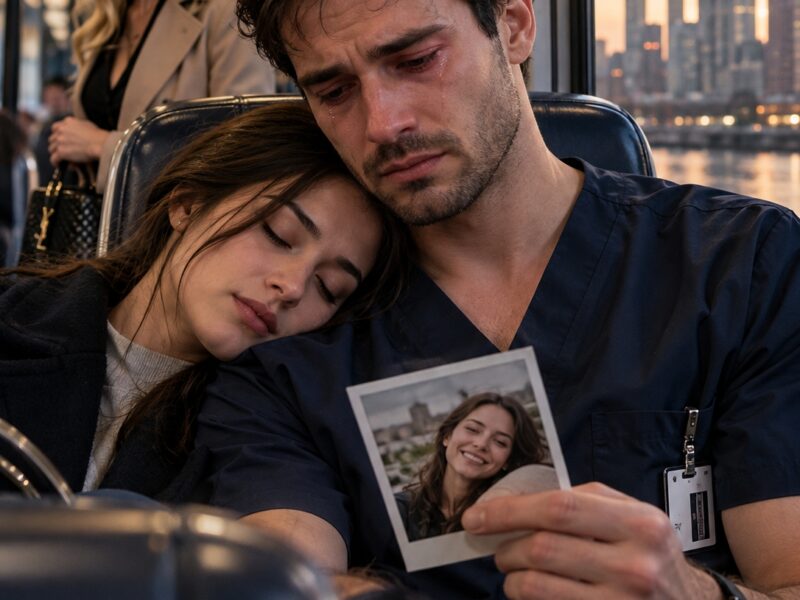
She Rested Her Head on a Widower’s Shoulder for 47 Minutes—Then He Learned Why She Chose Him

The stranger kept her head on my shoulder for exactly forty-seven minutes.
I know because I counted every one of them.
I counted the minutes because counting was easier than asking myself why I was terrified to move.
She smelled faintly of coffee, cold October rain, and something clean I couldn’t identify. Her dark hair brushed the underside of my jaw whenever the train rocked. One strand had caught against the zipper of my jacket, and I could feel the warmth of her temple through two layers of clothing.
I didn’t shift my arm.
Didn’t clear my throat.
Didn’t even reach for my phone when it vibrated in my coat pocket.
I sat perfectly still in the third row from the back of the 5:48 a.m. commuter train into Chicago, behaving less like a man with a sleeping stranger on his shoulder and more like someone trying not to detonate a bomb.
Because it had been fourteen months since another human being had touched me like that.
Fourteen months since my wife died.
And apparently, forty-seven minutes was all it took for my body to remember that warmth existed.
When the train began slowing for the next station, the woman stirred.
She lifted her head quickly, blinking as if she’d forgotten where she was.
For one second, we just stared at each other.
She was probably thirty. Maybe thirty-one. Dark hair braided loosely over one shoulder. Navy wool coat. No makeup that I could see. There were shadows beneath her eyes deep enough that I recognized them immediately.
I saw those shadows in the mirror every morning.
“Oh God,” she whispered. “I’m sorry.”
Her face reddened.
“I didn’t mean to fall asleep on you.”
“It’s fine.”
“No, really. That’s mortifying.”
“You’re okay.”
She grabbed the canvas tote bag between her boots and stood as the train doors opened.
“Sorry again.”
“Don’t worry about it.”
She gave me an awkward little smile, turned, and walked down the aisle.
I watched her go.
I shouldn’t have.
I hadn’t watched a woman walk away from me in years.
But something about her made it impossible to look anywhere else.
She reached the door.
Then stopped.
People moved around her onto the platform.
She turned back.
Our eyes met across the train car.
And the embarrassed expression she’d been wearing was gone.
Completely gone.
What replaced it was calm.
Deliberate.
Almost sad.
“I wasn’t really sleeping,” she said.
Then she stepped off the train.
The doors closed before I could answer.
I sat there with the warmth of her head still trapped in my jacket and watched her disappear into the morning crowd.
My heart was pounding.
Not romantically.
Not yet.
It felt more like fear.
Because for the first time since Abby died, I wanted something that had nothing to do with surviving until tomorrow.
I wanted to see that woman again.
And that scared the hell out of me.
I didn’t know her name.
I didn’t know where she was going.
I didn’t know why she’d chosen the empty seat beside mine when half the train car had been available.
Most of all, I didn’t know why a complete stranger had deliberately rested her head against a grieving widower for forty-seven minutes.
Seven mornings later, I would know.
And I would discover that almost nothing about our meeting had been an accident.
My name is Cole Sullivan.
I was thirty-three then, and I worked nights as an emergency room nurse at a hospital in downtown Chicago.
Seven p.m. to five a.m.
Sometimes six.
Sometimes seven if somebody called out or the waiting room filled up or a trauma rolled through the doors five minutes before shift change, which happened often enough that I stopped making plans for mornings.
Not that I had plans anymore.
My wife, Abby, had been a nurse too.
That’s how we met.
Same hospital. Different departments initially, then the same floor for almost two years.
She was better at the job than I was.
Better with frightened families.
Better at remembering names.
Better at walking into a room where somebody had just received the worst news of their life and somehow making the air feel breathable again.
She used to tell me I treated medicine like engineering.
“You’re always trying to fix the machine,” she’d say.
“That’s literally the job.”
“No. Sometimes the job is sitting beside the broken machine until it’s less afraid.”
“Machines aren’t afraid.”
She’d grin.
“Exactly why you’re the difficult one.”
Then she’d kiss me.
Abby got pancreatic cancer at thirty-two.
By the time they found it, there wasn’t much language left that didn’t sound like a euphemism.
Aggressive.
Advanced.
Complicated.
Limited options.
We both worked in medicine.
We knew what those phrases meant.
Eleven weeks after the diagnosis, I was holding her hand while she died.
People imagine grief arrives like an explosion.
Mine didn’t.
Mine arrived like winter.
Quietly.
Then everywhere.
After the funeral, friends filled our house for three days. They brought casseroles and flowers and bottles of wine nobody opened. Abby’s sister slept on the couch. My father stayed in the guest room. People washed dishes that were already clean because nobody knew what else to do with their hands.
Then they left.
That’s when the real grief started.
The first morning alone, I walked into the kitchen and saw Abby’s yellow coffee mug upside down in the drying rack.
I stood there for twenty minutes.
Just staring at it.
She had washed that mug.
She had put it there.
Her hands had touched it.
And somehow the world expected me to take it out of the rack and put it in a cabinet as though the person who had placed it there wasn’t dead.
I couldn’t.
Fourteen months later, it was still there.
I learned quickly that the hospital was easier than home.
At the hospital, suffering had instructions.
Bleeding? Apply pressure.
Cardiac arrest? Start compressions.
Anaphylaxis? Epinephrine.
Shock? Fluids, oxygen, monitor.
Death at home had no protocol.
There was no order set for walking past your wife’s shoes.
No medication for finding her shampoo in the shower.
No procedure for waking at 2:13 a.m. and reaching across the mattress before remembering there was nobody there.
So I worked.
And worked.
And worked some more.
I picked up every shift they offered.
Sometimes sixteen hours.
Sometimes eighteen.
People called me dedicated.
That was generous.
I was hiding.
Eventually, home became somewhere I stored clothes between shifts.
I’d get off work, ride the 5:48 train toward the suburbs, unlock the front door, and immediately feel the silence hit me.
I rarely slept more than two hours there.
But on the train?
I could sleep.
Something about being surrounded by strangers made grief easier.
Nobody knew me.
Nobody tilted their head and asked, “How are you holding up?”
Nobody said Abby’s name carefully, like it might cut me.
The train asked nothing.
So every morning I took the same car.
Same seat.
Window side.
Third row from the back.
And somewhere between downtown and the river, I’d close my eyes.
Sometimes I’d get twenty minutes.
Sometimes thirty.
It was the closest thing to peace I had.
Until Hannah.
I didn’t know her name yet on the second morning.
But she boarded the same train.
Same car.
5:48.
I noticed immediately.
Not because I was looking for her.
That’s what I told myself anyway.
She wore the same navy coat, her dark hair braided again, a canvas bag over one shoulder.
This time she didn’t sit beside me.
She sat three rows ahead.
I felt something stupidly close to disappointment.
She took a book from her bag and read the entire ride.
Never looked back.
When she reached her stop, she disappeared through the doors without acknowledging me.
I told myself that was good.
Normal.
Whatever strange thing had happened yesterday was over.
The following morning, she appeared again.
One row ahead this time.
Still reading.
Still pretending I didn’t exist.
But when the train rounded the sharp curve near the river and the car lurched sideways, her hand shot toward the empty seat beside her.
Not the armrest.
The seat.
Her palm landed there briefly, almost instinctively.
As if checking whether someone was still beside her.
Then she pulled it back.
At her station, she stepped onto the platform.
Before walking away, she glanced toward my window.
I was already looking.
Our eyes met.
We both looked away.
That should have embarrassed me.
Instead, I spent my entire twelve-hour shift thinking about it.
By the fourth morning, she’d moved to my row.
Across the aisle.
Her book was open.
She hadn’t turned a page in twenty minutes.
I knew because I was counting.
Apparently, grief had transformed me into a thirty-three-year-old man who monitored the reading habits of mysterious women on commuter trains.
The train hit the river curve.
Her book slipped from her lap.
My hand moved automatically.
I caught it inches above the floor.
She looked at the book.
Then at me.
“Nice reflexes.”
“ER nurse.”
“That explains it?”
“I catch things.”
Her mouth twitched.
“What’s the weirdest thing you’ve ever caught?”
I considered the question.
“A man’s dentures during a seizure.”
She stared at me.
“You’re lying.”
“I wish.”
“In midair?”
“Clean catch.”
She laughed.
Not politely.
Really laughed.
The sound was too loud for the quiet train car, and three people looked over.
She covered her mouth.
“Sorry.”
“Don’t apologize. He was fine.”
“The man?”
“The dentures.”
She laughed again.
And something happened inside my chest.
Something small.
Something painful.
Something alive.
“I’m Hannah,” she said.
“Cole.”
“Cole.”
She repeated my name slowly.
I noticed that.
I would remember it later.
“You take this train every morning,” she said.
“So do you.”
“I’ve only been doing it a few weeks.”
“You’ve been watching me?”
One eyebrow rose.
“You have a seat.”
I looked down.
“So?”
“People who have a seat have been commuting a long time. Everybody else searches. You don’t. You walk straight here.”
“Observant.”
“It’s a professional hazard.”
“What profession?”
“Illustrator.”
“For what?”
“Children’s books, mostly.”
That surprised me.
She didn’t look whimsical.
She looked tired.
“What are you doing downtown at six-thirty in the morning if you draw children’s books?”
Something moved across her face.
Gone almost immediately.
“I’m visiting someone.”
“Every day?”
She closed her book.
“Every day.”
“That’s a lot of visiting.”
“It’s a lot of someone.”
There was enough pain in the sentence that I knew not to ask anything else.
When her station arrived, she stood.
“See you tomorrow, Cole.”
And left.
I watched her go again.
That night, guilt arrived.
Not because I’d done anything.
Because I’d enjoyed myself.
I’d laughed with another woman.
I had looked forward to seeing her.
And somewhere in the broken arithmetic of grief, that felt like cheating.
I came home the next morning and stood in the bedroom doorway.
Abby’s side of the bed was still almost untouched.
Her paperback sat on the nightstand.
Page 186 folded at the corner.
A glass she’d used during her final week still sat beside it.
I hadn’t moved either.
“Is this okay?” I asked the empty room.
The silence gave me exactly what it always gave me.
Nothing.
Morning five, Hannah sat beside me.
She didn’t ask.
She simply arrived, placed her bag between her boots, opened her book and began reading.
For twenty minutes, neither of us spoke.
It was strange how comfortable it felt.
Silence with Abby had never been empty.
We could sit in the same room doing completely different things and still feel connected.
After she died, silence became punishment.
But sitting beside Hannah, for the first time in fourteen months, silence felt like company again.
Then she said, without looking up from her book, “You don’t sleep at home.”
My body tightened.
“What?”
“You sleep here.”
“Lots of people sleep on trains.”
“Not like you.”
She turned a page.
“You get on looking like you haven’t slept in a week. Your jaw is tight. Your hands are always moving. Then somewhere around the river, your eyes close.”
I stared at her.
“And?”
“And your hands stop.”
That landed harder than it should have.
She finally looked at me.
“You actually rest here.”
“You’ve been studying me?”
“Observing.”
“That’s less creepy?”
“Marginally.”
I almost smiled.
Then she said, “Whatever is waiting for you at home doesn’t let you rest.”
My throat closed.
She saw it.
Immediately, she looked back at her book.
“You don’t have to tell me.”
I said nothing.
“I just wanted you to know somebody noticed.”
That was all.
No questions.
No pity.
No head tilt.
Somebody noticed.
Fourteen months of working myself numb.
Fourteen months of answering “I’m fine.”
Fourteen months of becoming thinner, quieter, more exhausted.
And a stranger on a train noticed.
When Hannah stood to leave, she touched my sleeve.
Two fingers.
Barely anything.
“Tomorrow?”
I looked at her.
“Tomorrow.”
I felt those two fingers for the next twelve hours.
On morning six, she told me more.
Hannah Reed.
Thirty-one.
Freelance illustrator.
Raised in Springfield, Illinois.
Moved closer to Chicago about a year earlier.
Lived alone.
Worked mostly from home.
Which made the 5:48 train even stranger.
“Who are you visiting?”
She looked through the window.
“Someone I love.”
I waited.
Nothing else came.
So I let it go.
That evening at work, I did something I would later regret.
I searched her name.
It wasn’t difficult.
Hannah had a professional website.
Her illustrations were beautiful—soft watercolors, moonlit forests, rabbits wearing rain boots, bears carrying tiny lanterns.
They felt gentle in a way Hannah herself seemed determined not to be.
On her biography page was one sentence:
For my mother, who taught me that the best stories are the ones we tell someone who needs to hear them.
Her mother.
Something clicked.
Then I saw the address associated with one of Hannah’s recent posts.
My hospital.
I stared at the screen.
No.
I told myself not to do what I was thinking about doing.
Then I did it anyway.
I checked the patient directory.
REED, MARGARET.
Room 614.
Oncology.
I stopped breathing.
At three in the morning, I found myself standing outside the oncology elevators.
Sixth floor.
I worked emergency downstairs.
Different universe, same building.
Margaret Reed had been above me every night while Hannah rode into the city every morning.
And suddenly I understood those shadows beneath Hannah’s eyes.
I understood “It’s a lot of someone.”
I understood how she had recognized a person who couldn’t sleep at home.
Grief has a face before death.
People don’t talk about that enough.
It’s the face of someone already losing a person who is still breathing.
Hannah knew my face because she was becoming me.
The next morning, I sat beside her.
She looked up.
“Morning.”
“I know about your mother.”
Everything in her changed.
Her book slowly closed.
“What?”
“I work at the hospital where you get off.”
She said nothing.
“I looked you up.”
“Cole—”
“I know. I shouldn’t have.”
Her fingers tightened around the book.
“Room 614.”
Her eyes closed.
“Oncology.”
For several seconds, the only sound between us was the train.
Finally, she whispered, “Three months.”
“What?”
“They think she has maybe three months. Four if we’re lucky.”
I didn’t know what to say.
She laughed once, bitterly.
“Funny word, isn’t it? Lucky.”
“Hannah.”
“She was diagnosed almost a year ago. I moved here because I couldn’t keep driving from Springfield. Every morning I sit with her from six until noon. Then I go home and draw cheerful woodland creatures learning lessons about friendship.”
Her mouth trembled.
“Some days I think that’s hilarious.”
I looked down at my hands.
“I’m sorry.”
“Don’t be.”
“I invaded your privacy.”
“You did.”
“I’m sorry for that too.”
“I know.”
We sat quietly.
Then she said, “She’s all I’ve got.”
I knew that sentence.
Maybe not literally.
But emotionally.
“I know.”
Hannah looked at me.
And there was something strange in her expression.
Not surprise.
Recognition.
“I know you do,” she said.
The words made me turn.
“What does that mean?”
She looked away.
“Hannah.”
Her hands began trembling.
“I have to tell you something.”
A cold feeling moved through me.
“Okay.”
“You might hate me.”
“I’m too tired to hate anyone.”
“This might do it.”
She inhaled.
Then said one word.
“Abby.”
The train kept moving.
But for me, everything stopped.
“What did you say?”
“Your wife.”
I couldn’t speak.
Hannah’s eyes filled with tears.
“My mother knew Abby.”
I stared at her.
“How?”
“Your hospital. Mom’s been receiving treatment there for almost a year.”
I still didn’t understand.
“She had dozens of nurses. Most were kind. Some were busy. Some barely remembered her name.”
Hannah swallowed.
“But there was one nurse who came into her room at night when Mom couldn’t sleep.”
My chest tightened.
“She brought tea.”
I closed my eyes.
Abby always carried peppermint tea on night shifts.
“She’d sit with Mom after her rounds. They talked about old movies. Gardening. Books. Mom’s house in Springfield.”
“Hannah…”
“She treated her like a person instead of a diagnosis.”
Tears rolled down Hannah’s face.
“Her name was Abby Sullivan.”
The air disappeared from my lungs.
“No.”
“Yes.”
“Abby worked oncology before she got sick.”
“I know.”
“She never told me about—”
“She probably had hundreds of patients, Cole.”
Hannah wiped her cheek.
“But Mom remembered her.”
I looked through the window because looking at Hannah suddenly felt impossible.
Chicago blurred past.
“Abby told Mom about you.”
My head snapped toward her.
“What?”
“Apparently a lot.”
I almost laughed.
It came out broken.
“That sounds like her.”
“She said you were quiet. Stubborn. Kind when nobody was watching.”
My eyes burned.
“Hannah, stop.”
“There’s more.”
“I don’t want more.”
“I think you do.”
“No.”
She reached toward me, then stopped before touching me.
“Before Abby got sick, she told my mother she was worried about you.”
I couldn’t breathe properly.
“Why would she—”
“Because she knew.”
“Knew what?”
“That something was wrong.”
The train noise seemed to recede.
Hannah’s voice became the only sound.
“Mom said Abby hadn’t been diagnosed yet. But she’d been feeling sick. Losing weight. She knew enough medicine to be afraid.”
I stared at her.
“She told Mom that if something happened to her, you’d disappear.”
My jaw clenched.
“Hannah.”
“She said you’d work.”
“Stop.”
“You’d take extra shifts.”
“Please.”
“You’d convince everybody you were surviving because you were still functioning.”
I stood abruptly.
People looked at us.
I didn’t care.
“Don’t.”
Hannah’s face crumpled.
“She knew you, Cole.”
“You didn’t know her.”
“No.”
“Then don’t sit there telling me what my dead wife thought.”
“I know.”
“You don’t know anything about us.”
“I know.”
“Then why are you doing this?”
Her answer came so quietly I almost missed it.
“Because she asked my mother to look after you.”
I froze.
Hannah was crying now.
Not dramatically.
Silently.
“My mom told me Abby made her promise.”
“Promise what?”
“If she ever had the chance…”
Hannah’s voice broke.
“…not to let you disappear.”
I sat back down.
My legs had stopped working properly.
For a while, neither of us spoke.
Then another realization arrived.
Slowly.
Terribly.
“How long have you known who I am?”
Hannah looked at me.
I already knew I wasn’t going to like the answer.
“Before we spoke.”
My stomach dropped.
“How long?”
“Three weeks.”
I stared at her.
“You watched me for three weeks?”
“Mom knew your first name. She knew you worked nights in the ER. She knew roughly where you lived because Abby talked about the commute.”
“So you came looking for me?”
“No.”
“But you found me.”
“By accident.”
I laughed.
It sounded ugly.
“That’s convenient.”
“Cole, I swear.”
“Morning one.”
She went still.
“You sat beside me.”
“Yes.”
“You put your head on my shoulder.”
“Yes.”
“You said you weren’t sleeping.”
She closed her eyes.
“I wasn’t.”
“Why?”
Her face folded.
And when she answered, the truth destroyed what was left of me.
“Because I’d watched you for three weeks.”
I couldn’t move.
“You got on every morning looking a little worse. You sat in the same seat. You stared through the window like there was nothing on either side of it.”
“Hannah…”
“I told myself I was only checking on you for Mom. For Abby.”
Her voice trembled.
“But one morning you looked so tired, Cole.”
She pressed her palms together.
“So completely gone.”
I stared at her.
“I sat beside you because I needed to know if there was still somebody in there.”
My eyes filled.
“I leaned against you on purpose.”
“Why?”
“Because people react when strangers touch them.”
I couldn’t speak.
“I thought you’d move.”
She looked directly at me.
“You didn’t.”
Forty-seven minutes.
“I waited.”
Her tears fell freely now.
“You didn’t shift once. You didn’t wake me. You didn’t make me feel embarrassed. You just sat there.”
She covered her mouth briefly.
“And I thought, Abby was right.”
Something inside me broke.
“He’s still there,” Hannah whispered. “He’s just been alone too long.”
I cried.
Right there.
Third row from the back.
5:48 in the morning.
Thirty-three years old.
ER nurse.
Widower.
Professional fixer of other people’s emergencies.
I folded forward and cried so hard I couldn’t breathe.
Fourteen months of grief came out of me in one violent rush.
Abby’s diagnosis.
Her hair in the shower drain.
The morphine pump.
Her wedding ring sliding loose because she’d lost so much weight.
The final night.
That yellow mug.
Her side of the bed.
Everything.
Hannah didn’t tell me to calm down.
She didn’t tell me Abby would want me to be happy.
She didn’t say everything happens for a reason.
Thank God.
She simply put one hand between my shoulder blades.
And left it there.
Eventually, I managed to whisper, “She sent you.”
“No.”
I lifted my face.
“She did.”
“Abby asked my mother to look after you. Mom told me about you. That’s all.”
“Same thing.”
“No.”
Hannah’s eyes held mine.
“Abby got me onto this train.”
She took a shaky breath.
“But you’re the reason I kept sitting beside you.”
I stared at her.
“Why?”
Her answer was almost a whisper.
“Because somewhere between the dentures and the book and those forty-seven ridiculous minutes…”
She smiled through tears.
“…I started falling for you.”
I went home and shut every curtain.
For hours, I sat in the dark.
My first instinct was to call work.
There would always be a shift available.
Somebody would always be sick.
Somebody would always need me.
I picked up my phone.
Then I heard Abby.
Not literally.
Grief does strange things with memory. Sometimes the people you lose survive in sentences.
One of Abby’s favorite sentences came back to me.
Cole, you can’t outwork grief. You can only outwork yourself.
She’d said it years earlier about a patient’s husband.
Now it felt aimed directly at me.
I put the phone down.
For once, I stayed.
I sat in the chair until sunrise.
I cried again.
I slept for almost four hours.
The next morning, Hannah was already on the train.
I nearly turned around.
She saw me.
Neither of us spoke.
I sat beside her.
She reached into her bag and produced two coffees.
One with cream.
One black.
She held out the black one.
“How did you know?”
“You’re a night-shift ER nurse.”
“So?”
“Nobody working those hours voluntarily weakens coffee.”
I laughed.
A real laugh.
It startled both of us.
We rode quietly.
Near the river, her hand rested on the armrest between us.
A few minutes later, her smallest finger touched mine.
She didn’t grab my hand.
Didn’t force anything.
She just left it there.
An invitation.
I turned my palm upward.
Her fingers slipped into mine.
That became our first rule.
No pretending the dead hadn’t existed.
No pretending the living didn’t matter.
Weeks passed.
Then months.
The first time we met somewhere other than the train, Hannah claimed it was accidental.
It was a Saturday.
I found her on the station platform carrying a sketchbook and a paper bag from a bakery.
“Oh,” she said when she saw me. “You’re here.”
“Suspiciously convincing.”
“I’m drawing the river.”
“At six in the morning?”
“Good light.”
She lifted the bakery bag.
“I accidentally bought two croissants.”
“Tragic.”
“You could help.”
“Is this a date?”
“It’s a croissant, Cole. Try to survive the emotional complexity.”
We walked to the river.
Hannah sat with her sketchbook while I ate.
After twenty minutes she said, “Can I draw you?”
“No.”
“That wasn’t really a question.”
“I’m not interesting.”
Her pencil began moving.
“You’re extremely interesting.”
“Based on?”
“Your hands.”
I looked down.
“My hands?”
“They never stop.”
She studied them.
“Even when you’re sitting still, your fingers move. Checking. Adjusting. Reaching.”
I swallowed.
“Abby used to say that.”
It was the first time I’d said Abby’s name casually in front of Hannah.
Without preparing.
Without feeling like I had to apologize.
Hannah’s pencil paused.
Then continued.
“Tell me about her hands.”
The question almost undid me.
But I did.
I told Hannah Abby could start an IV in near darkness.
That she knitted during breaks.
That she used to cup my face with both hands whenever she wanted to make absolutely sure I was listening.
That the last time I’d held those hands, they’d still been warm.
Hannah never interrupted.
When I finished, she turned the sketchbook around.
She hadn’t drawn my face.
Only my hands.
Resting on my knees.
One thumb touching the scar across my opposite palm.
They looked tired.
Capable.
Lonely.
Alive.
“Keep it,” she said.
I still have that drawing.
But before it hung above our bed, before there was an “our,” there was Room 614.
I started visiting Margaret Reed.
Not as a nurse.
As Cole.
The first morning I walked into her room, she looked over her reading glasses and studied me for five uncomfortable seconds.
“So,” she finally said. “You’re Abby’s Cole.”
Apparently I would never escape that title.
“I’m Cole.”
“I know. Sit down.”
I obeyed.
Margaret was smaller than I’d expected.
Cancer had hollowed her cheeks, but her eyes were sharp.
“Abby talked about you constantly.”
“That’s what Hannah says.”
“She also said you were stubborn.”
“That sounds more accurate.”
“And that you wouldn’t ask for help.”
“Also accurate.”
“And that after she died, you’d probably try to work yourself to death.”
I looked at Margaret.
“She really said that?”
“Several times.”
Margaret adjusted her blanket.
“I told Hannah once she found you, she should be subtle.”
I stared.
“Your daughter pretended to sleep on my shoulder for forty-seven minutes.”
Margaret sighed.
“Yes. Subtlety has never been her strongest quality.”
I laughed.
Margaret smiled.
For two months, I visited her three mornings a week.
Sometimes Hannah arrived while I was there.
Eventually, the three of us developed a rhythm.
Coffee.
Bad hospital oatmeal.
Margaret criticizing television doctors.
Hannah sketching.
Me pretending not to monitor Margaret’s oxygen saturation even though everybody knew I was doing it.
Margaret watched Hannah and me carefully.
Not suspiciously.
Hungrily.
Like someone memorizing a room before leaving it forever.
One morning Hannah went downstairs for coffee.
Margaret reached beneath her pillow.
“Cole.”
Her voice had changed.
I moved closer.
“What?”
“She loves you.”
I looked toward the door.
“Hannah?”
“No, the respiratory therapist. Of course Hannah.”
“Margaret—”
“She won’t tell you.”
“Why?”
“Because she’s losing me.”
Her eyes softened.
“And she thinks loving you makes you another thing she can lose.”
I understood that too well.
“Don’t make her say it first.”
“I’m not sure I’m ready.”
“Nobody is.”
She reached for my hand.
Her fingers were frighteningly light.
“Can I tell you exactly what Abby said?”
My entire body went still.
“What do you mean?”
“I wrote it down.”
Margaret pulled a folded sheet of hospital stationery from beneath her pillow.
The paper was worn along the creases.
“I knew I’d forget parts. Medication, pain, all of it. So after Abby left my room that night, I wrote down what she’d said.”
She unfolded it.
My pulse began pounding.
“Do you want to hear it?”
No.
Yes.
Both answers existed simultaneously.
I nodded.
Margaret began reading.
“He’s going to be so alone when I’m gone, Margaret.”
My eyes closed.
“He won’t ask for help. He’ll work until there’s nothing left, and he’ll think that makes him strong.”
I pressed my fist against my mouth.
“But it doesn’t. It just makes him empty.”
Margaret’s voice shook.
“If you ever get the chance, show him the world still has warmth in it.”
A tear slipped down my face.
“He’ll resist. He always resists.”
Margaret smiled faintly.
“That sounds like her.”
I couldn’t answer.
She continued.
“But he’s worth the fight. He’s the kindest, quietest, most stubborn man alive.”
My chest hurt.
“And he deserves somebody who will sit next to him and not move.”
Margaret stopped.
I opened my eyes.
“That’s all he needs,” she finished. “Someone who doesn’t move.”
For several seconds, neither of us spoke.
Then I laughed through tears.
“She actually said that?”
“Word for word.”
Margaret folded the paper.
“Your wife knew you.”
“Yes.”
“She also loved you enough to imagine a world where she wasn’t the last person who ever would.”
That sentence changed something in me.
I’d spent fourteen months believing loving again would betray Abby.
But Abby had apparently spent part of her dying worrying that I wouldn’t.
Margaret squeezed my hand.
“Don’t turn her love into a prison, Cole.”
I looked toward the hallway where Hannah would soon appear.
“That’s not what she built.”
Margaret died on a Tuesday in April.
Hannah held her left hand.
I held her right.
The monitors slowed.
Her breathing changed.
I recognized every stage.
Every terrible little sign.
Fourteen months earlier, I’d stood beside Abby’s bed helplessly watching death approach.
Now I stood beside Margaret.
But this time I didn’t run afterward.
That mattered.
When Margaret took her final breath, Hannah made a sound I will never forget.
Not a scream.
Something smaller.
Almost childlike.
“Mom?”
I moved around the bed.
Hannah looked at me.
“Mom?”
I held her.
And for the first time in my life, I understood what Abby had meant about broken machines.
Sometimes you don’t fix anything.
Sometimes there is no fix.
Sometimes love is simply staying beside the person who is breaking.
Hannah fell apart after Margaret’s funeral.
Completely.
For a year, she’d had a mission.
5:48 train.
Hospital.
Room 614.
Six hours beside her mother.
Home.
Illustrations.
Sleep.
Repeat.
Then suddenly there was no Room 614.
No reason for the 5:48.
No mother waiting.
The structure disappeared, and Hannah disappeared with it.
So I stayed.
When she cried on her kitchen floor at two in the morning, I sat beside her.
When she went three days without drawing, I brought her sketchbook but didn’t tell her to use it.
When she woke from dreams and called for Margaret, I held her.
When she apologized for being “too much,” I told her the truth.
“You sat beside me when I was disappearing.”
She looked at me.
“I’m not going anywhere.”
One night, weeks after Margaret died, Hannah whispered, “I’m scared.”
“Of what?”
“You.”
“That’s flattering.”
“I’m serious.”
I turned toward her.
She was crying.
“I love you.”
There it was.
The sentence Margaret had said Hannah would be too afraid to speak.
“And every person I love leaves.”
I touched her face.
“Your mother didn’t leave because you loved her.”
“I know.”
“Abby didn’t die because I loved her.”
“I know.”
“We don’t get to protect people by loving them less.”
Her face crumpled.
I kissed her forehead.
“I love you too.”
She closed her eyes.
“And I’m terrified.”
That made her laugh through her tears.
“Good.”
“Good?”
“Now we’re terrified together.”
We married the following fall.
Small ceremony.
Hospital chapel.
People thought that choice was strange.
It wasn’t.
That hospital had taken more from us than any building should be allowed to take.
But it had also given us things.
Abby and me.
Margaret and Abby.
Hannah and me.
The ER nurses filled two rows.
Several oncology nurses came.
Hannah’s publisher attended.
There was an empty chair for Margaret.
And another for Abby.
Not because we wanted ghosts at our wedding.
Because pretending they hadn’t helped bring us there would have been a lie.
Before the ceremony, I gave Hannah something.
A blue scarf.
She stared at it.
“Abby made this.”
I nodded.
I’d found it in a drawer months after her death.
Soft blue wool.
Uneven stitching near one end.
The sort of thing Abby knitted during night shifts when the floor was quiet.
Hannah pressed it against her face.
For a second, she didn’t move.
Then she began crying.
“What?”
She breathed against the wool.
“It smells like peppermint.”
My throat closed.
“She used to bring Mom peppermint tea.”
Hannah wrapped Abby’s scarf around her shoulders.
She wore it when she walked toward me.
People sometimes ask whether that was strange.
Whether my dead wife’s scarf belonged at my wedding to another woman.
Those people misunderstand grief.
Hannah never replaced Abby.
She couldn’t.
Love isn’t a job vacancy.
Abby was my wife.
She existed.
She mattered.
She died.
Hannah was not the eraser that removed those facts.
She became the person who taught me I could carry them without letting them bury me.
And somehow, loving Hannah didn’t make Abby smaller.
It made the life Abby had loved in me larger again.
I eventually switched to day shifts.
The first night I slept eight uninterrupted hours at home, I woke up terrified.
Sunlight was coming through the curtains.
For a second, I didn’t know where I was.
Then I felt Hannah beside me.
Her hand rested on my chest.
I looked across the room.
The drawing of my hands hung above the nightstand.
Hannah’s books were stacked beneath it.
And in the bottom drawer was Abby’s scarf.
Nothing erased.
Nothing competing.
Everything simply allowed to exist.
We still take the 5:48 sometimes.
Not because we need to.
Because some anniversaries deserve rituals.
Abby’s birthday.
Margaret’s.
The day Hannah first leaned against me.
We buy coffee.
Board the same car.
Take the same seats.
Third row from the back.
Window side.
Chicago slowly wakes beyond the glass.
And eventually, without fail, Hannah puts her head on my shoulder.
I always smile.
I always stay still.
After about ten minutes, she whispers the same thing.
“I’m not really sleeping.”
And every time, I answer the same way.
“I know.”
Then we ride.
Sometimes Hannah closes her eyes.
Sometimes I do.
Sometimes neither of us says anything for the entire trip.
There are mornings when I swear I can smell peppermint tea.
I don’t believe in signs.
At least, I don’t think I do.
But I’ve stopped needing explanations for everything.
Once, I believed surviving grief meant moving.
Work another shift.
Answer another call.
Save another patient.
Keep walking.
Keep moving.
Never stop long enough for death to catch up.
I was wrong.
The bravest thing I ever did wasn’t saving someone in an emergency room.
It wasn’t holding Abby’s hand while she died.
It wasn’t falling in love again.
It happened at 5:48 on an ordinary weekday morning, when a woman I didn’t know rested her head against my shoulder.
For forty-seven minutes, I didn’t move.
I thought I was being kind to a sleeping stranger.
I didn’t know she was awake.
I didn’t know she’d been watching me disappear.
I didn’t know my dying wife had once sat beside her dying mother and worried about the man she’d leave behind.
I didn’t know Abby had asked someone to show me there was still warmth in the world.
And I certainly didn’t know that warmth would arrive wearing a navy coat, carrying a children’s book, pretending to sleep.
I only knew someone needed a place to rest.
So I stayed.
Years later, I finally understand what Abby understood before I did.
Sometimes love doesn’t save you by pulling you forward.
Sometimes it doesn’t need speeches, promises, miracles, or answers.
Sometimes love simply sits down beside you when you’re certain everyone eventually leaves.
It leans its head against your shoulder.
And when every instinct you’ve developed from loss tells you to run before you can be hurt again—
love stays.
So you stay too.
This morning, Hannah and I took the 5:48 again.
Rain streaked the windows.
Chicago appeared slowly through the gray.
She rested her head on my shoulder in the third row from the back.
I felt her breathing.
Warm.
Steady.
Alive.
After ten minutes, she whispered, “Cole?”
“Yeah?”
“I’m not really sleeping.”
I looked down at the woman who once found me because my dead wife was afraid I would disappear.
“I know.”
Her hand found mine.
The train kept moving.
Neither of us did.









