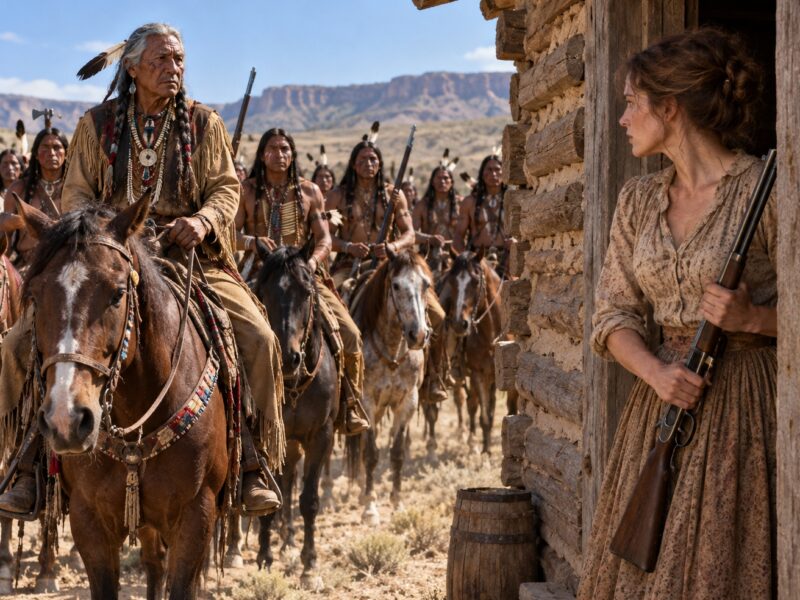
She Saved a Dying Comanche From Six Armed Men—Two Days Later, Warriors Surrounded Her Lonely Cabin
Clara McKe knew that standing between six armed men and a wounded Comanche stranger might cost her everything.
She did it anyway.
But when more than a dozen warriors appeared outside her isolated New Mexico cabin less than two days later, she realized that saving one man’s life might have brought an entire world of danger to her doorstep.
The sun had been merciless since morning. Heat wavered above the hard-packed earth, and the distant mountains looked pale through a curtain of dust. Clara walked home from the half-dried creek with a dented metal bucket in one hand, trying not to think about how little water she had managed to collect.
She had spent nearly an hour scraping the shallowest part of the creek bed, waiting for muddy water to settle enough to fill her bucket. The journey had taken a mile each way, and now the sun was climbing toward its hottest hour. With every step, the handle cut more deeply into her fingers.
Her cabin stood beyond the next rise, where a few struggling cottonwoods offered the only real shade for miles. It was not much of a home anymore, but it was hers. After her husband’s death, that had become a distinction she held on to with surprising stubbornness.
She was thinking about the cracked clay water jar beside her kitchen stove when she noticed the buzzards.
Three of them circled low over the trail ahead. A fourth perched on a dead branch, its dark head angled toward something lying among the rocks.
Clara slowed.
At first, she thought it was a calf or perhaps a deer that had wandered too far from water. Then a movement caught her eye—a hand shifting weakly against the dirt.
She set down her bucket.
The young man lay partly in the shadow of a large rock, his black hair tangled against his forehead. His shirt was torn and stiff with dried blood. One leg rested at an unnatural angle, and a broken arrow shaft protruded from his thigh.
He could not have been much older than twenty.
For a moment, Clara did nothing.
Her father’s voice returned with painful clarity. You see one of them alone, girl, he’s bait. Don’t stop. Don’t get close.
Her father had believed the frontier could be divided neatly into people worth trusting and people worth fearing. Clara had once believed him, too. Marriage, loss, and years spent watching decent people do cruel things had made those divisions harder for her to accept.
She glanced toward the empty trail.
No horses. No voices. Nothing but the buzzards and the dry rasp of wind moving across the brush.
The young man’s chest rose again, barely.
Clara crouched beside him and pressed two fingers against his neck. His skin was burning hot, but beneath her touch she felt a faint, uneven pulse.
“Lord help us both,” she murmured.
She lifted his head carefully and brought the bucket close. There was scarcely enough water for supper, washing, and the following morning, but she dipped her fingers into it and touched them to his cracked lips.
His mouth moved.
“Easy,” she whispered. “Just a little.”
He swallowed a few drops. His eyelids fluttered but did not open.
Then Clara heard horses.
She turned sharply.
Six riders appeared beyond the rise, their horses moving fast enough to send long clouds of dust across the trail. Clara recognized the man in front before she could make out his face.
Tucker.
He was a broad-shouldered ranch hand with a reputation for settling disagreements through intimidation. Clara had known him long enough to recognize that the easy smile he wore in public rarely reached his eyes.
He reined in several yards away. His gaze traveled from Clara’s bucket to the wounded man, then returned to her face.
“Miss McKe,” he drawled. “Ain’t this a surprise.”
Clara remained kneeling.
“He’s hurt.”
Tucker glanced at his companions. One of them gave a short, unpleasant laugh.
“Looks worse than hurt to me.”
“He’s dying,” Clara said.
“He’s Comanche,” Tucker answered, as though that settled the matter.
Clara looked down at the young man. Blood had seeped through the dust beneath his leg. The broken arrow was lodged deep, and his breathing had grown so shallow that she had to watch carefully to see it.
“He’s still a human being.”
Tucker’s expression hardened.
“That one killed two men near Dry Creek.”
“Did you see him do it?”
The question seemed to irritate him more than an outright accusation would have.
“That’s what we were told.”
“By whom?”
Tucker leaned forward in his saddle. “You fixing to interrogate me, Clara?”
She stood slowly. Her knees ached from kneeling on the hot ground, but she did not step away from the injured man.
“I’m asking whether you know what you’re saying is true.”
One of the other riders shifted his rifle across his lap. “Woman, you save him, he’ll gut you before sundown.”
Clara felt her heartbeat quicken. She was alone, miles from anyone who might come to her aid. Tucker knew that. So did the men riding beside him.
She wished suddenly that she had brought her rifle.
Tucker studied her for a moment, then nodded toward the stranger.
“Move aside.”
“No.”
His eyes narrowed.
“Clara, don’t make trouble where there don’t need to be any.”
“Then leave him alone.”
“You’re helping an enemy.”
“I’m helping a wounded man.”
“You do this, you’re a traitor.”
Clara’s fingers tightened around the bucket handle.
Tucker reached toward his rifle.
Something cold moved through her, steadier than fear. She had watched her husband die of an infection that no amount of care or praying had been able to stop. She knew what a human body looked like when it was running out of strength. The young man at her feet had very little left.
“Then let him die,” Tucker said.
Clara stepped directly between the rifle and the man on the ground.
“You raise that rifle again on my land, Tucker, and I swear I’ll put you in the ground next to him.”
The words came out quieter than she expected.
For several seconds, nobody moved.
The horses stamped and tossed their heads. A leather saddle creaked. Sweat trickled down Clara’s back beneath her faded cotton dress.
She was not sure whether Tucker would shoot her.
Worse, she suspected he wasn’t sure either.
Then he spat into the dirt.
“You always were a fool for lost causes.”
He pulled his horse around and rode away. The others followed, though two looked back before disappearing beyond the ridge.
Clara stood motionless until the sound of hooves faded.
Only then did she realize how badly her hands were trembling.
She knelt beside the stranger again. His eyes were closed, but his breathing continued.
“Well,” she whispered, “I suppose we ought to get you somewhere before I lose what little sense I’ve got left.”
She tore a strip from her scarf and tied it firmly enough around his injured leg to secure a clean dressing without pressing on the embedded shaft. Then she examined the ground around him.
Dragging him a mile over rough terrain could make the injury worse. Leaving him under the sun would be worse still.
Clara fetched the small canvas she used to cover her bucket on dusty days. She eased it beneath his shoulders and hips as carefully as she could, wincing whenever he groaned.
The journey home was slow and miserable.
She stopped often to rest, protecting his injured leg from the rocks whenever possible. Her palms blistered. Her shoulders burned. Twice she sank onto her knees, too exhausted to move another inch.
Each time, she looked at his face.
He was so young.
Once, her husband Daniel had carried a frightened stray dog nearly three miles after finding it caught in an abandoned trap. Clara had scolded him for exhausting himself over an animal they couldn’t afford to feed.
Daniel had smiled and said, “Guess we don’t get to decide what matters only when it’s convenient.”
She had not thought about that afternoon in years.
Now, with tears stinging her eyes from heat and effort, she heard his voice as clearly as if he were walking beside her.
By the time the cabin appeared, the sun had begun its slow descent.
Clara almost laughed with relief.
“There’s home,” she told the unconscious stranger. “Such as it is.”
She managed to pull him across the threshold and into the dim interior. The cabin smelled of dried herbs, woodsmoke, and the dust that always found its way through the walls.
She closed the door behind them.
For a long moment, she leaned against it, listening.
Nothing.
Still, Tucker knew where she lived.
And Tucker was not a man who enjoyed being defied.
Clara crossed to the cellar hatch and lifted its heavy wooden cover. The space below was small and cool, used mostly for storing potatoes, preserves, and the few supplies she could afford to keep through winter.
She spread blankets on the earth floor and carefully helped the stranger down the narrow steps, taking most of his weight against her shoulder.
“I’ll regret this,” she muttered when they finally reached the bottom. “But not today.”
She lit a lantern.
The arrow shaft protruded from the swollen tissue of his thigh. Clara had little medical knowledge beyond what years of hardship had taught her, but she knew enough not to pull something deeply embedded out of a wound without knowing what it might tear on the way.
She boiled water, washed her hands, and carefully cleaned the dirt and dried blood from the surrounding skin. She set whiskey nearby, though she knew it could do little to repair the damage already done.
Her husband’s last illness had begun with a small wound on his hand.
At first, Daniel had laughed it off. Then the skin turned red, the swelling spread, and fever took hold so suddenly that by the time they reached a doctor, there was little left anyone could do.
Clara still remembered sitting beside his bed with a damp cloth in her hand, watching the man she loved drift farther away.
She had promised herself she would never again ignore the early signs of a wound turning dangerous.
Now she pressed a clean dressing gently around the arrow shaft and secured it in place.
The stranger groaned.
His eyelids opened.
His gaze darted around the cellar, then fixed on Clara. Fear passed across his face so quickly and clearly that she lifted both hands to show they were empty.
“Easy,” she said. “You’re safe.”
His breathing quickened.
“For now,” she added, because she could not bring herself to promise anything more.
He stared at her.
“I found you beside the trail. Six men came looking for you.”
His expression changed.
“One of them was Tucker,” she continued, though she doubted the name meant anything to him. “They’ve gone.”
The young man tried to lift himself, but pain twisted his face and forced him back onto the blanket.
“Don’t,” Clara said gently. “You’ll start bleeding again.”
He watched her as she adjusted the dressing. His eyes remained alert, measuring every movement.
“You don’t have to thank me,” she said. “Just don’t kill me when you can stand again.”
For the first time, something shifted in his expression.
Not quite a smile.
But perhaps the beginning of an understanding.
That evening, Clara brought him broth made from dried beans and the last of her salted meat. He drank slowly, with one hand resting protectively near the injured leg.
She checked his fever, changed the damp cloth beneath his head, and left a cup of water within reach.
Then she climbed out of the cellar, pulled the hatch almost closed, and sat beside it with her rifle across her knees.
Outside, night settled over the desert.
Coyotes called somewhere beyond the creek. Wind scraped branches against the cabin wall. Every unfamiliar sound made Clara glance toward the door.
She did not believe the stranger would harm her.
Not exactly.
But she had survived long enough to understand that compassion was not the same thing as certainty.
Near midnight, a whisper rose through the hatch.
Clara leaned closer.
The young man was speaking in his own language, his voice hoarse with fever.
One word returned again and again.
“Nocomi.”
She listened, trying to decide whether it was someone’s name, a prayer, or a plea.
“Nocomi,” he whispered once more.
Clara lowered herself beside the opening.
“I’m here,” she said softly, though she knew he might not understand.
His voice faded.
For a long while, she remained where she was, watching the dim light from the lantern move across the cellar wall.
By morning, the fever had eased slightly.
The stranger was awake when she brought down another cup of broth. He pushed himself up on one elbow, grimaced, and accepted it with both hands.
His fingers brushed hers.
He glanced at the cup, then at her.
For the first time since she had found him, his eyes held something other than fear.
He gave one small nod.
Clara returned it.
“You’re welcome,” she said.
The day passed slowly.
She changed his bandages, brought him water, and watched for signs of worsening infection. He remained weak, but his breathing was steadier. He spoke little, and the words he did say were unfamiliar to her.
Once, when she lifted the cellar hatch, she found him staring at the strip of sunlight falling across the floor.
She wondered whether he had a mother waiting somewhere.
Perhaps a wife.
Perhaps children.
She thought of the word he had whispered in the night.
Nocomi.
There were so many things she did not know about the man she had risked her life to save.
Before bed, she checked the door latch twice and rested her rifle beside her chair.
She told herself Tucker would not return.
She did not quite believe it.
The following morning, Clara woke to a sound that was entirely out of place in the quiet desert.
Hooves.
Not one horse.
Many.
She sat upright.
For a few seconds, she listened without moving, trying to count the separate rhythms passing over the hard earth.
Then she rose and crossed to the window.
Dust curled beyond her fence.
Riders emerged through it, one after another, until more than a dozen Comanche warriors surrounded the little cabin.
Clara’s stomach tightened.
The men moved with quiet purpose. Their rifles remained lowered, but each carried weapons, and none showed any sign of leaving.
She looked toward the cellar hatch.
The young stranger was directly beneath her feet.
Had he somehow summoned them?
Had someone followed her home?
Clara reached for her rifle.
Outside, the riders formed a loose semicircle around the cabin. Their horses shifted in the morning light, dark shapes against the pale landscape.
At the center rode an older warrior with silver threaded through his braids. Faded paint marked his chest, and his face carried the stillness of a man accustomed to being obeyed.
He lifted one hand.
The other riders stopped.
Clara held her breath.
The older man dismounted, handed his reins to a younger warrior, and turned toward the cabin.
He did not draw a weapon.
He did not call for the others to follow.
Instead, he began walking alone toward Clara McKe’s front door.
And Clara, standing inside with her rifle trembling in her hands, had no idea whether he had come to thank her for saving the young man—or make her pay for what she had done.









