She Saved a Stranger’s Life—Then Discovered the One Thing He Had Been Hiding From Her

The first time Grace Miller touched Nathaniel Cole, his heart had already stopped.
She didn’t know his name.
She didn’t know where he lived.
She didn’t know that people waited months just to get ten minutes on his calendar, that his signature could move millions of dollars before lunch, or that his photograph had appeared on the front page of business magazines more times than she could count.
All Grace knew was that thirty seconds earlier, the tired-looking stranger had been standing on the other side of her grocery-store register.
Now he was lying motionless on the pavement.
And nobody was moving.
“Call 911!”
Grace’s voice cracked across the parking lot.
Someone screamed.
A shopping cart rolled loose between two parked cars.
A man near the entrance pulled out his phone but seemed too shocked to dial.
Grace was already running.
Her name tag bounced against the faded green apron she had been wearing for almost nine hours. Her knees hit the pavement hard enough to tear the fabric of her pants, but she barely felt it.
“Sir?”
Nothing.
She touched his shoulder.
“Can you hear me?”
Nothing.
His face had gone frighteningly still.
Grace checked for breathing.
There was none.
For one horrible second, the parking lot became silent around her.
Then training she hadn’t used in years came back.
She placed her hands over the center of his chest.
“Come on.”
She pushed.
Once.
Twice.
Again.
“Please.”
Again.
Again.
Again.
She had learned CPR during a workplace safety course three years earlier. She remembered complaining that the class had lasted too long. She remembered laughing with another cashier while they practiced compressions on a plastic mannequin.
She had never imagined that one night she would be kneeling beneath the white fluorescent glow of a grocery-store sign, trying to force a stranger’s heart to beat.
“Ambulance is coming!” someone shouted.
Grace didn’t look up.
“Come on. Stay with me.”
His body moved beneath the force of every compression.
Nothing else did.
“You were just talking to me,” she whispered. “You don’t get to do this now.”
A woman standing nearby began crying.
Grace kept counting.
She could hear her own breathing.
She could hear someone praying.
She could hear the distant siren growing louder.
But she couldn’t hear the one thing she desperately wanted.
A breath.
“Please don’t die.”
The ambulance tore into the parking lot.
Two paramedics jumped out before it had fully stopped.
“Ma’am, step back.”
“He’s not breathing,” Grace said quickly. “He collapsed maybe two minutes ago. I started CPR immediately.”
“We’ve got him.”
She moved aside.
Only then did she realize her hands were shaking.
The paramedics worked with brutal efficiency—monitor, pads, oxygen, commands Grace couldn’t fully process.
One of them opened the man’s wallet.
“Do you know him?”
Grace shook her head.
“No. He came through my register.”
“Name’s Nathaniel.”
The name meant nothing to her.
The paramedic tried a phone number.
No answer.
Another.
Still nothing.
Grace stared.
“His family?”
“We can’t reach anyone.”
“What do you mean?”
The paramedic was already moving.
“It means nobody’s answering.”
They lifted Nathaniel onto the stretcher.
Grace looked at the man’s pale face.
Twenty minutes earlier, he had been buying coffee, bread, eggs, and a frozen dinner.
She remembered because the frozen dinner had been the cheapest one in the case.
She had smiled at him while scanning it.
“Long day?”
He had looked exhausted.
“You could say that.”
“Hopefully tomorrow’s better.”
He’d given her the faintest smile.
Then he’d walked outside.
And collapsed.
Now tomorrow wasn’t guaranteed at all.
The ambulance doors opened.
Grace hesitated.
Her shift wasn’t technically over.
Her purse was still in the employee locker.
She had no car.
If she left now, she would miss the last bus home.
None of those thoughts lasted longer than a second.
“I’m coming with him.”
The paramedic looked at her.
“You family?”
“No.”
“Friend?”
Grace looked at the unconscious stranger.
“No.”
The paramedic frowned.
“Then why—”
“Because nobody else is.”
Something in Grace’s voice ended the question.
She climbed inside.
And that was how Grace Miller—a thirty-four-year-old grocery-store cashier with forty-three dollars in her checking account, a rent payment due Friday, and absolutely no idea who Nathaniel Cole was—rode through the city beside one of the wealthiest men in the state.
Neither of them knew it yet.
But Nathaniel’s stopped heart was not the most dangerous thing that began that night.
Because hearts could sometimes be restarted.
Trust was harder.
Grace sat in the ambulance with her hands clasped tightly between her knees.
The paramedics worked around her.
Nathaniel’s shirt had been cut open.
Wires crossed his chest.
His skin looked gray beneath the harsh lights.
Grace kept staring at his face.
There was something unsettling about seeing a stranger so defenseless.
No wallet.
No job title.
No polished shoes.
No explanation.
Just a human being whose body had suddenly betrayed him.
“Come on,” she whispered.
One paramedic glanced at her.
Grace didn’t care.
“You don’t know me,” she said softly to Nathaniel. “I don’t know you. But you better stay.”
The monitor changed.
The paramedic leaned forward.
Grace held her breath.
Then came another command, another movement, another terrifying stretch of seconds.
Finally, one of them exhaled.
“We’ve got a rhythm.”
Grace closed her eyes.
She had not realized she was crying until a tear reached her mouth.
At the hospital, Nathaniel disappeared behind a pair of emergency-room doors.
Grace remained in the hallway.
Her grocery-store apron was stained.
There was dirt on her knees.
Her hair had fallen loose from the ponytail she’d tied that afternoon.
Everyone around her seemed to belong there.
Families.
Doctors.
Nurses.
People holding insurance cards and overnight bags.
Grace belonged nowhere in the picture.
A nurse approached.
“Are you Mrs. Cole?”
Grace blinked.
“No.”
“His sister?”
“No.”
“Relative?”
“No.”
The nurse hesitated.
“Then who are you?”
Grace looked toward the closed treatment-room doors.
“I was standing close enough to help.”
The nurse studied her for a moment.
Something in her expression softened.
“He’s being treated. You can wait if you’d like.”
Grace sat down.
The chair was cold plastic.
At 10:17 p.m., she missed the final bus.
At 10:43, her stomach reminded her that lunch had been seven hours earlier.
At 11:06, her manager texted asking where she had gone.
Grace typed:
Medical emergency. I’ll explain tomorrow.
At 11:31, she stood at a vending machine deciding whether spending $2.75 on crackers was irresponsible.
She bought them.
At midnight, she still had no update.
At 12:26, she considered leaving.
She stood.
Looked toward the emergency-room doors.
Sat down again.
It made no logical sense.
She had done everything she could.
She wasn’t responsible for him.
Yet every time she imagined walking outside, something stopped her.
Maybe it was because she had felt his ribs beneath her hands.
Maybe it was because she had watched a human life narrow down to a line on a monitor.
Or maybe it was because of those unanswered phone calls.
Grace understood something about empty chairs.
Her mother had died six years earlier after a long illness. Her father had been gone since Grace was seventeen. There were people she knew, coworkers who liked her, neighbors who waved from porches.
But there was a difference between knowing people and having someone who would come when the hospital called at midnight.
Grace knew that difference too well.
At 1:12 a.m., the nurse returned.
“He’s stable.”
Grace stood so quickly the cracker wrapper fell from her lap.
“Stable?”
“Yes. The doctor says the CPR made a significant difference. Whoever started compressions quickly probably saved his life.”
Grace lowered her eyes.
“Can I see him?”
“He’s unconscious.”
“I don’t need him to know I’m there.”
The nurse considered it.
“Just for a minute.”
Nathaniel looked different beneath hospital sheets.
Smaller somehow.
Less mysterious.
Grace stood beside the bed.
There was a bruise beginning to form where she’d performed compressions.
“Sorry about that,” she murmured.
No response.
She almost laughed at herself.
“I don’t even know why I’m talking to you.”
The monitor answered with steady beeps.
Grace looked at his face.
“I hope somebody comes.”
Nothing.
She waited another moment.
Then she touched the railing rather than his hand.
“Take care of yourself, Nathaniel.”
It was the first time she had said his name.
She left before dawn.
She didn’t leave her phone number.
She didn’t ask whether there was a reward.
She didn’t even leave her last name.
And several hours later, when Nathaniel Cole finally opened his eyes, the first thing he asked wasn’t whether his company had been notified.
It wasn’t what meetings he had missed.
It wasn’t whether the press knew.
It was—
“Where is she?”
Dr. Harris looked up from the chart.
“Who?”
“The woman.”
Nathaniel’s voice was rough.
“The woman from the parking lot.”
“You remember her?”
“Pieces.”
He remembered fluorescent lights.
Pain.
A woman’s voice.
Stay with me.
Please don’t die.
He remembered nothing after that.
Dr. Harris pulled a chair closer.
“You suffered sudden cardiac arrest. You were fortunate.”
Nathaniel gave him a tired look.
“People usually say that after something less dramatic.”
The doctor smiled slightly.
“In your case, I’m serious. CPR was started almost immediately. Those first minutes mattered.”
“The woman did it?”
“Yes.”
Nathaniel stared at the ceiling.
“Where is she?”
“She left early this morning.”
“Did she leave a name?”
“Grace. I think.”
“Last name?”
“No.”
“Phone number?”
“No.”
Nathaniel frowned.
“She rode here with me?”
“Apparently.”
“Why?”
The doctor seemed amused by the question.
“You’d have to ask her.”
Nathaniel turned his head.
“Was she family?”
“No.”
“A friend?”
“No.”
“Employee?”
“I don’t believe so.”
Nathaniel stared at him.
Dr. Harris closed the chart.
“From what I heard, she was the cashier who checked out your groceries.”
For several seconds Nathaniel said nothing.
There were moments in life when wealth altered reality.
Nathaniel knew that better than most.
A delayed flight could become a chartered jet.
A fully booked restaurant could discover a private table.
A bureaucratic obstacle could suddenly become a scheduled meeting.
Money did not make every problem disappear.
But it persuaded many problems to move.
Nathaniel had spent decades learning that lesson.
And because of that, he had learned another one.
People behaved differently when they knew what he had.
They laughed harder.
Agreed faster.
Remembered birthdays.
Forgave insults.
Asked for opportunities.
Offered friendships.
Nathaniel had stopped judging them for it years ago.
But he had also stopped trusting easily.
Now somewhere in the city was a woman who had knelt on dirty pavement and fought for his life without knowing whether he could ever repay her.
Then she had waited for hours.
And left without asking for anything.
Nathaniel looked at Dr. Harris.
“Find her.”
The doctor raised an eyebrow.
“I’m a cardiologist, Mr. Cole.”
Despite the ache in his chest, Nathaniel almost smiled.
“Right.”
His assistant, Benjamin, arrived forty minutes later.
Nathaniel gave him one instruction.
“Find the grocery store.”
Benjamin stared.
“The grocery store?”
“Where I collapsed.”
“Sir, shouldn’t we first discuss the board meeting and—”
“No.”
Nathaniel looked toward the window.
“Find her.”
Benjamin had worked for Nathaniel for eleven years.
He knew when an instruction was negotiable.
This one wasn’t.
Three days later, Nathaniel Cole walked back through the automatic doors of Miller’s Market.
No driver.
No assistant.
No tailored suit.
Just dark pants, a gray sweater, and a body still sore every time he breathed too deeply.
Grace was scanning a carton of milk when she looked up.
She froze.
The carton remained suspended in her hand.
Nathaniel smiled.
“Hi.”
Her eyes widened.
“You’re alive.”
“That seems to be the consensus.”
Grace put the milk down.
“Oh my God.”
For a second, she looked as if she might come around the register and hug him.
Then she seemed to remember they were strangers.
“You’re okay?”
“Getting there.”
“Your heart?”
“Still attached.”
She laughed.
It was small and involuntary.
Nathaniel felt something shift inside him.
“You saved my life.”
Grace immediately looked uncomfortable.
“I did CPR.”
“You saved my life.”
“Someone else would have done it.”
“No.”
His answer was quiet enough that she looked directly at him.
Nathaniel continued.
“A lot of people were standing there.”
Grace didn’t know what to say.
He placed a basket on the counter.
Inside were coffee, bread, eggs, and the same frozen dinner he’d bought the night he collapsed.
Grace noticed.
“You came back for the dinner?”
Nathaniel looked down.
“I never got to eat the first one.”
She stared at him.
Then she laughed again.
This time he laughed too.
It was absurd.
He had almost died.
She had bruised his ribs keeping him alive.
And now they were discussing frozen lasagna.
Maybe that was why it felt good.
Ordinary.
Nathaniel had almost forgotten what ordinary felt like.
Grace scanned the last item.
“That’ll be eighteen forty-seven.”
Nathaniel handed her twenty dollars.
She gave him the change.
He didn’t move.
“Was there something else?”
“Yes.”
He suddenly seemed less confident than a man who routinely negotiated deals worth hundreds of millions of dollars had any right to be.
“Coffee.”
Grace glanced at the bag.
“You already bought coffee.”
“I meant with me.”
She stared.
Nathaniel cleared his throat.
“I’d like to buy you coffee.”
“Why?”
“To say thank you.”
“You already said thank you.”
“Then apparently I need another reason.”
Grace’s mouth twitched.
Nathaniel waited.
She finally said, “My break is tomorrow at ten thirty.”
“I’ll be here.”
“You don’t even know if I like coffee.”
“You were drinking it the night I collapsed.”
Grace narrowed her eyes.
“You remember that?”
“No.”
“Then how—”
“I noticed the cup behind your register.”
Grace smiled despite herself.
“Ten thirty.”
Nathaniel walked out.
She watched him through the glass.
Her coworker Jenna appeared beside her.
“Who was that?”
Grace returned to the register.
“Nobody.”
But for reasons she couldn’t explain, the word didn’t feel true.
Nathaniel returned at 10:21 the next morning.
Nine minutes early.
Grace noticed.
She pretended not to.
They sat outside on a bench with paper cups between them.
For the first several minutes, conversation was awkward.
Nathaniel asked how long she had worked at the store.
“Seven years.”
“You like it?”
Grace shrugged.
“I like people.”
“That wasn’t my question.”
“No. It was your polite version of the question.”
Nathaniel smiled.
“Fine. Do you like the job?”
“Some days.”
“And the other days?”
“I like paying rent.”
He laughed.
Grace looked at him.
“What do you do?”
The question should have been simple.
Instead Nathaniel hesitated.
He could have told her.
He could have said his name and watched recognition replace whatever this was.
He could have explained Cole Holdings, the real-estate portfolio, the logistics companies, the investment group, the hotels, the foundation.
Instead he said, “Business.”
Grace waited.
Nathaniel added, “I’ve been taking some time away.”
“Between jobs?”
He should have corrected her.
He didn’t.
“Something like that.”
That was the first lie.
Not technically.
But close enough.
And sometimes the lies that destroy trust are not the ones spoken loudly.
They are the truths deliberately left unspoken.
Grace sipped her coffee.
“Well, I hope you find something you like.”
Nathaniel looked at her.
Nobody had said that to him in thirty years.
Not something profitable.
Not something strategic.
Something you like.
He felt a strange tightness in his chest that had nothing to do with his heart.
“Me too,” he said.
He returned three days later.
Then two days after that.
At first he bought things.
A newspaper.
Coffee.
Apples.
Once, an entire package of batteries despite not needing batteries.
Grace held them up.
“Emergency?”
Nathaniel looked at them as if seeing them for the first time.
“Absolutely.”
“What are they for?”
He paused.
“Battery-related matters.”
Grace laughed so loudly a customer in the next line turned around.
After that, Nathaniel stopped pretending quite so hard.
Sometimes he brought flowers.
Grace accepted the first bouquet with suspicion.
“What are these?”
“Flowers.”
“I can see that.”
“I thought women liked flowers.”
“Some women also like health insurance.”
Nathaniel nearly choked laughing.
Grace shook her head.
“You don’t have to keep thanking me.”
“I know.”
“Then stop acting like you’re in debt.”
His smile faded slightly.
“I’m not very good at owing people things.”
Grace studied him.
“That sounds exhausting.”
“It is.”
She placed the flowers in a plastic water pitcher behind the register.
“Then don’t owe me.”
Nathaniel looked at her.
“What?”
“You don’t owe me anything. You lived. That’s enough.”
He said nothing.
Grace turned toward the next customer.
Nathaniel stood there a moment longer than necessary.
That night, sitting alone in a penthouse overlooking the city, he thought about four words spoken by a woman who rented a one-bedroom apartment above a laundromat.
You don’t owe me.
He had spent most of his adult life in a world built on debts.
Favors.
Leverage.
Obligations.
Contracts.
Everyone owed someone something.
Grace seemed to live by another set of rules.
And Nathaniel began wanting to understand them.
Weeks passed.
Their conversations grew longer.
Nathaniel learned that Grace took her coffee with one cream and no sugar.
That she hated olives.
That she read mystery novels on the bus.
That she could recognize nearly every regular customer by what they bought.
Mr. Patterson always bought canned soup on Wednesdays.
Mrs. Alvarez bought strawberries for her granddaughter every Friday.
A young mother named Kiara sometimes counted coins at the register near the end of the month, and Grace quietly removed an item from her own employee discount account so the total would work.
Nathaniel noticed everything.
Grace learned things about him too.
Or at least she thought she did.
He hated crowded restaurants.
He slept badly.
He had lost both parents.
He had been married once, years earlier, and did not speak about it.
He liked black coffee but always complained that Grace’s store brewed it too weak.
He wore expensive shoes, though Grace didn’t know exactly how expensive.
He spoke carefully whenever the subject of work came up.
And sometimes his phone would vibrate six or seven times in ten minutes before he finally turned it off.
One evening, Grace’s shift ended at nine.
Nathaniel was waiting outside.
“What are you doing?”
“Walking.”
“At a grocery store?”
“Coincidence.”
She looked toward the parking lot.
“Where’s your car?”
“Another coincidence.”
Grace smiled.
“You’re terrible at lying.”
The words struck him harder than she knew.
He hid it.
“I’ll walk you to the bus stop.”
“You don’t have to.”
“I know.”
They walked beneath streetlights.
Grace tucked her hands into her jacket.
Nathaniel stayed on the side nearest traffic without thinking.
She noticed.
“You do that every time.”
“Do what?”
“Walk on that side.”
Nathaniel glanced toward the road.
“Habit.”
“From your wife?”
“Ex-wife.”
Grace immediately regretted asking.
“Sorry.”
“Don’t be.”
They walked another block.
“What happened?”
Nathaniel’s face changed.
Grace shook her head.
“You don’t have to answer.”
“No. It’s okay.”
He took a breath.
“She fell in love with the life before she fell in love with me.”
Grace looked at him.
“What does that mean?”
Nathaniel watched headlights pass.
“It means sometimes people see what surrounds you before they see you.”
Grace thought he meant ambition.
Maybe status.
Maybe a demanding career.
She didn’t push.
Instead she said, “Then she missed something.”
Nathaniel stopped walking.
Grace took two steps before realizing.
She turned.
“What?”
He stared at her.
“What did she miss?”
Grace smiled faintly.
“The guy who buys batteries he doesn’t need.”
Nathaniel laughed.
The bus arrived.
Grace stepped onto the first stair, then turned.
“Good night, Nathaniel.”
“Good night, Grace.”
The doors closed.
He stood on the sidewalk watching the bus disappear.
For the first time in years, Nathaniel wanted to tell someone everything.
And for the first time in years, he was terrified that telling the truth might destroy the only place where he felt seen.
So he waited.
That choice would cost him.
Grace knew she was beginning to care about him when she started making two coffees instead of one.
She never admitted it.
At 8:15 every morning, she poured hers.
Then, without consciously deciding to, she poured another.
Some days Nathaniel arrived.
Some days he didn’t.
On the days he didn’t, Grace told herself the second coffee had been an accident.
Jenna did not believe her.
“You like him.”
“I saved his life.”
“That is not a denial.”
“He’s my friend.”
“Still not a denial.”
Grace rolled her eyes.
Jenna leaned against the counter.
“Do you even know what he does?”
“Consulting. Business. Something.”
“That sounds suspicious.”
“He’s between things.”
“Between what? Identities?”
Grace laughed.
“Leave him alone.”
But later, while stocking candy beneath the register, Grace caught herself thinking about it.
Nathaniel was unusual.
He didn’t seem unemployed.
He wasn’t worried about money.
His clothes were understated but clearly good.
His watch looked old rather than flashy, yet Grace suspected it was worth more than her car had been before the transmission died.
He sometimes received calls and answered with a completely different voice.
Sharper.
Controlled.
Powerful.
Once she overheard him say:
“Then tell the board we’re not closing until I see the revised terms.”
When he noticed Grace, he stepped outside.
She had asked about it later.
“Board?”
“Work.”
“I thought you weren’t working.”
Nathaniel had smiled.
“Old habits.”
Grace accepted that answer because she wanted to.
That was the part she would hate herself for later.
Not that he fooled her.
That some part of her had noticed the cracks and chosen not to look inside them.
The truth arrived on a Thursday afternoon printed on glossy cardstock.
Jenna came rushing toward Grace’s register.
“Okay, mystery solved.”
Grace barely looked up.
“What mystery?”
“Your boyfriend.”
“He’s not my boyfriend.”
“Your weird grocery-store millionaire.”
Grace stopped scanning.
“My what?”
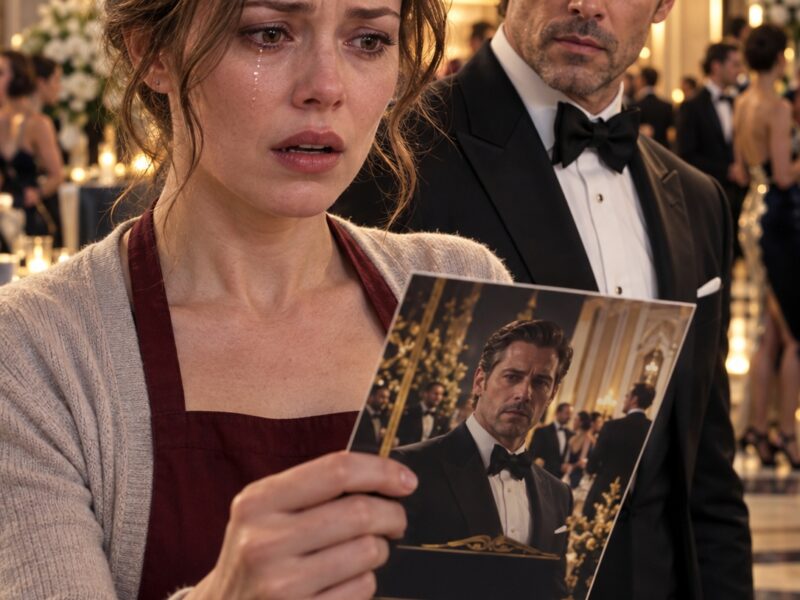
Jenna placed a charity-gala flyer on the counter.
Grace looked down.
At first, she saw the tuxedo.
Then the familiar eyes.
Then the name.
NATHANIEL COLE
Beneath it:
Founder & Chairman, Cole Holdings
Guest of Honor — The Cole Foundation Annual Benefit
Grace didn’t move.
Jenna was still talking.
“Apparently he’s worth, like, hundreds of millions. Maybe more. Cole Holdings owns half the new waterfront development and those hotels downtown and—Grace?”
The store noise seemed to disappear.
Grace picked up the flyer.
The photograph showed Nathaniel standing behind a podium.
Not the Nathaniel who joked about batteries.
Not the man who walked her to the bus.
This Nathaniel wore a black tuxedo.
Behind him was a wall carrying his company’s name.
The caption called him “one of the state’s most influential business leaders.”
Grace read it twice.
Then a third time.
Her stomach tightened.
She thought of the coffee.
The flowers.
The walks.
Between jobs.
She remembered telling him she hoped he found work he liked.
Had he laughed afterward?
Had he gone back to some mansion and told his wealthy friends about the cashier who thought he was unemployed?
The humiliation came first.
Then anger.
Then something worse.
Doubt.
Grace looked at every memory and watched it change shape.
Had any of it been real?
Or had she become Nathaniel Cole’s vacation from being Nathaniel Cole?
A little neighborhood store.
A woman who didn’t recognize him.
A convenient place to pretend he was ordinary until he got bored.
“Grace?”
Jenna’s voice returned.
“You okay?”
Grace folded the flyer.
“Yes.”
She wasn’t.
At 6:12 that evening, the automatic doors opened.
Grace knew it was Nathaniel before she looked up.
Her body had learned the rhythm of his arrival.
Usually she smiled.
This time she didn’t.
Nathaniel saw the difference immediately.
He approached the register.
“Bad day?”
Grace placed the flyer on the counter.
Nathaniel looked down.
His face went still.
That was all the confirmation she needed.
“You lied to me.”
“Grace—”
“Don’t.”
He stopped.
She kept her voice low because customers were nearby.
“I asked what you did.”
“I know.”
“You let me think you were unemployed.”
“I never said—”
Grace laughed once, without humor.
“Don’t do that.”
Nathaniel closed his mouth.
“Don’t use technicalities. Not with me.”
He nodded slowly.
“You’re right.”
“You own Cole Holdings?”
“Yes.”
“The hotels?”
“Some of them.”
“The waterfront buildings?”
“Yes.”
“The foundation?”
“Yes.”
“And how much are you worth?”
“Grace—”
“How much?”
Nathaniel’s jaw tightened.
“I don’t know exactly.”
She stared at him.
That answer hurt more than a number could have.
Because only extremely wealthy people could genuinely say it.
Grace looked away.
“I told you about my rent.”
Nathaniel’s face changed.
“I know.”
“I told you I couldn’t afford to fix my car.”
“Yes.”
“I told you I was picking up Sunday shifts because my health insurance deductible went up.”
“I remember.”
“And all that time you were…”
She gestured helplessly toward the flyer.
“This.”
Nathaniel leaned closer.
“I never laughed at you.”
“I didn’t say you did.”
“But you’re thinking it.”
Grace looked directly at him.
“I don’t know what to think anymore.”
That landed.
Nathaniel stepped back slightly.
“I should have told you.”
“Yes.”
“I wanted to.”
“But you didn’t.”
“No.”
“Why?”
The store continued around them.
Scanner beeps.
Shopping carts.
A child crying near the cereal aisle.
Nathaniel could have given her a polished answer.
He had spent his career giving polished answers.
Instead he told her the ugly truth.
“Because I liked who I was when you didn’t know.”
Grace frowned.
Nathaniel continued.
“People know my name before I enter rooms. They know what I own. They know what they want from me. You didn’t.”
“So you tested me?”
“No.”
“Then what?”
“I hid.”
“From me.”
“From everyone.”
Grace shook her head.
“You don’t get to make that sound romantic.”
Nathaniel fell silent.
Her eyes were wet now, which made her angrier.
“You had the truth. I didn’t. Every conversation we had, you knew something that would have changed the way I understood you.”
“I was afraid it would change this.”
“It already did.”
His face tightened.
Grace pushed the flyer toward him.
“I didn’t care whether you had twenty dollars or twenty million.”
“I know.”
“No, you don’t.”
Her voice trembled.
“If you knew, you would have trusted me with the choice.”
Nathaniel said nothing.
And there it was.
The part he had not understood.
He had thought hiding his wealth protected something pure between them.
Grace saw it differently.
He had taken away her ability to decide whether she wanted to be part of it.
“You saved my life,” he said quietly.
Grace’s expression hardened.
“Stop using that.”
He looked confused.
“I didn’t save you so you would owe me.”
“I know.”
“Then stop looking at me like gratitude gives you permission to lie.”
Nathaniel flinched.
Grace immediately hated how much seeing him hurt affected her.
But she didn’t take the words back.
He nodded once.
“You’re right.”
Then he did something Grace had not expected.
He left.
No flowers.
No check.
No offer to fix her car.
No attempt to buy forgiveness.
He simply walked through the automatic doors and disappeared into the evening.
Grace watched him go.
And for the first time since the night Nathaniel’s heart stopped, she wondered whether saving him had been the beginning of the worst mistake she had ever made.
Nathaniel didn’t return the next day.
Or the day after.
By Monday, Grace had stopped making the second coffee.
By Tuesday, she made it accidentally and poured it down the sink.
By Wednesday, she was angry with herself for looking toward the doors every time they opened.
Jenna noticed.
“You miss him.”
“No.”
“Okay.”
“I don’t.”
“Okay.”
“Stop saying okay like that.”
Jenna smiled.
Grace hated her.
At night, she replayed their argument.
Sometimes Nathaniel was clearly wrong.
Other times she remembered his face when he said, I liked who I was when you didn’t know.
She understood that more than she wanted to.
Grace knew what it was like to be reduced to circumstances.
Cashier.
Poor.
Single.
Bus rider.
Woman in an apron.
People looked at those details and decided the rest.
Nathaniel had the opposite problem.
People saw wealth first.
Maybe that could be lonely too.
But understanding his fear didn’t erase what he’d done.
Grace wasn’t angry that Nathaniel was rich.
She was angry because he had decided what truth she could handle.
There was a difference.
Eight days passed.
Then, on an ordinary Tuesday afternoon, the automatic doors opened.
Grace looked up before she could stop herself.
Nathaniel walked inside.
No flowers.
No suit.
No gift.
He carried nothing.
He waited until her line was empty.
Then he approached.
“I almost didn’t come.”
Grace folded her arms.
“Why did you?”
“Because staying away was easier.”
“That doesn’t answer the question.”
Nathaniel nodded.
“No. It doesn’t.”
He took a breath.
“I came because you deserved an apology that wasn’t designed to make me feel better.”
Grace said nothing.
“I lied by omission. I knew what you believed about me, and I let you believe it because it gave me something I wanted.”
“What?”
“A place where I wasn’t Nathaniel Cole.”
Grace looked at him.
“That wasn’t my responsibility to give you.”
“I know.”
“And you could have been yourself with me after telling me.”
“I know that now.”
“Do you?”
“Yes.”
“How?”
Nathaniel’s smile was sad.
“Because I spent eight days thinking about the moment you found out.”
He paused.
“I kept telling myself I had hidden my money because I wanted you to see me. Then I realized I hadn’t allowed you to see me at all.”
Grace’s expression softened almost imperceptibly.
Nathaniel continued.
“I showed you the version of me I was comfortable showing.”
Silence.
“That isn’t honesty.”
“No.”
Grace looked down at her hands.
“Why did you really come back after the hospital?”
“To thank you.”
“And after that?”
Nathaniel answered without hesitation.
“To see you.”
“Why?”
“Because I liked you.”
Grace looked up.
He didn’t look away.
“I still do.”
Something inside her tightened.
Nathaniel put both hands on the counter.
“I don’t expect you to trust me because I apologized. And I won’t offer you anything to make this easier.”
A faint, bitter smile touched Grace’s lips.
“You could buy me a car.”
“Yes.”
“Apartment?”
“Yes.”
“Store?”
Nathaniel glanced around.
“Probably.”
Grace laughed despite herself.
Nathaniel smiled.
Then Grace’s face became serious again.
“And that’s exactly why this is complicated.”
“I know.”
“No. Listen.”
He did.
“If I let you into my life, I need to know that when something goes wrong, you won’t solve it by writing a check.”
Nathaniel considered that.
“I solve a lot of things by writing checks.”
“I noticed.”
“But I won’t solve you that way.”
Grace’s throat tightened.
Nathaniel immediately corrected himself.
“That sounded terrible.”
“It really did.”
“I meant—”
“I know what you meant.”
For the first time in days, she smiled.
Small.
Cautious.
But real.
Nathaniel exhaled.
Grace pointed toward the coffee machine.
“You want coffee?”
“Yes.”
“You’re paying.”
“I can afford it.”
Grace gave him a look.
Nathaniel raised both hands.
“Too soon?”
“Way too soon.”
But she was still smiling.
Trust did not return that afternoon.
It began.
There was a difference.
Nathaniel stopped bringing flowers.
Grace noticed that too.
He simply showed up.
Sometimes for ten minutes.
Sometimes for an hour.
He answered questions honestly now.
Even uncomfortable ones.
Grace learned about his companies.
His father.
His failed marriage.
The years he’d spent confusing being needed with being loved.
Nathaniel learned more about Grace.
Not just what she lacked.
What she wanted.
That distinction mattered.
Grace did not dream of mansions.
She wanted enough stability that a broken transmission didn’t become a crisis.
She wanted time to read.
She wanted to take a trip somewhere she’d never been.
She wanted her neighborhood to stop being treated like the forgotten side of the city.
One evening, while they walked toward the bus stop, an ambulance passed them.
Grace watched it disappear.
“My mother used to hate ambulances.”
Nathaniel looked at her.
“You never told me that.”
“She was sick for a long time.”
“What happened?”
“Complications from diabetes.”
Grace kept walking.
“The clinic near us was always overcrowded. Sometimes appointments took weeks. When things got worse, we’d end up at the ER.”
Nathaniel listened.
Grace pointed toward a dark brick building two blocks away.
“That used to be a community health center.”
“What happened?”
“Funding.”
Nathaniel looked at it.
“Closed?”
“Three years ago.”
“And now?”
“Nearest affordable clinic is almost forty minutes by bus.”
Nathaniel frowned.
Grace continued.
“Mrs. Alvarez goes there twice a month. She’s seventy-four.”
“The strawberry lady?”
Grace smiled.
“You remember.”
“I remember everything you tell me.”
She looked away.
That sentence felt more intimate than it should have.
“There are families around here choosing between missing work for a medical appointment or waiting until something gets bad enough for the emergency room.”
Nathaniel’s expression changed.
Grace noticed.
“Don’t.”
“What?”
“Do the billionaire face.”
“I don’t have a billionaire face.”
“You absolutely do.”
“What does it look like?”
“Like you’re about to acquire something.”
Nathaniel laughed.
“I’m listening.”
“That’s all I want.”
He nodded.
So he listened.
He asked how many people lived in the neighborhood.
Which clinics remained.
What services were missing.
Grace answered what she knew.
When they reached the bus stop, Nathaniel didn’t make promises.
He didn’t say he would fix it.
He kissed Grace’s cheek for the first time.
Then he watched her bus disappear.
The next morning, Nathaniel canceled three meetings.
By noon, he had called the executive director of the Cole Foundation.
By evening, he had commissioned a healthcare-access assessment.
Within seventy-two hours, he knew exactly how bad the problem was.
Worse than Grace knew.
The neighborhood had thousands of residents with limited access to primary care.
Emergency-room usage was significantly higher than surrounding districts.
The old health-center building was still standing.
The property could be acquired.
Renovation was possible.
Nathaniel sat alone in his office looking at the report.
His assistant Benjamin entered.
“You’ve moved the Denver meeting twice.”
“Move it again.”
Benjamin looked at the documents.
“What is this?”
Nathaniel closed the folder.
“A debt.”
Benjamin frowned.
Nathaniel shook his head.
“No.”
He thought of Grace.
You don’t owe me.
“Not a debt.”
“What, then?”
Nathaniel looked out across the city.
“A reason.”
For the next three weeks, Nathaniel became strangely busy.
Grace noticed immediately.
“You’ve disappeared again.”
They were sitting outside the grocery store.
“Work.”
“I thought you were between jobs.”
Nathaniel smiled.
“I’ve recently found employment.”
Grace nudged his shoulder.
“What are you doing?”
“Something.”
“That sounds suspicious.”
“It isn’t illegal.”
“That’s not reassuring.”
Nathaniel laughed.
Grace narrowed her eyes.
“Are you hiding something from me?”
The question landed differently now.
Nathaniel stopped smiling.
Grace noticed.
He reached for her hand.
“Yes.”
She pulled back slightly.
Nathaniel quickly added, “But not about me.”
“What does that mean?”
“It means I need you to trust me for about four more days.”
Grace stared at him.
“That is a terrible thing to ask someone after what happened.”
“I know.”
“Then why ask?”
“Because if I tell you now, you’ll try to stop me.”
Grace’s eyes narrowed further.
“Nathaniel.”
“Four days.”
She studied him.
“Three.”
“Four.”
“Three.”
“Three and a half.”
“You negotiate everything?”
“Yes.”
“Fine. Three and a half.”
Nathaniel smiled.
Grace pointed at him.
“If you’ve bought my apartment building, I will murder you.”
“I have not bought your apartment building.”
“My store?”
“No.”
“My bus route?”
Nathaniel blinked.
“Can people buy bus routes?”
“Nathaniel.”
“No.”
Grace finally laughed.
But as he drove away that evening, she had no idea that the folder on the passenger seat contained architectural plans, funding commitments, staffing projections, and one final approval.
Nor did she know Nathaniel had rejected the first proposed name for the project.
The Nathaniel Cole Community Health Center.
He had crossed it out.
“Absolutely not.”
The foundation director had looked confused.
“Mr. Cole, donors typically—”
“It’s not about the donor.”
“What would you like it called?”
Nathaniel had looked at the neighborhood map Grace had drawn for him on a grocery receipt.
Then he answered.
“The neighborhood’s name.”
Three and a half days later, Nathaniel walked into Miller’s Market carrying a plain blue folder.
Grace saw it immediately.
“That better not contain a deed.”
“It doesn’t.”
“Car title?”
“No.”
“Plane tickets?”
“No.”
“Then what?”
Nathaniel placed the folder on the counter.
“Open it.”
Grace looked suspicious.
“You promised.”
“I remember.”
She opened the folder.
The first page was architectural.
Grace didn’t understand it.
The second page contained a map.
She recognized the street.
Her expression changed.
She turned another page.
Then another.
Her fingers slowed.
“Nathaniel.”
He said nothing.
Grace read the heading again.
RIVER DISTRICT COMMUNITY HEALTH CENTER
She looked up.
“What is this?”
“A clinic.”
“I can see that.”
Nathaniel waited.
Grace’s eyes moved across the page.
Primary care.
Pediatric services.
Diabetes management.
Women’s health.
Mental-health counseling.
Preventive screening.
A pharmacy-assistance program.
Transportation vouchers for elderly patients.
Her hand went to her mouth.
“No.”
Nathaniel’s brow furrowed.
“No?”
“You didn’t.”
“I did.”
“Nathaniel.”
“The foundation did.”
“You funded this?”
“Yes.”
Grace closed the folder as if the pages were too heavy.
“How much?”
“That’s not important.”
“It is to me.”
“Enough.”
She stared at him.
He sighed.
“A lot.”
Grace stepped back.
For one terrifying second, Nathaniel thought he had made exactly the mistake she’d warned him about.
“I told you not to fix my life with money.”
“I didn’t.”
“You built a clinic because I complained about healthcare.”
“No.”
“Then why?”
Nathaniel leaned toward her.
“Because you weren’t complaining.”
Grace fell silent.
“You were telling me about Mrs. Alvarez.”
He continued.
“And the families who wait until they’re sick enough for the emergency room. And your mother. And the building that’s been empty for three years.”
Grace’s eyes filled.
Nathaniel touched the folder.
“I had people study it. The need is real. The foundation already funds healthcare projects. This wasn’t charity because I care about you.”
He paused.
“It was something worth doing because you made me notice people I’d driven past for years.”
Grace looked at him.
Nathaniel’s voice softened.
“The building won’t have my name.”
She opened the folder again.
He was right.
No Cole.
No Nathaniel.
Nothing.
“Why?”
“Because the people who live here shouldn’t have to walk into a building every time they’re sick and be reminded who paid for it.”
Grace blinked back tears.
Nathaniel continued.
“You saved my life without asking my name.”
His own voice began to change.
“I’ve spent years putting my name on things.”
He looked around the little grocery store.
“Maybe you taught me there are things worth doing even when nobody knows you did them.”
Grace pressed her lips together.
“Don’t make me cry at register three.”
Nathaniel smiled.
“Sorry.”
“You’re not sorry.”
“No.”
She laughed through her tears.
Then she looked at the folder again.
“When?”
“Renovation starts next month.”
“And the people working there?”
“Local hiring preference where possible.”
“Sliding scale?”
“Yes.”
“People without insurance?”
“Yes.”
“Transportation?”
“Included.”
Grace stared.
“You thought of everything.”
“No.”
Nathaniel shook his head.
“You did.”
Grace looked confused.
“I just listened.”
Nathaniel reached across the counter.
“That was the point.”
Grace looked at his hand.
Months earlier, those hands had been motionless beside his body while hers pressed against his chest.
She remembered begging a stranger to stay alive.
She had thought that was the night she saved Nathaniel Cole.
Now she understood something else.
Saving a heart and changing one were not the same thing.
Slowly, Grace placed her hand in his.
The clinic opened nine months later.
There was no giant gala.
Nathaniel had suggested one.
Grace had said no.
He’d argued that donors expected events.
She’d reminded him that his name wasn’t on the building.
He’d smiled.
“Right.”
So the opening was simple.
Folding chairs.
Coffee.
Children running between adults.
Local nurses meeting families.
Mrs. Alvarez arrived twenty minutes early wearing a blue dress and carrying strawberries.
“For you,” she told Grace.
Grace laughed.
“Why me?”
“Because everyone says this happened because you wouldn’t stop talking.”
Nathaniel, standing nearby, nearly spit out his coffee.
Grace glared at him.
“Don’t.”
“I said nothing.”
“You’re enjoying this.”
“Very much.”
Grace looked different that morning.
Not because her clothes were expensive.
They weren’t.
Not because Nathaniel had transformed her into someone else.
He hadn’t.
She still worked part-time at Miller’s Market during the transition.
But she had accepted a position on the clinic’s community advisory board.
She knew the neighborhood.
She knew its people.
And for the first time, Grace had begun to understand that the qualities she had always considered ordinary—listening, remembering, noticing who needed help—were not ordinary at all.
Nathaniel stood beside her near the entrance.
“You nervous?”
“Yes.”
“Why?”
Grace looked through the glass doors.
“Because things that matter can fail.”
Nathaniel nodded.
“That sounds familiar.”
She glanced at him.
He touched his chest.
Grace smiled.
“You’re never going to stop using that, are you?”
“You did technically restart my heart.”
“I performed CPR.”
“You saved my life.”
“Your cardiologist saved your life.”
“He gives you most of the credit.”
“He’s trying to avoid lawsuits.”
Nathaniel laughed.
The doors opened.
People began entering.
Grace watched an elderly man approach the reception desk.
A mother carried a coughing little boy toward pediatrics.
Mrs. Alvarez was already arguing with a nurse about whether seventy-four counted as “elderly.”
The building filled with voices.
Life.
Ordinary life.
The kind nobody photographed.
The kind Nathaniel once drove past behind tinted windows.
Grace stepped outside for air.
Nathaniel followed.
For a while, neither spoke.
Across the street stood the bus stop where they had spent so many evenings together.
Grace looked at it.
“Funny.”
“What?”
“The first time I met you, I thought you were just some tired man buying frozen lasagna.”
Nathaniel smiled.
“I was.”
“No. You were apparently some terrifying corporate emperor pretending to be a tired man.”
“I was genuinely tired.”
“That part I believe.”
Nathaniel leaned against the brick wall.
“What did you think when you saw me on the flyer?”
Grace considered lying.
Then smiled.
“I wanted to hit you with the register.”
“Understandable.”
“I felt stupid.”
His smile disappeared.
Grace continued.
“Not because you had money. Because I thought maybe I’d imagined everything.”
“You didn’t.”
“I know that now.”
Nathaniel looked toward the clinic doors.
“I was afraid that if you knew who I was, you’d change.”
Grace looked at him.
“And instead you lied, and you changed.”
He nodded.
“That took me embarrassingly long to understand.”
Grace leaned beside him.
“Money wasn’t your problem.”
“No?”
“No.”
“You seemed pretty upset about the several hundred million dollars.”
Grace turned sharply.
“Several hundred—”
Nathaniel froze.
Grace stared at him.
“How many hundreds?”
“I walked into that.”
“You absolutely did.”
“Can we return to my emotional growth?”
“No.”
Nathaniel laughed.
Grace shook her head.
Then her expression softened.
“Your problem was that you thought being loved meant controlling what people were allowed to know about you.”
Nathaniel stopped laughing.
Grace looked toward the street.
“You wanted someone to see you without seeing the money.”
“Yes.”
“But the money is part of you.”
He listened.
“Not the best part. Not the worst part. Just part.”
She looked at him.
“If you have to hide half your life to believe someone cares about the other half, you’ll never actually know whether they care about you.”
Nathaniel was quiet for a long time.
“That sounds expensive.”
Grace smiled.
“That advice is free.”
“Those are usually the things that cost me the most.”
She laughed.
Inside the clinic, a little girl pressed her face against the glass and waved at Grace.
Grace waved back.
Then Nathaniel asked quietly, “Do you ever regret stopping that night?”
Grace turned.
He wasn’t joking anymore.
“What?”
“The parking lot.”
His eyes dropped.
“You missed your bus. You spent hours at the hospital. Then I came back and complicated your life.”
Grace studied him.
There were still moments when she could see the man beneath the power.
The stranger on the pavement.
The man who had no control over whether his next breath came.
She walked closer.
“I regretted you for about eight days.”
Nathaniel smiled.
“Fair.”
“But stopping?”
Grace shook her head.
“Never.”
“Why?”
She thought about the question.
Then looked through the clinic doors.
“Because you don’t ask what a life is worth before you save it.”
Nathaniel’s smile vanished.
Grace continued.
“That night I didn’t know whether you were rich or poor. Good or terrible. Married or alone. I didn’t know if you’d ever remember me.”
She looked at him.
“I just knew you were dying.”
Nathaniel swallowed.
“And if I had known who you were?”
Grace smiled.
“I would’ve done exactly the same thing.”
That answer broke something open inside him.
Not dramatically.
Nathaniel didn’t cry.
Grace didn’t give a speech.
He simply reached for her hand.
And she let him hold it.
Months passed.
The clinic survived its first winter.
Then its first funding review.
Grace remained involved.
Nathaniel kept his promise to stay mostly out of the spotlight.
When reporters discovered his foundation had financed the project, they asked why his name wasn’t on the building.
He gave them one sentence.
“Because the building isn’t for me.”
Grace saw the interview on her phone during lunch.
She smiled.
Then she put the phone away.
That evening, Nathaniel met her outside.
No driver.
No entourage.
He had groceries.
Grace looked inside the bag.
“Frozen lasagna?”
“Tradition.”
“Your cardiologist would be horrified.”
“He already is.”
They walked toward the bus stop.
Nathaniel owned six cars.
Grace knew that now.
He still walked her there.
“You know,” she said, “you don’t have to keep pretending you’re headed this way.”
“I stopped pretending months ago.”
“Then why do you still walk me?”
Nathaniel looked at her.
“Because I make time for things that matter.”
Grace recognized the sentence.
He had said it before she knew who he was.
Back when she thought he was an unemployed man with too much free time.
She smiled.
“That line worked better when I thought you were poor.”
“I’ve been told wealth damages my charm.”
“You were told correctly.”
They reached the stop.
But Grace didn’t board the first bus.
They sat together instead.
Cars moved past.
The city glowed around them.
Somewhere several blocks away, the clinic’s lights were still on.
Nathaniel looked toward them.
“There are days I still think about the parking lot.”
Grace nodded.
“Me too.”
“I remember your voice.”
“You were unconscious.”
“Mostly.”
“What did I say?”
Nathaniel looked at her.
“You told me not to die.”
Grace laughed softly.
“That sounds bossy.”
“It was extremely aggressive.”
“You’re welcome.”
Nathaniel smiled.
Then he grew serious.
“I spent years thinking the most important thing about surviving that night was getting another chance at my life.”
Grace waited.
“I was wrong.”
“What was it?”
He looked toward the clinic.
“Getting a chance to live differently.”
Grace didn’t answer.
There was nothing to add.
A bus approached in the distance.
Its headlights grew brighter.
Grace stood.
Nathaniel stood with her.
She looked at him.
“Dinner tomorrow?”
“Your place?”
“Yes.”
“What are we having?”
“Frozen lasagna.”
Nathaniel groaned.
Grace smiled.
“Full circle.”
The bus stopped.
The doors opened.
Grace stepped aboard.
Before the doors closed, she turned.
“Nathaniel?”
“Yes?”
“Tomorrow at seven.”
“I’ll be there.”
“And don’t bring anything expensive.”
He put a hand over his heart.
“You wound me.”
“I’ve already damaged your ribs once.”
Nathaniel laughed.
The doors closed.
Grace found a seat beside the window.
Nathaniel remained on the sidewalk.
Neither of them waved immediately.
They simply looked at each other through the glass.
Then Grace raised her hand.
Nathaniel did the same.
The bus pulled away.
For a moment, Grace could still see him beneath the streetlight.
Not Nathaniel Cole, chairman of anything.
Not the man from the magazine.
Not the donor.
Not the millionaire whose name could open doors.
Just Nathaniel.
A man who had once collapsed alone on cold pavement while strangers watched.
A man whose heart had stopped before a grocery-store cashier dropped to her knees and refused to let him disappear.
Grace had believed that night was about saving his life.
For a long time, Nathaniel believed it too.
But neither of them understood the real consequence until much later.
Grace’s hands had restarted a heart.
Her refusal to ask what that heart was worth had changed the man carrying it.
And Nathaniel, for all the money he possessed, had eventually learned that the most valuable things in his life could not be purchased, negotiated, named after him, or repaid.
They could only be received.
Then honored.
The bus turned the corner.
Nathaniel disappeared from Grace’s view.
Across the neighborhood, the lights of the community clinic remained glowing against the dark.
Inside, a nurse was checking the blood pressure of an old woman who once had to ride two buses for an appointment.
A frightened father was holding his daughter’s hand.
A tired mother was filling a prescription she had postponed for months.
None of them knew that the building existed because one ordinary evening, a woman earning an hourly wage had seen a stranger collapse and chosen not to walk past him.
None of them needed to know.
That was the part Nathaniel finally understood.
Some acts of kindness become stories.
Others become buildings.
Some become second chances.
And the most important ones become something quieter—a person deciding that because somebody once saw their life as worth saving, they will spend whatever time remains making sure someone else’s life is seen too.
Grace had once told Nathaniel that he didn’t owe her anything.
Years later, he would still think about those words.
She had been right.
A life wasn’t a debt.
Love wasn’t repayment.
Kindness wasn’t a transaction.
And perhaps that was why the moment stayed with him forever:
A nearly empty grocery-store parking lot.
Cold pavement beneath his body.
A woman who didn’t know his last name.
Her hands pressed against his silent chest.
Her voice somewhere above him, demanding that a complete stranger stay alive.
And somewhere in the darkness between one heartbeat and the next, a life that had once been measured in money, companies, buildings, and influence quietly began to be measured by something else.
Not by what Nathaniel Cole owned.
But by what he chose to do after someone who owned almost nothing refused to let him die.









