SHE SCREAMED AT HIS 3-YEAR-OLD DAUGHTER—THEN THE LITTLE GIRL POINTED BEHIND HER

Vivian Cross was still screaming when three-year-old Mia Bellamy lifted one tiny hand and pointed over her shoulder.
The little girl did not cry.
She did not run.
She did not even blink.
She simply stood in the middle of the marble hallway in a faded blue dress, one white sock slipping down around her ankle, and stared at the elegant woman towering over her.
Vivian’s finger was still aimed at Mia’s face.
“You do not walk into a room when I have guests,” she snapped. “How many times does someone have to tell you? You stay where you’re supposed to stay. You are not to be seen unless you’re called for. Do you understand me?”
Behind Vivian, two women sat frozen beside untouched glasses of Chardonnay.
One of them lowered her eyes.
The other looked toward the doorway as if calculating whether leaving without saying goodbye would somehow make her less responsible for what she had just witnessed.
Mia’s dark curls had fallen partly across her forehead. She tucked her stuffed rabbit tighter beneath one arm.
Then she raised the other.
And pointed.
Vivian’s face changed before she even turned around.
Not because she knew what was behind her.
Because Mia did.
Slowly, Vivian looked over her shoulder.
Marcus Bellamy stood halfway down the staircase.
He had one hand resting on the dark walnut railing.
His phone was still in the other.
The conference call he had been taking upstairs had ended sometime during Vivian’s speech, but nobody had heard him come down.
In the enormous foyer, where polished stone and twelve-foot ceilings carried every whisper upward, he had heard everything.
Every word.
Every sharp breath.
Every syllable of Vivian telling his three-year-old daughter that she was not supposed to be seen.
Marcus said nothing at first.
That frightened Vivian more than if he had shouted.
“Marcus.”
Her voice transformed instantly.
The hard edge vanished.
Her shoulders softened.
She even managed a small, wounded smile.
“Mia wandered in while I was having lunch. I was just trying to explain boundaries.”
Marcus looked at his daughter.
“Mia.”
His voice was quiet.
Warm.
“Come here, sweetheart.”
Mia dropped her pointing hand.
She walked toward the stairs.
When she reached the second step, she raised both arms.
Marcus came down.
He lifted her.
The moment his daughter touched him, something in her body changed.
She folded against his chest.
Not dramatically.
Not with sobs.
She simply released the stiffness she had been carrying.
Her forehead pressed against his neck.
Her fingers curled into the collar of his shirt.
And Marcus felt it.
The kind of trust so complete it was almost painful.
His three-year-old daughter had not cried when a grown woman screamed in her face.
She had waited until her father appeared.
Only then had she allowed herself to become small again.
Marcus looked over Mia’s curls at the woman he was supposed to marry in seven weeks.
Vivian was standing beside a table covered with white peonies.
On her left hand was the six-carat engagement ring Marcus had bought four months earlier.
Behind her stood a house she had already begun redesigning as if the Bellamys were an old company she had acquired.
And for the first time since he had asked her to marry him, Marcus wondered whether he had confused elegance with kindness.
He carried Mia upstairs without saying another word.
Vivian remained standing beneath the chandelier.
One of her friends finally reached for her purse.
Nobody finished lunch.
That should have been the moment Vivian understood that something had broken.
Instead, she believed the real conversation had not happened yet.
She was right.
She just misunderstood which one of them would be doing the convincing.
Marcus Bellamy had spent most of his adult life learning how to recognize risk before everyone else saw it.
At thirty-seven, he was the founder and chief executive of Bellamy Systems, a Boston technology firm that had begun twelve years earlier with two computers, one employee, and an office above a laundromat in Somerville.
He had worked through winters when the heat failed.
He had slept beneath his desk before investor meetings.
He had once sold his car to cover payroll because three engineers had mortgages and babies while he had neither.
By thirty-five, magazines were writing profiles about him.
By thirty-six, people who had ignored his first hundred emails were inviting him onto private jets.
Marcus understood numbers.
He understood leverage.
He understood how quickly a friendly handshake could become litigation once enough money was involved.
What he had never learned was how to evaluate the people who arrived when a man was grieving.
Fourteen months earlier, Marcus had buried his wife.
Elena Bellamy had been thirty-four.
For most of their marriage, she had been the healthier one.
She ran half marathons.
She ate vegetables Marcus could not pronounce.
She was the kind of person who brought soup to neighbors without announcing it on social media and remembered birthdays without needing reminders.
Then she began waking with headaches.
After that came exhaustion.
Then tests.
Then specialists.
Then the sentence nobody was prepared for.
Aggressive.
Late stage.
Months, not years.
The disease moved with such brutal efficiency that Marcus occasionally remembered those final weeks not as a sequence of days but as rooms.
A hospital room.
Their bedroom.
A consultation room where an oncologist took off his glasses before explaining there were no remaining curative options.
Mia’s nursery, where Elena sat on the rug one afternoon because she no longer had the strength to stand and watched her daughter stack wooden blocks.
And finally their bedroom again, where Elena died on a gray Sunday morning with Marcus holding one hand and Ruth holding Mia downstairs.
For several months afterward, Marcus moved through his own life like a man walking through a building after the fire had been extinguished.
The structure was still standing.
The rooms technically existed.
But everything smelled like smoke.
People told him he was strong.
He hated that word.
Strong meant he remembered to answer emails.
Strong meant he learned how much milk a two-year-old should drink.
Strong meant he could sit through a board meeting three days after identifying flowers for his wife’s memorial service.
Strong meant he did not collapse where anyone could see him.
At night, after Mia was asleep, Marcus sometimes sat on the floor of the closet with Elena’s favorite sweater in his hands because it still carried the faintest trace of her perfume.
That was not strength.
That was survival.
Mia survived differently.
She became quiet.
Not mute.
Not withdrawn enough to alarm her pediatrician.
She still laughed when Ruth chased her around the kitchen island.
She still demanded the same book twice before bed.
She still became furious if someone cut her toast into triangles instead of squares.
But she watched people now.
Closely.
Before Elena’s illness, Mia had approached strangers with the fearless curiosity of a child who assumed adults were safe.
Afterward, she observed first.
She studied voices.
She noticed footsteps.
She noticed the moment someone’s smile disappeared.
Ruth noticed this before Marcus did.
“She reads rooms now,” Ruth told him one evening.
Marcus was rinsing a small plastic cup at the kitchen sink.
“What does that mean?”
“It means she knows how people feel before they say it.”
Marcus looked toward the family room, where Mia sat coloring beside a stuffed rabbit nearly as old as she was.
“She’s three.”
Ruth gave him the patient look she had used on him since Mia was born.
“Three-year-olds know plenty. They just don’t have words for all of it.”
Marcus had smiled then.
He did not smile when he remembered it later.
Mia owned dozens of dresses because relatives, business partners, neighbors, and well-meaning acquaintances had responded to Elena’s death by purchasing things.
But there was one dress she chose repeatedly.
Blue cotton.
Simple.
Almost plain.
Elena had bought it two weeks before her final hospitalization.
The first time Ruth suggested packing it away because it was becoming worn around the hem, Mia had placed both hands over it and said, “No.”
So Ruth washed it gently.
Again.
And again.
And Mia wore it on ordinary afternoons as if love could be preserved in fabric.
Eight months after Elena died, Marcus met Vivian Cross.
Not at a nightclub.
Not at some glittering charity event.
They met in the waiting area of a pediatric dentist’s office in Back Bay.
Vivian was there with her sister’s son.
Marcus was there because Mia had chipped a tooth attempting to climb onto the kitchen counter after Ruth told her not to.
Vivian laughed when Marcus described the incident.
“She sounds fearless.”
“She is,” Marcus said.
Mia was sitting beside him, holding his hand.
Vivian crouched.
“And what is your name?”
Mia studied her.
“Mia.”
“That’s beautiful.”
Vivian smiled.
Mia did not smile back.
Marcus noticed.
Then forgot.
That was how it began.
Coffee became dinner.
Dinner became weekends.
Vivian was thirty-three, sophisticated, socially graceful, and director of partnerships for a luxury hotel group headquartered in Boston.
She knew how to enter a room.
She knew names.
She understood seating charts, donor politics, restaurant openings, private clubs.
After months of people treating Marcus like a widower first and a man second, Vivian treated him normally.
She never lowered her voice when mentioning Elena.
She did not constantly ask how he was holding up.
She did not look at him with pity.
For Marcus, that felt like oxygen.
He mistook the relief for compatibility.
Mia remained polite but cautious.
“She just needs time,” Vivian said.
Marcus believed her.
When Vivian began leaving a toothbrush at the house, Mia noticed.
When a silk robe appeared in Marcus’s bedroom, Mia noticed.
When Vivian started spending nights there, Mia began carrying her stuffed rabbit into breakfast again.
Marcus noticed that too.
But grief makes people skilled at explanations.
She’s adjusting.
She’s tired.
She’s going through a stage.
Every troubling thing had a reasonable interpretation if he wanted badly enough to find one.
And Marcus wanted one.
He was exhausted.
He missed adulthood.
He missed someone asking how his day went.
He missed sitting across from another grown person after Mia was asleep.
He missed imagining that the rest of his life might contain something other than memory.
Vivian moved into the house three months before the afternoon in the marble hallway.
By then, Marcus had proposed.
The wedding was scheduled for June.
At first, Vivian’s changes seemed harmless.
She replaced several abstract paintings in the main hallway.
Elena had chosen them years earlier.
Marcus barely noticed they were gone until Mia asked where “Mommy’s red picture” had gone.
Vivian heard her.
“It didn’t work with the room,” she said.
Marcus found the painting in storage the next morning and moved it into his office.
He told himself it was a compromise.
A week later, the family photographs on the living-room console disappeared.
Vivian explained that too.
“They make the room look cluttered. I had them moved to the upstairs hall.”
She had not thrown them away.
So Marcus told himself it was fine.
Then she replaced the enormous cream sectional Elena had insisted on buying because “a family couch should survive spilled juice and bad movies.”
Vivian chose ivory Italian furniture.
When Marcus saw the invoice, he laughed.
“We have a three-year-old.”
“Which is why children need to learn boundaries.”
The sentence landed strangely.
He almost said something.
Then his phone rang.
He took the call.
Life continued.
Ruth was the only person in the house who saw the pattern forming.
She had worked for the Bellamys since before Mia’s birth.
Officially, she was Mia’s nanny.
In practice, she had become something harder to define.
She had made coffee for Marcus the morning his company received its first major acquisition offer.
She had helped Elena choose baby clothes.
She had sat in a hospital parking garage with Marcus after the oncologist told him the treatment had failed.
She knew which cabinet contained the emergency flashlight and which floorboard outside the nursery creaked.
Vivian called her “staff.”
Ruth never corrected her.
But Vivian understood the correction anyway.
The first conflict came over the living room.
Mia climbed onto the new sofa one morning with a coloring book.
Vivian was arranging flowers.
“Off.”
Mia looked up.
“Please.”
“No, sweetheart. Off the sofa.”
Mia stayed where she was.
Vivian crossed the room, placed both hands beneath the child’s arms, and lifted her to the floor.
“That’s not for children.”
Mia looked at the sofa.
Then at Vivian.
Then walked away.
Ruth was standing in the doorway.
“You could have asked me to move her.”
“I did move her.”
“She’s allowed to sit in her own living room.”
Vivian smiled.
Not warmly.
“It’s everyone’s living room now.”
Ruth told herself Marcus would eventually see.
But she also knew the dangerous truth about households where one person holds most of the authority.
Employees who criticize a future spouse rarely remain employees.
And Ruth could not protect Mia if she was dismissed from the house.
So she watched.
She documented nothing.
She interfered quietly when necessary.
And she hated herself for every silence.
Mia kept trying with Vivian for the first month.
Children are relentless that way.
She brought Vivian drawings.
A purple horse.
A yellow house.
A page containing circles Mia insisted were strawberries.
Vivian would glance down and say, “Very nice.”
Then continue typing on her phone.
One morning, Mia carried a picture into the breakfast room.
“Miss Vivian.”
Vivian was reviewing invitations with a wedding planner.
“What, Mia?”
“I made you.”
Vivian looked at the drawing.
It showed three figures beneath a giant red sun.
One was Marcus.
One was Mia.
One, presumably, was Vivian.
Vivian stared for a second.
Then she said, “Sweetie, I’m busy right now. Give it to Ruth.”
Mia lowered the paper.
She walked out.
Ruth found the drawing later beneath the small table in the upstairs hallway.
Mia never brought Vivian another one.
Marcus did not know that.
There were many things he did not know.
One afternoon, Vivian objected to Mia eating lunch in the kitchen.
“She should eat in the breakfast room. That’s what it’s for.”
Ruth looked at the little girl sitting beside her, feet swinging beneath the chair.
“Her mother always let her eat here.”
Vivian’s expression cooled.
“I don’t think comparing everything to Elena is helpful.”
Ruth went still.
“Nobody was comparing you to anyone.”
“You do constantly.”
“I said where Mia eats lunch.”
“You said what her mother allowed.”
Ruth’s jaw tightened.
Vivian lowered her voice.
“Marcus is trying to move forward. It would be good if the rest of this house allowed him to.”
Ruth looked at her for a long moment.
Then at Mia.
The child was staring down at her sandwich.
“Eat your lunch, sweetheart,” Ruth said.
The next day they ate in the kitchen again.
Small victories.
Small defeats.
Marcus missed nearly all of them.
He worked.
He came home.
Mia ran to him.
Vivian kissed him.
Dinner happened.
Baths happened.
Stories happened.
Life looked functional from the outside.
That was the problem.
Some forms of cruelty are easy to identify.
A slap leaves a mark.
A broken object remains broken.
A screamed insult can be repeated.
Coldness is harder.
Coldness survives by making each individual incident seem too small to matter.
A drawing ignored.
A chair declared off limits.
A child sent from a room.
A smile that disappears when the father turns away.
Nothing Marcus could point to.
Nothing he could accuse.
Nothing—until Tuesday.
Vivian had planned the luncheon for weeks.
Paige Whitmore and Caroline Ellis were coming.
Both women belonged to the social universe Vivian had inhabited long before Marcus entered it.
The florist arrived at nine.
The caterer arrived at ten.
Vivian rearranged the white peonies herself because she disliked the height of the centerpieces.
At eleven-thirty, she asked Ruth to make certain Mia remained upstairs during lunch.
Ruth frowned.
“Why?”
“We’re having an adult conversation.”
“Then close the dining-room doors.”
Vivian exhaled slowly.
“Ruth, I don’t need every request turned into a debate.”
“And I don’t need a three-year-old treated like she’s an inconvenience in her own house.”
For half a second, neither woman moved.
Then Vivian smiled.
The expression contained no warmth.
“After the wedding, Marcus and I are going to have to clarify everyone’s roles.”
Ruth understood the threat.
She looked toward the playroom.
Mia was kneeling on the rug with crayons spread around her.
“I’ll keep her occupied.”
“Thank you.”
At noon, Marcus returned unexpectedly from the office.
A client call had been moved forward, and he preferred taking difficult negotiations from his study.
Vivian barely looked up when he walked through the living room.
“You’re home early.”
“Only physically.”
He kissed her cheek.
“Call?”
“Forty-five minutes if everyone behaves.”
Vivian smiled.
“Good luck with that.”
He glanced toward the hall.
“Where’s Mia?”
“Playroom with Ruth.”
Marcus nodded.
He went upstairs.
Twenty minutes later, Ruth smelled something burning in the kitchen.
One of the caterer’s assistants had left a tray too close to the oven’s upper element.
There was smoke.
Someone shouted.
The alarm almost triggered.
Ruth hurried in.
Mia remained in the playroom.
At least, she was supposed to.
Then laughter floated down the hall.
Mia looked up from her drawing.
Children do not understand social boundaries the way adults do.
They understand sounds.
Laughter means something good is happening.
So Mia put down the green crayon.
She stood.
She walked through the open door.
Her white socks whispered across the polished floor.
She followed the laughter.
Vivian was standing near the fireplace with Paige and Caroline.
All three women were holding wine.
Paige was in the middle of telling a story about a disastrous vacation in St. Barts.
Caroline laughed.
Vivian laughed louder.
Then she saw Mia.
Her face changed.
Paige noticed it first.
“Oh,” she said brightly. “Hi, sweetheart.”
Mia looked at her.
Paige smiled.
Vivian did not.
“What are you doing in here?”
Mia looked up.
“I wanted to see.”
“See what?”
Mia shrugged.
“The ladies.”
Caroline laughed awkwardly.
“She’s adorable.”
Vivian’s jaw tightened.
“Mia, you’re supposed to be in the playroom.”
“I finished green.”
Paige smiled.
“Finished green?”
“My picture.”
Vivian took one step toward her.
“Go back, please.”
Mia remained where she was.
Maybe she did not understand the urgency.
Maybe she understood it perfectly.
“I want Daddy.”
“Your father is working.”
Mia looked toward the staircase.
Vivian glanced at her guests.
Something about being watched sharpened her embarrassment into anger.
“Mia.”
The child’s eyes returned to her.
“I said go.”
Mia hugged the rabbit.
“No.”
It was not defiant.
It was barely louder than a breath.
But Vivian heard it.
And something snapped.
“What did you say?”
Mia stayed silent.
Vivian crossed the remaining distance.
“You do not tell me no.”
Caroline’s smile vanished.
“Vivian—”
“No. This happens constantly.”
It did not.
But anger rarely waits for accuracy.
Vivian bent down.
Her face was now only a few feet from Mia’s.
“You need to learn that when an adult tells you to do something, you listen.”
Mia stared back at her.
“Viv,” Paige said quietly.
Vivian ignored her.
“You don’t walk into rooms where you’re not invited. You don’t interrupt people. And you do not stand there and say no to me.”
Mia squeezed her rabbit.
Vivian’s voice rose.
“You stay where you belong. You are not to be seen whenever you feel like wandering around. Do you understand me?”
Silence.
Paige looked horrified.
Caroline placed her wineglass down.
And Mia lifted her hand.
She pointed.
Vivian turned.
Marcus stood on the stairs.
Nobody moved.
For years afterward, Marcus would remember strange details about that moment.
Sunlight on the floor.
The smell of lilies from somewhere near the front door.
The red smear left by Caroline’s lipstick on her glass.
Mia’s blue dress.
Vivian’s engagement ring flashing as her hand fell to her side.
But mostly he remembered his daughter’s face.
She did not look surprised to see him.
That bothered him later.
She had known he was there.
She had heard his footsteps or sensed him on the stairs.
And instead of asking for help, she had simply pointed.
As if she needed him to see for himself.
As if this was not new.
Marcus came down.
“Mia. Come here.”
Everything after that happened quietly.
He picked her up.
She folded into him.
He felt the rapid beat of her heart.
That was the first evidence that she had been frightened.
Vivian began explaining.
Marcus did not answer.
He took his daughter upstairs.
In Mia’s bedroom, afternoon light fell across the pale rug.
Marcus placed her on the bed.
She immediately reached for a toy rabbit already sitting there, apparently forgetting she was holding another one.
For several seconds, she seemed confused.
Then she realized her mistake and laughed.
The sound nearly broke him.
He sat beside her.
“Mia.”
She looked up.
“Did Vivian scare you?”
Mia considered this.
“No.”
Children sometimes lie to protect adults from truths adults have trained them to hide.
Marcus did not know that yet.
“She was loud.”
Mia nodded.
“Does she get loud with you a lot?”
Mia’s eyes drifted toward the window.
“Sometimes.”
His stomach tightened.
“When?”
“Sometimes.”
“Only today?”
She shook her head.
Marcus tried to keep his voice neutral.
“What other times?”
Mia looked at her rabbit.
“Can we read Bunny Goes Home?”
Marcus stopped.
He had negotiated with Fortune 500 CEOs.
He had sat across from attorneys trying to extract millions of dollars from him.
He knew how to pursue information.
But this was his daughter.
So he did the hardest thing.
He stopped asking.
“Yeah,” he said. “We can read.”
Mia climbed into his lap.
Halfway through the book, she fell asleep.
Marcus stayed there.
Her head rested against his arm.
Downstairs, he could hear distant voices.
A door closed.
A car started.
Another followed.
Vivian’s lunch was over.
Marcus stared at his sleeping daughter and replayed one sentence.
You are not to be seen.
He wondered how often people revealed their deepest beliefs by accident.
At six-thirty, Mia ate macaroni at the kitchen table.
Marcus stayed beside her.
Vivian did not come into the room.
Ruth said little.
But every time Marcus looked at her, Ruth’s face seemed to hold a question.
At seven fifteen, Marcus gave Mia her bath.
At seven forty, she chose two books.
At eight, he tucked the blanket beneath her chin.
“Two songs.”
“Two?”
“Two.”
“You drove a hard bargain.”
Mia held up two fingers.
Marcus sang badly.
Elena had always teased him about his voice.
Mia did not care.
When he stood to leave, she reached for his hand.
“Daddy?”
“Yeah?”
“Miss Vivian mad at me?”
Marcus felt something move inside his chest.
“No.”
“She looked mad.”
“That wasn’t your fault.”
Mia stared at him.
Then asked the question that changed the entire shape of the evening.
“Do I have to go when you marry her?”
Marcus froze.
“Go where?”
Mia shrugged.
“Somewhere.”
“Who said you had to go somewhere?”
Another shrug.
“Mia.”
She pulled the blanket toward her chin.
“Nobody.”
Children often say “nobody” when they do not yet understand that adults need names.
Marcus sat back down.
“You never have to leave me.”
Mia studied his face.
“Promise?”
“I promise.”
Her body relaxed.
Within minutes, she was asleep.
Marcus remained beside the bed long after he needed to.
At nine, he went downstairs.
Vivian was waiting in the living room.
The room looked immaculate.
The flowers had been replaced.
Wineglasses were gone.
Cushions were straight.
Nothing about the space suggested anything ugly had occurred there hours earlier.
Vivian stood when Marcus entered.
“I know what you think you heard.”
Marcus closed the door behind him.
“That’s an interesting place to start.”
“I was frustrated.”
“You screamed at a three-year-old.”
“I did not scream.”
“Vivian.”
“Marcus, please. Your house carries sound like a cathedral. I’m sure it seemed louder upstairs.”
He stared at her.
“The acoustics are your defense?”
Her mouth tightened.
“That’s not what I’m saying.”
“Then what are you saying?”
“I’m saying Mia ignores boundaries.”
“She’s three.”
“I know she’s three.”
“Then why do you keep talking about her like she’s an employee with a performance issue?”
Vivian folded her arms.
“I knew you would do this.”
“Do what?”
“Turn me into a monster because I corrected your daughter.”
“You told her she wasn’t supposed to be seen.”
“It was an expression.”
“What expression?”
Vivian looked away.
Marcus waited.
She paced toward the fireplace.
“She disrupts everything.”
The words came quieter now.
More honest.
“Everything?”
“Every dinner. Every conversation. Every plan becomes about Mia.”
“She’s my child.”
“I know.”
“No, I don’t think you do.”
Vivian turned.
“For eight months, I’ve structured my entire life around the fact that you have a daughter.”
Marcus stared at her.
“Do you hear yourself?”
“I moved into this house. I changed my schedule. I’ve tried to bond with her.”
“You make that sound like a sacrifice.”
“It is a sacrifice.”
The sentence hung between them.
Marcus felt suddenly cold.
Vivian seemed to hear it too late.
“That’s not what I meant.”
“I think it is.”
“Marcus, stop doing that thing where you take one sentence and build a criminal case around it.”
He almost laughed.
He did not.
Vivian came closer.
“I love you.”
Marcus said nothing.
“I love you,” she repeated. “But this arrangement isn’t sustainable.”
“What arrangement?”
“All of us living like Elena died yesterday.”
Marcus’s face changed.
Vivian saw it.
And still she continued.
“Her pictures everywhere. Ruth bringing her up constantly. Mia being allowed to dictate the mood of this entire house.”
“She’s three.”
“Stop using that as an answer.”
“It is the answer.”
“No. It’s an excuse for not creating structure.”
Marcus stared at the woman in front of him and wondered how many times she had said versions of these things while he was distracted enough not to hear them.
“What structure do you want?”
Vivian exhaled.
Then she said it.
“After the wedding, I think Mia should have a more formal routine.”
“Meaning?”
“School.”
“She’s starting preschool in September.”
“Something more structured.”
Marcus waited.
Vivian hesitated.
“Maybe during the week she stays somewhere designed for children.”
He thought he had misunderstood.
“Somewhere?”
“There are excellent residential early-learning programs.”
Marcus did not move.
The room seemed to narrow around him.
“Residential.”
Vivian’s voice softened.
“Only during the week.”
“You’re talking about boarding school.”
“It’s not boarding school the way you’re making it sound.”
“For my three-year-old.”
“Almost four.”
Marcus stared at her.
Vivian kept talking, faster now.
“Children thrive on routine, Marcus. She’d have other kids around. Specialists. Activities. And we would have weekends together. Real family time instead of constantly feeling like we’re—”
“Stop.”
Vivian stopped.
Marcus did not raise his voice.
He did not need to.
“You’re suggesting that seven weeks after I marry you, I send my three-year-old daughter out of her own home five nights a week.”
“When you phrase it like that—”
“How should I phrase it?”
“It would be good for everyone.”
“Everyone.”
“Marcus.”
“Would it be good for Mia?”
Silence.
That was the answer.
Marcus looked at the engagement ring he had placed on Vivian’s hand.
He remembered choosing it.
The private appointment.
The champagne.
The absurd discussion about clarity and cut.
He had spent more time examining the quality of the diamond than the character of the person who would wear it.
The realization disgusted him.
Vivian reached for him.
Marcus stepped back.
Her hand stopped in the air.
“We’re both emotional.”
“I’m not.”
“Yes, you are.”
“No.” His voice was terrifyingly calm. “For the first time in months, I don’t think I am.”
Vivian’s eyes narrowed.
“You’re going to throw away our marriage because I suggested a school?”
“There is no marriage.”
Her face emptied.
“What?”
Marcus looked at her.
The words surprised even him by how easy they were.
“There is no wedding.”
“Marcus.”
“I’m not marrying someone who sees my daughter as the obstacle between her and the life she wants.”
Vivian’s mouth opened.
Nothing came out.
Then anger returned.
“You cannot be serious.”
“I am.”
“You’re ending an engagement over one bad afternoon?”
“No.”
He looked toward the staircase.
“I’m ending it because I think one bad afternoon finally made me pay attention.”
That night, Marcus slept in his study.
Not because Vivian asked him to.
Because he could not bring himself to enter the bedroom they had been sharing.
At 2:13 a.m., he opened his laptop.
There were 187 unread messages.
He answered none.
Instead, he searched residential preschool programs.
They existed.
That was almost worse.
Vivian had not invented the idea during an argument.
She had researched it.
Marcus sat back.
He stared at the screen.
Then he remembered Mia asking him, Do I have to go when you marry her?
His stomach dropped.
At 2:27, Marcus stood.
He walked upstairs.
Mia’s bedroom door was cracked open.
Ruth slept in a guest room down the hall.
The house was silent.
Marcus stepped inside.
Mia was sleeping sideways across the bed.
Her stuffed rabbit rested beneath her chin.
The blue dress from earlier was folded over the chair.
Marcus noticed something on the desk.
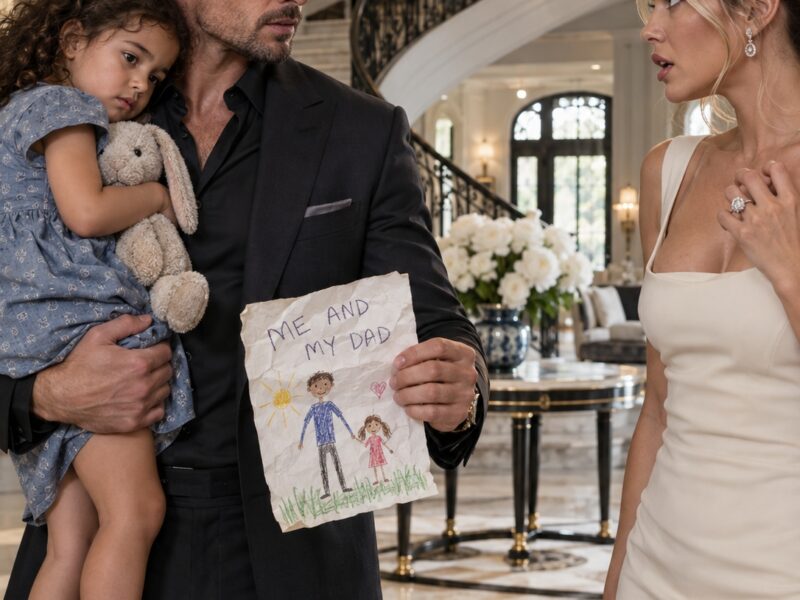
A drawing.
Two people beneath a yellow sun.
One tall.
One small.
Both holding hands.
No third person.
Marcus sat on the edge of the chair.
At the bottom of the page, in uneven letters clearly guided by an adult, were four words.
ME AND MY DAD.
He stared at them until the letters blurred.
At six-twenty the next morning, someone knocked on the study door.
Marcus had not slept.
“Come in.”
Ruth entered carrying two mugs of tea.
She set one in front of him.
Marcus looked at her.
“You knew.”
It was not an accusation.
That made it worse.
Ruth sat down.
“I knew some things.”
“How much?”
Ruth wrapped both hands around her mug.
“Enough that I should have spoken sooner.”
“Why didn’t you?”
She looked at him directly.
“Because if I accused the woman you were marrying of being unkind to your child and you didn’t believe me, I would be gone by dinner.”
Marcus said nothing.
Ruth’s eyes filled, but her voice remained steady.
“And then Mia would have nobody in this house when you were working.”
The truth hurt because it was rational.
Marcus looked down.
“I would have believed you.”
“Would you?”
He opened his mouth.
Then closed it.
Ruth nodded.
“That’s why I didn’t know.”
She told him everything.
Not dramatically.
Not all at once.
Small things.
Vivian removing Mia from the sofa.
Vivian criticizing toys left downstairs.
Vivian refusing to let Mia bring finger paintings into the breakfast room because they looked messy.
Vivian telling caterers that after the wedding, the child’s things would be confined to “designated areas.”
Marcus closed his eyes.
“When?”
“Over the last three months.”
“Did she yell?”
“Not often.”
“Did she touch her?”
“Never to hurt her.”
Marcus looked relieved for exactly one second.
Ruth stopped him.
“But don’t make the mistake of thinking that’s the only way to hurt a child.”
He looked back at her.
Ruth continued.
“She ignored her.”
Marcus frowned.
“That’s what you’re telling me?”
“I’m telling you that Mia kept trying.”
Ruth’s voice cracked.
“She brought Vivian drawings. She brought her flowers from the garden. Once she saved the pink marshmallow from her cereal because Vivian had said pink was her favorite color.”
Marcus looked away.
“Vivian didn’t notice.”
“No.”
“How do you know?”
“Because I watched Mia stand beside her for almost two minutes holding that marshmallow while Vivian texted someone. Then Mia ate it herself.”
The image destroyed him in a way screaming never could.
Ruth reached into the folder she had brought beneath her arm.
She removed the drawing Marcus had seen during the night.
“You found it.”
“It was on her desk.”
“She drew it two weeks ago.”
Marcus touched the edge.
“I thought maybe you helped her write this.”
“I did.”
“What did she say?”
Ruth hesitated.
Marcus looked up.
“What did she say, Ruth?”
“She asked me how to spell ‘me and my dad.'”
“That’s all?”
“No.”
Ruth’s eyes softened.
“She said, ‘Just us is happy.'”
Marcus looked at the drawing.
For years, he had trusted data.
Market research.
Financial models.
Behavioral trends.
He had built his company on the belief that patterns mattered more than isolated events.
And yet, in his own house, he had ignored a pattern because acknowledging it would have required admitting that he had made a terrible choice.
He had wanted Vivian to fit.
So he had edited reality until she did.
Upstairs, a door opened.
Tiny footsteps crossed the hall.
Marcus looked toward the ceiling.
Ruth stood.
“I’ll get her.”
“No.”
Marcus pushed back his chair.
“I will.”
When he entered the kitchen ten minutes later carrying Mia, Vivian was already there.
She had dressed.
Her hair was done.
Makeup perfect.
Two suitcases stood beside the front hall.
For a moment, Marcus wondered whether she believed the gesture would frighten him into changing his mind.
Mia saw the suitcases.
She went still.
Vivian saw her reaction.
“Good morning.”
Mia pressed her face into Marcus’s shoulder.
Vivian looked hurt.
“That’s unfair.”
Marcus stared at her.
“What’s unfair?”
“This.”
She gestured at Mia.
“You’re making me the villain.”
“I haven’t said anything to her.”
“Children hear things.”
“Apparently they do.”
Vivian’s jaw tightened.
“I barely slept.”
“Neither did I.”
“Then maybe we don’t make permanent decisions this morning.”
“The decision is permanent.”
Vivian stared at him.
“Seven weeks.”
Marcus said nothing.
“Our wedding is in seven weeks. Guests have flights. The hotel is booked. My parents—”
“Cancel it.”
“You don’t mean that.”
“I do.”
“Do you have any idea how humiliating this will be?”
Marcus looked at Mia.
“There are worse things.”
Vivian laughed once.
It was bitter.
“So that’s it?”
“Yes.”
“You’re choosing her.”
Marcus’s expression changed.
Vivian immediately understood the mistake.
But it was too late.
“Marcus, that’s not—”
“There was never a choice.”
Silence.
Vivian’s eyes filled.
For the first time since Marcus had known her, she looked unpolished.
Not elegant.
Not controlled.
Simply furious and wounded.
“I loved you.”
“I believe you.”
“No, you don’t.”
“I believe you loved what our life could look like.”
Vivian wiped beneath one eye.
“And you think you’re some perfect father?”
The question hit its target.
Marcus went still.
Vivian saw it.
So she pushed harder.
“You didn’t see any of this, did you?”
Ruth appeared quietly in the kitchen doorway.
Vivian continued.
“You want to stand there judging me, but you didn’t see her drawings. You didn’t notice where she ate. You didn’t notice whether she liked me. You were too busy working and grieving and telling yourself everything was fine.”
Marcus’s face changed.
Because that part was true.
Vivian’s voice softened.
“You needed me.”
Marcus looked at her.
“Maybe I did.”
“And now you’re punishing me because you’re guilty.”
Marcus held Mia tighter.
“No.”
His voice was quiet.
“I’m ending this because my guilt doesn’t require my daughter to keep paying for it.”
Vivian stared at him.
There was nothing left to argue.
Forty minutes later, a black SUV came through the gates.
The driver loaded her suitcases.
Vivian walked toward the front door.
She stopped once.
Marcus stood at the far end of the foyer.
Mia was upstairs with Ruth.
Vivian looked at the staircase.
Then back at Marcus.
“Was any of it real?”
“Yes.”
“Then why does it feel so easy for you?”
Marcus thought about that.
“It isn’t.”
She waited.
He added, “But difficult doesn’t mean wrong.”
Vivian nodded.
She removed the engagement ring.
For a second, Marcus thought she might throw it.
She did not.
She placed it on the narrow table beside the door.
The diamond caught the morning sun.
Then Vivian left.
Upstairs, Mia had climbed onto the small bench beneath her bedroom window.
She watched the black SUV move down the long driveway.
Ruth stood behind her.
Mia said nothing until the car disappeared beyond the trees.
Then she climbed down.
She sat on the carpet with her rabbit.
Several minutes later, Marcus entered.
Mia looked up.
“Is she gone?”
He sat beside her.
“Yes, baby.”
“For today?”
Marcus swallowed.
“For good.”
Mia considered this with the solemn attention children give to information they know matters.
Then she held out her rabbit.
“You can hold him.”
Marcus stared at the toy.
“Why?”
“Because you’re sad.”
That nearly destroyed him.
Marcus took the rabbit.
Mia climbed into his lap.
He held her.
The house became quiet again.
But this time it did not feel cold.
For the first time in months, it felt like something had left.
Three weeks passed.
Wedding deposits were lost.
Invitations had to be canceled.
Marcus’s mother called from Connecticut and asked repeatedly whether he was certain.
Several acquaintances offered unsolicited opinions.
One person told him that blended families required compromise.
Marcus thanked them.
Then ignored them.
He reduced his travel schedule.
For the first time since Elena became ill, he blocked two evenings each week on his calendar and marked them in capital letters.
MIA.
His assistant never scheduled over them.
They did ridiculous things.
They built a tent in the living room.
They burned pancakes.
They went to the aquarium, where Mia spent forty minutes staring at a jellyfish and refused to leave until Marcus agreed it was “the princess of water.”
The house changed too.
Marcus moved Elena’s red painting back into the hall.
Not because he wanted to transform the home into a shrine.
Because he realized removing every trace of grief was not the same as healing.
Healing did not require pretending Elena had never existed.
One Friday morning, Marcus’s assistant called him while he was driving into the city.
“There’s a lawyer asking for you.”
“What lawyer?”
“Daniel Fowler.”
Marcus knew the name vaguely.
Elena’s estate attorney.
“He says it’s personal.”
Marcus’s hands tightened on the wheel.
“Put him through.”
A second later, a man’s voice filled the car.
“Mr. Bellamy.”
“Daniel.”
“I’m sorry to contact you unexpectedly.”
“What’s wrong?”
“Nothing is wrong.”
A pause.
“Actually, I suppose that depends on how you define wrong.”
Marcus felt his heart accelerate.
The last time someone had called him from an attorney’s office after Elena died, it involved finalizing probate documents.
“What is this about?”
“Elena.”
Marcus stopped breathing for a second.
Daniel continued.
“Your wife left something with my office.”
“What?”
“A letter.”
Marcus pulled the car onto the shoulder.
Traffic hissed past.
“What letter?”
“She wrote it shortly before her final hospitalization.”
Marcus stared through the windshield.
“Fourteen months ago?”
“Yes.”
“Why haven’t I received it?”
“Because she specifically instructed us not to deliver it immediately.”
Marcus rubbed his forehead.
“What was the instruction?”
Daniel opened something on his end.
Paper moved.
“Her exact words were: ‘Don’t give this to Marcus while grief is still making every decision for him. Give it to him when you believe he is finally looking forward again—or when something makes him question whether he knows how.'”
Marcus said nothing.
Daniel’s voice softened.
“I saw the wedding cancellation announcement.”
Marcus almost laughed at the surreal sentence.
“So you decided now?”
“I decided maybe your wife understood you better than I ever could.”
The letter arrived by courier two hours later.
Marcus left the office.
He drove home.
Ruth was in the garden with Mia.
Marcus went into his study alone.
The envelope was cream-colored.
His name was written across the front.
MARCUS.
He recognized Elena’s handwriting instantly.
For several minutes, he could not open it.
His hands shook.
Grief is strange.
You can spend fourteen months learning to live with someone’s absence.
Then you see six letters written by their hand and suddenly no time has passed at all.
Marcus opened the envelope.
There were four pages.
The first sentence made him cover his mouth.
My love,
If you’re reading this, enough time has passed that the world has probably asked you to become someone new.
Marcus stopped.
He closed his eyes.
Then continued.
I hope you let it.
I don’t want my death to become the most important thing that ever happened to you.
We had a life before this illness. You and Mia deserve a life after it too.
Marcus read slowly.
Elena wrote about practical things.
She told him not to keep her clothes forever.
She told him the lamp in the guest room was ugly and had always been ugly.
She asked him to make sure Mia learned to swim because Marcus was “a terrible swimmer who will lie and say otherwise.”
He laughed.
Then cried.
Then turned the page.
The tone changed.
You are a wonderful father.
I know you don’t believe that because you measure fatherhood the way you measure work. You look for mistakes. Missed details. Things you should have predicted.
Stop doing that.
Mia doesn’t need a man who predicts every danger.
She needs a father who notices her.
Marcus read that sentence twice.
Then came the words that would stay with him for the rest of his life.
Watch her face when you walk into a room.
That’s how you’ll always know.
Marcus sat completely still.
Elena wrote about the worst nights of her illness.
Nights Marcus thought Mia had been too young to remember.
She described one evening when nausea and fear left her shaking on the bathroom floor.
Mia had wandered in.
She had not cried.
She had not asked what was wrong.
She simply pressed one tiny hand against Elena’s cheek.
She does that, Elena wrote.
She finds whoever in the room needs her most.
Maybe children haven’t yet learned all the ways adults hide from each other.
Trust her instincts.
They’re better than ours.
Marcus lowered the page.
The marble hallway returned to him.
Vivian’s raised voice.
Mia standing still.
Her small hand lifting.
Not asking to be rescued.
Pointing.
Showing him where to look.
Elena’s final paragraph was shorter.
If someone comes into your life someday, I hope you love her without guilt.
I hope Mia loves her too.
But if you ever have to choose between making another adult comfortable and making our daughter feel safe, please remember this:
Adults can understand disappointment.
Children learn from it.
Be careful what you teach her.
Marcus stared at the words.
Outside, Mia laughed.
He could hear her through the partly open window.
Ruth said something.
Water splashed.
Mia shrieked.
Marcus folded the letter.
For several minutes, he sat with his hands pressed against his eyes.
Then he went outside.
Mia was beside a small plastic bucket.
Her blue dress was soaked from the waist down.
Ruth held a garden hose.
“I had nothing to do with this,” Ruth announced.
Mia pointed at her.
“She did it.”
“You appear to have evidence.”
“She sprayed me.”
“You sprayed me first,” Ruth said.
Mia gasped as if betrayed by confidential information.
Then she saw Marcus.
Everything changed.
Her whole face opened.
“DADDY!”
She dropped the bucket.
She ran.
No hesitation.
No calculation.
No caution.
Marcus crouched.
Mia collided with him.
He lifted her.
Her wet dress soaked his shirt.
He did not care.
She placed both hands on his cheeks.
Exactly the way Elena had described.
Marcus closed his eyes.
For one impossible second, the past and present seemed to touch.
Elena in a hospital bed.
Mia in his arms.
The woman he had loved.
The child they had made.
Loss and life occupying the same body.
“Daddy?”
Marcus opened his eyes.
“I’m here.”
Mia smiled.
“You’re wet.”
He laughed.
“So are you.”
“No. I’m splashy.”
“Ah. Completely different.”
She nodded seriously.
Marcus held her tighter.
Months passed.
Summer arrived.
The canceled wedding date came and went.
Marcus did not realize what day it was until noon.
He was sitting on the floor of Mia’s preschool classroom during a family picnic, attempting to construct a paper crown.
His phone vibrated.
A calendar notification appeared.
WEDDING — 4:00 PM.
Marcus stared at it.
For a moment, he imagined the alternate version of his life.
A ballroom.
Hundreds of guests.
Vivian in white.
Mia perhaps absent.
Perhaps somewhere she had been sent for “structure.”
The thought made him physically ill.
“Daddy.”
Mia tugged his sleeve.
“You made it wrong.”
Marcus looked down at the crooked crown.
“I did?”
“Yes.”
“Can you fix it?”
She sighed dramatically.
“I have to.”
Marcus deleted the calendar event.
Then handed Mia the tape.
That autumn, he replaced most of the ivory furniture.
Not because Vivian had chosen it.
Because nobody liked sitting on it.
The new sofa was enormous.
Brown.
Soft.
Ugly enough that an interior designer might have cried.
Mia loved it.
She climbed onto it the day it arrived wearing muddy socks.
Marcus looked at the mud.
Then at Ruth.
Ruth lifted one eyebrow.
Marcus sighed.
“Mia.”
The little girl froze.
He pointed at the floor.
“Socks.”
She immediately removed them.
“Thank you.”
Then she jumped back onto the sofa.
Marcus smiled.
Boundaries, he learned, were not the enemy.
Love without safety was.
Rules without tenderness were.
A home could contain both.
The difference was whether a child believed breaking a rule might cost her belonging.
Marcus never wanted Mia to wonder that again.
One wall of the living room became hers.
At first, Marcus planned to hang only three drawings.
Then five.
Then ten.
Eventually Ruth stopped asking.
A purple horse appeared.
A green moon.
A family of what Marcus thought were bears but Mia angrily informed him were “business people.”
He framed one picture.
The simplest one.
Two crooked figures.
One tall.
One small.
The small figure wore blue.
ME AND MY DAD.
He hung it in his study.
Directly across from his desk.
Executives noticed it during meetings.
Investors noticed it.
One afternoon, a visiting banker asked, “Who’s the artist?”
Marcus looked at the drawing.
“My daughter.”
“How old?”
“Four now.”
The banker smiled.
“Looks valuable.”
Marcus did not smile.
“It is.”
Vivian sent one message six months after the breakup.
Marcus saw her name on his phone while standing in the grocery store trying to determine which yogurt Mia had demanded.
He almost did not open it.
Eventually, he did.
I’ve thought a lot about what happened. You were right about some things. I was right about some things too. But I should never have made Mia feel unwanted. I am sorry.
Marcus read it.
He stood between shelves of yogurt while shoppers moved around him.
Then he typed:
Thank you for saying that. I hope you’re well.
He did not add anything else.
Forgiveness did not require reopening doors.
Sometimes closure was simply recognizing that a person did not need to remain a villain for you to know they could no longer belong in your life.
Marcus slipped the phone into his pocket.
He finally found the yogurt.
Mia informed him later that he had bought the wrong one anyway.
Life continued.
That was perhaps the most surprising part.
For months after Elena’s death, Marcus had believed every major emotional event would divide life forever into before and after.
Before diagnosis.
After diagnosis.
Before death.
After death.
Before Vivian.
After Vivian.
But children resisted that kind of structure.
To Mia, life was mostly this afternoon.
This snack.
This story.
This scraped knee.
This joke Ruth made.
This moment when her father entered the room.
She dragged Marcus forward simply because she kept moving herself.
On the second anniversary of Elena’s death, Marcus took Mia to the cemetery.
The day was bright.
Mia carried yellow flowers.
She did not remember enough of her mother to understand grief the way Marcus did.
That had once devastated him.
Now he realized memory could be built from stories too.
They sat in the grass.
Marcus told her about the time Elena tried to make pancakes and accidentally used salt instead of sugar.
Mia laughed so hard she fell sideways.
“Mommy was bad cooker?”
“Terrible.”
“Was she worse than you?”
Marcus looked offended.
“Absolutely not.”
Mia considered this.
“Ruth says you burned eggs.”
“Ruth shares too much information.”
Mia placed the flowers beside the headstone.
For several minutes, she said nothing.
Then she touched Elena’s name.
“She buy my blue dress?”
“She did.”
“I like it.”
“I know.”
“It’s small now.”
“I know.”
Mia looked toward him.
“Can we keep it?”
Marcus swallowed.
“Forever, if you want.”
She nodded.
Then something unexpected happened.
Mia put her small hand against the cold stone.
Not dramatically.
Not because Marcus had told her about Elena’s letter.
He had never told her that part.
She simply rested her palm there.
Marcus stared.
Then looked away because some moments felt wrong to watch too closely.
On the drive home, Mia fell asleep.
Marcus carried her inside.
He passed the red painting Elena had chosen.
He passed the wall covered with Mia’s art.
He passed the living room where toys were scattered beneath furniture no longer protected from childhood.
The house no longer looked like a magazine.
It looked lived in.
There were scratches on the floor.
A purple crayon mark behind one chair.
A basket of laundry Ruth had forgotten to move.
A plastic dinosaur inexplicably sitting inside an expensive decorative bowl.
Marcus loved every imperfection.
That evening, after putting Mia to bed, he went into his study.
Elena’s letter was in the top drawer.
He did not read it often.
He no longer needed to.
He knew the important lines by heart.
Watch her face when you walk into a room.
That’s how you’ll always know.
Marcus looked at the framed drawing.
Then he understood something Elena had perhaps known before he did.
The afternoon Vivian screamed at Mia was not the moment his daughter saved him from marrying the wrong woman.
That interpretation was too simple.
Vivian was not secretly monstrous.
Marcus was not a flawless father who had heroically discovered the truth at the perfect moment.
Reality was less flattering.
And more important.
Marcus had been lonely.
So lonely that he allowed himself to see what he wanted.
Vivian had wanted a particular kind of life.
So badly that she convinced herself a grieving child could be organized around it.
Ruth had been afraid of losing access to Mia.
So she stayed silent longer than she wished she had.
Everyone had reasons.
Reasons did not erase consequences.
The truth was that a three-year-old had spent months adapting to adult failures she had no power to change.
Until one afternoon, she stopped adapting.
She pointed.
That was all.
And because her father happened to be standing where she pointed, Marcus finally saw what had been happening inside his own home.
Years later, he would still occasionally think about those few seconds.
The raised finger.
The blue dress.
The silent room.
What frightened him most was not how close he had come to marrying Vivian.
It was how close he had come to explaining everything away again.
If he had remained upstairs another five minutes, Vivian might have softened the story.
Mia wandered in.
Mia was misbehaving.
Vivian had only corrected her.
The guests might have said nothing.
Ruth might have remained cautious.
Marcus might have accepted the explanation.
The wedding might have happened.
And Mia might have learned the worst possible lesson:
That the adults who loved you could see your discomfort and still choose convenience.
Marcus would spend the rest of his life grateful that she never had to learn it.
One Saturday morning nearly a year after Vivian left, Marcus woke to someone patting his forehead.
He opened one eye.
Mia stood beside the bed.
Her curls looked as though she had been electrocuted.
“What time is it?”
“Morning.”
“That’s not a time.”
“It is.”
Marcus found his phone.
6:07 a.m.
He groaned.
“Mia.”
“I’m hungry.”
“Ruth is awake?”
“No.”
“Why am I awake?”
“Because you’re my dad.”
Marcus stared at her.
That logic was unfortunately difficult to challenge.
He got up.
They went downstairs.
Mia requested pancakes.
Marcus attempted them.
The first one burned.
The second folded in half.
The third resembled the state of Florida.
Mia stared at it.
“It’s ugly.”
“It has character.”
“What’s character?”
“What ugly things have when people love them.”
Mia thought about this.
Then nodded.
“I love it.”
They ate breakfast at the kitchen island.
Sunlight came through the windows.
Somewhere upstairs, Ruth finally woke and began moving around.
Mia had syrup on her cheek.
Marcus reached across the counter and wiped it away.
She looked at him.
Then suddenly raised one hand.
For half a second, Marcus’s heart stopped.
The old image flashed through him.
Vivian.
The hallway.
The pointing finger.
But this time Mia pointed past him toward the refrigerator.
“Daddy.”
“What?”
“Look.”
He turned.
Taped to the refrigerator was a new picture.
Marcus had not seen it before.
Four figures stood beneath a sun.
One was tall.
One was small.
One had wings.
The fourth had gray hair.
Marcus smiled.
“Who’s that?”
Mia climbed down from her stool.
She pointed.
“Me.”
Then the tall figure.
“You.”
Then the figure with wings.
“Mommy.”
Marcus swallowed.
Then she pointed to the last.
“Ruth.”
Ruth had entered the kitchen behind them.
She stopped.
Her hand flew to her mouth.
Mia looked between the adults.
“We’re family.”
Marcus glanced at Ruth.
Ruth blinked hard.
“Yes, sweetheart.”
Mia frowned.
“Why you crying?”
“I’m not.”
“You are.”
Ruth laughed through it.
Marcus picked up the drawing.
For a man who once measured success in valuations, contracts, and growth percentages, the picture represented an almost embarrassing recalibration of what mattered.
The house had once contained expensive objects arranged perfectly.
Now its most valuable things were attached to walls with tape.
Marcus looked toward Mia.
She had returned to her pancake.
She was humming.
Safe.
That was the word.
Not happy every second.
Not protected from every disappointment.
Not living in a world where nobody ever raised a voice or made a mistake.
Safe.
Safe enough to be annoying.
Safe enough to say no.
Safe enough to climb on furniture.
Safe enough to bring drawings into rooms without wondering whether her presence ruined them.
Safe enough to trust that being corrected did not mean being unwanted.
Marcus understood now that children were always learning the answer to one silent question.
Do I still belong here when I’m inconvenient?
Adults answered that question hundreds of times without realizing it.
At breakfast.
During tantrums.
At parties.
In hallways.
When a child interrupted.
When they spilled something.
When they wanted attention at the worst possible moment.
When they walked into a beautiful room in a faded blue dress and disrupted an elegant lunch simply because they heard people laughing.
Years later, Mia would not remember Vivian’s exact words.
She might not remember the flowers.
Or Paige’s horrified expression.
Or the staircase.
She might not even remember pointing.
But Marcus hoped she would remember something deeper than the incident itself.
He hoped somewhere beneath language, beneath conscious memory, she would remember what happened afterward.
Her father came down the stairs.
He picked her up.
He listened.
And when the choice finally became clear, he chose the child who should never have been made into a choice at all.
One warm morning, long after the ivory furniture had disappeared and the canceled wedding was no longer something people whispered about, Marcus stood at the back window with a cup of coffee.
Mia was outside with Ruth.
She was wearing shorts now.
The blue dress had been carefully folded into a memory box upstairs.
Mia was negotiating the terms of what appeared to be a serious battle involving a garden hose and a plastic bucket.
Ruth said something.
Mia laughed.
Then, somehow, she sensed Marcus watching.
She turned toward the house.
Her entire face changed.
Her mouth opened into a huge smile.
Both arms flew up.
“DADDY!”
Marcus put down his coffee.
He opened the back door.
Mia ran across the grass.
He stepped into the sunlight.
She crashed into him.
Marcus lifted her.
She took his face between both hands.
For one heartbeat, he saw Elena in the gesture.
Not as a ghost.
Not as something lost.
As something that had survived.
“Dad,” Mia said.
Just one word.
Marcus kissed her forehead.
“I’m here, baby.”
She smiled.
And this time, when his daughter looked into his face, Marcus knew he was finally paying attention.
“I’m right here.”









