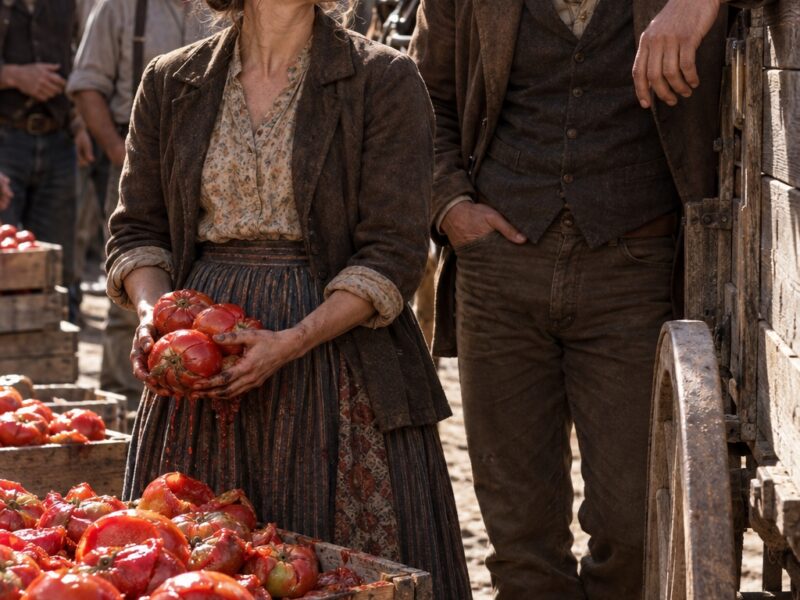
She Spent Her Last $6 on 300 Pounds of Ruined Tomatoes—Then the First Frost Made the Entire Valley Come Knocking

“Who’d pay fifty cents for hog feed?”
Barton Creed laughed as another wooden crate split against the dirt, spilling bruised tomatoes across the market yard. Ten feet away, Eliza Marlo stood with six dollars in her coat pocket—and nothing else between herself and a hungry winter.
By the time the first mountain frost reached Dry Fork, the same people laughing at her would be standing outside her cabin, desperate to buy what she had made.
But on that hot August morning, Eliza had no way of knowing whether her grandmother’s old recipe would save her or finish ruining her.
The tomatoes lay in a sprawling red heap beside Barton’s wagon. They had spent three days beneath an unforgiving summer sun, some split clean across their shoulders, others bruised where heavy crates had crushed them against one another. Juice stained the dust beneath the wagon wheels, and flies gathered wherever the fruit had burst.
Barton stood over the mess with his hands on his hips.
“Fifty cents,” he announced. “That’s what I’d take if somebody hauled the whole thing away.”
Eliza didn’t move.
She studied the tomatoes, looking past the cracks and bruises to the firm red flesh beneath. Some were certainly rotten and beyond saving. Others had been damaged only recently, their skins split by ripening too quickly in the heat.
She knew the difference.
Her grandmother had taught her when she was barely tall enough to see over a kitchen table.
“How much for all of them?” Eliza asked.
Barton turned toward her.
“You mean that pile?”
“All of it.”
“Lady, half those tomatoes split on the vine.”
“I can see.”
“And the other half split in the wagon.”
“I can see that too.”
Barton smiled, and Eliza felt the familiar heat of humiliation creeping up her neck.
She knew that smile.
She had seen it at the general store when she bought flour in small quantities instead of by the sack. She had seen it at the lumberyard when she asked whether the owner had any crooked shingles he couldn’t sell at full price. She had seen it when men rode past her three-acre property and shook their heads at the cracked cabin standing among the hard clay and weeds.
Four months earlier, she had arrived in Dry Fork with one trunk, forty-two dollars, and a deed to land nobody else wanted.
Her husband, Samuel, had died the previous winter after a long illness that consumed everything they owned. There had been medical bills, burial expenses, and debts Eliza hadn’t known existed until creditors began appearing at her door.
She had sold their furniture, his tools, and finally the small house where they had spent seven years together.
When everything was settled, she had forty-two dollars left.
She used the money to purchase three neglected acres outside Dry Fork, a patch of land with poor soil, a leaking roof, and a narrow creek that disappeared beneath the stones every August.
At least the cabin belonged to her.
No landlord could make her leave. No creditor could claim it for Samuel’s debts.
But ownership did not fill an empty pantry.
By the end of summer, Eliza had six dollars remaining.
There was flour enough for nine days if she ate sparingly. Cornmeal might last twelve. Her left boot needed a new sole, and the roof above her bed leaked whenever rain blew from the northwest.
She had been saving the six dollars for roofing shingles.
Now she was considering spending every penny on ruined fruit.
Barton watched her with growing amusement.
“One dollar and fifty cents if you’re calling it a purchase.”
Eliza reached into her coat.
“I’ll give you six.”
His expression changed.
“For what?”
“Every cracked tomato you were going to dump today.”
Someone laughed behind her.
A moment later, another voice joined in.
“Six dollars for garbage?”
A woman near the feed wagon shook her head.
“Poor thing must have lost her senses along with her husband.”
Eliza heard the remark. She kept her eyes on Barton.
The words hurt more than she wanted to admit, not because they were especially cruel, but because she had been hearing different versions of them for months.
Every mistake she made seemed to prove what the town already believed.
That a woman alone couldn’t manage property.
That poverty was evidence of foolishness.
That surviving one bad winter didn’t mean she would survive another.
Barton glanced at the coins in her palm.
“Mrs. Marlo, I’m not going to stop you if you’re determined to waste your money.”
“I didn’t ask you to.”
She counted all six dollars into his hand.
The coins looked painfully small against his broad palm.
He pocketed them.
“Well, they’re yours.”
Eliza stared at the tomatoes.
Three hundred pounds, perhaps more.
She had just spent the last of her money on something she couldn’t possibly carry home.
The laughter returned.
Then a quiet voice spoke behind her.
“You’ll need a wagon.”
Eliza turned.
Jonah Mercer stood beside the hitching rail, one hand resting against the neck of his brown gelding.
He was her nearest neighbor, although nearly a mile of rocky pasture separated their homes. A widower in his late thirties, Jonah lived alone on a cattle ranch that had belonged to his family for two generations.
He was tall, broad-shouldered, and usually so quiet that people sometimes mistook his silence for unfriendly pride.
Eliza had spoken to him perhaps a dozen times.
Once, when he found her struggling to repair a fence.
Twice, when their paths crossed at the creek.
And several times at the general store, where he always removed his hat when addressing her, as though they were meeting in a fine drawing room instead of a building that smelled of grain and kerosene.
She stiffened.
“I can pay twenty cents for the wagon.”
“No.”
“I’m not accepting charity.”
“Wasn’t offering.”
Jonah settled his hat onto his head.
Then he asked a question that stopped her argument before it began.
“Are you planning to cook them?”
Eliza looked at him.
“What?”
“The tomatoes. Are you going to cook them down?”
For the first time that morning, someone had asked what she intended to do instead of telling her she was foolish.
“Yes,” she answered cautiously.
Jonah glanced at the crates.
“Then you’d better get them home before the afternoon heat ruins the rest.”
He unhitched his wagon from the rail.
“Load the good ones separately. I’ll take the worst ones to Creed’s hog pen.”
Eliza hesitated.
“Why would you do that?”
Jonah looked toward the crowd, where several men were still grinning.
“Because standing here discussing it won’t make those tomatoes any fresher.”
He lifted the first crate.
Eliza stared at him for a moment, then bent to help.
By noon, they had sorted the pile.
Some of the tomatoes were already soft with decay. Those went back to Barton, who had no objection to feeding them to his pigs. Others had begun to sour and were discarded.
But more than two hundred pounds were still usable, including many that looked terrible on the outside but remained sound beneath the damaged skin.
Jonah drove the wagon slowly along the dusty road toward her cabin.
Eliza walked beside him, one hand resting on the wooden sideboard to steady herself.
Neither spoke for several minutes.
Finally, Jonah glanced down at her.
“Your grandmother teach you to preserve food?”
Eliza looked surprised.
“How did you know?”
“My mother did the same thing.”
“The same thing?”
“Bought split fruit nobody wanted. Cooked it down before it spoiled.”
Eliza felt something loosen inside her chest.
“My grandmother used to say the split ones were sweeter.”
Jonah nodded.
“My mother said something similar.”
He looked ahead at the winding road.
“She also said sweetness wasn’t much use if you didn’t know how to keep it.”
Eliza almost smiled.
“She was right about that.”
They reached her cabin shortly after one.
Jonah helped unload the tomatoes beneath the shade of a broad cottonwood tree. He carried two heavy buckets of water from the well and placed them beside her washbasin.
When he noticed the loose shingles above the north corner, his eyes lingered there.
“You’ll need to fix that before the rains.”
“I know.”
“Creed has scrap shingles behind his barn.”
“I’ve already asked.”
Jonah gave a small nod.
He understood the rest without making her explain.
Before leaving, he paused beside the wagon.
“What are you making?”
Eliza looked toward the mountain of tomatoes.
“Something my grandmother called winter relish. Some of it I’ll make into sauce.”
Jonah regarded her for a moment.
Then he said, “My mother used to put up tomato preserves with brown sugar and cider vinegar. You could taste summer in January.”
Eliza looked at him.
“That’s exactly what Grandma used to say.”
His expression changed, almost imperceptibly.
For a moment, she saw something behind his quiet face that had nothing to do with tomatoes.
Then he looked away.
“Well,” he said, gathering the reins, “I hope you can put up enough.”
He drove off before she could thank him.
Eliza stood beneath the cottonwood until the wagon disappeared around the bend.
Then she turned toward her unexpected fortune.
Two hundred pounds of usable tomatoes.
A tiny kitchen.
One iron pot.
And a pantry containing just enough salt, vinegar, sugar, and spices to begin.
Her grandmother’s kitchen returned to her memory.
Steam clouding the windows.
A black iron pot simmering on the stove.
The sharp smell of vinegar mingling with onions and ripe fruit.
Her grandmother standing beside the table with red-stained hands.
Don’t throw away what’s bruised, Eliza. Cut away what’s spoiled. Give the rest a chance.
Eliza rolled up her sleeves.
She began washing tomatoes.
By sunset, her hands were stained red and the kitchen floor was wet with juice. She had filled every clean bowl, pan, and crock in the cabin.
She cut away bruises, discarded damaged sections, and washed the sound fruit again.
The first pot began simmering shortly after dark.
Eliza added onions, vinegar, salt, and a little brown sugar.
She stirred until the mixture thickened.
Then she tasted it.
For a moment, she was eleven years old again, standing beside her grandmother’s stove while rain tapped against the windows.
The taste wasn’t perfect.
It needed more vinegar.
A little salt.
Perhaps another hour over the fire.
But it was close.
So close that tears suddenly blurred her vision.
She rested the wooden spoon against the rim of the pot.
“Almost, Grandma,” she whispered.
Then she wiped her face and returned to work.
The next morning, she carried a small crock of relish to the general store.
Mr. Pritchard, the storekeeper, looked at the reddish mixture with suspicion.
“What is it?”
“Tomato relish.”
“Made from Creed’s rotten tomatoes?”
“Made from the sound parts of the tomatoes he couldn’t sell.”
He raised an eyebrow.
“That’s a distinction people might find hard to swallow.”
Eliza placed the crock on the counter.
“Then taste it before you decide.”
Pritchard hesitated.
At last, he took a clean spoon from behind the counter.
He tasted a little.
Chewed thoughtfully.
Then took another spoonful.
“That’s rather good.”
Eliza waited.
He set down the spoon.
“How much?”
“Twenty cents for a small jar.”
Pritchard nearly laughed.
“Twenty cents? I sell canned tomatoes for less than that.”
“Mine isn’t canned tomatoes. It’s relish. It goes with beans, meat, potatoes, or bread.”
“People around here make their own preserves.”
“Some do.”
“And the ones who don’t are unlikely to pay twenty cents.”
Eliza looked at the crock.
She had expected refusal.
It still hurt.
“Would you take six jars on trial?”
Pritchard considered her.
“Ten cents apiece, if they sell.”
Eliza felt a familiar tightening in her chest.
Ten cents wouldn’t leave much after vinegar, sugar, firewood, and a proper jar were accounted for.
Still, it was a beginning.
“Fifteen,” she said.
He shook his head.
“Twelve.”
She thought for a moment.
“Four jars. Twelve cents each. And I’ll bring you more if they sell.”
Pritchard gave a reluctant nod.
“Four jars.”
Eliza left the shop with the little crock, a promise that might never become money, and the knowledge that she still had no coins in her pocket.
She returned home before noon.
There was much to do.
The tomatoes would not wait.
Neither would winter.
Over the next three days, Eliza worked until her shoulders ached.
She boiled sauce, made relish, prepared tomato preserves, and turned the last of the sound fruit into a thick paste that could be packed in small crocks and kept cool for a shorter period.
She saved some fresh tomatoes for immediate meals and wasted as little as she could.
But preserving the rest safely presented a problem.
Her grandmother had taught her recipes, yet Eliza owned only a handful of proper preserving jars. Most of her containers were cracked crocks, reused bottles, and mismatched glass jars whose lids no longer sealed reliably.
Tomato sauce and relish would be no use to her if they spoiled before winter.
She needed jars.
And she had no money to buy them.
On the fourth morning, Jonah Mercer arrived while she was carrying a steaming pot from the stove.
He climbed down from his wagon and stood at the doorway.
“Morning, Mrs. Marlo.”
“Mr. Mercer.”
He looked past her into the kitchen.
Steam drifted through the open window.
Every available surface was covered with bowls, knives, jars, and stained cloths.
“You’ve been busy.”
Eliza shifted the heavy pot.
“I have.”
Jonah glanced at the stove.
“Smells good.”
“Thank you.”
He lingered, looking as though he wanted to say something but couldn’t decide how to begin.
Finally, he lifted a wooden crate from his wagon.
“My mother left these.”
Eliza stared.
Inside were two dozen glass preserving jars with sturdy metal closures.
A few were dusty.
Most appeared sound.
She looked up.
“Mr. Mercer, I can’t possibly—”
“They’ve been sitting in my pantry for three years.”
“That doesn’t mean you should give them away.”
“I’m not giving them away.”
He rested the crate on her table.
“I’d like to trade.”
Eliza folded her arms.
“For what?”
Jonah looked toward the iron pot.
“A jar of whatever smells that good.”
She studied his face.
“Twenty-four jars for one jar of relish?”
“Seems fair.”
“It isn’t.”
“Then two jars.”
She tried not to smile.
“You’re a very poor businessman, Mr. Mercer.”
“I’ve been told.”
Eliza touched one of the glass jars.
It was clean beneath the dust, carefully wrapped in an old dishcloth.
Something about that small detail made her throat tighten.
These hadn’t been thrown together carelessly.
He had packed them so they wouldn’t break.
“How long was your mother gone?” she asked softly.
Jonah’s expression settled.
“Seven years.”
“I’m sorry.”
He nodded once.
“My wife kept using the jars after Mother passed.”
Eliza looked up.
Jonah’s gaze moved toward the cottonwood outside.
“She died three winters ago.”
The words were plain.
But his hand tightened around the brim of his hat.
Eliza understood the silence that followed.
People talked about loss as though it were a door someone eventually closed. She knew better. Sometimes grief sat quietly in a room until an ordinary object—a jar, a coat, a chipped plate—made its presence unbearable again.
“Her name?” Eliza asked.
“Anna.”
“Did she make preserves?”
“Every autumn.”
A faint smile touched his mouth.
“She’d insist we had enough to feed the whole county, then worry every January that we’d run out.”
Eliza smiled too.
“My grandmother was exactly the same.”
Jonah looked down at the crate.
“I think she’d have wanted somebody to use them.”
Eliza did not argue again.
Instead, she chose two jars of finished relish and set them on the table.
“Then these are yours.”
Jonah accepted them.
At the door, he paused.
“Mr. Pritchard mentioned you were trying to sell some.”
Eliza nodded.
“He’s taking four jars on trial.”
“Four?”
“For now.”
Jonah studied her.
“Have you tasted your own relish with cold beef?”
“Of course.”
“With beans?”
“Yes.”
“With cornbread?”
She smiled.
“Yes, Mr. Mercer. I’ve tasted my relish.”
“Good.”
He put on his hat.
“Then you know something Pritchard doesn’t.”
After he left, Eliza stood for a long moment holding one of the old jars.
She washed each carefully and checked the closures.
That evening, as the last light faded behind the hills, she filled the first of them with her grandmother’s relish.
For the first time since arriving in Dry Fork, the shelves above her stove began to look less empty.
Not full.
Not yet.
But less empty.
And sometimes that was enough to make a woman believe she could endure another day.
A week later, Eliza returned to the general store.
All four jars were gone.
Pritchard looked up when she entered.
“Mrs. Marlo.”
“Good morning.”
He reached beneath the counter and counted forty-eight cents into her hand.
“They sold.”
Eliza tried to keep her face composed.
“All four?”
“All four.”
Her heart lifted.
“Would you like another six?”
Pritchard scratched his chin.
“Perhaps.”
Then he leaned closer.
“There’s been a complaint.”
The small happiness inside her disappeared.
“A complaint?”
“About the tomatoes.”
Eliza went still.
Pritchard lowered his voice.
“Mrs. Dobbins bought two jars. She heard how you got the fruit.”
Eliza swallowed.
“Was there something wrong with the relish?”
“No. She said it tasted fine.”
“Then what was the complaint?”
“She doesn’t like the idea of paying for something made out of refuse.”
Eliza stared at him.
Pritchard shrugged.
“People are particular.”
For several seconds, she couldn’t speak.
She thought of the endless washing, the fruit she had discarded, the vinegar and sugar, the hours spent tending the fire while her back throbbed.
She thought of the clean jars, the careful preparation, and the nights spent awake worrying whether the seals would hold.
Then she looked at the forty-eight cents in her palm.
“Did she return the jars?”
“No.”
“Did she ask for her money back?”
“No.”
“Did she finish the relish?”
Pritchard hesitated.
“I believe so.”
Eliza closed her fingers around the coins.
“Then perhaps her complaint isn’t about the food.”
Pritchard said nothing.
She placed six more jars on the counter.
“Would you like these?”
He eyed them.
Finally, he nodded.
“I’ll take them.”
Eliza walked home with forty-eight cents and a strange mixture of pride and exhaustion.
She had earned money.
Not much.
But it was money she had made with her own hands.
That evening, as she sat beside the stove eating cold beans with the last spoonful of relish from an open jar, she heard wagon wheels outside.
Jonah Mercer had arrived.
He stood beside his horse holding something long and narrow beneath one arm.
Eliza opened the door.
“What brings you here?”
Jonah looked at the north corner of her roof.
“Rain coming.”
“I’ve noticed.”
He lifted the bundle.
“Found some shingles.”
Eliza stared.
“Mr. Mercer—”
“Creed was clearing his barn. These were in the scrap pile.”
“They’re not yours to give.”
“They are now. I traded him a broken harness buckle.”
She looked from the shingles to his face.
“Why?”
Jonah seemed genuinely puzzled.
“Because the roof leaks.”
Eliza let out a breath that was almost a laugh.
“That isn’t what I meant.”
“I know.”
He shifted the bundle beneath his arm.
“Will you let me fix it?”
She wanted to refuse.
She had spent so much of the past year proving she could survive without depending on anyone that accepting help felt dangerously close to admitting defeat.
But the sky was darkening over the western ridge.
And the north corner of the roof had leaked since April.
“Yes,” she said quietly. “I will.”
Jonah nodded.
He climbed onto the roof while Eliza held the ladder.
The first drops of rain began falling just as he drove the last nail.
When he came down, his shirt was damp and his hands smelled of wet wood.
Eliza offered him supper.
“It’s only beans and cornbread.”
Jonah glanced toward the cabin.
“Do you have any of that relish left?”
She smiled.
“A little.”
“Then it sounds like a fine supper.”
They ate at her small kitchen table while rain drummed on the repaired roof.
Jonah spoke more than she had ever heard him speak.
He told her about the cattle he’d lost during the terrible winter of 1884, about the stubborn mare that kicked every man who tried to shoe her, and about his father, who had once planted an entire field of potatoes on the wrong side of a creek.
Eliza told him about her grandmother’s kitchen, the little garden she had kept with Samuel, and the way her husband used to whistle when he was nervous.
For a while, speaking Samuel’s name didn’t feel like reopening a wound.
It felt like remembering a life that had mattered.
When Jonah rose to leave, he looked at the shelves above her stove.
“You’ve put up a good many jars.”
“Not enough to live on.”
“No,” he admitted.
Eliza folded her hands.
“But more than I had before.”
Jonah smiled faintly.
“Yes, ma’am.”
Then his expression became serious.
“There’s something you ought to know.”
Eliza waited.
“Word’s gone around town about those tomatoes. Creed’s been telling people you paid six dollars for what he would have dumped.”
“I know.”
“He’s making it sound worse than it was.”
Eliza lowered her gaze.
“I suppose he would.”
Jonah hesitated.
“Pritchard’s worried people won’t buy more.”
The room fell quiet.
Outside, the rain strengthened.
Eliza looked at the carefully sealed jars lining her shelves.
She had worked for days to turn waste into something useful.
But no matter how good the relish tasted, people could refuse to buy it.
And she couldn’t eat pride through the entire winter.
Jonah watched her face.
“I’m sorry.”
Eliza shook her head.
“Don’t be.”
She looked at the jars again.
“Maybe I was foolish.”
He didn’t answer immediately.
Then he said, “My mother used to keep a jar of peaches on the highest shelf. Nobody could touch it until the first snow.”
Eliza looked back at him.
“Why?”
“Because she said a man never understood the worth of summer until winter took it away.”
He picked up his hat.
“Good night, Mrs. Marlo.”
“Good night, Mr. Mercer.”
After he left, Eliza remained beside the stove.
She thought about his mother’s peaches.
About her grandmother’s red-stained hands.
About the people who had laughed at her.
Then she reached for a clean piece of paper and began counting.
The jars.
The cost of sugar.
The vinegar.
The firewood.
The number of servings each jar could provide.
For the first time, she wasn’t simply trying to survive the coming winter.
She was beginning to wonder whether the coming winter might need exactly what she had made.
September arrived with cold mornings and yellowing grass.
The cottonwood beside Eliza’s cabin began dropping leaves into the yard.
Jonah continued visiting once or twice a week, usually with a practical excuse.
A loose fence post.
A broken handle.
A question about whether she had enough wood stacked for the stove.
Eliza began setting aside a little coffee whenever she heard his wagon approaching.
Neither mentioned the habit.
One afternoon, she found him standing beside her woodpile with a measuring tape.
“What are you doing?”
“Counting what you have.”
“Why?”
“Because you won’t have enough.”
Eliza crossed her arms.
“I know that.”
Jonah looked toward the northern mountains.
“Winter came hard last year.”
She followed his gaze.
Beyond the valley, the distant peaks were already dusted white.
“I’ve survived hard winters before.”
“I believe you.”
He rolled up the tape.
“Doesn’t mean you need to make this one harder.”
Eliza studied him.
“You have a habit of saying things that sound like advice but aren’t.”
Jonah smiled.
“You have a habit of refusing help before anybody offers it.”
She looked away, but not before he saw her smile.
That evening, he left a small load of split wood beside her cabin in exchange for four jars of relish.
Eliza protested the uneven trade.
Jonah insisted he had more timber than he could burn.
Eventually, she stopped arguing.
She had learned that some people helped because they expected gratitude.
Others helped because it made them feel important.
Jonah helped, she was slowly beginning to understand, because he knew what it felt like to return to an empty house.
And perhaps because he was tired of doing it.
By the middle of September, Eliza had sold eleven jars through Pritchard’s store.
She had also traded preserves for onions, a sack of potatoes, and a length of leather to repair her boot.
The money was still desperately short.
Some of the jars had been bought only because a customer was curious. Others had been sold at prices too low to leave much profit.
She had learned that good food did not automatically make a good business.
But the few coins in her kitchen drawer were no longer imaginary.
Each had come from work she understood.
On the last Sunday of September, she carried a basket of relish and cornbread to the church social.
Mrs. Dobbins was there.
So was Barton Creed.
Eliza placed her food on the long table between a plate of ham and a crock of baked beans.
As the congregation gathered, she noticed Barton speaking to several men near the doorway.
He looked toward her basket.
Then laughed.
Eliza felt her stomach tighten.
A little later, Mrs. Dobbins approached the table with her lips pressed together.
“I hear you’ve been selling that relish.”
“Yes, ma’am.”
“From Creed’s spoiled tomatoes.”
Eliza looked at her steadily.
“From the good portions of tomatoes that couldn’t be sold fresh.”
Mrs. Dobbins sniffed.
“Seems an unusual way to make a living.”
“I haven’t made much of a living from it yet.”
The older woman was momentarily silenced.
Eliza cut a piece of cornbread and placed a spoonful of relish beside it.
“Would you like some?”
Mrs. Dobbins hesitated.
Then, with the air of someone performing an unpleasant duty, she accepted the plate.
She took a bite.
Her expression changed almost immediately.
She chewed.
Looked down at the plate.
Then took another bite.
“This is different from what you sold before.”
“A little. I adjusted the spices.”
Mrs. Dobbins swallowed.
“My late sister used to make something similar.”
Eliza waited.
“She used more onion.”
“I can add more onion.”
The woman looked surprised.
“You’d change the recipe?”
“If you prefer it that way.”
Mrs. Dobbins stared at the relish.
Then she said, very quietly, “I might take two jars.”
Eliza managed to keep her voice even.
“I’d be happy to make them.”
Across the room, Jonah Mercer caught her eye.
He had seen the exchange.
He didn’t smile broadly or congratulate her.
He simply lifted his coffee cup a little.
Eliza lowered her head to hide the smile spreading across her face.
For the first time in months, she felt she might belong somewhere.
Not as Samuel’s widow.
Not as the foolish woman living on three useless acres.
But as herself.
Eliza Marlo.
A woman who could make something worth buying.
The frost arrived on October 3.
Two weeks earlier than most people expected.
It came silently during a clear night, settling over the valley while the sky glittered with stars.
By morning, the grass had turned silver.
The leaves on the tomato vines hanging over backyard fences were black and limp.
Puddles wore thin skins of ice.
In Barton’s fields, the last unharvested tomatoes collapsed beneath a glittering crust of frost.
He had been planning one final harvest before the weather changed.
Now there would be none.
He stood in the field that morning with his hands buried in his pockets, staring at the ruined vines.
At the general store, people began talking about the cold.
Too early.
Too sharp.
Too sudden.
Several families had counted on another fortnight of fresh vegetables.
Others had planned to preserve their remaining produce after finishing the hay harvest.
Now the growing season was over.
Within days, the fresh tomatoes at Pritchard’s store were gone.
The last onions and late beans disappeared next.
People began opening their winter stores earlier than they had intended.
Then someone remembered Eliza Marlo.
The woman who had spent six dollars on cracked tomatoes.
The woman who had cooked through the August heat while everyone else laughed.
The woman who had spent September filling jars instead of waiting for autumn.
Mrs. Dobbins was the first to come.
She arrived at Eliza’s cabin on a cold Thursday afternoon, wrapped in a thick gray shawl.
Eliza opened the door with a dishcloth in her hand.
“Mrs. Dobbins?”
The older woman looked uncomfortable.
“I was wondering whether you had any of that relish left.”
Eliza glanced toward the kitchen shelves.
“I have some.”
“Would you sell me four jars?”
Eliza hesitated.
Four jars represented nearly a week’s worth of food for her if she rationed carefully.
But four jars at twenty cents each would buy flour, salt, and perhaps a little kerosene.
She weighed the choice.
“I’m selling them for twenty cents apiece.”
Mrs. Dobbins opened her purse.
“I’ll take four.”
Eliza packed the jars carefully.
Before leaving, Mrs. Dobbins paused on the porch.
“I was unkind to you at the church social.”
Eliza looked at her.
The woman adjusted her shawl.
“My sister used to say I had a sharp tongue.”
Eliza said nothing.
Mrs. Dobbins looked down at the jars.
“She was right.”
A cold breeze moved between them.
Finally, Eliza replied, “I hope you enjoy the relish.”
Mrs. Dobbins nodded.
“I believe I will.”
By the following afternoon, two more families had come.
Then Pritchard sent word that customers were asking whether she had more jars available.
A ranch hand from the northern ridge bought six.
The schoolteacher wanted three.
A mother with four children offered to trade a sack of potatoes for two jars of sauce and a crock of relish.
Eliza accepted.
Suddenly, the shelves she had spent weeks filling began to empty.
She kept a careful account.
Every jar sold.
Every coin received.
Every trade made.
And every jar she needed to reserve for her own winter meals.
It would have been easy to sell everything.
The money tempted her.
She could buy shingles, more firewood, perhaps a new pair of boots.
But she remembered why she had bought the tomatoes in the first place.
To survive.
And she refused to let the excitement of selling destroy the purpose of saving.
On the following Monday, Barton Creed himself arrived at her cabin.
Eliza saw his wagon from the kitchen window.
Her stomach tightened.
He climbed down carrying an empty wooden crate.
For a moment, neither spoke.
Then Barton cleared his throat.
“Morning, Mrs. Marlo.”
“Mr. Creed.”
He glanced toward the shelves visible behind her.
“Heard you’ve been selling quite a bit.”
“Some.”
“Pritchard says people are asking for more.”
“They have been.”
Barton shifted his weight.
“Those tomatoes I sold you turned out better than I expected.”
Eliza waited.
He removed his hat.
“I was wondering if you’d sell me a dozen jars.”
She stared at him.
“A dozen?”
“For the ranch hands. They get tired of salt pork and beans.”
Eliza folded her hands.
“I don’t have twelve jars to sell.”
Barton looked disappointed.
“I’d pay a fair price.”
“I’m sure you would.”
He studied her expression.
Then he looked away.
“I suppose I owe you an apology.”
Eliza said nothing.
He rubbed the back of his neck.
“I made a spectacle of you at the market.”
“Yes,” she answered.
“I didn’t think you’d do anything useful with that fruit.”
“I know.”
Barton looked toward his wagon.
“Truth is, I was glad to be rid of it. You paid me six dollars for something I thought was worthless.”
Eliza’s voice remained calm.
“It wasn’t worthless.”
“No,” Barton admitted. “I see that now.”
She looked at him for a long moment.
Then she said, “I can sell you three jars.”
Barton nodded quickly.
“I’ll take them.”
“Twenty-five cents each.”
His eyebrows rose.
“Pritchard was selling them for twenty.”
“He was. I’ve sold most of my supply now.”
Barton considered the price.
Then he reached into his pocket.
“Fair enough.”
Eliza counted out the jars.
Barton paid seventy-five cents without another word.
As he climbed onto the wagon, he paused.
“Mrs. Marlo?”
“Yes?”
“I hope you’ll buy from me again next summer.”
Eliza looked at him.
“Perhaps.”
He smiled awkwardly.
“Even if I don’t have any ruined tomatoes?”
She studied the empty crate beside him.
“If you have good tomatoes at a fair price, Mr. Creed, I’d be glad to discuss it.”
He nodded.
Then drove away.
Eliza remained on the porch until the wagon disappeared.
She had imagined this moment more than once.
She had imagined Barton standing before her, embarrassed, forced to admit that she had been right.
But the satisfaction was quieter than she expected.
He had laughed because he hadn’t understood what she could do.
Now he did.
That was enough.
Or she thought it was.
Until the following morning, when Jonah Mercer rode into her yard with news that changed everything.
He dismounted slowly.
Eliza had never seen him look so troubled.
“What’s wrong?” she asked.
Jonah held the reins tightly.
“Barton isn’t the only farmer who lost crops.”
“I know.”
“The frost reached the eastern valley too. Two supply wagons were delayed by snow on the pass.”
Eliza frowned.
“How bad?”
“Bad enough that Pritchard’s already limiting flour sales.”
She glanced toward her pantry.
Jonah continued.
“Some families are going to have a harder winter than anybody expected.”
Eliza felt the cold settle deeper inside her.
She knew what he was telling her.
The valley didn’t simply want what she had made.
Some people might need it.
And the jars on her shelves suddenly felt smaller than ever.
Over the next week, Eliza made a decision she hadn’t expected to face.
She would sell enough preserves to buy the food, fuel, and supplies she needed.
She would keep enough to feed herself.
And she would set aside a few jars for families who had nothing left to trade.
Jonah didn’t argue when she explained her plan.
He simply asked how he could help.
Eliza looked at the remaining tomatoes she had preserved, the empty jars waiting to be washed, and the ledger on her kitchen table.
“I need a better way of doing this next year.”
Jonah leaned against the doorframe.
“What kind of way?”
“A proper kitchen. More jars. Enough vinegar and sugar before harvest. And somebody who knows how to find buyers beyond Dry Fork.”
Jonah was silent.
Then he said, “That sounds like a business.”
Eliza looked down at her hands.
They were rough, stained, and scarred from months of work.
“I suppose it does.”
“Have you thought of a name?”
She laughed.
“A name?”
“For the jars.”
Eliza looked at the old black iron pot sitting on her stove.
Then at the photograph of her grandmother tucked beside the kitchen clock.
She remembered the warm kitchen of her childhood.
The sound of a spoon scraping the bottom of a pot.
The smell of tomatoes cooking while rain tapped against the windows.
And the words she had carried all the way to Dry Fork.
The split ones are sweeter.
She smiled.
“Grandmother’s Winter Relish.”
Jonah nodded.
“It’s a good name.”
Over the following days, Pritchard agreed to take orders for her preserves. He offered her a better price now that customers were asking for the product by name.
Eliza insisted on keeping a written record of every arrangement.
She had learned too much about money and debt to trust memory alone.
Jonah helped her build shelves inside the cabin.
In exchange, Eliza cooked supper and sent him home with preserves.
They worked together beneath the October sun, their breath visible in the morning air.
One afternoon, while they were fastening the final shelf, Jonah reached for a board at the same moment Eliza did.
Their hands touched.
Both stopped.
Eliza pulled hers away first.
“Sorry.”
“Nothing to be sorry about.”
The silence stretched.
Jonah looked at her with an expression she hadn’t seen before.
Not pity.
Not amusement.
Something gentler.
Something that frightened her a little because it had been so long since anyone had looked at her that way.
“Eliza,” he said.
It was the first time he had used her given name.
She met his eyes.
“Yes?”
He hesitated.
Then, almost reluctantly, he smiled.
“Would you come to supper at my place Sunday?”
She looked at him.
“Sunday?”
“I thought I might cook.”
“You cook?”
“Badly.”
She laughed.
Jonah’s smile deepened.
“But I could use someone willing to tell me what I’m doing wrong.”
Eliza lowered her eyes.
For a moment, she saw Samuel as clearly as if he were standing in the room.
She remembered his nervous whistling, the way he used to warm her hands between his, the last winter when he could barely lift his head from the pillow.
Grief rose unexpectedly.
She breathed through it.
Then she looked back at Jonah.
“I’d like that.”
He nodded, his relief unmistakable.
“Sunday, then.”
Outside, the wind moved through the nearly bare cottonwood.
For the first time since Samuel’s death, Eliza found herself looking forward to a day that had nothing to do with surviving.
The first snow came in November.
It settled over Dry Fork in a thin white blanket, covering the road, the pastures, and the hard clay ground around Eliza’s cabin.
Inside, her stove burned steadily.
Her roof no longer leaked.
Her woodpile had grown.
There was flour in the pantry, potatoes in the cellar, and enough preserves set aside to last through winter.
She had earned more money from her six-dollar purchase than she had ever believed possible.
Not a fortune.
Nothing that would impress the wealthy cattlemen or merchants who passed through Dry Fork.
But enough to keep her home.
Enough to buy supplies.
Enough to begin planning for spring.
One cold evening, Jonah arrived carrying a small package wrapped in brown paper.
Eliza met him at the door.
“What’s this?”
“A present.”
“For what?”
He shrugged.
“First snow.”
She looked at him suspiciously.
“Is that a proper occasion for presents?”
“I’m making it one.”
Inside the paper was a new wooden spoon.
Beautifully carved.
Smooth and polished.
Its handle bore a tiny pattern of leaves.
Eliza ran her fingers over the wood.
“Did you make this?”
Jonah nodded.
“My father taught me.”
She turned the spoon in her hands.
It was simple.
Practical.
And somehow more precious than anything anyone had given her in years.
“Thank you,” she whispered.
Jonah looked embarrassed.
“I thought your old one was wearing thin.”
Eliza glanced toward the stove.
The black iron pot was sitting on its familiar hook.
She looked back at Jonah.
“Come in. I’ve made supper.”
He followed her inside.
They sat at the kitchen table, eating beans, fresh bread, and the last open jar of summer relish.
Snow tapped gently against the window.
For a while, neither spoke.
Then Jonah looked around the room.
“You’ve changed this place.”
Eliza followed his gaze.
The repaired roof.
The shelves.
The clean table.
The stove.
The jars.
The little photograph beside the clock.
“It still isn’t much,” she said.
Jonah shook his head.
“I didn’t say it was grand.”
He looked at her.
“I said you changed it.”
Eliza smiled.
Then she looked down at the wooden spoon in her hand.
“I used to think surviving meant doing everything by myself.”
Jonah waited.
“I thought if I accepted help, it meant I wasn’t strong enough.”
He leaned back in his chair.
“And now?”
Eliza looked at him.
“Now I think strength might mean knowing what you can do, and letting people help with what you can’t.”
Jonah smiled faintly.
“My mother would have liked that.”
“Would she?”
“She would have liked you.”
Eliza felt her cheeks grow warm.
Outside, the snow deepened.
Inside, the stove crackled.
They talked until the fire burned low.
When Jonah finally rose to leave, Eliza walked him to the door.
He stood beneath the porch roof, pulling on his gloves.
“Eliza?”
“Yes?”
He looked toward the dark yard.
Then back at her.
“There’s something I’ve been meaning to ask.”
She waited.
He removed one glove.
“I know you’ve had a hard few years.”
She nodded.
“And I know the last thing you need is somebody making decisions for you.”
Eliza studied him quietly.
Jonah continued.
“I won’t ask you to leave this place. I know what it means to you.”
Her breath caught.
“But if you’d let me,” he said, “I’d like to keep coming by. Not because your roof needs fixing or your fence needs mending.”
He hesitated.
“Just because I like being here.”
For several seconds, Eliza couldn’t answer.
The old instinct rose inside her.
Protect yourself.
Keep your distance.
Don’t build a life that can be taken away again.
Then she looked past Jonah into the snowy darkness.
She thought of Samuel.
Of the years they had shared.
Of the grief she would always carry.
And of the strange, gentle companionship that had grown beside her during the hardest summer of her life.
She realized that making room for someone new didn’t mean erasing the person she had lost.
It simply meant her life had not ended when Samuel’s did.
“I’d like that,” she said softly.
Jonah’s face changed.
A smile spread slowly across it.
“Good night, Eliza.”
“Good night, Jonah.”
After he left, she stood in the doorway a little longer.
Snow settled over the porch railing.
The cold air touched her face.
Then she went inside and closed the door against the wind.
By the following spring, Eliza had saved enough to buy fresh tomato plants, onions, and herbs for a small garden.
Barton Creed offered her a standing agreement for any sound but unsalable tomatoes left after his regular harvest. They negotiated a modest price and wrote it down.
Pritchard agreed to stock her relish through the summer.
A merchant traveling to the next county took a dozen jars as a trial order.
And Jonah helped her repair the old shed beside the cabin so she could use it for storage.
The business grew slowly, as most real things do.
There were days when jars broke.
Days when batches didn’t turn out properly.
Days when customers failed to pay and Eliza wondered whether she had made another terrible mistake.
She learned to calculate every expense.
To keep careful records.
To save money before spending it.
To discard fruit that could not be used safely, no matter how painful the waste felt.
And to refuse prices that would leave her working for nothing.
She wasn’t suddenly wealthy.
She didn’t become the most powerful woman in Dry Fork.
She still patched her clothes, watched her expenses, and worried when the weather changed.
But she no longer faced each morning with the feeling that one small misfortune would destroy her.
One afternoon in late August, nearly a year after the day at the market, Eliza stood beside her stove stirring a fresh batch of relish.
The kitchen smelled of tomatoes, onions, and cider vinegar.
Sunlight poured through the open window.
Outside, Jonah was repairing the gate.
She could hear him working.
Every few minutes, he whistled a little tune.
Not Samuel’s tune.
A different one.
And for the first time, hearing it did not make her feel guilty for being happy.
Eliza lifted the new wooden spoon and tasted the relish.
A little sweet.
A little sharp.
Just as her grandmother had made it.
She smiled.
Then she looked toward the shelf above the stove.
There, beside her grandmother’s photograph, sat a small glass jar.
Inside were six silver dollars.
Not the same coins she had spent that August morning.
Those were long gone.
But the first six dollars she had saved from her earnings, set aside one at a time.
She kept them there as a reminder.
Not of how foolish she had been.
Not even of how brave.
But of how easily people mistake the appearance of something for its worth.
The tomatoes had been cracked.
Her cabin had been broken.
Her life had seemed ruined.
Yet with patience, work, and a little help, she had found something valuable in all three.
Jonah appeared at the doorway.
“Smells good.”
Eliza looked up.
“You say that every time.”
“It’s true every time.”
He stepped inside and rested his hat on the table.
“Barton sent word. He has another wagonload ready.”
Eliza laughed softly.
“Cracked ones?”
“Some.”
“Bruised ones?”
“A few.”
She turned back to the pot.
“Then I suppose we’d better get to work.”
Jonah looked at the shelves.
“Think the valley will want more this winter?”
Eliza stirred the bright red relish.
Through the open window, she could see the mountains rising beyond Dry Fork.
Somewhere high above the valley, the first cold winds of autumn were already gathering.
She smiled.
“I believe they’ll find room for another jar.”
And as Jonah went outside to hitch the wagon, Eliza returned to her grandmother’s old recipe—the one that had taught her, long before Dry Fork ever heard her name, that a thing could be bruised without being worthless.









