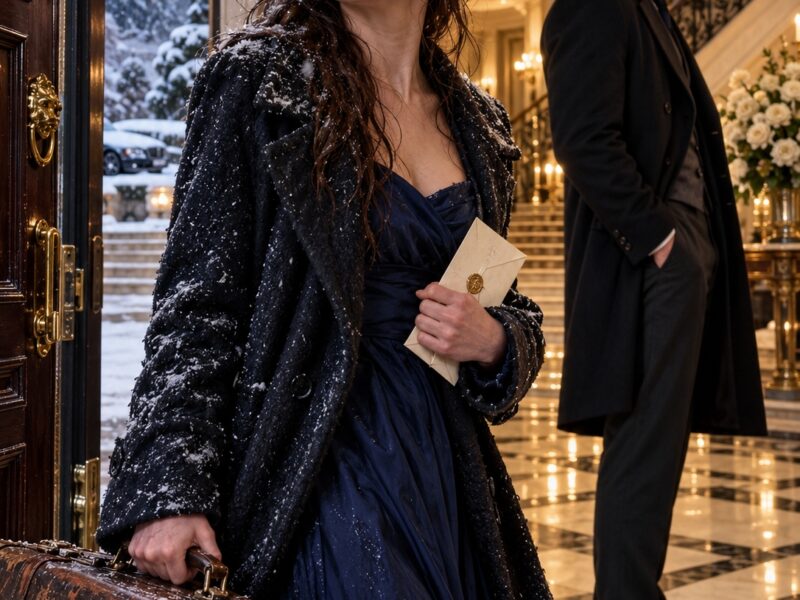
SHE SPENT HER LAST DOLLAR TO MARRY A RICH HEIR—BUT HE ABANDONED HER IN A SNOWSTORM, AND HIS COLD BILLIONAIRE COUSIN MADE AN OFFER SHE NEVER SAW COMING.

The night Elena Whitmore ended her engagement, the man she had crossed half the country to marry looked her straight in the face and told her exactly what she was worth.
Nothing.
No money.
No family name worth protecting.
No home that creditors could not take.
No respectable future without him.
Julian Blackwood stood in the Duke of Blackthorne’s study with snow melting from his riding boots and fury staining his handsome face.
“You need me,” he said.
Elena’s fingers were cold, though a fire burned only a few feet away.
Julian took another step toward her.
“Have you forgotten what you are?”
Behind the desk, Duke Adrien Blackwood rose slowly.
Julian did not notice.
Or perhaps he did and simply believed blood would protect him.
“You are the bankrupt daughter of a dead man,” Julian continued. “You have nowhere to go. No fortune. No brothers. No useful connections. Do you honestly believe men are lining up to marry you?”
Elena heard every word.
The terrible thing was that none of it was entirely false.
She had spent nine years counting pennies.
She knew precisely how poor she was.
She knew the roof of her family house leaked over the west bedroom. She knew which creditors had stopped using polite language. She knew exactly how much money remained in the small purse hidden beneath the lining of her suitcase.
And she knew that by refusing Julian, she was throwing away the last bargain standing between her and ruin.
Still, she looked at him and said, “I will not marry you.”
Julian stared.
Then he laughed.
Not because anything was funny.
Because men like Julian laughed when reality refused to obey them.
“You’ll regret this.”
Elena said nothing.
“When you’re scrubbing floors in some miserable boardinghouse, you’ll remember tonight.”
Still nothing.
Julian’s gaze shifted past her to Adrien.
Something changed in his expression.
Perhaps he finally saw the way his cousin was looking at her.
Not possessively.
Not triumphantly.
Worse.
As though Elena’s choice mattered more to him than his own.
Julian’s mouth twisted.
“Fine,” he said. “Keep her.”
Adrien’s jaw tightened.
Julian gave a bitter smile.
“You always did have to fix everything.”
Then he walked out.
The study door slammed hard enough to shake the portraits.
Seconds later, the enormous front doors of Blackthorne Hall crashed shut.
And Elena Whitmore—who had survived her father’s death, nine years of debt, hungry winters, humiliating negotiations and a journey through the worst snowstorm northern New York had seen in decades—finally began to shake.
Because Julian had been cruel.
But he had also been right about one thing.
She had nowhere to go.
And the man standing behind her was the one man she could not allow herself to need.
Three weeks earlier, Elena had arrived at Blackthorne Hall carrying everything she owned in one battered leather suitcase.
The snow had swallowed the road by then.
Blackthorne Hall stood above the Adirondack valley like something carved from winter itself—gray stone, black windows, steep roofs buried beneath snow, chimneys breathing thin columns of smoke into an iron sky.
The driver had warned her twice that they should turn back.
Elena refused twice.
She had already spent too much money reaching this place.
Turning back was a luxury.
When the SUV finally stopped before the stone steps, no welcoming fiancé came running through the doors.
No one came at all.
Elena opened the door herself.
Wind struck her so hard she nearly lost her footing.
Her wool coat was useless within seconds.
She pulled her suitcase from the back, gripped the handle with both hands and started toward the house.
A young employee hurried down the steps.
“Miss Whitmore, let me—”
“I have it.”
“Ma’am, it’s heavy.”
“I know.”
She kept walking.
From a second-floor window, Adrien Blackwood watched her drag that suitcase through snow nearly to her knees.
He had expected someone different.
Julian had described Elena as “a practical little thing.”
Adrien had assumed that meant compliant.
A desperate woman who would smile at whatever Julian offered because she needed his name more than she needed dignity.
Instead, he watched a soaked stranger refuse help and pull her own life through a blizzard.
Adrien was thirty-two and had inherited Blackthorne Hall at twenty-six after the sudden death of his father.
Along with the estate came hundreds of acres, investment holdings, employees, tenant properties, family obligations, lawsuits, unpaid bills that were not his, and Julian.
Especially Julian.
By thirty-two, Adrien had developed a reputation for being difficult.
Cold.
Private.
Brutally efficient.
He considered most social interaction an expensive interruption.
Blackthorne Hall reflected him perfectly.
Beautiful.
Immaculate.
Silent.
Then Elena Whitmore walked into it dripping snow onto the marble floor.
Adrien waited at the bottom of the staircase.
She removed one wet glove, then the other.
Her eyes swept the entrance hall.
The staircase.
The corridor.
The empty doorway behind him.
Adrien saw the exact second she understood.
Julian was not there.
“Miss Whitmore.”
Her gaze returned to him.
“My cousin has been delayed.”
“How delayed?”
“He didn’t say.”
“Of course he didn’t.”
Adrien raised an eyebrow.
“He sends his apologies.”
Elena pulled off her scarf.
“He’ll arrive when he runs out of excuses.”
For perhaps the first time that week, Adrien had no immediate response.
Elena’s chin was lifted, but she was shivering.
He noticed that she did not ask whether Julian was safe.
She did not seem frightened that something had happened to him.
Which suggested she already understood something about the man she intended to marry.
Mrs. Beatrice Hale, Blackthorne Hall’s longtime house manager, appeared from the east corridor.
“I’ll show Miss Whitmore upstairs.”
“Thank you.”
This time, when Thomas reached for Elena’s suitcase, she let him take it.
Halfway up the stairs, she looked back.
Adrien was still standing where she had left him.
Their eyes met.
Only for a second.
Then Elena disappeared upstairs.
Adrien looked down.
Small pools of melted snow marked the marble where she had stood.
It irritated him.
Everything in Blackthorne Hall had a place.
Everything had an order.
Nothing changed unless Adrien allowed it.
Yet a woman he had never met had walked through his front door and somehow made the entire house feel different.
He should have disliked her immediately.
Instead, he found himself wondering why Julian had left her to arrive alone.
Dinner answered part of that question.
The dining room could seat thirty-six people.
That evening, it held two.
Mrs. Hale had placed Elena near the far end of the table.
Adrien looked at the chair.
Then at Elena.
“Not there.”
She stopped.
He gestured to the chair on his right.
“Here.”
A flicker of surprise crossed her face.
She sat.
For several minutes, only silverware broke the silence.
Elena wore a dark blue dress that had been carefully repaired at both cuffs.
Adrien noticed because Adrien noticed everything.
She noticed things too.
The old silver.
The thinning upholstery.
The fact that only one server handled a room built for ten times as many people.
Finally, Adrien put down his fork.
“Why are you marrying Julian?”
Elena looked at him.
No embarrassment.
No false outrage.
“My father died three years ago.”
Adrien waited.
“He was a good man,” she continued, “and a disastrous businessman.”
Something in her tone made him listen more carefully.
“He left a house that needs repairs, unpaid taxes, business debts, personal loans and approximately enough cash to pay for his funeral.”
“You know the exact amount?”
“I know every amount.”
“Why?”
“Because I’ve managed the family accounts since I was seventeen.”
Adrien leaned back.
“And Julian?”
“Julian has a name.”
“That is your reason?”
“He also promised financial stability.”
Adrien almost smiled.
“You’ve met my cousin twice.”
“Yes.”
“You don’t love him.”
“No.”
The answer came so quickly that he nearly laughed.
Elena folded her hands.
“I don’t require romance, Your Grace.”
The old title sounded strange in modern America, but Blackthorne’s family history had made it stick, half tradition and half private joke among the old families who still moved through that world.
Elena did not sound amused by it.
“What do you require?” Adrien asked.
“A roof I cannot lose.”
That silenced him.
Elena looked down at her plate.
“My father spent his life believing something would eventually rescue us. A business deal. An investment. A friend. Luck. I don’t believe in rescue.”
“And yet you came here.”
“I believe in contracts.”
Adrien’s expression hardened.
“Then you should understand the contract you’re considering.”
Elena looked up.
“Julian gambles.”
She said nothing.
“He spends money before he receives it. He owes people in Manhattan, Boston and London. He lives largely on what I give him.”
Still nothing.
“He has never successfully managed a business, a property or, as far as I can tell, his own checking account.”
Elena reached for her wine.
“He cannot save you.”
She took one slow sip.
Then she put the glass down.
“Then I’ll manage him.”
Adrien stared.
“You think you can control Julian?”
“I said manage.”
“There’s a difference?”
“A significant one.”
For the first time, something dangerously close to amusement touched Adrien’s face.
Elena continued.
“I kept my father out of bankruptcy for almost nine years.”
“Almost?”
“He eventually died.”
Adrien blinked.
Elena’s mouth twitched.
It was dry humor, not cruelty.
He understood.
“I can manage a household,” she said. “I can manage investments. I can manage debts. I can certainly manage a man who forgets which people he owes money to.”
Adrien studied her.
“And you’d be satisfied?”
“With what?”
“A marriage without love.”
Elena’s expression changed.
Not dramatically.
Just enough.
“Boredom,” she said softly, “is a privilege enjoyed by people who already know where they’re sleeping next month.”
The words landed harder than she intended.
Adrien looked around the enormous dining room.
He had been bored in Paris.
Bored in London.
Bored at charity dinners that cost more per plate than some families earned in a week.
He had complained about boredom.
Elena had worried about roofs.
Suddenly, he disliked himself a little.
And because Adrien had spent his adult life solving problems with resources, he made his first mistake.
“I’ll pay the debts.”
Elena froze.
“All of them,” he continued. “Your family house as well. Whatever is outstanding.”
She placed her napkin beside her plate.
“No.”
Adrien frowned.
“You haven’t heard the amount.”
“You haven’t heard me.”
“It’s a practical solution.”
“It’s charity.”
“It’s money.”
“To you.”
Her voice remained calm.
That made it sharper.
“To me, it is the difference between owing creditors and owing you.”
“You wouldn’t owe me anything.”
“Men with money always say that before the money changes hands.”
Adrien went still.
Elena stood.
“I am not one of Julian’s debts for you to settle.”
“That isn’t what I—”
“I came here to enter an agreement. Perhaps a foolish agreement, but one I chose.”
She pushed the chair back into place.
“I did not come to be purchased by whichever Blackwood feels most responsible for me.”
Then she walked out.
Adrien remained alone.
A half-full wineglass stood beside the empty chair.
He stared at it for a long time.
He had offered her freedom.
She had treated it like an insult.
That should have annoyed him.
Instead, he realized something far more inconvenient.
He wanted her to stay.
That night, the storm intensified.
Near midnight, Adrien sat in the library staring at the estate’s financial reports.
He had read the same line six times.
The door opened.
Elena stood there holding a mug of tea.
Her hair was loose.
Without the rigid posture and carefully arranged clothes, she looked younger.
More tired.
She stopped.
“I thought this room would be empty.”
Adrien should have left.
Instead, he said, “The fireplace works better here.”
Elena glanced at the flames.
“That explains why the guest room feels like a refrigerated mausoleum.”
He looked at her.
“Mrs. Hale said it was comfortable.”
“Mrs. Hale lied out of loyalty.”
Something unexpected escaped him.
A laugh.
Barely one.
But Elena heard it.
She sat near the fire.
For a while, neither mentioned Julian.
They talked about the storm.
Then the roads.
Then the estate.
Elena asked why the lower fields had not been properly drained.
Adrien asked how she knew they had drainage problems.
“The maps.”
“You’ve seen the maps?”
“They’re hanging in the west corridor.”
“You studied them?”
“I was waiting twenty minutes for Mrs. Hale.”
Adrien stared at her.
“What else do you do while waiting?”
“Improve other people’s lives without permission.”
This time he laughed properly.
Later, Elena walked behind his desk to examine an old photograph.
Her eyes passed over the open ledger.
She stopped.
“That’s wrong.”
Adrien looked up.
“What?”
She pointed.
“That payment.”
He followed her finger.
“The blacksmith?”
“You entered it twice.”
“No, I didn’t.”
“October twelfth. Nine thousand eight hundred dollars.”
Adrien checked.
Once under structural maintenance.
Again under equipment repair.
Same invoice.
Same amount.
He frowned.
Elena had read it upside down.
“You saw that from there?”
“Yes.”
“Upside down?”
“Numbers don’t change because you turn the paper around.”
For several seconds, he stared at her.
Then she smiled.
A real smile.
Small.
Almost mischievous.
And something changed.
Not love.
Not yet.
Respect.
Which, for Adrien, was much more dangerous.
The following morning, he asked her to inspect storm damage with him.
The main equipment barn had taken the worst of it.
A contractor insisted that most of the eastern roof needed replacing.
Elena walked beneath the structure once.
Then again.
She pointed upward.
“No.”
The contractor frowned.
“No?”
“The roof isn’t failing.”
Adrien watched her.
“That beam is.”
She indicated a water-damaged load-bearing section near the third truss.
“Moisture has been collecting there for years. Brace that section until spring. Replace the damaged timber. Check the adjoining joints.”
The contractor looked offended.
Elena asked for his estimate.
He gave it.
She stared at him.
“That’s absurd.”
Adrien almost smiled.
Within ten minutes, she had calculated an alternative repair for less than half the price.
Adrien climbed the ladder himself.
He examined the joint.
Came back down.
“She’s right.”
The contractor’s face fell.
“Do it her way.”
Walking back toward the house, Elena struggled through the deep snow.
Adrien offered his arm.
She looked at it.
Then at him.
“I can walk.”
“I’ve noticed.”
She took his arm anyway.
Neither spoke for the next fifty yards.
Neither needed to.
Julian still did not come.
Days became weeks.
The roads disappeared beneath snow.
Elena became stranded at Blackthorne Hall.
And gradually, dangerously, the house began arranging itself around her.
She reviewed household expenses with Mrs. Hale.
She found a supplier charging nearly eighteen percent above market price.
She discovered that one tenant family had been billed twice for heating repairs.
Adrien corrected it immediately.
She reorganized the kitchen’s purchasing schedule.
She argued with him about timber.
He argued with her about drainage.
She won more often than he liked.
In the mornings, they drank coffee across from one another.
In the afternoons, she studied maps while he handled calls.
At night, they worked in the library.
Sometimes they spoke for hours.
Sometimes not at all.
The silence changed first.
It stopped feeling empty.
Then came the small things.
Adrien learned that Elena hated sentimental poetry.
She loved old maps.
She hated wasting food.
She saved bread for the maintenance staff because she could not stand watching good food thrown away.
When anxious, she wrapped the fringe of her scarf around one finger.
Elena learned that Adrien drank coffee black and far too quickly.
He hated crowds.
He worked until two in the morning because responsibility made him feel guilty whenever he stopped.
She also discovered something Julian had never mentioned.
Adrien spent much of his life repairing damage Julian left behind.
A loan.
A scandal.
A broken promise.
An unpaid hotel bill.
A woman who had been promised money.
A horse Julian purchased and abandoned.
Every disaster eventually arrived at Adrien’s desk.
“You resent him,” Elena said one night.
Adrien continued reading.
“No.”
“You’re lying.”
He looked up.
“I’m not accustomed to being accused of dishonesty in my own library.”
“You’re welcome.”
His mouth almost curved.
Elena closed her book.
“You resent him.”
Adrien stared into the fire.
“I resent that he gets to be careless because everyone assumes I won’t be.”
There it was.
Not anger.
Exhaustion.
Elena recognized it because she had lived inside the same emotion for years.
Her father had been charming too.
Generous.
Optimistic.
Loved by everyone.
And every time he made another bad decision, Elena had been the person quietly moving numbers around so the electricity remained on.
For the first time, she understood Adrien not as a wealthy man with problems she could never comprehend.
She understood him as the responsible child in a family that had made responsibility his prison.
Perhaps that was the night affection became something else.
Or perhaps it happened later, when she read aloud from an old agricultural book claiming cows produced more milk when farmers sang to them.
Adrien stared at her.
“What?”
“That’s what it says.”
“You’re lying.”
Elena handed him the book.
He read the paragraph.
Then said, completely seriously, “I’ll inform the farm manager that vocal training begins Monday.”
Elena laughed.
Not politely.
Not carefully.
She laughed until she bent forward and covered her face.
Adrien watched her.
Then he laughed too.
Mrs. Hale heard it from the hallway.
She stopped.
In twenty years, she had almost forgotten what Adrien Blackwood’s laughter sounded like.
Inside the library, neither Elena nor Adrien noticed her.
They were looking at each other.
Too long.
Elena’s smile slowly faded.
Adrien’s did too.
Something unspoken entered the room.
Neither touched it.
Elena was promised to Julian.
Adrien was Julian’s cousin.
That should have been enough.
It wasn’t.
Love did not arrive like lightning.
It arrived like snow.
Quietly.
One layer at a time.
Until one morning, Adrien looked out the window and realized the entire landscape of his life had changed.
Then Julian’s letter arrived.
Elena recognized the handwriting before Thomas set the envelope beside her coffee.
Adrien recognized it too.
Neither spoke while she opened it.
She read.
Folded it.
Placed it beside her plate.
“Julian is coming.”
Adrien felt something cold settle beneath his ribs.
“When?”
“Within the week.”
“That’s good.”
“Yes.”
Their eyes met.
Neither believed the other.
The next two days were worse than the weeks before.
Elena avoided the library.
Adrien found unnecessary reasons to inspect distant properties.
When they passed in corridors, they became strangers again.
Polite.
Controlled.
Miserable.
On the third night, Elena entered the library believing Adrien was outside.
He stood at the window.
Moonlight turned the snow blue beyond the glass.
She stopped.
He turned.
Neither moved.
Then Adrien asked the question he had been trying not to ask.
“Do you truly want to marry him?”
Elena’s hand tightened around the doorframe.
“It was never about wanting him.”
“Then why?”
“You know why.”
“I knew why when you arrived.”
“Nothing has changed.”
Adrien stared at her.
“Everything has changed.”
Elena looked away.
“I need the marriage.”
“No.”
Her eyes snapped back.
“You needed security.”
“They’re the same thing.”
“They aren’t.”
“To a man like you, perhaps.”
The words struck.
Adrien crossed the room.
“You think I don’t understand what you’re afraid of?”
“I think you’ve never had to calculate whether dignity was worth more than rent.”
He stopped.
Elena immediately regretted it.
But Adrien only said, “You’re right.”
That disarmed her.
He moved closer.
“Julian doesn’t deserve you.”
“This isn’t about deserving.”
“He doesn’t know you.”
“He doesn’t need to.”
“I do.”
Silence.
Elena swallowed.
Adrien’s voice lowered.
“He doesn’t know you count every cost twice because being surprised by money frightens you. He doesn’t know you save bread because you remember being hungry.”
Her breathing changed.
“He doesn’t know you twist your scarf when you’re afraid.”
Her fingers released the fringe instantly.
Adrien almost smiled.
“He doesn’t know you pretend you need no one because everyone you’ve needed eventually became another responsibility.”
Elena stared at him.
“And you do?”
The question was barely audible.
“You know me?”
Adrien looked at her.
For once, there was no title between them.
No cousin.
No engagement.
No duty.
“I see nothing else.”
Elena stopped breathing.
He lifted his hand.
His fingers touched her cheek.
Warm.
Careful.
She closed her eyes.
For one second, Elena leaned into his palm.
It was the most dangerous thing she had ever done.
Because Julian offered security.
Adrien offered something she had never planned for.
Being known.
Adrien lowered his head.
Their faces were inches apart.
Then Elena stepped back.
“You’re his cousin.”
Adrien’s hand fell.
“And I’m his fiancée.”
“Elena—”
“We cannot forget that.”
“I haven’t forgotten anything.”
“I can’t afford not to.”
Then they heard it.
Hooves and tires on frozen gravel outside.
A vehicle coming quickly up the drive.
Headlights swept across the library windows.
Elena’s face lost its color.
Adrien looked toward the door.
Julian had finally arrived.
And he was three weeks too late.
Julian entered Blackthorne Hall like a man arriving at a party thrown in his honor.
He was twenty-four, handsome, golden-haired and effortlessly charming.
He hugged Adrien.
Kissed Elena’s hand.
Called her darling.
Complained about the roads.
Asked about dinner.
Asked about his room.
Asked whether Adrien had spoken to his accountant about increasing his monthly allowance.
He did not ask Elena a single question about her journey.
Or the weeks she had spent waiting.
Adrien watched.
Elena noticed him watching.
Dinner was unbearable.
Julian talked about Manhattan.
Ski trips.
Parties.
A horse he had recently purchased despite not having paid for it.
Then the wedding.
“Spring,” he said. “Manhattan. Somewhere enormous.”
Elena moved food around her plate.
“We haven’t discussed it.”
“We’re discussing it now.”
Julian grinned.
“Adrien will pay.”
Adrien’s knife stopped.
Julian laughed.
“Don’t look like that. You always pay.”
Later, over dessert, Julian leaned back.
“Honestly, Elena is perfect.”
She looked at him.
He swirled his wine.
“She handles the accounts. Adrien stops lecturing me. Everyone wins.”
Elena said nothing.
“A wife who knows numbers is more useful than a trust fund.”
He laughed.
No one joined him.
Slowly, Elena looked across the table.
Adrien was watching her.
And suddenly she understood the difference.
Julian admired her usefulness.
Adrien respected her mind.
Julian wanted someone to clean up his life.
Adrien wanted someone capable of challenging his.
The realization frightened her.
Because she could no longer pretend the marriages were equivalent.
And Julian was beginning to notice.
The following afternoon, Elena entered the west hallway and heard voices through Adrien’s study door.
Julian.
Angry.
“What did you tell her?”
“Nothing she didn’t deserve to know.”
“She was perfectly willing to marry me before she came here.”
“That sounds like a problem between you and Elena.”
“You poisoned her against me.”
“I told her you gamble.”
Julian laughed bitterly.
“She knew that.”
“I told her you’re in debt.”
“She suspected that.”
“I told her you cannot offer the stability you promised.”
Silence.
Then Julian said, “Is that all?”
Adrien did not answer.
Elena stopped outside the door.
Julian’s voice lowered.
“Or do you want her yourself?”
Another silence.
Longer.
Elena’s heart began pounding.
Adrien could have lied.
He didn’t.
“I care for her.”
Julian swore.
“But,” Adrien continued, “I will not pressure her. Her choice belongs to her.”
Elena opened the door.
Both men turned.
Her face was pale.
Her hands were steady.
“Then let me make it.”
Julian frowned.
Elena looked directly at him.
“I won’t marry you.”
Julian laughed.
She didn’t.
His laughter died.
“Don’t be ridiculous.”
“I’m not.”
“You crossed the country to marry me.”
“I know.”
“You need this marriage.”
“I know.”
“Then stop behaving like a child.”
Adrien moved.
Elena lifted one hand.
Not yet.
She needed to do this herself.
Julian stepped closer.
“You have debts.”
“Yes.”
“No money.”
“Yes.”
“Almost no family.”
“Yes.”
“No career capable of paying what you owe.”
“Yes.”
“Then what exactly do you imagine happens when you walk away from me?”
Elena looked at him.
“I don’t know.”
For the first time, Julian seemed uncertain.
Elena’s voice shook.
But she continued.
“That terrifies me.”
She took a breath.
“But I would rather be terrified and free than secure beside a man who thinks my desperation gives him ownership of me.”
Julian’s face hardened.
That was when he told her she would regret it.
That was when he called her poor.
Unwanted.
Nothing.
And that was when Elena discovered something extraordinary.
She could hear the worst thing she believed about herself spoken aloud—
and still choose herself.
Julian left.
The door slammed.
The house became silent.
Then Elena’s body betrayed her.
Her hands began shaking.
Adrien came around the desk.
“Elena?”
“I’m fine.”
“You’re white.”
“I’ve always been pale.”
“You’re about to faint.”
“I do not faint.”
“Elena—”
“It’s completely impractical.”
Then the room tilted.
Adrien caught her before she hit the floor.
When Elena woke, she was on the library sofa.
Mrs. Hale sat beside her.
Adrien stood by the window.
He looked furious.
Not with her.
With the universe.
Elena sat up.
“What time is it?”
Mrs. Hale sighed.
“You’ve been unconscious seven minutes and you’re asking for the time.”
“I need to pack.”
Adrien turned.
“No.”
Elena ignored him.
She stood.
The floor shifted.
She waited.
Then walked upstairs.
Packing took twelve minutes.
That was the humiliating part.
Twenty-six years of life fit easily into one suitcase.
Three dresses.
Two books.
Her father’s watch.
Documents.
Unpaid bills.
She placed the bills on top.
A reminder.
Whatever had happened downstairs, reality remained.
She put on her coat.
Lifted the suitcase.
Opened the bedroom door.
Adrien stood in the corridor.
He looked at the suitcase.
Then at her.
“You’re not leaving.”
“I have to.”
“No.”
“I am no longer Julian’s fiancée.”
“I’m aware.”
“I have no reason to stay here.”
“You’re my guest.”
“That is not a reason.”
“It is in my house.”
“Adrien.”
It was the first time she had used his name without a title.
Something passed across his face.
Elena tightened her grip.
“If I stay now, everyone will know.”
“Know what?”
She looked at him.
“You know.”
“No.”
His voice softened.
“I want you to say it.”
Tears suddenly burned her eyes.
She hated them.
“I have lost everything.”
Adrien’s expression changed.
Elena’s voice cracked.
“The house. The agreement. The money. The only plan I had.”
One tear escaped.
Then another.
“I have nothing.”
Adrien stepped closer.
He took her free hand.
“No.”
She shook her head.
“You don’t understand.”
“I understand perfectly.”
“You cannot.”
“You have not lost everything.”
“What would you call it?”
“Freedom.”
Elena stared at him.
The word felt almost cruel.
Adrien continued.
“You were about to marry a man you didn’t love because fear convinced you it was your only rational choice.”
“My creditors may have opinions about your philosophy.”
“I’m sure they will.”
Despite herself, she almost laughed.
Adrien squeezed her hand.
“You walked away before you knew anyone would catch you.”
Elena looked at him.
“That matters.”
He breathed slowly.
Then something in him changed.
The distance disappeared.
The Duke.
The family name.
The controlled expression.
All of it.
“I have dreaded Julian’s arrival since the day you came here.”
Elena stopped.
Adrien looked toward the staircase.
“I watched you drag that ridiculous suitcase through a blizzard.”
“It isn’t ridiculous.”
“It is barely held together.”
“It’s dependable.”
“It has one functioning buckle.”
“It has character.”
He almost smiled.
Then his expression became serious again.
“And from that first day, you kept changing things.”
“I apologize.”
“I’m not asking you to.”
His voice broke slightly.
“You changed this house.”
Elena said nothing.
“You changed me.”
“Adrien…”
“I waited for you at night.”
Her eyes widened.
“I would sit in the library pretending to work and listen for your footsteps.”
He laughed once, quietly, at himself.
“I’m thirty-two years old. I manage thousands of acres, dozens of employees and more financial responsibilities than any reasonable person should possess, and somehow I became a man sitting beside a fire hoping a woman would come downstairs and insult his accounting.”
Elena’s lips trembled.
“I love you.”
There it was.
No music.
No perfect speech.
Only a frightened man in a dim corridor and a woman holding a suitcase.
Elena closed her eyes.
“You shouldn’t.”
“I’ve considered that.”
“You’re a Blackwood.”
“So is Julian. It doesn’t appear to be a guarantee of good judgment.”
She opened her eyes.
“People will talk.”
“People are always talking.”
“They’ll say I came here for Julian and chose you because you’re richer.”
“Then they’ll be wrong.”
“They’ll call me a fortune hunter.”
“Let them.”
“You don’t understand what that will do to your reputation.”
Adrien’s face became very still.
“Elena, I have spent my entire life protecting a reputation I never chose.”
She looked at him.
“I inherited obligations I never created. I paid debts I never incurred. I protected relatives who never protected me. I behaved properly. I said the correct things. I attended the correct events. I became exactly the man everyone expected.”
His eyes were tired now.
“And this house has been silent for years.”
Elena’s throat tightened.
“I don’t want silence anymore.”
Adrien looked at the suitcase.
Then gently removed it from her hand.
He set it between them.
“I don’t want to rescue you.”
That surprised her.
“I don’t want you grateful.”
He moved closer.
“I don’t want a woman who smiles beside me at dinners and asks permission before having an opinion.”
“Good.”
“I assumed you’d approve.”
A faint smile passed between them.
Then he said the words that finally broke her defenses.
“I want a partner.”
Elena’s eyes filled again.
“Someone who looks at my numbers and tells me they’re wrong.”
“They frequently are.”
“Someone who argues about crop rotation.”
“You have terrible instincts about crop rotation.”
“I’m beginning to regret this declaration.”
She laughed through her tears.
Adrien continued.
“I want someone beside me. Not behind me. Not beneath me.”
His voice dropped.
“Beside me.”
For years, Elena had dreamed of security.
Not love.
Security.
A locked door.
Paid bills.
A roof.
She had believed those things would finally make her safe.
But standing there, she understood why Julian’s offer had always felt like another kind of debt.
He would have given her a roof.
And expected obedience in exchange.
Adrien was offering something much more frightening.
Choice.
“You should know,” Elena whispered, “that if I stay, I’m auditing every account in this house.”
“I assumed.”
“Every account.”
“Yes.”
“And I’m almost certain your estate manager is either incompetent or stealing from you.”
Adrien sighed.
“I suspected that was coming.”
“I intend to prove it.”
“I’m counting on you.”
“And the barn contractor is never setting foot on this property again.”
“Done.”
“And—”
“Elena.”
She stopped.
Adrien smiled.
Warm.
Crooked.
Real.
“Marry me.”
She stared at him.
Then looked down the corridor.
At the library door.
At the staircase.
At the old house that had frightened her when she arrived.
Somewhere during those snowbound weeks, she had learned its sounds.
Its drafts.
Its rhythms.
Its people.
It no longer felt like a fortress.
It felt dangerously like home.
She looked back at Adrien.
“Show me the ledgers first.”
For one second, he simply stared.
Then he laughed.
Deep and helpless.
Elena laughed too.
The sound echoed down the corridor.
And that was her answer.
Adrien cupped her face.
This time, when he leaned toward her, Elena did not step away.
Their kiss was quiet.
Careful.
Almost disbelieving.
Outside, snow covered every road leading away from Blackthorne Hall.
Inside, for the first time, Elena no longer wanted one.
The following morning, she woke early.
Blackthorne Hall was still.
But not lonely.
She walked downstairs and entered the library.
Then stopped.
Every estate ledger had been placed across the long table.
Household accounts.
Tenant properties.
Agricultural expenses.
Timber.
Investments.
Payroll.
Maintenance.
Years of numbers.
Beside them sat a sharpened pencil, a calculator and a fresh cup of coffee.
Elena picked it up.
Black.
No sugar.
She smiled.
“He doesn’t know how I take mine.”
“Apparently not.”
She turned.
Adrien stood in the doorway holding another cup.
“I guessed.”
“You guessed wrong.”
“Already?”
“I take one sugar.”
He handed her the second cup.
“One sugar.”
Elena stared.
“You made two?”
“I considered the risk.”
She looked down at the ledgers.
No diamonds.
No flowers.
No grand romantic gesture.
He had given her access.
Trust.
Work worth doing.
A place at the table.
No one had ever understood her well enough to give her something so perfectly suited to who she actually was.
She sat.
Opened the first ledger.
Started reading.
Adrien moved behind her.
Three minutes later, Elena frowned.
He noticed immediately.
“How bad?”
She turned a page.
Checked another number.
Then looked at him.
“Very.”
Adrien closed his eyes.
“How very?”
Elena pointed.
“You paid for the same equipment twice.”
“That again?”
“And there’s a twelve-thousand-dollar discrepancy in fuel costs.”
He leaned over her shoulder.
“There can’t be.”
“There is.”
“Elena.”
“Adrien.”
Their eyes met.
Then both began laughing.
That was how they started.
Not with rescue.
With a problem.
When spring finally reached the Adirondacks, Elena married Adrien Blackwood in the small stone chapel on the estate.
Julian did not attend.
Society talked exactly as Elena predicted.
Some called her calculating.
Some whispered that she had traveled north intending to catch whichever Blackwood had the largest bank account.
Elena discovered something surprising.
She no longer cared.
People who had never spent a night wondering whether creditors would take their home were free to misunderstand the choices of a woman who had.
Adrien never defended her with dramatic speeches.
He did something more effective.
He treated her publicly exactly as he treated her privately.
As his equal.
At meetings, he asked her opinion.
When she disagreed, he listened.
When she was right, he said so.
When she was wrong, which she insisted happened “occasionally and under unusual atmospheric conditions,” he told her.
Within six months, Elena had restructured much of the estate’s financial management.
The old manager was dismissed before Easter.
The barn survived every remaining storm.
Tenant repairs were completed faster.
Waste decreased.
Profits increased.
But those were not the changes Mrs. Hale remembered.
She remembered laughter.
Thomas remembered music coming from the kitchen because Elena had decided silent breakfasts were depressing.
Employees remembered seeing Adrien leave his office before midnight.
Blackthorne Hall changed not because its stone walls changed, but because the people inside them did.
Years later, on another winter evening, snow fell over the valley almost exactly as it had on the night Elena arrived.
She and Adrien sat in the library.
A ledger lay between them.
Two cups of coffee steamed beside it.
One black.
One with sugar.
Adrien put down his pen.
“Elena?”
“Hm?”
“Do you ever regret coming here?”
She looked up.
His question was casual.
His eyes were not.
“Coming here?”
“Any of it.”
She watched snow drift beyond the windows.
“You mean arriving to marry Julian?”
Adrien grimaced.
“I was hoping we could avoid saying his name.”
“You asked.”
“I regret asking.”
Elena smiled.
Adrien reached across the table.
She placed her hand in his.
“Do you regret choosing me?” he asked.
Elena considered him carefully.
Then she glanced at the open ledger.
“I’ll answer after I finish auditing this quarter.”
Adrien stared at her.
She kept a perfectly straight face.
Then he laughed.
That same warm laugh that once startled the servants.
Elena smiled and returned to the numbers.
But she did not release his hand.
Outside, winter covered the roads.
Inside, Blackthorne Hall glowed against the snow.
Elena had once crossed those roads believing survival meant finding someone willing to give her shelter.
She had been wrong.
A roof was not the same as a home.
Money was not the same as safety.
And being rescued was not the same as being loved.
Julian had looked at her desperation and seen leverage.
Adrien had looked at her strength and seen someone worth standing beside.
That was the difference.
Elena had not been saved by a powerful man.
Adrien had not been saved by a clever woman.
They had simply seen one another clearly—the burdens, the pride, the fear, the stubbornness, the damaged pieces neither knew how to put down—and chosen to carry the weight together.
On the far side of the library, the old leather suitcase Elena had once dragged through the snow still sat on top of a cabinet.
Adrien had offered to replace it many times.
Elena always refused.
The leather had cracked.
One buckle no longer closed.
Its handle had been repaired twice.
It was objectively terrible luggage.
But Elena kept it.
Not because it reminded her of poverty.
Not because it reminded her of Julian.
She kept it because sometimes, on quiet winter nights, she would look at that battered suitcase and remember the woman who had carried it up the steps.
That woman had believed she was traveling toward the only future available to her.
She had been cold.
Afraid.
Nearly broke.
And prepared to exchange love for security because life had taught her that wanting both was irresponsible.
She could not have known that the man watching from the upstairs window would eventually love the very qualities other people had treated as inconveniences.
Her stubbornness.
Her sharp tongue.
Her numbers.
Her refusal to be bought.
She could not have known that the cold house before her would one day fill with laughter.
Or that the greatest decision of her life would not be choosing between two men.
It would be choosing whether fear was still allowed to choose for her.
Elena looked across the library.
Adrien had returned to his work.
His brow was furrowed.
His coffee was already empty.
“You’re doing it again,” she said.
He looked up.
“What?”
“Working too late.”
“It’s nine thirty.”
“Exactly.”
“That is not late.”
“It is for a man who promised me dinner.”
“I ate dinner.”
“You attended dinner. Those are different things.”
Adrien sighed.
Elena closed the ledger.
“Come.”
“Where?”
“Kitchen.”
“I have work.”
“So do I.”
“Then why are we leaving?”
She stood.
“Because the work will still be here tomorrow.”
Adrien looked at her for a moment.
Years earlier, he would have disagreed.
Duty had once been the only language he trusted.
Now he closed the file.
Took her hand.
And followed.
The library fire burned behind them.
Snow tapped softly against the windows.
And high above the valley, the house that had once seemed built to keep the entire world outside held two people who had finally learned something neither money nor survival had been able to teach them:
A life was not made secure by never needing anyone.
It became worth living when you found someone you could need without disappearing inside them.
And sometimes the door you walk through because you have nowhere else to go becomes the first place you are finally free to stay.









