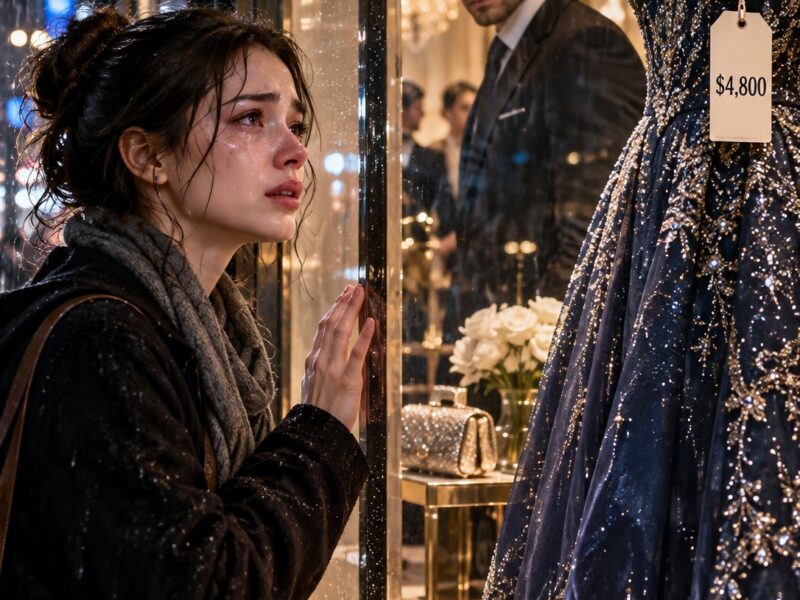
SHE STOOD IN THE RAIN STARING AT A $4,800 DRESS—THEN THE MAN INSIDE THE STORE LEARNED WHY SHE COULDN’T WALK AWAY
Emily Carter had exactly twelve dollars in her wallet when she stopped in front of a dress that cost more than three months of her salary.
Nine of those dollars were supposed to help pay for her sixteen-year-old brother’s heart medication the next morning.
The remaining three were all she had until payday.
So no, Emily wasn’t standing outside the luxury boutique because she planned to buy the dress.
She wasn’t even dreaming about wearing it.
She was standing there because, for ten quiet minutes in the rain, that blue dress reminded her of a woman she barely remembered being.
And from inside the boutique, a stranger was watching her.
Emily didn’t know it yet.
She didn’t know his name.
She didn’t know he owned the building, the company, or the dress behind the glass.
Most of all, she didn’t know that less than a month later, she would be sitting on a hospital floor believing her little brother was going to die—and that this same stranger would appear at the end of the hallway.
But on that rainy Thursday night in Chicago, all Emily knew was that her shoes were wet, her feet hurt, and she was tired enough to cry over something as ridiculous as a dress.
The boutique window glowed against the dark sidewalk.
Brooks & Lane.
The name was etched discreetly in brass beside the entrance, understated in the way expensive places often were. No flashing signs. No giant SALE posters. Just warm amber light, polished marble, and clothing displayed with enough empty space around each piece to make ordinary people understand they probably shouldn’t touch anything.
The dress stood alone on a mannequin.
Midnight blue.
Silver embroidery climbed from the waist toward one shoulder like frost on glass. The fabric caught the moving light from passing cars and seemed to change color—navy one second, almost black the next.
Emily stared.
Rain collected on the shoulders of her faded gray coat.
A city bus hissed to a stop half a block away.
She could have run for it.
Instead, she let it leave without her.
“Stupid,” she whispered.
She wasn’t talking about the bus.
Her reflection floated over the boutique glass: twenty-seven years old, damp brown hair escaping from a tired ponytail, cheap coat, exhausted eyes, no makeup left except a faint smudge beneath one eyelid.
Behind that reflection stood the dress.
For one strange second, Emily imagined herself wearing it.
Not at a ball.
Not beside some handsome millionaire.
Not stepping onto a red carpet while cameras flashed.
She imagined standing in her apartment.
That was all.
She imagined Noah looking up from the couch and saying, “Whoa, Em. You look like a normal person.”
She almost laughed.
Then the laugh died.
Because she could hear what he would actually say.
How much did that cost?
And Emily would lie.
Because Noah was sixteen, but illness had made him old enough to understand money.
He knew what his medication cost.
He knew why Emily watered down laundry detergent.
He knew why she claimed she preferred toast for dinner whenever groceries ran low.
He knew why their heat stayed at sixty-three degrees all winter.
And lately, Emily had begun noticing something that frightened her more than his heart condition.
Noah had started apologizing for being alive.
Sorry the medicine costs so much.
Sorry you had to leave work.
Sorry you didn’t go out with your friends.
Sorry.
Sorry.
Sorry.
Emily hated that word.
Their mother’s final request three years earlier had been simple.
“Take care of him.”
Emily had promised.
She had been twenty-four.
Noah had been thirteen.
Their father had already disappeared so completely that Emily no longer knew whether to call him absent or simply gone.
After their mother died, there had been no dramatic rescue.
No mysterious inheritance.
No wealthy relative.
Just overdue bills arriving in white envelopes and a grieving thirteen-year-old boy sleeping with his bedroom door open because he was afraid the last person he loved might disappear too.
Emily became his guardian.
Then his cook.
Then his driver.
Then his nurse.
Then, without realizing it, she stopped being much of anything else.
The blue dress seemed to belong to the life she might have had.
That was why she couldn’t stop looking.
Not because she wanted the dress.
Because she missed herself.
A movement behind the glass startled her.
Emily blinked.
A man stood inside the boutique.
Tall. Early thirties. Charcoal overcoat over a dark suit. Neatly styled black hair. No tie.
He was looking directly at her.
Emily’s stomach tightened.
Great.
Now some rich guy thinks I’m casing the store.
She immediately stepped back.
The man didn’t smile.
He didn’t wave.
He simply watched her with an expression she couldn’t read.
Emily lowered her eyes and turned away.
Inside the boutique, Daniel Brooks watched the woman disappear into the rain.
“Mr. Brooks?”
Daniel glanced over.
The flagship manager, Lauren Pierce, stood behind him holding a tablet.
“The donor seating chart?”
“Right.”
Daniel looked back through the window.
The sidewalk was empty.
“Sir?”
“Nothing.”
Daniel accepted the tablet.
But something bothered him.
He had seen people stare through those windows every day.
Teenagers took pictures.
Tourists pointed.
Customers studied themselves in the glass.
Women came inside and spent twenty thousand dollars without asking the price.
This woman had looked different.
Not envious.
Not impressed.
Sad.
Daniel glanced toward the blue gown.
“How much is that?”
Lauren followed his gaze.
“The Bellamy evening piece?”
“Yes.”
“Forty-eight hundred.”
Daniel gave a small nod.
Then he returned to the seating chart.
He should have forgotten the woman before reaching the next page.
He didn’t.
Across town, Emily climbed the narrow staircase above Russo’s Bakery at 10:14 p.m.
She opened the apartment door as quietly as possible.
“You missed the bus again.”
Emily froze.
Noah was sitting on the couch beneath a faded Chicago Bulls blanket.
“You’re supposed to be asleep.”
“You’re supposed to take the bus.”
“I enjoy walking.”
“In freezing rain?”
“It builds character.”
“You already have too much character.”
Emily smiled despite herself.
Noah had their mother’s eyes.
That made some days easier.
Other days, unbearable.
She took off her wet coat.
“Did you take the seven o’clock pill?”
Noah pointed toward the kitchen.
Empty glass.
Pill organizer.
Thursday compartment open.
“Yes, Nurse Ratched.”
“Good.”
“And before you ask, I ate.”
“What?”
“Food.”
“Noah.”
“Pasta.”
“With?”
“More pasta.”
She opened the refrigerator.
Half a container of spaghetti remained.
Emily relaxed slightly.
Then she noticed Noah pressing two fingers against the center of his chest.
Her smile vanished.
“What’s wrong?”
His hand dropped immediately.
“Nothing.”
“Noah.”
“I’m fine.”
“Were you having pain?”
“No.”
“You were holding your chest.”
“I stretched weird.”
Emily stared at him.
He looked away.
That was enough.
She crossed the room and crouched in front of him.
“When?”
“I said I’m fine.”
“When did it start?”
“It didn’t start.”
“Noah.”
His jaw tightened.
“Maybe at school.”
Her blood went cold.
“What happened?”
“Nothing happened.”
“Did you tell the nurse?”
“No.”
“Why?”
“Because then she calls you.”
“Yes.”
“And then you leave work.”
“Yes.”
“And then your manager gets pissed off.”
“I don’t care.”
“I do.”
The answer stopped her.
Noah looked down at his hands.
“You need the hours.”
Emily felt something crack quietly inside her.
She reached for him.
“No. Listen to me. You never hide symptoms because of money. Ever.”
“Emily—”
“Promise me.”
He sighed.
“Promise.”
She hugged him.
Over his shoulder, Emily looked toward the kitchen counter where another hospital bill waited unopened.
She closed her eyes.
The following morning, the pharmacy text arrived at 11:43.
Prescription ready. Amount due: $78.14.
Emily was standing behind the front desk of the Lakeshore Grand Hotel.
She checked her bank account.
$34.26.
For several seconds, she simply stared.
“Emily?”
She locked her phone.
Her manager, Richard Hale, was standing beside the desk.
“You were two minutes late this morning.”
“I know. I’m sorry.”
“That’s the third time this month.”
The first time, Noah had vomited after changing medication.
The second time, the train had stopped because of a signal failure.
Last night, Noah’s chest pain had returned at 2:17 a.m., and Emily had taken him to an urgent clinic.
She had slept forty-three minutes.
“I understand.”
Richard studied her.
“You look exhausted.”
“I’m fine.”
He nodded, already losing interest.
“Saturday. Private event. They need four extra staff.”
Emily looked up.
“Overtime?”
“Contract rate. Thirty-two an hour, six hours minimum.”
She almost answered before he finished.
“I’ll do it.”
“It’s Brooks & Lane. High-end charity thing. Wear the black uniform.”
Emily paused.
Brooks & Lane.
For a moment, she saw rain running down boutique glass.
The blue dress.
The man watching her.
“Emily?”
“Yes. Sorry. I’ll be there.”
At lunch she called the pharmacy.
“Could you hold the prescription until Friday?”
There was a pause.
“We can hold it.”
“Thank you.”
Emily hung up.
Friday was seven days away.
She knew Noah had enough medication for four.
She opened the calculator on her phone.
Rent.
Electricity.
Groceries.
Transit.
Medication.
Every number demanded something.
Every number won.
And somewhere beneath all of them was Emily herself, getting smaller.
Saturday evening, she entered Brooks & Lane through the service entrance.
The place looked different from inside.
Crystal fixtures floated above polished floors. Champagne glasses stood in perfect rows. White roses filled low silver bowls. Staff members moved quickly beneath discreet instructions while guests began arriving through the front entrance wearing clothing that cost more than Emily made in a year.
She kept her head down.
Work.
That was all this was.
Six hours.
One hundred ninety-two dollars before taxes.
Medication.
Groceries.
Maybe enough left for the gas bill.
Then Emily turned a corner.
And stopped.
The blue dress was still there.
She shouldn’t have smiled.
But she did.
For three seconds, the exhaustion disappeared from her face.
“You like that one.”
Emily spun around.
The tray in her hands tilted.
A champagne flute wobbled.
A hand caught it before it fell.
The man from the window.
Up close, he looked younger than she remembered.
And more intimidating.
“Sorry,” Emily said quickly.
“You didn’t do anything.”
“I almost broke that.”
“I almost saved it.”
That caught her off guard.
A tiny smile appeared at the corner of his mouth.
Emily straightened the glasses.
“I should get back.”
“You work for the hotel?”
“Tonight.”
He glanced at the blue gown.
“You were looking at that dress.”
Heat rose into Emily’s face.
“I was looking at the display.”
“Of course.”
His tone wasn’t mocking.
That somehow made it worse.
Emily started to leave.
“Wait.”
She turned.
“I’m Daniel.”
“Emily.”
“Emily.”
Something about the way he repeated her name unsettled her.
Not romantically.
Not yet.
It was the feeling of being noticed after years of successfully making herself invisible.
“Have we met?” she asked.
Daniel hesitated.
He could have told her.
I saw you standing outside in the rain.
Instead, he said, “I don’t think so.”
Emily nodded.
“Then I really need to work.”
She walked away.
Daniel watched her disappear into the crowd.
Lauren approached him.
“Your board members are asking for you.”
“I’m coming.”
She followed his gaze.
“Do you know her?”
“No.”
Daniel paused.
“Not yet.”
The evening became busier.
Emily served champagne, cleared plates, found a chair for an elderly donor whose knee was hurting, repaired a centerpiece after someone bumped the table, and quietly helped a nineteen-year-old temporary server named Kayla who had started panicking in the service corridor.
“Breathe,” Emily told her.
“I’m going to get fired.”
“No, you’re not.”
“I dropped six forks.”
Emily stared at her.
“Then civilization is over.”
Kayla laughed despite herself.
“Come on. I’ll cover table nine. You do eight.”
Neither woman knew Daniel had heard them.
Later, Emily was passing behind a guest in a white designer suit when the woman turned too quickly.
Her elbow struck a wineglass.
Red wine splashed across Emily’s black blouse.
The guest gasped.
Then immediately frowned.
“Look what you did.”
Emily froze.
Several people had seen exactly what happened.
So had Daniel.
“I’m sorry, ma’am.”
“You should be. This is vintage.”
Emily looked at the woman’s spotless suit.
The wine was entirely on Emily.
“I’ll clean this up.”
“You people need better training.”
Something flickered across Emily’s face.
Gone instantly.
“Yes, ma’am.”
Daniel took one step forward.
Emily caught his eye.
Barely.
But her expression stopped him.
Don’t.
She disappeared through the service door.
Ten minutes later, Daniel found her in a quiet hallway blotting her blouse with paper towels.
“You know that wasn’t your fault.”
Emily glanced at him.
“I know.”
“Then why did you apologize?”
“Because I need tonight’s paycheck more than I need a stranger to admit she was wrong.”
Daniel went silent.
Emily threw the paper towel away.
“You looked like you were about to say something.”
“I was.”
“Thank you for not doing it.”
“She humiliated you.”
“No.” Emily looked directly at him. “She tried to.”
The distinction surprised him.
Emily continued, “Those aren’t the same thing.”
Daniel stared at her.
For years, people had agreed with him because of his last name.
Employees became careful around him.
Investors laughed too hard.
Strangers researched him before dinner.
Emily had known him for perhaps six minutes and had already told him, politely, to mind his own business twice.
He liked that.
More than he should have.
“What do you do when you’re not working events?” he asked.
“Front desk at Lakeshore Grand.”
“Do you like it?”
“I like getting paid.”
Daniel laughed.
Emily didn’t.
Then, reluctantly, she smiled.
Her phone vibrated.
She checked it.
The smile vanished.
“Everything okay?”
“Yes.”
It was Noah.
Chest hurts again. Don’t freak out. I’m lying down.
Emily typed immediately.
Call Mrs. Russo. I’m coming home.
She put the phone away.
“I have to go.”
“Your shift isn’t over.”
“I know.”
“I wasn’t criticizing.”
Emily had already started walking.
Daniel followed.
“Emily.”
She turned.
For the first time, he saw fear on her face.
Not stress.
Fear.
“My brother needs me.”
“Go.”
“I need to tell the event manager.”
“I’ll handle it.”
“I can’t lose the pay.”
“You won’t.”
She hesitated.
“Why?”
Daniel didn’t have a good answer.
So he gave her the simplest one.
“Because sometimes people need to go home.”
Emily left.
Daniel stood watching the service door close.
The next morning, an envelope arrived at the hotel.
Inside was Emily’s full event pay.
Plus a bonus.
She called Brooks & Lane immediately.
By noon, she was standing inside Daniel’s office.
“I can’t take this.”
Daniel looked at the check she placed on his desk.
“Why?”
“Because I left early.”
“You worked.”
“Not the full shift.”
“You covered two people’s sections for most of the night.”
“That’s not the point.”
“What is?”
Emily crossed her arms.
“The extra money.”
“A performance bonus.”
“I don’t want charity.”
The words landed harder than she intended.
Daniel leaned back.
“Neither do I.”
Emily frowned.
“What?”
“I said I don’t want charity either. I want competent people paid for competent work.”
“I carried trays.”
“You reorganized a service problem my event manager didn’t notice, calmed an employee who was about to quit, prevented a donor from falling over a misplaced chair, and managed a guest insulting you without turning my charity event into a scene.”
Emily blinked.
“You saw all that?”
“Yes.”
“Why?”
Daniel should have lied.
Instead, he said, “Because I notice you.”
Silence.
Something changed in the room.
Emily looked away first.
“My brother was sick.”
“I figured.”
“He has a heart condition.”
Daniel’s expression softened.
“I’m sorry.”
“Don’t be. You didn’t give it to him.”
Again, that bluntness.
Again, Daniel almost smiled.
Emily picked up the check.
“I’m keeping the regular pay.”
“And the bonus.”
She looked at him.
“Why are you so stubborn?”
“I was about to ask you the same thing.”
For the first time, Emily laughed.
It was brief.
But Daniel remembered it.
Three weeks later, Noah collapsed at school.
Emily was checking in a family from Denver when her phone rang.
She ignored it.
It rang again.
Then the front desk phone lit up.
“Lakeshore Grand, this is Emily.”
“Ms. Carter?”
Something in the woman’s voice made Emily grip the counter.
“This is St. Matthew’s High School. It’s Noah.”
The lobby disappeared.
“What happened?”
“He collapsed during gym.”
Emily was already moving.
At Northwestern Memorial Hospital, time became fluorescent light, rubber soles, antiseptic air, and unanswered questions.
A cardiologist named Dr. Patel sat across from Emily.
“We’ve stabilized him.”
“Then he’s okay.”
Dr. Patel paused.
Emily hated the pause.
“He’s stable.”
“That isn’t what I asked.”
“No.”
Her fingers tightened around each other.
The doctor pulled an image onto the monitor.
Noah’s condition had progressed faster than expected.
There were words Emily understood individually but not together.
Pressure.
Rhythm.
Obstruction.
Procedure.
Soon.
“How soon?”
“We’d prefer not to wait.”
“How much?”
The doctor’s expression changed.
That was when Emily knew the answer would hurt in a different way.
After insurance questions, assistance applications, hospital estimates, and numbers large enough to stop feeling real, Emily ended up alone in a corridor outside the cardiac unit.
She sat.
Then she bent forward.
Then she cried.
Not beautifully.
Not silently.
She covered her mouth with one hand because she was ashamed of the sound coming out of her.
For three years she had been strong.
Strong when her mother died.
Strong when Noah asked whether he was going to die too.
Strong when the landlord raised the rent.
Strong when their father failed to answer the letter Emily sent to his last known address.
Strong when she sold her mother’s bracelet.
Strong when she stopped seeing friends because every invitation cost money.
Strong when she woke up at four in the morning and wondered how long a human being could keep doing this.
But strength had become another bill.
And Emily could no longer pay it.
“I promised her,” she whispered.
Nobody answered.
“I promised.”
She wiped her face.
Then a voice came from several yards away.
“Emily?”
She looked up.
Daniel Brooks stood at the end of the corridor.
For one irrational second, Emily wondered whether exhaustion had made her imagine him.
He walked toward her.
“What happened?”
Emily immediately wiped her cheeks.
“Nothing.”
Daniel looked toward the cardiac unit.
Then back at her.
He sat beside her.
He didn’t ask again.
That was what broke her.
If he had asked questions, Emily could have defended herself.
If he had offered sympathy, she could have rejected it.
Instead, he simply sat.
The silence gave her nowhere to hide.
“My brother needs surgery.”
Daniel listened.
“I don’t have enough.”
He still said nothing.
“I don’t have anywhere near enough.”
Her voice cracked.
“I have thirty-eight dollars in checking. I owe the pharmacy money. My rent is due in nine days. I’ve applied for assistance, but they said it could take weeks, and the doctor is telling me we shouldn’t wait.”
She laughed once.
It sounded terrible.
“I keep thinking there must be some adult I’m supposed to call.”
Daniel looked at her.
“And then I remember I’m the adult.”
Emily covered her eyes.
“I’m all he has.”
“No,” Daniel said quietly.
She lowered her hands.
“You’re the person who stayed. That’s different.”
Emily stared at him.
Daniel leaned forward, forearms resting on his knees.
“Do you have insurance?”
“Barely.”
“Hospital assistance?”
“Pending.”
“State programs?”
“We’re over the threshold for one and underinsured for everything else. Apparently I’m poor incorrectly.”
Daniel almost smiled.
Then he became serious.
“Let me help you.”
“No.”
“Emily.”
“No.”
“You don’t even know what I’m offering.”
“I know enough.”
“What do you think I’m offering?”
“Money.”
“I’m offering resources.”
“Same thing.”
“No.”
She stood.
“I can’t owe you.”
Daniel looked up at her.
“You wouldn’t.”
“Everybody says that before they want something.”
The sentence changed his face.
Emily regretted it immediately.
“I’m sorry.”
“Don’t apologize.”
“I shouldn’t have—”
“Who taught you that help always has a price?”
Emily went still.
Daniel waited.
Finally, she said, “Life.”
He stood.
“My company has a foundation.”
Emily’s eyes narrowed.
“No.”
“It assists families with medical expenses.”
“No.”
“You haven’t heard the details.”
“Because the details don’t matter.”
“They matter to Noah.”
That stopped her.
Daniel saw anger flash across her face.
“Don’t use my brother against me.”
“I’m not.”
“You are.”
“I’m reminding you that accepting legitimate help is not the same as surrendering your dignity.”
“You don’t know anything about my dignity.”
“No.”
Daniel lowered his voice.
“But I know something about hospitals.”
Emily stared at him.
He took out his phone.
Opened a photograph.
A woman in her forties sat in a hospital bed, thin and pale, smiling beside a nineteen-year-old Daniel.
“My mother.”
Emily looked at him.
“She died six months after that picture.”
“I’m sorry.”
“We didn’t need money. My father had money.”
Daniel stared at the photograph.
“But there was an experimental treatment insurance wouldn’t cover. My father refused it because the doctors said the odds were bad. My mother wanted to try.”
He swallowed.
“A stranger paid for it.”
Emily said nothing.
“Anonymous. We never learned who.”
“Did it work?”
“For a while.”
The answer hurt more because it was honest.
“She got five more months when she felt well enough to leave the hospital. We went to Maine. She saw the ocean again. She met my sister’s first baby.”
Daniel locked the phone.
“I used to think the stranger wasted his money because she died anyway.”
Emily watched him.
“Then I got older.”
His eyes met hers.
“And I realized he bought my mother five months of being alive instead of five months of waiting to die.”
The hospital hummed around them.
Daniel continued quietly.
“That’s why the foundation exists.”
Emily’s defenses shifted.
Not disappeared.
Shifted.
“I still don’t want special treatment.”
“Good.”
He handed her his phone.
“Call the foundation yourself. Don’t mention my name. Ask what programs exist.”
She didn’t take it.
“Why are you doing this?”
Daniel considered lying.
Because it would have been easier.
Instead, he said, “Because I saw you in the rain.”
Emily froze.
“The boutique.”
He nodded.
“You remembered me.”
“Yes.”
“All this time?”
“Yes.”
Embarrassment and suspicion collided in her expression.
“Why?”
Daniel looked at her for a long moment.
“Because you looked at that dress like you were saying goodbye to something.”
Emily’s eyes filled again.
This time she refused to let the tears fall.
“You were wrong.”
“Was I?”
She looked through the glass wall toward Noah’s room.
“No.”
That single word told Daniel more about Emily Carter than everything else combined.
The next morning, Emily received a call from hospital billing.
A large portion of Noah’s procedure had been approved through the Brooks Foundation medical assistance program.
Emily hung up.
Then she stood perfectly still in the kitchen.
Noah looked up from the table.
“What?”
She said nothing.
“Emily?”
She covered her mouth.
“Em, what happened?”
“They approved it.”
“What?”
“The assistance.”
Noah stood too quickly.
She caught him.
“They approved it.”
He hugged her.
Emily held him so tightly he complained.
“Ow.”
“Shut up.”
“You’re crushing the patient.”
“Good.”
He laughed against her shoulder.
Then Emily started crying.
Noah pulled back.
“Why are you crying?”
“I don’t know.”
“Yes, you do.”
Emily wiped her face.
“I’m tired.”
Noah studied her.
“You don’t have to be strong every second.”
The words were too mature.
Too familiar.
Emily wondered how many times he had heard her say them to him.
That afternoon, she went to Brooks & Lane.
Daniel was in a meeting.
She waited.
When he finally entered the lobby, Emily stood.
“You did it.”
He stopped.
“Did what?”
“The foundation.”
“I gave them your information.”
“You said you wouldn’t give me special treatment.”
“I didn’t.”
“They approved it in one day.”
“Emergency applications move quickly.”
“Daniel.”
He sighed.
“I asked them to review the application quickly. I did not ask them to approve it.”
Emily folded her arms.
“That is still influence.”
“Yes.”
“At least you admit it.”
“Yes.”
She hated that he made anger difficult.
“Why didn’t you tell me?”
“Because you would have spent twelve hours arguing with me while your brother needed care.”
“That’s manipulative.”
“Probably.”
Emily stared at him.
Daniel stared back.
Then she did something he didn’t expect.
She laughed.
Not because it was funny.
Because she was exhausted.
“You are unbelievable.”
“I hear that often.”
“I’m still angry.”
“You’re allowed.”
“And I’m paying something back.”
“No.”
“Yes.”
“No.”
“Then I’m donating to the foundation when I can.”
Daniel paused.
“That I’ll accept.”
Emily nodded.
The conflict ended there.
Or it should have.
But as she turned to leave, Daniel said, “Emily.”
She looked back.
“How is he?”
For the first time, she heard the question without hearing pity behind it.
“Scared.”
“And you?”
She hesitated.
“More scared.”
Noah’s procedure took four hours and seventeen minutes.
Emily counted every one.
Daniel did not sit with her.
He did not send flowers.
He did not make the day about himself.
At 6:41 that evening, Emily received one text.
Thinking of you both. No need to reply.
She read it seven times.
At 7:03, Dr. Patel walked through the waiting-room doors.
Emily stood so quickly her knees nearly buckled.
The procedure had gone well.
Noah was stable.
Recovery would take time.
There would be monitoring.
Medication.
Follow-ups.
Nothing was magically fixed.
But he was alive.
Emily went into the restroom afterward and cried again.
This time, relief hurt almost as much as fear.
Months passed.
Noah grew stronger.
Emily returned to work.
Life did not suddenly become easy.
That was something stories often lied about.
Hospital bills still arrived.
Rent still came due.
Noah still had bad days.
Emily still worked too much.
Daniel did not transform into a magical solution to every problem.
Instead, something more believable happened.
He remembered her.
One Tuesday afternoon, Emily received an email from Brooks & Lane Human Resources.
Interview Invitation — Customer Relations Coordinator.
She assumed it was a mistake.
Then Daniel called.
“I didn’t hire you.”
“I haven’t even interviewed.”
“Exactly.”
“Then why am I getting this?”
“Because there’s an opening.”
“And?”
“And I recommended that HR interview you.”
Emily closed her eyes.
“Daniel.”
“You can say no.”
“I don’t have a degree.”
“The job description says degree preferred, not required.”
“I know nothing about luxury fashion.”
“You know people.”
“That sounds like something rich people say before making a terrible hiring decision.”
Daniel laughed.
“Interview. If they don’t want you, they won’t hire you.”
“And if they do?”
“Then perhaps stop assuming every open door is a trap.”
Emily went to the interview.
She nearly walked out twice.
She got the job.
Her first week was awful.
Everyone seemed polished.
Educated.
Certain.
Emily felt like the woman outside the glass again.
She bought two blouses from a thrift store and altered them herself.
She wrote unfamiliar terms on index cards.
Textile construction.
Client retention.
CRM segmentation.
Brand positioning.
She studied on the train.
She studied while Noah watched basketball.
She studied at two in the morning.
Six months later, she handled her first major client complaint alone.
Nine months later, she redesigned part of the customer follow-up process.
Eleven months later, her manager told Daniel, “She’s better than half the people we recruited from business schools.”
Daniel smiled.
“I know.”
A year after Emily first stood outside the boutique, Daniel asked her to come to his office.
She entered carrying a notebook.
“You wanted to see me?”
“Yes.”
“Am I fired?”
“No.”
“Good. Rent is Tuesday.”
Daniel pointed toward the far side of the room.
Emily turned.
And stopped breathing.
The blue dress.
The same one.
Midnight fabric.
Silver embroidery.
Exactly as she remembered it.
Emily stared at Daniel.
“What is this?”
“A dress.”
“I can see that.”
“Then we’re making progress.”
“Daniel.”
His smile disappeared.
“I kept it.”
“For a year?”
“Yes.”
“Why?”
“Because the night I saw you outside the window, I thought you wanted something you couldn’t afford.”
Emily looked at the dress.
“And now?”
“Now I know you weren’t looking at the dress.”
Her throat tightened.
“You were looking at yourself.”
Emily said nothing.
“A version of yourself you thought life had taken away.”
She slowly shook her head.
“I can’t take this.”
Daniel had expected that.
“It isn’t charity.”
“It’s a forty-eight-hundred-dollar dress.”
“It was. It’s technically old inventory now.”
“That does not make this normal.”
“No.”
He stepped closer.
“It makes it a reminder.”
“Of what?”
Daniel looked at her.
“That beautiful things don’t belong exclusively to people who have never struggled.”
Emily’s eyes burned.
She touched the sleeve.
Soft fabric moved beneath her fingertips.
“I used to hate this dress.”
Daniel looked surprised.
“Why?”
“Because I wanted it.”
“That seems like a reason to like it.”
“No. I hated wanting anything for myself.”
She laughed softly.
“It felt selfish.”
Daniel said nothing.
Emily looked at the dress.
“That night I had twelve dollars.”
He remained silent.
“Nine were supposed to go toward Noah’s medication.”
Daniel’s expression changed.
“I skipped the bus because I was trying to save money.”
“You walked home?”
“Four miles.”
“In that rain?”
“Yes.”
Daniel looked away for a moment.
Emily smiled sadly.
“You see why I couldn’t let myself want a dress?”
“Yes.”
“No.”
She faced him.
“I wasn’t afraid I couldn’t afford it. I already knew I couldn’t.”
Her voice dropped.
“I was afraid that wanting it made me a bad sister.”
Daniel looked at her for a long time.
Then he said, “Emily, loving Noah never required you to stop being alive.”
That was the sentence that broke her.
Not the hospital.
Not the money.
Not the job.
Not even the dress.
Emily covered her mouth.
Tears came.
Daniel didn’t touch her.
He simply stayed.
Finally, Emily nodded.
“I’ll take it.”
Several weeks later, Brooks & Lane held its annual employee recognition dinner at the Langham.
Emily almost didn’t wear the dress.
She stood in front of her bedroom mirror for twenty minutes.
Noah leaned against the doorway.
“Well?”
Emily turned.
His mouth fell open dramatically.
“No.”
Her face dropped.
“No, absolutely not.”
“What?”
“I cannot be seen with you.”
Emily threw a makeup sponge at him.
Noah laughed.
“You look incredible.”
She looked at herself again.
For years, mirrors had been functional.
Is my uniform clean?
Do I look tired?
Can anyone tell I cried?
That night, she actually looked.
The woman in the mirror was not twenty-four-year-old Emily before her mother died.
She was not the exhausted twenty-seven-year-old outside the boutique either.
She was someone else.
Someone built from both.
At the ballroom, conversation faded briefly when Emily entered.
Not because she was the most beautiful woman there.
Not because of the dress.
Because she carried herself differently.
Then she saw Noah.
He stood near the front in a navy suit slightly too large in the shoulders.
Healthy color had returned to his face.
Beside him stood Daniel.
Noah grinned.
Emily walked toward them.
“You clean up okay,” Noah said.
“Careful. I control your ride home.”
Daniel smiled.
“You wore it.”
Emily looked down at the blue fabric.
“I did.”
“How does it feel?”
She thought about the answer.
Then looked across the ballroom.
“I thought it would feel different.”
“Bad different?”
“No.”
Emily smiled.
“I thought wearing it would make me feel like someone else.”
“And?”
“It doesn’t.”
Daniel waited.
“It feels like me.”
Across the room, applause began as the program started.
Emily sat beside Noah.
During dinner, her name was announced for an employee excellence award.
She stared at the stage.
Noah nudged her.
“That’s you.”
“I know.”
“Then go.”
Emily stood.
As she walked toward the stage, something strange happened.
She remembered the rain.
Not vaguely.
Completely.
Cold water inside her shoes.
Twelve dollars.
The pharmacy text.
Her reflection against the glass.
The blue dress floating behind it like evidence of another universe.
She remembered thinking beautiful things belonged to other people.
People without hospital bills.
People without fear.
People who could afford mistakes.
People whose lives had not narrowed into survival.
She had been wrong.
But not in the way she once imagined.
Daniel had not rescued her.
The dress had not changed her.
The job had not erased the years before it.
Noah’s successful procedure had not made life painless.
There had been no single magical moment when everything became perfect.
What changed Emily was smaller.
A stranger noticed.
A foundation helped.
A doctor succeeded.
A frightened sixteen-year-old kept fighting.
An exhausted woman accepted help.
Then she worked.
And learned.
And failed.
And tried again.
One kindness had not solved her life.
It had simply given her enough room to continue living it.
Years later, Emily would still sometimes walk past the old Brooks & Lane flagship.
The displays changed.
The seasons changed.
Eventually, even the company signage changed.
But every time rain touched the glass, Emily remembered that night.
Once, Noah—older now, healthier, studying biomedical engineering—walked beside her.
He noticed her slowing down.
“You’re doing it again.”
“What?”
“Staring at the window.”
Emily smiled.
“There used to be a dress there.”
“The blue one?”
“You remember?”
“You only told that story approximately nine thousand times.”
She nudged him.
They continued walking.
After several steps, Noah asked, “Do you ever wonder what would’ve happened if Daniel hadn’t seen you?”
Emily considered it.
“Yes.”
“What do you think?”
She looked back at the window.
For years, she would have said everything would have been different.
Maybe it would have.
But age had taught her something gentler.
“I think we would’ve found another way.”
Noah smiled.
“Yeah?”
“Eventually.”
“Then why does that night matter so much?”
Emily looked at him.
“Because sometimes surviving and living are two different things.”
Rain began to fall lightly.
People hurried past them beneath umbrellas.
Emily tucked her hands into the pockets of her coat.
“I knew how to survive.”
She looked once more at the glowing window.
“I’d just forgotten I was allowed to want a life after survival.”
Noah slipped an arm around her shoulders.
They walked toward the train.
Behind them, the boutique window reflected hundreds of strangers passing through the city.
Most never looked inside.
Some stopped.
Some stared at things they could afford.
Others stared at things they couldn’t.
And somewhere among those reflections might have been another exhausted person quietly believing that everyone else had been given permission to dream.
Emily knew better now.
Beautiful things were not promises.
Money could not erase grief.
Kindness could not guarantee happy endings.
And being helped did not mean being saved.
Sometimes kindness did something much quieter.
It gave a person one more day.
One more chance.
One open door.
One reason to believe that the life waiting on the other side of the glass might not belong exclusively to somebody else.
And sometimes—
that was enough.









