She Thought He Was a Broke Job Applicant—Then Her Grandmother Revealed Why He Was Really There
“You’re ten minutes late, Mr. Mercer.”
The accusation crossed the glass conference room with the clean precision of a blade.
Hollis Mercer glanced at the clock mounted above the door.
Then he looked back at the woman sitting at the head of the walnut table.
“No, ma’am,” he said calmly. “I’m actually twenty minutes early.”
Someone near the windows lowered his coffee cup to hide a smile.
Another executive suddenly became very interested in the notes on his tablet.
Prescott Vale did neither.
He sat two chairs from the head of the table in a navy suit that probably cost more than Hollis’s first truck, watching the plainly dressed stranger with the faint amusement wealthy men sometimes reserved for people they had already decided were beneath them.
But Wyn Harkort did not smile.
At thirty-four, the CEO of Harkort Meridian Group had spent nearly a decade learning how to control rooms before anyone else realized control was being contested. She had negotiated acquisitions worth hundreds of millions, fired men twice her age without raising her voice, and survived a board that had initially regarded her as the founder’s granddaughter wearing an executive title.
She had learned to read weakness quickly.
And the man standing across from her appeared, at first glance, almost offensively easy to read.
Weathered brown work boots.
A charcoal jacket that had survived more winters than fashion cycles.
No luxury watch.
No leather portfolio.
No polished résumé folder.
Just steady gray-green eyes, callused hands, and the strange composure of someone who did not seem particularly worried about impressing the most powerful person in the room.
“Your interview was scheduled for nine,” Wyn said.
Hollis’s eyes dropped to the résumé in front of her.
His name was printed across the top.
The rest of it was not his life.
Not exactly.
That should have been the moment he corrected her.
Instead, he looked past Wyn toward the frosted glass wall behind her, where the company name stretched in silver letters.
HARKORT MERIDIAN GROUP.
He knew exactly who she was.
Wyn Harkort.
Granddaughter of Lenora Harkort.
The woman he had flown from Idaho to Chicago to meet.
Wyn, however, had absolutely no idea who he was.
And for reasons Hollis did not yet fully understand, he decided to let the mistake breathe a little longer.
“Sit down, Mr. Mercer.”
“Thank you.”
He pulled out the chair.
Forty-two floors beneath them, Chicago moved through a cold October morning. Trains rattled between buildings. Taxis threaded through intersections. The river caught pieces of pale sunlight between towers of glass and steel.
Up here, hundreds of employees were beginning another workday inside a corporation worth billions.
Hollis had never cared much for buildings designed to remind people how small they were.
“You applied for Director of Facilities Engineering,” Wyn said.
Hollis almost answered no.
Almost.
Six weeks earlier, Lenora Harkort had called him personally.
She had known his late father.
More accurately, she had once helped Hollis’s father through a financial disaster he never discussed without lowering his voice afterward.
So when Lenora asked Hollis to come to Chicago and meet her granddaughter, he had listened.
When she explained that Wyn was thirty-four, unmarried, fiercely independent, and “entirely too good at convincing herself she needs no one,” Hollis had laughed.
Then Lenora had added something else.
“She has survived things by becoming harder than she needed to become.”
That sentence had stayed with him.
Hollis was thirty-nine.
A widower.
A father.
And six years after burying his wife, he had no interest in being pushed into some wealthy family’s romantic experiment.
He told Lenora exactly that.
Lenora had laughed.
“I’m not arranging a marriage, Hollis. I’m arranging dinner.”
“With expectations.”
“All dinners have expectations.”
“I eat cereal over the sink.”
“That explains more about you than you realize.”
Eventually, respect for Lenora had defeated his reluctance.
He agreed to one meeting.
No photographs.
No background briefing beyond what he already knew.
No promises.
He would meet Wyn Harkort as a person, not a résumé.
That had been the plan.
Then a receptionist downstairs had seen “Hollis Mercer” on a visitor list at nearly the same time an applicant with a similar appointment had been delayed.
An assistant had hurried him upstairs.
Someone had clipped the wrong badge to his jacket.
And before Hollis understood exactly how the mistake had happened, he was sitting across from the woman he was supposed to meet that evening while she interviewed him for a job he had never requested.
“Your résumé shows a six-year gap in corporate employment,” Wyn said. “That concerns me.”
“I imagine it would.”
Prescott leaned back.
“Do you have an explanation?”
Hollis looked at him, then back at Wyn.
“Yes.”
Silence followed.
Wyn waited.
Hollis did not rush to fill it.
That irritated her more than it should have.
People always filled silence around her.
They explained.
Qualified.
Apologized.
Sold themselves.
This man simply sat there.
“Then explain it.”
Hollis nodded.
“My wife died six years ago.”
Prescott’s expression changed first.
Only slightly.
Wyn’s fingers stopped against the résumé.
“My daughter was two,” Hollis continued. “I had a choice. Keep chasing promotions, or be home when she woke up at two in the morning looking for a mother who wasn’t coming back.”
Nobody moved.
“So I went home.”
Wyn studied him.
“You gave up your career?”
“No.”
His gaze drifted briefly toward the skyline.
“I changed what success meant.”
For the first time that morning, Wyn had no immediate response.
She had built her adult life around momentum.
Her father had taught her that careers punished hesitation.
Graduate school had taught her that sacrifice was the entrance fee for exceptional achievement.
The board called seventy-hour weeks leadership.
Investors called exhaustion commitment.
And here sat a man who had walked away from the very ladder thousands of people would have begged to climb.
He did not sound bitter.
He did not sound defeated.
Worst of all, he did not sound as though he needed her approval.
Something about him did not fit the paper.
And something about this meeting did not fit him.
“What do you want, Mr. Mercer?”
“From this meeting?”
“From your career.”
Hollis considered the question.
“To raise my daughter well. Keep my business honest. Get home before dinner most nights.”
Prescott laughed once.
“That isn’t exactly executive ambition.”
Hollis turned toward him.
“No.”
Nothing else.
No defense.
No embarrassment.
Just no.
Wyn leaned forward.
“Then why would you want this position?”
For the first time, Hollis almost smiled.
“Maybe I don’t.”
Prescott stopped smiling.
Wyn slowly removed her glasses.
“Excuse me?”
“You asked why I would want it.”
“Yes.”
“Maybe I don’t.”
“More than three hundred people applied for this position.”
“That’s a lot of people.”
Prescott’s jaw tightened.
“Do you understand where you are?”
Hollis glanced around.
“Forty-second floor. Harkort Meridian headquarters. Chicago.”
Someone at the far end of the table coughed into his fist.
Wyn should have ended the interview.
Instead, curiosity began replacing irritation.
“You’re unusually relaxed for someone sitting across from a CEO.”
“Should I be nervous?”
“Most people are.”
“Does it help them?”
She paused.
“Usually not.”
“Then I suppose I’ll save us both the trouble.”
Something dangerous happened.
The corner of Wyn’s mouth nearly lifted.
She stopped it.
“Your previous salary was significantly higher than what most small-business owners earn. Why leave that?”
Hollis looked at his hands.
“My daughter used to have nightmares after her mother died.”
The room became quiet again.
“She’d wake up around two and walk down the hallway looking for someone who wasn’t there. I had seven o’clock meetings. Flights twice a week. A promotion waiting. Everyone told me not to throw away my future.”
His eyes lifted.
“But every morning I was leaving a two-year-old alone with grief she couldn’t name.”
“She was two?” Wyn asked softly.
Hollis noticed she had remembered.
“At first. Grief didn’t disappear when she turned three.”
Something in Wyn’s face shifted.
“Did you ever regret leaving?”
“Yes.”
The answer surprised her.
“About six months later, an old colleague became vice president. I saw the announcement and wondered what my life would’ve looked like if I stayed.”
Prescott’s expression brightened, as if ambition had finally entered the room.
“And?”
“That evening, Tessa rode her bicycle without training wheels.”
Hollis smiled.
“I was there.”
Prescott looked away.
Wyn lowered her eyes.
She had interviewed executives who could explain market penetration in six countries without looking at a note.
Men who measured themselves by acquisitions.
Women who spoke in percentages.
Candidates who could make greed sound like vision.
Hollis Mercer talked about a bicycle.
Somehow, she trusted the bicycle more.
“What salary would you expect?”
“I haven’t thought about it.”
Wyn stared at him.
“You came to an executive interview without thinking about compensation?”
Hollis nearly laughed at the absurdity.
Instead he said, “Money matters. It’s just not the first question I ask anymore.”
“What is?”
“Who I’m working with. What they value. Whether I can respect them when nobody important is watching.”
Prescott leaned forward.
“That sounds judgmental.”
“Interviews work both ways.”
The sentence landed differently than Hollis intended.
Because Wyn suddenly felt as though the room had shifted.
She glanced at his crooked visitor badge.
Then the résumé.
Then his boots.
His answers belonged to a man who had already built a life.
His posture belonged to someone who could leave.
And people who could leave were always harder to control than people who needed something.
“Mr. Mercer,” she said slowly, “I’m beginning to think you didn’t come here because you need this job.”
Hollis met her gaze.
“That would be a fair observation.”
The conference-room door flew open.
A young operations manager stepped inside, pale and breathless.
“Miss Harkort, I’m sorry, but we have a major systems failure at Joliet.”
Wyn stood immediately.
“How major?”
“Conveyor control is down across three loading zones. Engineering can’t isolate the fault. Outbound shipments are stacking up.”
Prescott reached for his phone.
The manager placed a tablet on the table.
A technical schematic glowed across the screen.
Hollis looked at it once.
His expression changed.
Prescott saw it.
And smiled.
“Well,” he said, pushing the tablet toward Hollis, “perhaps our applicant has an opinion.”
Hollis looked at Wyn.
“Do you want one?”
She hesitated.
“Yes.”
He studied the screen.
“Your primary control module isn’t losing synchronization.”
Prescott laughed.
“You determined that in five seconds?”
“Seven, maybe.”
The operations manager almost smiled.
Hollis pointed toward the lower section of the schematic.
“What was replaced in Zone Three during the last maintenance cycle?”
The manager frowned.
“A variable-frequency drive.”
“Manufacturer?”
“Nortech.”
“And Zones One and Two are still running the original Emerson units?”
“Yes.”
“There’s your problem.”
Prescott folded his arms.
“That tells us almost nothing.”
Hollis looked at him.
“The new drive is broadcasting at a different update interval than the legacy controllers expect. Your central system isn’t losing synchronization. It’s trying to correct conflicting timing signals.”
The manager leaned closer.
“That would explain why the fault keeps moving between zones.”
“Exactly.”
Wyn stared at Hollis.
“Why would our engineers miss it?”
“Because the system reports the symptom as a network fault. They’re probably checking switches, cables, controller health. Those components aren’t failing.”
“What would you do?”
“Match the polling interval on the Nortech drive to the legacy configuration, then reset the sequencing layer.”
He pushed the tablet back.
“If I’m wrong, you lose five minutes. If I’m right, the conveyors restart without replacing hardware.”
Prescott lifted a hand.
“We are not seriously changing a distribution system because a job applicant glanced at a tablet.”
Wyn turned toward him.
“We’re letting the engineering team evaluate the recommendation.”
Her voice hardened.
“Which came from an applicant. I heard you.”
The manager stepped outside to call Joliet.
Thirty seconds passed.
Then sixty.
Hollis did not watch the door.
He did not look excited.
He simply folded his hands.
“You seem confident,” Wyn said.
“I’ve seen the problem before.”
“Where?”
“A food-processing facility outside Nampa.”
Prescott smirked.
“Your little repair shop handles facilities that size?”
Hollis met his eyes.
“Sometimes little shops get called after expensive teams run out of expensive answers.”
The door opened.
The manager walked in.
His face told them before his words did.
“Zone Three is back.”
Wyn stood straighter.
“And the others?”
“Coming online now.”
His phone vibrated.
He checked it.
“All three green.”
Nobody laughed.
“How much did that save us?” Wyn asked.
“If we’d followed the replacement plan? Six figures, probably. Parts, labor, downtime.”
Prescott cleared his throat.
“Lucky observation.”
Hollis gave him a faint smile.
“Those are useful when they happen.”
Wyn looked at Hollis’s boots.
Then his hands.
Then his eyes.
Twenty minutes earlier, she had believed she was evaluating him.
Now she was no longer certain who had been evaluating whom.
“You could’ve made more of that,” she said.
“More of what?”
“You just solved something my engineering team has been chasing since six this morning.”
“Then they can get back to work.”
“You don’t want credit?”
“Credit doesn’t move shipments.”
That answer irritated Prescott.
It unsettled Wyn.
In her world, people collected credit more carefully than money.
Hollis had just saved her company from an expensive mistake and appeared more concerned with whether trucks were moving again.
“Sit down, Mr. Mercer.”
He did.
She reopened the résumé.
It now looked ridiculous between them.
“Where were we?”
“I believe you were deciding whether I’m ambitious enough for a job I may not want.”
The operations manager lowered his face to hide a grin.
Wyn released a tiny laugh before recovering.
Prescott did not.
Then Hollis’s phone vibrated.
He checked it.
Everything about him changed.
“Excuse me. I need to take this.”
He moved toward the windows.
Wyn heard fragments.
School.
Emergency maintenance.
Early dismissal.
No bus service.
Hollis closed his eyes.
“I’ll come get her.”
He ended the call.
“I’m sorry. My daughter’s school is closing early.”
Prescott stared at him.
“You’re leaving in the middle of an executive interview?”
“My daughter needs me.”
“Surely someone else can pick her up.”
Hollis became still.
“There isn’t someone else.”
That sentence silenced the room.
He reached for his jacket.
In less than half an hour, he had challenged Wyn’s assumptions, solved a six-figure technical problem, and was now prepared to walk away without hesitation because an eight-year-old needed a ride home.
“Mr. Mercer.”
He turned.
Wyn surprised herself.
“Have someone bring her here.”
Prescott looked at her.
So did Hollis.
“We have a family lounge on thirty-eight. If you leave now, you’ll spend half the afternoon fighting traffic. Have the school send her here.”
Hollis studied her.
Wyn understood the question in his eyes.
Was this kindness?
Or convenience?
Her voice softened.
“She can stay with you. It isn’t a condition of anything.”
Something changed behind Hollis’s eyes.
Not trust.
Not yet.
But perhaps the first place trust could someday exist.
“Thank you.”
Forty-seven minutes later, the elevator doors opened.
A little girl in a red sweater stepped out wearing a crooked paper crown and carrying a purple backpack covered in faded astronomy patches.
“Dad!”
The single word transformed Hollis.
He crossed the hallway, crouched, and checked her face.
“You okay?”
“The boiler leaked into the hallway.”
“Did you eat lunch?”
“Half.”
“Why half?”
“Trevor traded me his cookie for my apple and then wanted the cookie back.”
Hollis considered this solemnly.
“Difficult negotiation.”
“I won.”
“Of course you did.”
Wyn watched from several yards away.
She had seen Hollis under pressure.
She had seen him solve a systems failure.
But here no one was evaluating him.
No one was impressed.
No money was at stake.
He was simply a father straightening his daughter’s paper crown.
Then Tessa noticed Wyn.
“Who’s she?”
Hollis followed her gaze.
For the first time all morning, he looked nervous.
“That’s Miss Harkort.”
Tessa’s eyes widened.
“The Miss Harkort?”
Hollis cleared his throat.
“Tessa.”
“What?”
“Inside voice.”
“That was my inside voice.”
Wyn approached.
“You must be Tessa.”
“How do you know my name?”
“Your dad mentioned you.”
Tessa smiled.
“He talks about me a lot.”
“I gathered.”
Then Tessa looked toward the conference room.
“Did you get the job?”
Hollis froze.
Wyn looked at him.
Prescott, emerging from the conference room, stopped walking.
“It’s complicated,” Hollis said.
Tessa frowned.
“But you said you weren’t looking for a job.”
Silence.
Wyn’s expression changed.
Hollis closed his eyes.
“Tessa—”
“You said you were coming to Chicago to meet a lady.”
Wyn turned toward him.
“A lady?”
Tessa nodded enthusiastically.
“Grandma Lenora’s friend.”
The world seemed to stop.
“Lenora?” Wyn asked.
Tessa brightened.
“You know her?”
Prescott glanced between them.
Hollis tried to intervene.
“Tess, why don’t you go see the family lounge?”
“Am I in trouble?”
“No.”
“You have the forehead line.”
“I always have the forehead line.”
“Not that one.”
Wyn looked away to hide a smile.
Then Tessa pointed at her.
“Wait. Are you the lady Dad came to meet?”
Wyn answered before Hollis could.
“For the job?”
Tessa’s eyebrows pulled together.
“What job?”
That innocent question detonated everything.
Wyn slowly looked down at Hollis’s badge.
APPLICANT — FACILITIES ENGINEERING.
For the first time, she truly read it.
Then she looked through the glass toward the résumé.
The résumé that had never sounded like him.
The résumé he had treated as if it belonged to a stranger.
A cold realization began assembling itself.
“Mr. Mercer,” Wyn said quietly, “why exactly did you come to this building today?”
Hollis looked at Tessa.
Then at Wyn.
“I think we should discuss that privately.”
Prescott gave a humorless laugh.
“I think we should discuss it now.”
Tessa tugged her father’s sleeve.
“Dad, is she the lady Grandma said was really smart but maybe forgot how to have fun?”
Wyn blinked.
Hollis stared at the ceiling.
“I’m going to have a very long conversation with Lenora about confidentiality.”
Tessa whispered loudly.
“So it is her.”
“Tessa.”
“Going.”
The elevator swallowed her.
When the doors closed, Wyn folded her arms.
“You didn’t apply for this job.”
“No.”
“And you knew who I was?”
“Yes.”
“Before today?”
“Yes.”
Her voice dropped.
“And I was supposed to know who you were?”
Hollis hesitated.
“Eventually.”
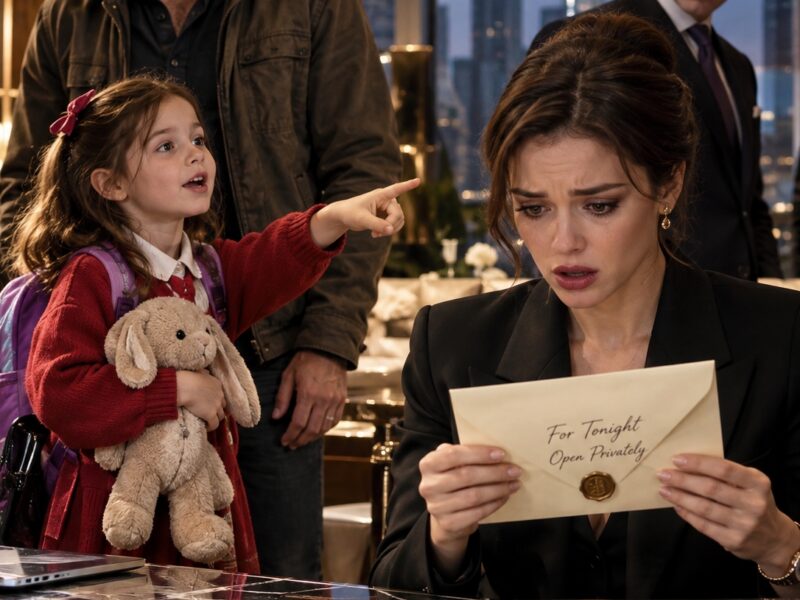
Before Wyn could respond, her assistant hurried toward them carrying a cream envelope.
“Miss Harkort. Your grandmother just arrived downstairs. She asked that I give you this immediately.”
Wyn recognized Lenora’s handwriting.
Four words appeared beneath her name.
For tonight. Open privately.
Hollis went completely still.
Wyn looked at him.
Then at the envelope.
And for the first time, she understood that the stranger she had spent the morning evaluating might never have entered her life by accident.
“You’re coming with me.”
The executive dining room occupied the thirty-ninth floor.
Lenora Harkort waited near the windows.
Seventy-six.
Silver-haired.
Elegant without effort.
When she saw Hollis beside Wyn, she displayed no surprise.
Wyn stopped.
“You knew he was here.”
“Yes.”
“You knew I was interviewing him?”
“Not until twenty minutes ago.”
Hollis glanced at Lenora.
“That part really was an accident.”
“An unfortunate one,” Lenora said.
Then her eyes moved to Wyn.
“Or perhaps a useful one.”
“I am not in the mood for one of your lessons.”
“Open the envelope.”
Inside was a letter and a cream card.
Wyn unfolded the letter.
Then read the card.
Two names.
Wyn Harkort.
Hollis Mercer.
Her eyes moved downward.
A private family introduction.
Arranged months earlier.
Not a contract.
Not a wedding.
Not a legal promise.
But something close enough to make her pulse change.
If the meeting went well, both families hoped Wyn and Hollis might consider a serious relationship.
Possibly an engagement.
“No.”
Lenora’s expression remained gentle.
“You agreed to meet him.”
“I agreed to meet a widowed father from Idaho.”
“That is him.”
“You never told me his name.”
“You specifically told me you didn’t want his name.”
Wyn turned toward Hollis.
“You knew?”
“Yes.”
“You knew our families wanted this?”
“I knew they hoped we might consider getting to know each other.”
“Seriously?”
Lenora answered.
“Yes.”
Wyn stared at Hollis.
“You walked into my company knowing this.”
“Yes.”
“And when I called you an applicant, you said nothing.”
“At first, I assumed somebody would correct the mistake.”
“And after that?”
Hollis paused.
“I became curious.”
“About what?”
“You.”
Her jaw tightened.
“You were testing me.”
“No.”
“Don’t soften it.”
Hollis held her gaze.
“I wanted to know how you treated someone you believed needed something from you.”
That hurt.
She hated that it hurt.
“And what did you decide?”
“I decided you were more complicated than Lenora described.”
“That’s diplomatic.”
“It wasn’t meant to be.”
“Then say what you mean.”
Hollis looked at her.
“You expect people to disappoint you before they have the chance.”
Her shoulders stiffened.
“You’ve known me for one morning.”
“Long enough to see everyone in that conference room was afraid of giving you the wrong answer.”
“I run a corporation. Standards matter.”
“They do.”
“You think kindness means lowering them?”
“No.”
His voice softened.
“I think dignity means remembering that the person who misses the standard is still a person.”
The words reached somewhere Wyn had spent years barricading.
Her father telling her compassion made leaders vulnerable.
Board members testing her because she was young.
Investors assuming politeness meant weakness.
She had built armor so carefully that eventually she forgot she was wearing it.
“You have no idea what it took for me to sit in that chair.”
“You’re right.”
The lack of argument stopped her.
“I don’t.”
“Then don’t pretend you understand me.”
“I’m not.”
Hollis stepped slightly closer.
“I’m saying I’d like to.”
Her phone vibrated.
Then again.
Five notifications appeared.
An internal company thread.
A photograph of Hollis entering headquarters.
Another of him sitting across from Wyn.
Beneath it:
CEO SECRETLY INTERVIEWS FAMILY-CHOSEN HUSBAND FOR EXECUTIVE ROLE.
Wyn’s face hardened.
“Prescott.”
Lenora said nothing.
She didn’t need to.
What had begun as a private misunderstanding was becoming a corporate scandal.
“You should probably leave,” Wyn said.
Hollis studied her.
“Do you want me to?”
She opened her mouth.
Nothing came.
“Do you want me to leave, Wyn?”
“I don’t know.”
Hollis nodded.
“That may be the first completely honest thing either of us has said today.”
“I’ve been honest.”
“You’ve been direct. That isn’t always the same thing.”
She glared at him.
Yet she knew exactly what he meant.
Two hours later, twelve board members sat beneath warm brass lights in the executive dining room.
Hollis remained.
So did Tessa.
Prescott waited until the first course was served.
“Before quarterly projections, I believe there’s a governance issue requiring discussion.”
Wyn put down her fork.
“Then discuss it.”
Prescott turned toward Hollis.
“It appears Mr. Mercer was evaluated for a senior engineering position while simultaneously being considered for a personal relationship with our CEO.”
Tessa whispered, “Is he talking about you?”
Hollis murmured, “Eat your roll.”
“The appearance of favoritism,” Prescott continued, “is serious.”
“There was no employment consideration,” Wyn said. “There was an administrative mistake.”
“An unusually convenient one.”
That was Prescott’s talent.
He rarely accused.
He simply placed suspicion on the table and waited for other people to pick it up.
A board member named Judith Crane looked at Hollis.
“Were you offered compensation for solving the Joliet problem?”
“Not for solving it.”
Prescott smiled.
“Not yet.”
Hollis looked at him.
“You clearly have something you want to ask.”
“Fine. Did you come here expecting financial benefit from your connection to the Harkort family?”
“No.”
“Did you know they hoped you might become engaged to Miss Harkort?”
“Yes.”
Murmurs moved around the table.
“And yet you allowed yourself to be mistaken for an applicant.”
“Yes.”
“Why?”
“Because nobody asked the right question soon enough.”
“That sounds convenient.”
“It was mostly confusing.”
Prescott leaned closer.
“You run a repair business in Idaho. You’re now sitting at the table of a multibillion-dollar corporation beside a woman your family hopes you’ll marry. Surely you understand why people might wonder what you stand to gain.”
Hollis reached into his jacket.
He removed a folded document.
Wyn recognized it.
Earlier that afternoon, company counsel had prepared a six-month consulting agreement after the Joliet incident.
The compensation was enormous.
Prescott unfolded it.
Then stared at the signature line.
Blank.
“You declined this?”
“Yes.”
“Why?”
“Because I didn’t come here for a job.”
Prescott’s jaw tightened.
“That proves nothing about your intentions toward Miss Harkort.”
“You’re right.”
Hollis placed the visitor badge beside the contract.
Then looked at Wyn.
“I’m going home tomorrow.”
Her chest tightened.
“Hollis.”
“This situation is becoming a problem for your company.”
“That isn’t your decision.”
“No. But my part in it is.”
Prescott leaned back, almost satisfied.
Hollis saw it.
“I won’t become evidence someone uses against you. I won’t take money people can call favoritism. And I won’t stand beside you while everyone wonders whether I’m there because of your last name.”
Wyn stared at him.
“So you’re leaving because people are talking?”
“No.”
His voice was gentle.
“I’m leaving because if I choose to know you, I want that choice to belong to us.”
He glanced at Lenora.
“Not our families.”
Then the board.
“Not them.”
Finally Prescott.
“And definitely not him.”
Silence.
Then Wyn turned toward Prescott.
“You circulated the photograph.”
He hesitated.
“I raised legitimate governance concerns.”
“You sent a private photograph of my guest into an internal channel before asking me a single question.”
“I was protecting the company.”
Wyn stood.
“No.”
Her voice never rose.
“You were protecting your position inside it.”
Prescott went pale.
“Tomorrow morning, Compliance will review the source account, distribution list, and every message connected to this incident.”
“Wyn—”
“Miss Harkort.”
He stopped.
She turned toward the board.
“Mr. Mercer accepted no position, payment, or advantage from this company. He solved a problem because someone asked him for help. Then he declined the money we offered.”
Her gaze traveled around the table.
“If anyone here still believes that makes him opportunistic, the problem is no longer his character.”
A pause.
“It’s ours.”
No one answered.
Later, Wyn found Hollis near the elevators.
Tessa slept against his shoulder.
“You’re really leaving tomorrow.”
“My flight is at nine-forty.”
“And after that?”
“I open the shop Wednesday morning.”
“That isn’t what I meant.”
He knew.
For several seconds, neither spoke.
Then Hollis said, “Maybe we find out whether today was an accident worth remembering.”
The elevator arrived.
He stepped inside.
Tessa stirred and lifted one sleepy hand.
“Bye, smart lady.”
Wyn smiled despite the ache in her chest.
“Good night, Tessa.”
The doors began closing.
Wyn had spent years believing control meant never chasing anything.
Then the doors shut.
And she realized the one man who wanted absolutely nothing from her was about to disappear from her life.
Three weeks later, rain drummed against the metal roof of Mercer Equipment & Repair outside Boise.
Hollis was beneath the hood of an old Ford when someone knocked.
“Door’s open.”
He tightened one last fitting.
Then turned.
Wyn Harkort stood ten feet away.
No cream suit.
No assistant.
No security.
Dark jeans.
Brown boots.
A navy coat damp with rain.
A small overnight bag beside her feet.
Hollis stared.
Wyn raised one eyebrow.
“This is usually where someone says hello.”
He set down the wrench.
“Hello.”
“Better.”
“What are you doing here?”
“I came for an interview.”
Silence.
Hollis glanced around the shop.
“For what position?”
Wyn looked at the hand-painted sign over his office.
“I was hoping you could tell me.”
“You flew almost eight hundred miles for that joke?”
“Commercial.”
That surprised him.
“Middle seat for part of it.”
“That sounds serious.”
“A child kicked my seat for forty minutes.”
“Very serious.”
The corner of his mouth lifted.
During the previous three weeks, they had exchanged only a few messages.
The compliance investigation had confirmed Prescott distributed the photograph and manipulated internal communications.
He had been placed on administrative leave.
Wyn had sent Hollis the update.
He had replied:
I hope the company gets the truth it needs.
She had typed nearly twenty responses before settling on:
I think I do too.
Now she stood inside his shop.
Hollis nodded toward the coffee pot.
“Want some?”
“How long has it been sitting there?”
“Long enough to qualify as industrial solvent.”
“No.”
“Smart.”
A voice came from the office.
“Dad, where’s the blue marker?”
Tessa appeared holding a cardboard solar system.
She saw Wyn.
Stopped.
“Smart lady!”
Wyn’s face broke into a genuine smile.
“Hello, Tessa.”
“You came to Idaho.”
“I did.”
“Why?”
Wyn looked at Hollis.
“I’m still figuring out how to answer that.”
Tessa nodded knowingly.
“Dad does that.”
“Does what?”
“Takes forever to answer important questions.”
“Tessa.”
“Blue marker?”
“Top drawer.”
She vanished.
Wyn looked around.
Tools lined the walls.
Invoices were clipped beside a calendar covered in Tessa’s handwriting.
On a shelf sat a photograph of Hollis, a younger Tessa, and a smiling woman Wyn immediately knew was his late wife.
Her eyes lingered there respectfully.
Then returned to him.
“I owe you an apology.”
Hollis waited.
“Not for mistaking you for an applicant. That was ridiculous, but accidental.”
She breathed in.
“I owe you an apology because once I learned the truth, I was more angry about being embarrassed than interested in why you stayed.”
“You had reasons to be angry.”
“Reasons aren’t always excuses.”
Rain filled the silence.
“I kept thinking about what you said.”
“Which part?”
“Respecting people when nobody important is watching.”
“You remembered that?”
“I remember almost everything said to me when it’s annoying.”
He smiled.
“Useful executive skill.”
“Terrible personal one.”
She stepped closer.
“You were right about something else.”
Hollis waited.
“I expect people to disappoint me.”
She looked down.
“It’s efficient. If you assume everyone wants something, you’re rarely surprised when they do.”
“And when they don’t?”
Her eyes returned to his.
“Apparently I fly to Idaho.”
Hollis laughed.
A real laugh.
Tessa peeked from the office and grinned.
Then Hollis grew serious.
“I meant what I said in Chicago. I don’t want an arrangement.”
“Neither do I.”
“I don’t want our families deciding where this goes.”
“Neither do I.”
“And I can’t move Tessa into somebody else’s world because that world has better views.”
“I’m not asking you to.”
“Then what are you asking?”
Wyn removed her coat.
Hung it over a chair.
As if she planned to stay.
“Dinner.”
He blinked.
“Dinner?”
“One dinner. No board. No grandmother. No résumé. No expectations.”
“That’s your interview?”
“First round.”
“My daughter chooses the restaurant.”
“How bad could that be?”
From the office, Tessa shouted:
“PANCAKE PLACE!”
Hollis looked at Wyn.
“There’s your answer.”
She laughed.
“Fine. Pancakes.”
He studied her.
Three weeks earlier, she had sat behind a walnut table asking what he wanted from life.
Now she had crossed nearly eight hundred miles to stand in his small repair shop and ask for nothing except the opportunity to begin again.
“All right.”
Her smile softened.
“All right what?”
“You got the interview.”
Tessa cheered from the office.
Wyn shook her head.
“I walked into that one.”
Hollis held the door.
Outside, the rain was easing.
Wyn paused.
“Hollis?”
“Yeah?”
She looked back at the tools.
The family photograph.
Tessa’s crooked solar system.
The ordinary life he had refused to treat as ordinary.
“I think I understand why you didn’t need that job.”
Hollis looked toward his daughter.
“This is the job I couldn’t afford to lose.”
Six months later, the lobby of Harkort Meridian looked almost exactly the same.
Polished stone.
Silver elevators.
Morning light through forty feet of glass.
But the people entering it had changed.
Hollis walked beside Tessa.
She carried cinnamon rolls in a paper bag.
Wyn waited near security.
Tessa saw her first.
“Smart lady!”
Half the lobby turned.
Wyn laughed.
“You promised you’d stop calling me that.”
“I changed my mind.”
Six months had given them more than pancakes.
Flights between Chicago and Idaho.
Long calls after Tessa went to sleep.
Weekends when Wyn learned how to hold a flashlight under a truck hood.
Roadside diners.
Arguments that did not become exits.
Silence that did not become punishment.
The slow, difficult grace of allowing another person to see what no résumé could explain.
Wyn had changed too.
Not because Hollis rescued her from ambition.
She did not abandon her company.
She was still demanding.
Still exact.
Still capable of silencing a room with one look.
But she listened longer.
Asked names before titles.
Required senior executives to spend time with the people affected by their decisions.
Prescott eventually resigned after the investigation confirmed a pattern of manipulating company communications to undermine colleagues.
Wyn did not celebrate.
She approved the findings.
Then moved forward.
Power, she had learned, did not become smaller when it showed restraint.
Hollis stopped in front of her.
“You’re early,” Wyn said.
He looked at the clock.
“Twenty minutes.”
“That sounds familiar.”
“I hoped you’d notice.”
Tessa sighed.
“Are you doing the weird interview thing again?”
Wyn lifted a finger.
“Actually, yes.”
Hollis raised an eyebrow.
“Should I be worried?”
“Probably.”
She reached into her coat.
And pulled out a visitor badge.
Hollis stared.
It was the original badge.
The one from that first morning.
The edges were bent now.
APPLICANT — FACILITIES ENGINEERING.
Wyn turned it over.
Three handwritten words covered the back.
NO MORE LABELS.
“You kept it.”
“I almost threw it away.”
“Why didn’t you?”
She looked at the badge.
“Because I needed to remember something.”
“What?”
“The fastest way to misunderstand someone is to decide who they are before they speak.”
Then she produced another visitor card.
Blank except for two words.
Hollis Mercer.
No applicant.
No consultant.
No fiancé.
Just his name.
Hollis studied it.
“I like this one better.”
“So do I.”
Tessa groaned.
“Are you going to kiss now?”
“You’re eight.”
“Almost nine.”
“That doesn’t improve the question.”
Wyn laughed.
Then her expression grew serious.
“The board approved the regional partnership proposal.”
“What proposal?”
“Harkort Meridian is going to begin contracting independent maintenance companies in smaller markets instead of forcing every facility through national vendors.”
Hollis stared at her.
“You built that?”
“We built the opportunity.”
“I never asked you to.”
“I know.”
“And Mercer Equipment gets the contract?”
“No.”
Wyn smiled.
“You have to compete for it.”
Hollis laughed.
“There she is.”
“You told me interviews work both ways.”
“I did.”
“So does respect.”
That was the difference.
She was not giving him a future.
She was opening a fair door and allowing him to decide whether he wanted to walk through it.
“I’ll submit a bid.”
“Good.”
“And if I lose?”
“I take you to dinner anyway.”
“Conflict of interest.”
“I’m willing to risk it.”
Tessa tugged Wyn’s sleeve.
“Can we get pancakes after the meeting?”
Wyn looked at Hollis.
“Is this another negotiation?”
“She usually wins.”
“I’ve noticed.”
The three of them headed toward the elevators.
Near security, the same receptionist from six months earlier looked up.
“Good morning, Mr. Mercer. Are you here for an interview?”
Hollis stopped.
Wyn stopped beside him.
Tessa covered her mouth, already laughing.
Hollis looked at Wyn.
She raised one eyebrow.
The same expression she had worn that first morning.
Only warmer now.
“Something like that,” he said.
The elevator opened.
Tessa stepped inside first.
Wyn followed.
Then Hollis entered and turned toward the lobby.
For one second, he could almost see the man who had stood there six months earlier.
A widower in worn boots.
A father carrying grief quietly.
A man expecting nothing.
A man prepared to leave the instant respect disappeared.
He was still that man.
He hoped he always would be.
But he was no longer alone.
As the doors began to close, Wyn reached for his hand.
Hollis took it.
There was no announcement.
No applause.
No diamond waiting beneath dramatic lights.
No promise that grief would disappear, that ambition would never create distance between them, or that two complicated lives would merge without pain.
Only a quiet choice.
Made freely.
By a woman who had spent years hiding behind a title.
And a man who had spent years believing the life he already had was enough.
Perhaps that was why they finally had a chance.
Neither had come looking for someone to complete an empty life.
They had come with lives already scarred, already full, already difficult.
And somewhere between a mistaken visitor badge, an eight-year-old girl’s dangerous honesty, a boardroom accusation, and pancakes in Idaho, they had learned the one thing neither résumé nor family name could reveal.
A person was not the title on the door.
Not the salary on a contract.
Not the mistake someone made about them in the first thirty seconds.
Not even the grief they carried quietly into a room.
The elevator doors narrowed.
Wyn’s fingers tightened gently around Hollis’s.
And just before the lobby disappeared, Hollis saw the old visitor badge still resting in her other hand.
APPLICANT.
A word that had once reduced him to something he was not.
On the back:
NO MORE LABELS.
Then the doors closed.
And for once, neither of them needed to know exactly what would happen when they opened again.









