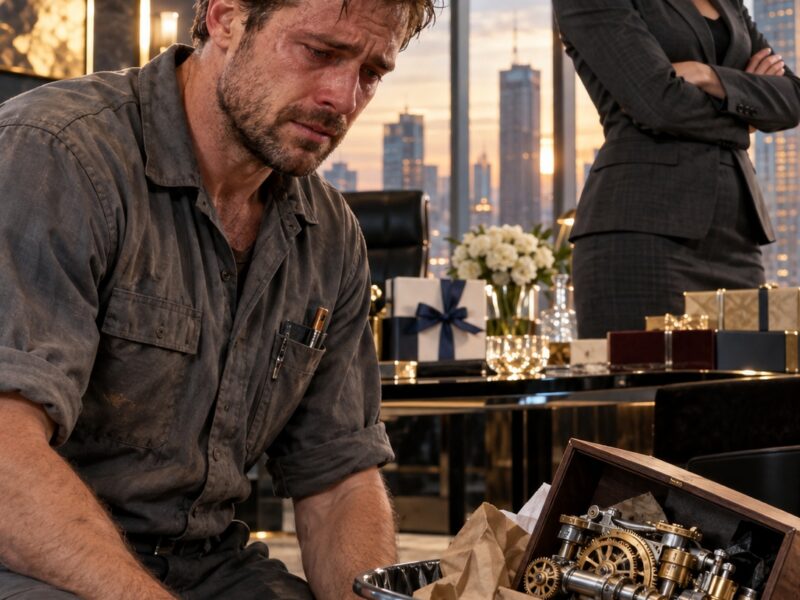
SHE THREW THE JANITOR’S “CHEAP” GIFT IN THE TRASH—THEN THE BILLIONAIRE CHAIRMAN SAW WHAT WAS INSIDE

The little box hit the bottom of the steel trash can with a hollow metallic knock.
Nobody laughed after that.
A few seconds earlier, there had been smiles around the administration office on the twelfth floor of Veil Meridian. Polite smiles. Expensive smiles. The kind people wore when they were standing near executives and wanted to look amused without actually risking an opinion.
Now the room had gone strangely quiet.
Everett Knox stood beside the long anniversary gift table with his faded maintenance cap folded between both hands.
He was forty years old, broad through the shoulders, wearing a gray work shirt with the Veil Meridian patch washed nearly white over the left pocket. There was machine oil beneath one thumbnail. A pale scar crossed the knuckle of his right index finger.
He looked nothing like the people whose gifts covered the table beside him.
There were leather cases embossed with initials.
A crystal decanter.
A limited-edition watch.
A bottle of Scotch sealed inside a polished wooden crate that probably cost more than Everett’s monthly mortgage payment.
And then there had been Everett’s gift.
A box small enough to fit in one palm.
Brown paper.
Copper wire instead of ribbon.
No card.
No expensive logo.
No evidence that anyone important had sent it.
Marla Voss, Veil Meridian’s director of operations, had taken one look at it and decided that was all she needed to know.
“You actually thought the chairman was going to want this?”
She had asked the question loudly enough for half the office to hear.
Everett hadn’t answered.
That seemed to irritate her more.
Marla had always disliked silence when she was trying to establish authority. Silence gave the other person too much room.
She tugged the copper wire loose and opened the box herself.
Inside, resting on folded cloth, was a compact mechanism of dark steel and brass. Its exposed gears had been cut so precisely they almost looked decorative. A narrow shaft ran through its center, surrounded by tiny weighted arms mounted along curved tracks.
Marla turned it once beneath the fluorescent light.
“Homemade.”
A man near the copier gave a short laugh.
Everett looked at him.
The man immediately found something interesting on his computer screen.
Marla lifted the mechanism with two fingers.
“Scrap from the maintenance shop?”
“Some of it,” Everett said.
“Of course.”
She put it back into the box.
“We have board members arriving in less than two hours. Investors. Clients. The governor’s office sent something. And you want me to put this beside their gifts?”
Everett’s expression barely changed.
“I wanted to give it to Mr. Vale.”
“Chairman Vale.”
“Yes, ma’am.”
Marla’s mouth tightened.
“Do you have any idea what people give a man like Adrien Vale?”
Everett looked at the table.
“I can see.”
“Watches. Artwork. Things worth thousands of dollars.”
“I can see that too.”
Something moved behind Marla’s eyes.
Everett wasn’t challenging her. That was the problem.
He wasn’t embarrassed enough.
She closed the lid.
“This is inappropriate.”
Everett glanced at the box.
“I understand.”
“No, I don’t think you do.”
Marla crossed the three steps between them and the steel wastebasket beside her desk.
Then she dropped the box.
The impact made that dull, unforgettable sound.
Metal against metal.
A corner of brown wrapping paper fluttered over the rim and landed on the carpet.
The entire office seemed to hold its breath.
Everett stared at the trash can.
For three months, after his daughter had gone to bed and his small house had become quiet, he had sat beneath the single yellow bulb above his garage workbench and built what was now lying beside discarded coffee cups and shredded memos.
He had filed every edge by hand.
Cut every gear.
Rebuilt the balancing assembly six times.
On some nights he had worked until two in the morning, slept four hours, packed his daughter’s lunch, and reported for the seven o’clock shift.
He had never expected anyone to understand that.
But he hadn’t expected this either.
His jaw tightened once.
Then relaxed.
He bent down.
Not toward the trash.
Toward the torn piece of wrapping paper lying on the carpet.
He picked it up, smoothed it against his knee, folded it once, and slipped it into his pocket.
Marla had already turned back to her monitor.
“You can go downstairs now.”
Everett put his cap beneath one arm.
“Yes, ma’am.”
He took one step toward the hallway.
The office door opened.
And Chairman Adrien Vale walked in.
He was sixty-two, silver-haired, tall, wearing a navy suit without a tie. His assistant, Caleb Price, followed two steps behind carrying a tablet.
Adrien had entered smiling.
Then he saw the trash can.
The smile disappeared.
His eyes didn’t go to Marla.
They didn’t go to Everett.
They went to a sliver of dark steel visible through the crumpled brown paper.
For a moment, the chairman of Veil Meridian didn’t move.
Then he said four words.
“Who threw this away?”
Nobody answered.
Everett looked down.
Marla stood.
“Mr. Vale—”
Adrien raised his eyes.
“Who threw it away?”
There was something different in his voice now.
Not anger.
Something worse.
Recognition.
And for the first time that afternoon, Marla Voss looked uncertain.
She stepped around her desk and smoothed the front of her charcoal jacket.
“I did. It was nothing important. One of the maintenance employees made a little craft project for the anniversary. I was trying to keep the gift table appropriate.”
Adrien didn’t look at her.
“Bring it to me.”
Marla hesitated.
Only for a second.
But Adrien noticed.
So did everyone else.
“I said bring it to me.”
“Sir, really, there’s no need—”
Adrien walked past her.
The chairman of a company employing nine thousand people crouched beside a steel office wastebasket in an eight-hundred-dollar suit and reached inside with his bare hand.
No one spoke.
Somewhere behind the glass partition, a telephone rang.
Once.
Twice.
Three times.
Nobody answered it.
Adrien lifted the little box out.
A brown coffee stain had spread across one corner.
He brushed it away with his thumb.
Then he opened the lid.
The color left his face.
Everett saw it happen.
So did Marla.
Adrien lifted the mechanism into the afternoon light.
His fingers moved over the polished steel frame, the brass gears, the central shaft.
He examined the bevels.
Turned it over.
Then his thumb stopped against a nearly invisible engraving near the base.
His breath caught.
“Who made this?”
Marla immediately stepped forward.
“Sir, as I said, I evaluated it before—”
Adrien looked up.
“I didn’t ask who evaluated it.”
His voice remained quiet.
“I asked who made it.”
Three heartbeats passed.
Everett stepped forward.
“I did.”
Adrien stared at him.
Not at the faded uniform.
Not at the old boots Everett had resoled twice.
At him.
“What’s your name?”
“Everett Knox.”
“Department?”
“Maintenance.”
“How long?”
“Eleven years.”
Adrien looked back at the mechanism.
Then at Everett.
“Do you know what this is?”
Everett held his gaze.
“I think you know that better than I do, sir.”
Something changed in Adrien’s expression.
He turned the mechanism upside down.
Beneath the base was a small brass plate secured with four tiny screws.
Adrien pressed one edge with his thumbnail.
The plate opened on a hidden hinge.
Inside the dark steel was a symbol almost no one at Veil Meridian would have recognized.
A compass needle crossed by a single letter.
V.
A gray-haired accountant near the windows inhaled sharply.
Marla looked at him.
“What?”
He didn’t answer.
Adrien did.
“My father’s mark.”
The room went still.
Not the Veil Meridian corporate logo.
Not the polished symbol displayed in the lobby.
This mark was older.
Private.
It had belonged to Harland Vale, Adrien’s father, back when Veil Meridian was not a multinational industrial company but a narrow Ohio machine shop with a borrowed lathe, unpaid invoices, and four hundred dollars in the bank.
Adrien looked at Everett.
“Where did you get this design?”
“I found it.”
“Where?”
“The old subbase.”
Adrien’s eyes narrowed.
Everett continued.
“Behind the storage wall.”
For several seconds, Adrien said nothing.
Then he closed his hand around the mechanism.
“Come with me.”
He started toward the hallway.
Everett followed.
Marla moved after them.
At the door to Adrien’s fourteenth-floor office, he stopped.
“Not you, Marla.”
Her face froze.
“Sir, Everett works under operations. If this concerns company property—”
“Not this time.”
Caleb stepped quietly into the doorway.
The door closed between them.
For four years, Marla Voss had been one of the people at Veil Meridian who decided where other people were allowed to go.
Now she stood alone in the hallway, staring at a closed door.
Inside, Adrien placed the mechanism on his desk.
“Tell me everything.”
So Everett did.
Four months earlier, Marla herself had assigned maintenance to clear several abandoned storage rooms beneath the original Veil Meridian building.
The subbase had been ignored for decades.
The lights barely worked.
Pipes sweated overhead.
Behind rotting wooden shelving, Everett had discovered a steel box sealed with wax and secured by a rusted padlock.
Inside were engineering drawings.
Yellowed.
Brittle.
Rolled tightly enough that the edges threatened to crack when he opened them.
There was also a heavy steel plate wrapped in oilcloth.
Stamped into that plate was the same compass symbol.
Everett had taken the drawings home.
For weeks, he studied them at his kitchen table.
Every night after the dishes were washed.
After his daughter was asleep.
After the house became quiet enough for him to hear the refrigerator cycling in the next room.
One phrase appeared repeatedly in the notes.
PROJECT ORION.
Adrien gripped the edge of his desk.
“Orion was my father’s last design.”
Everett said nothing.
Adrien looked toward the windows.
“He spent almost three years on it.”
“A drive coupling,” Everett said.
Adrien turned.
“You understood the drawings?”
“Most of them.”
“It was supposed to eliminate harmonic vibration in high-speed industrial motors.”
“I know.”
“My father died before he finished it.”
Everett’s expression changed slightly.
“I’m sorry.”
“The engineering team tried to continue his work. They couldn’t solve the balancing problem. Eventually the board killed the project.”
Adrien touched the mechanism.
“I thought everything connected to Orion had been lost when the old building was renovated.”
“It wasn’t lost.”
Everett paused.
“Somebody hid it.”
Adrien looked at him.
“Why do you say that?”
“The box was sealed too carefully. Whoever put it behind that wall wanted it protected.”
Adrien lowered his eyes toward the mechanism.
“And you completed the design?”
Everett shook his head.
“No.”
“No?”
“I corrected one part.”
He pointed toward the small brass weights surrounding the central shaft.
“The original drawings fixed the counterweights in position. At low speed, that’s fine. But as the shaft accelerates, it flexes. The weights stay where they were designed to stay, so the system fights itself.”
Adrien leaned closer.
Everett touched one curved track.
“I let them move.”
“Move?”
“They float outward with centrifugal force and settle where the shaft needs them.”
Adrien stared at him.
For two years, Veil Meridian’s newest drive line had suffered catastrophic harmonic vibration at high speed.
Millions had been spent trying to fix it.
Consultants had been hired.
Prototypes scrapped.
University engineering departments brought in.
Nothing had worked.
“You know about the Meridian drive problem?” Adrien asked.
Everett shrugged.
“I know Line Four sounds wrong.”
“You’ve seen the engineering reports?”
“No.”
“Then how?”
“I walk past it every morning.”
Adrien waited.
Everett seemed surprised that more explanation was necessary.
“It sounds like it’s arguing with itself.”
Adrien almost smiled.
Instead, he picked up the mechanism.
A small brass key protruded from the frame.
He wound it.
Once.
Twice.
Then placed it on the desk.
The central shaft began turning.
Slowly at first.
Then faster.
The gears became a golden blur.
The tiny counterweights slid outward along their curved tracks.
And the mechanism remained perfectly still.
No vibration.
No rattle.
Not even a tremor against the polished wood.
Adrien placed a coin on the frame.
It stayed upright.
Neither man spoke until the mechanism wound itself down.
Adrien finally looked at Everett.
“Do you understand what you’ve done?”
Everett studied the little machine.
“I fixed a drawing.”
“Everett.”
“Yes, sir?”
“Our research division has spent more than eleven million dollars trying to solve this problem.”
Everett blinked.
“That’s a lot.”
Adrien stared at him.
Then, unexpectedly, laughed.
Just once.
A stunned, breathless sound.
He picked up his phone.
“Caleb.”
“Yes, sir?”
“Postpone the board meeting.”
A pause.
“The anniversary board meeting?”
“Yes.”
“Until when?”
“Until I understand how a maintenance technician just solved an eleven-million-dollar engineering problem in his garage.”
Adrien’s eyes remained on Everett.
“And pull every record we have on Project Orion.”
He paused.
“Then get me everything we have on Everett Knox.”
Downstairs, Marla Voss was already trying to understand what had gone wrong.
She took an elevator to the maintenance level for perhaps the first time in years.
The corridor smelled of oil and cold concrete.
She found Jenna Brooks, a young technician restocking a parts cabinet.
“Everett Knox.”
Jenna turned.
“What about him?”
“Did he build a small brass-and-steel mechanism?”
Jenna’s face brightened.
“The Orion piece?”
Marla’s stomach tightened.
“You know about it?”
“Everybody down here does. He’s been working on it for months.”
“Using company equipment?”
“Sometimes the lathe during lunch.”
Marla seized on that.
“So he used company resources.”
Jenna frowned.
“He used a lathe for maybe twenty minutes at a time. The rest he did at home.”
“Did anyone help him?”
“No.”
“Nobody?”
Jenna closed the cabinet.
“I watched him cut the gear teeth by hand.”
She shook her head.
“I wouldn’t have the patience.”
Marla stepped closer.
“How complicated is it?”
Jenna laughed.
“Complicated enough that I wouldn’t touch it.”
The elevator doors reflected Marla’s face on the way back upstairs.
“He got lucky,” she whispered.
The words sounded weaker outside her head.
By four that afternoon, the chairman’s office had requested Everett’s entire eleven-year work history.
Caleb expected a folder.
He got boxes.
Three hundred twelve work orders completed ahead of schedule.
Forty-one employee improvement suggestions.
Most had been marked with the same phrase.
NOT NECESSARY.
But some had later reappeared.
A cooling-loop redesign Everett submitted in 2019 had been rejected.
Eight months later, a nearly identical system was implemented under another manager’s proposal.
Annual savings: $260,000.
A compressor maintenance change rejected in 2021 surfaced the following year in a management presentation.
The manager received a bonus.
A generator repair Everett completed alone over a holiday weekend prevented nearly half a million dollars in downtime.
The report credited “Operations.”
No technician was named.
Adrien spread the papers across the conference table.
“How many?”
Caleb swallowed.
“We haven’t finished.”
“How many so far?”
“Enough that I think you should see the original submissions.”
Adrien slowly sat down.
A gift had been thrown into a trash can.
He was beginning to understand that the gift might not have been the first thing Veil Meridian had thrown away.
At five o’clock, he summoned senior management.
Eleven executives sat around the walnut conference table.
Marla was among them.
Adrien entered carrying Everett’s mechanism.
He placed it in the center.
Wound the key.
And let it spin.
Nobody understood why they were watching until he spoke.
“A man this company has treated as a maintenance worker solved a technical problem we have spent two years and eleven million dollars failing to solve.”
The head of engineering stared at the machine.
Adrien let the silence deepen.
Then he looked directly at Marla.
“And this afternoon, you threw it in the trash.”
Marla opened her mouth.
Nothing came out.
Adrien nodded slowly.
“Tomorrow,” he said, “we find out how many other things we’ve thrown away.”
The audit began that night.
Dana Whitfield, an outside compliance reviewer with twenty years of forensic corporate work behind her, joined two internal analysts.
By midnight, she had found the pattern.
Employee proposals from technicians and line workers entered the operations approval chain.
Many were rejected.
Months later, some reappeared.
Different formatting.
Different presentation.
Different names.
Same measurements.
Same diagrams.
Same ideas.
At 12:47 a.m., Dana rotated her laptop toward Adrien.
“Here.”
Everett had submitted a modified bearing housing three years earlier.
Rejected.
Six months later, a senior manager presented nearly the same design to the executive committee.
“Coincidence?” Adrien asked.
“No.”
“How certain?”
Dana opened another file.
“Because I found another.”
Then another.
By two in the morning, they had nine.
By sunrise, fourteen.
More than half traced back to Everett.
Adrien asked him to come upstairs at seven.
Everett arrived wearing his normal gray shirt and carrying his lunch in a brown paper bag.
Adrien showed him the files.
Everett read silently.
Page after page.
Finally, he handed the laptop back.
“I didn’t know.”
“You didn’t know they were using your work?”
“No.”
“Doesn’t that make you angry?”
Everett thought about it.
“Not really.”
Adrien stared.
“Why?”
Everett shifted the paper bag to his other hand.
“Because if the repair worked, then the machine worked.”
“That’s it?”
“Pretty much.”
“Someone else received bonuses for your ideas.”
“Would putting my name on them make the machines run better?”
Adrien had spent forty years around executives who counted recognition like currency.
For a moment, he didn’t know how to answer.
Later that morning, Everett disassembled the Orion mechanism for the engineering team.
He laid each piece carefully on white cloth.
Gears.
Counterweights.
Tracks.
Shaft.
Finally, the heavy dark-steel core.
Adrien picked it up.
Something about the grain of the metal bothered him.
He carried it toward the window.
Then he saw the faint remains of an old forge stamp.
His fingers tightened.
“Everett.”
“Sir?”
“Where did this steel come from?”
“The box.”
“The same box?”
“Yes.”
“What did it look like before?”
“A plate. Maybe a foot wide.”
Everett demonstrated with his hands.
“It had that compass mark stamped into it. I figured whoever stored it with the drawings thought it mattered.”
Adrien lowered himself into a chair.
He knew the plate.
It had once been bolted to the front of Harland Vale’s workbench in the original workshop on Calder Street.
Adrien had swept floors beneath it as a boy.
He had learned to hold a file correctly at that bench.
When the building was demolished after his father’s death, the plate disappeared.
Adrien had searched salvage yards for months.
Then years passed.
Eventually he accepted that it was gone.
Now part of it sat in his hands.
Reshaped.
Polished.
Alive again.
His eyes filled before he could stop them.
Everett looked away, giving him the privacy of pretending not to notice.
“You have no idea,” Adrien said.
His voice broke slightly.
“You have no idea what you just gave back to me.”
Everett’s answer was simple.
“I thought it belonged here.”
That should have been the end of the conflict.
It wasn’t.
Marla Voss had survived two decades in corporate management because she understood one rule very well:
When power starts slipping away, find the policy.
She went to Legal.
“Who authorized Everett Knox to remove proprietary engineering documents from restricted storage?”
Nobody had.
The drawings belonged to Veil Meridian.
So did the steel.
Everett had taken both home.
He had also used a company lathe.
On paper, Marla had him.
Before nine the next morning, she filed a formal complaint alleging unauthorized removal of proprietary documents, misuse of company property, and unauthorized use of company equipment.
She attached the archive access record.
Everett’s name wasn’t on it.
What she did not attach was the cleanup order that had sent him into the subbase.
An order bearing her own signature.
Adrien was in Chicago meeting Veil Meridian’s largest customer.
At 1:30 p.m., Human Resources summoned Everett.
Gordon Pike, the vice president of HR, couldn’t quite look him in the eye.
“This is temporary.”
Everett sat across from him.
“Okay.”
“We have to investigate.”
“Okay.”
“You’ll be suspended with pay.”
Everett nodded.
“We need your badge.”
He removed it.
“And your keys.”
Everett placed them beside the badge.
Gordon looked almost disappointed that he wasn’t arguing.
“I’m sorry.”
Everett stood.
“You’re doing your job.”
Security escorted him downstairs.
By the time Everett reached maintenance, everyone knew.
The shop went quiet as he opened his locker.
Thermos.
Spare shirt.
Twenty-year-old leather tool roll.
Jenna stood in the doorway.
“This is wrong.”
Everett folded his shirt.
“It’s procedure.”
“Then procedure is wrong.”
“Maybe.”
Ray Holloway, a welder who had worked beside Everett for nine years, removed his gloves.
“If they can walk him out over some old drawings, what happens when they want one of us gone?”
Nobody answered.
Someone switched off the radio.
Everett looked around the maintenance shop.
At people who had spent years working beside him.
At people whose names executives upstairs probably didn’t know.
He shook his head.
“Don’t.”
Ray frowned.
“Don’t what?”
“Turn this into a war.”
“They’re throwing you out.”
“No.”
Everett closed the cardboard box.
“They’re investigating.”
Jenna stared at him.
“How can you be this calm?”
Everett looked at the workbench.
Because he had lost things before.
Real things.
Fifteen years earlier, Everett Knox had owned one of the best restoration shops in Ohio.
Museums sent him damaged mechanisms.
Collectors drove hundreds of miles to watch him rebuild machines everyone else considered dead.
People said he could hear metal fail before he saw the crack.
Then his wife got sick.
The illness moved fast.
Less than a year later, Everett was alone with a child, a mortgage, an eighty-hour-a-week business, and a grief that made every room in his house feel too large.
So he closed the shop.
Sold the equipment.
Took a maintenance job because Veil Meridian offered health insurance and hours that allowed him to be home every night.
He had already watched one life disappear.
A job title could not frighten him the same way.
Before leaving, he made one request.
“Five minutes upstairs.”
Security called Caleb.
Caleb said yes.
Everett carried the Orion mechanism to the fourteenth floor.
Adrien’s office was empty.
Late sunlight crossed the desk.
Beside the window sat a framed photograph.
A young Adrien.
His father.
The old Calder Street workshop.
Everett placed Orion beside the photograph.
Caleb watched from the doorway.
“You don’t have to leave that.”
Everett adjusted the cloth beneath it.
“I think it belongs to him.”
“You built it.”
“From his father’s work.”
“Partly.”
Everett looked at the machine.
“That’s enough.”
He turned away.
He never reached the elevator.
The doors opened.
Adrien Vale stepped out wearing his overcoat, travel bag in hand.
He had taken an earlier flight.
Caleb had called him the moment Everett was suspended.
Adrien looked at the cardboard box.
Then the security officer.
Then Everett.
“You’re not going anywhere.”
Everett shifted the box.
“Sir, there’s a complaint.”
“I read it.”
Adrien stepped closer.
“I also read the cleanup order assigning you to that storage area.”
Everett waited.
“It’s signed by Marla Voss.”
Adrien took the cardboard box from Everett and handed it to security.
“Put this back in his locker.”
The guard nodded.
Everett didn’t move.
“What am I staying as?”
Adrien looked at him.
“Not a maintenance technician.”
He returned to his office and picked up a thin folder.
Then he slid it across the desk.
Everett read the title.
DIRECTOR OF RESTORATION AND INNOVATION.
He read it again.
“Sir.”
“Yes?”
“I don’t have an engineering degree.”
“My father didn’t either.”
“I went to trade school.”
“My father had a borrowed lathe.”
Everett looked at him.
Adrien leaned against the desk.
“I need someone who can restore what this company forgot it had.”
He nodded toward Orion.
“And build what we haven’t imagined yet.”
Everett remained silent.
“And there’s one more part.”
“What’s that?”
Adrien’s expression hardened.
“Make sure the next person who brings something real upstairs doesn’t have to watch someone throw it into a trash can.”
Everett looked through the tall windows toward the factory roofs two miles away.
Then nodded.
“Okay.”
The executive board assembled at nine the following morning.
Dana Whitfield stood at the front with her report.
Marla arrived wearing a cream suit and pearl earrings.
Perfect posture.
Perfect makeup.
Only her hands betrayed her.
Dana spoke for forty minutes.
Fourteen technical proposals rejected and later presented under management names.
Eight originally submitted by Everett.
Eleven major repairs credited only to “Operations.”
The unauthorized archive complaint.
The original cleanup order signed by Marla.
Then Dana displayed one final image.
A security-camera still.
A little brown box suspended in the air above a steel trash can.
“The gift incident,” Dana said, “didn’t cause the problem.”
She looked around the table.
“It revealed it.”
Marla stood.
“I’d like to respond.”
Adrien nodded.
She drew a breath.
“I managed a division with limited resources. Hundreds of suggestions came through my department. Not every idea from the floor can become a project.”
Nobody interrupted.
“Leadership requires filtering noise. It requires judgment. I made decisions based on what I believed was best for this company.”
Adrien waited until she finished.
Then he said, “No.”
Marla blinked.
“You made decisions based on what was best for your ego.”
The room went silent.
“You didn’t filter ideas.”
Adrien placed his hand on Dana’s report.
“You collected them.”
Marla’s face tightened.
“You buried what you couldn’t use. You handed valuable work to managers who owed you favors. And when Everett carried something into your office that was too complete for anyone else to claim, you threw it away before someone important could see it.”
Marla sat slowly.
Adrien continued.
“Effective today, you’re removed as director of operations.”
Her face went white.
“You’ll lose management authority, hiring authority, and access to the evaluation system.”
Adrien paused.
“But I’m not firing you.”
Even Marla looked surprised.
“For three months, you’re going to work on the factory floor.”
A murmur moved around the table.
“You’ll work beside the people whose ideas you rejected. You’ll read what they submitted. You’ll learn their names.”
Marla stared at him.
“And after three months?”
“We’ll decide whether you still belong here.”
Adrien looked toward Caleb.
“Bring Everett in.”
The door opened.
Everett entered wearing a clean gray maintenance shirt.
Not a suit.
Not a jacket.
The same uniform.
Every executive turned toward him.
Adrien gestured toward Marla.
“You have more reason than anyone here to want her gone.”
Everett looked at her.
“If you ask me to terminate her, I will.”
Marla raised her eyes.
For the first time since Everett had known her, there was no authority in them.
Only uncertainty.
Everett thought for a long moment.
Then shook his head.
“No.”
Adrien studied him.
“What do you want?”
Everett looked around the conference table.
“I want this company to stop making people like me.”
Nobody understood immediately.
Everett continued.
“People nobody sees.”
His voice remained calm.
“People who stop submitting ideas because nobody reads them. People who figure it’s easier to keep their heads down than explain what they know.”
He glanced toward Marla.
“If you fire one person and keep the same system, it’ll happen again.”
Adrien slowly nodded.
That afternoon, Veil Meridian changed the system.
Every technical proposal would receive a documented review.
Every employee would receive a written response.
No idea could be reassigned without the original submitter’s name remaining attached.
And every Thursday afternoon, Everett’s door would be open to anyone in the company with an idea and nowhere else to take it.
Marla reported to the factory floor at six the following Monday.
Steel-toed boots.
Blue work shirt.
No private office.
Rosa Delgado, the shift supervisor whose cost-saving proposals Marla had rejected three separate times, handed her a clipboard.
“Line Two.”
That was all she said.
The first day, nobody spoke to Marla unless necessary.
On the second, a machinist named Walt asked her to hold a flashlight while he reset a sensor.
She held it for forty minutes.
He never thanked her.
On the third day, Ray Holloway sat across from her in the break room and dropped a stack of grease-stained pages on the table.
Marla looked down.
“What are these?”
“My ideas.”
Ray drank his coffee.
“You stamped every one.”
Marla touched the first page.
NOT NECESSARY.
Her own digital approval appeared beneath it.
Ray leaned back.
“Read them this time.”
For once, Marla didn’t defend herself.
She began reading.
Everett started his new job the same week.
He still arrived at seven.
Still wore work boots.
Still carried lunch from home.
His eighth-floor office became mostly a place to store blueprints because Everett spent nearly every useful hour downstairs.
Within two weeks, engineering had a full-scale Orion prototype.
The senior engineers were skeptical.
Until Everett identified a tolerance error in the second prototype without touching it.
He simply stood beside the running test assembly.
Tilted his head.
“Shut it down.”
The lead engineer frowned.
“Why?”
“Left bearing.”
“The sensors are green.”
“Shut it down.”
They did.
When they opened the housing, the bearing seat was out of tolerance by less than the width of a human hair.
After that, the engineers stopped asking why Everett listened before he looked.
They began listening too.
He still repaired small things.
A stapler.
A break-room chair.
A coffee machine nobody had reported.
One afternoon, young engineer Tyler Banks found his new director crouched behind a vending machine holding a screwdriver.
“You’re aware you’re management now?”
Everett tightened a screw.
“So I’ve been told.”
“You’ve got a director’s salary.”
“Apparently.”
“Are you at least buying a new truck?”
Everett stood.
“What’s wrong with my truck?”
“It’s older than I am.”
Everett handed him the screwdriver.
“Does it run?”
“Yeah.”
“Then it knows its job.”
Tyler laughed.
He kept that screwdriver on his desk for the next three years.
Adrien began visiting the eighth floor.
At first, he came to discuss Orion.
Eventually, he came with coffee.
They talked about machines.
Old workshops.
Harland Vale.
Everett’s restoration shop.
Sometimes they talked about loss without using the word.
Adrien had lost a father and the place where his childhood lived.
Everett had lost a wife and the version of himself who existed before she died.
Neither man tried to fix the other.
Perhaps that was why the friendship worked.
Two months later, Adrien announced a new research facility would be built on the site of the old Calder Street workshop.
He asked Everett to name it.
Everett took three days.
Then handed him a piece of paper.
THE KNOX WORKSHOP.
Adrien raised an eyebrow.
“You don’t strike me as a man who wants his name on a building.”
“I don’t.”
“Then why?”
Everett looked toward the factory.
“Because maybe somebody with grease on his hands will walk past that sign someday and understand he’s allowed to have an idea.”
Thursday afternoons became something nobody predicted.
The first week, Everett’s open office stayed empty.
The second week, Jenna arrived carrying a sketch for a quieter conveyor bearing.
The third week, six employees waited outside.
By the second month, the line reached the elevators.
Forklift operators.
Receptionists.
Security guards.
Accountants.
Machinists.
People who had been carrying ideas silently for years.
Everett read everything.
Some proposals were excellent.
Some were impossible.
He treated both with respect.
When something wouldn’t work, he explained why.
Then asked, “What if we tried it this way?”
He never wrote NOT NECESSARY.
Near the end of Marla’s three months on the factory floor, she returned to the fourteenth floor for her review.
She was early.
While waiting outside Adrien’s office, she noticed a glass display case.
Inside sat Orion.
Dark steel.
Warm brass.
Soft light catching every gear.
Beneath it was a small engraved plate.
ORION — RESTORED BY EVERETT KNOX.
Adrien came out and found her staring at it.
Marla had changed.
The tailored suits were gone.
Small cuts crossed her hands.
There was grease beneath one fingernail.
“Why keep it here?” she asked.
Adrien stood beside her.
“Where everyone can see it?”
“Yes.”
He looked through the glass.
“Because some things only become valuable to people after they almost lose them.”
Marla lowered her eyes.
“I read them.”
“Whose?”
“Ray’s.”
She swallowed.
“Rosa’s. Walt’s. All the ones I rejected.”
Adrien waited.
“Some were good.”
She gave a small, humorless laugh.
“A few were better than anything I ever put my own name on.”
Adrien offered neither forgiveness nor punishment.
Marla kept looking at Orion.
“I used to think the people downstairs were there to carry out decisions made upstairs.”
Her voice became quieter.
“I never thought they were watching us make the wrong ones.”
Adrien nodded.
“Then the three months worked.”
When her review ended, Marla asked to remain on the factory floor.
Not as a director.
As coordinator for the new employee suggestion program.
Adrien agreed.
Five months after the little box struck the bottom of the trash can, the first full-size Orion coupling was installed on Line Four.
Engineers gathered around.
Everett stood slightly apart.
The line started.
For two years, those machines had shuddered violently at high speed.
Now the shaft accelerated.
Faster.
Faster.
And then—
nothing.
No shudder.
No groan.
Only a smooth mechanical hum.
An older line worker stepped forward and placed his palm against the housing because the machine was so quiet he wasn’t certain it was running.
Everett smiled.
Within three months, Orion reduced downtime on the line by more than ninety percent.
Projected annual savings exceeded twenty million dollars.
Three major customers ordered the technology.
But Adrien considered the larger change more important.
People had started bringing ideas upstairs again.
In late spring, Veil Meridian held a ceremony in the main atrium.
Employees filled every chair.
Then the walls.
Then the balconies.
Jenna stood near the back with a wrench clipped to her belt.
Ray Holloway was beside her.
Tyler Banks stood near the front.
Dana Whitfield sat in the second row.
And near the rear, wearing a plain blue work shirt, stood Marla Voss.
Adrien walked to the podium.
He spoke about Orion.
About Harland Vale.
About the future of the company.
Then he spoke about Everett.
“Veil Meridian almost lost something extraordinary,” he said.
The atrium became quiet.
“Not because it wasn’t valuable.”
He looked across the crowd.
“Because we had forgotten how to recognize value when it didn’t arrive wearing the right clothes.”
Marla lowered her eyes.
Adrien announced the new Restoration and Innovation Division.
The Knox Workshop.
The thirty-day guarantee for employee suggestions.
Then he said, “Everett, come up here.”
Everett froze.
Ray nudged him.
“Go.”
Everett started walking.
The maintenance crew stood first.
Then engineering.
Then the factory workers.
Then the executives.
The applause rolled through the atrium until nearly nine thousand lives seemed compressed into that one room.
Everett stopped halfway.
He looked genuinely uncomfortable.
He didn’t know what to do with his hands.
So he nodded.
Then kept walking.
At the podium, Adrien reached beneath the lectern.
He brought out a walnut case.
Everett recognized it immediately.
Adrien opened it.
Orion rested inside.
Everett shook his head.
“Sir.”
Adrien lifted the mechanism.
“I made that for you.”
“I know.”
“Then keep it.”
Adrien smiled.
“No.”
He placed it into Everett’s hands.
“My father spent his life building things.”
Adrien closed Everett’s fingers around the steel.
“He would have known exactly who this belongs to.”
Everett looked down.
For a moment, the atrium disappeared.
He saw his garage.
The single bulb.
Steel shavings curling beneath his file.
His daughter’s bedroom light beneath the hallway door.
He remembered the nights after his wife died when he had believed the part of himself capable of making beautiful things had died with her.
He remembered closing his shop.
Selling his machines.
Putting on a gray maintenance shirt.
Learning to be invisible because invisibility made life easier.
Then he remembered the sound of Orion hitting the trash can.
Cheap.
Homemade.
Embarrassing.
Now the same mechanism rested in his hands while the entire company stood.
Adrien moved aside.
The microphone waited.
Everett looked across hundreds of faces.
He could have made a speech.
He could have talked about respect.
Credit.
Class.
Arrogance.
He could have told everyone exactly how it felt to spend eleven years repairing a company that barely knew his name.
Instead he leaned toward the microphone.
“Thank you.”
His voice almost failed on the second word.
That was all.
And somehow it was enough.
Afterward, employees approached in twos and threes.
Ray nearly crushed his hand.
Jenna hugged him.
“If I ever see you wearing a tie every day, I’m quitting.”
Everett laughed.
Tyler raised the old screwdriver like a trophy.
Near the end, when almost everyone had gone, Marla approached.
The empty space between them seemed to contain that entire first afternoon.
The brown paper.
The office.
The laughter.
The trash can.
Marla stopped in front of him.
“I was wrong about you.”
Everett waited.
She glanced toward the remaining employees.
“And about a lot of people.”
Everett studied her face.
Then extended his hand.
Marla looked at it.
A few months earlier, she had taken his work from his hands without permission and thrown it away.
Now she took his hand carefully.
Neither apologized again.
Neither needed to.
That evening, long after the atrium had emptied, Everett took the elevator down.
On his way out, he walked through the administration office on the twelfth floor.
It was dark except for the emergency lights.
The anniversary gift table was gone.
Marla’s old desk belonged to someone else.
Everett walked past it.
Then stopped.
Beside the desk stood the same steel trash can.
For several seconds, he simply looked at it.
Orion was tucked safely beneath his jacket.
He could still remember the sound.
That hollow metallic knock.
Once, it had sounded like humiliation.
Now it sounded different.
Not because Everett had become a director.
Not because the company applauded him.
Not because Orion would make millions.
It sounded different because Everett finally understood something he had spent years refusing to admit.
He had told himself he didn’t care about recognition.
Maybe that had even been true.
But being seen was not the same thing as being praised.
Being seen meant someone finally understood that the quiet man repairing elevators had once been an artist with steel.
That the single father in resoled boots had sacrificed a career so his daughter would have a father at home.
That the employee who never demanded credit still deserved not to have his work stolen.
And that sometimes the most dangerous thing a company could throw away wasn’t an idea.
It was the person who had stopped believing anyone wanted to hear it.
Everett touched the mechanism beneath his jacket.
Then he smiled.
Barely.
He turned toward the elevators.
The doors opened with the smooth, quiet motion of a system he had repaired himself years earlier.
No plaque carried his name.
No executive had ever thanked him for it.
He stepped inside anyway.
Before the doors closed, Everett looked once more at the steel trash can.
Then he let it disappear from view.
He didn’t need revenge.
He didn’t need Marla destroyed.
He didn’t need to prove that he had won.
Somewhere downstairs, machines were running smoothly because someone had finally listened.
Somewhere on the eighth floor, there was probably another grease-stained page waiting on his desk from a worker who had spent ten years believing nobody cared.
And somewhere in the city, his daughter was waiting for him to come home.
Everett pressed the lobby button.
Inside his jacket, the small brass gears of Orion shifted softly against one another.
Thirty years earlier, Harland Vale had begun something he never lived long enough to finish.
Years later, a widowed mechanic everyone had learned not to notice found the forgotten drawings behind a wall.
He didn’t know they were worth millions.
He didn’t know they would change his career.
He didn’t know the steel in his hands had once belonged to the workbench where Veil Meridian began.
He only knew something was broken.
So he fixed it.
And maybe that was why Adrien had recognized his father’s spirit in Everett long before Everett ever understood what the chairman was seeing.
The elevator descended.
Fourteen.
Thirteen.
Twelve.
Everett watched the numbers change.
For eleven years, he had traveled through this building repairing what other people couldn’t see.
Tomorrow morning, he would come back and do almost exactly the same thing.
Only now, when someone from the loading dock or the front desk or the factory floor walked into his office holding an idea wrapped in cheap paper, Everett Knox would make certain of one thing.
Before anyone decided what it was worth—
someone would open the box.









