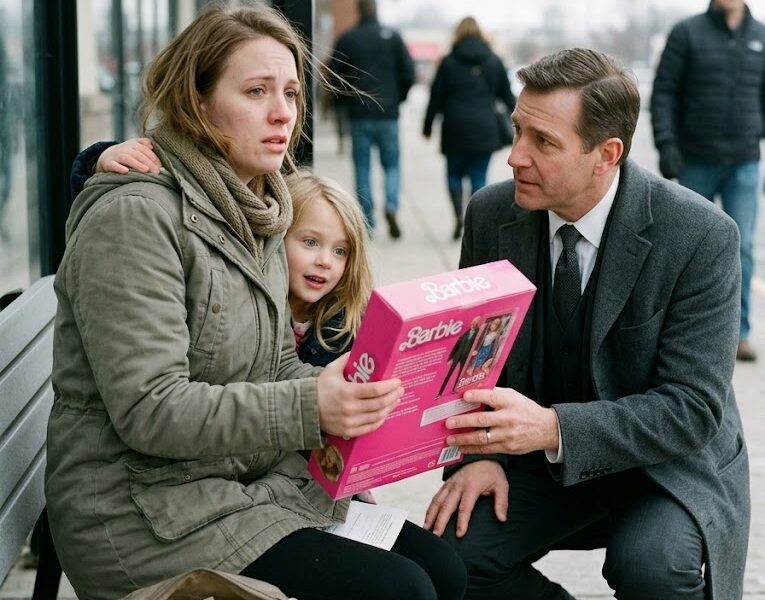
SHE TOLD HER DAUGHTER SHE COULDN’T AFFORD A BIRTHDAY DOLL—THEN THE STRANGER BEHIND THEM SAID FOUR WORDS THAT CHANGED EVERYTHING
Harper Bennett had eight dollars in her wallet when her six-year-old daughter asked for the one thing she had been talking about for three months.
Eight dollars, a past-due rent notice folded beneath the grocery list, and twenty-three cents in loose change rattling at the bottom of her purse.
That was everything.
The Barbie in the store window cost thirty-nine ninety-nine.
Harper knew because she had checked the tag four times.
She kept hoping she had read it wrong.
She hadn’t.
The Saturday morning air in Columbus had the sharp, metallic cold that came before the first real freeze of November. People hurried along Easton Town Center carrying coffee cups and glossy shopping bags, their scarves pulled high around their faces. Holiday music drifted through hidden outdoor speakers even though Thanksgiving was still weeks away.
To Mia, the whole place looked magical.
To Harper, it looked expensive.
“Mommy.”
Harper pretended not to hear.
She knelt beside the toy store window and tightened the loose lace on Mia’s sneaker, though the lace was already tied.
“Mommy, look.”
“I’m looking, baby.”
“No. Really look.”
Harper raised her eyes.
Behind the glass stood a row of dolls in bright pink boxes beneath warm white lights. There were princesses, veterinarians, astronauts and fashion dolls wearing tiny sequined dresses. In the center of the display was the one Mia had been pointing out every time they passed the store after taking the bus home from the public library.
A birthday-edition Barbie in a shimmering rose-colored gown.
Mia pressed one palm to the glass.
Her faded blue dress hung a little too loosely from her shoulders. Harper had found it at a church clothing exchange two months earlier. The hem had been carefully repaired twice, once by the previous owner and once by Harper after Mia caught it on a playground fence.
“Her dress sparkles when the light moves,” Mia whispered.
“I know.”
“And she has the little brush.”
“I see it.”
“And the shoes.”
Harper smiled.
“Very fancy shoes.”
Mia grinned.
Then she looked up.
The grin softened.
Six-year-olds were supposed to believe their mothers could fix anything.
They were not supposed to notice overdue notices.
They were not supposed to understand why the refrigerator sounded louder when it was almost empty.
They were not supposed to know that their mother sometimes claimed she had already eaten because there was only enough macaroni for one bowl.
But children noticed things adults prayed they didn’t.
“Is my birthday still Tuesday?” Mia asked.
Harper’s throat tightened.
“Yes.”
“And I’ll still be six?”
“That’s usually how birthdays work.”
Mia giggled.
For one brief second, Harper could breathe.
Then Mia looked back at the doll.
“I know it’s a lot.”
The words struck harder than begging would have.
Harper stared at her daughter’s reflection in the glass.
“Who told you that?”
“Nobody.”
“Mia.”
Her daughter shrugged.
“I saw you looking at the sticker last time.”
Harper closed her eyes for half a second.
She wanted to lie.
She wanted to tell Mia the doll was already hidden somewhere in their apartment, wrapped in pink paper beside a cake with six candles.
She wanted to be the kind of mother who could say, Of course, sweetheart.
Instead, she had eight dollars.
And three of those dollars needed to buy milk.
Harper reached for Mia’s hand.
“Sweetheart…”
Mia’s fingers curled around hers.
Harper hated how small they felt.
“I can’t afford the Barbie this year.”
She tried to say it lightly.
Almost casually.
As if it were about weather.
As if the sentence did not feel like an admission of failure.
Mia looked at the doll for another second.
Then she nodded.
“Okay.”
That was worse.
No crying.
No argument.
Just okay.
Harper felt heat gather behind her eyes.
“Mia, I’m sorry.”
“It’s okay, Mommy.”
“We can still make pancakes Tuesday morning. The ones with chocolate chips.”
“If we have chocolate chips.”
Harper’s heart cracked a little more.
“We’ll have them.”
“And can we watch my movie?”
“Twice.”
“Three times?”
Harper managed a smile.
“Now you’re negotiating.”
Mia smiled back.
Then she leaned toward the window and whispered so softly Harper almost didn’t hear it.
“Maybe one day.”
Harper turned her face away.
Across the sidewalk, a man in a charcoal overcoat stopped walking.
He had been heading toward a black sedan parked at the curb.
Instead, he stood still.
Harper never noticed him.
She was too busy trying not to cry in front of her daughter.
The man noticed everything.
He noticed Harper’s torn coat cuff.
He noticed the way she kept her left hand closed around her purse as if losing it would be catastrophic.
He noticed Mia’s repaired dress.
And he noticed something else.
When the little girl accepted disappointment without complaint, Harper bent down, pulled her into her arms and said the words his own mother had once said to him.
“You’re still my princess. Doll or no doll.”
The man’s expression changed.
For a moment, the crowded shopping center disappeared.
He was no longer forty-three-year-old Cole Harrington, chief executive of Harrington Playworks, a national toy retailer with distribution centers in eleven states.
He was eight years old again.
Standing beside his mother outside a bookstore.
Wanting a science encyclopedia she could not afford.
His mother had cleaned offices at night in downtown Cleveland. She wore rubber gloves until her hands cracked in winter. She packed the same peanut butter sandwich for lunch four days in a row so Cole could eat the turkey she bought on Sundays.
That afternoon outside the bookstore, she had apologized for not buying the encyclopedia.
Cole remembered telling her he didn’t care.
He remembered caring very much.
He remembered hating himself for caring.
And he remembered what she had said.
“You are not what I can afford to buy you.”
He had carried that sentence his entire life.
Now another mother was kneeling beside another child, carrying the same shame.
Cole turned around.
Behind him, his executive assistant, Nathan Pierce, almost walked into his back.
“Everything okay?”
Cole looked toward Harper and Mia.
“No.”
Nathan followed his gaze.
He saw them.
Then he looked back at his boss.
Cole had spent the morning criticizing regional performance reports.
He had rejected a holiday expansion campaign.
He had taken two calls from board members, one from an investor and one from an attorney about a warehouse dispute.
Nothing in his expression suggested softness.
Until now.
Cole walked back toward the store.
“Give me five minutes.”
Nathan checked his watch.
“The distribution meeting starts in twenty.”
“They can start without me.”
Nathan blinked.
Cole Harrington did not say things like that.
Inside the store, Harper was guiding Mia toward the exit.
“Come on,” she said. “We’ll make pancakes at home.”
“With cinnamon?”
“If we have cinnamon.”
Mia gave her a suspicious look.
“You keep saying ‘if.’”
“That’s because you keep adding ingredients.”
They were almost outside when Cole approached the counter.
A young clerk named Jess recognized him immediately.
Her posture straightened.
“Mr. Harrington.”
Cole nodded toward the display.
“The birthday Barbie. Pink gown.”
“The display one?”
“Yes.”
Jess hesitated.
“It’s the last one. We sold out yesterday.”
“Perfect.”
She smiled uncertainly.
“I can check the stockroom just in case—”
“Pack that one.”
Cole placed his card on the counter.
Then he looked toward the front doors.
Harper and Mia were already outside.
“Hurry.”
Three minutes later, Harper was sitting on a cold concrete planter near the curb, pretending to search her purse.
She did not need anything from her purse.
She needed thirty seconds to collect herself before walking to the bus stop.
Mia swung her legs beneath the bench.
“I don’t need a present, Mommy.”
Harper froze.
Every parent knew there were sentences children should never have to say.
That was one of them.
“You deserve presents.”
“I have you.”
Harper looked down.
“Who taught you to talk like a greeting card?”
“My teacher says I’m emotionally advanced.”
Despite everything, Harper laughed.
Mia beamed.
Then her eyes moved past Harper’s shoulder.
A man was approaching them.
Tall.
Dark coat.
Expensive shoes.
In his hands was a bright pink box wrapped with a ribbon.
Harper immediately stood.
Years of surviving alone had sharpened her instincts around strangers.
She moved Mia behind her.
“Can I help you?”
The man stopped several feet away.
“Actually, I was hoping I could help you.”
Harper stiffened.
“No, thank you.”
He glanced at the box.
“You haven’t even heard what I was going to say.”
“I can guess.”
“I’m not sure you can.”
Mia peeked around her mother.
Her eyes went huge.
“Mommy.”
Harper didn’t look away from the stranger.
“Behind me, Mia.”
The man’s expression softened.
“I’m sorry. I didn’t mean to make you uncomfortable.”
“Then don’t.”
He nodded.
Fair enough.
“My name is Cole.”
“Okay.”
“I was inside the store.”
Harper’s jaw tightened.
“I heard what you said to your daughter.”
Embarrassment burned across her face.
“So you listened to a private conversation?”
“I overheard one.”
“There’s a difference?”
“There should be.”
Harper crossed her arms.
“I don’t want money.”
Cole looked at her for a moment.
“I wasn’t going to offer you money.”
He held out the box.
“I was going to offer her a birthday present.”
Harper stared at it.
The same Barbie.
The one from the window.
Mia made a small sound behind her.
Harper’s entire body went rigid.
“No.”
Cole lowered the box slightly.
“No?”
“We can’t take that.”
“Why?”
“Because we don’t know you.”
“That’s a reasonable objection.”
“And because I don’t accept expensive gifts from strangers.”
“Also reasonable.”
“And because I don’t want my daughter learning that if she looks sad long enough, some man with money will buy her things.”
That surprised him.
Harper noticed.
“Goodbye.”
She reached for Mia.
Cole spoke before they could walk away.
“My mother cleaned offices.”
Harper stopped.
Cole’s voice had changed.
Not louder.
Quieter.
“When I was a kid, there was a book I wanted. She couldn’t afford it. I remember watching her apologize like she had done something wrong.”
Harper turned slowly.
Cole looked down at the doll.
“I wish someone had told her she didn’t have to be ashamed.”
Harper said nothing.
“I’m not giving this to your daughter because she looked sad,” he continued. “I’m giving it to her because I heard you tell her she was still your princess without it.”
Mia peeked around Harper again.
Cole crouched until he was closer to the child’s height.
“But it’s completely up to your mom.”
He held the box toward Harper rather than Mia.
That mattered.
More than he probably realized.
Harper swallowed.
“I can’t repay you.”
“I didn’t ask you to.”
“I don’t want charity.”
Cole stood.
“Then don’t call it charity.”
“What would you call it?”
He thought for a moment.
“One parent remembering another parent.”
Harper’s eyes narrowed.
“You have children?”
There was the smallest pause.
“Yes.”
Something in his face changed.
Pain, perhaps.
But it vanished quickly.
Harper noticed anyway.
Cole extended the box again.
“Please.”
Mia whispered, “Mommy, it’s okay if you say no.”
Harper nearly lost control then.
Not because Mia wanted the doll.
Because her daughter was trying to protect her pride.
Harper closed her eyes.
Then she nodded.
“Okay.”
Mia’s hands flew over her mouth.
Harper took the box first.
“Thank you.”
Cole smiled.
“You’re welcome.”
Only then did Harper hand it to her daughter.
Mia stared at the box like someone had given her a piece of the moon.
Her fingers traced the plastic window.
“She has freckles.”
Cole glanced at the doll.
“So do you.”
Mia touched her own nose.
“I have more.”
“That means you win.”
Mia laughed.
The sound hit Harper harder than she expected.
For weeks, she had heard her daughter laugh less.
Not dramatically.
Just less.
Fewer spontaneous giggles.
Fewer silly songs at breakfast.
Fewer requests that required money.
Children adapted.
That was the terrifying part.
Mia hugged the box to her chest.
“Thank you, Mr. Cole.”
“You’re very welcome, Mia.”
Harper looked sharply at him.
“I never told you her name.”
Mia pointed at her own backpack.
A laminated school tag hung from the zipper.
MIA BENNETT.
Harper exhaled.
Cole smiled slightly.
“Still suspicious?”
“I’ve had reasons to be.”
“Good.”
That answer caught her off guard.
Cole looked toward the waiting car.
Nathan stood beside it pretending not to stare.
Cole reached into his coat pocket.
Harper immediately shook her head.
“No.”
“It’s not money.”
He pulled out a business card.
She did not take it.
“Harrington Playworks has a seasonal distribution facility on Westbelt Drive,” he said. “They’re hiring.”
Harper stared at him.
“For what?”
“Inventory, packaging, fulfillment. Some office support.”
“I don’t have warehouse experience.”
“Have you worked before?”
“Yes.”
“Then you have some kind of experience.”
“I was a café supervisor until May.”
Cole glanced at the card.
“Take it.”
Harper still hesitated.
“There’s a hiring manager named Denise Alvarez. Tell her Cole told you to apply.”
Harper almost laughed.
“Just Cole?”
“Just Cole.”
“Are you the owner or something?”
For the first time that morning, Nathan coughed loudly near the car.
Cole gave him a look.
Nathan became very interested in the pavement.
Cole returned his attention to Harper.
“Something like that.”
Harper finally took the card.
His name was printed beneath a small silver logo.
COLE HARRINGTON.
No title.
Just a direct phone number and company email.
She slipped it into her purse without examining the logo closely.
“I’m not promising anything.”
“I didn’t ask you to.”
Harper nodded.
“Thank you. For the doll.”
Cole looked at Mia.
“Happy birthday.”
Then he walked away.
Mia watched him enter the sleek black sedan.
“Mommy?”
“Yes?”
“Is he a secret prince?”
Harper laughed.
“No.”
“How do you know?”
“Princes don’t wear boring gray ties.”
Mia considered this carefully.
“Maybe he was undercover.”
Harper took her hand.
“Come on, detective.”
They walked toward the bus stop carrying a forty-dollar doll Harper could not have bought if she had emptied every pocket she owned.
But what Harper kept thinking about was not the doll.
It was the card in her purse.
Something like that.
She did not yet understand that the stranger had understated the truth by several billion dollars.
Their apartment sat on the second floor of an aging brick building on the east side.
The hallway smelled faintly of radiator heat, laundry detergent and the downstairs neighbor’s garlic-heavy cooking.
When Harper opened the door, Mia raced inside.
“I’m putting her at my seat!”
“Shoes first.”
Mia froze.
Slowly backed up.
Kicked off her sneakers.
Then sprinted toward the kitchen.
Harper leaned against the door after locking it.
Silence.
Not actual silence.
Their refrigerator hummed.
Pipes rattled somewhere in the wall.
Mia was already talking to her Barbie about pancakes.
But inside Harper there was a silence she had not felt in months.
Relief.
Dangerous, fragile relief.
She pulled the overdue-rent notice from her purse.
FINAL REMINDER.
$1,184.
She had eleven days.
Her next cleaning shift would pay eighty dollars.
Laundry folding for Mrs. Kowalski would earn twenty-five.
If the church pantry helped with groceries, maybe she could save another forty.
It would not be enough.
Harper had done the math so many times she could calculate the deficit while half asleep.
She sank into the chair opposite Mia.
Her daughter had freed the Barbie from the box and was brushing her hair carefully.
“Don’t lose the shoes,” Harper said automatically.
“I put them in the cup.”
Mia pointed toward a chipped coffee mug.
Harper smiled.
“Good thinking.”
Mia looked at her.
“Are you sad?”
“No.”
“That was too fast.”
Harper raised an eyebrow.
“Excuse me?”
“When grown-ups say no really fast, it means yes.”
Harper stared at her six-year-old.
“I am raising a dangerous person.”
Mia giggled.
Then she grew serious.
“Is it because of the money paper?”
Harper stopped breathing.
“What money paper?”
“The one you hide under the fruit bowl.”
Harper glanced toward the counter.
She had moved the notice twice.
Mia continued brushing the doll.
“I can give the Barbie back.”
Harper stood so quickly the chair legs scraped the floor.
“No.”
Mia looked startled.
Harper crossed the room, crouched beside her and took both of her hands.
“No, baby. Listen to me. That doll is yours.”
“But we need money.”
“That is my job to figure out.”
“I can help.”
“You help by being six.”
Mia’s face crumpled slightly.
Harper softened.
“Hey.”
She brushed hair from her daughter’s forehead.
“You are not responsible for rent. You are not responsible for groceries. You are not responsible for fixing things adults are supposed to fix.”
“But Daddy left.”
The words landed quietly.
That was how pain entered their home now.
Not screaming.
Not dramatic.
Just a child mentioning the absence everyone had learned to live around.
“Yes,” Harper said.
Mia looked down.
“Did he leave because we cost too much?”
Harper felt something inside her break open.
“No.”
She said it so firmly that Mia looked up.
“No, sweetheart. Your father leaving had nothing to do with you.”
“Or you?”
Harper hesitated.
Children noticed hesitation too.
“Your father made choices because of who he was at that time. Not because of what you were worth.”
Mia’s eyes filled.
Harper pulled her close.
“You are not expensive. You are not a burden. You are not a problem anyone has to solve.”
Mia pressed her face into Harper’s neck.
“Okay.”
Harper held her tightly.
Over Mia’s shoulder, she saw the business card on the table.
COLE HARRINGTON.
HARRINGTON PLAYWORKS.
Something in her memory shifted.
She had seen that name before.
Not on a storefront.
On television.
On the financial news playing silently above the bar at the café.
She picked up the card later that evening after Mia fell asleep.
Then she searched his name on her old phone.
The first result made her sit straighter.
COLE HARRINGTON, CEO OF HARRINGTON PLAYWORKS.
The second article called him one of the most influential retail executives in the Midwest.
Another showed him standing beside a governor at the opening of a distribution center.
Another estimated his company’s annual revenue in the billions.
Harper stared at the photograph.
Same gray eyes.
Same charcoal coat.
Same boring tie.
“Oh, my God.”
Mia murmured from the couch.
Harper lowered the phone.
Her daughter had fallen asleep hugging the Barbie.
Cole Harrington had not been “something like” an owner.
He was the owner’s grandson, current CEO and public face of the entire corporation.
And he had personally told her to apply.
Harper looked back at the overdue notice.
For the first time, hope appeared.
And Harper did not trust it.
Hope had betrayed her before.
When Mia was born, Harper had believed her husband, Jordan, when he promised he would stop drinking.
She believed him when he promised he would keep the construction job.
She believed him when he said the missing savings were a banking mistake.
She believed him when he kissed Mia’s forehead and said he would be back from the store in twenty minutes.
He returned six years later only through a letter from an attorney requesting reduced child-support obligations.
Harper had learned something from that.
A person could survive disappointment.
Hope was more dangerous.
Because hope convinced you to stand up before life knocked you down again.
She opened Cole’s card.
Her thumb hovered over his number.
She almost threw it away.
Instead, she placed it beneath the rent notice.
Tuesday morning, Mia turned six.
Harper woke at 5:18 a.m.
She opened the kitchen cabinet.
No chocolate chips.
She had promised.
Harper checked her wallet.
Eight dollars had become six dollars and twelve cents after buying milk.
She stood in the tiny kitchen wearing pajama pants and stared at the six dollars.
Then she put on her coat.
The convenience store two blocks away sold small bags of chocolate chips for $3.29.
Harper bought one.
On the way home, she passed a woman sleeping beneath a bus shelter wrapped in two thin blankets.
Harper stopped.
She looked at the change in her palm.
Two dollars and some coins.
She bought a coffee from the machine inside the store.
Then she gave it to the woman.
By the time Harper reached home, her fingers were numb.
She didn’t regret it.
Mia woke to chocolate-chip pancakes shaped like imperfect hearts, one candle stuck in the tallest stack and her Barbie sitting in the empty chair beside her.
“Happy birthday, baby.”
Mia’s face lit up.
“Did Barbie help cook?”
“Barbie contributed nothing.”
“She doesn’t know how.”
“She could at least wash dishes.”
Mia laughed so hard she almost knocked over the syrup.
For fifteen minutes, they were not poor.
They were not behind on rent.
They were not abandoned.
They were simply a mother and daughter eating pancakes in a warm kitchen while morning light slowly brightened the windows.
Then Harper’s phone rang.
Unknown number.
She almost ignored it.
“Hello?”
“Harper Bennett?”
“Yes.”
“This is Rachel from NorthStar Collections.”
Her stomach dropped.
Mia kept eating.
Harper stood.
She walked into the bedroom.
“I already told your company I’m between jobs.”
“The account has advanced to final review.”
“It’s a medical bill.”
“That does not alter the account status.”
“My daughter had pneumonia.”
“I understand.”
No, you don’t, Harper thought.
“I can pay twenty dollars next Friday.”
“The minimum required payment is one hundred fifty.”
“I don’t have that.”
There was a pause.
Then the woman’s voice became softer.
“Ms. Bennett, I’m going to note what you offered. But I need to tell you the system may move the account automatically.”
“To what?”
“Legal collections.”
Harper leaned against the wall.
“How much time?”
“I can’t guarantee anything.”
The call ended.
Harper stood there with the phone against her chest.
From the kitchen, Mia called, “Mommy, the syrup is making a lake!”
Harper closed her eyes.
Then she returned smiling.
By noon, she had made a decision.
She would go to the warehouse.
Not because she believed Cole Harrington had changed her life.
Because she was out of options.
The Harrington Playworks distribution center on Westbelt Drive was larger than Harper expected.
It looked less like a warehouse than an airport terminal built entirely for cardboard boxes.
Trucks moved through security gates.
Employees in orange vests crossed marked lanes.
A giant silver H logo covered one side of the building.
Harper almost turned around.
She had worn her nicest blouse.
It had a faint bleach mark near the cuff.
She had printed her résumé at the library.
One page.
Café work.
Housecleaning.
Two years of community college she never finished.
No warehouse experience.
No corporate references.
Nothing that looked like it belonged in a place this enormous.
Mia was at school.
Harper had exactly three hours before pickup.
She forced herself through the employee entrance.
A security guard looked up.
“Can I help you?”
“I’m here about a job.”
“Applications are online.”
“I know.”
She swallowed.
“A man told me to ask for Denise Alvarez.”
The guard gestured toward a tablet.
“Name?”
“Harper Bennett.”
He typed.
Then stopped.
His eyes moved from the screen to Harper.
“Wait here.”
Harper’s stomach tightened.
“What?”
“One second.”
He picked up the phone.
“Denise? Yeah. Harper Bennett is here.”
Silence.
The guard’s expression changed.
He covered the receiver.
“She’s coming down.”
Harper stared at him.
“Why?”
He smiled.
“I guess she knows who you are.”
Harper’s heart began beating too fast.
Denise Alvarez appeared four minutes later.
She was in her late forties, wearing black slacks, comfortable shoes and an employee badge clipped to a red sweater.
“You’re Harper?”
“Yes.”
Denise extended her hand.
“I’m Denise.”
“Thank you for seeing me.”
“Cole said you might come.”
Harper’s cheeks warmed.
“He talked about me?”
“Only professionally.”
Harper almost laughed.
“I don’t think he knows anything professional about me.”
Denise smiled.
“He said, and I’m quoting, ‘There’s a woman named Harper Bennett who may apply. Interview her seriously. Do not hire her because I said her name.’”
Harper blinked.
Denise continued.
“He was very specific about the second sentence.”
Something in Harper relaxed.
“So this isn’t a fake job.”
Denise’s eyebrows rose.
“You thought it might be?”
“I thought maybe the CEO gave a poor woman a business card because it made him feel better.”
Denise laughed.
“That does sound cynical.”
“It’s been a cynical year.”
“Fair.”
She motioned toward a hallway.
“Come on.”
The interview lasted forty minutes.
Denise did not ask Harper whether she needed the job.
She asked whether Harper had handled cash discrepancies at the café.
Yes.
Whether she had ever trained employees.
Six.
Whether she understood inventory counts.
Basic ones.
Whether she could work early mornings.
Yes, after arranging school drop-off.
Whether she was comfortable learning digital order systems.
Harper said she was comfortable learning anything someone would teach her.
Denise wrote that down.
At the end, Harper folded her hands in her lap.
“I know Mr. Harrington said not to hire me because of him.”
“He did.”
“So I’m asking you not to.”
Denise looked up.
Harper continued.
“If I’m not qualified, tell me.”
Denise studied her.
“You think accepting help means you didn’t earn what comes after it?”
Harper looked away.
“I think people talk.”
“People always talk.”
“I don’t want to walk in here every day wondering whether everyone thinks I got hired because a billionaire saw my kid looking at a doll.”
Denise leaned back.
“Can I tell you something?”
Harper nodded.
“We processed 18,000 orders yesterday.”
She gestured toward the warehouse behind the glass wall.
“Do you think I can afford to hire someone who can’t work because the CEO had an emotional Saturday?”
Harper almost smiled.
“No.”
“No.”
Denise closed the folder.
“You have customer-service experience, cash-control experience, scheduling experience and supervisory experience. You’re overqualified for seasonal packing.”
Harper blinked.
“Overqualified?”
“I want to put you in inventory support.”
“I don’t know inventory systems.”
“We train.”
“How much?”
Denise named an hourly wage.
Harper stared at her.
It was nearly five dollars more per hour than she had made at the café.
“With overtime during the holidays.”
Harper’s voice came out too quietly.
“When would I start?”
“Monday.”
Harper sat frozen.
Denise smiled.
“Is that a yes?”
Harper tried to answer.
Instead, tears filled her eyes.
She looked down quickly.
“I’m sorry.”
“Don’t apologize.”
“It’s embarrassing.”
“No. Crying during an interview after being rejected would be embarrassing. You got the job.”
Harper laughed through the tears.
Denise pushed a box of tissues toward her.
Harper took one.
“I haven’t paid my rent yet.”
Denise’s smile faded slightly.
“You need an advance?”
Harper stiffened.
“No.”
“I wasn’t offering charity.”
The phrase hit Harper.
Denise noticed.
“What?”
“Nothing.”
Harper wiped her eyes.
“I’ve just heard that before.”
On Monday, Harper started work at 6:30 a.m.
She nearly quit by 9:15.
The inventory system looked like another language.
SKU numbers blurred together.
RF scanners beeped constantly.
Conveyor belts moved boxes faster than she could process them.
Her trainer, Devon, was twenty-four and spoke in abbreviations.
“Pull the RT discrepancy, verify the ASN, check the pallet count and flag the variance.”
Harper stared at him.
“I understood ‘pallet.’”
Devon laughed.
“That’s enough for day one.”
At 10:40, Harper entered the wrong code and temporarily froze a shipment heading to Indianapolis.
At 11:05, she spilled coffee on her own notebook.
At noon, she ate the peanut butter sandwich she had packed while pretending she wasn’t exhausted.
Across the cafeteria, two women whispered.
One looked at Harper.
Then both looked away.
Her stomach tightened.
There it was.
People talking.
A few minutes later, one of the women approached.
“You’re Harper, right?”
“Yes.”
“I’m Gina.”
Harper waited.
Gina smiled.
“My cousin worked at the café on Broad Street. She said you used to give employees your shifts if their kids were sick.”
Harper blinked.
“Sometimes.”
“She said you were a good boss.”
Harper felt ridiculous for immediately assuming the worst.
“Thank you.”
Gina nodded toward the empty seat.
“Mind if I sit?”
“No.”
The second woman joined them.
By Friday, Harper could process basic discrepancies without Devon hovering.
By the second week, she understood why two recurring count errors were appearing in aisle G-14.
By the third, she caught a vendor labeling problem that had caused almost twelve thousand dollars in shipment delays.
Denise called her into the office.
Harper entered expecting bad news.
Years of instability had conditioned her to interpret closed doors that way.
Denise turned her monitor.
“You found this?”
Harper looked at the spreadsheet.
“The duplicated vendor codes?”
“Yes.”
“I think so.”
“You saved us a very ugly week.”
Harper smiled cautiously.
“So I’m not fired?”
Denise stared at her.
“Why would you be fired?”
“You called me into an office.”
Denise laughed.
“We need to work on your trauma response.”
Harper laughed too.
But later, walking back onto the warehouse floor, the words stayed with her.
Trauma response.
She had spent years calling it responsibility.
Checking the account balance three times.
Keeping canned food hidden for emergencies.
Sleeping lightly because Jordan sometimes came home drunk.
Saving every receipt.
Never assuming a job would last.
Never believing anyone who said, Trust me.
Harper thought survival had made her stronger.
Maybe it had.
But survival had also taught her to treat good news like a trap.
That evening, she picked Mia up from after-school care.
Mia ran toward her holding a drawing.
“Mommy!”
Harper bent.
“What is this?”
“Our family.”
There were two stick figures.
One with brown hair labeled MOM.
One smaller one labeled MIA.
Beside them stood Barbie.
Harper smiled.
“Barbie lives with us now?”
“She pays no rent.”
“That’s becoming a pattern.”
Mia pointed to another figure in the corner.
Tall.
Black suit.
Gray scribble for a tie.
Harper’s smile faded.
“Who’s that?”
“Mr. Cole.”
“Why is Mr. Cole in our family picture?”
“He gave us the Barbie.”
“That doesn’t make someone family.”
Mia thought.
“He gave you the job.”
“No. He gave me a chance to interview.”
“Same thing.”
“Not the same thing.”
Mia looked up.
“Do you like him?”
Harper almost choked.
“He’s a man I met one time.”
“He was nice.”
“Yes.”
“And tall.”
“What does that have to do with anything?”
“My teacher says details make stories better.”
Harper laughed despite herself.
“Your teacher is causing problems.”
Mia tucked the drawing into Harper’s bag.
“Can Mr. Cole come to Christmas?”
“No.”
“You answered too fast.”
“Mia.”
Her daughter grinned.
Cole Harrington did not think about Harper every day.
At least that was what he told himself.
He had a company to run.
Eight thousand employees.
Holiday forecasts.
A board preparing for an acquisition.
A teenage daughter who currently spoke to him mostly through one-word texts.
His life had enough complications.
Still, every Monday morning, Cole received a workforce update.
He had never cared about individual seasonal hires before.
Now his eyes occasionally stopped at one name.
BENNETT, HARPER — INVENTORY SUPPORT.
He hated that he noticed.
Not because there was anything wrong with caring.
Because Cole had built his adult life by compartmentalizing.
Work belonged in one box.
Family belonged in another.
Regret lived in a third box that he tried never to open.
Harper had somehow touched all three.
Nathan noticed.
Of course Nathan noticed.
They were in a conference room reviewing holiday capacity when Nathan slid a tablet across the table.
“Westbelt reduced discrepancy losses six percent this month.”
Cole scanned the chart.
“Good.”
“Partly because someone caught a vendor-code issue.”
Cole kept his expression neutral.
“Who?”
Nathan smiled.
Cole looked up.
“What?”
“You already know.”
“I asked who.”
“Harper Bennett.”
Cole stared at the screen.
Then nodded.
“Good.”
Nathan waited.
Cole looked at him.
“Anything else?”
“No.”
“Then stop looking at me like that.”
“Like what?”
“Like you have a thought.”
“I almost always have thoughts.”
“Try fewer.”
Nathan gathered the papers.
At the door, he stopped.
“You know she earned the job.”
“I know.”
“So why do you look guilty every time her name comes up?”
Cole’s expression hardened.
Nathan raised both hands.
“Never mind.”
But Cole knew why.
Because kindness was simple when it remained one moment.
A doll.
A card.
A door opened.
Then both people moved on.
It became complicated when he started caring what happened after.
December came with freezing rain and longer shifts.
Harper worked overtime whenever she could.
Her first paycheck covered groceries, electricity and part of the rent.
Her second paycheck brought the rent current.
The moment she pressed the online payment button, Harper stared at the confirmation screen until the numbers blurred.
BALANCE DUE: $0.00.
She screenshotted it.
Then she printed it at the library.
That night she taped it inside the kitchen cabinet.
Mia found it.
“What’s that?”
Harper looked at the page.
“A trophy.”
“It looks like numbers.”
“Some trophies do.”
For Christmas, Harper did something she had not done in years.
She bought Mia a present without checking her bank account first.
Not an expensive one.
A purple art set with markers, colored pencils and watercolor paints.
Twenty-two dollars.
Harper stood in the aisle holding it and waited for guilt.
It came.
Then she bought it anyway.
Christmas Eve at the warehouse was strangely festive.
Someone played music near the loading stations.
Employees wore Santa hats over safety helmets.
Denise ordered pizza.
At 2:00 p.m., an announcement crackled over the speakers.
“Good afternoon, Westbelt team. Please gather in your department meeting zones at two-fifteen.”
Harper looked at Gina.
“What’s happening?”
“Probably numbers.”
“On Christmas Eve?”
“Corporate people think spreadsheets are decorations.”
At 2:15, employees gathered near the central floor.
Harper stood in the back.
Then Cole Harrington walked onto the raised platform.
Her stomach flipped.
She had not seen him since the toy store.
He wore no overcoat now.
Just dark trousers, a white shirt with the sleeves rolled to his forearms and the same kind of understated tie Mia had once called boring.
People applauded.
Harper understood something immediately.
He was different here.
At the store, he had seemed like a wealthy stranger trying carefully not to embarrass her.
Here, thousands of square feet of machinery and people seemed to respond to his presence.
Managers straightened.
Supervisors stopped talking.
Employees pulled out phones.
Cole took the microphone.
“I’ll be brief.”
Someone laughed.
Cole smiled.
“I heard that.”
More laughter.
Harper watched him thank employees for record holiday volume.
He mentioned safety.
He mentioned families.
He announced paid closing hours for Christmas Day and additional bonuses for hourly workers who had covered emergency shifts.
The warehouse erupted.
Harper clapped with everyone else.
Then Cole said something she did not expect.
“Companies like ours talk too much about leadership from the top.”
The room quieted.
“But the people who keep this place moving are not standing where I’m standing.”
His gaze moved across the crowd.
“It’s the employee who notices the wrong code before twelve thousand dollars in orders disappear into a bad system.”
Harper froze.
Gina elbowed her.
“Girl.”
Cole continued.
“It’s the person who stays thirty minutes to help a new hire. The supervisor who knows which employee needs a schedule change because their kid is sick. The driver who refuses to rush when the roads are dangerous.”
Harper looked down.
Cole never said her name.
She was grateful.
He understood.
After the speech, Harper slipped toward the lockers.
She almost made it.
“Harper.”
She stopped.
Cole stood twenty feet away.
Nathan was beside him.
Several employees turned.
Harper resisted the instinct to flee.
Cole approached.
“Congratulations.”
“For what?”
“I heard you’re doing well.”
“I heard you heard.”
He smiled.
“Denise talks.”
“She’s terrifying.”
“Yes.”
Harper studied him.
“You didn’t tell anyone about the store.”
“No.”
“Thank you.”
“For keeping a private moment private?”
“Yes.”
“That shouldn’t require thanks.”
Harper looked toward the busy warehouse.
“I thought this job was going to be a favor.”
“And?”
“It wasn’t.”
Cole nodded.
“Good.”
“I almost didn’t come.”
“I figured.”
“How?”
“You looked at my business card like it might explode.”
Harper laughed.
A silence settled between them.
Not awkward.
Just unfamiliar.
Cole glanced toward the lockers.
“Heading home?”
“Eventually. Mia and I have a very serious Christmas Eve plan.”
“Cookies?”
“Frozen pizza and The Polar Express.”
“Ambitious.”
“What about you?”
The question slipped out before she could stop it.
Something changed in his face.
“My daughter is with her mother tonight.”
Harper remembered his pause when she had asked whether he had children.
“Divorced?”
“Seven years.”
“I’m sorry.”
“Don’t be. We’re better parents apart than we were spouses together.”
Harper nodded.
“That can happen.”
Cole looked at her.
“You?”
“Different story.”
He waited.
She appreciated that he didn’t ask.
“My husband left when Mia was eight months old.”
Cole’s expression tightened.
“Left?”
“As in walked out.”
“I’m sorry.”
Harper shrugged.
It was the gesture she used when the truth mattered too much.
“He sends legal letters occasionally. Apparently abandonment is easier if an attorney handles the stationery.”
Cole almost smiled but decided against it.
“Is Mia okay?”
“She doesn’t remember him.”
“That doesn’t always mean okay.”
Harper looked at him sharply.
Cole’s gaze shifted away.
“My daughter remembers everything.”
There was a story there.
A painful one.
Before Harper could ask, Denise called her name.
She turned.
When she looked back, Cole was already stepping away.
“Merry Christmas, Harper.”
“Merry Christmas, Cole.”
That night, Mia placed her Barbie beside the tiny artificial Christmas tree someone at church had given them.
“Do you think Mr. Cole has a tree?”
Harper looked over.
“Yes.”
“A big one?”
“Probably.”
“Like twelve feet?”
“Probably twelve trees.”
Mia’s eyes widened.
“Rich people have twelve Christmas trees?”
“I have no idea.”
Mia hugged Barbie.
“Do you think he’s lonely?”
Harper stopped folding wrapping paper.
Children saw things adults disguised with money.
“Why would you ask that?”
“When people are happy, they smile with their eyes.”
Harper looked at her daughter.
“And?”
“Mr. Cole smiles with his mouth.”
Harper sat back.
For the rest of the night, she could not stop thinking about it.
January brought layoffs.
Seasonal employees expected them.
Harper expected them more than anyone.
On the first Monday after New Year’s, Denise called her into the office.
Harper’s body reacted before her brain did.
Her hands went cold.
Her stomach tightened.
She sat across from Denise.
“You’re making the office face again.”
“What office face?”
“The one where you look like I’m about to ruin your life.”
Harper forced herself to breathe.
“Sorry.”
“I have bad news.”
Harper’s heart stopped.
Denise leaned forward.
“You’re no longer seasonal.”
Harper stared.
“What?”
“We’re offering you a permanent inventory-control position.”
Harper did not move.
“Permanent?”
“Benefits start after thirty days.”
Harper’s eyes widened.
“Health insurance?”
“Yes.”
“For Mia?”
“Yes.”
Harper covered her mouth.
Denise smiled.
“Retirement match too, but I can tell insurance is the sentence that got you.”
Harper nodded.
Her daughter’s pneumonia bill.
Dental cleanings they had postponed.
The inhaler Harper had stretched two months longer than the pediatrician recommended.
“You earned this,” Denise said.
Harper looked at her.
“Are you sure?”
“Yes.”
“Cole didn’t—”
“Stop.”
Harper closed her mouth.
Denise pointed a pen at her.
“Cole did not tell me to promote you. Cole has never asked about your performance directly. And if he had, I would have told him to stay in his lane.”
Harper smiled.
“You’d tell the CEO that?”
“I have.”
Harper laughed.
Then cried.
Again.
Denise handed her the familiar tissue box.
“I’m going to start charging you for these.”
Harper accepted the permanent position.
Three weeks later, someone knocked on her apartment door at 8:47 p.m.
Harper was helping Mia with spelling words.
She looked toward the door.
Nobody visited without texting.
Another knock.
Harper stood.
“Stay here.”
“Why?”
“Because I said so.”
She checked the peephole.
Her blood went cold.
Jordan.
For a moment, Harper was thirty years old again, holding an eight-month-old baby while her husband packed a duffel bag and said he needed space.
She had imagined his return a thousand times.
In some versions she screamed.
In others she slapped him.
In others she calmly shut the door.
Reality was different.
Her knees nearly buckled.
He knocked again.
“Harper?”
Mia looked up from the table.
“Who is it?”
Harper couldn’t answer.
“Harper, I know you’re in there.”
She opened the door but kept the chain secured.
Jordan Bennett stood in the hallway.
Older.
Heavier around the face.
His hair shorter.
His jacket looked expensive.
“Hi.”
Harper stared at him.
“What are you doing here?”
“I wanted to talk.”
“No.”
“Harper.”
“You can call my attorney.”
“You don’t have an attorney.”
“Then I’ll get one.”
He glanced through the opening.
“Is Mia here?”
Harper stepped sideways, blocking the view.
“Leave.”
“I drove three hours.”
“That sounds like a poor use of gasoline.”
“Can you not do this?”
Her hand tightened around the door.
“Do what?”
“Make everything hostile.”
Harper almost laughed.
“You disappeared.”
“I know.”
“You left me with a baby, six thousand dollars in debt and seventy-four dollars in the bank.”
“I know.”
“You changed your number.”
“I was messed up.”
“You missed six birthdays.”
“I said I know.”
Behind Harper, a small voice asked, “Mommy?”
Jordan froze.
Harper closed her eyes.
No.
Mia stepped into the hallway behind her.
Jordan looked through the gap.
His face changed.
“Oh, my God.”
Mia stared at him.
“Who are you?”
Jordan’s eyes filled.
Harper felt no satisfaction.
Only fear.
He crouched.
“Mia?”
Harper slammed the door.
She locked it.
Mia stood behind her.
“Mommy?”
Harper leaned against the door.
Her whole body shook.
“Who was that?”
Harper looked at her daughter.
There were moments parents knew would divide a child’s life into before and after.
This was one.
“That was your father.”
Mia stared at her.
Outside, Jordan knocked again.
And Harper realized the kindness that had begun changing their lives had not erased the past.
It had only made the past easier to find.
Jordan returned the next day with an attorney.
Not physically.
By email.
REQUEST FOR PARENTAL ACCESS.
Harper read the subject line in the warehouse bathroom and nearly dropped her phone.
He wanted visitation.
He claimed he had been sober for three years.
He had remarried.
He owned a home in Cincinnati.
He said he was ready to establish a relationship with his daughter.
Harper read the email six times.
Then she vomited.
For the next week, she barely slept.
Mia asked questions.
Why did Daddy leave?
Did he know where we were?
Does he love me?
Is he coming back?
Harper answered carefully.
Truthfully.
Without poisoning her daughter against a man who had done enough damage without Harper adding to it.
But privately, rage consumed her.
Jordan had missed pneumonia.
First steps.
First words.
Preschool.
Nightmares.
Christmas mornings.
Three apartments.
Two job losses.
A broken arm.
He had missed the afternoon Mia asked why other kids had dads at school pickup.
Now that Harper was stable, he had returned.
The timing felt obscene.
At work, she made mistakes.
Small ones.
Then bigger ones.
She entered a quantity incorrectly and delayed a truck.
Denise pulled her aside.
“What’s going on?”
“Nothing.”
“That answer is insulting.”
Harper looked away.
Denise waited.
Finally, Harper told her.
Not everything.
Enough.
Denise listened.
“You need time off.”
“I need money.”
“You have paid personal days.”
“I’m still new.”
“You’re human.”
Harper shook her head.
“If I stay home, I’ll think about it.”
“Then talk to someone.”
“Who?”
Denise hesitated.
“Employee assistance program includes legal consultation.”
Harper looked up.
“What?”
“Benefits.”
Harper had forgotten.
Within forty-eight hours, she was speaking to a family-law attorney.
Not because a billionaire intervened.
Not because someone rescued her.
Because she had a job with benefits she had earned after someone opened a door.
That distinction mattered to Harper.
Eventually, it would matter to Cole too.
They saw each other again in February.
Cole visited Westbelt for quarterly reviews.
Harper was leaving the building when she noticed him near the lobby.
He was arguing quietly on the phone.
“No, Claire. I’m not changing Saturday.”
Pause.
“That isn’t what we agreed.”
Another pause.
Cole rubbed his forehead.
“I understand she has plans. I’m her father.”
Harper tried to walk past unnoticed.
Cole saw her.
His expression changed.
“I’ll call you back.”
He ended the call.
“Harper.”
“Hi.”
“You look tired.”
She gave him a dry look.
“Rich people can say that?”
He smiled.
“Apparently not.”
“I’m fine.”
He studied her.
“You’re doing that thing.”
“What thing?”
“The thing where you say you’re fine while looking like you haven’t slept in six days.”
Harper looked away.
“Five.”
Cole waited.
She sighed.
“My husband came back.”
Cole’s face went still.
“The one who left?”
“Yes.”
“What does he want?”
“Our daughter.”
The last two words came out bitterly.
Cole noticed.
“He wants visitation?”
“Yes.”
“After six years?”
“Yes.”
Cole looked angry.
That surprised Harper.
Not performative outrage.
Personal anger.
“What are you going to do?”
“I have an attorney.”
“Good.”
“Through the employee plan.”
“Good.”
“And before you say anything, I’m handling it.”
Cole raised both hands slightly.
“I wasn’t going to interfere.”
Harper looked at him.
“Really?”
“Yes.”
“That’s growth.”
Cole laughed softly.
Then his expression turned serious.
“I know what it’s like to fight about a child.”
Harper remembered the phone call.
“Your daughter?”
“Emily.”
“How old?”
“Fifteen.”
“And things are difficult?”
“Things are teenage.”
“That bad?”
“Worse.”
Harper smiled.
Cole leaned against the lobby wall.
“After the divorce, I overcompensated.”
“With gifts?”
“With everything.”
“Did it work?”
“For about six months.”
“What happened?”
“She figured out expensive things weren’t the same as time.”
Harper looked at him.
The CEO who had bought Mia a doll seemed suddenly embarrassed by his own history.
“My ex-wife wasn’t wrong,” he continued. “I missed too much. Meetings. Dinners. School events. I kept telling myself I was building something for my family.”
“And?”
Cole looked through the glass doors toward the parking lot.
“One day I realized the company had become the family I was always present for.”
Harper said nothing.
Cole smiled without humor.
“Your daughter was right, by the way.”
Harper froze.
“How do you know what my daughter says?”
“I don’t.”
He frowned.
Harper relaxed.
“Nothing.”
Cole studied her suspiciously.
“Mia says you smile with your mouth.”
He stared.
“She said what?”
“She thinks your eyes look lonely.”
Cole was silent.
Then he laughed once.
“She’s terrifying.”
“I’ve been saying that.”
Cole looked down.
“Maybe she’s right.”
Harper saw it then.
Not wealth.
Not authority.
Not the man from magazine photographs.
A father who had spent years trying to buy back minutes that no longer existed.
“Kids don’t need perfection,” Harper said.
Cole looked at her.
“They need proof you keep showing up.”
He absorbed that.
“Is that what you’re going to tell Mia about her father?”
Harper’s smile disappeared.
“I don’t know.”
A car horn sounded outside.
Nathan was waiting.
Cole straightened.
“For what it’s worth, Harper…”
She waited.
“You don’t have to let guilt decide what’s best for your daughter.”
The sentence stayed with her.
Three months later, a judge granted Jordan gradual supervised visitation.
Harper hated it.
Her attorney told her it was reasonable.
Jordan had documented sobriety.
Stable employment.
No criminal record.
Regular child-support payments for the past four months.
The court did not punish parents forever for disappearing.
It focused on the child’s present interests.
Harper understood the law.
Understanding did not make it easier.
The first visitation occurred at a family-services center.
Mia wore her blue headband and carried her Barbie.
Harper sat in the car afterward, gripping the steering wheel.
“You don’t have to go in,” she said.
Mia looked at the building.
“Will you wait?”
“The whole time.”
“Promise?”
“Promise.”
Mia opened the door.
Then closed it again.
“What if he leaves?”
Harper’s heart twisted.
“Then you come back to me.”
“What if I like him?”
The question surprised her.
Harper turned.
“Then you like him.”
“You won’t be mad?”
“Never.”
“What if I don’t?”
“Then you don’t.”
Mia nodded.
She reached for the door again.
“Mommy?”
“Yes?”
“Can Barbie go?”
Harper smiled.
“I think Barbie has earned visitation rights.”
Mia carried the doll inside.
Harper sat in the parking lot for ninety minutes.
She did not cry.
Not until Mia returned holding a paper bag.
Jordan had brought her a stuffed rabbit.
Mia climbed into the car.
“How was it?”
“Okay.”
“Just okay?”
Mia shrugged.
“He cried.”
Harper looked forward.
“What did you do?”
“I gave him a tissue.”
Harper laughed through sudden tears.
Mia placed the stuffed rabbit beside Barbie.
“He said he’s sorry.”
Harper’s grip tightened on the wheel.
“What did you say?”
“I said he has to prove it.”
Harper turned slowly.
“Where did you learn that?”
Mia buckled her seat belt.
“You.”
Summer changed everything again.
Harper was promoted to inventory coordinator.
She moved out of the old apartment.
Not into luxury.
Into a cleaner two-bedroom unit with windows that sealed properly and a playground behind the building.
On the day they moved, Harper stood alone in the empty kitchen of the old apartment.
There was a pale square on the wall where the calendar had hung.
A scratch near the door from Mia’s stroller.
A chipped tile where Harper once dropped a jar of spaghetti sauce during an argument with Jordan.
She opened the cabinet.
The printed rent confirmation was still taped inside.
BALANCE DUE: $0.00.
Harper peeled it down.
She folded it carefully.
Then put it in her purse.
Some people kept photographs.
Harper kept evidence.
At the new apartment, Mia chose the bedroom facing the trees.
“Barbie gets the shelf.”
“Obviously.”
“And Mr. Rabbit.”
“The rabbit too.”
“Daddy’s coming Saturday.”
Harper paused.
Jordan had been consistent for five months.
He had never missed a visit.
He had not asked Harper to forgive him.
That helped.
He understood forgiveness was not his to request on a schedule.
“Yes,” Harper said.
Mia looked at her.
“You don’t hate him anymore.”
Harper leaned against the doorway.
“I don’t know what I feel.”
“That’s not an answer.”
“You’re seven. You don’t get to critique emotional complexity.”
Mia grinned.
“Ms. Porter says feelings can be mixed.”
“Ms. Porter talks too much.”
Mia laughed.
Harper smiled.
There were no miracles.
That was the truth of it.
Cole’s doll had not magically fixed their lives.
The business card had not erased debt.
The job had not erased abandonment.
Jordan’s return had not repaired six missing years.
But one act of kindness had interrupted the direction Harper’s life was moving.
That interruption created an opportunity.
Harper did the rest.
She showed up.
She learned.
She failed.
She tried again.
She defended her daughter.
She accepted help without surrendering her dignity.
And slowly, almost invisibly, survival stopped being the only thing she knew how to do.
In August, Harrington Playworks held its annual family picnic at a park outside Columbus.
Harper almost skipped it.
Mia insisted.
“Mr. Cole might be there.”
“He has eight thousand employees. I don’t think he’s waiting at a picnic for us.”
“He’ll remember me.”
“You’re very confident.”
“I have freckles.”
Apparently, freckles were unforgettable.
They arrived around noon.
Children ran between inflatable slides and face-painting tents.
Music played near a pavilion.
Employees wore company shirts instead of warehouse vests.
Harper saw Denise.
Gina.
Devon.
Then Mia grabbed her hand.
“Mommy.”
Across the grass, Cole stood beside a teenage girl.
The resemblance was obvious.
Same gray eyes.
Same reserved posture.
Emily Harrington looked uncomfortable in the way only teenagers forced into company events could look uncomfortable.
Cole noticed Harper.
He smiled.
This time, Mia would have approved.
His eyes smiled too.
“Mia.”
Cole crouched slightly as they approached.
“You got taller.”
“I’m seven.”
“That explains it.”
Mia held up the Barbie.
Harper stared.
“You brought the doll?”
“She wanted to meet him.”
Cole nodded seriously.
“I’ve been wondering how she’s doing.”
Mia lowered her voice.
“She lost a shoe.”
“Tragic.”
“But Mommy found it in the vacuum.”
Cole looked at Harper.
“Heroic.”
“Thank you.”
He gestured toward the teenager.
“This is my daughter, Emily.”
Emily offered a polite smile.
“Hi.”
Mia stared at her.
“You’re his daughter?”
Emily glanced at Cole.
“Unfortunately.”
Cole sighed.
“Teenager.”
Mia nodded sympathetically.
“I understand.”
Emily laughed.
Within twenty minutes, Mia had convinced Emily to accompany her to the face-painting station.
Harper and Cole watched them walk away.
“She likes you,” Harper said.
“Emily?”
“Mia.”
“Emily liking me would be more surprising.”
Harper smiled.
Cole looked at her.
“I heard about your promotion.”
“Denise talks.”
“Yes.”
“I also heard you tried asking Denise how I was doing.”
Cole looked offended.
“I asked how the inventory team was doing.”
“She said you asked one person’s name afterward.”
Cole sighed.
“I need to fire Denise.”
“She said you’d say that.”
They laughed.
For a while they stood quietly.
Then Cole asked, “How’s Mia’s father?”
Harper glanced toward her daughter.
“Showing up.”
Cole nodded.
“That’s something.”
“It is.”
“And you?”
“I’m learning not to wait for everything to collapse.”
Cole understood.
“I know that feeling.”
Harper looked at him.
“How’s Emily?”
His expression softened.
“Better.”
“You showing up?”
“More.”
“That’s something.”
He smiled.
“Yes.”
A gust of summer wind moved through the trees.
Children screamed happily near the inflatable slide.
Somewhere behind them, a manager called Cole’s name.
He ignored it.
Harper noticed.
“That sounds important.”
“It probably is.”
“You should go.”
Cole looked toward Emily.
His daughter was letting Mia paint a crooked pink heart on her cheek.
“No.”
Harper smiled.
“Growth.”
“Apparently.”
He stayed.
Not forever.
Another twenty minutes.
But for Cole Harrington, twenty minutes once would have belonged to a conference call.
Now they belonged to his daughter.
Sometimes change did not look dramatic.
Sometimes it looked like a man not answering his phone.
In October, nearly one year after the morning at the toy-store window, Harper took Mia back to Easton Town Center.
The air was chilly again.
Holiday decorations had started appearing.
They stopped in front of the same store.
The display had changed.
New dolls.
New colors.
New promises.
Mia pressed her hand against the glass.
Harper watched her reflection.
The little blue dress was gone.
Mia wore jeans, red sneakers and a yellow coat Harper had bought new.
Not secondhand.
New.
It still felt strange.
Mia pointed at a doll.
“She’s pretty.”
“Yes.”
“I don’t need her.”
“I didn’t ask.”
“I’m just saying.”
Harper smiled.
Then she noticed another mother standing a few feet away.
Young.
Maybe twenty-five.
Two children.
The younger boy was crying quietly over a toy truck.
The mother looked exhausted.
Embarrassed.
Harper heard her whisper, “Baby, I’m sorry. Maybe after payday.”
Harper stopped.
For one impossible second, time folded.
She saw herself.
Torn cuff.
Eight dollars.
Mia whispering, Maybe one day.
Harper reached into her purse.
She had money now.
Not much.
Enough.
She walked into the store.
Mia followed.
“What are we doing?”
Harper looked at her daughter.
“What do you think?”
Mia’s eyes widened.
“We’re going to be secret princes?”
Harper laughed.
“Something like that.”
They bought the truck.
The mother initially refused.
Of course she did.
Harper understood.
So she didn’t say, I know you can’t afford it.
She didn’t say, I was once like you.
She didn’t turn the woman’s difficult moment into a story about Harper’s generosity.
She simply held out the bag.
“My daughter and I are celebrating something today.”
The woman looked confused.
“What?”
“A year ago, a stranger was kind to us.”
Harper smiled.
“We’re returning it.”
The mother’s eyes filled.
“I can’t pay you.”
Harper looked at Mia.
Mia nodded solemnly.
Harper turned back.
“You’re not supposed to.”
The little boy hugged the truck.
His mother cried.
Harper did too.
Outside, Mia slipped her hand into Harper’s.
“Mommy?”
“Yes?”
“This is where our story changed.”
Harper looked at the window.
For a long moment, she remembered that first morning exactly.
The cold pavement.
The humiliating price tag.
The eight dollars.
The fear that she was failing her daughter.
Then she shook her head.
“No.”
Mia frowned.
“No?”
Harper crouched beside her.
“This is where someone opened a door.”
Mia considered that.
“And you walked through?”
Harper smiled.
“Eventually.”
Mia wrapped her arms around her neck.
Harper held her tightly.
Across the street, unseen by them, a black sedan slowed at the intersection.
Cole Harrington sat in the back seat reviewing messages on his phone.
Then he happened to look up.
He saw Harper.
He saw Mia.
He saw the young mother leaving the store with a toy bag in one hand and a little boy holding the other.
Cole understood before anyone explained it.
His driver asked, “Everything okay, Mr. Harrington?”
Cole watched Harper and Mia disappear into the Saturday crowd.
He thought about his mother.
About the encyclopedia she could not buy.
About the offices she cleaned.
About the shame she carried for being unable to provide things he had never truly needed.
For decades, Cole had believed becoming successful was how he repaid her.
Now he understood something success had never taught him.
His mother had never needed repayment.
She had needed someone to see her.
Just once.
To remind her that struggling was not the same as failing.
Cole smiled.
“Everything’s fine.”
The light turned green.
The car moved on.
That night, Harper tucked Mia into bed.
The original Barbie sat on the shelf above her desk, missing one shoe again.
The stuffed rabbit Jordan had given her rested beside it.
Life had become strange that way.
Nothing was perfect.
Jordan was still rebuilding trust one visit at a time.
Cole was still learning how to be present for Emily.
Harper still checked prices before buying groceries.
She still sometimes woke at three in the morning convinced she had forgotten a bill.
Healing was not a switch.
Stability was not immunity from fear.
Kindness did not erase wounds.
But it gave people room to heal them.
Mia yawned.
“Mommy?”
“Yes?”
“Do you think Mr. Cole knows?”
“Knows what?”
“That we bought the truck.”
Harper smiled.
“No.”
“Should we tell him?”
“No.”
“Why?”
Harper tucked the blanket beneath Mia’s chin.
“Because he never told anyone about the doll.”
Mia thought for a moment.
“Secret kindness?”
“Exactly.”
“Is that better than regular kindness?”
Harper looked toward the doll on the shelf.
“No.”
She kissed Mia’s forehead.
“But sometimes it’s quieter.”
Mia closed her eyes.
Harper switched off the lamp.
She stood in the doorway for a moment, listening to her daughter breathe.
Then she walked into the kitchen of the apartment she could now afford.
On the refrigerator was Mia’s latest family drawing.
Harper.
Mia.
Barbie.
A rabbit.
Jordan was there too, drawn farther away than everyone else but no longer outside the page.
And in one corner stood a tall stick figure wearing a gray tie.
Cole.
Harper smiled.
She took the old folded rent confirmation from a drawer.
BALANCE DUE: $0.00.
She unfolded it once.
Not because she was afraid.
Because she wanted to remember.
There had been a time when thirty-nine dollars felt impossible.
A time when one birthday doll seemed like proof that the world had divided people into those who could give their children joy and those who could only apologize.
Harper knew better now.
Love had never been measured by what she could buy.
Neither had motherhood.
Neither had worth.
The doll mattered because Mia loved it.
But the moment mattered because a stranger had seen Harper at the exact instant she felt invisible.
And instead of humiliating her, fixing her or turning her struggle into a performance, he had offered one small kindness and one practical opportunity.
Then he stepped away.
Harper did not become wealthy.
Cole did not become her savior.
Jordan did not magically become the father he should have been six years earlier.
Mia did not grow up without scars.
Real life was messier than that.
Harper simply became someone who no longer mistook needing help for being helpless.
Someone who understood that dignity and assistance could exist in the same moment.
Someone who could receive kindness without believing she owed the world her shame in exchange.
She folded the paper again.
Then she placed it back in the drawer.
Outside, the city moved through another cold Saturday night.
Somewhere, another mother was counting crumpled dollars beneath fluorescent grocery-store lights.
Another father was sitting in a parked car wondering how to explain an overdue bill.
Another child was staring through glass at something bright and beautiful that felt impossibly far away.
And perhaps somewhere nearby, someone had enough to help.
Not enough to solve everything.
No one person could do that.
But enough to interrupt despair.
Enough to open a door.
Enough to remind a stranger that the chapter they were living was not necessarily the end of their story.
Harper understood that now.
A year earlier, she had stood outside a toy store and told her daughter, through tears she refused to let fall, that she could not afford a Barbie for her birthday.
She had believed those words were evidence of everything she had failed to become.
Instead, they became the beginning of something neither she nor the stranger listening behind her could have predicted.
Not a miracle.
Something quieter.
A second chance.
And sometimes, Harper would eventually learn, the quietest changes are the ones that last.









