She Told the Poor Black Teen to Leave the Bank—Then His $10 Million Account Appeared on Her Screen
“Poor boys like you don’t have accounts here.”
The sentence crossed the marble lobby so cleanly that even the music seemed to stop.
Hunter Mason stood six feet from the teller counter with one hand curled around the torn strap of his backpack.
He was fifteen.
His sneakers were faded and splitting near the left toe. His black hoodie had been washed enough times to lose its original color. The backpack hanging from his shoulder had a strip of electrical tape wrapped around one strap where the stitching had given up months earlier.
Nothing about him looked expensive.
That, Hunter would later understand, was the only fact Vivien Caldwell had bothered to verify.
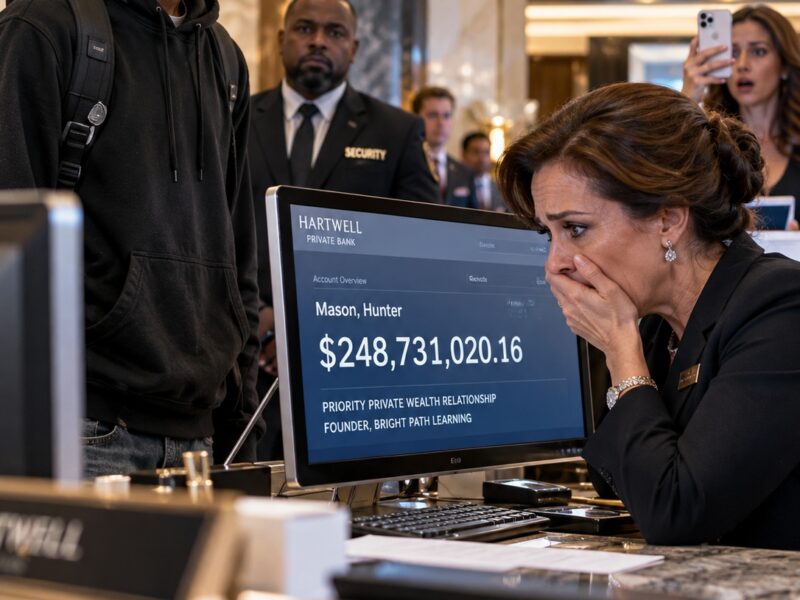
She stood between him and the teller counter in a tailored gray suit, her manager badge shining beneath the chandelier light.
Behind her, Hartwell Private Bank looked exactly the way wealth was supposed to look when it wanted to appear effortless.
Cream-colored marble.
Leather chairs.
Fresh white flowers.
Soft piano music drifting from hidden speakers.
A coffee station with porcelain cups no one seemed to touch.
And now, in the middle of all that polished quiet, a fifteen-year-old boy was being told he did not belong.
“I just want to speak to Mr. Pearson,” Hunter said.
Vivien gave him a smile that never reached her eyes.
“Mr. Pearson is unavailable.”
“He’s expecting me.”
“I’m sure you think he is.”
A customer sitting near the window slowly lowered his newspaper.
Another woman looked up from her tablet.
Hunter noticed both of them.
He also noticed the young teller behind the counter.
Her name tag read GRACE BENNETT.
She looked uncomfortable.
But she said nothing.
Hunter swallowed.
“My appointment is at nine-thirty.”
Vivien glanced at the clock.
It was 9:22.
Then she looked at Hunter again.
Not his face.
His clothes.
His shoes.
His backpack.
His skin.
Her eyes completed an entire investigation in less than two seconds.
“Sweetheart,” she said, lowering her voice as if she were doing him a kindness, “I think you may have the wrong building.”
Hunter looked toward the brass letters on the wall.
HARTWELL PRIVATE BANK.
“No, ma’am.”
“The public library is two blocks down. They have computers if that’s what you need.”
Something changed in Hunter’s face.
Not much.
Just enough that Grace noticed.
He had heard variations of that sentence before.
At twelve, when an adult at a technology conference had asked which booth his father worked at.
At thirteen, when a reporter calling about Bright Path had heard Hunter’s voice and said, “Can I speak to the founder?”
“I am the founder.”
There had been a pause.
Then laughter.
At fourteen, a potential investor had spent half a meeting directing every question toward Hunter’s attorney, even after being told three times that Hunter had written the software himself.
Hunter had learned something from those rooms.
Anger could protect your dignity.
But sometimes it could also become evidence for people who had already decided what you were.
His mother, Denise, had taught him another way.
Don’t let someone else choose who you become in the room.
So Hunter breathed.
Slowly.
“I’m in the right place,” he said. “I’m here to discuss moving some funds and opening several accounts.”
Vivien almost laughed.
“Moving funds?”
“Yes, ma’am.”
“Do you know what kind of institution this is?”
“A private bank.”
“Exactly.”
She leaned slightly closer.
“Our clients keep serious money here.”
The older man had stopped pretending to read his newspaper.
Hunter felt heat climb his neck.
Still, his voice remained level.
“I understand.”
“Do you?”
“Yes.”
Vivien folded her arms.
“Because this isn’t a place where teenagers come in to use the air-conditioning.”
Grace looked down.
That hurt Hunter more than he expected.
Not because Vivien had insulted him.
Because everyone else had heard her.
And because no one had stopped her.
Twenty minutes earlier, Hunter had stepped off the train believing this morning might change his life.
He had walked six blocks through downtown Atlanta with his hands inside his hoodie pockets, rereading an email from Daniel Pearson.
Looking forward to meeting you, Mr. Mason.
We believe Hartwell can provide the level of service Bright Path needs as it enters its next stage.
Mr. Mason.
Hunter had smiled at that.
Not because he cared about titles.
Because Pearson had never asked his age before deciding he deserved respect.
Three years earlier, there had been no private banker.
No foundation.
No millions.
There had only been Hunter, Denise, a borrowed laptop, and a kitchen table covered with math worksheets.
Hunter struggled with reading when he was younger.
Words sometimes seemed to take the long road into his brain.
Patterns did not.
Patterns arrived instantly.
Numbers made sense.
Systems made sense.
When Hunter was twelve, he began building a simple learning program for kids whose minds worked like his.
He called it Bright Path.
The first version looked terrible.
Hunter drew the graphics himself.
Some buttons barely worked.
The server cost one dollar a month.
Even that dollar mattered.
Denise Mason was raising Hunter alone, and grocery money did not contain many spare dollars.
But when Hunter told her what he wanted to build, she opened her purse.
“One dollar?” she asked.
“A month.”
She handed him the money.
“Then make it worth more than a dollar.”
He did.
A teacher in Ohio discovered Bright Path and shared it with colleagues.
Then a school district tried it.
Then another.
By Hunter’s thirteenth birthday, thousands of students were using it.
By fourteen, there were more than a million.
At fifteen, more than three million students across forty states had accessed Bright Path.
Licensing agreements followed.
Revenue followed.
The numbers became so large that Denise stopped looking surprised when attorneys came to their apartment.
But she made one rule.
Money changes the number in your account.
It does not get to change the boy sitting at my table.
So Hunter still took the train.
Still wore his old sneakers.
Still carried the backpack Denise had repaired with black tape.
The money existed.
Ten million dollars of it.
Hunter simply did not feel the need to wear proof.
Most of it sat untouched.
Some went back into Bright Path.
Better servers.
New accessibility features.
Artists.
Tutors.
Free licenses for rural schools.
Now Hunter wanted to do something larger.
A foundation.
Scholarships.
Permanent funding for schools that could not afford Bright Path.
That was why Hartwell mattered.
He was not shopping for a checking account.
He was deciding who would be trusted with the financial structure supporting everything he wanted to build next.
Daniel Pearson had contacted him twice.
Hartwell wanted the relationship badly.
Hunter had insisted on coming alone.
His attorney objected.
Denise objected harder.
“You’re fifteen.”
“I know.”
“Banks know that too.”
“I want to see how they treat me.”
Denise had stared at him across the kitchen table.
Hunter had said the part he had been thinking for days.
“I want to know how they treat me before they know what I’m worth.”
Now, standing beneath Hartwell’s chandelier, he had his answer.
Vivien pointed toward the glass entrance.
“I need you to leave.”
Hunter blinked.
“Could you please check with Mr. Pearson first?”
“I said he isn’t available.”
“Could you call upstairs?”
Her smile vanished.
“No.”
Behind Vivien, Grace shifted.
“Ms. Caldwell—”
Vivien turned.
One glance.
Grace stopped.
Three weeks.
That was how long Grace Bennett had worked at Hartwell.
Three weeks was not enough time to build courage when your manager controlled your schedule, your evaluations, and whether you survived your probation period.
Hunter saw the fear in her face.
He understood it.
That did not make the silence hurt less.
He looked back at Vivien.
“I have an existing account through Hartwell’s partner network.”
That stopped her for half a second.
“If you pull up Mason—”
“I’m not pulling up anything.”
Hunter stared at her.
“I can show identification.”
“No.”
“My account is verified.”
“No.”
“I can show you the appointment email.”
Vivien stepped closer.
“Do you know how many people walk through those doors with stories?”
Hunter said nothing.
“A check coming tomorrow. A wealthy relative. A trust fund. A friend who banks here.”
Her voice was louder now.
Customers could hear every word.
“Ma’am—”
“Do you know how many of them look like they’re about to ask me for bus fare?”
The lobby became perfectly still.
Grace’s face lost color.
The security guard near the entrance looked up.
Even Vivien seemed to realize she had crossed something.
But only for a second.
Then pride carried her forward.
“Poor boys like you don’t have accounts,” she said. “They have excuses.”
Hunter felt the words hit somewhere deeper than the others.
Poor boys like you.
Not teenagers.
Not confused visitors.
Not people without appointments.
Boys like you.
His mother’s voice returned to him.
Don’t let someone else choose who you become in the room.
Hunter looked directly at Vivien.
“You haven’t seen me.”
She frowned.
“What?”
“You said you’ve seen a hundred people like me.”
His voice was almost painfully calm.
“But you haven’t seen me.”
Vivien’s jaw tightened.
She turned toward security.
“Doug.”
The guard approached reluctantly.
Doug Carver was fifty-six, broad-shouldered, gray beginning to show in his beard.
He had spent twenty years removing drunk customers, separating arguments, and dealing with people who actually threatened employees.
The boy standing in front of him did not resemble any of them.
“Everything okay?” Doug asked.
“This young man has been asked to leave.”
Doug looked at Hunter.
Hunter looked back.
No clenched fists.
No shouting.
No attempt to move closer to Vivien.
Just embarrassment.
And something else.
Disappointment.
“Son,” Doug said quietly, “what happened?”
“I came for an appointment.”
Vivien interrupted.
“Doug.”
Hunter continued.
“I asked her to look up my account.”
Doug glanced toward Vivien.
“She won’t.”
“Doug,” Vivien repeated, “walk him out.”
For the first time, the woman holding the tablet raised her phone.
A tiny red dot appeared on the screen.
Recording.
The older man with the newspaper stood.
Hunter saw all of it.
He could have ended the humiliation immediately.
He could have said the number.
Ten million.
He could have said Bright Path.
Three million students.
He could have opened his phone and shown the press articles.
He could have watched Vivien transform before his eyes.
But that would answer the wrong question.
The question was not whether Vivien would respect a millionaire.
Hunter already knew she would.
He wanted to know whether she could respect a boy she believed had nothing.
And she had answered that.
Still, he gave her one final chance.
“Ms. Caldwell.”
Vivien looked at him.
“Please type my last name.”
She crossed her arms.
“Mason. M-A-S-O-N.”
Nothing.
“If nothing comes up, I’ll walk out myself.”
Doug looked at Vivien.
Grace looked at Vivien.
The phone kept recording.
Hunter waited.
Vivien understood the trap too late.
If she refused now, the video would show something difficult to explain.
A customer asking for account verification.
A manager refusing even to check.
So she smiled.
A cold, victorious little smile.
“Fine.”
She walked behind the counter.
“Move, Grace.”
Grace stepped aside.
Vivien placed her fingers on the keyboard.
“You wanted us to look?”
“Yes.”
“Then we’ll look.”
She typed.
M.
A.
S.
O.
N.
Hunter watched her hit Enter.
Vivien was already preparing her expression.
The screen would show nothing.
Then everyone would see she had been right.
The boy would leave.
The embarrassment would belong to him.
For half a second, a loading icon turned.
Then the page opened.
Vivien’s smile remained.
But everything behind it disappeared.
Her eyes stopped moving.
Grace leaned closer.
Her hand rose slowly toward her mouth.
Doug noticed.
“What?”
No answer.
Vivien scrolled.
Once.
Twice.
Faster.
Hunter waited on the other side of the counter.
“Is there a problem?”
“No.”
Vivien’s answer came too quickly.
“No. Just… give me a moment.”
The woman filming lowered her phone slightly to look past it.
The older man took a step closer.
Vivien stared at the screen.
ACCOUNT HOLDER: HUNTER J. MASON.
VERIFIED PRIVATE WEALTH BALANCE:
$10,000,000.
Pending inbound relationship.
Founder: Bright Path Learning.
Referred by: Daniel Pearson, Senior Wealth Adviser.
VIP onboarding.
Priority relationship.
Vivien read the number again.
Ten million.
Her mind searched for another explanation.
Wrong Mason.
Family trust.
Error.
Decimal point.
Anything.
Then she opened the profile.
Hunter’s photograph appeared.
The boy standing ten feet away.
The boy in the hoodie.
The boy with the broken sneaker.
The boy she had told to use a library computer.
Her hand began to tremble.
Doug saw it.
“Vivien?”
She did not answer.
“What does it say?”
Vivien swallowed.
Hunter tilted his head slightly.
“Did you find me?”
And then something almost physical happened inside the lobby.
Power moved.
Not because Hunter became richer.
He had possessed the money when he entered.
Nothing about him had changed.
The same hoodie.
Same backpack.
Same dark skin.
Same quiet voice.
Only Vivien’s knowledge had changed.
“Mr. Mason.”
Grace closed her eyes.
The older man whispered, “Jesus.”
Hunter said nothing.
“Mr. Mason,” Vivien repeated. “There seems to have been a misunderstanding.”
“You said Mr. Pearson wasn’t available.”
Vivien’s lips parted.
“I…”
“You said it twice.”
“I didn’t realize—”
She stopped.
Hunter looked at her.
“What didn’t you realize?”
The question was so simple that Vivien had nowhere to hide.
She did not realize he had money.
She did not realize he mattered.
She did not realize there could be consequences.
“I made a mistake,” she whispered.
Hunter shook his head.
“No.”
Vivien stared at him.
“You made a decision.”
Nobody moved.
“You looked at me and decided who I was. The mistake was the number.”
Vivien’s face reddened.
“Please. Come into my office.”
“No.”
“We can start again.”
“We can’t.”
“I’ll get Mr. Pearson. He is upstairs.”
Hunter’s expression changed.
Not anger.
Something sadder.
“You told me he wasn’t available.”
Vivien’s voice cracked.
“I misunderstood the situation.”
“No. You understood exactly what you thought the situation was.”
Hunter adjusted the broken strap on his shoulder.
“You thought I was poor.”
Vivien looked toward the recording phone.
Then toward Doug.
Then Grace.
She was searching for an ally.
There were none.
Hunter continued.
“And you thought that meant you could treat me that way.”
“I apologize.”
“Would you be apologizing if the balance said forty dollars?”
Vivien could not answer.
That silence answered for her.
“I came here prepared to move everything.”
Her eyes lifted.
Hunter saw hope appear instantly.
“Ten million dollars. Bright Path’s operating accounts. A foundation account. Scholarship funds.”
Vivien took one step toward him.
“We would be honored—”
“I’m not finished.”
She stopped.
“Mr. Pearson emailed me before he knew how old I was. He called me Mr. Mason before he saw my clothes. I wanted to know whether Hartwell deserved the money.”
Hunter looked around the lobby.
“I know now.”
Vivien’s panic became visible.
“We can waive fees.”
Hunter almost smiled.
Not because it was funny.
Because it was unbelievable.
“Fees?”
“Preferred rates. Personal management. Whatever you need.”
“A chair would’ve been enough.”
That sentence landed harder than the ten million.
Hunter turned toward the door.
“Mr. Mason.”
He kept walking.
Vivien followed.
“Please.”
His hand touched the glass.
“They’ll fire me.”
Hunter stopped.
For the first time that morning, Vivien Caldwell looked small.
Not poor.
Not powerless.
Small.
There was a difference.
Hunter looked at her.
For one moment, he remembered Denise counting grocery money at their kitchen table.
The dollar for his first server.
Her tired hands.
Her insistence that success did not give him permission to become cruel.
So when Hunter answered, there was no satisfaction in his voice.
“I know.”
Vivien’s eyes filled.
Hunter pushed open the door.
“And that isn’t me doing it to you.”
Warm Atlanta air rushed into the refrigerated lobby.
“That’s just the math catching up.”
Then he walked outside.
The glass door closed behind him.
No one inside moved.
Vivien remained in the center of the lobby.
Three minutes earlier, it had been her kingdom.
Now every polished surface seemed to reflect the same thing back at her.
The woman with the phone looked at her screen.
The video was already uploading.
Then the elevator chimed.
Daniel Pearson stepped out.
He was fifty-one, silver beginning at his temples, his jacket unbuttoned.
He held a folder in one hand.
WELCOME, MR. MASON was printed across the first page.
Pearson took in the room.
Doug.
Grace.
The customers.
Vivien.
The open account on the teller screen.
The closing door.
His expression changed.
“Where is he?”
Nobody answered.
“Where is Hunter Mason?”
Vivien opened her mouth.
“There was a boy—”
Pearson froze.
“A boy?”
“I didn’t know—”
“Fifteen? Black hoodie? Backpack?”
Vivien stared.
Pearson’s face hardened.
“That’s him.”
He looked toward the door.
“That’s Hunter Mason.”
“I didn’t realize who—”
“The founder of Bright Path.”
Vivien flinched.
“Three million users. Ten million in personal assets. Company accounts. Foundation funds.”
Pearson looked at the screen.
Then at Vivien.
“I’ve been working on this relationship for three weeks.”
Vivien whispered, “Daniel—”
“Tell me he’s coming back.”
Silence.
Pearson looked at Grace.
“What happened?”
Grace glanced at Vivien.
Three weeks.
That number ran through her mind.
Three weeks at Hartwell.
Rent due in twelve days.
Student loans.
A mother who had celebrated when Grace got the job.
A manager who could destroy her career before it started.
Then Grace remembered Hunter standing there while all of them watched.
She chose.
“She called him poor.”
Vivien turned.
“Grace.”
“She told him to go to the library.”
“Grace, be careful.”
Grace’s hands were shaking now.
But her voice strengthened.
“She refused to check his account. He asked several times.”
Pearson stared at Vivien.
“She called security.”
Doug nodded once.
“And there’s a video,” Grace said.
Pearson slowly turned toward the woman holding her phone.
She gave a small, uncomfortable nod.
His face went pale.
“How much?”
“What?”
“How much did she record?”
The woman looked at her screen.
“Almost all of it.”
Pearson closed his eyes.
When he opened them, he was already moving.
He passed Vivien without another word and pushed through the doors.
Hunter was nearly two blocks away.
Pearson ran after him.
“Hunter!”
Hunter heard.
He did not turn.
“Mr. Mason!”
That made him stop.
Pearson reached him breathing hard.
“I am so sorry.”
Hunter looked at the older man.
“I know you are.”
“What happened in there is unacceptable.”
“I know.”
“Please come back.”
Hunter looked past Pearson at the bank.
“I can’t.”
“I understand why you’re angry.”
“I’m not angry.”
That surprised Pearson.
Hunter looked tired.
“I’m disappointed.”
“Give me a chance to fix it.”
“You can fix your bank.”
Pearson waited.
“But you can’t fix this meeting.”
Hunter started walking.
Pearson followed for several steps.
“What about the foundation?”
“I’ll find another bank.”
“Hunter, we built the structure around—”
“You built paperwork.”
Hunter looked at him.
“The foundation is mine.”
Pearson stopped.
Hunter’s phone buzzed.
Denise.
He answered.
“Hey, Mom.”
“How did it go?”
Hunter looked back at Hartwell.
Pearson stood on the sidewalk twenty feet away.
“It didn’t.”
A pause.
“What happened?”
Hunter swallowed.
“Can we talk when I get home?”
Denise heard something in his voice.
“Are you okay?”
“Yeah.”
“Hunter.”
He closed his eyes.
“I’m okay.”
He was not.
Not completely.
But he would be.
“Come home,” Denise said.
Hunter boarded the train thirty minutes later.
By the time he reached his stop, the video had more than eighty thousand views.
By eleven, it had a title.
POOR BOYS LIKE YOU DON’T HAVE ACCOUNTS.
Someone had clipped the confrontation to ninety seconds.
Vivien blocking Hunter.
Hunter asking for Pearson.
Vivien laughing.
Security being called.
Then the screen.
People could not see the account details clearly.
They did not need to.
They could see Vivien’s face.
Cruelty disappeared.
Fear replaced it.
That was the moment everyone replayed.
By noon, the video passed a million views.
Inside Hartwell, events moved even faster.
Pearson called Katherine Holloway, Hartwell’s regional vice president.
Katherine supervised nineteen branches across the Southeast.
She watched the video once in her office.
Then again.
She did not finish the second viewing.
She grabbed her bag.
Vivien spent those hours inside her office trying to build a version of the morning she could survive.
He was disruptive.
No.
The video disproved that.
There was confusion about his appointment.
No.
Pearson’s emails existed.
She was protecting clients.
From what?
A fifteen-year-old asking someone to type his name?
Every explanation collapsed before she finished thinking it.
At 1:08 p.m., Katherine Holloway entered the branch.
Vivien stood when she saw her.
“Katherine. Thank God.”
Katherine closed the office door.
“I’ve seen the video.”
“It doesn’t show everything.”
“I’ve spoken to Pearson.”
Vivien’s mouth tightened.
“And Grace.”
Silence.
“And Doug.”
Vivien sat.
Katherine remained standing.
“You refused to verify a customer’s account.”
“I believed—”
“I know what you believed.”
Vivien looked up.
“That’s the problem.”
Katherine placed a printed transcript on the desk.
“You told him people who look like him come in asking for bus fare.”
Vivien’s face went white.
“You told him poor boys like him don’t have accounts.”
“I was frustrated.”
“With what?”
“He kept challenging me.”
“He asked you to verify his identity.”
Vivien’s eyes filled.
“Nine years.”
Katherine paused.
“What?”
“I’ve given this company nine years.”
Katherine looked at her for a long time.
Then something in her expression softened.
Not forgiveness.
Sadness.
“You did.”
Vivien nodded quickly.
“I built this branch.”
“Yes.”
“I brought in clients. I trained staff. I worked Christmas Eve. I missed my sister’s wedding rehearsal for this bank.”
“I know.”
Vivien’s voice cracked.
“So that has to matter.”
“It does.”
Hope appeared.
Then Katherine slid a paper across the desk.
“That’s what makes this sadder.”
Vivien looked down.
SUSPENSION PENDING FORMAL REVIEW.
Her breathing changed.
“Effective immediately, your access is disabled.”
“Katherine.”
“HR will contact you.”
“You can’t be serious.”
“I am.”
“Over four minutes?”
Katherine stared at her.
“No.”
Vivien waited.
“Over what those four minutes revealed.”
Doug escorted Vivien out.
The symmetry was not lost on anyone.
That morning, she had ordered Doug to walk Hunter through the glass doors.
That afternoon, Doug carried a cardboard box behind her while she walked through those same doors.
Her framed photograph.
A coffee mug.
A small plant.
Nine years reduced to objects that fit inside a box.
At the entrance, Vivien stopped.
She looked back.
Grace was behind the teller counter.
Pearson was upstairs on another call with Hunter’s attorneys.
Customers were pretending not to watch.
Vivien touched her badge.
Then she stepped outside.
The door closed.
A second later, she tried the badge against the employee entrance out of habit.
Red light.
Access denied.
Vivien stared at it.
For perhaps the first time in years, a door had decided she did not belong.
By the following morning, four million people had watched the video.
Then former Hartwell customers began telling their stories.
A Black contractor who had been required to produce three forms of identification before depositing a settlement check.
A woman followed toward the parking garage after asking about a mortgage.
A grandmother quietly encouraged to try “a branch better suited to her needs.”
A college student told there was a four-hour wait to discuss a loan when the lobby had been empty.
Some remembered Vivien.
Others remembered the branch.
Several had complained.
Nothing happened.
Their stories had lived separately.
That was what made them easy to dismiss.
Then Hunter’s video connected them.
Suddenly, what looked like isolated misunderstandings formed a pattern.
Hartwell terminated Vivien the next day.
The bank announced an outside review.
Complaints were reopened.
Regulators asked questions.
Two former customers filed formal discrimination complaints.
Vivien hired an attorney.
She wanted to explain context.
The attorney watched the video.
Then he said something she hated because it was true.
“There isn’t much context that improves the sentence ‘poor boys like you don’t have accounts.’”
Vivien did not go to jail.
Her life did not collapse in some theatrical explosion.
Something quieter happened.
Her professional reputation disappeared.
Applications went unanswered.
Interviews ended politely.
People searched her name before meetings.
The video appeared first.
The doors that had always opened for her stopped opening.
One after another.
For years, Vivien had believed status was evidence of character.
Then she discovered how quickly status could disappear when character became evidence.
But Hunter barely followed any of it.
He spent the first evening at home.
Denise made lemonade.
The same cheap powdered lemonade she had made when Bright Path had its first thousand users.
Hunter sat at the kitchen table.
His laptop was open.
He had not touched it for twenty minutes.
Denise sat across from him.
“You should have called me.”
“I knew you’d come down there.”
“You’re right.”
“And then you’d get arrested.”
Denise almost smiled.
“Also possible.”
Hunter looked at the glass in his hands.
“Mom?”
“Yes?”
“What if there had been forty dollars?”
Denise understood immediately.
“What if that was all I had?”
She waited.
“Everybody keeps talking about ten million dollars.”
Hunter looked up.
“They keep saying she insulted a millionaire.”
Denise nodded.
“But what if I wasn’t?”
Her expression changed.
“That’s the part bothering you.”
Hunter looked away.
“I hate that the story only became important because she was wrong about how much money I had.”
Denise reached across the table.
“She was wrong before anyone opened the account.”
Hunter nodded.
“I know.”
“But now other people get to learn that too.”
Two days later, Katherine Holloway knocked on their apartment door.
No cameras.
No public relations team.
No lawyer.
Just Katherine.
Denise opened the door.
“Yes?”
“My name is Katherine Holloway. I’m with Hartwell.”
Denise’s expression hardened.
Hunter appeared behind her.
“It’s okay.”
They sat at the kitchen table.
Katherine did not begin with Hartwell’s values.
She did not mention how seriously the company took the matter.
She did not talk about training.
She looked at Hunter.
“What happened to you was wrong.”
Hunter waited.
“It would have been wrong if you had ten dollars.”
Something in his face changed.
“It would have been wrong if you had no account at all. The number on that screen did not make her behavior wrong.”
Katherine paused.
“The way she treated you made it wrong.”
Hunter studied her.
Then he said quietly, “You’re the first person from Hartwell who apologized without mentioning the ten million.”
Katherine nodded.
“The money was never the point.”
“That’s what I told my mom.”
“The problem is that Vivien thought it was.”
For the first time since the bank, Hunter smiled slightly.
They talked for nearly two hours.
Not about moving Hunter’s money back.
Katherine never asked.
Instead, Hunter asked her questions.
“How many complaints were filed before mine?”
Katherine hesitated.
“Several.”
“And what happened?”
“Not enough.”
“Why?”
Katherine could have defended the system.
She did not.
“Because organizations can become very good at explaining away things they don’t want to see.”
Hunter thought about that.
“People too.”
“Yes.”
He looked toward his repaired backpack lying beside the kitchen counter.
“What happens to the next kid?”
Katherine followed his eyes.
“That depends on what we change.”
“Then change something.”
Katherine nodded.
“I intend to.”
Before leaving, she mentioned Grace Bennett.
“She told the truth.”
Hunter looked up.
“She looked scared.”
“She was.”
“Is she going to lose her job?”
“No.”
Katherine paused.
“Not if I have anything to say about it.”
Hunter nodded.
“Good.”
Six months later, Hunter Mason walked into another bank.
It was smaller.
No marble lobby.
No invisible piano.
No expensive flowers.
A woman in a navy jacket came from behind her desk the moment Hunter entered.
She smiled.
“Mr. Mason.”
Hunter shook her hand.
“We’ve been looking forward to meeting you.”
She had said exactly the same thing on the phone.
Before seeing his face.
That mattered.
Hunter moved the ten million.
Then the Bright Path corporate accounts.
Then the account he cared about most.
The Bright Path Foundation.
Its purpose was simple.
Schools that could not afford Bright Path would receive it free.
Students who learned differently would receive scholarships.
Children who had been underestimated because they read slowly, dressed cheaply, spoke quietly, or came from the wrong ZIP code would be given something Hunter understood better than most.
A chance before judgment.
By the end of the year, the foundation had reached schools in more than thirty states.
Hunter signed the first scholarship letters himself.
At the same kitchen table.
Denise sat opposite him with three glasses of lemonade.
“Three?” Hunter asked.
The doorbell rang.
Denise smiled.
Hunter opened the door.
Grace Bennett stood there.
She was no longer wearing a Hartwell name tag.
A few months after the incident, Grace had resigned.
The day Hunter was humiliated had left something inside her she could not ignore.
She had spent weeks thinking about the moment she almost stayed silent.
Then about the moment she finally spoke.
The second version of herself was the one she wanted to keep.
She had taken a job at Hunter’s new bank.
Neither had known until later.
Now Grace occasionally helped administer foundation accounts.
Hunter teased her that she had followed his money.
Grace told him his paperwork was not interesting enough.
The joke became easier with time.
The memory did not disappear.
But it changed shape.
Hartwell changed too.
Katherine forced new procedures through all nineteen branches.
Customer complaints could no longer disappear inside local management.
Account verification requests had to be documented.
Employees were retrained.
Managers were reviewed.
None of it erased what happened.
Nothing could.
But one afternoon, almost a year later, Katherine received a photograph from Grace.
A teenager stood inside the new bank.
Cheap sweatshirt.
Scuffed shoes.
Nervous expression.
A banker sat across from him.
There was a chair beneath him.
A glass of water on the desk.
Someone was listening.
Katherine stared at the picture for a long time.
Then she forwarded it to Hunter.
No message.
Hunter saw it while sitting at his kitchen table.
He zoomed in.
The boy was smiling now.
Hunter put his phone down.
Outside the apartment window, Atlanta moved through another ordinary afternoon.
Cars.
Buses.
People hurrying home.
Millions of strangers passing one another, making tiny judgments they might never remember.
Hunter looked at the repaired backpack leaning against the wall.
He could afford a hundred new ones.
Denise had offered.
He kept that one.
Not because poverty was noble.
Not because worn things made him better.
Because the strip of black tape reminded him of a morning when an entire room had decided what he was worth before anyone bothered to ask his name.
Reporters still occasionally asked him about Vivien Caldwell.
Hunter never gave them the revenge story they wanted.
He did not celebrate her firing.
He did not describe watching her career disappear.
Usually he gave some version of the same answer.
“She made one mistake the whole world saw. I’m more interested in the people nobody sees.”
Then he talked about students.
Kids who struggled to read.
Kids using old laptops.
Kids who shared bedrooms and Wi-Fi.
Kids whose intelligence did not arrive wearing the clothes adults expected intelligence to wear.
That was where Hunter wanted the story to go.
Because Vivien Caldwell had misunderstood something much larger than a bank balance.
The shocking thing was never that the teenager in the torn sneakers was worth ten million dollars.
Ten million was merely the number powerful enough to make everyone stop.
The truth existed before the screen loaded.
Hunter deserved a chair when Vivien thought he was broke.
He deserved a greeting when she thought he had nothing.
He deserved to have his name typed into the computer when she believed there would be no important account attached to it.
And so did every person she had dismissed before him.
The customers without cameras.
The people without millions.
The ones who walked out wondering whether they had imagined the insult.
The ones whose names never became hashtags.
That was the uncomfortable part.
Vivien did not become cruel when she discovered Hunter had ten million dollars.
She became polite.
The cruelty existed when she believed politeness carried no reward.
And maybe that was why Hunter kept the backpack.
Years later, people would remember the number.
Ten million dollars.
They would remember the frozen expression on Vivien Caldwell’s face.
They would remember the manager being escorted through the same doors she had tried to force Hunter through.
But Hunter remembered something else.
He remembered standing on the customer side of a marble counter while Vivien typed five letters.
M.
A.
S.
O.
N.
He remembered watching her face change as the screen loaded.
He remembered realizing that nothing about him had changed.
Not one thing.
He was the same boy before the balance appeared.
The same boy afterward.
Only her respect had changed.
And respect that appears only after a price tag is revealed was never respect at all.
One evening, long after the video had stopped trending, Hunter sat alone at the kitchen table reviewing applications for the next Bright Path scholarship class.
One application came from a sixteen-year-old boy in rural Mississippi.
His grades were uneven.
His reading scores were poor.
His mathematics scores were extraordinary.
A teacher had written a recommendation.
People sometimes think Marcus isn’t listening because he needs longer to read instructions. Give him enough time and he will see patterns the rest of us miss.
Hunter read that sentence twice.
Then he smiled.
He approved the scholarship.
Denise entered carrying laundry.
“Another one?”
“Yeah.”
“Good one?”
Hunter looked at the photograph attached to the application.
Marcus wore a hoodie.
Old sneakers.
A backpack with a frayed strap.
Hunter turned the laptop toward his mother.
Denise looked at the photograph.
Then at Hunter’s backpack beside the wall.
Neither said anything for a moment.
Finally Denise smiled.
“Give him a chance.”
Hunter clicked the final approval button.
“I was going to.”
Outside, evening settled over Atlanta.
Somewhere downtown, the glass doors of Hartwell Private Bank reflected the city lights.
People still walked through them.
Some wealthy.
Some not.
Some wearing tailored suits.
Others carrying worn backpacks.
The marble was still there.
The leather chairs were still there.
The flowers were replaced every week.
But now, whenever someone entered, there was a rule Katherine Holloway had insisted be printed in the employee handbook.
It was not complicated.
Greet them.
Offer them a seat.
Listen.
Verify before assuming.
Treat dignity as something a customer brings through the door, not something a bank grants after checking a balance.
Hunter never asked for the rule.
He never even knew the exact wording.
But perhaps that was the closest thing to revenge he ever wanted.
Not watching a woman lose her chair.
Making sure the next boy was offered one.
Because on that morning, a fifteen-year-old walked into a bank asking to be seen.
A woman looked directly at him and saw nothing.
Then a computer showed her ten million dollars, and suddenly she saw everything she believed mattered.
She was wrong twice.
The money did not make Hunter Mason valuable.
And losing it would never make him worthless.
The screen had only revealed a number.
The boy had been there all along.









