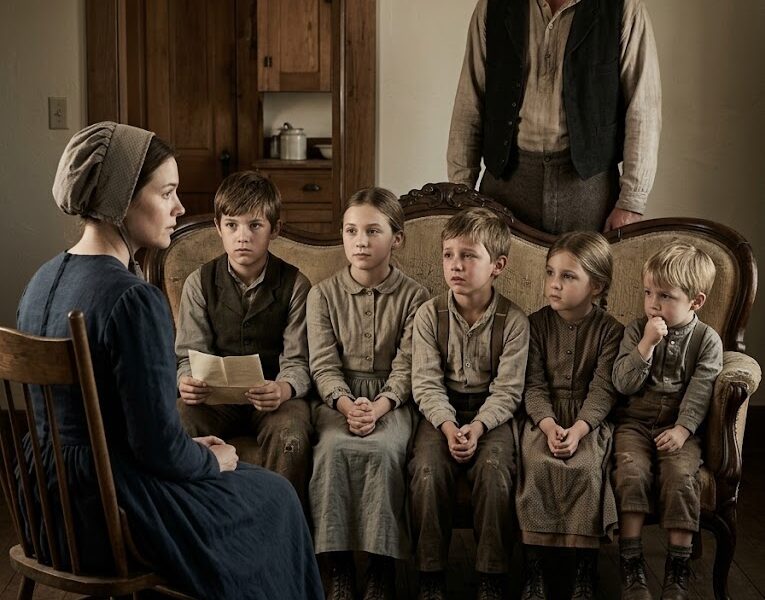
She Traveled 400 Miles to Marry a Widower—Then His Five Children Put Her on Trial Before He Could Propose

The first thing twelve-year-old Merritt Beck said to the woman who had traveled four hundred miles to marry his father was:
“You don’t get to meet him yet.”
Ottilie Pierce stopped in the middle of the parlor.
Dust from the Nebraska road still clung to the hem of her traveling skirt. Her right hand was wrapped around the handle of a worn brown carpetbag. Her back ached from two days of trains, wagons, bad coffee, and almost no sleep.
She had imagined this moment more times than she cared to admit.
She had imagined Ransom Beck waiting on the porch.
Perhaps awkwardly.
Perhaps holding his hat in both hands.
Perhaps smiling when he saw her.
She had imagined the widowed rancher from the letters saying, Miss Pierce?
She had imagined herself answering, Mr. Beck.
What she had not imagined was five children sitting shoulder to shoulder on a horsehair settee like a jury preparing to sentence her.
The oldest boy sat in the middle.
Twelve, she knew from the letters.
Merritt.
Thin, serious, dark-haired, wearing a shirt that had been scrubbed nearly white at the elbows. In his hands was a folded sheet of paper covered in different kinds of handwriting.
Beside him sat Cella, ten, her braids tight and her expression tighter.
Then Pate, eight, who looked openly suspicious.
Juny, six, whose bare feet did not quite touch the floor.
And at the end was four-year-old Tuck, one thumb resting against his lower lip.
Five children.
Five pairs of eyes.
Not one smile.
Ottilie slowly lowered her carpetbag.
“I beg your pardon?”
Merritt straightened.
“Pa says he wants a wife.”
A strangled noise came from somewhere behind the children.
Ottilie looked past them.
A large, weathered man stood in the kitchen doorway wearing a clean white shirt that appeared to have been ironed by someone with more determination than skill.
Ransom Beck.
He was taller than she had expected.
Broader, too.
His hair was dark with gray beginning at the temples, and his hands looked like the hands of a man who had spent his life repairing fences, delivering calves, hauling feed, and refusing to admit when something hurt.
At that moment, however, he looked less like the formidable Nebraska rancher from his letters and more like a man considering whether he could climb out the kitchen window without anyone noticing.
His face was red to the ears.
“Miss Pierce,” he began. “I can explain—”
“No, Pa.”
Merritt did not even turn around.
“You said we could handle it.”
“I most certainly did not say—”
“You said you weren’t marrying anybody we couldn’t live with.”
“That is not the same thing as—”
“So we have to know.”
Ransom closed his eyes.
Ottilie almost smiled.
Almost.
Then Merritt looked at her again.
“Pa gets a wife,” he said. “But we’re the ones who have to get a mother.”
The humor left her.
There it was.
Not rudeness.
Not exactly.
Fear wearing a boy’s face and pretending to be authority.
Merritt lifted the folded paper.
“We made questions. You have to answer them before there’s any proposing.”
Ransom stepped forward.
“Merritt, that is enough.”
Ottilie raised one hand.
Ransom stopped.
For a few seconds, nobody spoke.
Then Ottilie studied the five children carefully.
She saw Cella’s chapped hands.
Pate’s jaw set too hard for an eight-year-old.
Juny watching her as though deciding whether she was safe.
Little Tuck trying not to suck his thumb because the older children were being serious.
And Merritt.
Twelve years old and sitting like a lawyer because apparently nobody else had been available to defend the family.
Something inside Ottilie softened.
She set her carpetbag against the wall.
Then she noticed the chair.
A single hard wooden chair had been positioned directly across from the settee.
The accused chair.
She walked to it.
Ransom stared.
“Miss Pierce, you truly do not have to humor them.”
“I’m not humoring them.”
She smoothed her skirt and sat.
Back straight.
Hands folded in her lap.
Then she met Merritt’s eyes.
“You are quite right.”
That confused him.
“What?”
“This concerns you more than it concerns anyone else.”
She glanced at all five children.
“If I were to become your father’s wife, you would have to live with me every day. So ask what you need to ask.”
Merritt looked down at his paper.
Then back at her.
“All of it?”
“All of it.”
“Even if it’s rude?”
“I’ll tell you if it’s rude.”
Pate nearly smiled.
Ottilie leaned back.
“And I will answer truthfully, even when the truth does not flatter me.”
The children exchanged glances.
Apparently this was not how the previous candidates had behaved.
Ottilie would learn later that there had been two.
The first had lasted less than an afternoon.
The second had lasted forty-seven minutes.
Neither had survived the Beck children.
Merritt cleared his throat.
“First question.”
Ottilie waited.
“Our mother made the best bread in the county.”
The room changed.
Just slightly.
But Ottilie felt it.
Even Ransom became still.
Merritt continued.
“She let us punch the dough down.”
Juny nodded urgently.
“Everybody.”
“Except Tuck,” Cella said.
“I punched.”
“You were a baby.”
“I punched.”
“You slapped it.”
“That counts.”
Merritt glared until order returned to his courtroom.
Then he looked at Ottilie.
“If you can’t make bread as good as hers, will you at least let us help you learn?”
Ottilie did not answer immediately.
Because she understood.
The question had nothing to do with bread.
Not really.
They were asking whether she intended to walk into this house and erase a dead woman.
Whether Mary’s rocking chair would disappear.
Whether her recipes would be thrown away.
Whether photographs would come down.
Whether five children would someday be told to stop mentioning their mother because their new one found it uncomfortable.
Ottilie looked at Merritt.
Then Cella.
Then the little ones.
“I make mediocre bread.”
Pate blinked.
“Mediocre?”
“Very average.”
Juny whispered, “That’s not good.”
“No,” Ottilie agreed. “It is not.”
Tuck giggled.
Even Merritt’s mouth twitched.
Ottilie continued.
“So if your mother made the best bread in the county, I would be foolish not to learn her way.”
Cella looked up sharply.
Ottilie saw it.
That was the answer she had really been waiting for.
“I would like you to teach me,” Ottilie said. “All of you. And if there are recipes she used, we’ll keep them. If there are things she did that matter to you, you may tell me.”
She paused.
“A house should not have to forget someone in order to make room for someone new.”
Nobody moved.
In the kitchen doorway, Ransom lowered his eyes.
Tuck removed his thumb from his mouth.
Merritt looked down at the paper.
Then he made a small mark beside the first question.
Ottilie pretended not to notice.
“Next.”
Two years earlier, Ransom Beck had not been looking for love.
He had been looking for survival.
Mary Beck had died during the second spring of the drought.
There had been no dramatic accident.
No lightning strike.
No overturned wagon.
No final speech delivered beneath clean white sheets.
There had been a difficult birth.
Then a brutal winter.
Then exhaustion.
Then fever.
And finally the terrible quiet that follows when a strong person has spent too long being strong.
Mary left behind five children.
Merritt was ten then.
Cella was eight.
Pate six.
Juny four.
Tuck was still a baby.
She also left behind a husband who discovered almost immediately that grief did not excuse him from milking cows before sunrise.
Babies still cried.
Children still became hungry.
Shirts still tore.
Bills still came.
Cattle still broke fences.
Winter still arrived.
And every morning, Ransom woke with the same terror sitting on his chest.
I am not enough.
He could survive loneliness.
What frightened him was what loneliness was doing to his children.
Especially Cella.
At ten years old, she knew how much flour remained without checking the barrel.
She knew which of Tuck’s cries meant hunger and which meant nightmares.
She could mend a shirt, scrub laundry, braid Juny’s hair, prepare breakfast, and remind Pate to wash behind his ears.
Adults praised her.
“Such a capable little woman.”
Every time someone said it, Ransom felt ashamed.
She was not supposed to be a little woman.
She was supposed to be ten.
That was why he had eventually written to a matrimonial agency.
Not because he wanted a warm bed.
Not because he needed someone to cook.
And certainly not because he had forgotten Mary.
He wrote because he was watching his children organize themselves around an absence.
Merritt had become the protector.
Cella the mother.
Pate the angry one.
Juny the peacemaker.
Tuck the baby everyone protected.
They were surviving.
Ransom wanted more than survival for them.
Then Ottilie Pierce’s letter arrived.
He nearly threw it away.
He had received others.
Women asking how many acres he owned.
Whether the ranch was profitable.
Whether there was a town nearby.
Whether he intended to have more children.
Ottilie asked none of those things.
She asked:
Does Tuck sleep through the night?
Does Juny remember her mother clearly?
What does Pate enjoy?
Does Cella have friends her own age?
Does Merritt feel responsible for the younger ones?
And finally:
Who takes care of you, Mr. Beck, when you are taking care of everyone else?
Ransom had stared at that last question for a long time.
Then he folded the letter and put it in his shirt pocket.
He carried it there for three days.
Ottilie understood something the others had not.
Ransom Beck did not come alone.
He came as six people.
She had written to all six.
Now, watching her sit calmly in the chair his children had placed for interrogation, he began to understand why he had answered.
Cella was next.
She did not consult the paper.
She stared at her own hands.
“When you come here—”
Merritt turned.
“When?”
Cella flushed.
“I mean if.”
But Ottilie had heard it.
So had Ransom.
When.
One accidental word.
A tiny betrayal of hope.
Cella swallowed.
“If you come here, will you let me keep helping?”
Ottilie frowned slightly.
“Helping?”
“With the house.”
Cella spoke faster now.
“I do the wash on Mondays unless it rains because then things don’t dry right. Juny hates eggs if the yellow is runny. Pate says he doesn’t but he does. Tuck wakes up sometimes, but you can’t pick him up right away or he’ll stay awake. Pa forgets accounts when he’s tired, so I put the bills under the blue crock because if they’re anywhere else he loses them.”
“Cella,” Ransom said softly.
She ignored him.
“And I know where everything is. So if you come, are you going to tell me I can’t do anything anymore?”
Ottilie understood then.
This child was not afraid of work.
She was afraid of losing her place.
For two years, competence had been the price of belonging.
Cella had made herself indispensable because being indispensable felt safer than being helpless.
And now a grown woman might arrive and take the one identity grief had left her.
Ottilie leaned forward.
“No.”
Cella finally looked at her.
“I would never walk into your home and pretend the last two years did not happen.”
The girl’s shoulders loosened slightly.
“You kept this family fed?”
Cella nodded.
“You helped raise Tuck?”
Another nod.
“You know your father’s accounts?”
“Better than he does.”
Ransom coughed.
Ottilie’s mouth twitched.
“Then I would be an idiot not to listen to you.”
Cella blinked.
“You mean I can keep doing things?”
“Yes.”
Relief flashed across her face.
Then Ottilie added, “But not all of them.”
The relief vanished.
Cella stiffened.
“Why?”
“Because you are ten.”
“I’m almost eleven.”
“Then you are a very old woman indeed.”
Pate snorted.
Cella did not.
Ottilie softened.
“Listen to me carefully. You have done something extraordinary for this family. Nobody gets to take that away from you.”
Cella’s eyes shone.
“But being useful and being a child are not opposites.”
Silence.
“You can teach me where your father hides the bills.”
“Blue crock.”
“Right. You can teach me your mother’s bread. You can help with Tuck when you want to.”
Cella waited.
“And sometimes,” Ottilie said, “I am going to tell you to go outside.”
The girl frowned.
“To do what?”
“Nothing.”
“What do you mean?”
“Play. Get muddy. Climb something you have no business climbing. Argue with another girl. Waste an afternoon.”
“I don’t waste time.”
“I know.”
Ottilie’s voice grew quieter.
“That is exactly what worries me.”
Cella’s chin trembled.
Ottilie knew that look.
She had worn it herself.
She had been the oldest of eight children.
When her mother’s health failed, Ottilie had become the reliable one.
The one who remembered meals.
The one who knew who needed shoes.
The one who could soothe a fever while still completing schoolwork.
People called her mature.
Responsible.
A blessing.
Nobody asked what it cost a child to become indispensable.
So she spoke to Cella not as an adult correcting a little girl but as one tired keeper of a household speaking to another.
“You have earned your place in this kitchen,” she said. “You have also earned the right to leave it sometimes.”
A tear slipped down Cella’s cheek.
She wiped it away angrily.
Then she took the folded paper from Merritt and made a mark.
Another check.
The committee requested a recess.
They marched into the kitchen, dragging Ransom with them.
Ottilie remained alone in the parlor.
For the first time since arriving, she allowed herself to exhale.
Outside, wind moved through dry Nebraska grass.
Somewhere beyond the house, a horse struck a hoof against packed earth.
Ottilie looked around.
The furniture was worn but clean.
A woman’s rocking chair sat beside the window.
A sewing basket remained underneath it.
Nobody had moved it.
A photograph stood on the mantel.
Mary.
She was younger than Ottilie expected.
Strong-looking.
Not conventionally beautiful, perhaps, but alive in a way photographs rarely captured.
Five children had her eyes in different combinations.
Ottilie stood and walked toward the picture.
“So,” she whispered, “this is your jury.”
She felt foolish immediately.
Then strangely emotional.
She had not come to Nebraska impulsively.
At twenty-seven, Ottilie had already been called a spinster more times than she cared to remember.
Sometimes kindly.
Sometimes cruelly.
She had spent most of her youth raising siblings.
By the time the youngest no longer needed her, Ottilie had looked around and discovered that everyone else had begun lives of their own.
She became a schoolteacher.
She was good at it.
Respected.
Useful.
And desperately lonely.
She had spent so many years being needed that she had never learned what to do with herself when nobody needed her anymore.
Then she saw Ransom Beck’s advertisement.
Five children.
Widower.
Nebraska ranch.
Practical arrangement.
No poetry.
No promises.
Just a man admitting in painfully plain language that he was afraid he was failing his children.
Ottilie had answered because of that sentence.
Not because of the ranch.
Not even because of Ransom.
She had fallen a little in love with the idea of the family before she met any of them.
Now they were in the next room deciding whether they wanted her.
And suddenly she realized something dangerous.
She wanted them to say yes.
Badly.
The kitchen door opened.
The committee returned.
Ottilie resumed her seat.
Pate stepped forward.
Eight years old.
Freckles.
Suspicious eyes.
He did not bother with the paper.
“Are you going to die too?”
Every sound in the room disappeared.
Ransom’s face changed.
“Pate.”
He moved forward.
Ottilie raised her hand.
“Please.”
Ransom stopped.
Pate continued staring at her.
This, Ottilie knew, was the real question.
Bread was memory.
Cella’s question was identity.
This was terror.
A child who had learned too young that adults could disappear was asking whether loving another one would simply give death another target.
Ottilie could have said no.
She could have promised.
She could have offered the sweet lie adults give children because the truth feels too cruel.
Instead she said:
“I don’t know.”
Pate’s expression changed.
Behind him, Merritt looked startled.
Ottilie kept her voice steady.
“I cannot promise you that I will never die.”
Pate looked down.
“No one who loves you can honestly promise that.”
Ransom pressed his lips together.
Ottilie continued.
“But I can promise something else.”
Pate looked back at her.
“I am healthy. I am strong. I plan to live a very long time.”
A tiny smile touched Juny’s mouth.
“And if I stay here, I will not spend every day being afraid that loving you might hurt someday.”
Pate frowned.
“What does that mean?”
“It means I won’t love you halfway just because halfway feels safer.”
His face became very still.
“The people we love sometimes leave us,” Ottilie said. “Sometimes they choose to. Sometimes life takes them. Your mother did not choose to leave you.”
Pate’s eyes filled.
Ottilie wanted to reach for him.
She did not.
Not yet.
“That is the terrible price of loving people. There are no guarantees.”
She leaned forward.
“But I still think love is worth the price.”
Pate swallowed.
“And if you let me be part of this family, I will pay it with you.”
For several seconds, the boy said nothing.
Then he nodded once.
A hard, solemn little nod.
He shifted sideways on the settee.
Only an inch.
But he created a space beside him.
Ottilie saw it.
So did Ransom.
And Ransom turned toward the stove because his eyes had suddenly become suspiciously bright.
Juny’s question was easier.
“Do you know songs?”
“A few.”
“Pretty ones?”
“Some.”
“Sad ones?”
“Those too.”
“Can you sing?”
“Not especially well.”
“That’s okay. Pa can’t either.”
“Juny.”
Ottilie laughed.
It escaped before she could stop it.
The sound startled everyone.
Perhaps because laughter had become rare in the Beck house.
Juny climbed off the settee.
“Sing one.”
Ottilie did.
Only a few lines.
An old lullaby her own mother had sung before illness stole most music from their house.
By the second line, Juny had moved closer.
By the third, she leaned against Ottilie’s knee.
Merritt immediately objected.
“She’s still being interviewed.”
“I’m listening,” Juny said.
“You’re touching the candidate.”
“There’s no rule against it.”
“There should be.”
Pate said, “You can’t make rules after.”
“I’m chairman.”
“You made yourself chairman.”
“Because none of you know procedure.”
Ottilie laughed again.
Then Merritt said something that stopped her.
“We have to finish soon anyway.”
“Why?” Ottilie asked.
Merritt’s face closed.
“No reason.”
Cella looked at him.
He looked away.
Ottilie had spent three years teaching children.
Children could hide many things.
Fear was rarely one of them.
“Merritt.”
He did not answer.
Ransom stepped forward.
“We should talk privately.”
The children went silent.
Ottilie looked from him to them.
“What aren’t you telling me?”
Ransom’s shoulders sank.
Merritt answered first.
“Grandmother Ward is trying to take us away.”
Ottilie stared at him.
“What?”
“Not all together,” Cella whispered.
That was worse.
Much worse.
The truth came slowly.
Mary’s mother, Adelicia Ward, lived in the county seat.
She had money.
Property.
Social standing.
And an opinion about nearly everything.
She had never believed Ransom was good enough for her daughter.
Mary had married him anyway.
After Mary’s death, Adelicia watched the Beck household deteriorate.
The ranch struggled through drought.
Cella assumed adult responsibilities.
The younger children’s schooling became irregular.
Ransom worked from darkness to darkness and still fell behind.
To Adelicia, the conclusion was obvious.
Ransom Beck was failing.
She filed a petition.
She wanted custody.
Not because she planned to raise all five herself.
That would have been almost merciful.
She had arranged what she called “proper situations.”
Merritt could stay with one relative.
Cella with another.
Pate might be sent to an uncle.
Juny to a respectable family.
Tuck, being youngest, could live with Adelicia.
Five children.
Five homes.
One family turned into pieces.
Ottilie looked at them.
Suddenly the interview no longer seemed charming.
These children had not created a game.
They were auditioning the woman they believed might be their last defense.
Every question meant something different now.
Will you erase our mother?
Will you take away the roles grief forced us into?
Will you leave too?
Are you strong enough?
Will you keep us together?
Ottilie turned slowly toward Ransom.
“When is the hearing?”
“Five weeks.”
“And your lawyer?”
His hesitation answered her.
“Ransom.”
“I have spoken to one.”
“Can you afford him?”
“Not for long.”
“Does Mrs. Ward have one?”
“The best in the county.”
Ottilie looked again at the children.
Merritt’s jaw was clenched.
Cella was holding Juny’s hand.
Pate stared at the floor.
Tuck did not understand the legal words.
He only understood that everyone became frightened whenever Grandmother Ward was mentioned.
Ottilie felt something cold and clear settle inside her.
She had spent half her life raising children on too little money, too little sleep, and too much responsibility.
She had faced illness.
Debt.
School boards.
Cruel gossip.
Hungry winters.
She was not frightened by a wealthy grandmother in a black dress.
Not yet.
“Finish the interview.”
Ransom stared at her.
“Ottilie—”
She looked at him.
It was the first time she had used his Christian name.
“We finish what they started.”
Then she turned toward the settee.
“Who is left?”
Everyone looked at Tuck.
The four-year-old froze.
Merritt gently nudged him.
“Your turn.”
Tuck shook his head.
“You had a question.”
Another shake.
“What was it?”
His lower lip trembled.
Ottilie waited.
No pressure.
No coaxing.
Finally Tuck climbed down.
He stood in the center of the room in patched trousers, staring at the strange woman who had arrived with a carpetbag.
His eyes filled.
Ottilie opened her arms.
Nothing more.
Tuck ran.
He hit her hard enough that the chair creaked.
His arms locked around her neck.
His face buried against her collar.
And then he said the one word nobody in that room was prepared to hear.
“Stay.”
Ottilie closed her eyes.
His fists twisted into the fabric of her dress.
“Stay.”
Something inside her broke.
Not painfully.
Like river ice breaking in spring.
She had spent years believing the empty part of her life was freedom.
No siblings depending on her.
No sick mother.
No lunches to pack.
No feverish child crying her name.
She had told herself she was finally free.
But sitting in a Nebraska parlor with a four-year-old stranger clinging to her as if she were already home, Ottilie understood that freedom and loneliness sometimes wore the same coat.
She held him tighter.
“I’ll stay.”
Ransom inhaled sharply.
Merritt stood.
“You mean—”
Ottilie looked over Tuck’s head at all five children.
“I mean I’ll stay.”
Cella began crying silently.
Ottilie’s voice hardened.
“And nobody is taking one of you anywhere.”
Ransom stepped closer.
“You don’t know what you’re promising.”
“Yes, I do.”
“Adelicia has money.”
“So?”
“She has influence.”
“I’ve met influential people.”
“You haven’t met Adelicia.”
“No.”
Ottilie looked at the five children.
“But she hasn’t met me either.”
Pate grinned.
For the first time.
Ransom stared at Ottilie.
She saw something in his expression that made her heart stumble.
Gratitude, certainly.
Astonishment.
And perhaps the first dangerous beginning of something neither of them had traveled four hundred miles expecting.
Merritt looked at the paper.
“There’s technically still the vote.”
Cella wiped her cheeks.
“Oh, hush.”
“No, procedure matters.”
“Merritt.”
“Fine.”
He looked at Ottilie.
“All in favor?”
Five hands went up.
Even Tuck raised one while still holding her with the other.
Ransom rubbed his face.
Ottilie smiled.
“I believe I have been acquitted.”
Merritt shook his head.
“No.”
Her smile faded.
“What?”
“You’ve been hired.”
Two weeks later, Ottilie Pierce became Ottilie Beck.
It was not the wedding either of them would have chosen under different circumstances.
There were no elaborate flowers.
No long courtship.
No romantic declarations beneath stars.
There was a minister.
Five children.
A borrowed dress.
A rancher who looked more nervous saying his vows than he had facing a charging bull.
And a woman who understood that she was not merely marrying a man.
She was stepping into a war.
The first night after the wedding, Ransom stood awkwardly in the doorway of the bedroom.
Ottilie was removing pins from her hair.
Neither spoke.
Finally Ransom said, “I should tell you something.”
She looked at him in the mirror.
“I imagine there are several things.”
“I don’t expect anything from you.”
“That is an alarming way to begin a marriage.”
His ears reddened.
“I mean—I know why we did this.”
“For the children.”
“Yes.”
Ottilie turned.
“And the hearing.”
“Yes.”
“So?”
“I don’t want you thinking you owe me…”
He stopped.
She waited.
He looked genuinely miserable.
Ottilie rescued him.
“Affection?”
“Yes.”
“Children?”
His face became even redder.
“Anything.”
Ottilie studied him.
This man had opened his home to a stranger because he feared losing his children.
He had married her because she had promised to stand beside him.
And on their wedding night, his first concern was that she might feel trapped.
She walked closer.
“I appreciate that.”
Ransom nodded.
Then she said, “But you are also my husband now.”
He swallowed.
“So we might try speaking to each other without looking as though one of us is about to be executed.”
A laugh escaped him.
It was low and rusty from disuse.
Ottilie smiled.
“There. Better.”
He looked at her.
For one long moment, neither looked away.
Then Tuck screamed from the hallway.
“OTTI!”
They both jumped.
The door burst open.
Tuck entered carrying a blanket.
“Bad dream.”
Behind him appeared Juny.
Then Pate.
Then Cella.
Finally Merritt, who announced that he was only there because everyone else was behaving irresponsibly.
Ottilie looked at Ransom.
Ransom looked at Ottilie.
Their wedding night ended with seven people in one room and Merritt asleep on the floor while insisting he was not asleep.
It was, Ottilie would later think, an accurate beginning.
The next month was brutal.
Adelicia Ward’s lawyer had built a strong case.
And the worst part was that much of it was true.
The ranch books were chaotic.
The children’s schooling had suffered.
Cella had carried responsibilities inappropriate for her age.
There had been months when Ransom’s income barely covered necessities.
So Ottilie did not waste time pretending everything had always been fine.
She changed what could be changed.
Lessons resumed every evening.
Merritt studied arithmetic and history.
Cella read literature Ottilie selected specifically because it had nothing to do with housekeeping.
Pate discovered he was excellent at numbers.
Juny practiced handwriting.
Tuck drew circles and called them cattle.
Ottilie organized the household accounts.
The first night she opened Ransom’s ledger, she stared at it for almost a minute.
“What?”
Ransom asked.
“This is not bookkeeping.”
“Yes, it is.”
“This is evidence from a crime scene.”
“It makes sense to me.”
“Then explain this.”
She pointed.
He leaned closer.
“That’s feed.”
“You wrote ‘F.’”
“Yes.”
“And this?”
“Fence.”
“Also F.”
“Yes.”
“This?”
“Farrier.”
“Ransom.”
“What?”
“You cannot use the same letter for three expenses.”
“I know which is which.”
“How?”
“I remember.”
She stared at him.
“You lost three bills last week.”
“Two.”
“Cella found the third under your saddle blanket.”
He sighed.
“You and my daughter are going to be very happy together.”
“We already are.”
Cella, passing through the doorway, said, “Blue crock.”
Ottilie pointed at her.
“Exactly.”
Little by little, the house changed.
Not into a different house.
That mattered.
Mary’s rocking chair stayed by the window.
Her photograph stayed on the mantel.
Her bread recipe remained in Cella’s handwriting because the original card had been stained beyond recognition.
But there was more laughter.
More order.
Cella began spending afternoons outside.
At first she hated it.
Then Ottilie saw her racing Pate across the yard one evening, skirts gathered in both hands, shrieking with laughter.
Ransom stood beside Ottilie on the porch.
Neither spoke for a while.
Then he said, “I had forgotten what she sounded like.”
Ottilie looked at him.
“Who?”
“Cella.”
His eyes remained on his daughter.
“Laughing.”
Ottilie’s throat tightened.
Ransom said quietly, “Thank you.”
“Don’t.”
He looked at her.
“Why?”
“Because then I might start thinking I’m doing something noble.”
“Aren’t you?”
“No.”
She watched the children.
“I’m being selfish.”
He smiled faintly.
“How?”
“I wanted them too.”
That silenced him.
The moment stretched.
Then Ransom said, “They wanted you first.”
The hearing arrived in the hottest week of summer.
Adelicia Ward wore black.
Not mourning black.
Power black.
Her dress was immaculate.
Her posture straight.
Her gray hair pinned perfectly beneath a small hat.
She entered the county courthouse beside a lawyer whose suit probably cost more than Ransom earned in a good month.
When she saw Ottilie, her mouth tightened.
“So.”
Ottilie stood.
“So.”
“You are the agency woman.”
“I was.”
“And now you are Mrs. Beck.”
“Yes.”
“Convenient.”
Ransom stepped forward.
Ottilie touched his arm.
Not yet.
Adelicia noticed.
“I hope you understand what you have married into.”
Ottilie smiled politely.
“Five children and a man with criminal bookkeeping habits.”
Ransom muttered, “Ottilie.”
Adelicia did not smile.
“My grandchildren are not a joke.”
“No.”
Ottilie’s expression changed.
“They are not.”
Something passed between the two women then.
Recognition, perhaps.
Adelicia loved those children.
Ottilie could see it.
That did not make what she intended to do less terrible.
People could cause enormous harm while convinced they were acting out of love.
The courtroom filled.
The arguments began.
Adelicia’s lawyer was good.
Very good.
He described Ransom as overwhelmed.
Financially unstable.
Emotionally compromised.
Unable to provide adequate education.
Dependent on a ten-year-old daughter for household management.
He produced witnesses.
Neighbors.
A shopkeeper.
People who had seen Cella purchasing supplies alone.
People who had heard about unpaid accounts.
One woman testified that the children had once gone nearly a month without formal lessons.
Ransom sat rigidly beside Ottilie.
Every true accusation hurt worse than a lie.
Finally he whispered, “Maybe she’s right.”
Ottilie turned sharply.
“What?”
“I failed them.”
“You were drowning.”
“Same result.”
“No.”
He looked at her.
“No,” Ottilie repeated. “A man who fails his children and does not care is one thing. A man who is drowning and still keeps all five above water is another.”
“What if the judge doesn’t see the difference?”
Ottilie looked toward Merritt.
“He will.”
“How can you know?”
“I taught children for three years.”
“That has nothing to do with judges.”
“No.”
Her eyes remained on Merritt.
“But I know when someone is preparing to speak.”
When Ottilie took the stand, Adelicia’s lawyer expected emotion.
He expected a mail-order bride defending the legitimacy of a hasty marriage.
Instead he encountered a schoolteacher.
Ottilie did not claim the Beck household had been perfect.
She admitted its failures.
Then she explained what had changed.
She presented lesson schedules.
Household accounts.
Plans for improving the ranch.
She described each child individually.
Merritt’s intelligence.
Cella’s burden.
Pate’s fear.
Juny’s need for reassurance.
Tuck’s nightmares.
Then Adelicia’s lawyer asked the question he clearly believed would expose her.
“Mrs. Beck, you had known these children for approximately two weeks when you married their father. Correct?”
“Yes.”
“You expect this court to believe you became their mother in fourteen days?”
“No.”
The lawyer paused.
“No?”
“No.”
Ottilie looked at the children.
“They already had a mother.”
Adelicia looked up.
Ottilie continued.
“Her name was Mary.”
The courtroom became quiet.
“I am not replacing her.”
She looked directly at Adelicia now.
“I never could.”
Adelicia’s face changed.
Only slightly.
“But those children needed someone willing to stand beside what remained after Mary died. That is what I promised them.”
The lawyer recovered.
“A promise made after two weeks.”
“No.”
Ottilie’s voice was calm.
“A promise made the first afternoon.”
He frowned.
“Before your marriage?”
“Yes.”
“To children you barely knew?”
“Yes.”
“That sounds impulsive.”
“Perhaps.”
“Reckless?”
“Possibly.”
“Then why should this court trust your judgment?”
Ottilie thought about Pate asking if she would die.
Cella asking whether she still mattered.
Tuck whispering stay.
Then she answered.
“Because sometimes the reckless thing is walking away from people simply because loving them might become difficult.”
The lawyer sat down.
But Ottilie did not win the case.
Not really.
Merritt did.
Near the end of the hearing, when the adults had argued until every simple truth had become buried under legal language, twelve-year-old Merritt Beck stood.
“Your Honor?”
Ransom grabbed his sleeve.
“Merritt.”
The judge looked over his spectacles.
“Yes, son?”
“May I say something?”
The lawyer objected.
The judge waved him down.
“What do you want to say?”
Merritt stepped into the aisle.
He wore his one good shirt.
Ottilie recognized the expression on his face.
The chairman had returned.
“My grandmother’s lawyer keeps saying what is best for us.”
Adelicia went still.
“And Pa’s lawyer keeps saying what is best for us.”
Merritt swallowed.
“And everybody keeps talking about us.”
His voice shook.
“But nobody asked us.”
The judge leaned forward.
“I’m listening.”
Merritt looked back at his siblings.
Then at Ottilie.
“We asked her.”
“Asked who?”
“Mrs. Beck.”
A few people smiled.
Merritt did not.
“Before Pa proposed.”
Ransom covered his eyes.
Ottilie almost laughed despite everything.
“We interviewed her.”
The judge’s eyebrows rose.
“You interviewed your father’s prospective wife?”
“Yes, sir.”
“All five of you?”
“Yes, sir.”
“What did you ask?”
“Hard things.”
“How hard?”
Merritt looked at Pate.
Pate looked down.
“We asked if she would erase our mother.”
Ottilie felt Adelicia turn toward him.
“We asked if she would take Cella’s place away.”
Cella began crying.
“We asked if she was going to die.”
The judge’s expression softened.
“And?”
“She didn’t lie.”
Merritt looked at Ottilie.
“She said she might.”
A murmur moved through the room.
“But she said that wasn’t a reason not to love us.”
His voice broke.
He stopped.
Ottilie’s hands tightened together.
Merritt drew one breath.
Then another.
“And Tuck asked her to stay.”
The judge looked toward the four-year-old.
Tuck was asleep against Cella.
Merritt continued.
“She said yes.”
His eyes moved to his grandmother.
“We love Grandmother Ward.”
Adelicia’s face cracked.
Just once.
“But we don’t want to be divided up.”
Merritt looked at the judge again.
“Cella is my sister. Pate is my brother. Juny and Tuck are ours.”
His voice strengthened.
“We lost our mother already.”
Silence.
“Why does everybody think the best thing for us is to lose each other too?”
Nobody answered.
Not the lawyer.
Not Adelicia.
Not Ransom.
Not Ottilie.
Merritt wiped his nose with his sleeve.
Then, remembering he was in court, seemed embarrassed.
“We chose Mrs. Beck.”
He swallowed.
“And if this is supposed to be about us, I think what we choose should count for something.”
The judge stared at him for a long time.
Then he removed his spectacles.
The lawyers argued for another hour.
It hardly mattered.
The Beck children went home together.
All five.
The strange thing was that victory did not feel like victory.
That evening, Ottilie found Ransom sitting on the porch.
The children were asleep.
He held the court papers loosely in one hand.
“We won,” she said.
He nodded.
“You don’t look happy.”
“I am.”
“Ransom.”
He stared into the darkness.
“Mary should have been here.”
Ottilie sat beside him.
“Yes.”
He looked at her, surprised.
She did not try to soften it.
Did not say Mary would have wanted this.
Did not pretend grief had expired because something good happened.
“She should have,” Ottilie repeated.
Ransom looked away.
“I loved her.”
“I know.”
“I still do.”
“I know.”
His voice became rough.
“Does that bother you?”
Ottilie considered the question.
Then shook her head.
“No.”
“Why not?”
“Because I didn’t marry an empty man.”
He looked at her.
“I married someone who had a life before me.”
She glanced through the window toward Mary’s photograph.
“If loving me required you to stop loving the mother of your children, I would think less of you.”
Ransom said nothing.
Ottilie stood.
Then he caught her hand.
Not tightly.
Just enough to stop her.
“Ottilie.”
She turned.
He looked at their joined hands.
“I don’t know what this is yet.”
She did.
Or at least she knew what it was becoming.
But she spared him the terror of naming it.
“Neither do I.”
“Are you sorry?”
“For coming?”
“Yes.”
She thought about four hundred miles.
The accused chair.
Mediocre bread.
Cella’s trembling chin.
Pate’s impossible question.
Tuck saying stay.
“No.”
Ransom’s thumb moved once across her knuckles.
“Neither am I.”
Adelicia Ward did not return to the ranch for months.
Everyone assumed Ottilie would be pleased.
She was not.
That autumn, she wrote a letter.
Ransom found her sealing it.
“To whom?”
“Your mother-in-law.”
He nearly dropped his coffee.
“Why?”
“Because she is the children’s grandmother.”
“She tried to take them.”
“I remember.”
“She tried to divide them.”
“I remember that too.”
“And you are inviting her here?”
“For Thanksgiving.”
Ransom stared.
“You have lost your mind.”
“Possibly.”
“She hates me.”
“She disapproves of you.”
“That is the polite version of hate.”
Ottilie handed him the envelope.
“She loves the children.”
“In her way.”
“Yes.”
Ottilie met his eyes.
“And if we believe love can make room for Mary, it can make room for a difficult grandmother.”
Ransom groaned.
“I preferred you when you were fighting her.”
“No, you didn’t.”
“No.”
He smiled reluctantly.
“I suppose I didn’t.”
Adelicia declined Thanksgiving.
She declined Christmas.
She declined Easter.
Ottilie kept writing.
Not begging.
Not apologizing.
Simply leaving the door open.
The following Christmas, a carriage appeared on the road.
Cella spotted it first.
“Grandmother!”
Chaos erupted.
Adelicia entered carrying gifts large enough to suggest she had decided affection was best expressed through financial superiority.
She and Ottilie stood facing each other in the parlor.
Neither spoke.
Then Adelicia glanced toward Mary’s rocking chair.
Still beside the window.
Her expression shifted.
“You kept it.”
“Of course.”
“And the photograph.”
“Yes.”
Adelicia looked at Ottilie.
“I thought you would replace her.”
“I know.”
“You didn’t.”
“No.”
For the first time, Ottilie saw not the formidable woman from court but a mother who had buried her daughter.
Adelicia’s eyes filled.
“I could not save her.”
Ottilie’s anger disappeared.
There it was.
The hidden wound beneath everything.
The custody petition.
The lawyer.
The black dress.
The determination to control what remained.
She had lost Mary.
Then she had looked at five grandchildren living on a struggling ranch and decided she would never be powerless again.
Her solution had been wrong.
Cruel, even.
But the fear beneath it was painfully familiar.
Ottilie stepped closer.
“No.”
Adelicia’s mouth tightened.
“You think I was wrong.”
“I do.”
“You think I nearly destroyed them.”
“Yes.”
Adelicia flinched.
Ottilie did not retreat from the truth.
Then she added:
“But I never thought you didn’t love them.”
Adelicia began to cry.
Quietly.
Furiously.
As though tears themselves were an indignity.
Ottilie did not hug her.
That would have been too much.
She simply stood beside her until the older woman regained control.
Then Tuck ran into the room.
“Grandmother!”
Adelicia bent.
He threw himself into her arms with exactly the same reckless faith he had once thrown into Ottilie’s.
Ottilie smiled.
Some families were repaired by apologies.
Others were repaired by refusing to lock the door.
Over the years, Adelicia became a regular presence at the Beck table.
Still difficult.
Still proud.
Still convinced nearly everyone was doing nearly everything incorrectly.
But she came.
And the children loved her.
The marriage changed too.
At first, Ottilie and Ransom had been partners in an emergency.
Then partners in a household.
Then friends.
Love arrived so gradually neither could identify the exact day.
Perhaps it happened while balancing the ranch books.
Perhaps during a winter night when Tuck had fever and they took turns holding him.
Perhaps when Ransom repaired Ottilie’s school desk without being asked.
Perhaps when Ottilie found him asleep at the kitchen table and draped a blanket over his shoulders.
Perhaps love had begun much earlier, in the doorway, while he watched her take his children’s questions seriously.
It was not young love.
It did not arrive like lightning.
It accumulated.
Cup by cup.
Chore by chore.
Worry by worry.
One evening, years after the court hearing, Ottilie sat on the porch beside Ransom.
The Nebraska sky had turned gold.
Merritt and Pate were arguing over something near the barn.
Juny chased Tuck across the yard.
And Cella—
Cella was laughing.
Not cooking.
Not washing.
Not checking bills.
Laughing.
Ransom looked at her.
“I wrote that agency because of them.”
Ottilie rested her head against his shoulder.
“I know.”
“I thought if I could find someone good to them, that would be enough.”
“Was it?”
“For them?”
“Yes.”
He watched the children.
“More than enough.”
Then he looked at her.
“For me?”
Ottilie waited.
Ransom smiled.
“I got greedy.”
“Oh?”
“I wanted you too.”
After all those years, he could still make her blush.
She looked toward the yard.
“I answered your advertisement because of them.”
“I know that too.”
“I wasn’t looking for romance.”
“That is fortunate. My advertisement was terrible.”
“It was.”
“Painfully practical.”
“You mentioned livestock before mentioning yourself.”
“The livestock were reliable.”
She laughed.
There it was again.
That sound.
The thing Ransom had once secretly wanted without allowing himself to say it.
A woman’s laughter in a house that had been hollowed by death.
Ottilie looked at him.
“I thought I was coming here to take on another burden.”
Ransom’s expression softened.
“And?”
“I found the thing I had been missing.”
“What was that?”
She watched the five children.
“Somewhere to put all the love I kept thinking had become useless.”
Years later, there was another child.
A girl.
When Ransom asked what Ottilie wanted to name her, she already knew.
“Mary.”
He stared at her.
“Are you certain?”
“Yes.”
Cella cried when they told her.
So did Merritt, though he denied it.
Adelicia left the room and returned ten minutes later pretending she had needed fresh air.
And when baby Mary was old enough to stand at the kitchen table, five older siblings taught her how to punch down bread dough.
Not Ottilie’s recipe.
Mary Beck’s.
The first Mary.
The woman whose place nobody had taken.
Because Ottilie had understood from the beginning what frightened those children most.
Love was not a chair with room for only one person.
It did not require eviction.
It did not become smaller when shared.
A child could miss one mother and love another.
A widower could keep a dead wife in his heart and still build a life with the woman beside him.
A grandmother could be forgiven without anyone pretending she had been right.
And a woman who had spent her life believing she was valuable only when somebody needed her could eventually learn something even harder:
She was allowed to be loved too.
Many years passed.
The children grew.
Merritt became a man who still argued like an attorney whenever he believed something mattered.
Cella built a life in which competence was something she chose rather than something fear demanded from her.
Pate stopped asking whether everyone he loved would disappear.
Juny never stopped singing.
Tuck barely remembered the afternoon Ottilie arrived.
Or at least he claimed he did not.
But the old folded paper survived.
Cella found it decades later while clearing a drawer.
Five sets of handwriting.
Questions.
Check marks.
A stain where someone had spilled something.
At the bottom, in Merritt’s careful childhood script, were the words:
Approved unanimously.
They laughed when they found it.
Then Cella cried.
By then they had families of their own.
Children.
Homes.
Losses.
Lives scattered far beyond the Nebraska ranch where they had once sat shoulder to shoulder and tried to decide whether a stranger was safe enough to love.
If someone had asked them what saved the Beck family, they could have offered the respectable answer.
The judge.
The marriage.
The lawyer.
Their father’s determination.
But those were not the answers they gave.
They remembered a woman stepping into their parlor after traveling four hundred miles.
They remembered their father standing helplessly in the kitchen doorway.
They remembered a hard chair placed before five frightened children.
They remembered asking whether she would erase their mother.
Whether she would take away Cella’s place.
Whether she could sing.
Whether she would die.
And finally, without words, whether she would stay.
Ottilie had not answered with promises she could not keep.
She had not told them nobody else would ever die.
She had not told them everything would become easy.
She had not told them their grief would disappear.
She had simply offered the only thing she truly possessed.
All of herself.
Years later, on a cold afternoon, Ottilie stood in the same kitchen teaching one of her grandchildren to make bread.
The child pressed both hands into the dough.
“Like this?”
“Harder.”
The little girl punched it.
Ottilie laughed.
“Again.”
Ransom sat nearby, older now, silver-haired, watching her.
Mary’s old rocking chair was still beside the window.
The photograph was still on the mantel.
So were newer photographs.
Weddings.
Babies.
Graduations.
Faces belonging to people who would never have existed in one another’s lives if five frightened children had been separated all those years ago.
The little girl looked up.
“Grandma?”
“Yes?”
“Who taught you this?”
Ottilie stopped.
Her flour-covered hands rested on the dough.
For a moment she could see that first afternoon again.
Merritt sitting straight.
Cella watching everything.
Pate pretending not to be frightened.
Juny waiting for a song.
Tuck with his thumb against his mouth.
And a woman in a photograph silently occupying the room.
Ottilie smiled.
“Your Aunt Cella taught me.”
The girl frowned.
“Who taught her?”
Ottilie looked toward Mary’s photograph.
“Her mother.”
The child followed her gaze.
“Oh.”
Then she punched the dough again.
Nothing more needed explaining.
Outside, evening settled over the Nebraska land.
Inside, the house was noisy.
Someone was arguing.
Someone was laughing.
A baby had begun crying in another room.
Ransom complained that nobody had returned his spectacles, although they were on top of his head.
Ottilie looked around at the disorder.
Once, she had crossed four hundred miles believing she was traveling toward a widower who needed a wife.
She had been wrong.
She had traveled toward five children who needed an answer.
And those children had been wrong too.
They thought they were choosing someone to keep their family from breaking apart.
They never understood, not then, that they were saving her at the same time.
Tuck had asked her to stay.
So she had.
Through drought.
Through courtrooms.
Through childhood fevers.
Through arguments.
Through weddings.
Through grief.
Through ordinary Tuesdays nobody remembered.
She stayed long enough for Cella to become a child again.
Long enough for Pate to stop expecting death at every door.
Long enough for Merritt to stop believing he had to defend everyone alone.
Long enough for Juny’s songs to fill the house.
Long enough for Tuck to forget there had ever been a time when she was a stranger.
Long enough for Ransom Beck to take her hand one evening and hold it with the quiet certainty of a man who finally understood that love did not always arrive dramatically.
Sometimes it arrived carrying a battered carpetbag.
Sometimes it sat in the accused chair.
Sometimes it admitted it could not make good bread.
Sometimes it refused to promise it would never die.
And sometimes, when a frightened four-year-old wrapped his arms around its neck and whispered one desperate word—
Stay.
Love simply answered:
I will.









