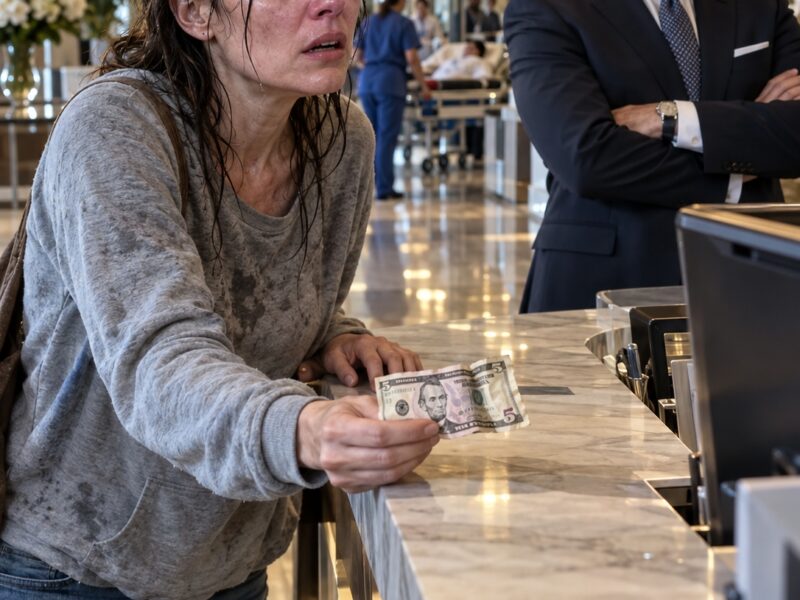
SHE WALKED INTO THE ER WITH ONLY $5 AND THEY REFUSED TO TREAT HER—BUT THE DOCTOR WHO RISKED HIS CAREER FOR HER HAD NO IDEA SHE SECRETLY OWNED THE HOSPITAL

The woman placed five crumpled dollars on the emergency-room counter and whispered, “This is all I have.”
The clerk looked at the bills.
Then she looked at the woman.
She did not look concerned.
She looked annoyed.
Behind the registration desk, fluorescent lights washed everything in the pale, sleepless color hospitals seemed to manufacture after midnight. Phones rang. Rubber soles squeaked over polished tile. Somewhere beyond the double doors, a monitor began chirping rapidly before someone silenced it.
The woman standing at the desk pressed one hand against her chest.
Her breathing was shallow.
Uneven.
“I’m having trouble breathing,” she said.
The clerk, whose badge identified her as MARLENE HICKS, pushed the five dollars back across the counter with one finger.
“That won’t even cover the paperwork.”
The woman stared at the money.
For a moment, she said nothing.
She looked somewhere between forty and forty-five, though exhaustion made age difficult to judge. Her dark hair was pulled into a loose knot. She wore a faded gray sweatshirt, inexpensive jeans, and sneakers that looked as if they had spent several nights walking through rain.
No purse.
No jewelry.
No insurance card.
Nothing about her suggested that anyone important would notice if she disappeared.
“Can a doctor examine me first?” she asked.
Marlene exhaled.
“There are places for people in your situation.”
“You haven’t asked what’s wrong.”
“You said you’re having trouble breathing.”
“Yes.”
“And you don’t have insurance.”
“No.”
“Then County General has an indigent-care program.”
The woman glanced toward the automatic doors behind her.
It was raining outside.
Hard.
“You expect me to walk there?”
Marlene’s expression barely changed.
“You walked here.”
Something shifted in the woman’s face then.
Not anger.
Not exactly.
It was more like disappointment being quietly recorded.
She reached for the five dollars.
“Security,” Marlene called.
The woman froze.
A security officer near the entrance turned.
And that was when another voice cut through the noise.
“Her money isn’t what makes her our responsibility.”
Marlene looked up.
A man in navy scrubs stood ten feet away.
He was tall, lean, and looked as though sleep had become a rumor several years ago. A stethoscope hung around his neck. His dark hair had been pushed back so many times that it refused to stay in place.
His badge read:
DR. ETHAN COLE
EMERGENCY MEDICINE FELLOW.
He approached the desk.
“Being sick does,” he finished.
Marlene’s jaw tightened.
“Doctor, this is intake.”
“I know where I am.”
“She has no insurance.”
“That wasn’t my question.”
Ethan turned toward the woman.
“Has anyone assessed you?”
“No.”
“How long have you had trouble breathing?”
“Since before I got here.”
“Chest pain?”
She hesitated.
“Yes.”
That changed him instantly.
“How bad?”
“Pressure. Tightness.”
“Dizziness?”
“A little.”
“Nausea?”
“No.”
Marlene interrupted. “We’ve already given her directions to County.”
Ethan looked at her.
“Bay Four.”
“What?”
“Put her in Bay Four.”
Marlene lowered her voice. “You know the policy.”
“I know emergency medicine.”
“She hasn’t paid.”
Ethan’s eyes hardened.
“Bring a wheelchair.”
The security guard remained near the doors.
Marlene looked at him, then at Ethan.
“You’re going to get written up again.”
Ethan nodded.
“You can save yourself the walk. Send the complaint directly to Veil.”
The woman looked at him.
“I don’t want trouble.”
“You asked for a doctor.”
“Yes.”
“You found one.”
For the first time that night, something almost like warmth appeared in her expression.
“What’s your name?” Ethan asked as he helped her into the wheelchair.
“Claire.”
“Last name?”
Another hesitation.
“Whit.”
He noticed it.
He noticed almost everything.
But the woman looked frightened, and there were moments in emergency medicine when curiosity became a luxury.
“Claire Whit,” he repeated.
She nodded.
“Okay, Claire. Let’s make sure your heart isn’t trying to kill you.”
As the orderly pushed her toward Bay Four, Claire looked back at the registration desk.
Marlene was already speaking quietly into the phone.
Claire watched her for two seconds.
Then she looked at Ethan.
And for the first time, he had the strange feeling that the frightened woman with five dollars wasn’t only being examined.
She was examining them.
Ethan ordered an ECG, pulse oximetry, blood work and a chest X-ray.
Claire sat upright on the bed while a nurse attached electrodes beneath the collar of her sweatshirt.
Her oxygen saturation was slightly low but not catastrophic.
Heart rate elevated.
Blood pressure normal.
The first ECG showed nothing immediately alarming.
Ethan listened to her lungs.
“Deep breath.”
She inhaled.
“Again.”
She did.
He stepped back.
“Any asthma?”
“No.”
“Cardiac history?”
“No.”
“Anxiety attacks?”
“No.”
“Recent travel?”
“No.”
“Medication?”
“Nothing regular.”
“Family history?”
Claire stared at him.
“My father died recently.”
Ethan paused.
“I’m sorry.”
Her gaze shifted to the ceiling.
“We weren’t finished with each other.”
The sentence landed strangely.
Ethan had heard hundreds of people talk about dead parents. Grief usually came in predictable fragments—too soon, I should have called, I wish I’d said something.
But Claire’s words sounded different.
Not sentimental.
Unresolved.
“Nobody ever is,” he said.
She looked back at him.
That seemed to surprise her.
A nurse entered carrying a blanket.
Ethan took it from her and handed it to Claire.
“You’re cold.”
“I’m fine.”
“You’re shivering.”
“I walked through rain.”
“That doesn’t make you immune to blankets.”
She accepted it.
“Do you always argue with patients?”
“Only difficult ones.”
A tiny smile appeared.
“Do you always insult strangers?”
“Only the ones I’m trying to keep alive.”
The smile lasted half a second longer.
Then someone appeared at the doorway.
Dr. Daniel Veil.
Chief administrator of Bellweather Memorial.
Veil never looked like he belonged in an emergency room.
His suits were too expensive.
His shoes were too clean.
His gray hair was always perfect, even at two in the morning, and he had developed the unnerving habit of entering rooms as if he already knew what everyone inside had done wrong.
“Cole.”
Ethan turned.
Veil glanced at Claire.
“Another charity case?”
“Patient.”
“I saw the intake notation.”
“Then you know she’s being evaluated.”
“Transfer her.”
“She isn’t stable enough for transfer.”
Veil glanced at the monitor.
“She looks stable.”
“That’s why I went to medical school.”
Claire’s eyes moved between them.
Veil smiled without humor.
“You know how this works.”
“So do you.”
“We have a county agreement for uninsured patients.”
“We have an emergency department.”
“We also have a budget.”
Ethan stepped closer.
“And she has chest pain.”
Veil’s gaze sharpened.
“Don’t make this another Samuel Reed.”
Something changed in Ethan.
Claire saw it.
“What happened to Samuel Reed?” she asked.
Neither man answered.
Veil adjusted his cuff.
“Arrange transfer when the initial screen is complete.”
“She stays until I say she’s stable.”
“You are a fellow, Ethan.”
“I’m the physician treating her.”
“And I am reminding you that decisions have consequences.”
Ethan held his stare.
“Put it wherever you want.”
Veil left.
Claire waited until his footsteps disappeared.
Then she said, “Samuel Reed.”
Ethan removed his gloves.
“Forget it.”
“You didn’t.”
“No.”
“What happened?”
He should have walked away.
Instead he pulled the rolling stool closer and sat down.
“Homeless man. Fifty-eight. Pneumonia. No insurance. Administration wanted him transferred.”
“Was he stable?”
“No.”
“And you refused.”
“Yes.”
“He lived?”
“Yes.”
“What happened to you?”
Ethan laughed quietly.
“They didn’t punish me for saving him.”
Claire waited.
“They punished me for making his life expensive.”
Her expression changed.
“Why stay here?”
“At first?”
“Yes.”
“To fight people like Veil.”
“And now?”
Ethan looked toward the hallway.
“Now I think hospitals survive because some people stay after they realize how ugly the machinery is.”
Claire studied him.
“That’s depressing.”
“Experience usually is.”
A nurse entered.
“Dr. Cole?”
“What?”
“There’s a problem with Samuel Reed’s file.”
Ethan frowned.
“What kind of problem?”
“He’s listed as transferred.”
“I know.”
“No. He’s listed as transferred and treated.”
Ethan stood.
“What?”
“Charity service completion. County acceptance. Follow-up disposition.”
“That’s impossible.”
Claire watched his face.
“Why?”
Ethan turned toward her.
“Because County never accepted him.”
The room suddenly felt quieter.
“Then who signed the record?” Claire asked.
Ethan didn’t answer.
He walked out.
Claire waited three seconds.
Then she pulled the IV lead from her finger and followed him.
The terminal in the staff station showed Samuel Reed’s name beside a classification Ethan had never seen attached to his case.
CHARITY VALUE TRANSFER — COMPLETED.
Date.
Authorization.
Estimated uncompensated care value.
County disposition.
Everything looked official.
Everything was false.
“I signed no transfer completion,” Ethan said.
The nurse shook her head.
“It doesn’t list you.”
“Who?”
“Administrative override.”
Claire stood several feet away.
Ethan noticed her.
“You shouldn’t be out of bed.”
“I’m breathing better.”
“That doesn’t mean you’re discharged.”
“What does ‘charity value transfer’ mean?”
“It means go back to Bay Four.”
“Doctor.”
He looked at her.
Something in her voice had changed.
It was subtle.
The frightened woman at intake had disappeared for a second.
In her place stood someone accustomed to receiving answers.
Ethan frowned.
“What do you do for a living?”
Claire blinked.
“Why?”
“You suddenly sound like a lawyer.”
“I’m not.”
“Accountant?”
“No.”
“Hospital administrator?”
Her mouth almost twitched.
“Definitely not.”
Ethan turned back to the monitor.
The nurse scrolled.
“There’s more.”
“How much more?”
She entered a search.
Samuel Reed disappeared.
Seventeen names replaced him.
Different patients.
Different dates.
Different shifts.
Same classification.
Ethan stopped breathing for a moment.
“Seventeen?”
The nurse nodded.
Claire moved closer.
“Same employee?”
“No.”
“Same night?”
“No.”
Ethan looked at Claire.
“You ask unusually specific questions for somebody who wandered in with five dollars.”
She ignored that.
“Who can change those classifications?”
The nurse answered before Ethan could.
“Administration. Billing. Compliance.”
Claire looked at Ethan.
“So it isn’t one clerk.”
“No.”
“One shift.”
“No.”
“One mistake.”
Ethan stared at the seventeen names.
“No.”
The hospital moved around them—stretchers, voices, alarms, overhead pages.
But Ethan suddenly felt as if he were standing in the center of something much larger than an emergency room.
A system.
And someone had been using sick people to feed it.
Claire quietly said, “Can you pull seven days?”
The nurse hesitated.
Ethan turned.
“Do it.”
She entered the request.
The screen went blank.
Then a message appeared.
ACCESS DENIED.
The three of them stared at it.
“Try again,” Ethan said.
She did.
ACCESS DENIED.
“That wasn’t happening ten seconds ago,” the nurse whispered.
Claire’s eyes lifted toward the security camera above them.
“No,” she said.
“Someone knows we’re looking.”
Ethan moved Claire back to Bay Four.
This time she didn’t argue.
Not because he had convinced her.
Because she was thinking.
He could see it.
Her breathing had become normal enough that he no longer believed she was in immediate danger, but something else about her now bothered him more than her symptoms.
The questions.
The way she watched administrators instead of doctors.
The way she had studied the terminology on Samuel’s chart.
The way fear seemed to leave her whenever information appeared.
He pulled the curtain closed.
“Who are you?”
“Claire.”
“I know.”
“You asked.”
“You lied about your last name.”
She looked at him.
“Did I?”
“You hesitated.”
“That isn’t proof.”
“Emergency doctors don’t get proof. We get patterns.”
Claire folded the blanket over her knees.
“And what’s your pattern telling you?”
“That you aren’t telling me something.”
She looked down.
Ethan waited.
Eventually she said, “Neither is this hospital.”
“That doesn’t answer me.”
“No.”
“Do you have insurance?”
“Yes.”
He stared at her.
“You told intake you didn’t.”
“I told her I didn’t have insurance with me.”
“No. I heard the conversation.”
Claire said nothing.
Ethan’s voice lowered.
“Was the chest pain real?”
Her eyes met his.
For the first time, uncertainty appeared.
“Ethan—”
He stepped back.
“You know my first name.”
“Your badge.”
“My badge says Dr. Cole.”
Silence.
Claire’s hand tightened around the blanket.
Then an overhead page interrupted them.
“Dr. Cole to Trauma Two.”
He remained where he was.
“Who are you?”
“Go help your patient.”
“I have one here.”
“You have another who might actually need you.”
Actually.
The word struck him.
His expression changed.
Claire realized her mistake.
“Ethan—”
He pulled the curtain open.
“Don’t leave.”
Then he disappeared into the corridor.
Claire sat alone.
Her face changed the instant he was gone.
The vulnerability disappeared.
She reached beneath the blanket and removed a phone from an inner pocket of her sweatshirt.
It was thin, black and unmistakably expensive.
She dialed one number.
A man answered immediately.
“Mrs. Whitmore?”
“Don’t call me that while I’m inside.”
“Understood.”
“Samuel Reed.”
“We’re looking.”
“Find him before the hospital does.”
“We’re also seeing unusual charity reporting.”
“How unusual?”
“Too early to quantify.”
Claire looked toward the curtain.
“Make it early.”
“We need access to source records.”
“You’ll get it.”
“Claire, if they recognize you—”
“They haven’t.”
“Your father spent thirty years building Whitmore Health. Half the executives know your face.”
“They know photographs taken at charity galas ten years ago.”
“That isn’t the same thing as anonymity.”
Claire closed her eyes.
Her father’s voice seemed to return from memory.
If you want to know what people are, Claire, remove the reason they have to impress you.
She hated that sentence now.
Mostly because he had been right.
Her father, Richard Whitmore, had died eleven weeks earlier.
He had left her controlling authority over the Whitmore Family Healthcare Trust.
That trust controlled the parent company that owned Bellweather Memorial and eight other hospitals.
Nine facilities.
Twenty-three thousand employees.
Billions in assets.
And a promise her father had repeated for most of Claire’s life:
No patient gets turned away because they’re poor.
After his death, Claire had begun reviewing the numbers.
Something didn’t fit.
Charity-care reporting had risen sharply.
Actual emergency expenditures had fallen.
Transfer rates for uninsured patients had nearly doubled.
Executive performance bonuses had risen with both numbers.
She had asked questions.
She received presentations.
She requested records.
She received summaries.
She asked for originals.
They stalled.
So Claire had done something her attorneys called reckless, her board called unnecessary, and her father—had he still been alive—might have secretly admired.
She put on old clothes.
Left her wallet behind.
Carried five dollars.
And walked into one of her own emergency rooms.
Now a doctor she had never met had risked his career because he thought she was poor.
And someone inside her father’s hospital had just locked access to patient records because that doctor had noticed too much.
“Claire?” the investigator said through the phone.
“Yes.”
“We found another issue.”
“What?”
“Samuel Reed never arrived at County.”
Her stomach tightened.
“Where is he?”
“We don’t know.”
Claire looked toward the corridor.
“Find him.”
“What about you?”
She stared at Ethan’s abandoned coffee cup on the counter.
“I’m staying.”
“Why?”
Before she could answer, she heard footsteps.
She ended the call.
Ethan pulled back the curtain.
He was holding a paper cup.
“You own a phone that costs more than my monthly rent.”
Claire looked at it in her hand.
Then at him.
“Who are you?”
This time, Ethan didn’t sound curious.
He sounded betrayed.
And Claire realized something she had not included in any investigation plan.
She cared what he thought of the answer.
She lied again.
“Consultant.”
“For whom?”
“Private.”
“Doing what?”
“Financial review.”
“At this hospital?”
“Not officially.”
Ethan stared at her.
“You walked into my ER pretending you couldn’t pay so you could investigate us?”
“I didn’t say that.”
“You didn’t need to.”
“Ethan—”
“Were you ever sick?”
Claire didn’t answer quickly enough.
His face went still.
“The chest pain.”
“I needed to see how intake handled an uninsured patient.”
“You made it up.”
“I simulated symptoms.”
He laughed once, without humor.
“That’s an impressive phrase.”
“I wasn’t trying to hurt anyone.”
“You occupied a bed.”
“I know.”
“You used nursing time.”
“I know.”
“You ordered me away from actual patients.”
“I didn’t order you.”
“You manipulated me.”
Claire stood.
“I needed to know what happened when nobody knew who was watching.”
“You could have asked.”
“I did.”
“What?”
“I asked executives. I asked compliance. I asked finance. I asked the board. Everyone told me everything was working.”
“So you decided to test the emergency room.”
“Yes.”
“With me.”
“No.”
“Really?”
“I didn’t know you.”
“But once you realized I would help you, you kept going.”
Claire said nothing.
That was answer enough.
Ethan looked away.
For a moment the anger drained from him, leaving something worse.
Disappointment.
“You should go.”
“I can’t.”
“Why?”
“Because Samuel Reed is missing.”
Ethan looked back at her.
“What?”
“My people found the transfer discrepancy.”
“Your people?”
“Outreach investigators.”
“Where is Samuel?”
“They’re searching.”
“County never received him?”
“No.”
Ethan’s face hardened.
“Then his record isn’t just inaccurate.”
“I know.”
“They claimed they treated a man they threw out.”
“Yes.”
“Why?”
Claire hesitated.
“Money. Metrics. Maybe both.”
Ethan stepped toward her.
“How many?”
“I don’t know.”
“Seventeen?”
“At least.”
“Claire.”
“I don’t know.”
His jaw tightened.
“Then let’s find out.”
She stared at him.
“I thought you wanted me gone.”
“I do.”
“That’s confusing.”
“You lied to me. The records didn’t.”
He walked toward the door.
Claire followed.
“Where are you going?”
“To reopen Samuel Reed’s report.”
“They already locked your access.”
“Then somebody made a mistake.”
“What mistake?”
Ethan pushed through the doors.
“They haven’t locked my staff login.”
They did not get far.
Dr. Veil was waiting outside the physician workroom.
Two administrators stood beside him.
So did hospital security.
“Let’s take this slowly,” Veil said.
Ethan stopped.
Claire remained behind him.
Veil’s eyes moved to her.
Then back to Ethan.
“You allowed an unauthorized individual into a restricted clinical area.”
“No patient data left my control.”
“That isn’t what I’m asking.”
“I know.”
“She accessed information using your credentials.”
“No.”
Veil tilted his head.
“Think carefully.”
“I am.”
“You’re a fellowship physician. You have a career ahead of you.”
Ethan said nothing.
Veil continued quietly.
“She took your badge without permission.”
“No.”
“Ethan.”
“No.”
Veil stepped closer.
“If she took it, you become the victim. Your fellowship survives. Security handles the rest.”
“And if I tell the truth?”
“Administrative suspension pending medical affairs review.”
“And the records?”
“What records?”
Ethan smiled faintly.
“There it is.”
Veil’s expression hardened.
“You don’t even know this woman’s last name.”
Claire lowered her eyes.
Veil saw it.
“She lied to you.”
“Probably.”
“Then why destroy your career for her?”
Ethan looked at Claire.
She expected anger.
Instead she saw something calmer.
More dangerous.
He turned back to Veil.
“I’m not doing it for her.”
Claire felt the words like a small cut.
Ethan continued.
“I’m doing it because the records are real.”
Veil stared at him.
“Choose.”
“I just did.”
“Administrative suspension, effective immediately.”
A security officer stepped forward.
“Badge.”
Ethan removed it.
Claire’s throat tightened.
She could stop this.
One sentence.
One phone call.
One name.
Claire Whitmore.
Controlling trustee.
The entire balance of power would change.
Ethan held his badge out.
The officer took it.
“Clinical access revoked,” Veil said. “HR at eight.”
Claire almost spoke.
Then Ethan looked at her.
Not asking for help.
Not knowing she could give it.
Simply accepting the price of telling the truth.
And Claire did something she would later hate herself for.
She remained silent.
Because if she revealed herself now, everyone would behave differently.
The investigation would end before she knew how high the corruption went.
Ethan walked past her.
He did not say goodbye.
Claire watched him disappear down the hallway.
Then she heard Veil say to security:
“Escort her out.”
She turned.
Veil smiled.
“Your game is over.”
Claire looked at him.
“No,” she said quietly.
“I think yours is.”
Outside, the rain had stopped.
Claire stood beneath the hospital awning while security remained behind the glass doors.
A black sedan waited half a block away.
She walked past it.
Her phone rang.
“Claire.”
“What?”
“Our examiner has been denied access.”
“By whom?”
“Local IT. They say we don’t have authority.”
“We have a preservation order.”
“They’re claiming it doesn’t give us physical access.”
Claire stopped walking.
“Do we have the reports?”
“Copies sent to the board.”
“Original approvals?”
“No.”
“Then we don’t have anything.”
“We have enough to establish anomalies.”
“Not who changed them.”
“No.”
Claire looked through the hospital windows.
Inside, Veil was speaking with someone from security.
“Get the originals protected.”
“We’re trying.”
“Try faster.”
“Claire, local IT reports to Veil.”
Her phone vibrated with another incoming message.
A name appeared.
ETHAN COLE.
She answered.
“What?”
His voice came low and tense.
“They haven’t closed my staff login.”
Claire turned toward the building.
“Where are you?”
“Parking garage.”
“You’re suspended.”
“I noticed.”
“You cannot go back inside.”
“Interesting advice from a woman who lied her way into an emergency room.”
“Ethan.”
“What are they trying to protect?”
Before Claire answered, her investigator spoke through the second line in her earpiece.
“Claire, we’re seeing deletion commands.”
Her blood went cold.
“What?”
“Charity database. Local audit cache.”
Claire stopped.
“Can they purge the source archive?”
“Corporate modification rights are locked.”
“Corporate, not local.”
Silence.
Then:
“Oh, God.”
Claire knew.
“Tell me.”
“The local source cache is still accessible.”
“Can they delete it?”
“Yes.”
A second voice came through the investigator’s line.
“We’re seeing an active purge instruction.”
Claire pressed the phone tighter to her ear.
Ethan was still waiting.
“They’re deleting the originals,” she said.
His breathing changed.
“What do you need?”
“Our examiner has a reader but needs a staff authentication inside the building.”
“I still have mine.”
“Your badge was taken.”
“My badge opens doors. My login opens systems.”
Claire closed her eyes.
“This could end your career.”
“They already suspended me.”
“Ethan.”
“You wanted to know who everybody really was.”
The sentence silenced her.
He continued.
“Now you know.”
Claire looked through the glass doors.
Veil disappeared around a corner.
“Meet me at the east service entrance.”
The examiner arrived in a delivery jacket carrying a laptop inside a battered courier bag.
Ethan let them through using an employee entrance that had not yet received the revocation update.
“Very glamorous,” Claire whispered.
Ethan didn’t smile.
“You should see the yacht.”
They moved through a basement corridor beneath the hospital.
Steam pipes ran overhead.
Laundry carts stood against concrete walls.
Nobody looked twice at Ethan in scrubs.
Claire stayed behind him.
“Where are we going?”
“Records annex.”
“You know how to get there?”
“I’ve spent seven years in this building.”
“Seven?”
“Eight makes me irresponsible.”
Despite everything, she almost laughed.
They reached a locked door.
The examiner connected a reader.
“Login.”
Ethan typed his credentials.
A green light appeared.
Inside, the laptop opened a mirrored local archive.
Files began populating.
Seven days.
Thirty days.
Six months.
One year.
Claire’s expression changed.
“What?”
The examiner scrolled.
“This isn’t one hospital.”
“How many?”
He stared at the screen.
“Nine.”
Claire felt the air leave her lungs.
“Nine?”
“All Whitmore facilities.”
Ethan leaned closer.
Numbers filled the display.
Uninsured arrivals.
Denied or redirected care.
False transfer completion.
Invented charity expenditure.
Executive cost ratios.
Performance incentives.
Ethan read one column twice.
Then a third time.
“He cut real care to meet the cost target.”
Claire said nothing.
“He invented charity care to meet the community-benefit target.”
“Yes.”
“And then somebody collected bonuses for both.”
“Yes.”
Ethan looked at her.
“Who?”
The examiner opened an approval trail.
Daniel Veil appeared repeatedly.
But above Veil’s authorization sat another level.
Regional executive authorization.
Corporate operational approval.
A name Ethan knew.
A name Claire had hoped not to see.
MARTIN KESSLER.
Chief Operating Officer of Whitmore Health.
Her father’s closest executive adviser.
The man who had spoken at Richard Whitmore’s funeral.
The man who had placed a hand on Claire’s shoulder and told her:
Your father trusted me to protect what he built.
Claire stared at the screen.
“No.”
Ethan watched her.
“You know him.”
“He practically lived in our house when I was growing up.”
The examiner continued.
“Veil couldn’t build this alone.”
“No,” Claire whispered.
“But Kessler could.”
The laptop suddenly flashed.
SESSION REVOCATION REQUESTED.
“Move,” the examiner said.
Ethan grabbed the computer.
“How long?”
“Seconds.”
“Do we have the copy?”
“Not yet.”
The progress bar reached eighty-three percent.
Eighty-seven.
Ninety-one.
A security alarm sounded somewhere in the corridor.
Claire looked at Ethan.
“They know.”
Ninety-four.
Footsteps echoed from the stairwell.
Ninety-seven.
“Close it,” Ethan said.
“No.”
Ninety-nine.
The door handle moved.
ONE HUNDRED PERCENT.
The examiner looked up.
“Complete copy received in the independent vault.”
The door opened.
Veil stood there.
Two security officers behind him.
His face had lost all pretense of calm.
“Take the laptop.”
Ethan stepped in front of it.
Veil looked at Claire.
“Whatever game you’re playing ends now.”
Claire’s phone rang.
She answered without looking away from him.
“Yes?”
Her investigator spoke.
“Financial trail preserved. Source archive verified.”
Claire’s shoulders relaxed.
“Thank you.”
Veil frowned.
“Who are you?”
Claire ended the call.
For twenty-four hours, she had avoided answering that question.
Now there was no reason left.
“My name is Claire Whitmore.”
Veil’s face changed.
Ethan looked at her.
Silence swallowed the corridor.
Claire continued.
“Richard Whitmore was my father.”
Veil said nothing.
“The Whitmore Family Healthcare Trust owns controlling interest in Whitmore Health.”
Ethan stared at her.
Claire looked directly at him.
“My father left control of that trust to me.”
His expression became unreadable.
Veil recovered first.
“A preservation order does not put you in charge of this hospital.”
Claire nodded.
“I never said it did.”
“Good.”
She took one step toward him.
“The controlling shares do.”
Nobody moved.
Veil’s face slowly drained of color.
Ethan looked from him to Claire.
“So this place is yours.”
Claire swallowed.
“Now it is.”
And Ethan finally understood that the woman he had defended because she had only five dollars could have bought the building around them without touching her personal bank account.
But that wasn’t the part that hurt.
The part that hurt was realizing she had known exactly what his sacrifice would cost.
And she had let him make it anyway.
“Could you have stopped my suspension?”
Ethan asked the question thirty minutes later.
They were alone in an empty consultation room.
Outside, attorneys, board members and investigators were arriving.
Claire stood near the window.
“Yes.”
Ethan nodded slowly.
“You watched them take my badge.”
“Yes.”
“You watched them threaten my fellowship.”
“Yes.”
“You could have stopped it.”
“Yes.”
He laughed under his breath.
Not because anything was funny.
Claire turned.
“I needed the investigation to remain credible.”
“You needed my login.”
“I needed a staff witness.”
“My badge.”
“Ethan—”
“You needed somebody inside who wasn’t bought.”
“Yes.”
“I thought you needed me.”
Her eyes softened.
“I did.”
“No.”
He stepped closer.
“You needed access.”
“That isn’t all.”
“Then what was?”
Claire opened her mouth.
Nothing came.
Ethan looked away.
“You wanted to know who everybody really was.”
“Yes.”
“Did it ever occur to you that I deserved the same chance?”
That broke through everything.
The investigation.
The money.
The hospital.
Her father’s legacy.
Claire had spent eleven weeks telling herself deception was necessary because powerful people performed goodness whenever they knew they were being watched.
She had never considered what it meant to make an honest man perform honesty for a lie.
“I was afraid,” she said.
Ethan looked at her.
“Of what?”
“That the truth would change the way you saw me.”
“It did.”
She nodded.
“I know.”
“You could’ve trusted me.”
“I didn’t know you.”
“You knew enough to risk my career.”
Claire flinched.
He saw it.
But he did not soften.
“That’s the problem with people who have power,” Ethan said quietly. “You call something a test because you’re the one who gets to decide when it ends.”
Claire’s eyes filled.
She looked away before the tears could fall.
“My father built this system.”
“And somebody corrupted it.”
“No.”
Ethan frowned.
Claire shook her head.
“My father built a system that allowed people like Kessler to hide behind numbers. He believed that if the metrics were good, the hospital was good. If charity care increased, we were helping more people. If costs fell, management was efficient.”
“That’s how corporations work.”
“That doesn’t make it right.”
“No.”
Claire stared through the glass toward the emergency department.
“When he died, I thought I was protecting his legacy.”
“And now?”
“Now I think protecting it may require admitting what was wrong with it.”
The door opened.
An attorney entered.
“Ms. Whitmore. The emergency board resolution is ready.”
Claire wiped her face before turning.
“What does it include?”
“Removal of Veil. Immediate suspension of Kessler pending independent investigation. Preservation of all patient and billing records. External audit across all nine facilities.”
“And the patients?”
“We can add remediation.”
“Don’t add it.”
The attorney paused.
Claire looked at him.
“Make it first.”
The board meeting lasted ninety-three minutes.
Daniel Veil entered believing he could survive it.
Martin Kessler joined by secure video from New York and spent the first twenty minutes insisting the records had been misunderstood.
Then the independent examiner presented the archive.
Real patients had been classified as receiving care they never received.
Uninsured people had been redirected or removed before stabilization.
False charity expenditures had been generated afterward.
The company reported those invented expenditures as community benefit.
Meanwhile administrators were rewarded for lowering actual treatment costs.
Kessler called it decentralized reporting.
Veil called it billing reconciliation.
Claire called Samuel Reed.
A screen lit up.
Samuel appeared from a county outreach clinic.
He looked exhausted.
Thin.
Alive.
A clinician sat beside him.
Claire did not ask Samuel to perform his suffering for the board.
She asked one question.
“Were you treated at Bellweather Memorial on March seventeenth?”
“No.”
“Were you transported from Bellweather to County General?”
“No.”
“Where did you go?”
Samuel looked toward the clinician.
“Outside.”
Silence filled the boardroom.
“They told me I couldn’t stay. I slept behind a pharmacy.”
Ethan, watching from the back of the room, lowered his eyes.
Samuel continued.
“Two days later I couldn’t stand up. Somebody called outreach.”
Claire thanked him and ended the connection.
Then she placed his hospital record on the screen.
TRANSFER COMPLETED.
CHARITY TREATMENT PROVIDED.
ESTIMATED VALUE: $18,460.
Nobody spoke.
Claire looked at Kessler’s image.
“Would you like to explain how this hospital spent eighteen thousand four hundred and sixty dollars treating a man it left behind a pharmacy?”
Kessler’s face tightened.
“These classifications are complicated.”
“No.”
Claire’s voice remained calm.
“That one isn’t.”
Veil stood.
“This is a theatrical ambush.”
Claire looked at him.
“You tried to delete the source archive.”
“On whose authority are you conducting this?”
The corporate attorney answered.
“By unanimous emergency resolution of the board, supported by the controlling shareholder.”
Veil looked around the table.
Faces that had once turned toward him for permission now avoided him.
The attorney continued.
“Your removal is effective immediately.”
Veil stared at Claire.
“Your father would never have done this.”
That was the only sentence that hurt.
Claire’s fingers tightened around the edge of the table.
For years, invoking Richard Whitmore’s name had been enough to control her.
What would your father think?
Your father believed—
Your father wanted—
But Richard Whitmore was dead.
And Claire had spent too much of her life mistaking obedience to the dead for loyalty to the living.
She looked at Veil.
“My father isn’t responsible for what I do next.”
The attorney nodded to security.
Veil was escorted from the room.
On the monitor, Kessler began talking rapidly to his lawyer.
Claire didn’t listen.
She looked through the glass wall.
Ethan was already leaving.
Three weeks later, Bellweather Memorial looked almost exactly the same.
That disturbed Claire more than she expected.
Same revolving doors.
Same polished floors.
Same coffee kiosk.
Same fluorescent lights.
Institutions rarely looked different after their secrets were exposed.
People expected corruption to leave stains on walls.
It didn’t.
The real evidence was hidden in spreadsheets, staffing decisions, passwords, quiet orders and the accumulated moments when someone vulnerable was told to go somewhere else.
Marlene Hicks no longer worked intake.
Claire had refused to make her the face of the scandal.
The investigation showed Marlene had been enforcing instructions given by supervisors, though her treatment of patients had violated hospital conduct rules. She was placed under review and later reassigned pending retraining rather than publicly sacrificed so executives could claim the problem had been one cruel clerk.
Claire wanted the system changed.
Not a convenient villain.
Emergency screening was separated from financial intake.
No employee could request insurance information before initial medical assessment when emergency symptoms were reported.
Transfers required clinical authorization.
Charity classifications required independent verification.
Executive bonuses tied to uncompensated-care metrics were frozen.
An outside review began examining every patient affected during the previous thirty months.
Samuel Reed was receiving treatment.
Seventeen became forty-three.
Forty-three became one hundred and twelve.
Then more.
Claire stopped asking for daily totals because every number had a name behind it.
That lesson stayed.
Her father had taught her to read financial statements.
Ethan Cole had taught her what they could hide.
His suspension had been removed within hours of the board vote.
His fellowship review was restored.
The reprimands in his personnel file relating to Samuel Reed were withdrawn.
Claire personally signed the corrective order.
Then she did not contact him for twenty-one days.
She told herself she was giving him space.
The truth was simpler.
She was afraid.
On the twenty-second morning, she entered a diner across the street from Bellweather Memorial.
Ethan sat alone in a booth.
He wore jeans and a dark jacket instead of scrubs.
A medical journal lay open beside his breakfast.
Claire approached carrying two coffees.
He looked up.
“You could have mailed it.”
She stopped.
“What?”
“The fellowship reinstatement.”
“I could have.”
“Is that why you’re here?”
“No.”
She placed one coffee in front of him.
Ethan looked at it.
Claire sat opposite him.
“That’s what Chairwoman Whitmore could fix.”
He said nothing.
“I’m here because Claire couldn’t.”
His eyes lifted.
She had rehearsed this conversation twelve times.
None of those rehearsals mattered now.
“You were right,” she said.
“About?”
“I tested you.”
Ethan leaned back.
“I used you.”
He said nothing.
“I took time from real patients. I lied about being sick. I let you believe I had nowhere else to go. And when you risked your career, I let it happen because your access was useful to me.”
The diner seemed painfully loud.
Plates clattered.
Someone laughed near the register.
Coffee hissed from the machine.
Claire continued.
“I could tell you the investigation saved people.”
“It did.”
“I could tell you we wouldn’t have preserved the evidence without your login.”
“Probably true.”
“I could tell you Veil and Kessler might have destroyed everything if I had revealed myself earlier.”
“Also probably true.”
She swallowed.
“But none of that makes what I did to you fair.”
Ethan looked at the coffee.
“No.”
“I’m sorry.”
He was quiet for a long time.
Claire resisted the urge to fill it.
Finally he asked, “Why me?”
“I didn’t choose you.”
“You kept choosing me.”
She looked down.
That was true.
“I trusted you.”
He almost smiled.
“You have an interesting definition of trust.”
“I know.”
“You lied about your name.”
“Yes.”
“Your symptoms.”
“Yes.”
“Your money.”
“Yes.”
“Your entire life.”
“Not all of it.”
“Which part was real?”
Claire looked at him.
“My father.”
Ethan’s expression changed slightly.
“When you said he died?”
“Yes.”
“And you weren’t finished with each other.”
“No.”
“That was real?”
“All of it.”
Ethan nodded.
Claire looked toward the hospital across the street.
“My father could walk into any room in that building and people would straighten their backs before he spoke. I grew up thinking that meant respect.”
She paused.
“After he died, I started reading complaints he’d never seen. Emails his executives filtered. Reports summarized before they reached him. Maybe he knew some of it. Maybe he didn’t. I don’t know anymore.”
Ethan listened.
“I wanted to walk into one of his hospitals without the Whitmore name and see what remained.”
“And?”
Claire gave a sad smile.
“I found five dollars wasn’t enough to make me human to some people.”
Ethan looked down.
“But then you showed up.”
Silence.
Claire’s voice softened.
“You didn’t know my name. You didn’t know what I could do for you. You didn’t think anyone important was watching.”
“I was doing my job.”
“I know.”
“That shouldn’t make me remarkable.”
“I know that too.”
He looked at her.
“That might be the saddest part.”
Claire nodded.
Neither spoke for several seconds.
Then Ethan asked, “What happens to Kessler?”
“Federal investigators have the records. Civil cases are likely. The board terminated him yesterday.”
“Veil?”
“Gone.”
“Samuel?”
“Improving.”
“Other patients?”
“We’re finding them.”
“Don’t stop.”
“I won’t.”
Ethan studied her.
“I don’t know if I trust you.”
Claire felt the sentence settle inside her.
It hurt.
But it did not feel unfair.
“I know.”
“You can’t order me to.”
A faint smile appeared through her sadness.
“I know that too.”
Ethan looked at the cup she had brought.
“What’s this?”
“Coffee.”
“Is that forgiveness?”
“No.”
His eyebrow lifted.
Claire pushed the cup an inch closer.
“It’s coffee.”
For the first time that morning, Ethan smiled.
Barely.
He picked it up.
Claire wrapped both hands around her own cup.
Neither of them called it a beginning.
Neither called it a date.
There were some things money could repair quickly—employment records, hospital policies, executive structures, legal authority.
Trust was not one of them.
Across the street, the emergency-room doors opened.
An ambulance arrived.
A nurse hurried outside.
Somewhere inside that building, another frightened person would walk to a desk and ask for help.
Claire watched through the diner window.
For years, Whitmore Health had measured charity in dollars.
Her father had believed numbers could prove whether a hospital had kept its promises.
Claire knew differently now.
Promises were measured in smaller moments.
A clerk deciding whether to look up.
A doctor refusing to look away.
A frightened patient being treated before anyone asked what she could afford.
A man losing his badge rather than signing a lie.
A woman powerful enough to control nine hospitals finally learning that ownership and responsibility were not the same thing.
Ethan followed her gaze.
“You’re going back over there, aren’t you?”
“Yes.”
“As chairwoman?”
Claire considered it.
“No.”
He looked at her.
“Then as what?”
She stared at the emergency-room entrance where, three weeks earlier, five crumpled dollars had been pushed back across a counter.
“As someone who still has a lot to fix.”
Ethan nodded once.
Claire stood.
She reached for her coffee.
Then stopped.
“There’s something else.”
He looked up cautiously.
“What?”
“The diner.”
“What about it?”
“You suggested it.”
“When?”
“The night we met.”
“I don’t remember.”
“You said coffee first, life decisions second.”
Ethan finally smiled for real.
“That sounds irresponsibly optimistic for me.”
“I remembered it.”
Claire turned toward the door.
Behind her, Ethan spoke.
“Claire.”
She stopped.
He held up the coffee.
“It’s not forgiveness.”
“I know.”
“But it’s good coffee.”
She smiled.
“I’ll take it.”
Then she walked outside.
Morning sunlight reflected from the glass walls of Bellweather Memorial, bright enough to make the building look almost new.
It wasn’t.
Claire knew that now.
Some damage couldn’t be erased by replacing the people at the top. Some mistakes lived inside habits, incentives and quiet assumptions passed from one employee to another until cruelty began calling itself policy.
She could not undo Samuel Reed’s night behind the pharmacy.
She could not give Ethan back the moment when he had handed over his badge because she had chosen evidence over honesty.
She could not ask her father whether he had known what his company had become.
But she could decide what happened next.
At the crosswalk, Claire waited for the light.
A man stood beside her wearing a hospital maintenance uniform.
He didn’t recognize her.
Neither did the young nurse on her other side.
For once, Claire was grateful.
The signal changed.
She crossed the street with them.
Behind the emergency-room glass, a new sign had been installed above intake.
It was simple.
No corporate slogan.
No Whitmore logo.
Just one sentence:
MEDICAL ASSESSMENT COMES FIRST.
Claire stopped beneath it.
Three weeks earlier, she had entered this hospital pretending to be powerless because she wanted to discover what powerful people had hidden from her.
Instead, she discovered something harder.
Power had hidden things inside her too.
Her arrogance.
Her fear.
Her belief that a good outcome could excuse a cruel method.
Her assumption that because she intended to help people, she could use one of them without consequence.
Ethan had stripped that illusion away without ever trying.
Maybe that was why his disappointment had hurt more than Veil’s corruption.
Veil had shown her what the institution had become.
Ethan had shown her what she had become inside it.
Claire reached into her coat pocket.
Her fingers touched a folded bill.
Five dollars.
She had kept the same one from that night.
Not as a souvenir.
As evidence.
Not against Bellweather.
Against herself.
A reminder that the most dangerous moment for someone with power was the moment she began believing the rules of ordinary decency could be suspended because her reasons were important enough.
Claire folded the bill again.
Then she walked deeper into the hospital.
At the nurses’ station, a woman was arguing quietly with intake.
“I don’t have my insurance card,” the woman said. “My husband has it. He’s driving here.”
The new clerk started to ask another question.
Then stopped.
“Are you having chest pain?”
“Yes.”
The clerk stood immediately.
“I’ll get someone.”
A wheelchair appeared.
No demand for payment.
No argument.
No security guard.
No five-dollar test.
Claire watched from twenty feet away.
Nobody knew she was there.
Nobody knew the chairwoman was watching.
And that, she realized, was the only kind of change that mattered.
She turned toward the elevators.
Her phone buzzed.
A message.
From Ethan.
She opened it.
You left without paying for my coffee.
Claire stared at the screen.
Then another message arrived.
Kidding. Mostly.
A laugh escaped her before she could stop it.
A nurse glanced over.
Claire shook her head.
“Sorry.”
She typed a reply.
Send the bill to administration. I hear they have a generous charity program.
Three dots appeared.
Then disappeared.
Then appeared again.
Finally:
Too soon.
Claire smiled.
Definitely.
She put the phone away.
The elevator doors opened.
Before stepping inside, she looked once more toward the emergency department.
For the first time since her father died, she did not wonder what Richard Whitmore would have done.
She did not need his answer anymore.
The doors began closing.
Across the lobby, Ethan entered through the diner-side entrance carrying the medical journal he had left on the table.
He saw her.
Claire saw him.
For one second, neither moved.
Then Ethan raised his coffee cup.
Not forgiveness.
Not yet.
Maybe not for a long time.
But not nothing.
Claire lifted her hand.
The elevator doors closed between them.
And in the brief darkness of her reflection, Claire Whitmore finally understood the lesson her father had tried to teach her but never fully understood himself:
If you truly want to know who people are, don’t tell them someone powerful is watching.
But if you truly want to know who you are—
give yourself power,
and see what you do when nobody can stop you.









