SHE WAS HUMILIATED FOR LOOKING AT A LUXURY DRESS—EIGHT YEARS LATER, THE WOMAN WHO MOCKED HER WALKED INTO HER BOUTIQUE AND ASKED FOR THE OWNER
“Put that down.”
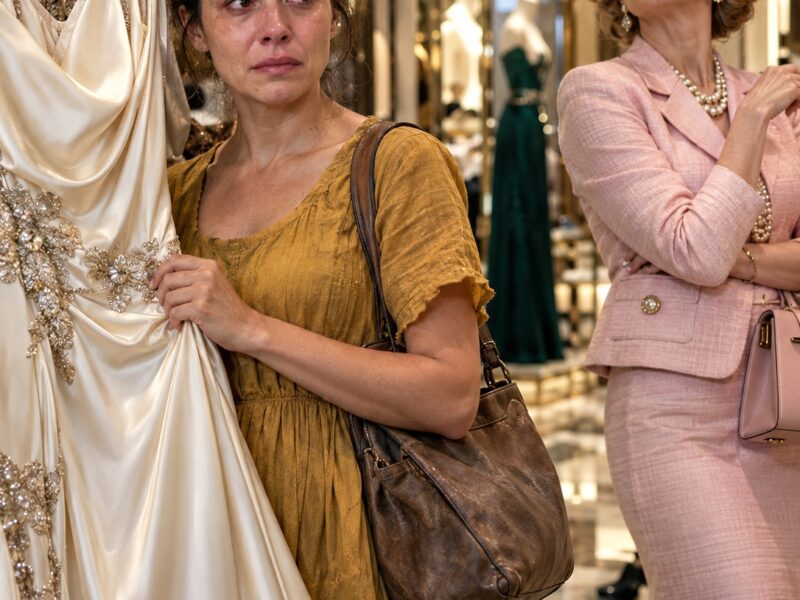
Elena Morales froze with two fingers still touching the sleeve of a cream silk dress.
She had not taken it off the rack. She had not checked the price tag. She had only brushed the fabric between her fingers for half a second, wondering what kind of hands could make something fall so beautifully.
But the woman standing behind her looked at Elena as if she had caught her stealing.
“I’m sorry,” Elena said quietly. “I was only looking.”
The woman’s gaze traveled from Elena’s worn mustard-colored dress to the faded handbag hanging from her shoulder.
“Looking?”
Her mouth curved.
“People like you shouldn’t even be shopping here.”
A second woman near the jewelry counter covered a laugh with her hand.
Elena felt the sound land harder than the words.
The boutique sat on one of the most expensive shopping streets in Chicago, all polished marble, pale flowers, and mirrors tall enough to show a woman everything she wished she could change about herself. Elena had stepped inside because the rain had started suddenly and because, through the window, she had seen the cream dress.
For thirty seconds, she had forgotten that she was tired.
She had forgotten the overdue electric bill folded inside her handbag.
She had forgotten the cleaning gloves that had left the skin around her nails raw.
She had forgotten that her daughter’s inhaler was nearly empty.
She had simply looked at something beautiful.
Apparently, even that was too expensive.
The woman nodded toward Elena’s handbag.
“Even that thing looks like it came from a trash bin.”
More laughter.
Elena’s face burned.
“Isabella,” the second woman murmured, although she was smiling.
“What?” Isabella said. “I’m doing her a favor. Someone should tell her.”
Then she looked directly at Elena.
“Stop pretending you belong here.”
Elena could have answered.
Years later, she would remember every sentence she might have said.
She could have told Isabella that poverty was not contagious.
She could have told her the mustard dress had been sewn by Elena’s mother during the final winter before she died.
She could have told her the handbag had belonged to Elena’s grandmother, the same woman who had taught Elena how to thread a needle before she could properly spell her own last name.
Instead, Elena lowered her hand.
“I don’t want any trouble.”
“That’s probably wise.”
Another laugh followed her toward the door.
Elena kept her back straight until she reached the sidewalk.
Only then did she breathe.
Rain misted across Michigan Avenue, turning headlights into blurred ribbons of white and red. People hurried beneath umbrellas, carrying shopping bags worth more than Elena earned in a month.
She walked three blocks before realizing she was crying.
Not dramatically.
No sobbing.
Just two hot lines down her cheeks she kept wiping away as if they were rain.
Her pride was bruised, but life had no interest in giving her time to recover.
“Mama?”
Elena stopped.
Her eight-year-old daughter, Sofia, was sitting on a bench outside a neighborhood pharmacy where Elena had told her to wait with Mrs. Greene from the apartment downstairs.
Mrs. Greene had apparently stepped inside.
Sofia was bent forward, one hand pressed against her ribs.
Elena’s humiliation vanished.
She ran.
“What happened?”
Sofia lifted frightened eyes.
“It hurts when I breathe.”
Elena dropped to her knees.
The wheezing was unmistakable.
“Look at me, baby.”
Sofia tried.
“I know it hurts. Slow breaths.”
“I’m trying.”
“I know.”
Elena put both hands around her daughter’s face.
“I’ll fix it.”
The promise came automatically.
Mothers made promises before checking whether the world intended to let them keep them.
Inside the pharmacy, Elena placed the medication on the counter.
The pharmacist checked the prescription.
“Thirty-two dollars.”
Elena opened her wallet.
A twenty.
A one.
Several receipts.
Nothing else.
She checked the side pocket even though she already knew it was empty.
“I have twenty-one.”
The pharmacist’s expression softened.
“I’m sorry.”
“Please. I get paid tomorrow afternoon.”
“I can’t release a prescription without full payment.”
“My daughter is having trouble breathing.”
“I understand, but—”
“Please.”
The word came out smaller than Elena intended.
She hated begging.
She hated it even more because Sofia was watching.
Then someone behind Elena spoke.
“How much is she short?”
Elena turned.
An older woman stood beside a small girl in a yellow raincoat.
“Eleven dollars,” the pharmacist said.
Before Elena could protest, the little girl reached into the pocket of her raincoat and pulled out a folded bill.
“Mom, I have eleven.”
Her mother blinked.
“That’s your lunch money for tomorrow.”
“I know.”
The girl looked at Sofia.
“Take it.”
Elena stared.
“No, sweetheart. I can’t.”
The child held the money closer.
“Please.”
Her mother crouched beside her.
“You’re sure?”
The girl nodded.
“All of it.”
Eleven dollars.
Everything she had for tomorrow’s lunch.
Elena had spent the afternoon being told that touching silk made her an impostor.
Now a child who did not know her name was offering everything in her pocket.
Elena swallowed.
“Why would you do that for a stranger?”
The girl looked confused by the question.
Then her mother answered.
“Because one day someone might do it for my daughter.”
For a moment, Elena couldn’t speak.
She accepted the money with both hands.
“Thank you.”
The little girl smiled.
Then she tore a page from a tiny notebook in her backpack.
Her fingers folded the paper clumsily.
Once.
Twice.
Three times.
When she finished, she held out a crooked flower.
“I made this for you.”
Elena took it.
And somehow that paper flower felt more valuable than every yard of silk in the boutique she had just left.
That evening, Sofia sat at their kitchen table drinking soup while rain ticked against the apartment windows.
“Mama?”
“Yes?”
“Why are your eyes red?”
Elena kept washing the same cup.
“Soap.”
Sofia stared at her.
“Did someone say something mean?”
Children sometimes saw through adults with terrifying precision.
Elena turned.
“Yes.”
“What did they say?”
“It doesn’t matter.”
“It made you cry.”
Elena dried her hands and sat beside her.
“Mean words only win when we believe them.”
Sofia frowned thoughtfully.
“Did Grandma say that?”
“No.”
Elena smiled.
“But she should have.”
Her eyes drifted toward the corner of the apartment.
Under a sheet sat her grandmother’s old sewing machine.
Black iron.
Gold lettering mostly worn away.
One pedal.
A chipped wooden table.
It had been untouched for almost two years.
Elena stood.
Sofia watched her pull away the sheet.
Dust rose into the kitchen light.
“That’s Grandma’s machine.”
“I know.”
“What are you doing?”
Elena ran her fingertips across the cold metal.
She thought about the cream silk dress.
She thought about Isabella’s laugh.
She thought about eleven dollars from a little girl who would have no lunch tomorrow.
And for the first time all day, Elena did not feel ashamed.
She felt angry.
But underneath the anger was something far more useful.
Direction.
“Tonight,” she said, “we start working.”
That was how Golden Thread began.
Not with investors.
Not with a business plan.
Not with a loan.
With humiliation, twenty-one dollars, an old sewing machine, and a paper flower beside the needle.
Elena began with repairs.
A torn hem for Mrs. Greene.
A church dress taken in two inches.
A broken zipper.
Curtains.
School uniforms.
Anything people would pay her to sew.
During the day, she cleaned houses.
Five every week.
Sometimes six.
She scrubbed marble floors in homes with rooms nobody used. She polished silverware families saved for guests they rarely invited. She changed sheets in bedrooms larger than her entire apartment.
One afternoon, Mrs. Whitmore caught her examining the corner of a linen tablecloth.
“You missed a spot.”
Elena immediately reached for her cloth.
“I’m sorry.”
Mrs. Whitmore pointed.
“The corner.”
Elena bent closer.
There was no stain.
The seam was uneven.
“You noticed the stitching,” Mrs. Whitmore said.
Elena straightened.
“Yes, ma’am.”
“You sew?”
“A little.”
Mrs. Whitmore laughed.
“People who sew ‘a little’ don’t notice a French seam from six feet away.”
Elena said nothing.
“Show me your work sometime.”
The following Tuesday, Elena brought three photographs.
Mrs. Whitmore studied them longer than Elena expected.
“These are yours?”
“Yes.”
“You made this blue dress?”
“Yes.”
“These stitches are nearly perfect.”
“Nearly?”
Mrs. Whitmore smiled.
“You missed the corner.”
Elena laughed before she could stop herself.
That evening, she went home and resewed the entire hem.
Sofia watched from the table.
“You’re doing it again?”
“I missed the corner.”
“Nobody would notice.”
“I would.”
That became Elena’s rule.
If she could see the flaw, the customer deserved better.
Months passed.
Her schedule became almost impossible.
Wake at 4:45.
Cook breakfast.
Get Sofia ready.
First cleaning job at seven.
Second at ten.
Sometimes a third after lunch.
Home by six.
Dinner.
Homework.
Sewing until one or two in the morning.
Sleep.
Repeat.
“You clean five houses a week,” Mrs. Greene said one evening. “When do you sleep?”
“After my sewing.”
“And when do you sew?”
“Before I sleep.”
“That makes no sense.”
“It does when rent is due.”
Elena smiled, but her hands were trembling from exhaustion.
The dream might have died there if another stranger had not noticed.
His name was Walter Hartley.
He owned a fabric store across from the weekend market where Elena occasionally sold alterations and homemade dresses.
Walter was seventy-one, stubborn, widowed, and permanently annoyed by anyone who called polyester satin.
One Saturday morning, he watched Elena unpack three dresses.
“You made those?”
Elena looked up.
“Yes.”
“What fabric?”
“Cotton blend.”
“Wrong.”
Elena frowned.
“Excuse me?”
“Cotton-rayon.”
She checked.
He was right.
Walter grunted.
“Come by my store at closing.”
“I can’t afford fabric right now.”
“I didn’t ask whether you could afford it.”
At six that evening, Elena arrived with Sofia.
Walter was waiting beside three rolls of cloth.
Navy crepe.
Soft green cotton.
And a bolt of deep blue fabric Elena touched almost reverently.
“These are beautiful.”
“They’ve been sitting too long.”
“I can’t pay you.”
“Then don’t.”
Elena stepped back.
“I don’t take charity.”
“Good. I don’t give it.”
Walter pushed the rolls toward her.
“Take them. Pay me when you’re rich.”
Elena laughed nervously.
“What if I’m never rich?”
Walter shrugged.
“Then pay me in dresses.”
She stared at him.
“Why?”
He glanced at Sofia, who was running her fingers over the green cotton.
“Because somebody helped me once.”
That sentence again.
Not exactly the same words.
But the same idea.
Someone helped me.
So now I help you.
Elena took the fabric.
Sometimes miracles did not arrive with trumpets.
Sometimes they were simply old men locking fabric shops after sunset.
Her first original dress sold three weeks later.
Elena had placed it on a borrowed mannequin at the market.
Blue.
Simple neckline.
Hand-finished waist.
She priced it at twelve dollars because twelve felt almost embarrassingly ambitious.
A woman stopped.
“How much?”
“Twelve.”
The woman touched the sleeve.
“You made it?”
“Yes.”
She examined the stitching.
“I’ll give you twenty.”
Elena thought she had misheard.
“The tag says twelve.”
“I can read.”
“Then why—”
“My granddaughter is getting married next month.”
The woman smiled.
“She’ll look beautiful in this.”
Elena accepted the twenty-dollar bill.
After the customer left, Sofia stared at the empty mannequin.
“Mama.”
“Yes?”
“You sold it.”
Elena looked down at the money.
Eight dollars more than she had asked.
Her first sale.
Her first proof.
That night, she put the twenty-dollar bill beneath the paper flower in a kitchen drawer.
She did not spend it for three months.
Business did not suddenly become easy.
There were Saturdays when nobody stopped.
Days when rain emptied the market.
Weeks when Elena spent more on fabric than she earned.
One Sunday afternoon, after sitting for five hours without making a sale, Elena began packing early.
“Maybe I should stop.”
Sofia looked up from her homework.
“What?”
“Nobody is coming.”
“So?”
“So maybe this isn’t working.”
Sofia pointed toward the old machine they had carried to the market for small alterations.
“Grandma’s machine didn’t stop when it rained.”
Elena stared at her daughter.
“You sound just like me.”
“That’s unfortunate.”
Elena laughed.
Then a woman appeared beneath a red umbrella.
She stopped so abruptly that rain splashed over her shoes.
“Elena?”
Elena looked up.
The woman pulled back her hood.
“I’ve been searching for you for weeks.”
Her name was Nadia Brooks.
She taught fifth grade.
Twenty teachers at her school had seen one of Elena’s dresses.
They wanted their own.
Elena thought she had misunderstood.
“Twenty?”
Nadia nodded.
“This is our thank-you.”
“For what?”
Nadia smiled.
“I told them about the pharmacy.”
Elena went still.
The yellow raincoat.
Eleven dollars.
The paper flower.
Nadia was the mother.
Her daughter, Chloe, was the child who had given away her lunch money.
Elena covered her mouth.
“You.”
Nadia nodded.
“I wondered if you remembered.”
“I still have the flower.”
“You do?”
Elena’s eyes filled.
“It sits beside my sewing machine.”
Nadia glanced at the dresses hanging beneath the market canopy.
“I told the teachers you had two things they don’t sell in department stores.”
“What?”
“Good hands.”
She smiled.
“And a good heart.”
That afternoon, Elena took twenty orders.
Kindness had found its way back.
Sometimes it wore a yellow raincoat.
Sometimes it returned carrying twenty measurements.
And sometimes it waited until you had almost quit.
A few weeks later, Nadia wore one of Elena’s dresses to a school fundraiser.
A local photographer stopped her.
“Where did you get that?”
Nadia pointed across the room.
“From a woman with golden hands.”
The photographer was curious enough to meet Elena.
Her name was Rebecca Lane.
She photographed three dresses against a brick wall behind Walter’s fabric shop.
Elena almost refused.
“My work isn’t ready for photographs.”
Rebecca looked at the dress.
“People decide what they’re ready to love.”
She lifted her camera.
“Stand beside it.”
“Me?”
“Yes.”
Elena laughed.
“No.”
“Why not?”
“Because nobody wants to see the seamstress.”
Rebecca lowered the camera.
“That may be exactly who they want to see.”
Elena reluctantly stood beside the blue dress.
Rebecca took one photograph.
Then another.
“What’s the name of your business?”
Elena hesitated.
She did not have one.
Sofia, sitting nearby, answered for her.
“Golden Thread.”
Elena looked at her.
“Since when?”
“Since now.”
Rebecca laughed.
“Golden Thread it is.”
The photograph went online that night.
By morning, fifty thousand people had seen it.
Elena did not know until Sofia ran into the bedroom holding her phone.
“Mama!”
Elena sat upright.
“What happened?”
“People like the dress.”
“How many people?”
Sofia turned the screen.
Elena blinked.
“Fifty thousand?”
“And they’re asking where they can buy one.”
Elena took the phone.
Hundreds of comments.
Then thousands.
Where can I order?
Does she ship?
I need this.
Who is the designer?
Is there a website?
By nine o’clock, Elena had more than three hundred order requests.
She sat at the kitchen table staring at the screen.
Sofia grinned.
“We’d better start sewing.”
Elena looked toward the corner.
One machine.
Three hundred orders.
For the first time, success frightened her more than failure.
She called Walter.
“I have a problem.”
“How bad?”
“Three hundred orders.”
Silence.
Then Walter said, “That’s not a problem.”
“I have one machine.”
“That is.”
He told her to come to the shop.
Next door to Walter’s fabric store was an empty storefront.
Dusty windows.
Bare concrete floor.
One broken ceiling light.
Walter unlocked it.
Elena stepped inside.
“What is this?”
“Your workshop.”
“I can’t afford this.”
“No rent for six months.”
She turned sharply.
“No.”
“Elena—”
“No. You’ve already done too much.”
Walter leaned against the doorway.
“I watched you help people when you had nothing.”
His voice softened.
“Let someone help you while you become something.”
That sentence stayed with her.
Elena hired two women.
Then four.
Then seven.
She learned payroll at midnight.
Shipping at dawn.
Inventory while stirring soup.
She made mistakes.
A supplier delivered the wrong fabric.
A shipment disappeared.
A customer posted a cruel review after ordering the wrong size.
Elena cried in the bathroom twice during the first year and once behind a stack of boxes where nobody could see her.
Then she washed her face and returned to work.
Golden Thread survived.
Then it grew.
Two years after that rainy day in Walter’s empty storefront, Elena opened her first boutique.
The night before the grand opening, Sofia found her mother standing alone near the entrance.
On the wall was a glass case.
Inside hung an old mustard-colored dress.
Faded.
Repaired.
One hem visibly darned.
“Mama?”
Elena turned.
“Why did you frame that?”
Elena looked at the dress.
“Because I almost threw it away.”
“Why?”
“Because someone once made me ashamed of wearing it.”
Sofia moved closer.
“And now?”
“Now I keep it where I can see it.”
“Why?”
Elena smiled.
“So I never confuse where I came from with something I should be ashamed of.”
The next morning, Walter cut the ribbon.
Nadia cried.
Chloe brought another paper flower.
Mrs. Whitmore inspected a display and whispered, “You missed a corner.”
Elena nearly choked laughing.
Golden Thread sold out its first spring collection.
Then the second.
Three years later, Elena had a small production studio.
Five years later, her dresses appeared in magazines.
Eight years after the day Isabella told her she did not belong in a luxury store, Golden Thread had become a respected Chicago label known for elegant clothing and a policy Elena refused to compromise on.
Every customer was treated with dignity.
No matter what she wore when she walked in.
No matter how much money was in her handbag.
No matter whether she purchased anything.
One evening, Sofia—now sixteen and already sketching designs better than Elena had at thirty—sat beside her mother in the flagship boutique.
“Mama?”
“Yes?”
“Do you still think about that woman?”
Elena knew immediately who she meant.
“Sometimes.”
“Do you hate her?”
Elena considered the question.
There had been a time when the answer would have been yes.
She had imagined seeing Isabella again.
Imagined Isabella discovering who Elena had become.
Imagined the perfect sentence.
The perfect humiliation.
The moment everyone would know who had won.
But somewhere between the hundredth dress and the thousandth customer, those fantasies had disappeared.
“Hate is heavy,” Elena said. “I put it down a long time ago.”
Sofia smiled.
“What if she walks in someday?”
Elena looked around the boutique.
Warm lights.
Soft music.
Dresses arranged with space between them so every piece could breathe.
The mustard dress remained framed behind glass.
“Then she’s a customer.”
Sofia laughed.
“You’d really treat her like everyone else?”
“Yes.”
“You wouldn’t say anything?”
Elena considered it.
“Maybe I’d offer her tea.”
Neither woman knew that Elena’s answer would be tested less than forty-eight hours later.
Saturday afternoon was unusually hot.
The boutique doors opened shortly after two.
Two women entered.
One wore pale pink.
Her voice reached Elena’s office before her face did.
“The fabric is acceptable.”
Elena stopped writing.
Something in that voice moved through eight years as easily as a needle through silk.
Sofia appeared at the office door.
“Mama?”
Elena looked up.
“Two women just walked in.”
“That happens occasionally. We are a store.”
“One of them is very rude.”
Elena smiled.
“What is she wearing?”
“Pale pink.”
Elena’s smile disappeared.
Sofia noticed.
“Do you know her?”
Elena stood slowly.
“Someone I met a long time ago.”
Outside, Isabella had aged beautifully.
Her hair was shorter.
Her jewelry more restrained.
But her expression had not changed.
She stood beside a younger woman—perhaps her daughter—examining a dress as though she were searching for reasons to dislike it.
“Girl,” Isabella said to an employee, “where is the owner?”
The employee remained polite.
“Ms. Morales will be with you shortly.”
“I don’t speak to assistants about purchases at this level.”
“Isabella,” the younger woman whispered.
“What?”
“Please.”
Isabella glanced around.
“Everything smells like cheap thread.”
The employee’s face tightened.
Then Elena entered.
For one second, the world seemed to lose sound.
Elena saw marble floors.
Silk.
Mirrors.
A mustard dress.
A younger version of herself trying not to cry.
Eight years disappeared.
She could almost hear the laughter again.
Sofia stood near the back counter watching her.
Elena walked forward.
Isabella turned.
“Finally.”
She did not recognize her.
“Welcome to Golden Thread,” Elena said.
Isabella looked her over.
“You’re the designer?”
“I am.”
Something changed in Isabella’s face.
Not recognition.
Not yet.
Surprise.
“You don’t look like…”
She stopped.
Elena waited.
“Like what?”
Isabella cleared her throat.
“Nothing. Forgive me.”
There it was.
The opening Elena had imagined a thousand times.
One sentence could do it.
One sentence could return every ounce of humiliation.
Instead Elena gestured toward a chair.
“Please sit. You must be tired in this heat.”
Isabella blinked.
“Would you like water or tea?”
“Water.”
Sofia looked at her mother.
Elena nodded.
Bring it.
That was her choice.
Not weakness.
Choice.
Isabella wanted a dress for a charity dinner.
Elena selected three.
The first was wrong.
The second was close.
The third, a deep emerald dress with a structured waist, seemed almost designed for her.
When Isabella emerged from the fitting room, even she became quiet.
“It fits perfectly.”
Elena adjusted one sleeve.
“You didn’t measure me.”
“I measured you when you walked in.”
Isabella studied herself in the mirror.
Then she looked around the boutique.
“Why is everyone here so… kind?”
Elena met her eyes in the reflection.
“Because every woman deserves to feel beautiful, whatever she’s wearing.”
Something flickered across Isabella’s face.
Elena saw the first shadow of recognition.
Isabella slowly turned.
Her gaze moved beyond Elena.
Toward the wall.
Toward the glass case.
Toward the mustard dress.
She stared.
Her face lost color.
“That dress.”
Elena said nothing.
Isabella stepped closer.
“The hem.”
Silence spread between them.
The younger woman beside Isabella looked confused.
“Mom?”
Isabella approached the glass.
Her hand rose but did not touch it.
“I’ve seen this before.”
Elena waited.
Isabella turned.
And suddenly she was no longer looking at a successful designer.
She was looking at the woman she had laughed at eight years earlier.
“The luxury store.”
Elena nodded.
Isabella whispered, “It was you.”
“Yes.”
No triumph.
No smile.
Just truth.
Isabella sank into the nearest chair.
“I laughed at you.”
Elena remained standing.
“I remember.”
“I said terrible things.”
“Yes.”
Isabella looked toward the glass of water Sofia had placed beside her.
“Why did you give me water?”
Elena glanced at it.
“Because you looked thirsty.”
Isabella stared at her.
That answer broke something.
“I’m sorry.”
Her voice cracked.
“I am so sorry.”
The younger woman beside her looked stunned.
Elena saw embarrassment in Isabella’s face now, but it was different from the embarrassment Elena had felt eight years ago.
Elena had been ashamed of poverty.
Isabella was ashamed of herself.
“I don’t deserve your kindness,” Isabella said.
Elena sat across from her.
“Nobody earns kindness.”
Isabella looked up.
“What?”
“It is simply given.”
“After what I did?”
Elena nodded.
“Forgiveness isn’t pretending something never happened.”
She glanced toward the mustard dress.
“I remember exactly what you said.”
“Then why didn’t you humiliate me?”
Elena almost smiled.
“Because I tried that conversation in my head many times.”
Isabella looked confused.
“What conversation?”
“The one where I saw you again.”
Elena leaned back.
“In some versions, I had security escort you out. In others, I told everyone what you’d done. Sometimes I imagined making you feel exactly as small as you made me feel.”
Isabella lowered her eyes.
“What changed?”
Elena looked at her hands.
“I noticed anger made them heavy.”
Isabella frowned.
“My hands are how I make things.”
Elena flexed her fingers gently.
“I couldn’t build anything while carrying you in them.”
For several seconds, nobody spoke.
Then Isabella looked around.
“You built all this from my insult.”
Elena shook her head.
“No.”
“But that day—”
“You were one bad moment.”
Elena’s voice remained gentle.
“The woman at the pharmacy was another moment. Her daughter gave eleven dollars she needed for lunch. Walter gave me fabric when I couldn’t pay. Nadia brought twenty customers when I was ready to quit. People opened doors.”
She looked at Isabella.
“You don’t get to take credit for my success just because you contributed to my pain.”
Isabella stared at her.
Elena continued.
“I built this from my choices.”
That sentence changed the room.
Revenge would have made Isabella important forever.
Forgiveness put her in the proper place.
One painful moment.
Not the author of Elena’s life.
Isabella wiped her cheek.
“I want to buy every dress in the window.”
Elena laughed softly.
“No.”
Isabella looked startled.
“No?”
“Buy the one you love.”
Elena nodded toward the emerald dress.
“And the next time you see someone who needs help, do it quietly.”
Isabella’s daughter looked at her mother.
“I’ve never seen you apologize.”
Isabella looked down.
“Maybe that’s part of the problem.”
She purchased the emerald dress.
At the door, she stopped.
“Elena?”
“Yes?”
“May I come back?”
Elena smiled.
“To shop?”
Isabella shook her head.
“To learn.”
“Learn what?”
“How to become the kind of woman who would have helped you instead.”
Elena looked toward the glass case.
Toward the dress.
Toward eight years of work.
“The door is open.”
Isabella nodded.
“Thank you.”
After she left, Sofia approached.
“You really forgave her?”
Elena began straightening the rack Isabella had been browsing.
“Forgiveness isn’t amnesia.”
“But weren’t you angry?”
“For years.”
“You could have destroyed her in there.”
Elena looked at her daughter.
“That would have lasted five minutes.”
“And this?”
Elena glanced through the window.
Isabella was standing on the sidewalk with her daughter.
Neither woman was speaking.
Then Isabella suddenly turned toward an elderly woman struggling with several shopping bags.
She crossed the sidewalk.
Took two bags.
The elderly woman smiled.
Elena watched.
“This might last longer.”
Weeks passed.
Then months.
Isabella did return.
At first, she came quietly.
She helped with Golden Thread’s clothing drives.
She donated without attaching her name to anything.
She learned the names of employees she once might have called assistants.
Change was not instant.
Sometimes she still said something careless and caught herself.
Sometimes Elena watched her struggle with habits built over decades.
But she kept coming back.
One afternoon, Chloe visited the boutique.
She was no longer the tiny girl in the yellow raincoat.
She was a college student now.
She carried something behind her back.
“Miss Elena?”
Elena smiled.
“Chloe.”
“I made you something.”
She revealed another paper flower.
It was better folded than the first one.
Elena laughed.
“You’ve improved.”
“I had eight years to practice.”
Elena opened a small wooden box beneath the counter.
Inside was the original.
Yellowed.
Bent.
Still intact.
Chloe covered her mouth.
“You kept it?”
“Of course.”
“Why?”
Elena looked toward the boutique.
Sofia was discussing sketches with two employees.
Walter, now moving more slowly with a cane, was criticizing a fabric supplier on the phone.
Nadia was trying on a jacket.
Isabella was carrying boxes toward a donation table without asking anyone to notice.
Elena placed the new flower beside the old one.
“Because this is where everything started.”
Chloe shook her head.
“I thought the dress started it.”
Elena glanced at the mustard dress behind glass.
“No.”
She smiled.
“The dress was humiliation.”
She touched the first paper flower.
“This was the beginning.”
Years earlier, Elena had walked into a luxury boutique and learned that some people believed dignity came with a price tag.
That same afternoon, an eleven-dollar gift taught her something stronger.
People could decide what kind of world they wanted to create in the smallest moments.
Nobody applauded Chloe when she gave away her lunch money.
Nobody photographed Walter when he pushed three rolls of fabric across his counter.
Nobody wrote an article about Nadia walking through the rain looking for a seamstress who had almost quit.
They had simply done what they believed was right.
And those quiet choices had traveled farther than any of them could have imagined.
Elena eventually understood that success was not the moment magazines learned her name.
It wasn’t the boutique.
It wasn’t the money.
It wasn’t seeing Isabella recognize the mustard dress.
Success was being able to stand in front of the woman who had once made her feel worthless and discovering she no longer needed to make that woman feel worthless in return.
That was freedom.
One evening after closing, Sofia found Elena alone beside the display case.
The city glowed outside.
“You still keep it,” Sofia said.
“The dress?”
“Yes.”
Elena nodded.
“Always.”
Sofia studied the faded fabric.
“Does it still hurt?”
Elena thought about the question.
“Not the same way.”
“What does it feel like now?”
Elena looked at her reflection in the glass.
Older.
Stronger.
Not untouched.
Just no longer controlled by what had touched her.
“Like a scar.”
Sofia waited.
Elena smiled.
“You don’t love a scar because you were hurt.”
She reached for her daughter’s hand.
“You love it because it proves the wound didn’t get the final word.”
Sofia rested her head on Elena’s shoulder.
Behind the glass hung the mustard dress Isabella had once mocked.
Beside Elena’s sewing machine sat two paper flowers.
One old.
One new.
And somewhere between those three ordinary objects lived the entire story of Golden Thread.
Not a story about a poor woman becoming rich.
Not even a story about proving cruel people wrong.
It was a story about what happens when humiliation reaches a human heart and that heart must decide what to make from it.
Elena could have made bitterness.
Instead, she made dresses.
She made jobs.
She made opportunities.
She made a place where nobody standing near a rack of beautiful clothes would ever hear the words:
People like you shouldn’t be shopping here.
And perhaps that was why, after everything she built, Elena still considered the paper flower the most valuable thing she owned.
Silk could tear.
Money could disappear.
Stores could close.
Names could be forgotten.
But kindness given when there was nothing to gain had a strange way of surviving.
It moved from a child with eleven dollars to a tired mother.
From that mother to employees.
From employees to customers.
Eventually, even to a woman who once believed kindness should be reserved for people who deserved it.
The night Golden Thread celebrated its tenth anniversary, Elena stood alone for a few minutes after everyone left.
She turned off the lights one by one.
At the last display, she stopped.
The mustard dress glowed faintly beneath the security light.
Elena remembered the younger woman who had worn it.
The worn handbag.
The empty wallet.
The raw hands.
The tears she had tried to hide in the rain.
She wished she could reach through time and tell that woman what was coming.
But perhaps she wouldn’t.
Perhaps she would only kneel beside her, the way Nadia had knelt beside Chloe in the pharmacy, and say:
Keep going.
Not because everything will become easy.
Not because everyone who hurts you will someday apologize.
Not because suffering automatically turns into success.
Keep going because another person’s cruelty does not get to decide what your hands create next.
Elena touched the glass.
Then she turned toward the door.
Outside, Chicago moved beneath a cold evening sky.
Sofia was waiting for her on the sidewalk.
Walter was arguing that ninety was “not old enough to stop working.”
Nadia and Chloe were laughing beside a cab.
And Isabella was helping an employee carry leftover boxes to a shelter van.
Elena locked the boutique.
Sofia slipped her arm through hers.
“Ready?”
Elena looked once more at the gold letters above the door.
GOLDEN THREAD.
She smiled.
“Ready.”
They walked away together.
And behind them, beneath the quiet lights of the boutique, an old mustard dress and a paper flower remained exactly where Elena had placed them—not trophies of revenge, but reminders of two choices made on the same terrible day.
One person had chosen to humiliate a stranger because she thought she could.
Another had chosen to help a stranger when she had almost nothing to give.
Eight years later, Elena finally understood which choice had truly changed her life.
Cruelty had wounded her.
But kindness had shown her what to build.
And in the end, that was the only thread she had ever needed to follow.









