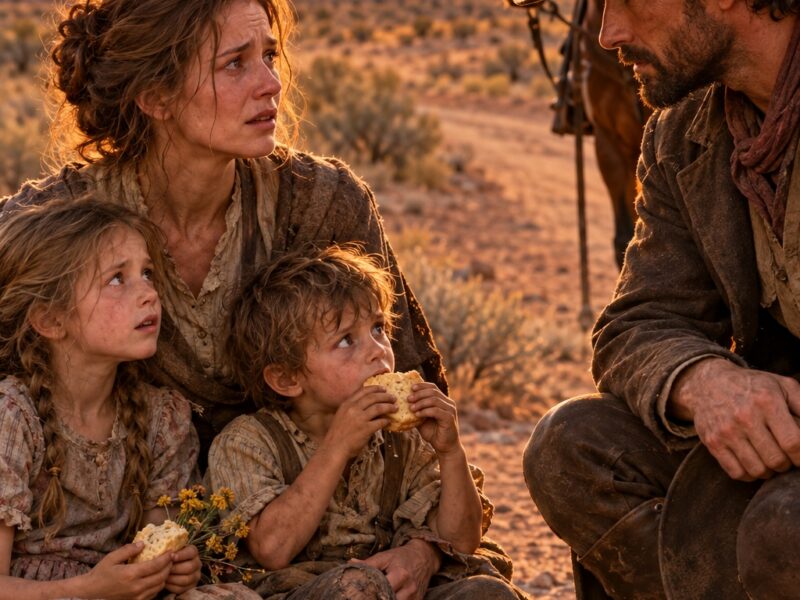
SHE WAS TAKING HER TWO STARVING CHILDREN AWAY TO GIVE THEM UP—UNTIL A LONELY COWBOY TOLD HER WHAT HAPPENED TO HIS LITTLE BROTHER
The widow had twelve miles to walk before she would lose her children.
Her seven-year-old daughter thought they were going to visit a church.
Her little boy thought they were going somewhere they could finally eat.
Neither knew their mother had packed their clothes because she didn’t expect to bring them home.
And neither knew that a stranger waiting on a lonely Arizona road carried a secret that could change all three of their lives.
By the time the sun rose over Cinder Creek, Maren Whitlock had counted the dried peas four times.
Thirty-seven.
She spread them across the kitchen table, separating the cracked ones from the whole ones, as though being careful might somehow make them multiply.
Outside, the Arizona desert lay beneath a cloudless sky. The ground had hardened into pale, broken plates. Beyond the washhouse, the remains of the family garden stood in crooked rows, its stalks brittle enough to crumble between her fingers.
The last rain had come almost five months earlier.
Her husband had been dead for three weeks.
And her children were hungry.
Not the ordinary hunger that came before supper.
The kind that made a child stop asking when supper would be ready.
Maren swept the peas into her palm and poured them back into the tin cup.
From the other room came a small cough.
Then another.
She turned toward the sound.
Noah was sitting on the edge of the narrow bed he shared with his sister, his bare feet dangling above the floor. At four years old, he had Caleb’s brown eyes and the same stubborn cowlick that refused to lie flat.
But his cheeks had grown hollow.
His nightshirt hung from shoulders that seemed smaller every morning.
“Mama?”
“I’m here, sweetheart.”
“Is today Sunday?”
“No. It’s Thursday.”
He considered this.
“Do we eat better on Sundays?”
Maren gripped the doorframe.
She remembered Sunday dinners when Caleb had still been alive. Beans simmering with salt pork. Cornbread cooling on the windowsill. Elsie stealing bits of crust when she thought nobody was looking.
There had never been much.
But there had always been enough.
“Sometimes,” Maren answered.
Noah nodded, satisfied by a promise she hadn’t made.
“Then I hope Sunday comes fast.”
She crossed the room and knelt before him.
“Come here.”
He leaned against her, light as a bundle of laundry.
Maren closed her eyes.
She could still remember how heavy he’d felt when Caleb carried him home from the creek one summer afternoon, laughing because the boy had eaten so many blackberries he’d made himself sick.
Now she could feel every small bone in his back.
Elsie stirred beneath the quilt.
“Is Papa coming home today?”
The question had become less frequent since the funeral, but it still appeared at the worst moments.
Maren brushed a strand of hair from her daughter’s forehead.
“No, honey.”
Elsie looked at her for a long moment.
“I dreamed he was.”
“I know.”
“He said the garden was going to grow again.”
Maren’s throat tightened.
“That sounds like something he’d say.”
Elsie sat up.
“He wasn’t sick in the dream.”
Maren looked away.
Caleb had died after an injury sustained while hauling feed from a neighboring settlement. A wagon wheel had broken on a steep stretch of road, throwing him against a rock.
He had managed to get home.
For two days, he’d insisted the pain would pass.
By the third, fever had taken hold.
Maren had ridden for a doctor, but the nearest physician was almost a day’s journey away.
When she returned, Caleb was barely conscious.
His last clear words had been about the children.
“Keep them together, Mare.”
She had promised.
At the time, she hadn’t understood how cruel a promise could become when the person who asked for it was no longer there to help keep it.
Maren prepared breakfast with water, a little salt, and twelve of the peas.
She boiled them until they softened, then crushed them against the side of the pot and divided the thin broth between two chipped bowls.
Elsie stared at hers.
“Where’s yours, Mama?”
“I ate before you woke up.”
She had told that lie so often it came without hesitation.
Elsie looked at the empty stove.
“What did you eat?”
“Some leftovers.”
“From yesterday?”
“Yes.”
There had been no leftovers yesterday.
There had been nothing yesterday except a few spoonfuls of watered-down cornmeal.
Elsie lowered her eyes and picked up her spoon.
Maren turned toward the window.
Behind the washhouse stood Caleb’s grave.
The wooden cross leaned slightly to the left.
She had tried to straighten it twice, but the earth was too dry to hold the post.
For a moment, she imagined him coming through the back door, wiping sweat from his forehead, asking why the house was so quiet.
She almost heard his boots.
Then Noah scraped the bottom of his bowl.
“Can I have some more?”
Maren went still.
Elsie immediately pushed her own bowl across the table.
“You can have mine.”
“No, Elsie,” Maren said.
“I’m not hungry.”
Her daughter’s voice was too practiced.
Maren knew another lie when she heard one.
“Finish your breakfast, both of you.”
Noah looked from one face to the other.
Then he pushed the bowl back.
“It’s okay, Mama.”
He tried to smile.
“My tummy can wait.”
Maren walked outside before either child could see her cry.
She stood beside the washhouse, one hand pressed over her mouth, and stared at the crooked cross until her tears stopped.
Then she returned to the kitchen.
By noon, she had made her decision.
Mercy Chapel stood twelve miles south of Cinder Creek, just beyond a low ridge where the road split toward Redwater.
Pastor Bell had once visited the Whitlock property to pray over Caleb’s grave.
Before leaving, he had quietly mentioned that the chapel helped families who could no longer support their children.
He had spoken carefully.
There were respectable households farther east, he said. Farming families with good reputations. Couples who had lost children of their own.
Sometimes permanent homes could be arranged.
Maren had been offended.
She remembered standing straighter, even as exhaustion made her knees tremble.
“My children have a home.”
Pastor Bell had looked toward the empty pantry.
“Of course they do, Mrs. Whitlock.”
She had closed the door before he finished speaking.
Now, three weeks later, she unfolded the small card he’d left behind.
Mercy Chapel — Pastor Samuel Bell.
She read the words until they blurred.
Then she set it beside the last peas.
There were decisions a mother made because she loved her children.
There were decisions she made because she feared losing them.
Maren no longer knew which kind this was.
She took the old flour sack from beneath the bed and began packing.
One spare dress for Elsie.
A blue hair ribbon.
Noah’s Sunday shirt.
Two pairs of stockings, both mended so many times that the original fabric was almost impossible to identify.
At the bottom, she placed a small wooden horse Caleb had carved for Noah.
The boy called it Thunder.
One of its legs was shorter than the others, so it never stood straight.
Caleb used to say that made it special.
Maren held the toy in her hands.
Then she put it carefully into the sack.
She brushed Elsie’s hair, tied the ribbon, and washed Noah’s face with the last clean water in the basin.
Elsie watched her with growing curiosity.
“Are we going somewhere nice?”
“We’re going to see Pastor Bell.”
“Why?”
Maren worked the brush through a knot.
“Because he might be able to help us.”
“With the garden?”
“With things.”
Elsie turned in her chair.
“Will Papa’s friend Mr. Haskell be there?”
“I don’t think so.”
“Will we come home before dark?”
Maren stopped brushing.
Outside, the wind moved dust across the porch.
“I don’t know, sweetheart.”
Elsie’s smile faded.
“Mama?”
“Yes?”
“Are you sick?”
Maren set the brush down.
“No.”
“Then why do you look like you’re going to cry?”
Maren knelt in front of her.
She wanted to explain everything.
The empty flour jar.
The unpaid debt at the mercantile.
The landlord who had visited two days earlier and warned that the grazing lease would not be renewed without payment.
The way she had stood beside Caleb’s grave that morning and wondered whether she could forgive herself for what she was about to do.
Instead, she kissed Elsie’s forehead.
“Because I love you so much.”
Elsie wrapped her arms around her mother’s neck.
“Then don’t cry.”
Maren held her daughter until Noah asked whether they could leave.
The desert road seemed longer than Maren remembered.
By early afternoon, the sun stood directly above them.
Heat shimmered over the rocks. Dust rose around their ankles, coating their shoes and the hems of their clothes.
Maren carried the flour sack over one shoulder.
Noah walked beside her, dragging Thunder through the air as though the wooden horse were galloping.
Elsie had found a small yellow flower growing in the shadow of a boulder.
She carried it carefully between two fingers.
“Look, Mama.”
“That’s pretty.”
“I’m saving it for you.”
“Why?”
Elsie smiled.
“Because you haven’t had anything pretty since Papa went away.”
Maren stared at the flower.
Something sharp moved through her chest.
She wanted to turn around.
She wanted to take them home, lock the door, and pretend there was still a way to survive without anyone’s help.
But she had already tried pretending.
Pretending the well would recover.
Pretending someone would offer her work.
Pretending the landlord would wait.
Pretending Noah’s coughing would stop.
Pretending hunger wasn’t slowly changing her children.
She kept walking.
After six miles, Noah stumbled.
His knees struck the road.
He didn’t cry at first.
He simply sat in the dust, looking confused.
Maren dropped the sack and knelt.
“Baby?”
“My legs won’t work.”
She lifted him.
He was hot, his skin dry beneath her fingers.
“Can we go home?”
The question almost finished her.
“Not yet.”
He rested his head against her shoulder.
“I want Papa.”
“I know.”
“Papa always carried me when I was tired.”
Maren adjusted his weight against her hip.
“Then I’ll carry you.”
Noah closed his eyes.
“You’re not as big as Papa.”
“No,” she whispered. “I’m not.”
Elsie walked quietly beside them.
A mile later, she offered her mother the flower.
Maren tucked it into the collar of her faded dress.
She would later remember that simple gesture more clearly than anything else about the journey.
Her daughter’s small hand.
The yellow petals.
The terrible thought that tomorrow nobody might be there to brush Elsie’s hair.
Then, in the distance, she heard hoofbeats.
The rider approached from the north.
At first, he was little more than a dark shape moving through the heat.
Then Maren saw a broad-shouldered man in a weathered brown coat, sitting easily on a dark bay horse.
His hat was low.
A rifle rested in a saddle scabbard.
Maren stepped in front of Elsie.
She had learned that a woman alone on a desert road could not afford carelessness.
The cowboy slowed several yards away.
“Afternoon, ma’am.”
Maren nodded.
He removed his hat.
“Silas Rourke.”
She said nothing.
“Didn’t mean to startle you.”
“We’re fine.”
His gaze moved toward Noah, asleep against her shoulder.
“That’s a fair piece of road to be walking with little ones.”
“We know where we’re going.”
Silas looked toward the distant ridge.
“Mercy Chapel?”
Maren stiffened.
“Yes.”
He nodded once.
Then he reached into his saddlebag.
Maren moved backward.
The cowboy stopped immediately.
“Just food,” he said.
He withdrew a cloth bundle and unwrapped two biscuits and several strips of dried beef.
“Got more than I need.”
“We don’t accept charity.”
Silas folded the cloth back over the biscuits.
“Well, that’s unfortunate.”
Maren lifted her chin.
“Why?”
“Because I was hoping you’d do me a favor.”
She looked suspicious.
“What favor?”
“Help me keep these biscuits from going stale.”
Despite everything, Elsie gave a tiny smile.
Noah stirred at the sound of voices.
Then his stomach growled.
Loudly.
The cowboy’s expression did not change.
He merely extended the bundle.
Maren stared at it.
She had once believed there were things she would never do.
Beg.
Take food from strangers.
Let her children see her helpless.
Now she understood that pride was easier to defend when there was bread in the house.
“Thank you,” she whispered.
She accepted the bundle.
Noah ate too quickly, choking on his first mouthful.
Maren rubbed his back and made him slow down.
Elsie broke her biscuit in half and tried to give some to her mother.
“Eat yours,” Maren said.
“But you haven’t—”
“I had breakfast.”
Silas looked away.
Not because he believed her.
Because he didn’t want to embarrass her.
After the children finished, he reached for his canteen.
“Water’s fresh.”
Maren hesitated.
“There’s plenty.”
He handed it down.
They drank.
For the first time all day, color returned to Noah’s cheeks.
The cowboy watched the boy carefully.
Then he asked, “What takes you to Mercy Chapel?”
Maren’s fingers tightened around the canteen.
“Business.”
“Pastor Bell?”
“Yes.”
Silas nodded.
“Good man, as far as I’ve heard.”
That should have ended the conversation.
But perhaps it was the food.
Or the way he’d kept his distance.
Or the fact that she was so exhausted she no longer had the strength to protect herself from every stranger.
Maren lowered her voice.
“He helps families.”
Silas waited.
“Families who can’t manage.”
Still, he said nothing.
She glanced toward her children.
Elsie was showing Noah how to make Thunder gallop along the edge of a flat stone.
Maren’s voice trembled.
“He finds homes for children.”
The cowboy’s face changed.
Not dramatically.
His eyes simply became still.
“What kind of homes?”
“Good ones.”
“Permanent?”
Maren looked down.
“I don’t know.”
Silas dismounted.
Slowly, without sudden movement, he led his horse toward a patch of shade beside the road.
Then he turned back to her.
“Are you taking those children there to give them away?”
Maren flinched.
The question struck harder than an accusation.
“I am taking them somewhere they’ll be fed.”
Silas looked toward Noah.
“And you’ve got no other choice?”
“No.”
She hated how quickly she’d answered.
Silas rested one hand against the saddle.
For several seconds, the only sound was the soft creak of leather and the distant hiss of wind through dry grass.
Then he said, “When I was nine, my mother died.”
Maren looked up.
“My father had a small place outside Cottonwood Crossing. We weren’t rich, but we were managing until fever took her.”
He swallowed.
“I had a little brother. Jonah.”
The name seemed to hurt him.
“He was four. About the size of your boy.”
Maren stood motionless.
“After Ma died, the crops failed. Father sold the mules. Then the seed grain. Then he started drinking.”
Silas ran a hand over his jaw.
“One day a wagon family came through. Said they wanted a son. Had money and a proper house back east.”
He paused.
“My father told me Jonah would be better off with them.”
The desert suddenly felt cold.
“I helped pack his clothes,” Silas continued. “Put his wooden whistle in the bag. Told him he’d see mountains and green fields.”
His voice roughened.
“Jonah didn’t understand. He kept asking when he could come home.”
Maren pressed her hand against her mouth.
“My father said we’d visit. Said it wasn’t forever.”
Silas stared past her toward the distant hills.
“I believed him.”
“What happened?” Maren whispered.
The cowboy looked back at her.
“I never saw my brother again.”
For a moment, she could hear nothing.
Then Elsie laughed softly as Noah made Thunder jump over a stone.
Silas glanced toward them.
“Forty years I’ve wondered whether he had enough to eat. Whether somebody held him when he was afraid. Whether he thought we stopped loving him.”
Maren couldn’t speak.
“Maybe he had a fine life,” Silas said. “I pray he did.”
He put his hat back on.
“But I don’t know.”
She looked at the road south.
Only a few miles remained.
Until that moment, Mercy Chapel had seemed like an answer.
Now, for the first time, she saw it as a question whose consequences might last forever.
“There’s a ranch north of Black Mesa,” Silas said.
Maren turned back.
“Hollis Ranch.”
“I’ve heard of it.”
“They need a cook.”
“Most ranches need strong men, Mr. Rourke. Not widows with children.”
“A cook doesn’t need to ride fence.”
“She does need to feed people.”
“Can you cook?”
The question almost offended her.
“I fed a husband and two children for nearly ten years.”
“Then I’d say you’re qualified.”
Maren shook her head.
“You make it sound simple.”
“It isn’t.”
Silas stepped closer, still leaving enough distance that she didn’t feel cornered.
“There’s a bunk cabin behind the smokehouse. Needs repairs, but it has a roof. There’s a schoolhouse four miles down the road.”
She stared at him.
“How do you know all this?”
“I’ve worked there.”
“Then you know the owner?”
“Some.”
“Would he hire me?”
Silas hesitated.
“That’s something we’d have to discuss.”
Maren felt the fragile hope inside her begin to harden into caution.
“I can’t carry two children all the way north just to be turned away.”
“No, ma’am.”
“I won’t make promises to them I can’t keep.”
Silas looked at Noah’s wooden horse.
“Neither would I.”
There was something in his face she couldn’t explain.
A loneliness deeper than the desert.
A man who had learned to speak carefully because careless words had once cost him something precious.
Silas reached into his coat and took out a small leather pouch.
Maren immediately stepped backward.
“No.”
“I haven’t offered anything yet.”
“I know what you’re about to offer.”
He closed the pouch.
“Fair enough.”
She took a breath.
“I’ve sold everything worth selling. I owe money in town. Our land lease is ending. My husband is buried behind our house, and I can’t even afford a proper stone.”
Silas listened.
“I don’t need another man telling me everything will work out.”
“I wasn’t going to.”
“I need work. Real work. Something I can earn.”
He nodded.
“Then let’s talk about work.”
Maren looked at him for a long time.
“What would the ranch pay?”
“Depends on what needs doing.”
“That isn’t an answer.”
A faint smile touched his mouth.
“No, ma’am. It isn’t.”
She narrowed her eyes.
“You’re not very good at hiring people.”
“Been told worse.”
For the first time in weeks, Maren almost smiled.
Then Noah approached, holding his wooden horse.
“Mister?”
Silas looked down.
“Yes, son?”
“Do you have a horse?”
Silas glanced at the large bay standing beside him.
“I’ve been accused of having one.”
Noah studied the animal.
“He’s bigger than Thunder.”
“Most horses are.”
“What’s his name?”
“Judge.”
Noah considered that.
“Does he judge people?”
Silas laughed.
It was a surprised sound, rusty from disuse.
“Only people who forget his oats.”
Elsie approached cautiously.
“Can Noah touch him?”
“If his mama allows it.”
Maren looked at the animal.
Judge stood quietly, ears forward, one hind hoof resting.
She nodded.
Silas lifted Noah gently so he could reach the horse’s neck.
The boy ran his small fingers across the dark coat.
Then he turned to Maren with a smile she hadn’t seen in weeks.
“Mama, he’s warm.”
Maren felt tears rise again.
Such a little thing.
A biscuit.
A horse.
A stranger who had taken the trouble to make her son smile.
She looked toward the road south.
Then north.
And for the first time since Caleb’s death, she didn’t know which way she should go.
They reached Hollis Ranch just before sunset.
Silas had insisted the children ride Judge while he walked beside Maren.
They traveled slowly, stopping when Noah grew tired and whenever Maren needed water.
The ranch appeared beyond a long ridge, its buildings clustered around a deep well and a stand of cottonwoods.
There was a two-story house with a broad porch, a red barn, a smokehouse, and several smaller cabins.
Cattle moved behind the southern fence.
Smoke curled from a kitchen chimney.
Maren smelled bread before they reached the gate.
Her stomach cramped painfully.
Elsie lifted her head.
“Mama?”
“Yes?”
“Is somebody cooking?”
Maren nodded.
Noah leaned forward in the saddle.
“Can we eat there?”
She couldn’t answer.
A gray-haired woman stepped onto the porch as they approached.
She wore a plain green dress and carried a dish towel over one shoulder.
“Silas Rourke!”
The woman’s expression sharpened when she saw Maren and the children.
“Where have you been?”
“Out riding.”
“For half the afternoon?”
“Found company.”
The woman descended the steps.
Her gaze swept across the children, their dusty clothes, and Maren’s exhausted face.
She didn’t ask questions.
Instead, she turned toward the house.
“I’ve got stew on the stove.”
Maren hurried to speak.
“Ma’am, we haven’t agreed to anything. I came to ask about work.”
The woman stopped.
“Then we can talk about work after you sit down.”
“I don’t want to impose.”
“You’re standing on a ranch with three hundred head of cattle and a kitchen big enough to feed twenty men.”
She looked at Noah.
“One more bowl won’t bankrupt us.”
Silas lowered his head to hide a smile.
The woman extended her hand.
“Agnes Pike. Housekeeper.”
“Maren Whitlock.”
“These yours?”
“Elsie and Noah.”
Agnes looked toward Silas.
Something silent passed between them.
Then she opened the front door.
“Well, come inside before the stew gets cold.”
Maren hesitated on the porch.
The house smelled of woodsmoke, baked bread, and onions.
A clock ticked above the mantel.
Fresh curtains hung beside clean windows.
There were books on a shelf.
A vase of late-season sunflowers stood on the dining table.
It was not a grand house.
But to Maren, it felt almost impossibly rich.
Noah stood beside her, staring at the bread.
“Can I have some?”
Agnes was already reaching for a knife.
“Sit down, sweetheart.”
Maren caught the woman’s wrist.
“Please. Don’t give them too much at once. They haven’t eaten properly in days.”
Agnes’s face softened.
“All right.”
She sliced the bread thinly and poured small portions of stew into their bowls.
Maren sat beside the children, watching every spoonful.
Elsie ate carefully.
Noah tried to rush.
Maren reminded him to slow down.
Agnes refilled their water cups.
Silas remained near the doorway, hat in hand.
Maren noticed that he had not taken a seat.
“You aren’t eating?”
He shook his head.
“Later.”
“Mr. Rourke—”
“Silas.”
“Silas. You said the ranch needed a cook.”
“It does.”
“Who should I speak to?”
He glanced at Agnes.
The older woman folded her arms.
“Oh, for heaven’s sake.”
Maren looked from one to the other.
Silas sighed.
“That would be me.”
The room went still.
Maren set down her spoon.
“You own this ranch?”
“Yes, ma’am.”
She stared at him.
“You told me you worked here.”
“I do.”
“You deliberately let me think you were a ranch hand.”
“Yes.”
“Why?”
Silas looked toward the children.
“Because I wanted you to decide whether you could trust me before you knew I could offer you a job.”
Maren pushed back her chair.
“That wasn’t your decision to make.”
“No.”
His answer was immediate.
“You’re right.”
She stood.
“I told you I didn’t want promises.”
“I remember.”
“And now I’m supposed to believe you can simply bring strangers home and hire them?”
Silas met her eyes.
“I can offer you work. You can decide whether to accept.”
Agnes cleared her throat.
“Before either of you gets too proud to hear a sensible thought, perhaps Mrs. Whitlock should look at the kitchen.”
Maren glanced at the children.
Noah was licking the last stew from his spoon.
Elsie had stopped eating to watch her mother.
“Mama?”
Maren looked down.
“Are we in trouble?”
The question broke through her anger.
“No, sweetheart.”
Silas stepped back.
“No one’s in trouble.”
Agnes led Maren toward the kitchen.
It was the largest kitchen she had ever seen.
Two stoves.
A heavy wooden preparation table.
Rows of copper pans.
Barrels of flour and sugar.
A pantry stocked with potatoes, beans, rice, dried fruit, and jars of preserved peaches.
Maren stood in the doorway.
Her eyes filled.
She had spent so many days opening an empty cupboard that the sight of food in such quantities felt almost painful.
Agnes watched her carefully.
“Can you manage breakfast for twelve working men?”
Maren wiped her face.
“Yes.”
“Biscuits?”
“Yes.”
“Stew?”
“Of course.”
“Pie?”
Maren gave a small, unsteady laugh.
“If you’ve got apples.”
Agnes nodded toward a crate.
“Then we’ll manage fine.”
The cabin stood behind the smokehouse.
It was smaller than the Whitlock home, with two rooms, a narrow porch, and a stone hearth.
One windowpane was cracked.
The front step sagged.
But the roof looked sound.
A small iron bed stood against the wall, and there was room for two children’s pallets.
Silas opened the door.
“It isn’t much.”
Maren walked inside.
She touched the mantel.
There was dust, but no mold.
No signs of leaking.
A water pump stood twenty yards away.
Behind the cabin, a little patch of earth had been fenced off from the cattle.
“Could that be a garden?” she asked.
Silas followed her gaze.
“Suppose it could.”
“Does the well hold through summer?”
“Deepest well in the valley.”
She looked out at the cottonwoods.
Their leaves moved gently in the evening breeze.
She remembered her own garden.
The cracked earth.
The empty jars.
Caleb’s crooked cross.
“How much would you pay?”
Silas named a monthly wage, plus the cabin and meals.
Maren looked at him sharply.
“That’s more than most ranch cooks earn.”
“Most don’t manage the house kitchen as well.”
“You don’t know how I cook.”
“Agnes will.”
Maren held his gaze.
“You’re doing this because of your brother.”
Silas did not deny it.
“Partly.”
“I don’t want to be anybody’s replacement.”
“You’re not.”
“And my children aren’t your brother.”
“I know.”
The firmness in his voice surprised her.
He looked toward Elsie and Noah, who were playing quietly near Judge.
“I couldn’t save Jonah. I know that.”
He rested a hand on the doorframe.
“But if I’ve got work that needs doing and you need work to keep your family together, I don’t see why either of us should pretend otherwise.”
Maren looked around the cabin.
For the first time in weeks, she pictured a tomorrow that did not frighten her.
The children sleeping safely.
Bread on the table.
A fire in the hearth.
Perhaps a garden.
Perhaps a life that was still theirs.
She turned back.
“I’ll take the position on one condition.”
Silas raised an eyebrow.
“Only one?”
“The children stay with me.”
“Of course.”
“Even if they’re noisy.”
“Judge’s noisier.”
“Even if Noah follows me into the kitchen.”
“Agnes might have something to say about that.”
“Even if I need time off when they’re sick.”
Silas nodded.
“Families get sick.”
She swallowed.
“And if the work doesn’t suit, you’ll tell me before you put us out.”
His expression changed.
“Mrs. Whitlock, I wouldn’t put children out on the road.”
Maren held his gaze.
“People say things when life is easy.”
He accepted the rebuke without looking away.
“Then you can judge me by what I do when it’s hard.”
She considered him.
Then held out her hand.
“All right, Mr. Rourke.”
He shook it.
“All right, Mrs. Whitlock.”
Behind them, Noah called out.
“Mama! Judge likes me!”
For one brief moment, the world seemed almost ordinary.
Maren didn’t yet know how fragile that peace would be.
The first two weeks at Hollis Ranch were harder than she expected.
Maren rose at four every morning to light the kitchen stove.
She rolled biscuits, stirred porridge, fried salt pork, and prepared coffee strong enough to wake men who had spent the previous day riding through dust.
By sunrise, the kitchen filled with cowboys.
Boots scraped against the floor.
Chairs dragged across the boards.
Men shouted greetings and complained about the weather.
At first, they stared at the quiet widow working beside Agnes.
One hand asked if she knew how to feed real ranchers.
Maren looked at his empty plate.
“If you keep eating this slowly, I may have to learn.”
The others laughed.
The man grinned.
By the end of the week, he was asking for a second helping of her biscuits.
Elsie helped Agnes gather eggs.
Noah followed Silas whenever he was permitted, asking questions about cattle, horses, saddle horns, branding irons, and why Judge disliked one particular mule.
Maren began to recognize the sound of her children’s laughter again.
It came slowly.
Like rain returning to a valley that had forgotten it.
But happiness brought its own fears.
Every evening, after putting the children to bed, she counted the wages she had earned.
She wrote down the cost of shoes.
The money owed in Cinder Creek.
The rent she still owed on the Whitlock place.
And the cost of a proper marker for Caleb’s grave.
She told herself she was safe as long as she worked.
Yet every morning she worried that someone would change his mind.
That Agnes would decide she was too slow.
That Silas would tire of having children underfoot.
That an injury or illness would destroy everything again.
One evening, Agnes found her scrubbing an already clean kitchen floor.
“You’re going to wear a hole through those boards.”
Maren kept working.
“Didn’t quite finish.”
“You finished an hour ago.”
Maren said nothing.
Agnes lowered herself into a chair.
“Silas isn’t going to throw you out because you sit down.”
Maren stopped scrubbing.
The older woman studied her.
“You’ve been waiting for the other shoe to drop since the day you arrived.”
Maren wrung out the cloth.
“Maybe I have.”
“Why?”
She gave a tired smile.
“Because it usually does.”
Agnes looked toward the doorway.
Beyond it, Noah could be heard laughing at something Silas had said.
“Well,” she answered quietly, “maybe this time you’ve found a different pair of shoes.”
The trouble came on a Tuesday.
Maren had just finished preparing the noon meal when a wagon rolled into the yard.
The driver was a heavyset man in a dark waistcoat, his beard trimmed close.
She recognized him immediately.
Edwin Haskell.
The man who held the Whitlocks’ grazing lease.
He climbed from the wagon and removed his gloves.
“Mrs. Whitlock.”
Maren’s stomach tightened.
“Mr. Haskell.”
“Been looking for you.”
“I sent word that I’d found employment.”
“So I heard.”
He surveyed the ranch house with an expression that was almost amused.
“Seems you’ve landed on your feet.”
“I’ve been working.”
“Of course.”
He took an envelope from his coat.
“Then perhaps you’ll have money to settle your obligations.”
Maren looked at the paper.
“What obligations?”
“The remaining lease payment. Interest. Collection costs.”
“I told you I couldn’t pay until I sold the equipment.”
“You already sold the equipment.”
“Some of it.”
He handed her the envelope.
Inside was a statement listing charges she had never seen before.
Maren read it twice.
“This isn’t the amount we owed.”
“It is now.”
“Caleb said the lease was paid through the harvest.”
“Your husband said many things.”
Her face went hot.
“Don’t speak about him that way.”
Haskell slipped his gloves back on.
“Mrs. Whitlock, sentiment doesn’t settle accounts.”
Maren folded the statement.
“I’ll have the agreement reviewed.”
“By whom?”
She looked up.
His smile thinned.
“You’re a widow working in another man’s kitchen. I doubt you can afford a lawyer.”
A voice sounded from the doorway.
“She doesn’t need to afford one just to have somebody read a contract.”
Silas stood on the porch.
He had heard enough to understand.
Haskell straightened.
“Mr. Rourke.”
“Mr. Haskell.”
“This is private business.”
Silas looked toward Maren.
“Is it?”
She took a breath.
“He’s claiming my husband owed more than we agreed.”
Silas held out his hand.
“May I see?”
Haskell stepped forward.
“You have no standing in this matter.”
Silas ignored him.
Maren gave him the paper.
He scanned it.
His expression hardened.
“These charges weren’t part of the original lease.”
Haskell laughed.
“You haven’t seen the original.”
“No.”
Silas handed the statement back to Maren.
“But I’d like to.”
Haskell’s expression changed.
He glanced toward the house, where Agnes stood watching.
“This doesn’t concern your ranch.”
Silas looked him directly in the eye.
“Then stop conducting it in my yard.”
For a moment, neither man spoke.
Finally, Haskell returned to his wagon.
“You have until the first of next month, Mrs. Whitlock.”
Maren stood rigid.
“To do what?”
“Pay what you owe.”
He climbed onto the seat.
“Or the remaining personal property at the Whitlock place will be taken to satisfy the debt.”
He flicked the reins.
The wagon rolled away.
Maren remained where she stood.
Her hands were trembling.
Silas approached.
“Mrs. Whitlock—”
“Please don’t.”
He stopped.
She looked at the road where Haskell had disappeared.
“I thought finding work would be enough.”
Silas waited.
Maren swallowed.
“I thought if I worked hard enough, I could stop being afraid.”
He said nothing.
She folded the statement into a small square.
“I was wrong.”
That evening, Silas rode to Cinder Creek.
Maren didn’t know until Agnes mentioned it over supper.
“Where did he go?” she asked.
“Had business.”
“What business?”
Agnes looked at her.
“Likely his own.”
Maren hated being left in the dark.
She hated even more that some part of her hoped Silas was trying to help.
Her husband had been a proud man.
Caleb had always said that debts were easier to repay than favors.
Now Maren wasn’t certain he had been right.
A debt came with a number.
A favor could become anything the person giving it wanted.
Silas returned after dark.
She was waiting on the porch.
“Did you go to see Haskell?”
He removed his hat.
“Not exactly.”
“Silas.”
“I went to the county recorder.”
Maren stared at him.
“Why?”
“To look at the Whitlock lease.”
“You had no right.”
“I didn’t enter your home or take your papers. County filings are available to be examined.”
She crossed her arms.
“And?”
He hesitated.
“There’s something you ought to see.”
Silas reached into his saddlebag and withdrew several copied pages.
They sat at the kitchen table while Agnes took the children to bed.
He spread the papers beneath the lamp.
“The agreement was recorded six years ago.”
Maren recognized Caleb’s signature.
Her fingers touched the ink.
For a second, she could hardly breathe.
Silas continued.
“The lease provided for annual payment, but it also gave your husband an option to purchase the grazing land at a fixed price.”
Maren frowned.
“I know.”
“Did Caleb ever exercise that option?”
“He tried. Last winter.”
She looked up.
“He sold forty head of cattle. Said he could finally buy the place.”
Silas grew still.
“What happened?”
“Haskell told him the sale wasn’t possible because of an old water-right dispute.”
“Did Caleb get his money back?”
Maren shook her head slowly.
“No.”
The room seemed to narrow.
“Caleb said Haskell was holding it until the papers cleared.”
Silas placed another document in front of her.
It showed a payment acknowledgment, signed by Haskell.
Beneath it was a copy of a filed notice concerning the land.
Maren read the lines.
Then read them again.
“I don’t understand.”
Silas leaned forward.
“The records suggest Haskell accepted your husband’s purchase money.”
“Yes.”
“But the transfer was never completed.”
“Because of the water rights.”
Silas shook his head.
“I found no recorded dispute affecting that parcel.”
Maren stared at the paper.
Her heart began to pound.
“Are you saying he lied?”
“I’m saying the records don’t match his story.”
She pressed her hand against the table.
Caleb had spent months believing they would finally own their home.
He had talked about putting in a second well.
About planting trees.
About building a proper room for Elsie.
And after his death, Haskell had stood on their porch and told her she owed more money.
Maren looked at Silas.
“What do we do?”
He didn’t answer immediately.
“We take the papers to someone who understands the law.”
She nodded, almost mechanically.
Then she looked down at Caleb’s signature.
For the first time since his death, she felt something stronger than grief.
Anger.
The attorney in Redwater was a careful man named Thomas Vale.
He examined the documents over the course of an afternoon, occasionally removing his spectacles to rub his eyes.
Maren sat beside Silas, her hands folded tightly in her lap.
At last, Vale set the papers down.
“Mrs. Whitlock, I can’t tell you without further investigation whether Mr. Haskell intended to defraud your husband.”
Maren nodded.
“But I can tell you he has some serious questions to answer.”
“What about the debt?”
“Much of it appears unsupported by the agreement. And the purchase payment changes the situation considerably.”
Maren stared at him.
“Can he take the house?”
“Not while we’re contesting these claims through the proper process. I would also want to establish precisely what rights your husband acquired.”
She looked at Silas.
He gave a small nod.
For the first time, the ground beneath her feet felt solid.
Vale continued.
“Do you have any letters from your husband discussing the purchase?”
“Maybe.”
“Receipts?”
“Caleb kept them in a tin box.”
“Where?”
“At the house.”
“Then we’ll need those.”
Maren looked down.
She had avoided returning to the Whitlock property.
The thought of walking past Caleb’s grave, opening the door, and finding the silence waiting inside had seemed unbearable.
Now she realized she would have to go back.
Not to surrender.
To recover what he’d left behind.
They rode to Cinder Creek the following morning.
Silas drove the wagon.
Agnes stayed with the children.
Maren had insisted on going without them.
The road seemed different this time.
The same red hills.
The same dry brush.
The same distant ridge.
But she was no longer carrying a sleeping child while wondering whether she’d ever hold him again.
She sat upright beside Silas, a small leather folder resting in her lap.
As the old house came into view, she stopped breathing.
The porch sagged.
Dust coated the windows.
The garden had died completely.
Behind the washhouse stood the crooked cross.
Silas pulled the wagon to a stop.
Maren didn’t move.
“You can stay here a moment,” he said.
She shook her head.
“No.”
She climbed down.
The door stuck when she turned the handle.
Inside, the air smelled of dust and old wood.
The bowls were still on the table where she’d left them.
A child’s drawing lay beside the stove.
Caleb’s work coat hung on a peg.
Maren touched the sleeve.
For an instant, she imagined his hand closing around hers.
She swallowed and turned toward the bedroom.
The tin box was beneath the bed, wrapped in an old blanket.
Inside were seed receipts, the marriage certificate, the children’s birth records, and several folded pages in Caleb’s handwriting.
Maren found the payment receipt.
Then a letter.
It was addressed to Haskell.
Caleb had written it only weeks before his death.
Maren unfolded the page carefully.
He had requested completion of the land transfer and confirmation that the purchase money had been received.
At the bottom, in his familiar uneven handwriting, he’d added a final line.
My wife and children deserve a home no man can take from them.
Maren lowered herself onto the bed.
The paper shook in her hands.
Silas remained in the doorway.
He said nothing.
She looked up at him.
“Caleb wasn’t foolish.”
“No.”
“He knew something was wrong.”
Silas nodded.
Maren pressed the letter to her chest.
“He was trying to protect us.”
For a long time, she cried.
Not the restrained tears she had hidden from the children.
Not the silent grief she carried through her workdays.
She cried for a husband who had died believing he had failed.
For a house she had nearly surrendered.
For the nights when she had wondered if her children would survive.
Silas waited.
When she could stand again, he offered his hand.
She took it.
Outside, they stopped beside Caleb’s grave.
Maren knelt and straightened the cross.
This time, she packed stones firmly around the base.
“I’m going to fix this,” she whispered.
The wind moved gently through the dried grass.
“I don’t know how long it’ll take.”
She brushed dust from his name.
“But I’m going to keep them together.”
The dispute with Haskell did not end quickly.
There were documents to examine, witnesses to question, and an accounting of the money Caleb had paid.
For the first time in her life, Maren learned how exhausting it could be to demand what was rightfully yours from someone who had counted on your silence.
She attended meetings.
Signed statements.
Read documents she barely understood until Vale explained them line by line.
Silas accompanied her when asked, but never spoke in her place.
That mattered.
At first, Maren had feared that accepting his help would mean surrendering control of her life.
Instead, she found that the man who had stopped her on the desert road was unusually careful about letting her make her own decisions.
One afternoon, after a difficult meeting in Redwater, she asked him why.
They were sitting on a bench outside the courthouse.
Silas considered the question.
“Because I’ve seen what happens when people decide what’s best for a family without listening to the people in it.”
Maren looked at him.
“Your brother?”
He nodded.
“Sometimes I wonder whether my father ever asked Jonah what he wanted.”
“He was four.”
“Old enough to know he wanted to stay.”
Maren studied his face.
“Have you looked for him?”
Silas gave a humorless laugh.
“Every chance I had.”
“Where?”
“California. Colorado. New Mexico. I even wrote to a family in Kansas because I heard they had taken in a boy about his age.”
“Nothing?”
“No.”
She looked down at her hands.
“Do you know the name of the family that took him?”
Silas hesitated.
“Bellamy.”
“First names?”
“Arthur and Ruth.”
“Where were they headed?”
He looked toward the street.
“St. Louis, last we heard.”
Maren was quiet.
Then she said, “You shouldn’t stop looking.”
Silas smiled faintly.
“Forty years is a long time.”
“Yes.”
She looked directly at him.
“But it isn’t forever.”
Autumn settled over Hollis Ranch.
Maren’s wages paid for two new pairs of children’s shoes.
Noah refused to take his off at bedtime.
Elsie began attending the little schoolhouse beyond the creek.
She returned each afternoon carrying slates covered in careful letters.
One evening, she brought home an assignment.
Write about someone you admire.
Maren found her sitting by the cabin window, chewing the end of her pencil.
“Who are you writing about?”
Elsie covered the page.
“Nobody.”
Maren smiled.
“That sounds interesting.”
“You’re not supposed to read it.”
“All right.”
Later, when Elsie had fallen asleep, Maren found the paper on the table.
She tried not to look.
But the first sentence caught her eye.
My mama is the bravest person I know because she was afraid and kept walking anyway.
Maren sat down slowly.
She read the rest with tears in her eyes.
Elsie had written about the hot road.
About how her mother carried Noah when he couldn’t walk.
About a cowboy with a gentle horse.
And about the day they had arrived at Hollis Ranch.
The final sentence was simple.
I think home is where Mama stays.
Maren pressed the paper against her heart.
She had believed she needed to give her children away to save them.
But Elsie had been watching something entirely different.
A mother who had refused to stop looking for a way forward.
The letter arrived in November.
It came folded inside an envelope bearing a Missouri postmark.
Silas carried it into the kitchen during breakfast.
His face was pale.
Maren looked up from a pan of biscuits.
“What’s wrong?”
He placed the envelope on the table.
“Remember what you said about not giving up the search?”
She wiped her hands.
“Yes.”
“I wrote to a church registry in St. Louis.”
Maren stared at him.
Silas looked down.
“They answered.”
He had found a record of Arthur and Ruth Bellamy.
The couple had indeed traveled east decades earlier.
They had settled near St. Louis and raised an adopted son.
A boy registered under the name Jonah Rourke Bellamy.
Maren’s breath caught.
“Silas.”
He sat down heavily.
“The registry says he married. Had children.”
She looked at the page.
“Does it say where he is?”
Silas swallowed.
“There’s an address.”
Maren waited.
He stared at the letter as though afraid to touch it.
For forty years, he’d imagined this moment.
He’d pictured his brother as a child.
Then a young man.
Then someone he might pass on a street without recognizing.
Now there was an address.
A name.
A possibility.
“Are you going to write?” Maren asked.
Silas looked at her.
“What if he doesn’t want to hear from me?”
She pulled out a chair.
“What if he’s spent forty years wondering where you are?”
Silas pressed his fingers against his eyes.
“I promised him I’d come.”
Maren’s voice softened.
“You were nine.”
“I remember him asking me not to let go.”
She reached across the table and placed her hand over his.
“Then tell him.”
Silas lowered his head.
“Tell him what?”
“The truth.”
He looked up.
Maren squeezed his hand.
“That you never stopped loving him.”
The letter took nearly two weeks to write.
Silas began it six times.
He tore up pages.
Crossed out sentences.
Stared at the blank paper until Agnes threatened to hide the inkwell.
Finally, one evening, he brought his latest attempt to Maren.
“Would you read it?”
She looked surprised.
“Are you sure?”
He nodded.
She unfolded the page.
It was short.
Dear Jonah,
I don’t know if you remember me.
My name is Silas Rourke, and I was your older brother.
When you were four, our father sent you away with a family named Bellamy. I was nine. I told you that I would come find you.
I am sorry it took me so long.
I have searched for you in every way I knew.
I don’t know what kind of life you’ve had or whether you want to know me now.
But I need you to understand one thing.
I did not let you go because I wanted to.
I loved you then.
I love you still.
Your brother,
Silas.
Maren read it twice.
Then she folded it carefully.
“It’s enough.”
He looked doubtful.
“Doesn’t explain everything.”
“No.”
She placed the letter back in his hand.
“But it explains the thing that matters most.”
He mailed it the following morning.
Then they waited.
By December, the legal dispute had begun moving in Maren’s favor.
The records showed Caleb had paid a substantial portion of the agreed purchase price and that Haskell had not completed the required transfer.
Vale secured a court order preventing Haskell from disposing of the property while the dispute was pending.
Months of uncertainty still lay ahead.
But Maren no longer faced the immediate loss of everything Caleb had worked for.
She had money saved.
Her children were healthy.
Noah’s ribs no longer showed through his shirt.
Elsie had grown nearly an inch.
The garden behind the cabin had been prepared for spring.
And the little wooden horse called Thunder now sat on a shelf beside two new books.
One evening, Silas arrived carrying a small parcel.
It contained a brass plaque.
Maren read the engraving.
Caleb Whitlock.
Beloved Husband and Father.
She looked up, startled.
“Silas.”
He held out the parcel.
“You mentioned wanting a proper marker.”
“I can’t accept—”
“It’s not meant to replace anything.”
She looked at the plaque again.
Silas spoke gently.
“He deserved to be remembered.”
Maren felt the familiar urge to refuse.
To protect herself with pride.
Then she thought of Caleb’s grave.
The crooked cross.
The years her children would remember him.
“Thank you,” she whispered.
Silas nodded.
“You’re welcome.”
The next day, they took the children to Cinder Creek.
Maren attached the plaque to a solid new wooden cross while Elsie laid wildflowers at its base.
Noah placed a small stone beside the grave.
“Papa,” he said quietly, “I’ve got new shoes.”
Maren turned away.
Silas stood several paces back, giving the family privacy.
After a while, Elsie approached him.
“Mr. Silas?”
“Yes?”
“Do you think Papa knows we’re okay?”
Silas looked toward the grave.
“I don’t know exactly how those things work, sweetheart.”
Elsie nodded.
Then he added, “But if your father loved you half as much as your mother says he did, I reckon being okay is what he’d want most.”
Elsie considered that.
Then she slipped her small hand into his.
And Silas stood very still.
The second letter arrived four days before Christmas.
Silas was in the barn when Agnes saw the mail wagon approaching.
She took the envelope from the driver.
Missouri.
The handwriting was unfamiliar.
Agnes carried it straight to Maren.
Together, they found Silas repairing a saddle strap.
Maren held out the envelope.
His hands stopped moving.
For several seconds, he simply stared.
“Is it—”
She nodded.
“I think so.”
Silas stood.
He wiped his hands on a cloth, but they were still trembling when he broke the seal.
Inside was a folded letter.
He read the first line.
Then he sat down.
Maren stepped toward him.
“Silas?”
He covered his mouth.
She could see his eyes filling.
After a long moment, he held out the paper.
Maren read the opening words.
Dear Si,
Silas made a broken sound.
Nobody had called him that in forty years.
I remember you.
Maren pressed her fingers against her lips.
The letter continued.
Jonah remembered their mother’s blue apron.
The smell of hay in the barn.
A wooden whistle.
And his older brother holding his hand beside a wagon.
He had been told that his father was too poor to keep him.
Later, when he asked to write home, the Bellamys said they didn’t know the family’s address.
He had grown up in a loving household.
He had married.
He had children of his own.
But he had never forgotten the brother who promised to find him.
Near the bottom, Jonah had written:
I thought you had forgotten me. I am glad I was wrong.
Silas bowed his head.
Maren knelt beside him.
He was crying openly now.
Not because the past had been repaired.
It never could be.
But because one terrible uncertainty had finally ended.
His brother had lived.
His brother had been loved.
And his brother remembered him.
Silas looked at Maren.
“He wants me to visit.”
She smiled through her own tears.
“Then you’d better go.”
He laughed shakily.
“Missouri’s a long way.”
Maren tilted her head.
“So was Mercy Chapel.”
Jonah came to Arizona in the spring.
He arrived by stagecoach, wearing a dark wool coat and carrying a battered traveling case.
Silas waited outside the Redwater station.
Maren stood a short distance away with Elsie and Noah.
A man with silver at his temples stepped down from the coach.
He looked around, uncertain.
Silas took one step forward.
“Jonah?”
The man turned.
For a long moment, neither brother moved.
Then Jonah’s expression changed.
“Si?”
Silas’s face crumpled.
They crossed the distance between them and embraced.
Two men who had spent most of their lives separated by one decision made when they were children.
Neither could speak.
Jonah finally stepped back and studied his older brother’s face.
“You got old.”
Silas laughed.
“So did you.”
Jonah wiped his eyes.
“I kept your whistle.”
Silas stared.
“You did?”
Jonah opened his case.
Wrapped inside a handkerchief was a little wooden whistle, worn smooth by decades of handling.
Silas took it carefully.
He recognized the uneven carving.
He had made it himself.
For forty years, he’d pictured the wagon disappearing down the road.
Now the little boy from that wagon stood before him.
Alive.
Smiling.
Home.
Maren watched with her children beside her.
Elsie looked up.
“Mama, why are they crying?”
Maren brushed a tear from her cheek.
“Because they’re happy.”
Elsie considered that.
“Happy people cry?”
“Sometimes.”
Noah tugged at her skirt.
“Do we get to go home now?”
Maren looked toward Silas and Jonah.
Then toward the road leading north.
“Yes, sweetheart.”
She took his hand.
“We do.”
Spring rain came late that year.
But when it came, it lasted two full days.
The water filled the creek, softened the ground, and left the whole valley smelling of wet earth.
Maren stood on the porch of the cabin, watching the rain move across the fields.
Behind her, Elsie read aloud from a schoolbook.
Noah sat on the floor, making Thunder gallop between the legs of a chair.
Silas approached carrying a small basket of seed packets.
“Thought you might want these.”
Maren looked inside.
Beans.
Squash.
Corn.
Sunflowers.
She smiled.
“Trying to give me more work?”
“Something like that.”
They stood together watching the rain.
After a while, Silas said, “Vale sent word.”
Maren turned.
“The court?”
He nodded.
“The transfer’s been ordered. Once the remaining paperwork is completed, the old property will be yours.”
She stared at him.
For a long moment, she couldn’t speak.
“Caleb’s place?”
“Your family’s place.”
Maren sat down on the porch bench.
She had imagined this outcome.
Hoped for it.
Prayed for it.
Yet now that it was real, she felt strangely uncertain.
Silas sat beside her.
“What’s wrong?”
She looked toward the children.
“Nothing.”
He waited.
Maren smiled faintly.
“I spent months trying to get our home back.”
“And now?”
She watched Noah build a little stable from wooden blocks.
“Now I don’t know where home is.”
Silas looked out over the wet fields.
“You don’t have to decide today.”
She turned toward him.
He smiled.
“Rain just started. Seems a shame to rush anything.”
Maren laughed softly.
Silas reached into his coat and withdrew a small piece of folded paper.
“Jonah asked me to give you this.”
She opened it.
It was a drawing made by Jonah’s youngest granddaughter.
Two houses.
A horse.
Five people holding hands.
Across the top, in crooked letters, were the words:
Families find each other.
Maren studied the picture.
Then she looked toward her children.
One year earlier, she had believed love meant finding them a life without her.
Now she understood something different.
Love wasn’t measured by how much suffering a mother could endure alone.
Sometimes love meant admitting she needed help.
Sometimes it meant accepting a hand without surrendering her dignity.
Sometimes it meant trusting that one road did not lead only to loss.
Outside, the rain continued.
Silas rose to leave.
“Maren?”
She looked up.
“Yes?”
“If you decide to stay, there’s room.”
He hesitated.
“Not because you owe me anything.”
She smiled.
“I know.”
“And not because I need somebody to take Jonah’s place.”
“I know that, too.”
He studied her face.
“Then why are you smiling?”
Maren looked through the doorway.
Elsie had fallen asleep with her book open.
Noah was arranging Thunder beside his new shoes.
The kitchen smelled of fresh bread.
A little yellow desert flower, pressed flat between the pages of Maren’s Bible, rested on the windowsill.
She thought of the long road to Mercy Chapel.
The heat.
The dust.
The terrible weight of Noah in her arms.
The stranger who had stopped.
And the six words that had changed the direction of her life.
I never saw my brother again.
She stood and stepped beside Silas.
“Because I think,” she said quietly, “we might already be home.”
He looked at her.
For once, the man who always seemed to know what to say had no answer.
Maren took his hand.
Beyond the porch, the desert was turning green.
And inside the cabin, her children were safe.
She had once been only a few miles away from giving them up.
Instead, she had found work, friendship, a future, and the possibility of a love she had not been looking for.
The past had not disappeared.
Caleb would always be part of their lives.
Silas would always remember the years he’d lost with Jonah.
And Maren would never forget the morning she counted thirty-seven dried peas and wondered how she could keep her children alive.
But those memories no longer held the power to decide everything that came next.
For the first time in a very long while, tomorrow did not look like something to fear.
It looked like something worth waking up for.
And when Noah came running onto the porch, asking whether Judge could have a biscuit, both Maren and Silas laughed.
The little boy stopped, surprised.
“What?”
Maren knelt and gathered him into her arms.
“Nothing, sweetheart.”
She kissed his hair.
“Absolutely nothing.”
And she held him close while the rain fell over the Arizona desert.









