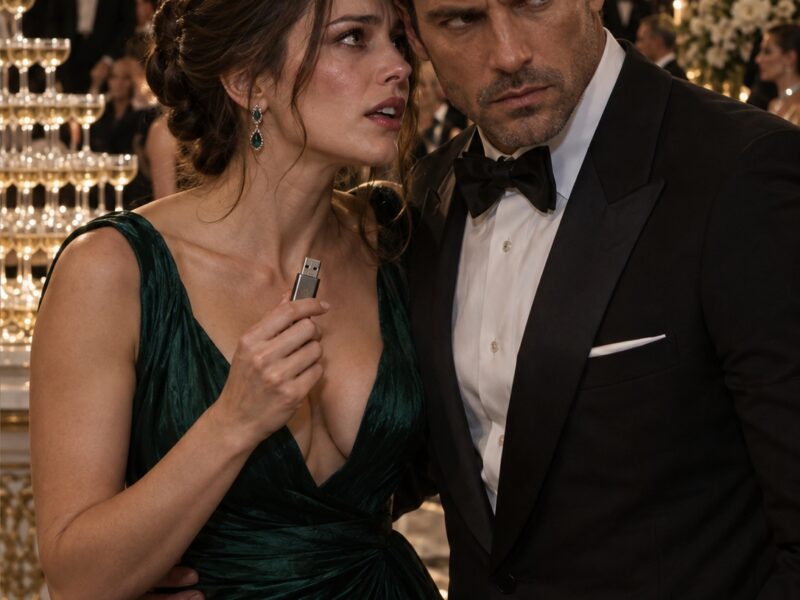
SHE WHISPERED, “DANCE LIKE YOU’RE MY HUSBAND—THERE’S A SNIPER AIMING AT YOUR HEAD.”
The first thing Sienna Mason noticed was the red dot.
Not the orchestra. Not the six-tier champagne tower glowing beneath crystal chandeliers. Not the senator laughing too loudly beside a woman wearing diamonds that could have paid off Sienna’s student loans three times over.
The red dot.
It rested for less than a second against the black lapel of Gerardo Hughes’s tuxedo, climbed toward his throat, and disappeared when a waiter crossed between them carrying a silver tray.
Then it returned.
Higher this time.
Right between his eyes.
Sienna stopped breathing.
Gerardo stood twenty feet away with one hand around a glass of bourbon, looking exactly like the kind of man everyone else in the ballroom pretended not to watch. Six-foot-three. Broad shoulders. Black tuxedo fitted with severe precision. Dark hair combed back from a face that rarely appeared in newspapers without words like investigation, waterfront, or organized crime somewhere beneath it.
He was surrounded by politicians, developers, attorneys, and businessmen who would have sworn under oath they barely knew him.
Sienna knew better.
She also knew that in approximately three seconds, Gerardo Hughes might be dead.
And if he died, she would probably be dead before lunch tomorrow.
The laser moved again.
Sienna crossed the ballroom.
She did not remember deciding to do it.
One moment she was standing beside a marble column with a stolen invitation folded inside her purse. The next, her heels were striking polished stone as she moved through laughing couples and circulating servers.
Gerardo turned just as she reached him.
His eyes landed on her face with immediate suspicion.
Sienna smiled.
It was the kind of smile women gave wealthy men at expensive parties when they wanted something.
Then she slipped her arm through his.
His entire body hardened.
“Dance with me,” she whispered.
Gerardo did not move.
“I don’t dance with strangers.”
“Tonight you do.”
His gaze dropped briefly toward her fingers locked around his arm.
“Give me one reason.”
Sienna leaned close enough that anyone watching might have mistaken the movement for intimacy.
Her lips nearly touched his ear.
“Because there’s a red dot on your forehead.”
Gerardo’s expression did not change.
That frightened her more than panic would have.
“Where?”
“South gallery. Second level. Behind the burgundy drapes.”
His fingers closed around her wrist.
Hard.
Not enough to hurt, but enough to remind her exactly what kind of man she had approached.
“You sure?”
“If I weren’t, I wouldn’t be standing beside you.”
The orchestra shifted into a slow waltz.
Gerardo placed his drink on a passing tray.
Then his hand went around her waist.
He pulled her against him so abruptly that Sienna lost half a breath.
“Smile,” he murmured.
“I am smiling.”
“You look like you’re attending a funeral.”
“If that shooter is good, I might be.”
Something almost resembling amusement flickered behind his eyes.
Then Gerardo stepped backward and dragged her onto the dance floor.
They disappeared into the moving crowd.
Sienna felt his hand tighten against her lower back as he steered her between couples. She had expected a criminal kingpin to dance like a man who considered rhythm beneath him.
Gerardo danced beautifully.
Of course he did.
Men like him learned early that control mattered everywhere.
Even here.
“Keep your head moving,” Sienna whispered.
“I know how snipers work.”
“I didn’t know whether murder came with a training manual.”
His eyes narrowed.
“You talk too much when you’re scared.”
“I’m trying not to scream.”
“That would attract attention.”
“That’s why I’m talking.”
He turned her sharply.
For one fraction of a second, Sienna saw the crimson point flash across the crystal stem of a nearby wineglass.
The shooter was tracking him.
She swallowed.
Gerardo saw it too.
His face became colder.
“Who sent him?”
“I’m not sure.”
“You walked across a ballroom and threw yourself into the line of fire without knowing who sent him?”
“I know who benefits.”
“Different question.”
“Virgil Woods.”
That changed something.
Gerardo’s grip shifted.
Not much.
But Sienna felt it.
“Virgil doesn’t use lasers.”
“He didn’t have to hire one of his own people.”
Gerardo spun her past the center of the ballroom.
“Who are you?”
“Sienna Mason.”
“That means nothing to me.”
“It shouldn’t.”
“Who do you work for?”
Her smile faltered.
The laser briefly appeared on Gerardo’s shoulder.
Sienna pulled him closer without thinking.
“For the next sixty seconds?” she whispered. “Apparently, you.”
His mouth hardened.
“Wrong answer.”
She looked up at him.
“If you die tonight, Virgil controls the South Port by sunrise. By tomorrow afternoon, he controls enough people to find me anywhere in this city.”
“And why would Virgil Woods care about finding you?”
Sienna hesitated.
Gerardo noticed.
“Whatever you’re hiding,” he said, “this would be a good time.”
“I’ll tell you when we’re not standing inside a rifle scope.”
The orchestra climbed toward a dramatic bridge.
Gerardo’s attention shifted to the kitchen doors across the ballroom.
Thirty yards.
Too far.
The shooter could anticipate a straight run.
“The next time the cello drops,” he said quietly, “I’m pushing you left.”
“What?”
“You hit the floor. Crawl behind the ice sculpture and get to the kitchen.”
“And you?”
“I’ll manage.”
“No.”
Gerardo looked at her.
Sienna could hardly believe the word had come out of her mouth either.
“You don’t give me orders,” he said.
“I didn’t risk my life walking over here so you could become a stationary target five seconds later.”
His eyes hardened.
“You risked your life because you need something from me.”
“That doesn’t make me wrong.”
The cello descended.
Gerardo moved.
His palm struck the center of Sienna’s chest.
She flew backward.
A suppressed gunshot cracked through the orchestra.
The chandelier exploded.
For half a second, the ballroom became glittering white light.
Then thousands of crystal fragments rained down.
Someone screamed.
Another gunshot hit marble.
The elegant gala vanished beneath raw panic.
Guests threw themselves beneath tables. Women in couture gowns crawled through spilled champagne. A city councilman shoved an elderly donor aside to reach the exit.
Sienna hit the floor hard enough to split the skin on her knee.
Pain flashed through her leg.
She ignored it.
“Move!” Gerardo shouted.
She crawled.
Broken glass tore into her palms.
The ice sculpture ahead of her cracked when a bullet struck its base.
Behind her, Gerardo rolled across the marble and drew a pistol from an ankle holster.
He did not fire toward the gallery.
Even in the middle of chaos, he was calculating.
Sienna reached the kitchen doors.
She grabbed one handle.
A hand seized the back of her gown.
For one terrified instant she thought someone had caught her.
Then Gerardo hauled her upright.
“Run.”
They burst through the doors.
Cooks scattered.
A tray of roasted vegetables crashed to the floor.
Steam filled the air as Gerardo pushed Sienna through the stainless-steel maze toward a rear service corridor.
Her bloody knee screamed every time her heel struck tile.
“Can you keep up?” he asked.
“Try losing me.”
He almost smiled.
Then a bullet punched through the swinging door behind them.
Gerardo’s expression changed.
“Faster.”
They hit the alley.
Rain had turned the pavement black.
A dark armored SUV idled near the dumpsters, engine running.
The driver had already stepped out.
“Boss!”
“Tommy, car!”
Another shot chipped brick inches from Gerardo’s head.
He returned three quick rounds toward the rooftop.
Not to hit.
To force the shooter down.
“Sienna!”
She dove into the back seat.
Gerardo followed.
A bullet hit the side window the instant he slammed the door.
The armored glass spiderwebbed but held.
“Drive.”
Tommy floored it.
The SUV tore into traffic.
For several blocks, nobody spoke.
Sienna pressed herself against the door and stared at the ruined silk around her knee.
Blood ran down her shin.
Now that the immediate danger had passed, her body started shaking.
Not delicately.
Violently.
Her teeth clicked.
She hated that Gerardo could see it.
He reached into his tuxedo jacket and tossed a white handkerchief into her lap.
“Pressure.”
She stared at it.
“Are you always this charming?”
“Only with women who introduce themselves by announcing assassins.”
She pressed the cloth against the wound.
Pain burned upward.
Gerardo watched her.
“You lied.”
Sienna looked up.
“About what?”
“Virgil’s man.”
“I told you he could have hired freelance.”
“You said that after I told you Virgil doesn’t use lasers.”
Her silence betrayed her.
Gerardo leaned back.
His gun rested casually against his thigh.
That frightened her too.
People only held weapons that casually when weapons had stopped feeling important.
“Who are you?” he asked again.
“You already know my name.”
“A name isn’t an answer.”
She looked toward the front.
Tommy’s eyes flicked into the mirror.
Gerardo noticed.
“Tommy.”
“Yeah, boss?”
“Take us somewhere private.”
Sienna’s stomach dropped.
“Wait.”
Gerardo turned toward her.
“Now you want to talk?”
“I’m Virgil Woods’s accountant.”
Silence filled the SUV.
Not ordinary silence.
The kind that altered the temperature of a room.
Tommy looked into the mirror again.
Gerardo did not blink.
“Accountant.”
“Forensic accountant.”
A humorless laugh escaped him.
“You threw yourself in front of a sniper because you prepare spreadsheets?”
“I found something.”
“What?”
“Something I wasn’t supposed to find.”
Gerardo waited.
Sienna looked at the blood soaking through his white handkerchief.
Two days ago she had still believed numbers were cleaner than people.
Numbers did not scream.
Numbers did not beg.
Numbers did not point guns.
But numbers could reveal exactly what monsters tried hardest to hide.
“I found discrepancies in South Port shipping manifests,” she said. “Containers listed as machine components arrived under weights that didn’t match their bills of lading. Some containers disappeared before customs inspections. The insurance records didn’t match the freight logs.”
Gerardo’s face became still.
“What was inside them?”
Sienna met his eyes.
“People.”
Tommy stopped looking into the mirror.
Gerardo’s jaw tightened.
“Be specific.”
“You know what I mean.”
“I want to hear you say it.”
Her voice grew smaller.
“Virgil is trafficking people through the port.”
Gerardo said nothing.
“Some of them were children.”
The SUV continued through the wet city.
Neon lights smeared across the windows.
“I downloaded everything,” Sienna said. “Payment records. Container numbers. Shell companies. Security schedules. Names.”
“Where?”
“Somewhere safe.”
“That answer could get you killed.”
“So could giving you the location.”
His eyes narrowed.
“There it is.”
“What?”
“The reason you warned me.”
She hated how easily he saw through her.
“You weren’t saving my life,” he continued. “You were buying yours.”
“Yes.”
The honesty surprised him.
Sienna swallowed.
“I am not heroic, Mr. Hughes. I have spent forty-eight hours sleeping in laundromats, bus stations, and the back seat of a rental car because Virgil’s men went through my apartment. My neighbor disappeared after telling them she saw me leave.”
Her voice cracked.
She stopped and forced it steady.
“I knew Virgil planned something tonight because I’d seen transfers to an outside contractor. I knew you were the target because he needs the northern docks. If he kills you, he controls enough of the waterfront to move those containers without anyone challenging him.”
“And you need me alive because?”
“Because you’re the only criminal in this city powerful enough to destroy him.”
Tommy coughed softly.
Gerardo glanced toward the front.
“You find something funny?”
“No, boss.”
Sienna gave Gerardo a tired look.
“He does.”
Gerardo ignored her.
“You expect me to believe you suddenly developed morals while working for Virgil Woods?”
“I knew he moved drugs.”
“And?”
“I knew he bribed officials. I knew he extorted businesses.”
“And that was acceptable?”
“No.”
“But acceptable enough to cash the checks.”
The accusation hit because it was true.
Sienna looked toward the rain-streaked window.
“I told myself numbers were numbers.”
Gerardo’s voice stayed cold.
“That must have helped you sleep.”
“It did.”
She turned back toward him.
“Until I saw a payment memo attached to a shipment containing twelve human beings.”
His expression did not change.
Sienna’s did.
“That was the night I stopped sleeping.”
For the first time since the ballroom, Gerardo had no immediate answer.
Finally he leaned toward the front.
“Tommy.”
“Yes?”
“Cancel the estate sweep.”
Tommy frowned.
“Boss?”
“Take us to the Glass House.”
Sienna looked between them.
“What is the Glass House?”
Gerardo’s eyes returned to her.
“You wanted a powerful criminal.”
A faint, humorless curve touched his mouth.
“You found one.”
The unfinished skyscraper stood above the city like a skeleton.
Sixty floors of steel, concrete, and empty darkness.
Gerardo had begun constructing it as a luxury tower before zoning disputes mysteriously stalled the project. Sienna suspected, within ten minutes of arriving, that the delays had not been accidental.
Nobody searched empty buildings.
Especially empty buildings privately owned by men like Gerardo Hughes.
A freight elevator carried them to the fifty-ninth floor.
Wind screamed through the open structure.
Temporary floodlights illuminated bare concrete and exposed columns.
Sienna stepped out and wrapped both arms around herself.
Her emerald gown, which had looked elegant when she entered the gala, now hung torn and bloodstained around her legs.
Gerardo removed his ruined tuxedo jacket.
“Sit.”
“Is that how you ask?”
“No.”
She sat on a plastic construction crate anyway.
Gerardo opened a duffel bag and removed a medical kit.
Sienna watched him crouch in front of her.
“What are you doing?”
“Your knee.”
“I can handle it.”
“Your hands are shaking.”
“They’re cold.”
“They were shaking in the car.”
“I had just been shot at.”
“You weren’t hit.”
“That distinction doesn’t calm the nervous system as much as you seem to think.”
His hand closed around her ankle.
Sienna stiffened.
“Relax.”
“You have a gun.”
“So?”
“You’re touching my leg while carrying a gun.”
Gerardo looked up.
“You approached me.”
“I’m beginning to reconsider that decision.”
“You should.”
He lifted the torn fabric away from her knee.
The cut was deeper than Sienna realized.
She winced.
“Needs stitches,” he said.
“Wonderful.”
“I’m using surgical adhesive.”
“You know how?”
Gerardo tore open an antiseptic packet.
“No.”
Sienna stared at him.
His mouth twitched.
Then he pressed the antiseptic into the wound.
She gasped.
“You could warn someone.”
“I did.”
“When?”
“Just now.”
“That was after—”
He cleaned the wound again.
Sienna swore.
Gerardo looked almost pleased.
“There. You still have a pulse.”
“I hate you.”
“You’ve known me less than an hour.”
“I work efficiently.”
That earned her the smallest smile.
It disappeared quickly.
He sealed the cut, bandaged her knee, then stood.
“Where are the files?”
Sienna pulled the blanket he had given her tighter around her shoulders.
“Safe.”
“We’re back to that.”
“Because it’s still true.”
“I saved your life.”
“You shoved me across a ballroom.”
“And the bullet missed you.”
“You’re asking for gratitude on a technicality.”
“I’m asking for the drive.”
Sienna studied him.
He had rolled his shirtsleeves to his forearms. Dark ink disappeared beneath the fabric near his elbows. The expensive tuxedo had made him look almost civilized.
Without it, he looked more dangerous.
“No.”
Gerardo’s expression emptied.
Sienna forced herself not to look away.
“If I give it to you tonight,” she said, “I stop being useful.”
“That’s insulting.”
“It’s accurate.”
“You think I would kill you?”
“I think you built an empire by removing problems.”
His eyes hardened.
“I am currently a problem with valuable information. If I become a problem without valuable information, I don’t love my odds.”
Gerardo walked toward the open edge of the building.
Fifty-nine stories below, traffic moved like veins of light.
He lit a cigarette.
“You have a low opinion of me.”
“You have armed guards downstairs.”
“For your protection.”
“And yours.”
“That too.”
Sienna watched smoke disappear into the night.
Finally Gerardo turned.
“Here’s what happens. You stay here. Tomorrow I start dismantling Virgil’s waterfront operation. When he’s weak enough, you give me the evidence.”
“And then?”
“Then I decide how to use it.”
“And me?”
He took another drag.
Sienna waited.
Gerardo’s gaze traveled over the blanket, the torn dress, the blood on her hands.
She expected cruelty.
Instead he said, “When this is done, we get an annulment.”
She blinked.
“Annulment?”
“You announced yourself as my wife in a ballroom full of people.”
“That was improvisation.”
“Congratulations. It spread.”
Her eyes widened.
“How?”
“People survive shootings by telling everyone about them.”
“Oh God.”
“By morning, half the city will believe Gerardo Hughes secretly married a woman in an emerald dress.”
Sienna stared at him.
“So what?”
“So we use it.”
“For what?”
“Virgil knows you stole something. He knows I survived. If he discovers you’re with me, a public association gives me a reason to place you under full protection without advertising why.”
“You want me to pretend to be your wife?”
“You started it.”
“I was trying to keep your skull intact.”
“And now I’m returning the favor.”
Sienna laughed once.
It sounded slightly hysterical.
“Do fake wives get health insurance?”
“No.”
“Dental?”
“No.”
“Coffee?”
Gerardo looked at her.
“If we’re staying married longer than twenty-four hours,” she said, “I need coffee.”
His expression softened almost imperceptibly.
“Fine.”
“Good coffee.”
“Don’t push it.”
For two days, the Glass House became Sienna’s entire world.
Tommy delivered jeans, sweaters, food, toiletries, and a burner phone with exactly one number programmed into it.
GERARDO.
She stared at the name the first time the screen lit up.
It felt ridiculous.
And somehow more intimate than it should have.
Gerardo did not stay.
He appeared at unpredictable hours smelling of rain, tobacco, gun oil, and exhaustion. Sometimes his knuckles were split. Once there was blood on his collar that he quietly told her was not his.
She stopped asking.
What frightened her most was how quickly violence became background noise.
Tommy would bring dinner and mention that two warehouses belonging to Virgil had burned.
Gerardo would arrive before dawn and report that a shipping crew had changed loyalties.
Sienna would sit beneath a construction light eating takeout noodles while men downstairs discussed ammunition.
Her old life seemed less real every hour.
Then, shortly after midnight on the third night, Gerardo stepped off the freight elevator wearing a white shirt streaked with dried blood.
Sienna stood immediately.
“Are you hurt?”
The question escaped before she could stop it.
Gerardo looked down at himself.
“No.”
She hated the relief that flooded her.
“Whose blood?”
“Someone who made a poor career decision.”
“Gerardo.”
“What?”
“That isn’t an answer.”
“It’s the only one you need.”
He removed a tactical vest and dropped it onto the plywood table.
The impact echoed across the empty floor.
“Virgil lost the northern docks,” he said.
Sienna stared.
“You took them?”
“His men decided loyalty was expensive.”
“So it’s almost finished.”
“No.”
Gerardo’s eyes found hers.
“Cornered men are more dangerous than powerful ones.”
The wind moved through the exposed tower.
Sienna wrapped her sweater tighter.
“He knows about me?”
“He knows there was a woman in emerald at the gala.”
“He knew that already.”
“Now he knows she’s my wife.”
Her mouth fell open.
“You spread it.”
Gerardo said nothing.
“You did.”
“It gives him something to chase.”
“Me.”
“A story.”
“I’m inside the story.”
“You’re inside a building he can’t find.”
Sienna stepped toward him.
“You used me as bait.”
“I used the rumor.”
“With my face attached.”
“Your face was already attached.”
“That doesn’t make it better.”
His jaw tightened.
“You wanted him destroyed.”
“I didn’t say you could turn me into a target.”
“You were already a target, Sienna.”
“Then stop pretending you’re protecting me when you’re also the reason the target got bigger.”
Silence landed hard between them.
Gerardo came closer.
Too close.
Sienna’s instinct told her to retreat.
Pride kept her still.
“You are alive,” he said quietly, “because every man in this city currently believes touching you means answering to me.”
“That’s supposed to make me feel safe?”
“No.”
His voice dropped.
“It’s supposed to make them afraid.”
Sienna looked at him.
There were shadows beneath his eyes. A cut crossed one knuckle. His shirt was stained with someone else’s blood.
He should have looked monstrous.
Instead he looked tired.
That unsettled her more.
“You don’t sleep,” she said.
The observation seemed to surprise him.
“Neither do you.”
“I have an excuse.”
“So do I.”
“What is yours?”
Gerardo stared at her for a long moment.
Then he raised one hand.
Sienna’s breath caught.
His fingers brushed a strand of hair away from her cheek.
The touch was startlingly gentle.
“As long as you wear my name,” he said, “nobody takes you from me.”
She could feel his thumb near the pulse beneath her jaw.
Her heartbeat betrayed her.
“Even if the name is fake?”
His eyes lowered briefly toward her mouth.
“A name can be fake.”
He looked back into her eyes.
“The protection isn’t.”
Neither moved.
For one dangerous moment, the empty construction floor seemed quieter than a church.
Then Sienna stepped backward.
“I need that laptop tomorrow.”
Gerardo’s hand fell.
“Why?”
“Because you’re attacking the wrong thing.”
He frowned.
“Virgil’s empire isn’t the docks.”
“They’re his infrastructure.”
“They’re replaceable.”
“What isn’t?”
“Cash.”
At sunrise, Sienna opened the black military-grade laptop Tommy brought.
Gerardo sat nearby cleaning his pistol.
The sound of metal sliding against metal punctuated the silence.
Sienna removed the USB drive she had kept hidden against her body since fleeing her apartment.
Gerardo noticed where it came from.
“You carried it there for three days?”
“Would you have searched there?”
“Yes.”
She looked at him.
He raised an eyebrow.
Sienna turned back to the laptop.
“Good to know.”
Encrypted spreadsheets filled the screen.
Payment routes.
Dummy companies.
Transfer schedules.
Gerardo stood behind her.
“You recognize these?”
“All of them.”
“Then you know this.”
She opened another file.
His expression changed.
“Cypress West Holdings.”
Sienna nodded.
“Virgil moved his operating funds six months ago. He stopped trusting offshore accounts after a federal audit came too close to one of his Miami fronts.”
“How much?”
She brought up the balance.
Gerardo stared.
“Forty-two million.”
“That’s not operating money.”
“It’s a war chest.”
Silence.
Sienna turned in the chair.
“You can burn warehouses for the next month. If he still has forty-two million dollars, he replaces every man, every truck, every boat.”
Gerardo looked back at the screen.
“Can you take it?”
“I can find it.”
“That wasn’t my question.”
“I’m an accountant.”
“You stole his records.”
“That required a USB drive, not a ski mask.”
“Can you move the money?”
Sienna hesitated.
“Maybe.”
Gerardo’s mouth curved.
“Now we’re talking.”
“We need a live secure network.”
“The building has one.”
“Not secure enough.”
“How secure?”
“Secure enough that if I make a forty-two-million-dollar transfer, Virgil’s people don’t trace us before breakfast.”
The freight elevator opened.
Tommy emerged.
His suit jacket was torn.
Soot covered his cheek.
Gerardo was moving before Sienna could stand.
“What happened?”
“Cobalt Lounge.”
Gerardo stopped.
Tommy’s face said the rest before his words did.
“Car bomb. Three men dead. Two critical.”
Gerardo’s expression became frighteningly calm.
Sienna had begun to understand that his anger worked backward.
The angrier he became, the quieter he sounded.
“Anything else?”
Tommy glanced at Sienna.
“Say it.”
Tommy exhaled.
“Virgil put five million on her.”
Sienna stared.
“What?”
“Alive or dead.”
The room suddenly felt colder.
“Five million dollars?” she whispered.
Tommy nodded.
“For that kind of money, freelancers are flying in from other states.”
Sienna looked at Gerardo.
For the first time since the gala, she felt completely exposed.
Not like a woman hiding from one powerful enemy.
Like a winning lottery ticket walking through a city full of guns.
Gerardo picked up his tactical vest.
“Pack the laptop.”
“Where are we going?”
“The Glass House is compromised by probability.”
“That doesn’t answer—”
“We’re going underground.”
The facility beneath the abandoned subway station did not appear on any city map.
Gerardo called it a data center.
Sienna called it the most expensive bunker she had ever seen.
Industrial cooling systems hummed behind sealed walls. Servers glowed in long blue-white rows. Heavy doors divided corridors reinforced with enough steel to survive things Sienna did not want described.
She sat at a workstation.
Gerardo paced behind her.
“I found the holding account,” she said.
“Can you access it?”
“Yes.”
He stopped.
“Move everything.”
Sienna looked back.
“Do you understand what you’re asking me to do?”
“Steal forty-two million dollars.”
“That sentence should concern you more.”
“It concerns Virgil.”
“It should concern federal prosecutors.”
Gerardo leaned down beside her.
“Miss Mason.”
“Don’t use the fake-marriage voice.”
“What voice?”
“That low intimidating thing.”
“This is my voice.”
“No, this one is specifically designed to make people reconsider their choices.”
“Is it working?”
Sienna glared at him.
Then turned toward the screen.
“I hate you.”
“You already said that.”
“And yet you continue earning it.”
She started typing.
The transfer architecture was more complicated than she expected.
Virgil’s shell companies moved money through layers of false ownership, but he had made one mistake.
He trusted the internal bookkeeping structure because he believed nobody who understood it would ever survive betraying him.
Sienna understood all of it.
The transfer began.
Ten percent.
Twenty.
Thirty.
Gerardo spoke into his radio.
“Tommy, you have eyes?”
Tommy’s voice crackled back.
“Three SUVs. Virgil’s moving south.”
“Keep him occupied.”
Sienna looked up.
“What does that mean?”
“You don’t want details.”
“That has never reassured anyone.”
Gerardo ignored her.
Forty-five percent.
Fifty.
Gunfire erupted faintly through the radio.
Sienna’s fingers froze.
“Keep typing,” Gerardo said.
“I am.”
“You stopped.”
“I’m trying to process the fact that a highway gunfight is happening because I clicked ‘transfer.’”
“Think about it after.”
“That is a horrible coping mechanism.”
“It’s effective.”
Seventy percent.
Eighty.
Then the screen flashed red.
Sienna’s stomach dropped.
“No.”
Gerardo stepped closer.
“What?”
“Two-factor authentication.”
“Explain.”
“The bank sent a verification code to Virgil’s registered device.”
“How long?”
A countdown appeared.
Fifty-eight seconds.
“If he approves the alert, we’re locked out.”
Gerardo grabbed the radio.
“Tommy. His phone. Do not let him use it.”
A burst of static.
Then Tommy shouted over weapons fire, “We can barely see the vehicle!”
Forty seconds.
Sienna stared at the screen.
Think.
The bank was secure.
The shell company was not.
Thirty seconds.
Her fingers started moving.
Gerardo leaned over her shoulder.
“What are you doing?”
“Changing the primary administrative device.”
“Can you?”
“No idea.”
“That’s encouraging.”
“Quiet.”
Twenty seconds.
She opened the internal corporate directory and forced an emergency credential reset.
Ten.
“I need your phone.”
Gerardo gave it to her without hesitation.
That mattered more than Sienna expected.
Five seconds.
She connected the device.
A message appeared.
CYPRESS WEST SECURITY CODE: 89342
Sienna typed it.
The progress bar jumped.
One hundred percent.
TRANSFER COMPLETE.
Nobody moved.
Sienna stared at the screen.
Forty-two million dollars had disappeared from Virgil’s control.
She leaned back slowly.
Her hands began shaking again.
Gerardo looked at the new balance.
Then at her.
“You robbed him.”
“You’re the crime boss.”
A weak smile touched her mouth.
“I just balanced the books.”
Gerardo laughed.
Not the short, cynical sound she had heard before.
A real laugh.
It transformed his face for perhaps two seconds.
Sienna hated how much she liked seeing it.
Then his phone rang.
Gerardo answered.
His smile disappeared.
He listened.
“Understood.”
He hung up.
“What?”
“Virgil knows.”
“Already?”
“He tried moving money.”
Sienna looked toward the screen.
“And?”
“And discovered he no longer has any.”
She swallowed.
“What does a man like Virgil do when he loses forty-two million dollars?”
Gerardo met her eyes.
“Something stupid.”
The answer came twelve minutes later.
An alarm began screaming.
Red lights flashed across the ceiling.
PERIMETER BREACH. SECTOR FOUR.
Gerardo drew his pistol.
Sienna rose.
“What is Sector Four?”
“Maintenance access.”
“I thought this place was secure.”
“It was.”
Gerardo pressed his radio.
“Tommy.”
Static.
“Tommy.”
Still nothing.
Then another voice came through.
“You should’ve stayed at the party, Hughes.”
Sienna’s blood froze.
Gerardo’s face emptied.
Virgil.
“Where’s Tommy?” Gerardo asked.
A laugh.
“Bleeding.”
Gerardo’s thumb tightened against the radio.
Virgil continued.
“Send me the accountant. I might let you keep whatever dignity you have left.”
Gerardo looked at Sienna.
She saw the answer before he spoke.
“No.”
The line went quiet.
Then the first explosion hit.
The outer corridor shook.
Sienna stumbled.
“Under the desk,” Gerardo ordered.
“What?”
“Now.”
Gunfire erupted beyond the reinforced door.
Not wild shooting.
Controlled bursts.
Professionals.
Sienna crawled beneath the steel workstation.
Her body remembered the ballroom.
Glass.
Blood.
The red dot.
Gerardo overturned another metal desk as a barricade.
The command-room glass exploded inward.
Sienna covered her ears.
Smoke poured into the room.
Gerardo fired twice.
A body fell.
Return fire shredded monitors and wall panels.
Sienna pressed herself against the concrete.
Gerardo slid beside her.
Blood ran from a cut on his cheek.
He pulled a small revolver from his ankle.
Then placed it in her hands.
Sienna recoiled.
“No.”
“Five rounds.”
“I can’t.”
“No safety.”
“Gerardo.”
“If someone comes around this desk and it isn’t me, aim at the center of his chest.”
Her hands shook.
“I don’t know how to shoot.”
“You know how to survive.”
“That is not the same thing.”
His hand closed around her chin.
“Sienna.”
She looked at him.
“Do you want to live?”
Tears burned her eyes.
“Yes.”
“Then hold the gun.”
He disappeared into the smoke.
Sienna stayed beneath the desk.
Gunfire.
A scream.
Metal striking concrete.
Someone shouted instructions from the corridor.
Then Gerardo reappeared and grabbed her arm.
“Move.”
They ran behind the server racks.
Bullets struck metal around them.
Sienna’s bare feet slid through broken glass.
Gerardo checked his pistol.
“One round.”
“That sounds bad.”
“I’ve had better evenings.”
“There’s that charm again.”
He pointed down the aisle.
“Emergency exhaust shaft. End of the row.”
“What about Tommy?”
“If he’s alive, he knows where to go.”
The pause before if told her everything.
Gerardo stepped from cover.
An attacker appeared.
Gerardo threw his empty pistol directly into the man’s face.
Then closed the distance.
Sienna ran.
She was almost at the exhaust shaft when she heard a rifle chamber behind her.
She turned.
A second gunman had Gerardo in his sights.
There was no time to think.
Sienna raised the revolver.
Her arms shook.
She pulled the trigger.
The recoil nearly knocked her backward.
The shot hit the attacker’s shoulder.
His rifle burst went wide.
Gerardo moved.
Seconds later, the man was down.
Sienna stared at the revolver in her hands.
“I shot him.”
Gerardo grabbed the exhaust grate.
“Sienna.”
“I shot someone.”
“We process that later.”
“I—”
“Later.”
He tore the grate free.
“Get inside.”
They crawled into darkness.
The shaft dropped steeply.
Metal vanished beneath Sienna’s hands.
Then gravity took them.
They slid.
Down.
Down.
Into blackness.
Sienna struck gravel hard.
The revolver flew from her fingers.
She rolled onto her side and tried to breathe.
A penlight clicked on.
Gerardo appeared beside her.
They were inside an abandoned subway tunnel.
Rusting rails disappeared into darkness.
Sienna looked at her hands.
And remembered the recoil.
Her stomach turned.
She crawled away and vomited.
Gerardo knelt behind her.
He gathered her hair away from her face.
His palm moved slowly between her shoulder blades.
“I shot him.”
“I know.”
“I could have killed him.”
“He would have killed me.”
“That doesn’t make it disappear.”
“No.”
She turned toward him.
That answer surprised her.
Gerardo’s expression softened.
“It never disappears.”
Sienna stared.
“How many?”
His silence answered.
She looked away.
Gerardo took her hands.
His thumbs pressed against her palms.
“Listen to me. You were afraid and you moved anyway.”
“That doesn’t make me brave.”
“Bravery is usually just fear that didn’t get the final vote.”
She laughed weakly through tears.
“That sounds rehearsed.”
“It isn’t.”
“You say surprisingly thoughtful things for someone whose first solution to every problem is a gun.”
“Second solution.”
“What’s first?”
“Money.”
Despite everything, she laughed.
The sound echoed strangely through the tunnel.
Gerardo helped her stand.
They walked for nearly an hour.
The adrenaline disappeared.
Pain replaced it.
Sienna’s feet bled.
Her knee throbbed.
Gerardo limped slightly but denied it when she mentioned it.
Eventually an iron grate appeared.
He pushed through.
They entered the rear office of an old auto-repair shop.
An elderly man in grease-stained coveralls sat behind a desk with a shotgun across his lap.
He looked at Gerardo.
Then Sienna.
Then her ruined clothes.
“Hell of a honeymoon.”
Sienna stared.
Gerardo sighed.
“Leo.”
“Just saying.”
“Tommy?”
“Alive.”
Gerardo stopped.
Leo nodded.
“Graze along the ribs. Lost some blood. He reached the clinic.”
The relief on Gerardo’s face lasted less than a second.
But Sienna saw it.
“And Virgil?”
Leo tossed Gerardo a set of car keys.
“His people found out the accounts were empty. Half walked. The other half are stealing whatever isn’t bolted down.”
“Where is he?”
“Estate.”
Gerardo caught the keys.
“Alone?”
“Close enough.”
Sienna understood immediately.
“No.”
Gerardo looked at her.
“You’re staying here.”
“No.”
“It wasn’t a question.”
“You’re going after him.”
“Yes.”
“Alone.”
“Yes.”
“That’s stupid.”
“He no longer has an army.”
“He still has a gun.”
“So do I.”
Sienna stepped closer.
“We survived all of that and now you’re going to walk into his house?”
“Yes.”
“Why?”
Gerardo stared at her.
“Because as long as he breathes, the bounty exists.”
His voice became quieter.
“And as long as the bounty exists, you don’t sleep.”
Something inside Sienna shifted.
“This isn’t only about me.”
“No.”
“Then don’t pretend it is.”
His eyes hardened.
“Virgil crossed lines.”
“So have you.”
“Yes.”
She waited.
Gerardo looked away.
Sienna suddenly understood the thing he rarely said aloud.
He knew exactly what he was.
No illusions.
No excuses.
Perhaps that was why Virgil disgusted him.
Not because Gerardo believed himself good.
Because even monsters had lines, and Virgil had erased his.
Gerardo crouched in front of Sienna and cleaned the cuts on her feet.
She watched his bowed head.
“Why do you keep doing that?”
“What?”
“Taking care of wounds.”
He taped gauze in place.
“Because untreated wounds become bigger problems.”
“Everything is logistics with you.”
“Usually.”
“And when it isn’t?”
His hands stopped.
Slowly, Gerardo looked up.
Neither of them spoke.
Sienna’s throat tightened.
He stood.
“You stay with Leo.”
“Gerardo—”
He touched her cheek.
“Please.”
It was the first time he had asked instead of ordered.
So Sienna said nothing.
Gerardo drove toward Virgil Woods’s estate before sunrise.
The gates stood open.
Abandoned.
The house looked as if panic had passed through it like weather.
Drawers emptied.
Paintings missing.
Cabinets open.
Virgil’s loyal men had apparently remembered they loved money more than him.
Gerardo followed the sound of glass.
Virgil sat inside the study behind a massive desk.
A bottle of scotch stood beside him.
A rifle sat several feet away.
Virgil looked older than he had three days earlier.
“Hughes.”
Gerardo raised his weapon.
Virgil laughed.
“I figured you’d send one of your boys.”
Gerardo stepped closer.
“This is personal.”
“Because of the accountant?”
“Because of a lot of things.”
Virgil poured another drink.
“You think you’re better than me?”
“No.”
That answer seemed to disappoint him.
Virgil leaned back.
“We’re the same.”
“No.”
“You just said—”
“I said I’m not better.”
Gerardo’s voice remained calm.
“I didn’t say we’re the same.”
Virgil smiled bitterly.
“Explain the distinction.”
“I know what I am.”
Gerardo moved closer.
“And there are things even I won’t become.”
Virgil’s face twisted.
“Business is business.”
“Children aren’t cargo.”
“Oh, spare me your morality.”
“It isn’t morality.”
“Then what?”
“A line.”
Virgil looked at the gun.
Then at Gerardo.
“You’re really doing this over her?”
Gerardo thought about Sienna standing beneath chandeliers with terror hidden behind a false smile.
About her hands moving across a keyboard.
About the revolver shaking in those same hands.
About the subway tunnel.
About her asking if he was hurt before asking whether she herself was safe.
Virgil smiled.
“There it is.”
“What?”
“You care.”
Gerardo said nothing.
“That’s weakness, Hughes.”
“Maybe.”
Virgil’s smile widened.
“You put your name on her. Now every enemy you ever make knows exactly where to cut.”
Gerardo raised the gun higher.
Virgil reached slowly toward the rifle.
“Don’t.”
“Or what?”
Gerardo’s answer came without hesitation.
Two shots.
The room became silent.
Gerardo lowered the weapon.
He left without looking back.
Sunrise spread pale gold over the city.
By the time he reached Leo’s garage, Gerardo felt every sleepless hour in his bones.
Leo was snoring behind the desk.
The shotgun remained across his lap.
Gerardo walked toward the back room.
Sienna sat on a narrow cot wearing oversized gray sweatpants and an old black T-shirt.
Her hair was damp.
A mug of coffee rested between both hands.
She looked up.
Her eyes moved across his body.
Shoulders.
Chest.
Hands.
Face.
Searching for blood.
When she found none, she exhaled.
Gerardo felt the gesture somewhere beneath his ribs.
“Is it done?” she asked.
“Yes.”
“Virgil?”
“Gone.”
“The bounty?”
“Gone.”
Sienna looked down into the coffee.
“You’re safe,” Gerardo said.
She nodded.
But she did not smile.
He leaned against the doorframe.
“This is usually the part where people look relieved.”
“I think I forgot how.”
“That happens.”
She looked at him again.
“What happens now?”
“I’ll arrange a new identity if you want one.”
Her brow furrowed.
“Why?”
“You can go anywhere.”
“Gerardo—”
“Europe. California. Somewhere quiet.”
“California is not quiet.”
“Parts are.”
“You sound like a travel brochure written by a criminal.”
He ignored that.
“I’ll set up an account.”
“With whose money?”
“Technically Virgil’s.”
She almost smiled.
“Forty-two million dollars doesn’t all belong to you.”
“No.”
“Good.”
“I was thinking thirty-five.”
Sienna stared.
Gerardo waited.
She laughed despite herself.
Then the humor disappeared.
“And the marriage?”
His stomach tightened.
He had expected the question.
He had rehearsed the answer.
It still tasted wrong.
“My attorneys can prepare the annulment.”
Sienna became very still.
“Tomorrow?”
“If you want.”
“You promised.”
“Yes.”
“And you always keep your promises?”
“When I can.”
She set the coffee down.
Gerardo kept talking because silence suddenly felt dangerous.
“You’ll have no legal connection to me. No public obligation. Nothing tying you to this world.”
She stood.
“That’s what you want?”
He looked away.
“It’s what makes sense.”
“That wasn’t my question.”
“Sienna.”
“Look at me.”
He did.
She crossed the small room.
Stopped inches from him.
“What do you want?”
Gerardo’s jaw flexed.
“What I want isn’t relevant.”
“That must be convenient.”
“It keeps people alive.”
“Does it?”
“Yes.”
“So you’re letting me go to protect me.”
“Yes.”
“After spending three days telling everyone I belong to you.”
“That was different.”
“You told me nobody touches what’s yours.”
“I meant it.”
“You told me your protection wasn’t fake.”
“It wasn’t.”
“And now?”
Gerardo’s voice became rough.
“Now Virgil is dead.”
Sienna stared at him.
For the first time since he met her, Gerardo wished she would stop asking questions.
She did not.
“So because I no longer need you, you assume I no longer want you.”
His expression changed.
Sienna stepped closer.
“Interesting.”
“Don’t.”
“Don’t what?”
“Confuse adrenaline with attachment.”
The words hurt her.
He saw it.
Still, he continued.
“You went through something traumatic. You depended on me because I was there.”
“You arrogant bastard.”
“Sienna—”
“You think every feeling I have can be explained like an entry in a ledger?”
“I think you deserve a life that doesn’t involve checking windows for rifles.”
“I was checking windows for rifles before you.”
“Because of Virgil.”
“Because I made choices.”
“You don’t belong here.”
“Stop deciding where I belong.”
Gerardo went silent.
Sienna reached up.
Her bruised fingers touched his jaw.
He could have stepped away.
He didn’t.
“You think protecting somebody means choosing for them,” she whispered.
His eyes darkened.
“Sometimes it does.”
“No.”
Her thumb moved gently across the cut beneath his cheekbone.
“Sometimes that’s just control wearing a nicer suit.”
The words landed harder than a punch.
Gerardo stared at her.
Nobody spoke to him this way.
Nobody stayed close enough to do it twice.
“You don’t know what staying means,” he said.
“Then explain it.”
“My enemies don’t disappear because Virgil does.”
“I know.”
“My life doesn’t become clean.”
“I know.”
“People around me get hurt.”
“I know.”
“I have done things you would hate me for.”
Sienna’s eyes glistened.
“I already hate several things about you.”
Despite himself, his mouth twitched.
She continued.
“You’re controlling. Irritating. Emotionally constipated.”
Gerardo raised an eyebrow.
“That last one isn’t a medical diagnosis.”
“It should be.”
“Sienna.”
“And you drink terrible coffee.”
“That was Leo’s coffee.”
“You allowed it near me.”
He almost laughed.
Then her face became serious.
“But I also know you could have taken that flash drive from me by force the first night.”
Gerardo said nothing.
“You didn’t.”
“Sienna—”
“You could have handed me to Virgil.”
“I never would have.”
“I know.”
Her voice softened.
“You could have left me beneath that desk.”
His expression hardened.
“Never.”
“I know that too.”
She moved closer until almost no space remained.
“You told me as long as I wore your name, I was untouchable.”
Gerardo looked down at her.
“And?”
“I think I want to keep it.”
Everything in him stopped.
The noise from the garage disappeared.
The city disappeared.
The wars.
The money.
The blood.
Gerardo Hughes, who had survived ambushes, federal investigations, betrayals, funerals, and twenty years of violence, could not think of one useful sentence.
Sienna tilted her head.
“You look terrified.”
“I’m not.”
“You are.”
“I was shot at three days ago.”
“And you looked calmer.”
His hand went around her waist.
The movement was instinctive.
Exactly like the ballroom.
Except this time there was no red dot.
No orchestra.
No audience.
No reason to pretend.
“You’re making a mistake,” he whispered.
“Probably.”
“You admit that?”
“I’m an accountant, Gerardo. I understand risk.”
“You understand financial risk.”
“Recently expanded my portfolio.”
He pulled her closer.
“You’re impossible.”
“So annul me.”
Her challenge hung between them.
Gerardo stared down at her.
Sienna’s bravado wavered for the first time.
“Unless,” she whispered, “you actually want me gone.”
There it was.
The real question.
Not safety.
Not strategy.
Not paperwork.
Want.
Gerardo lifted one hand and cupped the side of her face.
“I have spent three days trying not to want anything.”
Sienna’s breathing slowed.
“How’s that going?”
“Badly.”
She smiled.
It was small and exhausted and more beautiful than anything he had seen beneath the chandeliers.
“Good.”
He kissed her.
Not like a man making a claim.
Not like the dangerous stranger she had dragged onto a dance floor.
He kissed her like a man finally admitting he had something to lose.
Sienna’s fingers curled into his shirt.
For three days, every touch between them had happened because somebody was bleeding, running, hiding, or afraid.
This one happened because neither of them moved away.
When they finally separated, Gerardo kept his forehead against hers.
“The annulment papers are going to make my lawyer very confused.”
“Tell him the client changed his mind.”
“The client rarely changes his mind.”
“Marriage is helping you grow.”
“We’re not actually married.”
Sienna opened her eyes.
Gerardo paused.
She smiled slowly.
“We should probably fix that.”
He stared at her.
“Miss Mason.”
“What?”
“You realize most people date first.”
“Most people don’t meet during assassination attempts.”
“Fair.”
“And technically we’ve already had our honeymoon.”
“In an unfinished skyscraper.”
“With armed security.”
“Very exclusive.”
“And the coffee was terrible.”
“I’ll fix that part.”
She laughed.
Gerardo had heard hundreds of people laugh around him over the years.
Most were nervous.
Some flattering.
Some false.
Sienna’s laugh was different.
It made the room feel less temporary.
Weeks later, federal investigators would receive an anonymous package containing enough evidence to unravel what remained of Virgil Woods’s trafficking network.
Dozens of names would appear in sealed indictments.
Shipping companies would change ownership overnight.
Men who had once believed themselves untouchable would discover that spreadsheets could be deadlier than bullets.
No record would officially explain how the documents had surfaced.
Sienna never returned to Virgil’s office.
She never reclaimed the apartment his men had destroyed.
She did eventually recover her accounting license, though Gerardo joked that the review board probably would have felt differently if they knew how creatively she had once interpreted the phrase asset transfer.
Tommy survived.
He carried a scar along his ribs and never stopped reminding Sienna that he had been shot during her “wedding week.”
Leo insisted that made him family.
Sienna told him family usually provided better coffee.
Gerardo eventually finished the Glass House.
But not as the luxury residential tower originally planned.
The fifty-ninth floor remained largely unchanged.
One section was enclosed in glass, warmed, furnished, and turned into a private room overlooking the city.
Sienna kept the battered plastic construction crate beside one window.
Gerardo repeatedly threatened to throw it away.
She repeatedly threatened to audit him.
The crate stayed.
Months after the gala, they attended another charity event.
Different hotel.
Same class of chandeliers.
Same champagne.
Same politicians pretending not to recognize Gerardo.
Sienna wore black this time.
No emerald.
No blood.
No hidden USB drive.
At least none Gerardo knew about.
Halfway through the evening, an orchestra began to play.
Gerardo held out his hand.
Sienna looked at it suspiciously.
“What?”
“Dance.”
Her eyes moved toward the balconies.
Gerardo followed her gaze.
“No snipers.”
“You checked?”
“Twice.”
“That’s almost romantic.”
“It’s the best you’re getting.”
She placed her hand in his.
They moved onto the floor.
Gerardo pulled her close.
Sienna rested one hand against his shoulder.
For several moments they simply moved with the music.
Then Gerardo lowered his head.
“You know,” he murmured, “the first time you did this, you lied to me.”
“About what?”
“You called yourself my wife.”
Sienna smiled.
“No.”
Gerardo drew back slightly.
“No?”
She looked up at him.
“I was early.”
For once, Gerardo Hughes had absolutely nothing to say.
Sienna laughed quietly and rested her cheek against his chest.
Around them, the ballroom glittered.
People watched.
Some whispered.
None came too close.
Not because Sienna belonged to Gerardo Hughes.
That was the story the city preferred.
The truth was more dangerous.
They had met because she needed his power.
He had protected her because he needed her evidence.
Fear had placed them on the same dance floor, and survival had pushed them into the same war.
But somewhere between a red dot on his forehead, forty-two million stolen dollars, an underground tunnel, and an annulment neither truly wanted, necessity had transformed into choice.
Gerardo’s arm tightened gently around her waist.
Sienna listened to his heartbeat beneath the tuxedo.
Steady.
Alive.
Once, she had crossed a ballroom because if Gerardo Hughes died, she would die too.
Now she understood how much everything had changed.
If another red dot appeared tonight, she knew exactly what she would do.
She would warn him.
She would move.
She would fight.
Not because she needed the mafia boss alive.
Not because she needed his docks, his men, his money, or the protection attached to his name.
She would do it because somewhere inside three impossible days, the man everyone feared had become the one person whose absence she could no longer imagine.
And Gerardo—who had spent his entire life believing love was simply another vulnerability an enemy could exploit—finally understood the truth Sienna had been trying to teach him.
Having something to lose did not always make a man weaker.
Sometimes it finally gave him something worth surviving for.
The orchestra continued beneath the chandeliers.
Sienna closed her eyes.
Gerardo kissed the top of her head.
And this time, when they danced like husband and wife, nobody in the room was pretending.









