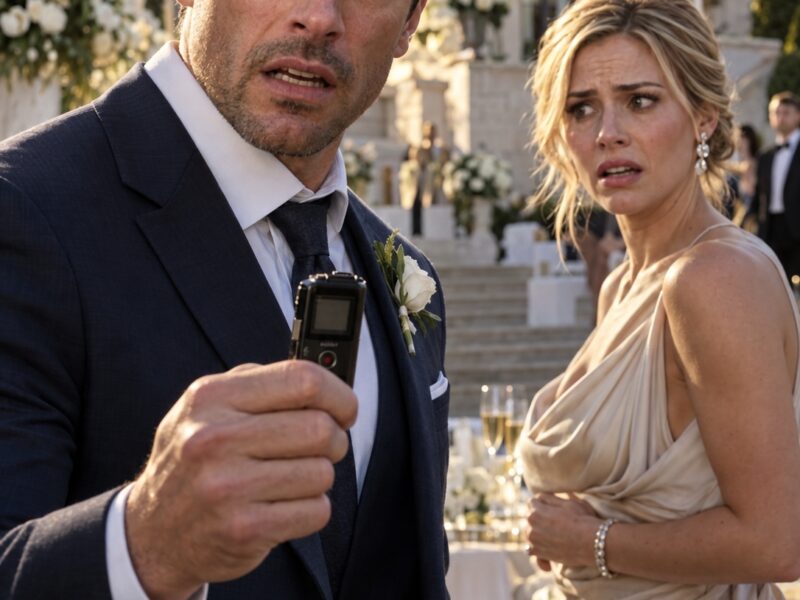
“SIR, YOUR FIANCÉE HURTS MY MOMMY WHEN YOU’RE NOT HOME” — THEN THE MAID’S 3-YEAR-OLD REVEALED WHAT HAPPENED INSIDE THE HOUSE

The little girl waited until the string quartet stopped playing.
Until the wedding planner lowered her clipboard.
Until nearly forty members of Michael Bennett’s family and closest friends were standing on the wide limestone steps of his grandfather’s estate, waiting for the rehearsal to begin.
Then Grace Carter walked straight through them.
She was three years old, wearing a lavender dress with one crooked ribbon at the waist and white shoes that had already collected grass stains along the toes. Under one arm she carried an old stuffed rabbit with one ear missing. Her other hand was curled tightly into a fist.
Michael noticed her because everyone else had suddenly stopped moving.
“Grace?”
The little girl came to him and tugged once on the sleeve of his navy rehearsal jacket.
Victoria Hail, the woman Michael was supposed to marry the next afternoon, stood ten feet away beneath an arch covered in ivory roses.
Her smile disappeared.
Grace tilted her face up toward Michael.
“Sir?”
Michael crouched automatically. “What is it, sweetheart?”
The child glanced toward her mother.
Emma Carter stood near the front doors holding a silver tray of champagne glasses.
The color had drained from her face.
“Grace,” Emma whispered.
But Grace had already turned back.
Her voice was so small that several guests leaned forward to hear.
“Your fiancée hurts my mommy when you’re not home.”
The tray slipped from Emma’s hands.
Crystal shattered across the stone.
No one screamed.
No one laughed.
No one even seemed to breathe.
Michael remained crouched in front of the child, one knee against the warm limestone, while the sentence moved through his mind as if spoken in a language he had never heard before.
Your fiancée hurts my mommy.
Behind him, someone whispered, “Oh my God.”
Victoria gave a strange little laugh.
Too quick.
Too bright.
The kind of laugh people used when something was absurd and they needed everyone else to agree before they had actually decided whether it was funny.
“Michael,” she said, “she’s three.”
Grace flinched at Victoria’s voice.
Michael felt it through the little hand still gripping his sleeve.
He looked at Grace.
Then at Emma.
Then at the woman he had planned to marry.
Victoria’s mother pressed two fingers against the pearls at her throat.
The wedding planner slowly lowered her clipboard.
Emma stepped forward. “Grace, honey, come here.”
But the little girl shook her head.
And what she said next made Michael understand that this moment had not begun on the front steps.
It had begun weeks earlier.
Maybe months.
Maybe long before he had noticed anything was wrong.
“She told Mommy,” Grace whispered, “that if Mommy tells you, we have to sleep outside.”
Victoria’s smile vanished completely.
Three weeks earlier, the Bennett estate had seemed like the happiest place Michael had ever known.
That was what he would remember afterward.
How ordinary happiness could look right before the floor opened beneath it.
The house sat on twenty-six acres outside Boston, built in 1928 by Michael’s grandfather with gray fieldstone, tall windows, and a wraparound rear terrace that overlooked maple trees running down toward a narrow river. Michael had inherited it at thirty-two after his father died unexpectedly, and for several years the place had felt too large for one man.
Then Victoria arrived.
She filled empty rooms with opinions.
White hydrangeas instead of blue.
The old library needed better lighting.
The west dining room should become a tasting room.
The pool house was charming but outdated.
The family portraits in the upstairs hall were “a little funeral home.”
Michael had laughed at that one.
He laughed at many things in those days.
He was thirty-eight, successful, busy, and tired of coming home to rooms that echoed. Victoria was elegant, socially effortless, and seemed to bring movement with her wherever she went.
She knew caterers.
Florists.
Museum board members.
Two state senators.
Three women who had appeared on magazine covers.
She could walk into a room of strangers and, within minutes, somehow make everyone feel that she had been expected.
Michael mistook that talent for warmth.
Emma Carter saw something else.
But Emma worked for the Bennett family.
She understood that seeing was not always the same as being allowed to speak.
She had been housekeeper at the estate for six years.
Michael’s father had hired her.
After he died, Michael kept her on and increased her salary.
She ran the house with a quiet efficiency that made complicated things disappear before Michael ever knew they had existed.
Broken boiler?
Handled.
Delivery confusion?
Handled.
Guest allergic to shellfish?
Emma somehow knew before the chef did.
She was thirty-one, with soft brown hair usually twisted into a low knot and a way of smiling that made Michael’s enormous house feel less formal.
Her daughter Grace had become part of the rhythm of the place.
Grace was three and considered the estate a kingdom.
She knew where the kitchen staff hid cookie dough.
She believed the bronze dog statue in Michael’s study came alive at night.
She had named two squirrels “Kevin” and “Other Kevin.”
And whenever Emma had to work late, Grace sat on the kitchen floor with crayons or followed her mother from room to room carrying her battered stuffed rabbit.
Michael kept a glass jar of butterscotch candies in the bottom drawer of his desk specifically because Grace liked them.
He pretended the jar belonged to him.
She pretended to believe him.
Their arrangement worked.
One Tuesday morning in August, Michael was halfway through an email when Grace appeared at the door of his study.
She didn’t knock.
She never knocked.
Her small face appeared around the doorframe.
Michael looked up.
“No appointment?”
Grace shook her head.
“This is a very important office.”
She stepped inside.
“Kevin?”
Michael nodded solemnly. “Both Kevins.”
That usually made her laugh.
This time, it didn’t.
Michael noticed.
“Candy?”
Another shake of the head.
That was unusual enough for him to close the laptop.
“What happened?”
Grace hugged the rabbit against her chest.
“Nothing.”
Michael leaned back.
Grace had recently discovered the word nothing and used it for everything from spilled juice to broken crayons.
He smiled.
“Where’s your mom?”
“Kitchen.”
“Then why are you hiding in here?”
“I’m not hiding.”
“Looks suspiciously like hiding.”
She walked to the side of his desk.
For several seconds she stared at the floor.
Then she whispered, “Don’t tell Miss Victoria I said hi to you.”
Michael frowned.
“What?”
Grace looked toward the door.
“Don’t tell.”
“Tell her what?”
“That I came.”
Michael almost laughed.
Almost.
But something in her expression stopped him.
Children had fears adults considered ridiculous.
A barking dog.
A dark hallway.
A strange sound inside the walls.
This looked different.
“Why would Victoria care if you came to see me?”
Grace shrugged so hard her little shoulders touched her ears.
Michael waited.
She said nothing.
He opened the drawer and handed her a butterscotch.
She took it but didn’t unwrap it.
When Emma entered twenty seconds later, there was genuine alarm in her face.
“There you are.”
Grace ran to her.
Emma gathered her quickly, glancing at Michael.
“I’m sorry, Mr. Bennett.”
“For what?”
“I told her not to bother you while you’re working.”
“She never bothers me.”
Emma’s smile appeared.
Too quickly.
“Of course.”
Michael’s attention dropped to her hands.
There was a dark discoloration around her left wrist.
Not large.
Not dramatic.
Almost hidden under the cuff of her blouse.
“What happened to your arm?”
Emma pulled her sleeve down.
“Nothing.”
The word landed differently coming from her.
Michael stood.
“That doesn’t look like nothing.”
“I caught it on the pantry door.”
“The pantry door?”
Emma picked Grace up.
“She’s been restless today. I should get her lunch.”
“Emma.”
She stopped.
“Are you all right?”
For one second, he thought she might answer honestly.
Her eyes shifted toward the hall.
Then she smiled.
“Just tired, sir. Long week.”
She left before he could ask anything else.
Michael remained beside his desk.
He remembered noticing something that morning.
He remembered wondering about it.
And then his phone rang.
Business had a way of swallowing questions.
By noon he had forgotten.
That was his first mistake.
Victoria began arriving at the estate earlier after that.
She called it wedding season.
The ceremony was scheduled for late September, but she insisted there was too much to manage remotely.
Flowers.
Lighting.
Valet routes.
Guest transportation.
Table linens.
Security.
Weather contingencies.
A temporary kitchen pavilion.
She spent entire afternoons moving through the estate with contractors and planners, clicking heels against old hardwood floors.
Michael was usually at Bennett Development’s downtown office.
At first, he considered Victoria’s involvement reassuring.
She was excited.
Invested.
Building a life there.
He did not know she had begun asking staff members questions that had nothing to do with wedding planning.
Who had keys?
Who stayed late?
Who spoke privately to Michael?
Which staff members had been hired by his father?
Who had access to the study?
How long had Emma been working there?
One morning Victoria entered the kitchen while Emma was preparing Grace’s breakfast.
Grace sat at the island coloring a horse purple.
Victoria stopped.
“Why is she here again?”
Emma looked up.
“My childcare canceled.”
Victoria stared at Grace.
“This isn’t a daycare.”
“I know.”
“We’re having the caterer here in twenty minutes.”
“She’ll stay with me.”
“That isn’t what I said.”
Emma’s hands became still.
Grace stopped coloring.
Victoria noticed.
Her expression softened immediately.
“Oh, sweetheart,” she said, bending slightly toward Grace. “Don’t look scared. Adults are just talking.”
Grace slid off the stool and moved behind her mother.
Victoria straightened.
Then she smiled at Emma.
“Hallway.”
They stepped outside the kitchen.
Victoria kept her voice low.
“Michael is too generous with staff.”
Emma said nothing.
“You’ve been comfortable here.”
“I do my job.”
“You do.”
Victoria looked toward the kitchen doorway.
“And you bring your personal life into his house.”
“My daughter comes only when I have no childcare.”
“Exactly.”
Emma’s jaw tightened.
“I’ve worked for this family six years.”
“And after the wedding, you’ll work for me too.”
The words were simple.
The way Victoria said them was not.
Emma looked directly at her.
“I work for Mr. Bennett.”
Victoria smiled.
“For now.”
She walked away.
Emma stood motionless for several seconds.
Grace appeared beside her.
“Mommy?”
Emma crouched and forced a smile.
“You want strawberries?”
Grace nodded.
Neither of them mentioned what had happened.
The next incident came four days later.
Emma had set out linen samples in the east sitting room.
Victoria arrived while Michael was still in Boston.
She examined the fabrics, rejected three colors, changed the seating chart, and then asked Emma where a box of handwritten place cards had gone.
“I moved them to the library table,” Emma said.
“I told you to leave them here.”
“The florist needed the table.”
Victoria stared at her.
“So you ignored me.”
“I moved a box.”
“That wasn’t your decision.”
Emma took a breath.
“The box is ten feet away.”
Victoria stepped closer.
“You keep doing that.”
“Doing what?”
“Answering back.”
Emma lowered her voice.
“I’m answering your question.”
A silence settled between them.
Victoria looked toward the open doorway.
No staff.
No Michael.
Only Grace sat in the hall arranging wooden blocks beside her stuffed rabbit.
Victoria reached for Emma’s wrist.
Hard.
Emma gasped.
Grace looked up.
“You listen to me,” Victoria whispered. “I will not be embarrassed in my own home by an employee who thinks being here six years gives her some kind of standing.”
Emma pulled her hand away.
“This isn’t your home yet.”
That sentence changed something.
Victoria’s face became very calm.
Too calm.
“What did you say?”
Emma knew immediately she had crossed an invisible line.
She stepped back.
“Nothing.”
“No. Say it again.”
Emma didn’t.
Victoria’s eyes moved toward Grace.
Then back to Emma.
“You have a child to support.”
Emma felt the warning before Victoria finished speaking.
“It would be unfortunate,” Victoria continued, “if some little misunderstanding cost you the job that keeps a roof over her head.”
Emma went pale.
“Are you threatening me?”
“I’m explaining reality.”
“You don’t know anything about my reality.”
“Oh, I know enough.”
Victoria lowered her voice further.
“Single mother. No husband. Your mother lives almost two hours away. Rent increased last spring. You need this position.”
Emma stared at her.
“How do you know where my mother lives?”
Victoria smiled.
“I like to understand the people around me.”
Grace began crying.
Neither woman had realized she had been listening.
Emma went immediately to her.
Victoria walked away.
That night Grace woke twice.
The second time she asked if their apartment was going to disappear.
Emma held her in bed until sunrise.
She almost called Michael.
Almost.
But fear had a practical vocabulary.
Rent.
Daycare.
Groceries.
Health insurance.
Car payment.
Emma had learned that people with money often described speaking up as bravery because they had never calculated what bravery could cost.
Michael was kind.
Emma believed that.
But Victoria was going to be his wife.
After the wedding she would live in the house.
What happened if Michael believed Victoria?
What happened if Victoria cried and said Emma had misunderstood?
What happened if Michael believed Emma but resented her for destroying his wedding?
People protected the lives they had invested in.
Michael had invested everything in Victoria.
Emma decided silence was safer.
For a while.
Two days later, Michael came home early.
A zoning meeting had been canceled, giving him an afternoon he had not expected.
He drove through the gates just after three.
The estate looked peaceful.
Sunlight through the maples.
Workers arranging outdoor lanterns.
A truck from the rental company near the west lawn.
He saw Emma on the rear porch.
She was sitting alone on the bottom step.
That itself was strange.
Emma rarely sat during working hours.
Michael parked and walked toward her.
She heard his shoes on the gravel and immediately stood.
“Mr. Bennett.”
“You know you can call me Michael after six years.”
“You always say that.”
“And you never do.”
She smiled faintly.
He stopped.
Her eyes were red.
“What happened?”
“Nothing.”
He sighed.
“Apparently everyone around here has decided nothing is responsible for everything.”
Emma looked confused.
“Grace said the same thing.”
Emma’s face changed.
“What did Grace say?”
“That she didn’t want Victoria knowing she visited me.”
Emma looked away.
Michael watched her.
“Why?”
“Children say strange things.”
“That’s exactly what Victoria said last week.”
Emma stiffened.
Michael stepped closer.
“Emma.”
“I slipped.”
He frowned. “What?”
“You were going to ask why I was upset. I slipped on the back stairs.”
“I wasn’t going to ask that.”
“Oh.”
“But now I am.”
Emma folded her hands tightly.
“I’m fine.”
Grace came through the screen door behind her.
“Mommy?”
Emma turned.
The child looked at Michael.
Then at her mother.
And in the innocent certainty of a three-year-old, she said, “Mommy didn’t slip.”
Emma closed her eyes.
Michael felt something cold move through his chest.
“Grace.”
Emma’s voice was sharper than he had ever heard it.
Grace’s face crumpled.
Emma immediately softened.
“Baby, go inside.”
“No.”
“Please.”
Grace pressed herself against her mother’s leg.
Michael crouched.
“Grace, did you see what happened?”
Emma interrupted.
“She doesn’t understand.”
“I’m asking her.”
“She’s three.”
Michael looked up.
“So?”
“Please.”
That word stopped him.
Emma was not asking casually.
She was pleading.
Michael stood.
“Emma, what’s going on?”
“Nothing.”
“You’re afraid.”
“I’m tired.”
“You’re afraid of something.”
“I said I’m fine.”
“Is this about Victoria?”
Emma went completely still.
Michael had his answer.
Not the whole answer.
But enough to feel uneasy.
Before he could continue, a car door slammed near the front drive.
Victoria’s voice carried from inside.
“Michael?”
Emma stepped away from him instantly.
That movement stayed with him.
Victoria came through the house wearing sunglasses and carrying two garment bags.
She kissed Michael.
“You’re home.”
“Meeting canceled.”
“Lucky me.”
She saw Emma.
Something passed between the women.
It happened in less than a second.
But Michael saw it.
“What’s going on?” Victoria asked.
“Emma slipped.”
Victoria removed her sunglasses.
“Again?”
Michael turned toward her.
“Again?”
Victoria smiled.
“She’s been clumsy lately.”
Emma’s face tightened.
Michael watched both of them.
“Did you know she hurt herself?”
Victoria shrugged.
“I told her to be more careful.”
Grace buried her face against Emma’s leg.
Victoria noticed.
“Hello, Grace.”
The child did not answer.
“Grace,” Emma whispered.
Still nothing.
Victoria’s smile hardened around the edges.
Michael suddenly remembered the morning in his study.
Don’t tell Miss Victoria I said hi to you.
For the first time, he did not laugh it off.
That evening, Michael asked Victoria directly.
They were sitting on the rear terrace after dinner.
The estate had gone quiet.
Beyond the stone railing, crickets pulsed beneath the trees.
Victoria held a glass of wine.
Michael had barely touched his.
“Is there a problem between you and Emma?”
Victoria looked amused.
“Is that what this is about?”
“What is ‘this’?”
“You’ve been strange since dinner.”
“I’m asking a question.”
Victoria took a sip.
“She doesn’t like me.”
Michael frowned.
“Emma likes everybody.”
“That doesn’t mean she likes me.”
“Why wouldn’t she?”
Victoria gave him a patient smile.
“Michael, you’ve never managed household staff.”
“She’s not household staff to me.”
Victoria’s eyebrows lifted slightly.
“Okay.”
“What does that mean?”
“Nothing.”
There was that word again.
Michael leaned back.
Victoria placed her wineglass on the table.
“She’s been here a long time,” she said. “Your father hired her. She’s comfortable. Then I arrive and suddenly things change.”
“What things?”
“Expectations.”
“Emma has always done excellent work.”
“I’m sure.”
“You sound like you don’t believe that.”
“I think you have a blind spot.”
Michael stared at her.
“For Emma?”
“For people who depend on you.”
He did not understand.
Victoria continued.
“You’re generous, which is one of the things I love about you. But sometimes people confuse generosity with permission.”
“Permission to do what?”
“To become too familiar.”
Michael laughed once.
“You sound like we’re running Buckingham Palace.”
“I’m serious.”
“So am I.”
Victoria looked toward the dark lawn.
“She brings Grace here constantly.”
“Because childcare falls through.”
“She sits with her in the kitchen.”
“She works in the kitchen.”
“She interrupts your work.”
“Grace is three.”
Victoria sighed.
“This is exactly what I mean.”
Michael felt irritation rise.
“She’s a child.”
“And Emma is an employee.”
“Who has worked for my family for six years.”
Victoria turned back.
“And soon this will be my family too.”
He heard something in the sentence.
Not threatening.
Not exactly.
Possessive.
Michael reached for his glass.
“Just… be kind to her.”
Victoria stared at him.
“Excuse me?”
“I’m not accusing you of anything.”
“It certainly sounds like you are.”
“I’m asking you to be patient.”
Victoria stood.
“You came home early, found your housekeeper crying, and now I’m the villain?”
“I didn’t say that.”
“Then what are you saying?”
Michael rubbed his forehead.
“I’m saying something feels off.”
Her expression changed.
Hurt replaced anger.
It happened beautifully.
That was one of Victoria’s gifts.
She could move from confrontation to vulnerability so smoothly that people often forgot what they had been discussing.
“Do you know how hard I’m trying?” she asked quietly.
Michael looked at her.
“I’m planning an entire wedding at your family’s house. Every choice I make gets compared to how your mother did things, how your father liked things, what your grandfather intended. I’m trying to build a place for myself in a house full of dead people’s preferences.”
Michael’s irritation softened.
“Victoria…”
“No. It’s fine.”
She looked away.
“I just didn’t realize I’d also have to compete with the staff.”
“You’re not competing with anyone.”
“Good.”
She touched his face.
“Then trust me.”
He did.
Or wanted to.
And wanting to trust someone could become almost indistinguishable from actually trusting them.
The next morning Michael left before seven.
By eight fifteen, Victoria was at the estate.
Emma was changing flowers in the front hall.
She heard Victoria’s heels before she saw her.
“Where’s Grace?”
“My sister has her today.”
“Good.”
Emma kept arranging the flowers.
Victoria stopped beside her.
“Michael spoke to me last night.”
Emma’s hand froze over a vase.
“I don’t know what you mean.”
“Yes, you do.”
“I didn’t say anything to him.”
“Apparently you cried dramatically enough that you didn’t have to.”
Emma turned.
“I was sitting outside.”
“You were performing.”
“For who?”
“For Michael.”
Emma laughed in disbelief.
Victoria’s eyes narrowed.
“You think because he is kind to you that you matter to him.”
Emma said nothing.
“He pities you.”
“That’s enough.”
“No, Emma. You need to understand this before I become Mrs. Bennett.”
Emma set down the flower she was holding.
“I don’t care what name you have after the wedding. You don’t get to threaten me.”
Victoria stepped forward.
“You think that was a threat?”
Emma held her ground.
“Yes.”
For one heartbeat nothing happened.
Then Victoria slapped her.
It was not dramatic.
No raised arm.
No shouted warning.
Just a quick, flat crack against Emma’s cheek.
The vase trembled under Emma’s hand.
Neither woman moved.
Victoria looked almost surprised by what she had done.
Then her face settled.
Emma whispered, “You just hit me.”
“You provoked me.”
“I provoked you?”
“You have been disrespectful for weeks.”
Emma stared at her.
“You are sick.”
Victoria seized her wrist.
Emma winced.
“Do not speak to me that way in my house.”
“It’s not your house.”
Victoria tightened her grip.
Emma tried to pull away.
“Let go.”
Victoria shoved her.
Emma struck the edge of the console table.
The vase toppled.
It hit the floor and exploded.
The sound carried through the hall.
Victoria released her.
Both women stared at the broken porcelain.
Emma’s breathing shook.
Victoria smoothed the front of her dress.
“Clean it up.”
Emma looked at her.
Victoria walked away.
Neither woman noticed the small digital recorder behind the second vase.
Emma had hidden it the previous afternoon.
She had bought it for thirty-nine dollars after work.
She had no plan.
Only fear.
Only the growing belief that if something happened, words would not be enough.
Hours later, Grace found the recorder while playing.
She recognized it because Emma had shown her how the red light worked.
“Secret,” Emma had said.
Grace thought secrets belonged in good hiding places.
So she moved it.
She tucked it behind a flower arrangement in the hallway.
Emma looked for it that night and could not find it.
She assumed Grace had misplaced it somewhere.
For almost a week, the recorder sat untouched.
During that week, Michael noticed more things.
A server quitting unexpectedly.
A groundskeeper becoming silent when Victoria approached.
Emma wearing long sleeves despite ninety-degree heat.
Grace no longer running into the main hall when Michael came home.
Most disturbing was how quickly everyone denied there was a problem.
“Everything good?” Michael asked his driver one afternoon.
“Absolutely.”
“You look miserable.”
“Just tired.”
Another nothing.
Another long week.
Another accidental bruise.
Michael began to wonder whether the problem was him.
Had he become the kind of employer people were afraid to speak to?
Had the money built distance without him noticing?
One Friday he called Emma into the study.
She entered carrying folded laundry.
“Sit down.”
“I’m working.”
“The sheets will survive.”
She remained standing.
Michael studied her.
There was faint yellowing beneath makeup along her cheekbone.
He felt his stomach tighten.
“Did you fall again?”
Emma touched her cheek.
“Cabinet door.”
“Remarkably dangerous house lately.”
She tried to smile.
Michael didn’t.
“Emma, I need you to tell me the truth.”
“I am.”
“No, you’re not.”
She looked toward the door.
Michael noticed.
“Is Victoria hurting you?”
The color left her face.
There it was.
That tiny involuntary reaction no practiced answer could hide.
Michael stood.
“Emma.”
“No.”
“You hesitated.”
“I was surprised.”
“Look at me.”
She did.
“If Victoria has threatened you or touched you, you need to tell me.”
Emma’s eyes filled with tears.
Michael felt a surge of anger before she had even spoken.
Then Emma shook her head.
“You’re getting married next week.”
“What does that have to do with anything?”
“Everything.”
“No.”
“Yes.”
Her voice cracked.
She hated that.
She looked down.
“You love her.”
“That doesn’t make you disposable.”
Emma said nothing.
Michael stepped closer.
“What happened to your face?”
“I walked into a cabinet.”
“Emma.”
“I’m fine.”
“Stop saying that.”
Grace appeared in the hall.
Emma looked over Michael’s shoulder and saw her.
The child was holding the stuffed rabbit.
Watching.
Emma’s entire posture changed.
“Please,” she whispered to Michael. “Just let it go.”
He stared at her.
Something in him wanted to push.
Something else understood that frightened people did not become less frightened because you cornered them.
So he stepped back.
“All right.”
Emma exhaled.
“But if you need me, at any hour, for any reason, you call.”
She nodded.
Michael glanced toward Grace.
“And you’re not losing your job.”
Emma closed her eyes briefly.
That sentence told him more than anything else had.
Someone had made her believe she might.
Emma left the study.
Michael stood alone for several minutes.
Then he called Victoria.
“Dinner tonight?”
Her voice brightened. “Thought you had the Kingsley meeting.”
“I moved it.”
“For me?”
“Yes.”
“Romantic.”
Michael stared through the study windows.
“We need to talk.”
Silence.
Then Victoria laughed softly.
“Those are every fiancée’s favorite words.”
“Seven.”
“What?”
“Dinner. Seven.”
“I’ll be there.”
Michael hung up.
He intended to ask her directly.
He intended to watch her face.
He intended, for once, not to let love answer a question before the evidence did.
But evidence found him first.
At six twelve that evening, Michael went looking for cuff links.
He kept a spare pair in the narrow drawer of the antique console table in the upstairs hall.
When he pulled the drawer open, something fell behind the table.
A small black object struck the floor.
Michael bent down.
Digital recorder.
He frowned.
He recognized it vaguely.
Emma sometimes used one to dictate inventory lists when her hands were occupied.
He almost put it back.
Then he noticed the scratched initials on the underside.
E.C.
Emma Carter.
Michael looked down the hall.
Empty.
He pressed the power button.
The screen lit.
There were eleven recordings.
Most were short.
Thirty seconds.
Forty-five.
One minute.
The most recent lasted six minutes and thirteen seconds.
He pressed play.
For several seconds there was only muffled movement.
Then Victoria’s voice.
Michael’s chest tightened instantly.
“Where is she?”
Emma answered.
“My sister has her today.”
“Good.”
Michael stopped breathing.
He listened.
The conversation unfolded exactly as it had happened.
Michael spoke to me last night.
I didn’t say anything.
You cried dramatically enough that you didn’t have to.
Then came the slap.
A sharp crack through the tiny speaker.
Michael stared at the recorder.
The sound of breaking porcelain followed.
Then Emma’s voice.
You just hit me.
Victoria:
You provoked me.
Michael’s fingers became cold.
He continued listening.
Do not speak to me that way in my house.
It’s not your house.
Let go.
A scuffle.
Emma gasping.
Then Victoria’s voice.
Clean it up.
The recording ended.
Michael stood motionless.
The hallway around him seemed to recede.
He pressed play again.
Not because he doubted what he had heard.
Because his mind refused to accept it.
The second time was worse.
He heard details he had missed.
Emma’s breathing.
The small tremor in her voice.
The dull impact when she struck the table.
The calmness in Victoria’s tone afterward.
Clean it up.
Michael sat down on the floor.
He had known Victoria for three years.
They had traveled together.
Celebrated birthdays.
Buried her grandmother.
Spent Christmas mornings opening gifts in this house.
She knew how Michael took his coffee.
He knew she hated thunderstorms.
They had talked about children.
Schools.
Retirement.
He had trusted her with every private corner of himself.
And on the recording, she sounded like a stranger wearing Victoria’s voice.
Michael pressed his hands against his eyes.
Then he listened to another file.
Victoria again.
“You’ll keep smiling in front of him, or you and that brat can find somewhere else to live.”
Michael’s head snapped up.
Emma’s voice:
“Do not call my daughter that.”
“You need this job.”
“Leave Grace out of this.”
“I’ll leave her out of it when you remember your place.”
Michael’s jaw tightened.
There was movement.
A door shutting.
Emma said, “Please, not in front of Grace.”
Then Grace began crying.
Michael stopped the recording.
His thumb hovered above the button.
For a moment he thought he might be sick.
He pictured Grace in his study.
Don’t tell Miss Victoria I said hi to you.
He pictured Emma covering her wrist.
Mommy didn’t slip.
He pictured every moment he had explained away because explanation was easier than confrontation.
He had not failed to see.
He had seen.
He had simply chosen more comfortable interpretations.
That realization hurt almost as much as the recording.
Michael rose.
At six fifty-five, Victoria arrived.
She wore a cream-colored dress and carried a bottle of wine.
Michael was waiting in the library.
No staff.
No dinner set.
No music.
Victoria stopped in the doorway.
“What happened?”
Michael looked at her.
For the first time in three years, he did not know the woman standing before him.
“We need to talk.”
She put down the wine.
“So you said.”
Michael held up the recorder.
Victoria’s eyes moved to it.
Only for a second.
But he saw recognition.
“What is that?”
“You tell me.”
“I have no idea.”
Michael pressed play.
Her recorded voice filled the library.
You’ll keep smiling in front of him, or you and that brat can find somewhere else to live.
Victoria went white.
Michael watched her.
The recording continued.
Please, not in front of Grace.
He stopped it.
Silence.
Victoria stared at the device.
Then at Michael.
“That’s not what it sounds like.”
Michael almost laughed.
The sentence was so predictable it felt insulting.
“What does it sound like?”
“Michael—”
“No. Tell me.”
Victoria swallowed.
“She has been provoking me for weeks.”
“So you threatened her child?”
“I did not threaten her child.”
“I just heard you.”
“You heard a fragment.”
“A fragment where you called a three-year-old a brat and threatened to put them on the street.”
“You don’t understand the context.”
“What context makes that acceptable?”
Victoria’s face changed.
The vulnerability appeared.
Tears.
Quick.
Beautiful.
Michael felt nothing.
“She hates me,” Victoria whispered. “She has been trying to turn you against me.”
“You hit her.”
Victoria shook her head.
“She was in my face.”
“You hit her.”
“She shoved me first.”
“The recording says otherwise.”
“You don’t know what happened before.”
Michael pressed another file.
The slap cracked through the speaker.
Victoria flinched.
Michael stopped it.
“You hurt her.”
Victoria’s tears vanished.
Something colder emerged.
“So what now?”
The sudden shift stunned him.
“What?”
“You’ve already decided.”
“I heard you.”
“You believe the maid.”
Michael stared.
“Her name is Emma.”
Victoria laughed once.
“There. Exactly.”
“Exactly what?”
“She wins.”
“This isn’t a competition.”
“It has always been a competition.”
“No, Victoria. It hasn’t.”
“You think I don’t see the way she looks at you?”
Michael’s confusion deepened.
“What are you talking about?”
“She’s always here. Always helpful. Always innocent. Her sweet little daughter running into your office. Do you know how ridiculous this looks?”
“She works here.”
“And she worships you.”
Michael shook his head.
“This is insane.”
“Is it?”
“Yes.”
Victoria stepped closer.
“You enjoy being needed.”
Michael said nothing.
“She needs your job. She needs your money. Her child adores you. You get to play generous prince in your grandfather’s mansion while she looks at you like you saved her life.”
“Stop.”
“And now she has you defending her against your own fiancée.”
“Stop.”
Victoria’s face twisted.
“You were never going to choose me first in this house.”
Michael stared at her.
And suddenly so much made sense.
This had never been about linen.
Or wedding planning.
Or staff hierarchy.
Victoria had entered a house with a history she could not control.
Instead of building a life inside it, she had tried to dominate every relationship that existed before her.
The portraits.
The employees.
Emma.
Grace.
Every symbol that reminded Victoria she had not created Michael’s world.
“You’re jealous of a housekeeper and a three-year-old,” Michael said quietly.
Victoria recoiled.
“I am not jealous.”
“You hurt Emma because you thought she had some kind of power over me.”
“She does.”
“She doesn’t.”
“You’re proving it right now.”
“No,” Michael said. “You did that yourself.”
Victoria stared at him.
Michael removed the engagement ring box from the desk.
He had placed it there before she arrived.
Her gaze dropped to it.
“No.”
“There is no wedding.”
Her face went still.
“Michael.”
“It’s over.”
“You don’t mean that.”
“I do.”
“You’re angry.”
“Yes.”
“You’re shocked.”
“Yes.”
“We can fix this.”
“No.”
Victoria stepped closer.
“We have four hundred guests coming tomorrow.”
“I don’t care.”
“My parents are here.”
“I don’t care.”
“The press knows about the wedding.”
“I don’t care.”
“You will humiliate me.”
Michael looked at her.
“You’re worried about humiliation?”
Victoria’s nostrils flared.
“You’re ending three years because an employee recorded a private argument.”
“I’m ending three years because I discovered who you become when you think no one important is watching.”
That sentence landed.
Victoria stared at him.
Michael continued.
“You thought Emma didn’t matter because she works for me.”
“I never said that.”
“You thought Grace didn’t matter because she’s a child.”
“That’s not—”
“You thought the staff wouldn’t speak because they needed their jobs. You were right about that.”
Victoria looked toward the doorway.
Michael followed her glance.
Emma stood there.
She had arrived silently.
Grace was not with her.
Michael had asked Emma’s sister to keep her overnight.
Emma looked terrified.
Victoria stared at her.
Then at Michael.
“You brought her into this?”
Michael’s expression hardened.
“She was already in it.”
Victoria turned to Emma.
“Are you happy now?”
Michael moved between them.
“Don’t.”
Emma’s hands trembled.
But this time she did not step backward.
“No,” Emma said.
Victoria blinked.
Emma’s voice strengthened.
“No, I’m not happy.”
She looked at Michael.
“I’m sorry.”
Michael frowned.
“For what?”
“For all of this.”
“You have nothing to apologize for.”
Victoria laughed bitterly.
“Of course not.”
Michael turned sharply.
“Enough.”
Emma wiped her eyes.
“I should have told you.”
Michael shook his head.
“I should have listened sooner.”
“No.”
“Yes.”
He looked at her bruised wrist.
“I asked questions, then accepted answers I knew weren’t true because the truth would have forced me to do something.”
Emma looked down.
“That’s on me.”
Victoria stood motionless.
For the first time that evening, she seemed to understand that her relationship was actually ending.
Not dramatically.
Not temporarily.
Ending.
Her face crumpled.
“Michael, please.”
He closed his eyes.
For one brief, brutal second, he remembered who he had believed she was.
Victoria laughing on a beach in Maine.
Victoria sleeping beside him.
Victoria crying at her grandmother’s funeral.
Victoria saying yes when he proposed beneath the maple tree.
Love did not disappear merely because it had become unsafe.
Sometimes that was the worst part.
Michael opened his eyes.
“You need to leave.”
Victoria stared at him.
“Tonight?”
“Now.”
Her face hardened.
“This is my wedding weekend.”
“No. It was.”
She looked at Emma.
Hatred flashed across her face.
Michael saw it.
So did Emma.
And in that instant Michael understood something else.
The recorder had exposed Victoria.
It had not frightened her into remorse.
It had frightened her because she had lost control.
Michael took out his phone.
“I’ve asked security to walk you to your car.”
“You called security on me?”
“I’m protecting the people in this house.”
Victoria looked shattered.
Then furious.
Then composed.
She picked up the wine bottle.
Set it down again.
She walked toward the door.
At the threshold she turned.
“You will regret this.”
Michael said nothing.
Victoria looked at Emma.
“You definitely will.”
Michael stepped forward.
“Leave.”
She did.
The next morning should have been quiet.
Instead, it became more complicated.
Victoria’s parents arrived before nine.
Then her attorney.
Then her sister.
Calls came from vendors.
Guests.
Family friends.
The wedding planner cried in the pantry because hundreds of arrangements had to be canceled.
Michael instructed his office to pay every vendor in full.
No disputes.
No arguments.
No one else would lose money because of his mistake.
He had planned to announce the cancellation privately.
But families had already arrived for the rehearsal luncheon.
Some guests had flown from California, London, Chicago.
Victoria’s parents insisted there had been “a misunderstanding.”
Her mother, Caroline Hail, requested ten minutes with Michael.
Michael gave her five.
They sat in the library.
Caroline looked exhausted.
“Victoria told us what happened.”
Michael almost smiled.
“I doubt that.”
“She admitted she lost her temper.”
“She assaulted my employee.”
Caroline flinched.
“She grabbed her.”
“She hit her.”
“Michael—”
“There’s a recording.”
Caroline looked down.
“I know.”
“Then why are we having this conversation?”
“Because my daughter is devastated.”
Michael stared.
“So is Emma.”
Caroline’s eyes lifted.
“I’m not excusing Victoria.”
“It sounds like you are.”
“I’m asking whether destroying a marriage is proportional to one terrible mistake.”
Michael leaned back.
“One?”
Caroline said nothing.
“There are multiple recordings.”
Her face changed.
Michael continued.
“Weeks of threats. Intimidation. She used Emma’s finances against her. Threatened her job. Frightened her daughter.”
Caroline’s mouth opened.
Then closed.
“You didn’t know,” Michael said.
“No.”
“I believe you.”
Caroline looked toward the windows.
“I raised her better than this.”
Michael did not answer.
After several seconds Caroline whispered, “Did she hurt the child?”
“No.”
“Thank God.”
Michael’s jaw tightened.
“That’s a low bar.”
Caroline closed her eyes.
“You’re right.”
She stood.
At the door she stopped.
“For whatever it’s worth, I’m sorry.”
Michael nodded.
She left.
The rehearsal was canceled.
Or was supposed to be.
But the problem with canceling a gathering at an estate full of people was that people still gathered.
By four that afternoon, immediate family and several close friends remained on the property.
Michael’s aunt convinced him that hiding indoors would only create more whispers.
“Come outside,” she said. “Say the wedding is off. Say no more than you want to say.”
Michael agreed.
Emma had planned to stay away.
Then Grace asked why they were hiding.
Emma did not have an answer.
She had spent months teaching her daughter not to be ashamed of truth.
Now Emma was about to teach her to disappear because truth had become inconvenient.
So she brought Grace to the estate.
The little girl wore the lavender dress Emma had bought for the rehearsal weeks earlier.
Emma had considered throwing it away that morning.
Instead, she buttoned it carefully.
Grace carried Rabbit.
“Are we still having cake?” she asked in the car.
Emma nearly cried.
“We’ll see.”
When they arrived, guests were arranged loosely across the front terrace.
No ceremony.
No vows.
No music.
Just confusion.
A string quartet that had not yet received the cancellation message finished warming up near the rose arch.
Then fell silent.
Grace saw Michael.
And before Emma understood what she was doing, the little girl started walking.
“Grace.”
She kept going.
People moved aside.
Michael saw her coming.
She tugged his sleeve.
“Sir?”
He crouched.
“What is it, sweetheart?”
Grace glanced at Victoria.
Emma had not known Victoria would be there.
Neither had Michael.
Victoria had arrived with her father ten minutes earlier to collect several personal items.
She stood now near the rose arch.
Grace looked at her.
Then back at Michael.
“Your fiancée hurts my mommy when you’re not home.”
Everything stopped.
Emma dropped the tray she was carrying.
Crystal shattered.
Victoria turned white.
“She’s three,” Victoria said quickly.
Grace’s fingers tightened around Michael’s sleeve.
Then came the sentence that stripped away any possibility of pretending.
“She told Mommy if Mommy tells you, we have to sleep outside.”
Several guests gasped.
Michael slowly stood.
Victoria shook her head.
“This is ridiculous.”
Grace moved behind him.
Victoria gave a strained laugh.
“She’s confused.”
“Don’t,” Michael said.
“Michael, honestly. You’re going to let a toddler turn this into some public spectacle?”
“You did that.”
Victoria’s father looked at Michael.
“What is she talking about?”
Michael reached into his jacket.
Victoria saw the recorder.
“No.”
Michael pressed play.
Her voice crossed the courtyard.
Clear.
Sharp.
Cold.
“You’ll keep smiling in front of him, or you and that brat can find somewhere else to live.”
No one moved.
The recording continued.
“You need this job.”
Emma’s voice answered.
“Leave Grace out of this.”
“I’ll leave her out of it when you remember your place.”
Michael stopped the recorder.
Silence swallowed the estate.
Victoria’s mother covered her mouth.
Her sister began crying.
Her father looked at the ground.
Victoria stared at Michael with naked disbelief.
“You had no right.”
Michael almost couldn’t believe what he had heard.
“No right?”
“That was private.”
Emma laughed once.
It came out like a sob.
Victoria turned toward her.
“Of course you’re enjoying this.”
Emma’s face changed.
Michael stepped between them.
But Emma touched his arm.
“No.”
He looked back.
Emma had spent weeks shrinking.
Hiding bruises.
Lowering her voice.
Changing rooms.
Apologizing for occupying space.
Now she stepped around Michael.
Victoria stared at her.
Emma’s hands were trembling.
Her voice was not.
“I’m not enjoying this.”
Victoria rolled her eyes.
“You recorded me.”
“Because nobody would believe me.”
“I would have,” Michael said.
Emma looked at him.
Her expression was kind.
That made what she said next harder.
“You didn’t.”
Michael became still.
Emma swallowed.
“You noticed.”
He looked down.
“You asked me what happened. I lied. You knew I was lying.”
Michael said nothing.
“You wanted to believe the easier answer.”
The words were not cruel.
They were true.
Michael nodded.
“Yes.”
The guests remained silent.
He looked at Emma.
“You’re right.”
Victoria stared at them both.
“This is unbelievable.”
Michael turned.
“The wedding is canceled.”
His aunt inhaled sharply.
Someone farther back whispered.
Michael continued.
“There is nothing to discuss.”
Victoria’s chin trembled.
“You’re doing this here?”
“You came here.”
“You’re humiliating me in front of everyone.”
“No,” Michael said. “They’re hearing what you did when you believed none of them ever would.”
Victoria looked around.
Faces turned away.
Her father would not meet her eyes.
Her mother was crying.
Something broke in Victoria then.
Not remorse.
Pride.
She ripped the engagement ring from her finger.
“You want it back?”
She threw it.
The ring struck the stone and bounced once near Michael’s shoe.
Grace startled.
Michael never looked down.
Victoria’s father stepped toward her.
“Come on.”
“Don’t touch me.”
“Victoria.”
“I said don’t.”
She pushed past him.
Security waited near the drive.
The woman who had planned to walk down those steps in a wedding gown the next afternoon left them with her face streaked by angry tears.
No one followed.
Michael looked down.
The engagement ring rested beside a shard of broken crystal.
Grace walked over to it.
“Shiny.”
Emma caught her hand gently.
“Don’t touch, baby.”
Michael picked up the ring.
For months he had imagined seeing it on Victoria’s finger for the rest of his life.
Now it felt strangely light.
He placed it in his pocket.
Then he knelt in front of Grace.
The little girl watched him carefully.
“You know something?”
She shook her head.
“You were very brave.”
Grace looked at Emma.
“Mommy said secrets can hurt your tummy.”
Emma covered her mouth.
Michael nodded.
“Your mommy’s right.”
“I don’t want her tummy to hurt.”
Michael’s eyes burned.
He had negotiated billion-dollar projects without losing composure.
A three-year-old nearly broke him with one sentence.
He looked at Emma.
She was crying silently.
Michael turned back to Grace.
“You helped your mommy today.”
Grace thought about this.
“Can she have candy?”
A laugh escaped Michael.
It spread through the people nearby.
Not because anything was funny.
Because after terror, the body sometimes needed another sound.
“Yes,” Michael said. “She can have candy.”
“And me?”
“Especially you.”
Grace nodded, satisfied.
Then she wrapped her small arms around his neck.
Michael closed his eyes.
Over her shoulder, he saw Emma.
She looked exhausted.
Relieved.
Ashamed of being relieved.
That expression stayed with him.
The estate emptied slowly.
By nightfall, only the staff remained.
Someone removed the flowers from the rehearsal arch.
Someone else collected broken glass.
The kitchen contained food for two hundred people.
Michael told the chef to package everything and send it to shelters and community kitchens.
The wedding cake arrived at nine the next morning because no one had remembered to cancel it.
Five tiers.
Ivory icing.
Sugar flowers.
Michael stared at it for nearly a minute.
Then he laughed.
His aunt found him in the kitchen.
“You okay?”
“No.”
“Good answer.”
He sat at the island.
She cut two slices.
They ate wedding cake for breakfast.
At eleven, Michael met Emma in the library.
She had brought Grace.
The little girl sat on the carpet coloring.
For once, she was smiling.
Michael watched her.
Then he looked at Emma.
“I want to talk about what happens next.”
Emma’s shoulders tensed.
“My resignation is in my bag.”
Michael stared.
“No.”
“I think it’s best.”
“For who?”
“For everyone.”
“No.”
Emma sighed.
“Mr. Bennett—”
“Michael.”
She looked at him.
He continued.
“You are not resigning because someone abused you.”
“I don’t want to stay here.”
That stopped him.
“Oh.”
Emma glanced around the library.
“I’m sorry.”
“Don’t apologize.”
“Every hallway reminds me.”
Michael understood.
She rubbed her wrist unconsciously.
“Grace gets scared when a car comes through the gate.”
Michael looked toward the child.
Emma continued.
“My mother lives in Worcester. My sister’s close. There’s a hotel there looking for a housekeeping supervisor.”
“Do you want that job?”
“I think so.”
“Then take it.”
Emma looked surprised.
Michael opened a folder on the desk.
“I made some calls.”
Her expression changed.
“What did you do?”
“Nothing you have to accept.”
He slid the folder toward her.
Inside was an offer letter.
Housekeeping operations manager.
Higher salary.
Regular hours.
Benefits.
Emma read the first page.
Her eyes filled.
“How?”
“I know the owner.”
“Michael.”
“They needed someone.”
“You called them yesterday?”
“Yes.”
She turned the page.
There was another document.
“What’s this?”
“Six months’ rent.”
Emma looked up immediately.
“No.”
“Yes.”
“No.”
“Emma.”
“I can’t take that.”
“You can.”
“I won’t.”
Michael leaned back.
“Okay.”
She blinked.
“Okay?”
“You don’t want six months, take three.”
“That’s not what I mean.”
“I know.”
Michael folded his hands.
“What would make it acceptable?”
“Nothing.”
“How about back pay for every hour you spent working while being threatened in my house?”
“You didn’t know.”
“I should have.”
“You keep saying that.”
“Because it’s true.”
Emma looked at him.
Michael lowered his voice.
“I can’t undo what happened.”
“No.”
“But I can make sure fear doesn’t make the next decision for you.”
Emma’s eyes dropped to the papers.
That sentence reached somewhere deeper than money.
She had made so many decisions from fear.
Smile.
Stay quiet.
Wear sleeves.
Say you slipped.
Don’t lose the job.
Don’t lose the apartment.
Don’t make Grace afraid.
Don’t make Michael choose.
Fear had become a second employer.
Emma looked at the offer again.
“Three months,” she whispered.
Michael nodded.
“And the job only if you want it.”
“I want it.”
“Then it’s yours.”
Grace looked up from the carpet.
“Are we moving?”
Emma smiled through tears.
“Yes, baby.”
“Rabbit too?”
“Especially Rabbit.”
Grace returned to coloring.
Michael looked down.
Emma noticed.
“You’re allowed to be sad.”
He laughed quietly.
“Apparently everybody knows what I’m feeling except me.”
“You loved her.”
“I loved who I thought she was.”
“That still hurts.”
Michael nodded.
Emma stood.
At the door she paused.
“Thank you.”
Michael shook his head.
“No.”
She frowned.
“You don’t owe me gratitude.”
“I’m thanking you for believing us.”
Michael looked toward Grace.
“Eventually.”
Emma understood what he meant.
She gave him a small, tired smile.
“Eventually matters.”
Then she left.
Victoria attempted to contact Michael eleven times over the next two weeks.
He did not answer.
Her attorney handled the return of personal belongings.
The ring arrived in a padded envelope.
Michael put it in a safe and forgot about it.
Or tried to.
He discovered that grief did not care whether the person you mourned deserved mourning.
Some mornings he woke expecting Victoria beside him.
Some evenings he nearly texted her about something stupid before remembering.
A restaurant.
A joke.
A thunderstorm.
Then the recordings returned to his mind.
Clean it up.
Remember your place.
You and that brat can find somewhere else to live.
Love became easier to release when he remembered the voice.
But never easy.
Two months later, Michael drove to Worcester.
Emma had moved into a small two-bedroom apartment on a street lined with maple trees.
Nothing glamorous.
Nothing like the estate.
It felt warm.
There were children’s drawings taped to the refrigerator.
Shoes near the door.
A half-finished puzzle on the coffee table.
Grace opened the door before Emma reached it.
“Sir!”
She launched herself at Michael’s knees.
He laughed.
“Still calling me sir?”
“Yes.”
“Why?”
She considered this.
“Because.”
Unbeatable logic.
He handed her a small paper bag.
“Butterscotch?”
Her eyes widened.
“Maybe.”
Emma appeared.
“You’re going to ruin her dinner.”
“I was told this household has strict management.”
“It does.”
Grace ran away with the bag.
Emma looked different.
Not dramatically.
Her hair was shorter.
Her clothes more casual.
The biggest difference was her posture.
She no longer seemed to listen for footsteps behind her.
“You look good,” Michael said.
“I sleep.”
“Useful habit.”
“Highly recommend it.”
They smiled.
Her new job was going well.
The hotel manager had promoted her earlier than expected.
Grace was in a new preschool.
Emma’s mother lived twenty minutes away.
They had dinner together often.
Michael was relieved.
And ashamed of how relieved he felt.
As if seeing Emma safe somehow erased his failure to protect her sooner.
It didn’t.
He was learning to accept that some mistakes could be repaired without being erased.
That afternoon, Emma’s sister arrived with food.
Her mother followed.
A few coworkers came later.
It became an informal housewarming party.
Grace ran through the apartment wearing a paper crown someone had brought.
Michael stayed longer than he intended.
At dusk he stood near the balcony door watching Grace chase bubbles outside.
Emma joined him.
“She asks about the estate sometimes.”
Michael glanced at her.
“Does she?”
“She misses Kevin.”
“Which one?”
“Both.”
“Understandable.”
Emma smiled.
Then became serious.
“She remembers more than I hoped she would.”
Michael’s smile faded.
“What does she remember?”
“Victoria.”
He looked toward Grace.
Emma continued.
“She asks if bad people always look pretty.”
Michael closed his eyes briefly.
“What do you tell her?”
“That people aren’t good or bad because of how they look.”
“Good answer.”
“I’m improvising.”
“Aren’t we all?”
Emma looked at him.
“How are you?”
Michael almost gave the automatic answer.
Fine.
The word rose to his tongue.
Then he stopped.
Emma noticed.
He laughed quietly.
“I’m not going to say fine.”
“Progress.”
“I’m lonely.”
She nodded.
“I’m embarrassed.”
“You shouldn’t be.”
“I know.”
“That’s different from feeling it.”
“Yes.”
Michael watched Grace.
“I keep replaying every warning.”
Emma was silent.
“The bruise. Grace hiding. You sitting outside. The staff going quiet.”
“You didn’t cause what she did.”
“No.”
“You know that?”
“I do.”
Emma studied him.
“But?”
Michael exhaled.
“But I had authority in that house. And everyone knew it except me.”
Emma looked down.
“That’s probably why nobody spoke.”
Michael nodded.
“If the people around you are afraid to tell you something important, it doesn’t matter how kind you think you are.”
Emma looked at him.
“That sounds like something you’ve been thinking about.”
“Too much.”
“Maybe the right amount.”
They stood quietly.
Outside, Grace laughed.
Michael heard it clearly.
Months earlier, he had stopped noticing its absence.
Now he understood how loud happiness could be when it returned.
Winter came early that year.
By December, the Bennett estate had changed.
Michael kept it.
But not the same way.
He created written protections for domestic staff.
Independent HR reporting.
Anonymous complaint channels.
No employee could be terminated by a household member without review.
His company adopted similar policies for executive residences and private properties.
His attorney told him it was excessive.
Michael said good.
Victoria disappeared from his social world almost completely.
He heard through friends that she had moved to New York.
Then London.
Then perhaps back to Boston.
Michael stopped asking.
Her absence became less dramatic with time.
That was another thing he learned.
Life rarely closed painful chapters with music.
Sometimes the chapter simply appeared less often in your thoughts.
One cold Sunday afternoon in January, Grace and Emma visited the estate.
It was Grace’s idea.
She wanted to see the Kevins.
Michael warned her that squirrels were not known for keeping appointments.
She remained optimistic.
They walked through snow behind the house.
Grace wore a bright red coat and carried Rabbit beneath one arm.
Emma walked beside Michael.
At the maple tree where Michael had once proposed to Victoria, Grace stopped.
“Why’s there a bench?”
Michael looked at it.
He had forgotten.
He and Victoria had planned to take wedding photographs there.
The bench had been installed a week before everything collapsed.
“No reason,” he said.
Grace climbed onto it.
“There’s always a reason.”
Emma laughed.
“She’s going through a philosophy phase.”
Michael looked at the bench again.
Perhaps Grace was right.
There was always a reason.
Sometimes the reason simply changed.
They sat.
Grace between them.
Snow drifted through the bare branches.
After several minutes Grace looked at Michael.
“Sir?”
“Yes?”
“Are you still sad?”
Emma froze.
“Grace.”
“What?”
Michael smiled faintly.
“A little.”
Grace considered this.
“Because no wedding?”
“Partly.”
“Mommy said weddings don’t make people nice.”
Emma covered her face.
Michael laughed.
“Your mommy says a lot of smart things.”
Grace kicked her boots against the bench.
“Miss Victoria wasn’t nice.”
“No.”
“Is she sorry?”
Michael looked toward the frozen river.
He did not know.
He had wondered.
Not because remorse would change anything.
Because some part of him still wanted the person he loved to exist somewhere inside the person who had hurt them.
“I don’t know,” he said.
Grace thought about that.
Then asked, “Are you happy now?”
Michael looked at her.
The question was simple.
Children’s questions often were.
Adults complicated them because simple answers were frightening.
Michael looked toward Emma.
Toward the house.
Toward the winter sky beyond the trees.
Was he happy?
Not the way he had expected to be.
There had been no wedding.
No photographs.
No champagne beneath the lights.
The rooms had not filled with the future he planned.
But Emma could sleep.
Grace could laugh when cars came through the gate.
The staff no longer went silent when someone important entered a room.
Michael had learned that love without character was not safety.
That charm was not kindness.
That generosity did not excuse inattention.
And that sometimes the person who saved everyone was the one nobody thought important enough to hear.
Michael crouched beside the bench so he was level with Grace.
“Because of you,” he said, “I’m getting there.”
Grace smiled.
“Good.”
She opened her coat pocket.
A butterscotch candy rested inside.
Michael raised an eyebrow.
“Where did you get that?”
“You.”
“I gave you that months ago.”
“No.”
She held it out.
“For when you’re sad.”
Michael took it.
Emma looked away, wiping at her eyes.
Grace climbed down from the bench.
Then she gasped.
“Kevin!”
A squirrel darted across the snow.
Grace screamed with delight and ran after it.
“Grace!” Emma called. “Don’t go past the tree!”
“I won’t!”
Michael watched her red coat move through the white landscape.
Emma stood beside him.
For a long moment neither spoke.
Then Michael unwrapped the candy.
“Butterscotch?” Emma asked.
“Apparently medicinal.”
She laughed.
He placed it in his mouth.
The sweetness was familiar.
Small.
Ordinary.
Almost painfully so.
Months earlier, in that same house, adults had stood in expensive clothes beneath thousands of dollars’ worth of flowers and failed to say what needed saying.
A three-year-old had done it for them.
Not because she understood careers.
Or marriage.
Or reputation.
Or money.
She understood only that her mother was hurting.
And that the man who might be able to stop it needed to know.
Sometimes courage was not a speech.
Sometimes it was a child clutching a rabbit with one missing ear.
Sometimes truth arrived wearing grass-stained shoes and a crooked lavender ribbon.
Sometimes it tugged on your sleeve.
And sometimes, if you were fortunate, you listened before silence became permanent.
Michael watched Grace disappear behind the maple tree, then reappear seconds later, laughing so loudly that the sound carried all the way back to the house.
This time, everyone heard her.









