THE DUKE’S FAMILY LAUGHED WHEN A POOR WOMAN ENTERED HIS GRAND BALLROOM WITH A BABY—BUT THE CHILD’S GRAY EYES AND A LETTER HIDDEN FOR YEARS WOULD FORCE HIM TO CONFRONT THE ONE BETRAYAL HIS OWN HOUSEHOLD HAD KEPT FROM HIM
“Whose child is that?”
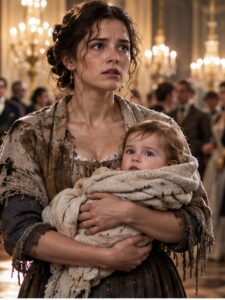
Lady Beatrice Harkort asked the question loudly enough to silence an entire ballroom.
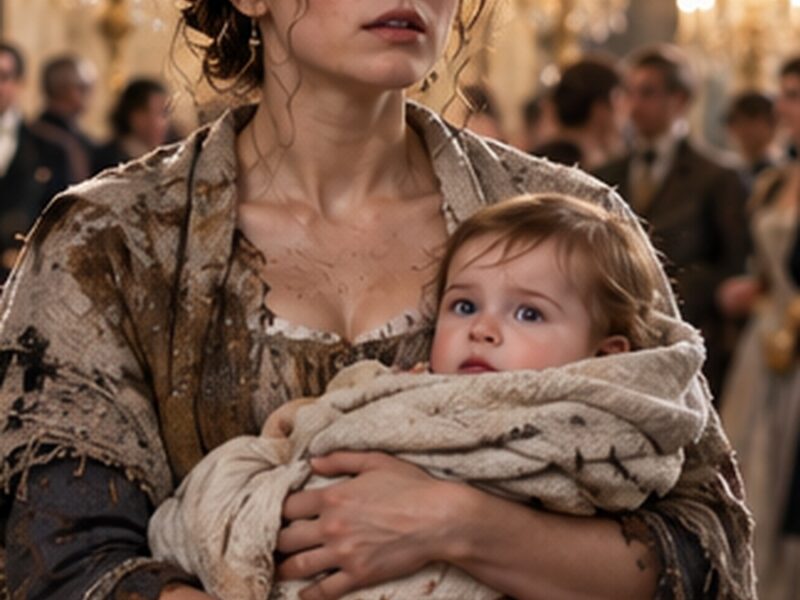
The orchestra stopped before the violinist could finish his final note. Beneath the glittering crystal chandelier, nearly three hundred elegantly dressed guests turned toward a young woman standing near the entrance, holding a baby beneath a worn woolen shawl.
Her traveling dress was splashed with mud. One sleeve had torn at the seam, and damp strands of brown hair clung to her cheeks. She looked as though she had walked through half of England’s worst weather to reach that room.
Perhaps she had.
Lady Beatrice examined her from head to foot, then gave a small, unpleasant laugh.
“Good heavens. Have the kitchens begun admitting strangers?”
Several guests chuckled. A gentleman near the windows lifted his glass to hide a smile, while two ladies whispered behind their fans.
The young woman tightened her arms around the child.
“I need to speak with His Grace.”
“His Grace?” Lady Beatrice repeated, her eyebrows rising. “My nephew is entertaining some of the most distinguished families in England. Whatever business you have can wait until morning.”
“It cannot wait.”
The firmness in the woman’s voice surprised several people.
Lady Beatrice’s expression hardened.
“This is a private celebration. I suggest you remember your place.”
A footman stepped forward, but the young woman did not move.
Then the baby stirred.
A tiny hand appeared from beneath the shawl, followed by a pale little face. The child blinked at the unfamiliar lights, her eyes unusually clear and gray.
Across the ballroom, Edmund Harkort, Duke of Harkort, turned toward the disturbance.
He had been standing near the fireplace, listening to a gentleman discuss Parliament. The conversation had already exhausted his patience, and he initially regarded the interruption with irritation.
Then he saw the child.
His wineglass shifted dangerously between his fingers.
He knew those eyes.
They had belonged to his mother.
And to the younger sister he had buried three years earlier.
For several seconds, Edmund could neither speak nor move.
The woman standing before him was Clara Whitmore, once employed in his household. But the child in her arms was a stranger, and Edmund could not understand why the sight of her made the old grief rise so violently in his chest.
He had spent three years convincing himself that certain questions would never be answered.
Now, in the middle of his engagement celebration, one of those questions had arrived in his home.
And someone in the ballroom already knew the answer.
Three years earlier, Clara Whitmore had been living in a modest village outside Bath.
At twenty-four, she earned a small income teaching children to read, write, and perform simple arithmetic. Her father had once worked as a clerk for a prosperous landowner, but his death had left the family without the security they had taken for granted.
Clara had learned early that poverty rarely announced itself all at once.
It arrived through smaller losses: a familiar house surrendered, books sold to pay outstanding bills, good clothing carefully mended until even the stitching began to wear thin.
She did not resent wealthy people simply because they had money. She distrusted the ease with which some of them confused wealth with good judgment.
When she was offered employment at Harkort Hall, she accepted immediately.
The Duke required someone capable of organizing the estate library and cataloging generations of family documents. It was careful, demanding work, but it offered stability and access to more books than Clara had ever seen.
The position had come through Lady Eleanor Harkort, the Duke’s younger sister.
Eleanor had met Clara at the village school and had been impressed by her intelligence and directness. Unlike many women of her rank, Eleanor seemed entirely uninterested in making ordinary conversations feel like examinations of social standing.
On Clara’s first morning at the estate, Eleanor found her standing before an enormous wall of bookshelves.
“Have you read all of these?” Eleanor asked.
Clara turned, startled.
“Certainly not, my lady.”
“Then what have you been doing with your life?”
Clara glanced back at the shelves.
“Trying to decide which ones are worth reading first.”
Eleanor laughed.
It was an unguarded, delighted sound, and Clara found herself smiling despite her nervousness.
That morning began a friendship neither woman had expected.
Eleanor was spirited, curious, and sometimes stubborn to the point of recklessness. She loved riding through the countryside, disliked elaborate social ceremonies, and had a remarkable memory for details other people dismissed.
She could remember the title of a book mentioned once during a dinner conversation or the precise location of a cottage described months earlier.
Her most striking feature, however, was her gray eyes.
Clara had noticed them immediately. They were the same unusual shade that appeared repeatedly in the Harkort family portraits, inherited from Eleanor’s mother.
The Duke was less approachable.
Edmund Harkort was thirty-two, reserved, disciplined, and accustomed to being obeyed. His father’s sudden death had placed the estate, its debts, its tenants, and its complicated obligations in his hands before he had properly learned how to carry his own grief.
He was not an unkind man.
But responsibility had made him cautious, and caution had gradually hardened into a belief that he should decide what was best for everyone he loved.
Especially Eleanor.
Their greatest disagreement concerned Captain James Ellery.
James was a naturalist who had traveled through Europe studying plants and wildlife. He possessed considerable knowledge, pleasant manners, and a reputation for adventurous pursuits.
What he did not possess was a fortune.
Edmund considered him an unsuitable husband for a duke’s sister.
“You cannot build a life on admiration,” he told Eleanor during one particularly bitter argument.
She faced him across the library table.
“And you cannot build one on fear.”
Edmund’s jaw tightened.
“You mistake concern for control.”
“Then stop making every decision for me.”
The conversation ended without reconciliation.
For weeks afterward, Eleanor avoided her brother whenever possible. She spent long afternoons with Clara in the library, reading, drawing, and occasionally looking through the windows as though she were considering a place far beyond the estate grounds.
Sometimes she disappeared for hours without explaining where she had gone.
Clara suspected she was meeting James.
She never asked.
One evening, Eleanor was examining a collection of botanical drawings when Clara approached her.
The illustrations were delicate, almost impossibly precise. Flowers had been rendered in soft colors, each accompanied by notes written in a narrow, elegant hand.
“These are beautiful,” Clara said.
“My mother made them.”
“She must have loved the countryside.”
“She did.”
Eleanor touched the edge of a drawing.
“She used to say every flower had a history, even if nobody remembered it.”
Clara studied the page.
Eleanor continued quietly.
“I sometimes think families are the same. Everyone remembers the grand events, but the smallest things tell you who people really were.”
Clara remembered the remark because Eleanor spoke it with unusual sadness.
She did not know that one day those drawings would become among the most precious possessions in the Harkort household.
By the following spring, relations between Edmund and Eleanor had begun to improve.
Edmund had finally agreed to meet Captain Ellery again. He offered no promise of approving the marriage, but Eleanor seemed encouraged.
Then she announced that she intended to spend several weeks near the coast.
“I need some time away from the estate,” she explained.
Edmund was displeased.
“You have only just returned to speaking to me.”
“Then perhaps we should both use the distance wisely.”
He looked at her for a long moment.
“When will you return?”
“Before summer.”
Those were the last words Eleanor ever spoke to her brother in person.
A week later, a letter arrived from a coastal town.
Eleanor had fallen ill, it said, and her condition was deteriorating.
Edmund immediately began arranging for a physician to travel to her.
Before the arrangements could be completed, a second letter reached Harkort Hall.
Lady Eleanor Harkort was dead.
The news devastated Edmund.
He traveled to the coast, determined to understand what had happened, but when he arrived, he was told that the funeral had already taken place.
Those responsible for Eleanor’s care explained that there had been no reason to delay the burial.
He returned home with a few of his sister’s belongings and a grief he refused to discuss.
Captain James Ellery was never seen at the estate again.
When Clara cautiously asked the housekeeper whether anyone had heard from him, the older woman shook her head.
“Some gentlemen are very good at making promises until trouble arrives.”
Clara wanted to believe that explanation.
But something about Eleanor’s death troubled her.
The letters had been unusually brief. There was no personal message, no final request, nothing that sounded like the young woman who had once filled the library with laughter and questions.
Edmund refused to speak about the matter.
And Clara, who knew how little authority she possessed in that house, eventually stopped asking.
The years passed.
The library was reorganized. Estate accounts were reviewed. The household returned to its usual routines.
Yet sometimes Clara would find herself looking at Eleanor’s favorite chair, half-expecting to see her seated there with a book open upon her knees.
The chair remained empty.
Almost two years after Eleanor’s supposed death, a letter arrived for Clara.
It came from a woman named Mrs. Finch, who claimed to have served as housekeeper at a small cottage near the coast.
The message was short.
Miss Whitmore,
I believe there is something you should know about Lady Eleanor. I have kept a promise for too long, and I fear I may not have much time left to explain it.
If you wish to understand what happened, come to Westmir.
Clara read the letter twice.
She did not know Mrs. Finch. She had no proof that the message was genuine, and traveling to the coast would cost money she could scarcely afford.
But the mention of Eleanor unsettled her.
Three days later, she departed for Westmir.
Mrs. Finch lived in a modest cottage overlooking the harbor.
The house smelled faintly of salt air and dried herbs. The elderly woman was confined largely to her bed, and her face had the exhausted appearance of someone who had spent too many years holding an unwelcome secret.
When Clara entered, Mrs. Finch studied her carefully.
“You knew her, then?”
“I worked for the Harkort family.”
The old woman nodded.
“She spoke of you.”
Clara felt something tighten in her chest.
“She did?”
“She said you were the only person at that house who listened without trying to correct her.”
Clara sat beside the bed.
For a moment, neither woman spoke.
Then Clara asked the question that had brought her there.
“What happened to Lady Eleanor?”
Mrs. Finch looked toward the window.
Beside it stood a small wooden cradle.
Inside was a sleeping child.
Clara followed the woman’s gaze, confused.
“Whose baby is that?”
Mrs. Finch’s eyes filled with tears.
“Eleanor’s.”
Clara stared at her.
“That is impossible.”
“I know what you were told.”
“Her brother buried her.”
“He buried the woman he believed she had become. He was never told the truth.”
Mrs. Finch reached for Clara’s hand.
Then, slowly, she began explaining what had happened.
Eleanor had traveled to Westmir with Captain Ellery.
They had married quietly, intending to return to Harkort Hall once they had gathered the documents needed to prove their marriage and explain their decision to Edmund.
Eleanor had given birth to a daughter.
They named her Margaret.
But childbirth had left Eleanor seriously ill.
She survived long enough to hold her daughter, give her a name, and make Mrs. Finch promise to protect her.
Captain Ellery had gone in search of medical assistance during a violent coastal storm.
He never returned.
His damaged boat was discovered near the rocks, and local authorities believed he had drowned.
Eleanor lived for several more weeks before her condition worsened beyond recovery.
Before dying, she wrote a letter to Edmund.
Mrs. Finch had attempted to send it to Harkort Hall.
It was returned unopened.
“Someone told the postmaster that the Duke would not receive letters from his sister,” Mrs. Finch whispered.
Clara leaned forward.
“Who?”
“I was never told. Only that His Grace had forbidden her to write.”
A cold uneasiness spread through Clara.
“Eleanor believed him?”
“She believed her brother wanted nothing more to do with her.”
Mrs. Finch turned away.
“She died thinking he had rejected her.”
Clara looked toward the cradle.
The child stirred, opened her eyes, and stared up at the ceiling.
They were Eleanor’s eyes.
Gray, clear, unmistakable.
Mrs. Finch reached beneath her pillow and produced a folded collection of papers.
“This is their marriage certificate. And this is the letter Eleanor wrote to her brother.”
Clara accepted them carefully.
“Why have you waited so long?”
The old woman’s expression changed.
“Because the gentleman who arranged her funeral warned me to remain silent.”
“What gentleman?”
“He said the family would take the child away if anyone discovered the truth. He said nobody would believe an old housekeeper against a duke’s household.”
Clara felt her pulse quicken.
“Tell me his name.”
Mrs. Finch hesitated.
Then she whispered, “Mr. Pritchard.”
Clara knew the name.
Pritchard had managed Harkort family affairs for years. He had been Edmund’s estate solicitor, a trusted adviser accustomed to handling documents, financial arrangements, and private correspondence.
He had retired shortly after Eleanor’s death, claiming ill health.
Clara looked again at the papers.
She had traveled to Westmir expecting an explanation for a strange letter.
Instead, she had found a little girl whose existence someone had deliberately concealed from her own family.
Mrs. Finch died two weeks later.
Clara remained in the cottage with Margaret.
She learned to recognize the child’s different cries, warmed milk, washed blankets, and walked the floor when Margaret refused to sleep.
The little girl was healthy, according to the village doctor, but the cottage was falling behind on its rent.
Clara sold several of her possessions and found sewing work with a local family.
By candlelight, she mended dresses while Margaret slept beside her.
More than once, Clara considered writing to Edmund.
She would place a clean sheet of paper on the table, dip her pen into the ink, and stare at the empty page.
How could she begin?
Your Grace, your sister did not die when you were told she died.
She was married.
She had a daughter.
Someone in your household made certain you would never know.
She feared the letter would be intercepted.
She feared that whoever had threatened Mrs. Finch would destroy the evidence.
And she feared Margaret might become the subject of a struggle between powerful people who cared more about the family name than the child herself.
So Clara waited.
Not because she doubted the truth, but because she had not yet found a way to protect it.
Then a newspaper arrived carrying an announcement about the Duke of Harkort.
He was to host a grand winter ball in London.
The event would celebrate his formal engagement to Miss Caroline Ashford, niece of Lady Beatrice Harkort.
Clara read the announcement with little interest until she reached a familiar name.
Pritchard.
He had returned to London as an adviser to the Duke’s household.
For a long time, Clara sat motionless at the kitchen table.
If Pritchard discovered Margaret’s existence before Edmund learned the truth, there was no telling what he might do.
She could not allow another letter to vanish.
This time, she would carry the evidence herself.
Clara placed Eleanor’s marriage certificate, her final letter, and the child’s miniature portrait into a leather case.
She wrapped Margaret in her warmest blanket.
Then she set out for London.
The journey was miserable.
Rain soaked the roads. The carriage broke down outside a market town, and Clara spent most of her remaining money securing another.
By the time she reached London, her dress was stained, her sleeve torn, and her small supply of coins nearly exhausted.
But Margaret was warm.
The papers were dry.
And Harkort House stood before her, its tall windows glowing against the winter darkness.
Carriages crowded the entrance.
Footmen escorted distinguished guests through the great doors, where warm light spilled across polished marble.
Clara approached one of the servants.
“I must speak with the Duke.”
“His Grace is occupied.”
“It concerns his sister.”
The footman glanced at the child in her arms.
“Everyone has some story they believe His Grace must hear.”
“I am not asking for money.”
“Then you are asking for something even less likely.”
He turned away.
For a moment, Clara stood at the entrance, listening to the music coming from within.
Beyond the great staircase, she could see portraits, chandeliers, and the distant movement of silk gowns.
It was a world she had once entered only because she was employed to serve it.
Now she had come demanding that it listen.
Margaret stirred beneath her blanket.
Clara lowered her face toward the child.
“I promised your mother,” she whispered. “I will not let them forget you.”
Then she stepped past the footman.
By the time she reached the ballroom, Lady Beatrice had already noticed her.
The older woman had spent weeks arranging the evening. She regarded the Harkort name as something that must be protected from every appearance of scandal.
A poorly dressed stranger carrying an infant through an engagement celebration offended nearly everything she believed proper.
“Whose child is that?” she demanded.
The music faltered.
Clara stopped beneath the chandelier.
“I have come to see His Grace.”
“Have you mistaken this house for a charity?”
“No, my lady.”
“Then what possible business brings you here?”
“I have brought something that belongs to the Harkort family.”
“Then you should have delivered it to the servants.”
Someone laughed.
A gentleman suggested that Clara was seeking financial support for an illegitimate child.
Another guest muttered that such women were becoming increasingly bold.
Clara heard every word.
Her cheeks burned, but she did not argue.
She had spent enough of her life watching powerful people dismiss explanations before they were spoken.
“I will speak with the Duke,” she repeated.
Lady Beatrice raised one hand.
“Remove her.”
Two footmen approached.
And across the ballroom, Edmund turned.
He had been speaking with Caroline Ashford near the musicians. The disturbance irritated him, but when his gaze reached Clara, the irritation faded.
At first, he did not recognize her.
Her face had changed with exhaustion, and the years had left their mark.
Then Margaret moved.
The blanket slipped from her face.
Edmund saw her eyes.
He stopped breathing for a moment.
“Stop.”
The single word carried across the room.
The footmen halted.
Edmund crossed the ballroom slowly, his attention fixed on the child.
“Where did you get that baby?”
Clara met his eyes.
“Her name is Margaret, Your Grace.”
Edmund looked down at the little girl.
“Who is her mother?”
Clara’s voice trembled.
“Your sister.”
A murmur swept through the guests.
Edmund stared at her.
“Eleanor?”
“Yes, Your Grace.”
Lady Beatrice stepped forward immediately.
“This is absurd. Eleanor is dead.”
Clara turned toward her.
“Yes. But she was not alone when she died.”
Edmund seemed unable to understand what he had heard.
“Explain yourself.”
Clara opened the leather case.
“I have brought Lady Eleanor’s marriage certificate and a letter written in her own hand.”
Before she could remove the papers, another voice interrupted.
“Your Grace, I strongly advise you against entertaining this performance.”
Mr. Pritchard emerged from the gathering crowd.
He was older than Clara remembered, but his expression was unchanged: controlled, disapproving, and entirely certain that his position entitled him to be believed.
Edmund turned toward him.
“Do you know this woman?”
Pritchard examined Clara.
“I have never seen her before.”
Clara felt a sudden, unmistakable certainty.
He was lying.
“You were at Westmir,” she said. “You arranged the papers after Lady Eleanor died.”
Pritchard’s expression tightened.
“Be careful, young woman. Such accusations carry serious consequences.”
“I know.”
She removed the folded marriage certificate.
“That is why I brought evidence.”
Edmund took the document.
The paper bore the names of Eleanor Harkort and James Ellery.
It contained a clergyman’s signature, two witnesses, and information concerning its entry into the parish register.
He read the names once.
Then again.
His fingers tightened around the paper.
He looked at Margaret.
“Why was I never told?”
Clara handed him Eleanor’s letter.
“Because your sister believed you had rejected her.”
Edmund unfolded the paper.
The handwriting struck him before the words did.
He knew the narrow letters, the familiar curves, the way Eleanor formed certain words when her pen moved quickly.
He had seen that handwriting on childhood drawings, birthday notes, bookplates, and dozens of messages left on his desk.
He began to read.
My dearest Edmund,
I know you may be angry that I did not wait for your approval. I wanted to tell you properly, but I feared you would refuse to hear me.
James has been kinder to me than I ever expected, and I believe I have finally found a place where I can be myself.
I have a daughter now. Her name is Margaret.
She has your mother’s eyes, and I wish you could see them.
Edmund’s vision blurred.
He continued.
Please do not let our disagreement become the last thing between us.
I still remember when you carried me across the garden after I fell from the old oak tree. I remember how you promised that nothing would ever frighten me while you were near.
I hope you will make that promise to my little girl one day.
Your loving sister, Eleanor.
Edmund lowered the letter.
No one in the ballroom spoke.
He looked at Clara.
“Where did you find this?”
“Mrs. Finch kept it. She attempted to send it here, but it was returned unopened.”
“Returned?”
“Yes, Your Grace. Someone told the postmaster that you would not receive letters from your sister.”
Edmund slowly turned toward Pritchard.
“Who gave that instruction?”
The solicitor adjusted his coat.
“I cannot possibly answer for every decision made by a provincial post office.”
“Then answer for your own.”
Pritchard’s gaze shifted.
Only briefly.
But it was enough.
He looked toward Lady Beatrice.
Edmund noticed.
Clara reached into the leather case again.
“There is another document.”
It was a receipt found among Eleanor’s papers after Mrs. Finch’s death.
It recorded an unusually large payment to a local clerk.
And beneath the sum was Pritchard’s signature.
Edmund examined it carefully.
“You paid someone to prevent my sister’s letters from reaching me.”
“That proves nothing,” Pritchard replied. “I was responsible for many estate payments.”
“Then perhaps you can explain why this one was made three days after Eleanor’s first letter was posted.”
Pritchard opened his mouth.
No answer came.
Lady Beatrice stepped forward.
“Edmund, this is neither the time nor the place for such a discussion.”
He turned toward her.
“Did you know?”
She held his gaze.
Then her eyes shifted toward Margaret.
“I knew Eleanor had made an unfortunate decision.”
“That was not my question.”
“I was protecting the family.”
“From what?”
“From scandal. From a marriage that could only embarrass us. She was determined to throw away everything for a man with no title and no fortune.”
Edmund looked at her for a long moment.
“She was my sister.”
“And you were the Duke,” Lady Beatrice replied. “Someone had to think of the estate.”
His voice became very quiet.
“So you decided she should disappear.”
Lady Beatrice said nothing.
Pritchard tried to intervene.
“Your Grace, I acted under instructions. There were legitimate concerns about the marriage, and I was told to keep the matter private until—”
“Until what?”
The solicitor stopped.
The silence was terrible.
Edmund turned and looked across the ballroom.
Only minutes earlier, these people had laughed at a woman whose dress was covered in mud.
They had questioned her character, mocked her poverty, and dismissed the child she carried.
Now their eyes were lowered.
No one laughed.
Margaret reached toward the silver buttons on Edmund’s coat.
He looked down.
Her small fingers opened and closed in the air.
Slowly, he bent toward her.
“You have your mother’s eyes,” he whispered.
Margaret blinked.
Edmund looked at Clara.
“Did Eleanor suffer?”
Clara hesitated.
“She was very ill. But Mrs. Finch said she spoke of you often.”
He closed his eyes briefly.
“Even after she believed I had rejected her?”
“She kept your portrait beside her bed.”
Edmund turned away.
For three years, he had blamed Eleanor for leaving him without explanation.
He had believed she had chosen a life that excluded him, and he had allowed that belief to harden into a silent, private bitterness.
Now he understood.
His sister had died believing exactly the same thing about him.
“Why did nobody tell me?” he asked.
Clara answered quietly.
“Because the people who knew the truth were afraid of the people who could hide it.”
Edmund looked at her.
Then he straightened.
“That ends tonight.”
He summoned his secretary and ordered every document relating to Eleanor’s journey, her marriage, and the payments made through the estate to be secured for examination.
Pritchard protested.
Edmund refused to be distracted.
The solicitor was instructed to remain at the house while the available records were gathered and the matter examined.
Lady Beatrice made one last attempt to intervene.
“You cannot make decisions of this nature before three hundred guests.”
Edmund faced her.
“You made your decisions on behalf of this family without allowing us to speak. I see no reason to conceal mine.”
She looked away.
Edmund turned toward Clara.
“You have traveled a considerable distance.”
“Yes, Your Grace.”
“You and Margaret will remain here tonight.”
Clara glanced around the ballroom.
The people who had mocked her now watched in awkward silence.
“I did not come for a room.”
“I know.”
“I came because Eleanor trusted me.”
Edmund nodded.
“Then I owe you far more than a room.”
He looked toward the child again.
“Please,” he said, his voice breaking slightly. “Let me know my niece.”
For the first time that evening, Clara cried.
Not because the guests had humiliated her.
Not because she was exhausted.
But because the little girl in her arms had finally reached the family her mother had wanted her to know.
The ballroom slowly emptied.
Caroline Ashford approached Edmund before leaving.
She had watched the confrontation without joining the laughter. Now she placed one hand gently on his arm.
“You should go to the child,” she said.
Edmund nodded.
The engagement was postponed the following morning.
Later, Caroline admitted that she had never been entirely certain she wanted to marry into a family that treated uncomfortable truths as threats to its reputation.
She and Edmund parted without bitterness.
The inquiry into Eleanor’s death and marriage continued for several weeks.
The parish register at Westmir confirmed her marriage to Captain James Ellery.
The local physician produced records of her illness.
The postmaster eventually admitted that he had been paid to return letters addressed to Harkort Hall.
Pritchard was dismissed and faced a formal inquiry into his professional conduct.
A wider examination of the estate accounts uncovered additional payments he had concealed over the years.
Lady Beatrice was required to leave Harkort Hall.
Edmund did not seek revenge through public spectacle.
He simply refused to continue protecting people who had treated his sister’s trust as something they could exploit.
For Margaret, he arranged the care, education, and security Eleanor had wanted her to have.
He insisted that she be recognized in the family as his niece, with the place in its history that rightfully belonged to her.
Clara remained at the estate while Margaret’s future was settled.
Yet the most significant changes occurred away from solicitors and account books.
They took place quietly, in the library Eleanor had once loved.
One afternoon, Edmund found Clara beside the window with Margaret sleeping in her arms.
A small cloth book lay near the child’s cradle.
Clara was reading from a familiar volume.
“What is that?” Edmund asked.
“Your sister’s botanical journal.”
He stopped.
“I thought it had been lost.”
“Mrs. Finch kept it with her belongings.”
Edmund approached the chair.
“May I see it?”
Clara handed him the journal.
He opened the worn cover carefully.
There were the flowers Eleanor had once shown Clara: delicate illustrations, narrow handwritten notes, and little observations that had seemed insignificant when they were first recorded.
But between the drawings were memories.
Descriptions of childhood walks.
References to the garden.
Small recollections of days Edmund himself had nearly forgotten.
Near the final pages, he found a drawing of a little girl holding a flower.
Beneath it, Eleanor had written a message for her daughter.
For Margaret, when she is old enough to ask why the world is so large, may she always find people who make it feel kind.
Edmund read the sentence twice.
Then he closed the journal.
“I thought I had lost my sister,” he said.
Clara looked at the sleeping child.
“You lost the chance to say goodbye. But you haven’t lost everything she left behind.”
Edmund sat quietly for a long time.
Then Margaret woke.
She stretched her small hands, turned her face toward him, and opened her gray eyes.
For the first time, those eyes reminded him of something other than grief.
They reminded him of a promise he could still keep.
That winter, the grand ballroom was opened for another gathering.
But this time there were no elaborate announcements, no competition between fashionable families, and no expectation that anyone should dress beyond their means.
Edmund invited families from the surrounding villages to a modest holiday supper.
Clara helped arrange the tables.
Margaret sat on her uncle’s knee while he showed her the painted flowers in Eleanor’s journal.
Some of the guests who had laughed at Clara during the engagement ball received invitations.
Some came.
Others did not.
Edmund asked no one to explain.
Above the fireplace, he placed a new portrait of Eleanor.
Beside it hung a smaller painting of Margaret, her gray eyes bright beneath a soft bonnet.
Beneath the portraits was a simple inscription:
The family is not made by the name we inherit, but by the love we choose to protect.
Clara continued teaching at the village school, which Edmund helped fund and expand.
She never requested a title or an important position in the Harkort family.
The life she had once wanted was a modest one, filled with books, children, and work that mattered.
And now she had the means to live it without fear.
As Margaret grew older, she began asking questions about her mother.
Clara answered them.
She told the girl about Eleanor’s love of flowers, her stubbornness, her laughter, and the way she could remember the smallest details of a conversation long after everyone else had forgotten.
She told her that Eleanor had been brave enough to choose a life of her own.
And when Margaret was old enough to understand, Clara told her about the winter evening when she had carried her through the doors of a magnificent ballroom.
She described the people who had laughed.
The uncle who had stared in disbelief.
The old letter that had finally reached the hands for which it was written.
And the silence that fell when a child opened her eyes.
Years later, people still spoke of that evening.
Some remembered the scandal surrounding the estate solicitor.
Others remembered the departure of Lady Beatrice.
But those who had witnessed the moment itself remembered something quieter.
A young woman had entered the room with a baby, a worn shawl, and a leather case containing the truth.
She had possessed none of the things the guests valued most.
No inherited title.
No fashionable gown.
No powerful family name.
Yet she had brought something that all the wealth in the ballroom could not replace.
She had brought a brother the final words of a sister he had loved.
And she had brought a little girl home.









