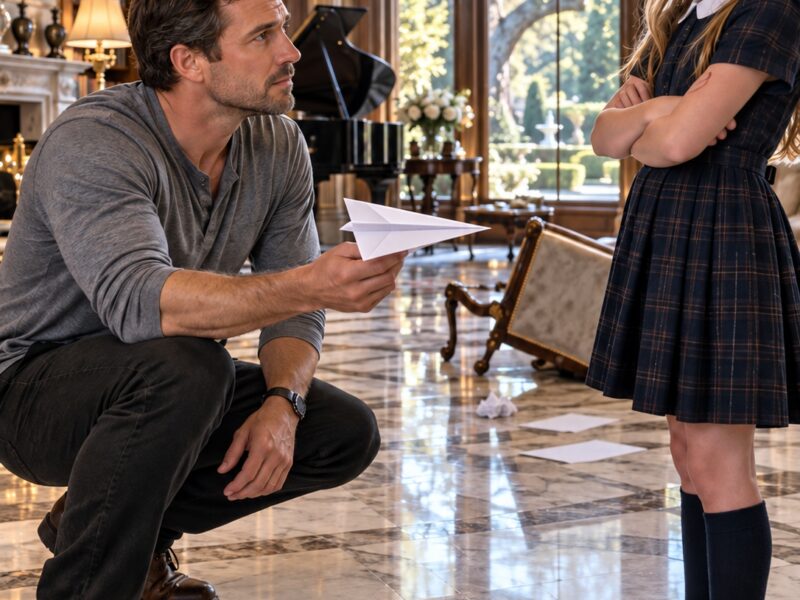
Six Tutors Quit on the Billionaire’s “Impossible” Daughter—Then the Seventh Man Discovered the Truth She Was Hiding

The seventh tutor had been inside the billionaire’s mansion for less than four minutes when a mathematics textbook flew past his face.
It struck the marble floor with a crack that made two housekeepers freeze in the hallway.
A second book followed.
Then a crystal pencil cup.
Then came the voice of a nine-year-old girl from behind the library doors.
“I SAID GET OUT!”
Kellan Mercer did not move.
At thirty-eight, he had been shouted at by men holding rifles, interrogated beneath desert heat, awakened by alarms in places where every second mattered, and once spent nearly eleven hours pinned inside a building while people outside tried very hard to make sure he never walked out.
But none of those memories were the reason he remained calm.
He stayed because he could hear something beneath the anger.
Fear.
On the other side of the library, Maribel Vale stood behind an overturned chair with her fists clenched so tightly that her fingernails had dug white crescents into her palms.
She was small for nine, dark-haired, sharp-eyed, and dressed in a navy skirt and white blouse that had probably cost more than Kellan’s monthly grocery bill.
Around her lay the wreckage of what had been prepared as a welcoming lesson.
Expensive textbooks.
A tablet.
New pencils arranged by color.
A leather-bound planner embossed with her initials.
All of it had been thrown across the room.
From the doorway, Seraphina Vale stared at her daughter with the same expression she wore when a billion-dollar acquisition was about to collapse.
Controlled.
Still.
Terrified.
“Maribel,” she said carefully.
“No.”
“You haven’t even met Mr. Mercer.”
“I don’t care.”
“He came here to help you.”
“I don’t need help!”
Her voice cracked on the last word.
Seraphina flinched.
Kellan noticed.
Maribel noticed too.
That was the problem.
The child noticed everything.
Kellan slowly set the folder he had been carrying onto a side table.
Inside it were lesson plans, educational evaluations, recommendations, background checks, and a twelve-page summary written by a child development consultant whose fee had apparently been higher than the cost of Kellan’s truck.
He left the folder closed.
“Okay,” he said.
Maribel stared at him.
Seraphina turned.
“Excuse me?”
Kellan glanced at the girl.
“I said okay.”
Maribel’s suspicion deepened.
“Okay what?”
“You don’t need help.”
Seraphina’s face tightened.
“Mr. Mercer—”
Kellan lifted one hand without looking away from Maribel.
“I’m not talking to you.”
Few people spoke that way to Seraphina Vale.
Fewer still did so inside her own home.
The billionaire’s expression cooled instantly, but Kellan continued before she could respond.
He looked at Maribel.
“You said you don’t need help. I heard you.”
The girl’s fists loosened slightly.
“So leave.”
“All right.”
That surprised her.
It surprised Seraphina even more.
Kellan turned and walked out of the library.
Maribel blinked.
For one moment, triumph flashed across her face.
Then confusion replaced it.
She stepped toward the doorway and watched him cross the enormous foyer.
“Where’s he going?” she asked.
Seraphina exhaled through her nose.
“I assume he’s quitting.”
“Good.”
Yet Maribel did not sound pleased.
Kellan reached the glass doors leading into the rear garden.
He opened them.
Then he disappeared outside.
Maribel waited.
Ten seconds.
Twenty.
Finally she marched toward the window.
He was not walking toward the driveway.
He was not on his phone.
He was not angrily complaining to the agency.
He had crossed the lawn, found a patch of shade beneath the enormous oak tree at the far end of the garden, and sat down.
Then he pulled a small notebook from his pocket.
Maribel stared.
“What is he doing?”
Seraphina joined her at the window.
For the first time that morning, she had no answer.
Kellan Mercer had become the seventh private tutor to enter Hawthorne Estate in nineteen months.
The first had lasted eleven days.
The second made it three weeks.
The third cried in the kitchen after Maribel refused to speak for five consecutive hours.
The fourth told Seraphina that the child was spoiled beyond repair.
The fifth recommended boarding school.
The sixth lasted six days before resigning through an email sent at 2:17 in the morning.
He had written only three sentences.
I cannot continue under these conditions.
Your daughter requires a level of intervention beyond private tutoring.
Please do not contact me again.
Seraphina had read the message four times.
Then she had deleted it before Maribel could see.
That was what Seraphina did with anything that might hurt her daughter.
She removed it.
She bought around it.
She negotiated with it.
She buried it beneath resources.
If a school failed Maribel, Seraphina found another school.
If a therapist had a six-month waiting list, Seraphina donated enough money to the clinic that an opening somehow appeared on Tuesday.
If her daughter struggled in mathematics, Seraphina hired a specialist.
If she struggled in reading, another specialist arrived.
Anxiety.
Grief.
Behavior.
Education.
Sleep.
Nutrition.
Social development.
There was always another expert.
There was always another appointment.
There was always another beautifully dressed adult standing in the mansion foyer saying, “We’re going to help you, Maribel.”
And every time they said it, Maribel trusted adults a little less.
She had been six when her father died.
Before that, according to everyone who remembered her then, she had been bright, curious, loud, affectionate, and incapable of entering a room without asking at least three questions.
After his death, the questions stopped.
At first, everyone called it grief.
Then the grief lasted longer than people found convenient.
Teachers began using other words.
Withdrawal.
Defiance.
Oppositional behavior.
Emotional dysregulation.
Maribel learned those terms by overhearing adults whisper them in hallways.
At seven, she asked her mother what “dysregulation” meant.
Seraphina nearly dropped her coffee.
“Where did you hear that?”
“Mrs. Dalton said it.”
“She shouldn’t have.”
“What does it mean?”
“It doesn’t matter.”
Maribel looked at her for several seconds.
Then she said quietly, “It means something is wrong with me.”
“No.”
“It does.”
“No, sweetheart.”
“Then why does everybody keep coming here to fix me?”
Seraphina never forgot the question.
She simply never found the right answer.
Eighteen months later, she was standing beside that same child, watching a former Navy SEAL sit under an oak tree as if he had nowhere else in the world to be.
“He’s weird,” Maribel announced.
“Yes.”
“You hired him.”
“Yes.”
“That means you’re weird too.”
Seraphina almost laughed.
The sound surprised both of them.
Maribel looked at her mother.
For a second, something soft passed between them.
Then Maribel remembered she was supposed to be angry.
She folded her arms.
“I’m not going outside.”
“No one said you had to.”
“Good.”
Five minutes passed.
Maribel remained at the window.
Ten minutes.
Kellan had not moved.
Eventually he opened his notebook and began writing.
Maribel leaned closer to the glass.
“What’s he writing?”
“I don’t know.”
“Is he writing about me?”
“Possibly.”
Her eyes narrowed.
“That’s rude.”
She left the window.
Seraphina watched her cross the foyer.
For one hopeful second, she thought her daughter was going upstairs.
Instead Maribel turned toward the rear doors.
“I’m only going out there to tell him not to write about me.”
“Of course.”
“Don’t follow me.”
“I won’t.”
“You always follow me.”
Seraphina’s mouth tightened.
“I said I won’t.”
Maribel opened the door.
Outside, afternoon sunlight stretched across the lawn.
She walked halfway toward the oak tree and stopped.
Kellan did not look up.
She went another few steps.
Still nothing.
“Hey.”
Kellan kept writing.
“Hey!”
He looked up.
“Hello.”
“Are you writing about me?”
“No.”
“What are you writing?”
“A list.”
“What list?”
“Things I’m bad at.”
Maribel frowned.
“You’re making a list of things you’re bad at?”
“Yes.”
“Why?”
“Trying to decide which one I should get better at first.”
She stared at him as if he had spoken another language.
Adults did not admit they were bad at things.
Adults told children to improve.
Adults said mistakes were normal, then frowned when children made them.
“What are you bad at?”
“Plenty.”
“Like what?”
Kellan studied the notebook.
“Cooking eggs.”
“That’s stupid.”
“It’s surprisingly difficult.”
“No, it isn’t.”
“You haven’t eaten my eggs.”
Despite herself, Maribel’s mouth twitched.
Kellan continued.
“I’m also bad at remembering where I put my keys. Dancing. Fixing plumbing. Knowing when avocados are ripe. And apparently”—he turned the notebook slightly—“choosing shoes that don’t make wealthy people uncomfortable.”
Maribel looked down at his worn brown shoes.
“My mom hates those.”
From fifty feet away behind the window, Seraphina narrowed her eyes.
Kellan glanced toward the mansion.
“I suspected.”
Maribel almost smiled.
Almost.
Then she remembered why she had come.
“You still have to leave.”
“Okay.”
“You keep saying okay.”
“I know.”
“It’s annoying.”
“Okay.”
This time she smiled.
It lasted less than a second.
But Seraphina saw it from inside the house.
Her hand rose involuntarily to her mouth.
Maribel turned away from Kellan.
That was when she noticed something resting on the grass between them.
A paper airplane.
She had made dozens that morning and thrown them through the hallway.
This one was different.
The folds were sharp.
Precise.
Almost military.
“You made that?”
“Yes.”
“It’s not very good.”
“It hasn’t flown yet.”
“That doesn’t mean it’s good.”
“Fair point.”
He pushed it gently across the grass.
It stopped several feet from her.
Maribel looked at him suspiciously.
“What am I supposed to do?”
“Nothing.”
“Then why did you give it to me?”
“I didn’t. I put it on the grass.”
“You pushed it at me.”
“That is technically accurate.”
“What’s inside?”
“I’m not sure you want to know.”
Now she definitely did.
Maribel picked it up.
Kellan returned to his notebook.
She unfolded the paper.
Inside was a simple pencil drawing.
A mountain.
At the bottom stood a tiny stick figure.
At the top was a small flag.
Beneath it Kellan had written:
Some mountains are climbed one step at a time.
Maribel read it twice.
“That’s cheesy.”
“It is.”
“You wrote it anyway.”
“Yes.”
“Why?”
Kellan shrugged.
“Sometimes cheesy things are still true.”
She sat down in the grass.
Not beside him.
Eight feet away.
It was the closest she had willingly sat to a tutor in months.
Kellan said nothing.
That silence became the first lesson.
The next morning, Seraphina expected disaster.
Instead, at nine twelve, she found Maribel in the breakfast room cutting toast into triangles.
“Where’s Mr. Mercer?”
Seraphina looked at the clock.
“He’s scheduled for nine thirty.”
“He was here at eleven yesterday.”
“Yes.”
“So?”
“So what?”
“Why isn’t he early?”
Seraphina put down her coffee.
“Are you waiting for him?”
“No.”
“Maribel.”
“I’m eating.”
“You’re wearing your backpack.”
Maribel immediately pulled it off.
“I forgot.”
Seraphina looked at the backpack.
Then at her daughter.
Then back at the backpack.
She wisely said nothing.
At nine twenty-eight, the doorbell rang.
Maribel was in the foyer before the housekeeper.
Kellan entered carrying the same worn canvas bag.
He looked at Maribel.
She looked at him.
Neither smiled.
“You’re late,” she said.
He checked his watch.
“I’m two minutes early.”
“You were earlier yesterday.”
“Yesterday I expected traffic.”
“There is always traffic.”
“That’s a fair criticism.”
Maribel turned.
“Come on.”
Seraphina watched her daughter lead him toward the library.
Kellan stopped at the doorway.
“No.”
Maribel spun around.
“No what?”
“No library.”
Her face hardened instantly.
“I knew it.”
“Knew what?”
“You lied.”
“About what?”
“You’re going to make me do school.”
Kellan put his canvas bag down.
“I am going to make you do absolutely nothing.”
“Then why are you here?”
“That’s a good question.”
She glared at him.
He pointed toward the garden.
“Mission one.”
Maribel hesitated.
“What mission?”
“I can’t tell you inside.”
“That makes no sense.”
“Most classified operations don’t.”
She studied him.
“What operation?”
Kellan lowered his voice.
“The oak tree is approximately one hundred eighty-three feet from this door.”
Maribel glanced outside.
“So?”
“I need to know how many steps it takes you to reach it.”
“That’s dumb.”
“Probably.”
“Why?”
“Because I need the information.”
“For what?”
“Mission two.”
“What’s mission two?”
“That depends on mission one.”
Maribel looked at her mother.
Seraphina held up both hands.
“I have no idea.”
Seven minutes later, Maribel was crossing the lawn counting steps.
“One hundred twenty-seven, one hundred twenty-eight, one hundred twenty-nine…”
Kellan walked behind her with a small notebook.
She reached the oak tree.
“One hundred forty-six.”
“Are you sure?”
“Yes.”
“How sure?”
“One hundred percent.”
“That’s dangerous.”
She frowned.
“What is?”
“Being one hundred percent sure.”
“I counted.”
“Then prove it.”
She rolled her eyes and walked back.
The second count was one hundred forty-eight.
Maribel stared at the ground.
“That’s wrong.”
“Which one?”
“The second one.”
“How do you know?”
“Because the first was one forty-six.”
“That doesn’t prove the second is wrong.”
She opened her mouth.
Stopped.
Kellan waited.
Finally she said, “My steps weren’t the same size.”
He nodded.
Maribel’s eyes changed.
She looked back across the lawn.
“So we need a standard measurement.”
“Interesting.”
“A measuring tape.”
“Maybe.”
“Do you have one?”
“No.”
“We have one in the garage.”
She began walking toward the house.
Kellan followed.
By ten fifteen, they had measured sections of the lawn.
By ten forty, Kellan had introduced multiplication without calling it multiplication.
At eleven, Maribel had calculated distance using different stride lengths.
At eleven twenty, she corrected one of her own mistakes without tearing the paper.
At eleven twenty-seven, she laughed.
Seraphina heard it from her office.
She stopped in the middle of a conference call with Singapore.
“Excuse me,” she whispered.
Her chief operating officer continued discussing quarterly projections.
Seraphina was no longer listening.
The laugh came again.
She muted the call.
Walked toward the window.
And saw her daughter sitting cross-legged in the grass while Kellan drew something ridiculous on a whiteboard.
Maribel laughed so hard she fell backward.
Seraphina pressed two fingers against her lips.
She had not realized until that moment how long it had been since she had heard that sound.
Over the next two weeks, Kellan changed almost nothing.
And somehow everything changed.
He did not remove the curriculum.
He disguised it.
History became intelligence gathering.
Reading became investigation.
Mathematics became navigation.
Science became field analysis.
Writing became a mission log.
Spelling words were hidden in coded messages.
Fractions appeared in recipes.
Geometry appeared in maps.
Mistakes stopped being marked with red ink.
Instead Kellan wrote one word beside them.
Again.
The first time he did it, Maribel became furious.
“I got it wrong.”
“Yes.”
“You’re supposed to tell me what I did wrong.”
“I can.”
“Then do it.”
“No.”
“Why?”
“Because I think you can find it.”
“What if I can’t?”
“Then I’ll still be here.”
The sentence was simple.
To Kellan, it was nothing.
To Maribel, it was everything.
Her pencil stopped moving.
She stared at him.
“What?”
“You said you’ll still be here.”
“Yes.”
“Even if I get it wrong?”
“That’s generally how tutoring works.”
“You don’t know.”
“Know what?”
She looked down.
“The others left.”
Kellan’s expression changed.
Not dramatically.
Just enough.
“They left because of me.”
“Did they tell you that?”
“No.”
“Then how do you know?”
“Because everybody leaves when I make things hard.”
The room became very quiet.
Kellan leaned back in his chair.
“Maribel.”
She did not look up.
“My wife died when my son was four.”
Maribel’s eyes lifted.
Kellan had never spoken about his family.
Not to her.
Not to Seraphina.
“She left?” Maribel asked.
“No.”
“You just said—”
“She died. That’s different from leaving.”
Maribel swallowed.
Kellan continued.
“For almost a year after that, my son, Tobin, thought if he behaved perfectly, nothing else bad would happen.”
Maribel said nothing.
“He cleaned his room without being asked. Ate vegetables he hated. Never complained. Never cried in front of me.”
“Why?”
“Because he thought maybe being difficult made people disappear.”
Maribel’s eyes dropped again.
“What did you tell him?”
“The truth.”
“What truth?”
“That his mother dying had nothing to do with him.”
She waited.
“And?”
“And I told him I wasn’t going anywhere because he got a math problem wrong.”
For a moment, the nine-year-old’s face became unreadable.
Then she pushed the worksheet toward him.
“Fine.”
“Fine what?”
“I’ll try again.”
She found the error in forty-three seconds.
Kellan did not praise her.
He simply wrote one word beside the corrected answer.
There.
That afternoon, Seraphina received a report from the private educational agency.
Maribel’s engagement had increased.
Completion rates were up.
Episodes of refusal had declined.
But numbers were not what changed Seraphina.
It was the small things.
Her daughter began sleeping with the curtains open.
She stopped tearing pages out of notebooks.
She started leaving paper airplanes on the kitchen counter with messages inside.
Need graph paper.
Mission 8 requires chocolate.
Tell Kellan the compass is broken.
One morning Seraphina walked downstairs at seven fifteen and found Maribel sitting beside the front door.
“You’re awake.”
“Obviously.”
“Mr. Mercer doesn’t arrive for another hour.”
“I know.”
“Then why are you sitting here?”
“I’m not waiting for him.”
“You’re holding his notebook.”
“I borrowed it.”
“You’re wearing shoes.”
Maribel scowled.
“Mom.”
Seraphina smiled.
“I didn’t say anything.”
“You were about to.”
“I wasn’t.”
“You smile before you say annoying things.”
Seraphina’s smile disappeared.
“I do not.”
“You do.”
At eight seventeen, Kellan arrived.
He was not alone.
A small boy stood beside him.
Messy brown hair.
Freckles.
A dinosaur backpack.
“This is Tobin,” Kellan said.
Tobin gave a shy wave.
“My childcare canceled.”
Seraphina glanced toward Maribel, expecting resistance.
Instead Maribel looked fascinated.
“This is your son?”
“Yes.”
“You said he was seven.”
“I am seven,” Tobin said.
Maribel looked him up and down.
“You’re short.”
“So are you.”
Seraphina closed her eyes.
Kellan coughed into one fist.
Maribel stared at Tobin.
Then, unexpectedly, she laughed.
By ten o’clock, the two children were arguing over a homemade bridge constructed from index cards.
By eleven, they were working together.
At lunch, Maribel offered Tobin half her dessert.
Seraphina stood in the doorway watching them.
Kellan stepped beside her.
“She doesn’t dislike children.”
“I never thought she did.”
“You stopped inviting them here.”
Seraphina stiffened.
“That wasn’t a question.”
“No.”
She looked at him.
“You seem very comfortable telling me what I’m doing wrong.”
“I’m not trying to.”
“You just did.”
Kellan folded his arms.
“Then maybe you should stop paying me.”
Her face cooled.
There it was again.
That complete absence of fear.
Employees feared disappointing Seraphina.
Executives feared being replaced.
Competitors feared underestimating her.
Kellan Mercer seemed to fear none of those things.
“You think money is the solution to everything,” he said quietly.
“I think money gives people options.”
“It does.”
“And options matter.”
“They do.”
“Then what exactly are you criticizing?”
Kellan looked toward the table.
Maribel was showing Tobin how to reinforce the bridge.
“Sometimes too many options tell a kid that every uncomfortable thing can be replaced.”
Seraphina’s jaw tightened.
“You know very little about my family.”
“I know your daughter has had more professionals in her life than friends.”
“That is unfair.”
“Probably.”
“You don’t know what I went through after my husband died.”
“No.”
“You don’t know what she went through.”
“No.”
“You don’t know how many nights she woke up screaming.”
Kellan’s expression softened.
“You’re right.”
“You don’t know what it is like to run a company, bury your husband, and then come home every night pretending you aren’t terrified your daughter is disappearing in front of you.”
Now Kellan was silent.
Seraphina’s eyes burned.
“I spent years building things because building things is something I understand. Systems. Companies. Solutions. Then my husband died, and suddenly my daughter was falling apart, and there was no system. No solution. Nothing I could buy or negotiate or force into working.”
Her voice dropped.
“So yes. I hired experts. I tried everything. What exactly was I supposed to do?”
Kellan looked at her for a long moment.
Then he said something she had not expected.
“Stay.”
Seraphina stared at him.
“What?”
“When she gets angry. Stay.”
Her expression hardened.
“I stay every day.”
“You’re physically here.”
The words landed harder than he intended.
Seraphina stepped backward.
Kellan immediately regretted them.
But before either could continue, Maribel appeared in the doorway.
“What are you talking about?”
Seraphina turned.
“Nothing.”
Maribel’s eyes moved between them.
Adults always said nothing when they meant something.
She had learned that long ago.
That evening, Seraphina canceled two meetings.
At seven thirty, she found Maribel sitting on the floor of her bedroom surrounded by paper.
“What are you doing?”
“Nothing.”
Seraphina almost smiled at the irony.
Instead she sat down.
Maribel looked suspiciously at her designer skirt touching the carpet.
“You’re going to wrinkle that.”
“I own another one.”
“You own like a hundred.”
“Approximately.”
“What do you want?”
Seraphina looked around.
Paper airplanes covered the carpet.
Some had equations written on the wings.
Others carried drawings.
One had Kellan’s mountain symbol.
“I thought maybe we could make one together.”
Maribel stared at her.
“You don’t know how.”
“No.”
“You’ll make it wrong.”
“Probably.”
Her daughter studied her face.
Then she handed her a sheet of paper.
For the next twenty minutes, Seraphina Vale—whose companies operated in twelve countries—failed repeatedly at folding a paper airplane.
Maribel laughed every time.
Eventually they created something vaguely capable of flight.
Seraphina threw it.
It nosedived immediately.
“That was terrible,” Maribel said.
“Yes.”
“Do it again.”
Seraphina picked it up.
And did.
Three days later, Kellan noticed the photograph.
Maribel had carried it into the library tucked inside her science book.
He saw the edge of it when she turned a page.
He said nothing.
Later she moved it onto the table.
Still, Kellan did not ask.
They completed a reading assignment.
Then a geography exercise.
The photograph remained between them.
Eventually Maribel touched it with one finger.
“That’s my dad.”
Kellan looked down.
The man in the photograph was perhaps forty.
He was smiling directly at the camera while holding a much younger Maribel against his chest.
She had her arms around his neck.
They both looked happy in the careless, unguarded way people often did before they understood that photographs would someday become evidence of a life that no longer existed.
“What was his name?” Kellan asked.
“Jonathan.”
“He looks happy.”
“He was funny.”
Kellan waited.
Maribel’s finger moved along the edge of the picture.
“I think.”
“You think?”
She nodded.
“I don’t remember his voice anymore.”
Kellan said nothing.
“I used to.”
Her eyes filled.
“I remembered everything.”
She swallowed.
“The way he said my name. The songs he sang wrong. He used to whistle when he cooked.”
One tear slipped down her cheek.
She wiped it away angrily.
“But now when I try to hear him, it’s like…”
She pressed both hands to her ears.
“Like nothing.”
Kellan’s chest tightened.
Maribel pushed the photograph away.
“Everyone says I’m supposed to remember the good things.”
“That sounds exhausting.”
She looked up.
“What?”
“Being told what you’re supposed to remember.”
Her face crumpled.
“I’m forgetting him.”
“No.”
“Yes, I am.”
“You’re forgetting details.”
“That’s the same thing.”
“No.”
“How do you know?”
Kellan reached into his wallet.
He removed a photograph.
Tobin, younger, asleep against a woman’s shoulder.
The woman was beautiful in an ordinary way.
No posed smile.
No expensive dress.
Just tired eyes, messy hair, and a child resting against her.
“My wife’s name was Rachel,” Kellan said.
Maribel stared at the photograph.
“I can’t always remember exactly what her laugh sounded like.”
Maribel looked shocked.
“You forgot too?”
“Some of it.”
“Doesn’t that make you sad?”
“Yes.”
“Then why are you okay?”
Kellan almost corrected her.
He almost said he was not always okay.
Instead he told the truth.
“I’m not okay every day.”
The child watched him.
“Sometimes I miss her so much I get angry at people who still have their person.”
Maribel’s eyes widened.
“Really?”
“Yes.”
“That’s bad.”
“Probably.”
“Do you feel guilty?”
“Sometimes.”
“Me too.”
“About what?”
Maribel looked at her father’s photograph.
“Being happy.”
Kellan felt something inside him go still.
She whispered, “Sometimes when I laugh, I think maybe Dad would think I forgot him.”
There it was.
Not defiance.
Not stubbornness.
Not a behavioral problem.
A nine-year-old girl had built a prison out of grief and believed leaving it would betray the dead.
Kellan leaned forward.
“Maribel.”
She wiped her eyes.
“If your dad loved your laugh when he was alive, why would he want you to lose it because he died?”
She stared at him.
Kellan let the question remain.
That afternoon, he took her into the garden.
No workbook.
No tablet.
No lesson plan.
He carried a small shovel and a flowering plant.
Maribel looked suspiciously at it.
“What’s that?”
“A flower.”
“I can see that.”
“Good. Science education is working.”
She rolled her eyes.
“Why do you have it?”
“We’re planting it.”
“Why?”
Kellan pointed toward the oak tree.
“Because sometimes love needs somewhere to go.”
Maribel said nothing.
They dug a hole together.
The soil was dark and cool.
When the plant was settled, Maribel pressed earth carefully around the roots.
“Will it die?”
“Eventually.”
Her head snapped toward him.
“You’re supposed to say no.”
“I’m not very good at saying things just because people want to hear them.”
She looked back at the flower.
“What happens when it dies?”
“We plant something else.”
Maribel’s eyes filled again.
“And that doesn’t replace it?”
“No.”
“Promise?”
“Yes.”
That was when she began to cry.
Not the furious crying that sometimes came after panic.
Not screaming.
Not hiding.
She simply sat in the grass and cried for her father.
Kellan sat beside her.
He did not touch her.
He did not tell her everything happened for a reason.
He did not say her father was in a better place.
He did not tell her to be strong.
He stayed.
From the open glass doors, Seraphina watched.
She should have gone outside.
Every instinct told her to.
That was her daughter.
Her grief.
Her responsibility.
But something stopped her.
Maribel was crying in front of another person without shame.
For nearly three years, Seraphina had tried to stop those tears.
Kellan was allowing them.
And somehow that was healing something Seraphina had spent millions trying to repair.
That night, she stood alone beside the flower.
Kellan was preparing to leave.
She heard him behind her.
“You don’t have to pay me extra for the plant.”
Seraphina looked at him.
“That was almost a joke.”
“I make them occasionally.”
She turned toward the small flower.
“What did she tell you?”
“That’s hers.”
“I’m her mother.”
“I know.”
“I have a right to know what is happening with my daughter.”
“If she tells me something that affects her safety, you’ll know.”
Seraphina’s expression sharpened.
“And everything else?”
“Everything else belongs to the trust she’s building.”
“With you.”
“Yes.”
The word irritated her more than it should have.
“She used to trust me.”
Kellan’s expression softened.
“She probably still does.”
“That doesn’t sound convincing.”
“She also thinks you’re scared of her feelings.”
Seraphina looked away.
The truth hurt because it was immediate.
Kellan continued more gently.
“You keep trying to make her feel better because watching her hurt makes you hurt.”
“What mother wouldn’t?”
“But sometimes she needs permission to feel terrible.”
Seraphina stared at the garden.
“I don’t know how to do this.”
It might have been the first time in twenty years she had spoken those words aloud.
Kellan heard them for what they were.
Not weakness.
Exhaustion.
“You don’t have to know.”
“I’m her mother.”
“That doesn’t make you psychic.”
She gave him a tired look.
“No?”
“No. Unfortunately, children are issued without instructions.”
“I would have paid extra for them.”
Kellan smiled.
This time, Seraphina did too.
For the first time, she wondered what he looked like before grief had settled behind his eyes.
The thought unsettled her.
She changed the subject.
“Your military records are unusually vague.”
His smile disappeared.
“My service was included in the background check.”
“Dates were included.”
“Yes.”
“Assignments were not.”
“They often aren’t.”
“You were a SEAL.”
“Yes.”
“What happened?”
The transformation in him was almost invisible.
His shoulders remained relaxed.
His voice stayed calm.
But the man standing beside Seraphina seemed suddenly farther away.
“A lot of things.”
“That is not an answer.”
“It’s the one I’m giving.”
She studied him.
For once, pushing harder felt wrong.
So she stopped.
But the unanswered question remained.
And three weeks later, it nearly destroyed everything they had built.
The day began normally.
Maribel had a reading assessment scheduled at ten.
A year earlier, even the word assessment could trigger a refusal.
Now she sat at the breakfast table eating strawberries while reviewing vocabulary cards.
Kellan entered.
She held one up.
“Obsequious.”
He took off his jacket.
“Trying too hard to please someone.”
“Use it in a sentence.”
“Your attempt to make me use vocabulary words before coffee is becoming obsequious.”
Maribel frowned.
“That doesn’t even make sense.”
“I need coffee.”
“You’re avoiding the test.”
“You’re the one taking it.”
“Exactly.”
Seraphina walked into the room.
“Good morning.”
Maribel pointed toward Kellan.
“He’s failing vocabulary.”
“Fire him.”
“Mom.”
Kellan looked at Seraphina.
“I see where she gets it.”
For several minutes, everything felt almost normal.
Almost like a family that had always known how to laugh together.
At ten fourteen, Maribel sat at the long table near the library windows.
Her assessment was open.
Kellan remained across from her.
Not behind.
He had learned she hated people standing behind her while she worked.
Question one.
Correct.
Question two.
Correct.
Question three.
She erased the answer twice.
Kellan did not interfere.
Maribel wrote it again.
Correct.
Then the sound came.
A glass shattered in the kitchen.
Sharp.
Sudden.
Violent.
Maribel froze.
Kellan saw it instantly.
Her pencil stopped.
Her shoulders locked.
Her pupils widened.
The room disappeared from her eyes.
“Maribel.”
No response.
“Look at me.”
Her breathing changed.
Fast.
Shallow.
She pushed back from the table.
The chair scraped across the floor.
“Maribel, you’re here. You’re safe.”
She shook her head.
“No.”
“Listen to my voice.”
“No.”
Kellan stood slowly.
She backed away.
In the hallway, Seraphina heard the chair.
She came running.
“What happened?”
“Stay there.”
Kellan’s tone stopped her instantly.
Maribel looked toward her mother.
Something in her expression changed.
Terror.
Pure, primitive terror.
Then she ran.
“Maribel!”
She flew through the library doors.
Across the foyer.
Out through the rear entrance.
Kellan followed.
Seraphina was seconds behind them.
Maribel ran barefoot across the grass.
She had lost one shoe inside.
“Stop!” Seraphina screamed.
Kellan did not.
“Don’t yell!”
“That’s my daughter!”
“You’ll push her farther!”
Maribel reached the far edge of the property.
Beyond the oak tree stood an old stone boundary wall.
On the other side, the ground dropped sharply into a wooded slope.
Normally the area was locked behind a small iron gate.
That morning, gardeners had left it open.
Maribel ran through.
Seraphina’s face drained of color.
“No.”
Kellan accelerated.
Maribel climbed onto the low stone ledge.
“Maribel!”
She turned.
Her face was wet with tears.
“Don’t come closer!”
Seraphina stopped so abruptly she nearly fell.
Kellan slowed.
Every part of him wanted to close the distance.
Training said distance was danger.
Experience said panic changed rules.
He lowered himself to one knee.
“Okay.”
Maribel shook violently.
“Get away.”
“Okay.”
Seraphina stared at him.
“Kellan—”
He raised one hand.
“Maribel, can you hear me?”
“No!”
“That was a very good answer.”
She blinked.
Kellan kept his voice low.
“Do you know where you are?”
Her breathing hitched.
“The garden.”
“Good.”
“What’s behind you?”
She glanced toward the trees.
“I don’t know.”
“Don’t look.”
She looked back at him.
“Why?”
“Because I’m much more interesting.”
Even now, even terrified, part of her almost recognized the joke.
Seraphina pressed both hands over her mouth.
Kellan slowly shifted one foot forward.
Maribel saw it.
“I SAID DON’T!”
He stopped.
“All right.”
“I hate you!”
“Okay.”
“I hate Mom!”
Seraphina flinched.
Kellan did not look at her.
“Okay.”
“I hate everyone!”
“You’re allowed.”
Maribel sobbed.
“No, I’m not!”
“Yes.”
“No!”
“You don’t have to be good right now.”
Her face broke.
Those words reached somewhere the others could not.
She cried harder.
“I can’t do it.”
“You don’t have to do anything.”
“I’m stupid.”
“No.”
“I couldn’t breathe.”
“That doesn’t make you stupid.”
“I ruined it again.”
“You didn’t ruin anything.”
Her bare foot shifted on the stone.
A small piece crumbled beneath her heel.
Kellan saw it.
His body changed instantly.
Seraphina saw that too.
He became frighteningly still.
“Maribel.”
Something in his voice made the child look at him.
“Don’t move.”
She froze.
“What?”
“Just look at me.”
“Kellan?” Seraphina whispered.
He did not answer.
Another fragment of stone slid away.
Maribel felt it.
Her eyes widened.
She looked down.
That was the mistake.
Her balance shifted.
Her foot slipped.
Seraphina screamed.
Maribel vanished over the wall.
Kellan moved.
There was no hesitation.
No visible decision.
One second he was kneeling.
The next he was sprinting.
He crossed the remaining distance, threw himself toward the wall, and reached over the edge.
His hand caught Maribel’s wrist.
Her body slammed against the stone.
She screamed.
Kellan’s shoulder struck the top of the wall.
Pain exploded through his arm.
He ignored it.
“I’ve got you.”
“Kellan!”
“I’ve got you!”
Maribel dangled against the slope.
Branches scraped beneath her shoes.
Seraphina reached them.
“Oh my God.”
“Don’t grab her.”
“What?”
“Grab me.”
Seraphina stared at him.
“Kellan—”
“NOW!”
She wrapped both hands around the back of his belt and shirt.
Kellan tightened his grip.
“Maribel, give me your other hand.”
“I can’t!”
“Yes, you can.”
“I CAN’T!”
His face twisted with effort.
“Look at me.”
She looked up.
“You know our mountain?”
She sobbed.
“What?”
“One step at a time.”
His grip was slipping.
“One hand at a time.”
Maribel reached.
Kellan caught her other wrist.
With Seraphina bracing behind him, he pulled.
Once.
Twice.
Then Maribel came over the wall and crashed into his chest.
All three of them fell onto the grass.
For several seconds, nobody moved.
Then Maribel made a broken sound and wrapped herself around Kellan.
He held her.
Seraphina crawled toward them.
She touched her daughter’s hair.
Her shoulders.
Her face.
“You’re okay.”
Maribel sobbed.
“You’re okay, baby.”
Seraphina was crying now.
“I’m here.”
Kellan’s hands shook.
Not from effort.
Something deeper.
Something old.
Maribel buried her face against him.
“I’m sorry.”
“No.”
“I’m sorry.”
“No apologies.”
“I almost fell.”
“But you didn’t.”
“You saved me.”
Kellan closed his eyes.
For a fraction of a second, another landscape replaced the garden.
Dust.
Smoke.
A radio screaming with voices.
A hand he had not reached quickly enough.
A man calling his name.
Then Maribel’s fingers tightened around his shirt.
The garden returned.
Kellan opened his eyes.
That was when Seraphina saw the scar.
His shirt sleeve had torn and slid upward.
Along the inside of his forearm was a pale, irregular mark.
Not unusual by itself.
But beside it was something else.
A small cluster of faded surgical lines and a distinctive burn pattern.
Seraphina stopped breathing.
Years earlier, her charitable foundation had funded a rehabilitation program for wounded veterans.
During the research process, she had reviewed hundreds of photographs and case studies.
One image had stayed with her.
A classified operation had later become partially public after several servicemen were decorated posthumously.
There had been a survivor.
His name had been redacted in the foundation material.
But one photograph showed an injured operator being carried toward an evacuation helicopter.
His face was turned away.
His forearm was visible.
So was the mark.
Seraphina stared at Kellan.
He noticed.
His expression hardened.
“Kellan.”
“Not now.”
“That scar.”
He pulled his sleeve down.
“Kellan.”
Maribel looked between them.
“What scar?”
“Nothing,” he said.
Seraphina’s voice trembled.
“You were there.”
Kellan stood slowly.
Maribel remained clutching his hand.
“Where?” she asked.
Seraphina stared at him.
“The Al-Hadir extraction.”
Kellan’s face went completely still.
Maribel looked up.
“What’s that?”
He released her hand gently.
“Inside.”
“Kellan—”
“Please.”
Seraphina had never heard him say the word that way.
Not politely.
Desperately.
She stopped.
But the past had already entered the garden.
That night, after Maribel finally fell asleep, Seraphina found Kellan in the kitchen.
He had an ice pack pressed against his shoulder.
His canvas bag sat beside the door.
“You were leaving without speaking to me.”
“I was coming back tomorrow.”
“Were you?”
He did not answer.
Seraphina closed the kitchen door.
“Seven men died.”
Kellan’s jaw tightened.
“Don’t.”
“You were the only one from the assault team who came home.”
“Seraphina.”
“You received a commendation.”
His hand tightened around the ice pack.
“You searched me.”
“Yes.”
“I told you my service history was private.”
“My daughter almost died today.”
“And she didn’t.”
“Because you reacted like a man who had done that before.”
His eyes rose.
“Pulling children off walls?”
“Saving people.”
The silence was immediate.
Kellan stood.
“I should go.”
Seraphina moved between him and the door.
“No.”
His expression sharpened.
“Move.”
“No.”
“You don’t get to trap me in your kitchen because you’re curious.”
“I’m not curious.”
“Yes, you are.”
“I am terrified.”
That stopped him.
Seraphina’s voice broke.
“My daughter was hanging over that wall.”
“I know.”
“And you were calm.”
“I wasn’t calm.”
“You looked calm.”
“That’s different.”
Her eyes filled.
“How?”
Kellan looked away.
For several seconds, his face became unreadable.
Then something cracked.
“I know what panic costs.”
Seraphina said nothing.
He stared at the dark window.
“The mission was supposed to be simple.”
His voice was quieter now.
“Go in. Extract two hostages. Leave.”
Seraphina did not interrupt.
“Intelligence was wrong.”
He swallowed.
“There were more people inside than expected. More weapons. Different exits.”
His hand trembled once.
“There was a family there.”
Seraphina’s chest tightened.
Kellan closed his eyes.
“One of the children wouldn’t move.”
The kitchen seemed suddenly too quiet.
“He was terrified. Everyone was shouting. Gunfire everywhere. I kept telling him to come to me.”
Kellan looked at his hands.
“He froze.”
“What happened?”
“I went back.”
Seraphina waited.
“The building took a hit.”
His voice went flat.
“The rest doesn’t matter.”
“It matters to you.”
“That doesn’t mean it belongs to you.”
“You lost your team.”
“Yes.”
“And the child?”
Kellan looked at her.
That answer was already in his face.
Seraphina’s eyes closed.
“I’m sorry.”
“I don’t need you to be sorry.”
“What do you need?”
He laughed once.
There was no humor in it.
“For people to stop calling me a hero.”
“I didn’t.”
“You were going to.”
“No.”
“Everyone does once they read the citation.”
Seraphina shook her head.
“You came home.”
“Exactly.”
The words were almost a whisper.
Seraphina understood.
“You think you shouldn’t have.”
Kellan’s expression became dangerous.
“Don’t analyze me.”
“I’m not.”
“You’ve had enough professionals in this house. Don’t turn me into another case.”
“I’m not trying to fix you.”
He looked at her.
The sentence echoed.
It was what he had never done to Maribel.
Seraphina stepped closer.
“I’m asking because today, when my daughter fell, you looked terrified after you saved her.”
Kellan’s eyes dropped.
“I was.”
“Why?”
He said nothing.
“Kellan.”
When he finally spoke, his voice barely carried.
“Because for one second, when her hand slipped…”
He stopped.
Seraphina waited.
“I thought I was going to fail another child who trusted me.”
All the air seemed to leave the room.
Kellan sat down.
He pressed both palms against his face.
The quiet tutor disappeared.
The former SEAL disappeared.
The man who always knew when to sit, when to wait, when to speak softly disappeared.
There was only a widower.
A father.
A survivor.
A man who had spent years believing survival was a debt he had not repaid.
Seraphina sat across from him.
Neither spoke.
Then a small voice came from the doorway.
“You didn’t fail me.”
Kellan froze.
Maribel stood there in pajamas.
Her hair was tangled.
Her eyes were red from sleep.
Seraphina rose.
“Sweetheart, you should be in bed.”
Maribel ignored her.
She walked toward Kellan.
“You didn’t fail me.”
He looked at her.
“How much did you hear?”
“Enough.”
“Maribel—”
“You said somebody died.”
Kellan’s face tightened.
“Yes.”
“And you think it was your fault.”
“It’s complicated.”
“That means yes.”
Seraphina almost intervened.
Then stopped.
Maribel stepped closer.
“You told me mistakes don’t make people leave.”
Kellan swallowed.
“Yes.”
“You told me bad things happening doesn’t mean I caused them.”
“Yes.”
Her lower lip trembled.
“Does that only count for kids?”
He stared at her.
The question hit with more force than anything Seraphina could have said.
Maribel’s eyes filled.
“You’re a liar if it only counts for me.”
Kellan looked down.
A broken laugh escaped him.
“You’re very difficult.”
“I know.”
“No.”
He looked at her again.
“You’re not.”
Maribel stepped forward.
Then she wrapped both arms around his neck.
Kellan went completely still.
The child pressed her face against his shoulder.
For several seconds, nobody moved.
Then Maribel whispered one word.
“Dad.”
Kellan stopped breathing.
Seraphina covered her mouth.
Maribel seemed to realize what she had said at the exact same moment.
She pulled away.
Her face went white.
“I didn’t mean—”
Kellan caught her gently by the shoulders.
“It’s okay.”
“I know you’re not—”
“It’s okay.”
“My dad is dead.”
“I know.”
“I didn’t mean to replace him.”
“You didn’t.”
“I’m sorry.”
“No.”
Tears ran down her face.
“I’m sorry.”
Kellan knelt.
“You never apologize for loving someone.”
Maribel stared at him.
“You can call me Kellan.”
She nodded quickly.
“Or Mr. Mercer.”
She made a face.
He almost smiled.
“Or the guy with terrible shoes.”
Another tiny nod.
“And if that word ever comes out by accident again, you don’t have to be scared of it.”
Maribel’s eyes searched his.
“Would you be mad?”
“No.”
“Sad?”
“Maybe.”
“Why?”
Kellan glanced toward Seraphina.
Then back to the child.
“Because sometimes good things hurt too.”
Maribel seemed to understand that better than most adults would have.
She hugged him again.
This time he hugged her back.
After that night, nothing became magically easy.
Maribel still had bad days.
That mattered.
There were mornings she refused to work.
Times she became overwhelmed.
Days when grief arrived without warning and sat beside her like an unwanted guest.
Once she tore up an entire writing assignment after spelling three words incorrectly.
Kellan did not tell her she had failed.
He handed her tape.
They repaired every page together.
Another afternoon, she screamed at Seraphina because a business trip had been extended by one day.
Before, Seraphina would have defended herself.
Explained schedules.
Explained responsibility.
Explained that the private jet would bring her home as quickly as possible.
This time she sat on the floor outside Maribel’s bedroom.
“I’m angry at you!” Maribel shouted through the door.
“I know.”
“You always leave!”
Seraphina closed her eyes.
“I know it feels that way.”
“I hate your company!”
“That’s allowed.”
“You care about it more than me!”
Seraphina’s throat tightened.
“That isn’t true.”
“You’re lying!”
Maybe once she would have forced the door open.
This time she remained outside.
“I’ll be here when you’re ready.”
Silence.
Five minutes.
Ten.
Twenty-three minutes later, the door opened.
Maribel sat down beside her.
Neither spoke.
Eventually the child leaned against her mother.
Seraphina kissed the top of her head.
Staying, she learned, did not always mean preventing the storm.
Sometimes it meant being there after it passed.
Months changed the atmosphere inside Hawthorne Estate.
The mansion remained enormous.
The staff remained discreet.
The windows still reflected sunlight like something from a magazine.
But signs of actual childhood slowly appeared among the expensive furniture.
A science project sat unfinished on a dining table.
Colored pencils were left on the stairs.
A paper airplane occasionally landed in the chandelier.
Tobin began visiting twice a week.
He and Maribel fought constantly.
Usually about important matters like who cheated during board games or whether dinosaurs could defeat modern military equipment.
Kellan never settled those arguments.
He claimed neutrality.
Seraphina accused him of cowardice.
Maribel’s grades improved.
Her teachers noticed.
Specialists sent optimistic reports.
But the most important changes had nothing to do with performance.
She made a friend.
Then two.
She accepted an invitation to a birthday party.
She slept through the night more often.
She stopped hiding her father’s photograph.
Instead, it sat openly beside her bed.
Sometimes she wrote letters to him.
Dear Dad,
I got an A on science but Kellan says grades aren’t the most interesting thing about me, which is annoying because I studied a lot.
Tobin thinks frogs are reptiles. He is wrong.
Mom made pancakes and burned them.
You would have laughed.
I still miss you.
Love,
Maribel.
She folded each letter into a paper airplane.
Most were stored in a wooden box beneath the oak tree.
Seraphina never opened them.
That was another thing she learned.
Love did not entitle you to every private corner of another person’s grief.
One afternoon in early fall, she stepped into the garden and found Kellan and Maribel beneath the oak tree.
The little flower they had planted months earlier had grown.
Maribel sat with a science book open across her knees.
Kellan leaned against the trunk.
“You’re wrong,” she announced.
“I usually am.”
“Whales are mammals.”
“I know.”
“You said fish.”
“I wanted to test you.”
“No, you forgot.”
“Prove it.”
“You literally said, ‘That’s a large fish.’”
“Could have been strategic.”
“You know what obsequious means but you don’t know what a whale is?”
“I have many gaps in my education.”
Maribel laughed.
Seraphina stopped several yards away.
The sound floated through the warm afternoon.
For years, she had believed safety meant eliminating everything that could hurt her child.
She had been wrong.
Money could build gates.
Money could hire drivers.
Money could create libraries, swimming pools, tutors, doctors, and every material protection available.
But money could not guarantee that nobody died.
It could not prevent grief.
It could not force trust.
It could not purchase the courage required to love people despite knowing they might someday disappear.
Kellan looked up and saw Seraphina.
Something passed between them.
No promise.
No grand romantic conclusion.
Life was more complicated than that.
They were two adults whose families had been damaged by loss in different ways.
They had begun, cautiously, to understand each other.
That was enough for now.
Maribel noticed her mother.
“Mom!”
“Yes?”
“Come here.”
Seraphina walked closer.
“We’re doing science.”
“I can see that.”
“Kellan thinks whales are fish.”
“I never said that.”
“He did.”
Seraphina looked solemnly at him.
“I’m afraid we’ll have to terminate your employment.”
“Finally.”
Maribel’s smile vanished.
“What?”
Kellan looked at her.
“Joke.”
“That wasn’t funny.”
Seraphina sat beside them.
“No. It wasn’t.”
“You’re both terrible.”
Maribel picked up her book again.
For several minutes she explained the respiratory system of whales with such intensity that she forgot anyone else might want to speak.
Kellan listened.
Really listened.
Not with the false attention adults often gave children while waiting for them to finish.
He asked questions.
Maribel answered enthusiastically.
Seraphina watched them.
Once, the sight might have frightened her.
She might have worried that her daughter was becoming too attached.
That Kellan could leave.
That another loss might break her.
Now Seraphina understood something she had not understood after Jonathan’s death.
Fear of losing love could become another way of refusing to live.
So she let the moment exist.
Later, as evening settled over the estate, Maribel disappeared inside.
Kellan gathered their books.
Seraphina noticed a paper airplane beneath the oak tree.
“You missed one.”
Kellan bent down.
The airplane was new.
Three words were written across one wing.
Thank you, Dad.
Kellan did not move.
Seraphina saw his throat tighten.
“You okay?”
He nodded.
It was obviously a lie.
She let him have it.
He unfolded the airplane.
Inside, Maribel had drawn two mountains.
On the first mountain stood a tiny girl.
On the second stood a man holding a small boy’s hand.
Between them was a bridge.
At the bottom she had written:
You said mountains are climbed one step at a time.
I think people are too.
Kellan stared at the page.
For years he had carried names he could not forget.
Men who had not come home.
A child he could not save.
A wife whose side of the bed had stayed empty long after he learned to sleep without reaching for her.
He had believed surviving meant owing the dead something enormous.
A debt.
A purpose.
A perfect explanation for why he had remained when others had not.
He had looked for that explanation in work.
In isolation.
In fatherhood.
In service.
He had never found it.
Then a furious nine-year-old girl had thrown a textbook across a billionaire’s library.
And somehow, by refusing to walk away, Kellan had begun to understand.
Maybe surviving was not a debt.
Maybe it was an invitation.
To stay.
To listen.
To fail and return.
To love people you could not guarantee you would keep.
To help one frightened child believe that getting something wrong did not make her unworthy of being loved.
Kellan folded the paper carefully.
“You know,” Seraphina said softly, “the first day you came here, I thought you were completely unqualified.”
He looked at her.
“You were probably right.”
“I almost canceled the interview.”
“You should trust your instincts.”
She smiled.
“Your application changed my mind.”
He knew the sentence she meant.
Children don’t always need someone to control them.
Sometimes they need someone who can stay when everyone else leaves.
Kellan looked toward the mansion.
Through the enormous windows, Maribel was arguing with Tobin about something in the kitchen.
A housekeeper was trying not to laugh.
The children’s voices reached faintly into the garden.
Seraphina followed his gaze.
“She still worries you’ll leave.”
“I know.”
“So do I.”
He looked at her.
She did not take the words back.
Kellan slid the paper airplane carefully into his jacket.
“I can’t promise forever.”
Seraphina nodded.
“No one can.”
That was the lesson all of them had been fighting.
Jonathan had not promised to die.
Rachel had not promised to leave Tobin without a mother.
Kellan’s teammates had not expected one mission to become their last.
Life made promises people could not keep.
Love was not valuable because it came with guarantees.
It was valuable because it existed without them.
The back door opened.
Maribel appeared.
“Kellan!”
He turned.
“What?”
“You forgot your notebook!”
She ran across the lawn carrying it.
Halfway there she slowed herself, as though suddenly remembering she was nine and supposedly too old to run excitedly toward her tutor.
Kellan pretended not to notice.
She handed him the notebook.
“Thanks.”
“Are you coming tomorrow?”
“Yes.”
“What time?”
“Nine.”
“Not nine thirty?”
“Nine.”
“Promise?”
Kellan hesitated.
Maribel noticed.
Months earlier, that hesitation might have frightened her.
Now he crouched so they were eye level.
“I promise I’ll do everything I can to be here at nine.”
She considered that.
It was not the absolute promise she wanted.
But it was an honest one.
“Okay.”
Kellan began walking toward the house.
Maribel caught his hand.
He looked down.
She did not call him Dad.
She did not need to.
They crossed the lawn together.
Behind them, beneath the oak tree, the little flower moved gently in the evening wind.
It had survived summer heat, heavy rain, careless gardeners, and one cold week when everyone assumed it would die.
Some of its leaves were imperfect.
One stem leaned permanently to the left.
It was not the kind of flower Seraphina once would have chosen for a mansion garden.
She would have replaced it.
Now she never would.
Because Maribel had been right about something adults often forgot.
Keeping something was not the same as keeping it perfect.
Sometimes the most beautiful things were the things that had been damaged, tended carefully, and allowed to keep growing anyway.
That night, after the estate became quiet, Maribel slipped downstairs one last time.
She walked barefoot across the garden.
The moonlight made the grass silver.
At the oak tree, she opened the wooden box containing her letters.
She added another paper airplane.
This one was addressed to her father.
Dear Dad,
I remembered something today.
You used to call pancakes “flapjacks” because you thought it sounded funny.
I don’t know why I suddenly remembered.
I thought I was forgetting you.
Maybe I’m not.
Kellan says memories hide sometimes.
Mom is different now.
She sits with me when I’m mad.
She’s still annoying.
I think you would be proud of her.
I called Kellan Dad once.
I felt bad afterward.
But I don’t anymore.
He isn’t you.
Nobody is.
I think that’s okay.
I used to think loving somebody new meant I was leaving you behind.
Now I think maybe love just gets bigger.
I hope that’s true.
I miss you.
I always will.
But I laughed today.
And I didn’t feel guilty.
Maribel folded the letter slowly.
She placed it inside the box.
Then she looked up through the branches of the oak tree.
For years, adults had asked her to be strong.
She finally understood they had been asking the wrong thing.
She did not need to become strong enough to stop missing her father.
She did not need to become strong enough to stop being afraid.
She did not need to become the perfectly behaved daughter of a billionaire, the brilliant student her teachers expected, or the repaired version of the broken child everyone thought they saw.
She only needed to know that when fear returned, she would not always have to face it alone.
Sometimes her mother would be there.
Sometimes Tobin.
Sometimes Kellan.
And one day, perhaps, she would be there for someone else.
Maribel closed the box.
As she walked back toward the mansion, she saw a light turn on in her mother’s bedroom.
The curtains moved.
Seraphina was watching.
Maribel lifted one hand.
Her mother waved back.
Neither called out.
Neither needed to.
For the first time since Jonathan died, the enormous Hawthorne estate did not feel like a beautiful place filled with people desperately trying not to lose one another.
It felt like a home.
And miles away, in a modest house far less impressive than the Vale mansion, Kellan Mercer stood alone in his kitchen after putting Tobin to bed.
He removed Maribel’s paper airplane from his jacket.
Thank you, Dad.
His fingers rested over the words.
For a long time, he simply stared.
Then the former Navy SEAL who had survived missions nobody wanted to discuss, buried friends he still dreamed about, buried the woman he loved, and spent years believing survival required punishment finally allowed himself to do something he had avoided for far too long.
He cried.
Quietly.
Not because he had replaced a dead father.
He knew he never could.
Not because a frightened child had turned him into a hero.
He knew better than to believe that.
He cried because somewhere between the first thrown textbook and that paper airplane, Maribel Vale had trusted him with something more fragile than her education.
She had trusted him with the part of her heart that still believed everyone eventually left.
And without realizing it, she had been trusted with the same part of his.
Kellan pressed the airplane against his chest.
Tomorrow morning, he would drive back through the iron gates.
Maribel would probably complain that he was two minutes late.
Tobin would forget something at school.
Seraphina would take three calls during breakfast and pretend she was listening to none of them.
There would be mistakes.
Arguments.
Panic.
Bad days.
Grief would return because grief always returned.
Nothing had been magically fixed.
And perhaps that was the most beautiful truth of all.
They did not need to be fixed.
They only needed people willing to remain beside them while they learned how to live with what could never be undone.
Under the oak tree at Hawthorne Estate, the small flower continued growing in the dark.
And inside a quiet kitchen across the city, Kellan unfolded Maribel’s paper airplane one final time.
At the bottom of the page, beneath the drawing of two mountains connected by a bridge, there was one sentence he had missed before.
The handwriting was small and uneven.
But the words were unmistakable.
You stayed.
Kellan closed his eyes.
For the first time in years, he understood that sometimes the greatest rescue was not dragging someone away from danger.
Sometimes it was sitting several feet away beneath an oak tree.
Waiting.
And proving, one ordinary day at a time, that when they finally found the courage to trust you—
you would still be there.









