“SLEEP BESIDE ME, JUST TONIGHT,” THE LONELY BLACKSMITH BEGGED A STRANGER—BUT NEITHER WAS PREPARED FOR WHAT HAPPENED NEXT

The first time Callum Wyatt asked Nora Reed to sleep beside him, she had a knife hidden in her boot.
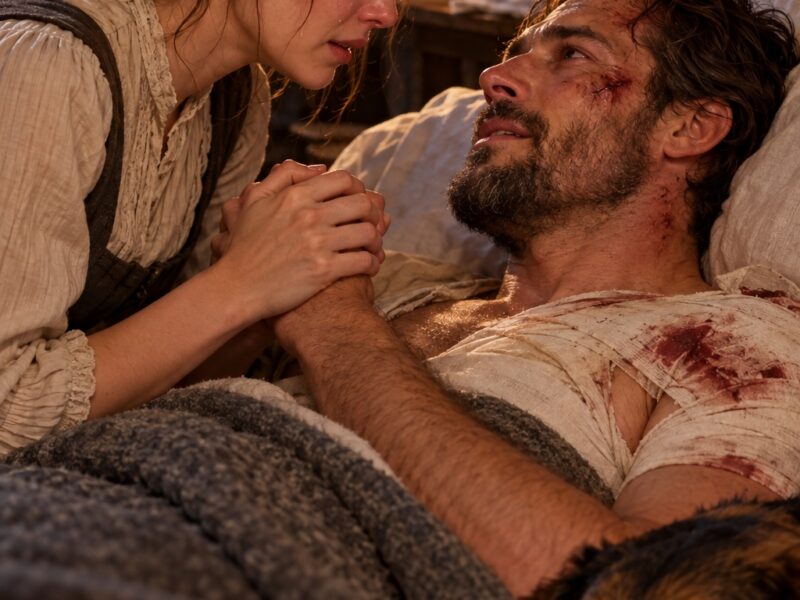
The second time, he was lying in a bed soaked with fever, and she was begging him not to die.
But between those two nights, something happened in a small American town that neither of them would ever forget.
It began with a storm.
And a red door that nobody in Dust Hollow had seen opened to a stranger in years.
October rain hammered the windows of the last stagecoach traveling west through the valley.
Inside, twenty-eight-year-old Nora Reed sat with her medical bag pressed against her knees, watching the countryside disappear behind sheets of water.
She had eleven dollars.
One spare dress.
A pair of worn leather boots.
And a future so uncertain that she had stopped allowing herself to imagine what might come next.
When the driver announced they had reached Dust Hollow, Nora almost asked him to keep going.
There was something unsettling about the place.
The muddy main street was deserted. Wooden storefronts stood dark behind dripping awnings. A church bell moved in the wind without ringing, and somewhere beyond the buildings, a creek roared louder than it should have.
“End of the line, ma’am,” the driver said.
Nora climbed down, clutching the small suitcase that contained everything she hadn’t left behind in Chicago.
“Is there an inn?”
“Halfway down the street.”
“Will it be open?”
The driver looked toward the darkening sky.
“Better hope so.”
Then he climbed back onto his seat and disappeared into the rain.
Nora stood alone.
For a moment, she considered crying.
Instead, she adjusted the strap of her medical bag and started walking.
She had learned something important during her last year in Chicago.
Crying might make the pain easier to carry.
But it rarely opened a locked door.
The Dust Hollow Inn had a faded sign and warm light shining through its curtains.
Nora knocked three times.
An older man opened the door just enough to look at her.
“I need a room,” she said. “Just for tonight.”
His eyes traveled from her soaked clothing to the medical bag.
“You traveling alone?”
“Yes.”
“Married?”
“No.”
His expression hardened.
“We don’t rent rooms to unaccompanied women after dark.”
Nora stared at him.
“I’m a nurse. I can pay.”
“Rules are rules.”
“Sir, there’s a storm coming through.”
“Then you should have arrived earlier.”
The door slammed.
Nora stood beneath the awning until the rain began seeping through her collar.
She tried the boardinghouse next.
A woman with carefully pinned hair examined her through a narrow opening.
“Have you got a husband?”
“No, ma’am.”
“Family in town?”
“No.”
“References?”
Nora almost laughed.
She had references in Chicago.
Excellent ones.
She also had a former fiancé who had made certain those references would never be enough to restore what she had lost.
“I’m willing to work,” Nora said. “I can help with cleaning or cooking.”
The woman shook her head.
“Try the next town, sweetheart.”
“How far is it?”
“Twenty miles.”
Then that door closed, too.
By ten o’clock, the rain had become a wall.
By eleven, Nora could no longer feel her toes.
She found shelter beneath the sagging roof of an abandoned filling station near the edge of town, a relic from a short-lived attempt to build an automobile route through the valley.
The wooden building smelled of damp earth, rust, and old oil.
Water dripped through the roof.
Nora sat on her suitcase and pulled her knees to her chest.
The knife in her boot had belonged to her father.
He had given it to her before she left home for nursing school.
“Not every stranger is dangerous,” he had said. “But you don’t owe anyone your trust.”
She had believed him.
Then she had met Daniel Mercer.
Daniel had been charming, successful, and patient enough to make her believe she was safe.
He had promised marriage.
A home.
A future.
Instead, he had used her access to hospital records to conceal financial irregularities in a charity medical program he administered.
When the missing money was discovered, he had blamed her.
By the time the truth began coming out, her reputation was already damaged.
Daniel moved on.
Nora left Chicago.
And somewhere along the road, she stopped believing that kindness came without a price.
Thunder shook the abandoned building.
Nora tightened her grip on the knife.
That was when she heard a voice.
“Ma’am, you planning on dying out here?”
She spun around.
A large man stood at the edge of the shelter, rain streaming from the brim of his hat.
He was broad through the shoulders, with work-scarred hands and a weathered face that looked older than his years.
His dark coat was soaked.
One leg dragged slightly when he stepped forward.
Nora pulled the knife.
“Stay where you are.”
The man stopped immediately.
His eyes moved to the blade.
“Fair enough.”
“Who are you?”
“Callum Wyatt.”
“That supposed to mean something?”
“Not unless you need a horseshoe.”
He glanced toward the road.
“Blacksmith. Workshop just uphill.”
“What do you want?”
“To keep you from freezing.”
“I’m fine.”
Callum looked at her trembling hands.
“You’re turning blue.”
“I said I’m fine.”
He didn’t argue.
Instead, he removed his heavy coat and laid it across a dry wooden crate between them.
“There’s a house uphill. Fire’s going. Got coffee and bread.”
Nora said nothing.
“There’s an empty bedroom,” he continued. “Door locks from the inside. You take it. I’ll sleep downstairs.”
“Why?”
He frowned.
“Why what?”
“Why would you offer your home to a woman you’ve never met?”
Callum stared past her toward the swollen creek.
For a moment, Nora thought he might walk away.
Then he said quietly, “Because somebody should.”
Something in his voice made her look at him again.
There was no flirtation.
No impatience.
No calculation.
Just a tired man standing in the rain, offering shelter because he couldn’t bear to leave someone outside.
Nora lowered her knife.
“How far?”
“Ten minutes if the road holds.”
She picked up his coat.
“Then you’d better walk slowly.”
Callum glanced at her suitcase.
“Mind if I carry that?”
“I’ve got it.”
He nodded.
“All right.”
They started uphill together.
And for the first time in months, Nora wasn’t walking entirely alone.
Callum’s house stood behind his blacksmith shop, where the road curved toward a hillside covered with oak trees.
It was small but sturdy, built from dark timber and pale stone.
The front door was painted deep red.
Nora would remember that door for the rest of her life.
Inside, a fire burned in the hearth.
Copper pans hung above a clean stove. Two chairs faced the kitchen table. A folded blanket rested on the sofa.
Everything was orderly.
Almost painfully so.
It was the kind of house where a person had learned to keep things exactly where they belonged because there was nobody else around to move them.
Callum took her wet suitcase and set it beside the stove.
“Coffee?”
“Please.”
He filled a kettle.
Nora noticed two ceramic cups on the shelf.
One was chipped along the rim.
The other looked untouched.
Callum reached for the chipped one.
Then, after a pause, he took down the second.
“Hope you don’t mind strong coffee.”
“Strong is better.”
He cut a thick slice of bread and placed it beside the cup.
Nora hadn’t eaten since morning.
She tried not to stare.
Callum noticed anyway.
“There’s more.”
She picked up the bread.
“Thank you.”
He sat opposite her.
Neither spoke for several minutes.
The fire crackled.
Rain tapped against the kitchen window.
Nora looked around again.
“Do you live here alone?”
“Yes.”
“Always?”
His fingers stopped moving around his cup.
“No.”
She waited.
Callum looked toward the empty chair.
“Not always.”
Something about those two words made further questions feel cruel.
Nora lowered her eyes.
“I’m sorry.”
“You didn’t do anything.”
He rose and gestured toward a short hallway.
“Bedroom’s at the end. Clean sheets. There’s a bolt on the door.”
“And you?”
“Here.”
He nodded toward the sofa.
Nora finished her coffee and carried her suitcase down the hallway.
The bedroom was simple.
A narrow wooden bed stood beneath a quilted blanket. A washbasin sat beside the window. A small vase held dried lavender.
Someone had once cared very much about making this room beautiful.
Nora touched the quilt.
Then she heard Callum speak from the doorway.
“Miss Reed?”
She turned.
“Yes?”
He stood several feet away, looking strangely uncertain.
His enormous hands were clasped together.
“I know this is going to sound peculiar.”
Nora stiffened.
“I’ve heard plenty of peculiar things.”
He swallowed.
“Would you sleep beside me?”
Silence.
The rain seemed suddenly louder.
Nora’s hand moved toward her boot.
Callum saw it.
“No. No, not like that.”
His cheeks reddened.
“I mean, you take the bed. I’ll lie on the floor. I won’t touch you.”
“Why would you ask that?”
He stared at the boards beneath his feet.
For several seconds, he said nothing.
Then he answered in a voice so low she nearly missed it.
“It’s been a long time since I’ve heard another person breathing under this roof.”
Nora felt something tighten in her chest.
Callum turned away.
“Forget I said it. I’m sorry.”
“Wait.”
He stopped.
Nora looked at the clean quilt, the dried lavender, and the shadow of a man who seemed more afraid of his own loneliness than of anything outside.
“On the floor,” she said.
He turned slowly.
“Ma’am?”
“You stay on the floor. And the knife stays beside my pillow.”
Callum nodded.
“Understood.”
“You don’t come near the bed.”
“Wouldn’t dream of it.”
“And if you snore, I’m throwing something at you.”
For the first time, the corner of his mouth lifted.
“Fair warning.”
He returned with a blanket and settled on the floor near the fireplace that warmed the bedroom through an open grate.
Nora lay beneath the quilt.
For a long time, neither slept.
Then Callum whispered into the darkness.
“Miss Reed?”
“Yes?”
“Thank you.”
Nora looked toward the ceiling.
“For what?”
“For not laughing.”
She closed her eyes.
“Good night, Mr. Wyatt.”
“Good night, Miss Reed.”
A few minutes later, she heard his breathing deepen.
Steady.
Peaceful.
Like a man who had been holding his breath for years and had finally remembered how to let it go.
Nora kept her knife beside the pillow.
But sometime before dawn, she fell asleep.
And when morning came, Callum Wyatt was still on the floor, wrapped in his blanket, sleeping more soundly than he had in a very long time.
The town began talking before Nora had finished her breakfast.
By nine o’clock, Mrs. Pettigrew at the general store had announced that an unmarried woman had spent the night in Callum Wyatt’s house.
By ten, someone claimed they had arrived together from Chicago.
By noon, another woman insisted Nora had come west specifically to marry him.
Nora learned this while attempting to purchase soap.
Mrs. Pettigrew looked her over.
“You’re staying with the blacksmith, I hear.”
“Yes.”
“Interesting arrangement.”
“He kept me from freezing during the storm.”
“Of course.”
Nora set the soap on the counter.
“If you have something to say, Mrs. Pettigrew, I’d prefer you say it plainly.”
The older woman smiled.
“Just concerned for your reputation.”
Nora met her eyes.
“My reputation didn’t keep me warm last night.”
She paid for the soap and walked out.
Outside, Callum was waiting beside his wagon.
He took one look at her expression.
“Mrs. Pettigrew?”
Nora exhaled.
“How did you know?”
“She’s been practicing concern professionally for twenty years.”
Despite herself, Nora laughed.
Callum watched her with quiet surprise.
“What?”
“Nothing.”
“You’re staring.”
“Haven’t heard much laughter around here lately.”
His smile faded.
Nora decided not to ask why.
Not yet.
Instead, she climbed into the wagon.
“Do you think anyone in this town actually minds their own business?”
Callum gathered the reins.
“Old Mr. Benson does.”
“That’s encouraging.”
“He’s ninety-two and mostly deaf.”
Nora laughed again.
And Callum found himself smiling all the way home.
The storm had washed out the eastern road.
For several days, the stagecoach couldn’t return.
Callum insisted Nora remain until travel was safe.
She offered to pay for food.
He refused.
She offered to clean.
He told her the house was already clean.
She offered to help at the forge.
That stopped him.
“You know anything about iron?”
“No.”
“Fire?”
“Enough to avoid putting my hand in it.”
He considered that.
“Then you’re already ahead of my last apprentice.”
Nora began helping anyway.
She swept the workshop.
Organized the shelves.
Repaired a torn work apron.
Callum pretended not to notice that the entire house somehow felt less empty.
On the fourth morning, someone began pounding on the red door.
Callum opened it to find Mrs. Hutchkins standing on the porch, crying so hard she could barely speak.
“My grandson,” she gasped. “Please. I heard there’s a nurse here.”
Nora appeared behind him.
“What happened?”
“He’s burning up. Won’t eat. Barely opens his eyes.”
Nora reached for her medical bag.
“How old?”
“Six.”
“How long has he been sick?”
“Since yesterday morning.”
Nora was already pulling on her coat.
“Take me to him.”
They hurried through the muddy streets to a narrow cottage near the church.
Inside, a small boy lay beneath a tangled blanket.
His cheeks were flushed.
His breathing was rapid.
Nora knelt beside him, placed two fingers against his wrist, and began asking questions.
She examined his throat and chest, checked his breathing, and looked for signs that his illness was becoming more serious.
She knew he needed a physician if one could be reached.
But the roads were still damaged, and the nearest doctor was miles away.
For hours, she monitored him carefully, offered small amounts of fluid whenever he could swallow safely, and kept Mrs. Hutchkins focused on the tasks she could do.
Callum arrived with fresh water, clean linens, and wood for the stove.
He didn’t interrupt.
He simply helped.
At one point, the boy opened his eyes.
“Am I dying?”
Mrs. Hutchkins broke into tears.
Nora leaned close.
“You’re sick, sweetheart. And we’re going to take very good care of you.”
He looked toward Callum.
“Who’s that?”
“My friend,” Nora said.
Callum’s head lifted.
The boy frowned.
“He looks scary.”
“That’s because he hasn’t had a haircut in months.”
Callum rubbed his jaw.
“That’s unkind, Miss Reed.”
“Then stop looking like a mountain bear.”
The boy gave a weak smile.
It was the first hopeful moment of the night.
Toward morning, his fever began to ease.
His breathing steadied.
He asked for water.
Mrs. Hutchkins covered her mouth and wept.
Nora remained cautious, explaining that the boy still needed rest, close observation, and medical evaluation if his condition worsened.
But the immediate danger appeared to be passing.
Mrs. Hutchkins took Nora’s hands.
“You came when nobody else could.”
Nora smiled tiredly.
“That’s what nurses do.”
“No,” the older woman whispered. “That’s what good people do.”
Outside the cottage, dawn was breaking.
Callum waited with the wagon.
He helped Nora climb aboard.
She looked exhausted.
“You all right?” he asked.
“I will be.”
He handed her a wrapped parcel.
“What’s this?”
“Breakfast.”
Nora opened it.
Toasted bread.
A slice of cheese.
And a small apple.
Her favorite breakfast from the past several mornings.
She stared at him.
“You remembered.”
Callum looked ahead.
“Wasn’t difficult.”
Nora bit into the apple.
And for the first time since leaving Chicago, she found herself wondering whether a place could begin to feel like home before a person was brave enough to call it that.
The next few weeks changed Dust Hollow.
At first, patients arrived cautiously.
A ranch hand with an infected cut.
A mother worried about her daughter’s persistent cough.
An elderly farmer who needed help caring for a painful injury.
Nora examined what she could, provided appropriate nursing care, and urged people with serious conditions to seek a physician.
Some paid her with coins.
Others brought eggs, bread, firewood, or vegetables.
An older woman delivered a knitted shawl.
A young rancher left a sack of potatoes on Callum’s porch without knocking.
Soon, Nora was no longer “the woman staying with the blacksmith.”
She was Nurse Reed.
Children waved when she passed.
Mothers asked her advice.
Ranchers who had once avoided Callum’s house now knocked on the red door for help.
Nora found the change uncomfortable.
She had learned not to trust affection that arrived too suddenly.
Callum noticed.
“You don’t like people being grateful?”
“It’s not that.”
“Then what?”
Nora sat at the kitchen table, sorting bandages into neat bundles.
“People can change their minds about you very quickly.”
Callum leaned against the doorway.
“Some can.”
“They can love you on Monday and condemn you by Friday.”
He was quiet for a moment.
Then he said, “Not everybody.”
Nora looked up.
Callum held her gaze.
“Not everybody, Nora.”
It was the first time he had used her given name without asking.
She found she liked the sound of it.
More than she should have.
Winter began creeping down from the mountains.
The morning frost stayed longer on the fences.
Callum’s old injury troubled him more often.
Nora noticed him favoring his right leg when he returned from the forge.
One evening, she found him sitting alone, rubbing his knee through his trousers.
“How long has that been hurting?”
“It’s nothing.”
“Callum.”
He looked up.
She folded her arms.
“You’re speaking to a nurse.”
“That explains the expression.”
“What expression?”
“The one that says I’m about to lose an argument.”
She brought warm cloths and helped him ease the aching muscles around the old injury.
He watched her hands.
“You’re always looking after somebody.”
“Occupational hazard.”
“Who looks after you?”
Nora paused.
She had no answer.
Callum stood slowly, reached for the shawl hanging beside the door, and settled it around her shoulders.
“You were cold yesterday,” he said.
Then he returned to the kitchen.
Nora remained seated long after he’d gone.
She had received expensive gifts before.
Jewelry.
Flowers.
A watch Daniel had once given her with a speech about everything they would build together.
None of those gifts had made her feel the way a plain wool shawl did.
Because Callum hadn’t given it to impress her.
He had simply noticed she was cold.
One evening in late November, the snow began falling.
Callum sat beside the fireplace, turning a small silver locket over in his hands.
Nora entered carrying fresh coffee.
She stopped when she saw his expression.
“Who’s in the picture?”
He looked down.
“Margaret.”
Nora sat opposite him.
He opened the locket.
Inside was a photograph of a young woman with kind eyes and an easy smile.
“She was beautiful,” Nora said.
“She was.”
A long silence settled between them.
“We were supposed to get married in the spring,” Callum finally said.
“What happened?”
He shut the locket gently.
“Fever. It came through the valley. By the time the doctor reached us, she was already too sick.”
Nora lowered her eyes.
“I’m sorry.”
Callum stared at the fire.
“I built this house for her.”
He gestured toward the shelves, the curtains, the second chair.
“She picked the paint for the door. Said every home ought to have something cheerful about it.”
Nora felt tears rising.
“And after she died?”
“I kept everything the way she left it.”
“How long ago?”
“Four years.”
He laughed once, without humor.
“Four years of waking up in a house meant for two people.”
Nora moved closer.
Callum continued before she could speak.
“People were kind at first. Brought food. Asked how I was doing. Then they went back to their own lives.”
“That’s what people do sometimes.”
“I know.”
He rubbed the edge of the locket with his thumb.
“Wasn’t their fault.”
“No,” Nora said softly. “But that doesn’t mean it didn’t hurt.”
Callum looked at her.
Something in his expression shifted.
For years, people had told him to move on.
To be strong.
To stop living in the past.
Nobody had simply acknowledged that losing Margaret still hurt.
Nora reached for his hand.
He let her take it.
After a while, he asked, “What happened in Chicago?”
Nora’s fingers tightened.
She had told him pieces.
Never the whole story.
Now, beneath the quiet glow of the fire, she told him about Daniel.
The engagement.
The charity accounts.
The missing money.
The accusations that spread before anyone bothered to ask whether she was guilty.
She described the night Daniel admitted he had allowed her to take the blame because protecting himself mattered more than protecting her.
“Did you report him?” Callum asked.
“I did.”
“What happened?”
“An investigation started. But people had already made their decisions about me.”
She stared at her hands.
“I lost my position. My apartment. Most of my friends.”
“And Daniel?”
“He stayed long enough to say I was ruining his life.”
Callum’s jaw tightened.
Nora gave a bitter smile.
“That’s the part I remember most.”
“What?”
“That he betrayed me, and somehow I ended up apologizing for being angry.”
The fire snapped.
Callum leaned forward.
“Nora.”
She looked at him.
“You didn’t deserve that.”
Her face crumpled.
Just for a second.
She looked away quickly.
Callum didn’t pull her toward him.
Didn’t offer promises he couldn’t guarantee.
He simply kept holding her hand.
After a while, she whispered, “I don’t know if I can trust anyone again.”
Callum nodded.
“Then don’t hurry.”
She looked up.
“You don’t mind?”
“Trust isn’t something I ought to ask you to hand over because I’ve been decent a few times.”
Nora laughed through her tears.
“You’re a strange man, Callum Wyatt.”
“I’ve been told.”
He glanced toward the red door.
“You belong here as long as you want.”
Neither mentioned what those words meant.
Neither said love.
But that night, as Nora fell asleep in the little bedroom, she realized something frightening.
She no longer wanted to leave Dust Hollow.
Not because the town needed her.
But because one man was beginning to matter more than all the places she had been running from.
December arrived with bitter winds.
Callum began leaving a lantern burning in the kitchen whenever Nora worked late.
At first, she assumed he simply forgot to extinguish it.
Then one evening, she returned to find him asleep in the armchair, an open book resting on his chest.
The lantern burned beside him.
Nora set down her bag.
“Callum?”
He woke immediately.
“You’re home.”
Home.
The word slipped so naturally from his mouth that neither noticed it at first.
Then they both did.
Nora smiled.
“You waited up.”
“Was reading.”
She looked at the book.
“It’s upside down.”
Callum slowly closed it.
“Must be a difficult chapter.”
Nora laughed.
He stood and went to warm the kettle.
She watched him cross the room, still limping slightly, still wearing the same faded work shirt.
She knew exactly when the loneliness had begun to leave his face.
It hadn’t disappeared all at once.
It had loosened gradually.
In the way he hummed while washing dishes.
In the way he began talking about rebuilding the porch.
In the way he bought a second loaf of bread without thinking.
And in the way he said “we” when discussing the following week.
She had been healing, too.
Her laughter came more easily.
She no longer startled at every unexpected knock.
She had begun hanging her shawl beside his coat.
Neither of them had spoken about what would happen when spring arrived.
Perhaps they were afraid of discovering that the happiness growing between them could still be taken away.
Then, three nights before Christmas, someone began pounding on the red door.
“CALLUM!”
He opened it.
A young ranch hand stood outside, breathless.
“Fire! Widow Malone’s place!”
Nora was already reaching for her coat.
“Is anyone inside?”
The man nodded desperately.
“Her little girl. Mary’s upstairs!”
Nora ran.
Callum followed.
By the time they reached the house, flames were pouring from the upper windows.
The air smelled of burning timber.
Sparks drifted across the street like furious orange snow.
Widow Malone stood barefoot in the mud, screaming her daughter’s name.
“MARY! PLEASE!”
Two men held her back.
Another tried to force open a side window.
The fire was spreading too quickly.
Nora looked toward the upstairs bedroom.
For one terrible moment, she remembered every patient she had been unable to save.
Then she saw movement behind the smoke.
A small hand.
She pulled off her shawl and soaked her cloak in water from a nearby barrel.
Callum grabbed her arm.
“Nora.”
“She’s alive.”
“The stairs might not hold.”
“I have to try.”
His expression changed.
“Then I’m coming.”
“No. Help them get the ladder against the window. If I can’t reach the stairs, that may be our only way out.”
“Nora—”
She placed her hand against his chest.
“Please.”
Then she pulled the wet cloth across her mouth and rushed into the burning house.
Smoke swallowed her.
Inside, the heat was suffocating.
She crouched low, feeling along the wall as the ceiling groaned above her.
“Mary!”
No answer.
She found the stairs.
One railing had already caught fire.
“Mary, sweetheart, can you hear me?”
A faint cry came from above.
“Help!”
Nora climbed.
Her lungs burned.
She reached the hallway and found the little girl curled beneath a bedroom window.
Mary couldn’t have been more than five.
Her face was streaked with soot.
Nora dropped beside her.
“Hello, sweetheart. I’m Nora.”
The child was shaking.
“Where’s Mama?”
“She’s outside. We’re going to her.”
Nora wrapped Mary in the damp cloak and lifted her into her arms.
The hallway erupted with a sharp cracking sound.
Part of the ceiling fell behind them.
Nora stumbled.
She turned toward the stairs.
Flames were already climbing the walls.
For a moment, panic nearly overcame her.
Then she heard Callum shouting from outside.
“NORA! THE FRONT DOOR! COME TOWARD MY VOICE!”
She moved.
One step.
Another.
She carried Mary down the damaged stairs, shielding her with her own body.
The front doorway appeared through the smoke.
Nora ran.
She emerged into the cold night, coughing violently, with the little girl pressed against her chest.
The crowd surged forward.
Widow Malone grabbed Mary and collapsed to her knees.
“My baby. Oh, my baby.”
Nora bent forward, struggling for air.
Callum caught her shoulders.
“Are you hurt?”
She shook her head.
“Mary?”
“She’s breathing. She’s here.”
His hands trembled as he looked over Nora’s face.
“Don’t ever do that to me again.”
She tried to smile.
“I’ll put it on my list.”
Then they heard barking.
Sharp.
Frightened.
From inside the burning house.
Widow Malone looked up.
“Buster!”
The dog was trapped near the rear kitchen.
Callum turned.
Nora recognized the expression that crossed his face.
“No.”
He didn’t move.
“Callum, no.”
The barking came again.
He looked toward the flames.
Then toward the frightened child clinging to her mother.
And before Nora could stop him, Callum pulled his coat over his head and ran inside.
“CALLUM!”
The crowd shouted.
Nora lunged forward, but two men caught her arms.
Inside the house, something crashed.
Then came the terrible sound of timber breaking.
A beam fell through the roof.
Sparks exploded into the street.
Nora screamed his name.
For a heartbeat, nothing moved.
Then a dark shape appeared in the doorway.
Callum staggered out holding the terrified dog against his chest.
His sleeve was burning.
Blood darkened the back of his shirt.
He stumbled down the porch steps.
A ranch hand grabbed the dog.
Nora rushed forward.
Callum looked at her once.
“I’m sorry.”
Then his knees buckled.
Nora caught his head before it struck the ground.
“Callum?”
His eyes fluttered.
“Stay with me.”
She pressed cloth against the bleeding wound while shouting instructions to the men around her.
“Get a wagon! Someone send for the doctor! Bring clean blankets!”
Callum tried to speak.
His lips barely moved.
“Nora.”
“I’m here.”
He looked at her through half-closed eyes.
Then he went limp.
Behind them, the roof of Widow Malone’s house collapsed in a shower of sparks.
The first night was terrible.
The second was worse.
The town physician reached Callum’s house after traveling through the freezing darkness.
He treated the burns, cleaned and dressed the wounds, and warned Nora that Callum had suffered serious injuries.
They would need to watch carefully for infection and complications.
Through it all, Callum drifted in and out of consciousness.
By the following evening, his fever had climbed.
Nora barely ate.
She followed the physician’s instructions, monitored Callum’s breathing and temperature, tended his dressings, and sent word whenever his condition changed.
Mrs. Hutchkins brought soup.
Widow Malone arrived carrying fresh linen, her face pale with guilt.
“I don’t know how to thank you,” she whispered.
Nora looked toward Callum’s room.
“Pray he survives.”
The older woman began crying.
Nora took her hand.
“He’s strong.”
But after Widow Malone left, Nora leaned against the kitchen wall and closed her eyes.
She had spent years watching people fight for their lives.
She knew that strength did not guarantee survival.
That night, Callum began calling Margaret’s name.
“Margaret…”
Nora sat beside him, holding a cool cloth.
“I’m here.”
His brow tightened.
“Don’t go.”
She swallowed.
“I’m not going anywhere.”
“Please…”
Nora looked at the silver locket resting on the bedside table.
She had never imagined herself jealous of a dead woman.
And she wasn’t.
Not really.
She understood that grief could carry old names into dreams.
But the sound still hurt.
Because Nora had finally allowed herself to imagine a future.
And now the man at the center of that future might never open his eyes again.
Near dawn, Callum became restless.
His hand searched the blanket.
Nora took it.
His fingers closed around hers.
“Nora,” he murmured.
She leaned forward.
“I’m here, Callum.”
He grew quiet.
She stayed beside him until morning.
The third night was the longest.
The house had never been so silent.
Not when Margaret died.
Not when Nora first arrived.
Not even during the four years Callum had spent alone.
The physician had returned earlier and worked to stabilize him, but his condition remained grave.
Nora sat beside the bed.
The same bed she had once been afraid to sleep in.
The same room where a lonely stranger had asked only to hear someone breathing nearby.
Callum lay motionless.
His face was pale.
His hand rested in hers.
Nora tried to remember the last ordinary thing he had said before the fire.
Had he asked whether she’d eaten?
Had he mentioned fixing the porch?
Had he reminded her to wear her shawl?
She couldn’t remember.
The thought terrified her.
What if the last conversation they had ever shared had been so ordinary that she hadn’t realized it mattered?
She bent close.
“You brought me home when nobody else would,” she whispered.
Her tears fell onto the blanket.
“You didn’t ask what I had done. You didn’t care what people said about me.”
She pressed his hand against her cheek.
“You just opened your door.”
His breathing seemed terribly faint.
Nora’s voice broke.
“I was so frightened of needing anyone. And then you made it feel safe.”
She closed her eyes.
“Please don’t make me lose you now.”
For several moments, she heard nothing but the fire.
Then his fingers loosened.
Nora froze.
“Callum?”
She touched his wrist.
“Callum?”
His breathing was difficult to detect.
She immediately checked him and called for the physician, who had remained nearby because of the seriousness of his condition.
For one terrible instant, she feared the man she loved was slipping away.
Then Callum stirred.
His eyelids moved.
“Nora?”
She bent toward him.
“I’m here.”
He stared at her, confused.
And then, in a hoarse whisper, he said the words that changed everything.
“Don’t leave me alone again, Margaret.”
Nora went still.
The name hung between them.
Callum blinked, fighting his way toward awareness.
For the first time in days, he seemed to see her clearly.
His brow furrowed.
“Nora?”
She swallowed.
“Yes.”
His hand tightened weakly around hers.
“Oh, God.”
A tear slipped from the corner of his eye.
“I thought I’d lost you.”
She tried to smile.
“You haven’t.”
He stared at her.
Then he whispered, “I love you.”
Nora couldn’t speak.
He struggled to continue.
“I know I shouldn’t say it like this.”
His eyes shone with fever and exhaustion.
“I know I haven’t been fair. I kept telling myself I was just grateful you were here.”
He breathed carefully.
“But I’ve been afraid to admit what I know.”
Nora leaned closer.
“What do you know?”
Callum looked at her with a tenderness that made her heart ache.
“That I don’t want you here because I’m lonely.”
He swallowed.
“I’m lonely when you’re not here because I love you.”
Nora covered her mouth.
For months, she’d been frightened of those words.
Afraid that loving someone meant giving them the power to destroy her.
Now, hearing them from a man who could barely lift his head, she understood something she hadn’t before.
Love was never a guarantee that pain would stay away.
It was the decision to care despite that possibility.
She brushed the damp hair from his forehead.
“I love you too, Callum Wyatt.”
His lips moved into the faintest smile.
“Good.”
“Good?”
“Because I’ve been making a fool of myself for months.”
A shaky laugh escaped her.
“Yes, you have.”
He closed his eyes.
Nora’s smile faltered.
“Callum?”
“I’m tired.”
She squeezed his hand.
“Then rest.”
His fingers moved against hers.
“Stay?”
Nora leaned down and kissed his forehead.
“Just tonight?”
His eyes opened again.
She smiled through her tears.
“No.”
She pressed his hand against her heart.
“As long as you’ll have me.”
Callum did not recover overnight.
There were difficult mornings.
Painful dressings.
Long stretches of weakness.
And moments when Nora’s fear returned so sharply that she had to step outside and breathe the cold air.
The physician continued overseeing his treatment.
The townspeople took turns bringing food and helping with the forge.
Mrs. Pettigrew, who had once condemned Nora for staying under Callum’s roof, arrived one afternoon carrying a freshly baked pie.
She stood awkwardly in the doorway.
“I thought you might need this.”
Nora accepted it.
“Thank you.”
Mrs. Pettigrew glanced toward the bedroom.
“How is he?”
“Improving.”
The older woman nodded.
Then she looked down at her hands.
“I said some unkind things about you.”
Nora said nothing.
“I was wrong.”
The apology was quiet.
Imperfect.
But real.
Nora studied her for a moment.
“Yes,” she said. “You were.”
Mrs. Pettigrew winced.
Then Nora stepped aside.
“Would you like some coffee?”
The woman looked surprised.
“Yes. I believe I would.”
It wasn’t forgiveness all at once.
But it was a beginning.
In the spring, Callum returned to the forge.
Slowly.
Carefully.
His injured shoulder remained stiff, and he tired more easily than before.
Nora scolded him whenever he tried to do too much.
He complained that she was the most stubborn woman west of Chicago.
She reminded him that she had once slept with a knife beneath her pillow because of him.
He said that was precisely why he never argued with her too long.
The town laughed.
The town had changed, too.
Widow Malone helped Nora establish a small nursing room beside the general store, where patients could receive care and visiting physicians could examine those who needed medical treatment.
Mrs. Hutchkins donated blankets.
Ranchers helped repair the building.
Callum made the iron sign above its entrance.
NORA REED — NURSING SERVICES.
Nora stood beneath it the morning it was installed.
For a long time, she couldn’t speak.
Callum moved beside her.
“Something wrong?”
She shook her head.
“I used to think Chicago had taken everything from me.”
He followed her gaze to the sign.
“And now?”
Nora looked toward the red door of his house, visible just beyond the bend in the road.
“Now I think it just sent me somewhere I wasn’t expecting.”
He smiled.
“Funny how that happens.”
She took his hand.
“Callum?”
“Hmm?”
“I never thanked you properly.”
“For what?”
“For finding me that night.”
He looked amused.
“You were hard to miss. Standing in the rain threatening people with a knife.”
“I wasn’t threatening people.”
“You certainly threatened me.”
“You approached a strange woman in the dark.”
“With coffee and a spare bedroom.”
“That wasn’t obvious at first.”
He laughed.
Nora stepped closer.
“Thank you for opening your door.”
His smile softened.
“Thank you for staying.”
Two months later, Callum asked Nora to walk with him after supper.
The evening was warm.
The last light of sunset stretched across the fields beyond Dust Hollow.
Nora wore the wool shawl he had given her during winter.
Callum seemed nervous.
Unusually nervous.
He kept adjusting the collar of his shirt.
Finally, Nora stopped walking.
“Are you ill?”
“No.”
“Is your shoulder hurting?”
“No.”
“Then why are you behaving like a man about to face a firing squad?”
Callum exhaled.
“Because I’ve spent the better part of a week trying to find the right words.”
Nora’s heart began beating faster.
He reached into his pocket.
Inside was a small velvet box.
He opened it.
A simple gold ring rested against the dark lining.
It wasn’t expensive.
But the craftsmanship was careful.
The band had been worked by hand.
“Nora Reed,” he began.
She covered her mouth.
Callum looked down at the ring.
“I spent four years believing I had already been given every good thing life intended to give me.”
His voice grew unsteady.
“Then one night, I found a woman freezing outside an abandoned filling station.”
Nora laughed through tears.
“With a knife.”
“With a very sharp knife.”
He smiled.
“I brought her home because I thought she needed somewhere safe.”
He looked at her.
“Turns out, I needed that just as much.”
Nora was crying openly now.
Callum took her hand.
“I’m not asking you to forget anything that happened before we met. I wouldn’t ask that of you.”
He glanced toward the ring.
“I’m asking whether you’d be willing to make a life with me. Not because you owe me anything. Not because this town needs you.”
His voice broke.
“But because I love you. And I’d like to spend the rest of my days showing you what that means.”
Nora looked at the man standing before her.
The scar along his shoulder.
The slight limp.
The hands that could shape iron but trembled while holding a tiny ring.
She thought of Chicago.
Of the boarded-up filling station.
Of eleven dollars in her boot.
Of two cups on a kitchen shelf, one untouched for years.
And of the first night Callum had asked her to sleep beside him because he was ashamed of how much he missed hearing another person breathe.
“Yes,” she whispered.
Callum blinked.
“Yes?”
Nora laughed.
“Yes, you impossible man.”
He slipped the ring onto her finger.
Then he pulled her gently into his arms.
For a long moment, neither spoke.
There was no need.
They married beneath the oak trees behind the little church in Dust Hollow.
Mrs. Hutchkins cried before the ceremony even began.
Widow Malone brought flowers.
Mary, now healthy and laughing, scattered petals along the aisle.
Buster the dog, rescued from the fire, tried to eat several of them.
Mrs. Pettigrew declared it the loveliest wedding she’d ever attended.
Nobody reminded her of what she had said the morning after Nora first spent the night at Callum’s house.
The past couldn’t be erased.
But people could choose what to do with it.
Callum stood beneath the trees wearing a dark suit that fit his broad shoulders imperfectly.
His hands trembled.
Nora noticed.
As she approached, she leaned close enough to whisper, “Nervous?”
“Terrified.”
“Of me?”
“A little.”
She smiled.
“Good.”
Their vows were simple.
They promised honesty.
Patience.
Kindness.
A home where neither person would have to earn the right to feel safe.
When the minister pronounced them husband and wife, Callum kissed Nora softly.
Somewhere behind them, Mary shouted, “Again!”
The crowd burst into laughter.
And Callum, who had once believed his life had ended with Margaret’s death, laughed harder than anyone.
Years later, people in Dust Hollow still spoke about the storm that brought Nora Reed into town.
Some remembered the flood.
Others remembered the innkeeper refusing her a room.
Most remembered the terrible fire and the blacksmith who nearly died saving a dog.
But Nora remembered something smaller.
A red door.
A loaf of bread.
Coffee so strong it made her eyes water.
And a man who had been brave enough to admit that he was lonely.
One autumn evening, years after their wedding, Nora found Callum sitting in the same old chair beside the fireplace.
His hair had begun turning gray.
The scars on his back had faded but never disappeared.
Two cups of coffee sat on the table.
Both had been used.
She sat beside him.
“What are you thinking about?”
Callum smiled.
“The night we met.”
Nora laughed.
“You mean the night you frightened me half to death?”
“You threatened to stab me.”
“You deserved a warning.”
He reached for her hand.
“Do you ever wish you’d kept walking?”
She looked around the room.
The lavender on the shelf.
The photographs above the fireplace.
The boots drying near the door.
The life they had built one ordinary day at a time.
Then she turned to him.
“Not once.”
Callum kissed her hand.
The fire crackled.
Outside, the October wind moved through the trees.
And as they prepared for bed, he paused at the bedroom doorway.
“Nora?”
She turned.
“Yes?”
His eyes held the same familiar tenderness.
“Sleep beside me?”
She walked toward him.
“Just tonight?”
Callum smiled.
She took his hand.
“Every night I can.”
And behind the little red door, in a house that had once been filled with silence, two people who had known the loneliness of losing everything lay down together.
Not because either needed saving anymore.
But because they had learned that love wasn’t always a grand promise, a perfect beginning, or a life without heartbreak.
Sometimes, it was a dry coat offered in the rain.
Sometimes, it was a lamp left burning until someone came home.
And sometimes, it began with five simple words from a stranger who had forgotten what hope felt like.
Sleep beside me. Just tonight.
That one night became a lifetime.









