The 14-Year-Old Girl Bought the Farm Everyone Called Dead—Then the Men Who Mocked Her Came Back Begging for What Grew There

The laughter stopped when the fourteen-year-old girl began stacking coins on the county auctioneer’s desk.
Until then, everyone in the room had thought Mina Voss was there by mistake.
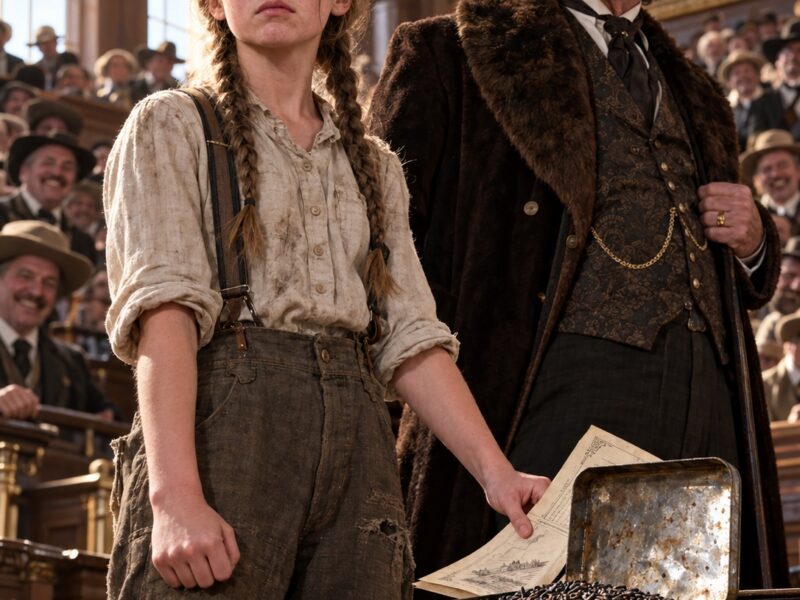
She stood barely five feet tall in a pair of work trousers that had belonged to her grandfather, cinched at the waist with an old strip of harness leather. Her boots were scuffed white at the toes. Two plain brown braids hung over her shoulders. In front of her sat a battered tin box dented at one corner and green with age along the seams.
Behind her, farmers who owned hundreds of acres whispered and grinned.
Old Silas Renfruit laughed loudest.
“Well,” he said, leaning back in his chair, “somebody find this child’s father before she buys the courthouse.”
More laughter rolled through the auction room.
Mina did not turn around.
She opened the tin box.
Then she began counting.
A quarter.
Two dimes.
Nickels.
Pennies.
Coins saved from birthdays, eggs sold before school, geese watched for neighbors, fences mended in summer heat, weeds pulled until her fingers blistered.
The auctioneer’s smile slowly disappeared.
“What exactly are you bidding on, miss?”
Mina looked up.
“Ashen Ridge.”
This time the laughter came harder.
Someone actually slapped his knee.
Ashen Ridge was forty acres of poisoned gray earth outside Harlo’s Bend, Kansas—a farm so useless the county had spent eleven years trying to get rid of it.
Three men had tried to make it profitable.
All three had failed.
One lost his savings.
Another lost his marriage.
The last farmer abandoned the property in the middle of the night with a debt notice nailed to his own front door.
Nothing grew there except thistle and bindweed.
The farmhouse leaned west.
The barn had no doors.
The fence posts looked as if one strong wind might finish what twenty years of neglect had started.
Around Harlo’s Bend, fathers mentioned Ashen Ridge when warning sons against foolishness.
That’s what happens when a man refuses to know when something is dead.
Now a fourteen-year-old girl wanted to buy it.
The auctioneer folded his hands.
“Did your mother send you?”
“No.”
“Your father?”
Mina’s face did not change.
“My father isn’t here.”
A few men stopped smiling.
She pushed the coins forward.
“I have one hundred eighteen dollars and fifty cents.”
Silence.
“And I mean to have the deed.”
That was when the room understood she was serious.
What none of them understood was why.
They saw forty acres of dead ground.
Mina saw something else.
She saw three pounds of black seed hidden for twenty-three years inside the wall of her grandfather’s house.
And she had come to Ashen Ridge because she needed the one piece of land in Kansas nobody else wanted.
Six months earlier, Mina’s grandfather Elias Voss had died.
He had not been a rich man.
He left behind a modest house, worn tools, jars of screws, broken clocks he had always meant to repair, and more debts than Mina’s mother, Rebecca, liked to discuss.
Rebecca worked at a boarding house in town, leaving before sunrise to cook breakfast for railroad men and returning after dark smelling of soap, onions, and coal smoke.
Mina had been helping clear Elias’s house for sale when she found the chest.
It was hidden beneath moth-eaten quilts in the loft.
Inside were two journals.
The handwriting belonged to Catherine Voss, Mina’s great-grandmother.
Mina knew Catherine only from a faded tintype on the mantel: a severe-looking woman in a high collar, staring into the camera as if daring the future to disappoint her.
But the woman in the journals was different.
She was funny sometimes.
Angry often.
Observant always.
And she wrote obsessively about wheat.
Not ordinary wheat.
She called hers midnight wheat.
The kernels were so dark they appeared almost blue beneath evening light. Catherine wrote that the roots drove deeper than common wheat, reaching moisture other crops could not touch.
But that was not what made Mina read until the lamp nearly burned dry.
Catherine claimed the wheat changed damaged soil.
Where it grew, exhausted ground became darker.
Softer.
Alive again.
And during a devastating outbreak of rust that destroyed surrounding farms, Catherine’s wheat had remained standing.
Mina read that passage three times.
Then she found the final entry.
The autumn of 1861.
Catherine’s once-perfect handwriting trembled across the page.
A seed company representative had been pressuring farmers to abandon old varieties and purchase standardized grain from the depot.
The future, he told them, belonged to uniform seed.
Catherine refused.
Her final lines read:
I have set aside three pounds.
I sealed them in wax.
I hid them behind the pantry shelf.
If the day comes when this land forgets how to feed itself, someone of ours will need to remember.
Mina nearly fell down the loft ladder.
She tore through the pantry.
Behind one shelf, she found a loose board.
Behind that board sat a small metal tin wrapped in brittle waxed paper.
Inside were three pounds of seed.
Dark.
Hard.
Silent.
Alive—or so Mina desperately hoped.
She held those kernels in both hands and understood something immediately.
She could never afford good farmland.
But she did not need good farmland.
She needed broken land.
Land cheap enough for a fourteen-year-old girl with $118.50 to buy.
Land everyone else had stopped believing in.
She needed Ashen Ridge.
So when the auctioneer finally looked toward the county clerk and asked whether a minor could legally purchase property, Mina already knew the answer.
The deed would have to be held in trust.
Her mother would have to sign.
Rebecca Voss had been standing by the back wall the entire time.
Her arms were crossed.
Her face was unreadable.
For one terrible second Mina thought she would refuse.
Then Rebecca walked forward.
She took the pen.
“You understand,” she whispered without looking at her daughter, “that this could be every cent you have?”
“Yes.”
“You understand I think this is madness?”
“Yes.”
Rebecca finally looked at her.
“And you still want me to sign?”
Mina swallowed.
“Yes.”
Her mother signed.
The auctioneer brought down the gavel.
Just like that, the worst farm in three counties belonged to a fourteen-year-old girl.
The men stopped laughing only long enough to watch her carry the deed away.
They would laugh again soon.
But not forever.
The wagon ride to Ashen Ridge took nearly an hour.
Rebecca said nothing for most of it.
Mina kept touching the folded deed beneath her coat as though it might disappear.
Finally her mother spoke.
“You’ll lose every cent.”
Mina stared ahead.
“Maybe.”
“That soil is ruined.”
“Maybe the top is.”
Rebecca turned sharply.
“Mina.”
“The journals say—”
“Journals.”
The word came out harder than Rebecca intended.
Then her voice softened.
“Your great-grandmother has been dead longer than either of us has been alive. A dead woman does not have to live with what happens if she was wrong.”
Mina said nothing.
Her mother gripped the reins.
“Men who have farmed this country forty years say Ashen Ridge is finished.”
“Those men all farm the same way.”
Rebecca stared at her.
Mina pointed toward the green fields passing beside them.
“Same seed. Same rows. Same fertilizer. Same everything.”
“And?”
“If they know everything, why are their wells getting deeper every year?”
Rebecca looked forward again.
“Why does it take more fertilizer to raise the same crop Grandpa raised with less?”
No answer.
“Why is good soil turning gray?”
Still nothing.
Mina lowered her voice.
“Maybe everybody doing the same thing doesn’t prove they’re right.”
That sentence frightened Rebecca more than she admitted.
Because it sounded less like something a child would say than something Elias might have said.
Then they reached Ashen Ridge.
Even Mina’s courage weakened.
The gate hung from one hinge.
The farmhouse seemed to be leaning away from its own foundation.
The barn stood open to the sky.
And the forty acres beyond it looked worse than memory.
Gray.
Cracked.
Powdery.
Dead.
Rebecca did not say I told you so.
She did not need to.
Mina climbed down.
She walked into the nearest field and knelt.
The topsoil crumbled like fireplace ash.
For several seconds, she simply stared at it.
Maybe they were right.
Maybe she had confused a dead woman’s hope with evidence.
Maybe she had spent every dollar she possessed on a grave.
Then her fingers dug deeper.
One inch.
Two.
Three.
And the color changed.
Brown.
Not rich.
Not healthy.
But brown.
Mina froze.
She scraped away more of the gray crust.
Underneath the poisoned surface was exhausted soil.
Wounded soil.
But not dead soil.
She looked toward Rebecca.
Her mother had seen it too.
Neither spoke.
Mina stood.
“We need a plow.”
Rebecca closed her eyes.
And that was how the work began.
Silas Renfruit rode onto Ashen Ridge less than a week later.
He owned more land than anyone in the county and carried himself like a man who considered acreage proof of wisdom.
Two hired men rode behind him.
One was Amos Teague, nineteen years old, quiet-eyed and thin from hard work.
Silas looked at Mina standing beside a broken quarter-acre of turned ground.
Then at her spade.
Then at the seed tin on the fence.
He chuckled.
“You know what that dirt is, girl?”
“Soil.”
“It’s poison.”
Mina pushed the spade into the ground.
Silas leaned over his saddle horn.
“You could empty a rain barrel on that field and watch the water run off like it hit a roof. Best seed money can buy would rot before sunrise.”
Mina turned another clod.
“You’re digging your own grave.”
She looked up.
“The money kind,” Silas added. “Though the way you work yourself, I suppose we’ll see.”
One hired man laughed.
Amos did not.
Mina straightened.
“Thank you for your concern, Mr. Renfruit.”
His smile vanished.
“You know your trouble?”
“No.”
“You think you’re special.”
Mina waited.
“You find some old woman’s papers and suddenly you know more than men who have worked prairie since before your mother was born.”
He pointed across the ruined field.
“You think five generations of farmers missed something a little girl found in an attic?”
Mina rested both hands on her spade.
“No, Mr. Renfruit.”
His eyebrows rose.
“I don’t think I’m special.”
She looked down at the earth.
“I think the land is.”
Then back at him.
“And I think you’ve forgotten how to listen to it.”
The old man’s jaw tightened.
He wheeled his horse so sharply that gray dust sprayed across Mina’s boots.
His workers followed.
Amos glanced back once.
He was the only one who did.
By the end of the week, everyone in Harlo’s Bend knew about the girl trying to resurrect Ashen Ridge.
At the mercantile, Della Mumford warned Mina she was wasting her childhood.
At the eating house, farmers deliberately spoke loudly enough for her to hear.
“Old heirloom seed.”
“On Ashen Ridge?”
“Might as well plant silver dollars.”
“Her mother ought to stop her.”
Mina drank her water and left.
She had expected ridicule.
What hurt more was what came next.
Her uncle Harlon Ross arrived on Sunday.
He was Rebecca’s brother, a town-property man who believed land existed mainly to be surveyed, divided, and sold.
He looked over Mina’s tiny patch of broken soil.
“Mina,” he said, crouching before her, “I’m going to speak to you like a grown woman.”
She already disliked what followed.
“This isn’t a farm. It’s a millstone.”
She wiped sweat from her forehead.
“Grandpa knew that,” Harlon continued. “That’s why he never bought it.”
“Grandpa didn’t know about the wheat.”
Harlon laughed.
“There is no magical wheat.”
“I didn’t say magical.”
“There is no secret seed five generations of grown men somehow missed.”
He stood.
“This is the real world. In the real world, dead soil stays dead.”
Then he delivered the part Mina had not expected.
“I’ve spoken to your mother.”
Her stomach tightened.
“When summer is finished, we’ll sell this tract. Whatever can be recovered goes back toward your schooling.”
Mina looked toward Rebecca.
Her mother was standing near the porch.
She did not meet Mina’s eyes.
Harlon adjusted his new hat.
“One day you’ll thank us.”
He left.
Mina watched his wagon disappear.
Then she picked up the spade.
She worked until her palms opened again.
By mid-May, she had broken three acres.
She hauled manure from a horse farm ten miles away in exchange for mucking stalls.
Della Mumford quietly began saving kitchen ash, eggshells, and coffee grounds behind the mercantile.
Mina sowed clover in places simply because she needed proof that green could exist there.
Then pressure came from the one person whose doubt mattered most.
Rebecca sat across from her one night beneath a dying lamp.
“If you’re going to prove them wrong,” she said, “prove them wrong soon.”
Mina looked up.
Her mother’s face was exhausted.
“I can take people laughing at me,” Rebecca whispered. “I can take them thinking I’m poor. I can take working until my hands stop feeling like hands.”
She swallowed.
“But I cannot spend the whole summer watching this town pity my daughter.”
That broke something in Mina.
Catherine’s journals had warned her not to plant until the ground warmed completely.
Mina knew it.
But she wanted one green blade.
One.
Something she could show her mother.
Something that would buy her time.
So Mina made her first serious mistake.
She planted early.
Four nights later, frost came.
By morning, the young shoots were black.
Mina walked the rows alone.
One-third of Catherine’s irreplaceable seed was gone.
Three pounds had become less than two.
She gathered the dead shoots in her apron.
She did not cry until she was behind the ruined corn crib where nobody could see her.
For the first time, Mina wondered whether stubbornness and courage might sometimes wear the same face.
Her mother found her later.
Rebecca did not scold.
She simply placed a hand on Mina’s shoulder.
That kindness hurt worse.
“The land keeps its own calendar,” Mina whispered.
Rebecca said nothing.
“I tried to make it hurry because I wanted people to believe me.”
She looked at the ruined seedlings.
“I nearly killed the only thing that mattered.”
From that day forward, Mina stopped trying to prove herself quickly.
She waited.
She prepared.
She watched the sky.
And on the last night of May, beneath a full moon and air finally warm after dark, she planted what remained of the midnight wheat.
By hand.
Row after row.
Six hours.
Dip.
Cast.
Step.
Cover.
Dip.
Cast.
Step.
Cover.
Rebecca sat on the porch with a lantern.
She did not help.
But she did not go inside.
When Mina finally staggered back, the tin was empty.
“It’s in the ground,” she said.
Rebecca reached out and tucked a loose strand into her daughter’s braid.
For the first time, Mina saw something in her mother’s eyes that looked dangerously close to hope.
Then nothing happened.
One week.
Nothing.
Two weeks.
Nothing.
Three.
Nothing.
Heat settled over Kansas.
Even Silas Renfruit’s expensive depot wheat began curling beneath the sun.
But Ashen Ridge remained gray.
Mina carried creek water morning and evening.
Still nothing.
Silas rode past one evening.
He slowed.
Looked.
Shook his head.
And rode away.
He did not laugh.
Mina discovered pity was harder to endure.
Then came the twenty-third morning.
She walked outside at sunrise.
And stopped.
A line of dark green crossed the field.
She ran.
Dropped to her knees.
There it was.
Midnight wheat.
Not pale.
Not weak.
Deep green.
Almost blue.
The second row had risen too.
Then the third.
Then another.
And another.
Mina moved through the field on her knees, laughing and crying at once.
Every row answered.
The seed had waited beneath the dead crust until it was ready.
Then it came.
By July, the wheat reached Mina’s waist.
Its stalks were thick and irregular.
Nothing about the field looked uniform.
Some plants stood taller.
Some broader.
Some darker.
To farmers accustomed to perfect identical rows, it looked almost disorderly.
But Mina remembered Catherine’s words.
Difference was not always weakness.
Sometimes difference was survival.
One morning she carefully lifted a plant to examine its roots.
They extended deeper than her arm.
Brown soil clung to them.
Not gray.
Brown.
Moist.
Then something moved in her palm.
An earthworm.
Mina stared at it.
Ashen Ridge had not held an earthworm anyone remembered seeing in twenty years.
The wheat was not merely surviving.
It was healing the ground.
And that was when Amos Teague returned.
He came walking.
Silas had dismissed several workers because drought had tightened his finances.
“I can’t pay you,” Mina told him.
“I didn’t ask.”
“Then why are you here?”
Amos looked over the dark field.
“My grandmother once grew vegetables in alkali bottomland everyone said was useless.”
Mina waited.
“People called her lucky.”
“What did she call it?”
Amos smiled slightly.
“Knowing which corner of a ruined thing was still willing.”
Something in Mina softened.
“I don’t believe in impossible farms,” she said.
“No?”
“No. Just impatient farmers.”
Amos set his hat on the fence post.
“Where do you want me to start?”
For the first time since April, Mina did not have to carry everything alone.
Amos repaired the gate.
Patched the barn.
Taught her how to use an old cultivator.
Rebecca eventually began setting a third plate at supper.
Then the letter arrived.
The county had reassessed Ashen Ridge.
Now that a valuable crop stood on it, the land was suddenly worth taxing.
Forty-one dollars.
Due by the end of harvest.
Rebecca placed the notice on the table.
“We don’t have four dollars.”
Mina reread the figure.
Then she noticed her mother’s expression.
“What?”
Rebecca looked away.
“What aren’t you telling me?”
“Your uncle wrote the assessor.”
Mina went still.
“Harlon?”
“He told them there was a valuable crop they had overlooked.”
“Why?”
“He thinks he’s saving you.”
Mina laughed once.
There was no humor in it.
“If we can’t pay, the county takes the land.”
“Yes.”
“And then?”
“He believes he can buy it, divide it, sell lots.”
The betrayal landed harder than every insult Mina had heard all summer.
She had survived ridicule.
Frost.
Drought.
Dead soil.
But she had never imagined family would turn success itself into a weapon.
“Then we pay it,” Mina said.
“With what?”
“The wheat.”
Rebecca stared.
“It ripens in September. We harvest. We sell enough. We pay the tax.”
“And if you don’t?”
Mina held her mother’s eyes.
“Give me eight weeks.”
Rebecca said nothing.
“If I fail, sign Ashen Ridge over to Uncle Harlon yourself.”
“Mina—”
“Eight weeks.”
Her mother studied the girl across the table.
But perhaps she no longer saw a girl.
“Eight weeks,” Rebecca said.
Then she pointed at her daughter.
“But this time you take help.”
Mina nodded.
She did not know that within days the entire county would begin dying.
The first report came from thirty miles north.
Rust.
Red rust.
A fungal disease capable of destroying wheat with terrifying speed.
Within a week it reached the neighboring farms.
Then Silas Renfruit’s land.
Mina and Amos rode out to see.
Silas stood in the middle of what had once been his best field.
The wheat surrounding him had turned orange.
Crews sprayed chemicals.
Others burned infected rows.
Nothing worked.
The wind carried spores through the smoke.
Farm after farm failed.
The problem was terrifyingly simple.
Almost everyone had purchased the same standardized seed.
The same strength.
The same weakness.
Once the rust found a way through one plant, it had found a way through millions.
Amos removed his hat.
“He’ll lose everything.”
Mina looked toward Silas.
Months earlier, she had imagined how satisfying it might feel to see him proven wrong.
There was no satisfaction now.
Because the wind was blowing toward Ashen Ridge.
The rust did not care who had laughed at whom.
It crossed property lines without asking permission.
Soon orange spores reached Mina’s fence.
Rebecca panicked.
“They’re saying we should burn it.”
Mina turned.
“What?”
“If your field catches the disease and becomes another source of spores, neighbors may blame us. Somebody has already asked a lawyer whether an infected farmer can be held responsible.”
Rebecca grabbed her daughter’s arm.
“They could take everything.”
Mina looked across the field.
Burn it now and they would save themselves from that risk.
But they would destroy the only crop that could pay the tax.
They would destroy Catherine’s seed.
They would destroy everything.
Then Mina saw orange dust on the first leaves.
She climbed the fence.
“Mina!”
She ignored her mother.
She reached the infected stalk.
The spores were there.
But something was wrong.
They were not spreading.
Mina examined another leaf.
Then another.
Tiny dark marks had formed where spores attempted to establish themselves.
The plant seemed to be sealing off the infection.
Starving it.
Killing it.
Mina’s hands began trembling.
Rebecca climbed over beside her.
“What is it?”
Mina held up the leaf.
“It can’t get in.”
“What?”
“The rust.”
Rebecca stared.
“It’s landing.”
Mina looked across the dark wheat.
“But it can’t get in.”
For three days, rust descended on Ashen Ridge.
For three days, the wheat refused to die.
The surrounding county turned orange.
Mina’s field remained green.
Word spread.
Men who had mocked her now stopped their wagons along her fence.
Nobody laughed.
Then Professor Nathaniel Crane arrived from the state agricultural college.
He spent two days examining roots, leaves, spores, soil, and seed.
Finally he sat on Mina’s porch holding a glass dish.
“I have spent most of my career,” he said slowly, “telling farmers old varieties belong to the past.”
Mina watched him.
“I told them uniform seed was progress.”
“And now?”
Crane looked toward the field.
“Now a fourteen-year-old girl has made my science explain why my certainty was wrong.”
He had found two things.
The roots appeared to release compounds into the surrounding soil that interfered with rust.
But something else mattered even more.
The midnight wheat was not uniform.
Within the same field existed numerous slightly different types.
Different leaves.
Different heights.
Different structures.
Different resistances.
“The rust adapts,” Crane explained. “Give it a thousand acres of identical plants and it needs to solve one problem.”
He pointed toward Mina’s field.
“But this?”
He shook his head.
“This field gave it a dozen problems at once.”
Mina thought about the farmers laughing because her wheat looked irregular.
What they had called disorder had saved it.
Crane asked where the seed came from.
“My great-grandmother.”
“When?”
“She hid it in 1861.”
His expression changed.
Mina told him everything.
The journals.
The company representative.
The tin behind the wall.
Catherine’s warning that someday the land might forget how to feed itself.
Crane was silent for a long time.
Then he said, “Do you understand what you have?”
Mina looked at the field.
“The land remembers.”
“No.”
His voice was almost reverent.
“You have something farmers across this state may need to survive.”
Then came the offer.
Crane wanted seed for the college.
He named a price large enough to pay the tax many times over.
Rebecca sat down.
Mina refused.
Her mother stared at her.
Crane stared too.
“I’ll sell you two pounds after harvest,” Mina said.
“Two?”
“For study.”
“Mina, the college could buy considerably more.”
“I know.”
“You need money.”
“I know.”
“Then why?”
Mina looked down the county road.
“Because the rest is for the farmers who are going to come down that road after they lose everything.”
Crane studied her.
“You could become wealthy.”
“So could Catherine.”
“What?”
“She could have hoarded her seed during a bad year.”
Mina touched the empty tin resting beside the window.
“She didn’t.”
Crane leaned back.
“You realize desperate men would pay almost anything?”
“That’s exactly why I won’t charge almost anything.”
He smiled then.
Not at a child.
At an equal.
The college draft solved the immediate tax problem.
But it also attracted attention.
Three days later, Uncle Harlon arrived with a land agent.
Four hundred dollars cash for Ashen Ridge.
More than three times what Mina had paid.
Harlon spread the offer across the porch rail.
“Rebecca, think.”
Rebecca stared at the paper.
“Four hundred dollars. The tax disappears. Mina goes to school. You stop working yourself sick.”
He smiled.
“A professor drives across Kansas to buy seed from a child, and suddenly men with money notice the property. This opportunity does not come twice.”
Rebecca slowly placed her dish towel beside the offer.
“You wrote the assessor.”
Harlon’s smile tightened.
“I was protecting—”
“You tried to tax us off this land.”
“I was trying to save Mina from herself.”
“And now you bring a buyer.”
“Because this is business.”
Rebecca stepped onto the porch.
All summer Mina had watched her mother bend beneath exhaustion.
Now something in her had straightened.
“I signed that deed because I thought my daughter might lose everything.”
Harlon opened his mouth.
Rebecca did not let him speak.
“I will not use that signature to take everything from her now that she proved me wrong.”
She turned toward the agent.
“Ashen Ridge is not for sale.”
“Rebecca—”
“Not for four hundred.”
Harlon scoffed.
“Four thousand, then?”
“Not for four thousand.”
The agent folded his offer.
Harlon stared at his sister.
“You’ll regret this.”
Rebecca looked at Mina.
“No.”
She said it quietly.
“I think I’ve already spent enough of my life regretting things before they happened.”
Harlon left furious.
But the harvest had not yet been secured.
September came.
The midnight wheat ripened dark bronze.
They began cutting by hand.
Mina.
Rebecca.
Amos.
Three men sent by Professor Crane.
Every hour mattered.
Then on the third day, Amos looked southwest.
His face changed.
“Hail.”
The sky had turned green.
They had perhaps two hours.
Everyone ran.
Sheaves were dragged into the barn.
Rebecca worked until she nearly collapsed.
Mina forced her to sit.
Then the storm hit.
Hailstones the size of hen eggs hammered the roof.
The uncut wheat went down.
A third of Mina’s crop disappeared in minutes.
She stood in the barn doorway watching stalks shatter into mud.
Months of work.
Gone.
Rebecca reached for her hand.
“We saved the seed.”
Mina looked behind them.
Two-thirds of the crop sat dry beneath the repaired roof.
She squeezed her mother’s fingers.
“Yes.”
Then she looked into the storm.
“We saved the future.”
Afterward, Mina walked through the ruined field.
That was when she saw the ground.
Where gray powder had once lain, the soil was dark.
Rich.
Crumbly.
The hail had stripped the plants away and revealed what their roots had done.
Ashen Ridge was healing.
For the first time, Mina understood that even if every stalk had been lost, the season would not have been wasted.
The wheat had changed the land.
And the land would remember.
Threshing took nearly two weeks.
When it was finished, more than 130 bushels of midnight wheat filled the barn.
Then came the offers.
A miller offered enough money to solve their problems.
Mina refused.
“This harvest isn’t bread.”
“What is it?”
“Next year.”
Then came a far more dangerous offer.
A large eastern seed company wanted everything.
Every bushel.
The amount offered was staggering.
Enough to buy a fine farm.
Enough for Rebecca to stop working at the boarding house.
Enough for Mina never to worry about another tax notice.
There was one condition.
The company would own the crop.
They would multiply it.
Control it.
Name their own price.
Mina sat with the letter beneath the kitchen lamp.
Rebecca watched her.
“You could take that money,” her mother said quietly.
“I know.”
“You earned the right to consider it.”
“I have.”
Mina folded the letter.
“If I sell everything, they own survival.”
Rebecca said nothing.
“Next spring every farmer whose crop died has to buy from them.”
Mina looked toward the window.
“They can charge whatever they want.”
Her mother studied her.
“A thing meant to be shared,” Mina said, “stops being what it was the minute one person decides nobody else gets it without permission.”
She pushed the letter away.
“Tell them no.”
The farmers began arriving the following week.
One wagon.
Then another.
Then five.
Men who had laughed at the auction house stood outside Mina’s barn with their hats in their hands.
She did not humiliate them.
She did not raise her price.
She charged enough to pay debts, maintain the farm, and continue growing seed.
Nothing more.
Those who could not pay received credit against the next harvest.
A handshake.
A name in a ledger.
Seed now.
Grain later.
Della Mumford came for seed for her sister.
She apologized repeatedly.
Mina took her hands.
“You told me what you believed.”
“I was wrong.”
“So was I when I planted before the frost.”
Della blinked.
Mina smiled.
“Being wrong isn’t the worst thing.”
“What is?”
“Refusing to look again.”
Mina paid the county tax in full.
She counted the money at the same office where Ashen Ridge had once been listed as nearly worthless.
Then she asked the clerk to write something into the record.
“That Ashen Ridge paid its assessment in the year of the great rust,” she said, “from a crop grown on land this county called dead.”
The clerk hesitated.
Then wrote it.
Mina watched the ink dry.
She thought that would be the moment the summer felt complete.
It was not.
That moment came in October.
Silas Renfruit was the last farmer to return.
He arrived beneath a gray sky in a plain wagon pulled by an ordinary plow horse.
The beautiful bay gelding was gone.
Mina understood immediately.
He had sold it.
Silas stopped beside the gate Amos had repaired.
He remained sitting for a long time.
Mina walked toward him.
She wore the same grandfather’s trousers she had worn in April, though now they fit differently.
Perhaps she did too.
Silas looked across Ashen Ridge.
The soil was dark now.
The stubble stood where the impossible wheat had grown.
“I’ve farmed this prairie fifty-two years,” he said.
Mina waited.
“I broke ground here when you could ride half a day without seeing a fence.”
His hands tightened around the reins.
“I thought that meant I knew it.”
Still Mina said nothing.
“I lost everything.”
The words barely came.
“My south quarter is already with the bank.”
He looked at her.
“The rest follows by spring unless I plant a clean crop.”
Mina knew what came next.
But she did not rescue him from having to say it.
Silas swallowed.
“The only clean seed in three counties is in the barn of the girl I told couldn’t grow a weed.”
“It grew more than a weed.”
“Yes.”
He looked down.
“I laughed at you.”
“Yes.”
“I came out here and told you you were digging your grave.”
“Yes.”
“I called your great-grandmother’s grain foolishness.”
Mina did not soften the truth.
“Yes.”
Silas finally raised his eyes.
“I was wrong.”
There it was.
No audience.
No applause.
No revenge.
Just an old man whose certainty had cost him nearly everything.
“And I’ve come,” he continued, “to buy seed from the child I mocked because I have nowhere else to go.”
All summer Mina had imagined this moment.
She had imagined triumph.
It did not feel triumphant.
It felt sad.
And strangely clean.
“You had fifty-two years to look closely,” she said.
Silas nodded.
“But you stopped looking.”
His jaw tightened.
“You had the biggest farm, the deepest well, the best horses. You didn’t have to wonder whether everyone else might be wrong.”
“No.”
“What ruined this county wasn’t just rust.”
Silas watched her.
“It was everybody planting the same thing because everybody else planted it, then calling that wisdom.”
He lowered his head.
“I know that now.”
Mina studied him.
Then turned toward the barn.
“Knowing now is worth something.”
Silas looked up.
“Get down.”
“What?”
“You’re not buying seed from me while sitting up there like you’re still deciding whether I’m worth listening to.”
For one second, something almost like the old Silas returned to his eyes.
Then it disappeared.
He climbed down.
Inside the barn, sacks of midnight wheat lined the wall.
Mina measured enough seed for his best remaining quarter.
Silas watched the scale.
“How much?”
She named the same price she had charged everyone else.
He frowned.
“That’s all?”
“That’s the price.”
“You could charge me twice that.”
“Yes.”
“And I’d pay.”
“I know.”
“Then why don’t you?”
Mina tied the sack.
“Because then this would be about you and me.”
She lifted it.
“It isn’t.”
Silas stared at the word stamped on the burlap.
CATHERINE.
“That her?”
“My great-grandmother.”
“The woman who saved it?”
Mina nodded.
“She hid three pounds in a wall in 1861.”
Silas touched the lettering with one rough thumb.
“She knew all this would happen?”
“No.”
Mina smiled faintly.
“She just knew people forget.”
Silas looked at her.
“She wrote that someday the land might forget how to feed itself, and somebody in our family would need to remember for it.”
Mina placed the sack in his arms.
The old farmer held it against his chest.
Then Mina said the one thing that finally broke whatever pride he had left.
“She was remembering for you too, Mr. Renfruit.”
His eyes lifted.
“She just didn’t know your name yet.”
Silas stood perfectly still.
Outside, October wind moved across Ashen Ridge.
It passed over the healed ground.
Across the repaired fence.
Through the cottonwood Amos had saved after the hailstorm.
Past the farmhouse that still leaned slightly west because there had never been enough money or time to straighten everything.
Not everything needed to be perfect to be worth saving.
Silas carried the seed to his wagon.
He set it down carefully.
Then he removed his hat.
For a moment he held it against his chest.
Not to Mina exactly.
Not even to Catherine.
Perhaps to the land.
Perhaps to all the things a man can spend a lifetime standing above and still never truly see.
Then he climbed into the wagon.
Mina watched him disappear down the road.
Rebecca came from the house and stood beside her daughter.
“Do you forgive him?”
Mina thought about it.
“I don’t know.”
Her mother slipped an arm around her shoulders.
“That’s an honest answer.”
They stood together.
Winter was coming.
The house still needed repairs.
There would be another tax bill.
Another planting.
Another drought someday.
Perhaps another disease nobody yet had a name for.
Ashen Ridge had not become a paradise.
Mina had not become rich.
And nothing about the land promised kindness simply because she had once been brave enough to believe in it.
But beneath their boots, the earth was dark.
Alive.
Restored enough to receive another seed.
Mina knelt and pressed her palm into it.
Months earlier, the ground had fallen through her fingers like ash.
Now it held together.
A worm turned beneath the surface and vanished into the dark.
Rebecca watched her daughter smile.
“What?”
“Nothing.”
“Mina.”
She looked toward the road where Silas’s wagon had disappeared.
Then toward the barn where Catherine’s wheat waited in smaller and smaller sacks, leaving Ashen Ridge for farms that had once laughed at the idea of it.
“Everybody thought Catherine saved three pounds of wheat.”
Rebecca waited.
Mina shook her head.
“She didn’t.”
“What did she save?”
The wind moved softly through the October stubble.
Mina closed her fingers around a handful of living soil.
“A second chance.”
That winter, sacks marked CATHERINE traveled farther than Mina ever did.
They crossed county lines in wagon beds.
They sat beside kitchen stoves until spring.
They were divided carefully between brothers, neighbors, widows, debtors, men who had once competed against one another and now understood that sameness had nearly destroyed them all.
Professor Crane carried his two pounds back to the college.
He wrote Mina several times.
His letters were full of scientific language she sometimes had to read twice, but he never again referred to the midnight wheat as primitive.
He called it a reservoir.
A living archive.
Evidence that improvement could sometimes mean preserving what progress was too impatient to understand.
Amos stayed through winter.
Not because Mina asked him.
Not exactly.
There was always another rail to mend.
Another hinge.
Another section of barn roof.
Another evening when Rebecca happened to set three plates at the table.
By February, nobody discussed whether he was leaving.
Then spring returned.
The first wagons appeared on the roads.
Farmers planted midnight wheat beside other varieties rather than replacing everything with one identical crop.
Some experimented.
Some failed.
Some succeeded.
They began talking to one another again.
Not because Mina had taught them everything.
She had not.
She was fifteen now, and she knew enough to understand how much she did not know.
But Ashen Ridge had taught them one lesson they could no longer pretend not to see.
Survival was not always found in making everything the same.
Sometimes it lived in what had been dismissed as old.
Uneven.
Unprofitable.
Unfashionable.
Sometimes the thing that saved a field was the difference someone else had tried to breed out of it.
And sometimes the person who noticed first was not the oldest man in the room.
Not the richest.
Not the one with the biggest farm.
Sometimes she was a fourteen-year-old girl in borrowed trousers, carrying $118.50 in a battered tin box while a room full of grown men laughed.
Years later, people would tell the story differently.
Stories always change in the telling.
Some would claim Mina knew from the beginning that Ashen Ridge would recover.
She had not.
Some would say she never doubted Catherine’s wheat.
She had.
Some would leave out the frost that killed one-third of her seed because heroes are easier to admire when their mistakes disappear.
Mina never left it out.
“That was the part that taught me most,” she would say.
Others would make Silas Renfruit a villain.
Mina refused that too.
“He was proud,” she would tell them. “Pride isn’t the same as evil. It’s just expensive when reality sends the bill.”
And when people asked why she had not sold the entire harvest to the eastern seed company and become wealthy, Mina never gave them the answer they wanted.
She did not say she was noble.
She did not say money meant nothing.
Money meant plenty.
She remembered winters when Rebecca counted pennies.
She remembered worn boots.
Thin soup.
Lamp oil rationed by the inch.
She had wanted that money.
That was precisely why the choice mattered.
She simply understood something the company did not.
Catherine’s wheat had survived because nobody had managed to own its future completely.
It had passed hand to hand.
Woman to woman.
Season to season.
Hidden when necessary.
Shared when possible.
Remembered when the world insisted forgetting was progress.
So Mina kept Ashen Ridge.
She kept the old farmhouse too.
Years later, when she finally had enough money to rebuild it, she repaired the foundation but left one section of the pantry wall untouched.
Behind the shelf where Catherine’s tin had waited twenty-three years, Mina placed a new tin.
Inside she put seed from that year’s strongest, strangest, most varied heads of midnight wheat.
Beside it she placed copies of Catherine’s journals.
Then she added pages of her own.
She wrote about the auction.
The laughter.
Silas.
The frost.
The first green blade.
The earthworm.
The tax notice.
The rust.
Professor Crane.
The hailstorm.
The seed company.
The farmers returning.
She wrote down her mistakes as carefully as her victories.
Especially her mistakes.
Because she had learned that memory becomes dangerous when people polish away everything inconvenient.
On the final page she wrote only a few lines.
Not for herself.
Not even for the children she might someday have.
For whoever opened the wall next.
If you are reading this because something has gone wrong, do not begin by asking what everyone else is doing.
Look at the ground.
Look at what survived.
Listen before you decide something is dead.
Then Mina closed the journal.
She sealed the tin.
And she returned it to the darkness behind the pantry wall.
Outside, Ashen Ridge moved beneath a summer wind.
The field was not perfectly even.
Some stalks stood taller.
Some darker.
Some bent.
Some straight.
From a distance, the differences made the field look almost restless.
Alive in a way uniform fields never quite were.
Mina stood on the porch beside her mother.
Amos was repairing something near the barn, as usual.
Far down the county road, another farmer’s field had begun turning dark green.
Then another beyond it.
And another.
Rebecca followed her daughter’s gaze.
“You know,” she said, “they laughed at you.”
Mina smiled.
“I remember.”
“Does it still bother you?”
Mina thought about the auction house.
The dusty light.
The grown men leaning back in their chairs.
The coins trembling slightly beneath her fingers though she had tried not to let anyone see.
She remembered believing courage meant not being afraid.
She knew better now.
Courage had been planting after losing a third of the seed.
It had been refusing the fortune when poverty made refusal hurt.
It had been giving Silas the same price as everyone else.
It had been accepting that saving the farm did not mean she could control what happened to it next.
“No,” Mina said.
Rebecca looked surprised.
“Why not?”
Mina watched the wind travel across the wheat.
“Because they were laughing at what they could see.”
“And?”
“I was betting on what they couldn’t.”
Rebecca smiled.
The two women stood there until evening.
Behind them, inside the old house, a sealed tin waited in darkness.
Ahead of them, the wheat bent beneath the wind and rose again.
And beneath everything—the repaired house, the mended gate, the barn, the fields, the roads carrying seed toward farms Mina might never visit—the land held the memory.
Not perfectly.
Not forever.
Only long enough for someone to listen.
Sometimes, that was enough.









