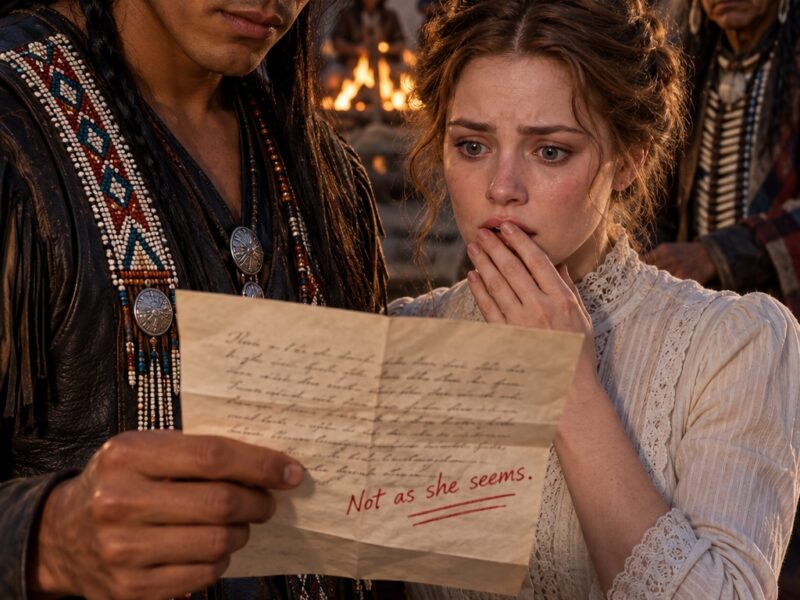
THE APACHE CHIEF STOPPED HIS OWN WEDDING—THEN MADE A SHOCKING PROPOSAL THAT LEFT HIS MAIL-ORDER BRIDE FROZEN BEFORE THE ENTIRE TRIBE

He had waited months for the woman who answered his letters.
But when she finally stood before him in her wedding dress, he stopped the ceremony.
Then he knelt before her—and asked for something no one in the valley had ever heard a chief ask.
PART 1 — THE BRIDE WHO CROSSED TWO THOUSAND MILES
The first thing Helena Marwood noticed about the man she had traveled two thousand miles to marry was that he did not smile when he saw her. The second was the scar cutting through his left eyebrow. The third was the unmistakable sadness in his eyes when she told him how much she had sacrificed to reach him.
It was October 1884, and the late-afternoon sun had turned the mountains of the American Southwest the color of old copper. Helena stood beside a freight wagon on the outskirts of a secluded Apache settlement, holding a worn leather suitcase against her skirts. Dust clung to the hem of her traveling dress, and the palms of her gloves were stained from gripping the wagon’s wooden rail through miles of unforgiving country.
The man approaching her was nothing like the husband she had imagined.
In Boston, she had pictured a quiet widower in his forties, perhaps a farmer with rough hands and a lonely house. The letters had suggested a thoughtful man who understood hardship, responsibility, and the difficult work of sharing a life. She had imagined silver at his temples, a tired smile, and the kind of gentleness that came from years of disappointment.
Instead, Naiche looked barely thirty.
He was tall and broad-shouldered, wearing a dark leather vest decorated with careful beadwork. His long black hair was tied behind his shoulders, and although he carried no visible weapon, the men standing nearby straightened when he approached. He moved with the quiet authority of someone who had learned that he rarely needed to raise his voice.
“You are Helena Marwood?”
His English was steady and unexpectedly gentle.
“Yes.” She swallowed. “And you are Naiche?”
“I am.”
For a moment, they simply regarded one another. Helena felt suddenly foolish about the small embroidered handkerchief she had tucked inside her sleeve, the ribbon she had arranged carefully beneath her hat, and the words she had practiced during the last three nights of her journey.
“I suppose,” she managed, “this is a rather unusual way to meet one’s future husband.”
Something flickered across his face.
“Yes,” he said. “It is.”
He looked at the suitcase she carried.
“You traveled a long way.”
“Two thousand miles. And another thirty by wagon after the train.”
“Was the journey difficult?”
“Only when the wagon lost a wheel, the train missed its connection, and a woman in Kansas informed me that I was either very brave or very foolish.”
Naiche’s mouth moved slightly.
“What did you tell her?”
“That I was still deciding.”
For the first time, he smiled. It was brief, but it transformed his expression so completely that Helena’s nervousness loosened for a moment.
Then his face grew serious.
“There is something we must discuss before you settle here.”
Helena tightened her grip on the suitcase.
“Have you changed your mind about marrying me?”
“No.”
“Then what is wrong?”
Naiche glanced toward the cluster of homes beyond the cottonwood trees. Children were carrying water beside the river, and smoke rose from cooking fires. Somewhere in the settlement, a woman was laughing.
“I am responsible for these people,” he said. “My marriage cannot be treated as a private matter alone.”
“I understand that. You explained your responsibilities in your letters.”
“I explained some of them.”
He met her eyes.
“I will not marry you tomorrow, Helena.”
The world seemed to go strangely quiet.
She stared at him.
“Tomorrow?”
“Or next week.”
Her fingers went numb around the suitcase handle.
“I don’t understand.”
“You will stay as our guest. You will learn about this place and the people who live here. You will have time to decide whether this is the life you truly want.”
“And if I decide it isn’t?”
“Then I will personally take you back to the railway station. You will have enough money to establish yourself elsewhere.”
Helena looked beyond him toward the distant mountains.
She had sold her furniture. Given away most of her dresses. Left the small Boston boardinghouse where she had spent three years teaching arithmetic to children whose parents could barely pay her.
She had spent nearly everything she possessed to begin a different life.
And now, before she had even unpacked, the man she intended to marry was telling her she could leave.
“Why advertise for a wife,” she asked quietly, “if you intended to send her away?”
Naiche did not look offended.
“Because I want a wife who chooses me after she knows me. Not a woman who believes she must marry me because she cannot afford the journey home.”
Helena’s throat tightened.
It was not the answer she had expected.
Back in Boston, a respectable banker named Edward Whitcomb had once proposed to her with flowers, expensive gloves, and a carefully prepared marriage agreement that placed her mother’s inheritance under his management. When Helena refused to sign, his tenderness had vanished so quickly that she understood it had never truly belonged to her.
Since then, she had believed marriage was simply another arrangement in which a woman surrendered something important.
Naiche was the first man who had offered her a door before asking her to enter his life.
“I suppose,” she said, struggling to keep her voice steady, “I should thank you for your honesty.”
“You owe me no thanks.”
“And what if I want to marry you?”
His expression softened.
“Then I hope you will still want that after you have learned the truth about me.”
Before Helena could ask what he meant, an older woman emerged from the settlement carrying a folded blanket.
“Sahali will show you where you can stay,” Naiche said.
He hesitated.
“I am glad you came, Helena.”
She watched him walk away, wondering why the words sounded almost painful.
Sahali was a silver-haired woman with intelligent eyes and a manner that suggested she had spent most of her life ignoring men who mistook volume for authority.
She studied Helena’s traveling dress.
“Those boots will not survive the winter.”
Helena glanced down at the polished leather.
“They survived Pennsylvania.”
Sahali gave a short laugh.
“The mountains here have never heard of Pennsylvania.”
Despite herself, Helena smiled.
The older woman led her toward a comfortable lodge near the river, where blankets had been arranged beside a low bed and a small fire warmed the interior. A clay pitcher of water stood on a wooden table. Someone had placed a sprig of dried lavender beside it.
“Naiche asked whether Boston women liked flowers,” Sahali said.
Helena touched the lavender.
“He did?”
“He asked many foolish questions about Boston women.”
“What sort of questions?”
“Whether they eat beans. Whether they sew their own clothes. Whether they are frightened of horses.”
Helena laughed.
“And what did you tell him?”
“That women are women, and perhaps he should ask the particular one he wished to marry.”
Sahali’s expression softened.
“He listened.”
Helena glanced toward the doorway.
“Does he often write letters?”
“Until you answered his advertisement, almost never.”
A strange warmth spread through Helena’s chest.
Then she noticed an elderly warrior standing across the settlement.
His hair was gray, his shoulders still straight, and his expression hardened as he watched her.
“Who is that?”
Sahali followed her gaze.
“Charalu. He advised Naiche’s father before Naiche became our leader.”
“He doesn’t seem pleased to see me.”
“He is not.”
“Because I’m an outsider?”
“Partly.”
“And the other part?”
Sahali folded her hands.
“Some people believe a leader must never allow his heart to influence his judgment.”
Helena watched the old man turn away.
“And what do you believe?”
“I believe men who speak most loudly about protecting tradition are sometimes protecting something else.”
Sahali said nothing more.
Over the next eleven days, Helena began to understand how little she had known about the man she had traveled so far to marry.
Naiche rose before sunrise. He met with families whose horses had gone missing, listened to disagreements about grazing land, and helped repair a damaged storehouse after an early autumn storm. When an elderly man struggled to lift a sack of cornmeal, Naiche took it without ceremony.
He was neither the solemn warrior Helena had feared nor the romantic gentleman she had imagined.
He had a dry sense of humor. He was patient with children and stubborn with men who tried to frighten others into agreement. He disliked being interrupted but never punished anyone for disagreeing with him.
Once, while helping Sahali prepare food, Helena dropped an entire wooden bowl of dried beans onto the dirt.
She stared at the scattered beans in horror.
Naiche, who had been carrying firewood past the doorway, stopped.
“Are you injured?”
“Only my dignity.”
He studied the floor.
“That appears serious.”
She looked up in surprise.
Then he knelt beside her and began gathering the beans.
“You don’t have to do that,” she protested.
“Neither do you.”
“But I made the mess.”
“And I have two hands.”
Their fingers brushed as they reached for the same bean.
Naiche withdrew his hand immediately.
Helena noticed.
She began noticing other things, too.
He never entered her lodge without permission. He never sat too close. When they walked beside the river, he kept a respectful distance even when the trail narrowed.
At first, she thought he regretted inviting her.
Then, on the eleventh evening, she found him standing alone beneath a cottonwood tree.
“You’ve been avoiding me,” she said.
Naiche turned.
“I speak to you every day.”
“Yes, about weather and firewood and whether my boots have finally offended your mountains enough to fall apart.”
“They are close.”
“Naiche.”
He grew still.
“You never come near me.”
A faint line appeared between his brows.
“Would you prefer that I did?”
Helena had spent most of her life believing that proper women waited for men to say difficult things first.
She was tired of waiting.
“Perhaps I would.”
For a long moment, Naiche said nothing.
Then he looked at their hands.
“I have wanted to hold yours since the day you arrived.”
Helena’s breath caught.
“Then why haven’t you?”
“Because I told you the choice would remain yours.”
He moved one step backward.
“And I will not break that promise simply because keeping it has become difficult.”
Helena watched him disappear toward the firelight.
That night, she lay awake beneath Sahali’s blankets with the sound of the river drifting through the lodge walls.
For the first time since leaving Boston, she imagined a future that did not feel like a bargain.
But the following afternoon, she overheard an argument that changed everything.
It came from behind the council lodge.
Charalu stood facing Naiche, his gray hair moving in the wind.
“You would overturn an agreement made before your father died?”
“I would correct a wrong.”
“You would place a stranger above your own people?”
“That is not what I am doing.”
“Then why must everything change because a woman from Boston has arrived?”
Naiche’s voice remained low.
“Because she has a right to know what was done in her name.”
Charalu stepped closer.
“Your father would never have permitted this.”
“My father is not here to answer for it.”
“Then tell her the truth,” Charalu snapped. “Tell her why those letters were kept.”
Helena backed away before either man could see her.
Her heart was pounding.
Those letters.
Her letters.
For weeks, she had believed the correspondence between them had been private. She had written about her mother’s death, her failed engagement, and the humiliation of discovering that the man who wanted to marry her was more interested in her money than her company.
She had even confessed that she feared becoming a wife only because she had failed to become anything else.
And someone had been keeping those letters.
That evening, Helena waited beside the river until Naiche returned from the council lodge.
“What are you planning?”
He stopped.
“Helena—”
“Please don’t tell me it is nothing.”
Naiche studied her face.
“What did you hear?”
“Enough to know that your adviser has been reading my letters.”
A silence settled between them.
Then Naiche reached inside his vest and removed a folded sheet of paper.
Helena recognized it immediately.
It was one of her letters from Boston.
Her handwriting crossed the page in neat blue-black ink.
But beneath her signature, someone had written three words in red.
KEEP HER CLOSE.
Helena stared at them.
“What does that mean?”
Naiche’s jaw tightened.
“It means someone decided what your arrival should accomplish before either of us knew what was happening.”
“Who?”
He looked toward the council lodge.
“Charalu was not the only man reading our letters.”
Helena felt cold despite the warmth of the evening.
“Naiche, tell me.”
He unfolded another sheet and placed it beside hers.
On the second page was a statement written in English, bearing what appeared to be Helena’s signature.
She read the first line.
Then she read it again.
According to the document, Helena Marwood had agreed to marry Naiche and serve as his authorized representative in negotiations concerning the valley’s southern grazing lands.
Beneath that statement was a date.
Three weeks before she had arrived.
Her voice became barely audible.
“I never signed this.”
“I know.”
She looked up.
“Then why is my name on it?”
Naiche’s eyes darkened.
“Because someone intends to use our marriage to take something from my people.”
And when Helena turned the document over, she saw the name of the man who had witnessed her supposed signature.
Edward Whitcomb. Boston, Massachusetts.
The man whose marriage proposal she had refused.
The man she had crossed a continent to escape.
Somehow, he had followed her all the way to the Apache valley.
PART 2 — THE LETTERS THAT WERE NEVER MEANT TO BE FOUND
Helena did not realize she had dropped the document until Naiche bent to retrieve it.
“Edward Whitcomb?” she whispered.
Naiche nodded.
“You know him?”
“He asked me to marry him last winter.”
Naiche’s expression changed.
“And you refused.”
“Yes.”
“Why?”
Helena looked toward the river, where the last sunlight was slipping between the cottonwood branches.
“Because he wanted my mother’s inheritance. He called it sensible financial planning. When I refused to surrender control of the money, he told me I would regret making decisions without a husband.”
She gave a humorless laugh.
“I suppose he finally found a way to make that prediction useful.”
Naiche carefully refolded the papers.
“How much did he know about your inheritance?”
“Everything. He handled some of my mother’s affairs after she died.”
“Did he know you were traveling here?”
Helena hesitated.
“The boardinghouse owner knew. She helped me purchase my railway ticket.”
“Did Whitcomb know her?”
“Everyone in our neighborhood knew Edward Whitcomb.”
Naiche looked toward the council lodge.
“Then this began before you ever boarded the train.”
He told her what he had discovered.
Six months earlier, a trading company operated by a man named Silas Vane had begun pressuring families throughout the valley to sign agreements granting passage through their grazing grounds. The company claimed it wanted a new freight route connecting a mining settlement to a southern railway station.
But the proposed road would cut directly across the valley’s water sources.
Naiche had refused.
He had seen too many agreements presented as harmless conveniences that later became weapons against the people who signed them. He had insisted that any arrangement affecting the settlement be discussed openly, with every affected family represented.
Then Vane had approached Charalu.
The old adviser had believed that limited cooperation with the company might protect the settlement from worse interference. He feared that continued refusal would bring soldiers, forced removals, or the loss of whatever fragile security the people still possessed.
At first, Naiche had considered his concerns reasonable.
But the meetings had gradually become secretive.
“Vane told Charalu that a marriage between me and an educated woman from the East would improve our standing with officials,” Naiche said. “He claimed you could speak for us in ways they would listen to.”
Helena stared at him.
“Is that why you advertised for a bride?”
“No.”
The answer came immediately.
“Why, then?”
Naiche’s expression grew unexpectedly vulnerable.
“My father died believing duty and loneliness were the same thing. I spent years trying to prove I could carry every burden myself.”
He looked down at his hands.
“One winter, Sahali told me I had become very good at keeping everyone alive and very bad at living.”
Helena’s mouth softened.
“So you wrote an advertisement.”
“I wrote six.”
“Six?”
“She threw away the first five.”
Helena almost laughed.
“What was wrong with them?”
“One sounded as though I wanted a housekeeper. Another sounded as though I was recruiting a soldier.”
“And the others?”
“Sahali said no woman with any sense would answer them.”
Helena smiled despite the fear pressing against her chest.
“Apparently, she was wrong about the last one.”
“She said the last one sounded like a man who wanted someone to talk to.”
Naiche held her gaze.
“That was the truth.”
The warmth between them lasted only a moment.
Then Helena remembered the forged document.
“Did you know someone was interfering with our letters?”
“Not at first.”
“When did you find out?”
“Four days before you arrived.”
She stepped back.
“Four days?”
“I found copies in Charalu’s storage chest. Some had passages marked. Others had been altered before they were shown to me.”
Helena felt as though the ground had shifted beneath her.
“Altered how?”
Naiche removed another folded letter.
It was addressed to him in handwriting that resembled hers.
The first paragraph spoke of marriage.
The second claimed Helena believed the settlement needed stronger supervision by educated outsiders.
The third suggested that Naiche’s leadership would be more secure if he cooperated with the trading company.
Helena shook her head.
“I never wrote those things.”
“I know.”
“How?”
“Because the woman who wrote to me about teaching poor children to read would never describe families she had not met as incapable of caring for themselves.”
Helena lowered the paper slowly.
For several seconds, she could not speak.
Then she said, “You believed me before you met me.”
Naiche looked almost embarrassed.
“I believed what you had shown me of yourself.”
The following morning, Helena went to Sahali.
The older woman listened without interrupting as Helena explained the letters, the forged signature, and Whitcomb’s involvement.
When Helena finished, Sahali set down the sewing she had been working on.
“That explains the red marks.”
“You’ve seen them?”
“Charalu brought several letters to the council. He said they proved you understood the proposed trade agreement.”
“Did anyone believe him?”
“Some did. Most had never heard you speak.”
Helena looked down at her hands.
“And now?”
“Now they have seen you carry water, teach the children their letters, and help old Pasha repair his blanket without laughing at his crooked stitches.”
“That hardly qualifies me to speak about land agreements.”
“No,” Sahali said. “But it qualifies you to be heard as yourself.”
The words stayed with Helena all day.
She began looking more carefully at the people around her.
She noticed which families collected water from the southern springs, which children accompanied their parents to the grazing grounds, and which elders remembered the valley before the trading road had been proposed.
She listened more than she spoke.
When a woman named Luta explained that the proposed road crossed the only reliable source of water for several families during dry months, Helena asked her to show her the location.
They walked there the next morning.
The springs emerged from a narrow opening beneath a shelf of pale stone. Reeds grew along the shallow pools, and animal tracks crossed the damp soil.
Helena knelt beside the water.
“Vane called this an unused passage.”
Luta frowned.
“He called it that because he did not ask who uses it.”
Helena touched the cold water with her fingertips.
Back in Boston, property disputes had seemed distant and abstract, matters settled by signatures in polished offices.
Here, a line on a map could determine whether children had drinking water in summer.
She understood then why Naiche had refused to treat the agreement as a simple business transaction.
Three days later, Silas Vane arrived in the settlement.
He came wearing a clean brown suit and polished boots, riding a fine chestnut horse beside two armed escorts. His mustache was carefully trimmed, and his smile possessed the practiced warmth of a man accustomed to selling things people did not need.
“Miss Marwood,” he said when Charalu introduced them. “What a pleasant surprise.”
Helena did not return his smile.
“Is it?”
“I had heard you were an educated young lady. Boston, wasn’t it?”
“Yes.”
“Then perhaps you’ll help us bring some reason to these negotiations.”
Naiche stood beside her.
“We have not agreed to negotiations.”
Vane spread his hands.
“Of course, Chief. I’m merely extending friendship.”
“Friendship does not usually arrive accompanied by armed men.”
Vane chuckled.
“A precaution against bandits.”
“Then they may wait outside the settlement.”
The trader’s smile tightened.
For a moment, he seemed ready to argue.
Then he nodded to his escorts.
They withdrew toward the horses.
Vane turned his attention back to Helena.
“I believe we have a mutual acquaintance in Boston.”
Her stomach tightened.
“Do we?”
“Edward Whitcomb. Fine gentleman. Very concerned about your welfare.”
“Mr. Whitcomb has no reason to concern himself with my welfare.”
“Ah.” Vane tilted his head. “I understood there had been some disagreement involving money.”
Helena felt Naiche grow still beside her.
“That matter is private.”
“Naturally.”
Vane leaned closer.
“Although private matters have a way of becoming public when important agreements depend upon them.”
Helena looked directly at him.
“Are you threatening me, Mr. Vane?”
His smile returned.
“Good heavens. I’m trying to help.”
Naiche stepped forward.
“Then help by leaving.”
Vane’s expression changed.
“You are making a mistake.”
“Perhaps.”
“The territorial authorities will not always tolerate obstruction.”
Naiche’s voice remained quiet.
“Then I suggest you explain to them why a trading company needs an innocent woman’s forged signature.”
Vane’s face lost its color.
Only for an instant.
But Helena saw it.
He recovered quickly.
“I don’t know what you’re talking about.”
“Then you will have an opportunity to explain.”
Vane turned toward Charalu.
“Your chief is allowing personal feelings to cloud matters of consequence.”
The old adviser did not answer.
That silence troubled Helena more than anything else.
After Vane left, Naiche called for an open meeting of the settlement’s families and elders.
It was not an easy gathering.
Some wanted the trader expelled permanently. Others feared provoking the authorities. A few believed the proposed road might bring supplies and opportunities the valley desperately needed.
Charalu spoke last.
“We cannot pretend the world beyond these mountains will leave us alone,” he said. “We have lost much already. Sometimes a difficult agreement is better than a fight we cannot win.”
His voice held no malice.
Helena understood that his fear was genuine.
Naiche listened.
Then he answered.
“Fear may tell us to be cautious. It must not be allowed to make our choices without us.”
Charalu’s jaw tightened.
“And this woman? Will she make those choices for us?”
Every eye turned toward Helena.
She felt heat climb her throat.
Naiche said nothing.
He left the decision to her.
Helena stood.
“No.”
The word carried farther than she expected.
“I came here believing I would become a wife. I did not come to speak for people whose lives I am only beginning to understand.”
She looked at the families gathered around the fire.
“Mr. Vane knows the laws and offices that men in the East use to take things from others. I understand some of those methods. I can help you examine what he has written. I can teach anyone who wishes to read the documents for themselves.”
She glanced toward Charalu.
“But I will not sign away what belongs to you, and I will not ask you to trust me simply because I came from Boston.”
For a long moment, nobody spoke.
Then Luta rose from her place beside the fire.
“I would like to learn.”
An elderly man nodded.
“So would I.”
Another woman spoke.
“And my daughters.”
Helena felt her eyes fill.
Across the gathering, Naiche watched her with an expression she could not quite understand.
Pride, perhaps.
Or something more dangerous to her heart.
That night, he walked her back to her lodge.
The settlement had grown quiet. Crickets sounded from the river grass, and the moon hung low over the mountains.
“You were brave today,” he said.
“I was terrified.”
“I know.”
“Was it obvious?”
“Only to someone watching your hands.”
Helena glanced down.
They were still trembling.
Naiche stopped outside her doorway.
“I owe you an apology.”
“For what?”
“For bringing you into a danger you did not choose.”
She thought of Whitcomb, Vane, and the forged agreement.
Then she looked at the man standing before her.
“I did choose to come here.”
“Not for this.”
“No,” she admitted. “Not for this.”
She stepped closer.
“But I am beginning to understand what it would mean to stay.”
Naiche’s breathing changed.
“Helena—”
She held out her hand.
He looked at it.
For eleven days, he had refused to take what she had not offered.
Now he carefully placed his hand in hers.
His palm was warm, calloused, and remarkably steady.
Helena closed her fingers around his.
“I am not asking you to marry me tonight,” she whispered.
A faint smile touched his mouth.
“That is fortunate. Sahali would insist on more preparation.”
Helena laughed softly.
Then the laughter faded.
“I am asking whether you still want to marry me at all.”
Naiche lifted her hand slightly.
“More than when I wrote the first letter.”
He hesitated.
“But only if you still want me when this is over.”
She moved closer.
“I think,” she whispered, “I have already begun wanting you for reasons that have nothing to do with those letters.”
Naiche bent his head.
He did not kiss her.
Instead, he rested his forehead gently against hers.
They stayed that way while the wind moved through the trees.
Neither wanted to be the first to step away.
But peace did not last.
The next morning, Sahali found Helena standing over a small stack of documents beside the communal fire.
“These are not copies of the same agreement,” Helena said.
Sahali leaned closer.
“What do you mean?”
“The English version gives Vane passage for freight wagons. This second version gives him rights to build structures beside the springs. And this third page refers to mineral extraction.”
Helena turned the papers over.
“The terms have been changed.”
“Can you prove it?”
“Yes. The dates are wrong. One refers to a survey that wasn’t completed until two weeks after the agreement was supposedly signed.”
Sahali’s expression hardened.
“Naiche needs to see this.”
Before Helena could gather the papers, a boy hurried into the lodge.
“Charalu is coming.”
The old adviser appeared moments later.
His face was pale beneath the weathered lines of age.
He looked at Helena, then at the documents.
“Where did you get those?”
“From the copies left for the council.”
Charalu closed his eyes.
“You should not have touched them.”
“Why?”
His voice dropped.
“Because Vane will know.”
Helena stared at him.
“You knew he had changed the terms?”
Charalu did not answer.
“You knew,” she repeated.
He looked toward the doorway.
“I knew he was dangerous.”
“Then why help him?”
Something in his face broke.
“Because he has my grandson.”
The words silenced the lodge.
Charalu gripped the doorway for support.
“He was taken three weeks ago. Vane said the boy would be returned when Naiche signed the agreement.”
Helena felt sick.
“Why didn’t you tell Naiche?”
“Because Vane said the boy would die if I did.”
Sahali stood.
“Charalu—”
The old man raised one hand.
“There is more.”
He reached inside his coat and removed a folded sheet bearing a dark official seal.
“Vane sent this last night.”
Helena opened it.
It was a request for military assistance, alleging that Naiche had threatened an American citizen and unlawfully detained a woman who had traveled to become his wife.
Her name appeared repeatedly.
Her supposed signature appeared again at the bottom.
But this time, the document carried a second declaration.
It claimed that Helena Marwood had already consented to a marriage arranged for political advantage and was now being prevented from leaving.
The trader had prepared two versions of her story.
One to secure the agreement.
The other to destroy Naiche if he refused.
Helena looked at Charalu.
“When is Vane sending this?”
The old man lowered his eyes.
“He already has.”
Outside, a horse whinnied sharply.
Then another.
Naiche appeared at the doorway, his expression unreadable.
“A rider from the southern trail,” he said. “The soldiers are coming.”
Helena gripped the edge of the table.
“How many?”
“Enough to make people afraid.”
He looked at the papers.
“And Vane has told them that I am holding you here against your will.”
Helena stared at him.
“Then I’ll tell them the truth.”
Naiche’s face tightened.
“They may not listen.”
“Then I’ll make them.”
But the following morning, a messenger brought worse news.
Whitcomb himself had arrived at the railway station, claiming he had come to rescue his former fiancée.
And unless Helena publicly confirmed that she wished to remain with Naiche, the territorial authorities intended to remove her from the settlement.
The ceremony Naiche had been reluctant to arrange suddenly became the one event Vane intended to use against him.
PART 3 — THE WEDDING THE CHIEF REFUSED TO FINISH
By sunrise on the appointed wedding day, the valley seemed to be holding its breath.
A cold wind moved through the cottonwood trees. Women carried woven blankets toward the gathering place, children whispered beside the river, and men stood watching the southern trail where a small detachment of soldiers had appeared the previous afternoon.
Helena sat inside Sahali’s lodge wearing a simple cream-colored dress.
She had altered it herself.
The sleeves were narrower than those on the fashionable dresses she had once worn in Boston, and the hem had been raised enough to keep it from dragging through the dust. Around her shoulders lay a beautifully woven shawl that Sahali had given her at dawn.
Helena ran her fingers over the fabric.
“It is too beautiful for me.”
Sahali gave her a look.
“The shawl does not care where you were born.”
Helena smiled weakly.
Then she looked toward the entrance.
“Do you think I’m doing the right thing?”
Sahali sat beside her.
“Which thing?”
“Staying.”
“Only you can answer that.”
“Naiche believes marrying me will put everyone in danger.”
“Naiche has spent his life believing every danger must be carried on his shoulders.”
Sahali adjusted the shawl.
“He is a good leader. But he is not always a wise man about his own heart.”
Helena lowered her eyes.
“I love him.”
The words surprised her.
She had never spoken them aloud before.
Sahali did not appear surprised at all.
“I know.”
“I barely know him.”
“You know enough to see how he treats people who cannot give him anything.”
Helena thought of Naiche kneeling to gather beans from the dirt, carrying firewood without being asked, and stepping backward when she had wanted him to step closer.
She thought of the night he had rested his forehead against hers.
Then she thought of the soldiers waiting beyond the trees.
“Love may not be enough.”
“No,” Sahali said. “Sometimes it is not.”
She took Helena’s hands.
“But fear is not enough either.”
Outside, the gathering began.
Helena emerged from the lodge into the pale morning light.
Families had assembled near the council fire. Some wore their finest clothing, while others had come dressed for an ordinary day’s work. There were no grand decorations, no gilded furniture, and none of the expensive flowers Edward Whitcomb had once promised her.
Yet the gathering felt more meaningful than any fashionable Boston ceremony she had ever attended.
Naiche stood beneath the cottonwoods.
He wore a dark vest, a clean shirt, and beadwork that Sahali had told Helena once belonged to his father.
When he saw her, his expression changed.
He did not smile.
For one terrible instant, Helena thought he was having second thoughts.
Then she noticed his hands.
They were trembling.
She crossed the gathering place slowly.
He met her halfway.
“You look beautiful,” he said.
Helena took a breath.
“So do you.”
His eyebrows lifted.
A tiny smile appeared.
“That is not a compliment I often receive.”
“Then your people have been neglecting you.”
For a moment, the danger surrounding them seemed very far away.
Then Naiche looked beyond her shoulder.
Three soldiers were standing near the entrance to the gathering place.
Beside them stood Silas Vane.
And beside Vane, in an expensive gray traveling suit, was Edward Whitcomb.
Helena felt the blood leave her face.
Edward looked exactly as she remembered.
His hair was neatly combed. His gloves were spotless. His expression wore the same mixture of concern and superiority that had once made him seem dependable.
He approached her with his hat in his hand.
“Helena.”
She did not move.
“Edward.”
“Thank God you’re safe.”
She stared at him.
“Safe from whom?”
He looked toward Naiche.
“These people have placed you in an impossible situation.”
“No one has placed me anywhere.”
Edward’s smile thinned.
“You are frightened. I understand.”
“Then you understand very little.”
A few people nearby turned toward them.
Edward lowered his voice.
“Don’t embarrass yourself. I have traveled a very long way to bring you home.”
Helena felt an old, familiar anger rise inside her.
In Boston, he had always spoken to her this way when she disagreed with him—softly, patiently, as though the problem were not his demand but her inability to understand it.
She was astonished by how small that voice sounded now.
“I didn’t ask you to come.”
He leaned closer.
“You made a foolish decision, Helena. That does not mean I intend to let you ruin your life.”
Naiche stepped beside her.
“She has answered you.”
Edward looked him over.
“I believe this is a matter between civilized people.”
Naiche’s expression did not change.
“Then you should begin behaving as one.”
The words carried clearly through the gathering.
Edward flushed.
Before he could answer, a military officer approached.
Captain Thomas Mercer was a middle-aged man with a tired face and a manner more cautious than threatening. He had arrived with written orders to investigate Vane’s allegations, and Helena had spoken to him briefly the evening before.
“Miss Marwood,” he said, “I need to know whether you are here voluntarily.”
“Yes, Captain.”
“Have you been prevented from leaving?”
“No.”
“Has Chief Naiche threatened you?”
“Never.”
Mercer glanced at Whitcomb.
“That differs considerably from the report I received.”
“Because the report is false,” Helena said.
Vane stepped forward.
“Captain, the lady is clearly under considerable emotional influence.”
Helena turned toward him.
“Then perhaps you would like to explain why my signature appears on documents I never saw.”
Vane’s mouth tightened.
“This is hardly the setting for a legal examination.”
“Then why have you brought soldiers to my wedding?”
A murmur moved through the gathering.
Captain Mercer raised one hand.
“I intend to hear everyone.”
Naiche looked at Helena.
She could see the conflict in his eyes.
He wanted to protect her.
He also knew that doing so in front of armed soldiers could be interpreted as an act of defiance.
Helena reached for his hand.
He held it.
The council elder who had agreed to oversee their marriage stepped forward.
The gathering quieted.
Helena felt her heartbeat climb.
This was the moment she had imagined for months.
Not this exact setting, perhaps. Not the soldiers, or Whitcomb, or the forged papers hidden beneath Sahali’s shawl.
But the man beside her was the one whose letters she had reread until the creases grew soft.
She wanted to marry him.
She knew that now.
The elder began speaking.
Naiche listened.
Then, just before Helena was asked to affirm her commitment, he raised his hand.
“Stop.”
The word seemed to strike the gathering like a stone thrown into still water.
The elder fell silent.
Helena turned.
Naiche released her hand.
A terrible coldness passed through her.
He stepped forward and faced the assembled families.
“I cannot finish this ceremony.”
A murmur swept through the crowd.
Helena felt her chest tighten so sharply she could barely breathe.
Sahali rose from her place.
Charalu stared at the ground.
Whitcomb smiled.
It was small and fleeting, but Helena saw it.
Naiche turned toward her.
“I asked you to come here because I wanted to build a life with you.”
She tried to speak.
Nothing came.
“I believed I was offering you a choice. But I did not tell you that others were using our marriage for their own purposes.”
“Naiche,” she whispered, “we’ve already discussed that.”
“Yes.”
He looked toward the gathering.
“But I have not yet made the choice I should have made as your future husband and as a leader.”
Then he did something that stunned everyone.
He removed the decorated band he wore as a symbol of his authority and placed it carefully on a folded blanket before the elders.
Charalu lifted his head.
“Naiche.”
The chief did not turn.
“My authority belongs to the responsibilities my people have placed in my hands. It does not give me the right to decide a woman’s life for her.”
He faced Helena.
“Nor does my love for you give me the right to ask you to bear the consequences of decisions made without your knowledge.”
Helena’s eyes filled.
He stepped toward her.
Then he lowered himself onto one knee.
A shocked silence spread through the settlement.
Even the soldiers stood motionless.
Naiche looked up into Helena’s face.
“I will not ask you to marry me today.”
Helena felt a tear slip down her cheek.
He continued.
“I am asking you to choose whether you still want a future with me after we face this danger together. And if you do, I ask that we build it as equals—without anyone selling your name, claiming your consent, or speaking in your place.”
Helena stared at him.
Behind her, Edward made a sound of disbelief.
Naiche held out his empty hand.
“I cannot promise you safety. I cannot promise that the world outside this valley will treat us fairly. I cannot even promise that the years ahead will be easy.”
His voice softened.
“But I can promise that I will never use your love as a reason to take away your freedom.”
He paused.
“And I ask my people to hold me to that promise.”
Helena looked from his hand to the faces surrounding her.
She saw Sahali pressing her lips together to hide tears.
She saw Luta holding her daughter’s hand.
She saw Charalu staring at the authority band on the blanket with an expression of unbearable regret.
For the first time in her life, Helena understood that she was not standing before a man who wanted to possess her.
She was standing before a man willing to be judged by the way he treated her.
She knelt beside him.
The movement sent a rustle through the crowd.
“Naiche,” she whispered, “I did not travel two thousand miles because I wanted an easy life.”
He looked at her.
“I traveled because I wanted a life that belonged to me.”
She took his hand.
“And I have found someone who understands why that matters.”
His eyes shone.
“I love you,” she said.
A tear slid down his cheek.
For a moment, he looked younger than she had ever seen him.
“I love you too.”
Behind them, Edward stepped forward sharply.
“This is absurd!”
Captain Mercer held out an arm.
“Mr. Whitcomb.”
“She’s being manipulated!”
Helena stood.
“No, Edward. For once in my life, I am being allowed to decide.”
She turned to Captain Mercer.
“And I have evidence that Mr. Vane and Mr. Whitcomb attempted to use forged documents to obtain control of land and silence the people who refused them.”
Vane moved toward his horse.
A soldier stepped into his path.
“Stay where you are, sir.”
Helena reached beneath her shawl and withdrew the documents she and Sahali had gathered.
She gave them to the captain.
“The dates do not agree. The survey references were added after the supposed signing. And these signatures are forgeries.”
Mercer studied the papers.
Edward laughed sharply.
“Anyone can make such accusations.”
“Yes,” Helena said. “But not everyone can produce the original correspondence.”
She drew a bundle of letters from beneath the shawl.
Naiche had preserved every one she had sent him.
On the evening before the ceremony, she had compared the ink, wording, and dates with the copies Vane had supplied.
Several had been altered.
Others had been fabricated entirely.
The captain examined the documents.
Then Charalu stepped forward.
“I can tell you who altered them.”
The old adviser’s voice shook.
Vane turned.
“Be careful.”
Charalu looked at him.
“I was careful. I was careful when you first threatened my family. I was careful when you told me cooperation would protect our valley. I was careful when you promised my grandson would be returned.”
His face twisted.
“And every careful decision I made helped you hurt someone else.”
Captain Mercer looked sharply at Vane.
“What grandson?”
Charalu explained.
He told the captain how the boy had been taken, where Vane had claimed he was being held, and which men had carried messages between the trading camp and the settlement.
He admitted that fear had made him cooperate.
He did not excuse himself.
By the time he finished, the air seemed painfully still.
Mercer turned to his soldiers.
“Keep Mr. Vane here. Mr. Whitcomb as well.”
Edward stepped backward.
“You have no authority—”
“I have authority to investigate a reported kidnapping, fraudulent documents, and a complaint brought under my command using false statements.”
Mercer looked at Helena.
“I’ll need your testimony.”
“You will have it.”
Vane’s expression hardened.
“The boy is already gone.”
Charalu swayed.
Naiche stepped toward him.
“What does that mean?”
Vane said nothing.
Mercer ordered two soldiers to secure the trader.
For several dreadful seconds, nobody moved.
Then a rider appeared on the northern trail.
He was young, covered in dust, and nearly falling from his saddle.
“Naiche!”
The chief turned.
The rider pointed behind him.
“At the old freight station. We found the boy.”
Charalu made a broken sound.
“Alive?”
“Alive.”
The old man covered his face with both hands.
Naiche reached for his shoulder.
Charalu shook beneath the weight of his relief.
But Vane’s troubles were only beginning.
The boy had escaped when two of Vane’s hired men abandoned their camp after hearing that soldiers had entered the valley. A family traveling north had found him hiding beneath a freight platform and brought him to the settlement’s search party.
He was hungry, frightened, and exhausted.
But he was safe.
His account, combined with the forged correspondence and Charalu’s testimony, gave Mercer grounds to detain Vane and investigate his associates.
Whitcomb protested loudly.
He claimed to have been misled.
He claimed the signature had been copied without his knowledge.
He claimed Helena was confused and ungrateful.
She listened until he finally stopped.
Then she said the words she wished she had spoken in Boston.
“You never wanted a wife, Edward. You wanted someone who could be made to agree with you.”
His face reddened.
“You have no idea what you’ve thrown away.”
Helena looked at Naiche.
Then at Sahali.
Then at the families who had gathered to witness a marriage and instead found themselves defending the right to choose their own futures.
“Yes,” she said quietly. “I do.”
Mercer escorted the two men away while the settlement watched.
But Helena knew their departure was not the end of the struggle.
There would be inquiries, testimony, and more disputes over the proposed road. Vane’s detention did not erase the pressure surrounding the valley, nor did it settle the larger injustices that threatened Apache communities.
The work ahead would be difficult.
This time, however, the documents were in the hands of people who understood what they said.
And Charalu had a chance to begin repairing the damage he had done.
That evening, as the settlement gathered around cooking fires, the old adviser approached Naiche.
He carried the decorated authority band.
“I was wrong.”
Naiche looked at him.
“You were afraid.”
“Fear does not excuse what I did.”
“No.”
Charalu bowed his head.
“I thought your love for her would weaken you.”
Naiche glanced toward Helena, who was helping Sahali pour tea.
“It has taught me that strength is not the same as control.”
Charalu held out the band.
“Your people still need you.”
Naiche accepted it.
“Then I must keep earning their trust.”
The old man turned toward Helena.
“I owe you an apology.”
She studied his lined face.
“You do.”
He seemed surprised by her directness.
She continued.
“But I would rather see you help repair what was damaged than spend the rest of your life apologizing.”
Charalu nodded.
It was not forgiveness.
Not yet.
But it was a beginning.
Over the following weeks, Helena remained in the valley.
She began teaching small reading classes beneath the cottonwoods, using discarded shipping papers and scraps of clean parchment. Men and women came when their work allowed it. Some were interested in English contracts. Others wanted to understand letters from distant relatives or documents brought by traders.
Helena did not presume to replace the community’s language or traditions.
She helped people develop another skill they could use when dealing with the outside world.
In return, Sahali taught her how to prepare food for winter, Luta showed her how to recognize approaching weather in the mountains, and the children delighted in correcting her pronunciation of everyday Apache words.
Naiche visited the classes when he could.
He remained a careful listener.
Sometimes he brought firewood.
Sometimes he stayed long enough to tease Helena about her increasingly practical boots.
And sometimes, when no one needed him, they walked beside the river holding hands.
One evening, nearly two months after the interrupted wedding, Helena found him repairing a broken fence near the southern pasture.
“You know,” she said, “there is something rather inconvenient about you.”
Naiche glanced up.
“Only one thing?”
“You have made it difficult for me to be angry with you.”
“I doubt I have succeeded completely.”
“No. You haven’t.”
She leaned against the fence.
“We were supposed to be married by now.”
Naiche set down the tool in his hand.
“Yes.”
“And instead, I’ve spent weeks learning to mend fences, recognize thunderclouds, and explain fraudulent contracts.”
“Useful skills.”
“Extremely.”
He studied her expression.
“Do you regret staying?”
Helena shook her head.
“Not for a moment.”
The wind moved gently through the tall grass.
She looked at the distant settlement.
“I’ve been thinking about the wedding.”
Naiche grew still.
“So have I.”
“I want one.”
He took a slow breath.
“Helena—”
“Not because I crossed two thousand miles. Not because anyone expects it. And certainly not because a man with a forged document believes he can decide my future.”
She stepped closer.
“I want to marry you because ordinary days beside you have become the best days of my life.”
Naiche looked at her for a long moment.
Then he smiled.
It was not the cautious smile she had first seen beside the freight wagon.
It was open and unguarded.
“Then I have a question.”
Helena laughed softly.
“You always do.”
He took her hands.
“Will you marry me?”
She pretended to consider.
“Will you continue carrying firewood when I drop things?”
“Yes.”
“Will you permit me to disagree with you?”
“I would be foolish to imagine I could prevent it.”
“And will you promise not to make me cross another two thousand miles to find you?”
Naiche laughed.
“That I can promise.”
Helena rose onto her toes and kissed him.
It was their first kiss.
Gentle, uncertain for only an instant, and filled with every feeling they had learned to trust in the weeks since her arrival.
When they finally stepped apart, Naiche rested his forehead against hers.
“Is that a yes?”
Helena smiled.
“That is a yes.”
Their wedding took place three weeks later.
There were no soldiers.
No threatening strangers.
No forged papers hidden beneath a shawl.
Only the people whose lives had slowly become intertwined with Helena’s own.
Sahali stood beside her, proudly adjusting the cream-colored dress that had now been worn twice for the same purpose.
Charalu attended with his grandson.
Luta brought her daughter.
The children had gathered wildflowers, and someone had tied a small bundle of lavender near the place where the couple would stand.
Naiche waited beneath the cottonwoods.
This time, when Helena approached, he smiled.
And this time, when the elder asked whether they wished to join their lives, neither hesitated.
They had spoken privately with the families and elders about the meaning of their commitment. The ceremony honored the community that had welcomed Helena while leaving no doubt that she and Naiche were entering marriage freely.
When it was finished, Naiche took Helena’s hand.
“No regrets?” he whispered.
She glanced down at the boots that had survived their first winter frost.
“Only that I didn’t buy sturdier shoes before coming.”
He laughed.
Then he kissed her before everyone.
Sahali wiped her eyes and loudly informed the children that their chief had finally learned how to behave like a married man.
Years later, Helena would remember the first wedding more clearly than the second.
Not because of the soldiers, the accusations, or the man who had traveled from Boston believing he could still claim her.
She remembered a chief kneeling before an entire settlement.
A decorated band resting on a blanket.
An empty hand offered instead of a command.
And the words that had changed the meaning of marriage for her forever.
“I will never use your love as a reason to take away your freedom.”
Helena had traveled two thousand miles believing she needed to find a husband.
Instead, she found a man who understood that love was not the act of holding someone close enough that they could never leave.
It was the courage to leave the door open.
And the quiet joy of discovering that, when given every chance to walk away, someone still chose to stay.









