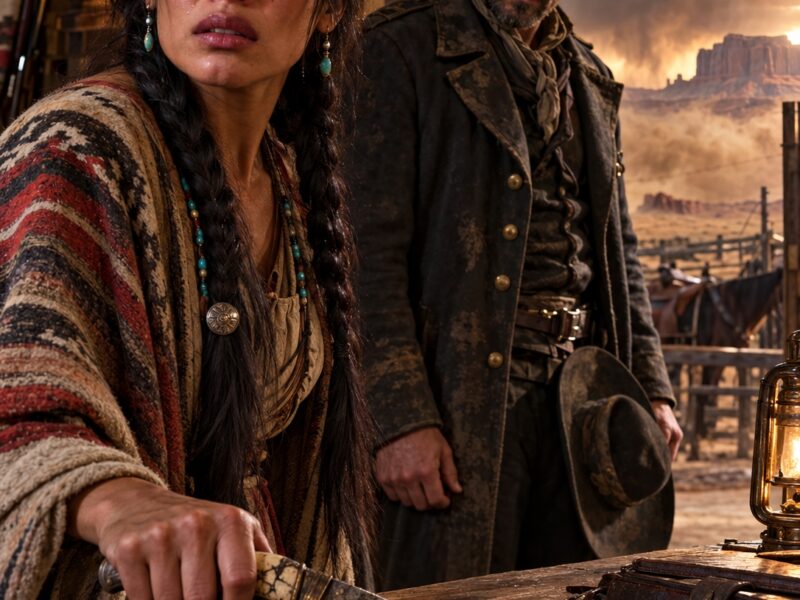
The Apache Widow Let a Former Soldier Into Her Cabin During a Dust Storm—Then She Saw the Name Hidden Inside His Saddlebag

The first time Elias Ward saw Naira, she was pointing a rifle directly at his heart.
The second time she nearly killed him, she had a better reason.
By then, the dust storm was gone.
And she knew what he had been hiding.
It was the autumn of 1884, twelve miles outside Silver Creek, Arizona Territory, where the desert stretched so wide beneath the white sky that a cabin could disappear into the distance like something the earth had decided to forget.
Naira preferred it that way.
For five years, she had lived alone beneath a ridge of red stone with only a small garden, two goats, a stubborn mule, and the wind for company.
People in Silver Creek had different names for her.
The Apache widow.
The medicine woman.
The witch beyond the ridge.
Some said she could stop fever with desert herbs.
Some said she could tell when a man was lying just by looking at his hands.
Some claimed that three ranchers who cheated her had later lost cattle, money, or wives, which was apparently enough evidence for half the town to decide she carried a curse.
Naira knew the truth was less interesting.
Men did not need curses to ruin themselves.
They managed perfectly well on their own.
Her husband, Taza, had understood that.
He had served as a scout for the United States Army during the years when survival required compromises no one should have been forced to make.
He knew the trails.
He knew the water.
He could read hoofprints after wind had nearly erased them.
He could look at a mountain and tell whether rain had fallen on the other side.
The Army praised those gifts when they needed him.
Then one afternoon, three soldiers rode to Naira’s home without him.
One carried Taza’s knife.
Another carried a folded letter.
The third would not look at her.
“Where is my husband?”
There had been a pause.
The kind of pause that answered more than words ever could.
“Ma’am,” the officer finally said, “there was an accident.”
“What accident?”
“Confusion during a skirmish.”
“Where?”
Another pause.
“North of the San Pedro.”
“Where is his body?”
The officer’s jaw tightened.
“We couldn’t recover it.”
Naira had looked from one soldier to another.
Three men.
Three horses.
Three rifles.
Not one pair of eyes willing to meet hers.
“What happened to him?”
The officer repeated the sentence.
“Confusion during a skirmish.”
That was five years ago.
Naira had stopped asking questions because eventually she understood something terrible about unanswered questions.
Sometimes nobody answered because nobody knew.
Sometimes nobody answered because everyone knew.
The difference could destroy a person.
So she built a life around the silence.
Then, on a September afternoon, the sky turned brown.
Naira saw the storm approaching from the west while gathering dried clothes from the line.
She moved quickly.
Blankets inside.
Goats secured.
Shutters closed.
Water covered.
The desert taught preparation because it rarely offered mercy twice.
The first wall of dust struck shortly before sunset.
It swallowed the ridge.
Then the trail.
Then the entire world.
Naira was fastening the final shutter when she heard something beneath the wind.
A horse.
She froze.
The sound came again.
A frightened whinny.
Then a man’s voice.
“Hello!”
Naira reached for the Winchester leaning beside the door.
“Anyone there?”
She did not answer.
The pounding came moments later.
Not violent.
Desperate.
“Ma’am!”
Naira lifted the rifle.
“Just need shelter until it passes!”
She opened the door only wide enough for the barrel to appear first.
A man stood outside with one hand raised.
He was tall, perhaps forty-five, though exhaustion made him look older. Dust coated his beard, coat, hat, eyelashes.
Behind him, a chestnut horse struggled to remain standing.
“Who are you?” Naira asked.
“Elias Ward.”
“Where are you going?”
“Was hoping Silver Creek.”
“You missed it.”
“I gathered that.”
Lightning flashed inside the dust.
The horse jerked.
Elias grabbed the reins.
Naira’s rifle remained centered on his chest.
“Soldier?”
Something changed in his face.
It lasted less than a second.
But Naira saw it.
“Once.”
Her finger tightened near the trigger.
Elias noticed.
He did not reach for the revolver at his hip.
Instead, he slowly unbuckled the gun belt.
He placed it in the dirt.
Then stepped away.
“I don’t want trouble.”
“Men usually say that after bringing it.”
“I suppose that’s true.”
“Why did you leave the Army?”
His eyes met hers.
“That answer takes longer than this storm will give us.”
“Then stay outside.”
She started closing the door.
The horse stumbled.
It dropped to one knee.
Elias turned immediately, forgetting the rifle, forgetting himself.
“Easy, boy. Easy.”
The animal tried to rise.
Failed.
Naira watched Elias place both hands against the horse’s neck.
There was genuine fear in his face.
Not for himself.
For the animal.
Thunder rolled across the desert.
And suddenly Naira heard Taza’s voice from years ago.
The desert has its own laws.
You don’t leave somebody outside when the land has decided to kill them.
She hated that she remembered it.
She hated even more that she still obeyed him.
“Bring the horse around back.”
Elias looked toward her.
“You mean—”
“Before I change my mind.”
The small lean-to behind the cabin barely sheltered the animal.
Elias worked quickly, covering the horse with an old blanket while Naira watched from the doorway.
When he entered the cabin, water and dust ran from his coat.
He stopped immediately.
“Where?”
Naira pointed toward a place beside the fire.
“Sit there.”
He did.
“Don’t touch anything.”
“Fair enough.”
“Don’t open anything.”
“I won’t.”
“And if you reach for another weapon—”
“I don’t have another weapon.”
Naira looked at him.
Elias sighed.
“Boot.”
He slowly pulled a small knife from inside his right boot and placed it on the floor.
“Anything else?” she asked.
“Bad memories.”
Naira did not smile.
“Keep those.”
“I was planning to.”
For hours, the storm battered the cabin.
Neither slept.
Naira sat against the opposite wall with the Winchester across her knees.
Elias remained near the fire.
At some point she gave him coffee.
He drank it black without complaint.
Later she placed dried venison and bread beside him.
“Thank you.”
Naira said nothing.
The fire cracked.
Wind pushed dust through tiny spaces around the window frame.
Elias glanced toward a shelf where bundles of dried herbs hung from twine.
“You sell those?”
Naira’s eyes hardened.
“I said don’t touch.”
“I wasn’t.”
“Then don’t look like you’re thinking about touching.”
He nodded.
“Understood.”
Several minutes passed.
Then he said, “You always this friendly?”
“Yes.”
That time he smiled.
Naira disliked the effect it had on the room.
Near midnight, Elias noticed the knife hanging beside the hearth.
Its handle was wrapped in faded leather.
A crack ran through the bone pommel.
His face changed.
Naira saw that too.
“What?”
“Nothing.”
“You looked at the knife.”
“I did.”
“Why?”
Elias looked away.
“Reminded me of something.”
“What?”
He took too long.
“Another knife.”
Naira’s fingers tightened around the rifle.
“Go to sleep, Elias Ward.”
He did not sleep.
Neither did she.
By dawn, the storm had passed.
The desert outside looked newly made.
Half Naira’s fence lay buried beneath sand.
The trough had disappeared.
One section of the roof sagged.
Her chicken enclosure had collapsed entirely.
Elias stepped outside and stared.
Naira expected him to saddle his horse.
Instead, he found her shovel.
“You don’t have to do that.”
He pushed the blade into the sand.
“I know.”
“You should rest your horse and leave.”
“I’ll leave when he can put weight on that leg.”
“That might take two days.”
“Then I’ll have plenty of time to fix this fence.”
Naira folded her arms.
“Why?”
Elias leaned on the shovel.
“If I stop working, I start thinking.”
“And?”
“Working’s better.”
Naira stared at him.
There were answers people gave because they wanted sympathy.
There were answers people gave because they wanted conversation to end.
His was the second kind.
She understood it immediately.
That frightened her more than the revolver.
Elias remained for two days.
Then three.
His horse’s leg improved slowly.
Meanwhile, the fence stood again.
The roof stopped leaking.
The trough emerged from beneath the sand.
Elias repaired a broken hinge Naira had ignored for nearly a year.
He never entered her sleeping area.
Never searched through her belongings.
Never asked why she lived alone.
Never asked what happened to her husband.
When she gave him food, he accepted it without behaving as though kindness had created an obligation between them.
On the fourth morning, Naira found him outside before sunrise rebuilding a section of corral.
“You missed a nail,” she said.
Elias looked over.
“Good morning to you too.”
She pointed.
“There.”
He examined the board.
“You’re right.”
“I usually am.”
“I’ve noticed.”
Naira turned away before he could see the beginning of her smile.
That evening they ate outside.
The sky was purple above the mountains.
Elias’s horse grazed nearby.
Naira finally asked, “You fought in the war?”
“Union Cavalry.”
Her expression cooled.
“After?”
“Yes.”
“Against my people?”
Elias stared into the fire.
“Yes.”
The answer landed between them.
Naira set down her cup.
Elias could have explained.
He could have defended himself.
He could have said he had followed orders.
Instead, he said, “I rode with men who burned villages.”
Naira’s face became completely still.
“We called it justice then.”
“And now?”
Elias looked toward the fence he had repaired.
“Now I fix fences.”
“That doesn’t undo anything.”
“No.”
“You think being sorry makes you good?”
“No.”
“Then why tell me?”
He looked at her.
“Because you asked.”
Naira hated the simplicity of the answer.
She hated that he had not asked forgiveness.
Forgiveness would have been easier to refuse.
“What made you leave?”
Elias’s gaze shifted toward the mountains.
“A man gave me an order.”
“What order?”
His jaw tightened.
“I didn’t follow it.”
“What happened?”
“I survived.”
“And the man?”
Elias looked into the fire.
“He did too.”
Naira waited.
Nothing else came.
Another locked door.
She recognized those.
She had built enough herself.
The next morning, Elias announced that his horse could probably travel.
Naira felt something unexpected.
Disappointment.
It embarrassed her.
She hid it by chopping wood too hard.
“You’ll leave today?”
“Probably.”
“Good.”
Elias looked at the pile.
“You’re attacking that wood like it insulted your mother.”
“It did.”
He almost laughed.
Then Naira said, “I need supplies.”
“When?”
“Tomorrow.”
“I could ride with you.”
She stopped chopping.
“You said you’re leaving.”
“I can leave afterward.”
“You don’t owe me.”
“It’s not debt.”
“Then what is it?”
Elias opened his mouth.
Closed it.
Naira waited.
Finally he said, “Company.”
The word was so ordinary it almost hurt.
She looked away.
“Be ready at sunrise.”
Silver Creek had grown since Naira last bothered noticing.
A telegraph office stood beside the general store.
A new hotel had opened near the saloon.
Men with money were buying land along the creek, fencing water that cattlemen had once treated as common.
But some things had not changed.
People still stared when Naira rode into town.
They stared harder because Elias rode beside her.
At Crawford’s trading post, Silas Crawford stood behind the counter weighing beans.
He was broad, gray-haired, and permanently suspicious of anyone whose money he wanted.
His eyes settled on Naira.
“Well.”
She placed two bundles of hides on the counter.
“I need flour, salt, lamp oil and coffee.”
Crawford touched one hide.
“Quality isn’t what it used to be.”
“It is the same quality you praised last winter.”
“Market changed.”
“In three months?”
Crawford shrugged.
Then he noticed Elias.
“You traveling with her?”
Elias leaned against the counter.
“I’m standing right here.”
“I can see that.”
“Then why ask her?”
Crawford laughed.
“Careful, friend. That woman brings bad luck.”
Naira watched Elias’s expression change.
Not dramatically.
That was what made it dangerous.
He straightened.
“You talk too much for a man doing business.”
Crawford’s smile disappeared.
Naira touched Elias’s sleeve.
“Leave it.”
They collected the supplies.
Outside, a drunk man leaning against the saloon rail saw them.
“Well, look at this.”
Naira kept walking.
The drunk called louder.
“Hey, soldier!”
Elias stopped.
Naira whispered, “Don’t.”
The man grinned.
“You keeping that Apache widow for company?”
Several men laughed.
Elias slowly turned his horse.
“Say it again.”
The laughter died.
The drunk’s smile weakened.
“I was joking.”
“No. You wanted everyone to hear it.”
Elias waited.
“Now say it again.”
The drunk looked at the ground.
Nobody spoke.
Naira rode away first.
Elias followed.
For several miles, only hoofbeats filled the space between them.
Then Naira said, “You didn’t have to defend me.”
“Yes.”
She looked over.
“Yes what?”
“Yes, I did.”
“Words don’t hurt me.”
Elias kept his eyes on the trail.
“They’ve been hurting you for years.”
Naira said nothing after that.
But the sentence followed her all the way home.
That evening the cabin felt different.
Not safer.
Safety was too large a word.
It felt occupied by something other than grief.
Naira removed a small wooden box from beneath her bed.
Inside lay a string of turquoise beads.
She carried them to the table.
Elias looked up.
“I made these for my husband.”
He said nothing.
“I stopped wearing them after he died.”
“Why?”
“They meant belonging.”
Her thumb moved across the smooth stones.
“After him, they only meant waiting.”
“For what?”
Naira stared at the beads.
“I don’t know.”
That was the truth.
Waiting for Taza to walk through the door.
Waiting for someone to admit what happened.
Waiting for anger to become something else.
Waiting for life to begin again without feeling like betrayal.
She lifted her eyes.
“I think I’m finished waiting.”
Elias did not move.
The fire shifted behind him.
Then he asked softly, “Do you still talk to him?”
Naira looked toward Taza’s knife.
“When I can’t sleep.”
Elias nodded.
“Sometimes I wake up and forget he’s gone.”
Her voice became quieter.
“I reach beside me.”
She hated herself for continuing.
But Elias had a way of making silence feel like permission instead of pressure.
“When I’m alone…”
She stopped.
Elias waited.
“My hands wander.”
His brow tightened slightly.
“They look for what’s gone.”
The sentence left her exposed in a way nakedness never could.
Elias looked down.
Not from embarrassment.
From respect.
Naira swallowed.
“I haven’t said that to anyone.”
“I won’t repeat it.”
“That’s not what I’m afraid of.”
He looked back at her.
“What are you afraid of?”
Naira’s eyes filled before she could stop them.
“That one day I’ll stop reaching.”
Elias understood.
She could see it.
Because grief had lived in him too.
He rose slowly.
Naira did not move.
He stopped several feet away.
“May I?”
She knew what he meant.
She nodded.
Elias sat beside her.
Nothing more.
No kiss.
No embrace.
Their shoulders barely touched.
Yet for Naira, that small contact felt more dangerous than anything that had happened since the storm.
Because loneliness was survivable when you believed it was permanent.
Hope was what made a person vulnerable.
Elias stayed another week.
Then another.
Nobody formally decided it.
His horse recovered completely.
Still, every morning Elias found something that needed repairing.
A gate.
A wagon wheel.
A loose floorboard.
Naira eventually said, “If you keep fixing things, you’ll have to start breaking them first.”
“Don’t tempt me.”
She laughed.
The sound surprised both of them.
Later that night, Elias lay beneath a blanket near the fire while Naira listened to his breathing.
She wondered whether this was how a life returned.
Not suddenly.
Not with trumpets.
With a repaired hinge.
A second coffee cup.
Boots beside a door.
Someone remembering how much wood the stove needed before midnight.
Then, three days later, a rider appeared on the ridge.
Naira saw him first.
She reached for the rifle.
Elias came outside.
The rider approached slowly.
Deputy Thomas Bell.
He removed his hat.
“Naira.”
“What?”
Bell looked toward Elias.
“You Ward?”
Elias’s body went rigid.
“Yes.”
“Sheriff wants to see you.”
“Why?”
Bell hesitated.
“Man came into town yesterday asking questions.”
“What man?”
“Says his name is Major Silas Rourke.”
The color left Elias’s face.
Naira noticed.
“Who is he?”
Elias did not answer.
Bell continued.
“Rourke says Ward deserted federal service and stole military property.”
Naira turned toward Elias.
“Is that true?”
“Part of it.”
“What part?”
“The desertion.”
“And the stolen property?”
Elias’s silence was answer enough.
Bell sighed.
“Sheriff said you can come voluntarily.”
“And if I don’t?”
“Rourke’s got two men with him.”
“Army?”
“Not anymore.”
Elias stared toward Silver Creek.
“I’ll come.”
Naira stepped forward.
“No.”
He looked at her.
“You don’t know what he wants.”
“I know exactly what he wants.”
That frightened her.
“What?”
Elias turned to Bell.
“Give me an hour.”
The deputy nodded and rode away.
Naira waited until he disappeared.
Then she faced Elias.
“Tell me.”
“I need to leave.”
“No.”
“Naira.”
“You came into my house with a lie.”
“I told you my name.”
“You told me enough truth to hide the rest.”
Elias flinched.
“Tell me what you stole.”
He looked toward the cabin.
Then toward her.
“A ledger.”
“What ledger?”
“Military reports.”
Her stomach tightened.
“Why?”
“Because men died.”
“Men always die in military reports.”
“These weren’t supposed to.”
Something cold moved through her.
“What does that mean?”
Elias closed his eyes briefly.
When he opened them, Naira saw the man he had been trying not to become again.
“A scouting patrol was sent north five years ago.”
Naira stopped breathing.
Elias continued.
“They were supposed to locate a group believed to be moving through the San Pedro corridor.”
“Five years?”
“Yes.”
Her voice changed.
“My husband died five years ago.”
“I know.”
The world became very quiet.
Naira looked at him.
“What did you say?”
Elias’s face broke.
Not dramatically.
Something inside it simply surrendered.
“I know.”
Naira backed away.
Her hand found the rifle leaning beside the door.
Elias did not move.
“You knew his name?”
“Yes.”
“When?”
“Before I came here.”
Naira lifted the rifle.
The barrel settled against his chest.
Almost exactly where it had during the storm.
Except now her hands were shaking.
“You knew.”
“Yes.”
“You knew who I was.”
“Yes.”
The word struck harder each time.
Naira’s finger moved toward the trigger.
Elias stood perfectly still.
“Were you there?”
His silence lasted only a moment.
But it lasted long enough.
Naira’s voice cracked.
“Were you there when my husband died?”
“Yes.”
She fired.
The bullet struck the doorframe beside Elias’s head.
Wood exploded.
He did not duck until afterward.
Naira worked the lever.
“Leave.”
“Naira—”
“LEAVE!”
He looked at her.
Then slowly walked toward his horse.
Naira followed with the rifle.
“Was it an accident?”
Elias stopped.
That was the question.
The one she had carried for five years.
He could have lied.
She almost wanted him to.
Instead, Elias turned.
“No.”
The rifle slipped slightly in Naira’s hands.
She stared at him.
“What happened?”
Elias’s eyes were wet.
“Rourke happened.”
The name meant nothing.
Yet.
“Tell me.”
“Not here.”
“You don’t get to decide where.”
“He’s coming.”
“Then let him.”
“You don’t understand.”
Naira raised the rifle again.
“Make me understand.”
Elias looked toward the empty trail.
Then he spoke.
“Your husband found something.”
“What?”
“Evidence that supplies meant for Apache families under military supervision were being diverted and sold.”
Naira’s face changed.
“Food?”
“Food. Blankets. Ammunition. Medicine.”
“By whom?”
“Rourke.”
The wind moved through the grass.
Elias continued.
“Taza had been scouting for us. He discovered wagon tracks going the wrong direction. He followed them.”
Naira could barely hear.
“He told his commanding officer.”
“Rourke.”
“Yes.”
“And?”
“Rourke ordered him to keep quiet.”
“Taza wouldn’t.”
“No.”
A broken laugh escaped Naira.
“No. He wouldn’t.”
“He threatened to take the evidence to Tucson.”
“What evidence?”
“Names. Dates. wagon numbers. Buyers.”
Naira stared at Elias.
“And you?”
“I was Rourke’s sergeant.”
The sentence changed everything.
“You served him.”
“Yes.”
“You followed his orders.”
“For too long.”
“What did he order you to do to Taza?”
Elias could not answer.
Naira stepped closer.
“What did he order you to do?”
“Bring him back.”
“Alive?”
Silence.
“Alive?”
“No.”
Naira struck him.
The sound echoed against the cabin wall.
Elias took it.
She struck him again.
“You came here.”
Another blow.
“You ate at my table.”
Again.
“You slept beside my fire.”
Again.
“You listened to me talk about him.”
Elias caught her wrist only when she tried to hit him a fifth time.
Not violently.
He held it because she was trembling so hard she could barely stand.
“I know.”
“Don’t say that!”
She ripped her hand free.
“You know nothing.”
“I know what I did.”
“You killed him.”
“No.”
Naira froze.
Elias swallowed.
“I was ordered to.”
“But?”
“I refused.”
“Then who?”
“Rourke sent another man.”
Naira stared at him.
“Did you stop him?”
“No.”
That answer mattered more than everything else.
Elias did not hide from it.
“I tried to warn Taza. I got to him before Rourke’s men did.”
Naira’s breathing became uneven.
“He knew?”
“He knew they were coming.”
“What did he say?”
Elias looked toward the knife hanging inside the cabin.
“He gave me that.”
Naira turned.
The cracked knife.
Her husband’s knife.
The soldiers had brought it to her.
But Elias had recognized it the first night.
“He gave it to you?”
“Yes.”
“Then how did they have it?”
“I gave it back.”
“Why?”
“Because he told me to.”
Naira shook her head.
“No.”
“He said if he didn’t return, his wife should have something that had touched his hand.”
Naira’s knees nearly failed.
Elias stepped forward.
She raised the rifle.
He stopped.
“What else did he say?”
Elias’s voice broke.
“He said not to tell you unless I could prove it.”
Naira stared at him.
“And you waited five years?”
“I spent five years trying to get the proof.”
Her face hardened.
“And now?”
“I have it.”
Naira looked toward his saddle.
The saddlebags.
He had guarded them carefully since arriving.
She had noticed.
She had simply chosen not to ask.
“Show me.”
Elias hesitated.
“Now.”
He walked to the horse.
Opened the right saddlebag.
Removed a wrapped oilskin bundle.
Inside was a black military ledger.
Naira took it.
The pages were filled with handwriting, dates, initials, wagon numbers, signatures.
She could read some English.
Not enough.
Elias opened to a marked page.
“There.”
Naira saw a name.
TAZA.
Below it, another.
ROURKE.
Then a sentence written in Elias’s hand.
SCOUT REFUSED ORDER. REQUESTED CIVILIAN INQUIRY.
Below that was a second note.
SUBJECT LOST DURING HOSTILE ENGAGEMENT.
Naira stared at it.
“Lost?”
“That’s the official version.”
“What is the real version?”
Elias’s jaw tightened.
“Taza escaped the first attempt.”
Naira looked up.
“What?”
“I helped him.”
For the first time since the conversation began, something other than rage entered her face.
“He survived?”
“For three days.”
The hope died almost immediately.
Elias continued.
“We hid in an abandoned mining camp. Taza wanted to reach Tucson.”
“Why didn’t you take him?”
“Rourke had men on the southern road.”
“Then west.”
“No water.”
“North.”
“Patrols.”
“Then you should have fought!”
“I know.”
Naira screamed the words.
“You should have fought!”
“I KNOW!”
The desert threw his voice back at them.
Elias lowered his head.
Then, quieter:
“I know.”
Naira had never seen a man look so tired.
“He told me to leave him.”
“He would never.”
“He did.”
“Why?”
“Because Rourke had captured two families traveling through the canyon.”
Naira’s face drained.
“He threatened them?”
“Yes.”
“If Taza surrendered?”
“They’d be released.”
“And were they?”
Elias could not speak.
Naira understood.
“No.”
“They killed him anyway?”
Elias looked at her.
“Yes.”
Something inside Naira went silent.
Not broken.
Silent.
There are pains too large for screaming.
She walked into the cabin.
Elias did not follow.
Several minutes later she returned carrying Taza’s knife.
“Who killed him?”
“Rourke gave the order.”
“Who pulled the trigger?”
“A corporal named Amos Creed.”
“Where is he?”
“Dead.”
“How?”
“I killed him.”
Naira stared at Elias.
“When?”
“That night.”
“You said you didn’t fight.”
“Not soon enough.”
He looked at the ground.
“I heard the shot from the ridge.”
His voice became distant.
“I reached the canyon after dark. Taza was already dead.”
Naira’s fingers tightened around the knife.
“Rourke’s men were burning papers.”
Elias continued.
“Creed saw me.”
“What happened?”
“He laughed.”
Naira’s face hardened.
“He said Taza had died believing I would tell you the truth.”
Elias swallowed.
“I shot Creed.”
“And Rourke?”
“Gone.”
“Why didn’t you come to me?”
“I had no proof except the ledger.”
“You had his body.”
“Rourke took it.”
“Where?”
“I don’t know.”
The sentence wounded her again.
Elias looked at the ledger.
“I stole that and deserted.”
“For five years?”
“I tried to get it before judges, Army investigators, territorial officials.”
“And?”
“Rourke had friends.”
Of course he did.
Men like Rourke always did.
“What changed?”
“He’s buying land near Silver Creek.”
Naira looked toward town.
“Why?”
“The railroad survey.”
She understood.
Water.
Land.
Money.
Elias nodded.
“He needs your property.”
“My cabin?”
“Your spring.”
The pieces moved together.
Crawford’s contempt.
The sudden land buyers.
The rumors.
The attempts to isolate her.
“How long has he known where I live?”
“I don’t know.”
“Why did you come here?”
Elias’s answer took too long.
Naira already knew.
“The storm wasn’t an accident.”
“The storm was.”
“But you were looking for me.”
“Yes.”
Her face closed.
Everything tender between them suddenly became evidence against him.
“The horse?”
“Really injured.”
“The fence?”
“Real.”
“Silver Creek?”
“Real.”
“The things you said to me?”
Elias looked at her.
“All real.”
“You don’t get to decide that.”
“No.”
“You came because of Taza.”
“Yes.”
“And stayed because?”
Elias’s voice became quiet.
“You.”
Naira’s eyes filled with anger again.
“Don’t.”
“I won’t lie anymore.”
“You think truth makes this better?”
“No.”
“You let me…”
She stopped.
The turquoise beads were still on the table inside.
She remembered telling him she was finished waiting.
She remembered their shoulders touching.
She remembered saying things she had not said aloud in five years.
“You let me trust you.”
“I know.”
“Stop saying you know.”
Elias looked away.
Naira pointed toward the trail.
“Go.”
“Naira—”
“Take the ledger.”
“No.”
“Take it.”
“It’s yours now.”
“I don’t want anything from you.”
“You need it.”
“For what?”
“To survive what’s coming.”
She stared at him.
“What is coming?”
A gunshot answered.
Elias moved before Naira understood.
He hit her hard around the waist.
They fell behind the water trough as another bullet struck the cabin wall.
Three riders appeared on the ridge.
Elias drew his revolver.
“Inside!”
Naira crawled toward the cabin.
Another shot.
Glass shattered.
She reached the door and turned.
Elias was still outside.
“Elias!”
“Go!”
One rider came down the slope.
Naira recognized him.
Deputy Bell.
Except Bell was not riding like a deputy coming to help.
He was riding beside two armed strangers.
“Bell!” she shouted.
The deputy raised his rifle.
Elias fired first.
Bell’s horse reared.
The deputy fell into the dust.
The other riders split apart.
Naira fired from the doorway.
One disappeared behind the corral.
The second retreated toward the ridge.
Then silence.
Elias ran toward Bell.
The deputy was alive.
Barely.
Blood spread across his shirt.
Naira approached with the rifle.
Bell looked at her.
“Didn’t… have a choice.”
“Everyone has a choice,” Elias said.
Bell coughed.
“Rourke has my boy.”
Elias crouched.
“Where?”
“Old mission.”
“What old mission?”
“South canyon.”
Bell grabbed Elias’s sleeve.
“He knows about the ledger.”
Elias’s face hardened.
“How?”
Bell’s eyes moved toward Naira.
“Crawford.”
Naira understood.
The trader.
The man who had weighed her hides.
Bought her herbs.
Watched her for years.
Bell whispered, “Rourke paid him.”
“For what?”
“To keep you alone.”
Naira went cold.
“What?”
“Rumors.”
The word landed softly.
“He started the stories.”
The cursed widow.
The dangerous Apache woman.
The bad luck.
Not superstition.
Strategy.
Isolation made theft easier.
A woman nobody defended could disappear without creating questions.
Bell’s hand fell.
“He’s coming tonight.”
Then the deputy stopped breathing.
Naira stood above him.
Elias looked toward the horizon.
“We need to leave.”
“No.”
“He has men.”
“This is my home.”
“He wants the ledger.”
“Then he’ll come for it.”
“Naira.”
She turned toward him.
For the first time, Elias saw something in her that had nothing to do with grief.
Decision.
“Good.”
They had six hours.
Naira spent the first preparing.
Not panicking.
Preparing.
She moved the goats into the wash.
Covered the spring.
Loaded rifles.
Placed water beneath the floorboards.
Elias watched her.
“You’ve done this before.”
“I’ve survived before.”
He almost smiled.
Then Naira handed him his saddlebag.
“You should go.”
He looked at it.
“You just said—”
“This isn’t your fight anymore.”
“It was my fight before it was yours.”
“No.”
Naira stepped closer.
“You made your choices five years ago.”
Elias absorbed the words.
“This one is mine.”
She expected him to argue.
Instead, he nodded.
Then placed the saddlebag down.
“What are you doing?”
“Making my choice.”
“You don’t owe me.”
“I know.”
“Then why stay?”
Elias looked at her.
“Because five years ago I arrived too late.”
He checked the cylinder of his revolver.
“I don’t intend to do that twice.”
Night came slowly.
No riders appeared.
Nine o’clock.
Ten.
Eleven.
Naira began to wonder whether Bell had lied.
Then the smell reached her.
Smoke.
Not from the cabin.
From the corral.
“Fire!”
Elias ran outside.
Flames climbed the western fence.
Naira grabbed a bucket.
“No!”
He caught her.
“It’s bait.”
A bullet punched through the window.
They dropped.
Men surrounded the cabin.
A voice came from outside.
“Sergeant Ward!”
Elias froze.
Naira looked at him.
Major Silas Rourke had arrived.
“Been a long time.”
Elias moved beside the window.
“Not long enough.”
Rourke laughed.
His voice was older than Elias remembered.
Calmer.
That somehow made it worse.
“Send out the ledger.”
“No.”
“Then I’ll burn the cabin.”
Naira shouted, “You already tried.”
Silence.
Then Rourke said, “Mrs. Taza.”
Naira’s blood went cold.
“Your husband was stubborn too.”
Elias looked at her.
Don’t answer.
Naira ignored him.
“You remember him?”
“Oh, very well.”
“Good.”
She lifted the rifle.
“Then you’ll remember what happens when you underestimate this family.”
Rourke laughed again.
“I see Ward has filled your head with stories.”
“Did you kill my husband?”
Elias stared at her.
Outside, the fire cracked.
Rourke answered.
“No.”
Naira’s grip tightened.
“Coward.”
“I gave an order.”
“That is killing.”
“History won’t see it that way.”
“History isn’t here.”
A pause.
Then Rourke said, “Ward hasn’t told you everything.”
Elias’s face changed.
Naira saw it.
Again.
That tiny betrayal of expression.
Her stomach dropped.
“What?”
“Naira,” Elias said.
Rourke’s voice carried through the darkness.
“Ask your friend why Taza was on that patrol in the first place.”
Naira turned.
Elias said nothing.
“Ask him who recruited your husband.”
The cabin seemed to shrink.
Naira looked at Elias.
“You?”
His eyes closed.
“Yes.”
The word nearly destroyed what remained.
Rourke laughed outside.
“There it is.”
Naira backed away.
“You recruited Taza?”
“I needed a scout.”
“You brought him into the Army?”
“Yes.”
“Why?”
“Because he was the best tracker I’d ever seen.”
“You put him under Rourke.”
“I didn’t know what Rourke was doing then.”
“But you brought him.”
“Yes.”
Naira lifted the rifle toward Elias.
Outside, Rourke called, “Ward has always been good at finding other people to carry his guilt.”
Elias looked at Naira.
“He’s right about one thing.”
“Which thing?”
“I brought Taza in.”
The rifle trembled.
“I told him service could protect his family.”
Naira’s eyes burned.
“You promised him?”
“Yes.”
“And he believed you.”
“Yes.”
“So did I.”
That hurt Elias more than the rifle.
Rourke shouted, “Ledger!”
Elias turned toward the door.
“No.”
Naira grabbed his arm.
“What are you doing?”
“Ending it.”
“How?”
“Giving him what he wants.”
“No.”
“He’ll kill you.”
“He’ll kill us both.”
Naira looked toward the floorboards.
Then at Elias.
An idea formed.
“Maybe.”
She lowered the rifle.
“But men like Rourke have one weakness.”
“What?”
“They believe everyone wants to live as badly as they do.”
Naira took the ledger.
Then she walked toward the door.
Elias caught her.
“No.”
“You said this was mine.”
“Not like this.”
“Trust me.”
The irony of the words struck them both.
Naira saw it in his face.
She opened the door.
“Rourke!”
Gun barrels shifted in the darkness.
Naira stepped onto the porch holding the ledger above her head.
“I have it.”
Rourke emerged.
He was in his late fifties.
Silver hair.
Clean coat.
Expensive boots.
He looked less like a killer than a banker.
That offended Naira more than she expected.
“Bring it here.”
“No.”
His smile faded.
“You don’t understand your position.”
“I understand perfectly.”
She held the ledger near the porch lantern.
Rourke’s face changed.
“You burn that and you lose your proof.”
“So do you.”
“Proof of what?”
“That you murdered my husband.”
Rourke smiled.
“You have a deserter’s handwriting and a dead Indian.”
Naira’s expression did not change.
“Then why did you come?”
Silence.
Elias almost smiled inside the cabin.
Naira continued.
“Why bring armed men?”
Rourke said nothing.
“Why pay Crawford to watch me?”
One of Rourke’s men glanced at him.
Naira saw it.
Good.
“You told them this was about stolen Army property, didn’t you?”
Rourke’s jaw tightened.
She had guessed correctly.
The men had not been told everything.
Naira raised her voice.
“Did he tell you what’s in here?”
“Naira,” Rourke warned.
“Names.”
One rider shifted.
“Payments.”
Another looked toward Rourke.
“Wagon numbers.”
“Enough.”
“And the names of men who stole government supplies and sold them while families went hungry.”
Rourke drew his pistol.
Elias fired from inside.
The lantern exploded.
Darkness swallowed the porch.
Naira dropped.
Gunfire erupted.
Horses screamed.
Men shouted.
Elias pulled Naira through the doorway.
They crawled behind the stove.
“How many?”
“Four left.”
“Five.”
“What?”
“Crawford.”
Elias looked toward the rear window.
A shadow moved.
Naira fired.
A man screamed.
“Four.”
Elias almost laughed.
“You’re terrifying.”
“I’ve been told.”
The shooting continued for less than three minutes.
It felt like an hour.
Then came silence.
A voice outside shouted, “I’m done!”
A rifle landed in the dirt.
One of Rourke’s hired men stepped forward with both hands raised.
“I didn’t know.”
Another followed.
Rourke shouted from behind the corral.
“Cowards!”
The first man yelled back, “You said he stole payroll records!”
Rourke fired at him.
The bullet missed.
That ended whatever loyalty remained.
His men scattered.
Rourke ran for a horse.
Elias pursued.
Naira followed.
“Elias!”
Rourke mounted.
Elias raised his revolver.
For one second, five years stood between his finger and the trigger.
Taza.
Creed.
The canyon.
The ledger.
Every night Elias had imagined this moment.
Rourke turned in the saddle.
“You won’t.”
Elias’s arm remained steady.
Rourke smiled.
“You never could.”
Then Naira stepped beside Elias.
Her rifle rose.
Rourke’s smile disappeared.
But Naira did not fire.
“Get down.”
Rourke laughed.
“You think a territorial court will believe you?”
“No.”
That surprised him.
Naira continued.
“I think they’ll believe your men.”
Behind them stood the two hired riders.
One had heard enough.
The other had seen Rourke try to shoot him.
“And the ledger,” Naira said.
Rourke looked around.
For the first time that night, fear appeared in his face.
Not fear of death.
Something worse.
Fear of surviving long enough to answer questions.
Elias lowered his revolver.
Rourke stared at him.
“Still weak.”
Elias shook his head.
“No.”
He looked toward Naira.
“Just finally learned the difference between revenge and truth.”
Rourke reached for his pistol.
Naira fired.
The bullet struck his shoulder.
He fell from the horse.
Elias kicked the weapon away.
Naira stood above Rourke.
He looked up at her.
“You should kill me.”
“Probably.”
“Then do it.”
Naira thought about Taza.
About five years of silence.
About the knife.
The turquoise beads.
The empty side of the bed.
She lowered the rifle.
“No.”
Rourke smiled weakly.
“Mercy?”
Naira looked at him.
“Consequences.”
Silas Rourke was taken to Tucson in chains.
The investigation lasted seven months.
The ledger opened doors Elias had failed to open alone.
Two surviving soldiers testified.
So did the hired men from Naira’s ranch.
Records were recovered.
Payments were traced.
Crawford tried to flee Silver Creek and was arrested three days later at a stage stop near Benson.
The rumors about Naira did not disappear immediately.
Rumors rarely apologize.
But people stopped laughing when she entered town.
Some stopped looking at her altogether.
Others suddenly became very polite.
Naira preferred the ones who looked ashamed.
At least shame suggested memory.
Rourke was convicted on fraud, conspiracy, theft and multiple charges connected to killings concealed beneath falsified military reports.
But the most important truth arrived quietly.
A former scout named Joseph Running Elk came to Naira’s cabin one spring morning.
He was older.
Thin.
He carried a small cloth bundle.
“I knew Taza.”
Naira invited him inside.
Elias was repairing the stable.
He saw the visitor and stayed outside.
Joseph placed the bundle on the table.
Inside was a brass compass.
Naira recognized it immediately.
She had given it to Taza during their second winter together.
Her breath stopped.
“Where?”
“Canyon east of the old mission.”
Naira closed her eyes.
Joseph continued softly.
“We found where they buried him.”
The world did not shatter.
That surprised her.
For five years she had imagined this moment.
She thought she would scream.
Collapse.
Curse God.
Instead, she touched the compass.
“Can you take me there?”
“Yes.”
They rode the next morning.
Naira.
Joseph.
Elias followed twenty yards behind.
He had not been invited.
He also had not been told to stay.
The grave was beneath a cottonwood near a dry wash.
There was no marker.
Only stones.
Joseph showed them where.
Naira knelt.
She placed both palms against the earth.
For a long time she said nothing.
Elias removed his hat.
Then Naira whispered something in Apache.
Elias did not understand.
He did not need to.
Afterward, Joseph helped them gather the remains.
They buried Taza properly on a rise overlooking the valley.
Naira placed his knife beside him.
Then she hesitated.
The turquoise beads remained around her neck.
She had started wearing them again months earlier.
She touched them.
For years they had meant belonging.
Then waiting.
Now she understood something else.
Love did not become false simply because it ended.
And continuing to live did not betray the dead.
She left the beads around her neck.
Elias stood away from the grave.
When the others departed, Naira found him still there.
“You can go home,” she said.
Elias looked at the grave.
“I don’t know if your home is mine.”
Naira studied him.
“You’ve been sleeping in the barn for seven months.”
“I noticed.”
“You repaired it very well.”
“I had motivation.”
She almost smiled.
Then the smile disappeared.
“You lied to me.”
“Yes.”
“You recruited him.”
“Yes.”
“You failed him.”
“Yes.”
“You failed me.”
Elias’s eyes lowered.
“Yes.”
Naira stepped closer.
“I don’t know if I’ll ever forgive all of it.”
“I know.”
This time she let him say it.
Elias looked toward the valley.
“I can leave.”
“Do you want to?”
“No.”
“Why?”
He took a breath.
“Because when I wake up now, the first thing I listen for is you moving around the kitchen.”
Naira’s eyes softened.
“And when you’re angry, you slam the coffee pot.”
“I do not.”
“You absolutely do.”
“That pot has a loose handle.”
“It does now.”
She looked away so he would not see the smile.
Elias continued.
“I don’t expect you to make my guilt smaller.”
“Good.”
“I don’t expect you to forget.”
“I won’t.”
“I just…”
He stopped.
Naira waited.
“I’d like to stay long enough to become something besides the worst thing I’ve done.”
The words settled between them.
Naira looked at Taza’s grave.
Then at Elias.
“That’s not something I can give you.”
“I know.”
“You have to do that yourself.”
“Yes.”
She started walking toward the horses.
After several steps she turned.
“Are you coming?”
Elias looked surprised.
“Where?”
“Home.”
One word.
Nothing more.
But Elias followed.
Their life did not become simple.
That would have been another lie.
Naira still woke some nights reaching for a man who had been dead six years.
Sometimes she found Elias awake near the window because old battles had returned in dreams.
Sometimes they argued.
Once she threw a wooden spoon at him.
He kept it.
When she discovered it in his saddlebag months later, she demanded to know why.
“Sentimental value.”
“I was trying to hit you.”
“I know.”
“Stop saying that.”
He laughed.
She nearly threw another one.
Silver Creek changed too.
The railroad eventually came close enough to make land valuable.
Ranchers arrived.
Merchants arrived.
Families arrived.
The town grew.
Naira continued selling herbs and medicine.
But Crawford’s old trading post eventually belonged to someone else.
A widow from New Mexico bought it.
The first time Naira entered, the woman weighed her hides fairly.
No comments.
No whispers.
No superstition.
Just business.
Naira nearly cried afterward.
Not because anything extraordinary had happened.
Because nothing had.
Sometimes dignity was simply being allowed an ordinary day.
Years later, people in Silver Creek would tell stories about the Apache widow and the former cavalryman who lived beyond the ridge.
As stories do, the details changed.
Some claimed Naira shot Elias the first day they met.
Others insisted Elias fought twenty men alone.
Children said Naira could heal rattlesnake bites with one touch.
Old men swore Elias once stared down an entire cavalry patrol.
None of it was true.
The truth was quieter.
Two damaged people met during a storm.
One carried grief.
The other carried guilt.
Neither saved the other.
They simply stopped asking the other to suffer alone.
One winter evening, nearly twelve years after the dust storm, Naira woke before dawn.
The room was cold.
For one confused second, she was younger again.
Taza was alive.
The old cabin smelled of cedar smoke.
She reached across the bed.
Her hand wandered.
Searching.
Just as it had for years.
But this time it found another hand.
Elias was asleep beside her.
His fingers closed instinctively around hers.
Naira lay still.
She remembered the sentence she had once whispered beside the fire.
When I’m alone, my hands wander. They look for what’s gone.
She looked toward the window.
Beyond it, the desert remained vast and merciless and beautiful.
Somewhere beyond the ridge, Taza rested beneath the cottonwood.
Naira did not feel that she had left him behind.
She understood now that grief was not a road away from someone.
It was a road you learned to walk while carrying them differently.
Elias stirred.
“You awake?”
“Yes.”
“Bad dream?”
“No.”
His eyes opened.
“Then what?”
Naira looked down at their joined hands.
For a moment she saw every version of herself inside that small space.
The young wife.
The widow waiting for footsteps that never came.
The woman with the rifle.
The woman who almost fired.
The woman who learned the truth.
The woman who buried her husband.
The woman who came home afterward.
And finally, the woman who had survived long enough to discover that surviving was not the same thing as betraying the dead.
She tightened her fingers around Elias’s hand.
“Nothing,” she whispered.
Then, after a moment:
“I was just making sure you were here.”
Elias looked at her.
“I am.”
Outside, dawn slowly touched the Arizona desert.
Naira closed her eyes.
For the first time in many years, her hand was no longer searching for what was gone.
It was holding what had stayed.









