THE BABY WHO COPIED HER BILLIONAIRE FATHER’S FROWN—THEN A LETTER FROM HER DEAD MOTHER CHANGED EVERYTHING

The wine glass shattered on the Italian marble at 7:43 on a Thursday evening.
For one full second, nobody in the dining room moved.
Not the caterer holding a silver tray near the kitchen doors. Not the two members of the Cross Logistics board who had stopped by after a strategy meeting. Not Rosa Delgado, who stood beside the high chair with a folded napkin in one hand. And not the ten-month-old little girl staring across the table at her father with an expression so eerily similar to his that Rosa felt something cold move through her chest.
Nathaniel Cross had not thrown the glass.
That would almost have been easier to understand.
He had simply placed it on the table too hard while reading an email on his phone, and the stem had snapped between his fingers. The bowl struck the marble, broke into glittering pieces, and splashed a dark ribbon of Cabernet across the pale floor.
Nathaniel looked down at the mess.
His jaw tightened.
“Leave it,” he said.
Then he turned and walked away.
No apology.
No embarrassment.
No awareness that everyone else in the room had stopped breathing around him.
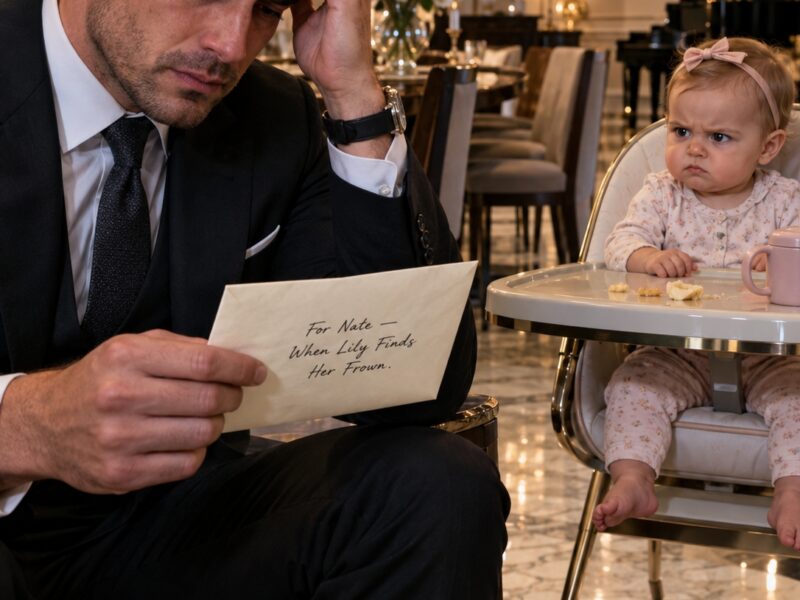
Behind him, his daughter Lily slowly pulled her tiny eyebrows together and copied the exact expression on his face.
Nobody laughed that night.
Three months later, that same expression would force Nathaniel Cross to choose between a deal worth hundreds of millions of dollars and the little girl he had been quietly abandoning without ever leaving the house.
But before that happened, a dead woman would speak to him again.
And she had been waiting for Lily to give the signal.
Nathaniel was thirty-six years old and had built the kind of fortune business magazines liked to reduce to a number.
Depending on the market, his personal wealth moved somewhere north of nine figures, while the company he had founded was valued in the billions. Cross Vector Logistics had begun sixteen years earlier in a rented office above a dry cleaner outside Chicago, with three folding desks, a secondhand server, and a twenty-year-old Nathaniel sleeping four hours a night because he was convinced inefficient shipping routes were a problem large enough to build a life around.
He had been right.
Retailers used his software.
Pharmaceutical companies used it.
Manufacturers used it.
Eventually, governments and multinational corporations used it.
By thirty, Nathaniel was flying on private aircraft because commercial schedules wasted hours he believed belonged to the company. By thirty-three, he had a lakefront estate with seven bedrooms, a climate-controlled garage, an indoor pool he had used exactly twice, and enough money to ensure that his future children would never have to wonder whether the electricity bill had been paid.
Then he met Clare.
And for the first time in his adult life, someone made him forget to check the time.
She was not impressed by the house.
She was not impressed by the car.
On their third date, when Nathaniel had taken her to a restaurant where the tasting menu cost more than Clare’s monthly rent, she had looked around at the gold light, the white tablecloths, and the waiter describing butter as though it were a religious experience.
Then she had leaned toward him.
“You know what I want?”
Nathaniel had smiled. “Something that isn’t on the menu?”
“A cheeseburger.”
He stared at her.
“With pickles.”
“You’re serious.”
“And fries.”
He laughed so unexpectedly that the couple at the next table looked over.
They left before dessert and ate burgers in Nathaniel’s car beneath the yellow lights of a twenty-four-hour diner parking lot.
Years later, that remained one of his favorite memories.
Which was precisely why he almost never allowed himself to remember it.
Because Clare Cross had been dead for fourteen months.
Her illness had been aggressive enough to turn a marriage into a countdown before either of them understood what was happening.
One hundred and nine days.
Nathaniel knew the exact number.
One hundred and nine days between the afternoon Clare sat beside him in a specialist’s office squeezing his hand and the morning he stood at a cemetery while someone lowered her coffin into wet ground.
He remembered everything from those days with cruel precision.
The green sweater she wore during the diagnosis.
The plastic cup beside her hospital bed.
The way she apologized to a nurse for vomiting.
The smell of sanitizer.
The gray February sky outside their bedroom window.
The moment she asked him to promise he would not disappear after she was gone.
“I won’t,” he had whispered.
Clare had looked at him for a long time.
“Nate.”
“I said I won’t.”
“That isn’t what I mean.”
He knew exactly what she meant.
That was why he kissed her forehead instead of answering.
Fourteen months later, Nathaniel had kept the technical version of his promise.
He had not disappeared.
He still lived in the house.
Still paid every bill.
Still signed every pediatric form.
Still employed excellent caregivers.
Still ensured Lily had the safest crib, the best doctors, the finest food, and a college fund large enough to finance the educations of several families.
He was physically present.
Emotionally, he had vanished.
He worked at six in the morning.
He answered messages over breakfast.
He took calls in the car.
He scheduled meetings through lunch.
He returned home with his mind still attached to a conference room downtown, then disappeared into his study until midnight.
It was easier that way.
Spreadsheets did not have Clare’s eyes.
Acquisition reports did not smell like her shampoo.
Quarterly forecasts never woke from a nap and looked at him with the exact same hazel gaze that had once met his across a hospital bed.
Lily did.
And Nathaniel hated himself for how much that hurt.
So he called his retreat responsibility.
That word made everything sound cleaner.
He was providing.
He was building.
He was securing Lily’s future.
He never finished the thought that sometimes entered his head at two in the morning.
I’m building everything she could ever need.
Everything except a father.
The staff noticed.
Of course they noticed.
People who work inside a wealthy family’s home often understand the family more accurately than the family understands itself.
The chef learned not to ask whether Nathaniel wanted dinner after nine.
The gardener could tell from the way Nathaniel crossed the patio whether he was about to take a call.
Even Winston, the elderly golden retriever Clare had adopted before she met Nathaniel, developed a habit of standing up and quietly leaving whenever Nathaniel entered a room wearing his work expression.
Rosa Delgado noticed most of all.
She had been with the Cross family almost four years.
She remembered Clare pregnant and barefoot in the kitchen at eleven at night, eating strawberries from the carton.
She had been there when Nathaniel came home from the hospital holding Lily as if someone had handed him a piece of the moon.
She had watched him stand beside the nursery crib the first week, terrified to sleep because he needed to make sure Lily kept breathing.
And she had watched that same man retreat after Clare’s death.
One closed door at a time.
One unanswered smile at a time.
One morning, Rosa was attempting to convince Lily that oatmeal belonged inside her mouth rather than on her hair when Nathaniel entered the kitchen.
He was already dressed for work.
Dark suit.
White shirt.
No tie yet.
Phone in his hand.
His brow was drawn together as he read something on the screen.
“Good morning, Mr. Cross,” Rosa said.
She had stopped calling him Nathaniel after Clare died.
She did not know exactly when the change happened.
Maybe formality simply became easier.
“Morning.”
He walked straight toward the coffee machine.
Lily stopped playing with the spoon.
Rosa noticed immediately.
The child’s entire attention shifted.
Her head turned.
Her eyes followed her father.
Nathaniel did not notice.
He poured coffee with one hand while typing with the other.
Lily leaned forward.
Studied him.
Then her tiny nose wrinkled.
Her eyebrows lowered.
Her lips pressed together.
And suddenly Rosa was looking at a miniature Nathaniel Cross.
The same crease between the eyes.
The same serious mouth.
The same expression of intense dissatisfaction.
Rosa froze with a spoon halfway between the bowl and Lily’s face.
“Oh my goodness.”
Nathaniel continued typing.
Lily continued frowning at him.
Rosa had to bite the inside of her cheek to keep from laughing.
“Sweet girl,” she whispered, “what are you doing?”
Lily blinked.
Nathaniel walked out.
The moment he disappeared through the doorway, Lily’s face relaxed.
Rosa stared after him.
Then back at the baby.
She told herself it was coincidence.
Until lunch.
Nathaniel came through the kitchen looking for a document one of his assistants had apparently left on the counter.
Lily was on a blanket on the floor.
She looked up.
Saw him.
Frowned.
Nathaniel left.
She smiled at Rosa.
By dinner, Rosa was testing the theory.
The instant Nathaniel appeared, Lily made the face.
“Mr. Cross.”
Nathaniel paused.
“What?”
Rosa glanced at Lily.
“Nothing.”
He frowned at her.
Lily frowned too.
Rosa covered her mouth with both hands.
Nathaniel narrowed his eyes.
“What?”
That nearly destroyed her.
“Nothing,” she repeated, turning away before he could see her laugh.
By Friday, the household knew.
The chef called it hilarious.
The gardener insisted Lily somehow made Nathaniel look even angrier than Nathaniel himself.
Rosa began privately calling it the Cross Face.
But beneath the humor, something about it bothered her.
Lily was not merely copying an expression.
She was waiting for him.
Every time Nathaniel entered a room, her eyes searched for his.
Every time he passed her without looking, she followed him until he disappeared.
She was ten months old.
She could not ask why her father rarely picked her up.
She could not say, Look at me.
She could not explain loneliness.
So she copied him.
And one person in that house knew exactly what it meant.
Rosa also knew something nobody else did.
Upstairs, hidden inside a locked wooden box at the back of her closet, there was an envelope written in Clare’s handwriting.
And across the front were six words Rosa had been waiting almost a year to understand.
FOR NATE—WHEN LILY FINDS HER FROWN.
The moment finally reached Nathaniel through a board meeting.
He was working from home because Lily had developed a mild fever the previous night, though he told himself the decision had nothing to do with concern. His assistant had canceled his downtown meetings, and three members of the executive committee were displayed in separate squares across a monitor in his study.
Nathaniel was halfway through criticizing a projected operating margin when the office door pushed open.
Lily crawled inside.
Rosa appeared behind her.
“I’m sorry,” she mouthed.
Nathaniel waved a hand.
“It’s fine.”
Lily crawled toward the desk.
Nathaniel continued speaking.
“If we accept those cost assumptions, we’re basically telling the board we have no discipline over—”
A small hand grabbed his pant leg.
He looked down.
Lily pulled herself upright against his knee.
Nathaniel’s face remained tense from the call.
Lily looked directly at him.
And performed the Cross Face.
Perfectly.
One board member, a sixty-one-year-old former investment banker named Howard Bell, stopped talking.
Then he laughed.
Not politely.
Not carefully.
He actually laughed.
“Nathaniel.”
Nathaniel looked back at the screen.
“What?”
“Is that your daughter?”
“Yes.”
Howard pointed toward his camera as though Nathaniel could somehow see the gesture in three dimensions.
“Because either she’s doing an impression of you or somebody installed a mirror beneath your desk.”
The others laughed.
Nathaniel did not.
At first.
Then he looked down again.
Really looked.
Lily stared up at him wearing the exact expression he had seen in mirrors for years.
Serious.
Tense.
Slightly annoyed.
Absurd on a ten-month-old face.
For a fraction of a second, something loosened inside him.
His mouth almost curved.
Lily’s eyes widened.
It was as if she sensed the movement before it became a smile.
Then Nathaniel’s phone vibrated.
He looked away.
A red notification filled the screen.
URGENT—SINGAPORE CLIENT ESCALATION.
The opening inside him slammed shut.
“Give me five minutes,” he told the board.
He stood, stepped around Lily, and took the call.
Lily remained beside the chair.
Watching him leave.
Howard was still smiling on the monitor.
Rosa was not.
That night, Nathaniel sat alone in the study with every light except the desk lamp turned off.
He had finished his calls.
The house was quiet.
He should have gone upstairs.
Instead he stared at a blank spreadsheet while remembering Lily’s face.
Not Lily herself.
The expression.
He had seen that face before.
Years earlier.
Clare would stand at the kitchen island while he searched for his keys with increasing irritation.
“Nate.”
“What?”
“You’re doing it again.”
“Doing what?”
“The face.”
“What face?”
She would imitate him, eyebrows lowered dramatically.
He would tell her he did not look like that.
She would insist he did.
“Your thinking face makes it look like civilization depends on finding your car keys.”
“They were here.”
“Obviously a hostile nation moved them.”
Then she would laugh.
That laugh.
Nathaniel closed his eyes.
For months, every memory of Clare had arrived attached to pain.
He had become skilled at stopping memories before they fully formed.
But this one kept going.
Her bare feet on the kitchen floor.
Her hair tied messily above her head.
Her smile.
Her voice.
“You know what I love about that face?”
“Nothing?”
“It means you care too much.”
He could almost hear it.
Nathaniel opened his eyes.
His throat hurt.
And for the first time since Clare’s funeral, he allowed himself to sit inside a memory instead of escaping from it.
It hurt.
But beneath the pain was something else.
Warmth.
Small.
Dangerous.
Alive.
Across the hallway, Rosa stood with one hand around the envelope.
She had taken it from the wooden box ten minutes earlier.
She had spent months wondering what Clare meant by the words on the front.
Now she knew.
The next morning was Saturday.
Nathaniel had no early meetings, which was rare enough that Rosa nearly missed her chance because she was not accustomed to seeing him at the breakfast table after eight.
He sat near the windows with black coffee and the financial section of a newspaper he was not actually reading.
Lily was upstairs napping.
Rosa walked into the room.
Then stopped.
“Mr. Cross?”
Nathaniel glanced up.
Something in her voice made him put down the paper.
“What is it?”
Rosa held the envelope with both hands.
Nathaniel went completely still.
He recognized the handwriting before he could read a single word.
“Where did you get that?”
Rosa swallowed.
“Clare gave it to me.”
Nathaniel stood so quickly his chair scraped the floor.
“When?”
“A few weeks before…”
She could not finish.
Nathaniel’s eyes never left the envelope.
“You’ve had that for a year?”
“She asked me to.”
His gaze snapped to Rosa.
“Why didn’t you give it to me?”
“Because she told me not to.”
His anger arrived instantly because anger was easier than fear.
“She was my wife.”
“I know.”
“You had a letter from my wife and decided I shouldn’t—”
“She wrote instructions on it.”
Rosa extended the envelope.
Nathaniel stopped.
His name appeared in Clare’s handwriting.
FOR NATE—WHEN LILY FINDS HER FROWN.
His anger disappeared.
Not gradually.
Completely.
He stared at the words.
“What does that mean?”
Rosa’s eyes filled.
“I think you know.”
Nathaniel took the envelope.
It was light.
Almost weightless.
Yet holding it required both hands.
He sat.
Rosa turned toward the door.
“Stay.”
She stopped.
Nathaniel looked frightened now.
It was the first time Rosa had seen that expression on him since Clare died.
“What if I can’t read it?”
Rosa answered softly.
“Then hold it until you can.”
He looked down.
The seal had never been broken.
For almost a year, Clare’s last private words to him had existed a few rooms away.
Waiting.
Nathaniel slid one finger beneath the flap.
The paper inside was cream-colored stationery Clare had always kept in the desk near their bedroom window.
Her handwriting leaned slightly to the right.
He saw the first two words.
My love,
And stopped breathing.
Rosa quietly left.
Nathaniel sat alone.
Then he began.
My love,
If you’re reading this, our girl has found that stubborn little frown of yours.
Nathaniel laughed once.
The sound broke halfway out of him.
He wiped his eyes with the heel of his hand and continued.
The one you always insist you don’t make. The one I noticed during our first week together when you were pretending not to care that the restaurant lost our reservation. The one that makes you look as if you’re negotiating peace between hostile countries even when you’re only deciding what cereal to buy.
If Lily is making that face, it means she has been watching you.
Closer than you probably realize.
Nathaniel lowered the page.
He looked toward the empty hallway.
Upstairs, faintly, the baby monitor carried Lily’s breathing into the room.
He forced himself to keep reading.
I know you, Nate.
I know what you do when something hurts.
You work.
You organize.
You build walls out of schedules and calls and problems that can be solved because solved problems are safer than grief.
I saw you start doing it when I got sick.
And I understand.
Please believe that.
But I am asking you for something I may not be there to ask you later.
Do not let work become the place where you hide from our daughter.
Nathaniel stopped.
His chest tightened.
He stood abruptly, walked to the window, then returned.
The page shook in his hand.
You will tell yourself you are doing it for her.
You will tell yourself you are securing her future.
And some of that will be true.
But money cannot hold her when she wakes frightened.
Money cannot laugh when she says something ridiculous.
Money cannot make her feel chosen.
She needs you.
Not the empire.
You.
Nathaniel pressed his fist against his mouth.
He remembered every morning he had passed Lily without touching her.
Every dinner abandoned for a call.
Every night Rosa carried Lily upstairs while Nathaniel answered email six feet away.
He read on.
When you see her copying your frown, do not think she is mocking you.
Babies copy what fascinates them.
What feels important.
What they love.
She is reaching toward you in the only language she has.
Please, Nate.
When she reaches, reach back.
Smile at her.
Even if you don’t feel like smiling.
Especially then.
Teach her that when she looks for her father, somebody is there.
Nathaniel stopped reading.
There was another paragraph.
He could not see it.
His eyes were too blurred.
He bent forward, elbows against his knees, letter hanging from one hand.
No one witnessed the sound he made.
It was not quite a sob.
It was the sound of something sealed for fourteen months finally cracking open.
Minutes passed.
Maybe twenty.
Maybe forty.
Eventually, he read the end.
You once told me you wanted to build something so strong it would outlive you.
You already did.
Her name is Lily.
Love her more bravely than you loved me.
And please don’t spend too long being angry that I made Rosa keep this.
You know I’m right.
I love you.
Always,
Clare.
Nathaniel laughed through tears at the line about Rosa.
Of course Clare had known.
Of course she had anticipated his anger.
Of course she had understood him well enough to send a message from beyond the grave at exactly the moment he was most likely to need it.
Then the laughter disappeared.
Because another thought came.
Lily had been reaching for him.
He had mistaken it for nothing.
How many times?
How many rooms had he walked through without realizing his daughter was trying to follow him with her face?
Nathaniel looked toward the ceiling.
For the first time since Clare’s death, the emptiness of the house did not feel quiet.
It felt accusing.
That afternoon, Lily woke from her nap at 3:17.
Nathaniel knew because he had been sitting outside the nursery since 3:02.
Rosa found him there.
He was still holding Clare’s letter.
“You’re waiting?”
He nodded.
“For what?”
Nathaniel looked at the closed door.
“For her to wake up.”
Rosa said nothing.
The monitor crackled.
A sleepy sound came from the room.
Nathaniel stood.
He entered alone.
Lily was sitting inside the crib with her hair flattened on one side.
She blinked at him.
Nathaniel approached slowly.
“Hey.”
Lily stared.
He placed Clare’s letter on the dresser.
For ten months, Nathaniel had spoken to his daughter mostly in functional sentences.
Careful.
Don’t touch that.
Daddy has a call.
Good night.
He suddenly had no idea what a father was supposed to say to a baby.
So he told her the truth.
“I think I’ve been getting this wrong.”
Lily grabbed the crib rail.
“I thought I was taking care of you.”
She pulled herself upright.
“I thought if I made everything safe, that counted.”
Her eyes fixed on his.
Nathaniel felt tears rising again.
“I’m sorry, Lily.”
Her eyebrows lowered.
There it was.
The Cross Face.
Nathaniel almost broke.
But he remembered Clare’s instruction.
Smile at her.
Even when you don’t feel like smiling.
Especially then.
Nathaniel smiled.
Not the polite expression he used in photographs.
Not the small controlled smile he gave investors.
A real one.
Awkward.
Wet-eyed.
Unsteady.
Lily froze.
Her frown disappeared.
For a second, she looked genuinely confused.
Nathaniel kept smiling.
Then Lily’s mouth opened.
A tiny laugh escaped.
Her cheeks lifted.
And suddenly she was smiling back so widely that her two small bottom teeth showed.
Nathaniel inhaled sharply.
From the doorway, Rosa covered her mouth.
Lily bounced against the crib rail.
Nathaniel laughed.
She laughed harder.
He lifted her.
She grabbed his face with both hands.
Nathaniel closed his eyes as her tiny fingers pressed into his cheeks.
For months he had been afraid that looking closely at Lily would make him see Clare.
He finally understood the deeper truth.
Avoiding Lily had not protected him from losing Clare.
It had only made him lose them both.
And for the first time, he was terrified by how close he had come to making that permanent.
Nothing transformed overnight.
Real grief does not obey cinematic timing.
Nathaniel did not read one letter and wake the next morning healed.
He still had bad days.
He still buried himself in work when memories arrived unexpectedly.
He still sometimes entered a room with his phone in front of his face.
But now Lily was waiting for him.
And once he understood that, he could no longer pretend not to see it.
The next morning, Nathaniel walked into the kitchen while reading an email.
Lily looked up from her high chair.
The Cross Face appeared.
Nathaniel stopped.
He lowered the phone.
Smiled.
Lily smiled.
Rosa watched from the stove.
“Again,” she murmured.
Nathaniel glanced at her.
“What?”
“The trade.”
“What trade?”
“You give her a smile. She gives the frown back.”
Nathaniel looked at Lily.
“The trade.”
The name stayed.
Every day, they practiced it.
Sometimes intentionally.
Sometimes not.
Nathaniel would frown over his laptop.
Lily would copy him.
He would notice.
Smile.
She would smile back.
Soon it became a game.
A private language.
The house changed in ways nobody announced.
Nathaniel began eating breakfast in the kitchen instead of taking coffee to his office.
He moved his first meeting from six-thirty to eight.
He blocked thirty minutes at dinner.
Then one hour.
When an executive assistant accidentally scheduled a call inside that window, Nathaniel rejected it.
The assistant called back, certain there had been an error.
“There’s nothing on your calendar at six-thirty,” she said.
“There is now.”
“What should I label it?”
Nathaniel looked at Lily, who was on the floor pulling one of his expensive ties through Winston’s collar.
“Dinner.”
There was a pause.
“Should I mark it movable?”
“No.”
“Priority?”
Nathaniel smiled.
“Highest.”
He began discovering things about his daughter that everyone else already knew.
Lily hated peas.
She loved blueberries.
She became furious if one sock came off before the other.
She laughed whenever Winston sneezed.
She was fascinated by the reflection of sunlight on the dining room wall.
She fell asleep faster if someone walked slowly rather than rocking in place.
She liked music Clare had played while pregnant.
The first time Rosa mentioned that last fact, Nathaniel went silent.
“She remembers?”
“She may not remember the way we do.”
Rosa lowered Lily into a playpen.
“But something in her settles.”
Nathaniel stood beside the speaker for a long moment.
Then he opened Clare’s old playlist.
A soft piano song filled the room.
Lily turned.
Her expression changed.
Nathaniel had to leave.
He made it halfway down the hall before stopping.
The old instinct screamed at him to go to the office.
Close the door.
Find a problem.
Solve something.
Instead he turned around.
He went back.
Sat on the floor beside his daughter.
And listened to the entire song.
That was how healing came.
Not as revelation.
As repetition.
One decision followed by another.
Until, slowly, Nathaniel began becoming someone recognizable again.
Howard Bell noticed during a board meeting.
“You’re late.”
Nathaniel checked his watch.
“Three minutes.”
“You have never been three minutes late.”
“Lily refused to surrender my shoe.”
The room went silent.
Howard smiled.
“Your shoe.”
“She has strong negotiating instincts.”
Someone laughed.
Nathaniel did too.
Two executives looked at each other.
It was the first time either could remember their CEO making a joke in nearly a year.
But change inside Nathaniel’s home soon collided with the world he had built outside it.
And that world did not care whether his daughter had learned to smile.
Two months after Clare’s letter, Nathaniel’s chief financial officer entered his office carrying a blue folder.
Her name was Evelyn Shaw.
She had worked with Nathaniel for eleven years and was one of the few people alive willing to tell him when he was being an idiot.
She put the folder on his desk.
“You’re going to hate this.”
Nathaniel kept typing.
“Then why are you smiling?”
“Because everyone else is going to love it.”
He opened the folder.
The first page contained a company name.
Then a valuation.
Nathaniel stopped typing.
“Is this real?”
“Very.”
A European logistics conglomerate wanted Cross Vector to acquire its technology division and integrate the two platforms.
The transaction would nearly double Cross Vector’s international presence.
It would also increase the company’s projected valuation by an amount so large that even Nathaniel read the figure twice.
“This changes everything,” Evelyn said.
Nathaniel turned the page.
Then another.
Then he reached the operational requirements.
His eyes stopped.
“London?”
“Primary transition base.”
“For how long?”
“Twelve months minimum.”
Nathaniel looked up.
Evelyn’s smile had disappeared.
“We tried to restructure it.”
“And?”
“They want you personally overseeing integration.”
“I can fly back.”
“Of course.”
“How often?”
“Nathaniel.”
“How often?”
Evelyn sat.
“You know what this kind of integration looks like.”
He did.
Six days a week.
Fourteen-hour days.
London.
Frankfurt.
Singapore.
Chicago when necessary.
Calls across time zones.
Airports.
Hotels.
A year measured by conference rooms.
He closed the folder.
“When does the board vote?”
“Friday.”
“That’s four days.”
“They expect you to recommend approval.”
Nathaniel looked through the glass wall of his office toward Chicago’s skyline.
Old Nathaniel would already have been calling attorneys.
Old Nathaniel would consider the decision obvious.
Growth was growth.
Opportunity had an expiration date.
Families adapted.
Children were resilient.
Private jets existed.
Video calls existed.
Nannies existed.
He had once believed presence was simply another resource that could be outsourced.
Then he remembered a sentence written in Clare’s handwriting.
Do not let her reach for you and find no one there.
He looked back at Evelyn.
“What do you think?”
She considered the question.
“I think if you’d asked me six months ago, I’d say sign it tonight.”
“And now?”
“I think you’re finally acting like a human being again.”
Nathaniel leaned back.
“That’s not financial analysis.”
“No.”
“It’s also insubordinate.”
“Fire me.”
He almost smiled.
Evelyn nodded toward the folder.
“The board will push hard.”
“I know.”
“Investors will call you emotional.”
“I know.”
“They’ll say you’re letting personal circumstances interfere with shareholder value.”
Nathaniel looked at the blue folder.
“And what will you say?”
Evelyn stood.
“I’ll say maybe your daughter finally made you remember you’re allowed to have personal circumstances.”
Then she walked out.
Nathaniel took the contract home.
For three days, it sat on the desk inside his study.
He read it repeatedly.
Tried to redesign the structure.
Called attorneys.
Proposed partial delegation.
Proposed rotating leadership.
Proposed remote oversight.
Every path eventually returned to the same requirement.
They wanted Nathaniel.
Not occasionally.
Not symbolically.
They wanted one year of his life.
And there was a time when he would have considered that cheap.
Thursday night, he did not sleep.
At 1:12 in the morning, Nathaniel walked through the dark hallway toward Lily’s nursery.
He told himself he was checking on her.
The truth was simpler.
He needed an answer.
Moonlight came through the curtains.
Lily slept on her back inside the crib, one arm above her head.
Nathaniel sat in the rocking chair Clare had chosen while pregnant.
He remembered the shopping trip.
Clare had tested seven chairs.
Nathaniel had complained they all looked identical.
“They are not identical.”
“They rock.”
“One squeaks.”
“We can buy it a yacht for what they’re charging.”
“You don’t rock a baby on a yacht.”
“We could.”
Clare had rolled her eyes.
Now Nathaniel sat in that chair alone.
He pictured London.
Lily’s first steps happening while Rosa held a phone.
Her first real sentence delivered through a screen.
Birthday photographs forwarded by email.
Returning after one year to a child who reached for Rosa before reaching for him.
His company would be worth more.
His daughter might know him less.
He could almost hear the version of himself from six months earlier.
This is temporary.
It’s for her future.
She won’t remember.
Then Lily moved.
Her eyes opened.
Nathaniel remained still.
She saw him.
No cry.
No fear.
Just recognition.
Lily lifted both arms.
Nathaniel’s chest tightened.
He stood and picked her up.
She rested her head beneath his chin.
Half asleep.
Trusting.
Reaching.
That was the decision.
The next morning, fourteen executives sat around the longest conference table at Cross Vector headquarters.
The blue folder rested in front of Nathaniel.
Howard Bell opened the meeting.
“We have preliminary support from every major stakeholder. Legal sees no structural barrier. The overseas team can begin integration within six weeks.”
Nathaniel said nothing.
Howard continued.
“This is the kind of acquisition companies wait decades for.”
“I know.”
“We can announce Monday.”
Nathaniel looked around the table.
Some of these people had known him since his twenties.
They understood his habits.
His appetite.
His obsession with scale.
That history was why none of them were prepared for what came next.
“I’m not recommending the current structure.”
Silence.
Howard blinked.
“What?”
“The relocation condition is unacceptable.”
Someone at the opposite end leaned forward.
“We discussed the residency requirement.”
“I’ve reconsidered.”
Howard stared at him.
“Nathaniel, they’ve already compromised on governance.”
“I know.”
“This is a generational opportunity.”
“I know.”
“Then what are we doing?”
Nathaniel folded his hands.
“I will not relocate for a year.”
The CFO watched him quietly.
Another director spoke.
“We can establish family accommodation in London.”
Nathaniel almost laughed.
“That isn’t the issue.”
“You can bring Lily.”
“And move a one-year-old across continents while I work fifteen hours a day?”
“You have staff.”
Nathaniel’s face changed.
Not anger.
Something firmer.
“That sentence is exactly why I’m saying no.”
The director frowned.
Nathaniel continued.
“I spent the last year telling myself that providing resources was the same as being a father. It isn’t.”
Howard lowered his glasses.
“With respect, this board has a fiduciary responsibility. We cannot evaluate acquisitions around bedtime schedules.”
Nathaniel met his eyes.
“No. But I can evaluate my participation around my daughter.”
A murmur moved through the room.
Nathaniel let it.
Then he pushed the blue folder forward.
“I’m willing to continue negotiations under a distributed leadership structure. Slower integration. Regional management. I’ll travel when necessary.”
“And if they refuse?”
“Then they refuse.”
Howard stared at him.
“You are prepared to walk away from billions in potential enterprise value?”
Nathaniel thought of Lily’s arms rising from the crib.
“Yes.”
Nobody spoke.
Howard leaned back.
“For what?”
Nathaniel answered without hesitation.
“So my daughter doesn’t spend the next year learning that every time she reaches for me, I’m on another continent.”
Something shifted in the room.
Not agreement.
Not yet.
But the conversation was no longer about numbers alone.
Nathaniel continued.
“We will grow. I’m not abandoning ambition. I’m putting a boundary around what ambition gets to consume.”
His voice remained calm.
“I built this company because I believed time was valuable. Apparently it took me sixteen years to understand that applies outside the office too.”
The deal nearly collapsed.
For twelve days, negotiations became brutal.
Investors complained.
One analyst privately questioned whether Clare’s death had made Nathaniel too cautious.
Two board members argued the company needed a CEO capable of separating emotion from business.
Nathaniel heard every comment.
Months earlier, such criticism would have terrified him.
Not because he doubted himself, but because Cross Vector had been the strongest identity he possessed.
Founder.
CEO.
Builder.
Winner.
Without those words, he had not known who he was.
Now there was another word.
Dad.
And surprisingly, it made the others feel smaller.
Eventually, the European company accepted a revised model.
The integration period doubled.
Growth projections slowed.
Cross Vector gained less immediate value.
Nathaniel remained in Chicago.
Financial newspapers called the agreement conservative.
One business columnist described it as “a rare case of a founder prioritizing control and lifestyle over maximum expansion.”
Nathaniel clipped the article.
Not because he agreed.
Because he wanted Lily to read it one day and understand something important.
The world would call almost anything “lifestyle” if a man admitted his family mattered.
Nathaniel knew better.
He had already lost one person he loved while believing time was something he could negotiate with.
He would not make that mistake twice.
Lily turned one on a warm afternoon in May.
Nathaniel kept the party small.
“Small” by Cross standards still meant forty people, a catering team, flowers arranged across the terrace, and a cake large enough to feed a school class, but there were no business reporters, no investors, and no corporate photographs.
Just friends.
Staff.
People Clare had loved.
Diane did not exist in their lives yet.
That revelation was still waiting.
For now, Nathaniel stood behind Lily’s high chair while she attempted to seize the candle from her cake.
“No.”
Lily reached again.
Nathaniel moved it.
She frowned.
The guests laughed.
Nathaniel frowned back.
Lily’s eyes lit up.
She smiled.
The trade.
Rosa shook her head.
“One day she’s going to use that against you.”
“She already does.”
Someone began singing happy birthday.
Halfway through, Nathaniel looked toward an empty chair near the garden.
He had not intentionally left it open.
Still, for one impossible second, he imagined Clare sitting there.
Barefoot.
Laughing.
Making fun of his tie.
He felt the old pain.
But this time, he did not leave.
That mattered.
After the cake, Nathaniel lifted Lily from the high chair.
She had frosting on one cheek.
He wiped it with his thumb.
“You had a good day?”
Lily stared at him.
Then touched his nose.
“Da.”
Nathaniel froze.
Rosa stopped moving.
“What?”
Lily patted his face.
“Da.”
The terrace fell silent.
Nathaniel’s mouth opened, but nothing came out.
Lily tried again.
“Dada.”
Rosa began crying immediately.
Someone behind Nathaniel laughed.
Another person applauded.
Within seconds, the entire terrace had erupted.
Nathaniel did not hear them.
He was looking at Lily.
His daughter had chosen a word.
Him.
He pressed his forehead gently against hers.
“That’s right.”
His voice broke.
“Dada.”
Lily smiled.
Nathaniel swallowed.
“I’m here.”
As though understanding more than a one-year-old possibly could, Lily leaned back in his arms.
Her brows dropped.
Her nose wrinkled.
The Cross Face.
Nathaniel laughed through his tears.
Then Lily grinned.
The guests dissolved into laughter again.
Rosa covered her mouth.
Because everyone who knew the story understood what had just happened.
Months earlier, Lily had copied the saddest expression her father owned.
Now she could turn it into laughter whenever she wanted.
What began as mimicry had become a language between them.
A reminder.
I see you.
Do you see me?
Yes.
I’m here.
Later that evening, after the guests left, Rosa found Nathaniel sitting alone on the terrace.
Lily was asleep upstairs.
A folded envelope protruded from his jacket pocket.
Rosa recognized Clare’s stationery.
“You found another one?”
Nathaniel looked up.
“There are seventeen.”
Rosa sat across from him.
He had discovered the box while going through some of Clare’s personal papers.
One envelope for every birthday.
Lily, age two.
Lily, age three.
Lily, age four.
All the way to eighteen.
“She knew,” Nathaniel said.
“She hoped.”
“No. She knew she wouldn’t be here.”
Rosa had no answer.
Nathaniel held up one envelope.
“And there are letters for me too.”
“You don’t have to read them all now.”
“I know.”
He looked toward the upstairs windows.
“I used to think the cruelest part of losing someone was that they stop speaking.”
Rosa waited.
Nathaniel ran his thumb over Clare’s handwriting.
“She figured out a way not to.”
One of Clare’s letters contained a request.
Not about business.
Not exactly.
She wrote about the nights after her diagnosis when Nathaniel had walked hospital corridors alone because he refused to cry in front of her.
She wrote about the families she saw in oncology waiting rooms.
Parents who disappeared from work for months.
Spouses who lost health insurance.
Fathers who slept in chairs.
Mothers who worried about rent while holding a dying partner’s hand.
She told Nathaniel something he had never known.
During one of her final hospital stays, Clare had quietly paid three months of rent for a woman whose husband was dying down the hall.
She had never told him.
Of course she hadn’t.
Clare had always believed generosity became less meaningful when used to decorate the giver.
Her letter ended with a challenge.
If our life gave us more than we needed, use some of it to make grief less lonely for someone else.
Nathaniel read the sentence repeatedly.
Then he remembered himself during the first months after Clare died.
The enormous house.
The employees.
The money.
The doctors.
Every resource.
And still drowning.
If grief could reduce Nathaniel Cross to a man unable to look at his own daughter, what did it do to people who were grieving while facing eviction, childcare bills, therapy costs, or jobs they could not afford to miss?
For the first time in years, Nathaniel began building something that had no valuation target.
The Clare Foundation opened eleven months later.
Its first programs offered emergency financial grants for widowed parents, grief counseling, childcare assistance, legal guidance, and peer support groups.
Nathaniel refused to place his own name on the organization.
Evelyn asked whether he wanted a media campaign.
“No.”
“A foundation this large will become public regardless.”
“Then make the work public.”
“And you?”
Nathaniel looked at a photograph of Clare holding newborn Lily.
“I’ll speak when I have something useful to say.”
The launch event changed that.
Hundreds of people gathered inside a downtown Chicago auditorium.
Many had lost spouses.
Some had lost children.
Some were still inside the first stunned weeks after receiving diagnoses that would alter their lives forever.
Nathaniel stood backstage listening to their conversations.
A woman describing funeral expenses.
A father explaining that his daughter had stopped talking after her mother died.
A grandmother who had suddenly become the primary caregiver for two children.
His hands began to shake.
He had spoken before crowds ten times larger.
He had presented billion-dollar acquisitions without notes.
This frightened him.
Because business speeches required authority.
This required vulnerability.
Evelyn stood beside him.
“You can still have someone else introduce the foundation.”
Nathaniel looked toward the stage.
“No.”
“You sure?”
He touched the folded copy of Clare’s letter inside his jacket.
“No.”
Evelyn smiled faintly.
“But you’re going anyway.”
“Yes.”
When Nathaniel walked onto the stage, the applause was polite.
Many people knew the billionaire founder.
Few knew the widower.
He stood behind the podium.
Looked at the prepared remarks.
Then pushed them aside.
“My daughter copied my saddest expression before she ever copied my smile.”
The room became quiet.
Nathaniel swallowed.
“She was ten months old.”
He told them about the Cross Face.
About work.
About Clare.
About the letter.
Not every detail.
Some words belonged only to him.
But enough.
“I thought I was protecting myself by staying busy,” he said. “What I was actually doing was making my daughter grieve two parents.”
A woman in the front row lowered her head.
Nathaniel continued.
“One was gone. The other was six feet away looking at a phone.”
Silence.
“That is difficult for me to admit.”
His voice tightened.
“But this foundation exists because grief makes people disappear in ways nobody can photograph.”
He looked across the audience.
“Sometimes they disappear into alcohol. Sometimes debt. Sometimes anger. Sometimes work. Sometimes silence.”
He paused.
“I was lucky. My wife knew exactly who she had married. She left instructions.”
Soft laughter moved through the room.
Nathaniel smiled.
“She told me that when Lily copied my frown, I should understand it as a reach.”
He gripped the podium.
“I almost missed that reach.”
His eyes filled.
“I don’t want other parents to miss theirs because they’re drowning alone.”
The video spread online within days.
Nathaniel hated watching himself in it.
Everyone else seemed to understand why it mattered.
Messages arrived from thousands of grieving parents.
Counselors.
Widows.
Widowers.
Adults who remembered losing a parent in childhood.
Foster families.
Social workers.
One message arrived seven weeks after the launch.
The sender was a woman named Diane Mercer.
The subject line contained four words.
I THINK CLARE WAS MY SISTER.
Nathaniel assumed it was a mistake.
Or fraud.
Success had taught him suspicion.
His security team investigated before he responded.
The results made no sense.
Diane Mercer.
Forty-two.
Living outside Portland, Oregon.
Former elementary school teacher.
No criminal record.
No known connection to Nathaniel’s business.
Then came an old child welfare document.
Two girls.
Diane, age six.
Clare, age three.
Parents deceased following an automobile accident.
Temporary foster placement.
Subsequent separation.
Nathaniel sat staring at the scanned page.
Clare had told him her parents died when she was young.
She had mentioned foster care once.
Briefly.
She never mentioned a sister.
He opened Diane’s message.
Mr. Cross,
I have rewritten this email eleven times because I understand how impossible it sounds.
I believe Clare was my younger sister.
Our parents died when we were children. We entered foster care together and were separated less than a year later. I spent years looking for her as an adult, but records were incomplete and her surname changed after adoption.
Last week, someone sent me the video of your foundation speech.
I recognized her photograph before I heard her name.
I am not contacting you for money.
I do not want publicity.
I only need to know whether I found her too late.
Nathaniel reread the final sentence.
Then again.
I only need to know whether I found her too late.
Something about it destroyed every suspicion he had.
He called Diane that evening.
She answered on the second ring.
“Hello?”
“Diane?”
Silence.
“Yes.”
“This is Nathaniel Cross.”
A breath.
Then another.
“Oh.”
Nathaniel closed his eyes.
“I saw the records.”
Diane began crying before he said anything else.
“I’m sorry.”
“No.”
“I didn’t know.”
“No, please.”
“I should have found her.”
Nathaniel heard a woman trying to control forty years of grief inside one sentence.
“Diane.”
She went quiet.
“You found her.”
A broken laugh came through the phone.
“No, I didn’t.”
Nathaniel looked toward the living room.
Lily was two now, sitting on the rug with blocks.
“Yes,” he said. “You did.”
Diane did not understand.
Nathaniel watched Lily stack one block on another.
“You have a niece.”
Diane met Lily three weeks later.
She arrived at the house carrying no expensive gift.
No flowers.
Just a small, worn cloth rabbit.
Nathaniel opened the front door himself.
Diane stood on the porch.
She looked nothing like Clare at first.
Different hair.
Different face shape.
Older.
Then she looked at Nathaniel.
Her eyes were Clare’s.
Nathaniel forgot how to speak.
Diane saw his reaction.
“She had them too?”
Nathaniel nodded.
Neither moved.
Finally Diane whispered, “I’m sorry you lost her.”
Nathaniel answered, “I’m sorry you lost her first.”
Diane covered her mouth.
Then Lily ran into the hallway.
She was old enough to run badly but confidently.
Nathaniel crouched.
“Lily, this is Diane.”
Diane lowered herself to the floor.
The little girl stopped several feet away.
Studied the stranger.
Diane’s eyes filled.
“She has Clare’s eyes.”
Nathaniel could not answer.
Diane held up the cloth rabbit.
“This belonged to your mom.”
Lily looked at her father.
Nathaniel nodded.
She approached.
Took the rabbit.
Diane began crying.
Lily watched her.
Then, perhaps because she had inherited an instinct for reaching toward people who were hurting, Lily stepped forward and put one small hand on Diane’s knee.
Diane broke completely.
Nathaniel knelt beside them.
For several minutes, three people connected by one absent woman sat together on the hallway floor.
And Clare, somehow, was everywhere.
Diane stayed for four days.
She brought photographs Nathaniel had never seen.
Clare at three.
Clare holding Diane’s hand outside a small house.
Two sisters wearing matching coats.
A photograph taken shortly before their parents died.
Nathaniel studied it until he realized something.
Clare had spent her entire adult life building the thing she lost earliest.
Home.
That explained details he had never fully understood.
Why birthdays mattered so much.
Why she insisted people eat dinner together.
Why she kept handwritten cards.
Why she hated leaving arguments unresolved overnight.
Why she made Nathaniel promise repeatedly that Lily would always know she was wanted.
Diane told him about their final day together in foster care.
“I knew they were moving her.”
“How old were you?”
“Seven.”
“And Clare?”
“Four.”
Diane looked down at her hands.
“She kept asking if I was coming.”
Nathaniel’s chest tightened.
“What did you say?”
“I told her yes.”
Diane wiped her eyes.
“I lied because she was scared.”
Nathaniel waited.
“I thought I’d see her again in a week. Maybe a month.”
Her voice broke.
“I never did.”
The next morning, Nathaniel opened Clare’s box of letters again.
This time, he read them differently.
He understood why she had written eighteen birthday letters.
Why she had planned words for a future she would never see.
Clare had once been the child left wondering why someone disappeared.
She was determined Lily never would.
Death could take Clare’s body.
She refused to let it erase her love.
Nathaniel called Diane.
“I want to add another program to the foundation.”
“What kind?”
“Sibling reunification.”
Diane went silent.
“For foster families?”
“For anyone we can realistically help.”
“Nathaniel…”
“It won’t fix what happened to you.”
“I know.”
“But maybe we can stop it happening to someone else.”
The Clare Foundation expanded.
Not explosively.
Nathaniel had stopped believing the most meaningful things needed to grow quickly.
Counselors were added.
Family tracing specialists.
Legal partnerships.
Emergency transportation funds.
Programs to maintain contact between separated siblings whenever child welfare regulations allowed it.
Nathaniel learned that systems could protect children and still wound them.
He learned the difference between intention and outcome.
He listened more than he spoke.
Years passed.
Lily became the kind of child who asked difficult questions at inconvenient times.
At four, she asked why everyone else had a mother at preschool pickup.
Nathaniel knelt beside her.
“You have a mom.”
“Where?”
The question nearly stopped his heart.
He answered carefully.
“She died when you were very little.”
Lily frowned.
“Why?”
“Her body got very sick.”
“Did she want to?”
“No.”
“Did she leave me?”
Nathaniel felt Clare in the room.
“No.”
He took Lily’s hand.
“She fought very hard to stay.”
Lily thought about that.
“Did she love me?”
Nathaniel smiled sadly.
“More than I know how to explain.”
He showed her the letters.
Not all of them.
Only the envelopes.
“One for every birthday.”
Lily touched the one marked LILY—AGE FIVE.
“Can I open it?”
“On your birthday.”
“That’s forever.”
“It’s six weeks.”
“Forever.”
Nathaniel laughed.
At five, Lily opened the letter.
Clare had written about courage.
About kindness.
About the fact that being brave did not mean never being afraid.
Nathaniel read it aloud because Lily was still learning.
Halfway through, his voice cracked.
Lily looked at him.
“Daddy?”
“I’m okay.”
“You’re crying.”
“I know.”
“Are you sad?”
“Yes.”
She climbed onto his lap.
“Because Mommy?”
“Yes.”
Lily considered this.
Then she deliberately scrunched her face into the oldest joke they shared.
The Cross Face.
Nathaniel laughed through tears.
“You are impossible.”
She grinned.
“You smiled.”
“I did.”
“That means I win.”
He stared at her.
“What exactly did you win?”
“You stopped being sad.”
Nathaniel kissed her hair.
“No, sweetheart.”
She looked up.
“I’m still sad.”
Her smile faded.
“Then why are you laughing?”
Nathaniel thought carefully.
Because this mattered.
“Because people can be sad and happy at the same time.”
Lily seemed skeptical.
“Really?”
“Really.”
He looked at Clare’s letter.
“That’s one of the strangest things about loving someone.”
Five years after the wine glass broke on the marble floor, the Clare Foundation held a gathering on what would have been Clare’s fortieth birthday.
Nathaniel almost canceled it.
Not because he disliked the idea.
Because forty made him imagine the woman Clare would have become.
He pictured gray beginning near her temples one day.
New lines around her eyes.
Arguments they never had.
Vacations they never took.
A teenage Lily rolling her eyes at both of them.
Grief matured with him.
In the beginning, it was about the past.
Later, he learned it could also be grief for futures that never happened.
Still, he went.
Hundreds of families gathered in a garden outside the foundation’s new community center.
Some had received counseling.
Others emergency grants.
A pair of teenage brothers separated for three years had been reunited through one of the foundation’s partner programs.
Diane stood near the front.
Rosa sat beside her.
Evelyn attended.
Howard Bell, now retired from the board, appeared wearing no tie and complaining loudly about Nathaniel scheduling events outdoors during allergy season.
And Lily stood beside her father.
Five years old.
One hand inside his.
Nathaniel looked at the prepared speech.
Then at his daughter.
Then at the faces in front of him.
“Five years ago,” he began, “I thought success meant building something nobody could take away from me.”
The garden became quiet.
“I had built a company. I had money. Property. Security. Options.”
He paused.
“And then my wife died.”
Lily squeezed his hand.
Nathaniel squeezed back.
“I discovered that grief is very good at showing you which things were never truly yours to control.”
He looked toward Diane.
“My daughter was ten months old, and I responded in the way I understood best.”
A few people who knew the story smiled.
“I went back to work.”
Nathaniel exhaled.
“I worked so much that I convinced myself exhaustion was responsibility.”
Lily looked up at him.
“I told myself everything I was doing was for her.”
He shook his head.
“A child does not experience your intentions. A child experiences your presence.”
The words settled across the garden.
“My daughter began copying my frown.”
Soft laughter.
Nathaniel smiled.
“She did it every time I walked into a room.”
He looked down.
Lily immediately made the face.
The audience laughed.
Nathaniel shook his head.
“She still does.”
Lily grinned.
Nathaniel continued.
“My wife left me a letter telling me what that expression meant.”
His voice softened.
“She said Lily was reaching.”
Nathaniel looked across the crowd.
“I almost missed it.”
The laughter disappeared.
“That became the beginning of everything that came afterward.”
He glanced toward the foundation building.
“This place.”
Toward Diane.
“A sister I didn’t know my wife had spent a lifetime missing.”
Toward Lily.
“A relationship with my daughter I nearly traded for meetings, flights, and growth projections.”
He paused.
“I used to believe the people who loved us would understand if we were too busy. Too hurt. Too distracted. Too afraid.”
Nathaniel shook his head.
“Maybe they do understand.”
He looked at Lily.
“But understanding someone’s absence does not make the absence hurt less.”
No one moved.
“The people who love us reach in ways that are sometimes incredibly small.”
A phone call.
A question at bedtime.
A hand on your sleeve.
A baby copying your face because she does not yet have the words to say, Please look at me.
Nathaniel swallowed.
“I spent years building software designed to make the world move faster.”
A smile touched his mouth.
“My wife and daughter taught me that some things become more valuable when you stop moving long enough to notice them.”
Applause began softly.
Nathaniel raised one hand.
“One last thing.”
The crowd settled.
He looked down at Lily.
She was staring at him with Clare’s eyes.
Exactly Clare’s eyes.
“I still work too much sometimes.”
Lily nodded dramatically.
Everyone laughed.
Nathaniel looked offended.
“Thank you for the public endorsement.”
She whispered loudly, “It’s true.”
More laughter.
Nathaniel smiled.
“And I still make the face.”
Lily nodded again.
“But now, somebody reminds me.”
He lowered the microphone.
Lily immediately scrunched her nose and frowned.
The Cross Face.
Nathaniel copied her.
She smiled.
He smiled.
The crowd laughed and applauded, but for a brief second Nathaniel barely heard them.
Because he remembered a quiet Saturday morning years earlier.
An envelope.
Clare’s handwriting.
Babies copy what they love most, Nate.
Do not let her reach out and find no one there.
For fourteen months after Clare died, Nathaniel had believed grief was something he needed to defeat.
Then he thought it was something he needed to escape.
Eventually, he understood it was neither.
Grief was love forced to live in a different form.
Sometimes it lived in letters.
Sometimes in foundations.
Sometimes in an aunt holding photographs of two little girls separated decades earlier.
Sometimes in an empty chair at a birthday party.
And sometimes it lived in the face of a child who had inherited her mother’s eyes and her father’s impossible frown.
That evening, after everyone left, Nathaniel and Lily remained in the garden.
The sun was dropping behind the trees.
Lily had removed her shoes.
Clare would have approved.
Nathaniel sat on a bench while Lily chased fireflies through the grass.
“Daddy?”
“Yeah?”
She stopped.
“Do you think Mommy can see us?”
Nathaniel looked toward the orange sky.
There had been a time when he would have searched for the logically correct answer.
Now he understood that not every important question wanted facts.
“I don’t know.”
Lily seemed disappointed.
Nathaniel held out his hand.
She came closer.
“But I think she knew us.”
“What does that mean?”
He lifted her onto the bench.
“It means she knew you before you had words.”
Lily leaned against him.
“She knew you’d make the grumpy face?”
Nathaniel laughed.
“Apparently.”
“And she knew you would work too much?”
“Yes.”
“Mommy was smart.”
“Terrifyingly.”
Lily thought about that.
Then she looked toward the foundation building.
“Did Mommy make that?”
Nathaniel followed her gaze.
“No.”
“You did.”
“A lot of people did.”
“But because of Mommy.”
Nathaniel nodded.
“Yes.”
Lily was quiet.
“And because I frowned?”
Nathaniel looked at her.
Five years earlier, that expression had seemed like a funny coincidence.
Now there were families inside homes they had almost lost.
Parents receiving therapy they could not afford.
Children meeting siblings they thought were gone forever.
A woman named Diane who had photographs of her sister sitting beside new pictures of her niece.
A CEO who knew when his daughter went to bed.
A house where laughter lived again.
All because one baby had studied her father carefully enough to imitate the sadness he did not know he was wearing.
Nathaniel kissed the top of Lily’s head.
“Yes.”
Lily smiled proudly.
“So I helped.”
“You helped more than you’ll understand for a long time.”
She rested against him.
They watched the last light disappear.
After a while, Lily became sleepy.
Nathaniel lifted her.
At the doorway, she raised her head from his shoulder.
“Daddy?”
“What?”
“You’re doing the face.”
Nathaniel had not realized it.
Maybe he had been remembering Clare.
Maybe some expressions never disappeared entirely.
Lily frowned dramatically.
Nathaniel stared at her.
Then, just as he had promised a dead woman years earlier, he smiled.
Lily smiled back.
The trade.
Again.
Always.
Nathaniel carried his daughter inside.
And this time, when she reached for him, there was someone there.









