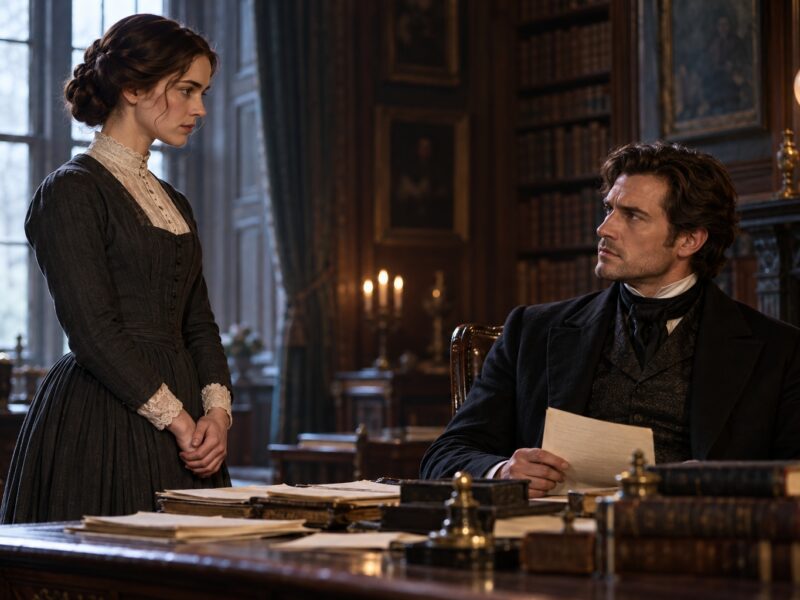
THE BARON’S SISTER-IN-LAW HUMILIATED HIS POOR BOOKKEEPER AT A LONDON BALL—BUT WHEN SHE DISAPPEARED, HE CAME TO HER SCHOOLHOUSE WITH A LETTER THAT CHANGED EVERYTHING

He hired her to save his bankrupt estate—and warned her never to enter his private rooms or attempt to change his life.
But when his wealthy sister-in-law discovered how much the penniless bookkeeper meant to him, she destroyed the young woman’s reputation and secretly dismissed her.
Two months later, the reclusive baron stood outside a village schoolhouse, holding the farewell letter he had read every night—and preparing to ask for something no amount of money could buy.
PART 1 — THE WOMAN WHO HAD NOTHING LEFT TO LOSE
A Stranger at Thornfield Hall
The carriage smelled of wet wool, damp leather, and the stale tobacco of passengers who had traveled before her. Clara Whitmore sat upright against the worn velvet seat, her gloved hands resting on a letter that had already been folded and unfolded so many times its edges were beginning to tear.
Outside, the English countryside disappeared beneath a cold autumn rain. Bare branches scraped against the carriage windows, and beyond the hedgerows, fields stretched toward a low gray sky. Clara watched the landscape without truly seeing it.
She had twenty-three shillings left in her reticule. She had counted them seven times since leaving the posting inn, although she knew counting would not make them multiply.
Six months earlier, she had been the respectable daughter of a country rector, living in a comfortable parsonage where books lined the sitting-room walls and her father insisted that every problem could be solved with sufficient patience and a sharpened pencil.
Then he died in April.
The debts appeared before the flowers on his grave had wilted.
There were medical bills, unpaid loans, and private promises he had made to help struggling parishioners. Clara discovered that her father’s generosity had been sustained by money he did not possess.
By midsummer, the parsonage had been surrendered to his successor. The furniture was sold, the books dispersed, and Clara’s small inheritance consumed by creditors who expressed their deepest condolences while demanding payment.
Now she was traveling to Thornfield Hall to apply for a position keeping accounts for a widowed baron.
It was respectable work, but not the kind of employment society expected a rector’s daughter to undertake in the household of an unmarried gentleman.
Clara had long since discovered that respectability was a luxury most easily maintained by people who had never needed to earn their bread.
The carriage turned through iron gates, their hinges protesting beneath the rain.
Thornfield Hall emerged between two enormous oak trees.
It was a grand house in the manner of an elderly aristocrat who had ceased to care about appearances. Ivy climbed the stone walls, several windows were shuttered, and the roof above the eastern wing showed unmistakable signs of neglect.
The building was not ruined.
It was simply tired.
Clara understood the distinction.
A footman helped her down, and an elderly butler admitted her into a marble entrance hall where the air was colder than it had been outside. A chandelier hung above the staircase, its crystal drops dim beneath a fine coating of dust.
“Miss Whitmore?” the butler asked.
“Yes.”
“I am Pritchard. His lordship is expecting you.”
He glanced toward the single trunk being carried inside.
Clara saw the glance.
It was not unkind, but it revealed that the servants had already understood something about their visitor.
She possessed almost nothing.
Pritchard led her through a long corridor into a study crowded with books, estate papers, and unopened letters.
Lord George Ashford sat behind a mahogany desk.
He did not rise.
For a moment, Clara wondered whether he had even noticed her entrance.
He was perhaps thirty-eight, broad-shouldered and dark-haired, with a face that might once have been handsome before exhaustion settled permanently around his eyes. His black coat was well made but carelessly worn, and the candle beside him had burned low despite the afternoon light.
“You are the rector’s daughter,” he said.
“I am, my lord.”
“Your father is dead.”
“Since April.”
“And you require employment.”
“Yes.”
Lord Ashford continued writing.
“I already employ a steward.”
“Mr. Holloway.”
His pen stopped.
Clara continued calmly. “He has served your family for forty-one years. Unfortunately, your estate accounts contain several years of overlapping rent records, and there appears to be a discrepancy of approximately four hundred pounds.”
The baron slowly raised his head.
“How could you possibly know that?”
“I stopped at the village inn. The innkeeper’s wife knows Mrs. Holloway, and I asked several questions.”
“You questioned my servants before I had hired you?”
“I wished to know whether the position required my skills.”
His expression darkened.
“And what have you concluded?”
“That it does.”
Silence filled the study.
Clara kept her hands folded in her lap.
After months of negotiating with creditors, she had learned that silence was not necessarily something to fear. Sometimes it was the only space in which a person could preserve dignity.
Lord Ashford leaned back.
“You are remarkably direct.”
“I am practical.”
“Is there a difference?”
“Often. Directness is a manner. Practicality is a necessity.”
He regarded her more carefully.
“You understand that this household has no mistress?”
“Yes.”
“You would reside among the servants. There would be no woman of your own station to supervise your conduct.”
“I understand.”
“The arrangement might damage your reputation.”
Clara glanced briefly toward the rain-streaked windows.
“My father’s creditors have already provided the village with sufficient conversation to last several seasons. I cannot afford to make decisions based upon what strangers might say.”
Something moved across his face.
It was gone before she could identify it.
“I cannot offer the wages a London counting house might pay.”
“I am not asking for London wages. I am asking for enough to live honestly.”
He wrote a figure on a sheet of paper and pushed it across the desk.
Clara examined it.
The salary was modest, but it would allow her to purchase necessities and perhaps save a little money.
She nodded.
“When would you like me to begin?”
“Tomorrow.”
“Then I should like to accept.”
Lord Ashford reached for another document.
“Mrs. Gable will show you to your rooms in the east wing. You will take your meals with the upper servants. You will not enter the west wing, which contains my private apartments.”
He paused.
“And, Miss Whitmore?”
“Yes, my lord?”
“You will not attempt to improve me.”
Clara blinked.
“I beg your pardon?”
“I have no desire to become the object of some charitable woman’s mission. I require a bookkeeper, not a companion, nurse, or moral instructor.”
She looked at him for a moment.
“How fortunate,” she replied, “because I have absolutely no intention of improving you.”
His eyebrows lifted.
“I intend to improve your accounts.”
For the first time, the corner of his mouth almost moved.
Almost.
Clara rose and curtsied.
At the door, she stopped.
“One more matter, my lord.”
He sighed.
“What now?”
“The north corner of the east wing has a serious leak. If the water reaches the supporting timbers, the repairs will cost considerably more by spring.”
“How do you know that?”
“There is damp staining on the exterior wall, and one of the gutters is broken.”
“You have been here less than half an hour.”
“Water does not require a formal introduction to cause damage.”
She closed the door before he could answer.
George Ashford sat motionless behind his desk.
The house had been silent for years.
For the first time in a very long while, he found himself listening for someone’s footsteps.
The Lady Who Intended to Become Family
Within a week, Clara had become the subject of nearly every conversation below stairs.
Mrs. Gable, the housekeeper, was a stout, energetic woman whose opinions were as strong as her tea. She initially suspected that any educated young woman willing to live among servants must either be unusually virtuous or unusually dangerous.
By Friday, she had begun to suspect Clara was both.
Clara rose before seven, worked in the steward’s office until evening, and never complained about the cold water or the draft beneath her bedroom door.
She treated the servants with a courtesy that surprised them, not because it was elaborate, but because it was consistent.
She thanked the kitchen maid who brought her tea. She helped an elderly gardener decipher a letter from his son. When a young footman accidentally spilled ink across her papers, she fetched a cloth instead of demanding his dismissal.
Mr. Holloway was the first to surrender completely.
The old steward had spent decades maintaining the estate through habit, memory, and sheer determination. He knew which tenant had lost his wife, which field flooded in November, and which family needed additional coal each winter.
What he did not know was how to reconcile fourteen years of increasingly confused financial records.
Clara spent three evenings beside him.
Together, they discovered duplicate payments, forgotten obligations, and rental income entered under properties that had changed hands decades earlier.
One morning, she found an unusual entry.
A tenant farmer had paid no rent for two years, yet the household records included an annual Christmas goose.
“Mr. Holloway,” Clara said, “I assume the goose is not intended to discharge an entire year’s rent?”
The steward removed his spectacles.
“His wife was very ill, miss. His lordship’s father allowed the arrangement.”
“And Lord Ashford continued it?”
“He never asked.”
Clara looked down at the ledger.
She quietly made a notation to review the family’s circumstances before adjusting the account.
“Your late master was generous,” she said.
“He was.”
“And you have done your best to preserve his intentions.”
Holloway stared at her.
For a moment, his lower lip trembled.
Then he cleared his throat and announced that the stables required his attention.
Clara pretended not to notice.
It was the sort of kindness that did not need witnesses.
On Thursday afternoon, however, Thornfield received a visitor who seemed to require an audience for everything she did.
Lady Margaret Ashford arrived in a polished carriage with two trunks, three hatboxes, a maid, and her daughter Helena.
By the time Clara entered the drawing room, Lady Margaret had already rearranged the flowers and complained about the fire.
She was elegantly dressed, fair-haired, and possessed of the fixed smile of a woman who considered politeness a useful weapon.
“Ah,” she said, surveying Clara from head to toe. “You must be the young woman George has employed.”
“Clara Whitmore, my lady.”
“The rector’s daughter.”
“Yes.”
“How very unfortunate.”
Clara did not ask what she meant.
Lady Margaret appeared disappointed.
“I warned George against unnecessary charitable impulses. He has always been susceptible to unsuitable arrangements.”
“His lordship employed me to examine the estate accounts.”
“Yes, I understand you are useful with figures.”
“I hope to be.”
Margaret adjusted the lace at her wrist.
“Of course, Thornfield requires rather more than a bookkeeper. It requires a proper mistress.”
She gestured toward her daughter.
Helena sat near the window with a book resting unopened in her lap.
She was a pretty young woman with pale curls and the exhausted expression of someone who had been displayed too frequently before unwilling purchasers.
“My Helena has always been fond of her cousin George,” Lady Margaret continued.
Clara offered a polite inclination of her head.
“I wish Miss Helena every happiness.”
“Indeed.”
Margaret’s smile sharpened.
“One hopes she will find it here.”
That evening, Lord Ashford appeared at dinner for the first time since Clara’s arrival.
The servants had dressed the dining room with fresh candles and polished silver. Lady Margaret occupied the chair nearest the baron and spent the meal discussing London society, the coming season, and the urgent importance of securing an heir.
“George,” she said eventually, “you have been alone far too long.”
“I have grown accustomed to it.”
“That is precisely the difficulty. Men become accustomed to all manner of unhealthy habits.”
The baron cut into his roast without answering.
“Helena would make you an excellent wife.”
“I am sure Helena will make someone an excellent wife.”
Helena lowered her eyes.
Margaret’s smile hardened.
“You cannot spend the rest of your life hiding in this house.”
“I had intended to try.”
A faint sound came from the far end of the table.
Clara had nearly laughed.
She immediately raised her glass.
Unfortunately, Lady Margaret noticed.
“And your new bookkeeper,” she said sweetly. “How charming that you allow her to dine with the upper servants. Does she normally sit with the scullery maids as well?”
The room became still.
Holloway stared at his plate.
Clara placed her glass on the table.
Before she could speak, George answered.
“Miss Whitmore takes her meals where she wishes.”
“Surely you understand the distinctions of society.”
“I understand that she is performing work of considerable value.”
“How very democratic of you.”
“How very observant of you.”
The footman nearest the wall coughed violently.
Clara kept her eyes lowered.
She did not need the baron to defend her.
But she could not deny the unfamiliar warmth of knowing he had chosen to do so.
Later, carrying a candle through the corridor, she nearly collided with him outside the library.
“Miss Whitmore.”
“My lord.”
“My sister-in-law will leave tomorrow.”
“Will she?”
“She has other engagements.”
Clara suspected the statement was more hope than certainty.
“I apologize for her remarks,” he said.
“There is no need.”
“She insulted you.”
“She expressed an opinion.”
“An unpleasant one.”
“Her opinions are not my responsibility.”
George studied her in the candlelight.
“You are unusually forgiving.”
“Not particularly. I understand what she wants.”
“And what is that?”
“Security for her daughter.”
“By marrying her to a man who has made it quite clear he does not wish to marry?”
“Fear does not always encourage wisdom, my lord.”
He looked away.
For several seconds, neither spoke.
Then he said quietly, “You see rather more than is comfortable, Miss Whitmore.”
“I assure you, I look away when necessary.”
“And when is it necessary?”
“When looking would be an intrusion.”
He held her gaze.
She suddenly became conscious of the small distance between them.
“Good night, my lord.”
“Good night, Miss Whitmore.”
He watched her walk away.
Behind him, the corridor stretched toward the west wing, where his private rooms had remained closed to almost everyone since his wife’s death.
For the first time, those rooms seemed less like a sanctuary than a prison.
A Confession Beside the Fire
Three weeks later, a storm swept across the countryside.
Rain struck the windows hard enough to rattle their frames, and the wind tore branches from the old trees surrounding Thornfield.
Clara remained in the library after supper, working through property records that had not been properly examined in thirty years.
One entry troubled her.
A northern parcel of farmland had been sold during the previous baron’s lifetime, yet payments connected to the property continued to appear in the estate’s accounts.
She was still examining the figures when the door opened.
George Ashford stood in the doorway, rainwater dripping from his coat.
“Miss Whitmore?”
She rose.
“My lord.”
“What are you doing here at this hour?”
“Your books have developed a habit of contradicting themselves.”
“Have they?”
“Frequently.”
He removed his wet coat and approached the fireplace.
“The servants have retired.”
“I had not realized it was so late.”
A gust of wind shook the windows.
Clara gathered the papers.
“There is a matter I should bring to your attention.”
She explained the farmland discrepancy.
George listened without interruption.
Then he said, “I know about the payments.”
She looked up.
“You do?”
“My father sold the property privately to the former steward’s family. The payments now support a settlement intended for my brother’s widow and her daughter.”
“Lady Margaret?”
“Yes.”
“Does she know?”
“No.”
Clara hesitated.
“May I ask why?”
George stood with his hands toward the fire.
“My brother died before he inherited anything. Margaret has always believed the estate owes her the position she expected to enjoy. My father tried to provide for her without endangering Thornfield.”
“And you maintained the arrangement.”
“Yes.”
“Without telling her.”
“If she knew, she would use it to demand more.”
Clara considered the answer.
“It is a difficult arrangement.”
“It is an impossible family.”
He spoke without bitterness.
That made it worse.
She placed the ledger on the table.
“Then perhaps the difficulty is not the provision itself, but the secrecy surrounding it.”
George looked at her.
“You believe I have handled the matter badly.”
“I believe you have avoided handling it openly.”
A long silence followed.
The fire cracked.
Finally, George said, “You are the first person in years who has spoken to me without pity or some expectation of reward.”
Clara did not respond immediately.
He continued, almost reluctantly.
“My wife died three years ago. In childbirth. The baby died with her.”
Clara looked at him.
“I am very sorry.”
“Everyone says that.”
“I imagine they do.”
“They also tell me how deeply I must have loved her.”
His voice changed.
A small, terrible weariness entered it.
“But I did not love her.”
Clara remained still.
“Our marriage was arranged. She was kind, and I respected her. I believed affection might grow between us, but it never became what she deserved.”
He turned toward the window.
“When she died, I was devastated. Not because I had lost the great love of my life, but because I had failed a woman who had trusted me.”
“You could not have prevented her death simply by loving her differently.”
“Perhaps not.”
“I suspect she knew you respected her.”
“Respect did not save her.”
“No.”
Clara let the truth remain between them.
Then she said, “But your punishment has not brought her back either.”
George slowly turned.
No one had spoken to him that way before.
No one had dared.
“You are dangerous, Miss Whitmore.”
“I keep accounts, my lord.”
“You see things I would prefer to hide.”
“I do not go looking for them.”
“And yet you find them.”
She met his eyes.
For a moment, the library seemed very small.
George took one step toward her.
Not enough to touch.
Enough that she noticed.
Then a voice rang out from the corridor.
“George? George, are you there?”
Lady Margaret entered carrying a candle.
She stopped.
Her eyes moved from Clara to George, then to the closed door.
The silence changed at once.
“I beg your pardon,” Margaret said, her voice bright with insinuation. “I had no idea you were entertaining.”
“Miss Whitmore is examining estate records,” George replied.
“At this hour?”
“The work required it.”
Margaret smiled.
“Of course.”
Her gaze settled on Clara.
“And in such intimate surroundings.”
George’s expression hardened.
“Margaret, you are neither my wife nor my mother. You need not concern yourself with the arrangements of my household.”
For one instant, the smile disappeared.
Then Margaret inclined her head.
“Naturally. I only wished to warn you that the roads are flooded. No one should attempt to travel tonight.”
She withdrew.
Clara remained beside the fire.
“She will use this,” she said.
“She uses everything.”
“You could ask her to leave.”
George rubbed his forehead.
“I owe something to my brother’s memory.”
“That may be true.”
She looked toward the door.
“But I do not believe your brother intended you to surrender the rest of your life.”
George said nothing.
Clara returned to her chair.
Outside, thunder rolled across the fields.
After several minutes, he spoke again.
“Miss Whitmore.”
“Yes?”
“You said you would leave a room when remaining would be an intrusion.”
“I did.”
“Yet you are still here.”
Clara looked at him across the fire.
“I have no wish to leave.”
His face changed.
Only slightly.
But enough.
And neither of them understood that Lady Margaret, walking through the dark corridor with her candle, had just discovered something far more dangerous than a breach of etiquette.
She had discovered the first person in years whom George Ashford might be afraid to lose.
The Letter That Should Never Have Been Written
The invitation to London arrived three weeks later.
A proposed investment in a canal company required Lord Ashford’s personal attention, and the financial papers suggested that a successful arrangement could provide the funds necessary to repair Thornfield’s neglected buildings.
Clara had spent days examining the proposal.
“The return is not guaranteed,” she told him, spreading the documents across his desk, “but the company’s existing contracts and projected revenue justify further investigation.”
“I dislike London.”
“So you have mentioned.”
“I dislike businessmen.”
“That is less convenient.”
“I particularly dislike businessmen who invite me to London.”
Clara lifted her eyes.
“Then you may dislike them while ensuring your roof does not collapse.”
George stared at her.
Then, unexpectedly, he laughed.
It was a brief, rusty sound.
They both seemed surprised by it.
A week later, he departed for London with Mr. Holloway and two footmen.
Lady Margaret accompanied them, declaring that her connections would be invaluable.
Clara remained at Thornfield.
George wrote twice each week.
His letters concerned rents, repairs, and tenant agreements, but occasionally included small observations that served no obvious business purpose.
He mentioned a concert he had disliked.
A London dinner at which he had been seated beside a woman who discussed her dogs for forty minutes.
A bookseller who had tried to charge him three guineas for a damaged atlas.
Clara answered his questions, corrected his figures, and eventually permitted herself one small joke about the atlas.
His next letter contained the sentence, I believe you would have negotiated him down to six shillings.
She smiled at the paper longer than she should have.
Then, on a Wednesday morning, an unfamiliar envelope arrived.
It bore Lady Margaret’s seal.
Clara opened it in the steward’s office.
The message was brief.
Lord Ashford no longer required her services. A bank draft covered her salary, and she was instructed to vacate Thornfield at the earliest opportunity.
The dismissal was signed by Lady Margaret.
Clara read the letter twice.
Her fingers grew cold.
She knew Margaret’s authority was questionable. She knew George had not written the letter himself.
But she also knew what a public dispute would mean.
A woman of uncertain fortune, residing in a widower’s household, challenging a member of his family.
The rumor would almost write itself.
She placed the letter beneath her papers.
When Mrs. Gable entered with tea, Clara thanked her as usual.
When Holloway asked about the rent schedule, she explained it patiently.
Only after the house had grown quiet did she return to her room and open her trunk.
Her clothes occupied less than half its space.
She folded them carefully, one by one.
Then she sat on the edge of the bed and stared at the empty room.
She had told herself she was employed to keep accounts.
Nothing more.
Yet leaving Thornfield felt strangely like losing a home.
And somewhere in London, George Ashford was about to learn that a woman he had trusted to examine his finances had been dismissed by someone who had never possessed the right to dismiss her.
END OF PART 1 — Lady Margaret believed a single letter would remove Clara from Thornfield forever. She did not know that Lord Ashford was already preparing to bring the bookkeeper before the most powerful people in London society.
PART 2 — THE BALLROOM HUMILIATION THAT BROKE HER HEART
A Guest Who Did Not Belong
The summons came the following Tuesday.
A groom arrived at Thornfield bearing a letter in George Ashford’s unmistakable handwriting.
He requested Clara’s immediate presence in London, at the townhouse of his aunt, the Dowager Countess of Wexford.
There was to be a ball that evening.
The reason for Clara’s attendance was not explained.
She read the letter while Mrs. Gable stood beside her, openly anxious.
“Will you go, miss?”
Clara looked at the trunk waiting beside her bed.
“I believe I must.”
The countess’s London residence occupied a distinguished terrace behind wrought-iron railings. Light glowed from the windows, and footmen hurried between arriving carriages as preparations for the ball reached their final stages.
Clara entered through a side door.
A servant led her to a private parlor.
George stood beside the mantel.
He was dressed in formal black evening clothes with a white cravat, his hair carefully arranged and his expression far from calm.
The moment she entered, he crossed the room.
“What has Margaret done?”
Clara stopped.
“My lord?”
“Do not protect her. Holloway has written to me. I understand she sent you a dismissal.”
“Yes.”
“Without consulting me.”
“Yes.”
George closed his eyes briefly.
“She had no authority.”
“I suspected as much.”
“Then why were you preparing to leave?”
Clara carefully removed her gloves.
“Because the situation had become difficult.”
“Difficult?”
“Your sister-in-law considers my presence inappropriate. I am not in a position to compete with a member of your family.”
“You are not competing with anyone.”
“She believes otherwise.”
George walked toward the window.
For a moment, Clara thought he might strike the frame with his fist.
Instead, he rested his palm against the sill.
“I should have dealt with her years ago.”
Clara said nothing.
When he turned back, his anger had settled into something firmer.
“You are not dismissed.”
“My lord—”
“And you will attend tonight’s ball as my guest.”
Clara stared at him.
“That would be extraordinarily improper.”
“Apparently I have spent the better part of a decade allowing other people to decide what is proper in my own life.”
“There will be questions.”
“There are always questions.”
“People will assume—”
“Let them assume.”
She looked at him carefully.
“You may not care what people say about you, but you have the protection of your title. I do not.”
The words stopped him.
For an instant, he seemed to recognize the distance between their positions more clearly than he ever had before.
Then he said, “My aunt will receive you. She has agreed to make the arrangements.”
“Why?”
“Because I asked her.”
Clara waited.
He looked away.
“There is something I intend to say tonight.”
“What is it?”
“Not yet.”
She felt an uneasiness she could not explain.
“George—”
It was the first time she had used his Christian name.
They both heard it.
His eyes returned to hers.
Clara lowered her gaze.
“I apologize, my lord.”
“Don’t.”
The word came too quickly.
Then, more gently, he added, “Please don’t.”
For a moment, neither moved.
A knock interrupted them.
The countess’s maid had arrived with a gown.
It was made of deep blue silk.
Clara stared at the fine fabric, knowing immediately that no amount of saving from her wages could have purchased it.
“Her ladyship thought this might suit you,” the maid explained.
Clara looked toward George.
He had the grace to appear slightly uncomfortable.
“My aunt has strong opinions about colors.”
“And I suppose she happened to possess a gown that fits me.”
“She possesses an alarming number of things.”
Despite herself, Clara smiled.
The expression faded when she remembered Lady Margaret.
And she realized that whatever George intended, she was walking into a room full of people who would examine her as though she were an item of suspicious merchandise.
The Cruelty Behind the Music
By nine o’clock, the ballroom glittered with candlelight.
Ladies in silk and satin moved beneath chandeliers, gentlemen gathered around card tables, and a small orchestra played near the far wall.
Clara entered on the arm of the countess’s elderly companion.
She wore the blue gown and the only jewelry she possessed: a modest string of pearls that had belonged to her mother.
For several moments, she allowed herself to enjoy the room.
The music was beautiful.
The polished floor reflected hundreds of dancing feet.
A young couple near the windows were laughing so helplessly that the gentleman nearly missed a step.
Then Clara saw Lady Margaret.
Margaret stood beside a column, speaking to two elaborately dressed ladies.
Her eyes widened.
The expression lasted only a second before she arranged her features into a smile.
She began moving toward Clara.
“My dear Miss Whitmore,” she said. “What an unexpected pleasure.”
Clara curtsied.
“Lady Margaret.”
“I was under the impression you had returned to the country.”
“I have come at Lord Ashford’s invitation.”
“How extraordinary.”
Her eyes moved deliberately over Clara’s gown.
“And you appear to have dressed for the occasion.”
“The countess was very kind.”
“She has always possessed a generous heart.”
Margaret leaned closer.
“Although generosity, as you know, is sometimes mistaken for encouragement.”
Clara met her gaze.
“I am grateful for her kindness.”
“Of course you are.”
Helena appeared at her mother’s side.
Unlike Margaret, she looked openly distressed.
“Miss Whitmore,” she said softly, “I am glad to see you.”
“And I you, Miss Helena.”
Margaret’s fingers closed around her daughter’s wrist.
“Come, Helena. Your cousin will be expecting us.”
She swept away.
Helena glanced back once.
There was something almost apologetic in her expression.
Clara remained near the wall as the music changed.
For a little while, the evening continued peacefully.
Then she heard her name.
It came from beyond the terrace doors, where two women were speaking behind a screen of greenery.
“The bookkeeper?”
“That is what Lady Margaret says.”
“Surely George Ashford has not brought his servant to a ball.”
“Apparently she has become indispensable.”
A soft laugh followed.
“I understand Margaret discovered them together in the library at midnight.”
“Alone?”
“With the door shut.”
“How interesting.”
“One cannot blame the poor creature for trying. A baron is an excellent solution to an empty purse.”
Clara stood absolutely still.
The music continued behind her.
A waiter passed carrying a silver tray.
Somewhere nearby, someone dropped a glass and laughed.
Yet Clara heard only the women’s next words.
“Margaret says the young woman has been manipulating him for months.”
“Poor George. Grief has made him vulnerable.”
“Perhaps she is hoping to become Lady Ashford.”
The laughter came again.
Light.
Careless.
Devastating.
Clara stepped backward.
Her heel caught the edge of the terrace threshold, and for one humiliating instant she nearly stumbled.
She caught herself against the stone railing.
No one noticed.
That made the shame worse.
She had endured the loss of her father, the sale of her childhood home, and the pity of neighbors who had once treated her family with respect.
She had endured hunger.
Cold rooms.
The exhaustion of pretending she was not afraid.
But this was different.
These women had taken the quietest, most private feeling she had ever allowed herself to entertain and made it sound dirty.
She returned to the ballroom.
George stood near the fireplace, listening impatiently to an elderly general.
He saw her immediately.
His expression changed.
Clara wondered whether she had ever truly understood what that look meant.
She approached him.
“My lord, I must leave.”
He excused himself from the general.
“What’s happened?”
“Nothing.”
“Clara.”
She looked away.
“I am tired. I would like to return to the inn.”
“Did Margaret speak to you?”
“Only briefly.”
“Then who—”
“Please.”
There was something in her voice that made him stop.
For a moment, the noise of the ballroom seemed to disappear between them.
“I am grateful for your kindness,” she said. “But I cannot remain.”
George looked as though he wished to reach for her.
He did not.
And that hesitation told Clara more than any declaration could have.
She curtsied.
“Good night, my lord.”
Then she walked away before he could answer.
The carriage he had arranged was waiting outside.
Clara gave the coachman the address of the inn where she had left her trunk.
As the carriage pulled away, she pressed one gloved hand against her mouth.
She did not cry until the London lights had disappeared behind the rain-streaked windows.
The Last Ledger
Three days later, Clara returned to Thornfield.
She did not ask to see George.
She did not speak of the ball.
Instead, she completed the estate accounts with the same care she had brought to them from the beginning.
The missing funds were traced to incorrectly transferred entries rather than theft. Holloway was instructed in the new system, and the canal investment documents were arranged in a separate leather folder.
Clara prepared a schedule of repairs for the spring.
The roof.
The west-wing drainage.
The rotting gutters.
The tenant cottages most urgently in need of attention.
It was practical work.
Numbers did not ask her to explain why her chest hurt whenever she heard footsteps in the corridor.
On her final morning, Mrs. Gable found her standing beside the open trunk.
The housekeeper stopped in the doorway.
“You’re truly going?”
Clara folded a shawl.
“Yes.”
“His lordship will be furious.”
“Then I hope he will direct his displeasure where it belongs.”
Mrs. Gable entered.
For once, the formidable housekeeper seemed uncertain.
“He has changed since you came here.”
Clara continued packing.
“Perhaps.”
“He laughs sometimes.”
“That is a good thing.”
“He asks whether you’ve eaten.”
Clara’s hands stopped.
Mrs. Gable stepped closer.
“Miss Whitmore, I have served in this house since before his lordship was born. I’ve seen him happy, and I’ve seen him grieving.”
She lowered her voice.
“I have never seen him look for someone the way he looks for you.”
Clara closed the trunk.
“Then he must learn to say what he wants, Mrs. Gable.”
The housekeeper looked at her for a long moment.
Finally, she nodded.
“Aye. Perhaps he must.”
Clara left a short letter on Holloway’s desk.
She thanked Lord Ashford for his employment, explained the arrangements she had completed, and assured him that the estate’s records were now in order.
At the bottom, she wrote:
I am grateful for the opportunity you gave me. I wish you every success.
She signed it simply.
Clara Whitmore.
Then she left Thornfield Hall.
No grand farewell.
No dramatic declaration.
Only the small sound of carriage wheels crossing wet gravel.
At an upstairs window, Mrs. Gable stood watching until the carriage disappeared beyond the gates.
The Schoolhouse in March
Clara settled in a village three counties away.
There was a vacancy at a small school, and the position included a modest cottage with a sound roof and a kitchen fireplace that did not smoke.
The salary was less than she had earned at Thornfield.
The peace was worth the difference.
She taught children their letters, their sums, and the importance of washing their hands before lunch.
She learned which pupils needed extra patience and which became frightened when corrected too sharply.
A little boy named Peter could add numbers beautifully but struggled to recognize written words. A girl named Alice always brought half her lunch for a younger brother who waited outside the school gates.
Clara found herself learning as much from them as they learned from her.
Occasionally, she thought of George.
At unexpected moments.
While mending a sleeve.
While lighting the schoolroom fire.
While reading a passage from a book he might have enjoyed.
She wondered whether the west-wing roof had been repaired.
Whether Holloway remembered to separate the tenant rents from the trust payments.
Whether George still worked alone in his study after midnight.
But she never wrote.
And no letter came.
The weeks passed.
The hard winter softened.
One Tuesday morning in early March, Clara was cleaning ink from her fingers when a carriage stopped outside the schoolhouse.
It was polished black.
On the door was a familiar crest.
The Ashford falcon.
Clara froze.
She watched a tall man step down, remove his hat, and look uncertainly around the village square.
He wore a dark traveling coat, and the wind moved through his hair.
Even from the window, she could see that he looked tired.
Then he turned toward the schoolhouse.
Clara stepped away from the glass.
Her heart beat so hard that she could feel it in her throat.
The knock came a moment later.
She opened the door.
George Ashford stood on the threshold.
For several seconds, neither spoke.
Then he held out a folded sheet of paper.
“I came to return something.”
Clara took it.
She recognized the paper immediately.
Her farewell note.
The corners had softened from repeated handling.
“Why have you brought this?” she asked.
George looked down at the hat in his hands.
“Because I have read it every day since you left.”
Clara could hear the children moving behind her.
A chair scraped across the wooden floor.
Someone whispered.
George lifted his eyes.
“You wrote that you wished me every success.”
“I did.”
“I found that I did not want it.”
She stared at him.
“I wanted you to stay, Clara.”
Her fingers tightened around the letter.
“Then you should have asked.”
“I know.”
“You let me leave.”
“I know.”
“You allowed your sister-in-law to humiliate me, and when I walked out of that ballroom, you let me go.”
George swallowed.
“I thought respecting your decision meant allowing you to leave.”
“And did you ask what had made me decide?”
He said nothing.
Clara looked away.
The answer was painfully clear.
“You never asked me what I needed,” she said.
“I am asking now.”
She turned back.
“What do you want, my lord?”
“Please come home.”
For one terrible moment, she wanted to say yes.
She wanted the familiar corridors, the library fire, the sight of George looking up from his desk when she entered.
She wanted the life she had imagined without ever daring to name it.
But wanting was not enough.
Clara shook her head.
“I cannot.”
His face drained of color.
“Why?”
“Because you still do not understand.”
“Then tell me.”
She looked directly at him.
“You are asking me to return to Thornfield.”
“Yes.”
“As what?”
George was silent.
Clara’s voice trembled only once.
“As your bookkeeper?”
He opened his mouth, then closed it.
She continued.
“I will not go back to sit at the far end of your table while your relatives decide whether I am respectable enough to breathe the same air. I will not be grateful for a place in a house where I have no place in your life.”
George stood motionless.
Then she said the words that changed everything.
“You have asked me to come back to your estate, my lord. But you have never asked me to come back as your wife.”
The children had fallen completely silent.
Outside, the carriage horses shifted against their harnesses.
George tightened his grip on his hat.
At last, he asked, very quietly, “If I were to ask you to become my wife, would you consider it?”
Clara looked at him for a long moment.
Then she stepped aside.
“Come in, George.”
He did not move.
She held the door open.
“And ask me properly.”
END OF PART 2 — For the first time in his life, Lord Ashford had come to a woman with no title, no fortune, and no prepared speech. And before Clara could accept him, he would have to prove that he was offering her more than another room in his lonely house.
PART 3 — THE PROPOSAL NO ONE IN LONDON BELIEVED POSSIBLE
A Man Who Had Finally Learned to Speak
The schoolroom smelled of chalk, damp coats, and the faint sweetness of apples stored in a basket near the stove.
Clara dismissed the children to their exercises, then led George to a small table near the window.
He remained standing.
She folded her hands.
“Well?”
George looked toward the doorway, where two children were clearly attempting to listen.
“Would you prefer privacy?”
“I would prefer honesty.”
He gave a faint, nervous smile.
“That has always been your preference.”
“And it has not changed.”
George placed his hat on the table.
“I have spent most of my life believing that silence was dignity.”
Clara waited.
“When my wife died, I withdrew from everyone. I convinced myself that staying alone was a kind of loyalty to her memory.”
He paused.
“Then you came to Thornfield and began telling me what was wrong with my gutters.”
Clara almost smiled.
“They were dreadful gutters.”
“They were.”
He looked at her more steadily.
“You brought order to the estate. You treated my servants as people. You remembered things I had stopped noticing.”
“That was part of my employment.”
“No.”
George shook his head.
“Balancing the ledgers was your employment. The rest was simply who you were.”
Clara glanced down.
He continued.
“I have spoken with my solicitor about Margaret. My father’s arrangements will be properly documented, and she and Helena will have sufficient income to maintain their own household in Bath.”
“That is generous.”
“It is necessary.”
“And Helena?”
“She will no longer be pressed to marry me.”
Clara looked relieved.
“She deserves a choice.”
“Yes.”
George drew a breath.
“My aunt knows why I came here. She has offered to announce our engagement if you accept.”
Clara raised an eyebrow.
“You have arranged an engagement I have not agreed to?”
“Not exactly.”
“George.”
“I told her I hoped to secure one.”
Clara laughed.
It escaped before she could stop it.
George stared at her, startled by the sound.
Then he smiled.
Not politely.
Not reluctantly.
He smiled as though the room had suddenly filled with sunlight.
Clara grew serious again.
“I must ask you something.”
“Anything.”
“Why do you want to marry me?”
He answered too quickly.
“Because I need you.”
Her expression changed.
George saw it.
And understood, perhaps for the first time, why the words were insufficient.
“No,” he said. “That is not what I mean.”
Clara remained silent.
“I have a steward. I can employ a dozen bookkeepers. I can hire a housekeeper, a secretary, and every companion society recommends.”
He stepped closer.
“But none of them would be you.”
Her breathing grew shallow.
“I want to marry you because I love you.”
The words were simple.
No theatrical declaration.
No elaborate promises.
Only a man who had spent years hiding from life finally speaking without protection.
Clara stared at him.
“You have never said that before.”
“I have never said it truthfully before.”
Her eyes filled.
George did not move closer.
He allowed her the space to decide.
“I love you,” he repeated. “And I should have told you before you ever left Thornfield.”
Clara turned toward the window.
In the square, the carriage waited beneath a pale March sky.
The children had gathered near the door, pretending to study their slates.
She could see her own reflection in the glass.
An ordinary woman in a plain brown dress, ink on her fingers, and an old pair of shoes beneath the hem.
Not a woman London society would have chosen for a baron.
But George had come to her.
Not to a ballroom.
Not to the gates of some grand estate.
To a village schoolhouse.
And he was standing there without any certainty that she would accept him.
At last, Clara turned.
“I will marry you.”
George closed his eyes.
For a moment, the relief on his face was almost painful to witness.
“But I have one condition,” she added.
“Anything.”
“I will not become a silent wife.”
He opened his eyes.
“I do not understand.”
“I will not be seated at the far end of your table. I will not be expected to agree with you simply because you possess a title. I will not spend our marriage guessing what you feel because you are too proud to say it.”
George listened.
“If you are angry, tell me. If you are afraid, tell me. If you believe I am wrong, tell me. And I will do the same.”
Clara stepped toward him.
“I want to be your partner, George. Not your servant. Not your charitable undertaking. Your equal.”
George took her hand.
“I have spent years shutting doors against the world.”
His voice thickened.
“I should like to stop.”
Clara looked at their joined hands.
“People will talk.”
“They already do.”
“They will say you married beneath you.”
“They have never understood what matters to me.”
“And you have?”
“Not until now.”
She smiled through her tears.
“Then you must prepare yourself for a lifetime of disagreeing with me.”
George bent his head.
“I have found I enjoy it rather more than is sensible.”
For the first time, he kissed her.
It was gentle and slightly awkward.
Clara caught the sleeve of his coat as though to steady herself.
From the doorway came a sharp little gasp.
They separated.
Six children stood watching in delighted horror.
A small boy whispered, “Is Miss Whitmore getting married?”
George glanced at Clara.
She lifted her chin.
“Yes, Peter.”
The child considered this.
“Does that mean we don’t have lessons tomorrow?”
Clara laughed so hard that George began laughing with her.
And for the first time in ten years, Lord Ashford stood in a room full of strangers without wishing to escape.
A Wedding Without Pretending
They were married three weeks later.
Not in London.
Not beneath a grand ceiling crowded with aristocrats.
They married in the little country church where Clara’s father had once preached.
The morning was cool and clear.
Sunlight fell through the narrow stained-glass windows, turning the old stone floor gold and blue.
Mrs. Gable attended in her best dark green gown, carrying a handkerchief she insisted she would not need.
Mr. Holloway arrived early and checked the church clock three times.
The Dowager Countess of Wexford appeared in magnificent purple silk and informed the astonished villagers that she had not traveled such a distance to witness a groom who failed to smile.
Helena sent a note of warm congratulations.
Lady Margaret did not attend.
Clara was not disappointed.
She wore a simple ivory gown with her mother’s pearls.
As she stepped into the church, she saw George standing beside the altar.
He looked impossibly serious.
For an instant, she feared he was unhappy.
Then he saw her.
His shoulders lowered.
The tension left his face.
And he smiled.
Mrs. Gable promptly began to cry.
The ceremony was brief.
When George promised to honor and cherish her, his voice shook.
Clara answered steadily until she reached the final words of her vows.
Then she looked into his face and found herself unable to speak.
George squeezed her hand.
She finished.
Afterward, they stood outside beneath the spring sunlight while the village children scattered flower petals across the path.
Holloway attempted to offer a formal toast at the wedding breakfast, but became overwhelmed before reaching the second sentence.
Mrs. Gable finished it for him.
The countess declared the entire affair perfectly charming.
George leaned toward his bride.
“Are you happy?”
Clara looked at the little gathering.
The servants who had become her friends.
The children who had brought wildflowers.
The man who had crossed three counties with a crumpled letter because he had finally learned that love required courage.
“Yes,” she whispered.
“Very.”
The House That Came Back to Life
Spring transformed Thornfield Hall.
Scaffolding rose along the eastern walls, carpenters repaired the roof, and the west wing was opened for the first time in years.
The financial arrangements concerning the northern farmland were properly reconciled, and Margaret’s settlement was secured through legal documents prepared by the family’s solicitor.
Lady Margaret accepted the arrangement with visible reluctance.
Her final letter contained several carefully worded complaints about the ingratitude of relations.
George read it at breakfast.
Then he handed it to Clara.
“Should I reply?”
Clara examined the page.
“Has she asked a question?”
“Not one worth answering.”
“Then perhaps the matter is settled.”
George folded the letter.
“An excellent suggestion.”
He placed it beneath the newspaper and reached for his tea.
Six months later, Clara hired a young clerk to assist with the estate accounts.
She had no intention of spending her married life confined to the steward’s office.
She began visiting tenant families, reviewing agricultural improvements, and helping organize repairs to cottages that had been overlooked for years.
Sometimes George accompanied her.
Sometimes he remained at the house.
But he no longer remained hidden.
One afternoon, Clara entered his study carrying a ledger.
She found him standing beside the window.
Watching her.
“You are staring again,” she said.
“I am.”
“Have you no work?”
“An abundance.”
“Then why aren’t you doing it?”
George considered.
“I appear to be distracted by my wife.”
Clara placed the ledger on his desk.
“That is a very poor excuse for negligence.”
“I shall endeavor to improve.”
“You have been saying that for months.”
“And yet you continue to tolerate me.”
She smiled.
George reached for her hand.
The smile faded from his face.
“Clara?”
“Yes?”
“Do you ever regret coming back?”
She looked at him.
“No.”
He lowered his eyes.
“I sometimes wake in the night and expect to discover that you have gone.”
Clara moved closer.
“George.”
“I know it is foolish.”
“It isn’t foolish.”
“It is unreasonable.”
“Perhaps.”
He gave her a rueful smile.
“Your comfort is extraordinary.”
She touched his cheek.
“You were alone for a long time. I cannot make the memory of that disappear.”
“I know.”
“But you need not live inside it.”
George closed his eyes against her hand.
“I am trying.”
“I can see that.”
She kissed him.
The ledger slipped from the desk and landed on the carpet.
Neither moved to retrieve it.
Outside the study door, Mrs. Gable paused, heard the unmistakable sound of laughter, and quietly continued down the corridor.
Some things, she decided, were best left undisturbed.
The Promise Beneath the Harvest Sun
By late summer, Thornfield no longer seemed tired.
The repaired windows caught the evening light.
Flowers grew along the terrace.
Servants moved through the corridors without the uneasy silence that had once settled over the house.
George began receiving visitors again.
Not frequently.
Not without occasional complaints.
But willingly.
At the village harvest festival, he accompanied Clara to the church where they had married.
Children carried baskets of apples.
Farmers gathered beneath the trees.
The bells rang above the village square, and warm afternoon sunlight rested on the churchyard stones.
Clara stopped beside her father’s grave.
George stood quietly at her side.
For a few moments, she said nothing.
Then she brushed a fallen leaf from the headstone.
“He would have liked you,” she said.
George looked doubtful.
“Would he?”
“He might have found you rather stubborn.”
“An accurate assessment.”
“And he would certainly have argued with you.”
“I should have welcomed it.”
Clara smiled.
“He believed people were better when they were encouraged to think for themselves.”
George looked at her.
“Then he must have been very proud of you.”
Her eyes filled.
She pressed his hand.
“I hope so.”
Together, they walked toward the churchyard gate.
George glanced down.
“You’re thinking.”
“I am remembering.”
“Tell me.”
Clara looked back toward the village.
“I came to Thornfield because I needed a place to live.”
“And I gave you employment.”
“You gave me a chance.”
George shook his head.
“You gave me much more.”
She smiled.
“Eventually.”
He laughed.
They continued walking beneath the golden trees.
At the gate, Clara turned toward him.
“When I first met you, you told me not to improve you.”
“I remember.”
“You were very insistent.”
“I was a remarkably unpleasant man.”
“You were frightened.”
He considered this.
“Yes.”
Clara squeezed his hand.
“And now?”
George looked at the children running ahead, the servants carrying baskets, and the woman beside him.
He took a slow breath.
“Now I am still frightened sometimes.”
“Of what?”
“Of losing what I have been fortunate enough to find.”
Clara leaned against his arm.
“Then we shall face that fear together.”
George looked at her.
For years, he had believed that protecting his heart meant keeping every door closed.
Clara had never forced one open.
She had simply refused to remain where she was not wanted.
And when he finally understood what her absence meant, he had discovered the courage to follow.
He brought her hand to his lips.
“Together,” he said.
They walked out of the churchyard into the warm afternoon.
Clara Whitmore had arrived at Thornfield with one trunk, twenty-three shillings, and no promise of security.
She had left because she refused to surrender her dignity.
She returned not because a baron had rescued her, but because a lonely man had finally learned to love her as an equal.
And in the end, the grandest thing Lord Ashford gave his wife was not his title, his fortune, or his estate.
It was the one thing he had denied the world for so many years.
An open heart—and a place beside him that belonged to her alone.
THE END.









