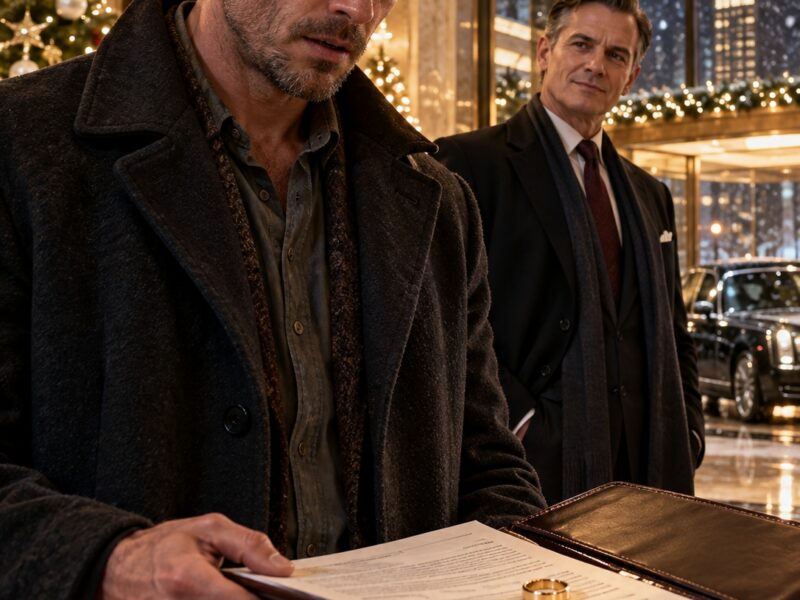
The Billionaire Asked a Freight Worker to Marry Her on Christmas Eve — She Had No Idea Who He Really Was

At exactly 11:47 on Christmas Eve, a black Bentley stopped outside Mason’s Diner in Bellather, Colorado.
Miles Avery noticed it because almost nothing moved on Main Street anymore.
Snow had been falling since noon. It covered the parked cars, softened the rooftops, and turned the yellow streetlights into blurred halos behind the diner’s frosted windows.
Inside, half the chairs were already upside down on the tables.
Darlene, the waitress, had wiped the counter twice and was pretending she wasn’t waiting for Miles to finish the slice of apple pie he had barely touched.
His coffee had been reheated three times.
Then the Bentley’s rear door opened.
A woman stepped into the snow wearing a long black coat over an evening gown that probably cost more than Miles’s pickup.
He recognized her before she reached the door.
Everyone in America who occasionally glanced at financial news would have recognized her.
Sloan Mercer.
Chief executive of Mercer Meridian Group.
Estimated net worth: nearly five billion dollars.
The woman who, less than an hour earlier, had been standing beneath crystal chandeliers at Denver’s Sterling Crown Hotel while financial reporters discussed whether she was about to lose control of the company her father had built.
Now she was walking into a nearly closed diner two hours away.
And looking directly at Miles.
The bell above the door gave a tired little jingle.
Sloan brushed snow from her coat, crossed the empty room, and slid into the booth opposite him.
“Merry Christmas, Miles.”
He looked behind himself.
There was nobody there.
“You have the wrong man.”
“No.”
She removed her gloves one finger at a time and placed them beside his coffee.
Miles waited.
Sloan Mercer was famous for making billion-dollar decisions without blinking. Television anchors described her as disciplined. Investors called her ruthless. Competitors used less flattering words when microphones were turned off.
But sitting across from him, she looked like a woman who had rehearsed something a hundred times and had suddenly forgotten the first line.
Finally, she drew a breath.
“Miles, will you marry me?”
Darlene stopped wiping the counter.
Miles slowly set down his fork.
He did not laugh.
He did not ask whether Sloan was drunk.
He did not even ask why.
Instead, he said something that wiped the last trace of corporate composure from her face.
“Does Conrad Whitmore know you’re here?”
For the first time that night, Sloan Mercer had no answer.
And that was when Miles knew this was much worse than a marriage proposal.
Hours earlier, he had expected Christmas Eve to be forgettable.
At forty-one, Miles had become good at quiet holidays.
His daughter Paige was twenty now, a junior at a university in Boston. She had earned a coveted winter internship and couldn’t come home.
Miles had told her not to apologize.
She apologized anyway.
Three times.
“You’re supposed to be building your own life,” he had said while scraping ice from the windshield of his aging pickup. “That was the whole point of raising you.”
“I know.”
“Then stop sounding guilty.”
“I’m not guilty.”
“You’ve said sorry three times.”
“That proves nothing.”
He laughed.
For twelve minutes they talked about Boston, the frozen Charles River, Paige’s internship, and a roommate who had nearly started a kitchen fire while baking cookies.
Then they said Merry Christmas.
The call ended.
And the cab of Miles’s truck suddenly seemed twice as large.
At Northline Freight, his supervisor Dale Hutchkins had invited him to the crew party at the bowling alley.
“Cheap beer,” Dale had promised. “Terrible karaoke. Possibly a fistfight if Gary sings Journey again.”
Miles had smiled.
“I’ve got plans.”
Dale had nodded like he believed him.
Miles appreciated the kindness enough not to correct him.
His actual plans consisted of a microwave dinner and an old movie.
But when he reached his small house, the silence felt different.
Paige’s old bedroom was dark.
Her high-school graduation photograph sat on the hallway table.
The kitchen clock sounded ridiculously loud.
Tick.
Tick.
Tick.
Miles lasted nineteen minutes.
Then he put his coat back on and drove to Mason’s Diner.
He told himself he wanted pie.
Maybe that was even partly true.
The television above the register was playing financial news when Darlene poured his coffee.
On-screen, Sloan Mercer stood at a gala surrounded by investors, politicians, cameras and people who smiled too carefully.
The anchor was discussing the January 15 shareholder meeting.
Mercer Meridian was facing the most serious internal challenge in its history.
Conrad Whitmore of Whitmore Capital had quietly assembled allies on the board.
If Sloan lost enough voting power, she could lose the company.
Darlene caught Miles watching.
“You know those people?”
Miles stirred his coffee.
“Not anymore.”
Darlene studied him for a second.
Before she could ask another question, headlights swept across the diner windows.
At 11:47, the Bentley arrived.
And now Sloan Mercer was sitting opposite him asking for marriage.
Darlene looked from Sloan’s evening gown to the driver waiting outside.
Then she flipped the sign on the door from OPEN to CLOSED.
“I suddenly remembered something in the kitchen,” she said.
She disappeared.
Sloan folded her hands.
“My father created a trust before he died.”
Miles said nothing.
“It holds eleven percent of Mercer Meridian’s voting power.”
“That’s enough to decide the January vote.”
Her eyes sharpened.
“You’ve been following this.”
“I own a television.”
She ignored the deflection.
“The voting block transfers fully to me if I establish what the trust defines as an independent household before January fifteenth.”
“And if you don’t?”
“It temporarily reverts to board control.”
“Where Conrad already has allies.”
“Yes.”
Miles leaned back.
“So you need a husband.”
“I need an independent household.”
“In three weeks.”
“Yes.”
“And marriage is the fastest way.”
“Yes.”
“And somehow, out of every man in America, you drove through a snowstorm to find a night manager eating cold pie.”
Sloan’s jaw tightened.
“You make it sound irrational.”
“I’m trying to decide whether it is.”
She looked toward the window.
Snow rattled softly against the glass.
Miles asked, “Why not marry someone from your world?”
A humorless smile touched her mouth.
“Because everyone in my world belongs to someone.”
“That sounds dramatic.”
“It’s accurate.”
She began naming connections.
Men whose investment firms borrowed from Whitmore Capital.
Men whose fathers sat on boards with Conrad.
Men whose companies needed Mercer contracts.
Men whose political foundations depended on the same donors.
“A husband from that world,” Sloan said, “would be an unlocked door in a house full of thieves.”
Then she reached beside her chair.
A leather folder landed on the table.
Miles opened it.
A one-year marriage agreement.
Separate bedrooms.
No expectation of intimacy.
Strict confidentiality.
Automatic termination provisions.
Protection against marital claims.
And compensation to Miles Avery:
$2,000,000.
He read the first page.
Then he closed the folder.
“No.”
Sloan blinked.
“You haven’t read it.”
“I read enough.”
“The amount is negotiable.”
Miles pushed the folder toward her.
“That sentence is why the answer is no.”
Her expression cooled.
“What amount would make you comfortable?”
He almost smiled.
“You still don’t understand.”
“Then explain it.”
“You walked into this diner assuming a man who earns less money than you must have a price.”
“That isn’t what I—”
“It’s exactly what you did.”
“I’m not trying to buy you.”
“Then what are you paying for?”
Sloan stopped.
For several seconds, only the old refrigerator hummed behind the counter.
Then she met his eyes.
“Your integrity.”
Miles’s face changed almost imperceptibly.
Sloan noticed.
Three years earlier, she explained, a freight subcontractor working for Mercer Meridian had falsified delivery records to conceal enormous losses.
Someone at Northline discovered discrepancies between fuel logs and delivery timestamps.
The employee followed the pattern.
Six states.
Dozens of shipments.
Millions of dollars.
Eventually, federal investigators became involved.
Before that happened, however, someone tried to make the problem disappear.
A substantial amount of money had been offered.
The Northline employee refused.
He handed over the evidence anyway.
Then he returned to his night shifts.
His name disappeared from the public reports.
But Sloan had spent months discovering who he was.
Miles Avery.
“I kept your file in my desk,” she said.
“Why?”
Sloan hesitated.
“Because I wanted to understand what kind of person turns down that much money.”
Miles stood.
He put ten dollars beside his plate.
“Good luck with your vote.”
“Miles.”
He reached the door.
Her next words stopped him.
“If Conrad wins, thirty-eight hundred employees will be gone before March.”
Miles kept his hand on the brass handle.
“That’s your company.”
“Yes.”
“Your problem.”
“Yes.”
He started opening the door.
Then Sloan said quietly:
“Northline Freight is on the list.”
Miles stopped.
For the first time since she had entered the diner, Sloan saw anger in him.
Not loud anger.
Something colder.
More dangerous.
The anger of a man who could tolerate being underestimated but had very little patience for watching innocent people pay for someone else’s greed.
He looked back at the leather folder.
Then at Sloan.
He took the contract home.
Christmas morning found Miles sitting alone at his kitchen table with untouched toast beside him and Sloan Mercer’s marriage agreement spread across the wood.
He read every clause.
Then he read them again.
The third time, he used a legal pad.
By noon, red notes covered several pages.
The contract protected Sloan against virtually everything.
Divorce claims.
Financial exposure.
Media leaks.
Corporate conflicts.
Personal liability.
It protected her money.
Her reputation.
Her company.
What it did not protect were the thousands of employees whose lives had supposedly brought her to his diner.
That interested Miles.
So did several other things.
At eleven, Paige called.
Miles nearly told her.
Instead, he asked about her internship.
Some decisions, he believed, a father should make before asking his child to carry the consequences.
That afternoon, he drove to Denver.
Sloan was waiting in a private suite at the Sterling Crown.
Her attorney, Grant Holloway, was there too.
Silver-haired.
Expensive suit.
Expression suggesting he considered Miles a temporary inconvenience.
Grant placed a pen beside the contract.
Miles ignored it.
Instead, he pulled a red pen from his coat.
“What are you doing?” Grant asked.
“Fixing it.”
“You cannot simply alter—”
Miles crossed out the two-million-dollar payment.
Grant stopped speaking.
Sloan stared.
Miles moved to the next page.
If Sloan retained control, Mercer Meridian would conduct no mass layoffs for twelve months merely to inflate the stock price.
Another clause prohibited Northline Freight from being sold to any liquidation fund.
Another allowed Miles to terminate the arrangement immediately if Sloan ever asked him to lie under oath, deceive investors or participate in illegal activity.
Then came the clause that finally made Sloan speak.
“No member of the Mercer family, the board, or any associated party will contact, threaten, publicly disparage, financially pressure or otherwise involve Paige Avery in matters relating to this agreement.”
Sloan looked up.
“You added protection for your daughter.”
“Yes.”
“And removed your compensation.”
“Yes.”
“You’ve taken nothing for yourself.”
Miles capped the pen.
“I’m taking the right to sleep at night.”
Grant stared at him.
“I have negotiated hundreds of prenuptial agreements. I have never seen the financially weaker party demand less money.”
Miles looked at him.
“Then consider this professional development.”
Sloan laughed before she could stop herself.
It was small.
Almost surprised.
Then she picked up the pen.
And signed every alteration.
They were married on December 27 in a judge’s chambers.
No flowers.
No photographers.
Two attorneys served as witnesses.
Nobody remembered to order a cake.
By sunrise the following morning, their faces were everywhere.
BILLIONAIRE CEO MARRIES UNKNOWN LOGISTICS WORKER.
Reporters photographed Miles’s rusting pickup.
They published his salary.
They interviewed people he hadn’t spoken to since high school.
One television host joked that Sloan Mercer had finally found a merger she could afford to lose.
Miles turned off the television.
Two days later, Conrad Whitmore met him in person.
The reception was being held in Mercer Tower.
Conrad approached carrying champagne and the effortless smile of a man accustomed to rooms rearranging themselves around him.
His gaze dropped to Miles’s shoes.
“Interesting choice.”
Miles glanced down.
“They’re comfortable.”
“I meant Sloan’s choice.”
“I know.”
Conrad smiled.
“If she wanted to rent a husband, I suppose she could have rented one with a proper suit.”
Miles took a sip of water.
“This suit is fine.”
“Fine for what?”
Miles looked directly at him.
“To stand right here when you lose this company.”
Conversation around them died.
Conrad’s smile remained.
His eyes did not.
Across the lobby, Sloan slowly turned toward her husband.
She couldn’t decide whether Miles had just made the most reckless bluff of his life—
or whether he knew something nobody else in the building knew.
To keep the marriage credible, Miles temporarily moved into Sloan’s Denver penthouse.
The guest wing was larger than his entire house.
They occupied bedrooms at opposite ends of a hallway long enough to require its own lighting system.
The first few days felt like two strangers sharing an expensive hotel.
Miles arrived with two suitcases.
A toolbox.
And a battered drip coffee maker he had owned for fifteen years.
He placed it beside Sloan’s imported espresso machine.
She stared at it.
“What is that?”
“A coffee maker.”
“I can see that.”
“Then we’re making progress.”
The espresso machine had cost eighteen thousand dollars.
Within a week, Sloan stopped using it.
Every morning, Miles would enter the kitchen and discover that she had already poured herself a cup from his machine.
Neither mentioned it.
One evening he found a loose cabinet hinge.
Sloan walked in and discovered him kneeling on the marble floor with a screwdriver.
“We have maintenance staff.”
“I know.”
“You can call them.”
“The screwdriver was six steps away.”
She stared at him.
Then laughed.
Not the careful laugh she used at galas.
A real one.
The sound seemed to surprise her more than him.
After that, rituals appeared without permission.
Miles left a hallway lamp burning when Sloan worked late.
Sloan began leaving financial briefings open to the logistics section on the kitchen counter.
He would scribble comments in the margins.
She would argue with them over breakfast.
Something that had started as a legal arrangement began acquiring the dangerous texture of ordinary life.
Then came New Year’s Eve.
The Mercer family dinner reminded Miles exactly what world he had entered.
Sloan’s mother, Helen Mercer, greeted him with a handshake colder than the silverware.
Vance Rockefford asked loudly what night managers earned these days.
Conrad sat too close to Sloan.
At one point, he nodded toward the watch on her wrist.
“Do you know that watch costs more than your house?”
Miles studied it.
“No.”
Conrad laughed.
Miles continued.
“But my house is paid off.”
Several people suddenly became fascinated by their soup.
Later Conrad raised his glass.
“To Sloan’s Christmas charity project.”
A few investors chuckled.
Sloan put down her wine.
Miles touched two fingers lightly to her wrist beneath the table.
She looked at him.
He shook his head.
Not here.
Not like this.
Miles understood men like Conrad.
They fed on reactions.
Sometimes the cruelest thing you could offer a man desperate to humiliate you was polite indifference.
So Miles finished dinner.
Complimented the chef by name.
Then asked Helen about a painting above the fireplace.
It turned out to be her favorite.
For ten unexpected minutes, the woman who had planned to tolerate him found herself discussing art with him.
After dessert, Miles escaped into the gallery.
An elderly man stood beside Harrison Mercer’s portrait.
Cashmere scarf.
Cane.
Sharp eyes.
Elias Braftoft.
Seventy-two years old.
Legendary investor.
One of Harrison Mercer’s closest advisers.
Elias looked at Miles.
“Mr. Avery.”
“Mr. Braftoft.”
They shook hands.
Not like strangers.
Sloan, approaching from the dining room, stopped before either man noticed her.
Elias asked quietly, “How long?”
“Almost eight years.”
“They still don’t know?”
Miles glanced toward the dining room.
“I’d prefer to keep it that way.”
Elias smiled faintly.
“You always did.”
Miles walked away.
Sloan remained hidden around the corner.
She had heard only fragments.
But one thing was suddenly clear.
Her husband had a history inside Mercer Meridian that he had never mentioned.
And she had no idea how deep it went.
The answer began emerging on January 6.
A blizzard slammed into the Rocky Mountain corridor.
Mercer Meridian’s largest distribution hub outside Cheyenne effectively froze.
Forty-seven trucks were stranded.
Two major highways closed.
Drivers radioed from shoulders and rest areas while fuel levels dropped.
The automated routing platform kept generating useless detours.
Finance projected eighteen million dollars in losses within thirty-six hours.
Sloan called an emergency meeting.
Miles happened to arrive carrying lunch.
He took a chair near the back.
Vance noticed.
“This is an executive meeting.”
Miles stood.
“No problem.”
He picked up his coat.
Then he saw the regional map on the wall.
And stopped.
Sloan recognized the change in his posture.
“What?”
Miles stared at the screen.
“Route 17 isn’t closed because of snow.”
Every head turned.
Operations director Tom Riley frowned.
“The highway authority has it closed.”
“The northern section is closed. Jackknifed tanker.”
“How would you know that?”
“The southern segment is open to commercial traffic.”
Miles walked toward the map.
“If you reroute through Redstone Depot, divide the convoy into three groups and move the fuel stop to Hawthorne Junction, you can probably recover seventy percent of the cargo.”
Tom looked toward Sloan.
Vance laughed.
“Have you ever even driven a truck?”
“No.”
“Then what exactly are you basing this on?”
Miles looked at the glowing map.
“The fact that I designed the routing model your software is running.”
Nobody laughed.
Sloan stared at him.
“What?”
Miles pointed toward one of the red indicators.
“The system assumes a complete closure whenever this sensor feed fails. We built that threshold as a safety margin.”
“We?”
Miles finally looked at her.
“Eight years ago.”
Tom Riley was already checking the highway reports.
His face changed.
“He’s right.”
Ten minutes later, Miles’s plan was being implemented.
By morning, the trucks were moving.
Projected losses fell from eighteen million dollars to under three.
And the story everyone thought they understood changed overnight.
Miles Avery wasn’t simply a freight-yard employee.
Years earlier, he had been one of the principal architects behind Meridian Atlas—the optimization system responsible for moving nearly every pallet Mercer Meridian owned.
His name had simply vanished from the story.
Employees who had mocked Sloan’s “charity husband” began asking Miles for advice.
A dispatcher in Cheyenne mailed a handwritten note signed by eleven drivers who had made it home before midnight.
Sloan pinned it to her office corkboard between investment memoranda worth billions.
Conrad Whitmore did something else.
He hired a private investigator.
“I want everything on Miles Avery.”
“What exactly are we looking for?”
Conrad watched Denver lights pass beyond the window of his car.
“I want to know why a man smart enough to build Atlas works nights for sixty-two thousand dollars a year.”
Sloan learned the answer before Conrad did.
It happened over grilled cheese.
Miles was cooking.
Sloan sat at the kitchen island with bare feet tucked beneath the stool.
Nine years earlier, he told her, his life had looked very different.
Consulting.
Airports.
Hotels.
Two hundred nights away from home some years.
Money had been excellent.
So had the titles.
But Paige had been growing up while he was somewhere else.
He missed recitals.
Birthdays.
Ordinary dinners.
Then one winter night, Miles was sitting in a boardroom in Chicago when his wife, Laura, died on an icy road.
Paige was eleven.
She waited two days for her father to get home.
Miles stopped speaking.
The grilled cheese hissed softly in the pan.
Sloan asked, “What happened after?”
“I came home.”
“I mean your company.”
“So do I.”
Within a year, Miles sold it.
He left consulting.
Took a predictable job.
Learned how to braid Paige’s hair badly.
Then slightly less badly.
Relearned algebra at midnight.
Made dinner.
Attended school meetings.
Was there.
The newspapers called his career a collapse.
Miles called it coming home.
“Do you miss the money?” Sloan asked.
“Yes.”
The honesty surprised her.
“The power?”
“Sometimes.”
“What do you miss most?”
Miles considered it.
“The time I wasted buying things I didn’t need.”
That sentence followed Sloan into bed.
A few nights later, she told him about her own childhood.
Christmas in the Mercer family had resembled an annual shareholder meeting.
Assistants selected gifts.
Photographers documented dinner.
Smiles were arranged.
When Sloan was nine, she asked for a sled.
Her father gave her a framed letter from a senator praising the family’s philanthropy.
She laughed while telling Miles.
But her eyes didn’t.
The following Saturday, Miles drove her north.
He stopped beside a closed farm stand.
A cheap wooden sled leaned against the fence.
Miles dropped cash into the honor box.
“What are you doing?” Sloan asked.
“Corporate acquisition.”
He threw the sled into the pickup.
They ate apple pie at Mason’s.
Darlene pretended not to recognize Sloan.
Then they walked Main Street beneath falling snow.
Behind the elementary school was a hill.
Sloan stared at it.
“No.”
Miles put down the sled.
“You asked for one.”
“When I was nine.”
“You’re behind schedule.”
The first trip down, Sloan screamed.
The second, she laughed.
The third, she crashed into a snowbank and lay there staring at the sky while Miles laughed so hard he had to sit down.
A woman worth nearly five billion dollars ruined an expensive coat that afternoon.
She didn’t care.
Later, beneath a streetlamp, Sloan looked at Miles.
“What would happen if this marriage had never come with a contract?”
Miles stopped walking.
Snow collected in her hair.
He looked at her for a long time.
Then her phone rang.
Grant Holloway.
Sloan answered.
Her expression changed.
“How much?”
Silence.
Then Grant said something Miles couldn’t hear.
Sloan looked directly at him.
“Not a little,” Grant said through the phone. “Enough to swing the vote.”
By Monday morning, the headline was everywhere.
SLOAN MERCER’S NEW HUSBAND HID CORPORATE STAKE.
Mercer stock fell four percent before lunch.
The documents were genuine.
Eight years earlier, Miles had co-founded Greyhaven Systems.
Its technology became the foundation of Meridian Atlas.
When Mercer Meridian acquired Greyhaven, part of Miles’s compensation had been structured as long-term equity rights.
He had never exercised them.
Until now, almost nobody remembered they existed.
Activated, they represented roughly 2.7 percent of the voting power.
In an ordinary company, that might have been merely valuable.
In a battle decided by fractions, it could determine who controlled Mercer Meridian.
Sloan sat alone in her office reading the article.
Suddenly every strange detail rearranged itself.
Miles knowing Conrad’s name.
Miles understanding Atlas.
Elias greeting him like an old colleague.
Miles telling Conrad he would lose.
Had Sloan found the one honest man in her world?
Or had the one honest man been waiting for her?
That evening, she confronted him across the kitchen island.
The cheap coffee mug she had begun using sat between them.
“Did you know about the equity?”
“Yes.”
Her stomach tightened.
“From the beginning?”
“Yes.”
“Did you know it could decide the vote?”
“Not until last week.”
“What happened last week?”
“Elias showed me the numbers.”
Sloan stared.
“You talked to Elias about the vote and didn’t tell me?”
Miles said nothing.
“Why?”
Still nothing.
His silence hurt more than a lie would have.
“Did you marry me for Mercer Meridian?”
“No.”
The answer came immediately.
“Then why?”
“You told me thirty-eight hundred people were going to lose their jobs.”
“That isn’t an answer.”
“It was enough for me.”
Sloan wanted to believe him.
That was the problem.
Wanting to believe him frightened her more than distrusting him.
She turned toward the windows.
For a long time, neither moved.
Then Miles unplugged his coffee maker.
He picked up his toolbox.
Carried both toward the guest wing.
The penthouse had slowly begun to feel like a home.
That night it became a beautiful building filled with expensive silence again.
The next afternoon, Conrad demanded an emergency board investigation.
Vance accused Miles of manipulating the marriage to gain corporate influence.
The insults had changed.
First he had been a gold digger.
Now he was a schemer.
Miles endured both without reacting.
But when Helen Mercer—who had begun to warm toward him—looked away, something in his expression finally broke.
Only slightly.
Sloan saw it.
When the meeting ended, Miles approached her.
He removed his wedding ring.
Set it on the table.
“You don’t have to trust me.”
Sloan stared at the ring.
“But you need to win tomorrow.”
“Miles—”
He walked away.
In the elevator lobby, Elias was waiting.
He carried an old leather briefcase.
“You still haven’t told her,” Elias said.
“It isn’t necessary.”
“Tomorrow it will be.”
He opened the case.
Inside was a thick file.
MERCER MERIDIAN — FOUNDERS PROTECTIVE TRUST.
January 15 arrived under a steel-colored sky.
Snow pressed against Mercer Tower’s glass walls.
Reporters crowded the forty-second-floor auditorium.
Analysts filled the back rows.
Directors whispered around the long table.
Miles’s chair was empty.
Conrad noticed immediately.
He smiled.
He had spent the morning greeting people like the building already belonged to him.
His assistants carried a transition plan bearing his name.
Then the meeting began.
Conrad attacked Sloan’s marriage as theater.
He called Miles a freight worker recruited for a desperate corporate stunt.
Then he presented his restructuring proposal.
Distribution centers would be sold.
Assets broken apart.
Thousands of jobs eliminated.
The stock price, he promised, would rise.
Some investors nodded.
Sloan sat perfectly still.
Beneath the table, her fingers were wrapped around Miles’s wedding ring.
She had spent the previous night rereading their contract.
Every line he had changed.
No mass layoffs.
Protect Northline.
No lying.
Protect Paige.
Nothing for himself.
At three in the morning, Sloan had realized something painfully simple.
A man planning to steal her company would not have written a contract protecting everyone except himself.
The auditorium doors opened.
Miles walked in.
No security.
No driver.
No entourage.
Just an ordinary winter coat over a gray suit.
Conrad grinned.
“Perfect timing. We were discussing how much it might cost to make you disappear.”
Miles removed his coat.
“You can’t afford it.”
Nervous laughter moved through the room.
Conrad’s expression tightened.
He offered ten million dollars for Miles’s voting rights.
“No.”
“Twenty.”
“No.”
“Fifty million.”
“No.”
Conrad slammed his hand against the table.
“What exactly don’t you understand?”
Miles looked at him.
“You’re trying to buy something that doesn’t belong to me.”
A side door opened.
Elias Braftoft entered with two attorneys.
He placed the thick file before the board secretary.
Then he requested five minutes to read something into the official record.
The room changed before he finished the first page.
When Mercer Meridian acquired Greyhaven Systems eight years earlier, Miles had surrendered much of the cash compensation owed to him.
In exchange, Harrison Mercer approved a provision.
A safeguard.
The Founders Protective Trust.
Its purpose was simple.
Mercer Meridian could never be dismantled and sold piece by piece to liquidation funds without triggering a protective mechanism.
The authority to activate it belonged neither to the CEO nor the board.
It belonged to a living Greyhaven founder who was not employed by Mercer Meridian.
Elias looked toward Miles.
“Miles Avery.”
Vance shot to his feet.
“He’s a logistics employee!”
Elias regarded him almost sadly.
“No. Mr. Avery is one of the reasons you still have a company to fight over.”
Miles wasn’t secretly richer than Conrad.
He wasn’t hiding a private empire.
Eight years earlier, he had simply anticipated that one day men might try to destroy a functioning company because the pieces were worth more to them than the people inside it.
And he had built a lock into the door.
Miles signed the activation.
Every sale of critical Mercer Meridian assets froze for ninety days.
Conrad’s restructuring plan died with one stroke of ink.
For the first time, his face lost color.
Then he recovered.
“The CEO vote remains.”
He was right.
Sloan could still lose.
Miles activated his Greyhaven voting rights.
The balance shifted.
But he did not vote.
Instead, he looked at Sloan.
“One question.”
The room went silent.
“If keeping that chair required becoming someone like Conrad, would you still want it?”
Conrad laughed.
Sloan didn’t.
She looked around the auditorium.
Investors.
Employees.
Her mother.
Her father’s company.
She remembered Harrison Mercer spending his life winning every battle placed before him.
And dying in a house so quiet that nurses whispered.
She remembered eleven drivers in Cheyenne making it home before midnight.
She remembered Miles crossing two million dollars out of a contract without hesitation.
Then she stood.
“No.”
Conrad’s smile vanished.
Sloan faced the board.
“If remaining CEO requires firing thirty-eight hundred people, selling functioning distribution centers and dismantling this company so I can protect my title, then I don’t deserve the title.”
A director shifted uncomfortably.
Sloan continued.
“If those are the conditions, I will resign this afternoon.”
Conrad laughed aloud.
One of his allies began drafting a statement on his tablet.
But something happened in the back rows.
Small investors looked at one another.
Employee pension representatives leaned forward.
For perhaps the first time, a Mercer had spoken about them as people rather than percentages.
Miles smiled.
Then cast his vote.
“For Sloan Mercer.”
Elias followed.
Then another vote moved.
Helen Mercer raised her hand.
The room stirred.
She transferred the Mercer family block to her daughter.
Helen did not look at Conrad.
She looked at Miles.
And gave him the smallest nod.
It was not an apology spoken aloud.
For a woman like Helen Mercer, it was more difficult than one.
Several wavering investors followed.
When the final count appeared, Sloan had won.
Barely.
But barely was enough.
Conrad Whitmore had spent a year constructing his victory.
It collapsed in minutes.
Within the hour, board counsel announced an inquiry into Vance Rockefford’s undisclosed financial connections to buyers positioned to acquire Mercer Meridian assets.
Conrad gathered his papers.
Before leaving, he stopped beside Miles.
“You could have made hundreds of millions.”
“Probably.”
“Then why didn’t you?”
Miles looked at him.
“That’s exactly why you’ll never understand how you lost.”
Conrad searched for an answer.
For once, none came.
He walked through the doors carrying his transition plan under his arm like a newspaper nobody wanted.
Later, the auditorium emptied.
Sloan found Miles beside the windows.
Snow drifted beyond the glass.
She opened her hand.
His wedding ring lay in her palm.
“You fulfilled the agreement.”
Miles looked at it.
“So we’re getting divorced?”
“If you want.”
He looked at her for a long time.
Then finally asked the question he should have asked on Christmas Eve.
“Why me?”
Sloan lowered her eyes.
Three years earlier, during the Northline fraud investigation, she had been outside a conference room in Phoenix.
Inside, attorneys had offered a night manager five million dollars to forget what he had discovered.
Sloan had heard his answer through the door.
If money was the only thing keeping someone beside you, Miles had told them, you would never know who would stay when the money disappeared.
She never forgot those words.
“I wanted to know the man who said them.”
Miles studied her.
Then he revealed something else.
He had read Harrison Mercer’s trust documents.
The independent-household clause did not actually require marriage.
There were other legal arrangements.
Sloan froze.
“You knew?”
“Yes.”
“When?”
“Before the vote.”
Her face changed.
Miles asked quietly:
“Did you know before Christmas?”
Sloan could have lied.
Instead, she whispered:
“Yes.”
The answer landed between them.
“Then why did you come to the diner?”
Sloan Mercer had prepared answers for hostile shareholders.
Senate committees.
Reporters.
Banks.
Courts.
She had no prepared answer for that.
Finally, she looked at him.
“Because I needed a reason foolish enough to ask the man I’d never forgotten if he might stay.”
Miles said nothing.
Suddenly the contract meant something different.
The lawyers.
The money.
The separate bedrooms.
The elaborate legal excuse.
It had not merely protected Sloan’s company.
It had protected Sloan.
A woman who had learned to negotiate everything because asking for something honestly meant admitting someone could refuse.
A week later, Miles asked Grant Holloway to terminate the marriage contract.
When Sloan heard, she stormed into his temporary office.
“You’re ending it?”
“The contract.”
She stopped.
Miles looked up.
“If we’re going to find out whether this is real, I don’t want payment schedules and termination clauses deciding it.”
“So what happens to the marriage?”
“That depends.”
“On what?”
“Us.”
They terminated every financial term.
They remained legally married.
Then, somewhat absurdly, began dating.
Sloan changed Mercer Meridian.
Not because Miles demanded it.
Because she chose to.
The planned layoffs were canceled.
An employee advisory council was created.
Northline Freight received a long-term contract instead of being sold.
Miles declined every executive position the board offered.
Eventually he agreed to become an independent strategic adviser.
Four days a week.
Never weekends.
Sloan stared at him when he insisted.
“You’re negotiating boundaries with a thirty-billion-dollar corporation?”
“No.”
“What would you call it?”
“Boundaries.”
She rolled her eyes.
He won.
Friday nights became dinner at a noisy taqueria.
Sundays sometimes meant driving into the mountains.
They argued about business.
Coffee.
Work hours.
And whether pineapple belonged on pizza.
Some weeks were easy.
Others weren’t.
Two stubborn people rarely build anything meaningful without friction.
But whenever Sloan began hiding behind contracts, Miles noticed.
Whenever Miles retreated into silence instead of explaining what hurt, Sloan noticed.
Slowly, they learned something neither had been particularly good at before.
Staying.
A year passed.
On Christmas Eve, snow covered Bellather again.
At Mason’s Diner, the same booth held two people instead of one.
No lawyers.
No directors.
No bodyguards.
No leather folder.
The Bentley remained in Denver.
They had arrived in Miles’s pickup with the heater rattling and an old country station playing Christmas music.
Paige called from Boston.
She appeared on the screen smiling suspiciously.
“Merry Christmas.”
“Merry Christmas,” Miles said.
Paige looked at Sloan.
Then at her father.
Then grinned.
“I’m going to go now.”
“Why?”
“No reason.”
The call ended.
Sloan narrowed her eyes.
“What was that?”
Miles shrugged.
Darlene brought apple pie.
Two forks.
Then she told Sloan the old wooden sled was still behind the diner where Miles had left it the previous winter.
Sloan laughed.
Miles looked at the clock.
11:47.
Sloan followed his eyes.
“You planned this.”
“Maybe.”
He placed a small velvet box between the coffee cups.
Sloan stopped smiling.
“Miles.”
“I need to correct something.”
He opened the box.
There was no enormous diamond.
No jewel designed for magazine covers.
Only a slender ring.
Elegant.
Simple.
Something meant to be worn while cooking breakfast, scraping ice from a windshield, arguing about pizza or sitting beside someone in a hospital waiting room decades later.
Inside the lid were four numbers.
11:47.
Nothing else.
Because that was the one detail from their strange beginning that had never needed rewriting.
Sloan looked from the ring to Miles.
“You’re serious.”
“No lawyers this time.”
Her eyes filled.
“No trust.”
She covered her mouth.
“No vote. No company. No clauses.”
“Miles—”
“Just me.”
Outside, snow drifted against the window.
Miles Avery—the freight worker television hosts had laughed at, the engineer executives had forgotten, the father who had once walked away from money because his daughter needed his time—looked across the same table where a billionaire had once offered him two million dollars to become her husband.
And asked:
“Will you marry me?”
Sloan stared at him for several seconds.
Then laughed through tears.
“It took you an entire year to ask.”
“Is that a yes?”
“You’re supposed to let me enjoy this.”
“Sloan.”
“Yes.”
He smiled.
“Yes?”
“Yes, Miles.”
Outside Mason’s Diner, the street was empty.
No reporters waited in the snow.
No markets reacted.
No investors received alerts.
No television anchor interrupted a broadcast.
For the first time in Sloan Mercer’s life, one of the most important decisions she had ever made did not move a stock price by a single cent.
It changed no board.
Saved no corporation.
Defeated no rival.
It simply made her happy.
And perhaps that was the truth both of them had taken the longest road to understand.
Miles never needed to become a billionaire to prove that his life had value.
Sloan never needed to become less powerful to deserve tenderness.
He had spent years learning that success meant very little if nobody you loved was there when you came home.
She had spent years believing love was simply another transaction with better lighting.
One had walked away from a fortune because he finally understood what money could not return.
The other had accumulated nearly everything money could buy before discovering what it could never guarantee.
In the end, neither rescued the other.
They simply learned to see each other clearly.
Not the billionaire.
Not the freight worker.
Not the CEO.
Not the forgotten engineer.
Just two people sitting in a nearly empty diner while snow covered a quiet Colorado street.
On the table between them sat two cups of ordinary coffee.
One slice of apple pie.
Two forks.
And a ring engraved with four small numbers.
11:47.
The exact minute a woman who knew how to negotiate everything walked through a diner door and asked the only question she had never learned how to ask honestly.
A year later, Miles finally gave her his answer.
Not because of a company.
Not because of thirty-eight hundred jobs.
Not because of eleven percent voting power.
And not because either of them needed a contract anymore.
This time, when Sloan reached across the table and took his hand, there was nothing left to negotiate.
And nothing left to buy.









