THE BILLIONAIRE ASKED A STRANGER TO BE HIS FIANCÉE FOR 90 DAYS—THEN SHE DISCOVERED WHY HE CHOSE HER

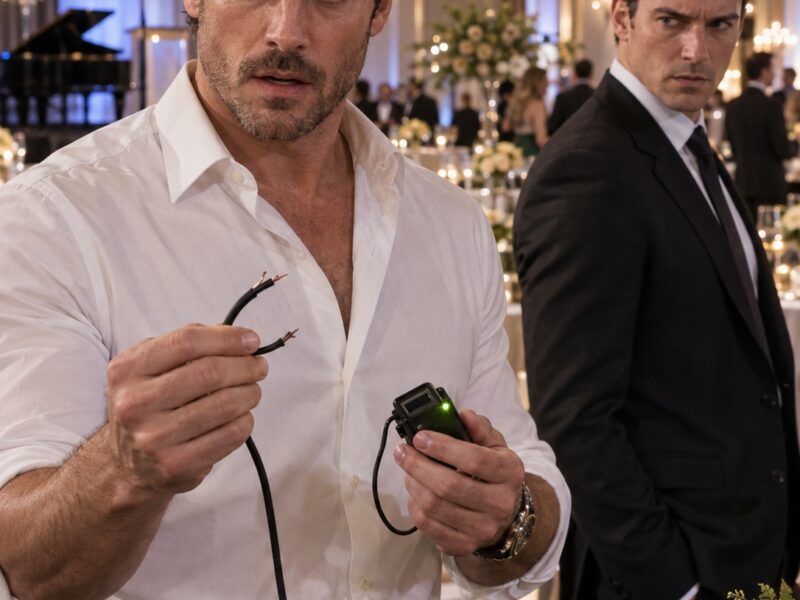
The wire had been cut cleanly.
Not torn. Not damaged by a careless stagehand. Not pinched beneath a rolling equipment case.
Cut.
Alexander Reed stared at the severed black cable beneath the ballroom stage while the muffled sound of panic moved above him like footsteps over a coffin lid.
Twenty minutes until nearly four hundred guests arrived.
Twenty minutes until Sophie Bennett’s biggest event of the year either began flawlessly—or collapsed in front of half the city’s corporate elite.
And somewhere inside the maze of speakers, lighting panels, power boxes, and temporary walls, Alexander had just found something that should not have been there.
A small black device no larger than a cigarette pack.
Its tiny green light blinked once.
Then twice.
Alexander’s stomach tightened.
Behind him, Sophie crouched in her pale blue dress, one hand gripping the edge of the stage.
“Alex?”
He didn’t answer.
She had known him for less than three hours.
As far as Sophie knew, he was a stranger who had wandered into the Lakeview Grand Hotel looking for temporary work. A man with rolled-up sleeves, no résumé, no references, and a face she vaguely believed she had seen somewhere before.
She did not know that his full name was Alexander Reed.
She did not know that the suit jacket hanging in the staff closet had been handmade in London.
She did not know that he owned a controlling interest in three companies represented in the ballroom above them.
She certainly did not know that his photograph had appeared on the cover of Forbes six months earlier beside the headline:
THE MAN WHO BUILT AN EMPIRE BEFORE FORTY.
Sophie only knew that he had fixed a broken audio console faster than the hotel technician.
And now she knew something else.
He was afraid.
“Alex,” she whispered again. “What is that?”
Alexander reached toward the device without touching it.
“That’s what I’m trying to figure out.”
“That doesn’t sound reassuring.”
“It isn’t.”
Sophie stared at him. “Is it dangerous?”
“Probably not in the way you’re thinking.”
“Then what way should I be thinking?”
Alexander looked at the green light again.
He had spent fourteen years learning to recognize corporate sabotage when he saw it. Competitors leaking contracts. Executives stealing files. Investors feeding rumors to financial reporters before acquisition votes. He had once watched a thirty-billion-dollar company lose eleven percent of its market value because someone anonymously emailed three documents at 4:12 on a Friday afternoon.
But this?
This was physical.
Personal.
Someone had entered Sophie’s event setup, deliberately cut a critical cable, and planted a device inside the system.
Someone who knew enough about professional event equipment to hide it.
And perhaps more importantly—
someone who knew Alexander was there.
He finally looked at Sophie.
“I think someone knows I’m here.”
Her eyebrows drew together.
“What do you mean?”
Before he could answer, footsteps thundered across the ballroom above them.
A voice shouted, “Sophie!”
She flinched.
Another employee.
Another emergency.
Sophie closed her eyes for half a second as if forcing herself not to break.
Then she stood.
Alexander watched her smooth the front of her dress even though it was already clean.
It was something he had noticed about her almost immediately.
When everyone else panicked, Sophie became quieter.
Not calmer.
Quieter.
There was a difference.
Calm came from confidence.
Quiet came from having learned that nobody was coming to rescue you.
“We have seventeen minutes,” she said.
Alexander glanced at the device.
Then back at her.
“I need ten.”
“For what?”
“To get your sound system working.”
“And that?”
She pointed beneath the stage.
Alexander hesitated.
“That problem may take longer.”
Sophie studied him.
The ballroom lights reflected faintly in her brown eyes.
“You’re not really looking for work, are you?”
Alexander said nothing.
“That’s what I thought.”
She turned away.
“Sophie.”
She stopped.
“If I fix this—”
She looked back.
“After tonight,” he continued, “I’ll explain.”
Her expression hardened.
“You don’t owe me your life story.”
“No.”
“But if whatever secret you’re carrying just walked into my event and started cutting wires, then you owe me something.”
Alexander knew she was right.
That bothered him more than it should have.
For nearly a decade, people had agreed with him before he finished sentences.
Employees nodded.
Executives adjusted.
Lawyers found language.
Politicians returned phone calls.
Journalists waited outside buildings.
His father still challenged him, occasionally.
His mother challenged everyone.
But strangers?
Strangers rarely spoke to Alexander Reed as if he were simply a man who had made a mess and needed to clean it up.
Sophie did.
And she did not even know who he was.
Maybe that was exactly why he had come here.
Maybe that was why, three hours later, he would make the most ridiculous proposal of his life.
But that morning, Alexander had believed his problems could be solved simply by disappearing.
He had been wrong.
At 7:30 a.m., twelve hours before the ballroom crisis, he had been standing sixty floors above downtown Chicago with his hands resting on the glass wall of his office.
The city looked strangely harmless from that height.
Cars moved like veins of light.
Buildings became geometry.
People disappeared entirely.
Alexander had always liked the view for that reason.
Distance made chaos look organized.
“You built an empire,” his father said behind him.
Alexander did not turn.
Richard Reed’s reflection appeared faintly in the glass—a broad-shouldered man in his late sixties, gray at the temples, still carrying himself like the attorney who had once entered courtrooms believing hesitation was a moral weakness.
Alexander smiled without humor.
“You say that like it’s supposed to make me feel better.”
“It should.”
“It doesn’t.”
Richard walked farther into the office.
Reed Enterprises occupied nine floors of the tower, but Alexander’s office contained almost nothing personal.
No family photographs.
No framed diplomas.
No awards.
Just wood, glass, steel, and a single old black-and-white photograph of his grandfather standing outside a small machine shop in 1963.
Richard glanced at the leather travel bag near Alexander’s desk.
“So the rumors are true.”
“What rumors?”
“That you’ve lost your mind.”
Alexander finally turned.
“I’m taking three weeks.”
“You haven’t taken three consecutive days since you were twenty-six.”
“Then I’m overdue.”
“Three weeks before the Whitmore merger vote?”
“The company has a management team.”
“The company has you.”
“That is precisely the problem.”
Richard’s jaw tightened.
Alexander walked toward the desk.
“I built Reed Enterprises around the idea that no single person should be indispensable. Somehow I became the exception.”
“You’re the CEO.”
“I’m a hostage with better parking.”
His father gave him a look.
Alexander laughed softly.
“I know what I built, Dad. That’s why I need to know what happens if I step away.”
“You already know what happens. People panic.”
“Then perhaps they should learn not to.”
“That isn’t what this is about.”
Alexander said nothing.
Richard had always possessed an irritating ability to find the truth hiding beneath Alexander’s sentences.
“You’re thirty-eight,” Richard continued. “You have more money than you could spend in three lifetimes. You built the company faster than anyone expected. You won every argument you insisted on winning. And now you wake up one morning asking what comes next.”
Alexander looked toward the window.
“Maybe.”
Richard’s voice softened.
“Or maybe you’re asking who Alexander Reed is when nobody needs anything from him.”
That landed closer than Alexander wanted.
For years, his identity had arrived before he did.
Restaurant managers recognized the reservation.
Charity boards rehearsed introductions.
Strangers adjusted their posture after hearing his surname.
Women who had been indifferent suddenly became fascinated.
Men who had been confident suddenly became careful.
Friendships felt negotiated.
Dating felt like due diligence.
Even kindness sometimes felt like an investment seeking future returns.
Alexander was tired of wondering what every smile wanted.
“I need to know who I am beyond the business,” he said.
Richard exhaled.
“You can’t simply walk away from everything you’ve built.”
“I’m not walking away from my life.”
“It looks remarkably similar.”
“I’m trying to understand it.”
“And disappearing will do that?”
Alexander looked at the travel bag.
“I want one chance to be treated like an ordinary man.”
Richard stared at him for several seconds.
Then he walked toward the door.
“Whatever you’re planning,” he said, “don’t let pride make the decision for you.”
“It isn’t pride.”
Richard paused.
“No?”
Alexander looked at the skyline again.
“I’m tired of proving things to everyone.”
His father’s expression changed almost imperceptibly.
For the first time that morning, the older man seemed less irritated than sad.
“Then stop proving them.”
Alexander almost laughed.
As though it were that simple.
Richard opened the door.
“One more thing.”
Alexander glanced over.
“Your mother knows something is happening.”
That was considerably more alarming than any corporate problem.
“How?”
Richard smiled.
“You’re asking the wrong question.”
“What’s the right one?”
“How much does she already know?”
The door closed behind him.
Alexander stared at it.
Then his phone vibrated.
A message from his mother.
Dinner tonight?
He put the phone facedown.
Ten minutes later, he left Reed Enterprises through a private elevator wearing jeans, a white shirt, a charcoal jacket, and no watch.
For once, nobody needed to know who he was.
He lasted less than four hours.
His first mistake was walking instead of taking a car.
His second was thinking he remembered how ordinary people moved through downtown Chicago without three assistants arranging every minute.
By noon, he had nearly been hit by a bicycle messenger, spilled coffee on his cuff, and discovered that his expensive shoes were spectacularly unsuited for walking six city blocks.
He should have been annoyed.
Instead, he felt almost cheerful.
Then he reached the Lakeview Grand.
He had not intended to enter.
The hotel was hosting a weekend charity gala benefiting youth arts programs, and people were carrying floral arrangements through revolving doors while workers unloaded lighting equipment along the side entrance.
Alexander knew the charity.
Reed Enterprises had donated to it twice.
He was about to keep walking when a woman backed through the service entrance carrying a crate of glass candle holders.
She nearly collided with him.
“Watch where you’re—”
She turned.
Her heel slipped.
Alexander caught the bottom of the crate before it crashed.
For one second they stood facing each other, each holding one side.
“Sorry,” she said.
“You were about to tell me to watch where I was going.”
“I changed my mind when you saved twelve hundred dollars’ worth of centerpieces.”
Alexander looked at the crate.
“Those cost twelve hundred dollars?”
“Welcome to corporate events.”
She was perhaps thirty-two, with chestnut-brown hair pinned loosely behind her head and a pencil tucked above one ear. No elaborate makeup. No expensive jewelry. A laminated badge hung around her neck.
SOPHIE BENNETT
EVENT DIRECTOR
Someone called her name from inside.
She closed her eyes.
“Of course.”
“Problem?”
“You wouldn’t happen to know how to assemble a portable stage, would you?”
Alexander smiled.
“Actually—”
She looked suspicious.
“Please don’t say ‘how hard can it be.’ People who say that are usually responsible for insurance claims.”
“I was going to say I’ve done it before.”
Technically true.
During Reed Enterprises’ early years, Alexander had personally helped set up product demonstrations because the company could not afford sufficient staff.
Sophie studied him.
“Are you with the hotel?”
“No.”
“The charity?”
“No.”
“Vendor?”
“No.”
“Guest?”
“Not exactly.”
She shifted the crate.
“Then what exactly are you doing back here?”
Alexander considered the question.
For once, he had no satisfying answer.
“Looking for work.”
The words came out before he could stop them.
Sophie blinked.
“Work.”
“Yes.”
“In that jacket?”
Alexander looked at himself.
“I can take it off.”
She nearly smiled.
Behind her, someone shouted, “Sophie, we’re short one person!”
She stared at Alexander another moment.
“You know how to set up staging?”
“Yes.”
“Cabling?”
“Yes.”
“AV?”
“A little.”
That was a ridiculous understatement.
Reed Enterprises had once acquired a commercial audio technology firm, and Alexander had spent six months understanding enough engineering to terrify its executives during meetings.
Sophie pointed inside.
“You break something, I never met you.”
“Understood.”
“You injure yourself, you signed nothing.”
“Comforting.”
“You complain, I’ll replace you with a folding chair.”
Alexander laughed.
She narrowed her eyes.
“Something funny?”
“No.”
“Good. Take off the jacket.”
And just like that, the billionaire CEO of Reed Enterprises spent the afternoon carrying folding tables.
Nobody recognized him.
Not the hotel employees.
Not the florist.
Not the nineteen-year-old intern who handed him a roll of tape and said, “Alex, right? Run this backstage.”
Alex.
No “Mr. Reed.”
No “sir.”
No nervous laughter.
No hidden agendas.
Just Alex.
He should have felt insulted by how quickly he became invisible.
Instead, it felt like freedom.
He watched Sophie move through the ballroom, solving problems before most people noticed them.
A caterer had brought the wrong linen count.
She found replacements.
A volunteer accidentally broke a centerpiece.
She knelt beside the embarrassed college student and helped clean the glass before anyone could blame him.
An elderly custodian struggled to move a stack of chairs.
Sophie left a conversation with a sponsor and quietly helped him.
Nobody applauded.
Nobody photographed it.
Nobody knew it mattered.
Alexander noticed.
At three, she found him tightening bolts beneath a temporary riser.
“You’ve been working nonstop.”
“So have you.”
“I’m supervising.”
“You carried six boxes twenty minutes ago.”
“That was executive lifting.”
She handed him a bottle of water.
“Take five minutes.”
Alexander accepted it.
“You don’t even know me.”
“Do I need your biography before I’m allowed to give you water?”
“Most people ask what I can do for them first.”
Her expression shifted.
“Then maybe you’ve met the wrong people.”
She walked away before he could respond.
Alexander stared after her.
It was such a simple sentence.
And for reasons he could not explain, it followed him for the rest of the afternoon.
At six, the ballroom transformed.
Crystal chandeliers glowed above white linen tables. Tall arrangements of ivory roses and eucalyptus framed the stage. Silver place settings caught warm light. Musicians began tuning instruments near the reception area.
Sophie had changed into a blue dress but still wore her event headset.
Alexander had found a black staff shirt somewhere.
He was considering leaving before guests arrived when a voice exploded through Sophie’s headset.
“Sophie, main sound just went down.”
She froze.
“What?”
“No output. Nothing.”
“The guests arrive in twenty minutes.”
“I know.”
She turned.
Her eyes found Alexander across the ballroom.
For no logical reason, she walked directly toward him.
“Alex.”
“That tone worries me.”
“Do you actually know how sound systems work?”
“A little more than I let people believe.”
Ten minutes later, he found the severed wire.
Then the hidden device.
And the day Alexander Reed had intended to spend discovering who he was became something else entirely.
He removed the device carefully and slipped it into his pocket.
“What are you doing?” Sophie asked.
“Making sure whoever placed it doesn’t get it back.”
“Do you know what it is?”
“A wireless relay.”
“For what?”
“To capture data or transmit a signal.”
She stared at him.
“From my sound system?”
“Possibly.”
“Why would anyone care about my sound system?”
Alexander didn’t answer.
Because the hotel network ran through integrated event infrastructure.
Because several Reed Enterprises executives were expected tonight.
Because the Whitmore merger had become one of the most closely watched deals in Chicago finance.
And because Alexander had made one unannounced appearance in a building filled with people whose fortunes depended on his next decision.
He repaired the cable.
At 6:54, the music returned.
Sophie closed her eyes when the first clean notes filled the ballroom.
“You did it.”
“Almost.”
She looked at him.
“What does almost mean?”
Alexander held up the small device.
“It means someone wanted more than your event to fail.”
Before Sophie could respond, guests began entering.
For the next two hours, there was no time for answers.
Alexander stayed backstage.
He watched donors in tuxedos and evening gowns pass through the room while Sophie directed servers, photographers, speakers, musicians, and volunteers with the controlled intensity of an air-traffic controller.
He recognized six CEOs.
Two senators.
A venture capitalist who had begged Reed Enterprises for an introduction the previous month.
Nobody noticed Alexander carrying a crate behind the curtain.
The absurdity almost amused him.
Until he saw Daniel Mercer.
Daniel stood near the far entrance.
Dark suit.
Silver tie.
A glass of champagne untouched in his hand.
Alexander felt every instinct sharpen.
Daniel had been Reed Enterprises’ senior vice president for strategic development until eighteen months earlier, when Alexander removed him from the merger committee after discovering undisclosed financial relationships with a competitor.
Daniel remained at the company because the board had refused to support termination without stronger evidence.
Officially, he was still loyal.
Unofficially, Alexander trusted him less than anyone in the building.
Daniel turned his head.
Their eyes met.
For a fraction of a second, surprise flickered across Daniel’s face.
Then it disappeared.
Alexander moved behind the curtain.
That was when he understood.
Someone did know he was there.
And the wire had not been cut randomly.
Ten minutes later, Daniel was gone.
At nine thirty, the last speech ended.
Sophie found Alexander near a service corridor.
“You vanished.”
“So did someone else.”
“Who?”
Alexander looked toward the ballroom.
“This isn’t about you.”
Her expression cooled immediately.
“That’s becoming your favorite sentence.”
“Sophie—”
“Someone sabotaged my event. You found something hidden in my equipment. Then you spent two hours watching the room like a federal agent. So no, you don’t get to tell me this isn’t about me.”
Alexander rubbed his jaw.
“You’re right.”
She crossed her arms.
“Good start.”
“My name isn’t Alex.”
“That would be a terrible second step.”
“It is Alex.”
She waited.
“Alexander.”
Something changed in her eyes.
He continued before he could reconsider.
“Alexander Reed.”
The silence lasted several seconds.
Then Sophie laughed.
Not politely.
Actually laughed.
Alexander stared at her.
“You think I’m joking.”
“Yes.”
“Why?”
“Because Alexander Reed doesn’t spend Saturday afternoon carrying folding tables.”
“Apparently he does.”
“He’s worth—”
She stopped.
Her expression altered.
She stepped closer, studying his face.
Alexander watched recognition arrive slowly.
The photographs.
The business magazine covers.
Financial news.
Her mouth opened.
“Oh my God.”
“That’s usually less flattering when people say it to me.”
“You’re him.”
“Yes.”
“You’re Alexander Reed.”
“Yes.”
“You own Reed Enterprises.”
“I run it.”
“That is not a meaningful distinction right now.”
She stepped backward.
Then forward again.
“You lied to me.”
“I said I was looking for work.”
“You are worth billions.”
“I didn’t say I needed the paycheck.”
“That’s your defense?”
“No.”
Sophie stared at him.
“Why?”
It was the same question his father had asked that morning.
This time Alexander answered honestly.
“Because people treat me differently when they know.”
“And you thought I would?”
“I didn’t know.”
“So you tested me.”
“No.”
“That’s exactly what you did.”
“I came here by accident.”
“You accidentally became temporary event staff?”
“That part became complicated.”
She shook her head.
“Unbelievable.”
Alexander reached into his pocket and placed the black device on a nearby service table.
“This is why I told you.”
“No. You told me because I figured out you were hiding something.”
“Fair.”
“And because whatever this is has something to do with you.”
“Possibly.”
Sophie looked at the device.
“Who was the man you saw?”
“Daniel Mercer.”
“Should that name mean something to me?”
“He works for Reed Enterprises.”
“Friend?”
“No.”
“Enemy?”
Alexander hesitated.
“It’s rarely that simple.”
She exhaled.
“In my world, if someone cuts my audio cable, we usually call them an enemy.”
Despite himself, Alexander smiled.
Sophie glared.
“Do not smile.”
“Sorry.”
“You’re not sorry.”
“No.”
That almost made her smile too.
Almost.
Then Alexander’s phone vibrated.
Twelve missed calls.
Three from his assistant.
Two from his father.
Seven from his mother.
He stared at the screen.
Sophie noticed.
“Problem?”
Alexander laughed quietly.
“You have no idea.”
He looked at her.
And then, perhaps because the day had already become absurd, perhaps because Daniel’s appearance had changed the equation, or perhaps because some reckless part of him did not want this strange connection to end when they walked out of the hotel—
he said the next thing that came into his mind.
“I need a favor.”
Sophie gave him a long look.
“You have thousands of employees.”
“Yes.”
“Lawyers?”
“Too many.”
“Assistants?”
“Three.”
“A board of directors?”
“Unfortunately.”
“And you need a favor from the woman you’ve been lying to for eight hours?”
“When you put it that way, it sounds unreasonable.”
“It is unreasonable.”
“Probably.”
“What favor?”
Alexander should have stopped.
Instead he said, “I need you to pretend to be my fiancée.”
Sophie stared at him.
The service hallway went completely silent.
Then she said, “I’m sorry?”
“Temporarily.”
“That was not the confusing part.”
“Three months.”
She looked around as though searching for cameras.
“Is this another test?”
“No.”
“Some billionaire reality show?”
“No.”
“A concussion?”
“Not that I’m aware of.”
“You want me to pretend to be engaged to you.”
“Yes.”
“For three months.”
“Yes.”
Sophie put both hands over her face.
Alexander waited.
When she lowered them, her expression was almost serene.
“No.”
He blinked.
“No?”
“No.”
“I haven’t explained.”
“You don’t need to.”
“My family is preparing to approve a merger.”
“Congratulations.”
“They believe my personal life creates instability.”
“That sentence alone tells me I should run.”
“My mother has spent the last two years introducing me to women she considers appropriate.”
“How devastating.”
“My father is less subtle.”
“This is somehow getting worse.”
“The Whitmore family controls forty percent of the company we’re acquiring. They want assurances about leadership continuity.”
“And a fake fiancée provides that?”
“In their universe, apparently.”
Sophie stared at him.
“So you want to borrow a woman for three months so a room full of wealthy men will think you’re emotionally stable?”
“When you say it—”
“Stop telling me how things sound when I say them. They sound insane because they are insane.”
Alexander laughed.
This time she did too.
Only for a second.
Then her face became serious.
“I can’t risk my job.”
“I’m not asking you to.”
“My company serves people like your family.”
“I know.”
“If someone thinks I manipulated you—”
“They won’t.”
“You can’t promise that.”
Alexander fell silent.
That interested her.
“See?” she said. “For a man who runs an empire, you don’t actually control everything.”
“No.”
There it was again.
No flattery.
No fear.
No calculation.
He looked at Sophie and understood with uncomfortable clarity why he had asked her.
“Then why me?” she said.
Alexander answered immediately.
“Because you don’t treat people differently.”
Her eyes narrowed.
“What makes you think I’m different?”
“I watched you today.”
“You watched me?”
“You helped that custodian move chairs.”
“So?”
“Nobody was watching.”
“You were.”
“I mean nobody you needed something from.”
Sophie said nothing.
“You covered for the intern who broke the centerpiece,” he continued. “You gave a server your dinner because you thought she’d missed hers. You thanked every vendor when they left. And when you thought I was nobody, you treated me exactly the same way you treated the donors writing fifty-thousand-dollar checks.”
“That should be normal.”
“It should.”
The quiet way he said it changed something between them.
Sophie looked away.
“What exactly would I have to do?”
Alexander knew that was not yes.
But it was no longer no.
“Family dinners. A few business events. Charity functions. Nothing you aren’t comfortable with.”
“Public appearances?”
“Possibly.”
“Travel?”
“Maybe one weekend.”
“Physical affection?”
Alexander raised an eyebrow.
“For credibility.”
“I know why.”
“You sound entertained.”
“A little.”
She sighed.
“Boundaries.”
“Of course.”
“No controlling my work.”
“Agreed.”
“No expensive gifts.”
“That may be difficult for my mother.”
“Your mother can survive disappointment.”
Alexander almost laughed.
“You haven’t met her.”
“And no lying.”
His amusement disappeared.
Sophie held his gaze.
“If I do this, you never lie to me again. Not about your family. Not about business. Not about whatever happened tonight. I will not walk blind into somebody else’s war.”
Alexander looked at the black device on the table.
He knew there were things he could not tell her.
Confidential merger negotiations.
Board investigations.
Suspicions he could not prove.
But the look in Sophie’s eyes made the decision feel unusually simple.
“Deal.”
She extended her hand.
“Three months.”
He took it.
“Three months.”
“No lies.”
“No lies.”
Neither of them understood how quickly he would break that promise.
They also did not understand how much it would cost.
Alexander’s mother arrived the following morning.
Not at his office.
At his apartment.
At eight o’clock.
Sophie had been there for twelve minutes.
She wore jeans, a cream sweater, and an expression suggesting she had seriously reconsidered every life decision that had brought her to Alexander Reed’s penthouse.
The apartment occupied the top two floors of a renovated Gold Coast building.
Floor-to-ceiling glass.
White oak.
Original modern art.
A terrace overlooking Lake Michigan.
Sophie had walked in, looked around once, and said, “You could fit my apartment inside your kitchen.”
Alexander had answered, “That sounds inconvenient.”
She had stared at him.
“You’re going to be exhausting.”
Then the elevator chimed.
Alexander checked his phone.
No message.
Only one person entered his home without warning.
“Who is that?” Sophie whispered.
“My mother.”
Her face changed.
“Already?”
“Looks like our first test.”
“You said dinner.”
“I underestimated her.”
The doors opened.
Eleanor Reed stepped out wearing a camel coat, pearl earrings, and the calm expression of a woman who had spent sixty-two years assuming rooms would reorganize themselves around her.
She looked at Alexander.
Then Sophie.
Then the untouched coffee on the counter.
Her gaze returned to Sophie.
“Alexander.”
“Mom.”
“And who is she?”
Alexander crossed the room.
“Mom, this is Sophie.”
Sophie extended her hand.
“It’s nice to meet you, Mrs. Reed.”
Eleanor looked at the hand, then shook it.
“How long have you known my son?”
Alexander stepped in.
“Mom.”
Sophie answered before he could stop her.
“Not very long.”
Eleanor’s eyebrows lifted.
“And you’re already engaged.”
Silence.
Alexander turned slightly toward Sophie.
Sophie smiled.
“Yes.”
No hesitation.
No trembling.
No elaborate story.
Eleanor looked at her son.
“You don’t seem like Alexander’s usual choice.”
Alexander felt his jaw tighten.
Sophie tilted her head.
“I’m not sure whether that’s a compliment.”
“It means you’re different.”
“Maybe that’s why he chose me.”
Alexander looked at Sophie.
She did not look back.
Eleanor noticed everything.
“You barely know her,” she said to him.
“I know enough.”
“Alexander.”
“She deserves a chance.”
His mother studied him.
Then Sophie.
“Tell me something.”
Sophie folded her hands loosely.
“Yes?”
“If Alexander lost everything tomorrow, would you stay?”
Alexander almost interrupted.
Sophie didn’t.
“Yes.”
Eleanor’s expression remained unreadable.
“Why?”
“Because money isn’t what makes someone worth staying for.”
“Then what does?”
Sophie looked at Alexander.
Not theatrically.
Not romantically.
Simply looked.
“How they treat people when nobody important is watching.”
Something moved in Eleanor’s face.
Alexander recognized it because he had seen it perhaps five times in his life.
Surprise.
His mother picked up her handbag.
“You’ll come to dinner tonight.”
“Mom—”
“Tonight.”
“She just agreed to this.”
Eleanor turned.
“Exactly.”
Alexander narrowed his eyes.
“Meaning?”
“Meaning I would like to see how she handles dinner.”
The elevator doors opened.
Eleanor stepped inside.
Before they closed, she looked at Sophie.
“Seven thirty.”
Then she was gone.
The apartment fell silent.
Sophie slowly turned toward Alexander.
“I hate your family.”
“You’ve met one person.”
“I like to work efficiently.”
Alexander laughed.
Sophie pointed at him.
“You said you would protect me from the pressure.”
“I will.”
“I don’t need you to protect me.”
“I noticed.”
“Then why did you say it?”
His smile disappeared.
“Because I asked you to trust me.”
Something passed between them.
Brief.
Unexpected.
Dangerous.
Sophie looked away first.
That evening, Eleanor Reed’s dinner table seated twelve.
Only six people attended.
Alexander.
Sophie.
Eleanor.
Richard.
Alexander’s younger sister, Grace.
And Daniel Mercer.
When Alexander entered the dining room and saw Daniel seated beside his father, every nerve in his body tightened.
Sophie felt it immediately.
She leaned closer.
“That’s him?”
Alexander nodded.
“The man from the gala?”
“Yes.”
“You didn’t tell me he’d be here.”
“I didn’t know.”
She gave him a look.
“That answer is going to become very convenient.”
“I’m telling the truth.”
“For now.”
Daniel stood.
“Alexander.”
“Daniel.”
His gaze shifted to Sophie.
“And you must be the mystery woman.”
Alexander’s expression hardened.
“Sophie Bennett.”
Daniel smiled and shook her hand.
“Congratulations.”
“Thank you.”
“I have to admit, we were all surprised.”
Sophie smiled pleasantly.
“I’m beginning to understand that’s a family tradition.”
Grace Reed laughed from the other side of the table.
Daniel did not.
Dinner began politely.
Which in the Reed family meant the hostility was temporarily using silverware.
Richard asked Sophie about her work.
“I coordinate events,” she said.
“And you enjoy it?”
“I love it.”
“Long hours.”
“Sometimes.”
“Unpredictable clients.”
“Often.”
“Difficult personalities.”
She looked at Alexander.
“Occasionally.”
Grace choked on her wine.
Alexander hid a smile.
Richard continued.
“Did you know Alexander was wealthy when you met him?”
“No.”
“And now that you do?”
“It doesn’t change anything.”
Daniel leaned back.
“That seems unlikely.”
Eleanor gave him a glance.
Sophie turned.
“Why?”
“Money changes every relationship.”
“Maybe it reveals them.”
Daniel’s smile thinned.
“And what has Alexander’s money revealed about yours?”
Alexander set down his glass.
“Enough.”
Daniel lifted both hands.
“I’m asking.”
“Ask with respect.”
Richard spoke quietly.
“This family has standards.”
Alexander looked at his father.
“So does Sophie.”
Sophie touched his wrist beneath the table.
A warning.
Or reassurance.
He wasn’t sure which.
Richard noticed anyway.
“I was only asking.”
“Then ask with respect.”
Daniel watched them with disturbing interest.
Sophie finally spoke.
“He isn’t protecting me because I’m his fiancé.”
Richard looked at her.
“Then why?”
She answered before Alexander could.
“Because that’s who he is.”
The sentence landed harder than it should have.
Alexander looked at her.
She believed it.
That frightened him.
Because the arrangement had begun as strategy.
Yet less than twenty-four hours later, Sophie Bennett was defending the version of Alexander Reed that he had spent years wondering whether anyone could still see.
Dinner ended shortly after ten.
Richard asked Alexander to remain.
Sophie prepared to leave.
“I’ll have a car take you home,” Alexander said.
“I can call one.”
“Sophie.”
“You don’t need to solve everything.”
“I know.”
“Do you?”
He smiled.
“I’m learning.”
She softened.
“Good night, Alex.”
Not Alexander.
Alex.
The name she had known first.
He watched her leave.
When he returned to the study, his father closed the door.
Eleanor stood beside the fireplace.
Daniel was gone.
Grace had disappeared upstairs.
Richard poured himself a drink.
“I think I’ve heard enough.”
Alexander frowned.
“What does that mean?”
Eleanor answered.
“It means she passed.”
He stared at them.
“You were testing her.”
“Of course we were testing her.”
“She’s a person, not a merger document.”
“And yet you brought her into a merger discussion.”
Alexander looked toward his father.
Richard’s face had changed.
The evening’s social tension was gone.
Something darker replaced it.
“What happened?”
Richard opened a folder on the desk.
“Daniel has been investigating the Whitmore deal behind your back.”
Alexander went still.
“What kind of investigation?”
“Private accounts. Supplier relationships. Executive communications.”
“That’s not his responsibility.”
“No.”
“Why didn’t I know?”
“Because until yesterday, we weren’t sure.”
Eleanor crossed her arms.
“Your father has been looking into him for six weeks.”
Alexander stared at Richard.
“You investigated one of my executives without telling me.”
“Yes.”
“You don’t work for Reed Enterprises.”
“No.”
“So how exactly did you—”
“Alexander.”
His father’s tone stopped him.
“This isn’t about your ego.”
Alexander almost laughed.
“That sentence generally precedes something designed specifically to damage my ego.”
Richard slid the folder across the desk.
Inside were hotel security photographs.
Daniel entering the Lakeview Grand through a service corridor.
Friday night.
Twenty hours before the gala.
Alexander’s pulse slowed.
He turned another page.
A payment record.
A shell company.
A contractor who specialized in event technology.
Then a photograph of the same contractor entering the hotel.
“Daniel sabotaged the event,” Alexander said.
“We don’t know that.”
“You know enough.”
“We know he was there.”
“Why?”
“That is what we need to establish.”
Alexander thought about the device beneath the stage.
Then Sophie.
His stomach tightened.
“Daniel knew I was going to that hotel.”
Richard looked at him carefully.
“How?”
“I didn’t tell anyone.”
“Your assistant?”
“No.”
“Driver?”
“I walked.”
Eleanor’s expression shifted.
“Someone is tracking you.”
Alexander looked toward the window.
For the first time, the fake engagement seemed like the least complicated problem in his life.
Over the next three weeks, the arrangement became strangely ordinary.
Sophie attended dinners.
Alexander attended one of her charity planning meetings.
She learned which tie he wore when he wanted investors to think he was relaxed.
He learned that she drank coffee with too much cinnamon and forgot to eat when nervous.
She learned that he called his sister every Sunday.
He learned that Sophie sent half her freelance income to her mother in Milwaukee, though she never mentioned it unless asked.
In public, they became convincing.
Too convincing.
At a museum fundraiser, Alexander placed a hand at the small of Sophie’s back because three cameras turned toward them.
She leaned close and whispered, “You could at least pretend you’re enjoying this.”
“I thought I was.”
“You look like you’re negotiating a hostage release.”
“I’ve negotiated hostage releases with less photography.”
She laughed.
The cameras captured it.
By morning, their photograph was everywhere.
A headline described Sophie as THE UNKNOWN WOMAN WHO TAMED CHICAGO’S MOST ELIGIBLE BILLIONAIRE.
She sent the article to Alexander with one message.
Tamed?
He replied:
I have instructed legal to pursue damages.
Her answer came instantly.
For your dignity?
Mine.
He smiled at his phone during a board meeting.
Nine executives noticed.
None commented.
At dinner later that week, Eleanor noticed too.
“You like her.”
Alexander cut his steak.
“We’re engaged.”
“Don’t insult me.”
“What do you want me to say?”
“The truth would be novel.”
He looked across the table.
His mother smiled faintly.
Alexander had spent his entire adult life defending himself from other people’s expectations.
He did not know what to do when someone recognized a feeling before he had decided whether to admit it.
“I like who I am around her,” he said finally.
Eleanor’s smile vanished.
That answer affected her more than a simple declaration of attraction would have.
She reached across the table and touched his hand.
“Then be careful.”
“Of Sophie?”
“No.”
“Of what?”
“Of the part of you that believes everything meaningful eventually becomes a negotiation.”
He pulled his hand back.
“That sounds like something Dad would say.”
“I taught your father everything useful he knows.”
Across town, Sophie was learning something else.
Someone had been inside her apartment.
Nothing obvious was missing.
The door was locked when she returned.
Windows intact.
Laptop still on the kitchen table.
Jewelry untouched.
But a drawer beside her bed was open.
Sophie never left drawers open.
She stood in the doorway for almost a minute before calling Alexander.
He answered immediately.
“Hey.”
“Were you here today?”
Silence.
“No.”
“Did you send anyone?”
His voice changed.
“No. Why?”
“My bedroom drawer is open.”
“Leave.”
“What?”
“Leave the apartment.”
“Alexander—”
“Now.”
She heard movement on his end.
“I’m sending security.”
“You promised not to control my life.”
“This isn’t control.”
“It sounds remarkably similar.”
“Sophie, someone may have entered your home.”
“I know.”
“Then please.”
It was the please that changed her mind.
Not a command.
Fear.
Real fear.
She left.
Security found no fingerprints other than Sophie’s.
No forced entry.
No stolen property.
But beneath a stack of old receipts, one thing had been moved.
The temporary engagement agreement.
Sophie kept her copy in that drawer.
Alexander stared at it when she showed him.
Someone had opened the folder.
The pages were no longer aligned.
“They knew what they were looking for,” he said.
Sophie folded her arms.
“Who?”
“I don’t know.”
“You have an idea.”
He said nothing.
She watched him.
“No lies.”
“I remember.”
“Then tell me.”
Alexander walked toward the window.
He could tell her about Daniel.
He should.
But he also knew his father’s investigation was incomplete.
If Sophie reacted publicly, Daniel might learn they were watching.
Alexander convinced himself silence was protection.
That was the lie.
The real reason was fear.
Not fear of Daniel.
Fear that Sophie would walk away.
“We’re looking into several possibilities.”
Her expression changed.
“That isn’t an answer.”
“It’s the only answer I can give you.”
“You promised.”
“I know.”
“Then you’re breaking the promise.”
Alexander turned.
“Sophie.”
“No.”
She picked up the agreement.
“This was the one condition.”
“I’m trying to keep you safe.”
“By deciding what I’m allowed to know?”
“Until we understand the threat.”
“There it is.”
“What?”
“The billionaire.”
He flinched.
She continued.
“The man who believes protecting someone means controlling the information around them. Moving pieces. Deciding what’s best.”
“That isn’t fair.”
“Neither is asking me to trust you while you keep secrets.”
“I never wanted you involved in this.”
“You involved me the night you asked me to wear your ring.”
The words hung between them.
Alexander looked at the diamond on her finger.
It had been his grandmother’s.
Originally, he had intended to buy something temporary.
Eleanor had refused.
“If the lie requires a ring,” she had said, “at least let one thing about it be real.”
Now Alexander hated how much that sentence meant.
Sophie removed the ring.
His chest tightened.
She placed it on the table.
“Maybe we should stop.”
“The agreement?”
“Everything.”
He stared at her.
“Is that what you want?”
“No.”
The answer came too quickly.
That made it worse.
Sophie looked away.
“No. But I don’t know what any of this is anymore.”
Alexander moved closer.
“Neither do I.”
She laughed softly, painfully.
“For someone who always has a strategy, that’s not very reassuring.”
He looked at the ring between them.
“Sophie.”
She met his eyes.
“I don’t want this to be an agreement anymore.”
Her breath changed.
Alexander heard it.
“I don’t know when that happened,” he continued. “Maybe at dinner when you insulted Daniel. Maybe when you yelled at me for sending two security guards to your office. Maybe the first day when you gave me water because you thought I was nobody.”
“You weren’t nobody.”
“You know what I mean.”
“Yes.”
“I asked you to pretend because I thought pretending would be safe.”
He stepped closer.
“It isn’t.”
Sophie didn’t move.
“No.”
“I think about you when you’re not there.”
“Alexander—”
“I cancel meetings to see you.”
“You cancelled one meeting.”
“Three.”
Her mouth almost curved.
He continued.
“I know how you take your coffee. I know you hate carnations because they remind you of funeral homes. I know you read the last page of books when you’re anxious.”
“That is a character flaw.”
“I find it horrifying.”
She smiled despite herself.
Alexander looked at her.
Then his voice dropped.
“I know I don’t want ninety days.”
The smile disappeared.
“What do you want?”
He should have answered.
Instead, his phone rang.
Richard.
Alexander ignored it.
It rang again.
Then Sophie’s phone buzzed.
Unknown number.
A photograph appeared on her screen.
Sophie stared.
Her face drained of color.
Alexander stepped closer.
The photograph showed the two of them standing in her apartment.
Taken through the window.
Minutes earlier.
Beneath it were six words.
TELL HIM TO STOP THE MERGER.
Everything changed after that.
The police became involved discreetly.
Reed Enterprises hired outside security.
Sophie moved temporarily into Alexander’s guest suite—not because either of them liked the arrangement, but because the alternative was placing security outside her apartment around the clock.
Daniel denied everything.
His attorney threatened litigation.
The board became divided.
And the Whitmore merger approached its final vote.
Alexander slept less.
Sophie noticed.
At two in the morning three days later, she found him in the kitchen staring at spreadsheets on his laptop.
“You’re doing it again.”
He looked up.
“Doing what?”
“Pretending numbers are easier than people.”
“They are.”
She walked to the refrigerator.
“That’s why you like them.”
“That sounds accusatory.”
“It is.”
She poured water.
Alexander closed the laptop.
“Can’t sleep?”
“Your guest room mattress costs more than my car. It’s intimidating.”
He smiled.
Sophie leaned against the counter.
“What happens if the merger fails?”
“Financially?”
“To you.”
Alexander considered.
“I lose credibility.”
“You have plenty.”
“With investors.”
“You have billions.”
“It isn’t about money.”
“I know.”
She watched him.
“What are you afraid of?”
The question irritated him because he didn’t know the answer.
“I’m not.”
“That’s a lie.”
He gave her a look.
“You’re very comfortable accusing billionaires of dishonesty.”
“I’ve developed specialized skills.”
Alexander looked at the dark windows.
Finally he said, “My grandfather built the first Reed factory with thirty-two employees. My father expanded it. I turned it into something neither of them imagined.”
“You say that like an apology.”
“Sometimes it feels like one.”
“Why?”
“Because when you grow something that fast, you leave pieces behind.”
“People?”
“Sometimes.”
He stared at his hands.
“My grandfather knew every employee’s name. I have thirty-four thousand people working for me. I couldn’t name one percent.”
“That doesn’t make you bad.”
“No. But it changes what responsibility means.”
Sophie walked closer.
“You think if the company stops growing, you’ve failed them.”
Alexander met her eyes.
“Yes.”
“And if it grows the wrong way?”
He said nothing.
“Maybe that’s what you’re supposed to figure out,” she said.
He smiled faintly.
“My board charges several million dollars a year to tell me things less useful than that.”
“Send me an invoice.”
He reached for her hand before thinking.
Sophie looked down at their fingers.
Neither moved away.
Then she whispered, “Why did you really choose me?”
“I told you.”
“Because I’m nice to custodians?”
“Partly.”
“Alexander.”
He looked at her.
Because you saw me before you knew my name, he thought.
Because for eight hours I was allowed to exist without the empire.
Because every person around me knows Alexander Reed, and you somehow found Alex.
Instead he said, “Because I trusted what I saw.”
Sophie looked at him for a long time.
Then she kissed him.
It wasn’t dramatic.
No orchestra.
No sweeping confession.
Just Sophie stepping closer in a silent kitchen at two in the morning and pressing her mouth carefully against his.
Alexander stood completely still for half a second.
Then he kissed her back.
When they separated, Sophie whispered, “That wasn’t in the agreement.”
“I’m willing to renegotiate.”
She laughed against his shoulder.
For the first time in weeks, Alexander forgot about Daniel.
That mistake nearly destroyed everything.
Two days before the merger vote, Richard called an emergency meeting.
Alexander arrived at Reed headquarters expecting another update on Daniel.
Instead he found Sophie waiting in the conference room.
She would not look at him.
Eleanor stood near the window.
Richard sat at the head of the table.
An outside investigator placed a file before Alexander.
“What happened?”
No one answered immediately.
Alexander looked at Sophie.
“Sophie?”
She finally raised her eyes.
There were tears in them.
His stomach dropped.
The investigator opened the file.
“We traced the contractor used for the Lakeview sabotage.”
Alexander glanced at the documents.
“Daniel.”
“Indirectly.”
“What does that mean?”
“The payments moved through three entities.”
Alexander turned pages.
One shell corporation.
A consulting company.
Then an event staffing subcontractor.
He stopped.
BENNETT EVENTS GROUP.
He slowly looked at Sophie.
Her face had gone white.
“What is this?”
She shook her head.
“I didn’t know.”
Richard spoke carefully.
“The company belongs to Sophie’s brother.”
Alexander stared.
“You have a brother?”
Sophie closed her eyes.
“Yes.”
“You never mentioned him.”
“We haven’t spoken in almost four years.”
“Why?”
“Because he steals.”
The room went silent.
Sophie swallowed.
“Evan had gambling debts. Then loans. Then more debts to cover the old ones. He started taking money from our mother’s accounts. After that he used my name to open a credit card.”
Alexander looked at the documents.
“Daniel paid him?”
“I didn’t know.”
“You said no lies.”
Sophie flinched.
The irony struck them both.
“I wasn’t lying to you.”
“You never told me.”
“Because he wasn’t part of my life.”
Alexander stood.
“What else don’t I know?”
“Alexander.”
“What else?”
Tears filled her eyes.
“Nothing.”
“Your brother is connected to the man threatening you.”
“I didn’t know!”
His anger wasn’t rational.
Part of him knew that.
But fear rarely was.
For weeks, Alexander had been terrified that Sophie would become collateral damage in his world.
Now suddenly her world was inside his crisis.
He looked toward Richard.
“When did you find this?”
“Last night.”
“You told her first?”
“She needed to know.”
Alexander turned to Sophie.
“You should have told me about him.”
Her expression hardened through the tears.
“Interesting.”
“What?”
“You hid Daniel from me because you were protecting me. I didn’t tell you about a brother I haven’t seen in four years, and suddenly it’s betrayal.”
“That isn’t the same thing.”
“Of course not.”
“Sophie.”
“No, it’s fine.”
She removed the ring.
Again.
This time her hand trembled.
Alexander saw it.
“Sophie, don’t.”
She set the ring on the conference table.
The small sound it made against polished wood somehow filled the room.
“This started because you wanted someone who wouldn’t treat you differently because of your money.”
She looked at him.
“But you’re the one who treats everyone differently when you’re afraid.”
Alexander said nothing.
“You investigate. You test. You protect. You control.”
Her voice cracked.
“And the second something doesn’t fit the version of someone you built in your head, you assume the worst.”
“I didn’t say—”
“You didn’t have to.”
She stepped away from the table.
“The agreement was supposed to last three months.”
“Sophie.”
“I think we’ve done enough pretending.”
She walked out.
Alexander did not follow.
For three days, he told himself that was because the merger vote required his attention.
That was a lie too.
He was afraid she would not stop walking.
Daniel was arrested the morning of the vote.
Not for sabotage.
For securities fraud.
The investigation uncovered something larger than Reed Enterprises had expected.
Daniel had quietly acquired financial interests in companies that would lose contracts after the Whitmore merger. If the merger collapsed, those holdings would increase dramatically in value.
He had used Evan Bennett as an intermediary after discovering Sophie’s connection to Alexander.
Evan had accepted money to provide building access credentials for event venues and Sophie’s apartment.
He claimed he never knew anyone would be threatened.
Alexander did not care.
For twenty-four hours, he wanted every available criminal charge pursued.
Then he remembered Sophie.
Not because she would defend Evan.
She wouldn’t.
But because Alexander finally understood what she had been trying to teach him.
Justice and vengeance were not the same thing.
The Whitmore merger passed.
The financial press called it Alexander Reed’s greatest corporate victory.
The Reed Enterprises board applauded when the vote was announced.
Someone opened champagne.
Alexander stood at the window of the same conference room where Sophie had removed her ring.
He felt nothing.
Richard approached.
“You won.”
Alexander watched the city below.
“Did I?”
His father followed his gaze.
“You wanted the merger.”
“I did.”
“And Daniel is finished.”
“Yes.”
“Company value increased eight percent.”
“I saw.”
Richard was quiet.
“Then why do you look miserable?”
Alexander smiled bitterly.
“Because I built an empire.”
His father waited.
Alexander’s voice lowered.
“And apparently I still don’t know what comes next.”
Richard placed a hand on his shoulder.
“Maybe the question was never what comes next.”
Alexander turned.
“Then what?”
“Who.”
Sophie returned to work.
She did not answer Alexander’s first call.
Or his second.
He did not make a third.
Instead he sent one message.
I owe you an apology. Not an argument. When you’re ready, I’ll give it to you.
Five days passed.
Then eight.
Alexander resumed meetings.
Interviews.
Board sessions.
He smiled when photographers expected it.
He spoke about integration strategy.
Corporate culture.
Operational efficiency.
Nobody asked about Sophie publicly.
Privately, everybody did.
Eleanor asked once.
“What are you doing?”
“Giving her space.”
His mother looked disgusted.
“Men have been hiding cowardice behind respectful language for centuries.”
“That’s unfair.”
“Is it?”
“I hurt her.”
“Yes.”
“She deserves time.”
“Yes.”
“Then what would you suggest?”
“Make sure she knows you’re waiting because she asked you to wait, not because you’re afraid to fight for her.”
Alexander stared at his mother.
“I liked you better when you disapproved of her.”
“I never disapproved of her.”
“You interrogated her five minutes after meeting her.”
“I interrogate everyone.”
“That isn’t comforting.”
Eleanor kissed his cheek.
“Love rarely is.”
“She never said she loved me.”
His mother smiled.
“Neither did you.”
Then she left.
On the twenty-first day, Alexander returned to the Lakeview Grand Hotel.
Another charity event was being prepared.
Not as large as the first.
No politicians.
No major CEOs.
Just a local foundation fundraiser for public-school arts programs.
Alexander entered through the service door.
A young volunteer carrying tablecloths looked at him.
“Can I help you?”
“I’m looking for Sophie.”
“She’s backstage.”
Alexander thanked him.
He found her kneeling beside an equipment case, arguing with a technician.
“No, because if you tape over the vent again, it overheats.”
“It survived last time.”
“That isn’t the standard we’re aiming for.”
The technician saw Alexander first.
He excused himself immediately.
Sophie turned.
For several seconds, neither spoke.
Alexander wore jeans.
A white shirt.
No jacket.
Almost exactly what he had worn the day they met.
Sophie stood.
“What are you doing here?”
“Looking for work.”
She nearly smiled.
Nearly.
“I hear you’re expensive.”
“I’m willing to negotiate.”
“Bad reference.”
“I’ve improved.”
Silence settled between them.
Alexander stepped closer.
“I was wrong.”
Sophie looked at him.
He continued.
“I wasn’t wrong because I asked questions. I was wrong because I decided your answers before you gave them.”
Her eyes softened slightly.
“I was afraid.”
“I know.”
“No. I don’t think you do.”
He swallowed.
“I wasn’t afraid you had betrayed me.”
Sophie waited.
“I was afraid I’d been wrong about the one person I desperately wanted to be right about.”
Something moved in her face.
Alexander exhaled.
“And that’s not your burden. It was mine.”
He reached into his pocket.
Not for the ring.
For the original agreement.
Three months.
Family appearances.
Business dinners.
Confidentiality.
Termination provisions.
A document drafted by lawyers to make pretending safe.
Alexander tore it in half.
Then again.
Sophie stared.
“What are you doing?”
“Ending the agreement.”
“You could have used a shredder.”
“I wanted you to see.”
“Very dramatic.”
“I’ve learned from your events.”
A tiny smile appeared.
Then vanished.
Alexander stepped closer.
“The agreement is over.”
Sophie nodded.
“And now?”
“Now I tell you the truth.”
She waited.
“I miss you.”
Her eyes filled.
“I miss arguing with you.”
“That’s concerning.”
“I miss you stealing my coffee.”
“You drink terrible coffee.”
“I miss pretending I wasn’t checking the door whenever you were late.”
Sophie looked down.
Alexander’s voice softened.
“I miss who I am when you’re in the room.”
She looked up.
“And what do you want from me?”
“Nothing you don’t choose.”
“No fake engagement.”
“No.”
“No business arrangement.”
“No.”
“No ninety days.”
“No.”
Sophie folded her arms.
“And your family?”
“They can adapt.”
“Your board?”
“They can suffer.”
She laughed through the tears.
“And the press?”
“I own several buildings with private entrances.”
“Of course you do.”
Alexander took another step.
“Stay because you want to.”
Sophie was quiet.
“Not because my family needs a fiancée,” he said. “Not because the merger needed stability. Not because I asked you to help me prove something.”
He looked at her.
“Stay because whatever this is between us is the first thing in years I don’t want to turn into a strategy.”
Sophie studied him for a long time.
Then she said, “I have conditions.”
Alexander smiled.
“Of course you do.”
“No security team following me unless there’s an actual threat.”
“Reasonable.”
“No interfering with my clients.”
“Agreed.”
“No buying my company.”
“I wasn’t planning—”
“Alexander.”
He sighed.
“Agreed.”
“No surprise apartment upgrades.”
“That happened once.”
“You bought the building.”
“There were maintenance issues.”
“You bought an eighteen-unit building because my radiator broke.”
“The inspection report was troubling.”
“Alexander.”
“Fine.”
She almost smiled.
“And one more.”
“Anything.”
Sophie stepped closer.
“No lies.”
This time he did not answer quickly.
He thought about what the promise actually meant.
Not perfect disclosure.
Not handing her every classified document.
Not knowing every answer.
It meant not hiding behind protection when fear was the real reason.
It meant admitting uncertainty.
Admitting weakness.
Admitting when Alexander Reed—the man who could command rooms, move markets, and acquire companies with a signature—didn’t know what to do.
He nodded.
“No lies.”
Sophie looked at him.
“And the ring?”
Alexander reached into his pocket.
The diamond caught the ballroom light.
Sophie shook her head.
“No.”
His chest tightened.
Then she smiled.
“Not that one.”
Alexander stared.
“That was part of the arrangement.”
She touched his hand.
“If you’re asking me something real someday, ask me with a ring that belongs to us.”
He laughed softly.
Relief nearly weakened his knees.
“Someday?”
“Don’t get ambitious.”
“I run a company. Ambition is an occupational hazard.”
Sophie leaned toward him.
“Then learn patience.”
She kissed him.
This time there were no cameras.
No board members.
No parents.
No merger.
No contract.
Just Alexander and Sophie standing backstage in a hotel ballroom where months earlier a billionaire had pretended to be ordinary because he believed anonymity was the only way to discover who he truly was.
He had been wrong about that too.
Being unknown had not shown him who he was.
Being known had.
Completely.
Imperfections included.
Six months later, Alexander stepped down as CEO.
Not permanently.
For twelve weeks.
The financial press treated it like a revolution.
Reed Enterprises survived.
The stock price fluctuated for three days, then recovered.
Executives made decisions without him.
Meetings happened.
Deals closed.
The empire did not collapse.
Alexander spent the first week doing something he had not done since college.
Nothing important.
He cooked badly.
Walked along the lake.
Ignored financial news.
Helped Sophie build stages for three charity events despite her continued belief that he taped cables incorrectly.
He visited his grandfather’s first machine shop, now a storage facility, and stood beneath the faded Reed Manufacturing sign for almost an hour.
For the first time, he understood something.
His grandfather’s legacy had never been the factory.
His father’s legacy had never been expansion.
And Alexander’s legacy would not be the merger.
Companies were structures.
Money was leverage.
Success was temporary.
What endured was smaller.
How you treated the person who could give you nothing.
Whether you listened when someone told you an uncomfortable truth.
Whether you stayed when control would have been easier than trust.
On a cold November afternoon, Alexander walked into Sophie’s office carrying two cups of coffee.
She looked up from her laptop.
“You’re twenty minutes late.”
“I’m unemployed.”
“You’re temporarily on leave.”
“Same emotional experience.”
She accepted the coffee.
“Cinnamon?”
“Too much.”
“Perfect.”
Alexander sat across from her.
For several minutes, she worked while he looked through the window at people moving along the street.
Ordinary people.
Years earlier, he had believed being ordinary meant becoming invisible.
Now he understood.
Nobody was ordinary.
Not really.
Everyone carried decisions they had not told anyone about.
Family histories.
Private shame.
Unfinished grief.
Hopes too fragile to say aloud.
Sophie closed her laptop.
“You’re staring again.”
“Thinking.”
“Dangerous.”
Alexander reached into his coat.
Her eyes narrowed.
“What are you doing?”
“Nothing dramatic.”
“That sentence has never once been true when you’ve said it.”
He placed a small velvet box on the desk.
Sophie stopped breathing.
Alexander did not open it.
She looked from the box to him.
“Alex.”
“Relax.”
“You put a ring box on my desk and told me to relax.”
“Technically you asked me to learn patience.”
“That was six months ago.”
“Exactly.”
“Six months isn’t patient.”
“For me, it’s historic.”
Sophie laughed nervously.
Alexander pushed the box toward her.
She did not touch it.
“You said someday.”
“I know.”
“And you promised not to turn everything into a strategy.”
“I know.”
“So is this a strategy?”
“No.”
“How long have you planned this?”
“Seventeen days.”
“That sounds suspiciously strategic.”
“Four jewelers rejected my design.”
“You designed a ring?”
“I had feedback.”
She covered her face.
Alexander smiled.
Then his expression became serious.
“Sophie.”
She lowered her hands.
He did not kneel.
Not yet.
Instead he sat across from her exactly as he had done a hundred times over coffee, arguments, schedules, and ordinary mornings.
“I spent most of my life believing that success meant never needing anybody.”
Sophie listened.
“I thought independence was strength. Control was safety. Information was power.”
He glanced at the box.
“Then I met a woman who thought I was unemployed and handed me a bottle of water.”
Her eyes filled.
“You were very sweaty.”
“I was having a transformative experience.”
“You were carrying chairs.”
“Apparently both can be true.”
She smiled through the tears.
Alexander leaned forward.
“You were the first person in a very long time who met Alex before Alexander Reed entered the room.”
His voice lowered.
“And somehow, after you learned everything else, you still wanted Alex.”
Sophie said nothing.
“I don’t need you to complete my life.”
Her eyebrows lifted.
“Romantic.”
“Let me finish.”
She smiled.
“I don’t need you to make me successful. Or stable. Or respectable. I don’t need you for my board, my family, my company, or a merger.”
He took her hand.
“I want you because when I’m with you, I don’t feel like the man on the magazine cover. I don’t feel like an empire. I feel like a person.”
A tear slipped down her cheek.
“And that’s harder to find than anything money ever bought me.”
He stood.
Then finally knelt.
Sophie laughed through a sob.
“Now?”
“Now.”
He opened the box.
The ring was simple.
A single diamond set between two narrow bands, one polished, one unfinished.
Sophie stared.
“The jeweler said the contrast looked strange,” Alexander said.
“It does.”
“He tried to convince me to make both sides perfect.”
“Why didn’t you?”
“Because that wasn’t the point.”
She looked at him.
Alexander smiled.
“One side is who people think we are.”
He touched the polished band.
Then the unfinished one.
“And one side is everything real people actually are.”
Sophie pressed a hand to her mouth.
“Messy?”
“Complicated.”
“Stubborn?”
“Frequently.”
“Emotionally exhausting?”
“Especially you.”
She laughed.
Alexander took a breath.
“No contract.”
Sophie nodded.
“No ninety days.”
Another nod.
“No pretending.”
Her eyes held his.
“No pretending.”
Alexander smiled.
“Sophie Bennett, will you marry me?”
She let the silence stretch long enough to punish him.
Alexander narrowed his eyes.
“You’re enjoying this.”
“A little.”
“Sophie.”
She knelt in front of him instead of letting him remain alone on the floor.
Then she took his face between her hands.
“Yes.”
He closed his eyes.
The word hit him more powerfully than any acquisition vote, board approval, award, or headline ever had.
“Yes?” he repeated.
“Yes.”
“You’re sure?”
“You’re ruining the moment.”
“I like verification.”
“I know.”
He slipped the ring onto her finger.
It fit.
Sophie stared at it.
Then at him.
“Your mother knew, didn’t she?”
Alexander hesitated.
“No lies?”
“Alexander.”
“She approved the jeweler.”
Sophie groaned.
“I knew it.”
“She threatened to redesign the setting.”
“Of course she did.”
“I defended you.”
“How heroic.”
“I’m growing.”
Sophie kissed him.
Outside her office window, Chicago kept moving.
Cars stopped at lights.
People crossed streets.
Somewhere, another executive made a decision without Alexander Reed.
Somewhere else, a journalist wrote another story about his empire.
But Alexander no longer cared whether the world remembered Alexander Reed every moment he stepped away.
He had spent years believing his greatest fear was losing everything he built.
It wasn’t.
His greatest fear had been discovering that beneath the company, the money, the headlines, and the name, there might be nothing left.
Sophie had never given him the answer he expected.
She gave him something better.
She showed him that identity was not what remained when everything else was stripped away.
It was what you chose when you finally had nothing left to prove.
Months earlier, Alexander had entered a hotel hoping nobody would recognize him.
He had wanted to disappear long enough to discover who he really was.
Instead, a stranger had looked directly at him before knowing his fortune, his company, or his surname.
She had seen a tired man carrying a decision he had not told anyone about.
And somehow, without trying to save him, Sophie Bennett had become the one person who made him want to stop running from the answer.
Alexander had built an empire before he was forty.
But in the end, the most important thing he ever built began with nothing more than a broken sound system, a bottle of water, a ridiculous ninety-day agreement—
and one promise neither of them would ever again take lightly.
No lies.
No pretending.
And this time, no ending date.









