The Billionaire Asked the Maintenance Man One Question—His Answer Exposed a Secret He Had Kept for Seven Years
“Do you remember the first thing I ever said to you?”
Lenora Wickham did not raise her voice.
She didn’t need to.
Three hundred people stopped moving anyway.
Hospital executives froze with champagne glasses halfway to their mouths. Physicians turned from whispered conversations. Investors stopped smiling. Donors, board members, local reporters—every face beneath the enormous crystal chandeliers slowly shifted toward the woman standing at the center of the ballroom.
Lenora was wearing black.
Not the cream suit Bram Mercer remembered from the first day they met.
Black.
Simple. Controlled. Almost severe.
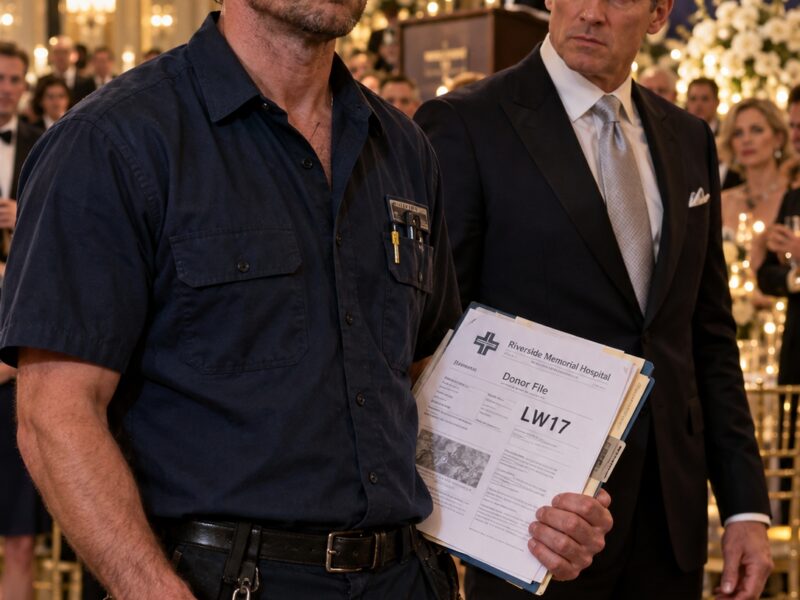
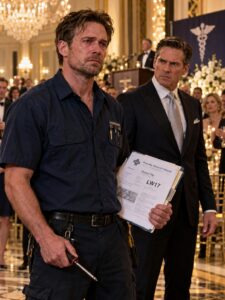
Beside the podium stood Corbin Vale, chief financial officer of Wickham Meridian, his silver tie perfectly centered and his expression still carrying the confidence of a man who believed he had just exposed something ugly.
At the back of the ballroom, beside a service door no guest had been meant to notice, stood Bram.
Navy maintenance shirt.
Work pants.
Old boots.
A screwdriver still in his right hand.
He had not even come to the gala as a guest.
Twenty minutes earlier, somebody from events had called Facilities because the keynote microphone kept cutting out.
Bram had been three floors below replacing a relay in an automatic door when his supervisor shouted across the maintenance shop.
“Mercer. Ballroom. Audio problem.”
So Bram had grabbed his tools.
That was all.
He had walked into a room filled with people whose watches cost more than his truck, fixed the loose connection beneath the stage, tested the microphone, and been preparing to leave when Corbin Vale saw him.
Then everything changed.
“A hospital maintenance technician,” Corbin had said into the microphone, “becomes personally close to one of the most powerful chief executives in the country after secretly donating blood products to her for years.”
A murmur had moved across the room.
Corbin looked directly at Bram.
“And we’re expected to believe he wanted nothing?”
Bram had said nothing.
Not because he was ashamed.
Because some accusations became smaller when you refused to kneel in front of them.
Corbin had continued.
“Miss Wickham, no one is questioning your compassion. We are questioning his intentions.”
That was when Lenora stepped away from the podium.
Now she was looking directly at Bram.
“Do you remember the first thing I ever said to you?”
Bram’s fingers tightened slightly around the screwdriver.
He remembered.
Of course he remembered.
“I do.”
“Tell them.”
A few people shifted in their chairs.
Bram looked around the ballroom once.
Then he looked back at Lenora.
“You asked if you could sit with me.”
Lenora nodded.
“That was all.”
Corbin gave a quiet, humorless laugh.
“And that proves what?”
Lenora turned toward him.
“It proves that when I sat down beside Bram Mercer, I believed I was meeting him for the first time.”
The smile remained on Corbin’s face.
For approximately two seconds.
Then Lenora said, “I was wrong.”
Somewhere near the wall, a server set a glass onto a tray.
The tiny click seemed impossibly loud.
Bram’s jaw tightened.
Lenora looked at him again.
Her voice changed.
Softer now.
Almost private.
“What I didn’t know was that I had already been carrying a part of this man with me for seven years.”
Nobody whispered after that.
Nobody moved.
Even Corbin stopped smiling.
And three months earlier, Lenora Wickham had not known Bram Mercer’s name.
Bram’s Thursdays began before sunrise.
At 5:20 every morning, the alarm on his phone vibrated against the wooden nightstand in a small house outside Asheville, North Carolina.
He always grabbed it before the sound could wake Willow.
At ten, his daughter could sleep through thunderstorms, barking dogs, and most Saturday lawn equipment.
But somehow Bram’s alarm could wake her through two walls.
He pulled on jeans, made coffee strong enough to qualify as industrial solvent, packed Willow’s lunch, checked the note on the refrigerator reminding him she needed poster board for Monday, and stood for a moment in the kitchen while darkness pressed against the windows.
There had been a time when another coffee mug sat beside his.
He no longer let himself look at the empty place where it used to be.
By 6:10, Bram was driving his faded Ford Ranger through the Blue Ridge foothills toward St. Alden Community Hospital.
At forty-two, Bram Mercer was the kind of man most people noticed only when something stopped working.
Patient lift stuck?
Call Bram.
Automatic doors refusing to open?
Bram.
Ventilation making a sound nobody liked?
Bram.
Monitoring cart with a bad power connection?
Bram.
He fixed what failed, signed the work order, put his tools away, and moved to the next problem.
He preferred it that way.
Machines were easier than people.
A machine rarely pretended to be something it wasn’t.
A damaged wire did not smile at you while planning to betray you.
A broken motor did not tell you everything was fine because it was afraid of making you uncomfortable.
Things failed honestly.
People were more complicated.
Quiet suited Bram.
Quiet paid the mortgage.
Quiet let him raise Willow without having to explain every scar life had left behind.
But every few weeks, sometimes before his shift and sometimes afterward, Bram crossed the hospital campus to the regional blood center.
On one Thursday morning, Marabel Ortiz looked over his chart.
“Same recipient preference?”
Bram leaned back in the donation chair.
“You ask me that every time.”
“And every time you avoid answering like you’re testifying before Congress.”
Bram glanced at the small code near the bottom of the file.
LW17.
Seven years.
He had seen those letters for seven years.
Never a face.
Never a name.
Never an occupation.
Just letters and numbers.
“If they still need me,” he said, “then yes.”
Marabel studied him.
“You’re never curious?”
“About what?”
“Who keeps receiving your platelets.”
Bram looked toward the collection machine.
“Would knowing their name make this work better?”
“No.”
“Then I’m good.”
Marabel shook her head.
“You’re strange, Mercer.”
“I repair hospital toilets. Mystery is all I have left.”
She laughed and connected the tubing.
The machine began its familiar hum.
Morning sunlight stretched across the polished floor.
Bram watched it for a moment.
He had started donating after his wife died.
Not because somebody had inspired him.
Not because he had experienced some grand revelation about the meaning of life.
Grief had simply left him with too much silence.
And nowhere useful to put it.
Then the blood center discovered he was an unusually strong match for one particular patient.
LW17.
Sometimes the requests came months apart.
Sometimes weeks.
During one terrible year, they came frighteningly often.
Bram never asked why.
If the phone rang and he could come, he came.
Once, Willow had found his donor card inside the truck console.
“Who’s LW?”
Bram had glanced at the initials.
“Someone who needs a Thursday more than I do.”
Willow had considered that for perhaps three seconds.
Then she nodded.
“Okay.”
Children sometimes understood grace before adults decided grace required an explanation.
That same afternoon, eighteen miles away, Lenora Wickham entered St. Alden Community Hospital wearing a cream-colored suit and the expression of a woman who had spent four consecutive hours hearing phrases like strategic alignment, scalable infrastructure, and long-term stakeholder value.
At thirty-eight, Lenora ran Wickham Meridian, a medical technology company with operations across the United States.
People stood when she entered rooms.
Assistants memorized her schedule to the minute.
Executives rehearsed before speaking to her.
Lawyers studied her face while talking, adjusting sentences in real time depending on whether she raised an eyebrow.
Financial magazines had called her brilliant.
Competitors had called her ruthless.
One former board member had called her impossible.
Lenora privately thought the last description might have been the most accurate.
She had almost everything money could provide.
What she had very little of was anything that arrived without an agenda.
By noon, she wanted ten minutes in which nobody needed her approval.
So she slipped away from her team.
No assistant.
No hospital president.
No Corbin Vale asking whether she had reviewed the revised partnership projections.
Just ten minutes.
The cafeteria was crowded.
Nurses filled several tables. Families occupied most of the rest.
Near the windows, Lenora spotted one empty chair.
Across from it sat a man wearing a navy maintenance shirt.
Beside him was a freckled girl arranging French fries into a star.
Lenora stopped.
The man looked up.
So did the girl.
Lenora touched the back of the empty chair.
“Can I sit with you?”
The man glanced at it.
“Chair’s free.”
The girl immediately pointed at his tray.
“But his fries aren’t.”
Lenora blinked.
Then she laughed.
Not the controlled laugh she used at charity dinners.
A real one.
The man pushed the ketchup toward her.
“She takes food security seriously.”
“I respect that.”
Lenora sat down.
That should have been the end of it.
Five minutes.
Maybe ten.
Instead, twenty minutes later, she was still there.
The girl introduced herself as Willow Mercer, age ten, artist, soccer player, and—according to her father—an unreliable witness regarding household rules.
The man was Bram Mercer.
Facilities maintenance.
Lenora glanced at his badge.
“What do you fix?”
Bram looked toward a vending machine rattling ominously near the wall.
“Whatever people ignore until it stops working.”
Something about that answer stayed with her.
Lenora spent her life around people who introduced themselves with titles.
Degrees.
Awards.
Valuations.
Connections.
Bram described himself by what needed doing.
Eventually Lenora leaned back.
“You really don’t know who I am, do you?”
Bram wiped his hands on a paper napkin.
“Should I?”
Willow looked up.
“Dad doesn’t know famous people.”
“I know Dolly Parton.”
“Everybody knows Dolly Parton.”
Lenora laughed again.
It escaped before she could control it.
She extended her hand.
“Lenora Wickham.”
Bram shook it once.
“Bram Mercer.”
“Lenora is too formal,” she said. “Nora is fine.”
Willow lifted her pencil.
“Willow Mercer. Ten. Better artist than him.”
“That’s a low bar,” Bram said.
Willow returned to drawing.
Nobody asked Lenora about Wickham Meridian.
Nobody mentioned her net worth.
Nobody wanted a business card.
For twenty minutes, she was simply a woman eating lunch with a father and his daughter.
Then two hospital administrators entered.
One recognized Lenora instantly.
His posture changed.
“Miss Wickham. We didn’t realize you were down here.”
“I was having lunch.”
“Of course.”
His eyes shifted toward Bram’s maintenance shirt.
Then toward Willow’s backpack.
It lasted perhaps one second.
But Bram saw it.
Lenora saw Bram see it.
The administrator smiled again.
“We’re ready whenever you are.”
“Thank you.”
When he walked away, Lenora looked at Bram.
“Does that happen often?”
“What?”
“People deciding who belongs at a table.”
Bram folded his napkin.
“People decide a lot of things before they know anything.”
No bitterness.
That made the words land harder.
Before Lenora could answer, Willow pushed her notebook across the table.
“I drew you.”
Lenora looked down.
Three people sat beneath an oversized window.
Bram had square shoulders and a coffee mug.
Willow had wild hair.
Lenora appeared to be wearing a cape.
“Why do I have a cape?”
“You look important.”
Bram leaned closer.
“You gave me stick arms.”
“You made me redo fractions.”
“Justice is complicated.”
Lenora smiled.
Photographers had spent hours arranging light around her face.
Corporate artists had painted formal portraits for anniversary walls.
Yet a ten-year-old who had known her for half an hour had somehow drawn her looking more relaxed than she had felt in years.
“Can I keep it?”
Willow immediately pulled the notebook back.
“Not yet.”
Lenora raised an eyebrow.
“That sounds expensive.”
“You have to come back.”
“Willow,” Bram warned.
“She asked the price.”
Lenora met Willow’s eyes.
“Deal.”
Bram shook his head.
“You don’t have to promise children things because they’re good negotiators.”
“I negotiate for a living.”
“Then you should know better.”
Lenora’s assistant appeared in the doorway.
“Miss Wickham, the hospital president is waiting. Presentation begins in six minutes.”
Lenora stood reluctantly.
Willow tapped the drawing.
“Until you come back.”
“Until I come back.”
Bram gave her a polite nod.
The kind that ended conversations without making a scene.
For reasons Lenora couldn’t explain, it bothered her.
Upstairs, her title returned immediately.
Glass walls.
Architectural renderings.
Financial projections.
Everyone stood when she entered.
Corbin Vale sat two chairs away.
Silver tie.
Perfect posture.
Perfectly controlled face.
“Everything all right?”
“Fine.”
“You disappeared.”
“I ate lunch.”
“With maintenance staff.”
Lenora looked at him.
“With Bram and his daughter.”
Corbin’s mouth curved.
“You learned their names.”
“That usually happens when people speak to each other.”
He said nothing.
But judgment had already entered the room.
Lenora opened the expansion packet.
On the first page was a photograph of hospital employees standing beside a construction site.
Executives occupied the center.
Bram stood near the edge holding a toolbox, almost cropped out.
Everyone else was looking at the camera.
Bram was looking toward the building.
As though something inside still needed fixing.
Lenora caught herself staring.
She closed the packet.
Across campus, Bram was finishing a work order when Marabel stepped into the hallway.
“Bram.”
One look at her expression changed his.
“What happened?”
“Nothing yet. Another match request came through.”
She showed him the label.
LW17.
“Already?”
“They want platelets available sooner than expected.”
Bram was silent.
“You were just here,” Marabel said. “You don’t have to say yes every time.”
Bram looked at the code.
“Neither does whoever’s still fighting.”
Then he picked up his toolbox.
“Call me when you have the time.”
Upstairs, Lenora’s phone vibrated.
She nearly ignored it.
Then she saw the sender.
Kesler Hematology Associates.
Annual follow-up reminder.
Her fingers stopped.
For one moment, the boardroom disappeared.
She remembered fluorescent lights.
A machine humming beside a hospital bed.
A nurse whispering a sentence she had heard more times than she could count.
Your match donor came through again.
Lenora locked her phone.
She looked through the glass wall toward the hospital floors below.
For seven years, she had wondered about the stranger behind those donations.
That afternoon, he was less than two hundred feet away.
She simply did not know it yet.
Lenora returned to St. Alden the following week.
Officially, she was there for an infrastructure review.
Unofficially, she had begun lying to herself.
The meeting could easily have been handled by someone else.
She knew that.
Her assistant knew it.
Corbin definitely knew it.
“You’re spending a surprising amount of time here,” he said as they crossed the lobby.
“It’s a major investment.”
“It was a major investment last week.”
Lenora stopped.
“Is there a question hidden in there?”
Corbin smiled.
“Just an observation.”
“Then observe quietly.”
Ten minutes later, the conference-room projection screen jammed.
An administrator reached for the phone.
The door opened before he finished dialing.
Bram stepped inside carrying a tool bag.
Lenora looked up too quickly.
Corbin noticed.
So did Bram.
“Morning,” Bram said.
The administrator pointed toward the ceiling.
“The screen refuses to come down.”
Bram climbed a small ladder and removed a panel.
Lenora attempted to read the report in front of her.
She lasted twelve seconds.
“Do you always repair things this fast?”
Bram didn’t look down.
“Only when people are watching.”
Several people laughed.
“So you perform under pressure?”
“No. I charge extra for an audience.”
Lenora smiled.
Corbin did not.
The motor clicked.
The screen lowered.
Bram climbed down.
“Anything else?”
Lenora looked at him.
“Actually, yes.”
Corbin’s eyes shifted toward her.
Bram waited.
“I owe your daughter a return visit.”
“That sounds like a problem between you and Willow.”
“She drew a legally binding contract.”
“She gets that from television.”
“I was thinking lunch.”
Bram zipped his bag.
“You asking me or her?”
“Both.”
He studied Lenora.
Not suspicious.
Not impressed.
Careful.
“Saturday. Twelve-thirty. Blue Ridge Diner.”
“Is that an invitation?”
“It’s where we eat.”
“Good enough.”
Corbin waited until Bram left.
“You realize people will notice.”
Lenora closed her folder.
“People notice expensive shoes. It doesn’t make shoes interesting.”
Saturday arrived cool and bright.
Lenora came alone.
No driver.
No assistant.
No security detail visible from the diner.
She parked a rented sedan beside Bram’s faded Ranger.
Through the window, Willow saw her first.
The girl waved both arms like she was directing an aircraft.
Bram turned.
For the smallest moment, he looked surprised Lenora had actually come.
“You came back,” Willow announced.
“I said I would.”
Willow pulled the drawing from her backpack.
“Then it’s yours.”
Lenora accepted it more carefully than she had accepted awards worth thousands of dollars.
“Thank you.”
Bram handed her a menu.
“Do chief executives eat pancakes?”
“Only during hostile takeovers.”
Willow frowned.
“What’s a hostile takeover?”
Bram answered immediately.
“Something you’re not learning before dessert.”
Breakfast became lunch without anyone noticing.
Willow talked about soccer and school and a science project involving bean plants.
Bram listened more than he spoke.
Lenora found herself talking about Boston winters, terrible airport coffee, and the first job she had held before anybody cared about her last name.
Nothing strategic.
Nothing useful.
Just pieces of herself.
When the check arrived, Lenora reached for it.
Bram got there first.
“I invited you.”
“Technically Willow did.”
“My dependent. My liability.”
“Dad.”
“Legal terminology.”
Outside, Willow ran toward a mural painted along the brick wall.
Lenora slowed beside Bram.
“You make ordinary things look easy.”
Bram watched his daughter.
“They aren’t easy.”
He put his hands into his jacket pockets.
“They’re just worth doing.”
His phone buzzed.
He glanced at it.
Blood Center Appointment Confirmation.
Thursday, 3:30 p.m.
Lenora saw only the logo before he locked the screen.
Something old stirred inside her.
A white hospital room.
A humming machine.
Your donor came through.
She looked at Bram.
Then at his phone.
The thought was absurd.
So she dismissed it.
But for the first time, the distance between Bram Mercer and LW17 felt smaller than it should have.
The invitations became ordinary after that.
That was what made them dangerous.
A soccer game.
Coffee near the loading dock.
A Saturday science project at Bram’s kitchen table.
Hot chocolate on folding chairs beside a public field.
Nothing looked like romance.
That was precisely why Lenora trusted it.
At Willow’s soccer game, nobody recognized her.
A mother sitting two chairs away complained about the cold without realizing she was talking to a billionaire.
Lenora complained back.
Bram handed her hot chocolate.
“You like this?” he asked.
“What?”
“Not being recognized.”
Lenora watched Willow chase the ball.
“I like not having to perform.”
Bram nodded.
“Different thing.”
Those two words followed her home.
That night, her penthouse seemed larger than usual.
City lights glittered beyond the windows.
The refrigerator hummed in a kitchen designed for entertaining people she rarely invited over.
Lenora set Willow’s drawing on the counter.
Three people.
One crooked table.
A ridiculous cape.
She stared at it longer than she meant to.
Two days later, she sat across from Dr. Miriam Kesler.
“Everything looks stable,” Miriam said.
Lenora exhaled.
“Good.”
“Your counts are strong. Better than last year.”
Lenora touched the faint scar near the inside of her arm.
“Do you ever hear from the donor program?”
Miriam looked up.
“The same donor?”
Lenora nodded.
“You’ve asked before.”
“I know.”
“And the answer is still the same. Identity stays protected unless both parties consent.”
“I just wondered if he still donates.”
Miriam closed the file.
“Some people disappear after one donation.”
“And some?”
“Some stay for years.”
At that exact moment, four floors below, Bram sat beneath the soft hum of a collection machine.
His sleeve was rolled above his elbow.
Marabel checked the line.
The code on the screen read LW17.
Neither of them knew how close the truth had come to introducing itself.
Then the storm hit.
By late afternoon, rain hammered the hospital windows hard enough to erase the mountains.
Bram had just finished donating when the lights flickered.
Once.
Twice.
Then darkness.
Emergency lights snapped on.
A low alarm sounded somewhere above.
Bram was already moving.
He called Hollis.
“Tell me the generators caught it.”
“Most of the building is stable. East wing isn’t transferring clean. Equipment is dropping to battery.”
“I’m coming.”
Four floors above, Lenora stepped from Dr. Kesler’s office as the corridor dimmed.
The elevators stopped.
Nurses moved faster.
Portable batteries appeared.
Nobody panicked.
That frightened Lenora more than panic would have.
Then Bram pushed through the double doors carrying a tool bag.
His hair was damp.
A white bandage showed beneath his rolled sleeve.
Lenora noticed it.
“Bram.”
He looked at her.
“You should stay clear of this hall.”
“What happened?”
“Transfer switch is cycling.”
“Can I help?”
“Yes.”
The answer surprised her.
“How?”
He pointed toward a nurse.
“Stay with her and do exactly what she asks.”
No special treatment.
No CEO voice.
Just a job.
For twenty minutes, titles disappeared.
Lenora carried sealed battery packs.
Nurses checked monitors.
Hollis called circuit numbers.
Bram worked inside the electrical panel with calm, precise movements.
“Circuit three?”
“Holding.”
“Five?”
“Unstable.”
“Bypass?”
“Not yet.”
The corridor smelled of antiseptic, rain, and warm plastic.
Bram closed his eyes.
Listened.
Then opened them.
“Now.”
Hollis reset the transfer.
White light returned from one end of the hallway to the other.
Nobody cheered.
They simply breathed again.
Later, with the storm still making the roads unsafe, Lenora found Bram sitting on the floor beside a vending machine.
He held up a packet of peanut-butter crackers.
“Dinner?”
She looked at the expensive suit she was wearing.
Then sat on the floor beside him.
“You really know how to impress a woman.”
“Wait until dessert.”
“What’s dessert?”
“More crackers.”
“Different flavor?”
“If we’re lucky.”
She laughed.
For several minutes, they listened to the rain.
Then Lenora said, “I spent a lot of time in hospitals when I was younger.”
Bram turned toward her.
She had never told him that.
“How much time?”
“Enough to memorize ceiling tiles.”
Her smile faded.
“I had a blood disorder.”
Bram’s hand stopped.
“There were years when every good test result felt temporary.”
“What years?”
“It started when I was twenty-nine. The worst lasted almost four years.”
Bram did the arithmetic before he could stop himself.
Seven years.
Blood disorder.
Platelets.
His eyes dropped to the bandage on his arm.
LW17.
“You’re all right now?”
“Stable.”
“That’s good.”
“I was lucky.”
Lenora looked toward the rain.
“I had excellent doctors. And a matched donor who kept showing up whenever I needed platelets.”
Bram stared at the unopened cracker packet in his hand.
“You never met him?”
“No.”
“Do you want to?”
Lenora thought about it.
“I used to.”
“And now?”
“I’m not sure.”
“Why?”
She turned toward him.
“How do you thank somebody for giving you time?”
Bram’s throat tightened.
“Maybe you don’t.”
Lenora frowned.
“What do you mean?”
He forced himself to meet her eyes.
“Maybe they didn’t give it so you’d owe them anything.”
The corridor suddenly felt very still.
Lenora studied his face.
But Bram looked away.
That night, he barely slept.
He sat at his kitchen table long after Willow went to bed.
Seven years.
Twenty-nine.
Platelets.
Matched donor.
It could be coincidence.
He told himself that repeatedly.
It sounded less convincing each time.
The next morning, he visited Marabel.
“Can I ask you something?”
“That sounds serious.”
“LW17.”
Her expression changed.
“I know you can’t tell me who they are.”
“Correct.”
“Can you tell me if the recipient is local?”
“Bram.”
“I’m not asking for a name.”
“You’re asking me to help you find one.”
He looked down.
Marabel softened.
“Why now?”
“I met someone.”
She waited.
“She was sick around the same time. Same treatment. Same timeline.”
“That doesn’t prove anything.”
“I know.”
“Then leave it alone unless the program contacts you.”
Bram nodded.
“That’s what I figured.”
He turned.
Marabel called after him.
“For what it’s worth, you did this right for seven years. Don’t let one possibility change why you did it.”
Bram looked back.
“It doesn’t.”
And he meant it.
The problem wasn’t that Lenora might be LW17.
The problem was what would happen if she learned he was the donor.
Because gratitude could imitate love.
Debt could imitate loyalty.
And Bram would rather lose the possibility of Lenora choosing him than spend the rest of his life wondering whether she had ever been free to choose at all.
Lenora noticed him pulling away.
At first, it was small.
Longer pauses before answering messages.
Less eye contact.
Invitations that suddenly stopped.
At Willow’s science-project afternoon, she finally confronted him.
“Did I say something the other night?”
Bram gathered spilled soil from the table.
“No.”
“Then why do I feel like you’ve been stepping backward ever since?”
“I’m usually backward.”
“That isn’t funny.”
He stopped.
Willow was upstairs looking for markers.
Lenora lowered her voice.
“Tell me what changed.”
“Nothing.”
“That’s not true.”
Bram looked toward the stairs.
“Maybe I’m trying to be careful.”
“With what?”
“With both of us.”
Lenora’s expression hardened.
“That sounds like something people say right before deciding what’s best for someone else.”
“I’m not deciding anything for you.”
“Then tell me.”
He could have.
He could have said LW17.
He could have told her the dates.
The blood center.
The bandage she had seen.
Instead, he said nothing.
Lenora laughed once.
No humor in it.
“Every time I get close, you take one step back.”
Bram’s voice dropped.
“Maybe I’m trying not to let you owe me something.”
She stared at him.
“What?”
The refrigerator hummed.
Tree branches scraped against the window.
“What does that mean?”
“Nothing.”
“That makes even less sense.”
He looked away first.
Lenora left soon after.
By Monday, her casual messages stopped.
Bram noticed because he had started expecting them.
A photograph of terrible airport coffee.
A complaint about meetings.
A picture of Willow’s bean plant.
Nothing came.
He told himself distance was better.
Then Corbin Vale found the first thread.
Wickham Meridian’s legal team had been reviewing St. Alden partnership records.
Bram’s name appeared in documentation connected to a long-running donor program.
It should have meant nothing.
Corbin kept looking.
Seven years of donations.
Repeated match requests.
Dates overlapping almost perfectly with Lenora Wickham’s private medical history.
Corbin had known about her illness for years.
He saw the pattern.
Then he made the mistake people often make when they discover half a truth.
He decided he understood the whole thing.
On Wednesday afternoon, he entered Lenora’s office carrying a thin folder.
“You need to see this.”
Lenora didn’t look up.
“If this is about Bram, leave.”
“It is.”
Her eyes lifted.
Corbin placed the folder on her desk.
“He’s been donating platelets through St. Alden for years.”
Lenora stared at the first page.
Her fingers went cold.
Corbin continued.
“Your matched donations came through St. Alden.”
She looked up.
“Say what you’re trying to say.”
“Same years. Same donation pattern. Same hospital.”
The room seemed to shrink.
“You’re guessing.”
“Maybe.”
Corbin turned a page.
“But ask yourself something.”
Lenora said nothing.
“Why did a man who supposedly wanted nothing from you become close to you after you arrived at the hospital?”
“He didn’t approach me.”
“That doesn’t mean he didn’t know.”
“Enough.”
“You’re a chief executive, Lenora. People build careers around learning what you need before you know you need it.”
“Bram isn’t ‘people.’”
Corbin’s voice softened.
“That is exactly what worries me.”
An hour later, Lenora found Bram beneath a sink in a maintenance room.
He looked up.
One glance at her face was enough.
“Lenora.”
She closed the door.
“How long?”
Bram slowly stood.
“How long what?”
“Have you been donating platelets?”
Silence.
Too long.
Her voice dropped.
“Bram.”
“Seven years.”
Her breath caught.
“Were you my donor?”
“I don’t know for certain.”
“Don’t do that.”
“I’m telling you the truth.”
“Did you suspect?”
He hesitated.
That hesitation hurt more than the answer.
“Recently.”
“How recently?”
“After the power outage.”
Lenora stepped backward.
“You knew.”
“I suspected.”
“And you said nothing.”
“It wasn’t mine to tell.”
“It was my life.”
“And my donation.”
The words stopped her.
Bram immediately softened.
“I didn’t know your name when I started. I didn’t know your company. I didn’t know anything about you.”
“But you knew before I knew.”
“Maybe.”
“And you let me keep coming back.”
“I never asked you to.”
The sentence struck harder than Bram intended.
Lenora stared at him.
“That isn’t the point.”
“Then tell me the point.”
“The point is every conversation we had—every lunch, every game, every time I thought you were pulling away—you were carrying something I couldn’t understand.”
“Because I didn’t want it changing what this was.”
“What was it?”
Bram looked directly at her.
“Something you chose.”
Her anger faltered.
“If I told you, every dinner becomes gratitude. Every phone call becomes obligation. Every time you sit beside me, I have to wonder whether you’re there because you want to be or because you think you owe me.”
Lenora’s eyes shone.
“You should have trusted me to know the difference.”
“I was trying to protect the difference.”
“No.”
Her voice broke slightly.
“You were protecting yourself.”
Bram said nothing.
And that silence told her she was partly right.
She opened the door.
“Corbin thinks you knew before we met.”
Bram’s expression changed instantly.
“I didn’t.”
“I want to believe you.”
“Then believe me.”
Lenora looked back.
“I don’t know what to believe right now.”
The door closed.
Softly.
That somehow made it worse.
Bram stood alone among pipes and tools.
For seven years, giving had been simple because nobody knew his name.
Now the truth had found him.
And the thing he had done without asking for anything was threatening to take away the one person he had begun wanting something from.
Lenora didn’t sleep.
Corbin’s folder sat on the kitchen counter.
Beside it lay Willow’s drawing.
One told her to be suspicious.
The other reminded her who she had been before suspicion entered the room.
At eight the next morning, Lenora sat across from Dr. Miriam Kesler.
“I need the truth.”
Miriam folded her hands.
“About your donor?”
“About whether Bram Mercer knew who I was before we met.”
Lenora slid Corbin’s folder across the desk.
“I’m not asking you to violate privacy. I’m asking whether this makes sense.”
Miriam read.
One page.
Two.
Three.
Then she removed her glasses.
“No.”
Lenora stopped breathing.
“Why?”
“Because whoever built this timeline started with a conclusion and searched backward for evidence.”
Miriam turned to her computer.
“Your matched donations began seven years ago.”
She opened an older record.
“At that time, Bram Mercer had no access to your medical records, no connection to Wickham Meridian, and no reason to know your identity.”
Lenora stared at her.
“You know it was him.”
“The donor program received mutual-consent authorization this morning.”
“What?”
“From Bram.”
Lenora’s chest tightened.
“He signed permission allowing me to answer if you came asking.”
Even now.
He had not come looking for credit.
He had simply opened the door and left the choice to her.
Miriam continued.
“His first donation matched you by chance. After that, when your physicians requested compatible platelets, the program contacted eligible donors.”
“And Bram?”
“He kept answering.”
“How often?”
Miriam turned the screen.
Dates filled it.
Lenora remembered some of them.
The winter she couldn’t climb stairs without resting.
The spring she spent six weeks pretending she wasn’t afraid.
The Christmas when she smiled through a company party knowing she had a hospital appointment the next morning.
“How many?”
“During your worst year?”
Miriam paused.
“Eleven.”
Lenora looked toward the window.
Rain slid down the glass.
“Why would someone do that for a stranger?”
Miriam studied her.
“You’re asking the wrong question.”
“What should I ask?”
“What did he ask for in return?”
Lenora already knew.
Nothing.
Miriam opened another record.
“There’s something else.”
Lenora looked back.
The date on the screen was six years earlier.
She recognized it immediately.
Her platelet count had collapsed that week.
Doctors had discussed intensive care.
“Your hospital requested an urgent matched collection.”
Miriam hesitated.
“Bram donated that afternoon.”
Lenora waited.
Miriam’s face changed.
“His wife had died three days earlier.”
The room lost its air.
Lenora stared at her.
“Three days?”
“Yes.”
“No.”
“The staff offered to reschedule him.”
Miriam looked at the record.
“He refused.”
Lenora covered her mouth.
For seven years, she had imagined her anonymous donor in vague pieces.
Generous.
Healthy.
Maybe retired.
Maybe someone with endless time.
She had never imagined a grieving husband getting into an old truck three days after burying his wife and driving to a blood center because somewhere, a woman he would never meet was running out of platelets.
“Did he know I was wealthy?”
“No.”
“Did he know I ran Wickham Meridian?”
“No.”
“Did he ever ask who I was?”
Miriam shook her head.
“No.”
Three answers.
Three doors closing on Corbin’s accusation.
Then Miriam said something Lenora would remember for the rest of her life.
“Bram Mercer didn’t enter your life because he donated to you.”
Lenora looked up.
Miriam’s voice softened.
“You entered his.”
Lenora looked down at her hands.
Hands that had signed billion-dollar agreements.
Hands that had fired executives.
Built factories.
Approved medical technologies designed to save lives.
Yet for seven years, an ordinary maintenance technician had been teaching her something her entire world had failed to explain.
Not all value announced itself.
Not all generosity sent an invoice.
Not everyone who gave wanted to be remembered.
“There’s one more thing,” Miriam said.
Lenora looked up.
“Bram asked me to give you this if the match was confirmed.”
She unfolded a small note.
The handwriting was plain.
Slightly uneven.
Miriam handed it over.
Lenora read.
You survived because you fought.
Her vision blurred.
I only had something useful on Thursdays.
Then the last line.
Please don’t turn that into a debt.
Lenora closed her eyes.
Of course.
Not I saved you.
Not remember what I did.
Not you owe me.
Just—
Please don’t turn it into a debt.
When Lenora left the office, she went directly to maintenance.
Hollis stood alone beside the workbench.
“Bram here?”
Hollis studied her face.
“No.”
“Willow okay?”
“She’s fine.”
“Then where is he?”
“Took the afternoon.”
“Why?”
Hollis glanced at Bram’s empty station.
“Sometimes a man needs a little quiet before people start telling him who he is.”
Lenora understood.
That evening, she sat alone at her dining table.
Corbin’s folder on one side.
Willow’s drawing on the other.
Corbin had seen seven years of donations and found a strategy.
Lenora looked at the crooked drawing.
She saw seven years of Thursdays.
And found character.
She called her assistant.
“Move tomorrow’s gala briefing to first thing.”
“Of course.”
“And add one person to the guest list.”
“Who?”
Lenora looked at Willow’s drawing.
“Bram Mercer.”
She did not know Corbin would make his accusation publicly the following evening.
But when he did, she would no longer be wondering whom to believe.
“Do you remember the first thing I ever said to you?”
The ballroom remained silent.
Bram stood near the service door.
Lenora faced him from the stage.
“You asked if you could sit with me,” he said.
Lenora turned toward the crowd.
“I asked Bram Mercer if I could sit at his table.”
Corbin shifted beside the podium.
“He didn’t know my name.”
Silence.
“He didn’t know my company.”
Another pause.
“He didn’t know my medical history.”
Corbin opened his mouth.
Lenora raised one hand.
“And seven years before that lunch, when I was sick enough to wonder whether I would see another spring, Bram Mercer was already walking into a blood center for someone he had never met.”
A reporter slowly lowered her phone.
Lenora continued.
“He never asked who I was.”
Bram looked at the floor.
“He never asked what I owned.”
Corbin’s face had gone pale.
“He never asked what I could do for him.”
Lenora’s voice softened.
“He simply knew somebody needed help.”
Nobody applauded.
That would have been easier.
Instead, silence settled over the ballroom.
Deep.
Uncomfortable.
Necessary.
It lasted long enough for everyone there to reconsider the story they had almost accepted.
Corbin finally looked at Bram.
“I didn’t have the full information.”
Bram spoke for the first time.
“No.”
His voice was quiet.
“You had enough information to decide what kind of man you thought I was.”
Corbin lowered his eyes.
Lenora turned toward him.
“Your position at Wickham Meridian will be reviewed.”
Corbin looked up.
“Lenora—”
“Not because you questioned me.”
She stepped closer.
“You should question me. That is part of your job.”
Then her expression hardened.
“But you used another man’s private generosity as evidence against his character because his job title made suspicion easier for you than respect.”
Corbin said nothing.
“There is a difference between protecting a company and humiliating someone you consider beneath it.”
He nodded once.
There was nothing left to argue.
Bram turned toward the service door.
Lenora watched him leave.
Then followed.
The hallway outside the ballroom was almost silent.
“You’re leaving?”
Bram lifted the screwdriver.
“Microphone works.”
“Bram.”
He stopped.
Lenora approached him.
“Dr. Kesler told me everything.”
His expression tightened.
“Then you know why I didn’t tell you.”
“I do.”
She stopped a few feet away.
Close enough to speak quietly.
Far enough to leave him a choice.
“And you were wrong about one thing.”
Bram waited.
“Knowing what you did doesn’t make me want to stay because I owe you.”
His eyes shifted away.
Lenora smiled through tears.
“It makes me understand why I wanted to stay before I knew.”
For several seconds, Bram said nothing.
Then he looked at her.
“Nora.”
“What?”
“Gratitude can sound a lot like love when people are scared.”
The sentence hurt.
Not because it was cruel.
Because it was true.
Lenora nodded.
“Then don’t call it love.”
He frowned slightly.
“What do I call it?”
“Dinner.”
“Dinner.”
“Tuesday.”
A small smile appeared at the corner of Bram’s mouth.
“Willow has homework.”
“I’m excellent at fractions now.”
“That remains unverified.”
Lenora laughed.
From inside the ballroom came the distant sound of people talking again.
The world was restarting.
But neither of them moved immediately.
Bram looked at her for another moment.
Then said, “Tuesday.”
Not forever.
Not love.
Not a promise made under chandeliers because the moment demanded one.
Just Tuesday.
For Lenora, it was enough.
Three months later, Bram was sitting in the St. Alden cafeteria when Willow suddenly looked toward the entrance.
Her face lit up.
“She brought contraband.”
Bram turned.
Lenora was walking toward them carrying three chocolate milks.
No entourage.
No assistant.
No cream suit.
Jeans, boots, dark sweater.
Under one arm was an envelope.
“You’re late,” Willow said.
“Four minutes.”
“That’s late.”
“I run a national company.”
“That sounds like an excuse.”
Bram slid the empty chair out with his foot.
Lenora stopped.
For a second, she looked at it.
The same table.
The same window.
The same chair.
A great deal had changed.
And somehow almost nothing had.
She placed the chocolate milks down.
Then pulled three tickets from the envelope.
Willow grabbed them.
“Baseball?”
“Saturday.”
Bram narrowed his eyes.
“Those better not be expensive seats.”
“They’re behind home plate.”
“Nora.”
Willow held the tickets against her chest.
“Dad, dignity has limits.”
Lenora laughed.
Bram tried not to.
Failed.
Willow dropped into her seat.
Lenora remained standing beside the empty chair.
Then she looked at Bram.
“Can I sit with you?”
Bram stared at her.
Three months earlier, those words had been meaningless.
A stranger asking for an empty chair.
Now they contained a hospital room she had never seen him enter.
Seven years of Thursdays.
A dead wife.
A grieving husband.
A code called LW17.
A soccer field.
Peanut-butter crackers.
A maintenance room where both of them had said things they regretted.
A ballroom where the truth had finally become public.
And all the uncertainty still waiting ahead.
Bram looked at the chair.
Then at Lenora.
“You know you don’t have to ask anymore.”
Lenora nodded.
“I know.”
She pulled the chair out anyway.
Willow pushed one chocolate milk toward Bram, kept one for herself, and placed the third in front of Lenora.
Outside the window, late-afternoon sunlight stretched across the Blue Ridge foothills.
The table looked completely ordinary.
Three drinks.
A backpack.
A worn maintenance jacket hanging over one chair.
Baseball tickets beneath Willow’s hand.
Nothing about it suggested destiny.
Nothing looked like a miracle.
Maybe that was the point.
Lenora had spent most of her adult life in rooms designed to convince people that important things should look important.
Crystal chandeliers.
Black cars.
Glass towers.
Private offices.
Names engraved into walls.
Bram had spent his life repairing things nobody noticed until they failed.
Somewhere between those two worlds, he had quietly given a stranger eleven Thursdays in one terrible year and never once asked to see the face of the woman who received them.
Even when his wife died.
Even when his own house had gone silent.
Even when nobody would have blamed him for staying home.
He had simply shown up.
Years later, when that stranger finally appeared at his table, he had not recognized her.
And she had not recognized him.
Maybe kindness was supposed to be like that.
Not a contract.
Not leverage.
Not a debt waiting to be collected.
Just something placed quietly into another person’s life without knowing where it might travel.
Willow stabbed the straw into her chocolate milk.
“So are you coming Saturday or not?”
Bram looked at Lenora.
“I apparently don’t control this family anymore.”
“You never did,” Willow said.
Lenora smiled.
Bram shook his head.
Outside, the mountains darkened beneath the approaching evening.
People crossed the cafeteria carrying trays.
A nurse laughed near the vending machines.
Somewhere upstairs, an elevator probably needed servicing.
Tomorrow another work order would be waiting.
Another machine would fail.
Another ordinary Thursday would arrive.
And perhaps somewhere in the blood center, somebody would sit beneath fluorescent lights while a machine hummed and wonder about a stranger they might never meet.
Lenora lifted her chocolate milk.
Her eyes moved toward Bram.
There were still things between them they had not named.
Maybe there always would be.
Grief did not disappear because someone new sat at the table.
Fear did not disappear because the truth turned out beautiful.
And love—if that was eventually what this became—would have to be built from something stronger than gratitude.
Tuesday dinners.
Soccer games.
Arguments.
Silences.
Homework.
Bad coffee.
Ordinary choices repeated until they became a life.
Bram seemed to understand that too.
That was why neither of them made promises.
Not that afternoon.
They didn’t need to.
Lenora had once believed the most important thing Bram Mercer gave her was inside his blood.
She knew better now.
The greater gift was something harder to measure.
For seven years, without knowing her face, her money, her title, or whether she would ever thank him, Bram had behaved as though her life mattered.
And when he finally met her, he asked for nothing in return.
Not even love.
Willow began arguing that baseball required nachos.
Bram informed her that baseball did not “require” anything containing liquid cheese.
Lenora sided with Willow.
Bram accused them of forming an alliance.
Willow called it democracy.
Their voices blended with the ordinary noise of the cafeteria.
And Lenora looked once more at the chair beneath her.
The chair that had once been the only empty seat in a crowded room.
The chair between a billionaire and a maintenance man.
Between suspicion and trust.
Between gratitude and love.
Between two lives that had already touched long before either person knew the other existed.
That empty seat was no longer empty.
And this time, nobody had to ask why she belonged there.









