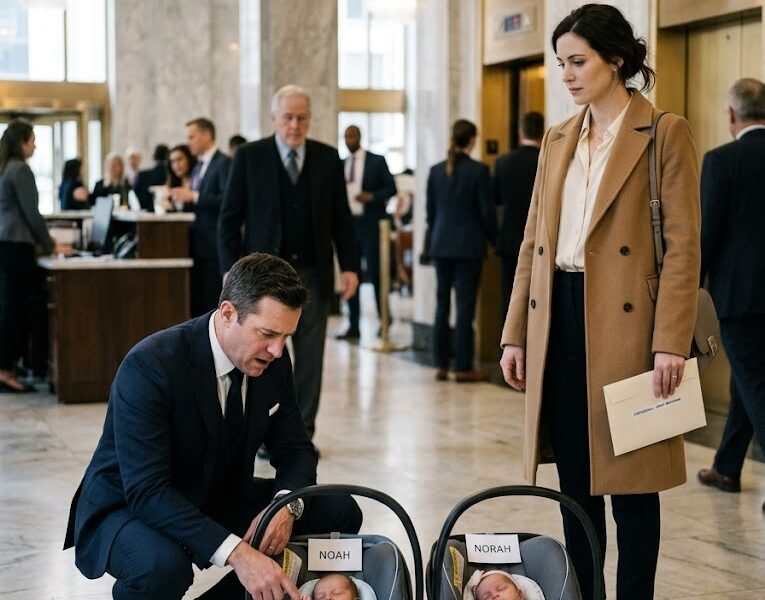
THE BILLIONAIRE CAME HOME AFTER 6 WEEKS—THEN HIS EX WHISPERED, “YOU SHOULD PROBABLY MEET YOUR CHILDREN”
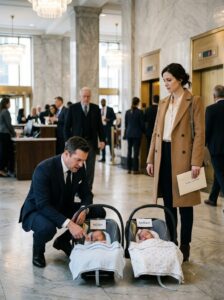
“You should probably meet your children.”
Grant Whitmore stopped in the middle of his own lobby.
For one impossible second, Whitmore Tower seemed to stop with him.
The revolving doors whispered shut behind his back. Shoes clicked across polished marble. Somewhere near reception, a phone rang twice before someone answered it. An elevator chimed.
But Grant heard none of it.
His eyes were fixed on Naomi Bennett.
And on the two infant carriers beside her.
Forty minutes earlier, Grant had stepped off a private flight from Paris believing the most complicated thing waiting for him in Manhattan was a nine-thirty acquisition meeting.
He had been gone six weeks.
London. Zurich. Milan. Paris.
Some of it business, some of it the first real vacation he had taken in years. At forty-one, Grant had built his life around the conviction that nothing truly dangerous could surprise a man who planned far enough ahead.
His company was expanding.
His investments were performing.
His calendar was booked three weeks out.
His penthouse had been cleaned before his arrival.
His driver had been waiting at the airport.
His chief of staff had reduced six weeks of problems into a twelve-page briefing packet.
Everything was exactly where Grant Whitmore had left it.
Or so he had believed.
Then he walked into the marble lobby of the skyscraper bearing his family name and found the woman he had spent nine months teaching himself not to miss.
Naomi stood beneath the pale morning light spilling through the forty-foot windows.
She was thirty-two now, although nine months had changed something in her face that had nothing to do with age.
She still carried herself the way Grant remembered—straight-backed, composed, elegant without trying. Her camel coat hung open over a cream blouse and dark trousers. Her hair was pulled loosely behind her shoulders.
She wasn’t crying.
That disturbed him more than tears would have.
She wasn’t angry, either.
She looked like a woman who had already survived whatever conversation they were about to have.
Beside her sat two identical infant carriers.
One baby slept beneath a pale blue blanket.
The other was wrapped in white fabric patterned with tiny silver stars.
Grant’s assistant, Evan, stopped several feet behind him.
“Mr. Whitmore?”
Grant didn’t answer.
Naomi did.
“Welcome home, Grant.”
Her voice was calm.
His wasn’t.
“Naomi?”
She held his gaze.
He looked at the carriers again.
Then at her.
Then back at the babies.
A strange pressure tightened behind his ribs.
“Whose children are these?”
Something flickered across Naomi’s face.
Not satisfaction.
Not revenge.
Sadness, perhaps.
Or disbelief that after everything, this was still the first question he needed answered.
She placed one hand on the handle of the blue carrier.
“You should probably meet your children.”
Grant Whitmore had negotiated against men who controlled governments.
He had walked away from a nine-figure deal while six attorneys shouted across a conference table.
He had once watched the stock price of his company lose four hundred million dollars in market value before lunch and never raised his voice.
But six quiet words from Naomi Bennett emptied his mind.
He stared at her.
Then at the babies.
Then back at her.
“My what?”
“Your children.”
The lobby suddenly felt too exposed.
Grant became aware of the receptionist pretending not to watch. Two executives slowed near the security gates. Evan had gone completely still behind him.
Naomi glanced toward the first carrier.
“His name is Noah.”
Then toward the second.
“And she’s Norah.”
Grant swallowed.
“They were born three weeks ago.”
Three weeks.
His mind did what it always did when emotion threatened to outrun reason.
It calculated.
Nearly nine months since Naomi had walked out of his penthouse.
Nearly nine months since two cups of coffee had gone cold on a kitchen island.
Nearly nine months since she had removed a brass key from her ring, placed it on the stone counter, and left him standing behind her.
Grant counted backward.
Once.
Then again.
The dates worked.
His stomach dropped.
Norah shifted beneath the silver-star blanket.
Noah opened his eyes.
Grant moved before he consciously decided to.
One step.
Then another.
He stopped beside the carrier and stared down at the tiny face beneath the blue blanket.
There was nothing rational about what happened next.
Nothing measurable.
Nothing he could put into a report.
The baby’s eyes moved without focus, searching the light.
Grant lowered one hand.
Stopped.
His fingers suddenly felt too large.
Too clumsy.
He extended one finger instead.
Noah’s tiny hand closed around it.
Grant forgot to breathe.
The grip was weak.
Instinctive.
Barely there.
It still felt stronger than anything that had touched him in years.
Naomi watched him.
She did not smile.
“I’m not here for your money,” she said.
Grant kept looking at Noah.
“I’m not here to embarrass you. And I’m not here because I want something from Whitmore Development.”
His eyes finally lifted to hers.
“Then why are you here?”
“Because they deserve the truth.”
Naomi reached into her leather bag.
She removed a sealed envelope and held it toward him.
Grant took it.
“What is this?”
“Copies of their birth information. My contact information. And an accredited paternity laboratory here in Manhattan.”
That word broke whatever fragile spell Noah’s hand had created.
Paternity.
Grant straightened.
“You already arranged a test?”
“I arranged the option.”
His jaw tightened.
Naomi saw it.
“You’re allowed to ask for certainty, Grant.”
There was enough history in that sentence to make him flinch.
He looked down at the envelope.
Then back at her.
“Why now?”
For the first time, something sharpened in Naomi’s eyes.
“I didn’t wait until now.”
Grant went still.
“What does that mean?”
“It means I tried to tell you before they were born.”
Noah was still holding Grant’s finger.
The sentence entered him slowly.
Then all at once.
“I never heard from you.”
“I know.”
“No. I mean I never received anything.”
Naomi studied him.
For the first time since he’d entered the building, her composure cracked just enough for him to see what was beneath it.
Months of exhaustion.
Months of disappointment.
Months of believing something about him that Grant suddenly desperately wanted to be untrue.
“I sent you two emails,” she said. “I called your private number. It had been disconnected. I called this building and left my name and phone number.”
Grant stared at her.
Naomi’s voice dropped.
“The second email literally said, ‘This concerns your children.’”
Something cold moved through him.
“I never saw it.”
Naomi’s eyes didn’t leave his.
“Then maybe you should find out why.”
And in that moment, standing beneath his own name carved into marble, Grant Whitmore understood that the two newborn babies in front of him might not be the only truth waiting to dismantle his life.
Because if Naomi was telling the truth—
someone, somewhere, had kept him from knowing he was a father.
And Grant had no idea yet that the person responsible was himself.
Nine months earlier, Naomi Bennett had not needed Grant Whitmore.
That was probably the first thing about her that made him unable to forget her.
By thirty-two, Naomi had built a respected career in commercial interior design and historic preservation. She had her own clients, her own apartment on the Upper West Side, her own savings, and a professional reputation that existed long before gossip columns occasionally photographed her beside one of Manhattan’s wealthiest developers.
She met Grant during the redesign of a Whitmore property in Midtown.
He arrived at the unfinished lobby surrounded by architects, executives, consultants, and people whose careers had taught them that Grant Whitmore preferred solutions over objections.
The design was dramatic.
Black stone.
Polished steel.
Towering glass.
Lighting expensive enough to make everyone involved very proud of themselves.
Grant stood in the center of the unfinished space and asked Naomi what she thought.
She studied it for several seconds.
“It looks expensive.”
His architect smiled.
Then Naomi added, “But it feels like an airport terminal after midnight.”
The smile disappeared.
Grant turned toward her.
“Excuse me?”
She pointed toward the rendering.
“Everything is designed to impress someone standing still for a photograph. Nothing makes me want to sit down.”
“You were hired to consult on preservation.”
“I was.”
“Not furniture.”
“Then don’t ask what I think.”
Someone coughed behind them.
Grant stared at her.
Naomi calmly closed her folder.
He should have been irritated.
Instead, to everyone’s surprise, he asked, “What would you change?”
That was the beginning.
She showed him warmer wood against the restored stone. Softer lighting. Seating arranged around human behavior rather than symmetry. Original architectural details the previous team wanted to cover.
“People don’t experience buildings through spreadsheets,” she told him.
Grant glanced at her.
“Everything eventually becomes a spreadsheet.”
Naomi smiled.
“That sounds exhausting.”
Months later, the finished property received glowing reviews.
Grant remembered none of them as clearly as he remembered Naomi standing in the unfinished lobby telling a billionaire his building felt lonely.
He asked her to dinner.
She looked up from her laptop.
“Is this related to the project?”
“No.”
“Then you’re asking a consultant working with your company on a date.”
“You work with my company. You don’t work for me.”
Naomi narrowed her eyes.
“You’ve thought about that distinction.”
“I have lawyers.”
That earned him the first real laugh he had heard from her.
She said yes.
Their relationship developed in small increments.
A dinner became another.
Friday evenings became Sunday mornings.
Sunday mornings became newspapers spread across Grant’s kitchen island while Manhattan stretched beneath the windows.
Naomi put cinnamon in her coffee.
Grant drank his black.
He always opened the financial section first.
She always stole it before he finished.
“You’re reading the arts section,” he’d complain.
“I’m improving your personality.”
“My personality built this apartment.”
“Your personality hired an architect.”
He loved that she was unimpressed by his money.
He loved it until he didn’t understand it.
Naomi never asked him to introduce her to clients.
Never asked for investments.
Never asked for jewelry.
Never asked for access to the Whitmore name.
When tabloids described her as Grant Whitmore’s “mystery girlfriend,” she laughed and went to work.
When a luxury brand offered her money to appear at an event because of the relationship, she declined.
When Grant offered to send a car after she worked late, she often took the subway instead.
“You know the car already exists,” he told her once.
“So does the train.”
After a year, a toothbrush appeared in his bathroom.
Then books appeared on his shelves.
Then two dresses appeared in his closet.
One Sunday morning, Grant placed a brass key beside her coffee.
Naomi picked it up.
“What’s this?”
“You’re here more than you’re home.”
She turned the key between her fingers.
“Grant Whitmore, is this your romantic version of asking me to move in?”
He almost smiled.
“I’m better with buildings than speeches.”
“That is painfully obvious.”
But she put the key on her ring.
For almost two years, they were happy.
Not perfectly.
Grant didn’t believe in perfectly.
But enough.
The problem was that Grant believed love could be protected the same way he protected everything else.
Through information.
Preparation.
Control.
He had grown up watching his father lose a family business because he trusted the wrong partner. Grant had been nineteen when he learned that one signature could destroy decades of work.
He never forgot it.
By forty-one, he had turned caution into architecture.
Every contract had contingencies.
Every acquisition had risk models.
Every employee with access to sensitive information passed background checks.
Every trip had alternate routes.
Every problem had a system.
Naomi understood why.
She just didn’t believe human beings could survive being treated the same way.
“Not everything needs to be managed,” she told him one night.
They were lying in bed, rain streaking the windows.
“Everything important needs to be protected.”
“Those aren’t the same thing.”
“They often are.”
Naomi turned toward him.
“Sometimes protecting something means trusting it.”
Grant kissed her forehead.
“That’s a very designer thing to say.”
“No.”
She touched his cheek.
“It’s a very human thing to say.”
He remembered those words later.
Much later.
By then, they hurt.
The project that broke them was called Westbridge.
Whitmore Development wanted to redevelop a historic Manhattan property that had been trapped for years between preservation disputes, financing problems, and competing proposals.
Naomi had been retained independently to evaluate preservation issues.
Daniel Mercer worked for a competing development company.
Grant disliked him professionally.
That should have been irrelevant.
It wasn’t.
Mercer’s company possessed records from an earlier preservation proposal. Those documents could affect Naomi’s recommendation.
So when Mercer asked to meet near Bryant Park, Naomi agreed.
The meeting lasted fifty-three minutes.
They discussed old structural reports.
Historic easements.
Original plans.
Nothing more.
But when Naomi left the restaurant, someone photographed them together.
The angle made the ordinary look intimate.
Mercer was leaning toward her.
Naomi was holding a folder against her chest.
They were both smiling at something he had said.
By the time Naomi reached Grant’s penthouse that evening, the photograph was already on his phone.
Two cups of coffee waited on the kitchen island.
Grant didn’t kiss her hello.
He placed the phone between them.
“How long were you planning to keep this from me?”
Naomi looked at the screen.
Then at him.
“Keep what from you?”
“Don’t.”
Her eyebrows lifted.
“Don’t what?”
“Pretend you don’t understand.”
The first fracture happened there.
Not because Grant had the photograph.
Because he had already decided what it meant.
Naomi looked at Daniel Mercer beside her on the screen.
Then at the man she had loved for nearly two years.
“He asked me to review preservation documents connected to Westbridge.”
“And you met privately.”
“At a restaurant with sixty other people.”
“You didn’t tell me.”
“I planned to tell you after I knew whether the documents were relevant.”
“Mercer’s company has spent months trying to undermine that project.”
“Which is why I discussed nothing confidential about Whitmore Development.”
Grant’s face remained unreadable.
Naomi pushed the phone gently toward him.
“You could have asked me.”
“I am asking.”
“No. You’re accusing me with a question mark at the end.”
That landed.
Grant turned toward the windows.
Below them, Manhattan glittered with the order he loved—avenues, towers, grids of light.
“This isn’t about one dinner.”
“Then what is it about?”
“Judgment.”
Naomi stared at him.
“Mine?”
“You knew the conflict.”
“Yes.”
“And went anyway.”
“Because doing my job required information your competitor happened to control.”
“You should have told me first.”
“Why?”
Grant turned.
“Because we’re building a life together.”
“Then judge me by the life we’ve actually built.”
Her voice was still calm.
That made it worse.
“I have never asked you for your company. I’ve never asked you for money. I’ve never used your contacts. I’ve never leaked anything you’ve told me. I’ve never given you one reason to question my integrity.”
Grant knew every word was true.
That should have ended the argument.
Instead, he looked at the photograph again.
Naomi saw him do it.
Something in her expression changed.
“I can’t build a life around surprises,” Grant said.
Silence.
Naomi looked at him for several seconds.
Then she gave a small, wounded laugh.
“That’s what you think love is?”
“What?”
“A construction project?”
“I didn’t say that.”
“You didn’t have to.”
She stepped closer to the island.
“You think if you gather enough information, write enough rules, and eliminate enough uncertainty, nobody can hurt you.”
“That’s not unreasonable.”
“It is when you start treating the person you love like a threat assessment.”
“Naomi—”
“Love isn’t a development project, Grant.”
Her voice trembled for the first time.
“You don’t get to eliminate every uncertainty before deciding whether someone is worthy of your faith.”
Neither of them spoke.
The coffee between them cooled.
Naomi looked down at her keys.
Grant saw her fingers move before he understood.
She removed the brass key.
Placed it beside his untouched coffee.
The tiny click of metal against stone was louder than their entire argument.
Grant stared at it.
“What are you doing?”
“Giving this back.”
“Why?”
“Because a key only means something when there’s trust behind the door.”
“So you’re leaving.”
Naomi put on her coat.
“I’m refusing to defend my character to someone who already knows it.”
His pride reacted before his heart could.
“If you walk out now, what am I supposed to think?”
Naomi froze.
Her hand rested on the door.
Then she turned.
Her eyes were wet now.
But she refused to let the tears fall.
“That is your problem, Grant.”
His jaw tightened.
“What is?”
“You keep asking what you’re supposed to think instead of asking me what’s true.”
There were moments in a life that seemed insignificant while they were happening.
A hand on a doorknob.
A cup of cold coffee.
A key on stone.
One sentence held back.
One question never asked.
Grant could have crossed the room.
He could have apologized.
He could have said, I believe you.
Instead, wounded pride gave him the sentence that would follow him for the rest of the year.
“Then maybe we have nothing left to discuss.”
Naomi stared at him.
Grant saw the exact instant hope disappeared from her face.
“All right,” she whispered.
Then she left.
The door closed.
Grant stood alone.
For ten minutes, he told himself she would come back.
For an hour, he told himself she would call.
The next morning, he checked his phone before getting out of bed.
Nothing.
Naomi waited, too.
Not for an apology exactly.
For understanding.
For some sign that Grant had replayed the conversation and recognized what he had done.
Nothing came.
A day became three.
Three became a week.
Silence hardened into something neither of them had intended but both became too proud to break.
Three weeks later, Naomi stood barefoot in her bathroom holding a positive pregnancy test.
She stared at it until her hand began to shake.
“No.”
Not because she didn’t want a child.
Because she knew immediately whose child it was.
She sat on the closed toilet lid and covered her mouth.
Grant.
Of all the ways their unfinished story could have returned, she had not imagined this.
The doctor’s appointment confirmed the pregnancy.
A second appointment changed everything again.
Naomi lay beneath a paper sheet in a softly lit examination room while the technician studied the ultrasound monitor.
The woman moved the wand slightly.
Paused.
Naomi saw her expression change.
“Is something wrong?”
“No.”
The technician smiled.
“Actually…”
She adjusted the image.
“There are two heartbeats.”
Naomi stopped breathing.
“Two?”
“Twins.”
The room became very quiet.
The technician pointed.
“This one.”
A flicker.
“And this one.”
Another.
Two heartbeats.
Two beginnings.
Two lives that had arrived after the door between Naomi and Grant had closed.
Naomi cried in her car afterward.
Not because she was helpless.
She wasn’t.
Not because she needed Grant’s fortune.
She didn’t.
She cried because somewhere in Manhattan was a man who had once placed a brass key beside her coffee, and despite everything that had happened between them, he had just become the father of two children he didn’t know existed.
That evening, Naomi sat at her kitchen table.
The ultrasound photographs lay beside her laptop.
She wrote an email.
Deleted it.
The first version was angry.
The second sounded like an apology.
She deleted that one faster.
She had nothing to apologize for.
The third contained only facts.
Grant,
I had a medical appointment today. I’m pregnant. The doctor confirmed twins.
Based on the timing, I believe you are their father.
I’m not writing because I expect us to repair our relationship. Whatever happens between us is separate from this.
But you need to know, and we need to discuss what comes next.
Please contact me.
Naomi read it twice.
Then pressed send.
She waited.
One day.
Three days.
A week.
Nothing.
Eventually, she called Grant’s private number.
The number she had used for almost two years.
A recorded voice answered.
The line was no longer in service.
Naomi slowly lowered the phone.
She didn’t know that after their breakup Grant had changed his private contact number.
She didn’t know he was preparing for sensitive international negotiations.
She didn’t know that in the same week he had told his staff to create harder boundaries between business communications and everything personal.
Grant had wanted silence.
Clean separation.
No emotional interruptions.
He had signed the authorization and forgotten about it.
Naomi knew none of that.
From where she stood, silence looked exactly like a decision.
Still, she tried again.
She called Whitmore Development.
“Mr. Whitmore’s office.”
“My name is Naomi Bennett. I need to speak with Grant.”
“May I ask what this concerns?”
Naomi closed her eyes.
She would not tell a stranger she was pregnant.
“It’s personal. It’s important.”
“I can take a message.”
Naomi left her number.
No call came.
Two days later, she sent another email.
This time there was no softness in it.
Grant,
I need you to understand that this concerns your children.
Please contact me.
She sent it.
Again—
nothing.
That was the moment something inside Naomi hardened.
She had tried.
She would not spend her pregnancy begging a billionaire to acknowledge his own children.
So she began preparing without him.
When she finally told her mother, Denise Bennett arrived from Philadelphia with three grocery bags, prenatal vitamins Naomi already owned, and enough opinions to reorganize the entire apartment.
Denise did not ask whether Grant was coming back.
She asked what color Naomi wanted the nursery.
“Cream.”
“Cream is not a color.”
“It is literally a color.”
“It is surrender.”
Naomi laughed for the first time in days.
They painted the room warm cream anyway.
Two white cribs went beneath a wall decorated with small silver stars.
Naomi worked as long as her doctor allowed.
She completed major design commitments.
Reviewed her savings.
Planned maternity leave.
Created spreadsheets for childcare.
Researched pediatricians.
She built a future around what she could control.
Not Grant.
But she kept records.
Every email.
Every call.
Every date.
Not as ammunition.
As truth.
Because one day Noah and Norah might ask a question she dreaded.
Did our father know about us?
Naomi wanted to answer with facts instead of anger.
Noah and Norah arrived three weeks early on a clear September morning.
Noah came first.
Norah followed four minutes later.
Naomi cried when she heard them both.
The first nights blurred into feedings, diapers, tiny cries, folded blankets and sleep measured in minutes.
Denise stayed.
Naomi learned.
Noah liked one hand curled beside his cheek.
Norah stared at lights as though every lamp had been installed specifically for her entertainment.
Sometimes at three in the morning, Naomi stood between their cribs beneath the silver stars and felt a love so overwhelming it frightened her.
And sometimes she wondered where Grant was.
She hated herself for wondering.
Then, three weeks after the twins were born, an industry newsletter appeared on her phone.
She almost deleted it.
One sentence stopped her.
Grant Whitmore was returning to Manhattan after six weeks in Europe.
Naomi read it twice.
Europe.
Six weeks.
Something shifted.
For months, she had assumed Grant had received her messages and chosen silence.
But what if he hadn’t?
She looked toward the nursery.
Noah slept.
Norah’s tiny hand rested beside her face.
Naomi opened the wooden box containing the first ultrasound images.
She stared at the two tiny shapes on the photograph.
Then closed the lid.
She would not go to Grant with memories.
She would go with facts.
Monday morning, Naomi dressed carefully.
Cream blouse.
Camel coat.
Hair pulled back.
She placed Noah and Norah into their carriers.
Copies of birth records went into a sealed envelope.
So did information for an accredited paternity laboratory.
Denise stood in the kitchen.
“Are you sure?”
Naomi looked at her children.
“No.”
Then she picked up both carriers.
“But they deserve the truth from both of us.”
Twenty-seven minutes after Naomi entered Whitmore Tower, Grant walked through the doors.
And everything he thought he knew about his life ended.
Less than an hour after Noah closed his hand around Grant’s finger, Grant and Naomi sat across from each other in a private conference room forty-eight floors above Manhattan.
No lawyers.
No assistants.
No public relations team.
No advisers.
Grant had dismissed everyone.
For once, there was no system between him and something he didn’t know how to handle.
The twins slept beside Naomi.
Grant held the sealed envelope.
“Three weeks old?”
“Yes.”
“Born early?”
“Three weeks.”
He calculated again.
Naomi noticed.
“You can stop doing that.”
His eyes lifted.
“Doing what?”
“Turning them into arithmetic.”
Grant leaned back.
“They could be mine.”
“They are.”
“I need certainty.”
“I know.”
He hesitated.
“I want the paternity test.”
Naomi didn’t blink.
“I expected that.”
She removed a printed page.
“The laboratory can see us this afternoon.”
Grant looked at it.
“You arranged it already?”
“I prepared for the questions you had a right to ask.”
Something about that sentence bothered him.
Not because it was unfair.
Because it wasn’t.
Norah made a tiny sound.
Naomi immediately leaned down, adjusted her blanket, touched two fingers to her cheek, and waited.
Norah settled.
Grant watched.
It was such a small movement.
But Naomi performed it with the effortless familiarity of someone who had done it a hundred times.
He had done it zero.
Three weeks suddenly became enormous.
“If they’re mine,” Grant said, “I’ll take responsibility.”
Naomi slowly looked up.
“Responsibility?”
“Yes.”
“What does that mean to you?”
Grant frowned.
“I’ll provide for them.”
“Of course you will.”
“I’ll make sure they have everything.”
“No.”
The word surprised him.
Naomi leaned back.
“You’ll make sure they have money. That’s different.”
Grant’s expression hardened slightly.
“Money matters.”
“I didn’t say it doesn’t.”
“Then what exactly are you asking?”
“For you not to turn fatherhood into another invoice.”
Silence.
Naomi’s voice softened.
“Noah and Norah don’t need a billionaire. They don’t know what one is. They need someone who learns which one hates being cold after a bath. They need someone who knows when their next doctor’s appointment is without an assistant reminding him. Someone who shows up when they’re sick. Someone who stays when they’re inconvenient.”
Grant looked toward the carriers.
“And you think I can’t do that?”
“I don’t know what you can do.”
The answer struck harder than an accusation.
“I know what you did.”
His eyes returned to hers.
“You disappeared.”
“I didn’t know.”
“I know you say that.”
“I am telling you the truth.”
“And nine months ago I told you the truth.”
Grant went still.
Naomi immediately knew she’d hit the wound.
Good.
Some wounds needed air.
She took a breath.
“I sent the first email after the ultrasound.”
“What address?”
“The personal address I always used.”
Grant’s brow tightened.
“I changed it.”
“I discovered that when you didn’t answer.”
“I changed several personal contact channels before negotiations.”
“You didn’t tell me.”
“We weren’t speaking.”
“No. We weren’t.”
That silenced him.
Naomi continued.
“I called your private number. Disconnected. I called this building. I left my name and number. Then I sent another email.”
“What did it say?”
Naomi looked directly at him.
“Grant, I need you to understand that this concerns your children. Please contact me.”
Something changed in his face.
“I never received that.”
“Neither email?”
“No.”
“The call?”
“No.”
Naomi studied him.
Grant recognized the look.
It was the same look she had given him nine months ago beside two cups of coffee.
A woman deciding whether the man in front of her deserved to be believed.
“I sent them.”
“I believe you believe—”
Naomi’s expression hardened.
“Careful.”
Grant stopped.
The old reflex had escaped before he caught it.
Suspicion.
Qualification.
Control.
He exhaled.
“That came out wrong.”
“Yes.”
“I believe you.”
The words felt strangely difficult.
Maybe because nine months earlier he had failed to say them when they mattered most.
Grant stared at the conference table.
Then something occurred to him.
“There may be records.”
Naomi waited.
“My office archives communications. Call logs. Routing classifications. Personal correspondence.”
“Then find them.”
“I will.”
“After the test.”
Grant nodded.
“After the test.”
The paternity test happened that afternoon.
Grant watched the technician collect the samples.
Noah protested loudly.
Norah barely reacted.
Naomi held each child afterward.
Grant signed where he was told.
The whole process took less than an hour.
When they finished, he offered his car.
“We have our routine,” Naomi said.
“I can have the driver take you.”
“I said we’re fine.”
He wanted to insist.
Then he realized insistence was another form of deciding what Naomi needed without listening to her.
So he stepped back.
“All right.”
Naomi picked up Noah’s carrier.
A laboratory employee helped with Norah until she reached the waiting car.
Grant stood on the sidewalk.
He watched her leave.
For the first time, he understood the shape of what he had missed.
Not abstractly.
Not nine months.
Three weeks.
Twenty-one mornings.
Twenty-one nights.
Hundreds of feedings.
First cries.
First baths.
The first time Noah opened his eyes.
The first time Norah fell asleep against someone’s chest.
Naomi had lived all of it.
Grant had been drinking wine in Paris.
Wednesday morning, the results arrived.
Grant was alone.
He opened Noah’s report first.
Probability of paternity: greater than 99.9 percent.
He read it again.
Then Norah’s.
Greater than 99.9 percent.
Grant sat motionless.
Noah Whitmore was his son.
Norah Whitmore was his daughter.
His phone rang.
He ignored it.
A calendar alert appeared.
He canceled the meeting himself.
No assistant.
No explanation.
He stood at the window overlooking Manhattan.
He had spent his entire adult life accumulating things people considered evidence of success.
Buildings.
Companies.
Properties.
Numbers.
But somewhere several miles away were two human beings who carried half his DNA and had existed for three weeks without him even knowing their names.
Grant folded the report.
Then unfolded it.
The laboratory had answered the easiest question.
The next question frightened him more.
What happened to Naomi’s messages?
When Naomi arrived later that morning, Grant placed the reports on the conference table.
“They’re mine.”
Naomi looked at him.
“Yes.”
No triumph.
No satisfaction.
She had never needed a laboratory to tell her.
Grant looked at her folder.
“I want to see everything.”
Naomi opened it.
The first email.
Timestamp.
Recipient.
Message.
Grant read every line.
Then the second.
This concerns your children.
Please contact me.
He stared at the sentence.
Naomi placed phone records beside it.
Then the date of her call to Whitmore Development.
The name of the assistant.
Grant looked at the pages for a long time.
“You did tell me.”
“More than once.”
She didn’t say anything else.
She didn’t need to.
Grant copied the timestamps.
Sent them to his chief of staff.
His instructions were simple.
Find everything.
Archived email.
Call logs.
Routing history.
Screening classifications.
Authorization records.
For once, Grant didn’t demand someone to blame.
He asked for facts.
Less than an hour later, his chief of staff called.
“We found matches.”
Grant stood.
“What?”
“Both emails appear to have entered the system.”
Naomi watched his face.
“And?”
“The first was classified as non-business personal correspondence.”
Grant felt his stomach tighten.
“The second?”
“Same routing category.”
“What about the call?”
“We’re still reviewing telephone logs.”
“Find it.”
“We will.”
Grant ended the call.
Naomi said nothing.
The laboratory had proven he was a father.
The archive was about to answer a more painful question.
Who had closed the door when the mother of his children tried to reach him?
The full report arrived before noon the next day.
Grant read it alone.
Naomi’s first email had entered exactly when her records showed.
Automated screening had categorized it as personal because it came from outside the company and referenced no active project.
Archived.
The second email had been flagged similarly.
Reviewed.
Archived.
Then the telephone record.
Naomi Bennett.
Name.
Number.
Important personal matter.
Placed in the personal queue.
Nothing had been deleted.
No jealous employee had hidden it.
No executive had sabotaged him.
No rival had interfered.
The system had done exactly what it had been designed to do.
Grant turned to the final page.
There, beneath the communication rules, was the authorization.
His signature.
Grant Whitmore.
He remembered the day.
Three days after Naomi left.
He had been furious with himself for checking his phone.
Furious every time the elevator opened and she wasn’t there.
Furious that one woman could disturb his concentration more effectively than any corporate crisis.
So he’d changed the number.
Tightened communication filters.
Told his staff that non-business personal matters could wait until he requested them.
He had called it efficiency.
Clean boundaries.
Control.
Grant stared at his own signature.
And finally understood.
No one had kept him from his children.
He had built the wall himself.
That evening, Grant went to Naomi’s apartment alone.
No driver.
No assistant.
No security waiting in the hall.
No flowers.
No jewelry.
No expensive apology disguised as a solution.
Naomi opened the door wearing a gray sweater.
Her hair was tied loosely.
Exhaustion lived beneath her eyes.
Grant had never seen her look more beautiful or more unreachable.
“I found the records.”
Naomi stared at him.
Then stepped aside.
Grant entered.
Warm light spilled from the nursery.
He remained near the door.
“Your first email was automatically filtered. Your second was archived as personal correspondence.”
Naomi’s face remained still.
“The call?”
“Same thing.”
“So you never saw them.”
“No.”
She looked away.
Grant could have stopped there.
He could have accepted the accidental innocence the facts appeared to offer.
Instead, he said, “But that doesn’t make this someone else’s fault.”
Naomi slowly looked back.
“I created the rules.”
Grant’s voice lowered.
“I changed the number. I approved the screening system. I told my staff personal communications weren’t to interrupt business unless I specifically requested them.”
Naomi didn’t move.
“I wanted clean boundaries after you left. I thought if I controlled what reached me, I could control what affected me.”
He swallowed.
“You tried to tell me I was going to be a father.”
The nursery was silent behind her.
“And the door was closed because I told everyone to keep it closed.”
For once, Grant did not explain his intentions.
Did not mention negotiations.
Did not mention pressure.
Did not defend himself with context.
“I’m sorry, Naomi.”
Her eyes filled.
She blinked the tears away.
“Do you know what I thought?”
Grant shook his head.
“I thought you knew.”
The words almost broke her composure.
“I thought you read the first email and decided the pregnancy was inconvenient.”
“Naomi—”
“I thought maybe you believed I was trying to trap you. Then I thought maybe you were waiting for me to beg. And after the second message…”
Her voice cracked.
Grant said nothing.
“I stopped checking my inbox every five minutes.”
She laughed once, painfully.
“I had to. I was growing two human beings. I couldn’t spend every day waiting for a man who had already decided one photograph mattered more than two years of knowing me.”
Grant lowered his eyes.
There was no defense.
Norah cried from the nursery.
Naomi instinctively turned.
Then stopped.
She looked at Grant.
“Being sorry makes you human.”
He waited.
“Being consistent will make you their father.”
Grant nodded.
“Where do I start?”
Naomi studied him.
Not the billionaire.
Not the CEO.
The man.
“They have a pediatric appointment tomorrow.”
“What time?”
“Nine-thirty.”
“I’ll have a car—”
“No.”
Grant stopped.
Naomi almost smiled.
“Eight forty-five downstairs. We walk.”
“Okay.”
“No assistant.”
“Okay.”
“No driver carrying anything.”
“Understood.”
“And Grant?”
“Yes?”
“If something more important appears on your calendar…”
He met her eyes.
“There won’t be.”
Naomi looked at him for several seconds.
“We’ll see.”
She turned toward the nursery.
Then stopped.
“Do you want to hold Noah?”
Grant followed her.
Two white cribs stood beneath silver stars.
On a shelf rested an ultrasound photograph.
The photograph Grant should have seen months earlier.
Naomi lifted Noah.
“Support his head.”
“I know.”
Her eyebrow rose.
Grant corrected himself.
“I’ve read that.”
“Reading and doing aren’t the same thing.”
“No.”
He looked at her.
“I’m beginning to understand that.”
Naomi placed Noah into his arms.
Grant froze.
The baby weighed almost nothing.
And somehow everything.
Noah shifted against his chest.
Grant looked down.
For the first time in his life, there was no strategy.
No leverage.
No contingency plan.
Tomorrow morning at 8:45, there would be no assistant to blame.
No automated filter.
No system.
Only a promise.
And whether Grant Whitmore chose to keep it.
He arrived at 8:39.
Six minutes early.
Naomi noticed immediately that there was no black sedan outside.
No driver.
No assistant.
Grant wore a charcoal coat over a sweater and carried two cups of coffee.
Naomi came downstairs pushing the stroller.
Grant handed her one cup.
She looked at it.
“What’s this?”
“Coffee.”
“I can see that.”
“Cinnamon.”
Naomi stared at him.
“You remembered?”
Grant looked toward Noah and Norah.
“I remembered more than I understood.”
She took the cup.
They walked.
Grant carried Noah.
Naomi pushed Norah.
At the pediatrician’s office, Grant listened.
Actually listened.
Feeding schedules.
Sleep patterns.
Weight.
Vaccinations.
What temperature meant call immediately.
What kind of crying mattered.
What was normal.
What wasn’t.
He wrote notes in a small black notebook.
Naomi noticed.
“You know phones can do that.”
“I know.”
“Then why the notebook?”
Grant glanced at Noah.
“I don’t want this mixed into everything else.”
One appointment became another.
One morning became three.
Three became weeks.
Grant learned Noah settled faster against his left shoulder.
He learned Norah hated having socks put on but became furious when her feet were cold.
He learned how to warm a bottle without overheating it.
He learned that babies had no respect for conference calls.
The first time Noah spit up across a shirt that cost more than Naomi’s first car, she waited for Grant’s reaction.
He looked down.
Then at Noah.
“You planned that.”
Naomi laughed so suddenly she had to cover her mouth.
Grant smiled.
It was the first uncomplicated moment between them in almost a year.
But Naomi was careful.
Affection was not trust.
She refused to confuse the two.
Grant didn’t pressure her.
He didn’t ask when she would forgive him.
He didn’t send jewelry.
He didn’t buy a larger apartment and present it as a solution.
When Naomi returned gradually to work, Grant didn’t call her clients.
He didn’t invest in her company.
He didn’t create opportunities she had already earned.
Instead, when Naomi had a meeting at ten, Grant moved his own.
When Norah developed a fever one February night, Grant arrived before Naomi finished texting the pediatrician.
When Noah wouldn’t sleep, Grant walked beside the windows for forty minutes until the baby finally rested against his chest.
Sometimes Naomi watched from the doorway.
Grant never noticed.
Or pretended not to.
The transformation wasn’t dramatic.
That was what made Naomi believe it might be real.
Grant didn’t become a different man in one apology.
He became one through repetition.
Tuesday.
Thursday.
Saturday.
6:30 a.m.
9:15 p.m.
Doctor appointments.
Bottles.
Diapers.
Canceled meetings.
Ordinary promises kept when nobody was watching.
One night, Grant sat on Naomi’s sofa with Norah asleep against his chest.
Naomi came from the kitchen.
“You can put her down.”
“I tried.”
“And?”
“She objected.”
“She weighs eleven pounds.”
“She is surprisingly persuasive.”
Naomi sat across from him.
For several minutes, neither spoke.
Grant looked around the apartment.
Warm lamps.
Books.
Children’s blankets.
Naomi’s sketches on the dining table.
This life existed without him.
The realization no longer offended his pride.
It humbled him.
“You did all this alone.”
“My mother helped.”
“You know what I mean.”
Naomi folded her hands.
“Yes.”
Grant looked down at Norah.
“I wish I’d been there.”
“I know.”
“I don’t mean because I missed it.”
Naomi waited.
“I mean because you shouldn’t have had to wonder if you were alone.”
Something shifted in her expression.
Grant continued.
“I can’t repair those months.”
“No.”
“And I can’t ask you to pretend they didn’t happen.”
“No.”
“So I’m not going to.”
Naomi stared at him.
That answer mattered more than she wanted it to.
By early spring, they could walk through Central Park without every silence feeling like unfinished business.
Noah and Norah were older now.
Alert.
Curious.
Noah grabbed everything within reach.
Norah watched strangers with solemn suspicion.
One afternoon, Grant stopped beside a bench.
Naomi parked the double stroller.
“What?”
Grant reached into his coat.
When he opened his palm, a brass key rested there.
Naomi stopped breathing.
“I found it after you left.”
Her eyes stayed on the key.
“I kept it.”
“Why?”
“I don’t know.”
“That isn’t true.”
Grant smiled faintly.
“No.”
He looked at the key.
“I think part of me knew throwing it away would mean admitting I’d destroyed something before I understood what it was.”
Naomi said nothing.
“I don’t want to go back.”
That surprised her.
Grant looked at her.
“What we had wasn’t good enough.”
“Grant—”
“I loved you. But I didn’t trust love unless I could control it.”
His fingers closed slightly around the key.
“I don’t want that relationship back.”
Naomi’s throat tightened.
“I want the chance to build something better.”
He opened his hand again.
“If you ever choose that too.”
Naomi slowly took the key.
Grant watched her.
For one reckless second, hope moved across his face.
Naomi felt it.
She looked down at the small piece of brass.
Months ago, she had placed it beside cold coffee because she could no longer walk through a door where she wasn’t trusted.
Now Grant was offering it back.
But some doors shouldn’t reopen because someone finally knocked correctly once.
Naomi placed the key back into his palm.
Grant’s face fell almost imperceptibly.
“I’m not ready.”
He closed his fingers around it.
“I understand.”
And Naomi knew he meant it.
No persuasion.
No negotiation.
No “when?”
No demand for a timeline.
Just acceptance.
She turned toward the stroller.
Removed two bottles.
Placed them beside him.
Grant looked down.
Naomi said, “Start with tomorrow.”
A small smile touched his mouth.
“What time?”
“Six-thirty.”
Grant was there at 6:24.
And the morning after that.
And the morning after that.
Summer arrived slowly.
By then, two coffee cups often stood beside two baby bottles on Naomi’s kitchen counter.
Sometimes Grant made breakfast while Naomi answered emails.
Sometimes Naomi came home and found him asleep on the sofa with Noah against his chest and Norah beside him.
Sometimes they argued.
But the arguments were different.
Grant asked questions now.
Naomi answered them.
When he was afraid, he tried to say he was afraid instead of disguising it as suspicion.
When she was angry, she stayed long enough to explain why.
Trust did not return like lightning.
It returned like daylight.
Slowly enough that neither of them could name the exact morning the darkness ended.
The brass key remained with Grant.
He never offered it again.
Not because he’d stopped hoping.
Because he finally understood that some things could not be requested repeatedly until the answer changed.
Then, one warm afternoon in Central Park, Noah reached from the stroller toward Grant.
Grant gave him one finger.
Noah wrapped his tiny hand around it.
Exactly as he had in the lobby months earlier.
Grant stopped walking.
Naomi noticed.
“What?”
He shook his head.
“Nothing.”
But his eyes had changed.
Norah slept beneath the silver-star blanket.
People moved around them.
Joggers.
Families.
Dogs pulling impatiently at leashes.
Manhattan continued without caring that one man’s entire understanding of success had been quietly rewritten.
Naomi stood beside him.
Grant had once believed the safest life was one in which every uncertainty had been eliminated before it could become dangerous.
Then Naomi walked away.
Two messages disappeared.
Two children arrived.
And the system he had built to protect himself became the very thing that kept the most important truth of his life from reaching him.
Grant looked down at Noah’s fingers wrapped around his own.
“I spent years thinking being prepared meant nothing could surprise me.”
Naomi smiled slightly.
“And how’s that working out?”
He looked at the double stroller.
“Terribly.”
She laughed.
Grant did too.
Then he became quiet.
“I used to think promises mattered because you could enforce them.”
Naomi looked at him.
“Contracts. Consequences. Something written down.”
He glanced at Noah.
“I was wrong.”
Naomi didn’t ask what he meant.
She already knew.
Months later, there was still no dramatic proposal.
No newspaper announcement.
No photograph of Naomi wearing an enormous diamond.
Grant did not solve their story with a grand gesture.
That would have been the old Grant.
Instead, one Sunday morning, Naomi entered the kitchen and found two cups of coffee on the island.
Black for him.
Cinnamon for her.
Two bottles beside them.
Noah babbled from his chair.
Norah was attempting to steal her brother’s toy.
Grant stood at the counter making breakfast.
Naomi stopped.
For a moment, she saw another kitchen.
Another morning.
Two untouched cups cooling between them.
A brass key striking stone.
A door closing.
Grant looked over.
“You okay?”
Naomi’s hand slipped into her coat pocket.
Her fingers closed around something small and metallic.
Grant didn’t know she had found it on his dresser the previous evening while looking for Noah’s pacifier.
He had kept the brass key all this time.
Naomi walked toward him.
Grant watched her expression carefully.
“What?”
She placed something beside his coffee.
Click.
Grant looked down.
The brass key.
His face changed.
Naomi said nothing.
Neither did he.
For several seconds, the only sound was Noah laughing because Norah had finally stolen the toy.
Grant looked at Naomi.
He did not reach for the key.
He had finally learned not to assume what an unfinished gesture meant.
So he asked.
“What are you telling me?”
Naomi’s eyes filled.
Nine months earlier, that question could have saved them.
Now it meant something even greater.
She stepped closer.
“That I’m ready to open a door.”
Grant’s breath caught.
“But not the old one.”
He nodded slowly.
“No.”
“We don’t go backward.”
“No.”
“We don’t pretend you didn’t hurt me.”
“I won’t.”
“And you don’t get to turn us into something you manage.”
A small smile touched his face.
“I’ve been informed my management style needs work.”
Naomi laughed through her tears.
Then Grant looked at the key.
“May I?”
She nodded.
Only then did he pick it up.
Not like an owner reclaiming something that belonged to him.
Like a man being trusted with something fragile.
Something that could still be lost.
Grant closed his fingers around the key.
Noah began crying.
Norah immediately joined him.
Naomi wiped beneath one eye.
“Romantic timing.”
Grant laughed.
“I’ll get Noah.”
“I’ve got Norah.”
They turned toward their children.
No orchestra.
No perfect ending.
No promise that life would never surprise them again.
Just two tired adults walking toward two crying babies.
Together.
Grant Whitmore had spent half his life constructing buildings designed to survive uncertainty.
He had believed strength meant predicting every weakness before it became a problem.
He had believed control protected what mattered.
He had been wrong.
The most important things in his life had entered without permission.
Naomi.
Noah.
Norah.
Love.
Forgiveness.
A second chance.
None came with guarantees.
None could be secured by wealth.
None could be delegated to an assistant or protected by a contract.
And perhaps that was why they mattered.
Because the promises that change a life are rarely the ones signed in conference rooms.
They are the quiet ones.
The cup of coffee remembered correctly.
The doctor’s appointment you don’t miss.
The frightened question you choose to ask instead of turning into an accusation.
The child you hold at three in the morning.
The door you refuse to force open.
The person you keep showing up for even when forgiveness has not yet arrived.
And the morning after you promise to return—
when you return.
Then you do it again tomorrow.
And tomorrow.
Until one day, without anyone noticing exactly when it happened, the life you once tried so desperately to control has become something far better.
A life you finally learned how to trust.









