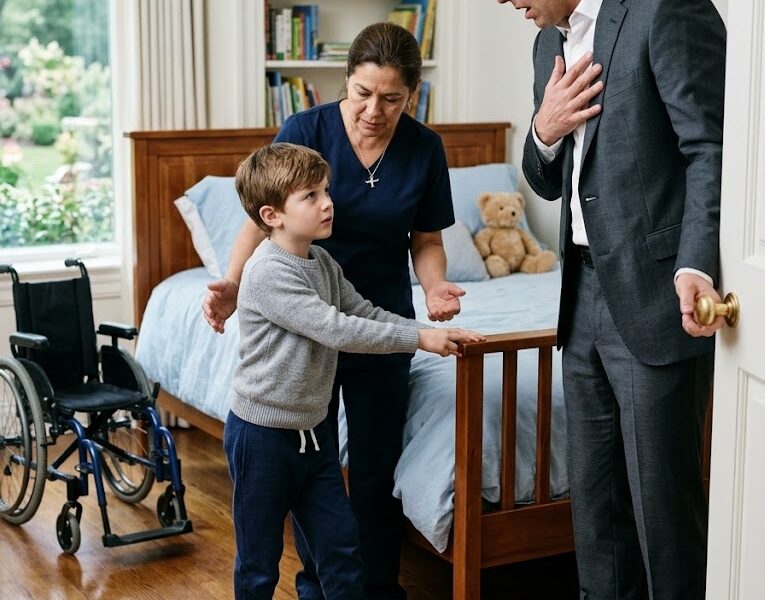
The Billionaire Came Home Early—and Froze When He Saw What the Maid Was Doing to His Son

Victor Hail heard his son scream before he reached the bedroom.
Not a cry.
Not the frustrated sob Victor had heard after surgeries, injections, failed therapy sessions, and doctors saying words like unlikely and permanent while refusing to look a father directly in the eye.
This was different.
“ELENA!”
Victor dropped his briefcase.
It struck the marble floor of the upstairs corridor hard enough to send papers sliding beneath an antique console table.
He ran.
Two security men followed him, but Victor barely heard them.
All he could hear was Leo.
His eight-year-old son.
The child who had never walked.
The child whose medical file had been reviewed by specialists in Boston, Chicago, Houston, London, Zurich, and Munich.
The child Victor had spent millions trying to help.
The child every expert had eventually told him to stop pushing.
Victor reached the doorway and stopped so violently that one of the security men nearly crashed into him.
For several seconds, nobody moved.
Leo’s wheelchair sat empty beside the window.
Victor’s heart stopped.
His son was six feet away from it.
Standing.
Not comfortably.
Not safely.
Not in any way Victor could understand.
Leo’s thin arms were wrapped around the polished wooden rail at the foot of his bed. His entire body shook with the effort. His knees trembled violently beneath blue pajama shorts. Sweat covered his forehead.
Behind him stood Elena Morales, the new housekeeper Victor had hired less than four months earlier.
Her hands hovered inches from Leo’s waist.
Ready to catch him.
But she wasn’t holding him.
“Come on,” she whispered.
Leo’s face twisted with pain.
“I can’t.”
“Yes, you can.”
“It hurts.”
“I know.”
“I can’t.”
Elena’s voice softened.
“Then don’t do ten steps.”
Leo swallowed.
“Do one.”
Victor couldn’t breathe.
Elena hadn’t seen him yet.
Neither had Leo.
The boy stared at the carpet in front of him as though it were the edge of a cliff.
Then his right hand released the bed rail.
Victor nearly shouted.
But something stopped him.
Maybe it was terror.
Maybe disbelief.
Maybe the expression on his son’s face.
Leo wasn’t afraid.
He was determined.
His left hand loosened.
His body swayed.
Elena moved closer.
“I’m right here.”
Leo lifted his right foot.
Barely an inch.
His knee buckled.
He gasped.
Then—
the foot moved forward.
And touched the floor.
One step.
One impossible, trembling step.
Leo collapsed backward.
Elena caught him before he hit the carpet.
For half a second there was silence.
Then Leo began laughing.
Not politely.
Not carefully.
He laughed from somewhere deep inside himself, the sound breaking into sobs as he clung to Elena’s arms.
“I did it.”
Elena was crying too.
“You did.”
“I did it!”
Victor’s hand found the doorframe.
His knees suddenly felt weak.
Leo finally looked toward the doorway.
His smile vanished.
“Papa?”
Elena turned.
The blood drained from her face.
Victor Hail stood in the doorway in a charcoal suit worth more than Elena made in several months, staring at the woman who had secretly been doing something with his disabled son that no doctor had authorized.
His expression revealed nothing.
Leo looked from his father to Elena.
Then back again.
“I stood,” he whispered.
Victor didn’t answer.
“Papa…”
Leo’s voice became smaller.
“I stood.”
Victor took one step into the room.
Then another.
Elena slowly rose.
“Mr. Hail, I can explain.”
Victor looked at the empty wheelchair.
Then at his son’s trembling legs.
Then at Elena.
His voice was terrifyingly calm.
“What have you been doing to my son?”
Four months earlier, nobody in that house would have imagined the question would ever need to be asked.
Because before Elena Morales arrived, Hail Manor was a house built around one unspoken rule:
Protect Leo from disappointment.
The mansion sat behind iron gates on eleven acres outside Greenwich, Connecticut, where old trees shielded limestone walls from the road and security cameras followed every approaching vehicle.
It had twenty-three rooms.
Three kitchens.
An indoor swimming pool.
A library with a rolling ladder.
A glass conservatory overlooking the gardens.
A wine cellar Victor rarely entered.
A screening room Leo loved.
And hallways so long that footsteps echoed after the person walking had disappeared.
Magazine profiles called the estate magnificent.
Leo called it home.
Sometimes, on bad days, he called it the castle.
Not because he felt like a prince.
Because castles had walls.
And Leo knew walls very well.
At eight years old, he had never walked independently.
His wheelchair had been customized three times as he grew.
There were ramps where other houses had steps, discreet grab bars incorporated into expensive bathrooms, a private elevator between floors, and a therapy room filled with equipment that made part of the mansion resemble a rehabilitation clinic.
Victor had built all of it without hesitation.
He could afford anything.
That was the problem.
For most of his adult life, money had behaved exactly the way Victor expected it to.
Money opened doors.
Money shortened waiting lists.
Money turned “maybe” into meetings.
It brought CEOs onto private jets.
It made politicians return calls.
It convinced competitors to sell companies they had sworn they would never sell.
Victor had built Hail Meridian from a failing logistics company operating three warehouses into an international infrastructure and technology empire.
At forty-two, his name appeared on business magazines, conference stages, charity buildings, and lists estimating fortunes too large for ordinary people to imagine.
He understood leverage.
He understood negotiation.
He understood how to turn obstacles into numbers.
Then Leo was born.
And Victor discovered that some things did not negotiate.
Leo’s mother, Caroline, had died when he was three.
Cancer had taken her in eleven months.
Victor had responded to grief the only way he knew how.
He worked.
And when Leo’s mobility problems became impossible to dismiss, Victor turned medicine into another business problem.
He assembled experts.
Requested second opinions.
Then third.
Then seventh.
He flew specialists across oceans.
He funded research.
He paid for rehabilitation programs that were not covered by insurance and equipment that arrived in wooden crates requiring engineers to install.
Every time someone mentioned a possibility, Victor pursued it.
Until eventually the possibilities became smaller.
The doctors became more careful.
And hope began sounding suspiciously like cruelty.
One February morning, after another evaluation at a specialist center in Boston, Dr. Martin Keller sat across from Victor and closed Leo’s file.
Victor hated when doctors closed files.
It always meant the conversation had changed.
“What aren’t you saying?” Victor asked.
Keller hesitated.
“Victor—”
“Don’t call me Victor because you’re about to tell me something unpleasant. Just tell me.”
Leo was in another room with a therapist.
Keller removed his glasses.
“We need to think about quality of life.”
“I already think about it.”
“I mean emotionally.”
Victor leaned back.
Keller continued carefully.
“Leo is becoming old enough to understand the expectations around him. Every appointment. Every new treatment. Every time another specialist examines him, he thinks the adults are waiting for him to do something.”
“They’re trying to help him.”
“I know.”
“Then what’s your point?”
“My point is that he may be interpreting treatment as failure.”
Victor’s jaw tightened.
Keller continued.
“He’s eight years old. He shouldn’t spend his childhood believing he’s disappointing everyone because his body isn’t responding the way we hoped.”
Victor stared at him.
“So you’re telling me to give up.”
“No.”
“That’s exactly what you’re telling me.”
“I’m telling you acceptance is not the same thing as surrender.”
Victor stood.
The conversation was over.
But Keller said something before he reached the door.
“Sometimes loving a child means letting go of the future you imagined for him.”
Victor stopped.
He didn’t turn around.
“What if that future is possible?”
Keller’s answer came quietly.
“Then I hope I’m wrong.”
Victor carried those words back to Connecticut.
And they followed him everywhere.
Especially in the mornings.
Leo usually ate breakfast near the conservatory windows because he liked watching sunlight move across the gardens.
One morning, Victor was knotting his tie when Leo looked up from a bowl of cereal.
“Papa?”
“Yes?”
“Do you think I’ll walk today?”
Victor’s fingers stopped.
It was a question Leo had asked dozens of times.
Maybe hundreds.
When he was five, it had sounded innocent.
At eight, Victor could hear the fear underneath it.
He walked over and crouched beside the wheelchair.
“Maybe.”
Leo considered that.
“Doctors always say maybe.”
Victor forced a smile.
“Doctors don’t know everything.”
“Do you?”
“No.”
“Then why do you say maybe?”
The question landed harder than Victor expected.
Leo looked down at his cereal.
Victor kissed his forehead.
“Because sometimes maybe is better than no.”
Leo nodded.
Victor stood and walked toward the door.
“Papa?”
He stopped.
“When you imagine me when I’m big…”
Victor turned.
Leo’s hands rested on his wheels.
“Am I standing?”
Victor couldn’t answer immediately.
Leo noticed.
Children always noticed the pauses adults believed they had hidden.
Finally Victor smiled.
“When I imagine you grown up, you’re happy.”
Leo looked toward the garden.
“That wasn’t what I asked.”
Victor left for work seven minutes later.
He cried in the back of the car where nobody could see him.
Three weeks after that morning, Elena Morales arrived at Hail Manor carrying one suitcase and wearing shoes with soles worn almost smooth.
She was forty-one.
Her résumé was unremarkable.
She had worked at hotels, cleaned offices after midnight, cared for an elderly couple in Stamford, and spent several years working in private homes.
Victor never interviewed her.
The household manager did.
To Victor, Elena was initially nothing more than another name on payroll.
To Elena, the Hail mansion was overwhelming.
On her first morning, Mrs. Whitmore, the house manager, walked her through rooms Elena suspected the family barely used.
“Mr. Hail values privacy,” Whitmore explained.
“I understand.”
“His office is never entered unless specifically requested.”
“All right.”
“The west bedrooms remain untouched unless guests are scheduled.”
Elena nodded.
“And Leo’s rooms?”
Whitmore stopped walking.
Her expression changed.
“Master Leo has specialized care.”
“I heard.”
“You are not his nurse.”
“I understand.”
“You are not his therapist.”
“I understand.”
“You should never move his chair, alter equipment, administer medication, or assist with exercises unless one of his professionals asks you.”
Elena looked toward the end of the corridor.
A little boy sat beside a window.
Alone.
He was watching two groundskeepers throw snow from the walkway.
“That him?”
Whitmore followed her gaze.
“Yes.”
Leo turned.
His eyes met Elena’s.
She smiled.
Leo didn’t.
Whitmore lowered her voice.
“Don’t stare.”
“I wasn’t staring.”
“People do.”
Elena looked at her.
“Why?”
Whitmore seemed surprised by the question.
Then she walked away.
Elena remained still for another second.
Leo continued watching her.
She raised one hand.
A small wave.
After a moment, Leo raised his.
That was all.
But something inside Elena moved.
A memory she had spent years trying to bury.
A hospital room.
A little hand.
A blue blanket.
A boy named Mateo.
She looked away first.
For the next several days, Elena kept her distance.
She cleaned.
Changed linens.
Polished furniture.
Carried laundry down service corridors.
She learned that Victor drank black coffee and rarely finished it.
She learned that Leo hated peas, loved astronomy, and secretly asked kitchen staff for chocolate cookies before dinner.
She learned that the enormous house became almost silent after Victor left each morning.
And she learned something else.
Everyone treated Leo carefully.
Too carefully.
“Would you like me to move you closer to the window, Master Leo?”
“Are you comfortable, Master Leo?”
“Do you need anything, Master Leo?”
“Would you like your blanket?”
Nobody teased him.
Nobody challenged him.
Nobody told him no.
Nobody seemed willing to risk making him unhappy.
Then one afternoon Elena entered the library and found Leo attempting to reach a book from the lower shelf.
His wheelchair was angled awkwardly.
His fingertips were perhaps two inches from the spine.
Elena watched from the doorway.
Leo stretched.
Missed.
Tried again.
Missed.
His face reddened.
Finally Elena said, “You’re doing that badly.”
Leo spun around.
“What?”
“That.”
She pointed toward the book.
“Your angle is terrible.”
Leo stared at her.
Adults did not speak to him that way.
“You’re supposed to help me.”
“Am I?”
“Yes.”
“Why?”
“Because I can’t reach it.”
Elena leaned against the doorframe.
“You almost reached it.”
Leo frowned.
“So?”
“So try again.”
He looked offended.
“You’re a maid.”
“And you’re short.”
His mouth fell open.
Elena almost laughed.
Leo looked toward the hallway, perhaps expecting someone to appear and reprimand her.
Nobody did.
He turned back toward the shelf.
He repositioned his chair.
Reached.
His fingers touched the book.
It slipped backward.
“Almost,” Elena said.
“Stop watching me.”
“Fine.”
She turned away.
“Wait.”
Elena hid a smile.
“What?”
“Don’t leave.”
She remained facing the opposite direction.
There was a scrape.
A grunt.
Then a thump.
“Got it!”
Elena turned.
Leo held the book against his chest.
His grin was enormous.
She nodded solemnly.
“Acceptable.”
Leo laughed.
It was the first time Elena heard that laugh.
After that, they began talking.
At first only for a few minutes.
Then longer.
Leo told her about planets.
Elena knew almost nothing about planets.
He explained that a day on Venus was longer than a year on Venus.
She accused him of inventing it.
He demanded she look it up.
She did.
He was right.
Leo celebrated for ten minutes.
Another afternoon, Elena found him constructing a cardboard rocket ship from delivery boxes.
“What is that?” she asked.
“A Saturn V.”
“That looks like a refrigerator.”
“You have no imagination.”
“You have no engineering skills.”
“You’re mean.”
“You keep talking to me.”
Leo grinned.
Victor began hearing Elena’s name at dinner.
“Elena says Pluto should still be a planet.”
“Elena says your chef puts too much garlic in everything.”
“Elena says people who own seven cars have problems.”
Victor paused.
“She said what?”
Leo giggled.
Victor looked toward Mrs. Whitmore.
Whitmore immediately said, “I’ll speak to her.”
“No!”
Leo nearly knocked over his water.
Victor studied his son.
Leo rarely defended staff.
“She’s funny.”
Victor picked up his fork.
“I wasn’t going to fire her.”
“You fire people.”
“Sometimes.”
“You fired Mr. Simmons.”
“Mr. Simmons stole four million dollars.”
Leo considered that.
“Okay. That was probably fair.”
Victor smiled despite himself.
But Elena didn’t become important because she made Leo laugh.
She became important because one rainy Tuesday afternoon, she saw him cry.
Victor was in Manhattan negotiating an acquisition.
Most of the staff were downstairs preparing for a charity dinner Victor would host that weekend.
Elena was carrying towels past the conservatory when she noticed Leo by the glass doors.
He was facing the lawn.
Rain streaked the windows.
Outside, beyond the gates, two neighborhood children were running through puddles beneath yellow raincoats.
Leo’s shoulders were shaking.
“Elena?”
He didn’t turn.
She placed the towels down.
“What happened?”
“Nothing.”
“That’s a lot of crying for nothing.”
“Go away.”
She sat on the floor beside his wheelchair.
Neither spoke.
Finally Leo whispered, “I hate them.”
“The kids?”
“My legs.”
Elena looked at him.
Leo wiped his face angrily.
“I hate them.”
His small fists struck his thighs.
“Hey.”
“They’re stupid.”
“Leo.”
“They don’t do anything!”
He hit his legs again.
Elena caught his wrists.
“Stop.”
“I hate this chair.”
“I know.”
“No, you don’t.”
His voice cracked.
“You walk.”
Elena released his wrists.
That was true.
So she said nothing.
Leo looked outside again.
“They keep saying maybe someday.”
“Who?”
“Everybody.”
His breathing became uneven.
“Maybe someday I’ll stand. Maybe someday something will change. Maybe someday there’ll be a new treatment.”
He wiped his nose with his sleeve.
“Elena?”
“Yes?”
“I don’t want someday.”
She felt something tighten in her chest.
“I want today.”
The rain tapped softly against the glass.
Elena looked at his legs.
Then at his face.
And suddenly she was twenty-nine again.
Sitting in a pediatric rehabilitation center beside Mateo.
Her son had not been paralyzed.
His condition had been different.
Neurological complications after a severe illness had weakened him badly. For months, ordinary movements had become work.
Physical therapy had consumed their lives.
Mateo hated it.
So Elena had turned exercises into games.
Reaching became treasure hunting.
Balance became pretending the floor was a pirate ship.
Repetition became songs.
It had not saved him.
A later infection had taken Mateo before his seventh birthday.
For twelve years Elena had carried one unbearable belief:
Everything she learned while caring for him had died with him.
Now Leo was staring at her.
“Can we do something?”
Elena should have said no.
She wasn’t trained to manage his condition.
She didn’t know every detail of his medical history.
She had been explicitly warned.
Instead she asked, “What do your therapists make you do?”
Leo rolled his eyes.
“Boring things.”
“Show me.”
He demonstrated several exercises he had been taught.
Elena watched carefully.
Nothing reckless.
Nothing outside movements already familiar to him.
But she noticed something when Leo tried shifting his weight.
A tiny contraction.
Almost invisible.
“Do that again.”
“What?”
“That.”
“I didn’t do anything.”
“Yes, you did.”
“No.”
“Again.”
Leo tried.
Nothing.
“Again.”
He groaned.
“Elena.”
“One more.”
He tried.
There.
A flicker.
She touched the muscle lightly.
“Did you feel that?”
“No.”
“Try again.”
“Elena—”
“Try.”
He did.
Another tiny movement.
Leo stared at her.
“What?”
She didn’t want to give him false hope.
So she chose her words carefully.
“I don’t know.”
His expression fell.
Then Elena added, “But maybe we should pay attention.”
The next afternoon, Leo was waiting.
“You’re late.”
“I have a job.”
“This is your job.”
“No, cleaning up after rich people is my job.”
“My father is rich.”
“I noticed.”
Leo smiled.
Elena placed a foam ball on a low table.
“What are we doing?”
“Playing.”
“With a ball?”
“You object?”
“I thought we were exercising.”
Elena pointed toward the ball.
“Reach it.”
Leo reached.
She moved it farther away.
“Hey!”
“Reach.”
He leaned.
His torso shook.
“Too far.”
“Then figure it out.”
Leo glared at her.
But he tried.
The first sessions lasted ten minutes.
Then fifteen.
They used only movements Leo had previously practiced with professionals—stretching, reaching, supported positioning—but Elena changed the emotional language around them.
No machines.
No white coats.
No adults watching a stopwatch.
No one saying progress.
They played.
And because Leo thought they were playing, he stopped measuring himself against a miracle.
Elena never told him he would walk.
She told him something else.
“You don’t owe anybody a miracle.”
One afternoon he looked at her.
“Not even Papa?”
“Especially not your father.”
“He wants me to walk.”
“He wants you happy.”
“He gets sad when I can’t do things.”
“That sadness belongs to him.”
Leo frowned.
“What does that mean?”
“It means you don’t have to carry it.”
Nobody had ever told Leo that.
He became quiet.
Then he asked, “Did you have a kid?”
Elena froze.
Leo pointed toward the chain around her neck.
A tiny silver airplane hung from it.
“You touch that whenever you’re sad.”
Elena looked down.
Children noticed everything.
“Yes.”
“A boy?”
“Yes.”
“What was his name?”
“Mateo.”
“Where is he?”
The question should have hurt.
Instead, somehow, it didn’t.
“He died.”
Leo’s eyes widened.
“I’m sorry.”
“So am I.”
“How old?”
“Six.”
Leo looked toward his own legs.
“Was he sick?”
“Yes.”
“Did you do exercises with him?”
Elena nodded.
“Is that why you know this stuff?”
“Some of it.”
“Did he walk?”
The room became very quiet.
“For a while.”
“And then?”
Elena swallowed.
“And then his body got too tired.”
Leo stared at her.
She expected him to apologize again.
Instead he reached out and touched the little airplane.
“Maybe that’s why you found me.”
Elena’s eyes filled.
“Maybe.”
Their secret continued.
But secrets inside large houses rarely stay secret forever.
Mrs. Whitmore noticed Leo requesting fewer naps.
A therapist noticed improved trunk control.
A nurse documented occasional muscle responses that had previously been inconsistent.
Victor noticed something simpler.
His son stopped asking whether he would walk today.
At first Victor considered that progress.
Maybe Leo was accepting reality.
Then one evening Victor entered the conservatory and found Leo gripping the arms of his wheelchair, face red with concentration.
“What are you doing?”
Leo released them immediately.
“Nothing.”
Victor looked suspiciously at him.
“You look like you’re trying to lift yourself.”
“I was stretching.”
“Who told you to?”
Leo hesitated.
“My therapist.”
It was Leo’s first deliberate lie to his father.
And Victor believed him.
Three days later, Dr. Keller visited from Boston.
He examined Leo.
Then he examined him again.
Victor stood near the window.
“What?”
Keller looked puzzled.
“Has something changed?”
“What do you mean?”
“His core strength seems better.”
Victor’s heart jumped.
“Better how?”
“Don’t get ahead of me.”
“Martin.”
“I’m seeing improvements in stability.”
Victor moved closer.
“And his legs?”
Keller performed another test.
Leo watched the ceiling.
“There’s some response.”
Victor stared.
“What response?”
“Small.”
“But it’s there.”
“Victor—”
“Is it there?”
“Yes.”
One word.
That was all Victor needed.
Within forty-eight hours, three specialists were scheduled.
New equipment was ordered.
A private rehabilitation consultant was flown in.
Leo’s calendar filled.
When Elena saw it posted in the staff office, she felt sick.
Monday: therapy.
Tuesday: evaluation.
Wednesday: hydrotherapy.
Thursday: neuromuscular testing.
Friday: specialist consultation.
Saturday morning: conditioning.
She found Leo in his room staring at the schedule on his tablet.
“You told him?”
“No.”
“Then how does he know?”
“Dr. Keller saw something.”
Leo looked frightened rather than excited.
Elena sat beside him.
“What?”
“He’s doing it again.”
“Doing what?”
“Making it everything.”
That evening Victor came home early enough for dinner.
Leo barely spoke.
Victor was energized.
“I spoke with Dr. Anand in Chicago.”
Leo moved peas around his plate.
“He thinks we should repeat imaging.”
No response.
“And there’s a program in California using an approach Keller thinks might be worth reviewing.”
Elena was serving water.
She saw Leo’s fingers tighten around his fork.
Victor didn’t.
“I’ve also asked my office to clear two weeks next month. We could—”
“Stop.”
Victor looked at his son.
“What?”
“I said stop.”
The dining room became silent.
Victor placed his glass down.
“What’s wrong?”
Leo’s eyes filled.
“I don’t want to be your project again.”
Victor went still.
“You’re not a project.”
“Yes, I am.”
“Leo—”
“Every time something happens, you make ten doctors come look at me.”
“Because I’m trying to help.”
“I know!”
Leo’s voice echoed beneath the chandelier.
“That doesn’t mean I like it!”
Victor stared at him.
Leo’s tears spilled over.
“I don’t want everybody waiting for me to walk.”
Victor’s face changed.
Nobody moved.
Then Leo pushed away from the table.
“I want Elena.”
Victor looked toward her.
Elena immediately lowered her eyes.
“Take him upstairs,” Victor said.
She did.
But after Leo was asleep, Victor summoned her to his office.
Elena stood before a wall of windows overlooking the dark estate.
Victor remained behind his desk.
“What does he tell you?”
She hesitated.
“About what?”
“About me.”
“Mr. Hail—”
“I’m not asking you to betray his confidence. I’m asking why my son talks to an employee he’s known for three months about things he won’t tell his father.”
Elena could have protected herself.
Instead she said, “Because you’re afraid of his sadness.”
Victor’s expression hardened.
“Excuse me?”
“You try to fix it.”
“That’s what fathers do.”
“Sometimes.”
“And what would you suggest?”
“Listening.”
Victor stood.
“You’ve worked in my home for three months.”
“Yes.”
“Don’t presume to tell me how to raise my son.”
Elena’s pulse quickened.
“I shouldn’t.”
“No.”
“But you asked.”
That stopped him.
Elena continued.
“When Leo tells you he’s scared, you call a doctor. When he’s frustrated, you buy something. When he’s sad, you promise it’ll get better.”
Victor stared at her.
“What exactly is wrong with telling my son things will get better?”
“Nothing.”
“Then what are you saying?”
“Sometimes he needs you to admit you don’t know.”
Victor’s jaw tightened.
Elena knew she was close to being fired.
But she had already lost the one person she feared losing most.
That changes what power means.
“He loves you,” she said. “But he thinks your happiness depends on whether he walks.”
Victor’s anger disappeared.
For a moment, he looked less like a billionaire and more like a tired father.
“Did he tell you that?”
“Yes.”
Victor turned toward the windows.
Elena waited.
Finally he said, “You can go.”
The following morning, Victor canceled three appointments.
Not all of them.
Just enough.
He sat with Leo at breakfast.
No phone.
No laptop.
No assistant waiting near the door.
“I owe you an apology,” Victor said.
Leo looked suspicious.
“For what?”
“For making you feel like you have to get better for me.”
Leo looked down.
Victor reached across the table.
“You don’t.”
“Okay.”
“I mean it.”
Leo’s eyes lifted.
“If you never walk, you are enough.”
The words nearly broke Victor as he said them.
“If you walk tomorrow, you’re enough. If you never take a step, you’re enough.”
Leo stared at him.
Then he whispered, “Really?”
Victor nodded.
“Really.”
Leo began crying.
Victor moved beside him.
His son wrapped both arms around his neck.
Victor held him.
And across the room, unseen by either of them, Elena quietly wiped her eyes.
After that, something changed.
Not in Leo’s legs.
In the house.
The pressure loosened.
Leo’s official therapists continued working with him.
Elena stopped hiding every little exercise and began asking the physical therapist questions about safe activities she could reinforce between sessions.
Some suggestions were approved.
Others weren’t.
She followed those boundaries.
And slowly, measurable changes appeared.
A stronger contraction.
Better balance.
Improved ability to bear limited weight with support.
Nothing guaranteed walking.
No doctor used the word miracle.
But for the first time, they stopped using the word impossible quite so confidently.
Then came the afternoon that changed everything.
Victor was supposed to be in Manhattan until nearly midnight.
A merger meeting ended unexpectedly when the opposing company requested twenty-four hours to review new terms.
His driver asked whether he wanted to return to the office.
Victor looked at his watch.
3:47 p.m.
“No.”
“Home, sir?”
Victor almost said no again.
He had spent years treating an early return home like wasted time.
Instead he said, “Home.”
The car entered the estate shortly before five.
Victor told no one he was coming.
He wanted to surprise Leo.
He entered through the side hall.
The house was unusually quiet.
Then he heard a voice upstairs.
Elena.
“Don’t look at the floor.”
Victor climbed the stairs.
Another voice.
Leo.
“I can’t.”
Victor stopped.
Elena again.
“Yes, you can.”
Victor’s pulse changed.
He walked faster.
“It hurts.”
“I know.”
“What if I fall?”
“Then I’ll catch you.”
Victor reached the corridor.
Leo’s bedroom door was open.
He heard his son breathing hard.
Then Elena said:
“One.”
Victor reached the doorway.
And the world he understood disappeared.
Leo was standing.
Victor’s briefcase hit the floor.
Neither noticed.
“Come on,” Elena whispered.
Leo released one hand.
His knees shook.
Victor wanted to rush forward.
Every instinct screamed at him to grab his son before he fell.
But Elena was there.
Calm.
Ready.
“I’m right here.”
Leo released the other hand.
His body swayed.
Then his foot moved.
One inch.
Two.
Forward.
Down.
A step.
Leo collapsed.
Elena caught him.
“I did it!”
His laughter became crying.
“I did it!”
Then he saw Victor.
“Papa?”
Elena turned.
Fear replaced joy instantly.
Victor entered the room.
“What have you been doing to my son?”
Elena stood.
“Mr. Hail—”
“You put him on his feet without me knowing?”
“Papa—”
“Leo, please.”
Victor’s voice was sharper than intended.
Leo flinched.
Elena moved between them almost instinctively.
Victor noticed.
That made him angrier.
“Don’t.”
Elena froze.
“You don’t get to make decisions about his medical care.”
“I know.”
“Do you?”
“Yes.”
“Because what I just saw suggests otherwise.”
Leo began crying.
Victor pointed toward the wheelchair.
“Sit him down.”
Elena didn’t move.
“I said—”
“I stood up myself!”
Leo shouted.
Victor turned.
The boy’s face was red.
“She didn’t make me!”
“Leo—”
“I wanted to!”
Victor looked back at Elena.
“You should have told me.”
“Yes.”
“Why didn’t you?”
Elena’s eyes filled.
“Because I knew what you would do.”
Victor laughed once in disbelief.
“And what exactly would I do?”
“Turn one step into a thousand expectations.”
Silence.
Victor stared at her.
“You don’t know me.”
“I know what fear does to parents.”
His face hardened.
“You’re fired.”
Leo screamed.
“No!”
Elena closed her eyes.
Victor immediately regretted the words.
But pride kept him from taking them back.
“Pack your things.”
“Papa, no!”
“Leo.”
“You can’t!”
“Enough.”
“No!”
Leo reached for Elena.
She knelt beside him.
“It’s okay.”
“No, it’s not!”
His sobs became desperate.
“You said you wouldn’t leave!”
Elena held his face.
“Listen to me.”
“No.”
“Leo.”
He looked at her.
“You did that step.”
His lips trembled.
“You.”
She pressed a hand over his heart.
“Not me.”
“Don’t go.”
Elena could barely speak.
“I have to.”
Victor looked away.
Something about the scene felt unbearable.
Not because Elena was defying him.
Because Leo was looking at her the way Victor remembered looking at Caroline in her final hospital room.
As if holding tightly enough could stop someone from disappearing.
Elena kissed Leo’s forehead.
Then she stood.
She walked past Victor.
At the doorway, he spoke.
“What if he had fallen?”
Elena stopped.
“What if you hurt him?”
She turned.
“I would never forgive myself.”
“Then why take the risk?”
Her answer came quietly.
“Because there’s another kind of hurt.”
Victor said nothing.
“Watching a child become afraid to try.”
Then Elena left.
That night Leo refused dinner.
The following morning, he refused therapy.
When Victor entered his room, Leo turned his wheelchair toward the window.
“Leo.”
No response.
Victor sat nearby.
“I know you’re angry.”
Nothing.
“I shouldn’t have yelled.”
Still nothing.
Victor waited.
Finally Leo spoke.
“You always make people leave.”
Victor felt the sentence like a blow.
“What?”
“Mom left.”
“That wasn’t her choice.”
“You’re always gone.”
Victor stared at him.
“And now Elena’s gone.”
“Leo—”
“You said I was enough.”
“You are.”
“Then why did you fire the person who made me feel like I was?”
Victor had negotiated billion-dollar disputes without losing his composure.
An eight-year-old destroyed him in twelve words.
He stood.
Walked into the hallway.
And called Dr. Keller.
“I need you at the house.”
Keller arrived that afternoon.
Victor showed him video from Leo’s room.
The security camera covered the doorway and part of the space near the bed. Victor hated himself for watching it, but he needed an answer.
Keller watched Leo rise with support.
Watched him balance.
Watched the step.
Then replayed it.
Victor stood behind him.
“Well?”
Keller leaned closer.
“Who was assisting him?”
“Elena.”
“The housekeeper?”
“Yes.”
“Is she trained?”
“Not professionally.”
Keller frowned.
Victor felt anger rising again.
Then Keller said, “But she isn’t forcing him.”
Victor looked at him.
“What?”
“She isn’t lifting him.”
Keller replayed the footage.
“Look.”
Leo shifted.
His muscles engaged.
Keller paused.
“He’s doing more of this than I expected.”
Victor’s throat tightened.
“Meaning?”
“Meaning we need a full evaluation.”
“Could she have hurt him?”
“Any unsupported activity can carry risk. She should have coordinated with his care team.”
Victor nodded.
That confirmed what he wanted to hear.
Then Keller added, “But Victor?”
“What?”
“I think you may be asking the wrong question.”
Victor stared at him.
“What question should I be asking?”
Keller looked at the frozen image of Leo standing.
“How did we underestimate him?”
Three days of testing followed.
Victor remained for every minute.
No conference calls.
No board meetings.
No private jet waiting.
For once, Hail Meridian survived without him.
The results were not magical.
They were complicated.
Leo’s condition had never fit neatly into the most pessimistic assumptions surrounding his mobility. His prognosis remained uncertain, and nobody promised independent walking.
But there was more functional potential than earlier evaluations had suggested.
Not because Elena had cured him.
Not because love replaced medicine.
Because bodies changed.
Children developed.
Responses that had once been weak had become more meaningful.
And because someone had spent months watching Leo without staring at a chart.
Dr. Keller sat with Victor after the final assessment.
“I was wrong.”
Victor looked at him.
Doctors rarely said those words.
Keller continued.
“Not about everything. But about how firmly I framed the possibilities.”
Victor rubbed his face.
“Will he walk?”
“I don’t know.”
Victor almost laughed.
Months earlier, those words would have infuriated him.
Now they felt strangely honest.
“What do we do?”
“We work.”
“How hard?”
“As hard as is appropriate.”
Victor nodded.
“And we don’t turn his childhood into a medical experiment.”
Victor looked at him.
Keller smiled faintly.
“I believe someone has already explained that part to you.”
Victor knew exactly who he meant.
Elena was staying in a small apartment in Stamford when someone knocked on her door at 7:12 the following evening.
She opened it expecting her landlord.
Victor Hail stood in the hallway.
No driver.
No assistant.
No suit jacket.
Just Victor.
Elena’s expression hardened.
“If you’re here about the severance papers—”
“I’m not.”
She waited.
Victor seemed uncomfortable.
Perhaps because he rarely visited buildings where the hallway carpet was stained and someone’s television could be heard through the wall.
Or perhaps because Victor Hail was not accustomed to apologizing.
“I was wrong.”
Elena blinked.
Victor continued before pride could stop him.
“You should have told me.”
“Yes.”
“You should have involved his therapists sooner.”
“Yes.”
“You took a risk I had a right to know about.”
“Yes.”
Victor frowned.
“Are you going to disagree with anything?”
“You haven’t gotten to the part where you’re wrong yet.”
For the first time, Victor almost smiled.
Then his face became serious.
“I was wrong to fire you.”
Elena said nothing.
“I was scared.”
“I know.”
“No.”
His voice changed.
“I don’t think you do.”
He looked down the hallway.
“When Caroline got sick, I kept believing there was another doctor. Another hospital. Another trial. Another amount of money.”
Elena listened.
“I kept telling her we weren’t done.”
Victor swallowed.
“Three days before she died, she asked me to stop making phone calls and sit beside her.”
His eyes reddened.
“I told her I needed to speak to a specialist in Switzerland.”
Elena’s face softened.
Victor stared at the floor.
“She died before I learned how to sit still.”
For several seconds, neither spoke.
“And I’ve been doing the same thing to Leo.”
Elena leaned against the door.
Victor looked at her.
“When I saw him standing, I wasn’t angry because you endangered him.”
She waited.
“I was angry because I wasn’t there.”
The truth surprised even him.
“I missed it.”
His voice cracked.
“I’ve missed so much.”
Elena looked at this man who owned buildings, companies, airplanes, houses—and suddenly seemed to possess nothing that could protect him.
“He’ll do it again,” she said.
Victor shook his head.
“You don’t know that.”
“No.”
She smiled gently.
“But maybe is better than no.”
Victor recognized his own words.
He laughed softly.
Then wiped his eyes.
“I’d like you to come back.”
Elena hesitated.
“Under conditions.”
Victor raised an eyebrow.
“You’re negotiating with me?”
“Yes.”
“People usually regret that.”
“I don’t have much to lose.”
Victor almost smiled again.
“Fine.”
“No secret exercises. Everything coordinated with the therapy team.”
“Agreed.”
“You don’t turn every improvement into an emergency conference.”
He sighed.
“Agreed.”
“You spend time with him that has nothing to do with walking.”
Victor nodded.
“Agreed.”
“And stop buying him things every time you feel guilty.”
“That one is unreasonable.”
Elena laughed.
Victor did too.
It was the first time she had ever heard him laugh.
Then she asked, “Does Leo know you’re here?”
“No.”
“Good.”
“Why?”
“Because you should suffer a little longer.”
Victor stared at her.
“You’re enjoying this.”
“A little.”
Elena returned the next morning.
Leo was in the conservatory.
Victor had told him someone was coming.
When Elena appeared in the doorway, Leo stared at her.
For one second, he seemed unable to understand.
Then he pushed his wheels so hard that the chair nearly struck a table.
“Elena!”
She dropped her bag.
Leo crashed into her arms.
He cried.
She cried.
Victor stood several feet away pretending not to.
After a moment Leo looked at his father.
“You brought her back?”
Victor nodded.
“Are you going to fire her again?”
Elena laughed through her tears.
Victor considered the question.
“Apparently I’m no longer allowed.”
Leo grinned.
Something changed in Hail Manor after that.
Not overnight.
Not magically.
But permanently.
The therapy room stopped feeling like a courtroom where Leo’s body was constantly being judged.
Some days were good.
Some were terrible.
There were weeks when progress seemed to disappear.
There were mornings when Leo screamed that he hated therapy.
There were afternoons when Elena let him quit early.
And others when she looked at him and said, “You’re not tired. You’re mad.”
“Same thing.”
“No.”
“Yes.”
“No.”
“I hate you.”
“You said that Tuesday.”
“I still mean it.”
“Great. Two more.”
He would glare at her.
Then do two more.
Victor learned too.
He learned to ask, “Do you want help?” instead of immediately helping.
He learned not to stare whenever Leo attempted something difficult.
He learned that his son wanted to discuss dinosaurs, girls, baseball, space, pizza, school, and whether ghosts existed—not just his legs.
He learned to sit.
One evening Leo fell during a supported exercise.
Victor rushed forward.
Leo shouted, “Don’t!”
Victor froze.
Leo lay on the mat.
Elena watched.
“Are you hurt?” she asked.
“No.”
“Then what do you do?”
Leo grunted.
“Get up.”
He struggled.
Victor’s hands twitched at his sides.
Every instinct told him to lift his son.
Elena glanced at him.
Don’t.
Victor stayed still.
Leo pushed.
Failed.
Tried again.
Failed.
His face reddened.
Victor felt his own eyes filling.
Leo tried a third time.
He got upright.
Then looked at his father.
Victor smiled.
No applause.
No celebration.
Just a smile.
Leo smiled back.
That moment mattered more than Victor expected.
Months passed.
Then came another milestone.
Leo crossed three feet using parallel bars.
Then five.
Then seven.
The first time he managed ten, Elena cried harder than he did.
The first time he crossed part of the therapy room with a walker, Victor filmed it.
Leo immediately pointed at him.
“You better not send that to your board.”
Victor lowered the phone.
“I wasn’t going to.”
“You sent them my science fair picture.”
“That was different.”
“You sent it to seventy people.”
“Forty-three.”
“Papa!”
Elena laughed from across the room.
Victor eventually created a foundation supporting pediatric rehabilitation access for families who could not afford specialized care.
He tried naming it after Leo.
Leo refused.
Then Victor suggested Caroline.
Leo liked that.
Elena asked that Mateo’s name appear somewhere too.
So inside the first center they opened, near a sunny rehabilitation room filled with toys rather than intimidating machines, there was a small plaque.
It didn’t mention Victor’s fortune.
It didn’t mention miracles.
It simply read:
For Caroline and Mateo—
who taught us that love is not measured by what it can fix,
but by who it refuses to abandon.
Years later, people would tell the story incorrectly.
They would say a billionaire’s disabled son had been healed by a maid.
Victor hated that version.
So did Elena.
Because it made Leo sound passive.
And Leo had never been passive.
The truth was harder.
And better.
Elena hadn’t given Leo the ability to walk.
She had given him permission to try without believing failure made him less worthy.
The doctors had not failed him.
They had worked from what they knew, revised what they believed when new evidence appeared, and helped him safely build on every small gain.
Victor’s money had mattered too.
It gave Leo access to extraordinary care.
But money had never been the missing piece Victor thought it was.
The missing piece had been something Victor couldn’t purchase.
A person willing to look at his son and see neither a diagnosis nor a tragedy.
Just a boy.
Leo never became the child Victor had once pictured in those desperate early years.
He became himself.
Some days he walked short distances with assistance.
Some days he used his wheelchair because it was faster, easier, or simply what his body needed.
Eventually he stopped seeing either as victory or defeat.
They were ways of moving through the world.
And Victor finally understood something that had taken him years—and nearly everything he loved—to learn.
Walking had never been the miracle.
Leo had been.
One autumn afternoon, years after Elena first entered the mansion with a worn suitcase and shoes almost smooth at the soles, Victor stood on the terrace overlooking the lawn.
Leaves had begun turning gold along the edge of the property.
Leo was outside with Elena.
He was older now.
Taller.
Still impatient.
Still sarcastic.
Still obsessed with proving Elena wrong whenever possible.
His wheelchair waited near the path.
Leo stood with a pair of forearm crutches.
Elena was several feet ahead.
“Too far,” Leo complained.
“You said that about the book.”
“What book?”
“The first one I made you reach for.”
“That was years ago.”
“And you were dramatic then too.”
“I was eight!”
“You were dramatic at eight.”
Victor smiled.
Leo moved forward.
One careful step.
Then another.
He stopped.
Breathed.
Another.
Elena didn’t touch him.
She simply walked backward, watching.
Victor felt the old instinct rise.
Help him.
Catch him.
Protect him.
Then he remembered.
So he remained where he was.
Leo took another step.
His foot slipped slightly.
Victor’s body tensed.
Leo recovered.
Then looked toward the terrace.
He saw his father watching.
“Papa!”
Victor lifted a hand.
Leo grinned.
“Watch this.”
Victor’s throat tightened.
There had been a time when those two words terrified him.
Now he smiled.
“I’m watching.”
Leo moved again.
Slowly.
Carefully.
Not toward some miraculous ending.
Not toward the future Victor had once demanded.
Just forward.
One step.
Then another.
Elena walked beside him.
Not carrying him.
Not pulling him.
Simply there.
And Victor watched his son cross the autumn grass beneath a sky so clear it seemed impossible that the same house had once held so much grief.
He thought about Caroline.
About Mateo.
About doctors who had said maybe.
About a frightened father who had mistaken control for love.
About a woman who entered his home almost invisible and changed it because she saw something everyone else had forgotten to see.
Not movement.
Not potential.
Not a medical possibility.
A child.
Leo stopped halfway across the lawn.
His arms were tired.
Elena pointed toward his wheelchair.
“Want it?”
Leo looked at the remaining distance.
Then at the chair.
For years, adults had turned choices like this into symbols.
Standing meant winning.
Sitting meant losing.
Walking meant hope.
A wheelchair meant surrender.
Leo knew better now.
He smiled.
“Yeah.”
Elena brought the chair.
Leo sat down.
No disappointment crossed his face.
No shame.
He pushed once, rolled quickly toward his father, and laughed when Elena had to jog to catch up.
Victor came down from the terrace.
Leo stopped in front of him.
“You saw?”
“I saw.”
“Pretty good, right?”
Victor crouched.
For a second, he saw the eight-year-old boy sitting beside the breakfast table asking the question that used to break his heart.
Papa, do you think I’ll walk today?
Victor placed a hand against his son’s cheek.
“Pretty good.”
Leo rolled his eyes.
“That’s it?”
Victor laughed.
Then he pulled him close.
Leo protested.
“Papa, I’m sweaty.”
“I don’t care.”
“Elena, help.”
“You’re on your own.”
Victor held his son tighter.
And over Leo’s shoulder, his eyes met Elena’s.
There was no grand speech.
There didn’t need to be.
Some debts were too large for money.
Some gratitude was too deep for language.
Years earlier, Victor had offered Elena a number on a check large enough to change her life.
She had refused it.
She asked for only one thing.
“Let me stay until he doesn’t need me anymore.”
Victor had agreed.
But standing on that lawn, watching Leo laugh as Elena teased him, Victor finally understood the flaw in that promise.
Families were not built only from blood.
Sometimes they were built from the people who stayed after they were free to leave.
Elena had entered Hail Manor as an employee.
Somewhere between Leo’s first laugh, his first act of defiance, and that trembling first step beside the bed, she had become something else.
She had become family.
And perhaps that was why, years later, when reporters asked Victor Hail to name the greatest investment of his career, he never mentioned the companies he had built or the billions attached to his name.
He always remembered a rainy afternoon he hadn’t even witnessed.
A lonely little boy staring through glass.
A woman sitting on the floor beside him.
And a question nobody with money, status, or expertise had thought to ask.
Not—
How do we fix him?
But—
What happens if we stop making him feel broken?
Because the first miracle in that mansion was never the day Leo stood.
It happened much earlier.
It happened the day someone finally looked at a child everyone wanted to protect from disappointment and gave him something far more powerful than a promise.
The freedom to try.
The freedom to fail.
And the certainty that whether he stood, fell, walked, rolled, or never took another step again—
he would still be loved exactly the same.
That was the lesson Victor’s fortune could never buy.
That was Elena’s gift.
And long after the echoes in those enormous hallways had changed from silence into laughter, Victor would sometimes pass the doorway where he had once dropped his briefcase and frozen at the sight of his son standing.
He would stop.
Just for a moment.
And remember Leo’s trembling foot moving forward.
One inch.
Then another.
One tiny step that had seemed to change everything.
Only now Victor knew better.
The step hadn’t changed their lives.
The love that allowed Leo to take it had.









