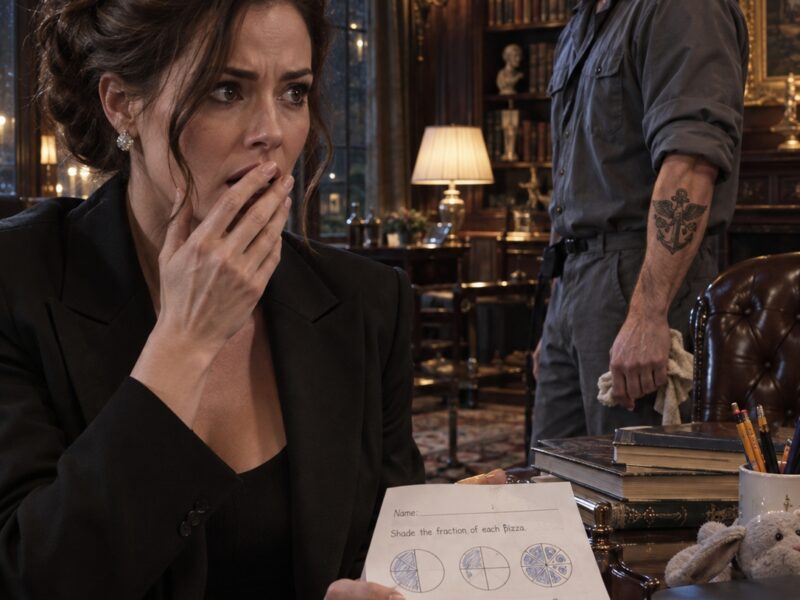
The Billionaire Caught Her Janitor Alone With Her Daughter—Then She Saw the Tattoo Hidden Under His Sleeve

The first thing Vivien Ashford noticed was not the janitor sitting alone with her nine-year-old daughter.
It was the sound coming from the library.
Laughter.
Real laughter.
Not the polite little breath of amusement Seraphina sometimes produced when adults tried too hard to cheer her up. Not the practiced smile she gave photographers at charity galas because her mother had quietly whispered, “Just for one picture, sweetheart.”
This was messy, breathless laughter.
The kind that made a child forget she had been sad.
Vivien stopped in the marble hallway of her Seattle mansion with one hand still wrapped around the handle of her briefcase.
She had not heard that sound in almost a year.
Then she looked through the half-open library door and saw who was making her daughter laugh.
Callum Reyes.
The new janitor.
He was sitting cross-legged on the Persian rug in his gray maintenance uniform while Seraphina leaned over a sheet of paper between them. A pencil rested behind Callum’s ear. Several crumpled worksheets were scattered beside his knee, and somebody had drawn a crooked pizza divided into eight slices on the back of an expensive stationery envelope.
Seraphina pointed at it.
“So if I eat three pieces…”
“You owe me three pieces,” Callum said.
She giggled. “That’s not how fractions work.”
“Then apparently I need a tutor.”
Seraphina laughed again.
Vivien should have felt relieved.
Instead, something colder moved through her.
She had rules for the household staff.
Clear rules.
Nobody entered Seraphina’s private rooms without permission. Nobody discussed the family outside the estate. Nobody drove her anywhere unless security approved it. Most importantly, nobody took responsibility for Vivien’s child without Vivien knowing about it.
Those rules had been written after Seraphina’s father died.
After reporters had crowded the gates.
After strangers sent letters claiming they knew how to heal a grieving child.
After Vivien learned that money attracted help, sympathy, curiosity—and sometimes predators.
She pushed the library door open.
“What is going on?”
The laughter died instantly.
Seraphina’s shoulders rose toward her ears.
Callum stood.
He did not jump. He did not make excuses. He simply rose in one smooth movement and placed the pencil on the table.
“Mrs. Ashford.”
Vivien’s gaze moved from him to her daughter.
“Seraphina, go upstairs.”
The little girl’s face changed.
“Mom—”
“Now.”
Callum bent to collect the worksheets.
That was when his sleeve slipped back.
Only a few inches.
But it was enough.
Vivien saw black ink against his forearm—a weathered design partly hidden beneath his cuff. An eagle. An anchor. A trident. A flintlock pistol.
She stopped breathing.
Years earlier, Ashford Meridian had donated several million dollars to a veteran rehabilitation initiative. Vivien had attended ceremonies, toured recovery centers, shaken hands with men and women who rarely spoke about where they had been or what they had done.
She knew that symbol.
She looked up slowly.
Callum Reyes, the man who emptied recycling bins at night and fixed cabinet hinges before breakfast, calmly pulled his sleeve back down.
For the first time since she had hired him, Vivien realized she knew absolutely nothing about the man living eight hours a day inside her home.
Seraphina looked between them.
“Mom?”
Vivien did not answer her.
Her eyes remained on Callum.
“Were you a SEAL?”
The room became very still.
Callum’s expression did not change.
But something behind his eyes did.
Something closed.
“That was a long time ago.”
Vivien stared at him.
People did not become Navy SEALs by accident.
And they certainly did not usually end up polishing floors in private homes without a story in between.
“What are you doing in my house, Mr. Reyes?”
Seraphina flinched.
Callum noticed.
Vivien noticed him noticing.
“I work here,” he said quietly.
“That isn’t what I asked.”
For several seconds, no one spoke.
Rain tapped softly against the library windows.
Finally Callum folded the worksheets once and placed them on the table.
“Maybe we should have this conversation without your daughter in the room.”
That should have sounded reasonable.
Instead, the calmness in his voice irritated Vivien more.
“This is my daughter.”
“Yes.”
“My house.”
“Yes.”
“And you were alone with her without my permission.”
“Yes.”
Seraphina suddenly stepped between them.
“He was helping me.”
Vivien looked down.
“With what?”
The girl lifted the worksheet as if it were evidence in a trial.
“Fractions.”
Vivien almost laughed from disbelief.
“You have a math tutor.”
“I hate him.”
“Seraphina.”
“I do.”
Her daughter’s voice shook now, but she did not back away.
“He makes me feel stupid.”
Vivien glanced toward Callum.
“Did you tell her that?”
“No.”
“Did you tell her to stop working with Dr. Bell?”
“No.”
“Then how did this happen?”
Callum hesitated.
Seraphina answered for him.
“I was crying.”
Vivien’s anger stalled.
“What?”
“Last Tuesday.”
Seraphina looked at the floor.
“I couldn’t finish the worksheet before Dr. Bell came. I knew he was going to ask why I still didn’t understand percentages, and I was trying to do it before he got here.”
Her fingers tightened around the paper.
“I ripped one of the pages.”
Vivien said nothing.
“Mr. Reyes was cleaning the fireplace. He asked if I was okay.”
Callum’s jaw tightened slightly.
Seraphina continued.
“I told him no.”
A strange pressure gathered behind Vivien’s ribs.
She remembered last Tuesday.
She had been in New York negotiating an acquisition.
She had called Seraphina from the back of a car between meetings. The conversation had lasted four minutes and twenty-three seconds.
How was school?
Fine.
How was your math lesson?
Fine.
Did you eat dinner?
Yes.
Love you.
Love you too.
Vivien had congratulated herself for remembering to call.
Now she wondered what had happened after her daughter hung up.
Seraphina held out the worksheet.
“He showed me a different way.”
Vivien looked at the paper.
Instead of dense equations, Callum had drawn boxes, coins, pizzas, staircases and little stick figures. One problem about percentages had been transformed into a pretend mission involving twenty supply crates.
At the bottom, in neat handwriting, were four words.
One step at a time.
Vivien stared at them longer than she intended.
Then she looked at Callum again.
“Why didn’t you tell me?”
“I should have.”
“That is not an answer.”
“No.”
His voice remained quiet.
“It’s an admission.”
Vivien disliked that answer because she could not easily attack it.
She turned to her daughter.
“Upstairs, please.”
This time Seraphina went.
At the doorway she stopped.
“Mom?”
Vivien looked at her.
“Please don’t fire him.”
Callum lowered his eyes.
Vivien felt the request land somewhere she did not want to examine.
“Go upstairs.”
After Seraphina disappeared, Vivien closed the library door.
Her voice changed immediately.
“Who are you?”
Callum met her gaze.
“My background check is in your employment records.”
“I read it.”
“Then you know who I am.”
“No. I know you were in the Navy. It didn’t specify where. I know you left with an honorable discharge. I know you worked construction in Tacoma, security in Portland, a warehouse outside Spokane, then maintenance for an apartment complex.”
She stepped closer.
“I know you have changed jobs six times in five years.”
Callum said nothing.
“I know you listed no family contacts.”
Still nothing.
“And now I discover that the man dusting my bookshelves once belonged to one of the most selective military units in the world.”
Vivien crossed her arms.
“So I’ll ask again. Why are you here?”
His answer came without drama.
“Because I needed a job.”
“You could make six times what I pay you in private security.”
“I know.”
“Corporate consulting.”
“I know.”
“Government contracting.”
“I know.”
“Then why are you cleaning houses?”
For the first time, his composure cracked.
Not much.
Just enough for Vivien to see pain pass behind his eyes.
“Because floors don’t ask questions.”
She stopped.
Callum looked toward the rain-darkened windows.
“Broken sinks don’t care what happened before you met them. A clogged drain doesn’t ask if you sleep. A furnace doesn’t ask why you don’t like fireworks.”
His mouth tightened.
“And dust doesn’t need you to explain why you survived when someone better didn’t.”
Vivien had spent twenty years sitting across negotiating tables from billionaires, politicians, founders and men who believed intimidation was a substitute for intelligence.
She knew when someone was performing emotion.
Callum was not.
If anything, he seemed embarrassed that emotion had escaped at all.
Vivien lowered her arms.
“What happened?”
His face closed again.
“That part isn’t relevant to my employment.”
“You were alone with my daughter.”
“Yes.”
“It became relevant.”
Callum looked at her for a long moment.
Then he nodded.
“Fair enough.”
But he still did not tell her.
Instead, he walked toward the table and picked up his maintenance keys.
“I crossed a boundary. You’re right about that.”
“So you agree?”
“Yes.”
“You should have asked permission.”
“Yes.”
“You should not have been tutoring her secretly.”
“Yes.”
Vivien frowned.
His refusal to defend himself unsettled her more than an argument would have.
Callum slipped the keys into his pocket.
“If you want me to leave tonight, I’ll leave tonight.”
Vivien had expected excuses.
She had expected promises.
She had expected him to mention the Navy and hope it changed how she viewed him.
Instead, he sounded almost relieved.
That bothered her.
“Do you want me to fire you?”
He looked at her.
“No.”
“Then why do you sound like you expected it?”
A faint humorless smile touched his mouth.
“Because people are easier to understand when they’re asking you to leave.”
Then he walked out of the library.
Vivien stood there alone with her daughter’s unfinished worksheet.
At the bottom of the page, beneath a crooked drawing of a pizza, Seraphina had written something in purple pencil.
I GOT IT RIGHT.
Three words.
All capital letters.
Circled twice.
Vivien sat down.
For reasons she could not explain, those three words hurt.
The following morning, Vivien canceled her first meeting.
Her executive assistant reacted as if she had announced the collapse of the stock market.
“You have the Meridian Health call at seven-thirty.”
“Move it.”
“The board review is at eight.”
“Move that too.”
“Vivien, they’re flying in from—”
“Claire.”
Silence.
“Move them.”
At 7:18 a.m., Vivien walked into the breakfast room wearing jeans instead of a suit.
Seraphina stared at her.
“Are you sick?”
Vivien nearly smiled.
“No.”
“You don’t eat breakfast.”
“I’m aware.”
“You drink coffee while walking.”
“That sounds unhealthy when you say it like that.”
“It is.”
Vivien sat across from her.
A plate of strawberry pancakes sat untouched between them.
“Why didn’t you tell me you hated Dr. Bell?”
Seraphina’s fork stopped halfway to her mouth.
There it was again—that immediate caution.
The carefulness.
Vivien suddenly wondered when her daughter had learned to study her mother’s mood before answering a question.
“I don’t know.”
“You can tell me.”
Seraphina looked at the pancakes.
“You always say I need to try harder.”
“I say that because I believe in you.”
“I know.”
“But?”
Her daughter swallowed.
“But sometimes when you believe in me, it feels like I’m disappointing you if I can’t do something.”
Vivien felt the sentence with almost physical force.
“I have never been disappointed in you.”
Seraphina looked up.
“Then why do you always hire somebody new when I’m bad at something?”
Vivien opened her mouth.
Nothing came out.
The nine-year-old continued with devastating simplicity.
“First Ms. Warner. Then Mr. Hayes. Then the reading lady. Then Dr. Bell.”
Her eyes dropped again.
“Every time I don’t get better, another person comes.”
Vivien saw those choices as solutions.
Seraphina had experienced them as replacements.
“Sweetheart…”
“I know you’re trying.”
That made it worse.
Vivien looked away.
Through the windows, Lake Washington was the color of steel beneath the morning clouds.
“When your father died,” she said slowly, “I didn’t know what to do.”
Seraphina became very still whenever anyone mentioned him.
Vivien had learned to avoid it.
Perhaps that had been another mistake.
“I couldn’t fix what happened,” Vivien continued. “So I started fixing everything else.”
“The company?”
“The company. The house. Your school. Your schedule.”
She managed a faint smile.
“Apparently your fractions.”
Seraphina looked at her.
“I thought if I could make every other part of our lives perfect, maybe we wouldn’t notice the part that was missing.”
Her daughter’s eyes filled.
“We noticed.”
Vivien looked down.
“Yes.”
A small hand moved across the table.
Seraphina touched her fingers.
“We still notice.”
Vivien closed her hand around her daughter’s.
For several seconds, neither spoke.
Then Seraphina whispered, “Daddy was bad at math too.”
Vivien laughed unexpectedly.
A real laugh.
“He was terrible.”
“How terrible?”
“He once calculated a twenty-percent tip and accidentally left eighty percent.”
Seraphina grinned.
“Really?”
“He refused to go back inside because he was too embarrassed.”
“Did you make fun of him?”
“Every anniversary for eleven years.”
Seraphina laughed.
And Vivien realized with a strange ache that grief did not always need to be pushed out of a room.
Sometimes it only needed permission to sit at the table.
Callum entered the breakfast room carrying a small toolbox.
He stopped when he saw them.
“I can come back.”
Vivien looked at him.
“No. Actually, I need to speak with you.”
Seraphina immediately looked alarmed.
Vivien noticed.
That hurt too.
“Not about firing him.”
Seraphina relaxed.
Callum did not.
Vivien rose.
“Dr. Bell will not be coming back.”
Callum’s eyebrows moved slightly.
“I see.”
“I canceled the sessions.”
He looked at Seraphina.
Then back at Vivien.
“That’s probably something you should discuss with an educational specialist.”
“I have discussed everything with educational specialists.”
Vivien folded her arms.
“Now I’m discussing it with the person who made my daughter laugh at a fraction.”
Callum glanced toward Seraphina.
The girl tried not to smile.
Vivien continued.
“I want you to help her.”
He did not answer immediately.
“You’re serious?”
“Yes.”
“I’m not a teacher.”
“I noticed.”
That earned the smallest smile.
“You draw terrible pizzas.”
Seraphina interrupted.
“They’re supposed to be terrible. That’s why they’re funny.”
“Thank you for the professional review,” Callum said.
Vivien almost smiled again.
Then his expression became serious.
“Mrs. Ashford, I appreciate the trust, but you should know something.”
She waited.
“I’m not qualified to treat anxiety. I’m not qualified to diagnose learning problems. If Seraphina needs professional help, she should have it.”
The distinction surprised her.
“Aren’t you the man who said floors don’t ask questions?”
“Yes.”
“You seem to have several opinions.”
“Cleaning gives you time to develop them.”
Vivien studied him.
“Then what are you qualified to do?”
Callum looked toward Seraphina.
“I can sit beside someone who thinks they can’t finish something and help them get to the next step.”
His eyes flickered away.
“I’ve had practice.”
That was how it began.
Not with a contract.
Not with a press release.
Not with one of Vivien’s carefully structured plans.
At four every afternoon, after Seraphina returned from school and Callum finished the main maintenance work, they sat in the library.
At first Vivien checked the security cameras.
She hated herself for doing it.
She did it anyway.
She watched Callum turn multiplication into card games and percentages into imaginary grocery discounts.
She watched him refuse to give Seraphina answers.
When the girl became frustrated, he never told her she was brilliant.
He never said the problem was easy.
Instead, he said, “Show me where you stopped understanding.”
That sentence changed something.
Most adults had asked Seraphina why she did not understand.
Callum asked where.
It turned failure from a judgment into a location.
A place you could walk backward from.
One evening Vivien stood outside the library and listened.
“I’m stupid.”
“No.”
“I got it wrong three times.”
“Correct.”
Seraphina frowned.
“You just agreed with me.”
“I agreed that you got it wrong three times.”
“That means I’m bad at it.”
“No. It means you now know three ways that don’t work.”
“That sounds like something adults say when kids lose.”
“Probably.”
Seraphina narrowed her eyes.
Callum leaned closer to the worksheet.
“You want the truth?”
“Yes.”
“You might get this one wrong ten times.”
Her face fell.
“Maybe twenty.”
“That’s worse.”
“It is.”
“Mr. Reyes!”
“But eventually you’re going to understand why.”
He tapped the paper.
“And once you understand why, nobody can take that away from you.”
Seraphina stared at the equation again.
Vivien watched from the hallway.
Something about his patience bothered her.
Not because it was false.
Because it exposed how little patience she herself had been offering.
She had spent years telling Seraphina, “You can do this.”
Callum told her, “You can take as long as you need.”
There was a difference.
Vivien began coming home earlier.
At first everyone noticed.
The chef nearly dropped a tray the first time she appeared in the kitchen at six.
Her executive team certainly noticed.
“You left before the analysts finished their presentation,” Claire told her on the phone.
“They emailed it.”
“You never leave before the end.”
“Now I do.”
There was silence.
Then Claire laughed softly.
“Who are you and what have you done with my boss?”
Vivien stood in the hallway watching Seraphina and Callum build a cardboard bridge for a school engineering project.
“I’m experimenting with inefficiency.”
“How terrifying.”
“Don’t tell the board.”
But the joke concealed something Vivien had not yet admitted.
She was becoming curious about Callum.
Not the tattoo.
Not the military record.
The man.
He never seemed impressed by wealth.
The first time she offered him access to the staff dining room instead of eating in the maintenance office, he thanked her and continued bringing sandwiches from home.
When she offered to replace his twelve-year-old truck because it broke down twice in one month, he looked genuinely offended.
“I can buy my own truck.”
“It wasn’t charity.”
“It was absolutely charity.”
“It could be a transportation allowance.”
“For a janitor?”
“For an employee.”
He stared at her.
“You always rename things until people agree with you?”
“Yes.”
“That explains the company.”
She had laughed before realizing he was teasing her.
Nobody on her payroll teased her.
Not twice, anyway.
But Callum remained impossible to understand.
Some days he was relaxed enough to joke with Seraphina.
Other days a helicopter passing low over the lake would make his eyes move toward the windows.
He always chose chairs facing doors.
At restaurants during household events, he sat with his back to a wall.
When a delivery worker unexpectedly entered through the service hallway, Callum’s entire body changed before his mind seemed to catch up.
Vivien started noticing things because she had learned to look.
Then came the tray.
It happened on a Saturday afternoon.
Vivien was in the hallway reading an email when a stainless-steel roasting pan slipped from the chef’s assistant’s hands.
It struck the tile.
The sound cracked through the house.
Callum had been standing ten feet away.
One second he was holding a light fixture.
The next, it was on the floor.
His body had dropped slightly. One arm moved instinctively toward a weapon that was not there while his eyes searched the room.
The entire transformation lasted less than two seconds.
Then he froze.
His breathing changed.
Vivien stopped moving.
The kitchen staff stared.
Callum looked around and seemed to realize where he was.
Embarrassment flooded his face.
“I’m fine.”
Nobody had asked.
He picked up the light fixture.
His hands were shaking.
“I’m fine.”
He started toward the service hallway.
Seraphina came around the corner.
She had seen everything.
“Callum?”
“I’m good, kiddo.”
He kept walking.
Seraphina followed him.
Vivien almost called her back.
Then she did something unusual.
She waited.
Callum stopped beside the back staircase.
Seraphina did not ask what was wrong.
She did not ask why his hands shook.
She simply stood beside him.
After a moment, she reached out and touched his wrist.
“Do you need one step at a time?”
Callum closed his eyes.
Vivien felt her throat tighten.
That phrase had belonged to him.
Now a nine-year-old girl was giving it back.
Callum crouched so they were eye level.
For several seconds he could not speak.
Then he whispered, “Yeah.”
Seraphina nodded seriously.
“Okay.”
“What’s step one?”
“Breathe.”
He smiled, but his eyes shone.
“That’s a good one.”
She breathed in dramatically through her nose.
He copied her.
Then out.
Again.
Vivien turned away before either of them could see her crying.
That night she found Callum outside near the garage.
He was sitting on the tailgate of his truck with a mug of coffee.
Vivien approached.
“Seraphina asleep?”
“Yes.”
“She asked if you were okay.”
He stared into the mug.
“What did you tell her?”
“That you had a difficult memory.”
Callum nodded.
“Thank you.”
Vivien leaned against the stone wall.
“Who died?”
His eyes lifted.
She had learned enough about him to know directness worked better than sympathy.
“You said someone better didn’t survive.”
He looked back toward the dark lawn.
For a long time, the only sound was the faint hiss of traffic far below the hill.
“Evan Holt.”
Vivien waited.
“He was my teammate.”
Callum rubbed his thumb along the rim of the mug.
“We had been together for almost seven years. Training, deployments, everything.”
His voice was flat now.
Too flat.
“He had a wife. Two boys.”
Vivien said nothing.
“There was an operation.”
He paused.
“I made a call.”
“What kind of call?”
“The kind you make in seconds and replay for years.”
Vivien felt cold despite the coat around her shoulders.
“Was it the wrong call?”
Callum gave a tiny, exhausted laugh.
“That question will drive you insane.”
He looked at her.
“The report said it was defensible.”
“That isn’t what I asked.”
“No.”
His jaw tightened.
“I don’t know.”
Vivien waited.
“We were pinned down. Evan moved because I told him to move.”
Callum’s eyes went somewhere far beyond the garage.
“He saw something I didn’t.”
His fingers tightened around the mug.
“Then he pushed me behind cover.”
Vivien understood without needing details.
“He saved you.”
Callum nodded.
“And died.”
“Yes.”
The word barely existed.
Vivien had no corporate language for this.
No solution.
No donation.
No specialist she could hire without insulting him.
So she asked the only honest question she could think of.
“Why do you think he was better than you?”
Callum looked at her sharply.
“You said someone better didn’t survive.”
He looked down.
“Evan was good.”
“So are you.”
“You don’t know that.”
“I know my daughter.”
“That has nothing to do with—”
“It has everything to do with it.”
Vivien stepped closer.
“My daughter does not trust people easily anymore.”
Callum looked toward the house.
“She trusts you.”
“That doesn’t erase what happened.”
“No.”
Vivien’s voice softened.
“But maybe what happened doesn’t erase everything else either.”
He gave her a tired look.
“You should put that on one of your company posters.”
“I’ll have marketing call you.”
He laughed.
It was small.
But it was real.
For the first time, Vivien understood why Seraphina liked making him smile.
Something changed after that conversation.
Not romance.
Not yet.
Not anything either adult was willing to name.
It was simply trust.
Vivien stopped checking the library cameras.
Callum stopped calling her Mrs. Ashford when nobody else was around.
Seraphina began improving.
Slowly at first.
A seventy-two became an eighty.
Then an eighty-six.
Then one afternoon she burst through the front door waving a test over her head.
“Ninety-four!”
Vivien came out of her office.
“What?”
“I got a ninety-four!”
Seraphina ran directly past her.
“Callum!”
Vivien stood there, arms half-open.
The humiliation lasted one second.
Then she laughed.
Callum appeared from the service hallway holding a wrench.
Seraphina practically jumped into him.
“Ninety-four!”
He caught her awkwardly with one arm.
“I assume this is bowling.”
“Math!”
“Oh. That’s disappointing.”
“Callum!”
He looked at the test.
His face changed.
He did not say he was proud of her.
Instead he asked, “How many did you miss?”
“Two.”
“Why?”
Seraphina beamed.
“I know why.”
Callum smiled.
“Then that’s a ninety-four worth celebrating.”
Vivien watched from across the foyer.
The distinction mattered.
He was not teaching her daughter to worship correct answers.
He was teaching her not to fear incorrect ones.
Three months later, the school announced a regional mathematics challenge.
Seraphina immediately refused.
“No.”
Her teacher encouraged her.
“No.”
Vivien tried.
“No.”
Callum did not mention it.
That bothered Seraphina more than pressure would have.
One afternoon she finally asked, “You don’t think I can do it?”
Callum kept cleaning a bookshelf.
“I didn’t say that.”
“You didn’t say anything.”
“You said you didn’t want to compete.”
“You always tell me not to quit because I’m scared.”
“I also tell you that you’re allowed to choose what matters to you.”
Seraphina frowned.
“What if I am scared?”
“Then figure out whether you don’t want to do it or whether fear is making the decision for you.”
She stared at him.
“I hate when you answer questions with questions.”
“Good training for adulthood.”
Two days later she entered the competition.
Vivien nearly withdrew her three times.
The night before the first round, Seraphina vomited from anxiety.
Vivien found her sitting on the bathroom floor at midnight.
“We can cancel.”
Seraphina shook her head.
“You don’t have to prove anything.”
“I know.”
“You can stop.”
“I know.”
Vivien crouched beside her.
“Then why are you doing this?”
Seraphina wiped her mouth.
“Because I’m scared.”
“That is usually a reason not to do something.”
The girl gave her a weak smile.
“Callum says sometimes it’s the reason you should.”
Vivien sighed.
“Of course he does.”
Seraphina leaned against her.
“Mom?”
“Yes?”
“Will you be mad if I lose?”
The question broke something open.
Vivien pulled her close.
“I will be mad if you ever believe losing could make me love you less.”
Her daughter went still.
Vivien kissed the top of her head.
“I should have told you that years ago.”
The next morning Callum drove separately to the competition.
He insisted he did not belong with the family.
Seraphina disagreed.
“You’re sitting with us.”
“There are reserved seats.”
“I reserved one.”
“You’re nine.”
“I told Mom.”
Callum looked at Vivien.
She shrugged.
“I’ve lost control of the household.”
“Finally,” he said.
The first round went badly.
Seraphina froze on the third problem.
Vivien watched her daughter stare at the board while the clock counted down.
Ten seconds.
Nine.
Eight.
Seraphina’s eyes filled with panic.
In the audience, Callum did nothing.
He did not wave.
Did not signal.
Did not mouth encouragement.
He simply held up one finger.
One step.
Seraphina looked at him.
Then she turned back to the board.
She wrote something.
The buzzer sounded.
Her answer was wrong.
Vivien’s heart fell.
Seraphina stared at the red mark.
For a terrible second, Vivien expected the old collapse.
Instead, the girl took a breath.
Then another.
The next problem appeared.
She solved it.
Then the next.
And the next.
She did not win that day.
She placed seventh.
Vivien expected disappointment.
Instead Seraphina ran out of the auditorium grinning.
“I got one wrong in front of two hundred people!”
Vivien blinked.
“Yes.”
“And I didn’t die.”
“No.”
“That was awesome.”
Callum laughed.
Vivien looked at him.
“What have you done to my child?”
“Damaged her respect for perfection.”
“Expensive therapists tried that.”
“They probably drew better pizzas.”
It would have been easy for the story to become simple after that.
A grieving child healed.
A wealthy mother learned humility.
A forgotten veteran found purpose.
Life was rarely that polite.
The first problem arrived through a photograph.
Someone took it outside Seraphina’s school.
Callum had been picking her up because Vivien was delayed in San Francisco.
A freelance photographer recognized Seraphina.
By morning, a celebrity gossip site had published the image.
MYSTERY MAN CLOSE TO BILLIONAIRE’S DAUGHTER.
By noon, another site identified Callum.
FORMER NAVY SEAL WORKING AS BILLIONAIRE’S JANITOR.
By evening, cameras were outside the Ashford estate.
Vivien was furious.
Callum was worse.
“I’m leaving.”
They were standing in her office while Claire tried to manage press calls downstairs.
“No.”
“Vivien.”
“No.”
“This is exactly why.”
“Why what?”
“Why I keep moving.”
Callum paced toward the windows.
“They’ll dig.”
“Let them.”
“They’ll find Evan.”
Vivien went quiet.
“They’ll find his family.”
“We can protect them.”
He turned.
“You think everything can be protected because you have lawyers.”
“That is not fair.”
“No.”
His voice rose for the first time.
“What’s not fair is Evan’s wife opening her phone tomorrow and seeing strangers turn the worst day of her life into a headline because I drew fractions for your daughter.”
Vivien flinched.
Callum immediately looked ashamed.
But he did not apologize.
“I have to go.”
“You do not.”
“This isn’t your decision.”
“No, but firing you would be.”
“I’m resigning.”
Her anger came fast.
“That is cowardly.”
The room went silent.
Callum looked at her.
Vivien knew instantly she had gone too far.
But pride kept her from taking the word back quickly enough.
“You think I’m a coward?”
“I think you run every time someone sees you.”
His face hardened.
“You have no idea what you’re talking about.”
“Then tell me.”
“I don’t owe the world my trauma.”
“I didn’t say you did.”
“You’re saying I should stand here and let them tear through my life so you can feel like we fought back.”
“No.”
Vivien’s voice dropped.
“I’m saying Seraphina is upstairs crying because she thinks you’re going to disappear.”
That stopped him.
Callum looked away.
“She’ll be okay.”
Vivien stared at him.
“Don’t you dare.”
His eyes snapped back.
“Don’t you dare teach my daughter that people can be scared and still stay, then leave the moment you become scared.”
“That’s different.”
“Why?”
“Because I’m an adult.”
“That is the worst answer you have ever given.”
His jaw tightened.
Vivien moved around the desk.
“She lost her father without warning.”
Callum’s anger faded.
“You know that.”
“I know.”
“She notices every door that closes.”
He looked toward the hallway.
Vivien’s voice softened.
“I am not asking you to sacrifice yourself for her.”
Callum rubbed both hands over his face.
“I’m asking you not to disappear without saying goodbye.”
For several seconds he said nothing.
Then came a knock.
Seraphina stood in the doorway.
Her face was wet.
Neither adult knew how long she had been there.
“You’re leaving?”
Callum closed his eyes.
“Kiddo…”
“You said running away doesn’t fix fear.”
Vivien looked down.
Callum crouched.
“I also told you people get to make choices about what is healthy for them.”
“Is leaving healthy?”
He hesitated.
Seraphina wiped her face.
“Or is it just easier?”
The question landed harder because it came from a child.
Callum looked at her for a long time.
Then he sat on the floor.
Seraphina sat too.
Vivien remained standing, suddenly feeling like the outsider.
“I don’t like people knowing about me,” Callum said.
“Why?”
“Because sometimes when people learn what I used to do, they stop seeing who I am now.”
“You mean being a SEAL?”
“Yes.”
“Why?”
“They either think I’m a hero…”
He paused.
“Or they think I’m damaged.”
Seraphina considered that.
“Which one are you?”
Callum smiled sadly.
“I’m just Callum.”
She nodded.
“Then tell them that.”
Vivien looked away so he would not see her eyes fill.
The next morning Callum did something he had avoided for years.
He stayed.
He did not give interviews.
Vivien’s communications team released one statement requesting privacy and emphasizing that Callum was an employee and family friend whose military service was his own story to discuss or not discuss.
The attention faded.
But not before another person saw the article.
Rear Admiral Thomas Beckett, retired.
He had known Callum during his service.
Three weeks later, Beckett contacted Vivien.
“I have a position I want him to consider.”
Vivien frowned at the phone.
“You should call him.”
“I did.”
“And?”
“He hung up.”
Despite herself, she smiled.
“That sounds like Callum.”
Beckett offered him a senior security position with one of Ashford Meridian’s corporate partners—a role supervising protective strategy, training and risk management.
The salary was nearly six times what Callum earned at the estate.
He refused.
Vivien discovered this accidentally.
“You turned down Beckett?”
Callum was replacing a broken cabinet hinge in the library.
“Yes.”
“Why?”
“Didn’t want the job.”
“You didn’t even interview.”
“Saved everyone time.”
She crossed her arms.
“Why?”
Callum kept tightening the screw.
“Not interested.”
“Callum.”
He sighed.
“Vivien.”
“Don’t use my name like that.”
“Like what?”
“Like I’m an irritating child.”
“You’re interrupting my hinge.”
“It is my hinge.”
“Then fix it.”
She stared at him.
He stared back.
From the sofa, Seraphina whispered, “This is better than television.”
Both adults turned toward her.
“Homework,” Vivien said.
Seraphina lowered her head but continued listening.
Vivien faced Callum again.
“The job is excellent.”
“Yes.”
“You are qualified.”
“Probably.”
“You would be working with people who understand your background.”
“That’s part of the problem.”
Vivien paused.
“What does that mean?”
He set down the screwdriver.
“It means people like Beckett remember who I was before Evan died.”
“And?”
“I don’t know if that person exists.”
Vivien felt the shape of the real issue.
“You’re afraid.”
Callum gave a short laugh.
“Careful. You’ll ruin my mysterious reputation.”
“You’re afraid you’ll fail.”
“No.”
Then he stopped.
Vivien waited.
Callum looked at his hands.
“Maybe.”
She sat opposite him.
“You spent months teaching my daughter that failure isn’t fatal.”
“Children are easier.”
“That is incredibly convenient.”
He smiled despite himself.
Vivien continued.
“You told her fear doesn’t get to make every decision.”
“That sentence is going to haunt me forever.”
“Yes.”
She leaned forward.
“Take the interview.”
He looked at Seraphina.
The girl pretended to be deeply interested in long division.
“This is between adults.”
She looked up immediately.
“I think you should take it.”
Callum sighed.
“Of course you do.”
Seraphina put down her pencil.
“Are you staying here because of me?”
Neither adult moved.
Callum answered carefully.
“I like being here.”
“That’s not what I asked.”
Vivien almost smiled.
Her daughter had inherited something from her after all.
Callum looked at the girl.
“Partly.”
Seraphina’s face tightened.
“Then you have to go.”
His expression changed.
“What?”
“You told me people shouldn’t make themselves small because they’re scared.”
“I never said small.”
“You said hiding.”
Close enough.
She folded her arms exactly the way Vivien did.
“I don’t want you to stay a janitor because of me.”
“There is nothing wrong with being a janitor.”
“I know.”
Seraphina looked serious.
“But is it what you want?”
Callum did not answer.
That was his answer.
He attended the interview.
He got the job.
Still, he delayed accepting it for four days.
On the fifth evening, Seraphina came downstairs holding a small box.
Inside was a new mechanical pencil.
Cheap.
Blue.
A piece of masking tape had been wrapped around it.
She had written three words on the tape.
ONE STEP FORWARD.
Callum stared at it.
“You bought this?”
“With my allowance.”
“You know I own pencils.”
“Not this one.”
He swallowed.
“No.”
She pushed it into his hand.
“This one is for scary jobs.”
That was the night he accepted Beckett’s offer.
Callum’s final day as the Ashford estate janitor arrived on a rainy Friday.
The staff held a small dinner.
The chef made ribs because Callum once mentioned liking them.
Claire came from the office.
Seraphina decorated a cake herself, which meant the icing leaned heavily to one side.
Vivien gave Callum a watch.
He immediately tried to refuse it.
“Absolutely not.”
“It costs more than my truck.”
“That is not difficult.”
“My truck is a classic.”
“Your truck is an environmental event.”
“I’m not accepting this.”
“Then leave it here.”
He looked at the engraving.
Keep moving forward.
His expression softened.
“That’s manipulative.”
“Yes.”
“I’ve noticed rich people give emotional gifts so you can’t return them.”
“Finally, you understand wealth.”
He took the watch.
Later that night, after everyone had gone to bed, Vivien found him in the library.
The room was almost dark.
Callum stood beside the same table where she had first found him with Seraphina.
“You’re leaving without saying goodbye again?” she asked.
He turned.
“I said goodbye.”
“To everyone else.”
Something moved between them.
Something they had both avoided naming.
He looked around the library.
“This house saved my life.”
Vivien leaned against the doorframe.
“I thought floors didn’t ask questions.”
“They don’t.”
He smiled.
“Children do.”
She walked toward him.
“Are you ready?”
“No.”
“Good.”
He laughed softly.
“That’s what you tell your board?”
“No. They’re fragile.”
The humor faded.
Callum looked at her.
“You changed too.”
Vivien glanced away.
“I eat breakfast now.”
“Revolutionary.”
“I know what cartoons Seraphina watches.”
“Impressive.”
“I attended a parent-teacher conference without sending an assistant.”
“Heroic.”
She smiled.
Then her voice softened.
“I know when my daughter is pretending to be okay.”
Callum became quiet.
“That one matters.”
“Yes.”
The silence between them grew warmer.
Dangerous in a different way.
Vivien looked at him.
“You know what I hated about you when we met?”
“Everything?”
“You saw her before I did.”
Callum frowned.
“No.”
“Yes.”
“You were grieving.”
“So was she.”
“You were surviving.”
“So was she.”
He stepped closer.
“You didn’t fail her, Vivien.”
She looked away.
“That sounds nice.”
“It’s true.”
“I outsourced her grief.”
“You panicked.”
“I tried to manage it.”
“You loved her badly for a while.”
Vivien looked back at him.
Callum shrugged.
“Most people do something badly before they learn to do it better.”
Her eyes burned.
“You have a very irritating way of making terrible things sound survivable.”
“Occupational hazard.”
She smiled through tears.
Then she hugged him.
It surprised them both.
Callum hesitated for half a second before wrapping his arms around her.
No cameras.
No staff.
No daughter watching hopefully from a doorway.
Just two adults standing in a library, each carrying a different kind of loss.
When they separated, neither mentioned what the hug meant.
Some things needed time.
Callum started his new job Monday.
He did not disappear.
Saturday morning at nine, his old truck rolled into the driveway.
Seraphina was waiting at the front door.
“You’re late.”
“It’s nine-oh-two.”
“Late.”
“You becoming management?”
“My mom says I’m controlling.”
From behind her, Vivien called, “Your mother says no such thing.”
Seraphina grinned.
Saturday became theirs.
Sometimes they did math.
Sometimes they built things.
Sometimes Callum and Seraphina went with Vivien for pancakes at a diner where nobody cared about Ashford Meridian.
Months passed.
The regional mathematics competition came around again.
This time Seraphina entered without being asked.
She advanced through the first round.
Then the second.
Then the semifinal.
On the morning of the final, Vivien found her standing outside the auditorium restroom breathing too quickly.
“You okay?”
“No.”
“Want to leave?”
Seraphina shook her head.
“Callum?”
“Parking.”
“I need him.”
The old Vivien might have been hurt.
The new one simply nodded.
“I know.”
Then she crouched.
“But until he gets here, you’ve got me.”
Seraphina looked at her.
“What do I do?”
Vivien smiled.
“One step at a time.”
Her daughter laughed.
“You stole that.”
“I acquire valuable assets.”
“Mom.”
“Fine. I stole it.”
Seraphina hugged her.
Then Callum appeared at the end of the hallway, slightly breathless.
“Did I miss anything?”
Vivien stood.
“Only a copyright dispute.”
Seraphina ran to him.
Twenty minutes later she walked onto the stage.
The final problem was projected on a giant screen.
It was harder than anything Vivien could understand.
Seraphina stared at it.
Thirty seconds passed.
Then forty.
Her competitor began writing.
Seraphina did not.
Vivien’s hands tightened.
Beside her, Callum remained still.
Seraphina looked into the audience.
She found them.
Her mother.
Callum.
Two people who had once tried to survive pain by controlling completely different things.
Vivien gave her a tiny nod.
Seraphina turned back to the board.
She started writing.
When the buzzer sounded, nobody moved.
The judges checked both solutions.
Then the head judge lifted a card.
Seraphina Ashford.
First place.
Vivien was on her feet before she realized it.
Callum shouted loud enough to embarrass himself.
Seraphina covered her mouth with both hands.
For a second she looked nine again.
Small.
Stunned.
Then she started crying.
The girl who once trembled over fractions stood on a stage before hundreds of people while a gold medal was placed around her neck.
But when reporters later asked Vivien what she was most proud of, she did not mention first place.
“She got stuck on the last problem,” Vivien said.
“And?”
“And she stayed.”
One year after the night in the library, Vivien Ashford hosted a benefit for wounded veterans and military families.
In another life, the evening would have been a branding exercise.
A ballroom filled with executives.
Perfect flowers.
Perfect speeches.
Perfect photographs.
This time Vivien refused to approve a press backdrop.
“Tonight isn’t about my company.”
Her communications director nearly fainted.
The event took place in a downtown Seattle hotel overlooking Elliott Bay.
Seraphina wore a dark blue dress and the mathematics medal under it because she insisted Callum might ask to see it again.
Vivien wore black.
She stood near the ballroom entrance greeting guests when the room subtly changed.
Several people looked toward the doors.
Callum had arrived.
No maintenance uniform.
No work boots.
He wore a simple charcoal suit.
Vivien watched two former officers recognize him.
One whispered something to another.
A third man crossed the room and shook Callum’s hand.
Callum looked uncomfortable.
Then Seraphina saw him.
“Callum!”
She ran.
Every important person in the ballroom disappeared from his attention.
He crouched just in time to catch her.
“You’re crushing my ribs.”
“You’re old.”
“I’m thirty-nine.”
“Exactly.”
He laughed.
Vivien walked toward them.
Callum stood.
For several seconds they simply looked at each other.
“You clean up well,” she said.
“So do you.”
“I own the hotel.”
“Then technically you’re at work.”
“Don’t ruin this.”
Seraphina looked between them with suspicious interest.
“When are you two going to stop being weird?”
Both adults stared at her.
“What?” Vivien said.
“Nothing.”
She walked away far too innocently.
Callum cleared his throat.
Vivien stared after her.
“She’s becoming dangerous.”
“She gets that from you.”
Before Vivien could reply, someone called Callum’s name.
A woman stood several feet away.
Mid-forties.
Blond hair.
Black dress.
Callum went pale.
Vivien saw the change immediately.
“Who is that?”
He did not answer.
The woman approached.
Tears filled her eyes.
“Callum.”
His voice became almost inaudible.
“Rachel.”
Vivien understood before anyone explained.
Evan Holt’s widow.
For a moment Callum looked like a man standing at the edge of a cliff.
Rachel stopped in front of him.
“I saw the article last year.”
Callum swallowed.
“I’m sorry they brought Evan into it.”
“They didn’t.”
He looked confused.
“I did.”
Rachel’s hands trembled.
“I contacted the reporter and told him to leave my family alone.”
Callum’s eyes dropped.
“I should have called.”
“Yes.”
The answer hit him.
Rachel continued.
“You should have called five years ago.”
“I didn’t know what to say.”
“You didn’t have to say anything.”
Her voice broke.
“You could have let us know you were alive.”
Callum closed his eyes.
“I didn’t feel like I deserved to.”
Vivien stepped back.
This was not her conversation.
Rachel looked at him for a long time.
Then she slapped him.
The sound was not especially loud.
But Callum did not move.
Several nearby conversations stopped.
Rachel started crying.
“So that was for disappearing.”
Callum nodded.
“I understand.”
Then she threw her arms around him.
“And this is because Evan would have kicked your ass if he knew what you did to yourself.”
Callum broke.
Not dramatically.
There was no collapse.
No speech.
His face simply folded against her shoulder, and for the first time Vivien saw him stop fighting the tears.
Rachel held him.
“You survived, Callum.”
“I know.”
“No.”
She pulled back.
“You know it happened.”
Her hands gripped his shoulders.
“You still haven’t decided you’re allowed to survive.”
He looked at her.
Rachel wiped her face.
“Evan didn’t save you so you could spend the rest of your life apologizing for breathing.”
Callum could not speak.
Across the ballroom, Seraphina watched.
She did not run to him.
She seemed to understand that this pain belonged to an older part of his life.
Vivien stood beside her.
“Is he okay?” Seraphina whispered.
Vivien looked at Callum.
“I think he might be.”
Rachel eventually left to find her sons, who were now teenagers.
Callum walked toward the balcony.
Vivien followed after giving him several minutes alone.
The city lights shimmered against the water.
“You okay?”
“No.”
She smiled faintly.
“Progress.”
He laughed through the remains of tears.
“Apparently honesty is terrible.”
“I’ve always thought so.”
They stood side by side.
“Did you know she was coming?”
“No.”
“I invited veteran families through the foundation. I didn’t recognize the name.”
“I believe you.”
Vivien studied him.
“Do you?”
“Yes.”
He looked at her.
“I trust you.”
The sentence was simple.
The meaning was not.
Vivien felt something shift.
“Callum…”
“I know.”
“You don’t know what I was going to say.”
“You were going to say this is complicated.”
She narrowed her eyes.
“I was.”
“I’ve spent a lot of time around you.”
“And?”
“And you make spreadsheets emotionally.”
She laughed.
He smiled.
Then his face became serious.
“I’m not asking you for anything.”
“That makes one of us.”
Callum blinked.
Vivien immediately regretted the sentence.
Too late.
“What are you asking for?”
She looked out across Seattle.
“I don’t know.”
“That’s not like you.”
“No.”
Her voice softened.
“I’m trying something new.”
He waited.
Vivien turned toward him.
“I spent most of my life believing uncertainty was a problem to solve.”
“And now?”
“Now I think maybe some things are supposed to unfold before you understand them.”
Callum smiled slightly.
“Seraphina teach you that?”
“Unfortunately.”
“Smart kid.”
“She had a good tutor.”
They stood close enough now that the distance between them felt intentional.
Then the balcony door flew open.
Seraphina appeared.
“There you are.”
Both adults moved apart.
The girl narrowed her eyes.
“What were you doing?”
“Talking,” Vivien said.
“About?”
“Adult things.”
“That means boring things.”
“Usually.”
Seraphina held up something.
An old piece of paper.
Vivien recognized it immediately.
The first worksheet.
The one with Callum’s terrible pizza.
“Where did you get that?”
“I saved it.”
Seraphina handed it to her mother.
The paper had been folded and unfolded so many times that the creases were nearly white.
The original fraction problem remained visible.
So did the purple words.
I GOT IT RIGHT.
Vivien smiled.
Then she noticed writing at the bottom she had forgotten.
Callum’s handwriting.
Keep trying, Seraphina.
Vivien ran her thumb over the words.
“Why did you bring this tonight?”
Seraphina shrugged.
“Because Callum said people forget how far they came.”
Callum looked mildly embarrassed.
Vivien held the page against her chest.
Suddenly the ballroom behind them seemed very far away.
The company.
The magazine covers.
The private jet.
The house.
The money.
All the things she had spent her adult life building because she believed security could be engineered if she simply controlled enough variables.
Yet the most important change in her daughter’s life had begun with a janitor, a pencil and a badly drawn pizza.
Her eyes filled.
Seraphina frowned.
“Why are you crying?”
Vivien laughed.
“I’m not.”
“You are.”
“I have something in my eye.”
“Both eyes?”
Callum looked away to hide a smile.
Vivien sighed.
“Fine.”
She crouched in front of her daughter.
“Sometimes people cry when they finally understand something they should have understood a long time ago.”
“What?”
Vivien looked at the worksheet.
“That fixing a problem and loving a person aren’t always the same thing.”
Seraphina considered that.
“Did you think I was a problem?”
Vivien’s heart tightened.
“No.”
She took both of her daughter’s hands.
“But sometimes I treated your pain like one.”
Seraphina looked at her quietly.
“I thought if I bought enough help, found enough experts and made everything organized enough, I could make you happy again.”
“Because of Daddy?”
“Yes.”
“Were you trying to make yourself happy too?”
Vivien froze.
Children had an unfair ability to locate truths adults spent years avoiding.
“Yes.”
Her voice broke.
“I think I was.”
Seraphina hugged her.
Vivien closed her eyes.
Over her daughter’s shoulder, she looked at Callum.
He understood without speaking.
He had hidden inside ordinary work.
Vivien had hidden inside extraordinary success.
Different uniforms.
Same instinct.
Do something.
Control something.
Avoid the place that hurts.
Seraphina pulled back.
“Can we have pancakes tomorrow?”
Vivien laughed.
“That is your response?”
“I’m hungry.”
“Of course you are.”
“Strawberry.”
“Fine.”
“Callum has to come.”
Vivien looked at him.
“He has an important job now.”
Seraphina rolled her eyes.
“He comes every Saturday.”
Callum shrugged.
“She has a point.”
The next morning, three people sat in a diner overlooking a wet Seattle street.
Nobody recognized them.
Callum wore jeans.
Seraphina had syrup on her sleeve.
Vivien’s phone buzzed six times inside her purse.
She ignored it.
A year earlier, that would have been impossible.
Seraphina noticed.
“You’re not going to answer?”
“No.”
“What if it’s important?”
Vivien cut another piece of pancake.
“You’re important.”
The girl tried to hide her smile.
Across the table, Callum watched them.
“What?”
Vivien asked.
“Nothing.”
“You have that look.”
“What look?”
“The one where you’re thinking something and pretending you aren’t.”
He sipped his coffee.
“You’re getting better.”
“At pancakes?”
“At being here.”
Vivien smiled.
“So are you.”
His expression changed.
For a moment the world around them seemed to disappear.
Then Seraphina pushed the syrup toward him.
“You need more.”
“I absolutely do not.”
“You’re being negative.”
Callum sighed.
“See what you’ve created?”
Vivien leaned back.
“I paid for experts. Apparently this is what worked.”
Months later, Rachel Holt sent Callum a photograph.
Evan’s two sons stood beside their mother.
On the back she had written:
They remember you.
Callum kept it in his wallet.
He eventually met them.
The first dinner was awkward.
The second was easier.
By the third, one of Evan’s sons asked Callum to tell a funny story about his father.
Callum discovered he had hundreds.
For years, every memory of Evan had ended with his death.
Slowly, other endings returned.
Evan laughing.
Evan cheating at cards.
Evan burning coffee.
Evan dancing badly at a wedding.
The dead did not have to remain frozen inside the moment they were lost.
That was another lesson nobody had known how to teach Callum until he was ready to hear it.
Vivien learned lessons of her own.
She continued running Ashford Meridian.
She remained demanding.
She still terrified junior executives.
She still corrected presentations at midnight and once sent a twenty-two-page response to a six-slide proposal.
Change did not require becoming someone else.
It required noticing when the person you had become was hurting the people you loved.
She stopped taking phone calls during breakfast.
She went to school performances.
She learned Seraphina hated scrambled eggs.
She learned the child loved sitting beside the living-room windows during thunderstorms.
She learned silence did not always mean sadness.
Sometimes Seraphina simply enjoyed silence.
For years Vivien had filled every quiet moment because she feared what grief might say if she allowed it space.
Now she sometimes sat beside her daughter and listened to the rain.
Callum remained part of their lives.
His new career grew quickly.
Within two years, he was running a security division.
The man who once wanted a job where nobody asked questions now spent his days making decisions again.
Some were difficult.
Some made him afraid.
He made them anyway.
Every Saturday, unless work made it impossible, he returned to the Ashford house.
Not as the janitor.
Not as a tutor.
Not even exactly as an employee or family friend.
By then the categories had become less important.
On a cold December evening, Seraphina found Vivien decorating the Christmas tree alone.
“Mom?”
“Yes?”
“Are you in love with Callum?”
Vivien nearly dropped an ornament.
“What?”
Seraphina looked bored.
“You heard me.”
“You are eleven.”
“Yes.”
“You are not allowed to ask me questions like that until you’re at least thirty.”
“That makes no sense.”
“It makes perfect sense.”
“Is that a yes?”
Vivien stared at her daughter.
“Go finish your homework.”
“I already did.”
“Read a book.”
“I finished one.”
“Go be less emotionally observant.”
Seraphina grinned.
At the doorway she turned.
“He likes you too.”
Then she disappeared.
Vivien stood beside the Christmas tree holding a glass ornament.
Five minutes later, the doorbell rang.
Callum walked in carrying takeout food.
Vivien stared at him.
“What?”
“Nothing.”
“You have the look.”
She groaned.
“Apparently everyone can read my face now.”
“That seems healthy.”
“I preferred emotional repression.”
“Less paperwork.”
He placed the food on the kitchen counter.
“Where’s Seraphina?”
“Hiding from consequences.”
“What did she do?”
“Asked an inappropriate question.”
Callum raised an eyebrow.
“About?”
Vivien looked at him.
He understood.
“Oh.”
“Exactly.”
A dangerous silence followed.
Then Callum smiled.
“She asked me last month.”
Vivien’s mouth fell open.
“What did you say?”
“I told her to ask you.”
“You coward.”
“I spent years in special operations. I know when to redirect a threat.”
She laughed.
He stepped closer.
The humor slowly disappeared.
“What would you have said?”
Vivien looked at him.
This was not a boardroom.
There was no correct answer prepared.
No outcome she could guarantee.
So for once she allowed uncertainty to exist.
“I would have said I’m getting there.”
Callum nodded.
“That seems fair.”
“And you?”
He looked toward the doorway where Seraphina had vanished.
Then back at Vivien.
“I think I got there a while ago.”
Vivien’s heart stumbled.
No dramatic music played.
Nobody applauded.
There was only a kitchen, Christmas lights reflected in dark windows, and two people who had learned slowly that survival was not the same thing as living.
She reached for his hand.
He let her take it.
From somewhere upstairs came Seraphina’s triumphant voice.
“I KNEW IT!”
Vivien closed her eyes.
Callum laughed.
“Still want emotional repression?”
“Desperately.”
But she was smiling.
Years later, Vivien would still keep that first math worksheet.
Not framed.
Not displayed at a charity event.
Not placed behind glass beside company awards.
It remained inside the top drawer of her bedroom desk, folded along the same tired creases.
Sometimes she took it out when business became overwhelming.
Sometimes when Seraphina, now older, doubted herself again.
Sometimes when Callum woke from a bad dream and stood quietly beside the window until morning.
The worksheet reminded Vivien that lives rarely change because of grand gestures.
They change because someone sits down on the floor.
Because someone notices tears.
Because someone refuses to make a frightened child feel stupid.
Because a little girl reaches for the trembling hand of a man everyone assumes is strong.
Because a mother finally understands that love cannot be delegated.
Because a grieving soldier allows himself to stay.
At the bottom of the page, Callum’s three words had faded slightly with time.
Keep trying, Seraphina.
Vivien once believed they had been written for her daughter.
Eventually, she understood they had belonged to all three of them.
To a child learning that mistakes did not determine her worth.
To a man learning that surviving did not make him guilty.
And to a woman who had built an empire because controlling the world seemed easier than admitting she could not protect the people she loved from pain.
Money had bought Vivien Ashford a mansion overlooking one of the richest cities in America.
It had bought security gates, private schools, consultants, cars and the best professionals she could find.
It had bought almost every answer she had ever demanded.
But the answer that changed her family came from a man in a gray maintenance uniform holding a pencil over a napkin.
And the lesson had never really been about fractions.
It was about worth.
A person was not worth more because of the title on an office door.
Not because of the number in a bank account.
Not because of medals hidden in a drawer.
Not because they never made mistakes.
Not because they were never afraid.
Worth survived failure.
It survived grief.
It survived uniforms being taken off and identities being rebuilt.
Sometimes the person everybody overlooked was carrying exactly the strength someone else needed.
And sometimes a frightened child could recognize that strength long before the adults in the room understood what they were seeing.
On the first night Vivien found Callum in the library, she had thought she was looking at a janitor who had crossed a boundary.
She had almost sent him away.
Instead, his sleeve had slipped back.
A hidden past had been revealed.
But years later, Vivien understood that the tattoo had never been the real revelation.
The real revelation was sitting beside him.
A little girl who had finally stopped crying.
A little girl who had discovered that getting something wrong did not mean there was something wrong with her.
And a man who thought he had nothing left to teach anyone had quietly given her that gift.
In return, Seraphina gave him something no medal, therapist, paycheck or job title had been able to give him.
Permission to imagine a life after survival.
That was the part Vivien never forgot.
Because sometimes the person who appears to be saving a child is being saved by that child at the very same time.
And sometimes the home you spend millions building does not truly become a home until someone overlooked walks through the door and reminds everyone inside what cannot be bought.









