The Billionaire CEO Mocked a Janitor and Promised to Marry Him If He Could Play Chopin—Then One Sentence Left Her in Tears
The billionaire had offered her hand in marriage to any man who could play the grand piano perfectly.
She never expected the hotel janitor to accept.
And when he finished playing, he revealed something about her dead father that changed everything she believed about him—and herself.
The grand piano stood beneath a canopy of golden chandeliers in the ballroom of one of the city’s most luxurious hotels. Its polished black surface reflected crystal glasses, silk gowns, immaculate tuxedos, and the carefully composed faces of guests who were accustomed to getting whatever they wanted. Tonight, the city’s wealthiest donors had gathered for an exclusive charity gala, where fortunes were discussed casually between sips of champagne.
The instrument occupied the center of the ballroom, though no one had touched it all evening. Guests admired its beauty as they passed, sometimes pausing to examine the intricate craftsmanship or their own reflections in its glossy finish. It was less a musical instrument than a symbol of refinement, something expensive enough to be admired from a distance.
It belonged to Eleanor Whitmore.
At thirty-four, Eleanor was one of the most successful businesswomen in the country. She had built an empire that made her name familiar in boardrooms, financial newspapers, and private clubs where membership cost more than most people earned in a year. Her beauty attracted attention, but it was her intelligence and famously uncompromising business instincts that made people wary of her.
She knew how to negotiate a difficult acquisition without raising her voice. She knew when someone was bluffing, how to find a weakness in an argument, and how to walk away from a deal that looked attractive but offered little real value. She had acquired almost everything she had once dreamed of possessing.
Yet she had never found a way to purchase the one thing she quietly wanted most.
Happiness.
She had become adept at concealing that absence. Tonight, she wore an elegant evening gown, an expensive necklace, and the confident expression everyone expected from Eleanor Whitmore. She greeted donors, exchanged polite compliments, and listened to conversations that seemed strangely interchangeable regardless of who was speaking.
But every so often, her eyes drifted toward the piano.
Her father had loved music.
Long before the business empire, before the magazine covers and carefully managed appearances, there had been evenings when his playing filled their home. She remembered the sound of piano keys beneath his fingers, the way a melody could travel through a quiet room and make the rest of the world seem less urgent.
Then he had died under circumstances Eleanor still considered mysterious.
The music had stopped.
Over the years, she had buried much of that grief beneath work. She learned to measure progress through contracts, investments, and quarterly results. Success gave her something concrete to hold on to, even when it could not replace what she had lost.
By the time she finished another glass of champagne that evening, the ballroom felt unbearably predictable.
A group of guests was discussing an extravagant purchase when Eleanor suddenly turned toward the piano. An impulsive smile crossed her face, mischievous enough to attract the attention of those standing nearby.
“Ladies and gentlemen,” she announced, lifting her glass. “I have a challenge for everyone here.”
The conversations softened. People turned toward her with the eager expressions of guests anticipating something entertaining from their hostess.
Eleanor placed a hand on the polished piano.
“If any man in this room can play Chopin’s most difficult composition perfectly, I’ll marry him.”
For a second, there was silence.
Then the ballroom erupted in laughter.
A businessman nearly spilled his drink. Several women exchanged amused looks, and one gentleman raised his hand as though he had just discovered an unusually profitable investment opportunity. The absurdity of a billionaire offering marriage as a reward for a piano performance seemed perfectly suited to the extravagant evening.
Eleanor laughed with them.
She had no serious intention of marrying a stranger. In her mind, it was an amusing wager, a way to make the guests compete for something none of them genuinely expected to win. The announcement also allowed her to do what she did best: control the attention of a room.
Eventually, a celebrated pianist who was attending the gala accepted her challenge.
The guests applauded as he approached the instrument. He adjusted the piano bench, straightened his cuffs, and looked down at the keys with the confidence of a man who had performed for distinguished audiences before.
His opening was promising.
The music flowed across the ballroom, and the audience settled into attentive silence. But as the passages became more demanding, his hands faltered. A difficult transition caught him off guard, several notes landed unevenly, and the momentum he had established began to unravel.
Finally, he stopped.
A polite round of applause followed, although the embarrassment in his expression was unmistakable.
Eleanor tilted her head.
“Apparently,” she said with a teasing smile, “talent is harder to purchase than a luxury car.”
The guests laughed again.
The pianist offered a restrained smile before returning to his seat. Eleanor lifted her champagne glass, satisfied that the evening had become more interesting.
Near the ballroom entrance, Daniel Carter had heard every word.
He was wearing a faded blue work shirt and tan overalls, the uniform he wore while cleaning the hotel’s marble floors. In one hand, he held a cleaning cloth. His equipment stood nearby, positioned carefully so that guests could move through the entrance without obstruction.
Daniel was accustomed to being overlooked.
People walked around him while continuing conversations about investments and vacations. Sometimes they stepped across a section of floor he had just polished without acknowledging his presence. He rarely took offense. There was work to do, and he had learned long ago that not everyone noticed the people who made their comfortable surroundings possible.
But the piano had caught his attention from the moment he entered the ballroom.
He had tried not to stare.
The sight of it awakened memories he had spent years teaching himself to live without. He remembered the weight of piano keys beneath his fingers, the quiet concentration required to shape a passage, and the particular satisfaction of finally understanding a piece that had once seemed beyond his ability.
For twenty years, music had belonged to another life.
A life he could no longer afford to live.
When Eleanor made her announcement, Daniel lowered his eyes and continued polishing the marble floor. He had no interest in her fortune or in becoming a spectacle for a crowd of wealthy strangers.
But when the pianist struggled through Chopin, Daniel involuntarily looked toward the instrument.
Eleanor noticed.
Her smile sharpened.
“You there,” she called.
Daniel glanced up, uncertain whether she was addressing him.
“Yes, you. The janitor.”
Several guests turned.
“Can you play?”
The question was delivered with the light, cutting amusement of someone who believed she already knew the answer.
Daniel slowly straightened.
“Yes, ma’am.”
Laughter rippled across the room.
Someone near the piano covered a smile with a champagne glass. Another guest looked Daniel up and down, as though his uniform alone settled the question of what he might know about classical music.
Eleanor crossed her arms.
“Then come prove it.”
Daniel looked at the cleaning cloth in his hand.
He could have returned to work. He could have ignored the laughter, allowed the guests their amusement, and finished his shift without another word. That would have been the sensible choice.
Instead, he folded the cloth and placed it carefully beside his equipment.
He walked toward the piano.
His footsteps sounded unexpectedly distinct against the polished marble. The guests parted just enough to let him pass, watching with expressions ranging from curiosity to open disbelief.
When Daniel reached the instrument, he did not immediately sit down.
He turned toward Eleanor.
“If I play perfectly,” he asked quietly, “will you really marry me?”
A few people chuckled.
But Daniel continued before she could answer.
“Or are you simply entertaining yourself at the expense of someone you consider beneath you?”
The laughter stopped.
Eleanor’s smile faded.
He had not raised his voice, and there was nothing theatrical about the question. That made it more uncomfortable. His words exposed something the ballroom had collectively agreed not to examine: that an invitation offered as entertainment might become humiliation when directed at someone without the same social standing.
Eleanor felt the attention shift toward her.
For the first time that evening, she was not entirely in control of the room.
She opened her mouth, then hesitated.
Daniel did not demand a response.
He pulled out the piano bench and sat down.
For several seconds, he simply looked at the keys.
The familiar arrangement of black and white stretched before him, unchanged by the years. His hands hovered above them, and a quiet emotion passed across his face before he closed his eyes.
Then he began to play.
The opening notes of Chopin rose gently into the ballroom.
At first, some guests listened with the skepticism of people expecting an elaborate joke. But the melody continued, delicate and remarkably controlled, each phrase unfolding with a sensitivity that seemed to come from somewhere far deeper than technical training.
Conversations stopped.
A waiter paused with a silver tray in his hands.
The guests who had been smiling now stood motionless.
Daniel played without looking toward the audience. His body leaned almost imperceptibly with the music, and his fingers moved across the keys with the confidence of someone who understood not only where every note belonged but why it mattered.
The composition grew in intensity.
Its passages demanded precision, but Daniel did not sound as though he were struggling to conquer them. He allowed the music to move naturally, balancing force with tenderness, discipline with feeling.
Several guests began to cry.
Eleanor remained standing beside the piano.
At first, she was stunned by the skill of the man she had mocked. Then something in the melody reached beyond her astonishment and touched a memory she had not expected to confront.
She knew this music.
Her father had played it.
Evenings in their home returned to her with startling clarity. She remembered listening while the familiar phrases traveled down the hallway. She remembered the comfort of knowing he was nearby, the way his music had filled rooms that later seemed unbearably empty.
The memories arrived so suddenly that she had to grip the edge of a nearby table.
Her face grew pale.
The man at the piano was playing the same composition she associated with her father’s final years.
And there was something about the tenderness of his performance that felt painfully familiar.
As Daniel reached the emotional climax, Eleanor took an involuntary step forward.
“Where did you learn to play like that?” she whispered.
He did not stop.
The music rose, softened, and slowly began to settle.
Daniel allowed the final notes to resonate through the ballroom. Then his fingers lifted from the keys, and silence filled the space where the music had been.
No one applauded immediately.
It was as though the audience needed a moment to return to the ordinary world.
Then Daniel turned toward Eleanor.
“Your father taught me.”
Eleanor stared at him.
For a moment, she could not make sense of the words.
“My father?”
Daniel nodded.
“Twenty years ago, I was a scholarship student at his music foundation.”
The guests stood silent.
“He believed I could become a concert pianist,” Daniel continued. “He gave me an opportunity I never would have had otherwise.”
Eleanor felt her throat tighten.
She remembered that her father had cared deeply about music, but his charitable work had never been something he discussed in search of admiration. He believed helping someone mattered more than receiving credit for it.
Daniel looked briefly at the piano.
“When my mother became seriously ill, I had to abandon my studies. She needed someone to care for her, and there wasn’t anyone else who could do it.”
There was no bitterness in his voice.
He spoke as a man describing a decision he had made because love left him no other acceptable choice.
“Your father found out what was happening,” he said. “He paid her medical bills anonymously.”
Eleanor lowered her eyes.
She could almost hear her father explaining that generosity did not require an audience.
“He never wanted me to know where the money came from,” Daniel added. “But eventually, I learned the truth.”
He paused.
“After he died, the foundation closed. I lost my scholarship.”
The chandelier light glimmered across the piano’s black surface.
“I never touched another piano until tonight.”
Eleanor looked at his hands.
Those same hands had been polishing floors only minutes earlier. Now they rested quietly on his knees, carrying the memory of a gift he had sacrificed to care for someone he loved.
She thought about the years she had spent accumulating more wealth than she could meaningfully use.
Daniel had once possessed a talent that might have brought him recognition and opportunity, yet he had walked away from it when his mother needed him.
Her father had recognized something in him that Eleanor herself had been too quick to dismiss.
“My father never told me about you,” she said.
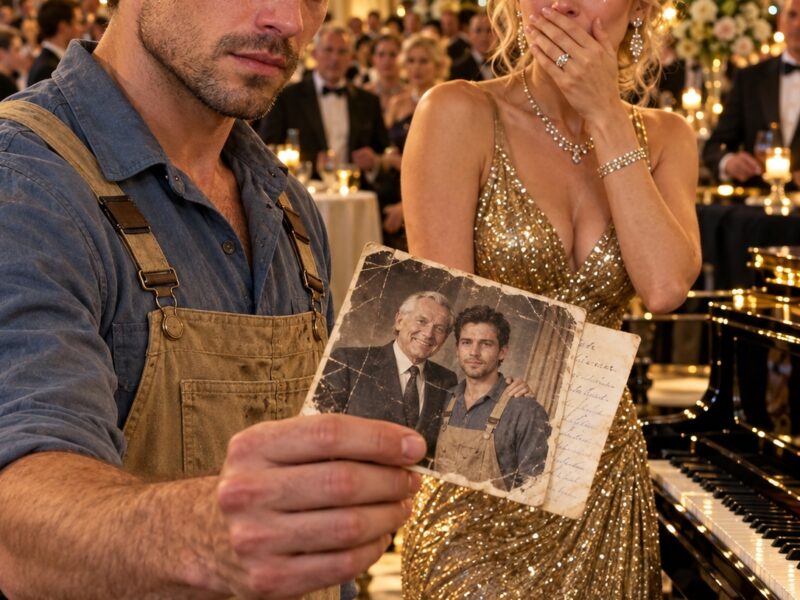
Daniel reached into his pocket.
He took out an old photograph, its edges worn from years of handling.
Eleanor accepted it carefully.
In the picture, a much younger Daniel stood beside her father. Both faced the camera with the quiet happiness of people who had shared something meaningful.
Her fingers tightened around the photograph.
There was handwriting on the back.
She turned it over.
Daniel has the gift of music, but his greatest gift is his heart.
Eleanor recognized her father’s writing.
For several seconds, she simply stared.
The message was brief, but it carried the unmistakable warmth of the man she had lost. He had seen Daniel’s potential, understood his circumstances, and valued him for something that had nothing to do with money or prestige.
Eleanor covered her mouth.
She remembered her own mocking voice.
You there, janitor? Can you play?
She remembered the laughter, the amused faces, and the certainty with which she had assumed the man in the faded uniform had nothing extraordinary to offer.
The shame was difficult to bear.
Not because she had been embarrassed before an audience, but because she had recognized a part of herself she no longer wanted to defend.
Her father had once helped a struggling student pursue his dream.
His daughter had turned that same man into a joke.
“I was wrong,” Eleanor whispered.
Daniel watched her quietly.
She looked up, her eyes filled with tears.
“I’m sorry.”
There was no attempt to explain away her behavior. No mention of champagne, social pressure, or the fact that the entire gathering had laughed along with her.
For once, Eleanor allowed an apology to stand without qualification.
Daniel gave her a gentle smile.
“I don’t want your money or your marriage, Eleanor.”
She swallowed.
“I only wanted you to understand that a person’s worth isn’t determined by their uniform.”
Eleanor looked around the room.
The guests who had laughed at Daniel now avoided his eyes or watched him with a new respect. Their fine clothes had not changed. Their fortunes had not changed. But the way they saw the man standing before them had changed completely.
She understood that the uniform had never concealed Daniel’s worth.
It had only revealed how little some people were willing to look beyond appearances.
For the remainder of the evening, Eleanor could not stop thinking about the photograph.
She carried it with her after the guests departed, turning it over again to read her father’s words. She had spent years trying to preserve his memory through possessions, portraits, and the name that appeared on the company’s documents.
Yet a man she had never noticed had kept alive one of the most important parts of her father’s legacy.
By the following morning, Eleanor had made a decision.
She reopened her father’s music foundation.
It was not merely a symbolic donation. The foundation began offering scholarships to talented students whose education and ambitions had been interrupted by family responsibilities, particularly those who had sacrificed their dreams to care for loved ones.
Eleanor wanted the assistance to reach the people her father would have recognized.
People like Daniel.
She approached him personally about becoming the foundation’s director.
Daniel had spent years working in a profession where few people asked about his past. Now Eleanor was inviting him to help guide a program that might keep other gifted young musicians from losing the opportunities he once had.
The invitation moved him.
He had not played the piano that evening to secure a new position. He had not intended to impress wealthy donors or change the course of his life.
He had simply wanted to stand up for the dignity of someone people were laughing at.
But Eleanor had listened.
In the months that followed, she began spending time at the foundation, learning about the students and the barriers they faced. She saw how a medical emergency, a family obligation, or financial hardship could quietly close doors for people who possessed extraordinary promise.
Her understanding of success began to expand.
She still ran her company. She still negotiated difficult deals and made decisions that carried enormous financial consequences. But she was no longer satisfied with the idea that a person’s importance could be measured solely by accomplishments, possessions, or position.
Daniel, meanwhile, found his way back to music.
He played again, not as the young scholarship student who once dreamed of concert halls, but as a man whose life had taught him that joy could survive even after years of sacrifice.
One afternoon, Eleanor found him sitting at a piano.
He was playing Chopin.
She stopped in the doorway and listened.
This time, there was no crowd. No expensive champagne, no audience waiting to laugh, and no impossible promise hanging over the performance.
There was only music.
Daniel noticed her when the passage ended.
Eleanor approached the bench.
“What if I asked you to teach me?” she said.
He looked at her with an amused smile.
“Only if you promise never to judge another person before hearing their story.”
She smiled back.
“I promise.”
Daniel moved slightly to make room beside him.
Eleanor sat down.
At first, their lessons were simply another way to honor her father’s memory. Daniel taught her with the same patience that had once been extended to him, while Eleanor discovered how much she had missed sitting at a piano without thinking about anything else.
Over time, the conversations between lessons became as meaningful as the music itself.
They spoke about family, regret, and the choices that had shaped their lives. Eleanor learned more about the years Daniel had spent caring for his mother. Daniel saw the loneliness Eleanor had hidden beneath her reputation for strength.
Neither had to pretend to be someone else.
What began as friendship slowly became love.
It did not come from a public wager or an extravagant promise. The marriage challenge that had once entertained a ballroom full of wealthy guests had meant nothing to Daniel, and Eleanor no longer needed such gestures to prove her power.
The connection between them developed through ordinary moments, quiet conversations, and a growing trust neither could have purchased.
Eleanor had once believed that being surrounded by people meant she could not possibly be alone.
Daniel had taught her that being truly seen was something very different.
And when she remembered that extraordinary evening beneath the golden chandeliers, she no longer thought first about the embarrassment of being challenged or the astonishment of hearing an unexpected performance.
She remembered her father’s handwriting on the back of a worn photograph.
She remembered the man who had placed his cleaning cloth aside, walked toward a piano, and asked to be treated with dignity.
Most of all, she remembered that he had never asked her to become less successful, less ambitious, or less powerful.
He had simply asked her to become more compassionate.
The piano that once stood as an expensive ornament had become a bridge between two lives that might otherwise never have truly met.
And the most valuable thing Eleanor Whitmore discovered that evening was something no fortune could have bought.
The ability to recognize another person’s worth before the world gave her a reason to notice it.









