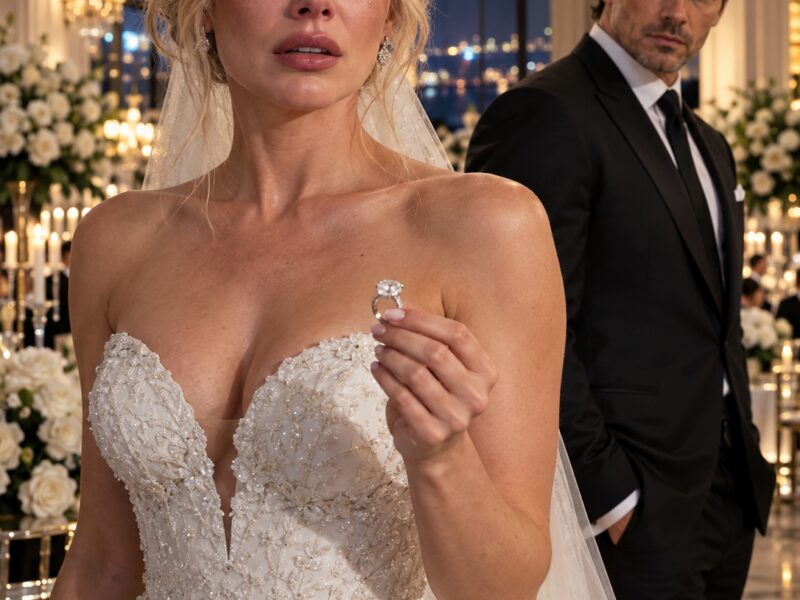
THE BILLIONAIRE CEO WAS LEFT AT THE ALTAR—THEN A BROKE CARPENTER SAID SIX WORDS THAT CHANGED EVERYTHING

“You would make a great bride.”
Callum Mercer said it without thinking.
One hand was wrapped around a worn brass hinge. The other rested against a century-old oak door he had spent most of the morning trying to convince not to sag.
The words left his mouth before common sense could stop them.
And suddenly, the Grand Ashford ballroom went quiet.
Not completely quiet.
Thirty feet away, a florist was still trimming white roses. Someone behind the temporary stage was testing a microphone. Crystal glasses touched softly as servers arranged them on linen-covered tables.
But the people closest to Callum stopped moving.
Because the woman standing ten feet away from him was wearing a wedding gown that probably cost more than his pickup truck.
And she was staring directly at him.
Vivien Hail lifted one eyebrow.
At thirty-six, she was the chief executive officer of Hail & Row Hospitality Group, a company that owned luxury hotels, resorts, and historic properties across several states.
She was also the reason half the people in the ballroom looked permanently nervous.
Callum had watched senior executives lower their voices when she entered a room.
He had watched contractors straighten their jackets before speaking to her.
He had watched a regional director rehearse a three-sentence update twice before approaching her.
Vivien Hail was not a woman people casually told would make a great bride.
Especially not while she was standing in a white wedding gown beneath a twelve-foot floral arch.
Yet instead of firing him, she looked down at herself, then back at him.
“I would need a groom for that.”
A few people laughed.
Callum did too.
“Minor detail.”
This time, the corner of Vivien’s mouth moved.
“Convenient opinion from a man holding a screwdriver.”
“Restoration chisel.”
“Is that better?”
“To a carpenter? Considerably.”
A real laugh escaped her.
It was quiet, surprised, almost young.
Three members of her public-relations team looked over.
That told Callum more about Vivien Hail than any magazine profile ever could.
Apparently, their CEO laughing without permission was unusual enough to interrupt the schedule.
Callum lowered his eyes.
He knew his place.
Thirty-eight years old.
Widower.
Single father.
Owner of Mercer Restoration, which consisted of himself, one part-time employee, a workshop with a leaking roof, and a truck that made a noise every cold morning suggesting it was reconsidering its commitment to transportation.
Vivien Hail lived in penthouses, private boardrooms, and financial statements with more zeroes than Callum had ever seen in his bank account.
Their lives had crossed because an old ballroom door refused to close.
That was all.
At least, that was what Callum told himself.
“Miss Hail, chin slightly left,” the photographer called.
Vivien faced the camera.
An assistant adjusted the train of her gown.
Another moved a bouquet two inches to the right.
Callum returned to the hinge.
Then he heard it.
Click.
A tiny metallic sound behind him.
He looked toward the antique mirror beside the stage.
In the reflection, Vivien had slipped a diamond ring from her right hand.
It was not an engagement ring.
Not technically.
But she held it in her palm for several seconds.
Her smile disappeared.
Then she closed her fingers around the ring and placed it inside the pocket of a garment bag.
For one brief moment, the woman surrounded by florists, photographers, assistants, executives, and enough white roses to decorate three weddings looked more alone than anyone Callum had ever seen.
He noticed because Callum Mercer had always been good at noticing damaged things.
It was part of his job.
Three years earlier, Vivien Hail had worn another white dress.
That time, there had been no photographer asking her to smile for a hotel campaign.
The flowers had been real.
The invitations had been real.
Her father had been waiting outside the bridal suite to walk her down the aisle.
And the man who had promised to marry her had never walked through the doors.
He sent a message instead.
Six sentences.
Six sentences to end four years.
Six sentences while two hundred guests sat downstairs.
Six sentences that became a business scandal before Vivien had even removed her veil.
By sunset, photographs of the abandoned bride were on entertainment websites.
By the next morning, financial reporters were speculating about whether the broken engagement would affect negotiations between two family-controlled companies.
Her heartbreak had become market commentary.
Her humiliation had become content.
And Vivien had learned something she never forgot.
Money could buy privacy after the fact.
It could buy security, lawyers, penthouses, drivers, silence.
But it could not stop someone from leaving.
And it could not protect a heart from humiliation.
Callum knew none of that.
He only knew that the woman in the mirror had stopped smiling.
He tightened the last screw, tested the door, then closed his toolbox.
Vivien caught his reflection.
“Leaving already?”
“Door’s fixed.”
“You always leave when the job is finished?”
Callum considered the question.
“Usually before somebody puts me in a tuxedo.”
Her eyes softened.
“That would be tragic for the tuxedo.”
“Exactly.”
She laughed again.
This time neither looked away quickly enough.
And neither noticed Graham Voss standing near the ballroom entrance.
Watching.
His charcoal suit was immaculate.
His expression was not.
Graham had worked beside Vivien for twelve years.
He knew which investors she trusted.
Which board members irritated her.
Which journalists she avoided.
Which restaurants she preferred for negotiations.
He knew what she did when she was angry and what she did when she was afraid.
And he knew one thing with absolute certainty.
Vivien Hail did not look at men the way she was looking at Callum Mercer.
The carpenter picked up his toolbox.
“Have a good afternoon, Miss Hail.”
“Vivien.”
Callum stopped.
She seemed almost surprised by her own correction.
“Vivien,” he repeated.
Something shifted behind Graham’s eyes.
It was small.
Almost invisible.
But some doors did not need to slam to announce that something dangerous had entered the room.
And the door Callum had repaired that morning was not the one Graham Voss had begun worrying about.
At 6:15 the next morning, Callum’s coffee maker hissed like it personally resented being useful.
September light slipped through the kitchen blinds and painted narrow gold stripes across a table covered with school papers, grocery receipts, two pencils, and a purple crayon missing its wrapper.
Posie Mercer sat across from him in mismatched socks, eating cinnamon toast while drawing on the back of an envelope.
Callum looked closer.
“That better not be the electric bill.”
“It was boring before.”
“Posie.”
She turned the page around.
She had drawn a house with a crooked chimney, three windows, a porch swing, and what appeared to be a dog larger than the front door.
Callum studied it.
“Where’s the garage?”
“You don’t need a garage in every house.”
“That is where you’re wrong.”
Posie rolled her eyes with the exhausted patience of a nine-year-old who had apparently been raising her father emotionally for years.
Behind her, the refrigerator hummed.
Beside the sugar jar sat a stack of unopened mail.
Callum reached for one envelope.
He could see red lettering through the paper.
FINAL NOTICE.
He slid it beneath a grocery flyer before Posie looked up.
Money was not a tragedy in the Mercer house.
It was simply something that never stayed long.
The mortgage got paid.
Posie had shoes that fit.
There was food in the refrigerator.
Most weeks, enough for leftovers.
But there was always something waiting behind the next corner.
The workshop roof leaked over the storage room.
The truck transmission coughed whenever the temperature dropped.
Posie’s field-trip deposit was due Friday.
Callum had learned to measure life in small equations.
Twenty dollars for gasoline meant packing lunch.
New work boots meant postponing the dentist.
Replacing the truck tires meant telling himself the workshop roof could survive another winter.
Pride meant never letting Posie know which sacrifice paid for which necessity.
She took another bite of toast.
“You going back to the fancy hotel?”
“For a few hours.”
“The one with the bride lady?”
Callum stopped with his coffee halfway to his mouth.
“She is not a bride lady.”
“She had a wedding dress.”
“It was for work.”
Posie frowned.
“That is a weird job.”
Callum laughed.
“On that, we agree.”
Thirty-five miles away, Vivien Hail stood barefoot in a penthouse suite overlooking downtown Cincinnati while her assistant read the day from a tablet.
“Seven-thirty breakfast with regional directors. Eight-fifteen construction review. Nine investor call. Ten-thirty press interview. Noon tasting. Two board session. Four-fifteen legal. Six-thirty Whitmore Foundation dinner.”
Every hour belonged to someone.
Every minute had a purpose.
“Move the investor call to nine-thirty,” Vivien said.
Marin Bell looked up.
“Because?”
“The construction review may run long.”
“The west corridor?”
“Yes.”
Marin said nothing.
Vivien glanced at her.
“What?”
“Nothing.”
“That expression is not nothing.”
“I don’t have an expression.”
“You’ve worked for me seven years. You have at least four.”
Marin returned her eyes to the tablet.
“Construction review. Nine-thirty investor call.”
Vivien narrowed her eyes but let it go.
On the marble table beside the windows sat breakfast.
Poached eggs.
Fresh berries.
Coffee in white china.
Everything perfect.
Everything cold.
She walked past it.
Outside, eighteen floors below, delivery trucks moved through morning traffic.
Somewhere in the city, people were packing lunches, arguing with children about homework, searching for missing keys, standing in kitchens that smelled like toast.
Ordinary things.
Vivien sometimes wondered what it would feel like to have a life that did not require an itinerary.
Then she dismissed the thought.
Longing was inefficient.
At 8:23, Callum entered the Grand Ashford through the service hallway carrying a toolbox and a paper cup of coffee.
He preferred hotels in the morning.
Before the guests filled them, luxury became honest.
No champagne.
No speeches.
No polished photographs.
Just housekeepers making beds, maintenance workers replacing bulbs, cooks chopping onions, engineers checking boilers.
People fixing what had broken overnight.
Callum had barely unpacked his chisels when heels approached.
Vivien rounded the corner with two executives.
She stopped.
“Mr. Mercer.”
“Miss Hail.”
One eyebrow rose.
He corrected himself.
“Vivien.”
One executive glanced at the half-restored walnut panel.
“We could replace all of this by Friday.”
Callum ran his thumb along the grain.
“You could.”
“It would be faster.”
“Yes.”
“Probably cheaper.”
“Probably.”
The executive looked at Vivien.
“Then why are we restoring it?”
Before she could answer, Callum did.
“Because somebody built it to last.”
The executive shrugged.
“It’s still wood.”
Callum looked at the hundred-year-old walnut.
Scarred.
Darkened.
Solid beneath the damaged finish.
“Most valuable things look ordinary if you only price the material.”
Silence settled over the corridor.
Vivien stared at him.
Then at the wood.
Something in her expression shifted.
“Restore it,” she said.
The executive opened his mouth.
Vivien was already walking away.
Callum returned to work.
He never saw her carry those words into the elevator.
Most valuable things look ordinary if you only price the material.
They stayed with her through the investor call.
Through the press interview.
Through a lunch she barely touched.
That night, while Callum sat at his small kitchen table helping Posie understand fractions by drawing increasingly terrible pizzas, Vivien ate alone beneath a chandelier designed to illuminate a table for twenty.
Callum had fewer rooms.
Less money.
Fewer choices.
Yet when Posie laughed because he accidentally turned three-eighths into what looked like a wounded pepperoni pizza, the Mercer kitchen felt full.
Vivien had spent years building a life no one could take from her.
She had never noticed how quiet it had become.
Until a carpenter made her notice.
Two days later, Callum saw Vivien shift in her chair for the third time during a budget meeting.
He was working outside the glass-walled conference room.
She pressed one hand briefly against the small of her back, straightened, and continued listening.
Nobody inside reacted.
Callum did.
By 5:30, the meeting room was empty.
He walked inside and inspected the chair at the head of the table.
Beautiful leather.
Hand-carved oak.
Probably seventy years old.
And miserable.
One rear joint had loosened, shifting the seat just enough to force whoever sat in it slightly off balance.
“There you are,” he murmured.
He carried the chair to his work area.
Tightened the joint.
Replaced a worn support.
Adjusted the seat angle.
Rubbed beeswax into the oak.
Forty-three minutes.
No work order.
No invoice.
The next morning, Vivien sat down and stopped.
She leaned back.
Forward.
Then back again.
Marin looked at her.
“Problem?”
“The chair.”
“What about it?”
“It doesn’t hurt.”
Marin crouched slightly, looked beneath it, then toward the hallway.
“I think I know why.”
Twenty minutes later, Vivien found Callum sanding a cedar door.
“Did you fix my chair?”
He kept sanding.
“Depends.”
“On?”
“Was it broken?”
“You know it was.”
“Then probably.”
“There was no work order.”
“I survived.”
“Send me an invoice.”
“No.”
That made her blink.
“No?”
“No.”
“People generally accept money when I offer to pay them.”
Callum looked up.
“That sounds exhausting.”
Her mouth twitched.
“Why did you fix it?”
He brushed dust from his hands.
“Because it was hurting you.”
“That is not a business reason.”
“Good thing I wasn’t making a business decision.”
She stared at him.
“Nothing is free.”
The sentence changed the air.
Callum heard the history inside it.
Not the CEO.
Not the negotiator.
Something older.
“Maybe not,” he said. “But not everything kind needs an invoice.”
Vivien went still.
“You really believe that?”
“I wouldn’t say it if I didn’t.”
“Most people want something.”
“Most people probably do.”
“And you?”
He smiled.
“Right now? I want to finish this door before my daughter decides cereal counts as dinner again.”
Vivien laughed.
“How old?”
“Nine.”
“And she chooses cereal for dinner?”
“She calls it a grain-based entrée.”
“Persuasive.”
“Terrifyingly.”
“What’s her name?”
“Posie.”
“That’s unusual.”
“Her mother chose it.”
The smile faded from Vivien’s face.
Not awkwardly.
Gently.
“I’m sorry.”
Callum nodded.
“Thank you.”
He offered nothing else.
No story about the hospital room.
No story about the drive home alone.
No story about waking the next morning and realizing he had to tell a five-year-old girl that her mother was never coming back.
No story about learning to braid hair with hands built for wood and steel.
Vivien did not ask.
That restraint mattered.
More than she knew.
She took three steps away.
Stopped.
“Callum.”
It was the first time she used his first name.
“Yes?”
“Don’t send an invoice.”
He smiled.
“Now you’re getting it.”
She walked away carrying a strange feeling through downtown traffic.
Someone had noticed she was hurting before she asked for help.
In Vivien’s world, attention usually arrived with expectation.
Favors came with leverage.
Kindness came attached to donations, publicity, names on buildings, or future obligations.
Callum had repaired a chair and asked for nothing.
For a woman who could buy almost anything, the absence of a price felt dangerously rare.
Three days later, the danger acquired a purple backpack.
Posie Mercer entered the Grand Ashford at 2:15 on a Wednesday because a water-main break had closed her school early and Callum had nobody to watch her.
She sat cross-legged on a drop cloth near the ballroom while he repaired carved molding six feet away.
“Stay where I can see you.”
“I am literally six feet away.”
“That isn’t the point.”
“What is the point?”
“The point is fathers say things like that.”
Posie nodded solemnly.
“Very professional.”
Callum gave her a look.
She grinned.
Ten minutes later, cream-colored heels stopped beside her sketchbook.
“That is a very serious-looking dress,” Vivien said.
Posie looked up.
Then her eyes widened.
“You’re the bride lady.”
Callum froze.
Vivien slowly turned toward him.
“Bride lady?”
“I can explain.”
“Can you?”
Posie helpfully continued.
“He said you weren’t actually a bride.”
Callum closed his eyes.
Vivien laughed.
Not her donor laugh.
Not her press laugh.
A real one.
Warm enough to make Posie laugh too.
Vivien crouched beside the sketchbook.
“So what am I wearing?”
Posie turned the page.
“This one. I made the sleeves longer because the other dress looked cold.”
“Practical.”
“And pockets.”
Vivien nodded seriously.
“Now that is luxury.”
Within five minutes, the CEO of Hail & Row Hospitality was sitting on the ballroom floor discussing lace, pockets, and whether wedding cakes needed six layers.
Callum tried not to stare.
He failed.
There was something unsettlingly beautiful about seeing Vivien without a conference table between herself and the world.
Her shoulders loosened.
Her voice changed.
She listened to Posie as if a nine-year-old’s opinion about buttercream genuinely mattered.
Then Posie handed her a pencil.
“You draw.”
“I’m terrible at drawing.”
“Everybody says that before they draw something ugly.”
Vivien blinked.
Callum covered his smile.
“Encouraging child,” Vivien said.
“I try.”
Together, they sketched a ballroom.
Tall windows.
Candles.
Flowers.
Posie drew a wooden arch.
Vivien added chairs.
Then Posie drew a narrow aisle.
And asked the question only a child could ask without realizing she had stepped into a graveyard.
“If you get married, who walks you down the aisle?”
Vivien’s pencil stopped.
Callum felt the room change.
“My father would have,” she said.
Posie’s voice softened.
“Did he die?”
“Yes.”
“When?”
“Two years ago.”
Posie looked down at her hands.
“My mom died too.”
Callum took a step forward.
Vivien looked at Posie.
“I’m sorry.”
Posie shrugged with the peculiar bravery children use when grief has lived with them long enough to become furniture.
“Dad says missing somebody means they mattered.”
Vivien looked at Callum.
He said nothing.
No apology.
No explanation.
No attempt to fix what could not be fixed.
He simply let the silence stay gentle.
“Your dad sounds wise,” Vivien said.
Posie lowered her voice.
“Sometimes.”
“I heard that.”
Posie giggled.
So did Vivien.
Later, after they left, Vivien found a drawing beneath the drop cloth.
Three figures stood beneath a wooden arch.
A little girl in the middle.
A man on one side.
A woman on the other.
No faces.
Just joined hands.
Vivien stared at it longer than she should have.
Then folded it carefully.
That night, Callum sat alone in his workshop after Posie went to bed.
He thought about Vivien’s face when Posie mentioned her father.
He thought about how quickly she had hidden the pain.
He recognized that instinct.
He reached into the scrap bin and pulled out a small piece of walnut.
He sanded the edges.
Then he took out his engraving knife.
The next morning, Vivien found it on her desk.
No box.
No card.
No signature.
Only one sentence carved into the grain.
Some people walk alone because nobody worthy has caught up yet.
She read it once.
Then again.
Her thumb traced the letters.
For the first time in years, the woman who trusted contracts more than promises had no idea what to do with kindness that demanded nothing in return.
Unfortunately, someone else noticed.
By 9:15, Graham Voss knew about the walnut.
He did not know what it said.
He only knew Vivien had read it twice during a strategy meeting and placed it inside the top drawer beside her personal stationery.
For Graham, that was enough.
At 10:30, he found Callum in the west corridor.
“Mr. Mercer.”
Callum looked up.
“Morning.”
“You have a minute?”
“Depends what the minute costs.”
Graham smiled.
“I think you’ll appreciate this.”
He opened a leather folder.
Inside was a proposal.
Twelve Hail & Row properties.
Historic restoration contracts.
Eighteen months guaranteed.
Callum read the first page.
Then the second.
The number at the bottom tightened something in his chest.
It was enough to repair the workshop roof.
Replace the truck.
Hire two employees.
Start a real college fund for Posie.
Maybe stop opening the refrigerator and mentally calculating the next seven days.
“This is a lot of work,” Callum said.
“It’s a lot of opportunity.”
“Why me?”
“You’re talented.”
Too fast.
Callum closed the folder.
“Then Vivien can tell me that.”
“She doesn’t need to be involved in every operational detail.”
“Her name is on the building.”
“Her name is on hundreds of buildings.”
Callum handed the folder back.
“Then one carpenter shouldn’t matter much.”
Graham’s smile disappeared.
“You’re making this personal.”
“I was about to say the same thing.”
“This is a serious offer.”
“I know.”
“You have a daughter.”
Callum’s jaw tightened.
“Be careful.”
“I mean financially. School. College. Stability. You could give her more.”
Callum looked at the folder.
God help him, he wanted it.
That was the humiliating part.
He could see new tires.
A dry workshop.
Posie at eighteen opening a college statement containing something besides hope.
“She already has more than most people know how to measure,” he said.
“That sounds noble.”
“It isn’t noble. It’s a fact.”
“Take the contract.”
“No.”
“You haven’t negotiated.”
“Because I’m not for sale.”
Graham stared at him.
“Everyone has a price.”
Callum picked up his chisel.
“That’s usually something people say after they forget the difference between price and value.”
Graham walked away.
Callum stood alone.
The money remained in his mind long after the man disappeared.
At noon, carrying restored trim toward the ballroom, Callum passed the executive lounge.
The door was partly open.
He heard his name.
“Mercer is temporary,” a board member said.
Another man laughed.
“A carpenter phase is new.”
“It’s harmless as long as she remembers who she is.”
“And he remembers who he is.”
Callum stopped.
Someone poured coffee.
Then another voice said, “She’ll get bored. Men like that enjoy getting close to power. He probably thinks he won the lottery.”
Callum looked down at his boots.
Dusty.
Scuffed.
Cheap.
He did not storm into the room.
He imagined Posie instead.
Fourteen.
Sixteen.
Twenty.
Standing somewhere expensive while someone smiled politely and made her understand she should feel grateful just to have been invited.
That image hurt more than anything they had said about him.
He stepped away.
That afternoon, Vivien found him packing early.
“You’re leaving?”
“For today.”
“Is something wrong?”
“No.”
“You’re a terrible liar.”
“Long day.”
She hesitated.
“Did Graham speak to you?”
Callum looked at her.
“He did.”
“About?”
“Work.”
“And?”
“I passed.”
“Why?”
He latched the toolbox.
“Some contracts cost more than they pay.”
She stared at him.
“Callum.”
He nearly told her.
The offer.
The comments.
The contempt wrapped in polished language.
Then he saw Posie’s face in his mind.
“I have to pick up my daughter.”
Vivien nodded slowly.
“Of course.”
He walked away.
She did not chase him.
But when the elevator doors closed, Vivien felt something she had not felt in years.
Fear.
Because Callum was not pulling away to make her chase him.
He was pulling away because someone inside her world had convinced him he needed to.
The next morning, she drove across Cincinnati alone.
Vivien entered Mercer Restoration before eight.
No assistant.
No driver.
No blazer.
The workshop smelled of cedar, coffee, and dust warmed by morning sunlight.
Old chair legs stood beside samples of walnut and oak.
Nothing had been designed to impress anyone.
Everything had been cared for.
Callum stood at the back, planing a board.
He looked up.
“You’re early.”
“You’re avoiding me.”
“That too.”
“Why?”
He set the plane down.
“You drove across town for that?”
“Yes.”
“You could have called.”
“You wouldn’t answer.”
“Probably not.”
Her jaw tightened.
“Stop making me guess.”
Callum wiped his hands.
“Graham offered me a contract.”
“I know now.”
“Did you ask him to?”
“No.”
“Know he planned to?”
“No.”
Callum nodded.
“All right.”
Vivien stared.
“That’s it?”
“What do you want me to say?”
“I want you to tell me why you walked away as if I had done something to you.”
He went quiet.
“I didn’t leave because of the contract.”
“Then why?”
“Because I heard what people around you think.”
Her expression hardened.
“Who?”
“Does it matter?”
“Yes.”
“Not to me.”
“It matters to me.”
“They called me a phase. Said I was lucky. Said men like me enjoy being close to power.”
Vivien’s face became perfectly still.
“Who said it?”
“That isn’t the point.”
“It is absolutely the point.”
“No, Vivien. The point is I have a daughter.”
She blinked.
“What does Posie have to do with this?”
“Everything.”
His voice stayed low.
“She watches me. She learns from what I tolerate.”
“And what exactly are you tolerating?”
“A world where people think respect is something you earn by having the right last name.”
“That is not my world.”
Callum looked directly at her.
“You run it.”
The words landed.
Vivien stepped back.
“That’s unfair.”
“Maybe.”
“No. It is.”
“I didn’t say you agree with them.”
“Then what are you saying?”
“I know where I don’t want my daughter learning her value.”
Her voice changed.
“From me?”
Callum hesitated.
Too long.
Hurt replaced anger in her eyes.
“You think I would make Posie feel small?”
“I think people around you already tried to make me feel small.”
“And you decided that means I would let them?”
“I decided I won’t gamble with her dignity.”
“From me?”
“From what comes with you.”
That was worse.
Vivien turned toward a row of restored chairs.
Each still carried scratches beneath the new finish.
“Do you know what people around me think about me?”
Callum said nothing.
“They think I’m impressive when I’m alone. Useful when I’m controlled. Dangerous when I make personal decisions.”
Her voice remained steady.
Barely.
“They thought my engagement was good because it made strategic sense. They thought my wedding was good because the photographs would reassure investors.”
Callum’s expression changed.
Vivien continued.
“When he left me, half the people around me were more worried about the stock price than whether I could stand.”
“Vivien—”
“No.”
She turned.
“Do not stand in your workshop and explain my world to me.”
“I’m not.”
“You are.”
Her eyes were wet now, but no tears fell.
“You think I don’t understand what it feels like to be measured by people who see a role instead of a person?”
Callum had no answer.
Vivien shook her head.
“You know the worst part?”
“What?”
“I thought you were different.”
The disappointment in her voice hurt more than anger would have.
He stepped closer.
“Vivien.”
“You don’t get to carve something kind into wood one day and decide I’m too dangerous for your daughter the next.”
“That isn’t what I meant.”
“Then say what you mean.”
Callum searched for words.
Wood had always been easier.
Measurements were easier.
“I mean I can’t bring Posie into a life where she has to prove she belongs.”
Vivien held his gaze.
“Neither can I.”
Silence filled the workshop.
Finally Callum said, “I’m sorry.”
Vivien nodded.
“So am I.”
She walked toward the door.
“Vivien.”
Her hand stopped on the brass handle.
“For what it’s worth, I never thought you were the problem.”
She closed her eyes.
“That is exactly the problem, Callum.”
The door opened.
The bell rang.
Then she was gone.
Callum stood alone for a long time.
He had spent years believing quiet choices protected the people he loved.
But dignity was not always the same thing as distance.
Sometimes, in trying to protect someone from being hurt, a good man could become the reason they were.
He just did not know whether he had realized it too late.
For the next day, Vivien ignored Graham Voss.
At 4:30, he entered her office carrying a revised merger packet.
“The showcase is tomorrow. The board wants the Whitmore partnership included in your remarks.”
“No.”
Graham paused.
“No?”
“No announcement.”
“The Whitmore Group expects clarity.”
“They’ll have clarity when the terms are acceptable.”
“You’re letting emotion complicate a business decision.”
Vivien looked up.
“Be very careful with your next sentence.”
“This company cannot afford distractions.”
“Callum is not part of this conversation.”
“Then why are we having it?”
Silence.
Graham straightened his cuffs.
“Tomorrow is supposed to reassure investors. We need stability.”
“Stability is not obedience.”
“Nobody said obedience.”
“You didn’t have to.”
“I’m trying to protect what you built.”
Vivien closed the folder.
“Stop trying to decide what I am allowed to care about.”
He stared at her.
For the first time in twelve years, Graham seemed to realize he had miscalculated.
He left.
Vivien opened her desk drawer.
The walnut was there.
Some people walk alone because nobody worthy has caught up yet.
Three days ago, the sentence had felt like grace.
Now it hurt.
Across town, Callum was losing an argument with a nine-year-old over macaroni and cheese.
“You’re sad,” Posie said.
“I’m tired.”
“That’s what grown-ups say when they’re sad.”
“Who taught you that?”
“You.”
Callum stopped stirring.
Posie watched him.
“Did you make Vivien mad?”
“Her name is Vivien now?”
“You said it first.”
“Adult things are complicated.”
“That usually means adults made them complicated.”
Callum almost smiled.
Posie tilted her head.
“Do you like her?”
“Eat your dinner.”
“It isn’t done.”
Callum looked at the pot.
She was right.
Again.
The next evening, the Grand Ashford ballroom glowed beneath hundreds of warm lights.
White roses climbed wooden arches.
Crystal flashed against linen.
The restored walnut panels shone along the walls, every preserved scratch visible beneath the finish.
Callum was not supposed to be there.
His contract had ended that afternoon.
Then at 5:17, a display frame near the stage came loose.
He had promised that if his work failed, he would repair it himself.
At 6:10, he was behind a service partition tightening a bracket while hundreds of guests filled the ballroom.
Then Graham’s voice came through the speakers.
“Ladies and gentlemen, tonight marks a new chapter for Hail & Row Hospitality Group.”
Callum stopped working.
Graham spoke about expansion.
Partnership.
Legacy.
Shared vision.
Then his tone changed.
“And some partnerships, as we know, become strongest when they extend beyond business.”
Polite laughter moved through the room.
Callum looked through a gap in the partition.
Vivien stood beneath the lights in a white evening gown.
Not a wedding dress.
Close enough.
Graham lifted his glass.
“To the future.”
Applause.
Vivien did not raise hers.
Instead, she walked to the podium.
She looked down at the prepared speech.
Then set the cards aside.
“Three years ago,” she said, “I stood in a room very much like this one wearing white.”
The applause died.
“There were flowers. Cameras. Investors. Friends. My father was waiting to walk me down the aisle.”
Graham’s face changed.
Callum did not move.
“The man I was supposed to marry never came.”
A murmur moved through the ballroom.
“For years, I told myself that was the day I learned not to trust love.”
She paused.
“I was wrong.”
Nobody touched a glass.
“That was the day I learned what happens when people mistake a life for a transaction.”
Callum felt something tighten in his chest.
“My engagement had become useful. My wedding had become useful. Even my heartbreak became useful. People discussed the worst day of my life in terms of market confidence.”
Graham moved toward her.
Vivien raised one hand.
He stopped.
“Tonight, I was asked to announce a partnership whose current terms would give another organization influence over decisions this company spent decades earning the right to make.”
She looked toward the Whitmore executives.
“I will not sign it.”
Absolute silence.
“Not because I am emotional.”
Her eyes moved toward Graham.
“Not because I am distracted.”
Another breath.
“Because it is a bad agreement.”
Then came the sentence that found Callum across the ballroom.
“And because I am finished allowing anyone to confuse control with care.”
Vivien stepped away from the podium.
For two seconds, nobody moved.
Then a woman near the back stood and began clapping.
Another joined.
Then another.
Applause spread across the room.
But Vivien was already walking offstage.
Callum stepped from behind the partition.
She saw him.
Stopped.
“You came.”
“A frame broke.”
Her mouth almost smiled.
“Of course it did.”
Callum looked toward the ballroom.
“What you did took courage.”
“I didn’t do it for you.”
“I know.”
That answer mattered.
Vivien waited.
Callum swallowed.
“I was wrong.”
“About?”
“Distance.”
Her expression changed.
“I thought protecting Posie meant keeping her away from every room where somebody might judge us.”
“And now?”
“Now I think maybe she needs to see what it looks like when somebody refuses to let judgment decide who they become.”
Vivien’s eyes glistened.
“That sounds expensive.”
Callum smiled faintly.
“Some things are worth the cost.”
Behind them, applause continued.
But the important thing was not that Vivien had chosen Callum.
She had not.
Not yet.
The important thing was that she had chosen herself.
And for the first time, Callum understood that loving someone with dignity did not mean rescuing them from every difficult room.
Sometimes it meant trusting them to stand in it.
Speak.
And walk out under their own power.
For twelve days, they did something neither was particularly good at.
Nothing.
Callum finished two restoration jobs.
He repaired the workshop roof with money he had saved instead of money Graham had offered him.
Vivien returned to the Whitmore negotiations and removed three clauses her board had previously called unavoidable.
She did not call Callum.
He did not call her.
But silence after truth was different from silence built from fear.
One closed a door.
The other waited beside it.
On a cool Thursday afternoon, Callum drove back to the Grand Ashford with Posie beside him and a six-foot nineteenth-century mirror secured in the bed of his truck.
It was the final piece of the original restoration contract.
“So this is really the last thing?” Posie asked.
“That is generally what final means.”
“You say that when you don’t want to answer the real question.”
“What real question?”
“Whether you’re going to see Vivien.”
“We are delivering a mirror.”
“That is not an answer.”
“You have become very demanding.”
“I’m nine. It’s my job.”
Twenty minutes later, they carried the mirror into the empty ballroom.
No investors.
No flowers.
No cameras.
Afternoon light stretched across the floor.
They placed the mirror near the east wall.
Callum adjusted it until it stood perfectly level.
He stepped back.
The ballroom looked softer in the old glass.
Every restored panel.
Every preserved scar.
Every place where he had chosen repair instead of replacement.
Then the doors opened.
Vivien entered alone.
Dark slacks.
Cream sweater.
No entourage.
Posie smiled.
“Hi, Vivien.”
“Hello, Posie.”
Callum straightened.
“The mirror’s finished.”
“I can see.”
“Original frame. New backing. Glass is old, but stable.”
Vivien touched the faint silvering along one edge.
“You kept the imperfections.”
“They’re part of it.”
“You say that about everything.”
“Only things worth saving.”
Their eyes met in the reflection.
Posie looked between them.
Then wandered toward a tray of fabric samples twenty feet away with the exaggerated innocence of a child who had decided to give adults privacy while hearing absolutely everything.
Vivien touched the walnut frame.
“Do you remember your first day here?”
“I remember a door that refused to close.”
“That isn’t what I meant.”
“I also remember someone criticizing my billing system.”
“You barely have a billing system.”
“Still don’t.”
She smiled.
Then her expression softened.
“You said something to me that day.”
Callum knew.
“I said a lot of things.”
“You said I would make a great bride.”
He looked down.
“Not my most professional moment.”
“No.”
She smiled.
“It wasn’t.”
“And you said you needed a groom.”
Vivien faced him.
“I still do.”
Callum stopped breathing for half a second.
She continued quickly.
“Not today. Not tomorrow. Maybe not for a long time.”
“Good.”
“Good?”
“I didn’t bring a ring.”
“That would have been alarming.”
He laughed.
So did she.
The tension loosened.
Vivien folded her hands.
“I’ve spent most of my life choosing people based on whether they fit into the life I already built.”
“How did that work?”
“You’ve seen the results.”
“Fair.”
She looked toward Posie.
Then back at him.
“Maybe I don’t need someone who fits into my life.”
Callum waited.
“Maybe I need to learn how to build a different one.”
The ballroom became very still.
“That sounds like a big project,” he said.
“I know a carpenter.”
“He’s expensive.”
“I heard he works for pizza.”
“Depends on the toppings.”
Vivien took one small step closer.
“Then maybe we start with dinner.”
“Dinner?”
“Dinner. No board members. No contracts. No photographers.”
“Posie comes.”
Vivien looked toward the girl.
“I was hoping she would.”
From twenty feet away, Posie immediately said, “I like pasta.”
Callum stared.
“You were listening.”
“The ballroom echoes.”
Vivien covered a laugh.
“I make lasagna,” Callum said.
“He burns the edges,” Posie added.
“They’re supposed to be crisp.”
“They’re black.”
“Character.”
Vivien laughed.
And something changed.
No miracle arrived.
No fortune changed hands.
A wealthy woman simply stood beside a working man and his daughter.
Nobody was trying to impress anyone.
Vivien looked at their reflection in the old mirror.
A woman once abandoned at an altar.
A father who had mistaken distance for protection.
A little girl who had understood before either of them that home was not always somewhere you inherited.
Sometimes it was something people built.
Carefully.
One honest choice at a time.
“Seven?” Vivien asked.
Callum nodded.
“Seven works.”
Posie raised one finger.
“Garlic bread.”
Vivien looked at Callum.
“Non-negotiable?”
“Apparently.”
“Then we have a deal.”
Callum smiled.
“No contracts.”
Her eyes warmed.
“No contracts.”
And in a ballroom designed to sell perfect weddings to strangers, three imperfect people walked toward dinner.
Three months later, the Grand Ashford looked almost exactly the same.
The walnut panels still lined the ballroom.
The old mirror still stood against the east wall.
The staircase still carried a century of footsteps beneath its polished rail.
What had changed was harder to photograph.
Callum no longer entered through the service door unless he wanted to.
Vivien no longer allowed Graham, the board, or anyone else to speak about him as though dignity came with a salary requirement.
Graham remained with the company.
But after a formal review of how the restoration contract had been handled, his authority over independent vendors was reduced.
His apology came weeks later.
Not beautifully.
Men like Graham rarely apologized beautifully.
He passed Callum in the lobby and stopped.
“Mercer.”
Callum looked up.
“I misjudged you.”
Callum waited.
“And I handled things badly.”
“Do better next time.”
That was all.
No humiliation.
No victory speech.
Just accountability accepted without cruelty.
Vivien learned that respect was not proved by protecting someone from every insult.
Sometimes it was proved by refusing to let the insult become policy.
Callum learned something too.
Protecting Posie did not require building walls around their lives.
It required teaching her she could enter unfamiliar rooms without surrendering who she was.
By December, dinner had become a weekly habit.
Then twice a week.
Then phone calls on ordinary Tuesdays.
Vivien attended Posie’s winter concert and sat in the third row instead of the reserved front seats.
Callum attended a hotel opening in a suit and complained about the collar for four straight hours.
Neither entered the other’s world and disappeared.
They began building a third one.
On a snowy Saturday evening, Callum stood in Vivien’s kitchen wearing an apron Posie had bought him.
TRUST ME, I HAVE A SAW.
Vivien read it again.
“That is not reassuring around food.”
“It was on sale,” Posie said.
“The lasagna edges are burning.”
“They’re developing character.”
“They’re developing smoke.”
Vivien opened the oven.
The kitchen smelled of tomato sauce, garlic bread, and cedar from a small wooden centerpiece Callum had made.
No caterers.
No photographers.
No chandelier.
Three plates.
Three glasses.
Crooked napkins.
A nine-year-old putting too much Parmesan on everything.
After dinner, Posie disappeared into the living room to work on a science project.
Callum and Vivien stood beside the sink.
Snow drifted beyond the windows.
Vivien handed him a plate.
“You missed a spot.”
“CEOs are very demanding.”
“Carpenters are defensive.”
“Occupational hazard.”
She smiled.
Then went quiet.
Callum noticed.
He always noticed.
“What?”
“Nothing.”
“That’s rarely true.”
Vivien looked toward the table.
Posie’s backpack rested beside Vivien’s work bag.
Two lives that once would never have occupied the same room now touched without ceremony.
“I used to think a second chance would feel dramatic,” she said.
Callum dried the plate.
“How?”
“Some enormous moment. Music. Certainty. Everything suddenly making sense.”
“And?”
She smiled.
“Mostly it feels like garlic bread.”
Callum looked offended.
“That is the nicest thing anyone has ever said about my cooking.”
She laughed.
Then opened a drawer.
Inside was the small piece of walnut.
The edges had become smoother from being handled.
Callum stared.
“You kept that?”
“I’m sentimental.”
“I knew it.”
“Do not tell the board.”
“Your secret is safe.”
Her thumb moved over the carved sentence.
“Some people do walk alone for a while.”
“Sometimes they need to.”
Callum looked toward the living room.
Posie was laughing at something on television.
Then he looked back at Vivien.
“And sometimes somebody catches up.”
She offered her hand.
He took it.
No ring.
No announcement.
No promise larger than they were ready to keep.
Just a hand offered.
A hand accepted.
Several weeks later, Vivien returned to the Grand Ashford for a final inspection before New Year’s.
Callum and Posie came with her.
They stopped beside the old mirror.
Posie stood between them, studying the reflection.
“You know what’s weird?”
“Dangerous opening,” Callum said.
“You both look happier.”
Vivien smiled.
“Is that weird?”
Posie shrugged.
“Adults usually make happiness complicated.”
Callum looked at Vivien.
“She has a point.”
“Unfortunately.”
Posie wandered toward the windows.
Snow fell over Cincinnati.
Vivien studied the silver scars around the mirror’s edges.
“Still think the imperfections should stay?”
Callum looked at their reflection.
“Especially those.”
Vivien rested her head lightly against his shoulder.
Across the ballroom, Posie pressed one hand against the cold glass.
Callum had once believed dignity meant never needing anyone.
Vivien had once believed control could keep disappointment away.
Neither belief survived kindness.
Maybe that was the quiet miracle.
They had not rescued each other.
Callum had not pulled Vivien out of a lonely tower.
Vivien had not rescued Callum with money.
She was still wealthy.
He was still a carpenter.
She still entered rooms where decisions worth millions were made.
He still came home with sawdust in his hair.
Posie still corrected both of them.
There was no perfect ending.
There was only a different beginning.
One built without contracts.
Without rescue.
Without either person having to become smaller so the other could feel larger.
Vivien looked into the old mirror.
For a second, she remembered another white dress.
Another ballroom.
Her father waiting outside a door.
Two hundred guests downstairs.
A phone vibrating in her hand.
Six sentences.
She remembered believing the worst thing a person could do was walk away.
She knew better now.
Sometimes walking away saved you.
Sometimes staying destroyed you.
And sometimes the bravest thing was neither.
Sometimes the bravest thing was learning how to recognize the person who did not ask you to surrender yourself before asking you to stay.
Callum touched her hand.
No words.
He did not need them.
Posie turned from the window.
“Are we getting dinner or are you two going to stare at yourselves all night?”
Callum sighed.
“There goes the moment.”
“I’m hungry.”
Vivien laughed.
“What do you want?”
“Pizza.”
Callum looked horrified.
“We had pizza yesterday.”
“So?”
“There are other foods.”
“Name three.”
“Lasagna.”
“That is flat pizza.”
“Absolutely not.”
“Garlic bread.”
“That isn’t a meal.”
“Exactly. You only named two.”
Vivien was laughing hard enough now that she had to look away.
Callum pointed toward the ballroom doors.
“Fine. Pizza.”
Posie smiled triumphantly and ran ahead.
Vivien started after her.
Then stopped.
She looked back one last time.
At the old mirror.
Three figures remained inside it.
A little girl already moving toward the door.
A carpenter with sawdust still caught near one sleeve.
And a woman who had once stood in a ballroom wearing white and believed being abandoned meant something inside her had been judged unworthy of staying for.
Now she understood.
The man who failed to arrive at that altar had not determined her value.
The people who turned her humiliation into a transaction had not determined it either.
Neither had Graham.
Neither had the board.
Neither had Callum.
That was the part she had needed longest to learn.
No one else got to determine it.
“Vivien?”
Callum stood at the doorway.
She looked at him.
“You coming?”
Years ago, she had waited for a man who never came through a ballroom door.
This time, nobody was asking her to wait.
Callum simply held the door open.
Vivien smiled.
“Yeah.”
She walked toward him.
He did not lead her.
He did not follow her.
They stepped through together.
Posie’s voice floated down the corridor.
“And I get mushrooms!”
“No mushrooms,” Callum called.
“You said I could choose!”
“I said pizza!”
“Mushrooms are on pizza!”
“Not civilized pizza!”
Vivien laughed again and disappeared through the doorway.
Behind them, the ballroom fell quiet.
Snow moved beyond the windows.
The old walnut walls carried their scratches beneath the polished finish.
And the antique mirror reflected an empty room.
No bride.
No groom.
No abandoned woman standing alone beneath perfect flowers.
Only the faint marks of age around the glass and an open door at the far end of the reflection.
Callum Mercer had spent his life restoring things other people thought should be replaced.
Vivien Hail had spent hers believing some damage had to be hidden before anyone could love what remained.
In the end, neither lesson had been completely right.
Some things could not be restored to what they had been.
Some scars never disappeared.
Some losses remained losses.
But perhaps healing had never meant returning to the original condition.
Perhaps it meant becoming something that could still hold weight after breaking.
Something honest enough to show where the damage had been.
Something strong enough to open again.
From somewhere down the corridor came Posie’s laughter.
Then Callum’s.
Then Vivien’s.
Three voices.
Growing quieter as they moved away.
And for the first time in that old ballroom’s long history, the most beautiful love story inside it was not the wedding anyone had planned.
It was the sound of three imperfect people leaving together.
And this time—
no one was walking away.









