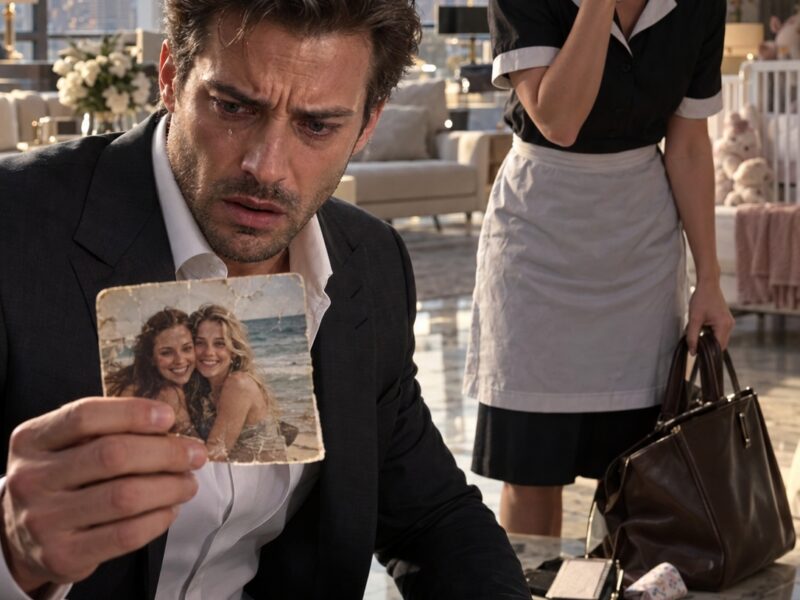
THE BILLIONAIRE FIRED HIS HOUSEKEEPER—THEN A PHOTO OF HIS DEAD WIFE FELL FROM HER BAG

The first thing Michael Hail noticed when he stepped out of the private elevator was that nobody was crying.
For eight months, silence had been the rarest thing in his home.
His twin sons cried when they woke. They cried when they were hungry, when they were tired, when a stranger leaned too close, when the elevator chimed, when the lights dimmed over Manhattan, and sometimes for reasons Michael suspected had nothing to do with hunger or sleep.
Sometimes he thought they were crying because their mother was gone.
He understood that kind of crying.
He just did his where nobody could hear.
But that afternoon, when the elevator doors slid closed behind him and the quiet of the penthouse settled around his shoulders, Michael stopped with his briefcase still in his hand.
Something was wrong.
Not loud wrong.
Quiet wrong.
The kind of silence that made a man who negotiated billion-dollar acquisitions for a living forget the conversation he had just finished on the phone.
“Michael?”
The voice of his assistant buzzed faintly through the wireless earbud still tucked in his right ear.
He didn’t answer.
Across the thirty-foot living room, beyond a wall of glass overlooking the silver-blue towers of Midtown Manhattan, his six-month-old sons were sitting on a thick cream rug.
Henry was on the left.
Noah was on the right.
Between them sat a little girl in yellow socks and a lavender dress Michael had never seen before.
She couldn’t have been older than three.
Her brown hair was pulled into two uneven pigtails. One had nearly fallen apart. A plastic purple butterfly clip hung crooked above her ear.
She held Henry’s tiny hand in her left hand.
Noah’s in her right.
Neither baby was crying.
They were watching her.
Completely absorbed.
The little girl was humming.
Not loudly.
Not even particularly well.
Just four or five notes repeated again and again.
Michael felt his fingers tighten around the handle of his briefcase.
Near the windows stood his new housekeeper, Emma Foster.
She wasn’t cleaning.
She wasn’t moving.
One hand was pressed over her mouth.
And near the entrance to the hall stood Richard Caldwell, Michael’s house manager, his expression so rigid that he looked carved out of the gray stone surrounding the fireplace.
Michael removed his earbud.
“What is this?”
The humming stopped.
The little girl looked up.
The twins looked up with her.
Three sets of eyes landed on Michael at exactly the same time.
Then Henry smiled.
It was small.
Barely there.
But Michael hadn’t seen that smile in weeks.
Something inside his chest gave a hard, painful twist.
Emma hurried forward.
“Mr. Hail, I’m sorry. I was going to explain.”
“Who is she?”
The little girl answered before Emma could.
“I’m Grace.”
Her voice was tiny but confident.
Then she pointed at Michael.
“You’re the babies’ daddy.”
Richard looked down.
Emma closed her eyes.
And for reasons Michael couldn’t have explained, that simple sentence hit him harder than some condolences he had received at Sarah’s funeral.
He put the briefcase down.
“Yes,” he said slowly. “I am.”
Grace nodded, apparently satisfied.
Then she turned back to the twins and resumed humming.
Henry squeezed her fingers.
Noah leaned sideways until his head rested against Grace’s shoulder.
Michael stared at them.
For eight months, he had paid specialists, night nurses, pediatric sleep consultants, feeding experts and private nannies whose résumés looked more impressive than those of some executives on his board.
None of them had managed what this child had accomplished in the space of a song.
His sons were peaceful.
That should have relieved him.
Instead, it frightened him.
Because peace had become unfamiliar inside Michael Hail’s home.
And unfamiliar things had a way of feeling dangerous after loss.
Eight months earlier, the penthouse had sounded completely different.
Sarah’s laugh used to travel through it.
She laughed loudly, without embarrassment, usually at her own jokes.
She sang while making coffee.
She talked to the babies before they were born as if they were already capable of arguing back.
Michael had once found her standing barefoot in the nursery at two in the morning, seven months pregnant, lecturing her stomach about whether their sons would attend Princeton or Stanford.
“They’re going to Columbia,” Michael had told her from the doorway.
Sarah had looked down at her belly.
“You hear that, boys? Your father already wants you commuting.”
She had thrown a pillow at him.
The pillow was still in the nursery.
Michael had never moved it.
Sarah had believed homes should be noisy.
Michael hadn’t understood how right she was until hers went silent.
She died suddenly less than two months after the twins were born.
There had been warning signs, doctors later said.
Complications after delivery.
Symptoms easily mistaken for exhaustion.
Sarah had ignored most of them because Henry and Noah were premature, because motherhood had arrived with feeding schedules and oxygen checks and terrifying nights when one baby coughed too long.
By the time Sarah collapsed, there had been almost nothing anyone could do.
Michael had stood in a private hospital room listening to a cardiac monitor flatten while a nurse pulled a curtain around his wife.
The twins had been eleven weeks old.
They would never remember her voice.
That thought haunted him more than almost anything else.
Michael remembered every version of Sarah.
The twenty-eight-year-old woman who had told him at a charity auction that his tie was ugly.
The thirty-two-year-old wife who had danced barefoot on their kitchen floor after they learned she was pregnant.
The exhausted new mother who had cried over spilled breast milk and then laughed at herself for crying.
The pale woman in the hospital bed who had squeezed his hand and whispered something he still woke up hearing.
“Don’t let this make you hard.”
He had promised.
He had failed.
Within months, Michael became more controlled than he had ever been.
His company grew.
His world shrank.
He worked because numbers behaved logically.
Markets crashed for reasons analysts could explain.
Businesses failed because somebody made a measurable mistake.
Death did not.
Grief did not.
Infant twins certainly did not.
Every morning he left for Hail Technologies before seven and returned before dinner whenever possible.
He hired help.
Then more help.
Then replacements for the help that quit.
The first nanny lasted nine days.
The second lasted five.
The third, an experienced neonatal nurse from Connecticut, resigned after Noah screamed for three hours because Michael was trapped in Chicago by a grounded private flight.
“I’ve cared for difficult babies,” she told him. “Your sons aren’t difficult. They’re scared.”
Michael had hated her for saying it.
Because he knew she was right.
Two weeks before he found Grace sitting between his children, Richard had approached him about replacing another member of the household staff.
“We need someone permanent,” Richard said. “Not another agency rotation.”
They were standing in Michael’s home office while Noah cried in the nursery down the hall.
Michael hadn’t slept more than three uninterrupted hours in months.
“Hire whoever you need.”
“I have someone coming tomorrow. Emma Foster. Good references. Five years with one family in Westchester before they relocated.”
“Fine.”
“There is one complication.”
Michael looked up.
Richard shifted his weight.
“She has a daughter.”
“So?”
“She doesn’t have regular childcare. She’s asking permission to bring the child with her.”
Michael stared at him.
“To work?”
“Yes.”
“In this apartment?”
“That would be the arrangement.”
Michael laughed once without humor.
“No.”
“I assumed that would be your answer.”
Then a crash came from the nursery, followed by Henry’s screaming.
Michael closed his eyes.
Ten seconds later Noah joined him.
Richard waited.
Michael rubbed both hands over his face.
“How old?”
“The child?”
“Yes.”
“Three.”
Michael looked around at the penthouse—the glass tables, sharp corners, art installations worth more than many people’s houses.
“A three-year-old is a liability.”
“Agreed.”
From down the hall came the exhausted voice of the current nanny trying to soothe Henry.
The baby screamed louder.
Michael stared at the doorway.
“When can Emma start?”
Richard blinked.
“Tomorrow.”
“Then make the apartment safe.”
That was how Emma Foster entered his life.
At 7:12 the following morning, she arrived wearing a navy blouse, black slacks and inexpensive white sneakers.
Michael remembered the sneakers because they squeaked against the marble foyer.
She looked younger than he expected, somewhere in her early thirties, with tired brown eyes and hair twisted into a simple knot.
Her daughter hid behind her leg.
“This is Grace,” Emma said.
Grace peeked around her mother’s knee.
Michael crouched awkwardly.
“Hi, Grace.”
The girl studied him for several seconds.
Then she looked at the enormous abstract painting behind him.
“Why is your wall angry?”
Michael followed her gaze.
The canvas had cost eighty thousand dollars.
“It isn’t angry.”
Grace frowned.
“It looks angry.”
Emma’s face went crimson.
“Grace.”
Michael almost smiled.
Almost.
Then Henry began crying from the nursery.
Grace’s head turned.
Noah followed a second later.
The girl stepped away from her mother.
“Babies.”
“Yes,” Michael said.
“My sons.”
Grace started walking toward the sound.
Emma caught her shoulder.
“No. Stay with me.”
“But they’re sad.”
“They’re babies, honey.”
Grace listened.
The twins screamed.
She looked at Michael.
“Why don’t you help them?”
The question struck him with ridiculous force.
Michael stood.
“They have a nanny.”
Grace’s forehead wrinkled in confusion, as if he had answered a completely different question.
Then Richard arrived and began explaining household rules.
Grace was not to enter Michael’s office.
Not the master bedroom.
Not the wine room.
Not the balcony without Emma.
She was to stay out of the way of guests and business meetings.
Emma nodded to every condition.
Michael left for work before the twins stopped crying.
When he returned that evening, the first strange thing happened.
He stepped inside and heard humming.
He followed the sound into the living room.
Grace sat cross-legged on the rug beside the twins.
Emma was polishing the dining table several yards away.
The nanny stood nearby looking stunned.
Henry wasn’t crying.
Neither was Noah.
Grace was singing some children’s song Michael didn’t recognize.
When she stopped, Henry made a small complaining noise.
Grace began again.
He quieted immediately.
Michael stood unseen in the hall for nearly a minute.
Emma eventually noticed him.
Her smile disappeared.
“Mr. Hail.”
Grace waved.
“Hi, babies’ daddy.”
The nanny laughed before covering it with a cough.
Michael felt a strange sensation in his chest.
He realized, after a moment, that it was amusement.
“What are you singing?”
Grace shrugged.
“My song.”
“Does it have words?”
“No.”
“Then how do you know when it ends?”
Grace considered the question.
“When they’re not sad anymore.”
Michael looked at his sons.
For the first time in weeks, they were both awake and calm.
That night, neither boy cried during dinner.
Michael told himself it was coincidence.
The next day happened the same way.
And the next.
By the fourth day, Grace had developed a routine.
Emma would arrive just after seven.
Grace would remove her tiny pink backpack, place it beside a chair, and head toward the nursery.
She never tried to lift the babies.
She never climbed into their cribs.
She simply sat near them.
Sometimes she sang.
Sometimes she rolled a soft fabric ball across the carpet.
Sometimes she held their hands.
Henry began kicking excitedly when she entered the room.
Noah, usually slower to trust strangers, would turn his head toward her voice.
It was inexplicable.
Richard hated it.
Michael noticed that slowly.
The house manager had worked for him for nearly seven years.
Richard was fifty-four, precise, discreet and relentlessly organized.
He knew which flowers Sarah preferred in the dining room.
He knew which journalists Michael refused to speak with.
He knew how to clear the penthouse for a private board dinner in twenty minutes.
After Sarah’s death, Richard had become almost indispensable.
He managed staff schedules, security protocols, household bills, grocery deliveries and the endless small decisions Michael no longer had the strength to make.
Michael trusted him.
That trust mattered.
So when Richard appeared in Michael’s office one morning and quietly closed the door, Michael immediately knew the subject wasn’t trivial.
“What is it?”
Richard hesitated.
“Emma.”
Michael kept reading the financial report in front of him.
“What about her?”
“Her work is satisfactory.”
“That sounds like the beginning of a complaint.”
“I wouldn’t call it a complaint.”
Michael looked up.
Richard folded his hands.
“I think some boundaries are becoming blurred.”
“Meaning?”
“The child spends most of her day with your sons.”
“So?”
“She isn’t family.”
Michael stared at him.
“No one said she was.”
“I understand. But staff members sometimes become… overly comfortable.”
“Richard.”
“I’m thinking of you, Michael.”
Richard rarely used his first name during working hours.
That got his attention.
“People know what happened. They know you’re grieving. They know the children have had difficulty adjusting.”
Michael’s jaw tightened.
“And?”
“A sympathetic young woman arrives with a child. Your sons form an attachment. She becomes necessary.”
“You think Emma planned for her three-year-old to manipulate six-month-old babies?”
“I think desperation can make people resourceful.”
Michael leaned back.
“What do you know about Emma’s financial situation?”
“Her husband left last year. There are debts. Medical bills. Childcare costs.”
“How do you know that?”
“It was part of the background check.”
Michael frowned.
Richard continued.
“I am not accusing her of anything. I’m asking you to be careful.”
“Of what?”
Richard paused.
“Of wanting something to be good because you need something good.”
The words irritated Michael precisely because there was truth in them.
He looked through the glass wall of his office.
Grace sat near the twins.
She was showing them a picture book.
Emma was dusting a shelf.
Normal.
Harmless.
Almost peaceful.
Michael hated how badly he wanted it to stay that way.
“I’ll keep it in mind.”
Richard nodded.
But he didn’t leave immediately.
“One other thing.”
“What?”
“Grace has been using Sarah’s chair.”
Michael went still.
Sarah’s chair stood beside the east windows.
A soft ivory armchair with a faded blue throw blanket.
There was nothing expensive about it.
Sarah had bought it from a furniture shop in Brooklyn before she and Michael were married.
It followed them from their first apartment to the penthouse.
She had nursed the twins there.
Michael hadn’t sat in it since she died.
“No one is supposed to use that chair.”
“I know.”
“Then tell Emma.”
“I already have.”
Something dark and irrational moved through Michael.
“Good.”
That evening, however, he came home earlier than expected.
And found Grace asleep in Sarah’s chair.
Henry lay in a bassinet beside her.
Noah was awake, holding one of Grace’s fingers.
The little girl’s head rested against the exact place where Sarah used to lay hers.
Michael stopped.
For half a second, memory replaced reality.
He saw Sarah there.
Barefoot.
Exhausted.
Smiling down at Noah.
Then the image vanished.
Grace remained.
Michael’s grief turned into anger before he understood what was happening.
“Emma.”
His voice cracked through the room.
Emma emerged from the kitchen.
She saw him.
Then Grace.
“Oh.”
“I thought Richard spoke to you.”
“He did.”
“Then why is your daughter sleeping there?”
Emma hurried over and gently lifted Grace.
“She was playing with Noah. I was in the kitchen for maybe two minutes.”
“That chair is off-limits.”
“I understand.”
“Do you?”
Emma’s expression changed.
Not defensive.
Hurt.
But controlled.
“Yes, Mr. Hail.”
Grace woke against her shoulder.
“What happened?”
“Nothing, baby.”
Michael walked away before his anger embarrassed him further.
But that night, standing alone in his bedroom, he looked at the empty side of the bed and knew the chair wasn’t what had upset him.
It was the ease with which Grace had occupied a space Sarah left behind.
And the horrifying idea that maybe someday all of Sarah’s spaces would be filled.
The next morning, he left before Emma arrived.
Over the following week, Richard’s concerns became more frequent.
Never accusations.
Suggestions.
A misplaced silver picture frame.
Emma had moved it while cleaning.
A kitchen drawer left open.
Grace had been looking for crayons.
A conversation Emma had with one of the nannies about Sarah’s favorite music.
“How would she know that?” Richard asked.
Michael looked up sharply.
“What?”
“She told the nanny Sarah liked Fleetwood Mac.”
Michael felt a chill.
“Lots of people like Fleetwood Mac.”
“True.”
Richard shrugged.
“Perhaps Sarah mentioned it publicly.”
Michael didn’t respond.
Another day, Richard told him Emma had stood in the nursery staring at Sarah’s photograph for several minutes.
“What exactly are you suggesting?” Michael finally snapped.
Richard remained calm.
“Nothing yet.”
“Then stop bringing me nothing.”
“I will.”
But suspicion had already done what suspicion does.
It stayed.
Michael began noticing things he had ignored before.
Emma knew where Sarah’s tea cups were stored, even though no one used them.
She knew the blue blanket in the nursery wasn’t supposed to go into the dryer.
She knew Sarah had preferred white roses to red.
One afternoon Michael heard Emma humming the same melody Grace used to soothe the twins.
He stopped in the hallway.
He had heard it before.
He was almost certain.
But he couldn’t remember where.
“Where did you learn that song?” he asked.
Emma nearly dropped the laundry she was folding.
“What?”
“That melody.”
She went pale.
For just a moment.
Then she looked away.
“It’s something my daughter sings.”
“Where did she learn it?”
“I don’t know. Kids pick things up.”
Michael stared at her.
Emma busied herself with a towel.
His unease deepened.
“Did you know my wife?”
Emma froze.
It was tiny.
Barely more than a pause.
But Michael spent his life watching people across negotiation tables.
He knew when a question landed somewhere important.
Emma folded the towel.
“No.”
The answer came too quickly.
Michael felt something cold move through him.
Richard’s voice returned in his mind.
Desperation can make people resourceful.
He said nothing more.
But the following afternoon, he called the private security firm that handled all senior Hail Technologies background checks.
“I want everything on Emma Foster.”
The investigator hesitated.
“Richard already requested a standard report.”
“I want more.”
“How far back?”
“Everything.”
Michael hated himself after hanging up.
Not enough to cancel the request.
The report arrived the next morning.
There was nothing.
No criminal record.
No lawsuits.
No history of fraud.
Emma Foster, thirty-three.
Born in Albany.
Moved to Brooklyn at eighteen.
Attended community college.
Married Andrew Foster at twenty-five.
Daughter, Grace, born three years earlier.
Husband left the household the previous year.
Emma had worked in private homes and hospitality jobs.
Debts, yes.
Money problems, yes.
But nothing suggesting she was dangerous.
Nothing suggesting she knew Sarah.
Michael should have felt relieved.
He didn’t.
Because that afternoon, he came home and found Grace sitting in Sarah’s chair again.
This time she wasn’t sleeping.
She held Henry’s hand.
Noah rested in a bouncer beside her.
And in her lap lay Sarah’s old silver photo frame.
The one that normally sat in the nursery.
Sarah smiling on a beach.
Pregnant with the twins.
Michael’s pulse spiked.
“What are you doing?”
Grace looked up.
“She has pretty hair.”
Michael crossed the room.
“Where did you get that?”
Grace pointed.
“Mommy gave it to me.”
Emma appeared behind him carrying folded linens.
Her face drained of color.
“I did not.”
Grace looked confused.
“Yes, you did.”
“Grace.”
“You said Aunt—”
“Enough.”
Emma’s voice came out sharper than Michael had ever heard it.
Grace flinched.
Michael turned slowly.
“Aunt who?”
Emma stared at him.
The penthouse seemed to shrink around them.
“What was she going to say?”
Emma pressed her lips together.
“Nothing.”
“Don’t lie to me.”
“I’m not.”
“You just did.”
Grace began crying.
The twins heard her and immediately joined in.
Within seconds the room filled with the noise Michael knew too well.
Emma gathered her daughter.
Michael watched her retreat.
For the first time, he saw fear in her.
Not embarrassment.
Fear.
That evening, Richard found him standing alone beside the windows.
“You see it now,” he said.
Michael didn’t answer.
“Whatever is happening, she hasn’t been honest.”
Michael poured himself a drink he didn’t want.
“She passed two background checks.”
“Background checks don’t show intention.”
“She hasn’t asked for money.”
“Not yet.”
Michael turned.
“Stop.”
Richard lifted his hands.
“You hired me to protect this house.”
“I hired you to run it.”
“And after Sarah died, you asked me to help keep everything stable.”
That shut Michael up.
Richard softened his voice.
“Those boys are vulnerable.”
Michael stared into his glass.
“They like Grace.”
“That’s exactly the problem.”
Michael looked at him.
Richard continued.
“If Emma leaves tomorrow, what happens?”
Michael didn’t answer.
“Henry and Noah scream again. You panic. You bring her back. She becomes indispensable.”
“So what’s your solution?”
“End it before the attachment gets worse.”
Michael looked toward the nursery.
No crying.
Grace had calmed them again.
The quiet now felt like pressure.
“She’s good with them.”
“Grace is.”
Richard’s eyes hardened.
“We don’t know why Emma came here.”
That sentence followed Michael all night.
The next morning, he stayed home.
Emma arrived unaware that anything had been decided.
Grace wore red sneakers.
She ran toward the nursery before Emma gently caught her hand.
“Not today, sweetheart.”
“Why?”
“Stay with Mommy.”
Michael watched from his office.
Emma knew.
Or suspected.
She cleaned more quietly than usual.
Around eleven, Michael called her in.
She entered alone.
Grace remained with the nanny in the living room.
“Close the door.”
Emma did.
Michael had fired hundreds of people over the course of his career.
Some deserved it.
Some did not.
He had learned long ago that vague language prolonged pain.
So he came directly to the point.
“I don’t think this arrangement is working.”
Emma’s fingers tightened around one another.
“All right.”
Michael had expected an argument.
“What?”
“You’ve made your decision.”
“You aren’t going to ask why?”
“I think I know why.”
That irritated him.
“Then tell me.”
Emma looked toward the closed door.
“Mr. Hail, I came here to do a job.”
“You lied to me.”
Her eyes returned to him.
“About what?”
“You know things about Sarah.”
Emma went completely still.
Michael leaned forward.
“You knew the song. You knew the blanket. My daughter—”
“Grace is my daughter.”
The correction was quiet.
Michael stopped.
“My sons,” he amended.
Emma looked away.
“What were you going to say?”
Michael swallowed his irritation.
“Grace almost called Sarah something yesterday.”
Emma’s face had lost its color again.
“What?”
“You heard her.”
Emma said nothing.
“Aunt Sarah?”
Still nothing.
Michael’s heartbeat changed.
“Did she say Aunt Sarah?”
Emma’s eyes filled.
That was his answer.
Michael stood.
“How did you know my wife?”
Emma shook her head.
“I can’t.”
“What does that mean?”
“I made a promise.”
“To who?”
Emma pressed a hand over her mouth.
Michael’s patience snapped.
“To who?”
But Emma didn’t answer.
And that silence decided it.
Michael stepped back from the desk.
“I need you to leave.”
Emma nodded immediately.
That hurt him more than resistance would have.
“Today?”
“Yes.”
“I understand.”
Her voice trembled.
“I’ll collect our things.”
“Human resources will arrange severance through the household employment service.”
“I don’t want severance.”
Michael stared.
“Take it.”
“No.”
“Emma.”
“I said no.”
For the first time, something like anger entered her face.
“I didn’t come here for your money.”
“Then why did you come?”
Her eyes locked on his.
For one second Michael believed she might finally tell him.
Instead, she whispered, “Because sometimes you keep a promise even when the person you made it to isn’t here anymore.”
Michael froze.
“What promise?”
Emma looked away.
Then she opened the door.
Grace came running toward her.
“Mommy?”
“We’re going home.”
The little girl’s smile disappeared.
“No.”
Emma knelt.
“Yes.”
“But I didn’t say bye to Henry and Noah.”
Emma closed her eyes.
Michael saw her shoulders shake once.
“Okay,” she whispered. “You can say goodbye.”
Grace ran toward the nursery.
Richard appeared from the dining room.
He looked at Michael.
Michael gave a single nod.
Done.
Emma returned a few minutes later with Grace’s pink backpack over one shoulder and her own worn brown handbag in her hand.
Grace was crying now.
Silently.
Her lower lip trembled.
She kept looking back toward the nursery.
Michael couldn’t stand it.
He turned away.
“Mr. Hail.”
Emma’s voice stopped him.
He looked back.
“I’m sorry.”
“For what?”
“For making things harder.”
Michael almost laughed.
“You did.”
Emma nodded.
“I know.”
She turned toward the door.
Then the strap of her handbag caught on the curved brass handle.
It happened quickly.
The bag jerked open.
Everything inside spilled across the marble floor.
Keys.
Receipts.
A grocery list.
A half-used packet of tissues.
Lip balm.
An orange plastic dinosaur.
Two crayons.
A child’s butterfly hair clip.
A pharmacy receipt.
And a photograph.
Old.
Worn.
Bent at one corner.
Michael crouched automatically.
“So sorry,” Emma said, dropping to her knees.
Their hands moved toward the photograph at the same time.
Michael reached it first.
And stopped breathing.
Two women stood on a beach.
Both young.
Maybe nineteen.
Maybe twenty.
One wore denim shorts and a white T-shirt.
The other wore a red bathing suit under an open linen shirt.
Their arms were wrapped around each other’s shoulders.
Their hair blew wildly across their faces.
They were laughing.
Michael knew the woman on the right before his mind could even form her name.
Sarah.
Younger than Michael had ever known her.
But Sarah.
Same smile.
Same dimple.
Same crescent-shaped scar near her right eyebrow from a childhood bicycle accident.
Michael’s fingers began shaking.
He looked at Emma.
Then back at the photograph.
The woman with her arm around Sarah’s shoulder was Emma.
A younger Emma.
But unmistakably her.
The room tilted.
“You knew her.”
Emma’s eyes closed.
“Michael—”
“You knew Sarah.”
Grace had stopped crying.
Richard had gone silent near the hall.
Michael rose slowly.
“How long?”
Emma picked up nothing.
“How long did you know my wife?”
She whispered, “Most of my life.”
Michael felt the words like a blow.
“You stood in my home every day and lied to my face.”
“I had to.”
“You had to?”
“She asked me.”
“What?”
Emma’s tears finally spilled.
“She asked me not to tell you.”
Michael stared at her.
Behind Emma, Grace suddenly looked toward the nursery.
A small hand appeared around the corner.
Noah’s.
The nanny followed, carrying him.
Grace ran over instinctively.
She took Noah’s fingers.
Then she looked at Michael with the complete trust only children possess.
“Don’t make Mommy leave.”
Michael couldn’t answer.
Grace looked at the photograph in his hand.
Then at Emma.
“Aunt Sarah is watching from the stars,” she said.
Emma inhaled sharply.
“Grace.”
“But you said.”
“Sweetheart—”
“You said we have to help her babies because she can’t come back yet.”
Nobody moved.
Grace continued innocently.
“You said Aunt Sarah was scared they’d forget love.”
Michael’s face went numb.
He looked at Emma.
“What did you tell her?”
Emma wiped her cheeks.
“Not here.”
“You don’t get to decide that anymore.”
Richard stepped forward.
“Michael, perhaps the child—”
“Not one word.”
Richard stopped.
Michael pointed toward his office.
“Emma. Now.”
She followed him inside.
Michael closed the door.
For several seconds neither spoke.
He placed the photograph on the desk between them.
“Start at the beginning.”
Emma looked down at it.
“When Sarah was seven, her family moved into the house across from mine in Albany.”
Michael said nothing.
“She was loud even then,” Emma continued with a broken laugh. “She climbed trees in dresses. She stole cherries from our neighbor’s yard. She broke my nose when we were ten.”
Michael frowned.
“She never told me that.”
“She didn’t break it on purpose.”
For the first time all day, Michael almost smiled.
Emma noticed.
The almost-smile disappeared.
“We went to school together. College in different cities, but we stayed close. I was in half the bad decisions she ever made.”
“You weren’t at our wedding.”
Emma looked away.
“We’d had a falling-out.”
“About what?”
“Life.”
“That isn’t an answer.”
“My marriage. Hers. Pride. Things that feel important until suddenly they don’t.”
Michael crossed his arms.
“When did you speak to her again?”
“Three months before she died.”
The room seemed to lose oxygen.
Emma opened her bag and took out her phone.
She scrolled through old messages.
Then she placed it on the desk.
Michael saw a name.
Sarah.
His throat tightened.
The messages stretched backward months.
Most were brief.
Are you awake?
I know it’s been forever.
Can we talk?
Then a photograph of newborn Henry and Noah.
Michael sat.
“She contacted you?”
“Yes.”
“Why?”
Emma’s voice lowered.
“She was afraid.”
Michael’s head snapped up.
“Afraid of what?”
“That something was wrong.”
Michael’s hands clenched.
“What do you mean?”
“She’d been feeling sick. Dizzy. Her heart racing. She didn’t want to worry you because the babies had just come home.”
“I was her husband.”
“I know.”
“She should have told me.”
“She was trying to protect you.”
“From what? Reality?”
His voice rose.
Emma flinched but didn’t look away.
“She told me you hadn’t slept. That you were trying to run the company and take overnight feedings. She said every time she mentioned being tired, you looked terrified.”
Michael stood abruptly.
“So she lied instead.”
“She was scared too.”
“I could have helped her.”
“I know.”
“You don’t know.”
His palm struck the desk.
The photograph jumped.
Emma’s tears returned.
“You think I haven’t replayed that conversation every day for eight months?”
Michael stopped.
Emma’s voice cracked.
“She called me from the bathroom floor one night because she didn’t want to wake you. She said her chest felt strange. I told her to go to the hospital.”
Michael could barely speak.
“And?”
“She promised she would.”
“She didn’t.”
“No.”
Michael turned toward the window.
Thousands of windows glittered in the city beyond him.
People living thousands of ordinary nights.
Unaware of which one would become the night they wished they could relive forever.
“When did you last see her?”
“Six days before she died.”
Michael turned.
Emma was crying openly now.
“She came to Brooklyn.”
“With the twins?”
“No. Alone.”
Michael searched his memory.
Six days before Sarah died.
He had been in California.
Two-day conference.
Sarah told him she spent the afternoon with a friend.
He had never asked which one.
“What did she want?”
Emma looked toward the photograph.
“To apologize.”
“For your fight?”
“For disappearing from my life. For letting years pass.”
She wiped her face.
“And then she asked me something.”
Michael already knew.
The promise.
Emma breathed in carefully.
“She said, ‘If something happens to me, Michael will have everybody. His mother. My parents. Doctors. Staff. Lawyers. But the boys might not have someone who remembers who I was before all this.’”
Michael couldn’t move.
“She asked me to remember for them.”
Emma pressed her fingertips against her lips.
“She said she didn’t want me charging into your life right away. She knew grief could make people protective. She knew you’d hate feeling like someone had been assigned to watch over you.”
Michael gave a bitter laugh.
“She knew me.”
“Yes.”
“Too well.”
Emma continued.
“She made me promise that if anything happened, I’d stay close somehow. Not force myself into your family. Not ask for anything. Just… be there if there was ever a way.”
“And you decided becoming my housekeeper was that way?”
“No.”
Emma shook her head.
“That happened by accident.”
Michael stared skeptically.
She took out another piece of paper.
A printed job listing.
Household cleaner needed. Midtown Manhattan. Full-time. Discretion required.
“The agency didn’t list your name.”
Michael took it.
“When did you find out?”
“The interview.”
“With Richard?”
“Yes.”
Michael looked toward the door.
“I nearly left.”
“Why didn’t you?”
Emma’s eyes softened.
“Because I heard Noah crying.”
That answer went through him.
“I hadn’t heard Sarah’s babies since the funeral,” she whispered.
Michael looked down.
“And Grace?”
“Sarah met Grace twice.”
“What?”
“She came to my apartment after we reconnected.”
Emma smiled faintly through her tears.
“Grace called her Aunt Sarah within ten minutes because Sarah told her that’s what she was.”
Michael closed his eyes.
Suddenly Grace’s words made sense.
Aunt Sarah.
“She taught Grace that song?”
Emma nodded.
Michael felt his heart stop again.
“It wasn’t Grace’s song.”
“No.”
He sat.
“What is it?”
“Something Sarah made up when we were children.”
Memory broke through him.
Sarah in the nursery.
Pregnant.
Humming under her breath.
The same notes.
Michael covered his face.
All this time.
His sons hadn’t been responding to a random melody.
They had been responding to something their mother had hummed before they were born.
Something they had heard through skin and bone and heartbeat.
Emma was crying again.
“I should have told you.”
Michael lowered his hands.
“Yes.”
“But she made me promise.”
“She was dead, Emma.”
The words came out harsher than he intended.
Emma recoiled.
Michael hated himself instantly.
He looked away.
“I know.”
Her voice was almost inaudible.
“I know she’s dead.”
Silence stretched between them.
Michael picked up the photograph.
On the back, written in faded blue ink, were four words.
Me + Em. Always trouble.
Sarah’s handwriting.
He recognized the exaggerated S.
His vision blurred.
“Why did you let me fire you?”
Emma looked confused.
“What?”
“You could have shown me this yesterday. Last week. You could’ve told me the second Richard started questioning you.”
“That would have turned Sarah into leverage.”
Michael stared.
Emma’s voice steadied.
“I wasn’t going to use your dead wife to keep a job.”
That sentence changed something.
A small internal shift.
Painful.
Permanent.
Michael looked toward the glass wall.
Outside his office, Grace sat beside Noah again.
The little girl wiped her own tears with the sleeve of her lavender dress.
Richard stood several feet away.
Watching.
Michael opened the office door.
“Richard.”
The house manager entered.
His eyes moved from Emma to the photograph.
“So there was a connection.”
Michael studied him.
“You knew there might be.”
“I suspected something.”
“You told me she was manipulating us.”
“I told you to be cautious.”
“You told me money could be her motive.”
“Given the circumstances, it was reasonable.”
Emma lowered her eyes.
Michael didn’t.
“Was it?”
Richard’s expression hardened slightly.
“My responsibility is to protect your household.”
“From what?”
“People who may exploit your vulnerability.”
Michael looked toward the twins.
“Did you ever see Emma ask me for anything?”
“No.”
“Did you ever see her neglect her work?”
“No.”
“Did she steal?”
“No.”
“Lie?”
Richard glanced at Emma.
“Yes.”
Emma closed her eyes.
Michael nodded slowly.
“Yes. She did.”
Richard seemed relieved.
Then Michael continued.
“So did Sarah.”
The relief vanished.
“My wife asked her to.”
Richard said nothing.
Michael walked toward the living room.
Grace looked up.
“Are we leaving?”
Michael crouched in front of her.
Behind him, Emma stopped breathing.
Michael looked at Grace’s little fingers still wrapped around Noah’s.
“No.”
Grace’s eyes widened.
“No?”
“No.”
“Mommy can stay?”
Michael looked at Emma.
“Yes.”
Emma opened her mouth.
Michael stood.
“But not like before.”
She stiffened.
He turned to her.
“I don’t want you here as a housekeeper.”
Emma’s face fell.
Michael continued before she could misunderstand.
“I think we’ve all pretended long enough that that’s what this was about.”
His voice broke slightly.
“I don’t know what you are to this family yet.”
Emma stared at him.
“A friend, maybe. Sarah’s friend. Someone my sons clearly trust. Someone who knew my wife when she was still breaking people’s noses.”
Grace gasped.
“Mommy broke Aunt Sarah’s nose?”
“No,” Michael and Emma said together.
For the first time, both laughed.
It lasted only a second.
But the sound startled Henry.
Then he smiled.
Michael stared at his son.
Emma wiped her tears.
Grace returned to her song.
And for the first time since Sarah’s death, the silence in Michael Hail’s home didn’t feel empty.
It felt like someone had finally opened a window.
But grief does not disappear because the truth arrives.
Sometimes truth makes grief harder first.
That night, after Grace and Emma left, Michael carried the beach photograph into his bedroom.
He placed it beside the framed wedding portrait on his dresser.
Two versions of Sarah.
The woman he knew.
And the girl he never had.
He stared at both until after midnight.
Then he called Emma.
She answered cautiously.
“Michael?”
He had never asked her to call him that.
But he didn’t correct her.
“Tell me about her.”
A pause.
“What?”
“Sarah.”
Emma was quiet.
“What do you want to know?”
“Everything she never told me.”
That conversation lasted until nearly three in the morning.
Emma told him about Sarah’s first car, a 1998 Honda that had to be started with a screwdriver.
She told him Sarah failed her driving test twice.
She told him about the summer Sarah dyed her hair black, hated it immediately and wore baseball caps for three months.
Michael laughed so hard once he covered his mouth because he feared waking the twins.
Then Emma told him about Sarah’s mother being hospitalized when Sarah was fourteen.
About the nights Sarah slept on Emma’s bedroom floor because she was afraid to be alone.
About how Sarah hated hospitals long before her final weeks.
That explained things Michael had never understood.
“She was terrified,” Emma said softly.
“Of dying?”
“Of becoming a patient.”
Michael leaned against the headboard.
“Why didn’t she tell me?”
“Because she wanted you to see her as strong.”
“I already did.”
“I know.”
Emma paused.
“She didn’t always know.”
After they hung up, Michael remained awake.
For months he had been grieving an image.
Wife.
Mother.
Woman in hospital bed.
But Sarah had been more than the roles she occupied in Michael’s life.
She had been a child.
A teenager.
A stubborn friend.
A frightened daughter.
She had belonged to other people’s memories before she belonged to his.
And strangely, that realization did not make him feel less important.
It made Sarah feel larger.
More alive.
The following morning Richard submitted his resignation.
Michael found the letter on his desk.
He read it once.
Then called Richard in.
“You don’t need to resign.”
Richard stood stiffly.
“I believe I misjudged the situation.”
“You did.”
“I may have contributed to unnecessary pain.”
“You did.”
Richard’s jaw tightened.
Michael placed the letter down.
“But you were trying to protect the boys.”
“I was.”
“Were you?”
Richard met his eyes.
Michael leaned back.
“Or were you trying to protect the house from changing?”
Richard didn’t answer.
Michael continued.
“You liked everything controlled.”
“Control is my job.”
“No. Management is your job.”
Michael looked toward Sarah’s chair.
“There’s a difference.”
Richard took that in.
“I didn’t trust Emma.”
“I noticed.”
“She lied.”
“She did.”
“And if the circumstances had been different—”
“They weren’t.”
Michael held his gaze.
“That’s the part you missed.”
Richard looked down.
Michael softened slightly.
“I spent eight months treating grief like a security problem. Close doors. Control access. Limit risk.”
He exhaled.
“You helped me do that.”
Richard looked back at him.
“And now?”
Michael watched Grace entering the living room with Emma.
Henry kicked wildly when he saw her.
“Now I think maybe we’re done living like everyone outside the elevator is a threat.”
Richard did not resign.
But things changed.
He apologized to Emma.
Not elegantly.
Richard was not an elegant apologizer.
“I made assumptions,” he said.
Emma nodded.
“You did.”
“I regret them.”
“Good.”
Richard blinked.
Emma returned to folding laundry.
Michael, overhearing from the kitchen, nearly smiled.
Within several weeks, Emma’s role evolved into something no employment contract could describe properly.
She still worked.
She insisted on it.
Michael offered to triple her salary.
She refused.
He doubled it anyway.
They compromised on childcare benefits, healthcare and fewer housekeeping duties.
A professional cleaning team took over the penthouse.
Emma spent more time with the twins.
And more time talking to Michael about Sarah.
Grace became part of the home’s rhythm.
Her pink backpack appeared beside the foyer table every morning.
Her drawings migrated across the refrigerator.
She was the first child to put fingerprints on Michael’s windows without anyone immediately wiping them away.
One afternoon, she used a washable marker to draw a purple circle on an Italian leather sofa.
Richard stared at it for twelve seconds.
Grace stared back.
“It’s a moon.”
Richard closed his eyes.
Michael walked past them.
“Nice moon.”
Richard looked personally betrayed.
Michael kept walking before he laughed.
The twins changed.
Their crying didn’t disappear completely.
They were babies.
They cried.
But the panic lessened.
Henry began sleeping longer.
Noah stopped screaming whenever Michael left the nursery.
Grace’s song worked less frequently because, eventually, it wasn’t needed every time.
Michael began coming home earlier.
At first, his board noticed.
Then investors.
A business magazine published an article speculating that Michael Hail was “stepping back from operational leadership.”
He read it while feeding Noah mashed sweet potato.
“Apparently I’m retiring,” he told Emma.
She was helping Grace wash paint from her hands.
“You’re forty-two.”
“Exactly. Ancient.”
Grace looked at him.
“You do look old.”
Emma nearly dropped the towel.
Michael stared at the child.
“How old do you think I am?”
Grace thought hard.
“Seventy.”
Michael pointed at Emma.
“She’s fired.”
“No, I’m not,” Emma replied.
“You keep saying that.”
Months earlier such a moment would have been impossible.
The penthouse had once felt like a museum built around Sarah’s absence.
Now it became messy.
Baby toys beneath chairs.
Sippy cups.
Blankets.
Grace’s shoes constantly appearing in locations where shoes had no logical reason to exist.
And Michael slowly understood what Sarah had meant when she said homes should be noisy.
Noise meant someone lived there.
Yet one question remained between Michael and Emma.
Why had Sarah told Emma not to reveal herself?
Michael eventually asked.
They were sitting at the kitchen island late one evening.
The twins were asleep.
Grace had gone home with Emma’s mother for the night.
Rain streaked the windows.
Emma turned her coffee cup in her hands.
“She thought you’d be angry.”
“I was.”
“She knew.”
“Why?”
“Because she’d kept our friendship from you.”
Michael frowned.
“She wasn’t required to tell me every childhood friend she ever had.”
“It was more complicated.”
“How?”
Emma hesitated.
“We stopped speaking partly because of you.”
Michael stared.
“Me?”
“Not because of anything you did.”
“That’s comforting.”
Emma gave him a look.
“When Sarah met you, everything changed fast. Your life was… huge. Private planes. Events. Cameras. People with assistants for their assistants.”
Michael nodded.
“I know what my life looks like.”
“She felt embarrassed about where she came from.”
“That doesn’t sound like Sarah.”
“It was Sarah.”
Emma looked at him carefully.
“She reinvented herself.”
Michael’s expression shifted.
“She never lied to me about her family.”
“No. But she edited herself.”
That word hurt.
Edited.
“What did she leave out?”
“The insecure parts.”
Emma smiled sadly.
“The broke parts. The parts where we’d split one cheeseburger because neither of us had enough money. The year her parents nearly lost their house. The time she borrowed prom shoes from me and pretended they were hers.”
Michael looked toward the dark windows.
“She thought I’d judge her?”
“No.”
Emma shook her head.
“She thought she might judge herself if you knew.”
That was worse.
Michael stared at the rain.
“Did she ever regret marrying me?”
Emma answered immediately.
“No.”
He looked at her.
“Never?”
“She loved you ridiculously.”
A small laugh escaped Emma.
“It was annoying.”
Michael smiled despite himself.
“She wouldn’t stop talking about you.”
“What did she say?”
“That you were emotionally constipated.”
Michael choked on his coffee.
Emma laughed.
“Her words.”
“Anything kinder?”
“She said you were the safest place she’d ever found.”
Michael’s smile disappeared.
Emma’s eyes softened.
“She loved you, Michael.”
He looked away.
“I wasn’t there when she needed me.”
“You didn’t know.”
“I should have.”
“How?”
“I was her husband.”
“You’re not a machine that detects every hidden pain.”
“I built machines that detect smaller problems.”
Emma shook her head.
“She wasn’t an algorithm.”
Michael’s jaw tightened.
“She died.”
“Yes.”
“I could’ve done something.”
“Maybe.”
That surprised him.
Emma didn’t give him the comforting lie everyone else offered.
She continued.
“Maybe you could’ve taken her to a different doctor. Maybe she would’ve told you sooner. Maybe she’d still be alive.”
Michael stared at her.
Emma’s voice softened.
“And maybe none of that would have changed anything.”
He swallowed.
“You live inside the first version because guilt makes you think you had control.”
Michael said nothing.
“The second version is harder.”
“Why?”
“Because it means sometimes terrible things happen even when someone would have done anything to stop them.”
Rain tapped the glass.
Michael looked toward the nursery.
“I hate that version.”
“I know.”
But over time he began living with it.
One Sunday morning, Emma brought a small cardboard box.
Michael recognized Sarah’s handwriting before Emma opened it.
His knees almost weakened.
“What is that?”
“Things she left with me.”
Michael stared.
“You had this?”
“Yes.”
“For how long?”
“Since before she died.”
Anger flashed.
“You waited months?”
“She specifically told me to.”
Michael laughed bitterly.
“Of course she did.”
Emma placed the box on the dining table.
“She said to give it to you when you were ready.”
“How did she expect you to know that?”
Emma shrugged.
“She was vague.”
“That sounds like her.”
Inside were photographs.
Old movie tickets.
A friendship bracelet.
A cheap metal pendant.
Three letters.
One addressed to Emma.
One to Grace.
And one to Michael.
His name was written across the front.
Michael stared at it.
His hands would not move.
Emma stepped away.
“I’ll take Grace to the park.”
“No.”
She stopped.
“Stay.”
Michael sat.
He opened the envelope.
The letter was short.
Sarah had always hated long handwritten letters.
Michael,
If Emma gives you this, then either I became unbearably dramatic in my old age, or something happened and I never got the chance to tell you everything I should have.
First, don’t be mad at her.
I can actually picture your face while writing this, which means you’re definitely mad at her.
She kept a promise because I asked.
I know you.
When you hurt, you build walls and call them protection.
I need someone around who remembers there was a version of me before you, before the company dinners, before motherhood, before I learned which fork to use at charity galas.
Emma remembers the girl who wore fake designer sunglasses and cried when her first car died.
Tell the boys about that girl.
Tell them their mother wasn’t perfect.
Tell them I was scared sometimes.
Tell them I laughed too loudly.
Tell them I loved them before I met them.
And Michael—
Do not turn our sons into a reason to stop living.
They need their father, not a monument to their mother.
Let people help you.
Please.
Love,
Sarah
Michael read the letter twice.
Then a third time.
He didn’t realize he was crying until Grace climbed onto the chair beside him.
Emma had not gone to the park.
The little girl looked at his face.
“Are you sad?”
“Yes.”
“Because of Aunt Sarah?”
Michael nodded.
Grace considered that.
Then she took his hand.
Exactly the way she held Henry’s.
Exactly the way she held Noah’s.
“You can be sad.”
Michael closed his fingers around hers.
“I know.”
She leaned against him.
Emma stood several feet away.
Michael looked at Sarah’s letter.
Don’t turn our sons into a reason to stop living.
That sentence stayed.
Not because Michael knew what living again looked like.
He didn’t.
He wasn’t ready for romance.
He wasn’t ready to stop missing Sarah.
He didn’t want another woman in Sarah’s place because, slowly, he was learning that nobody needed to occupy Sarah’s place.
It belonged to her.
Forever.
Life could grow around it.
It did.
Henry took his first independent steps toward Grace.
Noah said “Dada” first and “Gace” second.
Grace considered this a major personal victory.
Emma cried the first time Noah used “Em” for her.
Richard secretly kept every crayon drawing Grace gave him in the bottom drawer of his desk.
Michael discovered them by accident.
He never told anyone.
On the anniversary of Sarah’s death, Michael expected the old darkness to return.
It did.
He woke before dawn.
For several minutes he forgot why the date felt heavy.
Then remembered.
He sat at the edge of his bed until sunrise.
At breakfast, Emma found him staring at Sarah’s chair.
“You don’t have to go to the office.”
“I know.”
“What do you want to do?”
Michael thought.
“I don’t know.”
Grace entered carrying construction paper.
“I made something.”
She held up a drawing.
Five stick figures.
Actually seven.
Michael.
Emma.
Grace.
Henry.
Noah.
Sarah floating above them with enormous yellow wings.
And Richard standing at the edge with what appeared to be a rectangular head.
Michael smiled.
“Why does Richard look like a refrigerator?”
“He’s serious.”
Fair.
Michael pointed toward Sarah.
“Why does Aunt Sarah have wings?”
Grace looked at him as if he had asked why the sun was bright.
“Because she watches.”
Michael’s throat tightened.
Emma looked apologetic.
“Grace—”
“No.”
Michael shook his head.
“It’s okay.”
He studied the drawing.
For months he had been afraid that accepting comfort from Emma and Grace somehow betrayed Sarah.
As though grief were a contract.
As though enough laughter might erase love.
Sarah’s own letter had told him otherwise.
“Let’s go somewhere,” he said.
Emma looked surprised.
“Where?”
“Albany.”
Two hours later, they were driving north.
Michael.
Emma.
Grace.
The twins.
Even Richard, after Michael told him attendance was not optional.
Emma directed them to a modest neighborhood where Sarah had grown up.
The house belonged to someone else now.
Michael stood across the street holding Noah.
Emma pointed toward a maple tree.
“She fell out of that tree when we were eleven.”
Michael smiled.
“Broken arm?”
“No. Broken fence.”
They walked past the school.
The convenience store where Sarah used to buy cheap candy.
The parking lot where Emma had taught her to drive.
Finally Emma took them to a small lake outside town.
“This is where the picture was taken,” she said.
Michael looked down at the photograph he had carried in his coat pocket.
The beach had changed.
Different dock.
Different benches.
Same water.
Grace ran toward the shoreline.
Henry and Noah squealed from their stroller.
Michael looked at Emma.
“Thank you.”
She stared across the lake.
“For what?”
“For keeping your promise.”
Emma swallowed.
“I almost didn’t.”
“Why?”
“Because walking into your house felt wrong.”
“But you stayed.”
“I heard the twins.”
Michael nodded.
They stood in silence.
Not uncomfortable silence.
Something gentler.
After a moment Emma said, “Sarah didn’t send me, you know.”
Michael looked at her.
“She asked me to help if I could. But she didn’t arrange every coincidence.”
Michael smiled.
“You’re ruining the story.”
“I’m serious.”
“So am I.”
He looked toward Grace.
The child was crouched beside the twins, showing them smooth stones.
“Maybe Sarah didn’t arrange it.”
He paused.
“But I’m done pretending everything meaningful has to be explainable.”
Emma smiled.
Years later, Michael would remember that day more clearly than many billion-dollar deals.
Not because anything dramatic happened.
Nobody made a speech.
Nobody discovered another secret.
They simply sat by the lake.
Grace hummed.
The twins listened.
Emma talked about Sarah.
Michael listened too.
And when the sun lowered behind the trees, he realized he had gone several hours without feeling guilty for being happy.
That surprised him.
Then frightened him.
Then, slowly, freed him.
The old beach photograph returned to Manhattan with them.
Michael had it professionally restored but refused to remove the scratches completely.
“Those are part of it,” he told the technician.
He placed it on a table near Sarah’s chair.
Beside it he put another photograph.
A new one.
Emma sat on the living room rug.
Grace beside her.
Henry climbing onto her lap.
Noah reaching for Grace’s hair.
Michael in the background laughing at something outside the frame.
Sarah was not in the photograph.
Yet Michael saw her everywhere.
In the way Noah wrinkled his nose before laughing.
In Henry’s stubborn refusal to eat peas.
In Grace’s song.
In Emma’s stories.
In an ugly blue throw blanket nobody was allowed to replace.
Richard eventually stopped asking why it remained there.
One night, long after everyone else had gone home, Michael stood beside Sarah’s chair.
Manhattan glittered beyond the windows.
The penthouse was no longer silent.
The dishwasher ran.
A toy played music somewhere in the hall because someone had forgotten to switch it off.
One twin coughed in his sleep.
The other babbled through the baby monitor.
Michael picked up Sarah’s letter again.
Don’t let this make you hard.
He remembered her saying something similar from the hospital bed.
For eight months he’d thought honoring Sarah meant holding tightly to everything she left.
The chair.
The photographs.
Her clothes.
His grief.
But perhaps that had never been what she wanted.
Maybe honoring someone wasn’t refusing to move.
Maybe it was carrying what they gave you into whatever came next.
The following morning, Grace arrived earlier than usual.
She burst through the elevator doors wearing yellow rain boots even though the sky outside was perfectly clear.
Michael was holding Noah.
“Why the boots?”
Grace looked offended by the question.
“They’re for puddles.”
“There aren’t any puddles.”
“There might be later.”
Michael nodded.
“Good planning.”
She ran toward the rug.
Henry followed by crawling furiously across the floor.
Noah squirmed until Michael put him down.
Emma walked in behind her daughter carrying coffee.
Richard appeared from the dining room with the resigned expression of a man who had already discovered a yellow rain boot sitting inside one of his decorative planters.
For a moment Michael stood still.
He watched them.
The home he had tried so hard to preserve had changed.
Sarah’s chair was still there.
Her photograph was still there.
Her absence was still there too.
Some absences never shrink.
You simply become large enough to carry them.
Grace sat between Henry and Noah.
She took one small hand in each of hers.
Then she began humming the old melody.
This time Michael knew where it came from.
Two little girls in Albany.
A friendship that had survived distance, pride and lost years.
A frightened mother humming to unborn sons.
A promise whispered because she feared she would not have time to keep every promise herself.
A woman desperate enough to take a housekeeping job without revealing why.
And a three-year-old child who understood none of the complicated things adults built around love.
Grace didn’t understand inheritance.
Or social class.
Or employee boundaries.
Or billion-dollar companies.
She didn’t understand why Michael once watched her suspiciously.
She didn’t understand why Emma cried when Sarah’s name was spoken.
She didn’t understand why a photograph could make a grown man sit down because his legs suddenly stopped working.
Grace understood something simpler.
When Henry cried, she held his hand.
When Noah became frightened, she sang.
When Michael was sad, she sat beside him.
Perhaps that was why the twins trusted her before any adult in the room understood the reason.
Children did not always recognize history.
Sometimes they recognized safety.
Michael walked over and sat on the rug with them.
Grace stopped singing.
“You’re too big.”
“For the rug?”
“Yes.”
“Should I leave?”
She thought about it.
Then she moved closer to Henry, creating several inches of space.
Michael sat.
Noah climbed immediately onto his leg.
Henry reached for his watch.
Grace resumed humming.
Emma stood near the kitchen watching.
Michael glanced up.
Their eyes met.
No grand promise passed between them.
No dramatic declaration.
Only understanding.
Emma had once entered his home because a dead friend had asked her to stay close to two babies.
But somewhere along the way, she stopped being there merely because of Sarah.
She stayed because the twins loved her.
Because Grace loved them.
Because Michael had finally learned that accepting someone into his life did not erase the person he had lost.
And because families were sometimes formed in ways nobody would choose if given the chance.
Through birth.
Through marriage.
Through tragedy.
Through promises.
Through children sitting together on a rug.
Michael looked toward the restored beach photograph.
For just an instant, he remembered Sarah exactly as she had been the last summer before the twins were born.
Standing barefoot near the kitchen window, one hand resting on her stomach, laughing because Michael had burned dinner again.
“You know what your problem is?” she’d said.
“I own several companies. You’ll need to narrow it down.”
“You think everything important has to be complicated.”
He had rolled his eyes.
She kissed him anyway.
Now, years later, he finally understood.
His sons had not needed another specialist.
They had not needed a perfect schedule.
They had not needed Michael to make their world so controlled that nothing painful could ever enter.
Pain was already there.
What they needed was exactly what Sarah had tried to leave behind.
Familiarity.
Patience.
Noise.
Stories.
Hands to hold when the room felt frightening.
Love offered without demanding proof that it deserved a place.
Michael reached over and took Henry’s hand.
Grace held the other.
Noah pressed himself against Michael’s side.
The sunlight shifted across the rug.
The city roared forty floors below them.
And the penthouse that had once felt impossibly empty became full of ordinary sounds.
Grace’s uneven humming.
A baby laughing.
Emma opening a cupboard.
Richard complaining that someone had put crackers inside an antique vase.
Michael smiled.
Sarah had not left him a perfect plan.
She had left something messier.
A promise.
A friend.
A song.
A child small enough to walk into a room full of grieving adults and do what none of them knew how to do.
Sit down beside the sadness.
Take its hand.
And stay.
For the first time since Sarah died, Michael no longer wondered when his old life would come back.
It wouldn’t.
He understood that now.
Some losses divide your life into before and after.
There is no bridge back.
But there can be a road forward.
And sometimes that road begins so quietly you almost miss it.
With an old photograph falling from a worn handbag.
With a secret finally spoken.
With a dead woman’s melody remembered by two babies who were too young to remember her face.
Or with a three-year-old girl in mismatched socks sitting between two crying boys and teaching an entire household that grief and love were never enemies.
They had always been proof of the same thing.
That someone mattered.
That someone still mattered.
And that the gentlest kind of love does not always announce itself when it arrives.
Sometimes it simply walks through the door, sits down on the rug, reaches out two tiny hands—
and refuses to let go.









